Request Free Sample ×

Kindly complete the form below to receive a free sample of this Report

* Please use a valid business email

Leading companies partner with us for data-driven Insights

clients tt-cursor
Hero Background
English
Chinese
French
Japanese
Korean
German
Spanish

Protein Therapeutics Market Size

ID: MRFR/LS/8664-HCR
200 Pages
Rahul Gotadki
April 2026

Protein Therapeutics Market Research Report By Type (Monoclonal Antibodies, Recombinant Proteins, Hormones, Vaccines), By Application (Oncology, Autoimmune Diseases, Infectious Diseases, Metabolic Disorders), By End Use (Hospital, Research Laboratories, Pharmaceutical Companies), By Mode of Administration (Intravenous, Subcutaneous, Intramuscular) and By Regional (North America, Europe, South America, Asia Pacific, Middle East and Africa) - Growth & Industry Forecast 2025 To 2035

Share:
Download PDF ×

We do not share your information with anyone. However, we may send you emails based on your report interest from time to time. You may contact us at any time to opt-out.

Protein Therapeutics Market Infographic
Purchase Options

Protein Therapeutics Size

Protein Therapeutics Market Growth Projections and Opportunities

Protein treatments are affected by the rising frequency of chronic diseases including cancer, diabetes, and autoimmune disorders. Protein-based medications, which assist treat chronic conditions, are in demand as these diseases proliferate worldwide. Biotechnology advances affect the protein therapies business. Innovative approaches for protein expression, purification, and modification boost therapeutic protein output and efficacy, driving market expansion. Older adults have more chronic diseases that protein therapies can treat, making them a key market segment. Protein therapies can cure these illnesses. Protein-based medicines that are efficacious and personalized are in demand as the world's population ages. Pharmaceutical and biotechnology companies' research and development activities boost the Protein Therapeutics market. Significant investments in innovative therapeutic protein discovery and formulation enhancement affect innovation and market competitiveness. Government policies and regulations heavily impact the protein therapies sector. Research and development initiatives fuel market growth, and strict regulations ensure protein-based therapies are safe and effective. The emergence of protein therapy biopharmaceutical companies has brought a dynamic new aspect to the market. These companies develop new treatments and specialize in certain areas, making the protein therapeutics industry diverse and competitive. Patients' demand for biologics, including protein-based medications, drives market dynamics. As biologics become more desirable due to their focused processes and lower side effects, protein treatments are becoming more popular. Technical platforms and manufacturing processes that have improved greatly help define the protein therapies industry. Improved protein synthesis, purification, and formulation methods increase scalability and cost-effectiveness, which expands potential markets. Economic variables affect protein therapy availability and cost globally and regionally. Economic stability and healthcare costs affect market expansion and protein-based medication adoption. Competitive landscape, defined by prominent pharmaceutical manufacturing businesses, affects market dynamics. The Protein Therapeutics market may be altered by major industry players via mergers, acquisitions, and product launches, increasing competition and innovation.
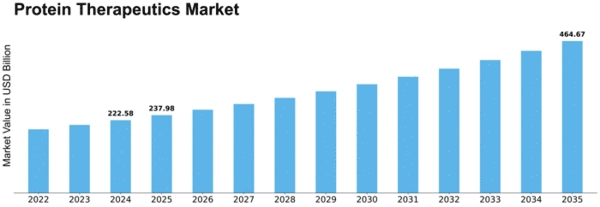
Protein Therapeutics Market Size Graph
Author
Author Profile
Rahul Gotadki
Research Manager

He holds an experience of about 9+ years in Market Research and Business Consulting, working under the spectrum of Life Sciences and Healthcare domains. Rahul conceptualizes and implements a scalable business strategy and provides strategic leadership to the clients. His expertise lies in market estimation, competitive intelligence, pipeline analysis, customer assessment, etc.

Leave a Comment

FAQs

What is the current valuation of the Protein Therapeutics Market?

<p>As of 2024, the Protein Therapeutics Market was valued at 222.58 USD Billion.</p>

What is the projected market size for the Protein Therapeutics Market by 2035?

<p>The Protein Therapeutics Market is projected to reach 464.67 USD Billion by 2035.</p>

What is the expected CAGR for the Protein Therapeutics Market during the forecast period 2025 - 2035?

<p>The expected CAGR for the Protein Therapeutics Market from 2025 to 2035 is 6.92%.</p>

Which application segment is anticipated to have the highest valuation in the Protein Therapeutics Market?

<p>The Oncology application segment is anticipated to reach between 40.0 and 90.0 USD Billion.</p>

What are the projected valuations for the Monoclonal Antibodies segment by 2035?

<p>The Monoclonal Antibodies segment is projected to grow to between 80.0 and 180.0 USD Billion.</p>

Which route of administration is expected to dominate the Protein Therapeutics Market?

<p>The Intravenous route of administration is expected to dominate, with a projected valuation of 80.0 to 180.0 USD Billion.</p>

What is the anticipated market size for the Pharmaceutical Companies end user segment by 2035?

<p>The Pharmaceutical Companies end user segment is anticipated to reach between 74.0 and 155.0 USD Billion.</p>

Which key players are leading the Protein Therapeutics Market?

<p>Key players in the Protein Therapeutics Market include Amgen, Genentech, AbbVie, and Bristol-Myers Squibb.</p>

What is the expected growth trend for the Autoimmune Disorders application segment?

<p>The Autoimmune Disorders application segment is expected to grow to between 30.0 and 70.0 USD Billion.</p>

How does the market for Recombinant Proteins compare to other types in 2035?

<p>The market for Recombinant Proteins is projected to reach between 50.0 and 100.0 USD Billion, indicating robust growth.</p>

Market Summary

As per MRFR analysis, the Protein Therapeutics Market Size was estimated at 222.58 USD Billion in 2024. The Protein Therapeutics industry is projected to grow from 237.99 USD Billion in 2025 to 464.67 USD Billion by 2035, exhibiting a compound annual growth rate (CAGR) of 6.92% during the forecast period 2025 - 2035.

Key Market Trends & Highlights

The Protein Therapeutics Market is experiencing robust growth driven by innovation and increasing demand for targeted therapies.

  • The rise of personalized medicine is reshaping treatment paradigms, particularly in oncology. Asia-Pacific emerges as the fastest-growing region, reflecting a surge in biopharmaceutical investments and healthcare advancements. Monoclonal antibodies continue to dominate the market, while recombinant proteins are gaining traction as the fastest-growing segment. The increase in chronic diseases and rising demand for targeted therapies are key drivers propelling market expansion.

Market Size & Forecast

2024 Market Size 222.58 (USD Billion)
2035 Market Size 464.67 (USD Billion)
CAGR (2025 - 2035) 6.92%
Largest Regional Market Share in 2024 North America

Major Players

Amgen (US), Genentech (US), AbbVie (US), Bristol-Myers Squibb (US), Eli Lilly (US), Sanofi (FR), Novo Nordisk (DK), Roche (CH), Merck &amp; Co. (US), Johnson &amp; Johnson (US)

Market Trends

The Protein Therapeutics Market is currently experiencing a dynamic evolution, driven by advancements in biotechnology and an increasing understanding of protein-based therapies. This sector encompasses a wide range of products, including monoclonal antibodies, vaccines, and enzymes, which are utilized in treating various diseases. The growing prevalence of chronic conditions and the demand for personalized medicine are propelling research and development efforts. Furthermore, collaborations between pharmaceutical companies and research institutions are fostering innovation, leading to the introduction of novel therapeutics that address unmet medical needs. In addition, regulatory agencies are adapting to the rapid pace of innovation, streamlining approval processes for protein therapeutics. This responsiveness is likely to enhance market accessibility and encourage investment in research initiatives. The Protein Therapeutics Market appears poised for substantial growth, as stakeholders continue to explore new applications and improve existing therapies. As the landscape evolves, it is essential for industry participants to remain agile and responsive to emerging trends and consumer demands, ensuring that they can capitalize on the opportunities presented by this vibrant market.

Rise of Personalized Medicine

The Protein Therapeutics Market is witnessing a notable shift towards personalized medicine, where treatments are tailored to individual patient profiles. This trend is driven by advancements in genomics and proteomics, enabling healthcare providers to design therapies that are more effective and have fewer side effects. As a result, the demand for protein therapeutics that cater to specific genetic markers is likely to increase, fostering innovation in drug development.

Expansion of Biosimilars

The emergence of biosimilars is reshaping the Protein Therapeutics Market, as these products offer cost-effective alternatives to existing biologics. With patents of several blockbuster biologics expiring, the introduction of biosimilars is expected to enhance market competition and improve patient access to essential therapies. This trend may lead to a broader acceptance of protein-based treatments, particularly in developing regions.

Technological Advancements in Manufacturing

Innovations in manufacturing processes are significantly impacting the Protein Therapeutics Market. Techniques such as continuous bioprocessing and advanced purification methods are enhancing production efficiency and product quality. These technological advancements not only reduce costs but also enable the rapid scaling of production to meet increasing global demand for protein therapeutics.

Protein Therapeutics Market Market Drivers

Advancements in Biotechnology

Technological advancements in biotechnology are propelling the Global Protein Therapeutics Market Industry forward. Innovations in genetic engineering, protein design, and production techniques are enhancing the development of novel therapeutics. For instance, the advent of CRISPR technology allows for precise modifications in protein structures, leading to more effective treatments. This progress is expected to contribute to a compound annual growth rate of 5.9% from 2025 to 2035. As biotechnology continues to evolve, it is likely that new protein-based therapies will emerge, further expanding the market and addressing unmet medical needs.

Rising Prevalence of Chronic Diseases

The Global Protein Therapeutics Market Industry is experiencing growth due to the increasing prevalence of chronic diseases such as diabetes, cancer, and autoimmune disorders. As of 2024, the market is valued at approximately 239.6 USD Billion, driven by the need for innovative treatment options. Protein therapeutics, including monoclonal antibodies and recombinant proteins, are becoming essential in managing these conditions. The demand for targeted therapies is likely to rise, as they offer improved efficacy and reduced side effects compared to traditional treatments. This trend suggests a robust future for the industry, potentially reaching 450 USD Billion by 2035.

Growing Demand for Personalized Medicine

The shift towards personalized medicine is significantly influencing the Global Protein Therapeutics Market Industry. Patients increasingly seek treatments tailored to their genetic profiles, which enhances therapeutic efficacy and minimizes adverse effects. This trend is evident in the rising approval rates of biologics that target specific patient populations. As the market evolves, the demand for protein therapeutics that align with personalized treatment approaches is expected to grow. This could potentially drive the market to reach 450 USD Billion by 2035, as healthcare systems adapt to more individualized care models.

Increasing Investment in Research and Development

Investment in research and development is a critical driver for the Global Protein Therapeutics Market Industry. Pharmaceutical companies are allocating substantial resources to discover and develop new protein therapeutics. In 2024, the market is projected to be valued at 239.6 USD Billion, reflecting the industry's commitment to innovation. Governments and private entities are also funding initiatives aimed at accelerating the development of biologics. This influx of capital is likely to enhance the pipeline of protein therapeutics, ultimately leading to a more diverse range of treatment options for patients and contributing to market growth.

Regulatory Support and Streamlined Approval Processes

Regulatory support is fostering growth in the Global Protein Therapeutics Market Industry. Regulatory agencies are implementing streamlined approval processes for biologics, which facilitates faster market entry for new protein therapeutics. This support is crucial in addressing the urgent need for innovative treatments in various therapeutic areas. As the market continues to expand, the anticipated compound annual growth rate of 5.9% from 2025 to 2035 underscores the positive impact of regulatory frameworks. The collaborative efforts between industry stakeholders and regulatory bodies are likely to enhance the development and availability of protein therapeutics.

Market Segment Insights

By Application: Oncology (Largest) vs. Autoimmune Disorders (Fastest-Growing)

The Protein Therapeutics Market displays a diverse application landscape, with Oncology representing the largest share due to the rising prevalence of cancer and the increasing development of targeted therapies. Autoimmune Disorders are also prominent, but their growth rate has accelerated significantly as advancements in biologic drugs attract larger investments and focus from pharmaceutical companies. Infectious Diseases, Metabolic Disorders, and Cardiovascular Diseases are notable segments as well, albeit with smaller shares, as they evolve with ongoing research and innovation in therapeutics.

Oncology (Dominant) vs. Autoimmune Disorders (Emerging)

Oncology stands out as the dominant application in the Protein Therapeutics Market, leveraging advances in immunotherapies, monoclonal antibodies, and gene therapies to combat a wide array of cancers. The continuous influx of research funding and regulatory approvals has solidified its stronghold. In contrast, Autoimmune Disorders have emerged as a fast-growing segment, driven by the need for effective treatments for conditions like rheumatoid arthritis and lupus. The rise of personalized medicine and biologics tailored to specific immunological pathways propels their market presence, attracting significant attention from drug developers. Together, these segments highlight the evolving focus of protein therapeutics in addressing complex diseases.

By Type: Monoclonal Antibodies (Largest) vs. Recombinant Proteins (Fastest-Growing)

In the Protein Therapeutics Market, Monoclonal Antibodies represent the largest share, driven by their broad applications in oncology and autoimmune diseases. This segment has become the gold standard for targeted therapies, allowing for a substantial market presence. In contrast, Recombinant Proteins are emerging rapidly, capturing attention with advancements in <a title="genetic engineering" href="https://www.marketresearchfuture.com/reports/genetic-engineering-market-1528" target="_blank" rel="noopener">genetic engineering</a> and production efficiencies that enhance their therapeutic potential.

Monoclonal Antibodies: Dominant vs. Recombinant Proteins: Emerging

Monoclonal Antibodies are widely recognized for their specificity and ability to target specific antigens, making them invaluable in treating various diseases, predominantly cancer. Their established market dominance stems from successful product launches and a robust pipeline of candidates. On the other hand, Recombinant Proteins are characterized by their versatility; they range from insulin to clotting factors and leverage technological innovations for improvement in efficacy and safety. The increased emphasis on personalized medicine is propelling the Recombinant Protein segment as a key player in the market.

By Route of Administration: Subcutaneous (Largest) vs. Intravenous (Fastest-Growing)

In the Protein Therapeutics Market, the route of administration is crucial for determining product effectiveness and patient compliance. Subcutaneous administration holds the largest market share, favored for its ease of use and patient convenience, allowing for self-administration in home settings. Conversely, intravenous administration, while traditionally used in clinical environments, is rapidly gaining traction due to its ability to provide immediate therapeutic effects, making up a significant portion of the overall market distribution.

Administration Methods: Subcutaneous (Dominant) vs. Intravenous (Emerging)

Subcutaneous administration is recognized as the dominant method in the Protein Therapeutics Market, primarily due to its patient-friendly nature, which facilitates higher adherence and convenience. This method allows patients to self-administer therapies, leading to improved quality of life. On the other hand, intravenous administration is an emerging trend, particularly in acute care settings, where the rapid onset of action is paramount. It is becoming popular with biologics that require precise therapeutic levels and immediate response, thus capturing market interest. Both methods have their unique benefits, catering to different patient needs and therapeutic objectives.

By End User: Hospitals (Largest) vs. Pharmaceutical Companies (Fastest-Growing)

In the Protein Therapeutics Market, hospitals represent the largest segment, reflecting their critical role in delivering advanced therapeutic treatments to patients. This sector accounts for a substantial portion of the overall market share, driven by the increasing prevalence of chronic diseases and demand for specialized care. Alongside hospitals, pharmaceutical companies are also significant players, known for their continuous innovation and development of novel protein-based therapies that cater to diverse medical needs. As the healthcare landscape evolves, the growth trends in this segment are influenced by several factors including technological advancements, heightened investments in R&amp;D, and collaborations between pharmaceutical companies and hospitals. Pharmaceutical companies are the fastest-growing segment, fueled by their agile response to emerging health challenges and patient-centered approaches, thereby expanding their market presence and driving competitive dynamics within the protein therapeutics sector.

Hospitals (Dominant) vs. Research Laboratories (Emerging)

Hospitals are the dominant end user in the Protein Therapeutics Market, representing a vital link in the healthcare delivery system. They focus on the application of therapeutic proteins in clinical settings, ensuring patients receive cutting-edge treatments. In contrast, research laboratories are viewed as the emerging segment, dedicated to the exploration and development of innovative protein therapeutics. Their role is crucial in advancing scientific knowledge and facilitating breakthroughs that can lead to novel therapies. As research laboratories continue to evolve with increased funding and collaboration with pharmaceutical companies, they significantly contribute to the pipeline of future protein therapeutics, thereby impacting overall market dynamics and patient outcomes.

Get more detailed insights about Protein Therapeutics Market Research Report - Forecast till 2035

Regional Insights

North America : Market Leader in Innovation

North America continues to lead the Protein Therapeutics Market, holding a significant share of 111.29 million in 2024. The region's growth is driven by advanced healthcare infrastructure, high R&D investments, and a robust regulatory framework that encourages innovation. Increasing prevalence of chronic diseases and a growing aging population further fuel demand for protein therapeutics, making it a pivotal market for stakeholders. The competitive landscape is characterized by major players such as Amgen, Genentech, and AbbVie, which dominate the market with their innovative product offerings. The U.S. remains the largest contributor, supported by favorable government policies and a strong focus on biotechnology. The presence of leading pharmaceutical companies enhances the region's capability to deliver cutting-edge therapies, ensuring sustained growth in the sector.

Europe : Emerging Market with Potential

Europe's Protein Therapeutics Market is valued at 66.55 million, showcasing a growing demand driven by increasing healthcare expenditure and a focus on personalized medicine. Regulatory bodies are actively promoting biopharmaceutical innovations, which is expected to enhance market dynamics. The region benefits from collaborative research initiatives and a strong emphasis on clinical trials, which are crucial for the development of new therapies. The germany protein therapeutics market is a major contributor due to strong pharmaceutical infrastructure, while the france protein therapeutics market is expanding with increased R&D investments. Additionally, the spain protein therapeutics market is gaining traction due to improved healthcare systems and clinical research capabilities in Spain. Key companies such as Roche and Sanofi are actively enhancing their portfolios, strengthening the protein therapeutics market in Europe.

Asia-Pacific : Rapidly Growing Market

The Asia-Pacific region, with a market size of 38.77 million, is witnessing rapid growth in the Protein Therapeutics Market. Factors such as increasing healthcare investments, rising awareness of biopharmaceuticals, and a growing patient population are driving demand. Governments are implementing favorable policies to support research and development, which is crucial for market expansion. The region is also seeing a rise in partnerships between local firms and global players, enhancing innovation. Countries like China, Japan, and India are leading this expansion. The japan protein therapeutics market is particularly strong due to advanced research capabilities and a mature pharmaceutical sector. The competitive landscape is evolving, with collaborations between global and regional players accelerating innovation in the protein therapeutics market.

Middle East and Africa : Emerging Market Opportunities

The Middle East and Africa (MEA) region, with a market size of 5.97 million, is gradually emerging as a significant player in the Protein Therapeutics Market. The growth is driven by increasing healthcare investments, rising prevalence of chronic diseases, and a growing focus on improving healthcare infrastructure. Regulatory bodies are beginning to streamline processes to facilitate the introduction of innovative therapies, which is expected to boost market dynamics. Countries such as South Africa and the United Arab Emirates are leading regional adoption. The gcc protein therapeutics market is also gaining momentum, supported by government initiatives and rising demand for advanced therapies. The presence of both local and international players is expanding access to innovative treatments, strengthening the protein therapeutics market across the region. "The World Health Organization emphasizes the need for innovative solutions to address healthcare challenges in the region," World Health Organization. World Health Organization

Key Players and Competitive Insights

The Protein Therapeutics Market is characterized by a dynamic competitive landscape, driven by innovation, strategic partnerships, and a focus on addressing unmet medical needs. Key players such as Amgen (US), Genentech (US), and AbbVie (US) are at the forefront, leveraging their extensive research capabilities and established market presence to enhance their product offerings. Amgen (US) emphasizes a strategy centered on biologics and biosimilars, aiming to expand its portfolio through continuous innovation and strategic collaborations. Meanwhile, Genentech (US) focuses on precision medicine, utilizing advanced technologies to develop targeted therapies that cater to specific patient populations. AbbVie (US) adopts a multifaceted approach, integrating acquisitions and partnerships to bolster its pipeline, particularly in immunology and oncology, thereby shaping a competitive environment that prioritizes therapeutic efficacy and patient outcomes.The business tactics employed by these companies reflect a concerted effort to optimize operations and enhance market positioning. Localizing manufacturing and optimizing supply chains are prevalent strategies, allowing for greater responsiveness to market demands and regulatory requirements. The competitive structure of the market appears moderately fragmented, with a mix of established players and emerging biotech firms. This fragmentation fosters innovation, as smaller companies often introduce novel therapies that challenge the status quo, compelling larger entities to adapt and evolve.
In November Amgen (US) announced a strategic partnership with a leading AI firm to enhance its drug discovery processes. This collaboration aims to leverage artificial intelligence to identify potential therapeutic targets more efficiently, potentially accelerating the development of new protein therapeutics. Such a move underscores Amgen's commitment to integrating cutting-edge technology into its operations, which may significantly enhance its competitive edge in the market.
In October Genentech (US) launched a new monoclonal antibody designed to treat a rare autoimmune disorder, marking a significant expansion of its therapeutic portfolio. This launch not only reflects Genentech's dedication to addressing niche medical needs but also highlights its ability to innovate within a highly specialized market segment. The introduction of this therapy could potentially strengthen Genentech's market position by attracting a new patient demographic and reinforcing its reputation as a leader in precision medicine.
In September AbbVie (US) completed the acquisition of a promising biotech firm specializing in next-generation protein therapeutics. This acquisition is likely to enhance AbbVie's research capabilities and diversify its product pipeline, particularly in the oncology space. By integrating this new technology and expertise, AbbVie may solidify its standing in the competitive landscape, positioning itself as a formidable player in the development of innovative therapies.
As of December the Protein Therapeutics Market is witnessing trends that emphasize digitalization, sustainability, and the integration of AI technologies. Strategic alliances are increasingly shaping the competitive landscape, as companies recognize the value of collaboration in driving innovation and improving operational efficiencies. Looking ahead, competitive differentiation is expected to evolve, with a pronounced shift from price-based competition to a focus on innovation, technological advancements, and supply chain reliability. This transition may redefine market dynamics, compelling companies to prioritize not only therapeutic efficacy but also the sustainability of their operations.

Key Companies in the Protein Therapeutics Market include

Industry Developments

Recent developments in the Protein Therapeutics Market have shown significant activities among major players such as Genentech, Pfizer, and AbbVie. In September 2023, AbbVie announced advancements in clinical trials for its new protein therapies aimed at treating rare diseases, reflecting a robust focus on Research and Development. Meanwhile, in August 2023, Roche secured regulatory approval for a breakthrough treatment that promises to improve patient outcomes in oncology.

Mergers and acquisitions continue to shape the market; for example, in July 2023, Pfizer completed its acquisition of a biotech firm specializing in innovative protein-based drugs, enhancing its product pipeline. The market saw a valuation increase, driven by the success of monoclonal antibodies and protein-based therapies in addressing various conditions including autoimmune diseases and cancers.

Overall, these developments highlight the dynamic landscape of the Protein Therapeutics Market, underscored by ongoing investments and regulatory progress that are poised to impact future growth trajectories for key companies like Johnson and Johnson, Gilead Sciences, and Bristol Myers Squibb. Significant movements within this sector are indicative of the increasing demand for effective therapeutic solutions on a global scale.

Future Outlook

Protein Therapeutics Market Future Outlook

The Protein Therapeutics Market is projected to grow at a 6.92% CAGR from 2025 to 2035, driven by advancements in biotechnology, increasing demand for biologics, and rising prevalence of chronic diseases.

New opportunities lie in:

  • <p>Development of personalized protein therapeutics targeting specific patient demographics. Expansion of biosimilar product lines to capture market share from branded therapeutics. Investment in automated manufacturing technologies to enhance production efficiency.</p>

By 2035, the Protein Therapeutics Market is expected to achieve substantial growth and innovation.

Market Segmentation

Protein Therapeutics Market Type Outlook

  • Monoclonal Antibodies
  • Recombinant Proteins
  • Fusion Proteins
  • Enzymes
  • Hormones

Protein Therapeutics Market End User Outlook

  • Hospitals
  • Research Laboratories
  • Pharmaceutical Companies
  • Diagnostic Laboratories
  • Academic Institutions

Protein Therapeutics Market Application Outlook

  • Oncology
  • Autoimmune Disorders
  • Infectious Diseases
  • Metabolic Disorders
  • Cardiovascular Diseases

Protein Therapeutics Market Route of Administration Outlook

  • Subcutaneous
  • Intravenous
  • Intramuscular
  • Oral
  • Transdermal

Report Scope

MARKET SIZE 2024 222.58(USD Billion)
MARKET SIZE 2025 237.99(USD Billion)
MARKET SIZE 2035 464.67(USD Billion)
COMPOUND ANNUAL GROWTH RATE (CAGR) 6.92% (2025 - 2035)
REPORT COVERAGE Revenue Forecast, Competitive Landscape, Growth Factors, and Trends
BASE YEAR 2024
Market Forecast Period 2025 - 2035
Historical Data 2019 - 2024
Market Forecast Units USD Billion
Key Companies Profiled Amgen (US), Genentech (US), AbbVie (US), Bristol-Myers Squibb (US), Eli Lilly (US), Sanofi (FR), Novo Nordisk (DK), Roche (CH), Merck & Co. (US), Johnson & Johnson (US)
Segments Covered Application, Type, Route of Administration, End User
Key Market Opportunities Advancements in biologics manufacturing enhance scalability in the Protein Therapeutics Market.
Key Market Dynamics Rising demand for innovative protein therapeutics drives competitive forces and regulatory adaptations in the biopharmaceutical landscape.
Countries Covered North America, Europe, APAC, South America, MEA

FAQs

What is the current valuation of the Protein Therapeutics Market?

<p>As of 2024, the Protein Therapeutics Market was valued at 222.58 USD Billion.</p>

What is the projected market size for the Protein Therapeutics Market by 2035?

<p>The Protein Therapeutics Market is projected to reach 464.67 USD Billion by 2035.</p>

What is the expected CAGR for the Protein Therapeutics Market during the forecast period 2025 - 2035?

<p>The expected CAGR for the Protein Therapeutics Market from 2025 to 2035 is 6.92%.</p>

Which application segment is anticipated to have the highest valuation in the Protein Therapeutics Market?

<p>The Oncology application segment is anticipated to reach between 40.0 and 90.0 USD Billion.</p>

What are the projected valuations for the Monoclonal Antibodies segment by 2035?

<p>The Monoclonal Antibodies segment is projected to grow to between 80.0 and 180.0 USD Billion.</p>

Which route of administration is expected to dominate the Protein Therapeutics Market?

<p>The Intravenous route of administration is expected to dominate, with a projected valuation of 80.0 to 180.0 USD Billion.</p>

What is the anticipated market size for the Pharmaceutical Companies end user segment by 2035?

<p>The Pharmaceutical Companies end user segment is anticipated to reach between 74.0 and 155.0 USD Billion.</p>

Which key players are leading the Protein Therapeutics Market?

<p>Key players in the Protein Therapeutics Market include Amgen, Genentech, AbbVie, and Bristol-Myers Squibb.</p>

What is the expected growth trend for the Autoimmune Disorders application segment?

<p>The Autoimmune Disorders application segment is expected to grow to between 30.0 and 70.0 USD Billion.</p>

How does the market for Recombinant Proteins compare to other types in 2035?

<p>The market for Recombinant Proteins is projected to reach between 50.0 and 100.0 USD Billion, indicating robust growth.</p>

  1. SECTION I: EXECUTIVE SUMMARY AND KEY HIGHLIGHTS |
    1. EXECUTIVE SUMMARY | |
      1. Market Overview | |
      2. Key Findings | |
      3. Market Segmentation | |
      4. Competitive Landscape | |
      5. Challenges and Opportunities | |
      6. Future Outlook 2
  2. SECTION II: SCOPING, METHODOLOGY AND MARKET STRUCTURE |
    1. MARKET INTRODUCTION | |
      1. Definition | |
      2. Scope of the study | | |
    2. RESEARCH METHODOLOGY | |
      1. Overview | |
      2. Data Mining | |
      3. Secondary Research | |
      4. Primary Research | | |
      5. Forecasting Model | |
      6. Market Size Estimation | | |
      7. Data Triangulation | |
      8. Validation 3
  3. SECTION III: QUALITATIVE ANALYSIS |
    1. MARKET DYNAMICS | |
      1. Overview | |
      2. Drivers | |
      3. Restraints | |
      4. Opportunities |
    2. MARKET FACTOR ANALYSIS | |
      1. Value chain Analysis | |
      2. Porter's Five Forces Analysis | | |
      3. COVID-19 Impact Analysis | | |
  4. SECTION IV: QUANTITATIVE ANALYSIS |
    1. Healthcare, BY Application (USD Billion) | |
      1. Oncology | |
      2. Autoimmune Disorders | |
      3. Metabolic Disorders | |
      4. Infectious Diseases | |
      5. Cardiovascular Diseases |
    2. Healthcare, BY Type (USD Billion) | |
      1. Monoclonal Antibodies | |
      2. Recombinant Proteins | |
      3. Fusion Proteins | |
      4. Enzymes | |
      5. Hormones |
    3. Healthcare, BY Route of Administration (USD Billion) | |
      1. Subcutaneous | |
      2. Intravenous | |
      3. Intramuscular | |
      4. Oral | |
      5. Transdermal |
    4. Healthcare, BY End User (USD Billion) | |
      1. Hospitals | |
      2. Research Laboratories | |
      3. Pharmaceutical Companies | |
      4. Diagnostic Laboratories | |
      5. Academic Institutions |
    5. Healthcare, BY Region (USD Billion) | |
      1. North America | | |
      2. Europe | | |
      3. APAC | | |
      4. South America | | |
      5. MEA | | |
  5. SECTION V: COMPETITIVE ANALYSIS |
    1. Competitive Landscape | |
      1. Overview | |
      2. Competitive Analysis | |
      3. Market share Analysis | |
      4. Major Growth Strategy in the Healthcare | |
      5. Competitive Benchmarking | |
      6. Leading Players in Terms of Number of Developments in the Healthcare | |
      7. Key developments and growth strategies | | |
      8. Major Players Financial Matrix | | |
    2. Company Profiles | |
      1. Amgen (US) | | |
      2. Genentech (US) | | |
      3. AbbVie (US) | | |
      4. Bristol-Myers Squibb (US) | | |
      5. Roche (CH) | | |
      6. Sanofi (FR) | | |
      7. Novo Nordisk (DK) | | |
      8. Eli Lilly (US) | | |
      9. Merck & Co. (US) | | |
    3. Appendix | |
      1. References | |
      2. Related Reports 6 LIST OF FIGURES |
    4. MARKET SYNOPSIS |
    5. NORTH AMERICA MARKET ANALYSIS |
    6. US MARKET ANALYSIS BY APPLICATION |
    7. US MARKET ANALYSIS BY TYPE |
    8. US MARKET ANALYSIS BY ROUTE OF ADMINISTRATION |
    9. US MARKET ANALYSIS BY END USER |
    10. CANADA MARKET ANALYSIS BY APPLICATION |
    11. CANADA MARKET ANALYSIS BY TYPE |
    12. CANADA MARKET ANALYSIS BY ROUTE OF ADMINISTRATION |
    13. CANADA MARKET ANALYSIS BY END USER |
    14. EUROPE MARKET ANALYSIS |
    15. GERMANY MARKET ANALYSIS BY APPLICATION |
    16. GERMANY MARKET ANALYSIS BY TYPE |
    17. GERMANY MARKET ANALYSIS BY ROUTE OF ADMINISTRATION |
    18. GERMANY MARKET ANALYSIS BY END USER |
    19. UK MARKET ANALYSIS BY APPLICATION |
    20. UK MARKET ANALYSIS BY TYPE |
    21. UK MARKET ANALYSIS BY ROUTE OF ADMINISTRATION |
    22. UK MARKET ANALYSIS BY END USER |
    23. FRANCE MARKET ANALYSIS BY APPLICATION |
    24. FRANCE MARKET ANALYSIS BY TYPE |
    25. FRANCE MARKET ANALYSIS BY ROUTE OF ADMINISTRATION |
    26. FRANCE MARKET ANALYSIS BY END USER |
    27. RUSSIA MARKET ANALYSIS BY APPLICATION |
    28. RUSSIA MARKET ANALYSIS BY TYPE |
    29. RUSSIA MARKET ANALYSIS BY ROUTE OF ADMINISTRATION |
    30. RUSSIA MARKET ANALYSIS BY END USER |
    31. ITALY MARKET ANALYSIS BY APPLICATION |
    32. ITALY MARKET ANALYSIS BY TYPE |
    33. ITALY MARKET ANALYSIS BY ROUTE OF ADMINISTRATION |
    34. ITALY MARKET ANALYSIS BY END USER |
    35. SPAIN MARKET ANALYSIS BY APPLICATION |
    36. SPAIN MARKET ANALYSIS BY TYPE |
    37. SPAIN MARKET ANALYSIS BY ROUTE OF ADMINISTRATION |
    38. SPAIN MARKET ANALYSIS BY END USER |
    39. REST OF EUROPE MARKET ANALYSIS BY APPLICATION |
    40. REST OF EUROPE MARKET ANALYSIS BY TYPE |
    41. REST OF EUROPE MARKET ANALYSIS BY ROUTE OF ADMINISTRATION |
    42. REST OF EUROPE MARKET ANALYSIS BY END USER |
    43. APAC MARKET ANALYSIS |
    44. CHINA MARKET ANALYSIS BY APPLICATION |
    45. CHINA MARKET ANALYSIS BY TYPE |
    46. CHINA MARKET ANALYSIS BY ROUTE OF ADMINISTRATION |
    47. CHINA MARKET ANALYSIS BY END USER |
    48. INDIA MARKET ANALYSIS BY APPLICATION |
    49. INDIA MARKET ANALYSIS BY TYPE |
    50. INDIA MARKET ANALYSIS BY ROUTE OF ADMINISTRATION |
    51. INDIA MARKET ANALYSIS BY END USER |
    52. JAPAN MARKET ANALYSIS BY APPLICATION |
    53. JAPAN MARKET ANALYSIS BY TYPE |
    54. JAPAN MARKET ANALYSIS BY ROUTE OF ADMINISTRATION |
    55. JAPAN MARKET ANALYSIS BY END USER |
    56. SOUTH KOREA MARKET ANALYSIS BY APPLICATION |
    57. SOUTH KOREA MARKET ANALYSIS BY TYPE |
    58. SOUTH KOREA MARKET ANALYSIS BY ROUTE OF ADMINISTRATION |
    59. SOUTH KOREA MARKET ANALYSIS BY END USER |
    60. MALAYSIA MARKET ANALYSIS BY APPLICATION |
    61. MALAYSIA MARKET ANALYSIS BY TYPE |
    62. MALAYSIA MARKET ANALYSIS BY ROUTE OF ADMINISTRATION |
    63. MALAYSIA MARKET ANALYSIS BY END USER |
    64. THAILAND MARKET ANALYSIS BY APPLICATION |
    65. THAILAND MARKET ANALYSIS BY TYPE |
    66. THAILAND MARKET ANALYSIS BY ROUTE OF ADMINISTRATION |
    67. THAILAND MARKET ANALYSIS BY END USER |
    68. INDONESIA MARKET ANALYSIS BY APPLICATION |
    69. INDONESIA MARKET ANALYSIS BY TYPE |
    70. INDONESIA MARKET ANALYSIS BY ROUTE OF ADMINISTRATION |
    71. INDONESIA MARKET ANALYSIS BY END USER |
    72. REST OF APAC MARKET ANALYSIS BY APPLICATION |
    73. REST OF APAC MARKET ANALYSIS BY TYPE |
    74. REST OF APAC MARKET ANALYSIS BY ROUTE OF ADMINISTRATION |
    75. REST OF APAC MARKET ANALYSIS BY END USER |
    76. SOUTH AMERICA MARKET ANALYSIS |
    77. BRAZIL MARKET ANALYSIS BY APPLICATION |
    78. BRAZIL MARKET ANALYSIS BY TYPE |
    79. BRAZIL MARKET ANALYSIS BY ROUTE OF ADMINISTRATION |
    80. BRAZIL MARKET ANALYSIS BY END USER |
    81. MEXICO MARKET ANALYSIS BY APPLICATION |
    82. MEXICO MARKET ANALYSIS BY TYPE |
    83. MEXICO MARKET ANALYSIS BY ROUTE OF ADMINISTRATION |
    84. MEXICO MARKET ANALYSIS BY END USER |
    85. ARGENTINA MARKET ANALYSIS BY APPLICATION |
    86. ARGENTINA MARKET ANALYSIS BY TYPE |
    87. ARGENTINA MARKET ANALYSIS BY ROUTE OF ADMINISTRATION |
    88. ARGENTINA MARKET ANALYSIS BY END USER |
    89. REST OF SOUTH AMERICA MARKET ANALYSIS BY APPLICATION |
    90. REST OF SOUTH AMERICA MARKET ANALYSIS BY TYPE |
    91. REST OF SOUTH AMERICA MARKET ANALYSIS BY ROUTE OF ADMINISTRATION |
    92. REST OF SOUTH AMERICA MARKET ANALYSIS BY END USER |
    93. MEA MARKET ANALYSIS |
    94. GCC COUNTRIES MARKET ANALYSIS BY APPLICATION |
    95. GCC COUNTRIES MARKET ANALYSIS BY TYPE |
    96. GCC COUNTRIES MARKET ANALYSIS BY ROUTE OF ADMINISTRATION |
    97. GCC COUNTRIES MARKET ANALYSIS BY END USER |
    98. SOUTH AFRICA MARKET ANALYSIS BY APPLICATION |
    99. SOUTH AFRICA MARKET ANALYSIS BY TYPE |
    100. SOUTH AFRICA MARKET ANALYSIS BY ROUTE OF ADMINISTRATION |
    101. SOUTH AFRICA MARKET ANALYSIS BY END USER |
    102. REST OF MEA MARKET ANALYSIS BY APPLICATION |
    103. REST OF MEA MARKET ANALYSIS BY TYPE |
    104. REST OF MEA MARKET ANALYSIS BY ROUTE OF ADMINISTRATION |
    105. REST OF MEA MARKET ANALYSIS BY END USER |
    106. KEY BUYING CRITERIA OF HEALTHCARE |
    107. RESEARCH PROCESS OF MRFR |
    108. DRO ANALYSIS OF HEALTHCARE |
    109. DRIVERS IMPACT ANALYSIS: HEALTHCARE |
    110. RESTRAINTS IMPACT ANALYSIS: HEALTHCARE |
    111. SUPPLY / VALUE CHAIN: HEALTHCARE |
    112. HEALTHCARE, BY APPLICATION, 2024 (% SHARE) |
    113. HEALTHCARE, BY APPLICATION, 2024 TO 2035 (USD Billion) |
    114. HEALTHCARE, BY TYPE, 2024 (% SHARE) |
    115. HEALTHCARE, BY TYPE, 2024 TO 2035 (USD Billion) |
    116. HEALTHCARE, BY ROUTE OF ADMINISTRATION, 2024 (% SHARE) |
    117. HEALTHCARE, BY ROUTE OF ADMINISTRATION, 2024 TO 2035 (USD Billion) |
    118. HEALTHCARE, BY END USER, 2024 (% SHARE) |
    119. HEALTHCARE, BY END USER, 2024 TO 2035 (USD Billion) |
    120. BENCHMARKING OF MAJOR COMPETITORS 7 LIST OF TABLES |
    121. LIST OF ASSUMPTIONS | |
      1. |
    122. North America MARKET SIZE ESTIMATES; FORECAST | |
      1. BY APPLICATION, 2025-2035 (USD Billion) | |
      2. BY TYPE, 2025-2035 (USD Billion) | |
      3. BY ROUTE OF ADMINISTRATION, 2025-2035 (USD Billion) | |
      4. BY END USER, 2025-2035 (USD Billion) |
    123. US MARKET SIZE ESTIMATES; FORECAST | |
      1. BY APPLICATION, 2025-2035 (USD Billion) | |
      2. BY TYPE, 2025-2035 (USD Billion) | |
      3. BY ROUTE OF ADMINISTRATION, 2025-2035 (USD Billion) | |
      4. BY END USER, 2025-2035 (USD Billion) |
    124. Canada MARKET SIZE ESTIMATES; FORECAST | |
      1. BY APPLICATION, 2025-2035 (USD Billion) | |
      2. BY TYPE, 2025-2035 (USD Billion) | |
      3. BY ROUTE OF ADMINISTRATION, 2025-2035 (USD Billion) | |
      4. BY END USER, 2025-2035 (USD Billion) |
    125. Europe MARKET SIZE ESTIMATES; FORECAST | |
      1. BY APPLICATION, 2025-2035 (USD Billion) | |
      2. BY TYPE, 2025-2035 (USD Billion) | |
      3. BY ROUTE OF ADMINISTRATION, 2025-2035 (USD Billion) | |
      4. BY END USER, 2025-2035 (USD Billion) |
    126. Germany MARKET SIZE ESTIMATES; FORECAST | |
      1. BY APPLICATION, 2025-2035 (USD Billion) | |
      2. BY TYPE, 2025-2035 (USD Billion) | |
      3. BY ROUTE OF ADMINISTRATION, 2025-2035 (USD Billion) | |
      4. BY END USER, 2025-2035 (USD Billion) |
    127. UK MARKET SIZE ESTIMATES; FORECAST | |
      1. BY APPLICATION, 2025-2035 (USD Billion) | |
      2. BY TYPE, 2025-2035 (USD Billion) | |
      3. BY ROUTE OF ADMINISTRATION, 2025-2035 (USD Billion) | |
      4. BY END USER, 2025-2035 (USD Billion) |
    128. France MARKET SIZE ESTIMATES; FORECAST | |
      1. BY APPLICATION, 2025-2035 (USD Billion) | |
      2. BY TYPE, 2025-2035 (USD Billion) | |
      3. BY ROUTE OF ADMINISTRATION, 2025-2035 (USD Billion) | |
      4. BY END USER, 2025-2035 (USD Billion) |
    129. Russia MARKET SIZE ESTIMATES; FORECAST | |
      1. BY APPLICATION, 2025-2035 (USD Billion) | |
      2. BY TYPE, 2025-2035 (USD Billion) | |
      3. BY ROUTE OF ADMINISTRATION, 2025-2035 (USD Billion) | |
      4. BY END USER, 2025-2035 (USD Billion) |
    130. Italy MARKET SIZE ESTIMATES; FORECAST | |
      1. BY APPLICATION, 2025-2035 (USD Billion) | |
      2. BY TYPE, 2025-2035 (USD Billion) | |
      3. BY ROUTE OF ADMINISTRATION, 2025-2035 (USD Billion) | |
      4. BY END USER, 2025-2035 (USD Billion) |
    131. Spain MARKET SIZE ESTIMATES; FORECAST | |
      1. BY APPLICATION, 2025-2035 (USD Billion) | |
      2. BY TYPE, 2025-2035 (USD Billion) | |
      3. BY ROUTE OF ADMINISTRATION, 2025-2035 (USD Billion) | |
      4. BY END USER, 2025-2035 (USD Billion) |
    132. Rest of Europe MARKET SIZE ESTIMATES; FORECAST | |
      1. BY APPLICATION, 2025-2035 (USD Billion) | |
      2. BY TYPE, 2025-2035 (USD Billion) | |
      3. BY ROUTE OF ADMINISTRATION, 2025-2035 (USD Billion) | |
      4. BY END USER, 2025-2035 (USD Billion) |
    133. APAC MARKET SIZE ESTIMATES; FORECAST | |
      1. BY APPLICATION, 2025-2035 (USD Billion) | |
      2. BY TYPE, 2025-2035 (USD Billion) | |
      3. BY ROUTE OF ADMINISTRATION, 2025-2035 (USD Billion) | |
      4. BY END USER, 2025-2035 (USD Billion) |
    134. China MARKET SIZE ESTIMATES; FORECAST | |
      1. BY APPLICATION, 2025-2035 (USD Billion) | |
      2. BY TYPE, 2025-2035 (USD Billion) | |
      3. BY ROUTE OF ADMINISTRATION, 2025-2035 (USD Billion) | |
      4. BY END USER, 2025-2035 (USD Billion) |
    135. India MARKET SIZE ESTIMATES; FORECAST | |
      1. BY APPLICATION, 2025-2035 (USD Billion) | |
      2. BY TYPE, 2025-2035 (USD Billion) | |
      3. BY ROUTE OF ADMINISTRATION, 2025-2035 (USD Billion) | |
      4. BY END USER, 2025-2035 (USD Billion) |
    136. Japan MARKET SIZE ESTIMATES; FORECAST | |
      1. BY APPLICATION, 2025-2035 (USD Billion) | |
      2. BY TYPE, 2025-2035 (USD Billion) | |
      3. BY ROUTE OF ADMINISTRATION, 2025-2035 (USD Billion) | |
      4. BY END USER, 2025-2035 (USD Billion) |
    137. South Korea MARKET SIZE ESTIMATES; FORECAST | |
      1. BY APPLICATION, 2025-2035 (USD Billion) | |
      2. BY TYPE, 2025-2035 (USD Billion) | |
      3. BY ROUTE OF ADMINISTRATION, 2025-2035 (USD Billion) | |
      4. BY END USER, 2025-2035 (USD Billion) |
    138. Malaysia MARKET SIZE ESTIMATES; FORECAST | |
      1. BY APPLICATION, 2025-2035 (USD Billion) | |
      2. BY TYPE, 2025-2035 (USD Billion) | |
      3. BY ROUTE OF ADMINISTRATION, 2025-2035 (USD Billion) | |
      4. BY END USER, 2025-2035 (USD Billion) |
    139. Thailand MARKET SIZE ESTIMATES; FORECAST | |
      1. BY APPLICATION, 2025-2035 (USD Billion) | |
      2. BY TYPE, 2025-2035 (USD Billion) | |
      3. BY ROUTE OF ADMINISTRATION, 2025-2035 (USD Billion) | |
      4. BY END USER, 2025-2035 (USD Billion) |
    140. Indonesia MARKET SIZE ESTIMATES; FORECAST | |
      1. BY APPLICATION, 2025-2035 (USD Billion) | |
      2. BY TYPE, 2025-2035 (USD Billion) | |
      3. BY ROUTE OF ADMINISTRATION, 2025-2035 (USD Billion) | |
      4. BY END USER, 2025-2035 (USD Billion) |
    141. Rest of APAC MARKET SIZE ESTIMATES; FORECAST | |
      1. BY APPLICATION, 2025-2035 (USD Billion) | |
      2. BY TYPE, 2025-2035 (USD Billion) | |
      3. BY ROUTE OF ADMINISTRATION, 2025-2035 (USD Billion) | |
      4. BY END USER, 2025-2035 (USD Billion) |
    142. South America MARKET SIZE ESTIMATES; FORECAST | |
      1. BY APPLICATION, 2025-2035 (USD Billion) | |
      2. BY TYPE, 2025-2035 (USD Billion) | |
      3. BY ROUTE OF ADMINISTRATION, 2025-2035 (USD Billion) | |
      4. BY END USER, 2025-2035 (USD Billion) |
    143. Brazil MARKET SIZE ESTIMATES; FORECAST | |
      1. BY APPLICATION, 2025-2035 (USD Billion) | |
      2. BY TYPE, 2025-2035 (USD Billion) | |
      3. BY ROUTE OF ADMINISTRATION, 2025-2035 (USD Billion) | |
      4. BY END USER, 2025-2035 (USD Billion) |
    144. Mexico MARKET SIZE ESTIMATES; FORECAST | |
      1. BY APPLICATION, 2025-2035 (USD Billion) | |
      2. BY TYPE, 2025-2035 (USD Billion) | |
      3. BY ROUTE OF ADMINISTRATION, 2025-2035 (USD Billion) | |
      4. BY END USER, 2025-2035 (USD Billion) |
    145. Argentina MARKET SIZE ESTIMATES; FORECAST | |
      1. BY APPLICATION, 2025-2035 (USD Billion) | |
      2. BY TYPE, 2025-2035 (USD Billion) | |
      3. BY ROUTE OF ADMINISTRATION, 2025-2035 (USD Billion) | |
      4. BY END USER, 2025-2035 (USD Billion) |
    146. Rest of South America MARKET SIZE ESTIMATES; FORECAST | |
      1. BY APPLICATION, 2025-2035 (USD Billion) | |
      2. BY TYPE, 2025-2035 (USD Billion) | |
      3. BY ROUTE OF ADMINISTRATION, 2025-2035 (USD Billion) | |
      4. BY END USER, 2025-2035 (USD Billion) |
    147. MEA MARKET SIZE ESTIMATES; FORECAST | |
      1. BY APPLICATION, 2025-2035 (USD Billion) | |
      2. BY TYPE, 2025-2035 (USD Billion) | |
      3. BY ROUTE OF ADMINISTRATION, 2025-2035 (USD Billion) | |
      4. BY END USER, 2025-2035 (USD Billion) |
    148. GCC Countries MARKET SIZE ESTIMATES; FORECAST | |
      1. BY APPLICATION, 2025-2035 (USD Billion) | |
      2. BY TYPE, 2025-2035 (USD Billion) | |
      3. BY ROUTE OF ADMINISTRATION, 2025-2035 (USD Billion) | |
      4. BY END USER, 2025-2035 (USD Billion) |
    149. South Africa MARKET SIZE ESTIMATES; FORECAST | |
      1. BY APPLICATION, 2025-2035 (USD Billion) | |
      2. BY TYPE, 2025-2035 (USD Billion) | |
      3. BY ROUTE OF ADMINISTRATION, 2025-2035 (USD Billion) | |
      4. BY END USER, 2025-2035 (USD Billion) |
    150. Rest of MEA MARKET SIZE ESTIMATES; FORECAST | |
      1. BY APPLICATION, 2025-2035 (USD Billion) | |
      2. BY TYPE, 2025-2035 (USD Billion) | |
      3. BY ROUTE OF ADMINISTRATION, 2025-2035 (USD Billion) | |
      4. BY END USER, 2025-2035 (USD Billion) |
    151. PRODUCT LAUNCH/PRODUCT DEVELOPMENT/APPROVAL | |
      1. |
    152. ACQUISITION/PARTNERSHIP | |

Healthcare Market Segmentation

Healthcare By Application (USD Billion, 2025-2035)

  • Oncology
  • Autoimmune Disorders
  • Metabolic Disorders
  • Infectious Diseases
  • Cardiovascular Diseases

Healthcare By Type (USD Billion, 2025-2035)

  • Monoclonal Antibodies
  • Recombinant Proteins
  • Fusion Proteins
  • Enzymes
  • Hormones

Healthcare By Route of Administration (USD Billion, 2025-2035)

  • Subcutaneous
  • Intravenous
  • Intramuscular
  • Oral
  • Transdermal

Healthcare By End User (USD Billion, 2025-2035)

  • Hospitals
  • Research Laboratories
  • Pharmaceutical Companies
  • Diagnostic Laboratories
  • Academic Institutions
Infographic

Free Sample Request

Kindly complete the form below to receive a free sample of this Report

Get Free Sample

Customer Strories

Compare Licence

×
Features License Type
Single User Multiuser License Enterprise User
Price $4,950 $5,950 $7,250
Maximum User Access Limit 1 User Upto 10 Users Unrestricted Access Throughout the Organization
Free Customization
Direct Access to Analyst
Deliverable Format
Platform Access
Discount on Next Purchase 10% 15% 15%
Printable Versions
%>