
Request Free Sample ×

Kindly complete the form below to receive a free sample of this Report

* Please use a valid business email

Leading companies partner with us for data-driven Insights

clients tt-cursor
Hero Background
English
Chinese
French
Japanese
Korean
German
Spanish

Produce Packaging Market Share

ID: MRFR/PCM/6861-HCR
107 Pages
Snehal Singh
April 2026

Produce Packaging Market Research Report Information by Packaging Type (Corrugated Boxes, Bags and Liners, Plastic Containers and Trays), Application (Vegetables, Fruits and Salads), End User (Growers/Shippers, Re-Packers and Retail Stores) and Region (North America, Europe, Asia-Pacific, Middle East & Africa and South America) - Forecast till 2035

Share:
Download PDF ×

We do not share your information with anyone. However, we may send you emails based on your report interest from time to time. You may contact us at any time to opt-out.

Produce Packaging Market Infographic
Purchase Options

Market Share

Produce Packaging Market Share Analysis

The Produce Packaging Market is a volatile environment where firms employ diverse market share positioning strategies aimed at gaining competitive advantage and establishing substantial presence in the industry. Differentiation through innovative packaging solutions is one of the most popular tactics employed in this regard. In their bid to come up with unique and environmentally friendly packages, companies strive to use such materials that not only enhance the attractiveness of the products but also meet sustainability objectives. By investing into research and development, firms can develop packs that will expand fruits’ shelf life thus reducing food waste as well as catering to increasing customer preference for green options.

Another key market share positioning strategy is cost leadership. Firms adopting this approach focus on operational efficiencies and economies of scale that allow them to offer cheap packaging solutions which are attractive to price sensitive clients. Key activities such as streamlining production processes, optimizing the supply chain, and employing technology significantly contribute towards achieving cost leadership within this industry. This tactic works effectively in markets where price remains a top consideration by buyers forcing organizations to remain efficient hence costs have to be kept low for competition purposes only.

Additionally, customization and flexibility are significant elements of market share positioning strategies in the Produce Packaging Market. Rapidly changing customer preferences and market trends require packaging companies to quickly adapt so as to meet new demands. To get ahead, firms can produce tailored solutions for various types of fruits. For instance, a wide range of manufacturing processes that can be used for various purposes should be established. These processes may include adapting to design trends or listening to customers’ feedback.

Effective communication and branding are also important for product-centric strategies through which a company tries to achieve its sales objectives. Packaging companies must create an unforgettable brand identity that connects with consumers emotionally and builds trust among them. This allows the firm’s customers to appreciate their expertise, commitment to sustainability, and innovation efforts towards solving problems and differentiating themselves from others in the same industry. Furthermore, communicating transparently about how our packaging materials affect our environment may resonate well with eco-friendly buyers who would then go further protecting this company’s niche in the marketplace.

Author
Author Profile
Snehal Singh
Manager - Research

High acumen in analyzing complex macro & micro markets with more than 6 years of work experience in the field of market research. By implementing her analytical skills in forecasting and estimation into market research reports, she has expertise in Packaging, Construction, and Equipment domains. She handles a team size of 20-25 resources and ensures smooth running of the projects, associated marketing activities, and client servicing.

Leave a Comment

FAQs

What is the projected market valuation of The Global Produce Packaging by 2035?

<p>The projected market valuation for The Global Produce Packaging is 59.87 USD Billion by 2035.</p>

What was the overall market valuation of The Global Produce Packaging in 2024?

<p>The overall market valuation of The Global Produce Packaging was 38.08 USD Billion in 2024.</p>

What is the expected CAGR for The Global Produce Packaging during the forecast period 2025 - 2035?

<p>The expected CAGR for The Global Produce Packaging during the forecast period 2025 - 2035 is 4.2%.</p>

Which companies are considered key players in The Global Produce Packaging?

<p>Key players in The Global Produce Packaging include Amcor, Berry Global, Sealed Air, Smurfit Kappa, and Mondi Group.</p>

What are the main types of packaging segments in The Global Produce Packaging?

<p>The main types of packaging segments include Bags and liners, Trays, Plastic containers, and Corrugated boxes.</p>

How much is the market for plastic containers projected to grow by 2035?

The market for plastic containers is projected to grow from 10.0 USD Billion in 2024 to 18.0 USD Billion by 2035.

What applications are driving growth in The Global Produce Packaging?

Applications driving growth include Fruits, Salads, and Vegetables, with Fruits projected to reach 23.0 USD Billion by 2035.

What is the expected market size for retail stores as an end-user segment by 2035?

The expected market size for retail stores as an end-user segment is projected to reach 23.0 USD Billion by 2035.

How does the market for corrugated boxes compare to other packaging types?

The market for corrugated boxes is projected to grow from 10.08 USD Billion in 2024 to 14.87 USD Billion by 2035, indicating robust demand.

What trends are influencing The Global Produce Packaging in 2025?

Trends influencing The Global Produce Packaging in 2025 include sustainability initiatives and innovations in packaging materials.

Market Summary

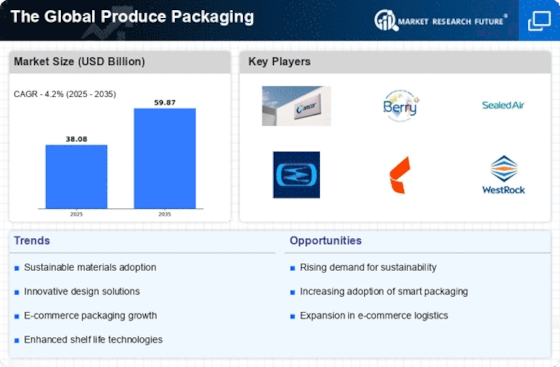
As per Market Research Future analysis, The Global Produce Packaging Market was estimated at 38.08 USD Billion in 2024. The produce packaging industry is projected to grow from 39.68 USD Billion in 2025 to 59.87 USD Billion by 2035, exhibiting a compound annual growth rate (CAGR) of 4.2% during the forecast period 2025 - 2035

Key Market Trends & Highlights

The Global Produce Packaging Market is experiencing a transformative shift towards sustainability and innovation.

  • Sustainable materials adoption is becoming increasingly prevalent in the North American market, reflecting a broader commitment to environmental responsibility. Smart packaging innovations are gaining traction, particularly in the Asia-Pacific region, as companies seek to enhance product freshness and consumer engagement. E-commerce driven packaging solutions are reshaping the landscape, with a notable rise in demand for convenient and efficient packaging formats. Key market drivers include sustainability initiatives and technological advancements, which are particularly influential in the plastic containers and fruits segments.

Market Size & Forecast

2024 Market Size 38.08 (USD Billion)
2035 Market Size 59.87 (USD Billion)
CAGR (2025 - 2035) 4.2%
Largest Regional Market Share in 2024 Asia Pacific

Major Players

Amcor (AU), Berry Global (US), Sealed Air (US), Smurfit Kappa (IE), Mondi Group (GB), WestRock (US), Sonoco Products (US), International Paper (US), Novolex (US)

Market Trends

The Global Produce Packaging Market is currently experiencing a transformative phase, driven by evolving consumer preferences and increasing environmental awareness. As sustainability becomes a focal point for both manufacturers and consumers, there is a noticeable shift towards eco-friendly materials and practices. This trend is not merely a response to regulatory pressures but reflects a broader societal movement towards reducing waste and enhancing recyclability. Consequently, companies are exploring innovative packaging solutions that align with these values, potentially reshaping the competitive landscape. Moreover, advancements in technology are playing a pivotal role in the evolution of packaging solutions. Smart packaging, which incorporates features such as freshness indicators and tracking capabilities, is gaining traction. This technology not only enhances the consumer experience but also aids in supply chain efficiency. As the market continues to adapt to these changes, it appears that the integration of sustainability and technology will define the future trajectory of The Global Produce Packaging Market, fostering a more responsible and efficient approach to food packaging.

Sustainable Materials Adoption

There is a growing emphasis on the use of biodegradable and recyclable materials in The Global Produce Packaging Market. This trend reflects a commitment to reducing environmental impact and meeting consumer demand for sustainable options.

Smart Packaging Innovations

The integration of technology into packaging solutions is becoming increasingly prevalent. Smart packaging, which includes features like freshness indicators and tracking systems, enhances product safety and consumer engagement.

E-commerce Driven Packaging Solutions

The rise of online grocery shopping is influencing packaging design and functionality. Packaging solutions are evolving to ensure product protection during transit while also appealing to consumers seeking convenience.

Produce Packaging Market Market Drivers

E-commerce Growth

The rapid growth of e-commerce is significantly influencing The Global Produce Packaging Industry. As online grocery shopping becomes increasingly popular, the demand for packaging that ensures product safety during transit is rising. This shift has led to the development of specialized packaging solutions designed to withstand the rigors of shipping while maintaining product quality. Market data suggests that the e-commerce food market is projected to reach USD 200 billion by 2025, underscoring the need for effective packaging strategies. Companies are now focusing on creating packaging that is not only protective but also visually appealing to attract consumers in a digital marketplace.

Regulatory Compliance

Regulatory compliance is an essential driver in The Global Produce Packaging Industry. Governments worldwide are implementing stringent regulations regarding food safety and packaging materials. These regulations aim to ensure that packaging does not compromise food quality or safety. Compliance with these regulations often necessitates the use of specific materials and labeling practices, which can drive innovation in packaging solutions. For instance, the introduction of the Food Safety Modernization Act in various regions has prompted producers to adopt more rigorous packaging standards. As a result, companies that proactively adapt to these regulations are likely to enhance their market position and consumer trust.

Sustainability Initiatives

The increasing emphasis on sustainability is a pivotal driver in The Global Produce Packaging Industry. Consumers are becoming more environmentally conscious, leading to a demand for eco-friendly packaging solutions. This trend is reflected in the growing adoption of biodegradable and recyclable materials. According to industry reports, the market for sustainable packaging is projected to reach USD 500 billion by 2027, indicating a robust shift towards environmentally responsible practices. Companies are investing in research and development to create innovative packaging that minimizes waste and carbon footprint. As a result, businesses that prioritize sustainability are likely to gain a competitive edge, appealing to a broader customer base that values environmental stewardship.

Technological Advancements

Technological advancements play a crucial role in shaping The Global Produce Packaging Industry. Innovations such as smart packaging technologies, which include QR codes and sensors, enhance the consumer experience by providing real-time information about product freshness and origin. The integration of these technologies is expected to increase market efficiency and reduce spoilage rates. Furthermore, The Global Produce Packaging Market is anticipated to grow at a CAGR of 7.5% from 2023 to 2030, highlighting the potential for growth in this sector. As producers adopt these technologies, they can improve supply chain transparency and enhance product safety, ultimately driving demand for advanced packaging solutions.

Consumer Preferences for Freshness

Consumer preferences for freshness are a significant driver in The Global Produce Packaging Industry. As consumers increasingly prioritize fresh and organic produce, the demand for packaging that preserves product quality is growing. Packaging solutions that extend shelf life and maintain freshness are becoming essential for retailers and producers. Market analysis indicates that the fresh produce packaging segment is expected to grow at a CAGR of 5% through 2028, reflecting the importance of quality preservation. Companies are investing in innovative materials and designs that enhance the visual appeal and functionality of packaging, thereby meeting consumer expectations for freshness and quality.

Market Segment Insights

By Type: Plastic Containers (Largest) vs. Bags and Liners (Fastest-Growing)

In The Global Produce Packaging, the segmentation by type reveals that <a href="https://www.marketresearchfuture.com/reports/plastic-container-market-2019">plastic containers</a> hold the largest share, driven by their durability and convenience. Bags and liners, although trailing in market share, are witnessing a surge in popularity, attributed to the increasing preference for lightweight and flexible packaging solutions. Trays and corrugated boxes also play significant roles, catering to specific produce needs but with lesser overall impact on market dynamics. The growth trends within this segment are largely influenced by evolving consumer preferences and sustainability concerns. The shift toward eco-friendly packaging materials is pushing bags and liners to the forefront as the fastest-growing option. Additionally, innovations in design and functionality, particularly in plastic containers, are enhancing their appeal in the market, appealing to both consumers and producers alike.

Plastic Containers (Dominant) vs. Bags and Liners (Emerging)

Plastic containers are a dominant force in The Global Produce Packaging, favored for their ability to minimize damage during transport and extend the shelf life of fresh produce. Their rigid nature offers excellent protection and facilitates vibrant branding opportunities. Conversely, bags and liners are emerging as a significant player, largely due to their lightweight, flexible design that caters to casual consumers and eco-conscious trends. While <a href="https://www.marketresearchfuture.com/reports/plastics-market-8347">plastic</a> containers ensure strength and reliability, the movement towards sustainable practices is propelling bags and liners into a growing position as they adapt to incorporate biodegradable materials and designs, aligning with consumer demands for more environmentally responsible packaging.

By Application: Fruits (Largest) vs. Salads (Fastest-Growing)

In The Global Produce Packaging, the application segment is prominently distinguished by its distribution among fruits, salads, and vegetables. Fruits hold the largest market share, benefiting from their high demand for packaging solutions that preserve freshness and extend shelf life. Salads, on the other hand, have captured the attention of consumers, resulting in a rapid increase in their packaging needs. Vegetables, while significant, tend to play a supporting role in the overall market dynamics as demand fluctuates based on seasonality and consumer preferences.

Fruits (Dominant) vs. Salads (Emerging)

Fruits represent a dominant segment in The Global Produce Packaging, driven by their extensive consumption patterns and the need for efficient packaging to maintain quality during transportation and storage. The <a href="https://www.marketresearchfuture.com/reports/packaging-market-10902">packaging</a> methods for fruits often emphasize moisture retention and visibility, catering to consumer preferences for freshness. In contrast, salads are emerging as a vibrant segment, increasingly favored for their convenience and health benefits. Fast-paced lifestyles have catalyzed innovations in salad packaging, with a focus on sustainability and user-friendly designs, appealing to health-conscious customers seeking ready-to-eat options.

By End-user: Re packers (Largest) vs. Retail stores (Fastest-Growing)

The Global Produce Packaging has seen a notable distribution of market shares among its key end-user segments, which include re packers, retail stores, and growers/shippers. Re packers have established themselves as the largest segment due to their crucial role in ensuring that produce is packaged efficiently for further distribution. Retail stores, while significant, are rapidly gaining ground as consumer preferences shift towards fresh produce shopping experiences, increasing their share in the market.

Re packers (Dominant) vs. Retail stores (Emerging)

Re packers play a dominant role in the produce packaging landscape, primarily focused on repackaging fresh fruits and vegetables for various distribution channels including grocery stores and wholesalers. They emphasize efficiency in packaging solutions to reduce spoilage and enhance shelf life. On the other hand, retail stores represent an emerging segment driven by consumer demand for convenience and sustainable practices. Retailers are increasingly adopting innovative packaging solutions that not only preserve freshness but also appeal to eco-conscious consumers. As a result, while re packers hold the dominance, retail stores are poised for significant growth in the coming years.

Get more detailed insights about Produce Packaging Market Research Report - Global Forecast 2035

Regional Insights

North America : Market Leader in Innovation

North America is the largest market for produce packaging, holding approximately 40% of the global share. The region's growth is driven by increasing consumer demand for fresh produce, coupled with stringent regulations on food safety and sustainability. The rise of e-commerce and online grocery shopping has further accelerated the need for efficient packaging solutions that extend shelf life and reduce waste. The United States and Canada are the leading countries in this market, with major players like Amcor, Berry Global, and Sealed Air dominating the landscape. These companies are investing heavily in innovative packaging technologies and sustainable materials to meet consumer preferences. The competitive environment is characterized by a focus on eco-friendly solutions and advanced packaging designs that enhance product visibility and freshness.

Europe : Sustainability Focused Market

Europe is the second-largest market for produce packaging, accounting for around 30% of the global market share. The region's growth is significantly influenced by stringent regulations aimed at reducing plastic waste and promoting sustainable packaging solutions. The European Union's Green Deal and various national initiatives are driving demand for biodegradable and recyclable materials in the packaging sector. Leading countries in this market include Germany, France, and the United Kingdom, where companies like Smurfit Kappa and Mondi Group are at the forefront of innovation. The competitive landscape is marked by a strong emphasis on sustainability, with many firms investing in research and development to create eco-friendly packaging solutions. This focus not only meets regulatory requirements but also aligns with consumer preferences for environmentally responsible products.

Asia-Pacific : Emerging Market Potential

Asia-Pacific is witnessing rapid growth in the produce packaging market, holding approximately 25% of the global share. The region's expansion is driven by increasing urbanization, rising disposable incomes, and a growing preference for fresh produce among consumers. Additionally, government initiatives to improve food safety and reduce waste are catalyzing demand for innovative packaging solutions that enhance product longevity. China and India are the leading countries in this market, with a burgeoning middle class driving demand for packaged fresh produce. Key players like Sealed Air and International Paper are actively expanding their operations in this region, focusing on developing cost-effective and sustainable packaging solutions. The competitive landscape is evolving, with local manufacturers also entering the market to cater to the increasing demand for fresh produce packaging.

Middle East and Africa : Untapped Market Opportunities

The Middle East and Africa region is emerging as a significant player in The Global Produce Packaging Market, accounting for about 5% of the total market share. The growth in this region is primarily driven by rapid urbanization, increasing population, and a rising demand for packaged food products. Governments are also implementing policies to enhance food safety and reduce waste, which is further propelling the need for effective packaging solutions. Countries like South Africa and the UAE are leading the way in this market, with local and international companies investing in innovative packaging technologies. The competitive landscape is characterized by a mix of established players and new entrants, all vying to capture the growing demand for fresh produce packaging. As the market matures, there is a significant opportunity for growth in sustainable and efficient packaging solutions.

Key Players and Competitive Insights

The Global Produce Packaging is currently characterized by a dynamic competitive landscape, driven by increasing consumer demand for sustainable packaging solutions and the need for enhanced shelf life of fresh produce. Key players such as Amcor (AU), Berry Global (US), and Sealed Air (US) are strategically positioning themselves through innovation and sustainability initiatives. Amcor (AU) has focused on developing recyclable packaging solutions, which aligns with the growing consumer preference for environmentally friendly products. Meanwhile, Berry Global (US) emphasizes its commitment to reducing plastic waste through its circular economy initiatives, which include partnerships aimed at improving recycling rates. Sealed Air (US) is leveraging technology to enhance its packaging solutions, particularly through smart packaging that monitors freshness, thereby catering to the evolving needs of retailers and consumers alike.

The business tactics employed by these companies reflect a concerted effort to optimize supply chains and localize manufacturing. The market structure appears moderately fragmented, with a mix of large multinational corporations and smaller regional players. This fragmentation allows for diverse offerings and competitive pricing, yet the influence of major players remains significant, as they set industry standards and drive innovation.

In August 2025, Amcor (AU) announced a partnership with a leading agricultural technology firm to develop biodegradable packaging solutions tailored for fresh produce. This strategic move not only enhances Amcor's product portfolio but also positions the company as a leader in sustainable packaging, potentially attracting environmentally conscious consumers and retailers. The collaboration underscores the importance of innovation in meeting regulatory demands and consumer expectations.

In September 2025, Berry Global (US) launched a new line of compostable packaging specifically designed for fruits and vegetables. This initiative reflects the company's proactive approach to sustainability and its understanding of market trends favoring eco-friendly products. By expanding its product range, Berry Global (US) aims to capture a larger market share while addressing the growing concerns regarding plastic waste in the produce sector.

In July 2025, Sealed Air (US) introduced an advanced smart packaging solution that utilizes IoT technology to provide real-time data on the freshness of produce. This innovation not only enhances the consumer experience but also offers retailers valuable insights into inventory management. The integration of technology into packaging solutions signifies a shift towards more intelligent and responsive supply chains, which could redefine operational efficiencies in the produce market.

As of October 2025, the competitive trends in The Global Produce Packaging are increasingly influenced by digitalization, sustainability, and the integration of artificial intelligence. Strategic alliances among key players are shaping the landscape, fostering innovation and enhancing supply chain resilience. The focus appears to be shifting from traditional price-based competition to a more nuanced approach that prioritizes technological advancement, sustainability, and reliability in supply chains. This evolution suggests that companies that can effectively differentiate themselves through innovative solutions and sustainable practices are likely to thrive in the increasingly competitive environment.

Key Companies in the Produce Packaging Market include

Industry Developments

In July 2023,

the United States Food and Drug Administration (FDA) approved the use of edible films for produce packaging. These films are made from food-grade materials, such as cellulose and protein, and can help to extend the shelf life of produce.

In August 2023,

the company Apeel Sciences launched its new produce packaging technology. Apeel Sciences' technology uses plant-based materials to create a protective coating on produce that helps to keep it fresh longer.

In September 2023,

the company Inland Paperboard announced the launch of its new compostable produce packaging. Inland Paperboard's packaging is made from 100% recycled paper and can be composted in home or commercial composting facilities.

In December 2023, Novolex®, a leader in packaging choice, innovation and sustainability, is introducing food packaging containers that are both recyclable and made with a minimum 10% post-consumer recycled (PCR) content. Manufactured by Novolex brand Waddington® North America (WNA), the new products include various sizes of dessert cups, tamper-evident containers, cake containers and bakery clamshells. Novolex develops and manufactures diverse packaging and food service products that touch nearly every aspect of daily life for multiple industries ranging from grocery, food packaging, restaurant and retail to medical applications and building supplies.

In June 2022, fruit importer IG International entered into a joint venture with Esquire Corrugation to manufacture sustainable fresh produce carton packaging. The companies through their joint venture Esquire IG aim to produce between 500 and 1000 tonnes of fresh produce packaging for the demands of the local and international markets.

In July 2022, Mondi Group launched Grow&Go, which is a series of purpose-built corrugated packing solutions for preserving and shipping vegetables and fruits. The assemblage of all the packages is designed in such a way that after filling, they can be easily stacked on top of one another without breaking or being damaged, thus preventing waste. These include options like bulky, heavy goods in large quantities, light assortments of fruits and vegetables for shelf displays, etc. All products within the entire range comply with food contact regulations and are completely paper based.

Future Outlook

Produce Packaging Market Future Outlook

The Global Produce Packaging Market is projected to grow at a 4.2% CAGR from 2025 to 2035, driven by sustainability trends, technological advancements, and increasing consumer demand for fresh produce.

New opportunities lie in:

  • <p>Development of biodegradable packaging solutions for organic produce Integration of smart packaging technologies for supply chain transparency Expansion of e-commerce packaging tailored for fresh produce delivery</p>

By 2035, the market is expected to achieve robust growth, reflecting evolving consumer preferences and innovative packaging solutions.

Market Segmentation

Produce Packaging Market Type Outlook

  • Bags and liners
  • Trays
  • Plastic containers
  • Corrugated boxes

Produce Packaging Market End-user Outlook

  • Re packers
  • Retail stores
  • Growers/shippers

Produce Packaging Market Application Outlook

  • Fruits
  • Salads
  • Vegetables

Report Scope

MARKET SIZE 2024 38.08(USD Billion)
MARKET SIZE 2025 39.68(USD Billion)
MARKET SIZE 2035 59.87(USD Billion)
COMPOUND ANNUAL GROWTH RATE (CAGR) 4.2% (2025 - 2035)
REPORT COVERAGE Revenue Forecast, Competitive Landscape, Growth Factors, and Trends
BASE YEAR 2024
Market Forecast Period 2025 - 2035
Historical Data 2019 - 2024
Market Forecast Units USD Billion
Key Companies Profiled Amcor (AU), Berry Global (US), Sealed Air (US), Smurfit Kappa (IE), Mondi Group (GB), WestRock (US), Sonoco Products (US), International Paper (US), Novolex (US)
Segments Covered Packaging Type
Key Market Opportunities Adoption of sustainable materials and smart packaging technologies in The Global Produce Packaging.
Key Market Dynamics Rising consumer demand for sustainable packaging solutions drives innovation and competition in the produce packaging sector.
Countries Covered North America, Europe, APAC, South America, MEA

FAQs

What is the projected market valuation of The Global Produce Packaging by 2035?

<p>The projected market valuation for The Global Produce Packaging is 59.87 USD Billion by 2035.</p>

What was the overall market valuation of The Global Produce Packaging in 2024?

<p>The overall market valuation of The Global Produce Packaging was 38.08 USD Billion in 2024.</p>

What is the expected CAGR for The Global Produce Packaging during the forecast period 2025 - 2035?

<p>The expected CAGR for The Global Produce Packaging during the forecast period 2025 - 2035 is 4.2%.</p>

Which companies are considered key players in The Global Produce Packaging?

<p>Key players in The Global Produce Packaging include Amcor, Berry Global, Sealed Air, Smurfit Kappa, and Mondi Group.</p>

What are the main types of packaging segments in The Global Produce Packaging?

<p>The main types of packaging segments include Bags and liners, Trays, Plastic containers, and Corrugated boxes.</p>

How much is the market for plastic containers projected to grow by 2035?

The market for plastic containers is projected to grow from 10.0 USD Billion in 2024 to 18.0 USD Billion by 2035.

What applications are driving growth in The Global Produce Packaging?

Applications driving growth include Fruits, Salads, and Vegetables, with Fruits projected to reach 23.0 USD Billion by 2035.

What is the expected market size for retail stores as an end-user segment by 2035?

The expected market size for retail stores as an end-user segment is projected to reach 23.0 USD Billion by 2035.

How does the market for corrugated boxes compare to other packaging types?

The market for corrugated boxes is projected to grow from 10.08 USD Billion in 2024 to 14.87 USD Billion by 2035, indicating robust demand.

What trends are influencing The Global Produce Packaging in 2025?

Trends influencing The Global Produce Packaging in 2025 include sustainability initiatives and innovations in packaging materials.

  1. SECTION I: EXECUTIVE SUMMARY AND KEY HIGHLIGHTS
    1. | 1.1 EXECUTIVE SUMMARY
    2. | | 1.1.1 Market Overview
    3. | | 1.1.2 Key Findings
    4. | | 1.1.3 Market Segmentation
    5. | | 1.1.4 Competitive Landscape
    6. | | 1.1.5 Challenges and Opportunities
    7. | | 1.1.6 Future Outlook
  2. SECTION II: SCOPING, METHODOLOGY AND MARKET STRUCTURE
    1. | 2.1 MARKET INTRODUCTION
    2. | | 2.1.1 Definition
    3. | | 2.1.2 Scope of the study
    4. | | | 2.1.2.1 Research Objective
    5. | | | 2.1.2.2 Assumption
    6. | | | 2.1.2.3 Limitations
    7. | 2.2 RESEARCH METHODOLOGY
    8. | | 2.2.1 Overview
    9. | | 2.2.2 Data Mining
    10. | | 2.2.3 Secondary Research
    11. | | 2.2.4 Primary Research
    12. | | | 2.2.4.1 Primary Interviews and Information Gathering Process
    13. | | | 2.2.4.2 Breakdown of Primary Respondents
    14. | | 2.2.5 Forecasting Model
    15. | | 2.2.6 Market Size Estimation
    16. | | | 2.2.6.1 Bottom-Up Approach
    17. | | | 2.2.6.2 Top-Down Approach
    18. | | 2.2.7 Data Triangulation
    19. | | 2.2.8 Validation
  3. SECTION III: QUALITATIVE ANALYSIS
    1. | 3.1 MARKET DYNAMICS
    2. | | 3.1.1 Overview
    3. | | 3.1.2 Drivers
    4. | | 3.1.3 Restraints
    5. | | 3.1.4 Opportunities
    6. | 3.2 MARKET FACTOR ANALYSIS
    7. | | 3.2.1 Value chain Analysis
    8. | | 3.2.2 Porter's Five Forces Analysis
    9. | | | 3.2.2.1 Bargaining Power of Suppliers
    10. | | | 3.2.2.2 Bargaining Power of Buyers
    11. | | | 3.2.2.3 Threat of New Entrants
    12. | | | 3.2.2.4 Threat of Substitutes
    13. | | | 3.2.2.5 Intensity of Rivalry
    14. | | 3.2.3 COVID-19 Impact Analysis
    15. | | | 3.2.3.1 Market Impact Analysis
    16. | | | 3.2.3.2 Regional Impact
    17. | | | 3.2.3.3 Opportunity and Threat Analysis
  4. SECTION IV: QUANTITATIVE ANALYSIS
    1. | 4.1 Packaging & Transport, BY Type (USD Billion)
    2. | | 4.1.1 Bags and liners
    3. | | 4.1.2 Trays
    4. | | 4.1.3 Plastic containers
    5. | | 4.1.4 Corrugated boxes
    6. | 4.2 Packaging & Transport, BY Application (USD Billion)
    7. | | 4.2.1 Fruits
    8. | | 4.2.2 Salads
    9. | | 4.2.3 Vegetables
    10. | 4.3 Packaging & Transport, BY End-user (USD Billion)
    11. | | 4.3.1 Re packers
    12. | | 4.3.2 Retail stores
    13. | | 4.3.3 Growers/shippers
    14. | 4.4 Packaging & Transport, BY Region (USD Billion)
    15. | | 4.4.1 North America
    16. | | | 4.4.1.1 US
    17. | | | 4.4.1.2 Canada
    18. | | 4.4.2 Europe
    19. | | | 4.4.2.1 Germany
    20. | | | 4.4.2.2 UK
    21. | | | 4.4.2.3 France
    22. | | | 4.4.2.4 Russia
    23. | | | 4.4.2.5 Italy
    24. | | | 4.4.2.6 Spain
    25. | | | 4.4.2.7 Rest of Europe
    26. | | 4.4.3 APAC
    27. | | | 4.4.3.1 China
    28. | | | 4.4.3.2 India
    29. | | | 4.4.3.3 Japan
    30. | | | 4.4.3.4 South Korea
    31. | | | 4.4.3.5 Malaysia
    32. | | | 4.4.3.6 Thailand
    33. | | | 4.4.3.7 Indonesia
    34. | | | 4.4.3.8 Rest of APAC
    35. | | 4.4.4 South America
    36. | | | 4.4.4.1 Brazil
    37. | | | 4.4.4.2 Mexico
    38. | | | 4.4.4.3 Argentina
    39. | | | 4.4.4.4 Rest of South America
    40. | | 4.4.5 MEA
    41. | | | 4.4.5.1 GCC Countries
    42. | | | 4.4.5.2 South Africa
    43. | | | 4.4.5.3 Rest of MEA
  5. SECTION V: COMPETITIVE ANALYSIS
    1. | 5.1 Competitive Landscape
    2. | | 5.1.1 Overview
    3. | | 5.1.2 Competitive Analysis
    4. | | 5.1.3 Market share Analysis
    5. | | 5.1.4 Major Growth Strategy in the Packaging & Transport
    6. | | 5.1.5 Competitive Benchmarking
    7. | | 5.1.6 Leading Players in Terms of Number of Developments in the Packaging & Transport
    8. | | 5.1.7 Key developments and growth strategies
    9. | | | 5.1.7.1 New Product Launch/Service Deployment
    10. | | | 5.1.7.2 Merger & Acquisitions
    11. | | | 5.1.7.3 Joint Ventures
    12. | | 5.1.8 Major Players Financial Matrix
    13. | | | 5.1.8.1 Sales and Operating Income
    14. | | | 5.1.8.2 Major Players R&D Expenditure. 2023
    15. | 5.2 Company Profiles
    16. | | 5.2.1 Amcor (AU)
    17. | | | 5.2.1.1 Financial Overview
    18. | | | 5.2.1.2 Products Offered
    19. | | | 5.2.1.3 Key Developments
    20. | | | 5.2.1.4 SWOT Analysis
    21. | | | 5.2.1.5 Key Strategies
    22. | | 5.2.2 Berry Global (US)
    23. | | | 5.2.2.1 Financial Overview
    24. | | | 5.2.2.2 Products Offered
    25. | | | 5.2.2.3 Key Developments
    26. | | | 5.2.2.4 SWOT Analysis
    27. | | | 5.2.2.5 Key Strategies
    28. | | 5.2.3 Sealed Air (US)
    29. | | | 5.2.3.1 Financial Overview
    30. | | | 5.2.3.2 Products Offered
    31. | | | 5.2.3.3 Key Developments
    32. | | | 5.2.3.4 SWOT Analysis
    33. | | | 5.2.3.5 Key Strategies
    34. | | 5.2.4 Smurfit Kappa (IE)
    35. | | | 5.2.4.1 Financial Overview
    36. | | | 5.2.4.2 Products Offered
    37. | | | 5.2.4.3 Key Developments
    38. | | | 5.2.4.4 SWOT Analysis
    39. | | | 5.2.4.5 Key Strategies
    40. | | 5.2.5 Mondi Group (GB)
    41. | | | 5.2.5.1 Financial Overview
    42. | | | 5.2.5.2 Products Offered
    43. | | | 5.2.5.3 Key Developments
    44. | | | 5.2.5.4 SWOT Analysis
    45. | | | 5.2.5.5 Key Strategies
    46. | | 5.2.6 WestRock (US)
    47. | | | 5.2.6.1 Financial Overview
    48. | | | 5.2.6.2 Products Offered
    49. | | | 5.2.6.3 Key Developments
    50. | | | 5.2.6.4 SWOT Analysis
    51. | | | 5.2.6.5 Key Strategies
    52. | | 5.2.7 Sonoco Products (US)
    53. | | | 5.2.7.1 Financial Overview
    54. | | | 5.2.7.2 Products Offered
    55. | | | 5.2.7.3 Key Developments
    56. | | | 5.2.7.4 SWOT Analysis
    57. | | | 5.2.7.5 Key Strategies
    58. | | 5.2.8 International Paper (US)
    59. | | | 5.2.8.1 Financial Overview
    60. | | | 5.2.8.2 Products Offered
    61. | | | 5.2.8.3 Key Developments
    62. | | | 5.2.8.4 SWOT Analysis
    63. | | | 5.2.8.5 Key Strategies
    64. | | 5.2.9 Novolex (US)
    65. | | | 5.2.9.1 Financial Overview
    66. | | | 5.2.9.2 Products Offered
    67. | | | 5.2.9.3 Key Developments
    68. | | | 5.2.9.4 SWOT Analysis
    69. | | | 5.2.9.5 Key Strategies
    70. | 5.3 Appendix
    71. | | 5.3.1 References
    72. | | 5.3.2 Related Reports
  6. LIST OF FIGURES
    1. | 6.1 MARKET SYNOPSIS
    2. | 6.2 NORTH AMERICA MARKET ANALYSIS
    3. | 6.3 US MARKET ANALYSIS BY TYPE
    4. | 6.4 US MARKET ANALYSIS BY APPLICATION
    5. | 6.5 US MARKET ANALYSIS BY END-USER
    6. | 6.6 CANADA MARKET ANALYSIS BY TYPE
    7. | 6.7 CANADA MARKET ANALYSIS BY APPLICATION
    8. | 6.8 CANADA MARKET ANALYSIS BY END-USER
    9. | 6.9 EUROPE MARKET ANALYSIS
    10. | 6.10 GERMANY MARKET ANALYSIS BY TYPE
    11. | 6.11 GERMANY MARKET ANALYSIS BY APPLICATION
    12. | 6.12 GERMANY MARKET ANALYSIS BY END-USER
    13. | 6.13 UK MARKET ANALYSIS BY TYPE
    14. | 6.14 UK MARKET ANALYSIS BY APPLICATION
    15. | 6.15 UK MARKET ANALYSIS BY END-USER
    16. | 6.16 FRANCE MARKET ANALYSIS BY TYPE
    17. | 6.17 FRANCE MARKET ANALYSIS BY APPLICATION
    18. | 6.18 FRANCE MARKET ANALYSIS BY END-USER
    19. | 6.19 RUSSIA MARKET ANALYSIS BY TYPE
    20. | 6.20 RUSSIA MARKET ANALYSIS BY APPLICATION
    21. | 6.21 RUSSIA MARKET ANALYSIS BY END-USER
    22. | 6.22 ITALY MARKET ANALYSIS BY TYPE
    23. | 6.23 ITALY MARKET ANALYSIS BY APPLICATION
    24. | 6.24 ITALY MARKET ANALYSIS BY END-USER
    25. | 6.25 SPAIN MARKET ANALYSIS BY TYPE
    26. | 6.26 SPAIN MARKET ANALYSIS BY APPLICATION
    27. | 6.27 SPAIN MARKET ANALYSIS BY END-USER
    28. | 6.28 REST OF EUROPE MARKET ANALYSIS BY TYPE
    29. | 6.29 REST OF EUROPE MARKET ANALYSIS BY APPLICATION
    30. | 6.30 REST OF EUROPE MARKET ANALYSIS BY END-USER
    31. | 6.31 APAC MARKET ANALYSIS
    32. | 6.32 CHINA MARKET ANALYSIS BY TYPE
    33. | 6.33 CHINA MARKET ANALYSIS BY APPLICATION
    34. | 6.34 CHINA MARKET ANALYSIS BY END-USER
    35. | 6.35 INDIA MARKET ANALYSIS BY TYPE
    36. | 6.36 INDIA MARKET ANALYSIS BY APPLICATION
    37. | 6.37 INDIA MARKET ANALYSIS BY END-USER
    38. | 6.38 JAPAN MARKET ANALYSIS BY TYPE
    39. | 6.39 JAPAN MARKET ANALYSIS BY APPLICATION
    40. | 6.40 JAPAN MARKET ANALYSIS BY END-USER
    41. | 6.41 SOUTH KOREA MARKET ANALYSIS BY TYPE
    42. | 6.42 SOUTH KOREA MARKET ANALYSIS BY APPLICATION
    43. | 6.43 SOUTH KOREA MARKET ANALYSIS BY END-USER
    44. | 6.44 MALAYSIA MARKET ANALYSIS BY TYPE
    45. | 6.45 MALAYSIA MARKET ANALYSIS BY APPLICATION
    46. | 6.46 MALAYSIA MARKET ANALYSIS BY END-USER
    47. | 6.47 THAILAND MARKET ANALYSIS BY TYPE
    48. | 6.48 THAILAND MARKET ANALYSIS BY APPLICATION
    49. | 6.49 THAILAND MARKET ANALYSIS BY END-USER
    50. | 6.50 INDONESIA MARKET ANALYSIS BY TYPE
    51. | 6.51 INDONESIA MARKET ANALYSIS BY APPLICATION
    52. | 6.52 INDONESIA MARKET ANALYSIS BY END-USER
    53. | 6.53 REST OF APAC MARKET ANALYSIS BY TYPE
    54. | 6.54 REST OF APAC MARKET ANALYSIS BY APPLICATION
    55. | 6.55 REST OF APAC MARKET ANALYSIS BY END-USER
    56. | 6.56 SOUTH AMERICA MARKET ANALYSIS
    57. | 6.57 BRAZIL MARKET ANALYSIS BY TYPE
    58. | 6.58 BRAZIL MARKET ANALYSIS BY APPLICATION
    59. | 6.59 BRAZIL MARKET ANALYSIS BY END-USER
    60. | 6.60 MEXICO MARKET ANALYSIS BY TYPE
    61. | 6.61 MEXICO MARKET ANALYSIS BY APPLICATION
    62. | 6.62 MEXICO MARKET ANALYSIS BY END-USER
    63. | 6.63 ARGENTINA MARKET ANALYSIS BY TYPE
    64. | 6.64 ARGENTINA MARKET ANALYSIS BY APPLICATION
    65. | 6.65 ARGENTINA MARKET ANALYSIS BY END-USER
    66. | 6.66 REST OF SOUTH AMERICA MARKET ANALYSIS BY TYPE
    67. | 6.67 REST OF SOUTH AMERICA MARKET ANALYSIS BY APPLICATION
    68. | 6.68 REST OF SOUTH AMERICA MARKET ANALYSIS BY END-USER
    69. | 6.69 MEA MARKET ANALYSIS
    70. | 6.70 GCC COUNTRIES MARKET ANALYSIS BY TYPE
    71. | 6.71 GCC COUNTRIES MARKET ANALYSIS BY APPLICATION
    72. | 6.72 GCC COUNTRIES MARKET ANALYSIS BY END-USER
    73. | 6.73 SOUTH AFRICA MARKET ANALYSIS BY TYPE
    74. | 6.74 SOUTH AFRICA MARKET ANALYSIS BY APPLICATION
    75. | 6.75 SOUTH AFRICA MARKET ANALYSIS BY END-USER
    76. | 6.76 REST OF MEA MARKET ANALYSIS BY TYPE
    77. | 6.77 REST OF MEA MARKET ANALYSIS BY APPLICATION
    78. | 6.78 REST OF MEA MARKET ANALYSIS BY END-USER
    79. | 6.79 KEY BUYING CRITERIA OF PACKAGING & TRANSPORT
    80. | 6.80 RESEARCH PROCESS OF MRFR
    81. | 6.81 DRO ANALYSIS OF PACKAGING & TRANSPORT
    82. | 6.82 DRIVERS IMPACT ANALYSIS: PACKAGING & TRANSPORT
    83. | 6.83 RESTRAINTS IMPACT ANALYSIS: PACKAGING & TRANSPORT
    84. | 6.84 SUPPLY / VALUE CHAIN: PACKAGING & TRANSPORT
    85. | 6.85 PACKAGING & TRANSPORT, BY TYPE, 2024 (% SHARE)
    86. | 6.86 PACKAGING & TRANSPORT, BY TYPE, 2024 TO 2035 (USD Billion)
    87. | 6.87 PACKAGING & TRANSPORT, BY APPLICATION, 2024 (% SHARE)
    88. | 6.88 PACKAGING & TRANSPORT, BY APPLICATION, 2024 TO 2035 (USD Billion)
    89. | 6.89 PACKAGING & TRANSPORT, BY END-USER, 2024 (% SHARE)
    90. | 6.90 PACKAGING & TRANSPORT, BY END-USER, 2024 TO 2035 (USD Billion)
    91. | 6.91 BENCHMARKING OF MAJOR COMPETITORS
  7. LIST OF TABLES
    1. | 7.1 LIST OF ASSUMPTIONS
    2. | | 7.1.1
    3. | 7.2 North America MARKET SIZE ESTIMATES; FORECAST
    4. | | 7.2.1 BY TYPE, 2025-2035 (USD Billion)
    5. | | 7.2.2 BY APPLICATION, 2025-2035 (USD Billion)
    6. | | 7.2.3 BY END-USER, 2025-2035 (USD Billion)
    7. | 7.3 US MARKET SIZE ESTIMATES; FORECAST
    8. | | 7.3.1 BY TYPE, 2025-2035 (USD Billion)
    9. | | 7.3.2 BY APPLICATION, 2025-2035 (USD Billion)
    10. | | 7.3.3 BY END-USER, 2025-2035 (USD Billion)
    11. | 7.4 Canada MARKET SIZE ESTIMATES; FORECAST
    12. | | 7.4.1 BY TYPE, 2025-2035 (USD Billion)
    13. | | 7.4.2 BY APPLICATION, 2025-2035 (USD Billion)
    14. | | 7.4.3 BY END-USER, 2025-2035 (USD Billion)
    15. | 7.5 Europe MARKET SIZE ESTIMATES; FORECAST
    16. | | 7.5.1 BY TYPE, 2025-2035 (USD Billion)
    17. | | 7.5.2 BY APPLICATION, 2025-2035 (USD Billion)
    18. | | 7.5.3 BY END-USER, 2025-2035 (USD Billion)
    19. | 7.6 Germany MARKET SIZE ESTIMATES; FORECAST
    20. | | 7.6.1 BY TYPE, 2025-2035 (USD Billion)
    21. | | 7.6.2 BY APPLICATION, 2025-2035 (USD Billion)
    22. | | 7.6.3 BY END-USER, 2025-2035 (USD Billion)
    23. | 7.7 UK MARKET SIZE ESTIMATES; FORECAST
    24. | | 7.7.1 BY TYPE, 2025-2035 (USD Billion)
    25. | | 7.7.2 BY APPLICATION, 2025-2035 (USD Billion)
    26. | | 7.7.3 BY END-USER, 2025-2035 (USD Billion)
    27. | 7.8 France MARKET SIZE ESTIMATES; FORECAST
    28. | | 7.8.1 BY TYPE, 2025-2035 (USD Billion)
    29. | | 7.8.2 BY APPLICATION, 2025-2035 (USD Billion)
    30. | | 7.8.3 BY END-USER, 2025-2035 (USD Billion)
    31. | 7.9 Russia MARKET SIZE ESTIMATES; FORECAST
    32. | | 7.9.1 BY TYPE, 2025-2035 (USD Billion)
    33. | | 7.9.2 BY APPLICATION, 2025-2035 (USD Billion)
    34. | | 7.9.3 BY END-USER, 2025-2035 (USD Billion)
    35. | 7.10 Italy MARKET SIZE ESTIMATES; FORECAST
    36. | | 7.10.1 BY TYPE, 2025-2035 (USD Billion)
    37. | | 7.10.2 BY APPLICATION, 2025-2035 (USD Billion)
    38. | | 7.10.3 BY END-USER, 2025-2035 (USD Billion)
    39. | 7.11 Spain MARKET SIZE ESTIMATES; FORECAST
    40. | | 7.11.1 BY TYPE, 2025-2035 (USD Billion)
    41. | | 7.11.2 BY APPLICATION, 2025-2035 (USD Billion)
    42. | | 7.11.3 BY END-USER, 2025-2035 (USD Billion)
    43. | 7.12 Rest of Europe MARKET SIZE ESTIMATES; FORECAST
    44. | | 7.12.1 BY TYPE, 2025-2035 (USD Billion)
    45. | | 7.12.2 BY APPLICATION, 2025-2035 (USD Billion)
    46. | | 7.12.3 BY END-USER, 2025-2035 (USD Billion)
    47. | 7.13 APAC MARKET SIZE ESTIMATES; FORECAST
    48. | | 7.13.1 BY TYPE, 2025-2035 (USD Billion)
    49. | | 7.13.2 BY APPLICATION, 2025-2035 (USD Billion)
    50. | | 7.13.3 BY END-USER, 2025-2035 (USD Billion)
    51. | 7.14 China MARKET SIZE ESTIMATES; FORECAST
    52. | | 7.14.1 BY TYPE, 2025-2035 (USD Billion)
    53. | | 7.14.2 BY APPLICATION, 2025-2035 (USD Billion)
    54. | | 7.14.3 BY END-USER, 2025-2035 (USD Billion)
    55. | 7.15 India MARKET SIZE ESTIMATES; FORECAST
    56. | | 7.15.1 BY TYPE, 2025-2035 (USD Billion)
    57. | | 7.15.2 BY APPLICATION, 2025-2035 (USD Billion)
    58. | | 7.15.3 BY END-USER, 2025-2035 (USD Billion)
    59. | 7.16 Japan MARKET SIZE ESTIMATES; FORECAST
    60. | | 7.16.1 BY TYPE, 2025-2035 (USD Billion)
    61. | | 7.16.2 BY APPLICATION, 2025-2035 (USD Billion)
    62. | | 7.16.3 BY END-USER, 2025-2035 (USD Billion)
    63. | 7.17 South Korea MARKET SIZE ESTIMATES; FORECAST
    64. | | 7.17.1 BY TYPE, 2025-2035 (USD Billion)
    65. | | 7.17.2 BY APPLICATION, 2025-2035 (USD Billion)
    66. | | 7.17.3 BY END-USER, 2025-2035 (USD Billion)
    67. | 7.18 Malaysia MARKET SIZE ESTIMATES; FORECAST
    68. | | 7.18.1 BY TYPE, 2025-2035 (USD Billion)
    69. | | 7.18.2 BY APPLICATION, 2025-2035 (USD Billion)
    70. | | 7.18.3 BY END-USER, 2025-2035 (USD Billion)
    71. | 7.19 Thailand MARKET SIZE ESTIMATES; FORECAST
    72. | | 7.19.1 BY TYPE, 2025-2035 (USD Billion)
    73. | | 7.19.2 BY APPLICATION, 2025-2035 (USD Billion)
    74. | | 7.19.3 BY END-USER, 2025-2035 (USD Billion)
    75. | 7.20 Indonesia MARKET SIZE ESTIMATES; FORECAST
    76. | | 7.20.1 BY TYPE, 2025-2035 (USD Billion)
    77. | | 7.20.2 BY APPLICATION, 2025-2035 (USD Billion)
    78. | | 7.20.3 BY END-USER, 2025-2035 (USD Billion)
    79. | 7.21 Rest of APAC MARKET SIZE ESTIMATES; FORECAST
    80. | | 7.21.1 BY TYPE, 2025-2035 (USD Billion)
    81. | | 7.21.2 BY APPLICATION, 2025-2035 (USD Billion)
    82. | | 7.21.3 BY END-USER, 2025-2035 (USD Billion)
    83. | 7.22 South America MARKET SIZE ESTIMATES; FORECAST
    84. | | 7.22.1 BY TYPE, 2025-2035 (USD Billion)
    85. | | 7.22.2 BY APPLICATION, 2025-2035 (USD Billion)
    86. | | 7.22.3 BY END-USER, 2025-2035 (USD Billion)
    87. | 7.23 Brazil MARKET SIZE ESTIMATES; FORECAST
    88. | | 7.23.1 BY TYPE, 2025-2035 (USD Billion)
    89. | | 7.23.2 BY APPLICATION, 2025-2035 (USD Billion)
    90. | | 7.23.3 BY END-USER, 2025-2035 (USD Billion)
    91. | 7.24 Mexico MARKET SIZE ESTIMATES; FORECAST
    92. | | 7.24.1 BY TYPE, 2025-2035 (USD Billion)
    93. | | 7.24.2 BY APPLICATION, 2025-2035 (USD Billion)
    94. | | 7.24.3 BY END-USER, 2025-2035 (USD Billion)
    95. | 7.25 Argentina MARKET SIZE ESTIMATES; FORECAST
    96. | | 7.25.1 BY TYPE, 2025-2035 (USD Billion)
    97. | | 7.25.2 BY APPLICATION, 2025-2035 (USD Billion)
    98. | | 7.25.3 BY END-USER, 2025-2035 (USD Billion)
    99. | 7.26 Rest of South America MARKET SIZE ESTIMATES; FORECAST
    100. | | 7.26.1 BY TYPE, 2025-2035 (USD Billion)
    101. | | 7.26.2 BY APPLICATION, 2025-2035 (USD Billion)
    102. | | 7.26.3 BY END-USER, 2025-2035 (USD Billion)
    103. | 7.27 MEA MARKET SIZE ESTIMATES; FORECAST
    104. | | 7.27.1 BY TYPE, 2025-2035 (USD Billion)
    105. | | 7.27.2 BY APPLICATION, 2025-2035 (USD Billion)
    106. | | 7.27.3 BY END-USER, 2025-2035 (USD Billion)
    107. | 7.28 GCC Countries MARKET SIZE ESTIMATES; FORECAST
    108. | | 7.28.1 BY TYPE, 2025-2035 (USD Billion)
    109. | | 7.28.2 BY APPLICATION, 2025-2035 (USD Billion)
    110. | | 7.28.3 BY END-USER, 2025-2035 (USD Billion)
    111. | 7.29 South Africa MARKET SIZE ESTIMATES; FORECAST
    112. | | 7.29.1 BY TYPE, 2025-2035 (USD Billion)
    113. | | 7.29.2 BY APPLICATION, 2025-2035 (USD Billion)
    114. | | 7.29.3 BY END-USER, 2025-2035 (USD Billion)
    115. | 7.30 Rest of MEA MARKET SIZE ESTIMATES; FORECAST
    116. | | 7.30.1 BY TYPE, 2025-2035 (USD Billion)
    117. | | 7.30.2 BY APPLICATION, 2025-2035 (USD Billion)
    118. | | 7.30.3 BY END-USER, 2025-2035 (USD Billion)
    119. | 7.31 PRODUCT LAUNCH/PRODUCT DEVELOPMENT/APPROVAL
    120. | | 7.31.1
    121. | 7.32 ACQUISITION/PARTNERSHIP
    122. | | 7.32.1

Packaging & Transport Market Segmentation

Packaging & Transport By Type (USD Billion, 2025-2035)

  • Bags and liners
  • Trays
  • Plastic containers
  • Corrugated boxes

Packaging & Transport By Application (USD Billion, 2025-2035)

  • Fruits
  • Salads
  • Vegetables

Packaging & Transport By End-user (USD Billion, 2025-2035)

  • Re packers
  • Retail stores
  • Growers/shippers
Infographic

Free Sample Request

Kindly complete the form below to receive a free sample of this Report

Get Free Sample

Customer Strories

Compare Licence

×
Features License Type
Single User Multiuser License Enterprise User
Price $4,950 $5,950 $7,250
Maximum User Access Limit 1 User Upto 10 Users Unrestricted Access Throughout the Organization
Free Customization
Direct Access to Analyst
Deliverable Format
Platform Access
Discount on Next Purchase 10% 15% 15%
Printable Versions
%>