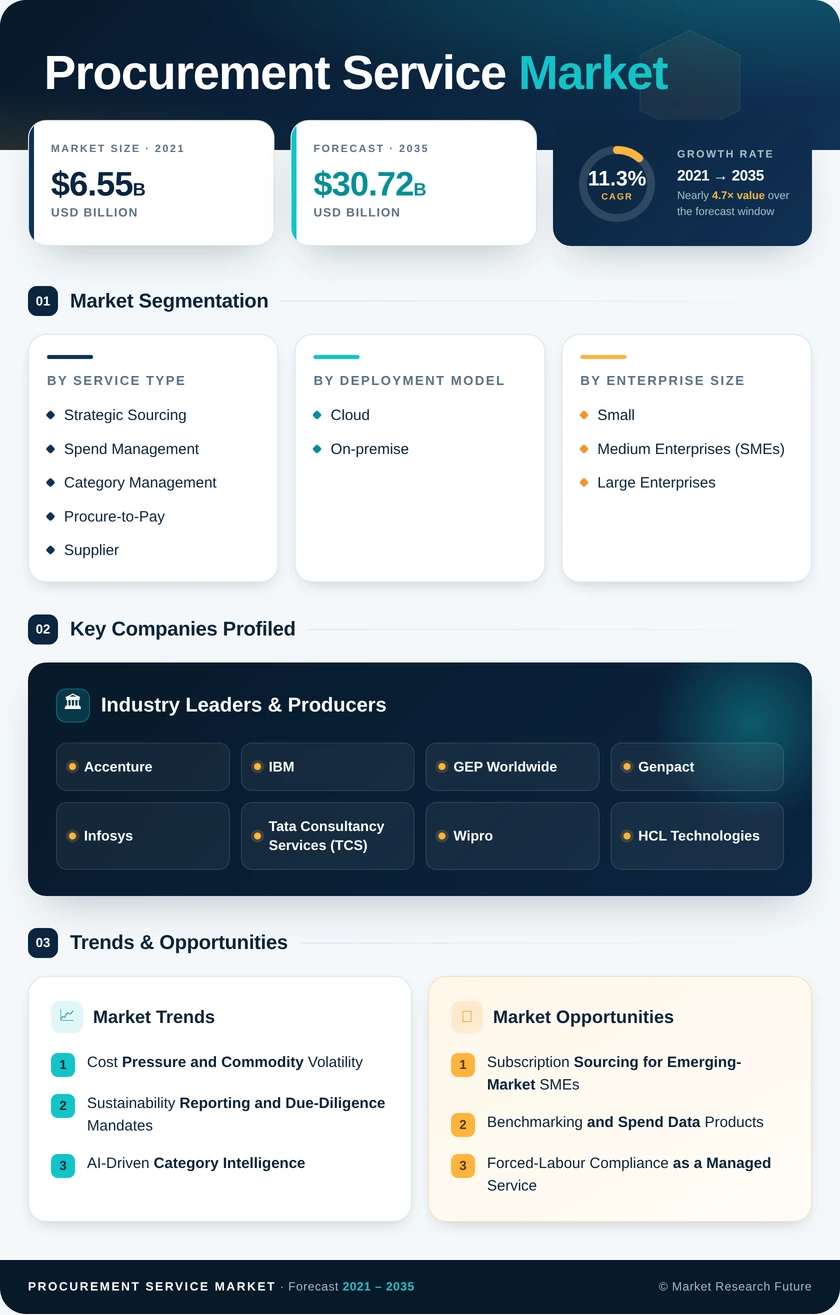
Segmentation Quick Reference
| Dimension | Sub-Segments | Dominant Segment | Fastest Growing Segment |
|---|
| By Service Type | Strategic Sourcing, Spend Management, Category Management, Procure-to-Pay, Supplier and Contract Management, Others | Strategic Sourcing (51.2% share) | Category Management (13.9% CAGR) |
| By Deployment Model | Cloud, On-premise | Cloud | Cloud (14.9% CAGR) |
| By Enterprise Size | Small and Medium Enterprises (SMEs), Large Enterprises | Large Enterprises (56.0% share) | Small and Medium Enterprises (SMEs) (13.0% CAGR) |
| By End-Use Industry | BFSI, Manufacturing, Retail and E-commerce, IT and Telecom, Healthcare and Life Sciences, Energy and Utilities, Consumer Goods and Others | Manufacturing (22.4% share) | Healthcare and Life Sciences (14.3% CAGR) |
| By Region | North America, Europe, Asia-Pacific, South America, Middle East and Africa | North America (38.4% share) | Asia-Pacific (13.6% CAGR) |
Market Segmentation Overview
| Sub-Segment | Key Trend |
|---|
| Strategic Sourcing | Bundling with contract execution to lock in negotiated value |
| Spend Management | Real-time dashboards exposing off-contract buying |
| Category Management | AI benchmarking extends to mid-sized buyers |
| Procure-to-Pay | Touchless invoice matching and faster payments |
| Supplier and Contract Management | Continuous supplier monitoring for due-diligence laws |
| Others | Tail-spend and logistics services for niche categories |
Strategic Sourcing leads because clients want a single partner accountable for category strategy and negotiated savings. Category Management grows fastest as AI-based supplier benchmarking becomes affordable outside the Fortune 500. Supplier and Contract Management gains momentum as due-diligence rules require ongoing, documented supplier oversight.
| Sub-Segment | Key Trend |
|---|
| Cloud | Subscription pricing with embedded AI analytics |
| On-premise | Retained in defense and regulated public-sector accounts |
Cloud leads and grows fastest because subscription pricing and automatic upgrades suit both SMEs and multinationals. On-premise persists only where data-residency rules bar external hosting, such as defense programs. Hybrid models bridge the two in Europe as data-sovereignty rules tighten.
| Sub-Segment | Key Trend |
|---|
| Small and Medium Enterprises (SMEs) | Packaged cloud workflows with weeks-long onboarding |
| Large Enterprises | Multi-category outsourcing tied to global supply chains |
Large Enterprises dominate revenue because their spend pools justify outsourcing several categories at once. Small and Medium Enterprises (SMEs) grow fastest, using pooled purchasing to win discounts once out of reach. Shorter onboarding lets smaller firms see returns within a single budget cycle.
| Sub-Segment | Key Trend |
|---|
| BFSI | ICT vendor oversight under resilience regulation |
| Manufacturing | Supplier rationalization across complex bills of materials |
| Retail and E-commerce | Indirect and logistics spend consolidation |
| IT and Telecom | Cloud and software license cost control |
| Healthcare and Life Sciences | Implant sourcing and device traceability |
| Energy and Utilities | Supplier emissions data for scope 3 reporting |
| Consumer Goods and Others | Packaging and ingredient cost management |
Manufacturing leads because bill-of-materials consolidation produces large, measurable savings. Healthcare and Life Sciences grows fastest as hospitals outsource implant sourcing and traceability compliance to cut carrying costs. BFSI demand rests on vendor-oversight rules rather than price, keeping contracts sticky.


 Noah Malgeri
Co-Founder

 Peter Groot koerkamp
Account and Business Manager

 Younghwan Choi
Senior Retail Manager

 Mark Irwin
Management Consultant

 Akif Moroglu
Strategy & Business Development Director

 Guilherme Gomes Martins
Product Management Director

 Joseph Aguayo
Sales Operations & Pricing Manager

 La Terria Dodd
Program Support Specialist

 Rob Kooiker
Group Product Manager HVAC & Fire Protection GMA