×
Hero Background
English
Chinese
French
Japanese
Korean
German
Spanish

Process Fluid Market Trends

ID: MRFR/CnM/2457-HCR
145 Pages
Priya Nagrale
October 2025

Process Fluid Market Research Report Information- By Type (Paraffinic Oils, Naphthenic Oils, Aromatic Oils, Veg & Bio Oils, and others), By Application (Polymerization, Catalyst, Solvents, Cleaners and others), By End Use Industry (Oil & Gas, Paint & Coatings, Plastics, Electronics, Fragrance, and others), and By Region- Forecast Till 2035

Share:
Download PDF ×

We do not share your information with anyone. However, we may send you emails based on your report interest from time to time. You may contact us at any time to opt-out.

Process Fluid Market Infographic
Purchase Options

Market Trends

Key Emerging Trends in the Process Fluid Market

Trends in this industry change very fast because it relies on dynamic industries that require essential fluids like process fluid. Shifts in demand and applications are occurring among process fluids, including a range of substances used in manufacturing and industrial processes. One observable trend is the increased usage of environmentally friendly, sustainable process fluids. Furthermore, there has been a growing preference for high-performance characteristics within several sectors, such as machining or metalworking, where superior lubrication properties are increasingly desired together with better cooling effects against rusting away. Manufacturers are looking for coolants that not only lubricate but also provide an enhanced cooling effect to protect against rusting away, thereby increasing their lifespan, too. Due to increased efficiency during machining operations, tool wear decreases, minimizing overall production optimization. Moreover, formulation technologies have advanced significantly within the Process Fluid segment. Companies are investing heavily in R&D to create innovative formulations capable of addressing particular industry challenges. However, regulatory frameworks now focus more on safety-health aspects regarding fluid-based processes across different sectors. Manufacturers are adjusting their products according to stricter rules pertaining to workplace safety as well as maximum allowable exposure rates. They achieve this through reduction or even complete eradication of harmful substances within process fluid formulations, hence making the working environment safer for industrial workers. The demand is also spreading geographically as emerging economies take the front role in this regard. Process fluids have been increasingly demanded by various manufacturing sectors spurred by the rapid industrialization in regions like Asia-Pacific and Latin America. In the energy sector, process fluids are being more commonly used, particularly with regard to hydraulic fracturing or fracking. Specialized fluids are used to facilitate drilling and fracturing processes during the extraction of oil and gas from unconventional sources. Therefore, this application trend will persist as a global thirst for energy continues to drive exploration and production activities.

Author
Priya Nagrale
Senior Research Analyst

With an experience of over five years in market research industry (Chemicals & Materials domain), I gather and analyze market data from diverse sources to produce results, which are then presented back to a client. Also, provide recommendations based on the findings. As a Senior Research Analyst, I perform quality checks (QC) for market estimations, QC for reports, and handle queries and work extensively on client customizations. Also, handle the responsibilities of client proposals, report planning, report finalization, and execution

Leave a Comment

FAQs

What are the leading types of process fluids?

Leading types of process fluids include paraffinic oils, naphthenic oils, aromatic oils, veg and bio oils, and others.

What is the application of process fluids?

Major applications of process fluids include polymerization, catalyst, solvents, cleaners, and others.

What is the major driver for the market?

The increasing demand in the oil and gas and paints and coatings industries is the major driver for the global process fluid market.

Which is the leading regional market?

Asia Pacific holds a dominant share of close to 50% in the global process fluid market.

What are the key players in the market?

Leading players in the market include Eastman, Renkert Oil, and LUKOIL, among others.

Market Summary

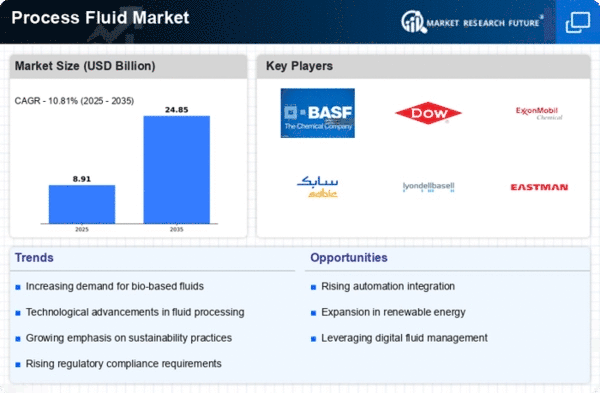
As per MRFR analysis, the Process Fluid Market Size was estimated at 8.04 USD Billion in 2024. The Process Fluid industry is projected to grow from 8.9 in 2025 to 24.85 by 2035, exhibiting a compound annual growth rate (CAGR) of 10.81 during the forecast period 2025 - 2035.

Key Market Trends & Highlights

The Process Fluid Market is currently experiencing a dynamic shift towards sustainability and technological innovation.

  • North America remains the largest market for process fluids, driven by robust industrial activities and technological advancements.
  • Asia-Pacific is recognized as the fastest-growing region, fueled by increasing investments in manufacturing and infrastructure development.
  • Hydraulic systems dominate the market, while cooling systems are emerging as the fastest-growing segment due to rising energy efficiency demands.
  • Key market drivers include the rising demand for energy efficiency and the expansion of industrial applications, particularly in the oil and gas and chemical processing sectors.

Market Size & Forecast

2024 Market Size 8.04 (USD Billion)
2035 Market Size 24.85 (USD Billion)
CAGR (2025 - 2035) 10.81%
Largest Regional Market Share in 2024 North America

Major Players

<p>BASF SE (DE), Dow Inc. (US), ExxonMobil Chemical Company (US), SABIC (SA), LyondellBasell Industries N.V. (NL), Shell Chemicals (GB), Eastman Chemical Company (US), Mitsubishi Chemical Corporation (JP), Solvay S.A. (BE)</p>

Market Trends

The Process Fluid Market is currently experiencing a dynamic evolution, driven by various factors that influence its growth trajectory. The increasing demand for efficient and sustainable fluid management solutions across multiple industries, including manufacturing, automotive, and energy, appears to be a primary catalyst. Companies are increasingly focusing on optimizing their processes to enhance productivity while minimizing environmental impact. This trend suggests a shift towards innovative technologies and materials that can improve fluid performance and reduce waste. Furthermore, regulatory pressures aimed at promoting sustainability are likely to shape the market landscape, compelling organizations to adopt greener alternatives in their operations. In addition to sustainability, the Process Fluid Market is witnessing advancements in automation and digitalization. The integration of smart technologies into fluid management systems seems to enhance operational efficiency and provide real-time monitoring capabilities. This technological evolution may lead to improved decision-making processes and reduced operational costs. As industries continue to adapt to changing market demands, the Process Fluid Market is poised for further growth, with an emphasis on innovation and sustainability as key drivers of future developments.

Sustainability Initiatives

The Process Fluid Market is increasingly influenced by sustainability initiatives, as companies strive to reduce their environmental footprint. This trend encompasses the adoption of eco-friendly fluids and the implementation of practices that minimize waste and energy consumption.

Technological Advancements

Technological advancements play a crucial role in shaping the Process Fluid Market. Innovations in fluid management systems, including automation and smart technologies, enhance efficiency and enable real-time monitoring, thereby optimizing operational performance.

Regulatory Compliance

Regulatory compliance is becoming more stringent, prompting organizations within the Process Fluid Market to adapt their practices. Companies are focusing on meeting environmental standards and adopting safer, more sustainable fluid solutions to align with regulatory requirements.

Process Fluid Market Market Drivers

Chart: Market Growth Projections

This chart illustrates the projected growth of the Global Process Fluid Market Industry from 2024 to 2035. The market is anticipated to reach 9.81 USD Billion in 2024, with a steady increase to 20.7 USD Billion by 2035. The compound annual growth rate during this period is estimated at 7.03%, reflecting the increasing demand for advanced process fluids across various industries.

Rising Demand for Energy Efficiency

The Global Process Fluid Market Industry experiences a notable increase in demand for energy-efficient solutions. Industries are increasingly adopting process fluids that enhance operational efficiency and reduce energy consumption. For instance, the use of advanced cooling fluids in manufacturing processes can lead to energy savings of up to 30%. This trend is driven by stringent regulations aimed at reducing carbon footprints and promoting sustainability. As a result, the market is projected to reach 9.81 USD Billion in 2024, with a compound annual growth rate of 7.03% anticipated from 2025 to 2035, indicating a robust shift towards energy-efficient process fluids.

Growth in Chemical Processing Industries

The Global Process Fluid Market Industry is closely tied to the expansion of chemical processing industries. As global demand for chemicals continues to rise, the need for specialized process fluids becomes more pronounced. Industries such as petrochemicals, pharmaceuticals, and food processing require specific fluids to ensure optimal performance and safety. The increasing complexity of chemical processes necessitates the use of high-quality process fluids that can withstand extreme conditions. This growth trajectory is reflected in the market's projected increase, with expectations of reaching 9.81 USD Billion in 2024, driven by the expanding chemical sector.

Technological Advancements in Fluid Formulation

Technological innovations in fluid formulation significantly influence the Global Process Fluid Market Industry. The development of synthetic and bio-based fluids has led to improved performance characteristics, such as enhanced thermal stability and reduced environmental impact. For example, the introduction of biodegradable hydraulic fluids has gained traction in sectors like agriculture and construction, where environmental regulations are stringent. These advancements not only meet regulatory requirements but also provide superior performance compared to traditional fluids. Consequently, the market is expected to grow substantially, reaching 20.7 USD Billion by 2035, as industries increasingly prioritize advanced fluid technologies.

Regulatory Compliance and Environmental Concerns

Regulatory compliance and heightened environmental concerns are pivotal drivers in the Global Process Fluid Market Industry. Governments worldwide are implementing stringent regulations to minimize environmental impact, prompting industries to adopt eco-friendly process fluids. For instance, the European Union's REACH regulation encourages the use of safer chemicals, influencing manufacturers to develop compliant fluids. This shift not only addresses regulatory requirements but also aligns with corporate sustainability goals. As a result, the market is likely to witness significant growth, with projections indicating a rise to 20.7 USD Billion by 2035, as companies increasingly prioritize environmentally responsible fluid solutions.

Market Segment Insights

By Application: Hydraulic Systems (Largest) vs. Cooling Systems (Fastest-Growing)

<p>In the Process Fluid Market, the application segments show distinct distributions among key categories: Hydraulic Systems, Cooling Systems, Lubrication Systems, and Process Control Systems. Hydraulic Systems dominate this segment, accounting for the largest share due to their widespread application across various industries, including manufacturing and construction. In contrast, Cooling Systems are emerging as a significant player, rapidly gaining market attention due to increasing demands for efficient thermal management across diverse sectors such as automotive and electronics.</p>

<p>Cooling Systems (Emerging) vs. Lubrication Systems (Dominant)</p>

<p>Cooling Systems are making noteworthy strides within the Process Fluid Market due to their vital role in optimizing temperature control and efficiency. These systems are increasingly utilized in industries requiring precise temperature regulation, thus reflecting a trend towards sustainability and energy conservation. Conversely, Lubrication Systems remain dominant, essential for reducing friction and wear in machinery. Their technology is well-established, contributing to enhanced equipment longevity and operational efficiency, which places them firmly at the forefront while Cooling Systems continue to rise.</p>

By End Use Industry: Oil and Gas (Largest) vs. Chemical Processing (Fastest-Growing)

<p>In the Process Fluid Market, the oil and gas industry holds the largest share, owing to its extensive use of various fluids for drilling, extraction, and refining processes. Following closely is the chemical processing segment, which employs process fluids for manufacturing a variety of chemicals and materials. These two industries dominate the market, while the food and beverage and pharmaceuticals sectors also contribute significantly, albeit on a smaller scale.</p>

<p>Oil and Gas (Dominant) vs. Pharmaceutical (Emerging)</p>

<p>The oil and gas sector is the dominant player in the Process Fluid Market, leveraging a vast array of process fluids to facilitate extraction, production, and refining activities. Its established infrastructure and operational practices drive consistent demand. In contrast, the pharmaceuticals segment represents an emerging opportunity, with increasing investments in biopharmaceuticals and stringent regulatory requirements shaping its growth. While traditional pharmaceuticals deploy process fluids primarily for production, the rise of biologics and personalized medicine is set to enhance fluid demand across the industry.</p>

By Fluid Type: Water-based Fluids (Largest) vs. Oil-based Fluids (Fastest-Growing)

<p>In the Process Fluid Market, Water-based Fluids hold the largest market share, primarily due to their widespread applicability and favorable environmental properties. These fluids are commonly used in various applications such as cooling, lubrication, and hydraulic systems. Meanwhile, Oil-based Fluids are gaining traction and showing considerable growth potential due to their superior performance in extreme conditions, making them vital for industrial processes requiring high efficiency and longevity. Growth trends in the Fluid Type segment indicate a shift towards more sustainable and efficient solutions. Water-based Fluids are favored for their eco-friendly characteristics, while Oil-based Fluids are benefiting from technological advancements that enhance their performance. The increasing demand for high-efficiency systems in industries like manufacturing and energy is further driving this market segment's evolution.</p>

<p>Water-based Fluids: Dominant vs. Oil-based Fluids: Emerging</p>

<p>Water-based Fluids are recognized for their non-toxic and environmentally friendly properties, making them ideal for industries focused on sustainability. They are extensively used in cooling applications and can be mixed with various additives to enhance their performance. On the other hand, Oil-based Fluids are emerging rapidly due to their superior lubricating abilities and thermal stability, which are crucial in demanding applications such as metalworking and hydraulic systems. The choice between these two types often depends on the specific requirements of the application, with Water-based Fluids being preferred for their safety and Oil-based Fluids for their performance under challenging conditions.</p>

By Functionality: Heat Transfer (Largest) vs. Corrosion Inhibition (Fastest-Growing)

<p>The Process Fluid Market showcases varied functionalities like Heat Transfer, Pressure Transmission, Lubrication, and Corrosion Inhibition. Among these, Heat Transfer commands the largest market share due to its widespread applications in industries such as HVAC, automotive, and chemical processing. This segment's dominant position is supported by increasing demand for efficient thermal management solutions across various sectors, making it a critical component in process fluid systems. In contrast, Corrosion Inhibition has emerged as the fastest-growing segment within the market. The rising awareness regarding equipment longevity and maintenance costs has heightened the demand for effective corrosion inhibitors. Coupled with stringent regulations on industrial emissions and waste management, this segment is expected to witness robust growth as industries prioritize sustainability and equipment reliability.</p>

<p>Heat Transfer (Dominant) vs. Corrosion Inhibition (Emerging)</p>

<p>The Heat Transfer functionality is crucial for optimizing energy efficiency in many industrial processes, serving as a dominant segment within the Process Fluid Market. It is characterized by its use in cooling and heating applications, which are vital for operations in sectors like power generation, oil & gas, and manufacturing. This segment benefits from ongoing technological advancements that enhance the performance and sustainability of heat transfer fluids. On the other hand, Corrosion Inhibition is positioned as an emerging functionality driven by the need for increased durability in machinery and infrastructure. This segment focuses on the development of advanced inhibitors that not only protect equipment but also offer environmental benefits. With industries facing elevated costs related to maintenance and failure, the demand for innovative corrosion inhibitors continues to rise, marking a significant shift in market dynamics.</p>

By Physical State: Liquid (Largest) vs. Gas (Fastest-Growing)

<p>The Process Fluid Market is distinctly characterized by a diverse distribution among its physical states: liquid, gas, and solid. The liquid segment commands the largest share, primarily due to its extensive application across various industries such as chemicals, oil and gas, and food processing. Conversely, gas is gaining traction as a rapidly emerging category, driven by increasing demands for cleaner energy and advancements in gas-based technologies. The solid segment, while present, continues to account for a smaller portion of the market.</p>

<p>Liquid (Dominant) vs. Gas (Emerging)</p>

<p>In the Process Fluid Market, the liquid segment stands as the dominant force, renowned for its versatility across diverse applications such as hydraulic fluids, coolants, and process solvents. With its status as a staple in industrial operations, it benefits from established infrastructure and supply chains. In contrast, the gas segment is marked as an emerging force, motivated by a surge in demand for natural gas and innovations in gas handling technologies. As industries pivot towards more sustainable solutions, the growth of gas reflects a shift in energy consumption patterns, paving the way for future advancements in processing methodologies.</p>

Get more detailed insights about Process Fluid Market Research Report- Forecast till 2035

Regional Insights

North America : Market Leader in Process Fluids

North America is poised to maintain its leadership in the Process Fluid Market, holding a significant market share of 3.5 in 2024. The region's growth is driven by robust industrial activities, technological advancements, and stringent regulatory frameworks promoting safety and efficiency. The demand for high-performance fluids in sectors like oil & gas, chemicals, and manufacturing is on the rise, further bolstered by investments in infrastructure and sustainability initiatives. The competitive landscape in North America is characterized by the presence of major players such as Dow Inc., ExxonMobil Chemical Company, and BASF SE. These companies are leveraging innovation and strategic partnerships to enhance their product offerings. The U.S. remains the largest market, supported by a strong manufacturing base and a focus on R&D. As companies adapt to evolving regulations and consumer preferences, the region is expected to see continued growth in the coming years.

Europe : Emerging Innovations and Regulations

Europe's Process Fluid Market is projected to grow significantly, with a market size of 2.5 in 2024. The region is witnessing a shift towards sustainable practices, driven by stringent environmental regulations and a growing emphasis on green technologies. The demand for eco-friendly fluids is increasing, supported by government initiatives aimed at reducing carbon footprints and enhancing energy efficiency across industries. Leading countries such as Germany, France, and the UK are at the forefront of this transformation, hosting key players like BASF SE and LyondellBasell Industries N.V. The competitive landscape is marked by innovation, with companies investing in R&D to develop advanced fluid solutions. As Europe continues to prioritize sustainability, the Process Fluid Market is expected to thrive, aligning with the region's broader environmental goals.

Asia-Pacific : Rapid Growth and Industrialization

The Asia-Pacific region is emerging as a significant player in the Process Fluid Market, with a market size of 1.8 in 2024. Rapid industrialization, urbanization, and increasing demand for energy-efficient solutions are key drivers of growth. Countries like China and India are experiencing a surge in manufacturing activities, leading to heightened demand for process fluids across various sectors, including automotive, chemicals, and pharmaceuticals. China stands out as the largest market in the region, with major companies like Mitsubishi Chemical Corporation and SABIC establishing a strong presence. The competitive landscape is evolving, with local players gaining traction alongside global giants. As the region continues to invest in infrastructure and technology, the Process Fluid Market is expected to expand, catering to the growing industrial needs and regulatory requirements.

Middle East and Africa : Emerging Market with Challenges

The Middle East and Africa (MEA) region, with a market size of 0.24 in 2024, is gradually emerging in the Process Fluid Market. The growth is primarily driven by increasing industrial activities and investments in oil & gas, chemicals, and manufacturing sectors. However, the region faces challenges such as regulatory hurdles and economic fluctuations that can impact market stability. Governments are working to enhance regulatory frameworks to support industry growth and sustainability. Countries like Saudi Arabia and South Africa are leading the way in market development, with key players such as SABIC and Shell Chemicals actively participating. The competitive landscape is characterized by a mix of local and international companies striving to meet the growing demand for process fluids. As the region navigates its challenges, opportunities for growth remain, particularly in sectors aligned with global sustainability trends.

Key Players and Competitive Insights

The Process Fluid Market is characterized by a dynamic competitive landscape, driven by innovation, sustainability, and strategic partnerships. Key players such as BASF SE (DE), Dow Inc. (US), and ExxonMobil Chemical Company (US) are at the forefront, each adopting distinct strategies to enhance their market positioning. BASF SE (DE) emphasizes innovation in sustainable solutions, while Dow Inc. (US) focuses on digital transformation and operational efficiency. ExxonMobil Chemical Company (US) is leveraging its extensive supply chain to optimize production and reduce costs. Collectively, these strategies contribute to a competitive environment that is increasingly focused on technological advancement and sustainability.

In terms of business tactics, companies are localizing manufacturing to better serve regional markets and optimize supply chains for efficiency. The market structure appears moderately fragmented, with a mix of large multinational corporations and smaller regional players. The influence of key players is substantial, as they set industry standards and drive technological advancements that smaller companies often follow.

In November 2025, BASF SE (DE) announced a partnership with a leading renewable energy firm to develop bio-based process fluids, reflecting a strategic pivot towards sustainability. This move is likely to enhance BASF's product portfolio and align with global trends favoring environmentally friendly solutions. The partnership may also position BASF as a leader in the sustainable process fluid segment, potentially attracting new customers and markets.

In October 2025, Dow Inc. (US) unveiled a new digital platform aimed at optimizing supply chain management for process fluids. This initiative is expected to streamline operations and improve customer engagement, showcasing Dow's commitment to digital transformation. By enhancing supply chain visibility and efficiency, Dow could gain a competitive edge in a market that increasingly values responsiveness and reliability.

In September 2025, ExxonMobil Chemical Company (US) expanded its production capacity for specialty process fluids in response to rising global demand. This strategic expansion not only reinforces ExxonMobil's market presence but also indicates a proactive approach to meeting customer needs. The increased capacity may allow ExxonMobil to capture a larger market share and respond more effectively to fluctuations in demand.

As of December 2025, current competitive trends in the Process Fluid Market are heavily influenced by digitalization, sustainability, and the integration of AI technologies. Strategic alliances are becoming increasingly vital, as companies seek to leverage complementary strengths to enhance their offerings. The competitive landscape is shifting from traditional price-based competition to a focus on innovation, technology, and supply chain reliability. This evolution suggests that companies that prioritize these aspects will likely emerge as leaders in the market, shaping the future of the Process Fluid industry.

Key Companies in the Process Fluid Market market include

Industry Developments

Future Outlook

Process Fluid Market Future Outlook

<p>The Process Fluid Market is projected to grow at a 10.81% CAGR from 2024 to 2035, driven by technological advancements, increasing industrial automation, and rising demand for efficient fluid management solutions.</p>

New opportunities lie in:

  • <p>Development of smart fluid monitoring systems for predictive maintenance.</p>
  • <p>Expansion into renewable energy sectors with specialized process fluids.</p>
  • <p>Integration of AI-driven analytics for optimized fluid management strategies.</p>

<p>By 2035, the Process Fluid Market is expected to achieve substantial growth, reflecting evolving industrial needs.</p>

Market Segmentation

Process Fluid Market Fluid Type Outlook

  • Water-based Fluids
  • Oil-based Fluids
  • Emulsions
  • Glycol-based Fluids

Process Fluid Market Application Outlook

  • Hydraulic Systems
  • Cooling Systems
  • Lubrication Systems
  • Process Control Systems

Process Fluid Market Functionality Outlook

  • Heat Transfer
  • Pressure Transmission
  • Lubrication
  • Corrosion Inhibition

Process Fluid Market Physical State Outlook

  • Liquid
  • Gas
  • Solid

Process Fluid Market End Use Industry Outlook

  • Oil and Gas
  • Chemical Processing
  • Food and Beverage
  • Pharmaceuticals

Report Scope

MARKET SIZE 20248.04(USD Billion)
MARKET SIZE 20258.9(USD Billion)
MARKET SIZE 203524.85(USD Billion)
COMPOUND ANNUAL GROWTH RATE (CAGR)10.81% (2024 - 2035)
REPORT COVERAGERevenue Forecast, Competitive Landscape, Growth Factors, and Trends
BASE YEAR2024
Market Forecast Period2025 - 2035
Historical Data2019 - 2024
Market Forecast UnitsUSD Billion
Key Companies ProfiledBASF SE (DE), Dow Inc. (US), ExxonMobil Chemical Company (US), SABIC (SA), LyondellBasell Industries N.V. (NL), Shell Chemicals (GB), Eastman Chemical Company (US), Mitsubishi Chemical Corporation (JP), Solvay S.A. (BE)
Segments CoveredApplication, End Use Industry, Fluid Type, Functionality, Physical State
Key Market OpportunitiesIntegration of advanced materials and automation technologies enhances efficiency in the Process Fluid Market.
Key Market DynamicsRising demand for sustainable process fluids drives innovation and regulatory compliance across various industrial sectors.
Countries CoveredNorth America, Europe, APAC, South America, MEA

FAQs

What are the leading types of process fluids?

Leading types of process fluids include paraffinic oils, naphthenic oils, aromatic oils, veg and bio oils, and others.

What is the application of process fluids?

Major applications of process fluids include polymerization, catalyst, solvents, cleaners, and others.

What is the major driver for the market?

The increasing demand in the oil and gas and paints and coatings industries is the major driver for the global process fluid market.

Which is the leading regional market?

Asia Pacific holds a dominant share of close to 50% in the global process fluid market.

What are the key players in the market?

Leading players in the market include Eastman, Renkert Oil, and LUKOIL, among others.

  1. Executive Summary
  2. Scope of The Report
    1. Market Definition
    2. Scope of The Study
      1. Research Objectives
      2. Assumptions & Limitations
    3. Markets Structure
  3. Market Research Methodology
    1. Research Process
    2. Secondary Research
    3. Primary Research
    4. Forecast Model
  4. Market Landscape
    1. Five Forces Analysis
      1. Threat of New Entrants
      2. Bargaining power of buyers
      3. Threat of substitutes
      4. Segment rivalry
    2. Value Chain/Supply Chain of Global Process Fluid Market
  5. Industry Overview of Global Process Fluid Market
    1. Introduction
    2. GMiddle East & Africath Drivers
    3. Impact analysis
    4. Market Challenges
    5. Impact analysis
  6. Market Trends
    1. Introduction
    2. GMiddle East & Africath Trends
    3. Impact analysis
  7. Global Process Fluid Market by Types
    1. Introduction
    2. Paraffinic Oils
    3. Naphthenic Oils
    4. Aromatic Oils
    5. Veg & Bio Oils,
    6. Others
  8. Global Process Fluid Market by Application
    1. Introduction
    2. Polymerization
    3. Catalyst
    4. Solvents
    5. Cleaners
    6. Others
  9. Global Process Fluid Market by End Use Industry
    1. Introduction
    2. Oil & Gas
    3. Paint & Coatings
    4. Plastic
    5. Electronics
    6. Fragrance
    7. Others
  10. Global Process Fluid Market by Region
  11. Introduction
    1. North America
      1. US
      2. Canada
    2. Europe
      1. Germany
      2. France
      3. Italy
      4. Spain
      5. UK
    3. Asia-Pacific
      1. China
      2. India
      3. Japan
      4. Australia
      5. New Zealand
      6. Rest of Asia-Pacific
    4. Middle East & Africa
      1. Turkey
      2. Israel
      3. North Africa
      4. GCC
      5. Rest of Middle East & Africa
    5. Latin America
      1. Brazil
      2. Argentina
      3. Rest of Latin America
  12. Company Landscape
  13. Company Profiles
    1. Eastman Chemical Company
      1. Company Overview
      2. Product/Business Segment Overview
      3. Financial Updates
      4. Key Developments
    2. Process Oil Inc
      1. Company Overview
      2. Product/Business Segment Overview
      3. Financial Updates
      4. Key Developments
    3. Renkert Oil, LLC
      1. Company Overview
      2. Product/Business Segment Overview
      3. Financial Updates
      4. Key Developments
    4. LUKOIL Lubricants Company
      1. Company Overview
      2. Product/Business Segment Overview
      3. Financial Updates
      4. Key Developments
    5. Panama Petrochem Ltd.
      1. Company Overview
      2. Product/Business Segment Overview
      3. Financial Updates
      4. Key Developments
    6. Eastern Petroleum Private Limited
      1. Company Overview
      2. Product/Business Segment Overview
      3. Financial Updates
      4. Key Developments
    7. HollyFrontier Refining & Marketing LLC
      1. Company Overview
      2. Product/Business Segment Overview
      3. Financial Updates
      4. Key Developments
    8. Nynas AB
      1. Company Overview
      2. Product/Business Segment Overview
      3. Financial Updates
      4. Key Developments
    9. Taurus Petroleums Pvt. Ltd.
      1. Company Overview
      2. Product/Business Segment Overview
      3. Financial Updates
      4. Key Developments
    10. Pentagon Lubricants pvt ltd
      1. Company Overview
      2. Product/Business Segment Overview
      3. Financial Updates
      4. Key Developments
  14. Conclusion
  15. LIST OF TABLES
  16. World Population by Major Regions (2020-2027)
  17. Global Process Fluid Market: By Region, 2020-2027
  18. North America Process Fluid Market: By Country, 2020-2027
  19. Europe Process Fluid Market: By Country, 2020-2027
  20. Asia-Pacific Process Fluid Market: By Country, 2020-2027
  21. Middle East & Africa Process Fluid Market: By Country, 2020-2027
  22. Global Process Fluid by Applications Market: By Regions, 2020-2027
  23. North America Process Fluid by Applications Market: By Country, 2020-2027
  24. Europe Process Fluid by Applications Market: By Country, 2020-2027
    1. Table9 Asia-Pacific Process Fluid by Applications Market: By Country, 2020-2027
    2. Table11 Middle East & Africa Process Fluid by Applications Market: By Country, 2020-2027
    3. Table12 North America Process Fluid for End User Market: By Country, 2020-2027
    4. Table13 Europe Process Fluid for End User Market: By Country, 2020-2027
    5. Table14 Asia-Pacific Process Fluid for End User Market: By Country, 2020-2027
    6. Table15 Middle East & Africa Process Fluid for End User Market: By Country, 2020-2027
    7. Table16 Global Process Fluid for End User Market: By Region, 2020-2027
    8. Table17 North America Process Fluid for End User Market: By Country, 2020-2027
    9. Table18 Europe Process Fluid for End User Market: By Country, 2020-2027
    10. Table19 Asia-Pacific Process Fluid for End User Market: By Country, 2020-2027
    11. Table20 Middle East & Africa Process Fluid for End User Market: By Country, 2020-2027
    12. Table21 Middle East & Africa Process Fluid for End User Market: By Country, 2020-2027
    13. Table22 Global Applications Market: By Region, 2020-2027
    14. Table23 Global End User Market: By Region, 2020-2027
  25. Table24 North America Process Fluid Market, By Country
  26. Table25 North America Process Fluid Market, By Applications
  27. Table26 North America Process Fluid Market, By End User
  28. Table27 Europe: Process Fluid Market, By Country
  29. Table28 Europe: Process Fluid Market, By Applications
  30. Table29 Europe: Process Fluid Market, By End User
  31. Table30 Asia-Pacific: Process Fluid Market, By Country
  32. Table31 Asia-Pacific: Process Fluid Market, By Applications
  33. Table32 Asia-Pacific: Process Fluid Market, By End User
  34. Table33 Middle East & Africa: Process Fluid Market, By Country
  35. Table34 Middle East & Africa Process Fluid Market, By Applications
  36. Table35 Middle East & Africa: Process Fluid Market, By End User
  37. LIST OF FIGURES
  38. Global Process Fluid Market segmentation
  39. Forecast Methodology
  40. Five Forces Analysis of Global Process Fluid Market
  41. Value Chain of Global Process Fluid Market
  42. Share of Global Process Fluid Market in 2020, by country (in %)
  43. Global Process Fluid Market, 2020-2027,
  44. Sub-segments of End Users
  45. Global Process Fluid Market size by End User, 2020
  46. Share of Global Process Fluid Market by End User, 2020-2027
  47. Global Process Fluid Market size by Applications, 2020
  48. Share of Global Process Fluid Market by Applications, 2020-2027

Process Fluid Market Segmentation

Market Segmentation Overview

  • Detailed segmentation data will be available in the full report
  • Comprehensive analysis by multiple parameters
  • Regional and country-level breakdowns
  • Market size forecasts by segment
Infographic

Free Sample Request

Kindly complete the form below to receive a free sample of this Report

Get Free Sample

Customer Strories

Compare Licence

×
Features License Type
Single User Multiuser License Enterprise User
Price $4,950 $5,950 $7,250
Maximum User Access Limit 1 User Upto 10 Users Unrestricted Access Throughout the Organization
Free Customization
Direct Access to Analyst
Deliverable Format
Platform Access
Discount on Next Purchase 10% 15% 15%
Printable Versions