Request Free Sample ×

Kindly complete the form below to receive a free sample of this Report

* Please use a valid business email

Leading companies partner with us for data-driven Insights

clients tt-cursor
Hero Background
English
Chinese
French
Japanese
Korean
German
Spanish

Preimplantation Genetic Testing Market Trends

ID: MRFR/HC/6649-HCR
200 Pages
Nidhi Mandole
Last Updated: April 15, 2026

Preimplantation Genetic Testing Market Research Report: Size, Share, Trend Analysis By Applications (Diagnostic Testing, Carrier Screening, Embryo Selection), By Technique (Polymerase Chain Reaction, Next Generation Sequencing, Fluorescence In Situ Hybridization, Single Nucleotide Polymorphism), By End Use (Fertility Clinics, Research Laboratories, Hospitals), By Client Type (Individuals, Healthcare Providers, Healthcare Institutions) and By Regional (North America, Europe, South America, Asia Pacific, Middle East and Africa) - Growth Outlook & Industry Forecast 2025 To 2035

Share:
Download PDF ×

We do not share your information with anyone. However, we may send you emails based on your report interest from time to time. You may contact us at any time to opt-out.

Preimplantation Genetic Testing Market Infographic
Purchase Options

Market Trends

Key Emerging Trends in the Preimplantation Genetic Testing Market

The Preimplantation Genetic Testing (PGT) Market has grown due to reproductive technology advances, genetic disease awareness, and need for individualized and precision reproductive treatment. PGT is being used for chromosomal analysis and genetic testing for hereditary disorders, in addition to aneuploidy screening. Prospective parents may now analyze a wider spectrum of genetic defects in embryos, providing a more complete genetic profile before implantation.

Demand for non-invasive PGT procedures such blastocyst culture and trophectoderm biopsy is rising. These methods capture genetic material without hurting the embryo, making assisted reproductive treatments safer and less intrusive. This trend fits with the focus on reducing embryo hazards and enhancing PGT safety.

Next-generation sequencing (NGS) is also being integrated into PGT. NGS can detect more genetic disorders with better precision due to its improved resolution and accuracy. This trend shows how genetic testing platforms are improving, making preimplantation screening more reliable and sensitive.

PGT for elective single embryo transfer (eSET) in assisted reproductive cycles is growing. With powerful bioinformatics tools and AI algorithms for data analysis, PGT technology is altering the industry. These techniques improve genetic data interpretation, making embryo selection for implantation more reliable. AI integration shows a dedication to using technology to improve PGT dependability and efficiency.

The market is also affected by younger people's fertility preservation and testing trends. Many people postpone childbearing, increasing need for fertility preservation and genetic testing before assisted reproductive therapies. This proactive family planning concept lets people use their genetic profile to choose reproductive alternatives.

Genetic testing labs, reproductive clinics, and healthcare practitioners are working together to improve PGT technology and make it more accessible. Research, development, and standardization collaborations increase PGT services. This collaborative movement emphasizes the need for multidisciplinary reproductive care.

The market is also paying more attention to PGT ethics and regulations. PGT usage requires clear norms and ethical standards to ensure responsible and informed decision-making by healthcare practitioners and prospective parents as technology improves. This development shows the dedication to ethical genetic testing in reproductive care.


Author
Author Profile
Nidhi Mandole
Senior Research Analyst

She is an extremely curious individual currently working in Healthcare and Medical Devices Domain. Nidhi is comfortably versed in data centric research backed by healthcare educational background. She leverages extensive data mining and analytics tools such as Primary and Secondary Research, Statistical Analysis, Machine Learning, Data Modelling. Her key role also involves Technical Sales Support, Client Interaction and Project management within the Healthcare team. Lastly, she showcases extensive affinity towards learning new skills and remain fascinated in implementing them.

Leave a Comment

FAQs

What is the current valuation of the Preimplantation Genetic Testing Market?

<p>The market valuation reached 2.11 USD Billion in 2024.</p>

What is the projected market size for the Preimplantation Genetic Testing Market by 2035?

<p>The market is expected to grow to 4.492 USD Billion by 2035.</p>

What is the expected CAGR for the Preimplantation Genetic Testing Market during the forecast period?

<p>The market is anticipated to experience a CAGR of 7.11% from 2025 to 2035.</p>

Which application segments are driving growth in the Preimplantation Genetic Testing Market?

<p>Diagnostic Testing, Carrier Screening, and Embryo Selection are key application segments, with valuations of 1.78, 1.35, and 1.37 USD Billion respectively by 2035.</p>

What techniques are primarily utilized in Preimplantation Genetic Testing?

<p>The market employs techniques such as Polymerase Chain Reaction, Next Generation Sequencing, Fluorescence In Situ Hybridization, and Single Nucleotide Polymorphism.</p>

How do the end-use segments contribute to the Preimplantation Genetic Testing Market?

<p>Fertility Clinics, Research Laboratories, and Hospitals are projected to generate revenues of 1.78, 1.36, and 1.35 USD Billion respectively by 2035.</p>

Who are the key players in the Preimplantation Genetic Testing Market?

<p>Prominent players include Illumina, Thermo Fisher Scientific, Fulgent Genetics, and Natera, among others.</p>

What client types are involved in the Preimplantation Genetic Testing Market?

<p>The market serves Individuals, Healthcare Providers, and Healthcare Institutions, with projected revenues of 1.78, 1.45, and 1.25 USD Billion respectively by 2035.</p>

What factors are influencing the growth of the Preimplantation Genetic Testing Market?

<p>Advancements in genetic testing technologies and increasing awareness among healthcare providers and individuals are likely driving market growth.</p>

How does the Preimplantation Genetic Testing Market compare to other genetic testing markets?

<p>While specific comparisons are complex, the Preimplantation Genetic Testing Market's growth trajectory appears robust, particularly with its projected CAGR of 7.11% from 2025 to 2035.</p>

Market Summary

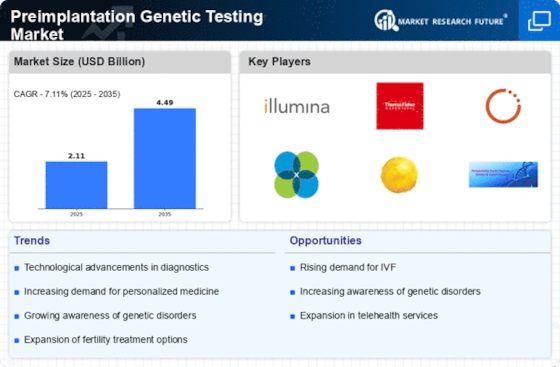
As per MRFR analysis, the Preimplantation Genetic Testing Market size was valued at USD 2.11 Billion in 2024. The market is projected to grow from USD 2.26 Billion in 2025 to USD 4.492 Billion by 2035, exhibiting a CAGR of 7.11% during the forecast period 2025-2035. North America led the market with over 42.65% share, generating around USD 0.9 billion in revenue.
 
The Preimplantation Genetic Testing Market is expanding due to rising infertility rates, increasing awareness of genetic disorders, and growing adoption of assisted reproductive technologies. Key trends include advancements in next-generation sequencing, integration of AI in genetic analysis, and increasing demand for personalized reproductive solutions to improve pregnancy success rates and prevent hereditary diseases globally.
 
The World Health Organization estimates that infertility affects approximately 1 in 6 people globally, driving demand for advanced reproductive technologies and genetic testing solutions.

Key Market Trends & Highlights

The Preimplantation Genetic Testing Market is experiencing robust growth driven by technological advancements and increasing public awareness.

  • North America remains the largest market for preimplantation genetic testing, reflecting a strong demand for advanced reproductive technologies. Asia-Pacific is emerging as the fastest-growing region, fueled by rising infertility rates and a growing acceptance of genetic testing. Diagnostic testing continues to dominate the market, while carrier screening is rapidly gaining traction as a vital segment. Key market drivers include rising infertility rates and increased public awareness, which are propelling the demand for personalized medicine.

Market Size & Forecast

2024 Market Size 2.11 (USD Billion)
2035 Market Size 4.492 (USD Billion)
CAGR (2025 - 2035) 7.11%
Largest Regional Market Share in 2024 North America

Major Players

Companies such as Illumina (US), <a href="https://www.thermofisher.com/in/en/home/life-science/sequencing/next-generation-sequencing/ion-torrent-next-generation-sequencing-applications/reproductive-health-research/preimplantation-genetic-testing.html">Thermo Fisher Scientific</a> (US), Fulgent Genetics (US), <a href="https://www.natera.com/womens-health/spectrum-preimplantation-genetics/faq/">Natera</a> (US), CooperSurgical (US), Preimplantation Genetic Diagnosis (UK), Genea (AU), Reproductive Health Technologies (US), Mayo Clinic (US) are some of the major participants in the global market.

Market Trends

The Preimplantation Genetic Testing Market is currently experiencing notable growth, driven by advancements in genetic technologies and increasing awareness regarding genetic disorders. As more individuals and couples seek to understand their genetic makeup, the demand for preimplantation genetic testing has surged. This testing allows for the identification of genetic abnormalities in embryos before implantation, thereby enhancing the chances of successful pregnancies and healthy offspring.

Furthermore, the rising prevalence of hereditary diseases and the growing acceptance of assisted reproductive technologies contribute to the market's expansion. In addition, the Preimplantation Genetic Testing Market is influenced by evolving regulatory frameworks and ethical considerations surrounding genetic testing. As healthcare providers and patients navigate these complexities, the market is likely to adapt, fostering innovation and improving accessibility.

The integration of artificial intelligence and machine learning into genetic testing processes may also enhance accuracy and efficiency, potentially reshaping the landscape of reproductive health. Overall, the Preimplantation Genetic Testing Market appears poised for continued evolution, reflecting broader trends in healthcare and genetics.

Technological Advancements

The Preimplantation Genetic Testing Market trends is witnessing rapid technological advancements that enhance testing accuracy and efficiency. Innovations in sequencing technologies and bioinformatics tools are streamlining the analysis of genetic material, allowing for more precise identification of genetic disorders. This trend not only improves patient outcomes but also encourages wider adoption of testing services.

Increased Awareness and Acceptance

There is a growing awareness and acceptance of preimplantation genetic testing among prospective parents. As educational initiatives and media coverage highlight the benefits of genetic testing, more individuals are considering these options during their family planning. This trend is likely to drive demand for testing services, as couples seek to mitigate the risks of genetic disorders.

The UNICEF reports that increasing awareness of genetic disorders and reproductive health services has contributed to a steady rise in the utilization of prenatal and preconception screening programs across more than 100 countries.

Regulatory Developments

The regulatory landscape surrounding genetic testing is evolving, impacting the Preimplantation Genetic Testing Market. As governments and health organizations establish guidelines and standards for genetic testing, the market may experience shifts in compliance requirements. These developments could influence the availability and accessibility of testing services, shaping the future of reproductive health.

The World Health Organization has issued global guidance on the governance and ethical use of genetic and genomic data, supporting the safe expansion of testing services.

Preimplantation Genetic Testing Market Market Drivers

Rising Infertility Rates

The increasing prevalence of infertility is a notable driver for the Preimplantation Genetic Testing Market. Factors such as delayed childbearing, lifestyle changes, and environmental influences contribute to this trend. According to recent statistics, infertility affects approximately 10-15% of couples worldwide, leading to a heightened demand for assisted reproductive technologies.
 
Preimplantation genetic testing offers a solution by enabling the selection of genetically healthy embryos, thereby improving the chances of successful pregnancies. As more individuals and couples seek fertility treatments, the market for preimplantation genetic testing is likely to expand, reflecting the urgent need for effective reproductive solutions.

Technological Innovations

Technological advancements in genetic testing methodologies are propelling the Preimplantation Genetic Testing Market forward. Innovations such as next-generation sequencing (NGS) and improved bioinformatics tools enhance the accuracy and efficiency of genetic testing. These technologies allow for comprehensive analysis of embryos, identifying genetic abnormalities with greater precision.
 
The market has witnessed a surge in the adoption of these advanced techniques, which not only improve diagnostic capabilities but also reduce the time required for testing. As the technology continues to evolve, it is expected that the Preimplantation Genetic Testing Market will experience significant growth, driven by the demand for more reliable and faster testing solutions.

Increased Public Awareness

Growing public awareness regarding genetic disorders and the benefits of preimplantation genetic testing is a crucial driver for the Preimplantation Genetic Testing Market. Educational campaigns and media coverage have played a pivotal role in informing potential parents about the advantages of genetic testing in preventing hereditary diseases.
 
As individuals become more knowledgeable about the implications of genetic conditions, the demand for preimplantation genetic testing is likely to rise. This heightened awareness not only encourages couples to consider genetic testing as part of their reproductive planning but also fosters a more informed dialogue about reproductive health, thereby expanding the market.

Regulatory Support and Guidelines

The establishment of supportive regulatory frameworks is influencing the Preimplantation Genetic Testing Market positively. Governments and health organizations are increasingly recognizing the importance of genetic testing in reproductive health. Guidelines that promote the safe and ethical use of preimplantation genetic testing are being developed, which may enhance public trust and acceptance.
 
Furthermore, regulatory approvals for new testing technologies can facilitate market entry for innovative solutions. As these frameworks evolve, they are likely to create a more conducive environment for the growth of the preimplantation genetic testing market, encouraging investment and research in this field.

Rising Demand for Personalized Medicine

The shift towards personalized medicine is significantly impacting the Preimplantation Genetic Testing Market. As healthcare moves towards tailored treatment plans based on individual genetic profiles, preimplantation genetic testing aligns perfectly with this trend. Couples are increasingly seeking personalized approaches to family planning, which includes selecting embryos based on genetic compatibility and health.
 
This demand for customized reproductive solutions is expected to drive market growth, as preimplantation genetic testing provides essential information that aids in making informed decisions. The integration of personalized medicine principles into reproductive health is likely to enhance the appeal and adoption of preimplantation genetic testing.

Market Segment Insights

By Application: Diagnostic Testing (Largest) vs. Carrier Screening (Fastest-Growing)

The global Preimplantation Genetic Testing Market is primarily composed of three key application segments: Diagnostic Testing, <a href="https://www.marketresearchfuture.com/reports/carrier-screening-market-8755" target="_blank" rel="noopener">Carrier Screening</a>, and Embryo Selection. Diagnostic Testing holds the largest market share due to its critical role in identifying genetic abnormalities before embryo implantation. Carrier Screening, on the other hand, is rapidly gaining traction as more prospective parents seek to understand their genetic risks, thereby driving significant growth in this segment. Embryo Selection remains crucial but has a comparatively smaller share in the overall market dynamics.

Testing Applications: Diagnostic Testing (Dominant) vs. Carrier Screening (Emerging)

In the Preimplantation Genetic Testing Market, Diagnostic Testing is the dominant application, providing essential insights into genetic conditions of embryos, therefore guiding implantation decisions. This segment benefits from advanced technologies that enhance accuracy and reliability, solidifying its essential role in reproductive health. Conversely, Carrier Screening is emerging as a vital part of family planning, allowing parents to assess the risk of passing on genetic disorders. As awareness increases and genetic testing technologies evolve, the demand for Carrier Screening is surging, making it a significant player in the market and appealing to a younger demographic interested in proactive genetics.

By Technique: Polymerase Chain Reaction (Largest) vs. Next Generation Sequencing (Fastest-Growing)

In the Preimplantation Genetic Testing Market, the Polymerase Chain Reaction (PCR) technique holds a significant market share due to its long-standing application in genetic testing. PCR's ability to amplify DNA with high precision has made it the go-to method for many laboratories. Following closely is <a title="next generation sequencing" href="https://www.marketresearchfuture.com/reports/next-generation-sequencing-market-6354" target="_blank" rel="noopener">Next Generation Sequencing</a> (NGS), which, while currently smaller in market share than PCR, is rapidly gaining traction due to its simultaneous multi-gene analysis capabilities, offering more comprehensive testing options to clinicians.

PCR (Dominant) vs. NGS (Emerging)

Polymerase Chain Reaction (PCR) is recognized as the dominant technique in the Preimplantation Genetic Testing Market owing to its reliability and established protocols in amplifying specific DNA sequences. It is widely utilized for target identification, mutation detection, and genotyping. In contrast, Next Generation Sequencing (NGS) is emerging as a revolutionary force, appealing to those seeking extensive genetic insights. Its ability to conduct large-scale sequencing projects efficiently positions it favorably in a market that values innovation, making it a crucial player as healthcare providers increasingly adopt technology-driven solutions.

By End Use: Fertility Clinics (Largest) vs. Research Laboratories (Fastest-Growing)

In the Preimplantation Genetic Testing Market, the distribution of market share among end-use segments illustrates a notable trend where Fertility Clinics hold the largest share. This segment thrives due to the rising number of couples seeking assisted reproductive technologies, as well as advancements in genetic testing methods. Meanwhile, Research Laboratories are emerging as a significant player in this market, capitalizing on increased funding for genetic research and innovation that caters to evolving healthcare needs. The growth trends in this segment are primarily driven by technological advancements and increasing awareness regarding genetic disorders. Fertility Clinics continue to expand their services to accommodate a growing patient base, while Research Laboratories are quickly adapting to the demand for robust genetic testing procedures, establishing their essential role in enhancing patient outcomes and advancing the field of reproductive health.

Fertility Clinics: Dominant vs. Research Laboratories: Emerging

Fertility Clinics are pivotal in the market share, characterized by their integration of advanced genetic testing techniques into in vitro fertilization (IVF) protocols. As the dominant player, they not only offer services to ensure successful pregnancies but also enhance the understanding of genetic diseases, thus attracting a steady influx of patients. On the other hand, Research Laboratories represent an emerging force with their focus on innovative genetic testing methods and collaboration with healthcare providers. These labs are essential for developing new genetic testing solutions, thus contributing to a faster turnaround in research and applications. Their role is becoming increasingly significant as they pave the way for advancements that influence fertility treatments and <a title="genetic counseling" href="https://www.marketresearchfuture.com/reports/genetic-counseling-market-19215" target="_blank" rel="noopener">genetic counseling</a>.

By Client Type: Individuals (Largest) vs. Healthcare Providers (Fastest-Growing)

The Preimplantation Genetic Testing Market is characterized by a diverse client base, including Individuals, Healthcare Providers, and Healthcare Institutions. Among these, Individuals constitute the largest segment, driven by the increasing adoption of genetic testing for reproductive health. Healthcare Providers, while smaller in overall market share, are rapidly gaining ground as they embrace genetic testing to enhance patient care and outcomes. This trend highlights the critical role of personalized medicine and the need for tailored solutions in reproductive healthcare.

Healthcare Providers (Dominant) vs. Healthcare Institutions (Emerging)

While Healthcare Providers play a dominant role in the market share, Healthcare Institutions are emerging as significant players. Healthcare Providers leverage their direct relationships with patients, ensuring a more personalized approach to genetic testing services. They implement advanced technologies and stay updated with the latest genetic research to provide optimal solutions for individuals seeking clarity in reproductive options. Conversely, Healthcare Institutions are increasingly recognizing the importance of genetic testing, contributing to the market's growth by integrating these services within broader healthcare offerings. This integration allows institutions to offer comprehensive reproductive care, making them an essential stakeholder in the evolving landscape of genetic testing.

Get more detailed insights about Preimplantation Genetic Testing Market Research Report - Global Forecast till 2035

Regional Insights

The Preimplantation Genetic Testing Market share is experiencing substantial growth, with North America being a major contributor, valued at 0.8 USD Billion in 2024 and projected to reach 1.75 USD Billion by 2035. This region dominates largely due to advanced healthcare infrastructure and high acceptance of genetic testing technologies. Europe follows closely, valued at 0.6 USD Billion in 2024 and expected to grow to 1.25 USD Billion, as it benefits from strong regulatory support and rising awareness about genetic disorders.

In the APAC region, the market is valued at 0.55 USD Billion this year, with future estimates of 1.2 USD Billion, driven by increasing medical tourism and healthcare expenditure.South America, while smaller with valuations of 0.1 USD Billion in 2024 and 0.25 USD Billion in 2035, shows potential growth as awareness about genetic testing rises. Conversely, the Middle East and Africa (MEA) segment remains the least valued at 0.06 USD Billion in 2024, projected to decline slightly, indicating challenges in healthcare accessibility.

The overall growth in these regions reflects increasing demand for advanced reproductive technologies, shaping the Global Preimplantation Genetic Testing Market landscape significantly.

Key Players and Competitive Insights

The Global Preimplantation Genetic Testing Market is characterized by a rapidly evolving landscape driven by technological advancements and increasing demand for genetic testing in assisted reproductive technologies. The competitive environment is shaped by key players who are consistently innovating and expanding their product offerings to cater to a diverse range of applications within reproductive medicine.
 
Market dynamics are influenced by factors such as regulatory changes, partnerships, mergers, and acquisitions that facilitate growth and enhance service delivery.  As awareness regarding genetic disorders and the importance of early diagnosis continues to rise among prospective parents, companies in this sector are focusing on delivering comprehensive solutions that not only ensure improved success rates in in vitro fertilization procedures but also contribute to the overall well-being of future generations. BioMarin Pharmaceutical stands out within the Global Preimplantation Genetic Testing Market with a robust focus on developing solutions aimed at addressing genetic conditions.
 
The company's strength lies in its commitment to research and development, which enables it to leverage cutting-edge technologies in genetic testing. BioMarin Pharmaceutical distinguishes itself with a strong portfolio of genetic therapies and diagnostic tools that facilitate preimplantation genetic analysis. The firm has established a notable presence in the market, supported by its extensive network of collaborations and partnerships that enhance its outreach and capability to deliver specialized genetic testing services.
 
This strategic positioning allows BioMarin Pharmaceutical to adapt quickly to market needs and consumer demands, solidifying its role as a pioneer in genetic testing solutions specifically tailored for reproductive health. Natera has established a significant footprint in the Global Preimplantation Genetic Testing Market with its innovative approach to genetic testing services.
 
The company is known for its comprehensive suite of reproductive health solutions that include Preimplantation Genetic Testing Market for Aneuploidy (PGT-A) and Preimplantation Genetic Testing Market for Monogenic Disorders (PGT-M). With a strong emphasis on leveraging advanced technology and data analytics, Natera has positioned itself as a leader in genetic testing, ensuring higher accuracy and precision in its offerings. The company continuously invests in research and development to enhance its product portfolio and expand its market presence.
 
Recent mergers and acquisitions have also bolstered Natera's capabilities, allowing it to integrate complementary technologies and services, which further strengthens its competitive edge within the global landscape. As Natera continues to innovate and broaden its reach, it remains closely aligned with the evolving needs of clinicians and patients alike, driving forward the adoption of genetic testing in reproductive health practices.

Key Companies in the Preimplantation Genetic Testing Market include

Industry Developments

The Global Preimplantation Genetic Testing Market has recently witnessed significant developments, notably with companies like BioMarin Pharmaceutical and Natera enhancing their offerings through innovative testing solutions. Illumina has expanded its market presence by launching advanced sequencing technologies aimed at improving genetic testing accuracy. In September 2023, Roche announced a partnership with Genea Limited to enhance integrated solutions for reproductive health, indicating a strategic push towards comprehensive genetic testing. Notably, Thermo Fisher Scientific and Quest Diagnostics have reported considerable growth in their testing services, reflecting a surge in demand for genetic testing in fertility treatments.

In the merger and acquisition space, Charles River Laboratories acquired a genetic testing firm in August 2023, reinforcing its position in this niche market. Laboratory Corporation of America has also been involved in expanding its genetic testing capabilities, emphasizing the growing importance of precision medicine. Over the past two to three years, the market has experienced substantial valuation growth, driven by technological advancements and an increasing awareness of genetic disorders among prospective parents. The focus on personalized medicine and genetic insights has led to a robust forecast for the Global Preimplantation Genetic Testing Market.

Future Outlook

Preimplantation Genetic Testing Market Future Outlook

The Preimplantation Genetic Testing Market size is projected to grow at a 7.11% CAGR from 2024 to 2035, driven by technological advancements, increasing infertility rates, and rising awareness of genetic disorders.

New opportunities lie in:

  • <p>Development of AI-driven genetic analysis software for enhanced accuracy. Expansion of telehealth services for remote genetic counseling. Partnerships with fertility clinics to offer bundled testing services.</p>

By 2035, the Preimplantation Genetic Testing Market share is expected to be robust, driven by innovation and strategic partnerships.

Market Segmentation

Preimplantation Genetic Testing Market End Use Outlook

  • Fertility Clinics
  • Research Laboratories
  • Hospitals

Preimplantation Genetic Testing Market Technique Outlook

  • Polymerase Chain Reaction
  • Next Generation Sequencing
  • Fluorescence In Situ Hybridization
  • Single Nucleotide Polymorphism

Preimplantation Genetic Testing Market Application Outlook

  • Diagnostic Testing
  • Carrier Screening
  • Embryo Selection

Preimplantation Genetic Testing Market Client Type Outlook

  • Individuals
  • Healthcare Providers
  • Healthcare Institutions

Report Scope

MARKET SIZE 2024 2.11(USD Billion)
MARKET SIZE 2025 2.26(USD Billion)
MARKET SIZE 2035 4.492(USD Billion)
COMPOUND ANNUAL GROWTH RATE (CAGR) 7.11% (2025 - 2035)
REPORT COVERAGE Revenue Forecast, Competitive Landscape, Growth Factors, and Trends
BASE YEAR 2024
Market Forecast Period 2025 - 2035
Historical Data 2019 - 2024
Market Forecast Units USD Billion
Key Companies Profiled Illumina (US), Thermo Fisher Scientific (US), Fulgent Genetics (US), Natera (US), CooperSurgical (US), Preimplantation Genetic Diagnosis (UK), Genea (AU), Reproductive Health Technologies (US), Mayo Clinic (US)
Segments Covered Applications, Technique, End Use, Client Type, Regional
Key Market Opportunities Advancements in gene editing technologies enhance accuracy and accessibility in the Preimplantation Genetic Testing Market.
Key Market Dynamics Rising demand for personalized medicine drives advancements in Preimplantation Genetic Testing technologies and regulatory frameworks.
Countries Covered North America, Europe, APAC, South America, MEA

FAQs

What is the current valuation of the Preimplantation Genetic Testing Market?

<p>The market valuation reached 2.11 USD Billion in 2024.</p>

What is the projected market size for the Preimplantation Genetic Testing Market by 2035?

<p>The market is expected to grow to 4.492 USD Billion by 2035.</p>

What is the expected CAGR for the Preimplantation Genetic Testing Market during the forecast period?

<p>The market is anticipated to experience a CAGR of 7.11% from 2025 to 2035.</p>

Which application segments are driving growth in the Preimplantation Genetic Testing Market?

<p>Diagnostic Testing, Carrier Screening, and Embryo Selection are key application segments, with valuations of 1.78, 1.35, and 1.37 USD Billion respectively by 2035.</p>

What techniques are primarily utilized in Preimplantation Genetic Testing?

<p>The market employs techniques such as Polymerase Chain Reaction, Next Generation Sequencing, Fluorescence In Situ Hybridization, and Single Nucleotide Polymorphism.</p>

How do the end-use segments contribute to the Preimplantation Genetic Testing Market?

<p>Fertility Clinics, Research Laboratories, and Hospitals are projected to generate revenues of 1.78, 1.36, and 1.35 USD Billion respectively by 2035.</p>

Who are the key players in the Preimplantation Genetic Testing Market?

<p>Prominent players include Illumina, Thermo Fisher Scientific, Fulgent Genetics, and Natera, among others.</p>

What client types are involved in the Preimplantation Genetic Testing Market?

<p>The market serves Individuals, Healthcare Providers, and Healthcare Institutions, with projected revenues of 1.78, 1.45, and 1.25 USD Billion respectively by 2035.</p>

What factors are influencing the growth of the Preimplantation Genetic Testing Market?

<p>Advancements in genetic testing technologies and increasing awareness among healthcare providers and individuals are likely driving market growth.</p>

How does the Preimplantation Genetic Testing Market compare to other genetic testing markets?

<p>While specific comparisons are complex, the Preimplantation Genetic Testing Market's growth trajectory appears robust, particularly with its projected CAGR of 7.11% from 2025 to 2035.</p>

  1. SECTION I: EXECUTIVE SUMMARY AND KEY HIGHLIGHTS |
    1. EXECUTIVE SUMMARY | |
      1. Market Overview | |
      2. Key Findings | |
      3. Market Segmentation | |
      4. Competitive Landscape | |
      5. Challenges and Opportunities | |
      6. Future Outlook 2
  2. SECTION II: SCOPING, METHODOLOGY AND MARKET STRUCTURE |
    1. MARKET INTRODUCTION | |
      1. Definition | |
      2. Scope of the study | | |
    2. RESEARCH METHODOLOGY | |
      1. Overview | |
      2. Data Mining | |
      3. Secondary Research | |
      4. Primary Research | | |
      5. Forecasting Model | |
      6. Market Size Estimation | | |
      7. Data Triangulation | |
      8. Validation 3
  3. SECTION III: QUALITATIVE ANALYSIS |
    1. MARKET DYNAMICS | |
      1. Overview | |
      2. Drivers | |
      3. Restraints | |
      4. Opportunities |
    2. MARKET FACTOR ANALYSIS | |
      1. Value chain Analysis | |
      2. Porter's Five Forces Analysis | | |
      3. COVID-19 Impact Analysis | | |
  4. SECTION IV: QUANTITATIVE ANALYSIS |
    1. Healthcare, BY Application (USD Billion) | |
      1. Diagnostic Testing | |
      2. Carrier Screening | |
      3. Embryo Selection |
    2. Healthcare, BY Technique (USD Billion) | |
      1. Polymerase Chain Reaction | |
      2. Next Generation Sequencing | |
      3. Fluorescence In Situ Hybridization | |
      4. Single Nucleotide Polymorphism |
    3. Healthcare, BY End Use (USD Billion) | |
      1. Fertility Clinics | |
      2. Research Laboratories | |
      3. Hospitals |
    4. Healthcare, BY Client Type (USD Billion) | |
      1. Individuals | |
      2. Healthcare Providers | |
      3. Healthcare Institutions |
    5. Healthcare, BY Region (USD Billion) | |
      1. North America | | |
      2. Europe | | |
      3. APAC | | |
      4. South America | | |
      5. MEA | | |
  5. SECTION V: COMPETITIVE ANALYSIS |
    1. Competitive Landscape | |
      1. Overview | |
      2. Competitive Analysis | |
      3. Market share Analysis | |
      4. Major Growth Strategy in the Healthcare | |
      5. Competitive Benchmarking | |
      6. Leading Players in Terms of Number of Developments in the Healthcare | |
      7. Key developments and growth strategies | | |
      8. Major Players Financial Matrix | | |
    2. Company Profiles | |
      1. Illumina (US) | | |
      2. Thermo Fisher Scientific (US) | | |
      3. Fulgent Genetics (US) | | |
      4. Natera (US) | | |
      5. CooperSurgical (US) | | |
      6. Preimplantation Genetic Diagnosis (UK) | | |
      7. Genea (AU) | | |
      8. Reproductive Health Technologies (US) | | |
      9. Mayo Clinic (US) | | |
    3. Appendix | |
      1. References | |
      2. Related Reports 6 LIST OF FIGURES |
    4. MARKET SYNOPSIS |
    5. NORTH AMERICA MARKET ANALYSIS |
    6. US MARKET ANALYSIS BY APPLICATION |
    7. US MARKET ANALYSIS BY TECHNIQUE |
    8. US MARKET ANALYSIS BY END USE |
    9. US MARKET ANALYSIS BY CLIENT TYPE |
    10. CANADA MARKET ANALYSIS BY APPLICATION |
    11. CANADA MARKET ANALYSIS BY TECHNIQUE |
    12. CANADA MARKET ANALYSIS BY END USE |
    13. CANADA MARKET ANALYSIS BY CLIENT TYPE |
    14. EUROPE MARKET ANALYSIS |
    15. GERMANY MARKET ANALYSIS BY APPLICATION |
    16. GERMANY MARKET ANALYSIS BY TECHNIQUE |
    17. GERMANY MARKET ANALYSIS BY END USE |
    18. GERMANY MARKET ANALYSIS BY CLIENT TYPE |
    19. UK MARKET ANALYSIS BY APPLICATION |
    20. UK MARKET ANALYSIS BY TECHNIQUE |
    21. UK MARKET ANALYSIS BY END USE |
    22. UK MARKET ANALYSIS BY CLIENT TYPE |
    23. FRANCE MARKET ANALYSIS BY APPLICATION |
    24. FRANCE MARKET ANALYSIS BY TECHNIQUE |
    25. FRANCE MARKET ANALYSIS BY END USE |
    26. FRANCE MARKET ANALYSIS BY CLIENT TYPE |
    27. RUSSIA MARKET ANALYSIS BY APPLICATION |
    28. RUSSIA MARKET ANALYSIS BY TECHNIQUE |
    29. RUSSIA MARKET ANALYSIS BY END USE |
    30. RUSSIA MARKET ANALYSIS BY CLIENT TYPE |
    31. ITALY MARKET ANALYSIS BY APPLICATION |
    32. ITALY MARKET ANALYSIS BY TECHNIQUE |
    33. ITALY MARKET ANALYSIS BY END USE |
    34. ITALY MARKET ANALYSIS BY CLIENT TYPE |
    35. SPAIN MARKET ANALYSIS BY APPLICATION |
    36. SPAIN MARKET ANALYSIS BY TECHNIQUE |
    37. SPAIN MARKET ANALYSIS BY END USE |
    38. SPAIN MARKET ANALYSIS BY CLIENT TYPE |
    39. REST OF EUROPE MARKET ANALYSIS BY APPLICATION |
    40. REST OF EUROPE MARKET ANALYSIS BY TECHNIQUE |
    41. REST OF EUROPE MARKET ANALYSIS BY END USE |
    42. REST OF EUROPE MARKET ANALYSIS BY CLIENT TYPE |
    43. APAC MARKET ANALYSIS |
    44. CHINA MARKET ANALYSIS BY APPLICATION |
    45. CHINA MARKET ANALYSIS BY TECHNIQUE |
    46. CHINA MARKET ANALYSIS BY END USE |
    47. CHINA MARKET ANALYSIS BY CLIENT TYPE |
    48. INDIA MARKET ANALYSIS BY APPLICATION |
    49. INDIA MARKET ANALYSIS BY TECHNIQUE |
    50. INDIA MARKET ANALYSIS BY END USE |
    51. INDIA MARKET ANALYSIS BY CLIENT TYPE |
    52. JAPAN MARKET ANALYSIS BY APPLICATION |
    53. JAPAN MARKET ANALYSIS BY TECHNIQUE |
    54. JAPAN MARKET ANALYSIS BY END USE |
    55. JAPAN MARKET ANALYSIS BY CLIENT TYPE |
    56. SOUTH KOREA MARKET ANALYSIS BY APPLICATION |
    57. SOUTH KOREA MARKET ANALYSIS BY TECHNIQUE |
    58. SOUTH KOREA MARKET ANALYSIS BY END USE |
    59. SOUTH KOREA MARKET ANALYSIS BY CLIENT TYPE |
    60. MALAYSIA MARKET ANALYSIS BY APPLICATION |
    61. MALAYSIA MARKET ANALYSIS BY TECHNIQUE |
    62. MALAYSIA MARKET ANALYSIS BY END USE |
    63. MALAYSIA MARKET ANALYSIS BY CLIENT TYPE |
    64. THAILAND MARKET ANALYSIS BY APPLICATION |
    65. THAILAND MARKET ANALYSIS BY TECHNIQUE |
    66. THAILAND MARKET ANALYSIS BY END USE |
    67. THAILAND MARKET ANALYSIS BY CLIENT TYPE |
    68. INDONESIA MARKET ANALYSIS BY APPLICATION |
    69. INDONESIA MARKET ANALYSIS BY TECHNIQUE |
    70. INDONESIA MARKET ANALYSIS BY END USE |
    71. INDONESIA MARKET ANALYSIS BY CLIENT TYPE |
    72. REST OF APAC MARKET ANALYSIS BY APPLICATION |
    73. REST OF APAC MARKET ANALYSIS BY TECHNIQUE |
    74. REST OF APAC MARKET ANALYSIS BY END USE |
    75. REST OF APAC MARKET ANALYSIS BY CLIENT TYPE |
    76. SOUTH AMERICA MARKET ANALYSIS |
    77. BRAZIL MARKET ANALYSIS BY APPLICATION |
    78. BRAZIL MARKET ANALYSIS BY TECHNIQUE |
    79. BRAZIL MARKET ANALYSIS BY END USE |
    80. BRAZIL MARKET ANALYSIS BY CLIENT TYPE |
    81. MEXICO MARKET ANALYSIS BY APPLICATION |
    82. MEXICO MARKET ANALYSIS BY TECHNIQUE |
    83. MEXICO MARKET ANALYSIS BY END USE |
    84. MEXICO MARKET ANALYSIS BY CLIENT TYPE |
    85. ARGENTINA MARKET ANALYSIS BY APPLICATION |
    86. ARGENTINA MARKET ANALYSIS BY TECHNIQUE |
    87. ARGENTINA MARKET ANALYSIS BY END USE |
    88. ARGENTINA MARKET ANALYSIS BY CLIENT TYPE |
    89. REST OF SOUTH AMERICA MARKET ANALYSIS BY APPLICATION |
    90. REST OF SOUTH AMERICA MARKET ANALYSIS BY TECHNIQUE |
    91. REST OF SOUTH AMERICA MARKET ANALYSIS BY END USE |
    92. REST OF SOUTH AMERICA MARKET ANALYSIS BY CLIENT TYPE |
    93. MEA MARKET ANALYSIS |
    94. GCC COUNTRIES MARKET ANALYSIS BY APPLICATION |
    95. GCC COUNTRIES MARKET ANALYSIS BY TECHNIQUE |
    96. GCC COUNTRIES MARKET ANALYSIS BY END USE |
    97. GCC COUNTRIES MARKET ANALYSIS BY CLIENT TYPE |
    98. SOUTH AFRICA MARKET ANALYSIS BY APPLICATION |
    99. SOUTH AFRICA MARKET ANALYSIS BY TECHNIQUE |
    100. SOUTH AFRICA MARKET ANALYSIS BY END USE |
    101. SOUTH AFRICA MARKET ANALYSIS BY CLIENT TYPE |
    102. REST OF MEA MARKET ANALYSIS BY APPLICATION |
    103. REST OF MEA MARKET ANALYSIS BY TECHNIQUE |
    104. REST OF MEA MARKET ANALYSIS BY END USE |
    105. REST OF MEA MARKET ANALYSIS BY CLIENT TYPE |
    106. KEY BUYING CRITERIA OF HEALTHCARE |
    107. RESEARCH PROCESS OF MRFR |
    108. DRO ANALYSIS OF HEALTHCARE |
    109. DRIVERS IMPACT ANALYSIS: HEALTHCARE |
    110. RESTRAINTS IMPACT ANALYSIS: HEALTHCARE |
    111. SUPPLY / VALUE CHAIN: HEALTHCARE |
    112. HEALTHCARE, BY APPLICATION, 2024 (% SHARE) |
    113. HEALTHCARE, BY APPLICATION, 2024 TO 2035 (USD Billion) |
    114. HEALTHCARE, BY TECHNIQUE, 2024 (% SHARE) |
    115. HEALTHCARE, BY TECHNIQUE, 2024 TO 2035 (USD Billion) |
    116. HEALTHCARE, BY END USE, 2024 (% SHARE) |
    117. HEALTHCARE, BY END USE, 2024 TO 2035 (USD Billion) |
    118. HEALTHCARE, BY CLIENT TYPE, 2024 (% SHARE) |
    119. HEALTHCARE, BY CLIENT TYPE, 2024 TO 2035 (USD Billion) |
    120. BENCHMARKING OF MAJOR COMPETITORS 7 LIST OF TABLES |
    121. LIST OF ASSUMPTIONS | |
      1. |
    122. North America MARKET SIZE ESTIMATES; FORECAST | |
      1. BY APPLICATION, 2025-2035 (USD Billion) | |
      2. BY TECHNIQUE, 2025-2035 (USD Billion) | |
      3. BY END USE, 2025-2035 (USD Billion) | |
      4. BY CLIENT TYPE, 2025-2035 (USD Billion) |
    123. US MARKET SIZE ESTIMATES; FORECAST | |
      1. BY APPLICATION, 2025-2035 (USD Billion) | |
      2. BY TECHNIQUE, 2025-2035 (USD Billion) | |
      3. BY END USE, 2025-2035 (USD Billion) | |
      4. BY CLIENT TYPE, 2025-2035 (USD Billion) |
    124. Canada MARKET SIZE ESTIMATES; FORECAST | |
      1. BY APPLICATION, 2025-2035 (USD Billion) | |
      2. BY TECHNIQUE, 2025-2035 (USD Billion) | |
      3. BY END USE, 2025-2035 (USD Billion) | |
      4. BY CLIENT TYPE, 2025-2035 (USD Billion) |
    125. Europe MARKET SIZE ESTIMATES; FORECAST | |
      1. BY APPLICATION, 2025-2035 (USD Billion) | |
      2. BY TECHNIQUE, 2025-2035 (USD Billion) | |
      3. BY END USE, 2025-2035 (USD Billion) | |
      4. BY CLIENT TYPE, 2025-2035 (USD Billion) |
    126. Germany MARKET SIZE ESTIMATES; FORECAST | |
      1. BY APPLICATION, 2025-2035 (USD Billion) | |
      2. BY TECHNIQUE, 2025-2035 (USD Billion) | |
      3. BY END USE, 2025-2035 (USD Billion) | |
      4. BY CLIENT TYPE, 2025-2035 (USD Billion) |
    127. UK MARKET SIZE ESTIMATES; FORECAST | |
      1. BY APPLICATION, 2025-2035 (USD Billion) | |
      2. BY TECHNIQUE, 2025-2035 (USD Billion) | |
      3. BY END USE, 2025-2035 (USD Billion) | |
      4. BY CLIENT TYPE, 2025-2035 (USD Billion) |
    128. France MARKET SIZE ESTIMATES; FORECAST | |
      1. BY APPLICATION, 2025-2035 (USD Billion) | |
      2. BY TECHNIQUE, 2025-2035 (USD Billion) | |
      3. BY END USE, 2025-2035 (USD Billion) | |
      4. BY CLIENT TYPE, 2025-2035 (USD Billion) |
    129. Russia MARKET SIZE ESTIMATES; FORECAST | |
      1. BY APPLICATION, 2025-2035 (USD Billion) | |
      2. BY TECHNIQUE, 2025-2035 (USD Billion) | |
      3. BY END USE, 2025-2035 (USD Billion) | |
      4. BY CLIENT TYPE, 2025-2035 (USD Billion) |
    130. Italy MARKET SIZE ESTIMATES; FORECAST | |
      1. BY APPLICATION, 2025-2035 (USD Billion) | |
      2. BY TECHNIQUE, 2025-2035 (USD Billion) | |
      3. BY END USE, 2025-2035 (USD Billion) | |
      4. BY CLIENT TYPE, 2025-2035 (USD Billion) |
    131. Spain MARKET SIZE ESTIMATES; FORECAST | |
      1. BY APPLICATION, 2025-2035 (USD Billion) | |
      2. BY TECHNIQUE, 2025-2035 (USD Billion) | |
      3. BY END USE, 2025-2035 (USD Billion) | |
      4. BY CLIENT TYPE, 2025-2035 (USD Billion) |
    132. Rest of Europe MARKET SIZE ESTIMATES; FORECAST | |
      1. BY APPLICATION, 2025-2035 (USD Billion) | |
      2. BY TECHNIQUE, 2025-2035 (USD Billion) | |
      3. BY END USE, 2025-2035 (USD Billion) | |
      4. BY CLIENT TYPE, 2025-2035 (USD Billion) |
    133. APAC MARKET SIZE ESTIMATES; FORECAST | |
      1. BY APPLICATION, 2025-2035 (USD Billion) | |
      2. BY TECHNIQUE, 2025-2035 (USD Billion) | |
      3. BY END USE, 2025-2035 (USD Billion) | |
      4. BY CLIENT TYPE, 2025-2035 (USD Billion) |
    134. China MARKET SIZE ESTIMATES; FORECAST | |
      1. BY APPLICATION, 2025-2035 (USD Billion) | |
      2. BY TECHNIQUE, 2025-2035 (USD Billion) | |
      3. BY END USE, 2025-2035 (USD Billion) | |
      4. BY CLIENT TYPE, 2025-2035 (USD Billion) |
    135. India MARKET SIZE ESTIMATES; FORECAST | |
      1. BY APPLICATION, 2025-2035 (USD Billion) | |
      2. BY TECHNIQUE, 2025-2035 (USD Billion) | |
      3. BY END USE, 2025-2035 (USD Billion) | |
      4. BY CLIENT TYPE, 2025-2035 (USD Billion) |
    136. Japan MARKET SIZE ESTIMATES; FORECAST | |
      1. BY APPLICATION, 2025-2035 (USD Billion) | |
      2. BY TECHNIQUE, 2025-2035 (USD Billion) | |
      3. BY END USE, 2025-2035 (USD Billion) | |
      4. BY CLIENT TYPE, 2025-2035 (USD Billion) |
    137. South Korea MARKET SIZE ESTIMATES; FORECAST | |
      1. BY APPLICATION, 2025-2035 (USD Billion) | |
      2. BY TECHNIQUE, 2025-2035 (USD Billion) | |
      3. BY END USE, 2025-2035 (USD Billion) | |
      4. BY CLIENT TYPE, 2025-2035 (USD Billion) |
    138. Malaysia MARKET SIZE ESTIMATES; FORECAST | |
      1. BY APPLICATION, 2025-2035 (USD Billion) | |
      2. BY TECHNIQUE, 2025-2035 (USD Billion) | |
      3. BY END USE, 2025-2035 (USD Billion) | |
      4. BY CLIENT TYPE, 2025-2035 (USD Billion) |
    139. Thailand MARKET SIZE ESTIMATES; FORECAST | |
      1. BY APPLICATION, 2025-2035 (USD Billion) | |
      2. BY TECHNIQUE, 2025-2035 (USD Billion) | |
      3. BY END USE, 2025-2035 (USD Billion) | |
      4. BY CLIENT TYPE, 2025-2035 (USD Billion) |
    140. Indonesia MARKET SIZE ESTIMATES; FORECAST | |
      1. BY APPLICATION, 2025-2035 (USD Billion) | |
      2. BY TECHNIQUE, 2025-2035 (USD Billion) | |
      3. BY END USE, 2025-2035 (USD Billion) | |
      4. BY CLIENT TYPE, 2025-2035 (USD Billion) |
    141. Rest of APAC MARKET SIZE ESTIMATES; FORECAST | |
      1. BY APPLICATION, 2025-2035 (USD Billion) | |
      2. BY TECHNIQUE, 2025-2035 (USD Billion) | |
      3. BY END USE, 2025-2035 (USD Billion) | |
      4. BY CLIENT TYPE, 2025-2035 (USD Billion) |
    142. South America MARKET SIZE ESTIMATES; FORECAST | |
      1. BY APPLICATION, 2025-2035 (USD Billion) | |
      2. BY TECHNIQUE, 2025-2035 (USD Billion) | |
      3. BY END USE, 2025-2035 (USD Billion) | |
      4. BY CLIENT TYPE, 2025-2035 (USD Billion) |
    143. Brazil MARKET SIZE ESTIMATES; FORECAST | |
      1. BY APPLICATION, 2025-2035 (USD Billion) | |
      2. BY TECHNIQUE, 2025-2035 (USD Billion) | |
      3. BY END USE, 2025-2035 (USD Billion) | |
      4. BY CLIENT TYPE, 2025-2035 (USD Billion) |
    144. Mexico MARKET SIZE ESTIMATES; FORECAST | |
      1. BY APPLICATION, 2025-2035 (USD Billion) | |
      2. BY TECHNIQUE, 2025-2035 (USD Billion) | |
      3. BY END USE, 2025-2035 (USD Billion) | |
      4. BY CLIENT TYPE, 2025-2035 (USD Billion) |
    145. Argentina MARKET SIZE ESTIMATES; FORECAST | |
      1. BY APPLICATION, 2025-2035 (USD Billion) | |
      2. BY TECHNIQUE, 2025-2035 (USD Billion) | |
      3. BY END USE, 2025-2035 (USD Billion) | |
      4. BY CLIENT TYPE, 2025-2035 (USD Billion) |
    146. Rest of South America MARKET SIZE ESTIMATES; FORECAST | |
      1. BY APPLICATION, 2025-2035 (USD Billion) | |
      2. BY TECHNIQUE, 2025-2035 (USD Billion) | |
      3. BY END USE, 2025-2035 (USD Billion) | |
      4. BY CLIENT TYPE, 2025-2035 (USD Billion) |
    147. MEA MARKET SIZE ESTIMATES; FORECAST | |
      1. BY APPLICATION, 2025-2035 (USD Billion) | |
      2. BY TECHNIQUE, 2025-2035 (USD Billion) | |
      3. BY END USE, 2025-2035 (USD Billion) | |
      4. BY CLIENT TYPE, 2025-2035 (USD Billion) |
    148. GCC Countries MARKET SIZE ESTIMATES; FORECAST | |
      1. BY APPLICATION, 2025-2035 (USD Billion) | |
      2. BY TECHNIQUE, 2025-2035 (USD Billion) | |
      3. BY END USE, 2025-2035 (USD Billion) | |
      4. BY CLIENT TYPE, 2025-2035 (USD Billion) |
    149. South Africa MARKET SIZE ESTIMATES; FORECAST | |
      1. BY APPLICATION, 2025-2035 (USD Billion) | |
      2. BY TECHNIQUE, 2025-2035 (USD Billion) | |
      3. BY END USE, 2025-2035 (USD Billion) | |
      4. BY CLIENT TYPE, 2025-2035 (USD Billion) |
    150. Rest of MEA MARKET SIZE ESTIMATES; FORECAST | |
      1. BY APPLICATION, 2025-2035 (USD Billion) | |
      2. BY TECHNIQUE, 2025-2035 (USD Billion) | |
      3. BY END USE, 2025-2035 (USD Billion) | |
      4. BY CLIENT TYPE, 2025-2035 (USD Billion) |
    151. PRODUCT LAUNCH/PRODUCT DEVELOPMENT/APPROVAL | |
      1. |
    152. ACQUISITION/PARTNERSHIP | |

Healthcare Market Segmentation

Healthcare By Application (USD Billion, 2025-2035)

  • Diagnostic Testing
  • Carrier Screening
  • Embryo Selection

Healthcare By Technique (USD Billion, 2025-2035)

  • Polymerase Chain Reaction
  • Next Generation Sequencing
  • Fluorescence In Situ Hybridization
  • Single Nucleotide Polymorphism

Healthcare By End Use (USD Billion, 2025-2035)

  • Fertility Clinics
  • Research Laboratories
  • Hospitals

Healthcare By Client Type (USD Billion, 2025-2035)

  • Individuals
  • Healthcare Providers
  • Healthcare Institutions
Infographic

Free Sample Request

Kindly complete the form below to receive a free sample of this Report

Get Free Sample

Customer Strories

Compare Licence

×
Features License Type
Single User Multiuser License Enterprise User
Price $4,950 $5,950 $7,250
Maximum User Access Limit 1 User Upto 10 Users Unrestricted Access Throughout the Organization
Free Customization
Direct Access to Analyst
Deliverable Format
Platform Access
Discount on Next Purchase 10% 15% 15%
Printable Versions