
Request Free Sample ×

Kindly complete the form below to receive a free sample of this Report

* Please use a valid business email

Leading companies partner with us for data-driven Insights

clients tt-cursor
Hero Background
English
Chinese
French
Japanese
Korean
German
Spanish

Precision Farming Market Share

ID: MRFR/SEM/1534-HCR
200 Pages
Ankit Gupta
December 2024

Precision Farming Market Size, Share and Research Report: By Technology (GPS Technology, Remote Sensing, Variable Rate Technology, Drones, IoT Solutions), By Application (Crop Management, Soil Management, Yield Monitoring, Field Mapping, Livestock Monitoring), By End Use (Farmers, Agricultural Cooperatives, Agribusiness Corporations, Research Institutions), By Component (Hardware, Software, Sensors, Services) and By Regional (North America, Europe, South America, Asia Pacific, Middle East and Africa) - Industry Forecast Till 2035

Share:
Download PDF ×

We do not share your information with anyone. However, we may send you emails based on your report interest from time to time. You may contact us at any time to opt-out.

Precision Farming Market Infographic
Purchase Options

Market Share

Precision Farming Market Share Analysis

These innovators stand apart from the pack through incorporation of advanced sensors, artificial intelligence algorithms and integrated software platforms. The result is an attraction for farmers who want to be equipped with up-to-date cutting edge instruments efficaciously applied in agricultural production practices. Collaboration and strategic partnerships is another important strategy employed by players in the precision farming market. By linking up with technology vendors, agricultural equipment makers and even research institutes in this way, companies can harness collective strength and create precision farming packages which feature complete integration. These kinds of collaborations support the overall value proposition and enable companies to offer one-stop solutions for modern agriculture. Besides expanding market scope, this strategic deployment also allows companies to brand themselves as industry firsts capable of offering comprehensive solutions for farmers. Brand reputation and recognition are powerful market-share positioning weapons. When product quality, reliability and customer satisfaction can be sustained over a long term period of time, companies will gain themselves quite a big share in the market. Oligopoly. Reputation: Positive reviews, testimonials and case studies of successful implementations of precision farming technologies boost a company's image. A powerful brand presence can not only attract customers, but it gives confidence to existing customers and helps build market share. Market share positioning in precision farming requires regulatory compliance and conformity to industry standards. Because agricultural practices and the use of data-driven technologies are so sensitive, companies that pay special attention to compliance with regulatory requirements and industry standards show a concern for ethical business responsibilities. With this, companies not only win the trust of farmers, but they also enter the market in a favorable position as well--especially if that is an area with particularly strict regulations on precision farming technologies.


Author
Author Profile
Ankit Gupta
Team Lead - Research

Ankit Gupta is a seasoned market intelligence and strategic research professional with over six plus years of experience in the ICT and Semiconductor industries. With academic roots in Telecom, Marketing, and Electronics, he blends technical insight with business strategy. Ankit has led 200+ projects, including work for Fortune 500 clients like Microsoft and Rio Tinto, covering market sizing, tech forecasting, and go-to-market strategies. Known for bridging engineering and enterprise decision-making, his insights support growth, innovation, and investment planning across diverse technology markets.

Leave a Comment

FAQs

What is the current valuation of the Precision Farming Market as of 2024?

<p>The Precision Farming Market was valued at 5.17 USD Billion in 2024.</p>

What is the projected market size for the Precision Farming Market by 2035?

<p>The market is projected to reach 12.05 USD Billion by 2035.</p>

What is the expected CAGR for the Precision Farming Market during the forecast period 2025 - 2035?

<p>The expected CAGR for the Precision Farming Market during 2025 - 2035 is 8.0%.</p>

Which application segment is anticipated to grow the most in the Precision Farming Market?

<p>The Crop Monitoring segment is expected to grow from 1.55 USD Billion in 2024 to 3.5 USD Billion by 2035.</p>

How does the Soil Management segment perform in terms of market valuation?

<p>The Soil Management segment was valued at 1.2 USD Billion in 2024 and is projected to reach 2.8 USD Billion by 2035.</p>

What are the key technologies driving the Precision Farming Market?

<p>Key technologies include Global Navigation Satellite System, Remote Sensing, and Artificial Intelligence, with valuations expected to rise significantly by 2035.</p>

Who are the leading players in the Precision Farming Market?

<p>Key players include John Deere, Trimble, AG Leader Technology, Bayer, and Monsanto, among others.</p>

What is the projected growth for the Internet of Things segment in the Precision Farming Market?

<p>The Internet of Things segment is expected to grow from 1.23 USD Billion in 2024 to 2.8 USD Billion by 2035.</p>

Which end-use segment is likely to dominate the Precision Farming Market?

<p>The Farmers segment is projected to grow from 1.55 USD Billion in 2024 to 3.6 USD Billion by 2035.</p>

What is the anticipated growth for the Variable Rate Technology segment?

<p>The Variable Rate Technology segment is expected to increase from 1.05 USD Billion in 2024 to 2.5 USD Billion by 2035.</p>

Market Summary

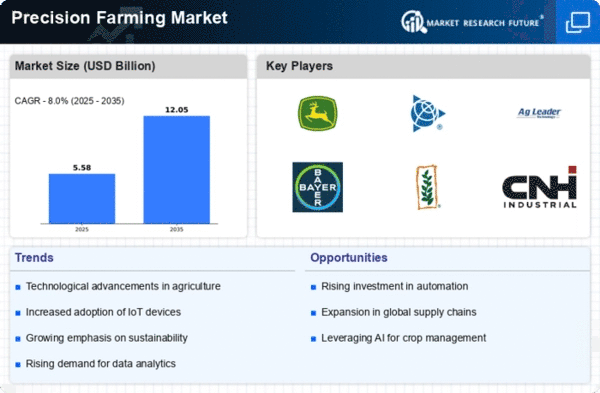
As per MRFR analysis, the Precision Farming Market Size was estimated at 5.17 USD Billion in 2024. The Precision Farming industry is projected to grow from 5.58 USD Billion in 2025 to 12.05 USD Billion by 2035, exhibiting a compound annual growth rate (CAGR) of 8.0% during the forecast period 2025 - 2035.

Key Market Trends & Highlights

The Precision Farming Market is experiencing robust growth driven by technological advancements and sustainability initiatives.

  • Technological integration is reshaping farming practices, particularly in North America, where the market is largest. A strong focus on sustainability is evident in the Asia-Pacific region, which is currently the fastest-growing market. Crop monitoring remains the largest segment, while soil management is emerging as the fastest-growing segment in precision farming. Technological advancements and government support are key drivers propelling the market forward.

Market Size & Forecast

2024 Market Size 5.17 (USD Billion)
2035 Market Size 12.05 (USD Billion)
CAGR (2025 - 2035) 8.0%
Largest Regional Market Share in 2024 North America

Major Players

John Deere (US), Trimble (US), AG Leader Technology (US), Bayer Crop Science (DE), Monsanto (US), CNH Industrial (GB), Topcon Positioning Systems (JP), Yara International (NO), Raven Industries (US), Precision Planting (US)

Market Trends

The Precision Farming Market is currently experiencing a transformative phase, driven by advancements in technology and a growing emphasis on sustainable agricultural practices. This sector encompasses a variety of innovative solutions, including precision irrigation, soil monitoring, and crop health assessment, which collectively enhance productivity and resource efficiency. As farmers increasingly adopt these technologies, the market is likely to witness a surge in demand for data-driven decision-making tools that optimize yields while minimizing environmental impact. Furthermore, the integration of artificial intelligence and machine learning into farming operations appears to be reshaping traditional agricultural methodologies, fostering a more precise and informed approach to farming. In addition to technological advancements, the Precision Farming Market is influenced by changing consumer preferences and regulatory frameworks that prioritize sustainability. Stakeholders are becoming more aware of the need for environmentally friendly practices, which may drive the adoption of precision agriculture techniques. This shift not only supports the efficient use of resources but also aligns with global efforts to combat climate change. As the market evolves, it seems poised to play a crucial role in addressing food security challenges while promoting responsible farming practices that benefit both producers and consumers alike.

Technological Integration

The incorporation of advanced technologies such as drones, sensors, and satellite imagery is revolutionizing the Precision Farming Market. These tools enable farmers to gather real-time data, facilitating informed decision-making and enhancing operational efficiency. As technology continues to evolve, its integration into agricultural practices is expected to deepen, potentially leading to more precise farming techniques.

Sustainability Focus

There is a growing emphasis on sustainable agricultural practices within the Precision Farming Market. Stakeholders are increasingly prioritizing methods that reduce environmental impact while maximizing productivity. This trend suggests a shift towards practices that not only enhance crop yields but also promote ecological balance, aligning with global sustainability goals.

Data-Driven Decision Making

The Precision Farming Market is witnessing a shift towards data-driven decision-making processes. Farmers are increasingly relying on analytics and insights derived from collected data to optimize their operations. This trend indicates a move away from traditional farming methods, as data becomes a central component in enhancing productivity and resource management.

Precision Farming Market Market Drivers

Technological Advancements

The Global Precision Farming Market Industry is experiencing rapid technological advancements, which are reshaping agricultural practices. Innovations such as drones, IoT devices, and AI-driven analytics are enhancing crop monitoring and management. For instance, the integration of satellite imagery and real-time data analytics allows farmers to make informed decisions regarding irrigation and fertilization. This technological evolution is projected to contribute significantly to the market's growth, with the industry expected to reach 9.01 USD Billion in 2024 and further expand to 22 USD Billion by 2035, reflecting a compound annual growth rate (CAGR) of 8.45% from 2025 to 2035.

Rising Adoption of Data Analytics

The rising adoption of data analytics in agriculture is significantly impacting the Global Precision Farming Market Industry. Farmers are increasingly utilizing data-driven insights to enhance decision-making processes related to crop management and resource allocation. The integration of big data analytics allows for precise forecasting and risk assessment, which can lead to improved yields and reduced costs. This trend is expected to contribute to the market's expansion, with projections indicating a growth from 9.01 USD Billion in 2024 to 22 USD Billion by 2035, supported by a CAGR of 8.45% from 2025 to 2035.

Government Initiatives and Support

Government initiatives aimed at promoting sustainable agriculture are playing a pivotal role in the Global Precision Farming Market Industry. Various countries are implementing policies that encourage the adoption of precision farming technologies through subsidies and grants. For example, programs that provide financial assistance for purchasing advanced farming equipment are becoming more prevalent. These initiatives not only support farmers in adopting innovative practices but also contribute to environmental sustainability. As a result, the market is expected to grow significantly, with projections indicating a rise from 9.01 USD Billion in 2024 to 22 USD Billion by 2035.

Increasing Demand for Food Security

As the global population continues to rise, the demand for food security intensifies, driving the Global Precision Farming Market Industry. Precision farming techniques enable farmers to maximize yield while minimizing resource usage, which is crucial in meeting the nutritional needs of an expanding population. The ability to produce more food with less land and water is becoming increasingly vital. This trend is likely to propel the market forward, as stakeholders recognize the importance of sustainable farming practices. The industry's growth is supported by the anticipated increase in market value from 9.01 USD Billion in 2024 to 22 USD Billion by 2035.

Environmental Sustainability Concerns

Growing concerns regarding environmental sustainability are influencing the Global Precision Farming Market Industry. Farmers are increasingly aware of the ecological impact of traditional farming practices, leading to a shift towards precision agriculture. This approach minimizes chemical usage and optimizes resource allocation, thereby reducing the carbon footprint of agricultural activities. The emphasis on sustainable practices is likely to drive market growth, as consumers and regulatory bodies demand more environmentally friendly solutions. The industry's value is projected to increase from 9.01 USD Billion in 2024 to 22 USD Billion by 2035, reflecting a broader commitment to sustainability.

Market Segment Insights

By Application: Crop Monitoring (Largest) vs. Soil Management (Fastest-Growing)

The precision farming market is witnessing a notable distribution in its application segment. Crop Monitoring is currently the largest segment, driven by the increasing demand for advanced crop management techniques that enhance yield and quality. Following closely, Soil Management is emerging as a significant player, leveraging technology to optimize soil health and fertility for sustainable agricultural practices.

Crop Monitoring (Dominant) vs. Soil Management (Emerging)

Crop Monitoring technology encompasses a wide array of tools and sensors that allow farmers to assess crop health, monitor growth, and predict yields with precision. This segment dominates the market due to its critical role in maximizing agricultural efficiency and productivity. In contrast, Soil Management is rapidly gaining traction as more farmers recognize the importance of soil health in growing high-quality crops. The demand for precision soil analysis and management tools is rising, driven by sustainable practices and regulatory pressure, making it an emerging segment that complements the established Crop Monitoring technology.

By Technology: Artificial Intelligence (Largest) vs. Internet of Things (Fastest-Growing)

<p>In the Precision Farming Market, the segment of Artificial Intelligence commands the largest market share, driving significant advancements in agricultural productivity and efficiency. Closely following are the Internet of Things (IoT), Global Navigation Satellite System, Remote Sensing, and Variable Rate Technology, each contributing unique functionalities to the precision farming ecosystem. IoT is rapidly gaining traction, especially among tech-savvy farmers, as it enhances the connectivity and communication of devices on the farm, facilitating better decision-making. The market for these technologies is driven by increasing demand for precision agriculture, the necessity to optimize resource use, and the growing adoption of automation in farming practices. Innovations like remote sensing and variable rate technology are transforming traditional farming methods. As data-driven solutions are becoming more integral, these technologies are expected to see consistent growth, especially in regions focused on sustainable agriculture and efficiency improvements.</p>

<p>Artificial Intelligence: (Dominant) vs. Internet of Things: (Emerging)</p>

<p>Artificial Intelligence in precision farming is characterized by its ability to analyze vast amounts of data from various sources, including soil conditions, weather patterns, and crop health. It enables farmers to make data-driven decisions that enhance efficiency and productivity through predictive analytics and machine learning. This dominance is driven by the growing need for sustainable agricultural practices and resource optimization. In contrast, the Internet of Things (IoT) represents an emerging technology that connects multiple devices and sensors on the farm, facilitating real-time monitoring and management. IoT's rapid adoption is driven by farmer demand for integrated solutions that provide actionable insights. While AI leads in influence and depth of application, IoT is quickly establishing itself as a requisite for modern precision farming.</p>

By End Use: Farmers (Largest) vs. Agricultural Cooperatives (Fastest-Growing)

<p>In the Precision Farming Market, the segment distribution reveals that Farmers hold the largest market share, primarily due to the increasing adoption of precision agriculture technologies that enhance crop yields and reduce resource consumption. Agricultural Cooperatives, while not as dominant, represent a significant portion of the market and are gaining traction as they facilitate the collective use of precision farming tools among their members, thus maximizing efficiency and cost-effectiveness. Growth trends for this segment are driven by a surge in technological advancements, particularly in IoT and data analytics, which allow Farmers to utilize smart farming techniques. Additionally, the rise of Agricultural Cooperatives as influential players in the market showcases a shift towards collaborative farming models, enabling smaller farmers to access precision farming technologies and methods that would otherwise be challenging to implement individually.</p>

<p>Farmers (Dominant) vs. Agribusinesses (Emerging)</p>

<p>Farmers are currently the dominant force in the Precision Farming Market, leveraging advanced technologies to optimize agricultural practices and enhance productivity. Their market position is bolstered by a growing awareness of sustainability and resource efficiency. Conversely, Agribusinesses are emerging as pivotal players, integrating precision farming solutions into their operational frameworks to achieve competitive advantages. They often drive innovation and adaptation of new technologies on large scales, which can influence industry standards and practices. The dynamics between these segments reflect a broader trend towards increased efficiency and the application of technology in agriculture, where Farmers benefit from direct technological application and Agribusinesses focus on strategic implementation within larger supply chains.</p>

Get more detailed insights about Precision Farming Market Research Report - Forecast to 2035

Regional Insights

North America : Market Leader in Precision Farming

North America is poised to maintain its leadership in the precision farming market, holding a significant share of 2.6 billion. The region's growth is driven by advanced agricultural technologies, increasing demand for food security, and supportive government policies promoting sustainable farming practices. The integration of IoT and AI in farming operations is also enhancing productivity and efficiency, making precision farming more attractive to farmers. The United States stands out as the leading country in this sector, with major players like John Deere, Trimble, and AG Leader Technology driving innovation. The competitive landscape is characterized by continuous advancements in technology and strategic partnerships among key players. The presence of robust agricultural infrastructure and investment in research and development further solidify North America's position in The Precision Farming.

Europe : Emerging Market with Growth Potential

Europe's precision farming market is valued at 1.5 billion, reflecting a growing trend towards sustainable agriculture and technological innovation. The region is witnessing increased adoption of precision farming techniques driven by stringent environmental regulations and the need for efficient resource management. Government initiatives aimed at enhancing agricultural productivity and sustainability are also key growth drivers, making Europe a significant player in this market. Leading countries such as Germany, France, and the Netherlands are at the forefront of this transformation, with companies like Bayer Crop Science and CNH Industrial leading the charge. The competitive landscape is marked by a strong emphasis on research and development, with numerous startups emerging to offer innovative solutions. The presence of established agricultural practices combined with cutting-edge technology positions Europe as a promising market for precision farming.

Asia-Pacific : Rapidly Growing Agricultural Sector

The Asia-Pacific region, with a market size of 0.9 billion, is rapidly emerging as a key player in precision farming. The growth is fueled by increasing population demands, the need for higher agricultural productivity, and the adoption of modern farming techniques. Governments in countries like China and India are implementing policies to support technological advancements in agriculture, which is further propelling market growth in this region. China and India are leading the charge in adopting precision farming technologies, with significant investments from both public and private sectors. Key players such as Topcon Positioning Systems and Yara International are expanding their presence in the region, contributing to a competitive landscape that is becoming increasingly dynamic. The focus on improving crop yields and resource efficiency is driving the adoption of precision farming practices across the Asia-Pacific region.

Middle East and Africa : Emerging Market with Challenges

The Middle East and Africa region, with a market size of 0.17 billion, presents unique challenges and opportunities in precision farming. The growth is primarily driven by the need for food security in arid regions and the increasing adoption of technology in agriculture. Governments are beginning to recognize the importance of precision farming in enhancing agricultural productivity, leading to gradual policy shifts in favor of modern farming practices. Countries like South Africa and Kenya are at the forefront of adopting precision farming technologies, with local startups and international companies exploring opportunities in this market. The competitive landscape is still developing, but the presence of key players like Raven Industries is helping to drive innovation. As awareness of the benefits of precision farming grows, the region is expected to see increased investment and adoption of these technologies in the coming years.

Key Players and Competitive Insights

The Precision Farming Market is currently characterized by a dynamic competitive landscape, driven by technological advancements and increasing demand for sustainable agricultural practices. Key players such as John Deere (US), Bayer Crop Science (DE), and Trimble (US) are at the forefront, each adopting distinct strategies to enhance their market positioning. John Deere (US) emphasizes innovation through the integration of AI and machine learning into its equipment, thereby improving operational efficiency and crop yield. Bayer Crop Science (DE) focuses on strategic partnerships and acquisitions to expand its product offerings and enhance its digital farming solutions, while Trimble (US) is leveraging its expertise in GPS technology to provide precision solutions that optimize resource use and reduce environmental impact. Collectively, these strategies contribute to a competitive environment that is increasingly centered around technological innovation and sustainability.
In terms of business tactics, companies are localizing manufacturing and optimizing supply chains to enhance responsiveness to market demands. The Precision Farming Market appears moderately fragmented, with a mix of established players and emerging startups. This structure allows for diverse offerings and competitive pricing, although the influence of key players remains substantial, shaping market trends and consumer preferences.
In November 2025, John Deere (US) announced a partnership with a leading AI firm to develop advanced predictive analytics tools for farmers. This strategic move is likely to enhance decision-making capabilities for farmers, enabling them to anticipate crop needs and optimize resource allocation. Such innovations may significantly improve productivity and sustainability in farming practices.
In October 2025, Bayer Crop Science (DE) launched a new digital platform aimed at integrating various agricultural technologies into a single user-friendly interface. This initiative is expected to streamline operations for farmers, allowing them to manage their resources more effectively. The platform's introduction signifies Bayer's commitment to enhancing digital transformation in agriculture, potentially setting a new standard for operational efficiency.
In September 2025, Trimble (US) expanded its precision agriculture solutions by acquiring a startup specializing in drone technology. This acquisition is anticipated to bolster Trimble's capabilities in aerial imaging and data collection, providing farmers with more comprehensive insights into crop health and field conditions. The integration of drone technology into precision farming could revolutionize data-driven decision-making processes.
As of December 2025, the Precision Farming Market is witnessing trends such as digitalization, sustainability, and AI integration, which are reshaping competitive dynamics. Strategic alliances among key players are fostering innovation and enhancing product offerings, indicating a shift towards collaboration over competition. The future of the market seems poised for a transition from price-based competition to a focus on technological advancements and supply chain reliability, suggesting that companies that prioritize innovation and sustainability will likely emerge as leaders in this evolving landscape.

Key Companies in the Precision Farming Market include

Industry Developments

  • Q2 2024: John Deere Launches New See & Spray™ Premium Technology for Precision Agriculture John Deere announced the launch of its See & Spray™ Premium technology, which uses advanced computer vision and machine learning to enable targeted spraying of crops, reducing herbicide use and improving efficiency in precision farming.
  • Q2 2024: CNH Industrial Acquires Augmenta to Expand Precision Farming Market Capabilities CNH Industrial completed the acquisition of Augmenta, a company specializing in real-time precision farming solutions, to enhance its portfolio of automated crop management technologies.
  • Q2 2024: Trimble and HORSCH Announce Strategic Collaboration to Advance Precision Agriculture Trimble and HORSCH entered a strategic partnership to integrate Trimble’s precision agriculture technologies with HORSCH’s machinery, aiming to deliver improved automation and data-driven solutions for farmers.
  • Q2 2024: AGCO Launches FendtONE Platform for Enhanced Precision Farming Market AGCO introduced the FendtONE platform, a new digital ecosystem that connects field and office operations, enabling farmers to manage precision farming tasks and data seamlessly.
  • Q3 2024: CNH Industrial Opens New Precision Technology Hub in Illinois CNH Industrial inaugurated a new technology hub in Illinois dedicated to developing and testing precision farming solutions, supporting innovation and product development in the sector.
  • Q3 2024: Raven Industries Unveils New OMNiDRIVE™ Autonomous Grain Cart System Raven Industries launched OMNiDRIVE™, an autonomous grain cart system designed to automate harvest logistics and improve efficiency for precision farming operations.
  • Q3 2024: Bayer and Microsoft Expand Digital Farming Partnership Bayer and Microsoft announced an expansion of their partnership to develop new digital tools for precision agriculture, focusing on data integration and cloud-based farm management solutions.
  • Q4 2024: Precision Ag Startup FarmWise Raises $45 Million Series C Funding FarmWise, a startup specializing in AI-powered precision weeding robots, secured $45 million in Series C funding to accelerate product development and expand its market reach.
  • Q4 2024: John Deere Announces Partnership with SpaceX for Satellite-Enabled Precision Farming Market John Deere partnered with SpaceX to leverage Starlink satellite connectivity, aiming to provide high-speed internet access for precision farming equipment in remote agricultural areas.
  • Q1 2025: CNH Industrial Launches New Autonomous Tractor for Precision Farming Market CNH Industrial introduced a new autonomous tractor equipped with advanced sensors and AI, designed to perform precision farming tasks with minimal human intervention.
  • Q1 2025: AGCO Announces Strategic Partnership with BASF for Digital Crop Management AGCO and BASF formed a strategic partnership to integrate BASF’s digital crop management tools with AGCO’s precision farming platforms, enhancing decision-making for farmers.
  • Q2 2025: Trimble Acquires Senceive to Boost Precision Agriculture Sensor Capabilities Trimble acquired Senceive, a provider of wireless sensor technology, to strengthen its precision agriculture offerings and improve real-time monitoring of field conditions.

Future Outlook

Precision Farming Market Future Outlook

The Precision Farming Market is projected to grow at an 8.0% CAGR from 2025 to 2035, driven by technological advancements, increasing demand for food, and sustainability initiatives.

New opportunities lie in:

  • Development of AI-driven crop monitoring systems
  • Expansion of precision irrigation technologies
  • Integration of blockchain for supply chain transparency

By 2035, the Precision Farming Market is expected to be robust, driven by innovation and increased adoption.

Market Segmentation

Precision Farming Market End Use Outlook

  • Farmers
  • Agricultural Cooperatives
  • Research Institutions
  • Government Agencies
  • Agribusinesses

Precision Farming Market Technology Outlook

  • Global Navigation Satellite System
  • Remote Sensing
  • Variable Rate Technology
  • Drone Technology
  • Internet of Things

Precision Farming Market Application Outlook

  • Crop Monitoring
  • Soil Management
  • Yield Mapping
  • Field Mapping
  • Weather Tracking

Report Scope

MARKET SIZE 2024 5.17(USD Billion)
MARKET SIZE 2025 5.58(USD Billion)
MARKET SIZE 2035 12.05(USD Billion)
COMPOUND ANNUAL GROWTH RATE (CAGR) 8.0% (2025 - 2035)
REPORT COVERAGE Revenue Forecast, Competitive Landscape, Growth Factors, and Trends
BASE YEAR 2024
Market Forecast Period 2025 - 2035
Historical Data 2019 - 2024
Market Forecast Units USD Billion
Key Companies Profiled John Deere (US), Trimble (US), AG Leader Technology (US), Bayer Crop Science (DE), Monsanto (US), CNH Industrial (GB), Topcon Positioning Systems (JP), Yara International (NO), Raven Industries (US), Precision Planting (US)
Segments Covered Application, Technology, End Use
Key Market Opportunities Integration of artificial intelligence and machine learning enhances decision-making in the Precision Farming Market.
Key Market Dynamics Technological advancements drive adoption of precision farming, enhancing efficiency and sustainability in agricultural practices.
Countries Covered North America, Europe, APAC, South America, MEA

FAQs

What is the current valuation of the Precision Farming Market as of 2024?

<p>The Precision Farming Market was valued at 5.17 USD Billion in 2024.</p>

What is the projected market size for the Precision Farming Market by 2035?

<p>The market is projected to reach 12.05 USD Billion by 2035.</p>

What is the expected CAGR for the Precision Farming Market during the forecast period 2025 - 2035?

<p>The expected CAGR for the Precision Farming Market during 2025 - 2035 is 8.0%.</p>

Which application segment is anticipated to grow the most in the Precision Farming Market?

<p>The Crop Monitoring segment is expected to grow from 1.55 USD Billion in 2024 to 3.5 USD Billion by 2035.</p>

How does the Soil Management segment perform in terms of market valuation?

<p>The Soil Management segment was valued at 1.2 USD Billion in 2024 and is projected to reach 2.8 USD Billion by 2035.</p>

What are the key technologies driving the Precision Farming Market?

<p>Key technologies include Global Navigation Satellite System, Remote Sensing, and Artificial Intelligence, with valuations expected to rise significantly by 2035.</p>

Who are the leading players in the Precision Farming Market?

<p>Key players include John Deere, Trimble, AG Leader Technology, Bayer, and Monsanto, among others.</p>

What is the projected growth for the Internet of Things segment in the Precision Farming Market?

<p>The Internet of Things segment is expected to grow from 1.23 USD Billion in 2024 to 2.8 USD Billion by 2035.</p>

Which end-use segment is likely to dominate the Precision Farming Market?

<p>The Farmers segment is projected to grow from 1.55 USD Billion in 2024 to 3.6 USD Billion by 2035.</p>

What is the anticipated growth for the Variable Rate Technology segment?

<p>The Variable Rate Technology segment is expected to increase from 1.05 USD Billion in 2024 to 2.5 USD Billion by 2035.</p>

  1. SECTION I: EXECUTIVE SUMMARY AND KEY HIGHLIGHTS
    1. | 1.1 EXECUTIVE SUMMARY
    2. | | 1.1.1 Market Overview
    3. | | 1.1.2 Key Findings
    4. | | 1.1.3 Market Segmentation
    5. | | 1.1.4 Competitive Landscape
    6. | | 1.1.5 Challenges and Opportunities
    7. | | 1.1.6 Future Outlook
  2. SECTION II: SCOPING, METHODOLOGY AND MARKET STRUCTURE
    1. | 2.1 MARKET INTRODUCTION
    2. | | 2.1.1 Definition
    3. | | 2.1.2 Scope of the study
    4. | | | 2.1.2.1 Research Objective
    5. | | | 2.1.2.2 Assumption
    6. | | | 2.1.2.3 Limitations
    7. | 2.2 RESEARCH METHODOLOGY
    8. | | 2.2.1 Overview
    9. | | 2.2.2 Data Mining
    10. | | 2.2.3 Secondary Research
    11. | | 2.2.4 Primary Research
    12. | | | 2.2.4.1 Primary Interviews and Information Gathering Process
    13. | | | 2.2.4.2 Breakdown of Primary Respondents
    14. | | 2.2.5 Forecasting Model
    15. | | 2.2.6 Market Size Estimation
    16. | | | 2.2.6.1 Bottom-Up Approach
    17. | | | 2.2.6.2 Top-Down Approach
    18. | | 2.2.7 Data Triangulation
    19. | | 2.2.8 Validation
  3. SECTION III: QUALITATIVE ANALYSIS
    1. | 3.1 MARKET DYNAMICS
    2. | | 3.1.1 Overview
    3. | | 3.1.2 Drivers
    4. | | 3.1.3 Restraints
    5. | | 3.1.4 Opportunities
    6. | 3.2 MARKET FACTOR ANALYSIS
    7. | | 3.2.1 Value chain Analysis
    8. | | 3.2.2 Porter's Five Forces Analysis
    9. | | | 3.2.2.1 Bargaining Power of Suppliers
    10. | | | 3.2.2.2 Bargaining Power of Buyers
    11. | | | 3.2.2.3 Threat of New Entrants
    12. | | | 3.2.2.4 Threat of Substitutes
    13. | | | 3.2.2.5 Intensity of Rivalry
    14. | | 3.2.3 COVID-19 Impact Analysis
    15. | | | 3.2.3.1 Market Impact Analysis
    16. | | | 3.2.3.2 Regional Impact
    17. | | | 3.2.3.3 Opportunity and Threat Analysis
  4. SECTION IV: QUANTITATIVE ANALYSIS
    1. | 4.1 Semiconductor & Electronics, BY Application (USD Billion)
    2. | | 4.1.1 Crop Monitoring
    3. | | 4.1.2 Soil Management
    4. | | 4.1.3 Yield Mapping
    5. | | 4.1.4 Field Mapping
    6. | | 4.1.5 Weather Tracking
    7. | 4.2 Semiconductor & Electronics, BY Technology (USD Billion)
    8. | | 4.2.1 Global Navigation Satellite System
    9. | | 4.2.2 Remote Sensing
    10. | | 4.2.3 Variable Rate Technology
    11. | | 4.2.4 Internet of Things
    12. | | 4.2.5 Artificial Intelligence
    13. | 4.3 Semiconductor & Electronics, BY End Use (USD Billion)
    14. | | 4.3.1 Farmers
    15. | | 4.3.2 Agricultural Cooperatives
    16. | | 4.3.3 Research Institutions
    17. | | 4.3.4 Government Agencies
    18. | | 4.3.5 Agribusinesses
    19. | 4.4 Semiconductor & Electronics, BY Region (USD Billion)
    20. | | 4.4.1 North America
    21. | | | 4.4.1.1 US
    22. | | | 4.4.1.2 Canada
    23. | | 4.4.2 Europe
    24. | | | 4.4.2.1 Germany
    25. | | | 4.4.2.2 UK
    26. | | | 4.4.2.3 France
    27. | | | 4.4.2.4 Russia
    28. | | | 4.4.2.5 Italy
    29. | | | 4.4.2.6 Spain
    30. | | | 4.4.2.7 Rest of Europe
    31. | | 4.4.3 APAC
    32. | | | 4.4.3.1 China
    33. | | | 4.4.3.2 India
    34. | | | 4.4.3.3 Japan
    35. | | | 4.4.3.4 South Korea
    36. | | | 4.4.3.5 Malaysia
    37. | | | 4.4.3.6 Thailand
    38. | | | 4.4.3.7 Indonesia
    39. | | | 4.4.3.8 Rest of APAC
    40. | | 4.4.4 South America
    41. | | | 4.4.4.1 Brazil
    42. | | | 4.4.4.2 Mexico
    43. | | | 4.4.4.3 Argentina
    44. | | | 4.4.4.4 Rest of South America
    45. | | 4.4.5 MEA
    46. | | | 4.4.5.1 GCC Countries
    47. | | | 4.4.5.2 South Africa
    48. | | | 4.4.5.3 Rest of MEA
  5. SECTION V: COMPETITIVE ANALYSIS
    1. | 5.1 Competitive Landscape
    2. | | 5.1.1 Overview
    3. | | 5.1.2 Competitive Analysis
    4. | | 5.1.3 Market share Analysis
    5. | | 5.1.4 Major Growth Strategy in the Semiconductor & Electronics
    6. | | 5.1.5 Competitive Benchmarking
    7. | | 5.1.6 Leading Players in Terms of Number of Developments in the Semiconductor & Electronics
    8. | | 5.1.7 Key developments and growth strategies
    9. | | | 5.1.7.1 New Product Launch/Service Deployment
    10. | | | 5.1.7.2 Merger & Acquisitions
    11. | | | 5.1.7.3 Joint Ventures
    12. | | 5.1.8 Major Players Financial Matrix
    13. | | | 5.1.8.1 Sales and Operating Income
    14. | | | 5.1.8.2 Major Players R&D Expenditure. 2023
    15. | 5.2 Company Profiles
    16. | | 5.2.1 John Deere (US)
    17. | | | 5.2.1.1 Financial Overview
    18. | | | 5.2.1.2 Products Offered
    19. | | | 5.2.1.3 Key Developments
    20. | | | 5.2.1.4 SWOT Analysis
    21. | | | 5.2.1.5 Key Strategies
    22. | | 5.2.2 Trimble (US)
    23. | | | 5.2.2.1 Financial Overview
    24. | | | 5.2.2.2 Products Offered
    25. | | | 5.2.2.3 Key Developments
    26. | | | 5.2.2.4 SWOT Analysis
    27. | | | 5.2.2.5 Key Strategies
    28. | | 5.2.3 AG Leader Technology (US)
    29. | | | 5.2.3.1 Financial Overview
    30. | | | 5.2.3.2 Products Offered
    31. | | | 5.2.3.3 Key Developments
    32. | | | 5.2.3.4 SWOT Analysis
    33. | | | 5.2.3.5 Key Strategies
    34. | | 5.2.4 Bayer (DE)
    35. | | | 5.2.4.1 Financial Overview
    36. | | | 5.2.4.2 Products Offered
    37. | | | 5.2.4.3 Key Developments
    38. | | | 5.2.4.4 SWOT Analysis
    39. | | | 5.2.4.5 Key Strategies
    40. | | 5.2.5 Monsanto (US)
    41. | | | 5.2.5.1 Financial Overview
    42. | | | 5.2.5.2 Products Offered
    43. | | | 5.2.5.3 Key Developments
    44. | | | 5.2.5.4 SWOT Analysis
    45. | | | 5.2.5.5 Key Strategies
    46. | | 5.2.6 CNH Industrial (GB)
    47. | | | 5.2.6.1 Financial Overview
    48. | | | 5.2.6.2 Products Offered
    49. | | | 5.2.6.3 Key Developments
    50. | | | 5.2.6.4 SWOT Analysis
    51. | | | 5.2.6.5 Key Strategies
    52. | | 5.2.7 Topcon Positioning Systems (JP)
    53. | | | 5.2.7.1 Financial Overview
    54. | | | 5.2.7.2 Products Offered
    55. | | | 5.2.7.3 Key Developments
    56. | | | 5.2.7.4 SWOT Analysis
    57. | | | 5.2.7.5 Key Strategies
    58. | | 5.2.8 Yara International (NO)
    59. | | | 5.2.8.1 Financial Overview
    60. | | | 5.2.8.2 Products Offered
    61. | | | 5.2.8.3 Key Developments
    62. | | | 5.2.8.4 SWOT Analysis
    63. | | | 5.2.8.5 Key Strategies
    64. | | 5.2.9 Raven Industries (US)
    65. | | | 5.2.9.1 Financial Overview
    66. | | | 5.2.9.2 Products Offered
    67. | | | 5.2.9.3 Key Developments
    68. | | | 5.2.9.4 SWOT Analysis
    69. | | | 5.2.9.5 Key Strategies
    70. | 5.3 Appendix
    71. | | 5.3.1 References
    72. | | 5.3.2 Related Reports
  6. LIST OF FIGURES
    1. | 6.1 MARKET SYNOPSIS
    2. | 6.2 NORTH AMERICA MARKET ANALYSIS
    3. | 6.3 US MARKET ANALYSIS BY APPLICATION
    4. | 6.4 US MARKET ANALYSIS BY TECHNOLOGY
    5. | 6.5 US MARKET ANALYSIS BY END USE
    6. | 6.6 CANADA MARKET ANALYSIS BY APPLICATION
    7. | 6.7 CANADA MARKET ANALYSIS BY TECHNOLOGY
    8. | 6.8 CANADA MARKET ANALYSIS BY END USE
    9. | 6.9 EUROPE MARKET ANALYSIS
    10. | 6.10 GERMANY MARKET ANALYSIS BY APPLICATION
    11. | 6.11 GERMANY MARKET ANALYSIS BY TECHNOLOGY
    12. | 6.12 GERMANY MARKET ANALYSIS BY END USE
    13. | 6.13 UK MARKET ANALYSIS BY APPLICATION
    14. | 6.14 UK MARKET ANALYSIS BY TECHNOLOGY
    15. | 6.15 UK MARKET ANALYSIS BY END USE
    16. | 6.16 FRANCE MARKET ANALYSIS BY APPLICATION
    17. | 6.17 FRANCE MARKET ANALYSIS BY TECHNOLOGY
    18. | 6.18 FRANCE MARKET ANALYSIS BY END USE
    19. | 6.19 RUSSIA MARKET ANALYSIS BY APPLICATION
    20. | 6.20 RUSSIA MARKET ANALYSIS BY TECHNOLOGY
    21. | 6.21 RUSSIA MARKET ANALYSIS BY END USE
    22. | 6.22 ITALY MARKET ANALYSIS BY APPLICATION
    23. | 6.23 ITALY MARKET ANALYSIS BY TECHNOLOGY
    24. | 6.24 ITALY MARKET ANALYSIS BY END USE
    25. | 6.25 SPAIN MARKET ANALYSIS BY APPLICATION
    26. | 6.26 SPAIN MARKET ANALYSIS BY TECHNOLOGY
    27. | 6.27 SPAIN MARKET ANALYSIS BY END USE
    28. | 6.28 REST OF EUROPE MARKET ANALYSIS BY APPLICATION
    29. | 6.29 REST OF EUROPE MARKET ANALYSIS BY TECHNOLOGY
    30. | 6.30 REST OF EUROPE MARKET ANALYSIS BY END USE
    31. | 6.31 APAC MARKET ANALYSIS
    32. | 6.32 CHINA MARKET ANALYSIS BY APPLICATION
    33. | 6.33 CHINA MARKET ANALYSIS BY TECHNOLOGY
    34. | 6.34 CHINA MARKET ANALYSIS BY END USE
    35. | 6.35 INDIA MARKET ANALYSIS BY APPLICATION
    36. | 6.36 INDIA MARKET ANALYSIS BY TECHNOLOGY
    37. | 6.37 INDIA MARKET ANALYSIS BY END USE
    38. | 6.38 JAPAN MARKET ANALYSIS BY APPLICATION
    39. | 6.39 JAPAN MARKET ANALYSIS BY TECHNOLOGY
    40. | 6.40 JAPAN MARKET ANALYSIS BY END USE
    41. | 6.41 SOUTH KOREA MARKET ANALYSIS BY APPLICATION
    42. | 6.42 SOUTH KOREA MARKET ANALYSIS BY TECHNOLOGY
    43. | 6.43 SOUTH KOREA MARKET ANALYSIS BY END USE
    44. | 6.44 MALAYSIA MARKET ANALYSIS BY APPLICATION
    45. | 6.45 MALAYSIA MARKET ANALYSIS BY TECHNOLOGY
    46. | 6.46 MALAYSIA MARKET ANALYSIS BY END USE
    47. | 6.47 THAILAND MARKET ANALYSIS BY APPLICATION
    48. | 6.48 THAILAND MARKET ANALYSIS BY TECHNOLOGY
    49. | 6.49 THAILAND MARKET ANALYSIS BY END USE
    50. | 6.50 INDONESIA MARKET ANALYSIS BY APPLICATION
    51. | 6.51 INDONESIA MARKET ANALYSIS BY TECHNOLOGY
    52. | 6.52 INDONESIA MARKET ANALYSIS BY END USE
    53. | 6.53 REST OF APAC MARKET ANALYSIS BY APPLICATION
    54. | 6.54 REST OF APAC MARKET ANALYSIS BY TECHNOLOGY
    55. | 6.55 REST OF APAC MARKET ANALYSIS BY END USE
    56. | 6.56 SOUTH AMERICA MARKET ANALYSIS
    57. | 6.57 BRAZIL MARKET ANALYSIS BY APPLICATION
    58. | 6.58 BRAZIL MARKET ANALYSIS BY TECHNOLOGY
    59. | 6.59 BRAZIL MARKET ANALYSIS BY END USE
    60. | 6.60 MEXICO MARKET ANALYSIS BY APPLICATION
    61. | 6.61 MEXICO MARKET ANALYSIS BY TECHNOLOGY
    62. | 6.62 MEXICO MARKET ANALYSIS BY END USE
    63. | 6.63 ARGENTINA MARKET ANALYSIS BY APPLICATION
    64. | 6.64 ARGENTINA MARKET ANALYSIS BY TECHNOLOGY
    65. | 6.65 ARGENTINA MARKET ANALYSIS BY END USE
    66. | 6.66 REST OF SOUTH AMERICA MARKET ANALYSIS BY APPLICATION
    67. | 6.67 REST OF SOUTH AMERICA MARKET ANALYSIS BY TECHNOLOGY
    68. | 6.68 REST OF SOUTH AMERICA MARKET ANALYSIS BY END USE
    69. | 6.69 MEA MARKET ANALYSIS
    70. | 6.70 GCC COUNTRIES MARKET ANALYSIS BY APPLICATION
    71. | 6.71 GCC COUNTRIES MARKET ANALYSIS BY TECHNOLOGY
    72. | 6.72 GCC COUNTRIES MARKET ANALYSIS BY END USE
    73. | 6.73 SOUTH AFRICA MARKET ANALYSIS BY APPLICATION
    74. | 6.74 SOUTH AFRICA MARKET ANALYSIS BY TECHNOLOGY
    75. | 6.75 SOUTH AFRICA MARKET ANALYSIS BY END USE
    76. | 6.76 REST OF MEA MARKET ANALYSIS BY APPLICATION
    77. | 6.77 REST OF MEA MARKET ANALYSIS BY TECHNOLOGY
    78. | 6.78 REST OF MEA MARKET ANALYSIS BY END USE
    79. | 6.79 KEY BUYING CRITERIA OF SEMICONDUCTOR & ELECTRONICS
    80. | 6.80 RESEARCH PROCESS OF MRFR
    81. | 6.81 DRO ANALYSIS OF SEMICONDUCTOR & ELECTRONICS
    82. | 6.82 DRIVERS IMPACT ANALYSIS: SEMICONDUCTOR & ELECTRONICS
    83. | 6.83 RESTRAINTS IMPACT ANALYSIS: SEMICONDUCTOR & ELECTRONICS
    84. | 6.84 SUPPLY / VALUE CHAIN: SEMICONDUCTOR & ELECTRONICS
    85. | 6.85 SEMICONDUCTOR & ELECTRONICS, BY APPLICATION, 2024 (% SHARE)
    86. | 6.86 SEMICONDUCTOR & ELECTRONICS, BY APPLICATION, 2024 TO 2035 (USD Billion)
    87. | 6.87 SEMICONDUCTOR & ELECTRONICS, BY TECHNOLOGY, 2024 (% SHARE)
    88. | 6.88 SEMICONDUCTOR & ELECTRONICS, BY TECHNOLOGY, 2024 TO 2035 (USD Billion)
    89. | 6.89 SEMICONDUCTOR & ELECTRONICS, BY END USE, 2024 (% SHARE)
    90. | 6.90 SEMICONDUCTOR & ELECTRONICS, BY END USE, 2024 TO 2035 (USD Billion)
    91. | 6.91 BENCHMARKING OF MAJOR COMPETITORS
  7. LIST OF TABLES
    1. | 7.1 LIST OF ASSUMPTIONS
    2. | | 7.1.1
    3. | 7.2 North America MARKET SIZE ESTIMATES; FORECAST
    4. | | 7.2.1 BY APPLICATION, 2025-2035 (USD Billion)
    5. | | 7.2.2 BY TECHNOLOGY, 2025-2035 (USD Billion)
    6. | | 7.2.3 BY END USE, 2025-2035 (USD Billion)
    7. | 7.3 US MARKET SIZE ESTIMATES; FORECAST
    8. | | 7.3.1 BY APPLICATION, 2025-2035 (USD Billion)
    9. | | 7.3.2 BY TECHNOLOGY, 2025-2035 (USD Billion)
    10. | | 7.3.3 BY END USE, 2025-2035 (USD Billion)
    11. | 7.4 Canada MARKET SIZE ESTIMATES; FORECAST
    12. | | 7.4.1 BY APPLICATION, 2025-2035 (USD Billion)
    13. | | 7.4.2 BY TECHNOLOGY, 2025-2035 (USD Billion)
    14. | | 7.4.3 BY END USE, 2025-2035 (USD Billion)
    15. | 7.5 Europe MARKET SIZE ESTIMATES; FORECAST
    16. | | 7.5.1 BY APPLICATION, 2025-2035 (USD Billion)
    17. | | 7.5.2 BY TECHNOLOGY, 2025-2035 (USD Billion)
    18. | | 7.5.3 BY END USE, 2025-2035 (USD Billion)
    19. | 7.6 Germany MARKET SIZE ESTIMATES; FORECAST
    20. | | 7.6.1 BY APPLICATION, 2025-2035 (USD Billion)
    21. | | 7.6.2 BY TECHNOLOGY, 2025-2035 (USD Billion)
    22. | | 7.6.3 BY END USE, 2025-2035 (USD Billion)
    23. | 7.7 UK MARKET SIZE ESTIMATES; FORECAST
    24. | | 7.7.1 BY APPLICATION, 2025-2035 (USD Billion)
    25. | | 7.7.2 BY TECHNOLOGY, 2025-2035 (USD Billion)
    26. | | 7.7.3 BY END USE, 2025-2035 (USD Billion)
    27. | 7.8 France MARKET SIZE ESTIMATES; FORECAST
    28. | | 7.8.1 BY APPLICATION, 2025-2035 (USD Billion)
    29. | | 7.8.2 BY TECHNOLOGY, 2025-2035 (USD Billion)
    30. | | 7.8.3 BY END USE, 2025-2035 (USD Billion)
    31. | 7.9 Russia MARKET SIZE ESTIMATES; FORECAST
    32. | | 7.9.1 BY APPLICATION, 2025-2035 (USD Billion)
    33. | | 7.9.2 BY TECHNOLOGY, 2025-2035 (USD Billion)
    34. | | 7.9.3 BY END USE, 2025-2035 (USD Billion)
    35. | 7.10 Italy MARKET SIZE ESTIMATES; FORECAST
    36. | | 7.10.1 BY APPLICATION, 2025-2035 (USD Billion)
    37. | | 7.10.2 BY TECHNOLOGY, 2025-2035 (USD Billion)
    38. | | 7.10.3 BY END USE, 2025-2035 (USD Billion)
    39. | 7.11 Spain MARKET SIZE ESTIMATES; FORECAST
    40. | | 7.11.1 BY APPLICATION, 2025-2035 (USD Billion)
    41. | | 7.11.2 BY TECHNOLOGY, 2025-2035 (USD Billion)
    42. | | 7.11.3 BY END USE, 2025-2035 (USD Billion)
    43. | 7.12 Rest of Europe MARKET SIZE ESTIMATES; FORECAST
    44. | | 7.12.1 BY APPLICATION, 2025-2035 (USD Billion)
    45. | | 7.12.2 BY TECHNOLOGY, 2025-2035 (USD Billion)
    46. | | 7.12.3 BY END USE, 2025-2035 (USD Billion)
    47. | 7.13 APAC MARKET SIZE ESTIMATES; FORECAST
    48. | | 7.13.1 BY APPLICATION, 2025-2035 (USD Billion)
    49. | | 7.13.2 BY TECHNOLOGY, 2025-2035 (USD Billion)
    50. | | 7.13.3 BY END USE, 2025-2035 (USD Billion)
    51. | 7.14 China MARKET SIZE ESTIMATES; FORECAST
    52. | | 7.14.1 BY APPLICATION, 2025-2035 (USD Billion)
    53. | | 7.14.2 BY TECHNOLOGY, 2025-2035 (USD Billion)
    54. | | 7.14.3 BY END USE, 2025-2035 (USD Billion)
    55. | 7.15 India MARKET SIZE ESTIMATES; FORECAST
    56. | | 7.15.1 BY APPLICATION, 2025-2035 (USD Billion)
    57. | | 7.15.2 BY TECHNOLOGY, 2025-2035 (USD Billion)
    58. | | 7.15.3 BY END USE, 2025-2035 (USD Billion)
    59. | 7.16 Japan MARKET SIZE ESTIMATES; FORECAST
    60. | | 7.16.1 BY APPLICATION, 2025-2035 (USD Billion)
    61. | | 7.16.2 BY TECHNOLOGY, 2025-2035 (USD Billion)
    62. | | 7.16.3 BY END USE, 2025-2035 (USD Billion)
    63. | 7.17 South Korea MARKET SIZE ESTIMATES; FORECAST
    64. | | 7.17.1 BY APPLICATION, 2025-2035 (USD Billion)
    65. | | 7.17.2 BY TECHNOLOGY, 2025-2035 (USD Billion)
    66. | | 7.17.3 BY END USE, 2025-2035 (USD Billion)
    67. | 7.18 Malaysia MARKET SIZE ESTIMATES; FORECAST
    68. | | 7.18.1 BY APPLICATION, 2025-2035 (USD Billion)
    69. | | 7.18.2 BY TECHNOLOGY, 2025-2035 (USD Billion)
    70. | | 7.18.3 BY END USE, 2025-2035 (USD Billion)
    71. | 7.19 Thailand MARKET SIZE ESTIMATES; FORECAST
    72. | | 7.19.1 BY APPLICATION, 2025-2035 (USD Billion)
    73. | | 7.19.2 BY TECHNOLOGY, 2025-2035 (USD Billion)
    74. | | 7.19.3 BY END USE, 2025-2035 (USD Billion)
    75. | 7.20 Indonesia MARKET SIZE ESTIMATES; FORECAST
    76. | | 7.20.1 BY APPLICATION, 2025-2035 (USD Billion)
    77. | | 7.20.2 BY TECHNOLOGY, 2025-2035 (USD Billion)
    78. | | 7.20.3 BY END USE, 2025-2035 (USD Billion)
    79. | 7.21 Rest of APAC MARKET SIZE ESTIMATES; FORECAST
    80. | | 7.21.1 BY APPLICATION, 2025-2035 (USD Billion)
    81. | | 7.21.2 BY TECHNOLOGY, 2025-2035 (USD Billion)
    82. | | 7.21.3 BY END USE, 2025-2035 (USD Billion)
    83. | 7.22 South America MARKET SIZE ESTIMATES; FORECAST
    84. | | 7.22.1 BY APPLICATION, 2025-2035 (USD Billion)
    85. | | 7.22.2 BY TECHNOLOGY, 2025-2035 (USD Billion)
    86. | | 7.22.3 BY END USE, 2025-2035 (USD Billion)
    87. | 7.23 Brazil MARKET SIZE ESTIMATES; FORECAST
    88. | | 7.23.1 BY APPLICATION, 2025-2035 (USD Billion)
    89. | | 7.23.2 BY TECHNOLOGY, 2025-2035 (USD Billion)
    90. | | 7.23.3 BY END USE, 2025-2035 (USD Billion)
    91. | 7.24 Mexico MARKET SIZE ESTIMATES; FORECAST
    92. | | 7.24.1 BY APPLICATION, 2025-2035 (USD Billion)
    93. | | 7.24.2 BY TECHNOLOGY, 2025-2035 (USD Billion)
    94. | | 7.24.3 BY END USE, 2025-2035 (USD Billion)
    95. | 7.25 Argentina MARKET SIZE ESTIMATES; FORECAST
    96. | | 7.25.1 BY APPLICATION, 2025-2035 (USD Billion)
    97. | | 7.25.2 BY TECHNOLOGY, 2025-2035 (USD Billion)
    98. | | 7.25.3 BY END USE, 2025-2035 (USD Billion)
    99. | 7.26 Rest of South America MARKET SIZE ESTIMATES; FORECAST
    100. | | 7.26.1 BY APPLICATION, 2025-2035 (USD Billion)
    101. | | 7.26.2 BY TECHNOLOGY, 2025-2035 (USD Billion)
    102. | | 7.26.3 BY END USE, 2025-2035 (USD Billion)
    103. | 7.27 MEA MARKET SIZE ESTIMATES; FORECAST
    104. | | 7.27.1 BY APPLICATION, 2025-2035 (USD Billion)
    105. | | 7.27.2 BY TECHNOLOGY, 2025-2035 (USD Billion)
    106. | | 7.27.3 BY END USE, 2025-2035 (USD Billion)
    107. | 7.28 GCC Countries MARKET SIZE ESTIMATES; FORECAST
    108. | | 7.28.1 BY APPLICATION, 2025-2035 (USD Billion)
    109. | | 7.28.2 BY TECHNOLOGY, 2025-2035 (USD Billion)
    110. | | 7.28.3 BY END USE, 2025-2035 (USD Billion)
    111. | 7.29 South Africa MARKET SIZE ESTIMATES; FORECAST
    112. | | 7.29.1 BY APPLICATION, 2025-2035 (USD Billion)
    113. | | 7.29.2 BY TECHNOLOGY, 2025-2035 (USD Billion)
    114. | | 7.29.3 BY END USE, 2025-2035 (USD Billion)
    115. | 7.30 Rest of MEA MARKET SIZE ESTIMATES; FORECAST
    116. | | 7.30.1 BY APPLICATION, 2025-2035 (USD Billion)
    117. | | 7.30.2 BY TECHNOLOGY, 2025-2035 (USD Billion)
    118. | | 7.30.3 BY END USE, 2025-2035 (USD Billion)
    119. | 7.31 PRODUCT LAUNCH/PRODUCT DEVELOPMENT/APPROVAL
    120. | | 7.31.1
    121. | 7.32 ACQUISITION/PARTNERSHIP
    122. | | 7.32.1

Semiconductor & Electronics Market Segmentation

Semiconductor & Electronics By Application (USD Billion, 2025-2035)

  • Crop Monitoring
  • Soil Management
  • Yield Mapping
  • Field Mapping
  • Weather Tracking

Semiconductor & Electronics By Technology (USD Billion, 2025-2035)

  • Global Navigation Satellite System
  • Remote Sensing
  • Variable Rate Technology
  • Internet of Things
  • Artificial Intelligence

Semiconductor & Electronics By End Use (USD Billion, 2025-2035)

  • Farmers
  • Agricultural Cooperatives
  • Research Institutions
  • Government Agencies
  • Agribusinesses
Infographic

Free Sample Request

Kindly complete the form below to receive a free sample of this Report

Get Free Sample

Customer Strories

Compare Licence

×
Features License Type
Single User Multiuser License Enterprise User
Price $4,950 $5,950 $7,250
Maximum User Access Limit 1 User Upto 10 Users Unrestricted Access Throughout the Organization
Free Customization
Direct Access to Analyst
Deliverable Format
Platform Access
Discount on Next Purchase 10% 15% 15%
Printable Versions