×
Request Free Sample ×

Kindly complete the form below to receive a free sample of this Report

* Please use a valid business email

Leading companies partner with us for data-driven Insights

clients tt-cursor
Hero Background
English
Chinese
French
Japanese
Korean
German
Spanish

Power Tools Market Size

ID: MRFR/Equip/2429-CR
147 Pages
Sakshi Gupta
April 2023

Power Tools Market Size, Share & Growth Analysis Report by Machine Type (Drilling Tools, Cutting/Sawing Tools, Fastening Tools, Breaker Tools, Others) By Mode of Operation (Electric, Hydraulic, Pneumatic, Others), By Mobility (Stationery, and Portable), By Application (Residential, Commercial, and Industrial), And by Region (North America, Europe, Asia-Pacific, and Rest of World) - Trends & Industry Forecast to 2035

Share:
Download PDF ×

We do not share your information with anyone. However, we may send you emails based on your report interest from time to time. You may contact us at any time to opt-out.

Power Tools Market Infographic
Purchase Options

Power Tools Size

Power Tools Market Growth Projections and Opportunities

The Call Control market, encompassing both conventional Private Branch Exchange (PBX) and Internet Convention (IP) PBX systems, is influenced by different variables that shape its elements and development. One of the key drivers is the continuous progress from legacy PBX to IP PBX arrangements. As businesses seek more flexible and scalable correspondence systems, IP PBX offers advantages like expense effectiveness, remote accessibility, and seamless integration with other advanced applications. The shift towards IP-based correspondence reflects a broader trend in the business, lining up with the developing importance of computerized change. Features like video conferencing, mobile integration, and advanced call steering contribute to the appeal of these systems, making them more attractive to businesses searching for comprehensive correspondence arrangements. The size and nature of businesses influence the demand for Call Control arrangements. Small and medium-sized enterprises often seek practical and easy-to-manage PBX systems, while larger enterprises require more sophisticated IP PBX arrangements with extensive adaptability and integration capabilities. Understanding the diverse needs of businesses of different sizes is essential for market players to appropriately tailor their offerings. During periods of economic development, businesses might be more inclined to invest in advanced correspondence systems to improve efficiency and joint effort. Conversely, economic slumps might lead to an emphasis on practical arrangements, driving demand for PBX systems that offer essential functionalities without excessive expenses. Global and regional trends likewise shape the Call Control market. The rise of remote work, accelerated by global events like the Coronavirus pandemic, has increased the demand for flexible correspondence arrangements. Both PBX and IP PBX systems assume a crucial part in enabling remote correspondence and cooperation, making them essential devices in the evolving work landscape.

Power Tools Market Size Graph
Author
Sakshi Gupta
Research Analyst Level II

I have about two years of experience working in the consumer goods and retail industries and I am a biotech graduate.A tech-savvy analytically focused professional with a strong capabilities in identification, concept generation, and strategy evaluation. I can produce data-driven solutions while fusing unusual viewpoints with original concepts. I have been extensively working on business case studies, competitive & comparative analyses, and strategic reports. My primary areas of experience include client management, financial analysis, supply chain evaluation, market entry strategy evaluation, and estimating and forecasting market size.

Leave a Comment

FAQs

How much is the Power Tools Market?

The Power Tools Market crossed a valuation of USD 40,344.4 billion in 2023.

How Big is the U.S Power Tools Market?

The U.S Power Tools Market is valued at USD 13,126.9 million in 2021.

What is the growth rate of the Power Tools Market?

6.26% CAGR is the growth rate of the Power Tools Market.

Which region held the largest market share in the Power Tools Market?

North America region held the largest market share in the Power Tools Market.

Who are the key companies in the Power Tools Market?

The companies such as Ingersoll Rand, Inc. (US), Kyocera Corporation (Japan), Robert Bosch Power Tools GmbH (Germany), Stanley Black & Decker, Inc. (US), Makita Corporation (Japan) are the key companies in the Power Tools Market.

Which machine type led the Power Tools Market?

Drilling tools Films is the major type that led the Power Tools Market.

Which mode of operation had the largest market share in the Power Tools Market?

Electric had the largest market share in the Power Tools Market.

Market Summary

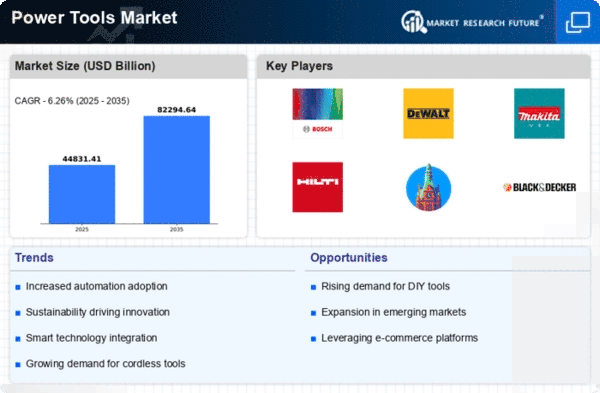
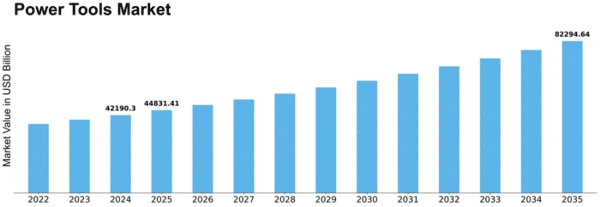
As per MRFR analysis, the Power Tools Market Size was estimated at 42190.3 USD Billion in 2024. The Power Tools industry is projected to grow from 44832.27 USD Billion in 2025 to 82294.64 USD Billion by 2035, exhibiting a compound annual growth rate (CAGR) of 6.26 during the forecast period 2025 - 2035.

Key Market Trends & Highlights

The Power Tools Market is experiencing a dynamic shift towards innovation and sustainability.

  • The integration of smart technology is reshaping the Power Tools Market, enhancing user experience and efficiency. Sustainability and eco-friendly products are gaining traction, reflecting a growing consumer preference for environmentally responsible tools. North America remains the largest market, while the Asia-Pacific region is emerging as the fastest-growing area for power tools. Technological advancements and rising construction activities are key drivers propelling market growth, particularly in the construction segment.

Market Size & Forecast

2024 Market Size 42190.3 (USD Billion)
2035 Market Size 82294.64 (USD Billion)
CAGR (2025 - 2035) 6.26%
Largest Regional Market Share in 2024 North America

Major Players

Bosch (DE), DeWalt (US), Makita (JP), Hilti (LI), Milwaukee (US), Black & Decker (US), Ryobi (JP), Festool (DE), Metabo (DE)

Market Trends

The Power Tools Market is currently experiencing a dynamic evolution, driven by advancements in technology and changing consumer preferences. The increasing demand for efficient and high-performance tools is evident, as both professionals and DIY enthusiasts seek products that enhance productivity and ease of use. Furthermore, the rise of smart technology integration within power tools appears to be reshaping the landscape, offering features such as connectivity and automation that cater to modern needs. This trend suggests a shift towards more sophisticated tools that not only perform tasks but also provide valuable data and insights to users. In addition, sustainability concerns are influencing purchasing decisions, with consumers increasingly favoring eco-friendly options. Manufacturers are responding by developing tools that utilize renewable energy sources and materials that minimize environmental impact. This focus on sustainability may lead to a more competitive market, as companies strive to innovate while adhering to environmental standards. Overall, the Power Tools Market seems poised for continued growth, with technological advancements and sustainability at the forefront of its evolution.

Smart Technology Integration

The incorporation of smart technology into power tools is becoming more prevalent, allowing for enhanced functionality and user experience. Features such as Bluetooth connectivity, app integration, and real-time monitoring are appealing to both professionals and hobbyists, as they provide greater control and efficiency.

Sustainability and Eco-Friendly Products

There is a noticeable shift towards sustainable practices within the Power Tools Market. Consumers are increasingly prioritizing eco-friendly products, prompting manufacturers to innovate with renewable materials and energy-efficient designs, thereby reducing the overall environmental footprint.

Growth in DIY Culture

The rise of the DIY culture is significantly impacting the Power Tools Market. As more individuals engage in home improvement projects, the demand for versatile and user-friendly tools is increasing, leading to a broader range of products tailored to meet the needs of amateur builders and crafters.

Power Tools Market Market Drivers

Growing DIY Culture

The Power Tools Market is significantly influenced by the growing do-it-yourself (DIY) culture among consumers. As more individuals engage in home improvement projects, the demand for user-friendly power tools has escalated. Retailers are responding by offering a wider range of products tailored to novice users, including cordless drills and compact saws. This shift not only boosts sales but also encourages consumers to invest in quality tools for personal projects. The increasing popularity of DIY initiatives is likely to sustain market growth, as it fosters a culture of creativity and self-sufficiency.

Sustainability Trends

Sustainability is becoming a pivotal driver in the Global Power Tools Industry, as consumers and manufacturers alike prioritize eco-friendly practices. The demand for energy-efficient tools and sustainable materials is on the rise, prompting companies to innovate and adapt their product lines. For instance, manufacturers are increasingly focusing on developing tools that utilize renewable energy sources or are made from recycled materials. This trend aligns with global efforts to reduce carbon footprints and promote sustainable living, potentially influencing purchasing decisions and shaping the future landscape of the power tools market, as power tool makers increasingly adapt their strategies to meet evolving sustainability expectations.

Technological Advancements

The Power Tools Industry is experiencing a surge in technological advancements, which significantly enhances product efficiency and user experience. Innovations such as brushless motors, smart tools with IoT capabilities, and improved battery technologies are becoming commonplace. These advancements not only increase the performance of power tools but also reduce energy consumption, appealing to environmentally conscious consumers. As a result, the market is projected to grow from 42190.3 USD Billion in 2024 to 82893.6 USD Billion by 2035, reflecting a robust demand for high-tech solutions in both residential and industrial applications.

Rising Construction Activities

The Power Tools Market is closely tied to the construction sector, which is witnessing a resurgence in various regions. Increased urbanization and infrastructure development projects are driving demand for power tools, as construction companies seek efficient and reliable equipment to meet project deadlines. The expansion of residential and commercial buildings necessitates the use of advanced power tools, which are essential for tasks ranging from drilling to cutting. This trend is expected to contribute to a compound annual growth rate (CAGR) of 6.33% from 2025 to 2035, further solidifying the industry's growth trajectory.

Expansion of E-commerce Platforms

The Power Tools Industry is witnessing a transformation due to the expansion of e-commerce platforms. Online retailing provides consumers with easy access to a wide variety of power tools, often at competitive prices. This shift not only enhances consumer convenience but also allows manufacturers to reach a broader audience without the constraints of traditional retail. As e-commerce continues to grow, it is expected to play a crucial role in shaping purchasing behaviors and driving sales in the power tools sector, contributing to the overall market growth.

Market Segment Insights

By Application: Construction (Largest) vs. Woodworking (Fastest-Growing)

In the Power Tools Market, the application segments reveal a diverse distribution of market share, with the construction sector leading significantly. This is primarily driven by the rising demand for residential and commercial infrastructure developments globally. On the other hand, woodworking is experiencing considerable traction, thanks to the increase in DIY projects and custom furniture manufacturing, making it a rapidly growing segment alongside construction. Growth trends in the application segment are indicative of changing consumer behaviors and technological advancements. Construction remains dominant as urbanization accelerates, but woodworking is poised for the fastest growth due to a surge in artisan and handcrafted product popularity. Factors such as increased online sales of woodworking tools and a shift towards more sustainable practices further bolster this emerging segment.

Construction: Dominant vs. Woodworking: Emerging

The construction application segment in the power tools market is characterized by its robust demand, necessitated by ongoing urban developments and infrastructure projects. This dominancy is bolstered by continual advancements in power tool technology, ensuring higher efficiency and productivity on construction sites. Conversely, woodworking, marked as an emerging segment, showcases its appeal through customization and craftsmanship. This sector attracts both professionals and hobbyists, spurred by rising interest in personalized woodworking projects and home renovations. As a result, power tools catering to woodworking are now being innovatively designed to meet the nuanced needs of this niche market, with enhancements aimed at precision, safety, and user-friendly features.

By Power Source: Electric (Largest) vs. Internal Combustion Engine (Fastest-Growing)

The Power Tools Market has seen a significant shift in its power source segment, with Electric tools holding the largest market share. These tools benefit from advancements in battery technology and more efficient electric motor designs, making them the preferred choice for both residential and commercial applications. Following Electric, Pneumatic and Hydraulic tools have their niche but are less prevalent in the overall market, mainly used in industrial settings. Internal Combustion Engine tools, while traditionally popular, are evolving due to new innovations that enhance their performance and efficiency. In terms of growth, the Internal Combustion Engine segment is recognized as the fastest-growing area within the Power Tools Market. Factors driving this growth include rising demand in outdoor power equipment and heavy-duty applications where high mobility and power are critical. Moreover, innovations that focus on reducing emissions and improving fuel efficiency are making these tools more attractive to environmentally-conscious consumers, thus expanding their market reach. As Electric tools continue to dominate, industries are also beginning to appreciate the versatility offered by Internal Combustion Engines, creating a dynamic and competitive landscape.

Power Source: Electric (Dominant) vs. Pneumatic (Emerging)

Electric power tools have become the dominant force in the market, primarily due to their convenience, minimal maintenance, and efficiency. Ideal for a range of applications from DIY projects to professional construction, Electric tools cater to growing environmental concerns by being more energy-efficient and reducing harmful emissions. In comparison, Pneumatic tools, while emerging, are gaining traction in sectors requiring high power-to-weight ratios for extended periods, such as manufacturing and assembly lines. Though typically reliant on air compressors, advancements in technology are making Pneumatic tools more versatile and accessible. This evolution, combined with a focus on performance and operator safety, positions Pneumatic tools as a compelling alternative to Electric options in specialized applications.

By Tool Type: Drills (Largest) vs. Saws (Fastest-Growing)

In the Power Tools Market, drills hold the largest share, attributed to their versatility and applicability across various DIY and professional projects. Saws, meanwhile, are rapidly gaining traction, capitalizing on the increasing demand for efficient wood and metal cutting solutions in both home and industrial settings. Grinders, sanders, and wrenches also play significant roles, but their shares are relatively smaller in comparison to drills and saws. Growth in this segment is primarily driven by technological advancements, fostering the development of innovative tools that increase efficiency and ease of use. The rise in home improvement projects and professional construction activities are further propelling the demand for power tools, particularly saws, which are being recognized as essential for precise cutting tasks. Consumer preferences are shifting towards battery-operated and cordless tools, enhancing the growth potential for both drills and saws.

Drills (Dominant) vs. Saws (Emerging)

Drills are the dominant force in the Power Tools Market, recognized for their multi-functional capabilities in drilling holes and driving screws across diverse materials. Their popularity stems from advancements in technology, such as improved battery life and the incorporation of smart features that cater to the needs of both amateur and professional users. On the other hand, saws are emerging rapidly, driven by the need for precision and efficiency in cutting processes. Innovations in saw technology, including laser-guided and automatic features, are appealing to consumers looking for enhanced performance. While drills remain the go-to tool for many projects, saws are carving out a substantial niche, reflecting a shift towards specialized tools for specific tasks.

By End User: Professional (Largest) vs. DIY Enthusiasts (Fastest-Growing)

The power tools market is significantly influenced by various end-user segments, with the professional segment holding the largest share due to its consistent demand among contractors and construction workers. Professional users prioritize durability and efficiency, opting for high-performance tools that can handle rigorous tasks. On the other hand, DIY enthusiasts have been expanding their presence in the market, driven by an increasing interest in home improvement projects and a growing number of online resources and tutorials that empower them to take on complex tasks themselves. In terms of growth trends, the DIY segment is emerging as the fastest-growing end-user category, fueled by a cultural shift towards self-sufficiency and personalization in home improvements. The surge in urban living also contributes to the decline of traditional home improvement retailing, as consumers seek convenient power tools that are easy to handle and store. Meanwhile, professionals continue to invest in advanced and specialized power tools to enhance productivity and efficiency in their work, indicating a stable growth trajectory for the professional segment as well.

Professional (Dominant) vs. Government (Emerging)

The professional segment is characterized by its dominance in the power tools market, given the frequent and demanding usage requirements of contractors and tradespeople. These users prefer tools that offer reliability, power, and advanced features to complete tough tasks efficiently. This segment drives innovation and leads to the development of higher-end products with enhanced safety and performance features. On the other hand, the government segment is emerging as a notable player, particularly in infrastructure projects where power tools are essential for construction and maintenance activities. Investment in public works and infrastructure development is bolstering the growth of this segment, as governments look for reliable and effective tools to fulfill their project requirements, thus supporting a rising demand for quality power tools.

By Distribution Channel: Retail (Largest) vs. Online (Fastest-Growing)

The Power Tools Market is seeing a diverse distribution channel landscape, with Retail holding the largest share. Consumers frequently prefer physical stores for purchasing power tools due to the ability to physically examine products before making a purchase. Following closely, Online channels are experiencing significant growth, appealing to tech-savvy customers who value convenience and often enjoy promotional offers available on digital platforms. Differences in customer preferences and shopping habits vary, helping shape the market landscape further. On the other hand, Online distribution is the fastest-growing segment, driven by increasing e-commerce penetration and shifting consumer behaviors. Retailers are enhancing their online presence, catering to customer demands for ease and accessibility. This trend towards digital shopping is expected to transform the way power tools are marketed and sold in the near future.

Retail (Dominant) vs. Online (Emerging)

Retail distribution of power tools remains dominant, characterized by vast network of physical stores that provide consumers with hands-on experience. Customers appreciate the opportunity to interact with products in person, fostering trust and making informed buying decisions. Prominent retail chains often feature exclusive brands or promotional bundles, which can further entice potential buyers. Conversely, online sales have emerged rapidly, fueled by the increasing preference for digital shopping. The online market offers a broader selection of products and competitive pricing, catering especially to younger consumers who prioritize convenience. This emerging segment is continuously evolving, as retailers increasingly leverage digital marketing strategies, improving logistics, and facilitating easier purchase processes, thus revolutionizing customer interactions in the power tools market.

Get more detailed insights about Power Tools Market Research Report - Global Forecast till 2035

Regional Insights

North America : Market Leader in Power Tools

North America continues to lead The Power Tools, holding a significant share of 21000.0. The growth is driven by increasing construction activities, DIY trends, and technological advancements in power tools. Regulatory support for safety standards and energy efficiency is also a catalyst for market expansion. The region's robust economy and high disposable income further fuel demand for innovative power tools. The competitive landscape is characterized by major players such as DeWalt, Milwaukee, and Bosch, which dominate the market with their advanced product offerings. The U.S. remains the largest market, followed by Canada and Mexico, where the demand for both professional and consumer-grade tools is on the rise. The presence of established brands ensures a diverse range of products catering to various consumer needs.

Europe : Emerging Market with Growth Potential

Europe's power tools market is valued at 12000.0, reflecting a growing demand driven by the construction and automotive sectors. The region is witnessing a shift towards battery-operated tools, aligning with sustainability goals and regulatory frameworks promoting eco-friendly practices. The increasing focus on energy efficiency and safety regulations is expected to further boost market growth in the coming years. Leading countries in this region include Germany, the UK, and France, where key players like Bosch and Hilti are well-established. The competitive landscape is marked by innovation and technological advancements, with companies investing in R&D to enhance product offerings. The European market is characterized by a mix of local and international brands, ensuring a competitive environment that fosters growth and development.

Asia-Pacific : Rapidly Growing Power Tools Sector

The Asia-Pacific power tools market, valued at 8000.0, is experiencing rapid growth, driven by urbanization, industrialization, and rising disposable incomes. The demand for power tools is increasing in both residential and commercial sectors, supported by government initiatives to boost infrastructure development. Regulatory frameworks promoting safety and quality standards are also contributing to market growth in this region. Countries like China, Japan, and India are leading the market, with significant contributions from local manufacturers and international brands. The competitive landscape is evolving, with companies like Makita and Ryobi expanding their presence. The region is witnessing a surge in e-commerce platforms, making power tools more accessible to consumers, thus driving sales and market penetration.

Middle East and Africa : Emerging Market with Challenges

The Middle East and Africa power tools market, valued at 1190.3, is gradually expanding, driven by construction and infrastructure projects. The region's growth is supported by increasing investments in real estate and government initiatives aimed at enhancing industrial capabilities. However, challenges such as economic fluctuations and regulatory hurdles may impact market dynamics. The demand for power tools is expected to rise as more projects are initiated in the coming years. Leading countries in this region include the UAE and South Africa, where the presence of key players like Black & Decker and Hilti is notable. The competitive landscape is characterized by a mix of local and international brands, with companies focusing on innovation and quality to capture market share. The region's potential for growth remains significant, particularly in urban areas where construction activities are on the rise.

Key Players and Competitive Insights

The Power Tools Market is currently characterized by a dynamic competitive landscape, driven by innovation, technological advancements, and a growing emphasis on sustainability. Major players such as Bosch (DE), DeWalt (US), and Hilti (LI) are strategically positioning themselves through a combination of product diversification and regional expansion. Bosch (DE) focuses on integrating smart technology into its tools, enhancing user experience and operational efficiency. DeWalt (US) emphasizes robust marketing strategies and partnerships with professional contractors, thereby solidifying its presence in the North American market. Hilti (LI), on the other hand, is investing heavily in digital transformation, aiming to streamline operations and improve customer engagement through advanced software solutions. Collectively, these strategies contribute to a competitive environment that is increasingly centered around innovation and customer-centric solutions.
Key business tactics within the Power Tools Market include localizing manufacturing and optimizing supply chains to enhance responsiveness to market demands. The market structure appears moderately fragmented, with several key players exerting considerable influence. This fragmentation allows for niche players to thrive, while larger companies leverage economies of scale to maintain competitive pricing. The collective influence of these key players shapes market dynamics, as they continuously adapt to evolving consumer preferences and technological advancements.
In November 2025, Bosch (DE) announced the launch of its new line of cordless power tools featuring advanced AI capabilities. This strategic move is significant as it positions Bosch at the forefront of the smart tools segment, appealing to tech-savvy consumers and professionals seeking enhanced functionality. The integration of AI not only improves tool performance but also offers predictive maintenance features, potentially reducing downtime for users.
In October 2025, DeWalt (US) expanded its product line by introducing a series of eco-friendly power tools made from recycled materials. This initiative aligns with the growing consumer demand for sustainable products and reflects DeWalt's commitment to environmental responsibility. By prioritizing sustainability, DeWalt not only differentiates itself in a competitive market but also appeals to a broader audience concerned with ecological impact.
In September 2025, Hilti (LI) entered a strategic partnership with a leading software company to enhance its digital offerings. This collaboration aims to develop a comprehensive platform that integrates tool management and project planning, thereby streamlining workflows for construction professionals. The strategic importance of this partnership lies in Hilti's ability to provide added value to its customers, reinforcing its position as a leader in the digital transformation of the construction industry.
As of December 2025, current competitive trends in the Power Tools Market are increasingly defined by digitalization, sustainability, and the integration of AI technologies. Strategic alliances are playing a crucial role in shaping the landscape, enabling companies to leverage complementary strengths and enhance their market offerings. Looking ahead, competitive differentiation is likely to evolve from traditional price-based competition towards a focus on innovation, technological advancements, and supply chain reliability. This shift underscores the importance of adaptability and forward-thinking strategies in maintaining a competitive edge.

Key Companies in the Power Tools Market include

Industry Developments

  • Q2 2024: Stanley Black & Decker appoints Donald Allan Jr. as CEO Stanley Black & Decker announced the appointment of Donald Allan Jr. as its new Chief Executive Officer, effective June 1, 2024, as part of its leadership succession plan.
  • Q2 2024: Makita opens new manufacturing facility in Romania Makita Corporation inaugurated a new power tool manufacturing plant in Romania in May 2024 to expand its production capacity and better serve the European market.
  • Q2 2024: Bosch launches new generation of cordless power tools for professionals Bosch announced the launch of its latest line of high-performance cordless power tools targeting professional users, featuring improved battery technology and connectivity features.
  • Q3 2024: Hilti Group acquires Fieldwire to strengthen digital jobsite solutions Hilti Group completed the acquisition of Fieldwire, a construction technology company, in July 2024 to enhance its digital offerings for power tool users in the construction sector.
  • Q3 2024: Techtronic Industries announces $200 million investment in US manufacturing expansion Techtronic Industries, parent company of Milwaukee Tool, revealed a $200 million investment to expand its US manufacturing footprint, including new facilities for power tool production.
  • Q3 2024: Atlas Copco acquires German power tool manufacturer SCA Schucker Atlas Copco announced the acquisition of SCA Schucker, a German manufacturer specializing in industrial power tools, to strengthen its product portfolio in Europe.
  • Q4 2024: Makita launches 40V Max XGT series in North America Makita introduced its 40V Max XGT cordless power tool series to the North American market, aiming to capture demand for higher-performance tools in construction and industry.
  • Q4 2024: Bosch Power Tools Market partners with Amazon for exclusive e-commerce distribution Bosch Power Tools Market entered into a strategic partnership with Amazon to offer exclusive product bundles and faster delivery options for select power tool lines.
  • Q1 2025: Stanley Black & Decker sells security business to Securitas for $3.2 billion Stanley Black & Decker completed the sale of its security business to Securitas in January 2025, allowing the company to focus more on its core power tools and industrial segments.
  • Q1 2025: Hilti Group announces partnership with Procore for integrated construction solutions Hilti Group and Procore Technologies formed a partnership to integrate Hilti's power tool data with Procore's construction management platform, enhancing jobsite productivity.
  • Q2 2025: Techtronic Industries launches AI-powered diagnostics for Milwaukee Tool Techtronic Industries introduced an AI-powered diagnostics platform for its Milwaukee Tool brand, enabling predictive maintenance and performance analytics for professional users.
  • Q2 2025: Bosch opens new R&D center for power tools in Singapore Bosch inaugurated a new research and development center in Singapore focused on innovation in cordless power tools and battery technology.

Future Outlook

Power Tools Market Future Outlook

The Power Tools Market is projected to grow at a 6.26% CAGR from 2025 to 2035, driven by technological advancements, increased DIY activities, and rising construction demands.

New opportunities lie in:

  • Expansion of cordless tool lines for enhanced mobility and convenience.
  • Development of smart power tools integrated with IoT for improved efficiency.
  • Investment in sustainable power tool technologies to meet eco-friendly consumer demands.

By 2035, the Power Tools Market is expected to achieve robust growth, reflecting evolving consumer preferences and technological innovations.

Market Segmentation

Power Tools Market End User Outlook

  • Professional
  • DIY Enthusiasts
  • Industrial
  • Commercial
  • Government

Power Tools Market Tool Type Outlook

  • Drills
  • Saws
  • Grinders
  • Sanders
  • Wrenches

Power Tools Market Application Outlook

  • Construction
  • Woodworking
  • Metalworking
  • Automotive
  • Maintenance

Power Tools Market Power Source Outlook

  • Electric
  • Pneumatic
  • Hydraulic
  • Internal Combustion Engine
  • Manual

Power Tools Market Distribution Channel Outlook

  • Online
  • Retail
  • Wholesale
  • Direct Sales
  • Distributors

Report Scope

MARKET SIZE 2024 42190.3(USD Billion)
MARKET SIZE 2025 44832.27(USD Billion)
MARKET SIZE 2035 82294.64(USD Billion)
COMPOUND ANNUAL GROWTH RATE (CAGR) 6.26% (2025 - 2035)
REPORT COVERAGE Revenue Forecast, Competitive Landscape, Growth Factors, and Trends
BASE YEAR 2024
Market Forecast Period 2025 - 2035
Historical Data 2019 - 2024
Market Forecast Units USD Billion
Key Companies Profiled Bosch (DE), DeWalt (US), Makita (JP), Hilti (LI), Milwaukee (US), Black & Decker (US), Ryobi (JP), Festool (DE), Metabo (DE)
Segments Covered Application, Power Source, Tool Type, End User, Distribution Channel
Key Market Opportunities Integration of smart technology and automation in the Power Tools Market enhances user efficiency and safety.
Key Market Dynamics Technological advancements and sustainability trends drive innovation and competition in the power tools market.
Countries Covered North America, Europe, APAC, South America, MEA

FAQs

How much is the Power Tools Market?

The Power Tools Market crossed a valuation of USD 40,344.4 billion in 2023.

How Big is the U.S Power Tools Market?

The U.S Power Tools Market is valued at USD 13,126.9 million in 2021.

What is the growth rate of the Power Tools Market?

6.26% CAGR is the growth rate of the Power Tools Market.

Which region held the largest market share in the Power Tools Market?

North America region held the largest market share in the Power Tools Market.

Who are the key companies in the Power Tools Market?

The companies such as Ingersoll Rand, Inc. (US), Kyocera Corporation (Japan), Robert Bosch Power Tools GmbH (Germany), Stanley Black & Decker, Inc. (US), Makita Corporation (Japan) are the key companies in the Power Tools Market.

Which machine type led the Power Tools Market?

Drilling tools Films is the major type that led the Power Tools Market.

Which mode of operation had the largest market share in the Power Tools Market?

Electric had the largest market share in the Power Tools Market.

  1. SECTION I: EXECUTIVE SUMMARY AND KEY HIGHLIGHTS
    1. | 1.1 EXECUTIVE SUMMARY
    2. | 1.1.1 Market Overview
    3. | 1.1.2 Key Findings
    4. | 1.1.3 Market Segmentation
    5. | 1.1.4 Competitive Landscape
    6. | 1.1.5 Challenges and Opportunities
    7. | 1.1.6 Future Outlook
  2. SECTION II: SCOPING, METHODOLOGY AND MARKET STRUCTURE
    1. | 2.1 MARKET INTRODUCTION
    2. | 2.1.1 Definition
    3. | 2.1.2 Scope of the study
    4. |-- 2.1.2.1 Research Objective
    5. |-- 2.1.2.2 Assumption
    6. |-- 2.1.2.3 Limitations
    7. | 2.2 RESEARCH METHODOLOGY
    8. | 2.2.1 Overview
    9. | 2.2.2 Data Mining
    10. | 2.2.3 Secondary Research
    11. | 2.2.4 Primary Research
    12. |-- 2.2.4.1 Primary Interviews and Information Gathering Process
    13. |-- 2.2.4.2 Breakdown of Primary Respondents
    14. | 2.2.5 Forecasting Model
    15. | 2.2.6 Market Size Estimation
    16. |-- 2.2.6.1 Bottom-Up Approach
    17. |-- 2.2.6.2 Top-Down Approach
    18. | 2.2.7 Data Triangulation
    19. | 2.2.8 Validation
  3. SECTION III: QUALITATIVE ANALYSIS
    1. | 3.1 MARKET DYNAMICS
    2. | 3.1.1 Overview
    3. | 3.1.2 Drivers
    4. | 3.1.3 Restraints
    5. | 3.1.4 Opportunities
    6. | 3.2 MARKET FACTOR ANALYSIS
    7. | 3.2.1 Value chain Analysis
    8. | 3.2.2 Porter's Five Forces Analysis
    9. |-- 3.2.2.1 Bargaining Power of Suppliers
    10. |-- 3.2.2.2 Bargaining Power of Buyers
    11. |-- 3.2.2.3 Threat of New Entrants
    12. |-- 3.2.2.4 Threat of Substitutes
    13. |-- 3.2.2.5 Intensity of Rivalry
    14. | 3.2.3 COVID-19 Impact Analysis
    15. |-- 3.2.3.1 Market Impact Analysis
    16. |-- 3.2.3.2 Regional Impact
    17. |-- 3.2.3.3 Opportunity and Threat Analysis
  4. SECTION IV: QUANTITATIVE ANALYSIS
    1. | 4.1 Healthcare, BY Application (USD Billion)
    2. | 4.1.1 Construction
    3. | 4.1.2 Woodworking
    4. | 4.1.3 Metalworking
    5. | 4.1.4 Automotive
    6. | 4.1.5 Maintenance
    7. | 4.2 Healthcare, BY Power Source (USD Billion)
    8. | 4.2.1 Electric
    9. | 4.2.2 Pneumatic
    10. | 4.2.3 Hydraulic
    11. | 4.2.4 Internal Combustion Engine
    12. | 4.2.5 Manual
    13. | 4.3 Healthcare, BY Tool Type (USD Billion)
    14. | 4.3.1 Drills
    15. | 4.3.2 Saws
    16. | 4.3.3 Grinders
    17. | 4.3.4 Sanders
    18. | 4.3.5 Wrenches
    19. | 4.4 Healthcare, BY End User (USD Billion)
    20. | 4.4.1 Professional
    21. | 4.4.2 DIY Enthusiasts
    22. | 4.4.3 Industrial
    23. | 4.4.4 Commercial
    24. | 4.4.5 Government
    25. | 4.5 Healthcare, BY Distribution Channel (USD Billion)
    26. | 4.5.1 Online
    27. | 4.5.2 Retail
    28. | 4.5.3 Wholesale
    29. | 4.5.4 Direct Sales
    30. | 4.5.5 Distributors
    31. | 4.6 Healthcare, BY Region (USD Billion)
    32. | 4.6.1 North America
    33. |-- 4.6.1.1 US
    34. |-- 4.6.1.2 Canada
    35. | 4.6.2 Europe
    36. |-- 4.6.2.1 Germany
    37. |-- 4.6.2.2 UK
    38. |-- 4.6.2.3 France
    39. |-- 4.6.2.4 Russia
    40. |-- 4.6.2.5 Italy
    41. |-- 4.6.2.6 Spain
    42. |-- 4.6.2.7 Rest of Europe
    43. | 4.6.3 APAC
    44. |-- 4.6.3.1 China
    45. |-- 4.6.3.2 India
    46. |-- 4.6.3.3 Japan
    47. |-- 4.6.3.4 South Korea
    48. |-- 4.6.3.5 Malaysia
    49. |-- 4.6.3.6 Thailand
    50. |-- 4.6.3.7 Indonesia
    51. |-- 4.6.3.8 Rest of APAC
    52. | 4.6.4 South America
    53. |-- 4.6.4.1 Brazil
    54. |-- 4.6.4.2 Mexico
    55. |-- 4.6.4.3 Argentina
    56. |-- 4.6.4.4 Rest of South America
    57. | 4.6.5 MEA
    58. |-- 4.6.5.1 GCC Countries
    59. |-- 4.6.5.2 South Africa
    60. |-- 4.6.5.3 Rest of MEA
  5. SECTION V: COMPETITIVE ANALYSIS
    1. | 5.1 Competitive Landscape
    2. | 5.1.1 Overview
    3. | 5.1.2 Competitive Analysis
    4. | 5.1.3 Market share Analysis
    5. | 5.1.4 Major Growth Strategy in the Healthcare
    6. | 5.1.5 Competitive Benchmarking
    7. | 5.1.6 Leading Players in Terms of Number of Developments in the Healthcare
    8. | 5.1.7 Key developments and growth strategies
    9. |-- 5.1.7.1 New Product Launch/Service Deployment
    10. |-- 5.1.7.2 Merger & Acquisitions
    11. |-- 5.1.7.3 Joint Ventures
    12. | 5.1.8 Major Players Financial Matrix
    13. |-- 5.1.8.1 Sales and Operating Income
    14. |-- 5.1.8.2 Major Players R&D Expenditure. 2023
    15. | 5.2 Company Profiles
    16. | 5.2.1 Bosch (DE)
    17. |-- 5.2.1.1 Financial Overview
    18. |-- 5.2.1.2 Products Offered
    19. |-- 5.2.1.3 Key Developments
    20. |-- 5.2.1.4 SWOT Analysis
    21. |-- 5.2.1.5 Key Strategies
    22. | 5.2.2 DeWalt (US)
    23. |-- 5.2.2.1 Financial Overview
    24. |-- 5.2.2.2 Products Offered
    25. |-- 5.2.2.3 Key Developments
    26. |-- 5.2.2.4 SWOT Analysis
    27. |-- 5.2.2.5 Key Strategies
    28. | 5.2.3 Makita (JP)
    29. |-- 5.2.3.1 Financial Overview
    30. |-- 5.2.3.2 Products Offered
    31. |-- 5.2.3.3 Key Developments
    32. |-- 5.2.3.4 SWOT Analysis
    33. |-- 5.2.3.5 Key Strategies
    34. | 5.2.4 Hilti (LI)
    35. |-- 5.2.4.1 Financial Overview
    36. |-- 5.2.4.2 Products Offered
    37. |-- 5.2.4.3 Key Developments
    38. |-- 5.2.4.4 SWOT Analysis
    39. |-- 5.2.4.5 Key Strategies
    40. | 5.2.5 Milwaukee (US)
    41. |-- 5.2.5.1 Financial Overview
    42. |-- 5.2.5.2 Products Offered
    43. |-- 5.2.5.3 Key Developments
    44. |-- 5.2.5.4 SWOT Analysis
    45. |-- 5.2.5.5 Key Strategies
    46. | 5.2.6 Black & Decker (US)
    47. |-- 5.2.6.1 Financial Overview
    48. |-- 5.2.6.2 Products Offered
    49. |-- 5.2.6.3 Key Developments
    50. |-- 5.2.6.4 SWOT Analysis
    51. |-- 5.2.6.5 Key Strategies
    52. | 5.2.7 Ryobi (JP)
    53. |-- 5.2.7.1 Financial Overview
    54. |-- 5.2.7.2 Products Offered
    55. |-- 5.2.7.3 Key Developments
    56. |-- 5.2.7.4 SWOT Analysis
    57. |-- 5.2.7.5 Key Strategies
    58. | 5.2.8 Festool (DE)
    59. |-- 5.2.8.1 Financial Overview
    60. |-- 5.2.8.2 Products Offered
    61. |-- 5.2.8.3 Key Developments
    62. |-- 5.2.8.4 SWOT Analysis
    63. |-- 5.2.8.5 Key Strategies
    64. | 5.2.9 Metabo (DE)
    65. |-- 5.2.9.1 Financial Overview
    66. |-- 5.2.9.2 Products Offered
    67. |-- 5.2.9.3 Key Developments
    68. |-- 5.2.9.4 SWOT Analysis
    69. |-- 5.2.9.5 Key Strategies
    70. | 5.3 Appendix
    71. | 5.3.1 References
    72. | 5.3.2 Related Reports

Healthcare Market Segmentation

Healthcare By Application (USD Billion, 2025-2035)

  • Construction
  • Woodworking
  • Metalworking
  • Automotive
  • Maintenance

Healthcare By Power Source (USD Billion, 2025-2035)

  • Electric
  • Pneumatic
  • Hydraulic
  • Internal Combustion Engine
  • Manual

Healthcare By Tool Type (USD Billion, 2025-2035)

  • Drills
  • Saws
  • Grinders
  • Sanders
  • Wrenches

Healthcare By End User (USD Billion, 2025-2035)

  • Professional
  • DIY Enthusiasts
  • Industrial
  • Commercial
  • Government

Healthcare By Distribution Channel (USD Billion, 2025-2035)

  • Online
  • Retail
  • Wholesale
  • Direct Sales
  • Distributors
Infographic

Free Sample Request

Kindly complete the form below to receive a free sample of this Report

Get Free Sample

Customer Strories

Compare Licence

×
Features License Type
Single User Multiuser License Enterprise User
Price $4,950 $5,950 $7,250
Maximum User Access Limit 1 User Upto 10 Users Unrestricted Access Throughout the Organization
Free Customization
Direct Access to Analyst
Deliverable Format
Platform Access
Discount on Next Purchase 10% 15% 15%
Printable Versions