×
Hero Background
English
Chinese
French
Japanese
Korean
German
Spanish

Porous Ceramic Market Trends

ID: MRFR/CnM/10390-HCR
128 Pages
Anshula Mandaokar
October 2025

Porous Ceramic Market Research Report Information By Raw Material (Alumina Ceramics, Titanate Ceramics, Zirconate Ceramics, Ferrite Ceramics, Aluminum Nitride, and Others), By Product (Filtration, Insulation, High Purity Materials, Structural Components, and Others), By Application (Automotive, Medical, Electronics & Semiconductors, Energy & Power, Industrial, Aerospace & Defense, and Others), and By Region (North America, Europe, Asia-Pacific, and Rest Of The World) – Market Forecast Till 2035

Share:
Download PDF ×

We do not share your information with anyone. However, we may send you emails based on your report interest from time to time. You may contact us at any time to opt-out.

Porous Ceramic Market Infographic
Purchase Options

Market Trends

Key Emerging Trends in the Porous Ceramic Market

The porous ceramic market is experiencing significant trends that are reshaping the industry and influencing its growth trajectory. One prominent trend is the increasing demand for porous ceramics across various applications such as filtration, catalysis, thermal insulation, biomedical implants, and aerospace components. Porous ceramics offer unique properties such as high porosity, thermal stability, chemical inertness, and mechanical strength, making them versatile materials for a wide range of industrial and scientific applications. As industries seek innovative solutions for filtration, separation, and material processing, the demand for high-quality porous ceramics continues to rise, driving market expansion across diverse sectors.

Moreover, there is a growing emphasis on sustainability and environmental consciousness in the porous ceramic market, driven by increasing awareness of environmental issues and regulatory pressures to reduce pollution and resource consumption. Porous ceramics made from natural and eco-friendly materials such as clay, silica, and alumina offer environmental benefits such as biodegradability, recyclability, and reduced carbon footprint compared to synthetic materials. Additionally, advancements in manufacturing processes such as sol-gel, foaming, and sintering enable the production of porous ceramics with tailored pore structures, surface properties, and functionalities that meet specific environmental and performance requirements. This trend towards sustainable porous ceramics aligns with the industry's commitment to environmental stewardship and circular economy principles.

Furthermore, the market is witnessing increasing demand for porous ceramics in the field of water and air purification, driven by growing concerns about water scarcity, air pollution, and public health. Porous ceramic filters and membranes are widely used for removing contaminants such as bacteria, viruses, heavy metals, and particulate matter from water and air streams in industrial, municipal, and residential applications. Additionally, porous ceramics offer advantages such as high surface area, uniform pore distribution, and resistance to fouling and chemical degradation, making them effective and durable filtration materials. With increasing emphasis on clean water and air quality standards, the demand for porous ceramics in filtration and purification applications is expected to grow, driving market expansion in the environmental sector.

Moreover, the market for porous ceramics is experiencing a shift towards advanced applications in catalysis, energy storage, and biomedical fields. Porous ceramic catalysts are used for chemical reactions such as hydrogenation, oxidation, and hydrocracking in petrochemical, pharmaceutical, and environmental industries. Porous ceramic materials such as zeolites and metal-organic frameworks (MOFs) are gaining attention for their ability to adsorb and store gases such as hydrogen, methane, and carbon dioxide for energy storage and transportation applications. Additionally, porous ceramics are used as scaffolds for tissue engineering, drug delivery carriers, and implants in biomedical applications due to their biocompatibility, mechanical properties, and ability to support cell growth and tissue regeneration. As research and development efforts continue to expand the application scope of porous ceramics, the demand for advanced porous ceramic materials in emerging fields is expected to grow, driving market growth and fostering innovation in the industry.

Author
Anshula Mandaokar
Team Lead - Research

Anshula Mandaokar holds an academic degree in Chemical Engineering and has been contributing to the field for more than 5 years. She has expertise in Market Research and Business Consulting and serves as a Team Lead for a reputed Market Research firm under the Chemicals and Materials domain spectrum. She has worked on multiple projects, generating explicit results in a quick turnaround time. Her understanding of data interpretation justifies her role as a leader.

Leave a Comment

FAQs

How much is the Porous Ceramic market?

The Porous Ceramic Market Application was valued at USD 5.9 Billion in 2022.

What is the growth rate of the Porous Ceramic market?

The global market is projected to grow at a CAGR of 10.90% during the forecast period, 2025-2035.

Which region held the largest market share in the Porous Ceramic market?

Asia Pacific had the largest share in the global market

Who are the key players in the Porous Ceramic market?

The key players in the market Applied Materials, Inc., CoorsTek, Inc., Innovacera, KeraNor AS, Kyocera Corp., Nishimura Advanced Ceramics Co., Ltd., STC Superior Technical Ceramics, and NGK Spark Plug Co., Ltd.

Which Raw Material led the Porous Ceramic market?

The Alumina Ceramics Raw Material dominated the market in 2022.

Which Product had the largest market share in the Porous Ceramic market?

The Filtration Product had the largest share in the global market.

Market Summary

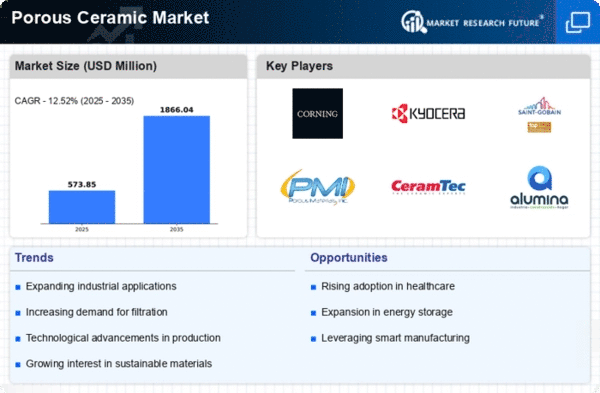
As per Market Research Future analysis, the Porous Ceramic Market Size was estimated at 510.0 USD Million in 2024. The Porous Ceramic industry is projected to grow from USD 573.83 Million in 2025 to USD 1866.04 Million by 2035, exhibiting a compound annual growth rate (CAGR) of 12.52% during the forecast period 2025 - 2035

Key Market Trends & Highlights

The Porous Ceramic Market is experiencing robust growth driven by sustainability and technological advancements.

  • North America remains the largest market for porous ceramics, driven by increasing applications in various industries.
  • Asia-Pacific is the fastest-growing region, reflecting a surge in demand for innovative materials and solutions.
  • The filtration segment leads the market, while the thermal insulation segment is witnessing rapid growth due to evolving energy efficiency standards.
  • Key market drivers include rising demand in the construction sector and growing environmental awareness, which are shaping industry dynamics.

Market Size & Forecast

2024 Market Size 510.0 (USD Million)
2035 Market Size 1866.04 (USD Million)
CAGR (2025 - 2035) 12.52%
Largest Regional Market Share in 2024 North America

Major Players

<p>Corning Inc (US), Kyocera Corporation (JP), Saint-Gobain (FR), Porous Materials Inc (US), CeramTec GmbH (DE), Alumina Limited (AU), Noritake Co Ltd (JP), Höganäs AB (SE)</p>

Market Trends

The Porous Ceramic Market is currently experiencing a dynamic evolution, driven by advancements in material science and increasing applications across various industries. This market encompasses a range of products characterized by their unique porous structures, which facilitate various functionalities such as filtration, insulation, and catalysis. The growing demand for lightweight and high-performance materials in sectors like aerospace, automotive, and healthcare is propelling the development of innovative porous ceramic solutions. Furthermore, the emphasis on sustainability and eco-friendly materials is influencing manufacturers to explore new production techniques and raw materials, thereby enhancing the market's growth potential. In addition, the Porous Ceramic Market is witnessing a shift towards customization and specialized applications. As industries seek tailored solutions to meet specific operational requirements, manufacturers are investing in research and development to create advanced porous ceramics with enhanced properties. This trend is likely to foster collaborations between material scientists and industry players, leading to the introduction of novel products that cater to niche markets. Overall, the Porous Ceramic Market appears poised for continued expansion, driven by technological advancements and evolving consumer preferences.

Sustainability Initiatives

The Porous Ceramic Market is increasingly influenced by sustainability initiatives, as manufacturers strive to reduce environmental impact. This trend involves the adoption of eco-friendly materials and production processes, which align with global efforts to promote sustainable practices. Companies are exploring biodegradable and recyclable options, potentially enhancing their market appeal.

Technological Advancements

Technological advancements play a crucial role in shaping the Porous Ceramic Market. Innovations in manufacturing techniques, such as additive manufacturing and advanced sintering methods, are enabling the production of complex geometries and improved material properties. These developments may lead to enhanced performance in various applications, from filtration to thermal insulation.

Customization and Specialization

Customization and specialization are emerging trends within the Porous Ceramic Market. As industries demand tailored solutions, manufacturers are focusing on developing products that meet specific performance criteria. This shift towards bespoke offerings could foster closer collaboration between producers and end-users, driving innovation and market growth.

Porous Ceramic Market Market Drivers

Market Growth Projections

The Global Porous Ceramic Market Industry is poised for substantial growth, with projections indicating a market size of 7.21 USD Billion in 2024 and an anticipated increase to 20.5 USD Billion by 2035. This growth trajectory reflects a robust CAGR of 9.95% from 2025 to 2035, driven by diverse applications across various sectors. The increasing demand for porous ceramics in healthcare, energy, filtration, and construction underscores the material's versatility and relevance in addressing contemporary challenges. As industries continue to innovate and seek sustainable solutions, the porous ceramic market is likely to expand significantly, presenting opportunities for stakeholders.

Rising Adoption in Energy Applications

The Global Porous Ceramic Market Industry is witnessing a rising adoption of porous ceramics in energy applications, particularly in fuel cells and batteries. These materials enhance energy efficiency and performance, making them attractive for renewable energy solutions. As global energy demands shift towards sustainable sources, the role of porous ceramics becomes increasingly critical. The integration of these materials in energy systems could lead to substantial market growth, with a projected CAGR of 9.95% from 2025 to 2035. This growth reflects the industry's potential to contribute to cleaner energy technologies and the transition towards a low-carbon economy.

Advancements in Filtration Technologies

Innovations in filtration technologies significantly propel the Global Porous Ceramic Market Industry. Porous ceramics are extensively used in water treatment, air filtration, and industrial processes due to their superior filtration capabilities. The material's ability to remove contaminants and improve water quality aligns with global sustainability goals. As industries seek to enhance efficiency and reduce environmental impact, the demand for advanced filtration solutions is likely to rise. This trend is expected to contribute to the market's growth, with projections indicating a market size of 20.5 USD Billion by 2035, driven by the increasing adoption of porous ceramics in filtration applications.

Growing Demand in Healthcare Applications

The Global Porous Ceramic Market Industry experiences a notable surge in demand driven by its applications in healthcare. Porous ceramics are utilized in bone grafts, dental implants, and drug delivery systems due to their biocompatibility and ability to promote tissue integration. As the global population ages, the need for advanced medical solutions increases, suggesting a robust market growth trajectory. The market is projected to reach 7.21 USD Billion in 2024, with healthcare applications playing a pivotal role in this expansion. The increasing focus on innovative medical technologies further supports the growth of porous ceramics in the healthcare sector.

Emerging Applications in Environmental Remediation

The Global Porous Ceramic Market Industry is expanding into emerging applications in environmental remediation. Porous ceramics are increasingly utilized in the treatment of contaminated soils and wastewater due to their ability to adsorb pollutants effectively. As environmental regulations tighten globally, industries are compelled to adopt sustainable practices, which may drive the demand for porous ceramics in remediation efforts. This trend highlights the material's versatility and potential to address pressing environmental challenges. The growing focus on sustainability and environmental protection is likely to bolster the market, contributing to its overall growth in the coming years.

Increasing Use in Construction and Building Materials

The Global Porous Ceramic Market Industry benefits from the increasing use of porous ceramics in construction and building materials. These materials offer excellent thermal insulation, sound absorption, and lightweight properties, making them ideal for modern architectural applications. As urbanization accelerates globally, the demand for innovative building solutions rises, driving the adoption of porous ceramics in construction projects. This trend is likely to enhance market growth, as builders and architects seek materials that meet both aesthetic and functional requirements. The integration of porous ceramics in construction could lead to a more sustainable built environment, further supporting the industry's expansion.

Market Segment Insights

By Application: Filtration (Largest) vs. Thermal Insulation (Fastest-Growing)

<p>The Porous Ceramic Market exhibits a diverse application landscape, with filtration reigning as the largest segment. It is predominantly utilized in water and air purification systems, capturing a substantial share due to increased environmental concerns and regulatory pressures. Following filtration, catalysis and thermal insulation also play critical roles, yet their contributions are smaller, positioning them as secondary choices in user preference and market strategy. Growth trends in the porous ceramic market are driven by a rising demand for sustainable solutions across various sectors. The thermal insulation segment is emerging rapidly, fueled by its application in energy-efficient construction and industrial processes. Innovations in biomedical applications are also influencing market dynamics, creating new opportunities for growth and application diversification within this segment.</p>

<p>Filtration (Dominant) vs. Biomedical (Emerging)</p>

<p>In the Porous Ceramic Market, filtration stands out as the dominant application, characterized by its extensive use in industrial and municipal water treatment, as well as air filtration systems. This segment benefits from stringent environmental regulations and a growing awareness of water and air quality. Conversely, the biomedical application represents an emerging frontier, involving the use of porous ceramics in drug delivery systems and tissue engineering. Its growth is supported by advancements in medical technology and increasing investments in healthcare, driving innovation and adoption. As both segments evolve, filtration maintains its leadership while biomedical applications are paving the way for new therapeutic solutions.</p>

By End Use: Healthcare (Largest) vs. Aerospace (Fastest-Growing)

<p>The porous ceramic market exhibits a diverse distribution of market share across various end-use sectors, with healthcare taking the lead due to its extensive applications in medical implants, drug delivery systems, and bioceramics. Following healthcare, industries such as automotive and construction contribute significantly as well, but with lesser proportions. Aerospace, while smaller in market share, is rapidly gaining traction as manufacturers explore innovative uses of porous ceramics for lightweight and heat-resistant components.</p>

<p>Healthcare: Medical Applications (Dominant) vs. Aerospace: Component Manufacturing (Emerging)</p>

<p>In the healthcare sector, porous ceramics are predominantly used for medical implants, which require biocompatibility and structural integrity. This segment's dominance is driven by the growing elderly population and the rising demand for advanced surgical procedures. On the other hand, the aerospace industry is emerging as a promising segment due to the increasing need for lightweight materials that can withstand high temperatures. Porous ceramics provide unique solutions in creating components that enhance fuel efficiency and reduce overall aircraft weight. As technological advancements continue to drive the innovation of porous materials, the aerospace sector is expected to see substantial investment and growth.</p>

By Material Type: Alumina (Largest) vs. Silica (Fastest-Growing)

<p>In the Porous Ceramic Market, the distribution of market share among material types reveals that Alumina leads with the largest share, attributed to its superior mechanical properties and high resistance to wear and corrosion. Silica, while smaller in overall share, is recognized for its versatility and cost-effectiveness, making it a popular choice in various applications. Other materials such as Zirconia, Titania, and Composite also contribute to the market, yet they trail behind the dominance of Alumina and the emerging strength of Silica. The growth trends in the Porous Ceramic Market indicate that Silica is rapidly gaining traction, driven by increasing demand in sectors such as electronics and construction. This growing interest is coupled with advancements in manufacturing technologies, enhancing the properties of silica-based ceramics. Meanwhile, Alumina continues to thrive, bolstered by its established reputation in high-performance applications. As industries evolve, the competition among these materials is expected to intensify, reflecting ongoing innovations and shifts in consumer preferences.</p>

<p>Alumina (Dominant) vs. Zirconia (Emerging)</p>

<p>Alumina stands out as the dominant material in the Porous Ceramic Market due to its excellent thermal stability, mechanical strength, and wide-ranging applications. It is primarily utilized in industries requiring durable and heat-resistant materials, such as aerospace and automotive sectors. Furthermore, Alumina's low cost and abundant availability make it a preferred option for manufacturers. On the other hand, Zirconia is emerging as a significant player as it offers unique advantages, including enhanced toughness and resistance to fracture. Its applications are expanding in biomedical fields and cutting-edge technologies, where high performance is crucial. As both materials vie for market share, advancements in processing techniques and tailored formulations are likely to shape their future positions.</p>

By Porosity Level: Medium Porosity (Largest) vs. High Porosity (Fastest-Growing)

<p>In the porous ceramic market, the distribution of market share reveals that medium porosity segments hold the largest proportion, primarily due to their versatile applications and favorable thermal properties. Medium porosity ceramics are widely utilized in sectors such as electronics, filtration, and construction, establishing a strong foothold in the market. Meanwhile, high porosity segments are gaining traction due to their significant advantages in lightweight applications and improving thermal insulation, capturing a growing share of the market. The growth trajectory for the porous ceramic market is significantly influenced by the increasing demand for advanced materials in various industries. High porosity ceramics are driven by innovations in technology and an uptick in their use for specialized applications such as biomedical implants and high-temperature filters. Additionally, the rising focus on sustainability and energy efficiency further accelerates the adoption of porous ceramics, helping elevate both medium and high porosity segments in the market landscape.</p>

<p>Medium Porosity (Dominant) vs. High Porosity (Emerging)</p>

<p>Medium porosity ceramics stand out as the dominant segment in the porous ceramic market, owing to their balanced properties that make them suitable for multiple applications. These materials exhibit a fine balance between strength, weight, and insulation properties, making them ideal for use in electronics and building materials. In contrast, high porosity ceramics, categorized as an emerging segment, are characterized by their lightweight structure, making them favorable for usage in sectors requiring high thermal insulation and low weight. These materials have become particularly popular in niche markets such as medical applications and specialized filters, where their unique properties enhance overall performance and functionality.</p>

By Production Method: Sintering (Largest) vs. 3D Printing (Fastest-Growing)

<p>In the Porous Ceramic Market, various production methods are employed, with sintering leading in market share. Sintering benefits from established processes and consistent quality results, making it the preferred choice among manufacturers. Conversely, 3D printing, while currently smaller in market share, is rapidly gaining traction due to its adaptability and ability to create complex designs. This shift highlights a significant interest in innovative production techniques, especially in niche applications. The growth dynamics for the production methods segment are indicative of evolving consumer needs and technological advancements. Sintering remains a reliable choice for mass production, ensuring efficiency and performance. Meanwhile, 3D printing is capturing attention as businesses seek to customize products and reduce waste. As industries like medical and automotive embrace these emerging technologies, the production methods are expected to evolve further, reflecting the market's responsiveness to innovation.</p>

<p>Sintering (Dominant) vs. 3D Printing (Emerging)</p>

<p>Sintering is the dominant production method in the Porous Ceramic Market, known for its efficiency in producing high-quality porous ceramics. This method utilizes heat to fuse materials, resulting in consistent properties and performance across various applications. As industries continue to rely on sintering for large-scale production, its established processes ensure reliability and quality control. In contrast, 3D printing represents an emerging approach that offers unique benefits, such as the ability to produce complex shapes and reduce material waste. This method aligns with trends towards customization and sustainability, making it increasingly attractive for specialized applications. While still in the growth phase, 3D printing is positioned to disrupt traditional production methods as technology advances and adoption increases.</p>

Get more detailed insights about Porous Ceramic Market Research Report—Global Forecast till 2035

Regional Insights

North America : Market Leader in Porous Ceramics

North America is poised to maintain its leadership in the porous ceramic market, holding a significant share of 255.0 million in 2024. The region's growth is driven by increasing demand in sectors such as healthcare, aerospace, and environmental applications. Regulatory support for advanced materials and sustainability initiatives further catalyze market expansion, making it a hub for innovation and investment. The competitive landscape in North America is robust, featuring key players like Corning Inc and Porous Materials Inc. The U.S. leads the market, supported by strong R&D capabilities and a focus on high-performance materials. The presence of established companies fosters a dynamic environment for new entrants, ensuring continuous advancements in porous ceramic technologies.

Europe : Emerging Market with Growth Potential

Europe's porous ceramic market is valued at 130.0 million, reflecting a growing interest in sustainable materials and innovative applications. The region benefits from stringent environmental regulations that promote the use of advanced ceramics in various industries, including automotive and construction. This regulatory framework encourages investment in R&D, driving demand for high-quality porous ceramics. Leading countries such as Germany, France, and the UK are at the forefront of this market, with companies like Saint-Gobain and CeramTec GmbH leading the charge. The competitive landscape is characterized by a mix of established firms and innovative startups, fostering a collaborative environment for technological advancements. The European market is expected to see continued growth as industries increasingly adopt porous ceramics for their unique properties.

Asia-Pacific : Rapid Growth in Emerging Economies

The Asia-Pacific region, valued at 100.0 million, is witnessing rapid growth in the porous ceramic market, driven by increasing industrialization and urbanization. Countries like China and Japan are leading this trend, with rising demand in sectors such as electronics, healthcare, and environmental applications. Government initiatives aimed at promoting advanced materials further bolster market growth, creating a favorable environment for investment. China stands out as a key player, with significant contributions from companies like Kyocera Corporation and Noritake Co Ltd. The competitive landscape is evolving, with both domestic and international firms vying for market share. As the region continues to develop, the porous ceramic market is expected to expand, driven by innovation and increased adoption across various industries.

Middle East and Africa : Niche Market with Growth Opportunities

The Middle East and Africa region, with a market size of 25.0 million, presents unique opportunities in the porous ceramic sector. The growth is primarily driven by increasing investments in infrastructure and energy sectors, where porous ceramics are utilized for filtration and insulation applications. Regulatory frameworks are gradually evolving to support advanced materials, enhancing market prospects in the region. Countries like South Africa and the UAE are emerging as key players, with a focus on sustainable development and innovation. The competitive landscape is still developing, with opportunities for both local and international companies to establish a presence. As the region continues to invest in technology and infrastructure, the porous ceramic market is expected to grow, driven by demand for high-performance materials.

Key Players and Competitive Insights

The Porous Ceramic Market is currently characterized by a dynamic competitive landscape, driven by innovation, sustainability, and strategic partnerships. Key players such as Corning Inc (US), Kyocera Corporation (JP), and Saint-Gobain (FR) are at the forefront, each adopting distinct strategies to enhance their market positioning. Corning Inc (US) emphasizes technological advancements in materials science, focusing on developing high-performance porous ceramics for various applications, including filtration and catalysis. Meanwhile, Kyocera Corporation (JP) is leveraging its extensive R&D capabilities to innovate in the production of eco-friendly porous ceramics, aligning with global sustainability trends. Saint-Gobain (FR) is pursuing a strategy of regional expansion, particularly in emerging markets, to capitalize on the growing demand for advanced ceramic materials.

The business tactics employed by these companies reflect a concerted effort to optimize supply chains and localize manufacturing processes. The market structure appears moderately fragmented, with a mix of established players and emerging companies vying for market share. This fragmentation allows for diverse offerings and competitive pricing, yet the influence of major players remains significant, shaping industry standards and customer expectations.

In November 2025, Corning Inc (US) announced a strategic partnership with a leading automotive manufacturer to develop porous ceramic components aimed at enhancing vehicle efficiency. This collaboration is poised to leverage Corning's expertise in materials science, potentially revolutionizing the automotive sector by integrating advanced ceramics into vehicle design, thereby improving performance and reducing emissions. The strategic importance of this partnership lies in its potential to set new benchmarks for sustainability in automotive manufacturing.

In October 2025, Kyocera Corporation (JP) launched a new line of porous ceramic filters designed for industrial wastewater treatment. This initiative not only underscores Kyocera's commitment to environmental sustainability but also positions the company as a leader in the growing market for eco-friendly filtration solutions. The introduction of these filters is likely to enhance Kyocera's competitive edge, particularly in regions with stringent environmental regulations.

In September 2025, Saint-Gobain (FR) completed the acquisition of a local porous ceramic manufacturer in Southeast Asia, aiming to strengthen its foothold in the region. This acquisition is strategically significant as it allows Saint-Gobain to tap into the rapidly expanding market for advanced ceramics in Asia, facilitating localized production and distribution. Such moves are indicative of a broader trend where established companies seek to enhance their operational capabilities through strategic acquisitions.

As of December 2025, the competitive trends in the Porous Ceramic Market are increasingly defined by digitalization, sustainability, and the integration of AI technologies. Strategic alliances are becoming more prevalent, enabling companies to pool resources and expertise to drive innovation. The shift from price-based competition to a focus on technological advancement and supply chain reliability is evident, suggesting that future competitive differentiation will hinge on the ability to innovate and adapt to changing market demands.

Key Companies in the Porous Ceramic Market market include

Industry Developments

April 2021: As part of its long-term goal to promote innovation in the aerospace and defence industries, CoorsTek, Inc. announced that it would expand the scale of its production facility in Benton, Arkansas, United States.

November 2020: A technique for designing and producing complicated ceramic bone implants using additive manufacturing was created by researchers at the Skoltech Centre for Design, Manufacturing, and Materials.

August 2021: A technique for designing and producing complicated ceramic bone implants using additive manufacturing was created by researchers at the Skoltech Centre for Design, Manufacturing, and Materials.

Future Outlook

Porous Ceramic Market Future Outlook

<p>The Porous Ceramic Market is projected to grow at a 12.52% CAGR from 2024 to 2035, driven by advancements in filtration technologies, increasing demand in healthcare, and sustainable manufacturing practices.</p>

New opportunities lie in:

  • <p>Development of advanced porous ceramic membranes for water purification systems.</p>
  • <p>Expansion into biocompatible porous ceramics for medical implants.</p>
  • <p>Integration of porous ceramics in energy-efficient building materials.</p>

<p>By 2035, the Porous Ceramic Market is expected to achieve substantial growth, reflecting its strategic importance across various industries.</p>

Market Segmentation

Porous Ceramic Market End Use Outlook

  • Automotive
  • Aerospace
  • Healthcare
  • Construction
  • Energy

Porous Ceramic Market Application Outlook

  • Filtration
  • Catalysis
  • Thermal Insulation
  • Electronics
  • Biomedical

Porous Ceramic Market Material Type Outlook

  • Alumina
  • Silica
  • Zirconia
  • Titania
  • Composite

Porous Ceramic Market Porosity Level Outlook

  • Low Porosity
  • Medium Porosity
  • High Porosity
  • Ultra High Porosity

Porous Ceramic Market Production Method Outlook

  • Sintering
  • Casting
  • 3D Printing
  • Extrusion

Report Scope

MARKET SIZE 2024510.0(USD Million)
MARKET SIZE 2025573.83(USD Million)
MARKET SIZE 20351866.04(USD Million)
COMPOUND ANNUAL GROWTH RATE (CAGR)12.52% (2024 - 2035)
REPORT COVERAGERevenue Forecast, Competitive Landscape, Growth Factors, and Trends
BASE YEAR2024
Market Forecast Period2025 - 2035
Historical Data2019 - 2024
Market Forecast UnitsUSD Million
Key Companies ProfiledCorning Inc (US), Kyocera Corporation (JP), Saint-Gobain (FR), Porous Materials Inc (US), CeramTec GmbH (DE), Alumina Limited (AU), Noritake Co Ltd (JP), Höganäs AB (SE)
Segments CoveredApplication, End Use, Material Type, Porosity Level, Production Method
Key Market OpportunitiesGrowing demand for lightweight, high-performance materials in aerospace and automotive applications drives Porous Ceramic Market expansion.
Key Market DynamicsRising demand for lightweight, high-performance materials drives innovation in the porous ceramic market.
Countries CoveredNorth America, Europe, APAC, South America, MEA

FAQs

How much is the Porous Ceramic market?

The Porous Ceramic Market Application was valued at USD 5.9 Billion in 2022.

What is the growth rate of the Porous Ceramic market?

The global market is projected to grow at a CAGR of 10.90% during the forecast period, 2025-2035.

Which region held the largest market share in the Porous Ceramic market?

Asia Pacific had the largest share in the global market

Who are the key players in the Porous Ceramic market?

The key players in the market Applied Materials, Inc., CoorsTek, Inc., Innovacera, KeraNor AS, Kyocera Corp., Nishimura Advanced Ceramics Co., Ltd., STC Superior Technical Ceramics, and NGK Spark Plug Co., Ltd.

Which Raw Material led the Porous Ceramic market?

The Alumina Ceramics Raw Material dominated the market in 2022.

Which Product had the largest market share in the Porous Ceramic market?

The Filtration Product had the largest share in the global market.

  1. EXECUTIVE SUMMARY
  2. MARKET INTRODUCTION
    1. Definition
    2. Scope of the Study
      1. Research Objective
      2. Assumptions
      3. Limitations
  3. RESEARCH METHODOLOGY
    1. Overview
    2. Data Mining
    3. Secondary Research
    4. Primary Research
      1. Primary Interviews
      2. Breakdown of Primary Respondents
    5. and Information Gathering Process
    6. Forecasting Modality
    7. Market Size Estimation
      1. Bottom-Up Approach
      2. Top-Down Approach
    8. Data Triangulation
    9. Validation
  4. MARKET DYNAMICS
    1. Overview
    2. Drivers
    3. Restraints
    4. Opportunities
  5. MARKET FACTOR ANALYSIS
    1. Value Chain Analysis
    2. Porter’s Five Forces Analysis
      1. Bargaining Power
      2. Threat of New Entrants
      3. Threat of Substitutes
      4. Intensity of Rivalry
    3. of Suppliers
    4. Bargaining Power of Buyers
    5. COVID-19 Impact Analysis
      1. Market Impact Analysis
      2. Regional Impact
      3. Opportunity and
    6. Threat Analysis
  6. GLOBAL POROUS CERAMIC MARKET, BY RAW MATERIAL
    1. Overview
    2. Alumina Ceramics
    3. Titanate Ceramics
    4. Zirconate Ceramics
    5. Ferrite Ceramics
    6. Aluminum Nitride
    7. Others
  7. GLOBAL POROUS CERAMIC MARKET, BY PRODUCT
    1. Overview
    2. Filtration
    3. Insulation
    4. High Purity Materials
    5. Structural Components
    6. Others
  8. GLOBAL POROUS CERAMIC
  9. MARKET, BY APPLICATION
    1. Overview
    2. Automotive
    3. Medical
    4. Electronics & Semiconductors
    5. Energy & Power
    6. Industrial
    7. Aerospace & Defense
    8. Others
  10. GLOBAL POROUS CERAMIC MARKET, BY REGION
    1. Overview
    2. North America
      1. U.S.
      2. Canada
    3. Europe
      1. Germany
      2. France
      3. U.K
      4. Italy
      5. Spain
      6. Rest of Europe
    4. Asia-Pacific
      1. China
      2. India
      3. Japan
      4. South Korea
      5. Australia
      6. Rest of Asia-Pacific
    5. Rest of the World
      1. Middle East
      2. Africa
      3. Latin America
  11. COMPETITIVE LANDSCAPE
    1. Overview
    2. Competitive Analysis
    3. Market Share Analysis
    4. Major Growth Strategy
    5. in the Global Porous Ceramic Market,
    6. Competitive Benchmarking
    7. Leading Players in Terms of Number of Developments
    8. in the Global Porous Ceramic Market,
    9. Key developments and Growth Strategies
      1. New Raw Material Launch/Product
      2. Joint Ventures
    10. Deployment
    11. Merger & Acquisitions
    12. Major Players Financial Matrix
      1. Sales & Operating
    13. Income, 2022
    14. Major Players R&D Expenditure. 2022
  12. COMPANY PROFILES
    1. Applied Materials, Inc..
      1. Company Overview
      2. Financial Overview
      3. Raw Materials
      4. Company Overview
      5. Financial Overview
      6. Raw Materials Offered
      7. Key Developments
      8. SWOT Analysis
      9. Key Strategies
    2. Offered
    3. Key Developments
    4. SWOT Analysis
    5. Key Strategies
    6. CoorsTek, Inc.
    7. Company Overview
    8. Financial Overview
    9. Raw Materials Offered
    10. Key Developments
    11. SWOT Analysis
    12. Key Strategies
    13. Innovacera
    14. Company Overview
    15. Financial Overview
    16. Raw Materials Offered
    17. Key Developments
    18. SWOT Analysis
    19. Key Strategies
    20. KeraNor AS
    21. Company Overview
    22. Financial Overview
    23. Raw Materials Offered
    24. Key Developments
    25. SWOT Analysis
    26. Key Strategies
    27. Kyocera Corp.
    28. Company Overview
    29. Financial Overview
    30. Raw Materials Offered
    31. Key Developments
    32. SWOT Analysis
    33. Key Strategies
    34. NISHIMURA ADVANCED CERAMICS CO., LTD..
    35. STC Superior Technical Ceramics
      1. Company Overview
      2. Financial Overview
      3. Raw Materials
      4. Company Overview
      5. Financial Overview
      6. Raw Materials Offered
      7. Key Developments
      8. SWOT Analysis
      9. Key Strategies
      10. SWOT Analysis
      11. Key Strategies
    36. Offered
    37. Key Developments
    38. SWOT Analysis
    39. Key Strategies
    40. NGK Spark Plug Co., Ltd.
  13. APPENDIX
    1. References
    2. Related Reports
  14. LIST OF TABLES
  15. GLOBAL POROUS CERAMIC MARKET, SYNOPSIS, 2018-2032
  16. GLOBAL POROUS
    1. CERAMIC MARKET, ESTIMATES & FORECAST, 2018-2032 (USD BILLION)
  17. GLOBAL POROUS CERAMIC
  18. MARKET, BY RAW MATERIAL, 2018-2032 (USD BILLION)
  19. GLOBAL POROUS CERAMIC MARKET, BY PRODUCT,
  20. GLOBAL POROUS CERAMIC MARKET, BY APPLICATION, 2018-2032 (USD
    1. BILLION)
    2. TABLE
  21. NORTH AMERICA POROUS CERAMIC MARKET, BY RAW MATERIAL, 2018-2032 (USD BILLION)
  22. NORTH AMERICA
  23. POROUS CERAMIC MARKET, BY PRODUCT, 2018-2032 (USD BILLION)
  24. NORTH AMERICA POROUS CERAMIC MARKET, BY APPLICATION,
  25. NORTH AMERICA POROUS CERAMIC MARKET, BY COUNTRY, 2018-2032
    1. (USD BILLION)
    2. TABLE
  26. U.S. POROUS CERAMIC MARKET, BY RAW MATERIAL, 2018-2032 (USD BILLION)
  27. U.S. POROUS
  28. CERAMIC MARKET, BY PRODUCT, 2018-2032 (USD BILLION)
  29. U.S. POROUS CERAMIC MARKET, BY APPLICATION,
  30. CANADA POROUS CERAMIC MARKET, BY RAW MATERIAL, 2018-2032 (USD
    1. BILLION)
    2. TABLE
  31. CANADA POROUS CERAMIC MARKET, BY PRODUCT, 2018-2032 (USD BILLION)
  32. CANADA POROUS CERAMIC
  33. MARKET, BY APPLICATION, 2018-2032 (USD BILLION)
  34. EUROPE POROUS CERAMIC MARKET, BY RAW MATERIAL,
  35. EUROPE POROUS CERAMIC MARKET, BY PRODUCT, 2018-2032 (USD BILLION)
  36. EUROPE POROUS
  37. CERAMIC MARKET, BY APPLICATION, 2018-2032 (USD BILLION)
  38. EUROPE POROUS CERAMIC MARKET, BY COUNTRY,
  39. GERMANY POROUS CERAMIC MARKET, BY RAW MATERIAL, 2018-2032
    1. (USD BILLION)
    2. TABLE
  40. GERMANY POROUS CERAMIC MARKET, BY PRODUCT, 2018-2032 (USD BILLION)
  41. GERMANY POROUS
  42. CERAMIC MARKET, BY APPLICATION, 2018-2032 (USD BILLION)
  43. FRANCE POROUS CERAMIC MARKET, BY RAW MATERIAL,
  44. FRANCE POROUS CERAMIC MARKET, BY PRODUCT, 2018-2032 (USD BILLION)
  45. FRANCE POROUS
  46. CERAMIC MARKET, BY APPLICATION, 2018-2032 (USD BILLION)
  47. ITALY POROUS CERAMIC MARKET, BY RAW MATERIAL,
  48. ITALY POROUS CERAMIC MARKET, BY PRODUCT, 2018-2032 (USD BILLION)
  49. ITALY POROUS
  50. CERAMIC MARKET, BY APPLICATION, 2018-2032 (USD BILLION)
  51. SPAIN POROUS CERAMIC MARKET, BY RAW MATERIAL,
  52. SPAIN POROUS CERAMIC MARKET, BY PRODUCT, 2018-2032 (USD BILLION)
  53. SPAIN POROUS
  54. CERAMIC MARKET, BY APPLICATION, 2018-2032 (USD BILLION)
  55. U.K POROUS CERAMIC MARKET, BY RAW MATERIAL,
  56. U.K POROUS CERAMIC MARKET, BY PRODUCT, 2018-2032 (USD BILLION)
  57. U.K POROUS CERAMIC
  58. MARKET, BY APPLICATION, 2018-2032 (USD BILLION)
  59. REST OF EUROPE POROUS CERAMIC MARKET, BY
    1. RAW MATERIAL, 2018-2032 (USD BILLION)
  60. REST OF EUROPE POROUS CERAMIC MARKET, BY PRODUCT,
  61. REST OF EUROPE POROUS CERAMIC MARKET, BY APPLICATION, 2018-2032
    1. (USD BILLION)
    2. TABLE
  62. ASIA PACIFIC POROUS CERAMIC MARKET, BY RAW MATERIAL, 2018-2032 (USD BILLION)
  63. ASIA PACIFIC
  64. POROUS CERAMIC MARKET, BY PRODUCT, 2018-2032 (USD BILLION)
  65. ASIA PACIFIC POROUS CERAMIC MARKET, BY APPLICATION,
  66. ASIA PACIFIC POROUS CERAMIC MARKET, BY COUNTRY, 2018-2032
    1. (USD BILLION)
    2. TABLE
  67. JAPAN POROUS CERAMIC MARKET, BY RAW MATERIAL, 2018-2032 (USD BILLION)
  68. JAPAN POROUS
  69. CERAMIC MARKET, BY PRODUCT, 2018-2032 (USD BILLION)
  70. JAPAN POROUS CERAMIC MARKET, BY APPLICATION,
  71. CHINA POROUS CERAMIC MARKET, BY RAW MATERIAL, 2018-2032 (USD
    1. BILLION)
    2. TABLE
  72. CHINA POROUS CERAMIC MARKET, BY PRODUCT, 2018-2032 (USD BILLION)
  73. CHINA POROUS CERAMIC
  74. MARKET, BY APPLICATION, 2018-2032 (USD BILLION)
  75. INDIA POROUS CERAMIC MARKET, BY RAW MATERIAL,
  76. INDIA POROUS CERAMIC MARKET, BY PRODUCT, 2018-2032 (USD BILLION)
  77. INDIA POROUS
  78. CERAMIC MARKET, BY APPLICATION, 2018-2032 (USD BILLION)
  79. AUSTRALIA POROUS CERAMIC MARKET, BY RAW
    1. MATERIAL, 2018-2032 (USD BILLION)
  80. AUSTRALIA POROUS CERAMIC MARKET, BY PRODUCT, 2018-2032 (USD
    1. BILLION)
    2. TABLE
  81. AUSTRALIA POROUS CERAMIC MARKET, BY APPLICATION, 2018-2032 (USD BILLION)
  82. SOUTH KOREA
  83. POROUS CERAMIC MARKET, BY RAW MATERIAL, 2018-2032 (USD BILLION)
  84. SOUTH KOREA POROUS CERAMIC
  85. MARKET, BY PRODUCT, 2018-2032 (USD BILLION)
  86. SOUTH KOREA POROUS CERAMIC MARKET, BY APPLICATION,
  87. REST OF ASIA-PACIFIC POROUS CERAMIC MARKET, BY RAW MATERIAL,
  88. REST OF ASIA-PACIFIC POROUS CERAMIC MARKET, BY PRODUCT, 2018-2032
    1. (USD BILLION)
    2. TABLE
  89. REST OF ASIA-PACIFIC POROUS CERAMIC MARKET, BY APPLICATION, 2018-2032 (USD BILLION)
  90. REST OF WORLD
  91. POROUS CERAMIC MARKET, BY RAW MATERIAL, 2018-2032 (USD BILLION)
  92. REST OF WORLD POROUS
  93. CERAMIC MARKET, BY PRODUCT, 2018-2032 (USD BILLION)
  94. REST OF WORLD POROUS CERAMIC MARKET, BY
    1. APPLICATION, 2018-2032 (USD BILLION)
  95. REST OF WORLD POROUS CERAMIC MARKET, BY COUNTRY,
  96. MIDDLE EAST POROUS CERAMIC MARKET, BY RAW MATERIAL, 2018-2032
    1. (USD BILLION)
    2. TABLE
  97. MIDDLE EAST POROUS CERAMIC MARKET, BY PRODUCT, 2018-2032 (USD BILLION)
  98. MIDDLE EAST
  99. POROUS CERAMIC MARKET, BY APPLICATION, 2018-2032 (USD BILLION)
  100. AFRICA POROUS CERAMIC
  101. MARKET, BY RAW MATERIAL, 2018-2032 (USD BILLION)
  102. AFRICA POROUS CERAMIC MARKET, BY PRODUCT,
  103. AFRICA POROUS CERAMIC MARKET, BY APPLICATION, 2018-2032 (USD
    1. BILLION)
    2. TABLE
  104. LATIN AMERICA POROUS CERAMIC MARKET, BY RAW MATERIAL, 2018-2032 (USD BILLION)
  105. LATIN AMERICA
  106. POROUS CERAMIC MARKET, BY PRODUCT, 2018-2032 (USD BILLION)
  107. LATIN AMERICA POROUS CERAMIC MARKET, BY
    1. APPLICATION, 2018-2032 (USD BILLION) 
  108. LIST OF FIGURES
  109. RESEARCH PROCESS
  110. MARKET STRUCTURE FOR THE GLOBAL POROUS CERAMIC
    1. MARKET
    2. FIGURE
  111. MARKET DYNAMICS FOR THE GLOBAL POROUS CERAMIC MARKET
  112. GLOBAL POROUS CERAMIC MARKET, SHARE (%),
    1. BY RAW MATERIAL, 2022
    2. FIGURE
  113. GLOBAL POROUS CERAMIC MARKET, SHARE (%), BY PRODUCT, 2022
  114. GLOBAL POROUS CERAMIC MARKET, SHARE (%),
    1. BY APPLICATION, 2022
    2. FIGURE
  115. GLOBAL POROUS CERAMIC MARKET, SHARE (%), BY REGION, 2022
  116. NORTH AMERICA: POROUS CERAMIC MARKET, SHARE
    1. (%), BY REGION, 2022
    2. FIGURE
  117. EUROPE: POROUS CERAMIC MARKET, SHARE (%), BY REGION, 2022
  118. ASIA-PACIFIC: POROUS CERAMIC MARKET, SHARE
    1. (%), BY REGION, 2022
    2. FIGURE
  119. REST OF THE WORLD: POROUS CERAMIC MARKET, SHARE (%), BY REGION, 2022
  120. GLOBAL POROUS
    1. CERAMIC MARKET: COMPANY SHARE ANALYSIS, 2022 (%)
  121. APPLIED MATERIALS, INC..: FINANCIAL OVERVIEW
    1. SNAPSHOT
    2. FIGURE
  122. APPLIED MATERIALS, INC..: SWOT ANALYSIS
  123. COORSTEK, INC.: FINANCIAL OVERVIEW SNAPSHOT
  124. COORSTEK, INC.:
  125. SWOT ANALYSIS
    1. FIGURE
  126. INNOVACERA: FINANCIAL OVERVIEW SNAPSHOT
  127. INNOVACERA: SWOT ANALYSIS
  128. KERANOR AS: FINANCIAL
    1. OVERVIEW SNAPSHOT
    2. FIGURE
  129. KERANOR AS: SWOT ANALYSIS
  130. KYOCERA CORP..: FINANCIAL OVERVIEW SNAPSHOT
  131. KYOCERA CORP..: SWOT
    1. ANALYSIS
    2. FIGURE
  132. NISHIMURA ADVANCED CERAMICS CO., LTD..: FINANCIAL OVERVIEW SNAPSHOT
  133. NISHIMURA ADVANCED
    1. CERAMICS CO., LTD..: SWOT ANALYSIS
  134. STC SUPERIOR TECHNICAL CERAMICS: FINANCIAL OVERVIEW
    1. SNAPSHOT
    2. FIGURE
  135. STC SUPERIOR TECHNICAL CERAMICS: SWOT ANALYSIS
  136. NGK SPARK PLUG CO., LTD.: FINANCIAL OVERVIEW
    1. SNAPSHOT
    2. FIGURE
  137. NGK SPARK PLUG CO., LTD.: SWOT ANALYSIS

Porous Ceramic Market Segmentation

Porous Ceramic Market Raw Material Outlook (USD Billion, 2018-2032)

  • Alumina Ceramics
  • Titanate Ceramics
  • Zirconate Ceramics
  • Ferrite Ceramics
  • Aluminum Nitride
  • Others

Porous Ceramic Market Product Outlook (USD Billion, 2018-2032)

  • Filtration
  • Insulation
  • High Purity Materials
  • Structural Components
  • Others

Porous Ceramic Market Application Outlook (USD Billion, 2018-2032)

  • Automotive
  • Medical
  • Electronics & Semiconductors
  • Energy & Power
  • Industrial
  • Aerospace & Defense
  • Others

  • North America Outlook (USD Billion, 2018-2032)

    • Porous Ceramic Market by Raw Material
      • Alumina Ceramics
      • Titanate Ceramics
      • Zirconate Ceramics
      • Ferrite Ceramics
      • Aluminum Nitride
      • Others
    • Porous Ceramic Market by Product
      • Filtration
      • Insulation
      • High Purity Materials
      • Structural Components
      • Others
    • Porous Ceramic Market by Application
      • Automotive
      • Medical
      • Electronics & Semiconductors
      • Energy & Power
      • Industrial
      • Aerospace & Defense
      • Others
    • US Outlook (USD Billion, 2018-2032)

    • Porous Ceramic Market by Raw Material
      • Alumina Ceramics
      • Titanate Ceramics
      • Zirconate Ceramics
      • Ferrite Ceramics
      • Aluminum Nitride
      • Others
    • Porous Ceramic Market by Product
      • Filtration
      • Insulation
      • High Purity Materials
      • Structural Components
      • Others
    • Porous Ceramic Market by Application
      • Automotive
      • Medical
      • Electronics & Semiconductors
      • Energy & Power
      • Industrial
      • Aerospace & Defense
      • Others
    • Canada Outlook (USD Billion, 2018-2032)

    • Porous Ceramic Market by Raw Material
      • Alumina Ceramics
      • Titanate Ceramics
      • Zirconate Ceramics
      • Ferrite Ceramics
      • Aluminum Nitride
      • Others
    • Porous Ceramic Market by Product
      • Filtration
      • Insulation
      • High Purity Materials
      • Structural Components
      • Others
    • Porous Ceramic Market by Application
      • Automotive
      • Medical
      • Electronics & Semiconductors
      • Energy & Power
      • Industrial
      • Aerospace & Defense
      • Others
  • Europe Outlook (USD Billion, 2018-2032)

    • Porous Ceramic Market by Raw Material
      • Alumina Ceramics
      • Titanate Ceramics
      • Zirconate Ceramics
      • Ferrite Ceramics
      • Aluminum Nitride
      • Others
    • Porous Ceramic Market by Product
      • Filtration
      • Insulation
      • High Purity Materials
      • Structural Components
      • Others
    • Porous Ceramic Market by Application
      • Automotive
      • Medical
      • Electronics & Semiconductors
      • Energy & Power
      • Industrial
      • Aerospace & Defense
      • Others
    • Germany Outlook (USD Billion, 2018-2032)

    • Porous Ceramic Market by Raw Material
      • Alumina Ceramics
      • Titanate Ceramics
      • Zirconate Ceramics
      • Ferrite Ceramics
      • Aluminum Nitride
      • Others
    • Porous Ceramic Market by Product
      • Filtration
      • Insulation
      • High Purity Materials
      • Structural Components
      • Others
    • Porous Ceramic Market by Application
      • Automotive
      • Medical
      • Electronics & Semiconductors
      • Energy & Power
      • Industrial
      • Aerospace & Defense
      • Others
    • France Outlook (USD Billion, 2018-2032)

    • Porous Ceramic Market by Raw Material
      • Alumina Ceramics
      • Titanate Ceramics
      • Zirconate Ceramics
      • Ferrite Ceramics
      • Aluminum Nitride
      • Others
    • Porous Ceramic Market by Product
      • Filtration
      • Insulation
      • High Purity Materials
      • Structural Components
      • Others
    • Porous Ceramic Market by Application
      • Automotive
      • Medical
      • Electronics & Semiconductors
      • Energy & Power
      • Industrial
      • Aerospace & Defense
      • Others
    • UK Outlook (USD Billion, 2018-2032)

    • Porous Ceramic Market by Raw Material
      • Alumina Ceramics
      • Titanate Ceramics
      • Zirconate Ceramics
      • Ferrite Ceramics
      • Aluminum Nitride
      • Others
    • Porous Ceramic Market by Product
      • Filtration
      • Insulation
      • High Purity Materials
      • Structural Components
      • Others
    • Porous Ceramic Market by Application
      • Automotive
      • Medical
      • Electronics & Semiconductors
      • Energy & Power
      • Industrial
      • Aerospace & Defense
      • Others
    • Italy Outlook (USD Billion, 2018-2032)

    • Porous Ceramic Market by Raw Material
      • Alumina Ceramics
      • Titanate Ceramics
      • Zirconate Ceramics
      • Ferrite Ceramics
      • Aluminum Nitride
      • Others
    • Porous Ceramic Market by Product
      • Filtration
      • Insulation
      • High Purity Materials
      • Structural Components
      • Others
    • Porous Ceramic Market by Application
      • Automotive
      • Medical
      • Electronics & Semiconductors
      • Energy & Power
      • Industrial
      • Aerospace & Defense
      • Others
    • Spain Outlook (USD Billion, 2018-2032)

    • Porous Ceramic Market by Raw Material
      • Alumina Ceramics
      • Titanate Ceramics
      • Zirconate Ceramics
      • Ferrite Ceramics
      • Aluminum Nitride
      • Others
    • Porous Ceramic Market by Product
      • Filtration
      • Insulation
      • High Purity Materials
      • Structural Components
      • Others
    • Porous Ceramic Market by Application
      • Automotive
      • Medical
      • Electronics & Semiconductors
      • Energy & Power
      • Industrial
      • Aerospace & Defense
      • Others
    • Rest Of Europe Outlook (USD Billion, 2018-2032)

    • Porous Ceramic Market by Raw Material
      • Alumina Ceramics
      • Titanate Ceramics
      • Zirconate Ceramics
      • Ferrite Ceramics
      • Aluminum Nitride
      • Others
    • Porous Ceramic Market by Product
      • Filtration
      • Insulation
      • High Purity Materials
      • Structural Components
      • Others
    • Porous Ceramic Market by Application
      • Automotive
      • Medical
      • Electronics & Semiconductors
      • Energy & Power
      • Industrial
      • Aerospace & Defense
      • Others
  • Asia-Pacific Outlook (USD Billion, 2018-2032)

    • Porous Ceramic Market by Raw Material
      • Alumina Ceramics
      • Titanate Ceramics
      • Zirconate Ceramics
      • Ferrite Ceramics
      • Aluminum Nitride
      • Others
    • Porous Ceramic Market by Product
      • Filtration
      • Insulation
      • High Purity Materials
      • Structural Components
      • Others
    • Porous Ceramic Market by Application
      • Automotive
      • Medical
      • Electronics & Semiconductors
      • Energy & Power
      • Industrial
      • Aerospace & Defense
      • Others
    • China Outlook (USD Billion, 2018-2032)

    • Porous Ceramic Market by Raw Material
      • Alumina Ceramics
      • Titanate Ceramics
      • Zirconate Ceramics
      • Ferrite Ceramics
      • Aluminum Nitride
      • Others
    • Porous Ceramic Market by Product
      • Filtration
      • Insulation
      • High Purity Materials
      • Structural Components
      • Others
    • Porous Ceramic Market by Application
      • Automotive
      • Medical
      • Electronics & Semiconductors
      • Energy & Power
      • Industrial
      • Aerospace & Defense
      • Others
    • Japan Outlook (USD Billion, 2018-2032)

    • Porous Ceramic Market by Raw Material
      • Alumina Ceramics
      • Titanate Ceramics
      • Zirconate Ceramics
      • Ferrite Ceramics
      • Aluminum Nitride
      • Others
    • Porous Ceramic Market by Product
      • Filtration
      • Insulation
      • High Purity Materials
      • Structural Components
      • Others
    • Porous Ceramic Market by Application
      • Automotive
      • Medical
      • Electronics & Semiconductors
      • Energy & Power
      • Industrial
      • Aerospace & Defense
      • Others
    • India Outlook (USD Billion, 2018-2032)

    • Porous Ceramic Market by Raw Material
      • Alumina Ceramics
      • Titanate Ceramics
      • Zirconate Ceramics
      • Ferrite Ceramics
      • Aluminum Nitride
      • Others
    • Porous Ceramic Market by Product
      • Filtration
      • Insulation
      • High Purity Materials
      • Structural Components
      • Others
    • Porous Ceramic Market by Application
      • Automotive
      • Medical
      • Electronics & Semiconductors
      • Energy & Power
      • Industrial
      • Aerospace & Defense
      • Others
    • Australia Outlook (USD Billion, 2018-2032)

    • Porous Ceramic Market by Raw Material
      • Alumina Ceramics
      • Titanate Ceramics
      • Zirconate Ceramics
      • Ferrite Ceramics
      • Aluminum Nitride
      • Others
    • Porous Ceramic Market by Product
      • Filtration
      • Insulation
      • High Purity Materials
      • Structural Components
      • Others
    • Porous Ceramic Market by Application
      • Automotive
      • Medical
      • Electronics & Semiconductors
      • Energy & Power
      • Industrial
      • Aerospace & Defense
      • Others
    • Rest of Asia-Pacific Outlook (USD Billion, 2018-2032)

    • Porous Ceramic Market by Raw Material
      • Alumina Ceramics
      • Titanate Ceramics
      • Zirconate Ceramics
      • Ferrite Ceramics
      • Aluminum Nitride
      • Others
    • Porous Ceramic Market by Product
      • Filtration
      • Insulation
      • High Purity Materials
      • Structural Components
      • Others
    • Porous Ceramic Market by Application
      • Automotive
      • Medical
      • Electronics & Semiconductors
      • Energy & Power
      • Industrial
      • Aerospace & Defense
      • Others
  • Rest of the World Outlook (USD Billion, 2018-2032)

    • Porous Ceramic Market by Raw Material
      • Alumina Ceramics
      • Titanate Ceramics
      • Zirconate Ceramics
      • Ferrite Ceramics
      • Aluminum Nitride
      • Others
    • Porous Ceramic Market by Product
      • Filtration
      • Insulation
      • High Purity Materials
      • Structural Components
      • Others
    • Porous Ceramic Market by Application
      • Automotive
      • Medical
      • Electronics & Semiconductors
      • Energy & Power
      • Industrial
      • Aerospace & Defense
      • Others
    • Middle East Outlook (USD Billion, 2018-2032)

    • Porous Ceramic Market by Raw Material
      • Alumina Ceramics
      • Titanate Ceramics
      • Zirconate Ceramics
      • Ferrite Ceramics
      • Aluminum Nitride
      • Others
    • Porous Ceramic Market by Product
      • Filtration
      • Insulation
      • High Purity Materials
      • Structural Components
      • Others
    • Porous Ceramic Market by Application
      • Automotive
      • Medical
      • Electronics & Semiconductors
      • Energy & Power
      • Industrial
      • Aerospace & Defense
      • Others
    • Africa Outlook (USD Billion, 2018-2032)

    • Porous Ceramic Market by Raw Material
      • Alumina Ceramics
      • Titanate Ceramics
      • Zirconate Ceramics
      • Ferrite Ceramics
      • Aluminum Nitride
      • Others
    • Porous Ceramic Market by Product
      • Filtration
      • Insulation
      • High Purity Materials
      • Structural Components
      • Others
    • Porous Ceramic Market by Application
      • Automotive
      • Medical
      • Electronics & Semiconductors
      • Energy & Power
      • Industrial
      • Aerospace & Defense
      • Others
    • Latin America Outlook (USD Billion, 2018-2032)

    • Porous Ceramic Market by Raw Material
      • Alumina Ceramics
      • Titanate Ceramics
      • Zirconate Ceramics
      • Ferrite Ceramics
      • Aluminum Nitride
      • Others
    • Porous Ceramic Market by Product
      • Filtration
      • Insulation
      • High Purity Materials
      • Structural Components
      • Others
    • Porous Ceramic Market by Application
      • Automotive
      • Medical
      • Electronics & Semiconductors
      • Energy & Power
      • Industrial
      • Aerospace & Defense
      • Others
Infographic

Free Sample Request

Kindly complete the form below to receive a free sample of this Report

Get Free Sample

Customer Strories

Compare Licence

×
Features License Type
Single User Multiuser License Enterprise User
Price $4,950 $5,950 $7,250
Maximum User Access Limit 1 User Upto 10 Users Unrestricted Access Throughout the Organization
Free Customization
Direct Access to Analyst
Deliverable Format
Platform Access
Discount on Next Purchase 10% 15% 15%
Printable Versions