Request Free Sample ×

Kindly complete the form below to receive a free sample of this Report

* Please use a valid business email

Leading companies partner with us for data-driven Insights

clients tt-cursor
Hero Background
English
Chinese
French
Japanese
Korean
German
Spanish

Polyurethane Dispersion Market Trends

ID: MRFR/CnM/3556-CR
111 Pages
Chitranshi Jaiswal
March 2018

Polyurethane Dispersion Market Research Report Information By Type (Water Based And Solvent Based) By Application (Coatings, Adhesives & Sealants, Leather Finishing, Paper & Textile, Fiberglass Sizing And Others) And By Region (North America, Europe, Asia-Pacific, And Rest Of The World) –Market Forecast Till 2035

Share:
Download PDF ×

We do not share your information with anyone. However, we may send you emails based on your report interest from time to time. You may contact us at any time to opt-out.

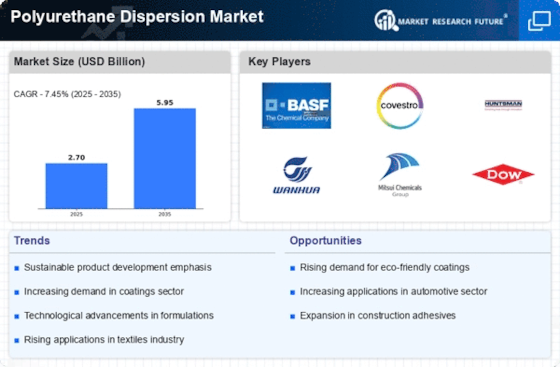
Polyurethane Dispersion Market Infographic
Purchase Options

Market Trends

Key Emerging Trends in the Polyurethane Dispersion Market

The Polyurethane Dispersion Market is subject to various market trends, reflecting changes in consumer preferences, technological advancements, and industry dynamics:

Growing Demand for Water-based Coatings: One prominent trend in the Polyurethane Dispersion (PUD) market is the increasing preference for water-based coatings over solvent-based alternatives. Water-based PUDs offer environmental advantages such as lower VOC emissions, reduced odor, and improved worker safety. As environmental regulations become stricter and sustainability gains importance, the demand for water-based PUDs continues to rise.

Focus on Green and Sustainable Solutions: Sustainability is a key trend shaping the PUD market, with manufacturers focusing on developing green and sustainable formulations. This includes the use of bio-based raw materials, renewable resources, and eco-friendly production processes. As consumers and industries become more environmentally conscious, the demand for sustainable PUDs is expected to grow steadily.

Rising Adoption in End-Use Industries: The PUD market is witnessing increased adoption across various end-use industries such as automotive, construction, furniture, and textiles. PUDs offer excellent adhesion, flexibility, and durability, making them suitable for a wide range of applications including coatings, adhesives, sealants, and elastomers. The versatility of PUDs drives their demand across multiple industries.

Advancements in Formulation Technology: Technological advancements play a significant role in shaping market trends in the PUD industry. Manufacturers are continuously investing in research and development to enhance the performance characteristics of PUD formulations. This includes improvements in film formation, UV stability, chemical resistance, and cure speed, catering to the evolving needs of end-users.

Growth of the Construction Sector: The construction industry is a major consumer of PUDs, particularly in applications such as architectural coatings, sealants, and adhesives. As the construction sector continues to grow, driven by urbanization, infrastructure development, and renovation projects, the demand for PUDs is expected to increase, especially for their excellent weatherability and durability.

Expanding Automotive Production: The automotive industry represents a significant market for PUDs, used in applications such as coatings, adhesives, and sealants for vehicle interiors and exteriors. With the growing demand for lightweight materials, fuel efficiency, and enhanced aesthetics in automobiles, the demand for PUDs is expected to grow as manufacturers seek innovative solutions to meet these requirements.

Shift towards High-Performance Coatings: There is a notable trend towards the adoption of high-performance coatings in industries such as aerospace, marine, and industrial equipment manufacturing. PUDs offer superior performance characteristics such as scratch resistance, chemical resistance, and UV stability, making them ideal for demanding coating applications in these industries.

Focus on Bio-based and Renewable Materials: Another emerging trend in the PUD market is the focus on bio-based and renewable materials. Manufacturers are exploring the use of bio-based polyols and renewable feedstocks to reduce dependence on fossil fuels and minimize environmental impact. This trend aligns with the growing demand for sustainable and eco-friendly products.

Demand for Functional Coatings and Additives: There is a growing demand for PUDs with functional properties such as antimicrobial, self-healing, and conductive coatings. These functional coatings find applications in healthcare, electronics, and automotive industries, where performance and functionality are critical requirements. As industries seek innovative solutions to address specific needs, the demand for functional PUDs is expected to rise.

Market Consolidation and Strategic Partnerships: The PUD market is witnessing consolidation as key players engage in mergers, acquisitions, and strategic partnerships to strengthen their market position and expand their product portfolios. This trend is driven by the need for companies to diversify their offerings, access new markets, and leverage synergies to stay competitive in the evolving PUD industry landscape.

Author
Author Profile
Chitranshi Jaiswal
Team Lead - Research

Chitranshi is a Team Leader in the Chemicals & Materials (CnM) and Energy & Power (EnP) domains, with 6+ years of experience in market research. She leads and mentors teams to deliver cross-domain projects that equip clients with actionable insights and growth strategies. She is skilled in market estimation, forecasting, competitive benchmarking, and both primary & secondary research, enabling her to turn complex data into decision-ready insights. An engineer and MBA professional, she combines technical expertise with strategic acumen to solve dynamic market challenges. Chitranshi has successfully managed projects that support market entry, investment planning, and competitive positioning, while building strong client relationships. Certified in Advanced Excel & Power BI she leverages data-driven approaches to ensure accuracy, clarity, and impactful outcomes.

Leave a Comment

FAQs

What is the current valuation of the Polyurethane Dispersion Market?

<p>The Polyurethane Dispersion Market was valued at 2.7 USD Billion in 2024.</p>

What is the projected market size for the Polyurethane Dispersion Market by 2035?

<p>The market is projected to reach approximately 5.953 USD Billion by 2035.</p>

What is the expected CAGR for the Polyurethane Dispersion Market during the forecast period?

<p>The expected CAGR for the Polyurethane Dispersion Market from 2025 to 2035 is 7.45%.</p>

Which companies are considered key players in the Polyurethane Dispersion Market?

<p>Key players include BASF SE, Covestro AG, Huntsman Corporation, and Wanhua Chemical Group, among others.</p>

What are the main types of polyurethane dispersions in the market?

<p>The main types are Water Based and Solvent Based, with valuations of 3.63 USD Billion and 2.32 USD Billion projected by 2035, respectively.</p>

What applications dominate the Polyurethane Dispersion Market?

Coatings, Adhesives &amp; Sealants, and Synthetic Leather Manufacture are leading applications, with coatings projected to reach 1.83 USD Billion by 2035.

How does the market for Water Based polyurethane dispersions compare to Solvent Based?

Water Based dispersions are expected to significantly outpace Solvent Based dispersions, with a projected valuation of 3.63 USD Billion versus 2.32 USD Billion by 2035.

What is the expected growth trend for the Adhesives & Sealants segment?

The Adhesives &amp; Sealants segment is projected to grow from 0.54 USD Billion in 2024 to 1.25 USD Billion by 2035.

What role do companies like DOW Inc. and Evonik Industries AG play in the market?

Companies like DOW Inc. and Evonik Industries AG are pivotal in driving innovation and market growth within the Polyurethane Dispersion sector.

What is the significance of the Synthetic Leather Manufacture application in the market?

The Synthetic Leather Manufacture application is expected to maintain a steady growth trajectory, with a projected valuation of 1.25 USD Billion by 2035.

Market Summary

As per Market Research Future analysis, the Polyurethane Dispersion Market Size was estimated at 2.7 USD Billion in 2024. The Polyurethane Dispersion industry is projected to grow from 2.901 USD Billion in 2025 to 5.953 USD Billion by 2035, exhibiting a compound annual growth rate (CAGR) of 7.4% during the forecast period 2025 - 2035

Key Market Trends & Highlights

The Polyurethane Dispersion Market is poised for growth driven by sustainability and technological advancements.

  • The market is increasingly influenced by sustainability initiatives, reflecting a broader environmental consciousness. Technological innovations are enhancing the performance and application scope of polyurethane dispersions. Water-based polyurethane dispersions dominate the market, while solvent-based variants are experiencing rapid growth. Rising demand in emerging economies and regulatory compliance are key drivers propelling market expansion.

Market Size & Forecast

2024 Market Size 2.7 (USD Billion)
2035 Market Size 5.953 (USD Billion)
CAGR (2025 - 2035) 7.45%
Largest Regional Market Share in 2024 North America

Major Players

BASF SE (DE), Covestro AG (DE), Huntsman Corporation (US), Wanhua Chemical Group Co., Ltd. (CN), Mitsui Chemicals, Inc. (JP), DOW Inc. (US), SABIC (SA), Evonik Industries AG (DE), Kraton Corporation (US)

Market Trends

The Polyurethane Dispersion Market is currently experiencing a notable transformation, driven by increasing demand for eco-friendly and sustainable materials across various industries. This shift is largely influenced by stringent environmental regulations and a growing awareness of the ecological impact of traditional coatings and adhesives. As manufacturers seek to innovate, the market is witnessing a rise in the development of water-based polyurethane dispersions, which offer lower volatile organic compound emissions and enhanced performance characteristics. Furthermore, the versatility of polyurethane dispersions in applications such as textiles, automotive, and construction is expanding their appeal, suggesting a robust growth trajectory in the coming years. In addition to sustainability, technological advancements are playing a crucial role in shaping the Polyurethane Dispersion Market. Innovations in formulation and production processes are enabling the creation of high-performance products that meet the evolving needs of end-users. This trend is likely to foster increased competition among manufacturers, as they strive to differentiate their offerings through enhanced properties such as durability, flexibility, and adhesion. Overall, the Polyurethane Dispersion Market appears poised for growth, driven by a combination of environmental considerations and technological progress, which may redefine industry standards and consumer expectations.

Sustainability Focus

The emphasis on sustainable practices is reshaping the Polyurethane Dispersion Market. Manufacturers are increasingly adopting eco-friendly formulations to meet regulatory requirements and consumer preferences for greener products. This trend is likely to drive innovation in water-based dispersions, which are perceived as more environmentally responsible.

Technological Advancements

Ongoing technological developments are enhancing the performance of polyurethane dispersions. Innovations in production techniques and formulations are enabling the creation of products with superior properties, such as improved adhesion and flexibility. This trend may lead to a more competitive landscape as companies strive to offer cutting-edge solutions.

Diverse Applications

The versatility of polyurethane dispersions is expanding their use across various sectors, including automotive, textiles, and construction. This broad applicability suggests a growing market potential, as industries seek materials that provide both performance and sustainability.

Polyurethane Dispersion Market Market Drivers

Regulatory Compliance

Regulatory frameworks are increasingly influencing the Polyurethane Dispersion Market, as manufacturers strive to comply with stringent environmental and safety standards. Governments worldwide are implementing regulations aimed at reducing volatile organic compounds (VOCs) in industrial products, which has led to a shift towards low-VOC and zero-VOC polyurethane dispersions. This regulatory push is compelling manufacturers to innovate and reformulate their products to meet compliance requirements. As a result, the market is witnessing a surge in the development of compliant products that not only meet regulatory standards but also appeal to health-conscious consumers. Industry expert's indicate that adherence to these regulations could enhance market competitiveness and open new avenues for growth.

Technological Innovations

Technological advancements are playing a pivotal role in shaping the Polyurethane Dispersion Market. Innovations in formulation chemistry and production processes are leading to the development of high-performance polyurethane dispersions that offer superior properties such as enhanced durability, flexibility, and adhesion. These advancements are particularly beneficial in applications such as coatings, adhesives, and sealants, where performance is critical. Furthermore, the integration of automation and digital technologies in manufacturing processes is streamlining production, reducing costs, and improving product consistency. Market data indicates that the adoption of advanced manufacturing technologies could potentially increase production efficiency by up to 20%, thereby fostering growth in the Polyurethane Dispersion Market.

Sustainability Initiatives

The increasing emphasis on sustainability within the Polyurethane Dispersion Market is driving demand for eco-friendly products. Manufacturers are increasingly adopting water-based polyurethane dispersions, which are less harmful to the environment compared to solvent-based alternatives. This shift aligns with regulatory pressures and consumer preferences for sustainable materials. As a result, the market is witnessing a notable rise in the production of bio-based polyurethanes, which are derived from renewable resources. According to recent data, the market for bio-based polyurethanes is projected to grow at a compound annual growth rate of approximately 8% over the next five years. This trend not only enhances the market's appeal but also positions it favorably in the eyes of environmentally conscious consumers.

Diverse End-Use Applications

The versatility of polyurethane dispersions is a significant driver for the Polyurethane Dispersion Market. These materials find applications across various sectors, including automotive, construction, textiles, and consumer goods. In the automotive sector, for instance, polyurethane dispersions are utilized in coatings and adhesives, enhancing vehicle aesthetics and performance. The construction industry employs these dispersions for waterproofing and insulation applications, contributing to energy efficiency. Recent market analysis suggests that the construction segment alone accounts for nearly 30% of the total demand for polyurethane dispersions. This broad range of applications not only diversifies the market but also mitigates risks associated with reliance on a single sector, thereby promoting stability and growth.

Rising Demand in Emerging Economies

Emerging economies are exhibiting a growing demand for polyurethane dispersions, significantly impacting the Polyurethane Dispersion Market. As these regions experience rapid industrialization and urbanization, the need for advanced materials in construction, automotive, and consumer goods is escalating. Countries in Asia and Latin America are particularly noteworthy, as they are investing heavily in infrastructure development and manufacturing capabilities. This trend is expected to drive the consumption of polyurethane dispersions, with market forecasts suggesting a potential increase in demand by over 15% in these regions over the next five years. The expansion of the middle class in these economies further fuels the demand for high-quality consumer products, thereby enhancing the market's growth prospects.

Market Segment Insights

By Type: Water Based (Largest) vs. Solvent Based (Fastest-Growing)

The Polyurethane Dispersion Market is experiencing a notable distribution between Water Based and Solvent Based segments. Water Based polyurethane dispersions currently dominate the market, primarily due to their eco-friendliness and compliance with stringent regulations regarding volatile organic compounds (VOCs). This segment's substantial market share highlights the industry's preference for sustainable solutions, catering to a wide range of end-user applications including textiles, coatings, and adhesives. Conversely, the Solvent Based segment, though smaller in market share, is recognized as the fastest-growing segment. This growth can be attributed to its excellent performance characteristics, which make it ideal for high-performance applications. The increasing demand for specialized products in automotive coatings and industrial applications is driving the expansion of this segment, as manufacturers seek high durability and aesthetic appeal in their offerings.

Polyurethane Types: Water Based (Dominant) vs. Solvent Based (Emerging)

Water Based polyurethane dispersions are positioned as the dominant force in the market, known for their low environmental impact and compliance with global regulations. They are favored in applications where safety and sustainability are paramount. Commonly used in coatings, adhesives, and textiles, Water Based variations offer excellent adhesion, flexibility, and resistance to water and chemicals, making them versatile solutions across multiple sectors. In contrast, the Solvent Based polyurethane dispersions, classified as emerging in the market, target more niche applications that require high performance and durability. These formulations are particularly well-suited for tough environments such as automotive and industrial coatings, where resistance to abrasion and chemicals is crucial. As industries evolve, Solvent Based options are increasingly being optimized to meet specific performance demands while maintaining a balance with regulatory standards.

By Application: Coatings (Largest) vs. Adhesives & Sealants (Fastest-Growing)

In the Polyurethane Dispersion Market, the application segment is diverse, with coatings being the largest contributor, primarily due to their widespread use in industries such as automotive, construction, and consumer goods. Adhesives &amp; sealants are recognized as a rapidly expanding segment, driven by their essential role in various manufacturing processes, particularly in automotive and construction applications. Together, these applications highlight the versatility and importance of polyurethane dispersions across multiple sectors. As consumer preferences shift towards sustainable and efficient materials, the demand for polyurethane dispersions in coatings and adhesives continues to rise. Technological advancements, such as the development of low-VOC and eco-friendly formulations, are fuelling growth, especially in the adhesives &amp; sealants segment. Furthermore, the increasing use of polyurethane-based products in emerging markets points towards a promising future for this application segment, with expectations of heightened growth driven by industrialization and urbanization.

Coatings (Dominant) vs. Fiberglass Sizing (Emerging)

Coatings have established themselves as the dominant application in the Polyurethane Dispersion Market, favored for their excellent durability, weather resistance, and aesthetic qualities. This segment serves various sectors, including automotive and marine, where protective coatings are crucial. On the other hand, fiberglass sizing is emerging as a key area within the market, although it has a smaller share compared to coatings. Fiberglass sizing provides essential bonding properties to fiberglass products, enhancing performance and durability. As the demand for lightweight and strong materials increases, especially in the automotive and aerospace industries, the significance of fiberglass sizing is likely to grow, showcasing its potential in a niche but expanding market.

Get more detailed insights about Polyurethane Dispersion Market Research Report - Forecast to 2035

Regional Insights

North America : Innovation and Demand Surge

The North American polyurethane dispersion market is driven by increasing demand in automotive, construction, and consumer goods sectors. The region holds approximately 40% of the global market share, making it the largest market. Regulatory support for eco-friendly products and innovations in manufacturing processes are key growth catalysts. The shift towards sustainable materials is further propelling market expansion. Leading countries in this region include the United States and Canada, with the U.S. being the largest contributor. Major players such as DOW Inc., Huntsman Corporation, and BASF SE are actively investing in R&D to enhance product offerings. The competitive landscape is characterized by strategic partnerships and mergers, aimed at increasing market penetration and sustainability initiatives.

Europe : Sustainability and Innovation Focus

Europe is a significant player in the polyurethane dispersion market, holding around 30% of the global share, making it the second-largest region. The market is driven by stringent environmental regulations and a strong push for sustainable products. The European Union's Green Deal and REACH regulations are pivotal in shaping market dynamics, encouraging the adoption of eco-friendly materials and processes. Germany, France, and the UK are leading countries in this region, with Germany being the largest market. Key players like Covestro AG and BASF SE are at the forefront of innovation, focusing on developing sustainable solutions. The competitive landscape is marked by collaborations between manufacturers and research institutions to enhance product performance and reduce environmental impact.

Asia-Pacific : Emerging Markets and Growth Potential

The Asia-Pacific region is witnessing rapid growth in the polyurethane dispersion market, driven by increasing industrialization and urbanization. This region holds approximately 25% of the global market share, with China and India being the largest contributors. The demand for eco-friendly products and advancements in manufacturing technologies are key growth drivers, supported by favorable government policies promoting sustainable practices. China is the leading country in this market, with significant investments in infrastructure and automotive sectors. Other notable players include Wanhua Chemical Group and Mitsui Chemicals. The competitive landscape is evolving, with local manufacturers increasingly focusing on innovation and sustainability to capture market share and meet rising consumer expectations.

Middle East and Africa : Resource-Rich and Growing Demand

The Middle East and Africa region is gradually emerging in the polyurethane dispersion market, holding about 5% of the global share. The growth is driven by increasing demand in construction and automotive sectors, alongside a growing focus on sustainable materials. Government initiatives aimed at diversifying economies and promoting industrial growth are also contributing to market expansion. Leading countries include South Africa and the UAE, where investments in infrastructure and manufacturing are on the rise. Key players like SABIC and Kraton Corporation are establishing a strong presence in the region. The competitive landscape is characterized by collaborations and partnerships aimed at enhancing product offerings and meeting local demand for eco-friendly solutions.

Key Players and Competitive Insights

The Polyurethane Dispersion Market is currently characterized by a dynamic competitive landscape, driven by increasing demand for eco-friendly and high-performance materials across various applications, including coatings, adhesives, and textiles. Key players such as BASF SE (Germany), Covestro AG (Germany), and Huntsman Corporation (US) are strategically positioned to leverage innovation and sustainability as core components of their operational focus. These companies are actively investing in research and development to enhance product performance while reducing environmental impact, thereby shaping a competitive environment that prioritizes both quality and sustainability.In terms of business tactics, companies are increasingly localizing manufacturing to reduce lead times and optimize supply chains. The market appears moderately fragmented, with several players vying for market share, yet the collective influence of major companies like DOW Inc. (US) and Wanhua Chemical Group Co., Ltd. (China) is significant. Their strategies often involve partnerships and collaborations that enhance their market presence and operational efficiency, contributing to a more integrated supply chain.

In August BASF SE (Germany) announced the launch of a new line of bio-based polyurethane dispersions aimed at reducing carbon emissions in the production process. This strategic move not only aligns with global sustainability goals but also positions BASF as a leader in the eco-friendly segment of the market, potentially attracting environmentally conscious customers and enhancing brand loyalty.

In September Covestro AG (Germany) revealed a partnership with a leading automotive manufacturer to develop innovative polyurethane solutions for lightweight vehicle components. This collaboration underscores Covestro's commitment to advancing technology in the automotive sector, suggesting a strategic focus on high-performance applications that could drive future growth and market penetration.

In July Huntsman Corporation (US) expanded its production capacity for polyurethane dispersions in response to rising demand in the Asia-Pacific region. This expansion reflects Huntsman's strategy to capitalize on regional growth opportunities, indicating a proactive approach to meeting customer needs and enhancing supply chain reliability in a rapidly evolving market.

As of October the Polyurethane Dispersion Market is witnessing trends such as digitalization, sustainability, and the integration of artificial intelligence in production processes. Strategic alliances are increasingly shaping the competitive landscape, enabling companies to pool resources and expertise. Looking ahead, competitive differentiation is likely to evolve from traditional price-based competition to a focus on innovation, technological advancements, and supply chain resilience, as companies strive to meet the growing expectations of consumers and regulatory bodies.

Key Companies in the Polyurethane Dispersion Market include

Industry Developments

In February 2021, Covestro announced plans for a new polyurethane dispersion production facility in China to meet the region's growing need for adhesives and coatings that are environmentally friendly. The business has set a 2024 completion date for this project.

In January 2020, Spain will get investment from BASF's polyurethane dispersion division. This investment resulted in a 30% increase in the production capacity of polyurethane dispersions based on water.

In November 2018, in order to increase its market value in the European region and compete favorably in the polymer dispersion industry, the manufacturing company Covestro AG developed a new production facility in Germany. By giving customers high-quality items, the business was able to improve customer relations and carve out a niche for itself in the market.

In 2024 BASF released a new polyurethane dispersion with enhanced durability and application properties for coatings and adhesives.

In 2023 Covestro introduced innovative polyurethane dispersion products with improved performance and environmental benefits.

Future Outlook

Polyurethane Dispersion Market Future Outlook

The Polyurethane Dispersion Market is projected to grow at a 7.45% CAGR from 2025 to 2035, driven by increasing demand in automotive, construction, and textile applications.

New opportunities lie in:

  • Development of eco-friendly polyurethane dispersions for sustainable applications.</p><p>Expansion into emerging markets with tailored product offerings.</p><p>Investment in advanced manufacturing technologies to enhance production efficiency.

By 2035, the market is expected to achieve robust growth, positioning itself as a leader in innovative applications.

Market Segmentation

Polyurethane Dispersion Market Type Outlook

  • Water Based
  • Solvent Based

Polyurethane Dispersion Market Application Outlook

  • Coatings
  • Adhesives & Sealants
  • Synthetic Leather Manufacture
  • Fiberglass Sizing
  • Others

Report Scope

MARKET SIZE 2024 2.7(USD Billion)
MARKET SIZE 2025 2.901(USD Billion)
MARKET SIZE 2035 5.953(USD Billion)
COMPOUND ANNUAL GROWTH RATE (CAGR) 7.45% (2025 - 2035)
REPORT COVERAGE Revenue Forecast, Competitive Landscape, Growth Factors, and Trends
BASE YEAR 2024
Market Forecast Period 2025 - 2035
Historical Data 2019 - 2024
Market Forecast Units USD Billion
Key Companies Profiled BASF SE (DE), Covestro AG (DE), Huntsman Corporation (US), Wanhua Chemical Group Co., Ltd. (CN), Mitsui Chemicals, Inc. (JP), DOW Inc. (US), SABIC (SA), Evonik Industries AG (DE), Kraton Corporation (US)
Segments Covered Type, Application, Region
Key Market Opportunities Growing demand for eco-friendly coatings drives innovation in the Polyurethane Dispersion Market.
Key Market Dynamics Rising demand for eco-friendly coatings drives innovation in polyurethane dispersion formulations and applications.
Countries Covered North America, Europe, APAC, South America, MEA

FAQs

What is the current valuation of the Polyurethane Dispersion Market?

<p>The Polyurethane Dispersion Market was valued at 2.7 USD Billion in 2024.</p>

What is the projected market size for the Polyurethane Dispersion Market by 2035?

<p>The market is projected to reach approximately 5.953 USD Billion by 2035.</p>

What is the expected CAGR for the Polyurethane Dispersion Market during the forecast period?

<p>The expected CAGR for the Polyurethane Dispersion Market from 2025 to 2035 is 7.45%.</p>

Which companies are considered key players in the Polyurethane Dispersion Market?

<p>Key players include BASF SE, Covestro AG, Huntsman Corporation, and Wanhua Chemical Group, among others.</p>

What are the main types of polyurethane dispersions in the market?

<p>The main types are Water Based and Solvent Based, with valuations of 3.63 USD Billion and 2.32 USD Billion projected by 2035, respectively.</p>

What applications dominate the Polyurethane Dispersion Market?

Coatings, Adhesives &amp; Sealants, and Synthetic Leather Manufacture are leading applications, with coatings projected to reach 1.83 USD Billion by 2035.

How does the market for Water Based polyurethane dispersions compare to Solvent Based?

Water Based dispersions are expected to significantly outpace Solvent Based dispersions, with a projected valuation of 3.63 USD Billion versus 2.32 USD Billion by 2035.

What is the expected growth trend for the Adhesives & Sealants segment?

The Adhesives &amp; Sealants segment is projected to grow from 0.54 USD Billion in 2024 to 1.25 USD Billion by 2035.

What role do companies like DOW Inc. and Evonik Industries AG play in the market?

Companies like DOW Inc. and Evonik Industries AG are pivotal in driving innovation and market growth within the Polyurethane Dispersion sector.

What is the significance of the Synthetic Leather Manufacture application in the market?

The Synthetic Leather Manufacture application is expected to maintain a steady growth trajectory, with a projected valuation of 1.25 USD Billion by 2035.

  1. SECTION I: EXECUTIVE SUMMARY AND KEY HIGHLIGHTS
    1. | 1.1 EXECUTIVE SUMMARY
    2. | | 1.1.1 Market Overview
    3. | | 1.1.2 Key Findings
    4. | | 1.1.3 Market Segmentation
    5. | | 1.1.4 Competitive Landscape
    6. | | 1.1.5 Challenges and Opportunities
    7. | | 1.1.6 Future Outlook
  2. SECTION II: SCOPING, METHODOLOGY AND MARKET STRUCTURE
    1. | 2.1 MARKET INTRODUCTION
    2. | | 2.1.1 Definition
    3. | | 2.1.2 Scope of the study
    4. | | | 2.1.2.1 Research Objective
    5. | | | 2.1.2.2 Assumption
    6. | | | 2.1.2.3 Limitations
    7. | 2.2 RESEARCH METHODOLOGY
    8. | | 2.2.1 Overview
    9. | | 2.2.2 Data Mining
    10. | | 2.2.3 Secondary Research
    11. | | 2.2.4 Primary Research
    12. | | | 2.2.4.1 Primary Interviews and Information Gathering Process
    13. | | | 2.2.4.2 Breakdown of Primary Respondents
    14. | | 2.2.5 Forecasting Model
    15. | | 2.2.6 Market Size Estimation
    16. | | | 2.2.6.1 Bottom-Up Approach
    17. | | | 2.2.6.2 Top-Down Approach
    18. | | 2.2.7 Data Triangulation
    19. | | 2.2.8 Validation
  3. SECTION III: QUALITATIVE ANALYSIS
    1. | 3.1 MARKET DYNAMICS
    2. | | 3.1.1 Overview
    3. | | 3.1.2 Drivers
    4. | | 3.1.3 Restraints
    5. | | 3.1.4 Opportunities
    6. | 3.2 MARKET FACTOR ANALYSIS
    7. | | 3.2.1 Value chain Analysis
    8. | | 3.2.2 Porter's Five Forces Analysis
    9. | | | 3.2.2.1 Bargaining Power of Suppliers
    10. | | | 3.2.2.2 Bargaining Power of Buyers
    11. | | | 3.2.2.3 Threat of New Entrants
    12. | | | 3.2.2.4 Threat of Substitutes
    13. | | | 3.2.2.5 Intensity of Rivalry
    14. | | 3.2.3 COVID-19 Impact Analysis
    15. | | | 3.2.3.1 Market Impact Analysis
    16. | | | 3.2.3.2 Regional Impact
    17. | | | 3.2.3.3 Opportunity and Threat Analysis
  4. SECTION IV: QUANTITATIVE ANALYSIS
    1. | 4.1 Chemicals and Materials, BY Type (USD Billion)
    2. | | 4.1.1 Water Based
    3. | | 4.1.2 Solvent Based
    4. | 4.2 Chemicals and Materials, BY Application (USD Billion)
    5. | | 4.2.1 Coatings
    6. | | 4.2.2 Adhesives & Sealants
    7. | | 4.2.3 Synthetic Leather Manufacture
    8. | | 4.2.4 Fiberglass Sizing
    9. | | 4.2.5 Others
    10. | 4.3 Chemicals and Materials, BY Region (USD Billion)
    11. | | 4.3.1 North America
    12. | | | 4.3.1.1 US
    13. | | | 4.3.1.2 Canada
    14. | | 4.3.2 Europe
    15. | | | 4.3.2.1 Germany
    16. | | | 4.3.2.2 UK
    17. | | | 4.3.2.3 France
    18. | | | 4.3.2.4 Russia
    19. | | | 4.3.2.5 Italy
    20. | | | 4.3.2.6 Spain
    21. | | | 4.3.2.7 Rest of Europe
    22. | | 4.3.3 APAC
    23. | | | 4.3.3.1 China
    24. | | | 4.3.3.2 India
    25. | | | 4.3.3.3 Japan
    26. | | | 4.3.3.4 South Korea
    27. | | | 4.3.3.5 Malaysia
    28. | | | 4.3.3.6 Thailand
    29. | | | 4.3.3.7 Indonesia
    30. | | | 4.3.3.8 Rest of APAC
    31. | | 4.3.4 South America
    32. | | | 4.3.4.1 Brazil
    33. | | | 4.3.4.2 Mexico
    34. | | | 4.3.4.3 Argentina
    35. | | | 4.3.4.4 Rest of South America
    36. | | 4.3.5 MEA
    37. | | | 4.3.5.1 GCC Countries
    38. | | | 4.3.5.2 South Africa
    39. | | | 4.3.5.3 Rest of MEA
  5. SECTION V: COMPETITIVE ANALYSIS
    1. | 5.1 Competitive Landscape
    2. | | 5.1.1 Overview
    3. | | 5.1.2 Competitive Analysis
    4. | | 5.1.3 Market share Analysis
    5. | | 5.1.4 Major Growth Strategy in the Chemicals and Materials
    6. | | 5.1.5 Competitive Benchmarking
    7. | | 5.1.6 Leading Players in Terms of Number of Developments in the Chemicals and Materials
    8. | | 5.1.7 Key developments and growth strategies
    9. | | | 5.1.7.1 New Product Launch/Service Deployment
    10. | | | 5.1.7.2 Merger & Acquisitions
    11. | | | 5.1.7.3 Joint Ventures
    12. | | 5.1.8 Major Players Financial Matrix
    13. | | | 5.1.8.1 Sales and Operating Income
    14. | | | 5.1.8.2 Major Players R&D Expenditure. 2023
    15. | 5.2 Company Profiles
    16. | | 5.2.1 BASF SE (DE)
    17. | | | 5.2.1.1 Financial Overview
    18. | | | 5.2.1.2 Products Offered
    19. | | | 5.2.1.3 Key Developments
    20. | | | 5.2.1.4 SWOT Analysis
    21. | | | 5.2.1.5 Key Strategies
    22. | | 5.2.2 Covestro AG (DE)
    23. | | | 5.2.2.1 Financial Overview
    24. | | | 5.2.2.2 Products Offered
    25. | | | 5.2.2.3 Key Developments
    26. | | | 5.2.2.4 SWOT Analysis
    27. | | | 5.2.2.5 Key Strategies
    28. | | 5.2.3 Huntsman Corporation (US)
    29. | | | 5.2.3.1 Financial Overview
    30. | | | 5.2.3.2 Products Offered
    31. | | | 5.2.3.3 Key Developments
    32. | | | 5.2.3.4 SWOT Analysis
    33. | | | 5.2.3.5 Key Strategies
    34. | | 5.2.4 Wanhua Chemical Group Co., Ltd. (CN)
    35. | | | 5.2.4.1 Financial Overview
    36. | | | 5.2.4.2 Products Offered
    37. | | | 5.2.4.3 Key Developments
    38. | | | 5.2.4.4 SWOT Analysis
    39. | | | 5.2.4.5 Key Strategies
    40. | | 5.2.5 Mitsui Chemicals, Inc. (JP)
    41. | | | 5.2.5.1 Financial Overview
    42. | | | 5.2.5.2 Products Offered
    43. | | | 5.2.5.3 Key Developments
    44. | | | 5.2.5.4 SWOT Analysis
    45. | | | 5.2.5.5 Key Strategies
    46. | | 5.2.6 DOW Inc. (US)
    47. | | | 5.2.6.1 Financial Overview
    48. | | | 5.2.6.2 Products Offered
    49. | | | 5.2.6.3 Key Developments
    50. | | | 5.2.6.4 SWOT Analysis
    51. | | | 5.2.6.5 Key Strategies
    52. | | 5.2.7 SABIC (SA)
    53. | | | 5.2.7.1 Financial Overview
    54. | | | 5.2.7.2 Products Offered
    55. | | | 5.2.7.3 Key Developments
    56. | | | 5.2.7.4 SWOT Analysis
    57. | | | 5.2.7.5 Key Strategies
    58. | | 5.2.8 Evonik Industries AG (DE)
    59. | | | 5.2.8.1 Financial Overview
    60. | | | 5.2.8.2 Products Offered
    61. | | | 5.2.8.3 Key Developments
    62. | | | 5.2.8.4 SWOT Analysis
    63. | | | 5.2.8.5 Key Strategies
    64. | | 5.2.9 Kraton Corporation (US)
    65. | | | 5.2.9.1 Financial Overview
    66. | | | 5.2.9.2 Products Offered
    67. | | | 5.2.9.3 Key Developments
    68. | | | 5.2.9.4 SWOT Analysis
    69. | | | 5.2.9.5 Key Strategies
    70. | 5.3 Appendix
    71. | | 5.3.1 References
    72. | | 5.3.2 Related Reports
  6. LIST OF FIGURES
    1. | 6.1 MARKET SYNOPSIS
    2. | 6.2 NORTH AMERICA MARKET ANALYSIS
    3. | 6.3 US MARKET ANALYSIS BY TYPE
    4. | 6.4 US MARKET ANALYSIS BY APPLICATION
    5. | 6.5 CANADA MARKET ANALYSIS BY TYPE
    6. | 6.6 CANADA MARKET ANALYSIS BY APPLICATION
    7. | 6.7 EUROPE MARKET ANALYSIS
    8. | 6.8 GERMANY MARKET ANALYSIS BY TYPE
    9. | 6.9 GERMANY MARKET ANALYSIS BY APPLICATION
    10. | 6.10 UK MARKET ANALYSIS BY TYPE
    11. | 6.11 UK MARKET ANALYSIS BY APPLICATION
    12. | 6.12 FRANCE MARKET ANALYSIS BY TYPE
    13. | 6.13 FRANCE MARKET ANALYSIS BY APPLICATION
    14. | 6.14 RUSSIA MARKET ANALYSIS BY TYPE
    15. | 6.15 RUSSIA MARKET ANALYSIS BY APPLICATION
    16. | 6.16 ITALY MARKET ANALYSIS BY TYPE
    17. | 6.17 ITALY MARKET ANALYSIS BY APPLICATION
    18. | 6.18 SPAIN MARKET ANALYSIS BY TYPE
    19. | 6.19 SPAIN MARKET ANALYSIS BY APPLICATION
    20. | 6.20 REST OF EUROPE MARKET ANALYSIS BY TYPE
    21. | 6.21 REST OF EUROPE MARKET ANALYSIS BY APPLICATION
    22. | 6.22 APAC MARKET ANALYSIS
    23. | 6.23 CHINA MARKET ANALYSIS BY TYPE
    24. | 6.24 CHINA MARKET ANALYSIS BY APPLICATION
    25. | 6.25 INDIA MARKET ANALYSIS BY TYPE
    26. | 6.26 INDIA MARKET ANALYSIS BY APPLICATION
    27. | 6.27 JAPAN MARKET ANALYSIS BY TYPE
    28. | 6.28 JAPAN MARKET ANALYSIS BY APPLICATION
    29. | 6.29 SOUTH KOREA MARKET ANALYSIS BY TYPE
    30. | 6.30 SOUTH KOREA MARKET ANALYSIS BY APPLICATION
    31. | 6.31 MALAYSIA MARKET ANALYSIS BY TYPE
    32. | 6.32 MALAYSIA MARKET ANALYSIS BY APPLICATION
    33. | 6.33 THAILAND MARKET ANALYSIS BY TYPE
    34. | 6.34 THAILAND MARKET ANALYSIS BY APPLICATION
    35. | 6.35 INDONESIA MARKET ANALYSIS BY TYPE
    36. | 6.36 INDONESIA MARKET ANALYSIS BY APPLICATION
    37. | 6.37 REST OF APAC MARKET ANALYSIS BY TYPE
    38. | 6.38 REST OF APAC MARKET ANALYSIS BY APPLICATION
    39. | 6.39 SOUTH AMERICA MARKET ANALYSIS
    40. | 6.40 BRAZIL MARKET ANALYSIS BY TYPE
    41. | 6.41 BRAZIL MARKET ANALYSIS BY APPLICATION
    42. | 6.42 MEXICO MARKET ANALYSIS BY TYPE
    43. | 6.43 MEXICO MARKET ANALYSIS BY APPLICATION
    44. | 6.44 ARGENTINA MARKET ANALYSIS BY TYPE
    45. | 6.45 ARGENTINA MARKET ANALYSIS BY APPLICATION
    46. | 6.46 REST OF SOUTH AMERICA MARKET ANALYSIS BY TYPE
    47. | 6.47 REST OF SOUTH AMERICA MARKET ANALYSIS BY APPLICATION
    48. | 6.48 MEA MARKET ANALYSIS
    49. | 6.49 GCC COUNTRIES MARKET ANALYSIS BY TYPE
    50. | 6.50 GCC COUNTRIES MARKET ANALYSIS BY APPLICATION
    51. | 6.51 SOUTH AFRICA MARKET ANALYSIS BY TYPE
    52. | 6.52 SOUTH AFRICA MARKET ANALYSIS BY APPLICATION
    53. | 6.53 REST OF MEA MARKET ANALYSIS BY TYPE
    54. | 6.54 REST OF MEA MARKET ANALYSIS BY APPLICATION
    55. | 6.55 KEY BUYING CRITERIA OF CHEMICALS AND MATERIALS
    56. | 6.56 RESEARCH PROCESS OF MRFR
    57. | 6.57 DRO ANALYSIS OF CHEMICALS AND MATERIALS
    58. | 6.58 DRIVERS IMPACT ANALYSIS: CHEMICALS AND MATERIALS
    59. | 6.59 RESTRAINTS IMPACT ANALYSIS: CHEMICALS AND MATERIALS
    60. | 6.60 SUPPLY / VALUE CHAIN: CHEMICALS AND MATERIALS
    61. | 6.61 CHEMICALS AND MATERIALS, BY TYPE, 2024 (% SHARE)
    62. | 6.62 CHEMICALS AND MATERIALS, BY TYPE, 2024 TO 2035 (USD Billion)
    63. | 6.63 CHEMICALS AND MATERIALS, BY APPLICATION, 2024 (% SHARE)
    64. | 6.64 CHEMICALS AND MATERIALS, BY APPLICATION, 2024 TO 2035 (USD Billion)
    65. | 6.65 BENCHMARKING OF MAJOR COMPETITORS
  7. LIST OF TABLES
    1. | 7.1 LIST OF ASSUMPTIONS
    2. | | 7.1.1
    3. | 7.2 North America MARKET SIZE ESTIMATES; FORECAST
    4. | | 7.2.1 BY TYPE, 2025-2035 (USD Billion)
    5. | | 7.2.2 BY APPLICATION, 2025-2035 (USD Billion)
    6. | 7.3 US MARKET SIZE ESTIMATES; FORECAST
    7. | | 7.3.1 BY TYPE, 2025-2035 (USD Billion)
    8. | | 7.3.2 BY APPLICATION, 2025-2035 (USD Billion)
    9. | 7.4 Canada MARKET SIZE ESTIMATES; FORECAST
    10. | | 7.4.1 BY TYPE, 2025-2035 (USD Billion)
    11. | | 7.4.2 BY APPLICATION, 2025-2035 (USD Billion)
    12. | 7.5 Europe MARKET SIZE ESTIMATES; FORECAST
    13. | | 7.5.1 BY TYPE, 2025-2035 (USD Billion)
    14. | | 7.5.2 BY APPLICATION, 2025-2035 (USD Billion)
    15. | 7.6 Germany MARKET SIZE ESTIMATES; FORECAST
    16. | | 7.6.1 BY TYPE, 2025-2035 (USD Billion)
    17. | | 7.6.2 BY APPLICATION, 2025-2035 (USD Billion)
    18. | 7.7 UK MARKET SIZE ESTIMATES; FORECAST
    19. | | 7.7.1 BY TYPE, 2025-2035 (USD Billion)
    20. | | 7.7.2 BY APPLICATION, 2025-2035 (USD Billion)
    21. | 7.8 France MARKET SIZE ESTIMATES; FORECAST
    22. | | 7.8.1 BY TYPE, 2025-2035 (USD Billion)
    23. | | 7.8.2 BY APPLICATION, 2025-2035 (USD Billion)
    24. | 7.9 Russia MARKET SIZE ESTIMATES; FORECAST
    25. | | 7.9.1 BY TYPE, 2025-2035 (USD Billion)
    26. | | 7.9.2 BY APPLICATION, 2025-2035 (USD Billion)
    27. | 7.10 Italy MARKET SIZE ESTIMATES; FORECAST
    28. | | 7.10.1 BY TYPE, 2025-2035 (USD Billion)
    29. | | 7.10.2 BY APPLICATION, 2025-2035 (USD Billion)
    30. | 7.11 Spain MARKET SIZE ESTIMATES; FORECAST
    31. | | 7.11.1 BY TYPE, 2025-2035 (USD Billion)
    32. | | 7.11.2 BY APPLICATION, 2025-2035 (USD Billion)
    33. | 7.12 Rest of Europe MARKET SIZE ESTIMATES; FORECAST
    34. | | 7.12.1 BY TYPE, 2025-2035 (USD Billion)
    35. | | 7.12.2 BY APPLICATION, 2025-2035 (USD Billion)
    36. | 7.13 APAC MARKET SIZE ESTIMATES; FORECAST
    37. | | 7.13.1 BY TYPE, 2025-2035 (USD Billion)
    38. | | 7.13.2 BY APPLICATION, 2025-2035 (USD Billion)
    39. | 7.14 China MARKET SIZE ESTIMATES; FORECAST
    40. | | 7.14.1 BY TYPE, 2025-2035 (USD Billion)
    41. | | 7.14.2 BY APPLICATION, 2025-2035 (USD Billion)
    42. | 7.15 India MARKET SIZE ESTIMATES; FORECAST
    43. | | 7.15.1 BY TYPE, 2025-2035 (USD Billion)
    44. | | 7.15.2 BY APPLICATION, 2025-2035 (USD Billion)
    45. | 7.16 Japan MARKET SIZE ESTIMATES; FORECAST
    46. | | 7.16.1 BY TYPE, 2025-2035 (USD Billion)
    47. | | 7.16.2 BY APPLICATION, 2025-2035 (USD Billion)
    48. | 7.17 South Korea MARKET SIZE ESTIMATES; FORECAST
    49. | | 7.17.1 BY TYPE, 2025-2035 (USD Billion)
    50. | | 7.17.2 BY APPLICATION, 2025-2035 (USD Billion)
    51. | 7.18 Malaysia MARKET SIZE ESTIMATES; FORECAST
    52. | | 7.18.1 BY TYPE, 2025-2035 (USD Billion)
    53. | | 7.18.2 BY APPLICATION, 2025-2035 (USD Billion)
    54. | 7.19 Thailand MARKET SIZE ESTIMATES; FORECAST
    55. | | 7.19.1 BY TYPE, 2025-2035 (USD Billion)
    56. | | 7.19.2 BY APPLICATION, 2025-2035 (USD Billion)
    57. | 7.20 Indonesia MARKET SIZE ESTIMATES; FORECAST
    58. | | 7.20.1 BY TYPE, 2025-2035 (USD Billion)
    59. | | 7.20.2 BY APPLICATION, 2025-2035 (USD Billion)
    60. | 7.21 Rest of APAC MARKET SIZE ESTIMATES; FORECAST
    61. | | 7.21.1 BY TYPE, 2025-2035 (USD Billion)
    62. | | 7.21.2 BY APPLICATION, 2025-2035 (USD Billion)
    63. | 7.22 South America MARKET SIZE ESTIMATES; FORECAST
    64. | | 7.22.1 BY TYPE, 2025-2035 (USD Billion)
    65. | | 7.22.2 BY APPLICATION, 2025-2035 (USD Billion)
    66. | 7.23 Brazil MARKET SIZE ESTIMATES; FORECAST
    67. | | 7.23.1 BY TYPE, 2025-2035 (USD Billion)
    68. | | 7.23.2 BY APPLICATION, 2025-2035 (USD Billion)
    69. | 7.24 Mexico MARKET SIZE ESTIMATES; FORECAST
    70. | | 7.24.1 BY TYPE, 2025-2035 (USD Billion)
    71. | | 7.24.2 BY APPLICATION, 2025-2035 (USD Billion)
    72. | 7.25 Argentina MARKET SIZE ESTIMATES; FORECAST
    73. | | 7.25.1 BY TYPE, 2025-2035 (USD Billion)
    74. | | 7.25.2 BY APPLICATION, 2025-2035 (USD Billion)
    75. | 7.26 Rest of South America MARKET SIZE ESTIMATES; FORECAST
    76. | | 7.26.1 BY TYPE, 2025-2035 (USD Billion)
    77. | | 7.26.2 BY APPLICATION, 2025-2035 (USD Billion)
    78. | 7.27 MEA MARKET SIZE ESTIMATES; FORECAST
    79. | | 7.27.1 BY TYPE, 2025-2035 (USD Billion)
    80. | | 7.27.2 BY APPLICATION, 2025-2035 (USD Billion)
    81. | 7.28 GCC Countries MARKET SIZE ESTIMATES; FORECAST
    82. | | 7.28.1 BY TYPE, 2025-2035 (USD Billion)
    83. | | 7.28.2 BY APPLICATION, 2025-2035 (USD Billion)
    84. | 7.29 South Africa MARKET SIZE ESTIMATES; FORECAST
    85. | | 7.29.1 BY TYPE, 2025-2035 (USD Billion)
    86. | | 7.29.2 BY APPLICATION, 2025-2035 (USD Billion)
    87. | 7.30 Rest of MEA MARKET SIZE ESTIMATES; FORECAST
    88. | | 7.30.1 BY TYPE, 2025-2035 (USD Billion)
    89. | | 7.30.2 BY APPLICATION, 2025-2035 (USD Billion)
    90. | 7.31 PRODUCT LAUNCH/PRODUCT DEVELOPMENT/APPROVAL
    91. | | 7.31.1
    92. | 7.32 ACQUISITION/PARTNERSHIP
    93. | | 7.32.1

Chemicals and Materials Market Segmentation

Chemicals and Materials By Type (USD Billion, 2025-2035)

  • Water Based
  • Solvent Based

Chemicals and Materials By Application (USD Billion, 2025-2035)

  • Coatings
  • Adhesives & Sealants
  • Synthetic Leather Manufacture
  • Fiberglass Sizing
  • Others
Infographic

Free Sample Request

Kindly complete the form below to receive a free sample of this Report

Get Free Sample

Customer Strories

Compare Licence

×
Features License Type
Single User Multiuser License Enterprise User
Price $4,950 $5,950 $7,250
Maximum User Access Limit 1 User Upto 10 Users Unrestricted Access Throughout the Organization
Free Customization
Direct Access to Analyst
Deliverable Format
Platform Access
Discount on Next Purchase 10% 15% 15%
Printable Versions
%>