Request Free Sample ×

Kindly complete the form below to receive a free sample of this Report

* Please use a valid business email

Leading companies partner with us for data-driven Insights

clients tt-cursor
Hero Background
English
Chinese
French
Japanese
Korean
German
Spanish

Polyurea Coatings Market Size

ID: MRFR/CnM/4500-HCR
100 Pages
Chitranshi Jaiswal
Last Updated: April 06, 2026

Polyurea Coatings Market Research Report Information by Type (pure, hybrid), Raw Material (aromatic isocyanate, aliphatic isocyanate), Technique (spraying, pouring, hand mixing), End-Use industry (building & construction, Transportation, industrial, chemical), and Region- Global Forecast till 2035

Share:
Download PDF ×

We do not share your information with anyone. However, we may send you emails based on your report interest from time to time. You may contact us at any time to opt-out.

Polyurea Coatings Market Infographic
Purchase Options

Polyurea Coatings Size

Polyurea Coatings Market Growth Projections and Opportunities

The Polyurea Coatings Market is influenced by various market factors that play a crucial role in its growth and development. These factors encompass a range of elements, including market demand, economic conditions, technological advancements, and environmental considerations. The polyurea coatings market size is anticipated to be valued at USD 2360.17 million with a significant CAGR of 13.20% during the forecast period 2021-2028

At the core of the Polyurea Coatings Market are customer demands and preferences. The market is driven by the increasing need for durable and protective coatings across various industries. Polyurea coatings, known for their exceptional strength, flexibility, and chemical resistance, have gained popularity as an effective solution for enhancing the lifespan and performance of surfaces. The rising awareness among end-users about the benefits of polyurea coatings has contributed significantly to the market's expansion.

Economic conditions also play a pivotal role in shaping the Polyurea Coatings Market. The growth of industries such as construction, automotive, and manufacturing, which are major consumers of polyurea coatings, is closely linked to economic stability. When economies are thriving, there is a higher demand for construction projects, new vehicles, and industrial production, subsequently driving the demand for polyurea coatings.

Technological advancements and innovations continually impact the Polyurea Coatings Market. Ongoing research and development activities lead to the creation of improved formulations and application techniques, enhancing the overall performance and efficiency of polyurea coatings. Manufacturers strive to develop products that meet the evolving needs of end-users, whether it be faster curing times, increased durability, or environmentally friendly options.

Environmental considerations have become increasingly important in the Polyurea Coatings Market. With a growing focus on sustainability and environmental responsibility, there is a rising demand for coatings that have minimal impact on the ecosystem. Polyurea coatings, with their low VOC (volatile organic compounds) content and reduced environmental footprint, are gaining favor among environmentally conscious consumers and industries. This shift towards eco-friendly solutions has not only broadened the market base but has also led to regulatory changes, influencing the production and usage of coatings.

Market competition is another crucial factor affecting the Polyurea Coatings Market dynamics. As the market expands, more players enter the arena, intensifying competition. This competition often leads to product innovation, improved quality, and competitive pricing strategies. Companies in the Polyurea Coatings Market strive to differentiate themselves by offering unique features or specialized formulations to cater to specific industry needs.

Global and regional trends also contribute to the overall landscape of the Polyurea Coatings Market. The market is affected by geopolitical factors, trade policies, and regional economic conditions. For example, a surge in construction activities in a particular region can drive the demand for polyurea coatings in that area. Understanding these trends is essential for market players to make informed decisions and adapt their strategies accordingly.

Supply chain dynamics and raw material availability are integral parts of the Polyurea Coatings Market. The availability and pricing of key raw materials, such as isocyanates and amines, can impact production costs and, subsequently, product pricing. Fluctuations in the supply chain can influence the overall market stability, requiring industry participants to maintain a resilient and adaptable supply chain.
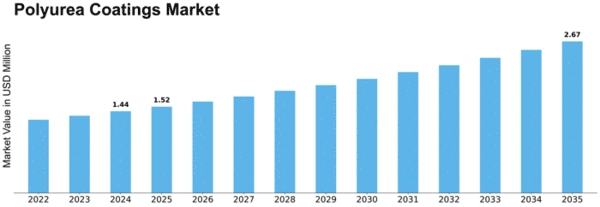
Polyurea Coatings Market Size Graph
Author
Author Profile
Chitranshi Jaiswal
Team Lead - Research

Chitranshi is a Team Leader in the Chemicals & Materials (CnM) and Energy & Power (EnP) domains, with 6+ years of experience in market research. She leads and mentors teams to deliver cross-domain projects that equip clients with actionable insights and growth strategies. She is skilled in market estimation, forecasting, competitive benchmarking, and both primary & secondary research, enabling her to turn complex data into decision-ready insights. An engineer and MBA professional, she combines technical expertise with strategic acumen to solve dynamic market challenges. Chitranshi has successfully managed projects that support market entry, investment planning, and competitive positioning, while building strong client relationships. Certified in Advanced Excel & Power BI she leverages data-driven approaches to ensure accuracy, clarity, and impactful outcomes.

Leave a Comment

FAQs

What is the projected market valuation of the Polyurea Coatings Market by 2035?

<p>The Polyurea Coatings Market is projected to reach a valuation of 2.67 USD Million by 2035.</p>

What was the market valuation of the Polyurea Coatings Market in 2024?

<p>In 2024, the market valuation of the Polyurea Coatings Market was 1.44 USD Million.</p>

What is the expected CAGR for the Polyurea Coatings Market during the forecast period 2025 - 2035?

<p>The expected CAGR for the Polyurea Coatings Market during the forecast period 2025 - 2035 is 5.76%.</p>

Which companies are considered key players in the Polyurea Coatings Market?

<p>Key players in the Polyurea Coatings Market include BASF SE, Huntsman Corporation, Sika AG, and Sherwin-Williams Company.</p>

What are the primary applications of polyurea coatings?

<p>The primary applications of polyurea coatings include industrial coatings, construction coatings, automotive coatings, and protective coatings.</p>

How does the market for polyurea coatings segment by end use?

The market segments by end use include building and construction, automotive, aerospace, marine, and industrial applications.

What are the different formulation types available in the Polyurea Coatings Market?

Formulation types in the Polyurea Coatings Market include pure polyurea, hybrid polyurea, water-based polyurea, and solvent-based polyurea.

What curing mechanisms are utilized in polyurea coatings?

Curing mechanisms for polyurea coatings include moisture curing, heat curing, chemical curing, and UV curing.

What sales channels are prevalent in the Polyurea Coatings Market?

Prevalent sales channels in the Polyurea Coatings Market include direct sales, distributors, online sales, and retail sales.

What was the valuation of the construction coatings segment in 2024?

The valuation of the construction coatings segment in 2024 was 0.48 USD Million.

Market Summary

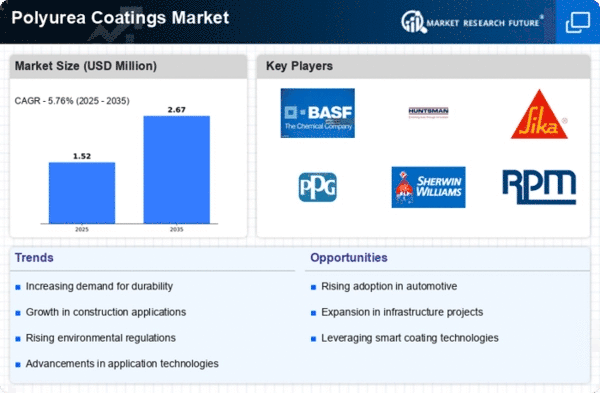
As per MRFR analysis, the Polyurea Coatings Market Size was estimated at 1.44 USD Million in 2024. The Polyurea Coatings industry is projected to grow from 1.52 USD Million in 2025 to 2.67 USD Million by 2035, exhibiting a compound annual growth rate (CAGR) of 5.76% during the forecast period 2025 - 2035.

Key Market Trends & Highlights

The Polyurea Coatings Market is experiencing robust growth driven by sustainability and technological advancements.

  • The market is witnessing a pronounced shift towards sustainable coating solutions, particularly in North America. Technological innovations are enhancing the performance and application of polyurea coatings across various sectors. Industrial coatings remain the largest segment, while automotive coatings are emerging as the fastest-growing segment in the market. Rising demand for durable coatings and expansion in infrastructure development are key drivers propelling market growth.

Market Size & Forecast

2024 Market Size 1.44 (USD Million)
2035 Market Size 2.67 (USD Million)
CAGR (2025 - 2035) 5.76%
Largest Regional Market Share in 2024 North America

Major Players

BASF SE (DE), Huntsman Corporation (US), Sika AG (CH), PPG Industries, Inc. (US), Sherwin-Williams Company (US), RPM International Inc. (US), Kukdo Chemical Co., Ltd. (KR), Alchemie Ltd. (GB), Polyurea Coatings, Inc. (US)

Market Trends

The Polyurea Coatings Market is currently experiencing a notable transformation, driven by increasing demand across various sectors such as construction, automotive, and industrial applications. These coatings are recognized for their rapid curing properties, exceptional durability, and resistance to chemicals and abrasion. As industries seek to enhance the longevity and performance of their surfaces, the adoption of polyurea coatings appears to be on the rise. Furthermore, the growing emphasis on sustainable practices and eco-friendly materials is likely to influence the market dynamics, as manufacturers strive to develop formulations that align with environmental regulations and consumer preferences.

In addition to the aforementioned factors, technological advancements in application techniques and product formulations are shaping the landscape of the polyurea coating market. Innovations such as spray application methods and the development of hybrid systems are enhancing the efficiency and effectiveness of these coatings. Moreover, the increasing focus on infrastructure development and maintenance is expected to further propel the demand for polyurea coatings, particularly in the north america polyurea coatings market, where infrastructure investments remain strong. As the market evolves, stakeholders must remain vigilant to emerging polyurea coatings market trends and shifts in consumer behavior, which could present both challenges and opportunities for growth in the coming years.

Sustainability Focus

The increasing emphasis on environmentally friendly products is shaping the Polyurea Coatings Market. Manufacturers are exploring sustainable formulations that minimize environmental impact while maintaining performance.

Technological Advancements

Innovations in application methods and product development are enhancing the capabilities of polyurea coatings. These advancements are likely to improve efficiency and broaden their applicability across various sectors.

Growing Industrial Applications

The demand for polyurea coatings in industrial settings is expanding. Their durability and resistance to harsh conditions make them suitable for a wide range of applications, from protective coatings to flooring solutions.

Polyurea Coatings Market Market Drivers

Market Growth Projections

The Global Polyurea Coatings Market Industry is projected to experience substantial growth over the next decade. With a market value of 2.75 USD Billion in 2024, the industry is expected to expand significantly, reaching an estimated 10.7 USD Billion by 2035. This growth is indicative of the increasing adoption of polyurea coatings across various sectors, driven by their unique properties and performance advantages. The anticipated compound annual growth rate (CAGR) of 13.2% from 2025 to 2035 further emphasizes the market's potential, as industries recognize the benefits of polyurea coatings in enhancing durability and sustainability.

Rising Demand in Construction Sector

The Global Polyurea Coatings Market Industry experiences a notable surge in demand driven by the construction sector. Polyurea coatings are increasingly utilized for their rapid curing properties and exceptional durability, making them ideal for various applications such as flooring, roofing, and protective coatings. In 2024, the market is projected to reach 2.75 USD Billion, reflecting the growing preference for high-performance materials in construction projects. As urbanization accelerates globally, the need for robust and long-lasting coatings becomes paramount, thereby propelling the growth of the Global Polyurea Coatings Market Industry.

Environmental Regulations and Sustainability

The Global Polyurea Coatings Market Industry is significantly influenced by stringent environmental regulations aimed at reducing volatile organic compounds (VOCs) and promoting sustainable practices. Polyurea coatings, known for their low VOC content and eco-friendly properties, align well with these regulations, making them a preferred choice among manufacturers and consumers. As industries increasingly prioritize sustainability, the demand for polyurea coatings is expected to rise. This trend is likely to contribute to the market's expansion, with projections indicating a growth trajectory that could see the market reach 10.7 USD Billion by 2035.

Growing Automotive and Transportation Sector

The automotive and transportation sector significantly contributes to the Global Polyurea Coatings Market Industry. Polyurea coatings are increasingly adopted for their protective properties, which safeguard vehicles and transportation infrastructure from corrosion, wear, and environmental damage. As the automotive industry evolves with a focus on durability and performance, the demand for polyurea coatings is expected to rise. This trend is particularly evident in the development of electric vehicles, where lightweight and resilient coatings are essential. The market's growth in this sector further underscores the versatility and applicability of polyurea coatings.

Technological Advancements in Coating Solutions

Innovations in coating technologies play a crucial role in the Global Polyurea Coatings Market Industry. Advances in formulation and application techniques enhance the performance characteristics of polyurea coatings, such as adhesion, flexibility, and resistance to chemicals and abrasion. These improvements not only expand the range of applications but also increase the efficiency of the application process. As manufacturers continue to invest in research and development, the market is poised for growth, potentially achieving a compound annual growth rate (CAGR) of 13.2% from 2025 to 2035, driven by the introduction of superior coating solutions.

Increased Investment in Infrastructure Development

Investment in infrastructure development is a key driver of the Global Polyurea Coatings Market Industry. Governments and private entities worldwide are allocating substantial resources to enhance infrastructure, including roads, bridges, and public facilities. Polyurea coatings are favored for their rapid curing times and exceptional protective qualities, making them ideal for infrastructure applications. As global infrastructure projects expand, the demand for polyurea coatings is likely to increase, supporting the market's growth trajectory. This investment trend aligns with the projected market value of 10.7 USD Billion by 2035, highlighting the importance of polyurea coatings in modern infrastructure.

Market Segment Insights

By Application: Industrial Coatings (Largest) vs. Construction Coatings (Fastest-Growing)

In the Polyurea Coatings Market, industrial coatings currently dominate as the largest segment, benefitting from extensive applications in manufacturing and heavy-duty usage. This segment enjoys robust demand due to its excellent durability, resistance to chemicals, and ability to withstand harsh environments, thus holding a significant market share compared to other applications. Meanwhile, construction coatings are emerging rapidly, gaining traction as the fastest-growing segment, largely driven by increased investments in infrastructure development and urbanization trends. These coatings are favored for their quick application and versatility, making them a preferred choice for construction projects.

Industrial Coatings: Dominant vs. Construction Coatings: Emerging

Industrial coatings are recognized for their exceptional durability and resistance to a variety of chemicals, making them essential in sectors such as manufacturing and warehousing. They typically emphasize performance under rigorous conditions, ensuring protection against wear and degradation. On the other hand, construction coatings represent an emerging segment, characterized by their rapid application processes and versatility in the field. These coatings cater to a growing demand for aesthetic and functional relevance in both residential and commercial projects, thus marking a significant shift in the market dynamics. As urbanization accelerates, construction coatings are likely to gain a larger footprint within the polyurea landscape.

By End Use: Building and Construction (Largest) vs. Automotive (Fastest-Growing)

In the Polyurea Coatings Market, the 'End Use' segment is predominantly led by the building and construction segment, which holds the largest share due to its extensive applications in protective coatings for concrete, steel, and other surfaces. The demand in this sector is driven by increased investments in infrastructure and architectural advancements, making it crucial for contractors and developers to utilize durable and weather-resistant materials, thereby solidifying its market dominance. Conversely, the automotive segment is identified as the fastest-growing area within the Polyurea Coatings Market. This growth is attributed to the rising need for vehicle customization and enhanced durability against environmental factors. With automotive manufacturers increasingly incorporating advanced materials to improve vehicle longevity and resistance to wear and tear, the uptake of polyurea coatings continues to rise, reflecting significant innovation and market potential in this sector.

Building and Construction (Dominant) vs. Automotive (Emerging)

The building and construction segment of the Polyurea Coatings Market is characterized by its robust applications in various infrastructure projects, from residential buildings to commercial complexes. Polyurea coatings are favored for their superior adhesion, flexibility, and resistance to chemicals and UV radiation, making them essential for long-lasting surface protection. Conversely, the automotive segment is emerging rapidly, focusing on innovative uses of polyurea, such as custom coatings for enhanced aesthetics and strength in vehicular components. This segment emphasizes environmental resistance and aesthetic customization, appealing to both manufacturers and consumers seeking high-performance solutions.

By Formulation Type: Pure Polyurea (Largest) vs. Hybrid Polyurea (Fastest-Growing)

The Polyurea Coatings Market exhibits a diverse range of formulation types, with Pure Polyurea leading in market share due to its superior adhesion, elasticity, and chemical resistance characteristics. Following closely is Hybrid Polyurea, which is rapidly gaining traction, attributed to its versatile properties that blend both pure polyurea and conventional coatings. Other formulation types such as Water-Based and Solvent-Based Polyurea show smaller but stable shares, catering to specific application needs based on environmental and regulatory requirements. Growth trends in the Polyurea Coatings Market are significantly influenced by increasing demand for protective coatings across various industries, notably in construction and automotive sectors. The rise of eco-friendly products has spurred the development of Water-Based Polyurea coatings as a compliant option. Furthermore, the push for higher durability and performance continues to drive interest in Polyurea Elastomers, ensuring that this segment remains dynamic and responsive to market demands.

Pure Polyurea (Dominant) vs. Solvent-Based Polyurea (Emerging)

Pure Polyurea is recognized as the dominant player in the formulation type segment, attributed to its unmatched performance characteristics, including rapid curing time and exceptional resistance against abrasion and chemical exposure. As applications in protective coatings escalate, Pure Polyurea's robust properties make it a preferred choice across multiple sectors. Conversely, Solvent-Based Polyurea, while emerging, is gaining attention due to its application versatility and ability to provide a strong protective layer in scenarios where pure formulations may not be feasible. However, challenges surrounding environmental regulations and VOC emissions could limit its growth. The market for Solvent-Based Polyurea could still thrive in specific industrial applications, driven by niche segments that require such formulations.

By Curing Mechanism: Moisture Curing (Largest) vs. UV Curing (Fastest-Growing)

The Curing Mechanism segment of the Polyurea Coatings Market showcases a diverse distribution, with Moisture Curing currently holding the largest share. This method benefits from its suitability for various applications, particularly in outdoor settings where humidity levels can activate the curing process. Other methods like Heat Curing, Chemical Curing, and UV Curing contribute to the overall market but with lesser shares. The market is leaning towards embracing innovative curing techniques that address specific performance and application needs. As industries continue to prioritize efficiency and sustainability, growth trends indicate a rising interest in UV Curing, which is recognized for its rapid curing capabilities and reduced energy consumption. The adoption of UV Curing is being driven by the increasing demand for eco-friendly solutions and the ability to cure coatings at ambient temperatures. This trend reflects a shift towards faster, more efficient coatings that meet modern performance standards while adhering to environmental regulations.

Moisture Curing (Dominant) vs. UV Curing (Emerging)

Moisture Curing is the dominant force in the Polyurea Coatings Market, known for its versatility and effectiveness in diverse climatic conditions. It allows for outdoor application without the need for a controlled environment, making it favorable for construction and industrial applications. In contrast, UV Curing is emerging as a significant technology, offering rapid cure times and energy efficiency. This method utilizes ultraviolet light to initiate the curing process, enabling coatings to set quickly and reducing downtime. As the market progresses, UV Curing is likely to capture more attention due to its innovative approaches and alignment with the push for sustainable practices. Both curing mechanisms serve distinct roles, catering to different needs within the industry.

By Sales Channel: Direct Sales (Largest) vs. Online Sales (Fastest-Growing)

In the Polyurea Coatings Market, the sales channel dynamics are predominantly shaped by Direct Sales, which captures a significant portion of market share. Following this, Distributors also play a crucial role, as they enable broader market access, particularly in regions where direct sales are less feasible. Meanwhile, Online Sales and Retail Sales show varying contributions; however, Online Sales are specifically marked by their rising relevance due to changing consumer behaviors and technological advancements in e-commerce.

Direct Sales (Dominant) vs. Online Sales (Emerging)

Direct Sales in the Polyurea Coatings Market signify a long-established approach, allowing manufacturers to engage directly with end-users, ensuring tailored solutions and superior customer service. This method is characterized by strong relationships built through personalized interactions. Conversely, Online Sales represent a rapidly emerging channel that is gaining traction due to rising digital adoption and convenience. It facilitates easy access to products for a wider audience and enhances market reach. The surge in this segment is driven by a growing preference for digital procurement solutions among consumers and businesses alike, pointing toward an evolving market landscape.

Get more detailed insights about Polyurea Coatings Market Research Report – Forecast to 2028

Regional Insights

Key Players and Competitive Insights

The Polyurea Coatings Market is currently characterized by a dynamic competitive landscape, driven by increasing demand for durable and versatile coatings across various applications, including construction, automotive, and industrial sectors. Key players such as BASF SE (DE), Huntsman Corporation (US), and Sika AG (CH) are strategically positioned to leverage innovation and regional expansion to enhance their market presence. These companies are focusing on developing advanced formulations that offer superior performance and sustainability, thereby shaping the competitive environment through their commitment to research and development.In terms of business tactics, companies are increasingly localizing manufacturing to reduce lead times and optimize supply chains. The market appears moderately fragmented, with several players vying for market share. However, the collective influence of major companies like PPG Industries, Inc. (US) and Sherwin-Williams Company (US) is notable, as they implement strategies that emphasize operational efficiency and customer-centric solutions, further intensifying competition.
In November BASF SE (DE) announced the launch of a new line of eco-friendly polyurea coatings designed to meet stringent environmental regulations. This strategic move not only aligns with global sustainability trends but also positions BASF as a leader in the development of innovative, environmentally responsible products. The introduction of these coatings is expected to enhance their market share, particularly in regions with strict environmental policies.Similarly, in October 2025, Huntsman Corporation (US) expanded its production capacity for polyurea coatings in North America. This expansion is indicative of Huntsman's commitment to meeting the growing demand in the region, particularly in the construction and infrastructure sectors. By increasing production capabilities, the company aims to strengthen its competitive edge and respond more effectively to customer needs.
In September Sika AG (CH) entered into a strategic partnership with a leading construction firm to develop customized polyurea solutions for large-scale projects. This collaboration is expected to enhance Sika's product offerings and provide tailored solutions that meet specific client requirements. Such partnerships are crucial in fostering innovation and expanding market reach, thereby reinforcing Sika's position in the market.
As of December current competitive trends indicate a strong emphasis on digitalization, sustainability, and the integration of advanced technologies such as AI in product development and customer engagement. Strategic alliances are increasingly shaping the landscape, allowing companies to pool resources and expertise. Looking ahead, competitive differentiation is likely to evolve from traditional price-based competition to a focus on innovation, technological advancements, and supply chain reliability, as companies strive to meet the evolving demands of the market.

Key Companies in the Polyurea Coatings Market include

Industry Developments

    • In February 2019, one of the leading enterprises, PPG started a new 82,000 square feet facility and class-A paint line with an investment of USD 10 million at its South Carolina coating services facility. PPG started this initiative, To meet the increasing demand for class A coatings from large truck markets and automotive.
    • In October 2017, the famous company, PPG acquired a US-based coatings application service provider named The Crown Group from the two popular Charter Oak Capital Partners and High Road Capital Partners. The new acquisition Crown Group caters to customers in various sectors like automotive, agriculture, construction, heavy truck, and alternative energy industries which are the major areas of interest for PPG. Moreover, this acquisition favors PPG to enhance its services to OEM customers.
    • In June 2017, one of the top key players, Sherwin-Williams Company acquired the Valspar Corporation. This Valspar Corporation favors by increasing the Sherwin-Williams global growth to establish itself as a global leader in paints & coatings. The combination of these two enterprises results in the benefits like enhanced portfolio, premier technology, extensive global footprint, expanded product range, and innovation platforms.


Future Outlook

Polyurea Coatings Market Future Outlook

The Polyurea Coatings Market is projected to grow at a 5.76% CAGR from 2025 to 2035, driven by increasing demand in construction, automotive, and industrial applications.

New opportunities lie in:

  • <p>Development of eco-friendly polyurea formulations Expansion into emerging markets with tailored solutions Integration of smart technologies for real-time monitoring</p>

By 2035, the Polyurea Coatings Market is expected to achieve robust growth and enhanced market presence.

Market Segmentation

Polyurea Coatings Market End Use Outlook

  • Building and Construction
  • Automotive
  • Aerospace
  • Marine
  • Industrial

Polyurea Coatings Market Technology Outlook

  • Spray Technology
  • Roller Technology
  • Brush Technology
  • Electrostatic Technology
  • Other Application Technologies

Polyurea Coatings Market Application Outlook

  • Industrial Coatings
  • Construction Coatings
  • Automotive Coatings
  • Marine Coatings
  • Protective Coatings

Polyurea Coatings Market Curing Mechanism Outlook

  • Moisture Cured
  • Heat Cured
  • Chemical Cured
  • UV Cured
  • Other Curing Mechanisms

Polyurea Coatings Market Formulation Type Outlook

  • Pure Polyurea
  • Hybrid Polyurea
  • Water-Based Polyurea
  • Solvent-Based Polyurea
  • Polyurea Elastomer

Report Scope

MARKET SIZE 2024 1.44(USD Million)
MARKET SIZE 2025 1.52(USD Million)
MARKET SIZE 2035 2.67(USD Million)
COMPOUND ANNUAL GROWTH RATE (CAGR) 5.76% (2025 - 2035)
REPORT COVERAGE Revenue Forecast, Competitive Landscape, Growth Factors, and Trends
BASE YEAR 2024
Market Forecast Period 2025 - 2035
Historical Data 2019 - 2024
Market Forecast Units USD Million
Key Companies Profiled BASF SE (DE), Huntsman Corporation (US), Sika AG (CH), PPG Industries, Inc. (US), Sherwin-Williams Company (US), RPM International Inc. (US), Kukdo Chemical Co., Ltd. (KR), Alchemie Ltd. (GB), Polyurea Coatings, Inc. (US)
Segments Covered Application, End Use, Formulation Type, Technology, Curing Mechanism
Key Market Opportunities Growing demand for environmentally friendly coatings drives innovation in the Polyurea Coatings Market.
Key Market Dynamics Rising demand for durable coatings drives innovation and competition in the polyurea coatings market.
Countries Covered North America, Europe, APAC, South America, MEA

FAQs

What is the projected market valuation of the Polyurea Coatings Market by 2035?

<p>The Polyurea Coatings Market is projected to reach a valuation of 2.67 USD Million by 2035.</p>

What was the market valuation of the Polyurea Coatings Market in 2024?

<p>In 2024, the market valuation of the Polyurea Coatings Market was 1.44 USD Million.</p>

What is the expected CAGR for the Polyurea Coatings Market during the forecast period 2025 - 2035?

<p>The expected CAGR for the Polyurea Coatings Market during the forecast period 2025 - 2035 is 5.76%.</p>

Which companies are considered key players in the Polyurea Coatings Market?

<p>Key players in the Polyurea Coatings Market include BASF SE, Huntsman Corporation, Sika AG, and Sherwin-Williams Company.</p>

What are the primary applications of polyurea coatings?

<p>The primary applications of polyurea coatings include industrial coatings, construction coatings, automotive coatings, and protective coatings.</p>

How does the market for polyurea coatings segment by end use?

The market segments by end use include building and construction, automotive, aerospace, marine, and industrial applications.

What are the different formulation types available in the Polyurea Coatings Market?

Formulation types in the Polyurea Coatings Market include pure polyurea, hybrid polyurea, water-based polyurea, and solvent-based polyurea.

What curing mechanisms are utilized in polyurea coatings?

Curing mechanisms for polyurea coatings include moisture curing, heat curing, chemical curing, and UV curing.

What sales channels are prevalent in the Polyurea Coatings Market?

Prevalent sales channels in the Polyurea Coatings Market include direct sales, distributors, online sales, and retail sales.

What was the valuation of the construction coatings segment in 2024?

The valuation of the construction coatings segment in 2024 was 0.48 USD Million.

  1. SECTION I: EXECUTIVE SUMMARY AND KEY HIGHLIGHTS |
    1. EXECUTIVE SUMMARY | |
      1. Market Overview | |
      2. Key Findings | |
      3. Market Segmentation | |
      4. Competitive Landscape | |
      5. Challenges and Opportunities | |
      6. Future Outlook 2
  2. SECTION II: SCOPING, METHODOLOGY AND MARKET STRUCTURE |
    1. MARKET INTRODUCTION | |
      1. Definition | |
      2. Scope of the study | | |
    2. RESEARCH METHODOLOGY | |
      1. Overview | |
      2. Data Mining | |
      3. Secondary Research | |
      4. Primary Research | | |
      5. Forecasting Model | |
      6. Market Size Estimation | | |
      7. Data Triangulation | |
      8. Validation 3
  3. SECTION III: QUALITATIVE ANALYSIS |
    1. MARKET DYNAMICS | |
      1. Overview | |
      2. Drivers | |
      3. Restraints | |
      4. Opportunities |
    2. MARKET FACTOR ANALYSIS | |
      1. Value chain Analysis | |
      2. Porter's Five Forces Analysis | | |
      3. COVID-19 Impact Analysis | | |
  4. SECTION IV: QUANTITATIVE ANALYSIS |
    1. Chemicals and Materials, BY Application (USD Million) | |
      1. Industrial Coatings | |
      2. Construction Coatings | |
      3. Automotive Coatings | |
      4. Marine Coatings | |
      5. Protective Coatings |
    2. Chemicals and Materials, BY End Use (USD Million) | |
      1. Building and Construction | |
      2. Automotive | |
      3. Aerospace | |
      4. Marine | |
      5. Industrial |
    3. Chemicals and Materials, BY Formulation Type (USD Million) | |
      1. Pure Polyurea | |
      2. Hybrid Polyurea | |
      3. Water-Based Polyurea | |
      4. Solvent-Based Polyurea | |
      5. Polyurea Elastomer |
    4. Chemicals and Materials, BY Curing Mechanism (USD Million) | |
      1. Moisture Curing | |
      2. Heat Curing | |
      3. Chemical Curing | |
      4. UV Curing |
    5. Chemicals and Materials, BY Sales Channel (USD Million) | |
      1. Direct Sales | |
      2. Distributors | |
      3. Online Sales | |
      4. Retail Sales |
    6. Chemicals and Materials, BY Region (USD Million) | |
      1. North America | | |
      2. Europe | | |
      3. APAC | | |
      4. South America | | |
      5. MEA | | |
  5. SECTION V: COMPETITIVE ANALYSIS |
    1. Competitive Landscape | |
      1. Overview | |
      2. Competitive Analysis | |
      3. Market share Analysis | |
      4. Major Growth Strategy in the Chemicals and Materials | |
      5. Competitive Benchmarking | |
      6. Leading Players in Terms of Number of Developments in the Chemicals and Materials | |
      7. Key developments and growth strategies | | |
      8. Major Players Financial Matrix | | |
    2. Company Profiles | |
      1. BASF SE (DE) | | |
      2. Huntsman Corporation (US) | | |
      3. Sika AG (CH) | | |
      4. PPG Industries, Inc. (US) | | |
      5. Sherwin-Williams Company (US) | | |
      6. RPM International Inc. (US) | | |
      7. Kukdo Chemical Co., Ltd. (KR) | | |
      8. Alchemie Ltd. (GB) | | |
      9. Polyurea Coatings LLC (US) | | |
    3. Appendix | |
      1. References | |
      2. Related Reports 6 LIST OF FIGURES |
    4. MARKET SYNOPSIS |
    5. NORTH AMERICA MARKET ANALYSIS |
    6. US MARKET ANALYSIS BY APPLICATION |
    7. US MARKET ANALYSIS BY END USE |
    8. US MARKET ANALYSIS BY FORMULATION TYPE |
    9. US MARKET ANALYSIS BY CURING MECHANISM |
    10. US MARKET ANALYSIS BY SALES CHANNEL |
    11. CANADA MARKET ANALYSIS BY APPLICATION |
    12. CANADA MARKET ANALYSIS BY END USE |
    13. CANADA MARKET ANALYSIS BY FORMULATION TYPE |
    14. CANADA MARKET ANALYSIS BY CURING MECHANISM |
    15. CANADA MARKET ANALYSIS BY SALES CHANNEL |
    16. EUROPE MARKET ANALYSIS |
    17. GERMANY MARKET ANALYSIS BY APPLICATION |
    18. GERMANY MARKET ANALYSIS BY END USE |
    19. GERMANY MARKET ANALYSIS BY FORMULATION TYPE |
    20. GERMANY MARKET ANALYSIS BY CURING MECHANISM |
    21. GERMANY MARKET ANALYSIS BY SALES CHANNEL |
    22. UK MARKET ANALYSIS BY APPLICATION |
    23. UK MARKET ANALYSIS BY END USE |
    24. UK MARKET ANALYSIS BY FORMULATION TYPE |
    25. UK MARKET ANALYSIS BY CURING MECHANISM |
    26. UK MARKET ANALYSIS BY SALES CHANNEL |
    27. FRANCE MARKET ANALYSIS BY APPLICATION |
    28. FRANCE MARKET ANALYSIS BY END USE |
    29. FRANCE MARKET ANALYSIS BY FORMULATION TYPE |
    30. FRANCE MARKET ANALYSIS BY CURING MECHANISM |
    31. FRANCE MARKET ANALYSIS BY SALES CHANNEL |
    32. RUSSIA MARKET ANALYSIS BY APPLICATION |
    33. RUSSIA MARKET ANALYSIS BY END USE |
    34. RUSSIA MARKET ANALYSIS BY FORMULATION TYPE |
    35. RUSSIA MARKET ANALYSIS BY CURING MECHANISM |
    36. RUSSIA MARKET ANALYSIS BY SALES CHANNEL |
    37. ITALY MARKET ANALYSIS BY APPLICATION |
    38. ITALY MARKET ANALYSIS BY END USE |
    39. ITALY MARKET ANALYSIS BY FORMULATION TYPE |
    40. ITALY MARKET ANALYSIS BY CURING MECHANISM |
    41. ITALY MARKET ANALYSIS BY SALES CHANNEL |
    42. SPAIN MARKET ANALYSIS BY APPLICATION |
    43. SPAIN MARKET ANALYSIS BY END USE |
    44. SPAIN MARKET ANALYSIS BY FORMULATION TYPE |
    45. SPAIN MARKET ANALYSIS BY CURING MECHANISM |
    46. SPAIN MARKET ANALYSIS BY SALES CHANNEL |
    47. REST OF EUROPE MARKET ANALYSIS BY APPLICATION |
    48. REST OF EUROPE MARKET ANALYSIS BY END USE |
    49. REST OF EUROPE MARKET ANALYSIS BY FORMULATION TYPE |
    50. REST OF EUROPE MARKET ANALYSIS BY CURING MECHANISM |
    51. REST OF EUROPE MARKET ANALYSIS BY SALES CHANNEL |
    52. APAC MARKET ANALYSIS |
    53. CHINA MARKET ANALYSIS BY APPLICATION |
    54. CHINA MARKET ANALYSIS BY END USE |
    55. CHINA MARKET ANALYSIS BY FORMULATION TYPE |
    56. CHINA MARKET ANALYSIS BY CURING MECHANISM |
    57. CHINA MARKET ANALYSIS BY SALES CHANNEL |
    58. INDIA MARKET ANALYSIS BY APPLICATION |
    59. INDIA MARKET ANALYSIS BY END USE |
    60. INDIA MARKET ANALYSIS BY FORMULATION TYPE |
    61. INDIA MARKET ANALYSIS BY CURING MECHANISM |
    62. INDIA MARKET ANALYSIS BY SALES CHANNEL |
    63. JAPAN MARKET ANALYSIS BY APPLICATION |
    64. JAPAN MARKET ANALYSIS BY END USE |
    65. JAPAN MARKET ANALYSIS BY FORMULATION TYPE |
    66. JAPAN MARKET ANALYSIS BY CURING MECHANISM |
    67. JAPAN MARKET ANALYSIS BY SALES CHANNEL |
    68. SOUTH KOREA MARKET ANALYSIS BY APPLICATION |
    69. SOUTH KOREA MARKET ANALYSIS BY END USE |
    70. SOUTH KOREA MARKET ANALYSIS BY FORMULATION TYPE |
    71. SOUTH KOREA MARKET ANALYSIS BY CURING MECHANISM |
    72. SOUTH KOREA MARKET ANALYSIS BY SALES CHANNEL |
    73. MALAYSIA MARKET ANALYSIS BY APPLICATION |
    74. MALAYSIA MARKET ANALYSIS BY END USE |
    75. MALAYSIA MARKET ANALYSIS BY FORMULATION TYPE |
    76. MALAYSIA MARKET ANALYSIS BY CURING MECHANISM |
    77. MALAYSIA MARKET ANALYSIS BY SALES CHANNEL |
    78. THAILAND MARKET ANALYSIS BY APPLICATION |
    79. THAILAND MARKET ANALYSIS BY END USE |
    80. THAILAND MARKET ANALYSIS BY FORMULATION TYPE |
    81. THAILAND MARKET ANALYSIS BY CURING MECHANISM |
    82. THAILAND MARKET ANALYSIS BY SALES CHANNEL |
    83. INDONESIA MARKET ANALYSIS BY APPLICATION |
    84. INDONESIA MARKET ANALYSIS BY END USE |
    85. INDONESIA MARKET ANALYSIS BY FORMULATION TYPE |
    86. INDONESIA MARKET ANALYSIS BY CURING MECHANISM |
    87. INDONESIA MARKET ANALYSIS BY SALES CHANNEL |
    88. REST OF APAC MARKET ANALYSIS BY APPLICATION |
    89. REST OF APAC MARKET ANALYSIS BY END USE |
    90. REST OF APAC MARKET ANALYSIS BY FORMULATION TYPE |
    91. REST OF APAC MARKET ANALYSIS BY CURING MECHANISM |
    92. REST OF APAC MARKET ANALYSIS BY SALES CHANNEL |
    93. SOUTH AMERICA MARKET ANALYSIS |
    94. BRAZIL MARKET ANALYSIS BY APPLICATION |
    95. BRAZIL MARKET ANALYSIS BY END USE |
    96. BRAZIL MARKET ANALYSIS BY FORMULATION TYPE |
    97. BRAZIL MARKET ANALYSIS BY CURING MECHANISM |
    98. BRAZIL MARKET ANALYSIS BY SALES CHANNEL |
    99. MEXICO MARKET ANALYSIS BY APPLICATION |
    100. MEXICO MARKET ANALYSIS BY END USE |
    101. MEXICO MARKET ANALYSIS BY FORMULATION TYPE |
    102. MEXICO MARKET ANALYSIS BY CURING MECHANISM |
    103. MEXICO MARKET ANALYSIS BY SALES CHANNEL |
    104. ARGENTINA MARKET ANALYSIS BY APPLICATION |
    105. ARGENTINA MARKET ANALYSIS BY END USE |
    106. ARGENTINA MARKET ANALYSIS BY FORMULATION TYPE |
    107. ARGENTINA MARKET ANALYSIS BY CURING MECHANISM |
    108. ARGENTINA MARKET ANALYSIS BY SALES CHANNEL |
    109. REST OF SOUTH AMERICA MARKET ANALYSIS BY APPLICATION |
    110. REST OF SOUTH AMERICA MARKET ANALYSIS BY END USE |
    111. REST OF SOUTH AMERICA MARKET ANALYSIS BY FORMULATION TYPE |
    112. REST OF SOUTH AMERICA MARKET ANALYSIS BY CURING MECHANISM |
    113. REST OF SOUTH AMERICA MARKET ANALYSIS BY SALES CHANNEL |
    114. MEA MARKET ANALYSIS |
    115. GCC COUNTRIES MARKET ANALYSIS BY APPLICATION |
    116. GCC COUNTRIES MARKET ANALYSIS BY END USE |
    117. GCC COUNTRIES MARKET ANALYSIS BY FORMULATION TYPE |
    118. GCC COUNTRIES MARKET ANALYSIS BY CURING MECHANISM |
    119. GCC COUNTRIES MARKET ANALYSIS BY SALES CHANNEL |
    120. SOUTH AFRICA MARKET ANALYSIS BY APPLICATION |
    121. SOUTH AFRICA MARKET ANALYSIS BY END USE |
    122. SOUTH AFRICA MARKET ANALYSIS BY FORMULATION TYPE |
    123. SOUTH AFRICA MARKET ANALYSIS BY CURING MECHANISM |
    124. SOUTH AFRICA MARKET ANALYSIS BY SALES CHANNEL |
    125. REST OF MEA MARKET ANALYSIS BY APPLICATION |
    126. REST OF MEA MARKET ANALYSIS BY END USE |
    127. REST OF MEA MARKET ANALYSIS BY FORMULATION TYPE |
    128. REST OF MEA MARKET ANALYSIS BY CURING MECHANISM |
    129. REST OF MEA MARKET ANALYSIS BY SALES CHANNEL |
    130. KEY BUYING CRITERIA OF CHEMICALS AND MATERIALS |
    131. RESEARCH PROCESS OF MRFR |
    132. DRO ANALYSIS OF CHEMICALS AND MATERIALS |
    133. DRIVERS IMPACT ANALYSIS: CHEMICALS AND MATERIALS |
    134. RESTRAINTS IMPACT ANALYSIS: CHEMICALS AND MATERIALS |
    135. SUPPLY / VALUE CHAIN: CHEMICALS AND MATERIALS |
    136. CHEMICALS AND MATERIALS, BY APPLICATION, 2024 (% SHARE) |
    137. CHEMICALS AND MATERIALS, BY APPLICATION, 2024 TO 2035 (USD Million) |
    138. CHEMICALS AND MATERIALS, BY END USE, 2024 (% SHARE) |
    139. CHEMICALS AND MATERIALS, BY END USE, 2024 TO 2035 (USD Million) |
    140. CHEMICALS AND MATERIALS, BY FORMULATION TYPE, 2024 (% SHARE) |
    141. CHEMICALS AND MATERIALS, BY FORMULATION TYPE, 2024 TO 2035 (USD Million) |
    142. CHEMICALS AND MATERIALS, BY CURING MECHANISM, 2024 (% SHARE) |
    143. CHEMICALS AND MATERIALS, BY CURING MECHANISM, 2024 TO 2035 (USD Million) |
    144. CHEMICALS AND MATERIALS, BY SALES CHANNEL, 2024 (% SHARE) |
    145. CHEMICALS AND MATERIALS, BY SALES CHANNEL, 2024 TO 2035 (USD Million) |
    146. BENCHMARKING OF MAJOR COMPETITORS 7 LIST OF TABLES |
    147. LIST OF ASSUMPTIONS | |
      1. |
    148. North America MARKET SIZE ESTIMATES; FORECAST | |
      1. BY APPLICATION, 2025-2035 (USD Million) | |
      2. BY END USE, 2025-2035 (USD Million) | |
      3. BY FORMULATION TYPE, 2025-2035 (USD Million) | |
      4. BY CURING MECHANISM, 2025-2035 (USD Million) | |
      5. BY SALES CHANNEL, 2025-2035 (USD Million) |
    149. US MARKET SIZE ESTIMATES; FORECAST | |
      1. BY APPLICATION, 2025-2035 (USD Million) | |
      2. BY END USE, 2025-2035 (USD Million) | |
      3. BY FORMULATION TYPE, 2025-2035 (USD Million) | |
      4. BY CURING MECHANISM, 2025-2035 (USD Million) | |
      5. BY SALES CHANNEL, 2025-2035 (USD Million) |
    150. Canada MARKET SIZE ESTIMATES; FORECAST | |
      1. BY APPLICATION, 2025-2035 (USD Million) | |
      2. BY END USE, 2025-2035 (USD Million) | |
      3. BY FORMULATION TYPE, 2025-2035 (USD Million) | |
      4. BY CURING MECHANISM, 2025-2035 (USD Million) | |
      5. BY SALES CHANNEL, 2025-2035 (USD Million) |
    151. Europe MARKET SIZE ESTIMATES; FORECAST | |
      1. BY APPLICATION, 2025-2035 (USD Million) | |
      2. BY END USE, 2025-2035 (USD Million) | |
      3. BY FORMULATION TYPE, 2025-2035 (USD Million) | |
      4. BY CURING MECHANISM, 2025-2035 (USD Million) | |
      5. BY SALES CHANNEL, 2025-2035 (USD Million) |
    152. Germany MARKET SIZE ESTIMATES; FORECAST | |
      1. BY APPLICATION, 2025-2035 (USD Million) | |
      2. BY END USE, 2025-2035 (USD Million) | |
      3. BY FORMULATION TYPE, 2025-2035 (USD Million) | |
      4. BY CURING MECHANISM, 2025-2035 (USD Million) | |
      5. BY SALES CHANNEL, 2025-2035 (USD Million) |
    153. UK MARKET SIZE ESTIMATES; FORECAST | |
      1. BY APPLICATION, 2025-2035 (USD Million) | |
      2. BY END USE, 2025-2035 (USD Million) | |
      3. BY FORMULATION TYPE, 2025-2035 (USD Million) | |
      4. BY CURING MECHANISM, 2025-2035 (USD Million) | |
      5. BY SALES CHANNEL, 2025-2035 (USD Million) |
    154. France MARKET SIZE ESTIMATES; FORECAST | |
      1. BY APPLICATION, 2025-2035 (USD Million) | |
      2. BY END USE, 2025-2035 (USD Million) | |
      3. BY FORMULATION TYPE, 2025-2035 (USD Million) | |
      4. BY CURING MECHANISM, 2025-2035 (USD Million) | |
      5. BY SALES CHANNEL, 2025-2035 (USD Million) |
    155. Russia MARKET SIZE ESTIMATES; FORECAST | |
      1. BY APPLICATION, 2025-2035 (USD Million) | |
      2. BY END USE, 2025-2035 (USD Million) | |
      3. BY FORMULATION TYPE, 2025-2035 (USD Million) | |
      4. BY CURING MECHANISM, 2025-2035 (USD Million) | |
      5. BY SALES CHANNEL, 2025-2035 (USD Million) |
    156. Italy MARKET SIZE ESTIMATES; FORECAST | |
      1. BY APPLICATION, 2025-2035 (USD Million) | |
      2. BY END USE, 2025-2035 (USD Million) | |
      3. BY FORMULATION TYPE, 2025-2035 (USD Million) | |
      4. BY CURING MECHANISM, 2025-2035 (USD Million) | |
      5. BY SALES CHANNEL, 2025-2035 (USD Million) |
    157. Spain MARKET SIZE ESTIMATES; FORECAST | |
      1. BY APPLICATION, 2025-2035 (USD Million) | |
      2. BY END USE, 2025-2035 (USD Million) | |
      3. BY FORMULATION TYPE, 2025-2035 (USD Million) | |
      4. BY CURING MECHANISM, 2025-2035 (USD Million) | |
      5. BY SALES CHANNEL, 2025-2035 (USD Million) |
    158. Rest of Europe MARKET SIZE ESTIMATES; FORECAST | |
      1. BY APPLICATION, 2025-2035 (USD Million) | |
      2. BY END USE, 2025-2035 (USD Million) | |
      3. BY FORMULATION TYPE, 2025-2035 (USD Million) | |
      4. BY CURING MECHANISM, 2025-2035 (USD Million) | |
      5. BY SALES CHANNEL, 2025-2035 (USD Million) |
    159. APAC MARKET SIZE ESTIMATES; FORECAST | |
      1. BY APPLICATION, 2025-2035 (USD Million) | |
      2. BY END USE, 2025-2035 (USD Million) | |
      3. BY FORMULATION TYPE, 2025-2035 (USD Million) | |
      4. BY CURING MECHANISM, 2025-2035 (USD Million) | |
      5. BY SALES CHANNEL, 2025-2035 (USD Million) |
    160. China MARKET SIZE ESTIMATES; FORECAST | |
      1. BY APPLICATION, 2025-2035 (USD Million) | |
      2. BY END USE, 2025-2035 (USD Million) | |
      3. BY FORMULATION TYPE, 2025-2035 (USD Million) | |
      4. BY CURING MECHANISM, 2025-2035 (USD Million) | |
      5. BY SALES CHANNEL, 2025-2035 (USD Million) |
    161. India MARKET SIZE ESTIMATES; FORECAST | |
      1. BY APPLICATION, 2025-2035 (USD Million) | |
      2. BY END USE, 2025-2035 (USD Million) | |
      3. BY FORMULATION TYPE, 2025-2035 (USD Million) | |
      4. BY CURING MECHANISM, 2025-2035 (USD Million) | |
      5. BY SALES CHANNEL, 2025-2035 (USD Million) |
    162. Japan MARKET SIZE ESTIMATES; FORECAST | |
      1. BY APPLICATION, 2025-2035 (USD Million) | |
      2. BY END USE, 2025-2035 (USD Million) | |
      3. BY FORMULATION TYPE, 2025-2035 (USD Million) | |
      4. BY CURING MECHANISM, 2025-2035 (USD Million) | |
      5. BY SALES CHANNEL, 2025-2035 (USD Million) |
    163. South Korea MARKET SIZE ESTIMATES; FORECAST | |
      1. BY APPLICATION, 2025-2035 (USD Million) | |
      2. BY END USE, 2025-2035 (USD Million) | |
      3. BY FORMULATION TYPE, 2025-2035 (USD Million) | |
      4. BY CURING MECHANISM, 2025-2035 (USD Million) | |
      5. BY SALES CHANNEL, 2025-2035 (USD Million) |
    164. Malaysia MARKET SIZE ESTIMATES; FORECAST | |
      1. BY APPLICATION, 2025-2035 (USD Million) | |
      2. BY END USE, 2025-2035 (USD Million) | |
      3. BY FORMULATION TYPE, 2025-2035 (USD Million) | |
      4. BY CURING MECHANISM, 2025-2035 (USD Million) | |
      5. BY SALES CHANNEL, 2025-2035 (USD Million) |
    165. Thailand MARKET SIZE ESTIMATES; FORECAST | |
      1. BY APPLICATION, 2025-2035 (USD Million) | |
      2. BY END USE, 2025-2035 (USD Million) | |
      3. BY FORMULATION TYPE, 2025-2035 (USD Million) | |
      4. BY CURING MECHANISM, 2025-2035 (USD Million) | |
      5. BY SALES CHANNEL, 2025-2035 (USD Million) |
    166. Indonesia MARKET SIZE ESTIMATES; FORECAST | |
      1. BY APPLICATION, 2025-2035 (USD Million) | |
      2. BY END USE, 2025-2035 (USD Million) | |
      3. BY FORMULATION TYPE, 2025-2035 (USD Million) | |
      4. BY CURING MECHANISM, 2025-2035 (USD Million) | |
      5. BY SALES CHANNEL, 2025-2035 (USD Million) |
    167. Rest of APAC MARKET SIZE ESTIMATES; FORECAST | |
      1. BY APPLICATION, 2025-2035 (USD Million) | |
      2. BY END USE, 2025-2035 (USD Million) | |
      3. BY FORMULATION TYPE, 2025-2035 (USD Million) | |
      4. BY CURING MECHANISM, 2025-2035 (USD Million) | |
      5. BY SALES CHANNEL, 2025-2035 (USD Million) |
    168. South America MARKET SIZE ESTIMATES; FORECAST | |
      1. BY APPLICATION, 2025-2035 (USD Million) | |
      2. BY END USE, 2025-2035 (USD Million) | |
      3. BY FORMULATION TYPE, 2025-2035 (USD Million) | |
      4. BY CURING MECHANISM, 2025-2035 (USD Million) | |
      5. BY SALES CHANNEL, 2025-2035 (USD Million) |
    169. Brazil MARKET SIZE ESTIMATES; FORECAST | |
      1. BY APPLICATION, 2025-2035 (USD Million) | |
      2. BY END USE, 2025-2035 (USD Million) | |
      3. BY FORMULATION TYPE, 2025-2035 (USD Million) | |
      4. BY CURING MECHANISM, 2025-2035 (USD Million) | |
      5. BY SALES CHANNEL, 2025-2035 (USD Million) |
    170. Mexico MARKET SIZE ESTIMATES; FORECAST | |
      1. BY APPLICATION, 2025-2035 (USD Million) | |
      2. BY END USE, 2025-2035 (USD Million) | |
      3. BY FORMULATION TYPE, 2025-2035 (USD Million) | |
      4. BY CURING MECHANISM, 2025-2035 (USD Million) | |
      5. BY SALES CHANNEL, 2025-2035 (USD Million) |
    171. Argentina MARKET SIZE ESTIMATES; FORECAST | |
      1. BY APPLICATION, 2025-2035 (USD Million) | |
      2. BY END USE, 2025-2035 (USD Million) | |
      3. BY FORMULATION TYPE, 2025-2035 (USD Million) | |
      4. BY CURING MECHANISM, 2025-2035 (USD Million) | |
      5. BY SALES CHANNEL, 2025-2035 (USD Million) |
    172. Rest of South America MARKET SIZE ESTIMATES; FORECAST | |
      1. BY APPLICATION, 2025-2035 (USD Million) | |
      2. BY END USE, 2025-2035 (USD Million) | |
      3. BY FORMULATION TYPE, 2025-2035 (USD Million) | |
      4. BY CURING MECHANISM, 2025-2035 (USD Million) | |
      5. BY SALES CHANNEL, 2025-2035 (USD Million) |
    173. MEA MARKET SIZE ESTIMATES; FORECAST | |
      1. BY APPLICATION, 2025-2035 (USD Million) | |
      2. BY END USE, 2025-2035 (USD Million) | |
      3. BY FORMULATION TYPE, 2025-2035 (USD Million) | |
      4. BY CURING MECHANISM, 2025-2035 (USD Million) | |
      5. BY SALES CHANNEL, 2025-2035 (USD Million) |
    174. GCC Countries MARKET SIZE ESTIMATES; FORECAST | |
      1. BY APPLICATION, 2025-2035 (USD Million) | |
      2. BY END USE, 2025-2035 (USD Million) | |
      3. BY FORMULATION TYPE, 2025-2035 (USD Million) | |
      4. BY CURING MECHANISM, 2025-2035 (USD Million) | |
      5. BY SALES CHANNEL, 2025-2035 (USD Million) |
    175. South Africa MARKET SIZE ESTIMATES; FORECAST | |
      1. BY APPLICATION, 2025-2035 (USD Million) | |
      2. BY END USE, 2025-2035 (USD Million) | |
      3. BY FORMULATION TYPE, 2025-2035 (USD Million) | |
      4. BY CURING MECHANISM, 2025-2035 (USD Million) | |
      5. BY SALES CHANNEL, 2025-2035 (USD Million) |
    176. Rest of MEA MARKET SIZE ESTIMATES; FORECAST | |
      1. BY APPLICATION, 2025-2035 (USD Million) | |
      2. BY END USE, 2025-2035 (USD Million) | |
      3. BY FORMULATION TYPE, 2025-2035 (USD Million) | |
      4. BY CURING MECHANISM, 2025-2035 (USD Million) | |
      5. BY SALES CHANNEL, 2025-2035 (USD Million) |
    177. PRODUCT LAUNCH/PRODUCT DEVELOPMENT/APPROVAL | |
      1. |
    178. ACQUISITION/PARTNERSHIP | |

Chemicals and Materials Market Segmentation

Chemicals and Materials By Application (USD Million, 2025-2035)

  • Industrial Coatings
  • Construction Coatings
  • Automotive Coatings
  • Marine Coatings
  • Protective Coatings

Chemicals and Materials By End Use (USD Million, 2025-2035)

  • Building and Construction
  • Automotive
  • Aerospace
  • Marine
  • Industrial

Chemicals and Materials By Formulation Type (USD Million, 2025-2035)

  • Pure Polyurea
  • Hybrid Polyurea
  • Water-Based Polyurea
  • Solvent-Based Polyurea
  • Polyurea Elastomer

Chemicals and Materials By Curing Mechanism (USD Million, 2025-2035)

  • Moisture Curing
  • Heat Curing
  • Chemical Curing
  • UV Curing

Chemicals and Materials By Sales Channel (USD Million, 2025-2035)

  • Direct Sales
  • Distributors
  • Online Sales
  • Retail Sales
Infographic

Free Sample Request

Kindly complete the form below to receive a free sample of this Report

Get Free Sample

Customer Strories

Compare Licence

×
Features License Type
Single User Multiuser License Enterprise User
Price $4,950 $5,950 $7,250
Maximum User Access Limit 1 User Upto 10 Users Unrestricted Access Throughout the Organization
Free Customization
Direct Access to Analyst
Deliverable Format
Platform Access
Discount on Next Purchase 10% 15% 15%
Printable Versions