×
Hero Background
English
Chinese
French
Japanese
Korean
German
Spanish

Polysomnography Devices Market Size

ID: MRFR/HC/10221-HCR
128 Pages
Rahul Gotadki
October 2025

Polysomnography Devices Market Research Report Information By Type (Fixed Polysomnography Devices and Portable Polysomnography Devices), By Application (Hospitals, Diagnostic Laboratories, Homecare Settings, and Others), and By Region (North America, Europe, Asia-Pacific, and Rest Of The World) – Market Forecast Till 2035

Share:
Download PDF ×

We do not share your information with anyone. However, we may send you emails based on your report interest from time to time. You may contact us at any time to opt-out.

Polysomnography Devices Market Infographic
Purchase Options

Polysomnography Devices Size

Polysomnography Devices Market Growth Projections and Opportunities

The polysomnography devices market is crucial to healthcare as it assists in diagnosing and treating sleeping disorders. Polysomnography also referred to as sleep study is done at night-time, where different physiological parameters are monitored such as brain waves, eye movement, heart rate, respiratory effort and oxygen saturation. Over time, the global polysomnography devices market has grown considerably due to rising incidence of such diseases combined with increasing awareness about their general health impacts.

High prevalence of insomnia, sleep apnea and restless legs syndrome among other sleep related conditions has led this sector’s expansion. Lifestyle changes like work-related stress and conditions such as obesity have resulted into more people seeking treatment because of sleep problems. Also, there is a tendency among health care providers to opt for extensive research on individual sleep by using polysomnography equipment’s given what they know regarding quality rest.

These incorporate more advanced polysomnography equipment with enhanced diagnostic capabilities together with patient comfort. For example, there are new portable home-based sleeping monitors which means that patients now have more options when it comes to accessing them than ever before. This implies that these advancements will meet changing needs of both clients and practitioners thereby driving overall industry growth.

In particular Europe North America and Asia Pacific are seen as experiencing noticeable growth trends in the field of Polysomnography Devices Market. The two continents show high market presence in terms of well-developed healthcare systems plus high levels of awareness on sleeping disorders along proactiveness in health care systems respectively. Conversely Asian-Pacific region records skyrocketing market expansion rates caused by increased health spending, emerging middle-class populations beside growing understanding on effects related with non-goodnight rests thereof.

Manufacturers now prefer unattended testing tools for sleep monitoring at home while the patients are asleep mostly resulting from this development. There has been a wider adoption of home sleep apnea testing devices due to the fact that people can now use them right from their beds. Apart from improving patient comfort, this shift also tends to overcome problems characterizing laboratory-based sleep studies including cost and accessibility.

The leading manufacturers in Polysomnography Equipment Market have been identified by a strong drive for innovation through research and development. They would like to increase the usability of these devices beyond question on the account of their reliability as well as accuracy improvements are made. This has led to a number of partnerships between them designed to extend their reach worldwide as well as diversify product lines.
Polysomnography Devices Market Size Graph
Author
Rahul Gotadki
Assistant Manager

He holds an experience of about 7+ years in Market Research and Business Consulting, working under the spectrum of Life Sciences and Healthcare domains. Rahul conceptualizes and implements a scalable business strategy and provides strategic leadership to the clients. His expertise lies in market estimation, competitive intelligence, pipeline analysis, customer assessment, etc. In addition to the above, his other responsibility includes strategic tracking of high growth markets & advising clients on the potential areas of focus they could direct their business initiatives

Leave a Comment

FAQs

What is the current valuation of the Polysomnography Devices Market?

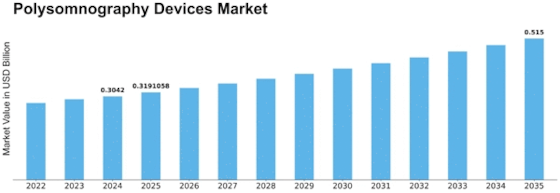
As of 2024, the Polysomnography Devices Market was valued at 0.3042 USD Billion.

What is the projected market valuation for the Polysomnography Devices Market in 2035?

The market is projected to reach a valuation of 0.515 USD Billion by 2035.

What is the expected CAGR for the Polysomnography Devices Market during the forecast period?

The expected CAGR for the Polysomnography Devices Market from 2025 to 2035 is 4.9%.

Which companies are considered key players in the Polysomnography Devices Market?

Key players in the market include Philips, ResMed, Medtronic, Natus Medical, and Sleep Number.

How do fixed and portable polysomnography devices compare in terms of market valuation?

In 2024, fixed polysomnography devices were valued at 0.1521 USD Billion, while portable devices reached 0.1521 USD Billion.

What are the primary applications of polysomnography devices?

The primary applications include hospitals, diagnostic laboratories, homecare settings, and others.

Market Summary

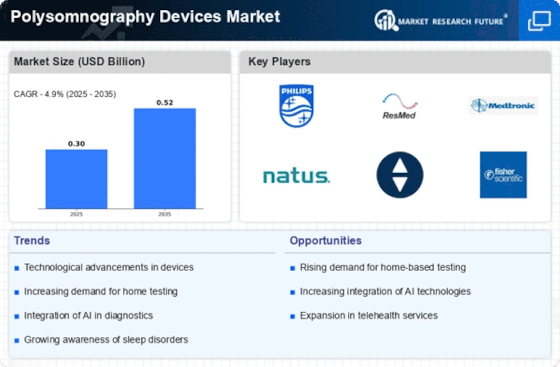
As per MRFR analysis, the Polysomnography Devices Market Size was estimated at 0.3042 USD Billion in 2024. The Polysomnography Devices industry is projected to grow from 0.3191 in 2025 to 0.515 by 2035, exhibiting a compound annual growth rate (CAGR) of 4.9 during the forecast period 2025 - 2035.

Key Market Trends & Highlights

The Polysomnography Devices Market is experiencing robust growth driven by technological advancements and increasing awareness of sleep health.

  • Technological advancements are enhancing the accuracy and efficiency of polysomnography devices.
  • Home-based testing is gaining traction, allowing for greater accessibility and convenience in sleep studies.
  • North America remains the largest market, while Asia-Pacific is emerging as the fastest-growing region in polysomnography.
  • The rising prevalence of sleep disorders and increased focus on sleep health awareness are key drivers propelling market growth.

Market Size & Forecast

2024 Market Size 0.3042 (USD Billion)
2035 Market Size 0.515 (USD Billion)
CAGR (2025 - 2035) 4.9%
Largest Regional Market Share in 2024 North America

Major Players

<p>Philips (NL), ResMed (AU), Medtronic (US), Natus Medical (US), Sleep Number (US), Fisher & Paykel Healthcare (NZ), Compumedics (AU), Neurovirtual (IT), Somnomed (AU)</p>

Market Trends

The Polysomnography Devices Market is currently experiencing a notable evolution, driven by advancements in technology and an increasing awareness of sleep disorders. As healthcare systems worldwide prioritize sleep health, the demand for sophisticated diagnostic tools is on the rise. These devices, which monitor various physiological parameters during sleep, are becoming integral in identifying conditions such as sleep apnea, insomnia, and other sleep-related disorders. The integration of artificial intelligence and machine learning into these devices appears to enhance their accuracy and efficiency, potentially leading to better patient outcomes. Furthermore, the growing trend of home-based sleep testing is reshaping the landscape, allowing for more accessible and convenient diagnostic options for patients. In addition to technological advancements, the Polysomnography Devices Market is influenced by changing lifestyles and increasing stress levels among populations. As more individuals recognize the importance of quality sleep, there is a corresponding rise in the utilization of polysomnography devices for both clinical and home settings. This shift suggests a broader acceptance of sleep health as a critical component of overall well-being. Moreover, the ongoing research into sleep disorders and their implications on health continues to fuel innovation within the market, indicating a promising future for polysomnography devices as essential tools in modern healthcare.

Technological Advancements

The Polysomnography Devices Market is witnessing rapid technological advancements, particularly with the integration of artificial intelligence and machine learning. These innovations enhance the accuracy of sleep disorder diagnoses and improve the overall efficiency of monitoring systems.

Home-Based Testing

There is a growing trend towards home-based sleep testing, which offers patients a more convenient and accessible option for diagnosing sleep disorders. This shift is likely to expand the market reach and increase the adoption of polysomnography devices.

Increased Awareness of Sleep Health

As awareness of sleep health rises, more individuals are seeking solutions for sleep-related issues. This trend is driving demand for polysomnography devices, as people recognize the importance of quality sleep for overall health.

Polysomnography Devices Market Market Drivers

Growing Geriatric Population

The aging population is another significant factor contributing to the growth of the Polysomnography Devices Market. As individuals age, they are more susceptible to sleep disorders, which can lead to a decline in overall health and quality of life. The World Health Organization projects that the number of people aged 60 years and older will double by 2050, reaching approximately 2 billion. This demographic shift is likely to increase the demand for effective sleep disorder diagnostics, including polysomnography devices. Healthcare systems are recognizing the need to address sleep health in the elderly, which may lead to increased investments in polysomnography technology. Consequently, the market is poised for growth as healthcare providers seek to cater to the unique needs of this population.

Rising Prevalence of Sleep Disorders

The increasing incidence of sleep disorders, such as sleep apnea and insomnia, is a primary driver of the Polysomnography Devices Market. According to recent estimates, approximately 30% of adults experience some form of sleep disorder, which necessitates effective diagnostic tools. This growing patient population is likely to propel demand for polysomnography devices, as healthcare providers seek reliable methods to diagnose and treat these conditions. Furthermore, the rising awareness of the health implications associated with untreated sleep disorders, including cardiovascular diseases and obesity, underscores the need for advanced polysomnography solutions. As a result, the market is expected to witness substantial growth, with projections indicating a compound annual growth rate of around 7% over the next several years.

Increased Focus on Sleep Health Awareness

There is a growing emphasis on sleep health awareness, which is significantly influencing the Polysomnography Devices Market. Public health campaigns and educational initiatives are increasingly highlighting the importance of sleep for overall well-being. As individuals become more informed about the risks associated with poor sleep quality, there is a corresponding rise in the demand for diagnostic tools to assess sleep health. This heightened awareness is likely to drive more patients to seek polysomnography testing, thereby boosting market growth. Additionally, healthcare providers are incorporating sleep health assessments into routine check-ups, further increasing the utilization of polysomnography devices. The trend towards preventive healthcare is expected to sustain the momentum of the market in the coming years.

Technological Innovations in Polysomnography

Technological advancements play a crucial role in shaping the Polysomnography Devices Market. Innovations such as portable and wireless polysomnography devices are enhancing the accessibility and convenience of sleep studies. These devices allow for home-based testing, which is becoming increasingly popular among patients who prefer the comfort of their own environment. Additionally, the integration of artificial intelligence and machine learning algorithms into polysomnography devices is improving the accuracy of sleep disorder diagnoses. As these technologies continue to evolve, they are likely to attract more healthcare providers and patients, thereby expanding the market. The introduction of advanced features, such as real-time data monitoring and analysis, is expected to further drive the adoption of polysomnography devices in clinical settings.

Regulatory Support and Reimbursement Policies

Regulatory support and favorable reimbursement policies are vital drivers of the Polysomnography Devices Market. Governments and health authorities are increasingly recognizing the importance of sleep health, leading to the establishment of guidelines and standards for sleep disorder diagnosis and treatment. This regulatory framework is likely to encourage healthcare providers to adopt polysomnography devices as part of their diagnostic arsenal. Furthermore, many insurance companies are expanding their coverage for sleep studies, which enhances the affordability and accessibility of polysomnography testing for patients. As reimbursement policies become more favorable, healthcare providers may be more inclined to invest in advanced polysomnography technologies, thereby stimulating market growth. This supportive environment is expected to foster innovation and drive the development of new polysomnography solutions.

Market Segment Insights

Polysomnography Devices Market Type Insights

<p>The Market segments of Polysomnography Devices Market, based on Type, includes fixed polysomnography devices and portable polysomnography devices. With a revenue share of more than 63.0% in 2022, the fixed polysomnography devices segment led the Polysomnography Devices Market. This significant portion can be attributed to the advancement of new gadgets that result in performance improvements. Additionally, the portable polysomnography devices sector is likely to develop at the highest rate and experience considerable growth throughout the forecast period. This rise can be attributed to its affordability and capacity to assess the patient's condition outside of sterile laboratory settings.</p>

Polysomnography Devices Market Application Insights

<p>The Polysomnography Devices Market segmentation, based on Application, includes hospitals, diagnostic laboratories, homecare settings, and others. In 2022, the diagnostic laboratories segment held the greatest market share. However, the homecare settings segment is anticipated to experience the greatest CAGR growth over the course of the forecast period due to the rising popularity of home sleep testing among patients and insurance providers as well as the advantageous reimbursement environment for this type of testing.</p>

<p>Figure 1: Polysomnography Devices Market, by Application, 2022 &amp; 2032 (USD Billion)</p>

<p>Source: Secondary Research, Primary Research, Market Research Future Database and Analyst Review</p>

Get more detailed insights about Polysomnography Devices Market Research Report—Global Forecast till 2035

Regional Insights

North America : Leading Market for Innovation

North America is the largest market for polysomnography devices, accounting for approximately 45% of the global market share. The region's growth is driven by increasing prevalence of sleep disorders, rising awareness about sleep health, and advancements in technology. Regulatory support from agencies like the FDA has also catalyzed innovation and product approvals, enhancing market dynamics. The United States is the primary contributor, with key players such as Philips, Medtronic, and Natus Medical leading the competitive landscape. The presence of advanced healthcare infrastructure and a strong focus on research and development further bolster the market. Canada also plays a significant role, contributing to the overall growth with its expanding healthcare initiatives.

Europe : Emerging Market with Potential

Europe is witnessing significant growth in the polysomnography devices market, holding approximately 30% of the global share. The increasing incidence of sleep apnea and other sleep disorders, coupled with rising healthcare expenditure, are key drivers of this growth. Regulatory frameworks in countries like Germany and France are also evolving to support innovative healthcare solutions, enhancing market accessibility. Leading countries include Germany, the UK, and France, where major players like Philips and ResMed are actively expanding their market presence. The competitive landscape is characterized by a mix of established companies and emerging startups, focusing on technological advancements and patient-centric solutions. The European market is poised for further growth as awareness of sleep health continues to rise.

Asia-Pacific : Rapidly Growing Market Segment

Asia-Pacific is rapidly emerging as a significant market for polysomnography devices, accounting for about 20% of the global market share. The region's growth is fueled by increasing urbanization, rising disposable incomes, and a growing awareness of sleep disorders. Countries like China and India are witnessing a surge in demand for sleep health solutions, supported by government initiatives aimed at improving healthcare access. China leads the market, followed by Japan and Australia, where key players such as ResMed and Fisher & Paykel Healthcare are expanding their operations. The competitive landscape is becoming increasingly dynamic, with local manufacturers entering the market, driving innovation and affordability. As healthcare systems evolve, the demand for advanced polysomnography devices is expected to rise significantly.

Middle East and Africa : Untapped Market Opportunities

The Middle East and Africa region is an emerging market for polysomnography devices, holding approximately 5% of the global market share. The growth is driven by increasing healthcare investments, rising awareness of sleep disorders, and the need for advanced diagnostic tools. Countries like South Africa and the UAE are leading the way, with government initiatives aimed at enhancing healthcare infrastructure and accessibility. The competitive landscape is characterized by a mix of international and local players, with companies like Neurovirtual and Compumedics making strides in the market. As healthcare systems in the region continue to develop, the demand for polysomnography devices is expected to grow, presenting significant opportunities for market entrants and existing players alike.

Key Players and Competitive Insights

Leading market players are investing heavily in research and development in order to expand their product lines, which will help the market of Polysomnography Devices Market, grow even more. Market participants are also undertaking a variety of strategic activities to expand their global footprint, with important market developments including new product launches, contractual agreements, mergers and acquisitions, higher investments, and collaboration with other organizations. To expand and survive in a more competitive and rising market climate, Polysomnography Devices industry must offer cost-effective items.

Manufacturing locally to minimize operational costs is one of the key business tactics used by manufacturers in the global Polysomnography Devices industry to benefit clients and increase the market sector. In recent years, the Polysomnography Devices industry has offered some of the most significant advantages to medicine. Major players in the Polysomnography Devices Market, including CleveMed, Nox Medical, SOMNOmedics GmbH, ResMed, Cidelec, Vyaire Medical, Koninklijke Philips, Natus Medical, BMC Medical, Recorders & Medicare Systems, CleveMed, Medicom MTD, Dr.

Langer Medical, Compumedics, Neurovirtual, Contec Medical Systems, and Shanghai NCC Medical, are attempting to increase market demand by investing in research and development operations.

For the diagnosis, treatment, and management of respiratory disorders such sleep disordered breathing (SDB), sleep apnea, and chronic obstructive pulmonary disease (COPD), ResMed Inc. (ResMed) designs, produces, and distributes medical equipment. Air flow generators such as CPAP machines, auto-bilevel machines, VPAP machines, APAP machines, humidifiers, and ventilation products are among its main products, along with masks, headgear, accessories, motors, diagnostic products, and data/patient management products. It also produces masks, headgear, and other protective gear. 

The business offers its goods to third party payers, home healthcare providers, and sleep clinics. In the Americas, Europe, and Asia-Pacific, it conducts business through a network of fully owned subsidiaries, direct offices, and independent distributors. The United States' ResMed has its headquarters in San Diego, California. ResMed paid $300 million to acquire Healthdyne Technologies in June 2022. ResMed will have access to Healthdyne's sleep apnea products through the acquisition, including its Sleep EasyTM continuous positive airway pressure (CPAP) system.

Koninklijke Philips NV (Philips) is a diversified technology firm that creates and produces consumer electronics and medical solutions. Diagnostic imaging, enterprise diagnostic informatics, image-guided therapy, ultrasound, monitoring and analytics, sleep and respiratory care, population health management, linked care informatics, and therapeutic care are all sectors in which the business provides products and solutions. Products available include power toothbrushes, brush heads, infant bottles, sterilizers, breast pumps, shavers, groomers, trimmers, and items for skin, hair, and hair removal. 

It also sells personal care and dental healthcare items. The corporation operates in North America, Europe, and the Asia-Pacific region. The corporate headquarters of Philips are located in North Brabant, the Netherlands. Philips paid $5.1 billion to acquire Respironics, Inc. in August 2022. Philips will get access to Respironics' CPAP and BiPAP equipment as a result of the acquisition.

Key Companies in the Polysomnography Devices Market market include

Industry Developments

May 2022 ProSomnus, a pioneer in OSA-treating medical devices that are popular with patients, and Lakeshore Acquisition Corp., a firm that specializes in acquisitions, have signed a formal merger agreement. When the deal is done, the combined company is expected to be called ProSomnus Inc., and its Class A common stock is expected to list on the Nasdaq Capital Market under the symbol "OSA."

April 2022 The Onera STS I non-invasive patch-based clinical-grade small medical device for polysomnography, created by Onera Health to diagnose sleep problems in patients in hospitals, sleep labs, or at home, has obtained approval from the US Food and Drug Administration.

Future Outlook

Polysomnography Devices Market Future Outlook

<p>The Polysomnography Devices Market is projected to grow at a 4.9% CAGR from 2024 to 2035, driven by technological advancements, increasing sleep disorders, and rising healthcare expenditure.</p>

New opportunities lie in:

  • <p>Development of portable polysomnography devices for home use.</p>
  • <p>Integration of AI for enhanced sleep analysis and diagnostics.</p>
  • <p>Expansion into emerging markets with tailored product offerings.</p>

<p>By 2035, the market is expected to be robust, driven by innovation and increased demand.</p>

Market Segmentation

Polysomnography Devices Market Type Outlook

  • Fixed Polysomnography Devices
  • Portable Polysomnography Devices

Polysomnography Devices Market Application Outlook

  • Hospitals
  • Diagnostic Laboratories
  • Homecare Settings
  • Others

Report Scope

MARKET SIZE 20240.3042(USD Billion)
MARKET SIZE 20250.3191(USD Billion)
MARKET SIZE 20350.515(USD Billion)
COMPOUND ANNUAL GROWTH RATE (CAGR)4.9% (2024 - 2035)
REPORT COVERAGERevenue Forecast, Competitive Landscape, Growth Factors, and Trends
BASE YEAR2024
Market Forecast Period2025 - 2035
Historical Data2019 - 2024
Market Forecast UnitsUSD Billion
Key Companies ProfiledMarket analysis in progress
Segments CoveredMarket segmentation analysis in progress
Key Market OpportunitiesIntegration of artificial intelligence in Polysomnography Devices Market enhances diagnostic accuracy and patient monitoring.
Key Market DynamicsTechnological advancements and regulatory changes drive innovation and competition in the polysomnography devices market.
Countries CoveredNorth America, Europe, APAC, South America, MEA

FAQs

What is the current valuation of the Polysomnography Devices Market?

As of 2024, the Polysomnography Devices Market was valued at 0.3042 USD Billion.

What is the projected market valuation for the Polysomnography Devices Market in 2035?

The market is projected to reach a valuation of 0.515 USD Billion by 2035.

What is the expected CAGR for the Polysomnography Devices Market during the forecast period?

The expected CAGR for the Polysomnography Devices Market from 2025 to 2035 is 4.9%.

Which companies are considered key players in the Polysomnography Devices Market?

Key players in the market include Philips, ResMed, Medtronic, Natus Medical, and Sleep Number.

How do fixed and portable polysomnography devices compare in terms of market valuation?

In 2024, fixed polysomnography devices were valued at 0.1521 USD Billion, while portable devices reached 0.1521 USD Billion.

What are the primary applications of polysomnography devices?

The primary applications include hospitals, diagnostic laboratories, homecare settings, and others.

  1. SECTION I: EXECUTIVE SUMMARY AND KEY HIGHLIGHTS
    1. EXECUTIVE SUMMARY
      1. Market Overview
      2. Key Findings
      3. Market Segmentation
      4. Competitive Landscape
      5. Challenges and Opportunities
      6. Future Outlook
  2. SECTION II: SCOPING, METHODOLOGY AND MARKET STRUCTURE
    1. MARKET INTRODUCTION
      1. Definition
      2. Scope of the study
    2. RESEARCH METHODOLOGY
      1. Overview
      2. Data Mining
      3. Secondary Research
      4. Primary Research
      5. Forecasting Model
      6. Market Size Estimation
      7. Data Triangulation
      8. Validation
  3. SECTION III: QUALITATIVE ANALYSIS
    1. MARKET DYNAMICS
      1. Overview
      2. Drivers
      3. Restraints
      4. Opportunities
    2. MARKET FACTOR ANALYSIS
      1. Value chain Analysis
      2. Porter's Five Forces Analysis
      3. COVID-19 Impact Analysis
  4. SECTION IV: QUANTITATIVE ANALYSIS
    1. Healthcare, BY Type (USD Billion)
      1. Fixed Polysomnography Devices
      2. Portable Polysomnography Devices
    2. Healthcare, BY Application (USD Billion)
      1. Hospitals
      2. Diagnostic Laboratories
      3. Homecare Settings
      4. Others
    3. Healthcare, BY Region (USD Billion)
      1. North America
      2. Europe
      3. APAC
      4. South America
      5. MEA
  5. SECTION V: COMPETITIVE ANALYSIS
    1. Competitive Landscape
      1. Overview
      2. Competitive Analysis
      3. Market share Analysis
      4. Major Growth Strategy in the Healthcare
      5. Competitive Benchmarking
      6. Leading Players in Terms of Number of Developments in the Healthcare
      7. Key developments and growth strategies
      8. Major Players Financial Matrix
    2. Company Profiles
      1. Philips (NL)
      2. ResMed (AU)
      3. Medtronic (US)
      4. Natus Medical (US)
      5. Sleep Number (US)
      6. Fisher & Paykel Healthcare (NZ)
      7. Compumedics (AU)
      8. Neurovirtual (IT)
      9. Somnomed (AU)
    3. Appendix
      1. References
      2. Related Reports
  6. LIST OF FIGURES
    1. MARKET SYNOPSIS
    2. NORTH AMERICA MARKET ANALYSIS
    3. US MARKET ANALYSIS BY TYPE
    4. US MARKET ANALYSIS BY APPLICATION
    5. CANADA MARKET ANALYSIS BY TYPE
    6. CANADA MARKET ANALYSIS BY APPLICATION
    7. EUROPE MARKET ANALYSIS
    8. GERMANY MARKET ANALYSIS BY TYPE
    9. GERMANY MARKET ANALYSIS BY APPLICATION
    10. UK MARKET ANALYSIS BY TYPE
    11. UK MARKET ANALYSIS BY APPLICATION
    12. FRANCE MARKET ANALYSIS BY TYPE
    13. FRANCE MARKET ANALYSIS BY APPLICATION
    14. RUSSIA MARKET ANALYSIS BY TYPE
    15. RUSSIA MARKET ANALYSIS BY APPLICATION
    16. ITALY MARKET ANALYSIS BY TYPE
    17. ITALY MARKET ANALYSIS BY APPLICATION
    18. SPAIN MARKET ANALYSIS BY TYPE
    19. SPAIN MARKET ANALYSIS BY APPLICATION
    20. REST OF EUROPE MARKET ANALYSIS BY TYPE
    21. REST OF EUROPE MARKET ANALYSIS BY APPLICATION
    22. APAC MARKET ANALYSIS
    23. CHINA MARKET ANALYSIS BY TYPE
    24. CHINA MARKET ANALYSIS BY APPLICATION
    25. INDIA MARKET ANALYSIS BY TYPE
    26. INDIA MARKET ANALYSIS BY APPLICATION
    27. JAPAN MARKET ANALYSIS BY TYPE
    28. JAPAN MARKET ANALYSIS BY APPLICATION
    29. SOUTH KOREA MARKET ANALYSIS BY TYPE
    30. SOUTH KOREA MARKET ANALYSIS BY APPLICATION
    31. MALAYSIA MARKET ANALYSIS BY TYPE
    32. MALAYSIA MARKET ANALYSIS BY APPLICATION
    33. THAILAND MARKET ANALYSIS BY TYPE
    34. THAILAND MARKET ANALYSIS BY APPLICATION
    35. INDONESIA MARKET ANALYSIS BY TYPE
    36. INDONESIA MARKET ANALYSIS BY APPLICATION
    37. REST OF APAC MARKET ANALYSIS BY TYPE
    38. REST OF APAC MARKET ANALYSIS BY APPLICATION
    39. SOUTH AMERICA MARKET ANALYSIS
    40. BRAZIL MARKET ANALYSIS BY TYPE
    41. BRAZIL MARKET ANALYSIS BY APPLICATION
    42. MEXICO MARKET ANALYSIS BY TYPE
    43. MEXICO MARKET ANALYSIS BY APPLICATION
    44. ARGENTINA MARKET ANALYSIS BY TYPE
    45. ARGENTINA MARKET ANALYSIS BY APPLICATION
    46. REST OF SOUTH AMERICA MARKET ANALYSIS BY TYPE
    47. REST OF SOUTH AMERICA MARKET ANALYSIS BY APPLICATION
    48. MEA MARKET ANALYSIS
    49. GCC COUNTRIES MARKET ANALYSIS BY TYPE
    50. GCC COUNTRIES MARKET ANALYSIS BY APPLICATION
    51. SOUTH AFRICA MARKET ANALYSIS BY TYPE
    52. SOUTH AFRICA MARKET ANALYSIS BY APPLICATION
    53. REST OF MEA MARKET ANALYSIS BY TYPE
    54. REST OF MEA MARKET ANALYSIS BY APPLICATION
    55. KEY BUYING CRITERIA OF HEALTHCARE
    56. RESEARCH PROCESS OF MRFR
    57. DRO ANALYSIS OF HEALTHCARE
    58. DRIVERS IMPACT ANALYSIS: HEALTHCARE
    59. RESTRAINTS IMPACT ANALYSIS: HEALTHCARE
    60. SUPPLY / VALUE CHAIN: HEALTHCARE
    61. HEALTHCARE, BY TYPE, 2024 (% SHARE)
    62. HEALTHCARE, BY TYPE, 2024 TO 2035 (USD Billion)
    63. HEALTHCARE, BY APPLICATION, 2024 (% SHARE)
    64. HEALTHCARE, BY APPLICATION, 2024 TO 2035 (USD Billion)
    65. BENCHMARKING OF MAJOR COMPETITORS
  7. LIST OF TABLES
    1. LIST OF ASSUMPTIONS
    2. North America MARKET SIZE ESTIMATES; FORECAST
      1. BY TYPE, 2025-2035 (USD Billion)
      2. BY APPLICATION, 2025-2035 (USD Billion)
    3. US MARKET SIZE ESTIMATES; FORECAST
      1. BY TYPE, 2025-2035 (USD Billion)
      2. BY APPLICATION, 2025-2035 (USD Billion)
    4. Canada MARKET SIZE ESTIMATES; FORECAST
      1. BY TYPE, 2025-2035 (USD Billion)
      2. BY APPLICATION, 2025-2035 (USD Billion)
    5. Europe MARKET SIZE ESTIMATES; FORECAST
      1. BY TYPE, 2025-2035 (USD Billion)
      2. BY APPLICATION, 2025-2035 (USD Billion)
    6. Germany MARKET SIZE ESTIMATES; FORECAST
      1. BY TYPE, 2025-2035 (USD Billion)
      2. BY APPLICATION, 2025-2035 (USD Billion)
    7. UK MARKET SIZE ESTIMATES; FORECAST
      1. BY TYPE, 2025-2035 (USD Billion)
      2. BY APPLICATION, 2025-2035 (USD Billion)
    8. France MARKET SIZE ESTIMATES; FORECAST
      1. BY TYPE, 2025-2035 (USD Billion)
      2. BY APPLICATION, 2025-2035 (USD Billion)
    9. Russia MARKET SIZE ESTIMATES; FORECAST
      1. BY TYPE, 2025-2035 (USD Billion)
      2. BY APPLICATION, 2025-2035 (USD Billion)
    10. Italy MARKET SIZE ESTIMATES; FORECAST
      1. BY TYPE, 2025-2035 (USD Billion)
      2. BY APPLICATION, 2025-2035 (USD Billion)
    11. Spain MARKET SIZE ESTIMATES; FORECAST
      1. BY TYPE, 2025-2035 (USD Billion)
      2. BY APPLICATION, 2025-2035 (USD Billion)
    12. Rest of Europe MARKET SIZE ESTIMATES; FORECAST
      1. BY TYPE, 2025-2035 (USD Billion)
      2. BY APPLICATION, 2025-2035 (USD Billion)
    13. APAC MARKET SIZE ESTIMATES; FORECAST
      1. BY TYPE, 2025-2035 (USD Billion)
      2. BY APPLICATION, 2025-2035 (USD Billion)
    14. China MARKET SIZE ESTIMATES; FORECAST
      1. BY TYPE, 2025-2035 (USD Billion)
      2. BY APPLICATION, 2025-2035 (USD Billion)
    15. India MARKET SIZE ESTIMATES; FORECAST
      1. BY TYPE, 2025-2035 (USD Billion)
      2. BY APPLICATION, 2025-2035 (USD Billion)
    16. Japan MARKET SIZE ESTIMATES; FORECAST
      1. BY TYPE, 2025-2035 (USD Billion)
      2. BY APPLICATION, 2025-2035 (USD Billion)
    17. South Korea MARKET SIZE ESTIMATES; FORECAST
      1. BY TYPE, 2025-2035 (USD Billion)
      2. BY APPLICATION, 2025-2035 (USD Billion)
    18. Malaysia MARKET SIZE ESTIMATES; FORECAST
      1. BY TYPE, 2025-2035 (USD Billion)
      2. BY APPLICATION, 2025-2035 (USD Billion)
    19. Thailand MARKET SIZE ESTIMATES; FORECAST
      1. BY TYPE, 2025-2035 (USD Billion)
      2. BY APPLICATION, 2025-2035 (USD Billion)
    20. Indonesia MARKET SIZE ESTIMATES; FORECAST
      1. BY TYPE, 2025-2035 (USD Billion)
      2. BY APPLICATION, 2025-2035 (USD Billion)
    21. Rest of APAC MARKET SIZE ESTIMATES; FORECAST
      1. BY TYPE, 2025-2035 (USD Billion)
      2. BY APPLICATION, 2025-2035 (USD Billion)
    22. South America MARKET SIZE ESTIMATES; FORECAST
      1. BY TYPE, 2025-2035 (USD Billion)
      2. BY APPLICATION, 2025-2035 (USD Billion)
    23. Brazil MARKET SIZE ESTIMATES; FORECAST
      1. BY TYPE, 2025-2035 (USD Billion)
      2. BY APPLICATION, 2025-2035 (USD Billion)
    24. Mexico MARKET SIZE ESTIMATES; FORECAST
      1. BY TYPE, 2025-2035 (USD Billion)
      2. BY APPLICATION, 2025-2035 (USD Billion)
    25. Argentina MARKET SIZE ESTIMATES; FORECAST
      1. BY TYPE, 2025-2035 (USD Billion)
      2. BY APPLICATION, 2025-2035 (USD Billion)
    26. Rest of South America MARKET SIZE ESTIMATES; FORECAST
      1. BY TYPE, 2025-2035 (USD Billion)
      2. BY APPLICATION, 2025-2035 (USD Billion)
    27. MEA MARKET SIZE ESTIMATES; FORECAST
      1. BY TYPE, 2025-2035 (USD Billion)
      2. BY APPLICATION, 2025-2035 (USD Billion)
    28. GCC Countries MARKET SIZE ESTIMATES; FORECAST
      1. BY TYPE, 2025-2035 (USD Billion)
      2. BY APPLICATION, 2025-2035 (USD Billion)
    29. South Africa MARKET SIZE ESTIMATES; FORECAST
      1. BY TYPE, 2025-2035 (USD Billion)
      2. BY APPLICATION, 2025-2035 (USD Billion)
    30. Rest of MEA MARKET SIZE ESTIMATES; FORECAST
      1. BY TYPE, 2025-2035 (USD Billion)
      2. BY APPLICATION, 2025-2035 (USD Billion)
    31. PRODUCT LAUNCH/PRODUCT DEVELOPMENT/APPROVAL
    32. ACQUISITION/PARTNERSHIP

Polysomnography Devices Market Segmentation

Polysomnography Devices Type Outlook (USD Billion, 2018-2032)

Fixed Polysomnography Devices

Portable Polysomnography Devices

Polysomnography Devices Application Outlook (USD Billion, 2018-2032)

Hospitals

Diagnostic Laboratories

Homecare Settings

Others

Polysomnography Devices Regional Outlook (USD Billion, 2018-2032)

North America Outlook (USD Billion, 2018-2032)

Polysomnography Devices by Type

Fixed Polysomnography Devices

Portable Polysomnography Devices

Polysomnography Devices by Application

Hospitals

Diagnostic Laboratories

Homecare Settings

Others

US Outlook (USD Billion, 2018-2032)

Polysomnography Devices by Type

Fixed Polysomnography Devices

Portable Polysomnography Devices

Polysomnography Devices by Application

Hospitals

Diagnostic Laboratories

Homecare Settings

Others

Canada Outlook (USD Billion, 2018-2032)

Polysomnography Devices by Type

Fixed Polysomnography Devices

Portable Polysomnography Devices

Polysomnography Devices by Application

Hospitals

Diagnostic Laboratories

Homecare Settings

Others

Europe Outlook (USD Billion, 2018-2032)

Polysomnography Devices by Type

Fixed Polysomnography Devices

Portable Polysomnography Devices

Polysomnography Devices by Application

Hospitals

Diagnostic Laboratories

Homecare Settings

Others

Germany Outlook (USD Billion, 2018-2032)

Polysomnography Devices by Type

Fixed Polysomnography Devices

Portable Polysomnography Devices

Polysomnography Devices by Application

Hospitals

Diagnostic Laboratories

Homecare Settings

Others

France Outlook (USD Billion, 2018-2032)

Polysomnography Devices by Type

Fixed Polysomnography Devices

Portable Polysomnography Devices

Polysomnography Devices by Application

Hospitals

Diagnostic Laboratories

Homecare Settings

Others

UK Outlook (USD Billion, 2018-2032)

Polysomnography Devices by Type

Fixed Polysomnography Devices

Portable Polysomnography Devices

Polysomnography Devices by Application

Hospitals

Diagnostic Laboratories

Homecare Settings

Others

Italy Outlook (USD Billion, 2018-2032)

Polysomnography Devices by Type

Fixed Polysomnography Devices

Portable Polysomnography Devices

Polysomnography Devices by Application

Hospitals

Diagnostic Laboratories

Homecare Settings

Others

Spain Outlook (USD Billion, 2018-2032)

Polysomnography Devices by Type

Fixed Polysomnography Devices

Portable Polysomnography Devices

Polysomnography Devices by Application

Hospitals

Diagnostic Laboratories

Homecare Settings

Others

Rest Of Europe Outlook (USD Billion, 2018-2032)

Polysomnography Devices by Type

Fixed Polysomnography Devices

Portable Polysomnography Devices

Polysomnography Devices by Application

Hospitals

Diagnostic Laboratories

Homecare Settings

Others

Asia-Pacific Outlook (USD Billion, 2018-2032)

Polysomnography Devices by Type

Fixed Polysomnography Devices

Portable Polysomnography Devices

Polysomnography Devices by Application

Hospitals

Diagnostic Laboratories

Homecare Settings

Others

China Outlook (USD Billion, 2018-2032)

Polysomnography Devices by Type

Fixed Polysomnography Devices

Portable Polysomnography Devices

Polysomnography Devices by Application

Hospitals

Diagnostic Laboratories

Homecare Settings

Others

Japan Outlook (USD Billion, 2018-2032)

Polysomnography Devices by Type

Fixed Polysomnography Devices

Portable Polysomnography Devices

Polysomnography Devices by Application

Hospitals

Diagnostic Laboratories

Homecare Settings

Others

India Outlook (USD Billion, 2018-2032)

Polysomnography Devices by Type

Fixed Polysomnography Devices

Portable Polysomnography Devices

Polysomnography Devices by Application

Hospitals

Diagnostic Laboratories

Homecare Settings

Others

Australia Outlook (USD Billion, 2018-2032)

Polysomnography Devices by Type

Fixed Polysomnography Devices

Portable Polysomnography Devices

Polysomnography Devices by Application

Hospitals

Diagnostic Laboratories

Homecare Settings

Others

Rest of Asia-Pacific Outlook (USD Billion, 2018-2032)

Polysomnography Devices by Type

Fixed Polysomnography Devices

Portable Polysomnography Devices

Polysomnography Devices by Application

Hospitals

Diagnostic Laboratories

Homecare Settings

Others

Rest of the World Outlook (USD Billion, 2018-2032)

Polysomnography Devices by Type

Fixed Polysomnography Devices

Portable Polysomnography Devices

Polysomnography Devices by Application

Hospitals

Diagnostic Laboratories

Homecare Settings

Others

Middle East Outlook (USD Billion, 2018-2032)

Polysomnography Devices by Type

Fixed Polysomnography Devices

Portable Polysomnography Devices

Polysomnography Devices by Application

Hospitals

Diagnostic Laboratories

Homecare Settings

Others

Africa Outlook (USD Billion, 2018-2032)

Polysomnography Devices by Type

Fixed Polysomnography Devices

Portable Polysomnography Devices

Polysomnography Devices by Application

Hospitals

Diagnostic Laboratories

Homecare Settings

Others

Latin America Outlook (USD Billion, 2018-2032)

Polysomnography Devices by Type

Fixed Polysomnography Devices

Portable Polysomnography Devices

Polysomnography Devices by Application

Hospitals

Diagnostic Laboratories

Homecare Settings

Others

Infographic

Free Sample Request

Kindly complete the form below to receive a free sample of this Report

Get Free Sample

Customer Strories

Compare Licence

×
Features License Type
Single User Multiuser License Enterprise User
Price $4,950 $5,950 $7,250
Maximum User Access Limit 1 User Upto 10 Users Unrestricted Access Throughout the Organization
Free Customization
Direct Access to Analyst
Deliverable Format
Platform Access
Discount on Next Purchase 10% 15% 15%
Printable Versions