×
  • Cat-intel
  • MedIntelliX
  • Resources
  • About Us
  • Hero Background
    English
    Chinese
    French
    Japanese
    Korean
    German
    Spanish

    Polypropylene Packaging Films Market Share

    ID: MRFR/PNT/10330-HCR
    111 Pages
    Pradeep Nandi
    October 2025

    Polypropylene Packaging Films Market Research Report Information By Type (Biaxially Oriented Polypropylene (BOPP) and Cast Polypropylene (CPP)), By Application (Bags & Pouches, Taps & Labels, and Others), By End Use (Food, Beverage, Healthcare, Industrial, and Others), and By Region (North America, Europe, Asia-Pacific, and Rest Of The World) – Market Forecast Till 2035

    Share:
    Download PDF ×

    We do not share your information with anyone. However, we may send you emails based on your report interest from time to time. You may contact us at any time to opt-out.

    Polypropylene Packaging Films Market Infographic
    Purchase Options

    Market Share

    Polypropylene Packaging Films Market Share Analysis

    In the competitive landscape of the polypropylene packaging films market, market share positioning strategies play a crucial role in determining the success of companies. These strategies involve various approaches aimed at capturing a larger portion of the market and establishing a strong foothold against competitors.

    One common strategy employed by companies operating in the polypropylene packaging films market is product differentiation. By offering unique features, functionalities, or benefits, companies can distinguish their products from those of competitors and attract customers seeking specific qualities. This may involve investing in research and development to innovate new types of films with enhanced properties such as improved barrier protection, sustainability, or aesthetics. By consistently introducing innovative products, companies can strengthen their market position and gain a competitive edge.

    Another important strategy is pricing. Companies may adopt different pricing strategies to gain market share depending on factors such as production costs, competitor pricing, and perceived value by customers. Some companies may opt for a cost leadership strategy, offering their products at lower prices to appeal to price-sensitive customers and capture a larger market share. Others may choose a premium pricing strategy, positioning their products as high-quality or luxury options and targeting customers willing to pay a premium for superior features or brand image. Additionally, companies may use promotional pricing or discounts strategically to stimulate sales and gain temporary market share advantages.

    Distribution channels also play a significant role in market share positioning strategies. Companies need to ensure their products are readily available to customers through efficient distribution networks. This may involve partnering with distributors, wholesalers, retailers, or e-commerce platforms to reach target markets effectively. By expanding distribution channels and improving accessibility, companies can increase their market penetration and capture a larger share of customers.

    Furthermore, branding and marketing efforts are essential for market share positioning in the polypropylene packaging films market. Building a strong brand identity and promoting brand awareness can help companies differentiate themselves from competitors and establish a loyal customer base. Effective marketing strategies may include advertising campaigns, social media presence, participation in trade shows and industry events, as well as engaging with customers through various channels. By conveying the unique value proposition of their products and building trust with customers, companies can increase their market share and drive growth.

    In addition to these strategies, strategic partnerships and collaborations can also contribute to market share positioning in the polypropylene packaging films market. By forming alliances with complementary businesses or industry stakeholders, companies can leverage each other's strengths and resources to enhance competitiveness and expand market reach. This may involve collaborations in areas such as product development, distribution, marketing, or research initiatives. Strategic partnerships can enable companies to access new markets, technologies, or capabilities, leading to increased market share and sustained growth.

    Overall, market share positioning strategies in the polypropylene packaging films market require a combination of product innovation, pricing, distribution, branding, and strategic partnerships. By effectively executing these strategies and adapting to changing market dynamics, companies can strengthen their competitive position, increase market share, and achieve long-term success in the industry.


    Author
    Pradeep Nandi
    Senior Research Analyst

    I have a bachelor's degree in mechanical engineering and an MBA. I have more than two years of expertise in the retail, food, and beverage, chemical, and material industries, and hence have developed a sound cross-domain expertise. A firm believer in lifelong learning and sharing of knowledge. Having a proclivity for hatching ideas and trying to absorb as much information as possible in a short amount of time. Introducing corporates to the data and insight, which enables them to move from probability to possibility, has been my key areas of interest. 

    Leave a Comment

    FAQs

    How much is the Polypropylene Packaging Films market?

    The Polypropylene Packaging Films Market size was valued at USD 31.1 Billion in 2022.

    What is the growth rate of the Polypropylene Packaging Films market?

    Polypropylene Packaging Films Market is expected to grow with a CAGR of 5.9% in the period 2025-2035

    Which region held the largest market share in the Polypropylene Packaging Films market?

    North America had the largest share in the global market

    Who are the key players in the Polypropylene Packaging Films market?

    The key players in the market are MITSUI CHEMICALS AMERICA INC., LyondellBasell Industries Holdings, Blueridge Films, Inc., Cosmo Films Ltd., Polyplex Corporation Ltd., TRINIFLEX, Jindal Poly Films, Profol Group, Manuli Stretch s.p.a, Polibak, and Panverta

    Which Type led the Polypropylene Packaging Films market?

    The Biaxially Oriented Polypropylene (BOPP) Type dominated the market in 2022.

    Which Application had the largest market share in the Polypropylene Packaging Films market?

    The Bags & Pouches Application had the largest share in the global market.

    Market Summary

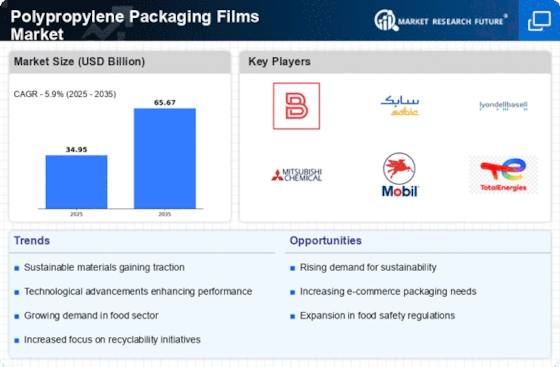
    As per MRFR analysis, the Polypropylene Packaging Films Market Size was estimated at 34.95 USD Billion in 2024. The Polypropylene Packaging Films industry is projected to grow from 37.01 USD Billion in 2025 to 65.67 USD Billion by 2035, exhibiting a compound annual growth rate (CAGR) of 5.9 during the forecast period 2025 - 2035.

    Key Market Trends & Highlights

    The Polypropylene Packaging Films Market is experiencing robust growth driven by sustainability and technological advancements.

    • North America remains the largest market for polypropylene packaging films, driven by increasing demand for flexible packaging solutions.
    • Asia-Pacific is emerging as the fastest-growing region, fueled by rapid industrialization and urbanization.
    • Biaxially Oriented Polypropylene (BOPP) dominates the market, while Cast Polypropylene (CPP) is witnessing the fastest growth due to its versatility.
    • Key market drivers include rising demand for flexible packaging and regulatory support for sustainable packaging initiatives.

    Market Size & Forecast

    2024 Market Size 34.95 (USD Billion)
    2035 Market Size 65.67 (USD Billion)
    CAGR (2025 - 2035) 5.9%
    Largest Regional Market Share in 2024 North America

    Major Players

    <p>Borealis AG (AT), SABIC (SA), LyondellBasell Industries N.V. (NL), Mitsubishi Chemical Corporation (JP), ExxonMobil Chemical (US), TotalEnergies SE (FR), Braskem S.A. (BR), PolyOne Corporation (US), AEP Industries Inc. (US)</p>

    Market Trends

    The Polypropylene Packaging Films Market is currently experiencing a dynamic evolution, driven by various factors that influence consumer preferences and industry practices. The increasing demand for sustainable packaging solutions appears to be a pivotal force, as businesses seek to reduce their environmental footprint. This shift towards eco-friendly materials is likely to encourage innovation in film production processes, leading to the development of biodegradable and recyclable options. Furthermore, the rise in e-commerce and online retailing is reshaping packaging requirements, necessitating films that offer enhanced durability and protection during transit. As a result, manufacturers are focusing on creating films that not only meet functional needs but also align with sustainability goals. In addition to sustainability, advancements in technology are playing a crucial role in shaping the Polypropylene Packaging Films Market. Innovations in film manufacturing techniques, such as multi-layer extrusion and advanced coating processes, are enhancing the performance characteristics of these films. This technological progress may lead to improved barrier properties, extending the shelf life of packaged products and ensuring food safety. Moreover, the growing trend of customization in packaging solutions is prompting companies to explore unique designs and functionalities, further diversifying the market landscape. Overall, the Polypropylene Packaging Films Market is poised for growth, driven by a combination of sustainability initiatives, technological advancements, and evolving consumer demands.

    Sustainability Initiatives

    The emphasis on eco-friendly packaging solutions is reshaping the Polypropylene Packaging Films Market. Companies are increasingly adopting sustainable practices, leading to the development of biodegradable and recyclable films. This trend reflects a broader commitment to reducing environmental impact and meeting consumer expectations for greener products.

    Technological Advancements

    Innovations in manufacturing processes are significantly influencing the Polypropylene Packaging Films Market. Techniques such as multi-layer extrusion and advanced coating are enhancing film performance, improving barrier properties, and extending product shelf life. These advancements are crucial for meeting the demands of various industries.

    Customization Trends

    The growing demand for personalized packaging solutions is driving innovation within the Polypropylene Packaging Films Market. Companies are exploring unique designs and functionalities to cater to specific consumer preferences, thereby enhancing brand differentiation and customer engagement.

    Polypropylene Packaging Films Market Market Drivers

    Rising Demand for Flexible Packaging

    The increasing consumer preference for flexible packaging solutions is a primary driver for the Polypropylene Packaging Films Market. Flexible packaging offers advantages such as lightweight, convenience, and enhanced shelf life, which are appealing to both manufacturers and consumers. According to recent data, the flexible packaging segment is projected to grow at a compound annual growth rate of approximately 4.5% over the next few years. This trend is likely to bolster the demand for polypropylene films, as they are widely used in various applications, including food, pharmaceuticals, and personal care products. As companies strive to meet consumer expectations for convenience and sustainability, the Polypropylene Packaging Films Market is expected to witness substantial growth.

    Growth in E-commerce and Retail Sectors

    The expansion of e-commerce and retail sectors is significantly influencing the Polypropylene Packaging Films Market. With the rise of online shopping, there is an increasing need for efficient packaging solutions that ensure product safety during transit. Polypropylene films are favored for their durability and protective qualities, making them ideal for packaging a wide range of products. Market analysis indicates that the e-commerce sector is anticipated to grow by over 20% in the coming years, which will likely drive the demand for polypropylene packaging films. This growth presents an opportunity for manufacturers to innovate and develop new packaging solutions tailored to the evolving needs of the retail landscape.

    Regulatory Support for Sustainable Packaging

    Regulatory frameworks promoting sustainable packaging practices are emerging as a key driver for the Polypropylene Packaging Films Market. Governments and organizations are increasingly advocating for the reduction of plastic waste and the adoption of recyclable materials. Polypropylene films, being recyclable, align with these sustainability goals, making them a preferred choice for manufacturers. Recent initiatives have shown that the demand for sustainable packaging solutions is expected to rise, with a projected increase of 15% in the adoption of recyclable materials by 2027. This regulatory support is likely to enhance the market position of polypropylene films, as companies seek to comply with environmental standards while meeting consumer demands.

    Technological Innovations in Film Production

    Technological advancements in the production of polypropylene films are driving efficiency and quality in the Polypropylene Packaging Films Market. Innovations such as advanced extrusion techniques and the development of multi-layer films are enhancing the performance characteristics of polypropylene films. These technologies allow for improved barrier properties, which are crucial for preserving product freshness and extending shelf life. Market data suggests that the introduction of new production technologies could lead to a reduction in manufacturing costs by up to 10%, thereby making polypropylene films more competitive against alternative materials. As manufacturers continue to invest in technology, the Polypropylene Packaging Films Market is poised for growth.

    Increasing Applications in Various Industries

    The versatility of polypropylene films is leading to their increasing applications across diverse industries, which serves as a significant driver for the Polypropylene Packaging Films Market. From food packaging to medical supplies, the adaptability of polypropylene films makes them suitable for a wide range of uses. Recent studies indicate that the food packaging segment alone accounts for over 40% of the total market share, highlighting the material's importance in preserving food quality. Additionally, the growing demand for hygienic packaging solutions in the healthcare sector is further propelling the use of polypropylene films. As industries continue to explore innovative applications, the Polypropylene Packaging Films Market is expected to expand.

    Market Segment Insights

    Polypropylene Packaging Films Type Insights

    The Polypropylene Packaging Films Market segmentation, based on Type, includes biaxially oriented polypropylene (BOPP) and cast polypropylene (CPP). Biaxially oriented polypropylene (BOPP) segment dominated the global market in 2022. The BOPP offers exceptional clarity, graphic reproduction, and shelf appeal while being moisture resistant. It provides a tonne of flexibility for incorporating printing, laminations, logos, labels, and other branding tools. These elements make it the perfect option for packaging in the food, beverage, and healthcare sectors. Furthermore, the food industry has adopted BOPP widely for the packaging of fresh fruits, vegetables, and meats.

    The demand for packaged foods will be driven by increased disposable income in emerging nations and technology advancements in online meal delivery. This will increase demand for BOPP even more and support market expansion.

    Polypropylene Packaging Films Application Insights

    The Polypropylene Packaging Films Market segmentation, based on Application, includes bags & pouches, taps & labels, and others. Bags & pouches segment dominated the global market in 2022. Demand for flexible packaging forms has been consistent over the past ten years, mostly due to significant changes in end-user preferences and factors. Numerous industry verticals continue to look for sustainable packaging solutions with enhanced functionality, which has accelerated the spread of flexible packaging across a wide range of end-use applications.

    Polypropylene Packaging Films End Use Insights

    The Polypropylene Packaging Films Market segmentation, based on End Use, includes food, beverage, healthcare, industrial, and others. Food segment dominated the Polypropylene Packaging Films Market in 2022. A constant expansion of the food and beverage sector, particularly due to the needs of the middle class's rapidly expanding population.

    Market operators must look beyond "one-size-fits-all" solutions because the use of polypropylene packaging films in food and beverage applications is opening up a wide range of options. 'Ready-to-eat' and 'easy-to-carry' are two major trends that are developing in the food and beverage industry and are expected to support the parallel market growth of polypropylene packaging films.

    Figure 1: Polypropylene Packaging Films Market, by End Use, 2022 & 2032 (USD Billion)

    Source: Secondary Research, Primary Research, Market Research Future Database and Analyst Review

    Get more detailed insights about Polypropylene Packaging Films Market Research Report—Global Forecast till 2035

    Regional Insights

    North America : Market Leader in Innovation

    North America is the largest market for polypropylene packaging films, holding approximately 40% of the global market share. The region's growth is driven by increasing demand for sustainable packaging solutions and stringent regulations promoting recyclable materials. The rise in e-commerce and food delivery services further fuels the demand for flexible packaging solutions, making it a key player in the market. The United States and Canada are the leading countries in this region, with major companies like ExxonMobil Chemical and AEP Industries Inc. driving innovation and production. The competitive landscape is characterized by a focus on advanced technologies and sustainable practices, ensuring that North America remains at the forefront of the polypropylene packaging films market.

    Europe : Sustainability and Innovation Focus

    Europe is the second-largest market for polypropylene packaging films, accounting for around 30% of the global market share. The region's growth is significantly influenced by regulatory frameworks aimed at reducing plastic waste and promoting circular economy practices. Initiatives like the European Green Deal are driving demand for sustainable packaging solutions, which is reshaping the market landscape. Leading countries in Europe include Germany, France, and the Netherlands, where companies like Borealis AG and TotalEnergies SE are prominent players. The competitive environment is marked by a strong emphasis on innovation and sustainability, with firms investing in research and development to create eco-friendly packaging solutions that meet regulatory standards.

    Asia-Pacific : Rapid Growth and Expansion

    Asia-Pacific is witnessing rapid growth in the polypropylene packaging films market, holding approximately 25% of the global market share. The region's expansion is driven by increasing urbanization, rising disposable incomes, and a growing demand for packaged food and beverages. Additionally, favorable government policies supporting manufacturing and trade are acting as catalysts for market growth. China and India are the leading countries in this region, with significant contributions from companies like SABIC and LyondellBasell Industries N.V. The competitive landscape is evolving, with local manufacturers increasingly adopting advanced technologies to enhance production efficiency and meet the rising demand for flexible packaging solutions.

    Middle East and Africa : Emerging Market with Potential

    The Middle East and Africa region is gradually emerging in the polypropylene packaging films market, holding about 5% of the global market share. The growth is primarily driven by increasing industrialization and urbanization, alongside a rising demand for packaged goods. Government initiatives aimed at boosting manufacturing capabilities are also contributing to market expansion in this region. Countries like South Africa and the UAE are leading the market, with key players such as Braskem S.A. and Mitsubishi Chemical Corporation establishing a presence. The competitive landscape is characterized by a mix of local and international companies, focusing on enhancing production capabilities and meeting the growing demand for flexible packaging solutions.

    Key Players and Competitive Insights

    Leading market players are investing heavily in research and development in order to expand their product lines, which will help the Polypropylene Packaging Films market, grow even more. Market participants are also undertaking a variety of strategic activities to expand their global footprint, with important market developments including new product launches, contractual agreements, mergers and acquisitions, higher investments, and collaboration with other organizations. To expand and survive in a more competitive and rising market climate, Polypropylene Packaging Films Industry must offer cost-effective items.

    Manufacturing locally to minimize operational costs is one of the key business tactics used by manufacturers in the global Polypropylene Packaging Films Industry to benefit clients and increase the market sector. In recent years, the Polypropylene Packaging Films Industry has offered some of the most significant advantages to medicine. Major players in the Polypropylene Packaging Films market, including MITSUI CHEMICALS AMERICA INC., LyondellBasell Industries Holdings, Blueridge Films, Inc., Cosmo Films Ltd., Polyplex Corporation Ltd., TRINIFLEX, Jindal Poly Films, Profol Group, Manuli Stretch s.p.a, Polibak, and Panverta, are attempting to increase market demand by investing in research and development operations.

    Max Speciality Films Limited (MSFL), which was established in 1990, has developed into one of the industry's top suppliers of specialty packaging, labels, coatings and thermal lamination films for the Indian and international markets. With the restructure of Max Group, a $2 billion conglomerate, on January 16, 2016, it hopes to maximise shareholder value, narrow the scope of each enterprise, and encourage partnerships that support "Make in India." As of right now, Max Ventures & Industries Limited (MVIL) is the parent company of MSFL.

    Modern "R&D centre", BRC "AA" certification, NABL accreditation, ongoing technological advancements, new product development, and a strong dedication to customer service & quality have kept MSFL at the top of the leader board. MSFL has launched the next phase of growth with these major goals in mind, driven by innovation, capacity and portfolio expansion, "best-in-class" customer service, and expanding equity in new markets.

    An organization that offers packaging solutions and goods is called Innovia Films Ltd. The business makes plastic packaging items and biaxially oriented polypropylene (BOPP) films. The business provides linerless labels, environmentally friendly labels, packaging made of renewable and biodegradable materials, security films, and tobacco packaging items. For the market for banknotes and securities, it creates polymer substrates. Giant graphic displays, adhesive tapes and labels, as well as specialty packaging for luxury and culinary items, are all uses for these products. It sells its goods under a variety of names, including Rayoface, Rayofoil, RayoForm, and Rayoart.

    Operating as a division of CCL Industries Inc. is Innovia. In Europe, Asia-Pacific, and the Americas, the corporation has production facilities and sales offices. Innovia's main office is in Wigton, United Kingdom.

    Key Companies in the Polypropylene Packaging Films Market market include

    Industry Developments

    In March 2024, Toppan announced plans to launch GL-SP, which is an innovative and environmentally friendly barrier film that is aimed at the Indian market. This new product was co-created alongside Indian TOPPAN Speciality Films.The use of Biaxially oriented polypropylene (BOPP) as a substrate will be the basis of this disruptive product.

    In May 2023, an unprecedented partnership between three Japanese companies, Toppan, Mitsui Chemicals Tohcello and Mitsui Chemicals initiated a trial phase to explore opportunities of utilizing a new technology that would turn printed biaxially oriented polypropylene (BOPP) films back into flexible packaging.

    In March 2022, Innovia launched the new cast polypropylene film Propacast KF, which was aimed at responding to HFFS, VFFS, and lidding applications as a laming solution. The film has a high seal wide range and is also completely recyclable.

    In November 2021, Cosmo Films Ltd, one of the roll leaders in extrusion film for laminate, printing, metalized bopp and adhesive industries, unveiled an advanced barrier metalized propylene film bopp. The high metal bond which advanced the moisture and oxygen barrier characteristics puts this film as one of the most ideal for packaging systems.

    In November 2020, the case for an expandable BOPP film began with Argha Films U.S.A. The purpose of Arlene Films is to facilitate protection, sensory experience, ease of dealing with the product, and profitability of any FMCG industry.

    Future Outlook

    Polypropylene Packaging Films Market Future Outlook

    <p>The Polypropylene Packaging Films Market is projected to grow at a 5.9% CAGR from 2024 to 2035, driven by increasing demand for sustainable packaging solutions and technological advancements.</p>

    New opportunities lie in:

    • <p>Development of biodegradable polypropylene films for eco-conscious consumers.</p>
    • <p>Expansion into emerging markets with tailored packaging solutions.</p>
    • <p>Investment in advanced manufacturing technologies to enhance production efficiency.</p>

    <p>By 2035, the market is expected to solidify its position as a leader in sustainable packaging solutions.</p>

    Market Segmentation

    Polypropylene Packaging Films Type Outlook

    • Biaxially Oriented Polypropylene (BOPP)
    • Cast Polypropylene (CPP)

    Polypropylene Packaging Films End Use Outlook

    • Food
    • Beverage
    • Healthcare​
    • Industrial​
    • Others

    Polypropylene Packaging Films Regional Outlook

    North America
    • US
    • Canada

    Polypropylene Packaging Films Application Outlook

    • Bags & pouches
    • Taps & labels
    • Others

    Report Scope

    MARKET SIZE 202434.95(USD Billion)
    MARKET SIZE 202537.01(USD Billion)
    MARKET SIZE 203565.67(USD Billion)
    COMPOUND ANNUAL GROWTH RATE (CAGR)5.9% (2024 - 2035)
    REPORT COVERAGERevenue Forecast, Competitive Landscape, Growth Factors, and Trends
    BASE YEAR2024
    Market Forecast Period2025 - 2035
    Historical Data2019 - 2024
    Market Forecast UnitsUSD Billion
    Key Companies ProfiledMarket analysis in progress
    Segments CoveredMarket segmentation analysis in progress
    Key Market OpportunitiesGrowing demand for sustainable packaging solutions drives innovation in the Polypropylene Packaging Films Market.
    Key Market DynamicsRising demand for sustainable packaging solutions drives innovation in polypropylene packaging films technology and production processes.
    Countries CoveredNorth America, Europe, APAC, South America, MEA

    FAQs

    How much is the Polypropylene Packaging Films market?

    The Polypropylene Packaging Films Market size was valued at USD 31.1 Billion in 2022.

    What is the growth rate of the Polypropylene Packaging Films market?

    Polypropylene Packaging Films Market is expected to grow with a CAGR of 5.9% in the period 2025-2035

    Which region held the largest market share in the Polypropylene Packaging Films market?

    North America had the largest share in the global market

    Who are the key players in the Polypropylene Packaging Films market?

    The key players in the market are MITSUI CHEMICALS AMERICA INC., LyondellBasell Industries Holdings, Blueridge Films, Inc., Cosmo Films Ltd., Polyplex Corporation Ltd., TRINIFLEX, Jindal Poly Films, Profol Group, Manuli Stretch s.p.a, Polibak, and Panverta

    Which Type led the Polypropylene Packaging Films market?

    The Biaxially Oriented Polypropylene (BOPP) Type dominated the market in 2022.

    Which Application had the largest market share in the Polypropylene Packaging Films market?

    The Bags &amp; Pouches Application had the largest share in the global market.

    1. SECTION I: EXECUTIVE SUMMARY AND KEY HIGHLIGHTS
      1. | 1.1 EXECUTIVE SUMMARY
      2. | | 1.1.1 Market Overview
      3. | | 1.1.2 Key Findings
      4. | | 1.1.3 Market Segmentation
      5. | | 1.1.4 Competitive Landscape
      6. | | 1.1.5 Challenges and Opportunities
      7. | | 1.1.6 Future Outlook
    2. SECTION II: SCOPING, METHODOLOGY AND MARKET STRUCTURE
      1. | 2.1 MARKET INTRODUCTION
      2. | | 2.1.1 Definition
      3. | | 2.1.2 Scope of the study
      4. | | | 2.1.2.1 Research Objective
      5. | | | 2.1.2.2 Assumption
      6. | | | 2.1.2.3 Limitations
      7. | 2.2 RESEARCH METHODOLOGY
      8. | | 2.2.1 Overview
      9. | | 2.2.2 Data Mining
      10. | | 2.2.3 Secondary Research
      11. | | 2.2.4 Primary Research
      12. | | | 2.2.4.1 Primary Interviews and Information Gathering Process
      13. | | | 2.2.4.2 Breakdown of Primary Respondents
      14. | | 2.2.5 Forecasting Model
      15. | | 2.2.6 Market Size Estimation
      16. | | | 2.2.6.1 Bottom-Up Approach
      17. | | | 2.2.6.2 Top-Down Approach
      18. | | 2.2.7 Data Triangulation
      19. | | 2.2.8 Validation
    3. SECTION III: QUALITATIVE ANALYSIS
      1. | 3.1 MARKET DYNAMICS
      2. | | 3.1.1 Overview
      3. | | 3.1.2 Drivers
      4. | | 3.1.3 Restraints
      5. | | 3.1.4 Opportunities
      6. | 3.2 MARKET FACTOR ANALYSIS
      7. | | 3.2.1 Value chain Analysis
      8. | | 3.2.2 Porter's Five Forces Analysis
      9. | | | 3.2.2.1 Bargaining Power of Suppliers
      10. | | | 3.2.2.2 Bargaining Power of Buyers
      11. | | | 3.2.2.3 Threat of New Entrants
      12. | | | 3.2.2.4 Threat of Substitutes
      13. | | | 3.2.2.5 Intensity of Rivalry
      14. | | 3.2.3 COVID-19 Impact Analysis
      15. | | | 3.2.3.1 Market Impact Analysis
      16. | | | 3.2.3.2 Regional Impact
      17. | | | 3.2.3.3 Opportunity and Threat Analysis
    4. SECTION IV: QUANTITATIVE ANALYSIS
      1. | 4.1 Packaging & Transport, BY Type (USD Billion)
      2. | | 4.1.1 Biaxially Oriented Polypropylene (BOPP)
      3. | | 4.1.2 Cast Polypropylene (CPP)
      4. | 4.2 Packaging & Transport, BY Application (USD Billion)
      5. | | 4.2.1 Bags & Pouches
      6. | | 4.2.2 Taps & Labels
      7. | | 4.2.3 Others
      8. | 4.3 Packaging & Transport, BY End Use (USD Billion)
      9. | | 4.3.1 Food
      10. | | 4.3.2 Beverage
      11. | | 4.3.3 Healthcare
      12. | | 4.3.4 Industrial
      13. | | 4.3.5 Others
      14. | 4.4 Packaging & Transport, BY Region (USD Billion)
      15. | | 4.4.1 North America
      16. | | | 4.4.1.1 US
      17. | | | 4.4.1.2 Canada
      18. | | 4.4.2 Europe
      19. | | | 4.4.2.1 Germany
      20. | | | 4.4.2.2 UK
      21. | | | 4.4.2.3 France
      22. | | | 4.4.2.4 Russia
      23. | | | 4.4.2.5 Italy
      24. | | | 4.4.2.6 Spain
      25. | | | 4.4.2.7 Rest of Europe
      26. | | 4.4.3 APAC
      27. | | | 4.4.3.1 China
      28. | | | 4.4.3.2 India
      29. | | | 4.4.3.3 Japan
      30. | | | 4.4.3.4 South Korea
      31. | | | 4.4.3.5 Malaysia
      32. | | | 4.4.3.6 Thailand
      33. | | | 4.4.3.7 Indonesia
      34. | | | 4.4.3.8 Rest of APAC
      35. | | 4.4.4 South America
      36. | | | 4.4.4.1 Brazil
      37. | | | 4.4.4.2 Mexico
      38. | | | 4.4.4.3 Argentina
      39. | | | 4.4.4.4 Rest of South America
      40. | | 4.4.5 MEA
      41. | | | 4.4.5.1 GCC Countries
      42. | | | 4.4.5.2 South Africa
      43. | | | 4.4.5.3 Rest of MEA
    5. SECTION V: COMPETITIVE ANALYSIS
      1. | 5.1 Competitive Landscape
      2. | | 5.1.1 Overview
      3. | | 5.1.2 Competitive Analysis
      4. | | 5.1.3 Market share Analysis
      5. | | 5.1.4 Major Growth Strategy in the Packaging & Transport
      6. | | 5.1.5 Competitive Benchmarking
      7. | | 5.1.6 Leading Players in Terms of Number of Developments in the Packaging & Transport
      8. | | 5.1.7 Key developments and growth strategies
      9. | | | 5.1.7.1 New Product Launch/Service Deployment
      10. | | | 5.1.7.2 Merger & Acquisitions
      11. | | | 5.1.7.3 Joint Ventures
      12. | | 5.1.8 Major Players Financial Matrix
      13. | | | 5.1.8.1 Sales and Operating Income
      14. | | | 5.1.8.2 Major Players R&D Expenditure. 2023
      15. | 5.2 Company Profiles
      16. | | 5.2.1 Borealis AG (AT)
      17. | | | 5.2.1.1 Financial Overview
      18. | | | 5.2.1.2 Products Offered
      19. | | | 5.2.1.3 Key Developments
      20. | | | 5.2.1.4 SWOT Analysis
      21. | | | 5.2.1.5 Key Strategies
      22. | | 5.2.2 SABIC (SA)
      23. | | | 5.2.2.1 Financial Overview
      24. | | | 5.2.2.2 Products Offered
      25. | | | 5.2.2.3 Key Developments
      26. | | | 5.2.2.4 SWOT Analysis
      27. | | | 5.2.2.5 Key Strategies
      28. | | 5.2.3 LyondellBasell Industries N.V. (NL)
      29. | | | 5.2.3.1 Financial Overview
      30. | | | 5.2.3.2 Products Offered
      31. | | | 5.2.3.3 Key Developments
      32. | | | 5.2.3.4 SWOT Analysis
      33. | | | 5.2.3.5 Key Strategies
      34. | | 5.2.4 Mitsubishi Chemical Corporation (JP)
      35. | | | 5.2.4.1 Financial Overview
      36. | | | 5.2.4.2 Products Offered
      37. | | | 5.2.4.3 Key Developments
      38. | | | 5.2.4.4 SWOT Analysis
      39. | | | 5.2.4.5 Key Strategies
      40. | | 5.2.5 ExxonMobil Chemical (US)
      41. | | | 5.2.5.1 Financial Overview
      42. | | | 5.2.5.2 Products Offered
      43. | | | 5.2.5.3 Key Developments
      44. | | | 5.2.5.4 SWOT Analysis
      45. | | | 5.2.5.5 Key Strategies
      46. | | 5.2.6 TotalEnergies SE (FR)
      47. | | | 5.2.6.1 Financial Overview
      48. | | | 5.2.6.2 Products Offered
      49. | | | 5.2.6.3 Key Developments
      50. | | | 5.2.6.4 SWOT Analysis
      51. | | | 5.2.6.5 Key Strategies
      52. | | 5.2.7 Braskem S.A. (BR)
      53. | | | 5.2.7.1 Financial Overview
      54. | | | 5.2.7.2 Products Offered
      55. | | | 5.2.7.3 Key Developments
      56. | | | 5.2.7.4 SWOT Analysis
      57. | | | 5.2.7.5 Key Strategies
      58. | | 5.2.8 PolyOne Corporation (US)
      59. | | | 5.2.8.1 Financial Overview
      60. | | | 5.2.8.2 Products Offered
      61. | | | 5.2.8.3 Key Developments
      62. | | | 5.2.8.4 SWOT Analysis
      63. | | | 5.2.8.5 Key Strategies
      64. | | 5.2.9 AEP Industries Inc. (US)
      65. | | | 5.2.9.1 Financial Overview
      66. | | | 5.2.9.2 Products Offered
      67. | | | 5.2.9.3 Key Developments
      68. | | | 5.2.9.4 SWOT Analysis
      69. | | | 5.2.9.5 Key Strategies
      70. | 5.3 Appendix
      71. | | 5.3.1 References
      72. | | 5.3.2 Related Reports
    6. LIST OF FIGURES
      1. | 6.1 MARKET SYNOPSIS
      2. | 6.2 NORTH AMERICA MARKET ANALYSIS
      3. | 6.3 US MARKET ANALYSIS BY TYPE
      4. | 6.4 US MARKET ANALYSIS BY APPLICATION
      5. | 6.5 US MARKET ANALYSIS BY END USE
      6. | 6.6 CANADA MARKET ANALYSIS BY TYPE
      7. | 6.7 CANADA MARKET ANALYSIS BY APPLICATION
      8. | 6.8 CANADA MARKET ANALYSIS BY END USE
      9. | 6.9 EUROPE MARKET ANALYSIS
      10. | 6.10 GERMANY MARKET ANALYSIS BY TYPE
      11. | 6.11 GERMANY MARKET ANALYSIS BY APPLICATION
      12. | 6.12 GERMANY MARKET ANALYSIS BY END USE
      13. | 6.13 UK MARKET ANALYSIS BY TYPE
      14. | 6.14 UK MARKET ANALYSIS BY APPLICATION
      15. | 6.15 UK MARKET ANALYSIS BY END USE
      16. | 6.16 FRANCE MARKET ANALYSIS BY TYPE
      17. | 6.17 FRANCE MARKET ANALYSIS BY APPLICATION
      18. | 6.18 FRANCE MARKET ANALYSIS BY END USE
      19. | 6.19 RUSSIA MARKET ANALYSIS BY TYPE
      20. | 6.20 RUSSIA MARKET ANALYSIS BY APPLICATION
      21. | 6.21 RUSSIA MARKET ANALYSIS BY END USE
      22. | 6.22 ITALY MARKET ANALYSIS BY TYPE
      23. | 6.23 ITALY MARKET ANALYSIS BY APPLICATION
      24. | 6.24 ITALY MARKET ANALYSIS BY END USE
      25. | 6.25 SPAIN MARKET ANALYSIS BY TYPE
      26. | 6.26 SPAIN MARKET ANALYSIS BY APPLICATION
      27. | 6.27 SPAIN MARKET ANALYSIS BY END USE
      28. | 6.28 REST OF EUROPE MARKET ANALYSIS BY TYPE
      29. | 6.29 REST OF EUROPE MARKET ANALYSIS BY APPLICATION
      30. | 6.30 REST OF EUROPE MARKET ANALYSIS BY END USE
      31. | 6.31 APAC MARKET ANALYSIS
      32. | 6.32 CHINA MARKET ANALYSIS BY TYPE
      33. | 6.33 CHINA MARKET ANALYSIS BY APPLICATION
      34. | 6.34 CHINA MARKET ANALYSIS BY END USE
      35. | 6.35 INDIA MARKET ANALYSIS BY TYPE
      36. | 6.36 INDIA MARKET ANALYSIS BY APPLICATION
      37. | 6.37 INDIA MARKET ANALYSIS BY END USE
      38. | 6.38 JAPAN MARKET ANALYSIS BY TYPE
      39. | 6.39 JAPAN MARKET ANALYSIS BY APPLICATION
      40. | 6.40 JAPAN MARKET ANALYSIS BY END USE
      41. | 6.41 SOUTH KOREA MARKET ANALYSIS BY TYPE
      42. | 6.42 SOUTH KOREA MARKET ANALYSIS BY APPLICATION
      43. | 6.43 SOUTH KOREA MARKET ANALYSIS BY END USE
      44. | 6.44 MALAYSIA MARKET ANALYSIS BY TYPE
      45. | 6.45 MALAYSIA MARKET ANALYSIS BY APPLICATION
      46. | 6.46 MALAYSIA MARKET ANALYSIS BY END USE
      47. | 6.47 THAILAND MARKET ANALYSIS BY TYPE
      48. | 6.48 THAILAND MARKET ANALYSIS BY APPLICATION
      49. | 6.49 THAILAND MARKET ANALYSIS BY END USE
      50. | 6.50 INDONESIA MARKET ANALYSIS BY TYPE
      51. | 6.51 INDONESIA MARKET ANALYSIS BY APPLICATION
      52. | 6.52 INDONESIA MARKET ANALYSIS BY END USE
      53. | 6.53 REST OF APAC MARKET ANALYSIS BY TYPE
      54. | 6.54 REST OF APAC MARKET ANALYSIS BY APPLICATION
      55. | 6.55 REST OF APAC MARKET ANALYSIS BY END USE
      56. | 6.56 SOUTH AMERICA MARKET ANALYSIS
      57. | 6.57 BRAZIL MARKET ANALYSIS BY TYPE
      58. | 6.58 BRAZIL MARKET ANALYSIS BY APPLICATION
      59. | 6.59 BRAZIL MARKET ANALYSIS BY END USE
      60. | 6.60 MEXICO MARKET ANALYSIS BY TYPE
      61. | 6.61 MEXICO MARKET ANALYSIS BY APPLICATION
      62. | 6.62 MEXICO MARKET ANALYSIS BY END USE
      63. | 6.63 ARGENTINA MARKET ANALYSIS BY TYPE
      64. | 6.64 ARGENTINA MARKET ANALYSIS BY APPLICATION
      65. | 6.65 ARGENTINA MARKET ANALYSIS BY END USE
      66. | 6.66 REST OF SOUTH AMERICA MARKET ANALYSIS BY TYPE
      67. | 6.67 REST OF SOUTH AMERICA MARKET ANALYSIS BY APPLICATION
      68. | 6.68 REST OF SOUTH AMERICA MARKET ANALYSIS BY END USE
      69. | 6.69 MEA MARKET ANALYSIS
      70. | 6.70 GCC COUNTRIES MARKET ANALYSIS BY TYPE
      71. | 6.71 GCC COUNTRIES MARKET ANALYSIS BY APPLICATION
      72. | 6.72 GCC COUNTRIES MARKET ANALYSIS BY END USE
      73. | 6.73 SOUTH AFRICA MARKET ANALYSIS BY TYPE
      74. | 6.74 SOUTH AFRICA MARKET ANALYSIS BY APPLICATION
      75. | 6.75 SOUTH AFRICA MARKET ANALYSIS BY END USE
      76. | 6.76 REST OF MEA MARKET ANALYSIS BY TYPE
      77. | 6.77 REST OF MEA MARKET ANALYSIS BY APPLICATION
      78. | 6.78 REST OF MEA MARKET ANALYSIS BY END USE
      79. | 6.79 KEY BUYING CRITERIA OF PACKAGING & TRANSPORT
      80. | 6.80 RESEARCH PROCESS OF MRFR
      81. | 6.81 DRO ANALYSIS OF PACKAGING & TRANSPORT
      82. | 6.82 DRIVERS IMPACT ANALYSIS: PACKAGING & TRANSPORT
      83. | 6.83 RESTRAINTS IMPACT ANALYSIS: PACKAGING & TRANSPORT
      84. | 6.84 SUPPLY / VALUE CHAIN: PACKAGING & TRANSPORT
      85. | 6.85 PACKAGING & TRANSPORT, BY TYPE, 2024 (% SHARE)
      86. | 6.86 PACKAGING & TRANSPORT, BY TYPE, 2024 TO 2035 (USD Billion)
      87. | 6.87 PACKAGING & TRANSPORT, BY APPLICATION, 2024 (% SHARE)
      88. | 6.88 PACKAGING & TRANSPORT, BY APPLICATION, 2024 TO 2035 (USD Billion)
      89. | 6.89 PACKAGING & TRANSPORT, BY END USE, 2024 (% SHARE)
      90. | 6.90 PACKAGING & TRANSPORT, BY END USE, 2024 TO 2035 (USD Billion)
      91. | 6.91 BENCHMARKING OF MAJOR COMPETITORS
    7. LIST OF TABLES
      1. | 7.1 LIST OF ASSUMPTIONS
      2. | | 7.1.1
      3. | 7.2 North America MARKET SIZE ESTIMATES; FORECAST
      4. | | 7.2.1 BY TYPE, 2025-2035 (USD Billion)
      5. | | 7.2.2 BY APPLICATION, 2025-2035 (USD Billion)
      6. | | 7.2.3 BY END USE, 2025-2035 (USD Billion)
      7. | 7.3 US MARKET SIZE ESTIMATES; FORECAST
      8. | | 7.3.1 BY TYPE, 2025-2035 (USD Billion)
      9. | | 7.3.2 BY APPLICATION, 2025-2035 (USD Billion)
      10. | | 7.3.3 BY END USE, 2025-2035 (USD Billion)
      11. | 7.4 Canada MARKET SIZE ESTIMATES; FORECAST
      12. | | 7.4.1 BY TYPE, 2025-2035 (USD Billion)
      13. | | 7.4.2 BY APPLICATION, 2025-2035 (USD Billion)
      14. | | 7.4.3 BY END USE, 2025-2035 (USD Billion)
      15. | 7.5 Europe MARKET SIZE ESTIMATES; FORECAST
      16. | | 7.5.1 BY TYPE, 2025-2035 (USD Billion)
      17. | | 7.5.2 BY APPLICATION, 2025-2035 (USD Billion)
      18. | | 7.5.3 BY END USE, 2025-2035 (USD Billion)
      19. | 7.6 Germany MARKET SIZE ESTIMATES; FORECAST
      20. | | 7.6.1 BY TYPE, 2025-2035 (USD Billion)
      21. | | 7.6.2 BY APPLICATION, 2025-2035 (USD Billion)
      22. | | 7.6.3 BY END USE, 2025-2035 (USD Billion)
      23. | 7.7 UK MARKET SIZE ESTIMATES; FORECAST
      24. | | 7.7.1 BY TYPE, 2025-2035 (USD Billion)
      25. | | 7.7.2 BY APPLICATION, 2025-2035 (USD Billion)
      26. | | 7.7.3 BY END USE, 2025-2035 (USD Billion)
      27. | 7.8 France MARKET SIZE ESTIMATES; FORECAST
      28. | | 7.8.1 BY TYPE, 2025-2035 (USD Billion)
      29. | | 7.8.2 BY APPLICATION, 2025-2035 (USD Billion)
      30. | | 7.8.3 BY END USE, 2025-2035 (USD Billion)
      31. | 7.9 Russia MARKET SIZE ESTIMATES; FORECAST
      32. | | 7.9.1 BY TYPE, 2025-2035 (USD Billion)
      33. | | 7.9.2 BY APPLICATION, 2025-2035 (USD Billion)
      34. | | 7.9.3 BY END USE, 2025-2035 (USD Billion)
      35. | 7.10 Italy MARKET SIZE ESTIMATES; FORECAST
      36. | | 7.10.1 BY TYPE, 2025-2035 (USD Billion)
      37. | | 7.10.2 BY APPLICATION, 2025-2035 (USD Billion)
      38. | | 7.10.3 BY END USE, 2025-2035 (USD Billion)
      39. | 7.11 Spain MARKET SIZE ESTIMATES; FORECAST
      40. | | 7.11.1 BY TYPE, 2025-2035 (USD Billion)
      41. | | 7.11.2 BY APPLICATION, 2025-2035 (USD Billion)
      42. | | 7.11.3 BY END USE, 2025-2035 (USD Billion)
      43. | 7.12 Rest of Europe MARKET SIZE ESTIMATES; FORECAST
      44. | | 7.12.1 BY TYPE, 2025-2035 (USD Billion)
      45. | | 7.12.2 BY APPLICATION, 2025-2035 (USD Billion)
      46. | | 7.12.3 BY END USE, 2025-2035 (USD Billion)
      47. | 7.13 APAC MARKET SIZE ESTIMATES; FORECAST
      48. | | 7.13.1 BY TYPE, 2025-2035 (USD Billion)
      49. | | 7.13.2 BY APPLICATION, 2025-2035 (USD Billion)
      50. | | 7.13.3 BY END USE, 2025-2035 (USD Billion)
      51. | 7.14 China MARKET SIZE ESTIMATES; FORECAST
      52. | | 7.14.1 BY TYPE, 2025-2035 (USD Billion)
      53. | | 7.14.2 BY APPLICATION, 2025-2035 (USD Billion)
      54. | | 7.14.3 BY END USE, 2025-2035 (USD Billion)
      55. | 7.15 India MARKET SIZE ESTIMATES; FORECAST
      56. | | 7.15.1 BY TYPE, 2025-2035 (USD Billion)
      57. | | 7.15.2 BY APPLICATION, 2025-2035 (USD Billion)
      58. | | 7.15.3 BY END USE, 2025-2035 (USD Billion)
      59. | 7.16 Japan MARKET SIZE ESTIMATES; FORECAST
      60. | | 7.16.1 BY TYPE, 2025-2035 (USD Billion)
      61. | | 7.16.2 BY APPLICATION, 2025-2035 (USD Billion)
      62. | | 7.16.3 BY END USE, 2025-2035 (USD Billion)
      63. | 7.17 South Korea MARKET SIZE ESTIMATES; FORECAST
      64. | | 7.17.1 BY TYPE, 2025-2035 (USD Billion)
      65. | | 7.17.2 BY APPLICATION, 2025-2035 (USD Billion)
      66. | | 7.17.3 BY END USE, 2025-2035 (USD Billion)
      67. | 7.18 Malaysia MARKET SIZE ESTIMATES; FORECAST
      68. | | 7.18.1 BY TYPE, 2025-2035 (USD Billion)
      69. | | 7.18.2 BY APPLICATION, 2025-2035 (USD Billion)
      70. | | 7.18.3 BY END USE, 2025-2035 (USD Billion)
      71. | 7.19 Thailand MARKET SIZE ESTIMATES; FORECAST
      72. | | 7.19.1 BY TYPE, 2025-2035 (USD Billion)
      73. | | 7.19.2 BY APPLICATION, 2025-2035 (USD Billion)
      74. | | 7.19.3 BY END USE, 2025-2035 (USD Billion)
      75. | 7.20 Indonesia MARKET SIZE ESTIMATES; FORECAST
      76. | | 7.20.1 BY TYPE, 2025-2035 (USD Billion)
      77. | | 7.20.2 BY APPLICATION, 2025-2035 (USD Billion)
      78. | | 7.20.3 BY END USE, 2025-2035 (USD Billion)
      79. | 7.21 Rest of APAC MARKET SIZE ESTIMATES; FORECAST
      80. | | 7.21.1 BY TYPE, 2025-2035 (USD Billion)
      81. | | 7.21.2 BY APPLICATION, 2025-2035 (USD Billion)
      82. | | 7.21.3 BY END USE, 2025-2035 (USD Billion)
      83. | 7.22 South America MARKET SIZE ESTIMATES; FORECAST
      84. | | 7.22.1 BY TYPE, 2025-2035 (USD Billion)
      85. | | 7.22.2 BY APPLICATION, 2025-2035 (USD Billion)
      86. | | 7.22.3 BY END USE, 2025-2035 (USD Billion)
      87. | 7.23 Brazil MARKET SIZE ESTIMATES; FORECAST
      88. | | 7.23.1 BY TYPE, 2025-2035 (USD Billion)
      89. | | 7.23.2 BY APPLICATION, 2025-2035 (USD Billion)
      90. | | 7.23.3 BY END USE, 2025-2035 (USD Billion)
      91. | 7.24 Mexico MARKET SIZE ESTIMATES; FORECAST
      92. | | 7.24.1 BY TYPE, 2025-2035 (USD Billion)
      93. | | 7.24.2 BY APPLICATION, 2025-2035 (USD Billion)
      94. | | 7.24.3 BY END USE, 2025-2035 (USD Billion)
      95. | 7.25 Argentina MARKET SIZE ESTIMATES; FORECAST
      96. | | 7.25.1 BY TYPE, 2025-2035 (USD Billion)
      97. | | 7.25.2 BY APPLICATION, 2025-2035 (USD Billion)
      98. | | 7.25.3 BY END USE, 2025-2035 (USD Billion)
      99. | 7.26 Rest of South America MARKET SIZE ESTIMATES; FORECAST
      100. | | 7.26.1 BY TYPE, 2025-2035 (USD Billion)
      101. | | 7.26.2 BY APPLICATION, 2025-2035 (USD Billion)
      102. | | 7.26.3 BY END USE, 2025-2035 (USD Billion)
      103. | 7.27 MEA MARKET SIZE ESTIMATES; FORECAST
      104. | | 7.27.1 BY TYPE, 2025-2035 (USD Billion)
      105. | | 7.27.2 BY APPLICATION, 2025-2035 (USD Billion)
      106. | | 7.27.3 BY END USE, 2025-2035 (USD Billion)
      107. | 7.28 GCC Countries MARKET SIZE ESTIMATES; FORECAST
      108. | | 7.28.1 BY TYPE, 2025-2035 (USD Billion)
      109. | | 7.28.2 BY APPLICATION, 2025-2035 (USD Billion)
      110. | | 7.28.3 BY END USE, 2025-2035 (USD Billion)
      111. | 7.29 South Africa MARKET SIZE ESTIMATES; FORECAST
      112. | | 7.29.1 BY TYPE, 2025-2035 (USD Billion)
      113. | | 7.29.2 BY APPLICATION, 2025-2035 (USD Billion)
      114. | | 7.29.3 BY END USE, 2025-2035 (USD Billion)
      115. | 7.30 Rest of MEA MARKET SIZE ESTIMATES; FORECAST
      116. | | 7.30.1 BY TYPE, 2025-2035 (USD Billion)
      117. | | 7.30.2 BY APPLICATION, 2025-2035 (USD Billion)
      118. | | 7.30.3 BY END USE, 2025-2035 (USD Billion)
      119. | 7.31 PRODUCT LAUNCH/PRODUCT DEVELOPMENT/APPROVAL
      120. | | 7.31.1
      121. | 7.32 ACQUISITION/PARTNERSHIP
      122. | | 7.32.1

    Polypropylene Packaging Films Market Segmentation

    Polypropylene Packaging Films Type Outlook (USD Billion, 2018-2032)

    • Biaxially Oriented Polypropylene (BOPP)
    • Cast Polypropylene (CPP)

    Polypropylene Packaging Films Application Outlook (USD Billion, 2018-2032)

    • Bags & pouches
    • Taps & labels
    • Others

    Polypropylene Packaging Films End-Use Outlook (USD Billion, 2018-2032)

    • Food
    • Beverage
    • Healthcare​
    • Industrial​
    • Others

    Polypropylene Packaging Films Regional Outlook (USD Billion, 2018-2032)

    • North America Outlook (USD Billion, 2018-2032)

      • Polypropylene Packaging Films by Type
        • Biaxially Oriented Polypropylene (BOPP)
        • Cast Polypropylene (CPP)
      • Polypropylene Packaging Films by Application
        • Bags & pouches
        • Taps & labels
        • Others
      • Polypropylene Packaging Films by End-Use
        • Food
        • Beverage
        • Healthcare
        • Industrial
        • Others
      • US Outlook (USD Billion, 2018-2032)

      • Polypropylene Packaging Films by Type
        • Biaxially Oriented Polypropylene (BOPP)
        • Cast Polypropylene (CPP)
      • Polypropylene Packaging Films by Application
        • Bags & pouches
        • Taps & labels
        • Others
      • Polypropylene Packaging Films by End-Use
        • Food
        • Beverage
        • Healthcare
        • Industrial
        • Others
      • Canada Outlook (USD Billion, 2018-2032)

      • Polypropylene Packaging Films by Type
        • Biaxially Oriented Polypropylene (BOPP)
        • Cast Polypropylene (CPP)
      • Polypropylene Packaging Films by Application
        • Bags & pouches
        • Taps & labels
        • Others
      • Polypropylene Packaging Films by End-Use
        • Food
        • Beverage
        • Healthcare
        • Industrial
        • Others
    • Europe Outlook (USD Billion, 2018-2032)

      • Polypropylene Packaging Films by Type
        • Biaxially Oriented Polypropylene (BOPP)
        • Cast Polypropylene (CPP)
      • Polypropylene Packaging Films by Application
        • Bags & pouches
        • Taps & labels
        • Others
      • Polypropylene Packaging Films by End-Use
        • Food
        • Beverage
        • Healthcare
        • Industrial
        • Others
      • Germany Outlook (USD Billion, 2018-2032)

      • Polypropylene Packaging Films by Type
        • Biaxially Oriented Polypropylene (BOPP)
        • Cast Polypropylene (CPP)
      • Polypropylene Packaging Films by Application
        • Bags & pouches
        • Taps & labels
        • Others
      • Polypropylene Packaging Films by End-Use
        • Food
        • Beverage
        • Healthcare
        • Industrial
        • Others
      • France Outlook (USD Billion, 2018-2032)

      • Polypropylene Packaging Films by Type
        • Biaxially Oriented Polypropylene (BOPP)
        • Cast Polypropylene (CPP)
      • Polypropylene Packaging Films by Application
        • Bags & pouches
        • Taps & labels
        • Others
      • Polypropylene Packaging Films by End-Use
        • Food
        • Beverage
        • Healthcare
        • Industrial
        • Others
      • UK Outlook (USD Billion, 2018-2032)

      • Polypropylene Packaging Films by Type
        • Biaxially Oriented Polypropylene (BOPP)
        • Cast Polypropylene (CPP)
      • Polypropylene Packaging Films by Application
        • Bags & pouches
        • Taps & labels
        • Others
      • Polypropylene Packaging Films by End-Use
        • Food
        • Beverage
        • Healthcare
        • Industrial
        • Others
      • Italy Outlook (USD Billion, 2018-2032)

      • Polypropylene Packaging Films by Type
        • Biaxially Oriented Polypropylene (BOPP)
        • Cast Polypropylene (CPP)
      • Polypropylene Packaging Films by Application
        • Bags & pouches
        • Taps & labels
        • Others
      • Polypropylene Packaging Films by End-Use
        • Food
        • Beverage
        • Healthcare
        • Industrial
        • Others
      • Spain Outlook (USD Billion, 2018-2032)

      • Polypropylene Packaging Films by Type
        • Biaxially Oriented Polypropylene (BOPP)
        • Cast Polypropylene (CPP)
      • Polypropylene Packaging Films by Application
        • Bags & pouches
        • Taps & labels
        • Others
      • Polypropylene Packaging Films by End-Use
        • Food
        • Beverage
        • Healthcare
        • Industrial
        • Others
      • Rest Of Europe Outlook (USD Billion, 2018-2032)

      • Polypropylene Packaging Films by Type
        • Biaxially Oriented Polypropylene (BOPP)
        • Cast Polypropylene (CPP)
      • Polypropylene Packaging Films by Application
        • Bags & pouches
        • Taps & labels
        • Others
      • Polypropylene Packaging Films by End-Use
        • Food
        • Beverage
        • Healthcare
        • Industrial
        • Others
    • Asia-Pacific Outlook (USD Billion, 2018-2032)

      • Polypropylene Packaging Films by Type
        • Biaxially Oriented Polypropylene (BOPP)
        • Cast Polypropylene (CPP)
      • Polypropylene Packaging Films by Application
        • Bags & pouches
        • Taps & labels
        • Others
      • Polypropylene Packaging Films by End-Use
        • Food
        • Beverage
        • Healthcare
        • Industrial
        • Others
      • China Outlook (USD Billion, 2018-2032)

      • Polypropylene Packaging Films by Type
        • Biaxially Oriented Polypropylene (BOPP)
        • Cast Polypropylene (CPP)
      • Polypropylene Packaging Films by Application
        • Bags & pouches
        • Taps & labels
        • Others
      • Polypropylene Packaging Films by End-Use
        • Food
        • Beverage
        • Healthcare
        • Industrial
        • Others
      • Japan Outlook (USD Billion, 2018-2032)

      • Polypropylene Packaging Films by Type
        • Biaxially Oriented Polypropylene (BOPP)
        • Cast Polypropylene (CPP)
      • Polypropylene Packaging Films by Application
        • Bags & pouches
        • Taps & labels
        • Others
      • Polypropylene Packaging Films by End-Use
        • Food
        • Beverage
        • Healthcare
        • Industrial
        • Others
      • India Outlook (USD Billion, 2018-2032)

      • Polypropylene Packaging Films by Type
        • Biaxially Oriented Polypropylene (BOPP)
        • Cast Polypropylene (CPP)
      • Polypropylene Packaging Films by Application
        • Bags & pouches
        • Taps & labels
        • Others
      • Polypropylene Packaging Films by End-Use
        • Food
        • Beverage
        • Healthcare
        • Industrial
        • Others
      • Australia Outlook (USD Billion, 2018-2032)

      • Polypropylene Packaging Films by Type
        • Biaxially Oriented Polypropylene (BOPP)
        • Cast Polypropylene (CPP)
      • Polypropylene Packaging Films by Application
        • Bags & pouches
        • Taps & labels
        • Others
      • Polypropylene Packaging Films by End-Use
        • Food
        • Beverage
        • Healthcare
        • Industrial
        • Others
      • Rest of Asia-Pacific Outlook (USD Billion, 2018-2032)

      • Polypropylene Packaging Films by Type
        • Biaxially Oriented Polypropylene (BOPP)
        • Cast Polypropylene (CPP)
      • Polypropylene Packaging Films by Application
        • Bags & pouches
        • Taps & labels
        • Others
      • Polypropylene Packaging Films by End-Use
        • Food
        • Beverage
        • Healthcare
        • Industrial
        • Others
    • Rest of the World Outlook (USD Billion, 2018-2032)

      • Polypropylene Packaging Films by Type
        • Biaxially Oriented Polypropylene (BOPP)
        • Cast Polypropylene (CPP)
      • Polypropylene Packaging Films by Application
        • Bags & pouches
        • Taps & labels
        • Others
      • Polypropylene Packaging Films by End-Use
        • Food
        • Beverage
        • Healthcare
        • Industrial
        • Others
      • Middle East Outlook (USD Billion, 2018-2032)

      • Polypropylene Packaging Films by Type
        • Biaxially Oriented Polypropylene (BOPP)
        • Cast Polypropylene (CPP)
      • Polypropylene Packaging Films by Application
        • Bags & pouches
        • Taps & labels
        • Others
      • Polypropylene Packaging Films by End-Use
        • Food
        • Beverage
        • Healthcare
        • Industrial
        • Others
      • Africa Outlook (USD Billion, 2018-2032)

      • Polypropylene Packaging Films by Type
        • Biaxially Oriented Polypropylene (BOPP)
        • Cast Polypropylene (CPP)
      • Polypropylene Packaging Films by Application
        • Bags & pouches
        • Taps & labels
        • Others
      • Polypropylene Packaging Films by End-Use
        • Food
        • Beverage
        • Healthcare
        • Industrial
        • Others
      • Latin America Outlook (USD Billion, 2018-2032)

      • Polypropylene Packaging Films by Type
        • Biaxially Oriented Polypropylene (BOPP)
        • Cast Polypropylene (CPP)
      • Polypropylene Packaging Films by Application
        • Bags & pouches
        • Taps & labels
        • Others
      • Polypropylene Packaging Films by End-Use
        • Food
        • Beverage
        • Healthcare
        • Industrial
        • Others
    Infographic

    Free Sample Request

    Kindly complete the form below to receive a free sample of this Report

    Get Free Sample

    Customer Strories

    “I am very pleased with how market segments have been defined in a relevant way for my purposes (such as "Portable Freezers & refrigerators" and "last-mile"). In general the report is well structured. Thanks very much for your efforts.”

    Victoria Milne

    Founder
    Case Study
    Chemicals and Materials

    Compare Licence

    ×
    Features License Type
    Single User Multiuser License Enterprise User
    Price $4,950 $5,950 $7,250
    Maximum User Access Limit 1 User Upto 10 Users Unrestricted Access Throughout the Organization
    Free Customization
    Direct Access to Analyst
    Deliverable Format
    Platform Access
    Discount on Next Purchase 10% 15% 15%
    Printable Versions