×
Hero Background
English
Chinese
French
Japanese
Korean
German
Spanish

Polyolefin Powders Market Share

ID: MRFR/CnM/4882-HCR
140 Pages
Chitranshi Jaiswal
October 2025

Polyolefin Powders Market Research Report Information by Type (PP, PE, EVA), Application (Rotomolding, Masterbatches, SMC, BMC, Dusting Agents, Sintering Agents), End-Use Industry (Electronics, Food Packaging, Construction, Automotive), Region— Forecast till 2035

Share:
Download PDF ×

We do not share your information with anyone. However, we may send you emails based on your report interest from time to time. You may contact us at any time to opt-out.

Polyolefin Powders Market Infographic
Purchase Options

Market Share

Polyolefin Powders Market Share Analysis

In the dynamic landscape of the Polyolefin Powders Market, businesses employ various strategies to carve out their niche and gain a competitive edge through market share positioning. One prevalent approach is differentiation, wherein companies focus on offering unique features or benefits to distinguish their products from competitors. This could involve introducing specialized formulations, such as powders with enhanced durability or tailored for specific industrial applications. By catering to distinct customer needs, companies can capture market segments that value these differentiated attributes, thus expanding their market share.

A polyolefin solution is made with a solvent, nonsolvent, small amount of an inorganic compound, and water; this solution is then cooled to create a polyolefin powder.

Another strategy involves pricing tactics, where companies strategically price their polyolefin powders to appeal to different customer segments. Some may opt for premium pricing, positioning their products as high-quality and premium offerings targeted at customers willing to pay a premium for superior performance or service. Conversely, others may adopt a cost leadership approach, leveraging economies of scale or operational efficiencies to offer competitive prices and capture price-sensitive segments of the market. By aligning pricing strategies with target customer preferences and market dynamics, companies can optimize their market share positioning and maximize profitability.

In addition to product differentiation and pricing strategies, effective distribution channels play a crucial role in market share positioning within the polyolefin powders industry. Companies may choose to collaborate with established distributors or leverage e-commerce platforms to enhance market reach and accessibility. By ensuring widespread availability and convenient access to their products, companies can effectively penetrate new markets and gain market share, particularly in regions with high demand for polyolefin powders.

Furthermore, strategic partnerships and collaborations with key stakeholders can significantly influence market share positioning in the polyolefin powders market. By forging alliances with suppliers, manufacturers, or research institutions, companies can access new technologies, resources, or market insights that enhance their competitive advantage. Joint ventures or licensing agreements can also facilitate market expansion and diversification, enabling companies to leverage complementary strengths and capabilities to capture a larger share of the market.

Moreover, effective marketing and branding initiatives are essential for shaping market perceptions and influencing purchasing decisions in the polyolefin powders market. Companies invest in branding efforts to build a strong brand identity and differentiate themselves from competitors. This may involve communicating the unique value proposition of their products through targeted advertising campaigns, sponsorships, or participation in industry events. By cultivating brand loyalty and awareness, companies can enhance their market share positioning and foster long-term customer relationships.

Furthermore, innovation and product development are critical drivers of market share positioning in the polyolefin powders market. Companies invest in research and development to continuously improve product performance, develop innovative solutions, or address emerging customer needs. By staying at the forefront of technological advancements and market trends, companies can introduce new products or formulations that resonate with customers, thereby gaining a competitive edge and increasing their market share.

Author
Chitranshi Jaiswal
Research Analyst Level I

In her 3 years of experience in the market research field, she has handled critical cross-domain projects. She has an in-depth knowledge of market estimation & analysis, problem-solving, primary as well as secondary research, and team management.She holds an engineering degree and is an MBA professional from a well-known university, capable of evaluating the market and competitive conditions. An exceptional strategist with excellent communication skills and a passion for delivering cutting-edge & practical insights for the market. Proficient in multi-tasking, and can successfully deal with competing demands, while maintaining complete confidentiality. Generated business through active client and project development, networking, and high-quality responses. Her knowledge and skills have helped in making solid business decisions, securing funding from investors, and avoiding business failures.

Leave a Comment

FAQs

What are the major end user industries for the polyolefins powder market?

The notable end users are food packaging, electronics, automotive, textiles, construction, and healthcare.

What can hamper the polyolefins powder market?

Dwindling raw material prices can hold back polyolefins powder market growth.

Which region to dominate the polyolefins powder market?

The Asia Pacific market would dominate the polyolefins powder.

What are the applications of the polyolefins powder market?

The applications are masterbatches, roto-molding, BMC, dusting agents, SMC, sintering agents, binding agents, carpet applications, and others.

Name players impacting the polyolefins market are?

These players are LyondellBasell Industries Holdings BV (Netherlands), Exxon Mobil Corporation (US), INEOS (UK), Merck KGaA (Germany), SABIC (Saudi Arabia), Borealis AG (Austria), Eastman Chemical Company (US), Asahi Kasei Corporation (Japan), Axalta Coating Systems (US), Mitsui Chemicals, Inc. (Japan), Wacker Chemie AG (Germany), and Sumitomo Seika Chemicals Co., Ltd (Japan).

Market Summary

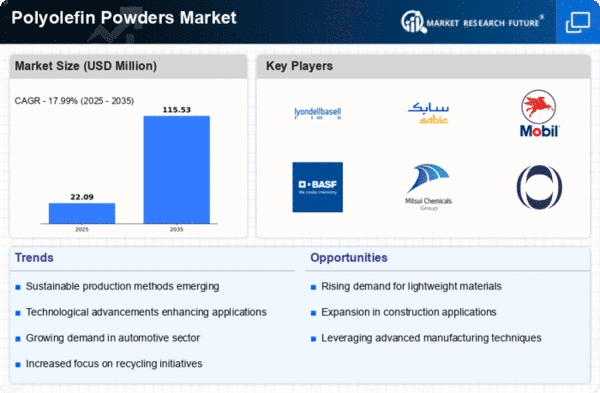
As per MRFR analysis, the Polyolefin Powders Market Size was estimated at 18.72 USD Million in 2024. The Polyolefin Powders industry is projected to grow from 22.09 USD Million in 2025 to 115.53 USD Million by 2035, exhibiting a compound annual growth rate (CAGR) of 17.99 during the forecast period 2025 - 2035.

Key Market Trends & Highlights

The Polyolefin Powders Market is poised for robust growth driven by sustainability and technological advancements.

  • North America remains the largest market for polyolefin powders, driven by strong demand in automotive applications.
  • Asia-Pacific is the fastest-growing region, with significant expansion in the construction sector.
  • The automotive segment leads in market size, while the textiles segment is experiencing rapid growth.
  • Key market drivers include rising demand in automotive applications and an increasing focus on sustainability.

Market Size & Forecast

2024 Market Size 18.72 (USD Million)
2035 Market Size 115.53 (USD Million)
CAGR (2025 - 2035) 17.99%
Largest Regional Market Share in 2024 Asia-Pacific

Major Players

<p>LyondellBasell Industries (US), SABIC (SA), ExxonMobil Chemical (US), BASF (DE), Mitsui Chemicals (JP), TotalEnergies (FR), INEOS (GB), Braskem (BR), Chevron Phillips Chemical (US)</p>

Market Trends

The Polyolefin Powders Market is currently experiencing a dynamic phase characterized by evolving consumer preferences and technological advancements. The demand for polyolefin powders is driven by their versatility and applicability across various industries, including automotive, packaging, and construction. As manufacturers seek to enhance product performance and sustainability, innovations in production processes and formulations are becoming increasingly prevalent. This shift towards more eco-friendly solutions appears to be influencing market dynamics, as stakeholders prioritize materials that align with environmental standards and regulations. Moreover, the competitive landscape of the Polyolefin Powders Market is marked by strategic collaborations and partnerships among key players. These alliances often aim to leverage complementary strengths, thereby fostering innovation and expanding market reach. The emphasis on research and development is likely to yield new applications and improve existing products, which may further stimulate market growth. As the industry adapts to changing regulations and consumer expectations, the Polyolefin Powders Market seems poised for continued evolution, reflecting broader trends in sustainability and technological integration.

Sustainability Initiatives

The Polyolefin Powders Market is witnessing a notable shift towards sustainability, as manufacturers increasingly focus on eco-friendly production methods. This trend is driven by growing consumer awareness and regulatory pressures, prompting companies to adopt practices that minimize environmental impact. Innovations in recycling technologies and the use of bio-based feedstocks are becoming more prevalent, suggesting a potential transformation in how polyolefin powders are produced and utilized.

Technological Advancements

Technological progress is playing a crucial role in shaping the Polyolefin Powders Market. Enhanced production techniques, such as advanced polymerization methods, are enabling manufacturers to create powders with improved properties and performance. This trend indicates a move towards higher efficiency and quality, which may attract a broader range of applications across various sectors.

Market Diversification

The Polyolefin Powders Market is experiencing diversification in its application areas, as industries explore new uses for these materials. Beyond traditional sectors, there is a growing interest in utilizing polyolefin powders in niche markets, such as electronics and medical devices. This expansion suggests that the market could see increased demand as companies seek innovative solutions to meet specific industry needs.

Polyolefin Powders Market Market Drivers

Market Growth Projections

The Global Polyolefin Powders Market Industry is projected to experience substantial growth over the next decade. With a market value anticipated to reach 12.5 USD Billion in 2024 and further expand to 20 USD Billion by 2035, the industry is poised for a robust trajectory. The compound annual growth rate of 4.37% from 2025 to 2035 indicates a steady increase in demand across various sectors. This growth is likely to be driven by factors such as technological advancements, expanding applications, and a shift towards sustainable materials, positioning polyolefin powders as a key player in the materials market.

Expanding Consumer Electronics Market

The Global Polyolefin Powders Market Industry is witnessing growth driven by the expanding consumer electronics market. Polyolefin powders are utilized in various electronic applications, including casings, components, and insulation materials, due to their excellent electrical properties and thermal stability. As consumer electronics continue to evolve, the demand for high-performance materials is expected to rise. This trend is likely to bolster the market, as manufacturers seek innovative solutions to meet the needs of the electronics sector. The integration of polyolefin powders into consumer electronics applications suggests a promising future for the industry.

Rising Demand for Lightweight Materials

The Global Polyolefin Powders Market Industry is experiencing a surge in demand for lightweight materials, particularly in the automotive and aerospace sectors. Manufacturers are increasingly adopting polyolefin powders due to their favorable properties, such as low density and high strength-to-weight ratios. This trend is particularly evident as companies strive to enhance fuel efficiency and reduce emissions. The market is projected to reach 12.5 USD Billion in 2024, reflecting a growing preference for materials that contribute to sustainability goals. As industries continue to innovate, the adoption of polyolefin powders is likely to expand, further driving market growth.

Growing Applications in the Construction Sector

The Global Polyolefin Powders Market Industry is benefitting from the growing applications of polyolefin powders in the construction sector. These materials are increasingly utilized in various applications, including insulation, roofing, and flooring, due to their durability and resistance to environmental factors. The construction industry is projected to expand significantly, driven by urbanization and infrastructure development. As a result, the demand for polyolefin powders is anticipated to rise, contributing to the market's growth. By 2035, the market is expected to reach 20 USD Billion, indicating a robust potential for polyolefin powders in construction-related applications.

Technological Advancements in Production Processes

Technological advancements in the production processes of polyolefin powders are significantly influencing the Global Polyolefin Powders Market Industry. Innovations such as advanced polymerization techniques and improved processing methods enhance the quality and performance of polyolefin powders. These advancements not only increase production efficiency but also enable manufacturers to tailor properties to meet specific application requirements. As a result, the market is expected to witness a compound annual growth rate of 4.37% from 2025 to 2035. This growth trajectory suggests that ongoing research and development efforts will play a crucial role in shaping the future landscape of the industry.

Environmental Regulations Favoring Sustainable Materials

The Global Polyolefin Powders Market Industry is positively impacted by stringent environmental regulations that favor the use of sustainable materials. Governments worldwide are implementing policies aimed at reducing plastic waste and promoting recyclable materials. Polyolefin powders, known for their recyclability and lower environmental impact, are increasingly being adopted as alternatives to traditional materials. This shift is likely to enhance the market's appeal, as manufacturers seek to comply with regulations while meeting consumer demand for eco-friendly products. The alignment of polyolefin powders with sustainability initiatives positions the industry for continued growth in the coming years.

Market Segment Insights

By Application: Automotive (Largest) vs. Construction (Fastest-Growing)

<p>In the Polyolefin Powders Market, the 'Automotive' segment currently holds the largest market share, driven by increasingly stringent regulations for lightweight and fuel-efficient vehicles. The automotive industry continues to adopt polyolefin powders for parts that require durability and resilience, cementing its dominant position. Meanwhile, the 'Construction' segment is gaining momentum, bolstered by growth in construction activities and the demand for sustainable building materials. The application of polyolefin powders in construction offers enhanced performance features such as weather resistance and ease of processing. As industries strive for innovation and sustainability, the 'Construction' segment is projected to be the fastest-growing application for polyolefin powders. The rise in infrastructure projects, along with the shift towards green construction practices, is driving the adoption of these materials. Additionally, the versatility of polyolefin powders allows for applications in various building components, making them an increasingly preferred choice in the sector.</p>

<p>Automotive: Dominant vs. Medical: Emerging</p>

<p>The automotive sector remains the dominant application for polyolefin powders, leveraging their properties to produce lightweight and impact-resistant automotive parts. These materials are essential for improving fuel efficiency and lowering emissions in new vehicle designs. The automotive industry is rapidly innovating, and polyolefin powders are at the forefront due to their versatility and performance under stress. On the other hand, the medical segment is emerging, slowly gaining traction as manufacturers look for materials that meet stringent regulations for cleanliness and reliability. Polyolefins are increasingly being recognized for applications such as medical devices and packaging, due to their chemical resistance and biocompatibility. Although still smaller in volume, the potential for growth in the medical segment is significant as the demand for high-quality medical supplies increases. Together, these segments highlight the diverse applications of polyolefin powders across critical industries.</p>

By End Use: Packaging (Largest) vs. Textiles (Fastest-Growing)

<p>The Polyolefin Powders Market showcases significant diversity in its end-use segments, with packaging leading the charge as the largest segment. Packaging applications, primarily driven by the growing demand for lightweight and versatile materials, account for a substantial portion of the market, utilized widely in the food and beverage industries and consumer goods. The textiles segment, while smaller, demonstrates remarkable growth potential due to increasing interest in sustainable materials and innovations in fiber production, positioning it as the fastest-growing category in the sector.</p>

<p>Packaging (Dominant) vs. Automotive Components (Emerging)</p>

<p>Packaging remains the dominant end-use segment in the Polyolefin Powders Market, driven by its essential role in food safety and product preservation. The versatility of polyolefin powders allows for applications ranging from flexible films to rigid containers, catering to diverse consumer needs. In contrast, automotive components represent an emerging segment, gaining traction due to advancements in lightweight materials and fuel efficiency standards. As the automotive industry shifts towards more sustainable practices, polyolefin powders are increasingly adopted for interior and exterior auto parts, signaling a significant opportunity for innovation and growth.</p>

By Type: Polyethylene (Largest) vs. Polypropylene (Fastest-Growing)

<p>The Polyolefin Powders Market showcases a diverse range of segment values, with Polyethylene being the largest contributor, driven by its wide applications in packaging, automotive, and construction industries. Polypropylene follows closely behind, emerging as a significant player thanks to its advantageous properties such as chemical resistance and flexibility, allowing it to cater effectively to the needs of various sectors including textiles and consumer goods. As markets evolve, the Polyolefin Powders segment is witnessing dynamic growth trends, particularly in the demand for Polypropylene, which is rapidly gaining traction. Key drivers include increasing consumer preference for lightweight materials and sustainability considerations driving manufacturers to seek eco-friendly alternatives. Moreover, advancements in production technologies are expected to further bolster the growth for both Polyethylene and Polypropylene in the coming years.</p>

<p>Polyethylene (Dominant) vs. Polypropylene (Emerging)</p>

<p>Polyethylene stands out as the dominant segment in the Polyolefin Powders Market due to its robust versatility and broad applicability in various industries. Known for its excellent chemical and impact resistance, it is widely used in packaging films, containers, and other critical applications that require durability. On the other hand, Polypropylene, categorized as an emerging segment, is gaining attention for its lightweight properties and substantial adaptiveness. As manufacturers increasingly innovate and improve production processes, the demand for Polypropylene is on the rise, particularly in areas like automotive components and consumer products. This significant growth potential positions Polypropylene as a viable competitor, although Polyethylene remains firmly established in its market leadership.</p>

By Production Method: Gas Phase Polymerization (Largest) vs. Slurry Polymerization (Fastest-Growing)

<p>In the Polyolefin Powders Market, the production method segment is characterized by diverse technologies, each contributing distinct advantages. Gas Phase Polymerization stands out as the largest segment due to its efficiency, lower energy requirements, and ability to achieve high purity levels in production. Conversely, Slurry Polymerization is emerging as the fastest-growing method, driven by advancements in technology and an increasing demand for high-performance polyolefin products in various applications.</p>

<p>Gas Phase Polymerization (Dominant) vs. Slurry Polymerization (Emerging)</p>

<p>Gas Phase Polymerization is the dominant production method for polyolefin powders, characterized by its streamlined processes that lead to consistent product quality and reduced operational costs. This method employs a fluidized bed reactor technology, which enhances the efficiency of polymerization. On the other hand, Slurry Polymerization is emerging due to its flexibility and adaptability in producing various grades of polyolefins. Its growing popularity is fueled by the increasing need for specialized materials in applications such as automotive and packaging, marking it as a pivotal element in future industry innovations.</p>

By Form: Powder (Largest) vs. Granule (Fastest-Growing)

<p>In the Polyolefin Powders Market, the segmentation by form reveals that powders hold the largest market share, primarily due to their extensive usage in various applications such as coatings, automotive, and consumer goods. Granule form is also significant, but not as dominant, with a notable share reflecting its adaptability across multiple industrial processes.</p>

<p>Powder (Dominant) vs. Granule (Emerging)</p>

<p>Powder form in the Polyolefin Powders Market is characterized by its widespread use in various applications due to its excellent processing characteristics and performance enhancements. It is often preferred for applications requiring high fluidity and low viscosity. Granules, on the other hand, while currently emerging, are gaining traction due to their ease of handling and versatility in manufacturing processes. They enable precise dosing and are often more efficient in certain processing methods, indicating a shift towards granulates in specific niches.</p>

Get more detailed insights about Polyolefin Powders Market Research Report – Forecast to 2035

Regional Insights

North America : Established Market with Growth Potential

The North American polyolefin powders market is projected to reach $4.5 billion by 2025, driven by increasing demand in automotive and packaging applications. Regulatory support for sustainable materials and innovations in production processes are key growth catalysts. The region's focus on recycling and eco-friendly solutions is expected to further enhance market dynamics, aligning with global sustainability trends. Leading countries like the US and Canada dominate the market, with major players such as LyondellBasell and ExxonMobil Chemical driving competition. The presence of advanced manufacturing facilities and R&D centers fosters innovation, ensuring that North America remains a competitive landscape. The market is characterized by strategic partnerships and collaborations among key players to enhance product offerings and expand market reach.

Europe : Innovation and Sustainability Focus

Europe's polyolefin powders market is anticipated to reach $5.0 billion by 2025, fueled by stringent regulations promoting sustainable practices and innovative applications in various industries. The region's commitment to reducing carbon emissions and enhancing recycling capabilities is a significant driver of market growth. Additionally, the increasing demand for lightweight materials in automotive and construction sectors is expected to boost market dynamics. Germany, France, and the UK are leading countries in this market, with key players like BASF and TotalEnergies at the forefront. The competitive landscape is marked by a strong emphasis on R&D, enabling companies to develop advanced polyolefin products. Collaborations between industry stakeholders and government initiatives further enhance the region's position as a leader in polyolefin powders.

Asia-Pacific : Emerging Powerhouse in Polyolefins

The Asia-Pacific region is projected to dominate the polyolefin powders market with a size of $8.0 billion by 2025, driven by rapid industrialization and urbanization. The growing demand for packaging materials and automotive components is a significant growth driver. Additionally, favorable government policies and investments in infrastructure are expected to further enhance market dynamics, making it a key player in the global landscape. China, Japan, and India are the leading countries in this market, with major companies like Mitsui Chemicals and SABIC actively participating. The competitive landscape is characterized by a mix of local and international players, fostering innovation and competitive pricing. The region's focus on expanding production capacities and enhancing supply chain efficiencies is crucial for maintaining its market leadership.

Middle East and Africa : Resource-Rich Frontier for Growth

The Middle East and Africa polyolefin powders market is expected to reach $1.22 billion by 2025, driven by increasing demand in construction and packaging sectors. The region's abundant natural resources and investments in petrochemical industries are significant growth drivers. Additionally, government initiatives aimed at diversifying economies and enhancing manufacturing capabilities are expected to boost market dynamics. Countries like Saudi Arabia and South Africa are leading the market, with key players such as Braskem and INEOS establishing a strong presence. The competitive landscape is evolving, with new entrants and local manufacturers emerging to meet the growing demand. Strategic partnerships and collaborations are essential for enhancing product offerings and expanding market reach in this region.

Key Players and Competitive Insights

The Polyolefin Powders Market exhibits a dynamic competitive landscape characterized by innovation and strategic positioning among key players. Major companies such as LyondellBasell Industries (US), SABIC (SA), and ExxonMobil Chemical (US) are actively shaping the market through various strategies. LyondellBasell Industries (US) focuses on enhancing its product portfolio with advanced polyolefin powders, aiming to cater to the growing demand in automotive and consumer goods sectors. Meanwhile, SABIC (SA) emphasizes sustainability, investing in eco-friendly production methods to align with global environmental standards. ExxonMobil Chemical (US) appears to be concentrating on expanding its operational footprint in emerging markets, thereby enhancing its competitive edge in the global arena. Collectively, these strategies indicate a trend towards innovation and sustainability, which are pivotal in shaping the competitive environment.

In terms of business tactics, companies are increasingly localizing manufacturing to reduce lead times and optimize supply chains. This approach not only enhances operational efficiency but also allows for better responsiveness to regional market demands. The competitive structure of the Polyolefin Powders Market is moderately fragmented, with several players vying for market share. However, the collective influence of major companies like BASF (DE) and TotalEnergies (FR) is significant, as they leverage their extensive resources and technological capabilities to maintain a competitive advantage.

In November 2025, BASF (DE) announced a strategic partnership with a leading technology firm to develop innovative polyolefin powder applications for the automotive industry. This collaboration is expected to enhance BASF's product offerings and position it as a leader in high-performance materials. The strategic importance of this partnership lies in its potential to drive technological advancements and meet the evolving needs of the automotive sector, which is increasingly focused on lightweight and durable materials.

In October 2025, TotalEnergies (FR) launched a new line of sustainable polyolefin powders derived from bio-based feedstocks. This initiative not only aligns with the company's sustainability goals but also caters to the rising consumer demand for environmentally friendly products. The introduction of these bio-based materials is likely to strengthen TotalEnergies' market position and appeal to a broader customer base seeking sustainable solutions.

In September 2025, Mitsui Chemicals (JP) expanded its production capacity for polyolefin powders in Asia, responding to the growing demand in the region. This expansion is strategically significant as it allows Mitsui to capitalize on the rapid industrialization and urbanization trends in Asian markets, thereby enhancing its competitive stance in the global market.

As of December 2025, current trends in the Polyolefin Powders Market are increasingly defined by digitalization, sustainability, and the integration of AI technologies. Strategic alliances among key players are shaping the landscape, fostering innovation and enhancing supply chain reliability. The competitive differentiation is likely to evolve from traditional price-based competition to a focus on technological advancements and sustainable practices. Companies that successfully navigate these trends will likely secure a competitive edge in the market.

Key Companies in the Polyolefin Powders Market market include

Industry Developments

  • Q2 2024: INEOS launches new high-performance polyolefin powder for 3D printing applications INEOS announced the commercial launch of a new grade of polyolefin powder specifically engineered for additive manufacturing, targeting automotive and industrial customers seeking improved material properties and processability.
  • Q1 2024: Borealis expands polyolefin powder production capacity at Schwechat, Austria facility Borealis completed a major expansion of its Schwechat plant, increasing annual polyolefin powder output by 20% to meet rising demand in the European automotive and construction sectors.
  • Q2 2024: LyondellBasell and SIBUR sign strategic partnership for polyolefin powder technology exchange LyondellBasell and Russian petrochemical company SIBUR entered a technology-sharing agreement to jointly develop advanced polyolefin powder grades for packaging and industrial applications.
  • Q3 2024: ExxonMobil appoints new VP for Polyolefins and Advanced Materials ExxonMobil named Dr. Lisa Chen as Vice President of Polyolefins and Advanced Materials, signaling a renewed focus on innovation and global expansion in specialty polyolefin powders.
  • Q2 2024: SABIC unveils bio-based polyolefin powder for sustainable coatings SABIC introduced a new bio-based polyolefin powder designed for use in eco-friendly coatings, targeting the construction and consumer goods industries with a lower carbon footprint product.
  • Q1 2024: Mitsui Chemicals secures major contract to supply polyolefin powders to European automotive OEM Mitsui Chemicals signed a multi-year supply agreement with a leading European automotive manufacturer to provide specialty polyolefin powders for lightweight interior components.
  • Q4 2024: TotalEnergies opens new R&D center for polyolefin powder innovation in France TotalEnergies inaugurated a state-of-the-art research and development center focused on next-generation polyolefin powders, aiming to accelerate product development for high-performance applications.
  • Q3 2024: Dow launches recycled-content polyolefin powder for rotomolding Dow introduced a new line of polyolefin powders containing up to 50% post-consumer recycled content, targeting the rotomolding market for large containers and tanks.
  • Q2 2025: Braskem announces $100 million investment in US polyolefin powder plant expansion Braskem committed $100 million to expand its Texas polyolefin powder facility, aiming to boost capacity and support growing demand in North America.
  • Q1 2025: INEOS acquires specialty polyolefin powder business from European competitor INEOS completed the acquisition of a specialty polyolefin powder business, strengthening its portfolio and market position in high-value applications.
  • Q4 2024: BASF and Covestro form joint venture for advanced polyolefin powder development BASF and Covestro established a joint venture to co-develop advanced polyolefin powder materials, focusing on automotive and electronics markets.
  • Q3 2025: Sinopec secures regulatory approval for new polyolefin powder plant in China Sinopec received government approval to construct a new polyolefin powder manufacturing facility in eastern China, expected to be operational by late 2026.

Intended Audience

    • Polyolefin powders manufacturers
    • Traders and distributors of polyolefin powders
    • Research and development institutes
    • Potential investors
    • Raw material suppliers
    • Nationalized laboratories

Future Outlook

Polyolefin Powders Market Future Outlook

<p>The Polyolefin Powders Market is projected to grow at a 17.99% CAGR from 2024 to 2035, driven by increasing demand in automotive and packaging applications.</p>

New opportunities lie in:

  • <p>Expansion into biodegradable polyolefin powders for eco-friendly products.</p>
  • <p>Development of customized polyolefin powder formulations for niche markets.</p>
  • <p>Investment in advanced manufacturing technologies to enhance production efficiency.</p>

<p>By 2035, the Polyolefin Powders Market is expected to achieve substantial growth and diversification.</p>

Market Segmentation

Polyolefin Powders Market Form Outlook

  • Powder
  • Granule
  • Pellet
  • Bead
  • Flake

Polyolefin Powders Market Type Outlook

  • Polyethylene
  • Polypropylene
  • Polybutylene
  • Polystyrene
  • Polyvinyl Chloride

Polyolefin Powders Market End Use Outlook

  • Packaging
  • Textiles
  • Automotive Components
  • Household Products
  • Industrial Applications

Polyolefin Powders Market Application Outlook

  • Automotive
  • Electronics
  • Construction
  • Consumer Goods
  • Medical

Polyolefin Powders Market Production Method Outlook

  • Gas Phase Polymerization
  • Slurry Polymerization
  • Solution Polymerization
  • Bulk Polymerization
  • Emulsion Polymerization

Report Scope

MARKET SIZE 202418.72(USD Million)
MARKET SIZE 202522.09(USD Million)
MARKET SIZE 2035115.53(USD Million)
COMPOUND ANNUAL GROWTH RATE (CAGR)17.99% (2024 - 2035)
REPORT COVERAGERevenue Forecast, Competitive Landscape, Growth Factors, and Trends
BASE YEAR2024
Market Forecast Period2025 - 2035
Historical Data2019 - 2024
Market Forecast UnitsUSD Million
Key Companies ProfiledLyondellBasell Industries (US), SABIC (SA), ExxonMobil Chemical (US), BASF (DE), Mitsui Chemicals (JP), TotalEnergies (FR), INEOS (GB), Braskem (BR), Chevron Phillips Chemical (US)
Segments CoveredApplication, End Use, Type, Production Method, Form
Key Market OpportunitiesGrowing demand for lightweight materials in automotive and packaging sectors drives Polyolefin Powders Market expansion.
Key Market DynamicsRising demand for lightweight materials drives innovation and competition in the polyolefin powders market.
Countries CoveredNorth America, Europe, APAC, South America, MEA

FAQs

What are the major end user industries for the polyolefins powder market?

The notable end users are food packaging, electronics, automotive, textiles, construction, and healthcare.

What can hamper the polyolefins powder market?

Dwindling raw material prices can hold back polyolefins powder market growth.

Which region to dominate the polyolefins powder market?

The Asia Pacific market would dominate the polyolefins powder.

What are the applications of the polyolefins powder market?

The applications are masterbatches, roto-molding, BMC, dusting agents, SMC, sintering agents, binding agents, carpet applications, and others.

Name players impacting the polyolefins market are?

These players are LyondellBasell Industries Holdings BV (Netherlands), Exxon Mobil Corporation (US), INEOS (UK), Merck KGaA (Germany), SABIC (Saudi Arabia), Borealis AG (Austria), Eastman Chemical Company (US), Asahi Kasei Corporation (Japan), Axalta Coating Systems (US), Mitsui Chemicals, Inc. (Japan), Wacker Chemie AG (Germany), and Sumitomo Seika Chemicals Co., Ltd (Japan).

  1. Executive Summary
  2. Scope of the Report
    1. Market Definition
    2. Scope of the Study
      1. Research Objectives
      2. Assumptions & Limitations
    3. Market Structure
  3. Market
    1. Research Methodology
    2. Research Process
    3. Secondary Research
    4. Primary Research
    5. Forecast Model
  4. Market Landscape
    1. Supply Chain Analysis
    2. Market Dynamics of Global Polyolefin Powders Market
    3. Drivers
    4. Trends/Strategies
  5. Raw Material Suppliers
  6. Manufacturers/Producers
  7. Distributors/Retailers/Wholesalers/E-Commerce
  8. End Users
    1. Porter’s Five Forces Analysis
      1. Threat of New Entrants
      2. Bargaining Power of Buyers
      3. Bargaining Power of Suppliers
      4. Threat of Substitutes
      5. Intensity of Competitive Rivalry
    2. Introduction
    3. Restraints
    4. Opportunities
    5. Challenges
  9. Global Polyolefin Powders Market, by Type
    1. Introduction
    2. Polyethylene (PE)
      1. High Density Polyethylene (HDPE)
      2. Low Density Polyethylene (LDPE)
    3. Market Estimates & Forecast, 2018–2027
    4. Forecast, by Region, 2018–2027
    5. & Forecast, by Region, 2018–2027
    6. Polypropylene (PP)
      1. Market Estimates &
    7. Market Estimates & Forecast, 2018–2027
    8. Forecast, by Region, 2018–2027
    9. Ethylene-Vinyl Acetate (EVA)
      1. Market Estimates &
    10. Market Estimates & Forecast, 2018–2027
    11. Forecast, by Region, 2018–2027
  10. Global Polyolefin Powders Market, by
    1. Application
    2. Introduction
    3. Rotomolding
      1. Market Estimates
      2. Market Estimates & Forecast, by Region,
    4. & Forecast, 2018–2027
    5. Masterbatches
      1. Market Estimates & Forecast,
      2. Market Estimates & Forecast, by Region, 2018–2027
    6. SMC
      1. Market Estimates & Forecast, 2018–2027
  11. Market Estimates & Forecast, by Region, 2018–2027
    1. BMC
      1. Market Estimates &
    2. Market Estimates & Forecast, 2018–2027
    3. Forecast, by Region, 2018–2027
    4. Dusting Agents
      1. Market Estimates
      2. Market Estimates & Forecast, by Region,
    5. & Forecast, 2018–2027
    6. Sintering Agents
      1. Market Estimates & Forecast,
      2. Market Estimates & Forecast, by Region, 2018–2027
    7. Binding Agents
      1. Market Estimates & Forecast, 2018–2027
      2. Market Estimates & Forecast, by Region, 2018–2027
    8. Carpet
      1. Market Estimates & Forecast, 2018–2027
    9. Applications
  12. Market Estimates & Forecast, by Region, 2018–2027
    1. Others
      1. Market Estimates & Forecast, 2018–2027
      2. Market Estimates
    2. & Forecast, by Region, 2018–2027
  13. Global Polyolefin Powders
  14. Market, by End-Use Industry
    1. Introduction
    2. Electronics
      1. Market Estimates &
    3. Market Estimates & Forecast, 2018–2027
    4. Forecast, by Region, 2018–2027
    5. Food Packaging
      1. Market Estimates
      2. Market Estimates & Forecast, by Region,
    6. & Forecast, 2018–2027
    7. Construction
      1. Market Estimates & Forecast,
      2. Market Estimates & Forecast, by Region, 2018–2027
    8. Automotive
      1. Market Estimates & Forecast, 2018–2027
      2. Market Estimates & Forecast, by Region, 2018–2027
    9. Textiles
      1. Market Estimates & Forecast, 2018–2027
      2. Market Estimates
    10. & Forecast, by Region, 2018–2027
    11. Medical
      1. Market Estimates
      2. Market Estimates & Forecast, by Region,
    12. & Forecast, 2018–2027
    13. Others
      1. Market Estimates & Forecast, 2018–2027
      2. Market Estimates & Forecast, by Region, 2018–2027
  15. Global
  16. Polyolefin Powders Market, by Region
    1. Introduction
    2. North America
      1. Market Estimates & Forecast, 2018–2027
      2. Market Estimates
      3. Market Estimates & Forecast,
      4. Market Estimates & Forecast, by End-Use
      5. US
    3. & Forecast, by Type, 2018–2027
    4. by Application, 2018–2027
    5. Industry, 2018–2027
  17. Market Estimates & Forecast, by End-Use Industry, 2018–2027
    1. Canada
  18. Market Estimates & Forecast, 2018–2027
  19. Market Estimates & Forecast, by Type, 2018–2027
    1. & Forecast, by Application, 2018–2027
    2. Forecast, by End-Use Industry, 2018–2027
    3. Estimates & Forecast, 2018–2027
    4. by Type, 2018–2027
  20. Market Estimates
  21. Market Estimates &
    1. Europe
      1. Market
      2. Market Estimates & Forecast,
      3. Market Estimates & Forecast, by Application,
      4. Market Estimates & Forecast, by End-Use Industry,
      5. Germany
  22. Market Estimates & Forecast, by End-Use Industry, 2018–2027
    1. France
  23. Market Estimates & Forecast, 2018–2027
  24. Market Estimates & Forecast, by Type, 2018–2027
    1. & Forecast, by Application, 2018–2027
    2. Forecast, by End-Use Industry, 2018–2027
    3. Estimates & Forecast, 2018–2027
    4. by Type, 2018–2027
  25. Market Estimates
  26. Market Estimates &
  27. Italy
  28. Market
  29. Market Estimates & Forecast,
  30. Market Estimates & Forecast, by Application,
  31. Market Estimates & Forecast, by End-Use Industry,
  32. Spain
  33. Market Estimates & Forecast, 2018–2027
  34. Market Estimates & Forecast, by Type, 2018–2027
  35. Market Estimates & Forecast, by Application, 2018–2027
    1. Estimates & Forecast, by End-Use Industry, 2018–2027
    2. & Forecast, by Type, 2018–2027
    3. by Application, 2018–2027
    4. End-Use Industry, 2018–2027
    5. & Forecast, 2018–2027
    6. Type, 2018–2027
  36. Market
  37. UK
  38. Market Estimates & Forecast, 2018–2027
  39. Market Estimates
  40. Market Estimates & Forecast,
  41. Market Estimates & Forecast, by
  42. Russia
  43. Market Estimates
  44. Market Estimates & Forecast, by
  45. Market Estimates & Forecast, by Application,
  46. Market Estimates & Forecast, by End-Use Industry,
  47. Poland
  48. Market Estimates & Forecast,
  49. Market Estimates & Forecast, by Type, 2018–2027
  50. Market Estimates & Forecast, by Application, 2018–2027
  51. Market Estimates & Forecast, by End-Use Industry, 2018–2027
    1. Rest of Europe
  52. Market Estimates & Forecast, 2018–2027
  53. Market Estimates & Forecast, by Type, 2018–2027
  54. Market Estimates & Forecast, by Application, 2018–2027
    1. Estimates & Forecast, by End-Use Industry, 2018–2027
    2. & Forecast, by Type, 2018–2027
    3. by Application, 2018–2027
    4. Industry, 2018–2027
  55. Market
    1. Asia-Pacific
      1. Market Estimates & Forecast, 2018–2027
      2. Market Estimates
      3. Market Estimates & Forecast,
      4. Market Estimates & Forecast, by End-Use
      5. China
  56. Market Estimates & Forecast, by End-Use Industry, 2018–2027
    1. India
  57. Market Estimates & Forecast, 2018–2027
  58. Market Estimates & Forecast, by Type, 2018–2027
    1. & Forecast, by Application, 2018–2027
    2. Forecast, by End-Use Industry, 2018–2027
    3. Estimates & Forecast, 2018–2027
    4. by Type, 2018–2027
    5. & Forecast, 2018–2027
    6. Type, 2018–2027
    7. & Forecast, 2018–2027
    8. Type, 2018–2027
    9. & Forecast, 2018–2027
    10. Type, 2018–2027
    11. Forecast, 2018–2027
  59. Market Estimates
  60. Market Estimates &
  61. Japan
  62. Market
  63. Market Estimates & Forecast,
  64. Market Estimates & Forecast, by Application,
  65. Market Estimates & Forecast, by End-Use Industry,
  66. Australia & New Zealand
  67. Market Estimates
  68. Market Estimates & Forecast, by
  69. Market Estimates & Forecast, by Application,
  70. Market Estimates & Forecast, by End-Use Industry,
  71. Indonesia & South Korea
  72. Market Estimates
  73. Market Estimates & Forecast, by
  74. Market Estimates & Forecast, by Application,
  75. Market Estimates & Forecast, by End-Use Industry,
  76. Rest of Asia-Pacific
  77. Market Estimates
  78. Market Estimates & Forecast, by
  79. Market Estimates & Forecast, by Application,
  80. Market Estimates & Forecast, by End-Use Industry,
    1. Middle East & Africa
      1. Market Estimates &
      2. Market Estimates & Forecast, by Type, 2018–2027
      3. Market Estimates & Forecast, by Application, 2018–2027
  81. Market Estimates & Forecast, by End-Use Industry, 2018–2027
    1. GCC
    2. Estimates & Forecast, by Type, 2018–2027
    3. & Forecast, by Application, 2018–2027
    4. Forecast, by End-Use Industry, 2018–2027
    5. Estimates & Forecast, 2018–2027
    6. by Type, 2018–2027
  82. Market Estimates & Forecast, 2018–2027
  83. Market
  84. Market Estimates
  85. Market Estimates &
  86. Israel
  87. Market
  88. Market Estimates & Forecast,
  89. Market Estimates & Forecast, by Application,
  90. Market Estimates & Forecast, by End-Use Industry,
  91. North Africa
  92. Market Estimates & Forecast,
  93. Market Estimates & Forecast, by Type, 2018–2027
  94. Market Estimates & Forecast, by Application, 2018–2027
  95. Market Estimates & Forecast, by End-Use Industry, 2018–2027
    1. Turkey
  96. Market Estimates & Forecast, 2018–2027
  97. Market Estimates & Forecast, by Type, 2018–2027
    1. & Forecast, by Application, 2018–2027
    2. Forecast, by End-Use Industry, 2018–2027
    3. & Africa
  98. Market Estimates
  99. Market Estimates &
  100. Rest of the Middle East
  101. Market Estimates & Forecast, 2018–2027
  102. Market Estimates & Forecast, by Type, 2018–2027
    1. & Forecast, by Application, 2018–2027
    2. Forecast, by End-Use Industry, 2018–2027
    3. Market Estimates & Forecast, 2018–2027
    4. Forecast, by Type, 2018–2027
    5. Application, 2018–2027
    6. Industry, 2018–2027
    7. Forecast, 2018–2027
  103. Market Estimates
  104. Market Estimates &
    1. Latin America
      1. Market Estimates &
      2. Market Estimates & Forecast, by
      3. Market Estimates & Forecast, by End-Use
      4. Brazil
      5. Mexico
  105. Market Estimates & Forecast, by Application, 2018–2027
    1. Estimates & Forecast, by End-Use Industry, 2018–2027
    2. Estimates & Forecast, by Type, 2018–2027
    3. & Forecast, by Application, 2018–2027
    4. Forecast, by End-Use Industry, 2018–2027
    5. Estimates & Forecast, by Type, 2018–2027
    6. & Forecast, by Application, 2018–2027
    7. Forecast, by End-Use Industry, 2018–2027
  106. Market
  107. Argentina
  108. Market Estimates & Forecast, 2018–2027
  109. Market
  110. Market Estimates
  111. Market Estimates &
  112. Rest of Latin America
  113. Market Estimates & Forecast, 2018–2027
  114. Market
  115. Market Estimates
  116. Market Estimates &
  117. Company Landscape
    1. Introduction
    2. Market Strategy
    3. Key Development Analysis
    4. (Expansions/Mergers
    5. & Acquisitions/Joint Ventures/New Application Developments/Agreements/Investments)
  118. Company Profiles
    1. LyondellBasell Industries Holdings BV
      1. Financial Updates
      2. Application/Business
      3. Strategy
      4. Key Developments
    2. Company Overview
    3. Segment Overview
    4. SWOT Analysis
    5. Exxon Mobil Corporation
      1. Company Overview
      2. Financial Updates
      3. Application/Business Segment Overview
      4. Strategy
      5. Key Developments
      6. SWOT Analysis
      7. Company Overview
      8. Financial Updates
      9. Application/Business
      10. Strategy
      11. Key Developments
    6. INEOS
    7. Segment Overview
    8. SWOT Analysis
    9. Merck KGaA
      1. Company Overview
      2. Financial
      3. Application/Business Segment Overview
      4. Strategy
      5. Key Developments
      6. SWOT Analysis
    10. Updates
    11. SABIC
      1. Financial Updates
      2. Application/Business
      3. Strategy
      4. Key Developments
    12. Company Overview
    13. Segment Overview
    14. SWOT Analysis
    15. Borealis AG
      1. Company Overview
      2. Financial
      3. Application/Business Segment Overview
      4. Strategy
      5. Key Developments
      6. SWOT Analysis
    16. Updates
    17. Eastman Chemical
      1. Company Overview
      2. Financial Updates
      3. Strategy
      4. Key Developments
      5. SWOT Analysis
    18. Company
    19. Application/Business Segment Overview
    20. Axalta Coating Systems
      1. Company Overview
      2. Financial Updates
      3. Application/Business Segment Overview
      4. Strategy
      5. Key Developments
      6. SWOT Analysis
      7. Company Overview
      8. Financial Updates
      9. Application/Business Segment Overview
      10. Strategy
      11. SWOT Analysis
    21. Wacker Chemie AG
    22. Key Developments
    23. Mitsui Chemicals, Inc.
      1. Company Overview
      2. Financial Updates
      3. Application/Business
      4. Strategy
      5. Key Developments
    24. Segment Overview
    25. SWOT Analysis
    26. Asahi Kasei Corporation
      1. Company Overview
      2. Financial Updates
      3. Application/Business Segment Overview
      4. Strategy
      5. Key Developments
      6. SWOT Analysis
    27. Sumitomo Seika Chemicals Co., Ltd
      1. Company Overview
      2. Application/Business Segment Overview
      3. Key Developments
      4. SWOT Analysis
    28. Financial Updates
    29. Strategy
  119. Conclusion
  120. LIST OF TABLES
  121. Global Polyolefin Powders Market, by Region,
  122. North America: Polyolefin Powders Market, by Country,
  123. Europe: Polyolefin Powders Market, by Country, 2020–2027
  124. Asia-Pacific: Polyolefin Powders Market, by Country, 2020–2027
  125. Middle East & Africa: Polyolefin Powders Market, by Country, 2020–2027
  126. Latin America: Polyolefin Powders Market, by Country, 2020–2027
  127. Global Polyolefin Powders Type Market, by Region, 2020–2027
  128. North America: Polyolefin Powders Type Market, by Country, 2020–2027
  129. Europe: Polyolefin Powders Type Market, by Country, 2020–2027
  130. Table10 Asia-Pacific: Polyolefin Powders Type Market, by Country, 2020–2027
  131. Table11 Middle East & Africa: Polyolefin Powders Type Market, by Country,
    1. Table12 Latin America: Polyolefin Powders Type Market, by
    2. Country, 2020–2027
    3. Table13 Global Polyolefin Powders Application Market,
    4. by Region, 2020–2027
    5. Table14 North America: Polyolefin Powders Application
  132. Market, by Country, 2020–2027
    1. Table15 Europe: Polyolefin Powders Application
  133. Market, by Country, 2020–2027
    1. Table16 Asia-Pacific: Polyolefin Powders
  134. Application Market, by Country, 2020–2027
    1. Table17 Middle East &
  135. Africa: Polyolefin Powders Application Market, by Country, 2020–2027
    1. Table18
  136. Latin America: Polyolefin Powders Application Market, by Country, 2020–2027
  137. Table19 Global Polyolefin Powders End-Use Industry Market, by Region, 2020–2027
  138. Table20 North America: Polyolefin Powders End-Use Industry Market, by Country,
    1. Table21 Europe: Polyolefin Powders End-Use Industry Market,
    2. by Country, 2020–2027
    3. Table22 Asia-Pacific: Polyolefin Powders End-Use
  139. Industry Market, by Country, 2020–2027
    1. Table23 Middle East & Africa:
  140. Polyolefin Powders End-Use Industry Market, by Country, 2020–2027
    1. Table24
  141. Latin America: Polyolefin Powders End-Use Industry Market, by Country, 2020–2027
  142. Table25 Global Type Market, by Region, 2020–2027
    1. Table26 Global
  143. Application Market, by Region, 2020–2027
    1. Table27 Global End-Use Industry
  144. Market, by Region, 2020–2027
    1. Table28 North America: Polyolefin Powders
  145. Market, by Country
  146. Table29 North America: Polyolefin Powders Market, by Type
  147. Table30 North America: Polyolefin Powders Market, by Application
    1. Table31
  148. North America: Polyolefin Powders Market, by End-Use Industry
    1. Table32 Europe:
  149. Polyolefin Powders Market, by Country
    1. Table33 Europe: Polyolefin Powders Market,
    2. by Type
  150. Table34 Europe: Polyolefin Powders Market, by Application
    1. Table35
  151. Europe: Polyolefin Powders Market, by End-Use Industry
    1. Table36 Asia-Pacific:
  152. Polyolefin Powders Market, by Country
    1. Table37 Asia-Pacific: Polyolefin Powders
  153. Market, by Type
  154. Table38 Asia-Pacific: Polyolefin Powders Market, by Application
  155. Table39 Asia-Pacific: Polyolefin Powders Market, by End-Use Industry
    1. Table40
  156. Middle East & Africa: Polyolefin Powders Market, by Country
    1. Table41 Middle
  157. East & Africa Polyolefin Powders Market, by Type
    1. Table42 Middle East &
  158. Africa Polyolefin Powders Market, by Application
    1. Table43 Middle East &
  159. Africa: Polyolefin Powders Market, by End-Use Industry
    1. Table44 Latin America:
  160. Polyolefin Powders Market, by Country
    1. Table45 Latin America Polyolefin Powders
  161. Market, by Type
  162. Table46 Latin America Polyolefin Powders Market, by Application
  163. Table47 Latin America: Polyolefin Powders Market, by End-Use Industry
  164. LIST OF FIGURES
  165. Global Polyolefin Powders Market Segmentation
  166. Forecast Research Methodology
  167. Porter’s Five Forces
    1. Analysis of Global Polyolefin Powders Market
  168. Value Chain of Global
    1. Polyolefin Powders Market
  169. Share of Global Polyolefin Powders Market
    1. in 2020, by Country (%)
  170. Global Polyolefin Powders Market, 2020–2027,
  171. Global Polyolefin Powders Market Size, by Type, 2020
  172. Share
  173. of Global Polyolefin Powders Market, by Type, 2020–2027
  174. Global
  175. Polyolefin Powders Market Size, by Application, 2020
  176. Share of Global
  177. Polyolefin Powders Market, by Application, 2020–2027
  178. Global
  179. Polyolefin Powders Market Size, by End-Use Industry, 2020
  180. Share of
  181. Global Polyolefin Powders Market, by End-Use Industry, 2020–2027

Polyolefin Powders Market Segmentation

Market Segmentation Overview

  • Detailed segmentation data will be available in the full report
  • Comprehensive analysis by multiple parameters
  • Regional and country-level breakdowns
  • Market size forecasts by segment
Infographic

Free Sample Request

Kindly complete the form below to receive a free sample of this Report

Get Free Sample

Customer Strories

Compare Licence

×
Features License Type
Single User Multiuser License Enterprise User
Price $4,950 $5,950 $7,250
Maximum User Access Limit 1 User Upto 10 Users Unrestricted Access Throughout the Organization
Free Customization
Direct Access to Analyst
Deliverable Format
Platform Access
Discount on Next Purchase 10% 15% 15%
Printable Versions