×
Request Free Sample ×

Kindly complete the form below to receive a free sample of this Report

* Please use a valid business email

Leading companies partner with us for data-driven Insights

clients tt-cursor
Hero Background
English
Chinese
French
Japanese
Korean
German
Spanish

Polymer Gel Market Size

ID: MRFR/CnM/4518-CR
100 Pages
Chitranshi Jaiswal
July 2018

Polymer Gel Market Research Report Information: by type (hydrogel, aerogel), forms (particle forms, amorphous gel, sheets, solid molded forms, blankets), raw material (PVA, PAA, PAN, PAM, silicone), end-use industry (cosmetics & personal care, healthcare, agriculture, water treatment, building & construction, chemical, electrical & electronics), and region – Forecast till 2035

Share:
Download PDF ×

We do not share your information with anyone. However, we may send you emails based on your report interest from time to time. You may contact us at any time to opt-out.

Polymer Gel Market Infographic
Purchase Options

Polymer Gel Size

Polymer Gel Market Growth Projections and Opportunities

The Polymer Gel Market is influenced by a myriad of market factors that collectively shape its dynamics. One key determinant is the demand for polymers across various industries. As industries like healthcare, agriculture, and personal care continue to expand, so does the need for polymer gels. For instance, in healthcare, polymer gels find applications in wound care, drug delivery systems, and tissue engineering. This surge in demand from diverse sectors propels the growth of the polymer gel market.

Polymer Gel Market is expected to surpass the market value of over USD 55 billion by the year 2024 while registering a CAGR of 6% during the forecast period.

Additionally, technological advancements play a pivotal role in shaping the market landscape. Continuous research and development activities in polymer science lead to the introduction of innovative polymer gel products with enhanced properties. These advancements not only cater to existing applications but also open doors to new possibilities, widening the market scope. Manufacturers and suppliers are often compelled to stay abreast of the latest technological trends to remain competitive in the dynamic polymer gel market.

Furthermore, economic factors significantly impact the polymer gel market. The overall economic health of a region or country influences consumer spending, which, in turn, affects the demand for polymer gel products. Economic growth and stability contribute to increased investments in various sectors, fostering the utilization of polymer gels in different applications. Conversely, economic downturns may lead to a temporary decline in demand, prompting market players to strategize and adapt to the changing economic landscape.

Environmental considerations have become increasingly crucial in recent years, driving the polymer gel market towards sustainable practices. With a growing emphasis on eco-friendly solutions, manufacturers are exploring and adopting greener alternatives in the production of polymer gels. This shift aligns with the global push for sustainability, and companies incorporating environmentally friendly practices may gain a competitive edge in the market.

Government regulations and policies also exert a significant influence on the polymer gel market. Regulatory frameworks governing the use and production of polymers impact market players, shaping their strategies and product development processes. Compliance with these regulations is imperative for market participants to ensure product safety and meet environmental standards. Additionally, government initiatives supporting research and development in the polymer industry contribute to market growth.

The competitive landscape and market structure are crucial factors affecting the dynamics of the polymer gel market. The presence of numerous manufacturers and suppliers fosters healthy competition, prompting innovation and quality improvements. Market players often engage in strategic collaborations, mergers, and acquisitions to strengthen their market position and expand their product portfolios. Understanding the competitive environment is essential for companies seeking sustained growth and success in the polymer gel market.

Consumer trends and preferences play a vital role in shaping the market as well. Changing consumer lifestyles and preferences drive the demand for specific types of polymer gel products. For instance, the preference for natural and organic ingredients in personal care products influences the development and marketing strategies of polymer gel manufacturers catering to the cosmetic industry.
Polymer Gel Market Size Graph
Author
Chitranshi Jaiswal
Research Analyst Level I

In her 3 years of experience in the market research field, she has handled critical cross-domain projects. She has an in-depth knowledge of market estimation & analysis, problem-solving, primary as well as secondary research, and team management.She holds an engineering degree and is an MBA professional from a well-known university, capable of evaluating the market and competitive conditions. An exceptional strategist with excellent communication skills and a passion for delivering cutting-edge & practical insights for the market. Proficient in multi-tasking, and can successfully deal with competing demands, while maintaining complete confidentiality. Generated business through active client and project development, networking, and high-quality responses. Her knowledge and skills have helped in making solid business decisions, securing funding from investors, and avoiding business failures.

Leave a Comment

FAQs

What was the polymer gel market valuation in 2035?

In 2035, the valuation was USD 11,357.2 million.

What would be the valuation of the polymer gel market by 2035?

The polymer gel valuation would be USD 16,312.5 million.

What is the market size of the polymer gel industry?

The market value of the polymer gel industry was at USD 39 billion in the year 2019 and it is expected to surpass the market value of over USD 55 billion by the year 2024 while registering a CAGR of 6% during the forecast period.

What would be the valuation of the polyacrylic acid by 2035?

The valuation would reach USD 7.83 billion.

Which form would dominate the polyacrylic acid market?

The amorphous segment would have the upper hand in the market.

What are the common raw materials used?

• Poly Acrylic Acid • Poly Vinyl Alcohol

Market Summary

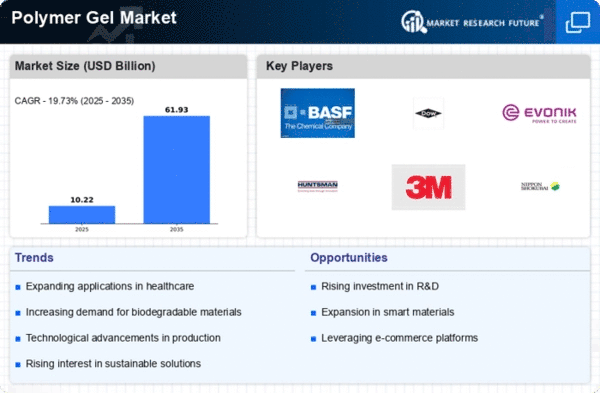
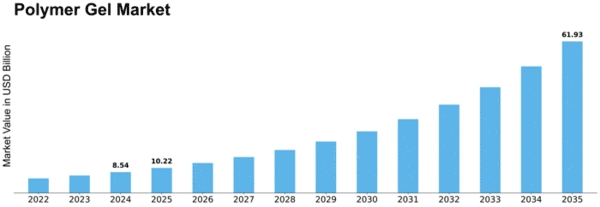
As per MRFR analysis, the Polymer Gel Market Size was estimated at 8.54 USD Billion in 2024. The Polymer Gel industry is projected to grow from 10.23 USD Billion in 2025 to 61.93 USD Billion by 2035, exhibiting a compound annual growth rate (CAGR) of 19.73 during the forecast period 2025 - 2035.

Key Market Trends & Highlights

The Polymer Gel Market is experiencing robust growth driven by innovations and increasing applications across various sectors.

  • North America remains the largest market for polymer gels, driven by advancements in healthcare applications.
  • The Asia-Pacific region is the fastest-growing market, reflecting a surge in agricultural applications and technological adoption.
  • The medical segment dominates the market, while the agriculture segment is witnessing rapid growth due to increasing demand for sustainable solutions.
  • Key market drivers include rising demand in healthcare applications and advancements in agricultural technologies, which are shaping the future of polymer gels.

Market Size & Forecast

2024 Market Size 8.54 (USD Billion)
2035 Market Size 61.93 (USD Billion)
CAGR (2025 - 2035) 19.73%
Largest Regional Market Share in 2024 North America

Major Players

BASF SE (DE), The Dow Chemical Company (US), Evonik Industries AG (DE), Huntsman Corporation (US), 3M Company (US), Nippon Shokubai Co., Ltd. (JP), Kraton Corporation (US), LG Chem Ltd. (KR), SABIC (SA)

Market Trends

The Polymer Gel Market is currently experiencing a dynamic evolution, driven by advancements in material science and increasing applications across various industries. This market encompasses a diverse range of products, including hydrogels and organogels, which are utilized in sectors such as healthcare, agriculture, and consumer goods. The growing demand for biocompatible materials in medical applications, particularly in drug delivery systems and wound care, appears to be a significant factor propelling market growth. Furthermore, the rising awareness of sustainable practices is influencing the development of eco-friendly polymer gels, which may offer a competitive edge in the marketplace. In addition to healthcare, the Polymer Gel Market is witnessing notable interest from the agricultural sector, where these materials are employed for soil conditioning and water retention. This trend suggests a shift towards innovative solutions that enhance crop yield and resource efficiency. As industries continue to explore the potential of polymer gels, the market is likely to expand, driven by ongoing research and development efforts. Overall, the Polymer Gel Market seems poised for substantial growth, with a focus on sustainability and multifunctional applications shaping its future trajectory.

Sustainable Innovations

The Polymer Gel Market is increasingly leaning towards sustainable innovations, as manufacturers prioritize eco-friendly materials. This trend reflects a broader commitment to environmental responsibility, with companies exploring biodegradable options that minimize ecological impact. Such developments may not only appeal to environmentally conscious consumers but also align with regulatory pressures for greener products.

Healthcare Advancements

Healthcare applications remain a pivotal driver in the Polymer Gel Market, particularly in areas such as drug delivery and tissue engineering. The demand for biocompatible and effective materials is likely to foster ongoing research, leading to novel formulations that enhance therapeutic outcomes. This trend indicates a robust future for polymer gels in medical settings.

Agricultural Applications

The utilization of polymer gels in agriculture is gaining traction, as these materials offer solutions for soil moisture retention and nutrient delivery. This trend suggests a growing recognition of the importance of efficient resource management in farming practices. As agricultural challenges intensify, polymer gels may play a crucial role in enhancing crop productivity.

Polymer Gel Market Market Drivers

Growth in Agricultural Applications

The Global Polymer Gel Market Industry is significantly influenced by the agricultural sector, where polymer gels are utilized for water retention and soil conditioning. These gels enhance soil structure and improve moisture retention, which is crucial for sustainable agriculture. As global agricultural practices evolve towards more efficient water usage, the adoption of polymer gels is expected to rise. This trend is particularly relevant in arid regions where water scarcity is a pressing issue. The increasing focus on sustainable farming practices suggests that the Global Polymer Gel Market Industry will see a steady growth, contributing to the overall market value projected to reach 73.6 USD Billion by 2035.

Rising Demand in Healthcare Applications

The Global Polymer Gel Market Industry experiences a notable surge in demand due to its extensive applications in the healthcare sector. Polymer gels are increasingly utilized in drug delivery systems, wound care products, and tissue engineering. For instance, hydrogels are employed in advanced wound dressings that promote healing and reduce infection risks. As the global healthcare expenditure continues to rise, projected to reach 55 USD Billion in 2024, the demand for innovative polymer gel solutions is likely to increase. This trend indicates a robust growth trajectory for the Global Polymer Gel Market Industry, particularly in biocompatible and biodegradable materials.

Technological Advancements in Material Science

Innovations in material science are propelling the Global Polymer Gel Market Industry forward. The development of new polymer formulations and crosslinking techniques enhances the performance characteristics of polymer gels, making them more versatile for various applications. For example, advancements in smart hydrogels that respond to environmental stimuli are gaining traction in sectors such as drug delivery and biosensors. These technological improvements not only expand the application range but also increase the market's attractiveness to investors. As a result, the Global Polymer Gel Market Industry is poised for growth, with a projected CAGR of 2.68% from 2025 to 2035, reflecting the ongoing evolution in polymer technology.

Expansion of the Cosmetics and Personal Care Sector

The Global Polymer Gel Market Industry benefits from the expansion of the cosmetics and personal care sector, where polymer gels are widely used in formulations for skincare, haircare, and makeup products. These gels serve as effective thickeners, stabilizers, and moisturizers, enhancing product performance and consumer experience. The increasing demand for innovative and high-quality personal care products is driving manufacturers to incorporate polymer gels into their formulations. As the global cosmetics market continues to grow, the Global Polymer Gel Market Industry is likely to experience a corresponding increase in demand, further solidifying its position in the market.

Increasing Consumer Awareness of Eco-Friendly Products

The Global Polymer Gel Market Industry is witnessing a shift towards eco-friendly products, driven by increasing consumer awareness regarding environmental sustainability. Biodegradable polymer gels are gaining popularity as consumers seek alternatives to traditional materials that contribute to pollution. This trend is particularly evident in packaging and personal care products, where sustainable options are becoming a priority. As manufacturers respond to this demand by developing greener polymer gel solutions, the market is likely to expand. The emphasis on sustainability aligns with global initiatives aimed at reducing plastic waste, thereby enhancing the growth potential of the Global Polymer Gel Market Industry.

Market Segment Insights

By Application: Medical (Largest) vs. Agriculture (Fastest-Growing)

In the Polymer Gel Market, the application segment is primarily dominated by the medical field, which holds the largest market share due to the extensive use of polymer gels in wound care, drug delivery systems, and tissue engineering. Following closely, the agricultural sector is gaining traction, leveraging polymer gels for soil moisture retention and enhancing crop performance, showing a promising share.

Medical (Dominant) vs. Agriculture (Emerging)

The medical application of polymer gels stands out as a dominant force, primarily focused on advanced healthcare solutions such as hydrogels for wound healing and sustained drug delivery. This segment benefits from continuous innovation driven by the healthcare industry's evolving landscape. Conversely, the agricultural sector represents an emerging market segment, with polymer gels increasingly adopted to improve soil water retention and nutrient delivery, addressing critical challenges in sustainable farming. This emerging trend is driven by the need for efficient water management practices and increased agricultural productivity, positioning agriculture as a significant contender in the polymer gel domain.

By Type: Natural Polymer Gel (Largest) vs. Synthetic Polymer Gel (Fastest-Growing)

The Polymer Gel Market is distinguished by the diverse range of product types, with Natural Polymer Gel holding the largest market share. Its unique properties derived from natural sources make it a preferred choice in applications such as food, cosmetics, and pharmaceuticals. In contrast, Synthetic Polymer Gel is significantly gaining traction due to its customizable properties and increasing demand in various industrial applications. As manufacturers look for tailored solutions, both segments present unique advantages that cater to specific market needs. In terms of growth trends, the Natural Polymer Gel segment benefits from the rising consumer preference for sustainable and eco-friendly products, while the Synthetic Polymer Gel segment is propelled by innovations in technology and materials. The market is experiencing rapid advancements, and the emergence of new applications, particularly in healthcare and agriculture, is driving the growth of Synthetic Polymer Gel, making it one of the fastest-growing segments in the market.

Natural Polymer Gel (Dominant) vs. Synthetic Polymer Gel (Emerging)

Natural Polymer Gel is recognized as a dominant player in the Polymer Gel Market, primarily due to its biocompatibility, versatility, and environmentally friendly characteristics. Derived from natural sources such as plant and animal materials, these gels are extensively used in sectors such as cosmetics, food processing, and pharmaceuticals, where safety and sustainability are paramount. On the other hand, Synthetic Polymer Gel is emerging rapidly and is distinguished by its engineered properties allowing for specific applications. Its adaptability and performance in conditions that demand durability and responsiveness have heightened interest in areas such as medical devices and agriculture. Together, these gels represent a dynamic interplay of tradition versus innovation, meeting varied consumer demands.

By End Use: Wound Care (Largest) vs. Drug Delivery (Fastest-Growing)

In the Polymer Gel Market, the 'End Use' segment showcases distinct characteristics across its various values. The Wound Care segment represents the largest share, owing to its extensive application in healthcare for effective healing and patient comfort. Following closely are Drug Delivery systems, Soil Moisture Retention, and Personal Care Products, which are gaining traction due to their versatile functionalities and innovative formulations. Growth trends in the Polymer Gel Market indicate that the Drug Delivery segment is poised for rapid expansion. This is driven by increasing demand for advanced medical solutions and targeted drug release mechanisms. Additionally, innovations in polymer technology and heightened awareness of soil conservation significantly bolster Soil Moisture Retention applications, positioning them as emerging players in the market landscape.

Wound Care (Dominant) vs. Drug Delivery (Emerging)

The Wound Care segment remains dominant in the Polymer Gel Market, distinguished by its critical role in medical applications where moisture management and healing are paramount. These gels are designed to create a conducive environment for wound healing while minimizing pain and infection risks. Conversely, the Drug Delivery segment is emerging rapidly, fueled by advancements in smart polymers that enable personalized medication delivery directly to affected areas. This evolution is motivated by a growing trend towards individualized treatment protocols and the increasing prevalence of chronic diseases requiring innovative therapeutic approaches. The interplay between these segments reflects a dynamic and responsive market, with each contributing to advancements in healthcare and personal care innovations.

Get more detailed insights about Polymer Gel Market Research Report – Forecast to 2035

Regional Insights

North America : Market Leader in Polymer Gels

North America is poised to maintain its leadership in the Polymer Gel market, holding a significant share of 3.5 in 2024. The region's growth is driven by increasing demand in sectors such as healthcare, agriculture, and personal care. Regulatory support for innovative materials and sustainability initiatives further catalyze market expansion. The presence of major players like BASF SE and The Dow Chemical Company enhances competitive dynamics, ensuring a robust market environment. The United States stands out as the leading country in this region, with a strong focus on R&D and technological advancements. Companies such as 3M and Huntsman Corporation are investing heavily in product innovation, catering to diverse applications. The competitive landscape is characterized by strategic partnerships and mergers, aimed at enhancing product offerings and market reach. This dynamic environment positions North America as a key player in The Polymer Gel.

Europe : Emerging Innovations and Regulations

Europe's Polymer Gel market is projected to grow significantly, with a market size of 2.5 in 2024. The region is characterized by stringent regulations promoting sustainable practices and innovative applications in various industries, including pharmaceuticals and agriculture. The demand for eco-friendly products is a key driver, supported by government initiatives aimed at reducing environmental impact. This regulatory landscape fosters innovation, encouraging companies to develop advanced polymer gel solutions. Germany and France are leading countries in this market, with a strong presence of key players like Evonik Industries AG and BASF SE. The competitive landscape is marked by collaborations between industry leaders and research institutions, focusing on developing high-performance products. The emphasis on sustainability and innovation positions Europe as a vital hub for the Polymer Gel market, attracting investments and fostering growth.

Asia-Pacific : Rapid Growth and Demand Surge

The Asia-Pacific region is witnessing rapid growth in the Polymer Gel market, with a market size of 2.3 in 2024. This growth is fueled by increasing industrialization, urbanization, and rising consumer demand for personal care and healthcare products. Countries like China and Japan are at the forefront, driving innovation and production capabilities. Regulatory frameworks are evolving to support the development of advanced materials, further enhancing market prospects. China is the leading country in this region, with significant investments in R&D and manufacturing. The competitive landscape features key players such as Nippon Shokubai Co., Ltd. and LG Chem Ltd., who are focusing on expanding their product portfolios. The presence of these companies, along with a growing emphasis on sustainability, positions Asia-Pacific as a promising market for Polymer Gels, attracting global attention and investment.

Middle East and Africa : Emerging Market with Challenges

The Middle East and Africa region is gradually emerging in the Polymer Gel market, with a market size of 0.24 in 2024. The growth is primarily driven by increasing demand in sectors such as agriculture and healthcare. However, the market faces challenges due to regulatory hurdles and limited infrastructure. Governments are beginning to recognize the potential of polymer gels, leading to gradual improvements in regulations that support market growth. Countries like South Africa and the UAE are showing potential for development, with local companies exploring opportunities in polymer gel applications. The competitive landscape is still developing, with few key players present. However, as awareness of the benefits of polymer gels increases, the region is expected to attract investments and foster growth, paving the way for a more robust market in the future.

Key Players and Competitive Insights

The Polymer Gel Market is currently characterized by a dynamic competitive landscape, driven by innovation, sustainability, and strategic partnerships. Key players such as BASF SE (DE), The Dow Chemical Company (US), and Evonik Industries AG (DE) are actively shaping the market through their distinct operational focuses. BASF SE (DE) emphasizes innovation in product development, particularly in bio-based polymer gels, which aligns with the growing demand for sustainable materials. Meanwhile, The Dow Chemical Company (US) is concentrating on expanding its production capabilities in emerging markets, thereby enhancing its global footprint. Evonik Industries AG (DE) is leveraging strategic partnerships to enhance its research and development capabilities, particularly in the healthcare sector, which is increasingly reliant on advanced polymer gel technologies. Collectively, these strategies contribute to a competitive environment that is both collaborative and fiercely competitive, as companies seek to differentiate themselves through technological advancements and sustainable practices.In terms of business tactics, companies are increasingly localizing manufacturing to reduce lead times and optimize supply chains. This approach not only enhances operational efficiency but also allows for greater responsiveness to regional market demands. The competitive structure of the Polymer Gel Market appears moderately fragmented, with several key players holding substantial market shares while numerous smaller firms contribute to niche segments. The collective influence of these major players is significant, as they set industry standards and drive innovation through their extensive resources and expertise.

In November BASF SE (DE) announced the launch of a new line of biodegradable polymer gels aimed at the agricultural sector. This strategic move is particularly noteworthy as it aligns with the increasing regulatory pressures for sustainable agricultural practices. By introducing these products, BASF SE (DE) not only addresses environmental concerns but also positions itself as a leader in sustainable solutions within the polymer gel market, potentially capturing a larger share of the eco-conscious consumer base.

In October The Dow Chemical Company (US) unveiled a partnership with a leading biotechnology firm to develop advanced polymer gels for medical applications. This collaboration is significant as it combines Dow's expertise in polymer chemistry with cutting-edge biotechnological advancements, potentially leading to innovative solutions in drug delivery systems. Such strategic alliances are likely to enhance Dow's competitive edge in the healthcare segment, which is experiencing rapid growth due to increasing healthcare demands.

In September Evonik Industries AG (DE) expanded its production facility in Asia to meet the rising demand for specialty polymer gels in the cosmetics industry. This expansion is indicative of Evonik's commitment to capturing market opportunities in high-growth regions. By increasing its production capacity, Evonik is well-positioned to respond to the evolving needs of the cosmetics market, which increasingly favors innovative and high-performance materials.

As of December the Polymer Gel Market is witnessing trends that emphasize digitalization, sustainability, and the integration of artificial intelligence in production processes. Strategic alliances are becoming increasingly vital, as companies recognize the need to pool resources and expertise to remain competitive. The competitive differentiation is likely to evolve from traditional price-based competition to a focus on innovation, technological advancements, and supply chain reliability. This shift suggests that companies that prioritize research and development, alongside sustainable practices, will be better positioned to thrive in the future.

Key Companies in the Polymer Gel Market include

Industry Developments

In the year 2020, one of the leading market players, BASF had brought in a new version of polymer gel that is named Luviset 360, which is considered as the new styling polymer and is designed especially for humid regions.

In the year 2020, one of the leading market players, Evonik had stated that they were exploring the characteristics of superabsorbent polymers.

Future Outlook

Polymer Gel Market Future Outlook

The Polymer Gel Market is projected to grow at a 19.73% CAGR from 2025 to 2035, driven by advancements in healthcare, agriculture, and consumer products.

New opportunities lie in:

  • Development of biodegradable polymer gels for sustainable packaging solutions.
  • Expansion into emerging markets with tailored polymer gel applications.
  • Investment in R&D for innovative drug delivery systems using polymer gels.

By 2035, the Polymer Gel Market is poised for robust growth, reflecting its strategic importance across various industries.

Market Segmentation

Polymer Gel Market Type Outlook

  • Natural Polymer Gel
  • Synthetic Polymer Gel
  • Hybrid Polymer Gel
  • Smart Polymer Gel

Polymer Gel Market End Use Outlook

  • Wound Care
  • Drug Delivery
  • Soil Moisture Retention
  • Personal Care Products

Polymer Gel Market Application Outlook

  • Medical
  • Agriculture
  • Cosmetics
  • Food Industry
  • Industrial

Report Scope

MARKET SIZE 20248.54(USD Billion)
MARKET SIZE 202510.23(USD Billion)
MARKET SIZE 203561.93(USD Billion)
COMPOUND ANNUAL GROWTH RATE (CAGR)19.73% (2025 - 2035)
REPORT COVERAGERevenue Forecast, Competitive Landscape, Growth Factors, and Trends
BASE YEAR2024
Market Forecast Period2025 - 2035
Historical Data2019 - 2024
Market Forecast UnitsUSD Billion
Key Companies ProfiledBASF SE (DE), The Dow Chemical Company (US), Evonik Industries AG (DE), Huntsman Corporation (US), 3M Company (US), Nippon Shokubai Co., Ltd. (JP), Kraton Corporation (US), LG Chem Ltd. (KR), SABIC (SA)
Segments CoveredApplication, Type, End Use
Key Market OpportunitiesAdvancements in biocompatible polymer gels enhance applications in medical and pharmaceutical sectors.
Key Market DynamicsRising demand for eco-friendly polymer gels drives innovation and competition among manufacturers in diverse applications.
Countries CoveredNorth America, Europe, APAC, South America, MEA

FAQs

What was the polymer gel market valuation in 2035?

In 2035, the valuation was USD 11,357.2 million.

What would be the valuation of the polymer gel market by 2035?

The polymer gel valuation would be USD 16,312.5 million.

What is the market size of the polymer gel industry?

The market value of the polymer gel industry was at USD 39 billion in the year 2019 and it is expected to surpass the market value of over USD 55 billion by the year 2024 while registering a CAGR of 6% during the forecast period.

What would be the valuation of the polyacrylic acid by 2035?

The valuation would reach USD 7.83 billion.

Which form would dominate the polyacrylic acid market?

The amorphous segment would have the upper hand in the market.

What are the common raw materials used?

• Poly Acrylic Acid • Poly Vinyl Alcohol

  1. SECTION I: EXECUTIVE SUMMARY AND KEY HIGHLIGHTS
    1. EXECUTIVE SUMMARY
      1. Market Overview
      2. Key Findings
      3. Market Segmentation
      4. Competitive Landscape
      5. Challenges and Opportunities
      6. Future Outlook
  2. SECTION II: SCOPING, METHODOLOGY AND MARKET STRUCTURE
    1. MARKET INTRODUCTION
      1. Definition
      2. Scope of the study
    2. RESEARCH METHODOLOGY
      1. Overview
      2. Data Mining
      3. Secondary Research
      4. Primary Research
      5. Forecasting Model
      6. Market Size Estimation
      7. Data Triangulation
      8. Validation
  3. SECTION III: QUALITATIVE ANALYSIS
    1. MARKET DYNAMICS
      1. Overview
      2. Drivers
      3. Restraints
      4. Opportunities
    2. MARKET FACTOR ANALYSIS
      1. Value chain Analysis
      2. Porter's Five Forces Analysis
      3. COVID-19 Impact Analysis
  4. SECTION IV: QUANTITATIVE ANALYSIS
    1. Chemicals and Materials, BY Application (USD Billion)
      1. Medical
      2. Agriculture
      3. Cosmetics
      4. Food Industry
      5. Industrial
    2. Chemicals and Materials, BY Type (USD Billion)
      1. Natural Polymer Gel
      2. Synthetic Polymer Gel
      3. Hybrid Polymer Gel
      4. Smart Polymer Gel
    3. Chemicals and Materials, BY End Use (USD Billion)
      1. Wound Care
      2. Drug Delivery
      3. Soil Moisture Retention
      4. Personal Care Products
    4. Chemicals and Materials, BY Region (USD Billion)
      1. North America
      2. Europe
      3. APAC
      4. South America
      5. MEA
  5. SECTION V: COMPETITIVE ANALYSIS
    1. Competitive Landscape
      1. Overview
      2. Competitive Analysis
      3. Market share Analysis
      4. Major Growth Strategy in the Chemicals and Materials
      5. Competitive Benchmarking
      6. Leading Players in Terms of Number of Developments in the Chemicals and Materials
      7. Key developments and growth strategies
      8. Major Players Financial Matrix
    2. Company Profiles
      1. BASF SE (DE)
      2. The Dow Chemical Company (US)
      3. Evonik Industries AG (DE)
      4. Huntsman Corporation (US)
      5. 3M Company (US)
      6. Nippon Shokubai Co., Ltd. (JP)
      7. Kraton Corporation (US)
      8. LG Chem Ltd. (KR)
      9. SABIC (SA)
    3. Appendix
      1. References
      2. Related Reports

Chemicals and Materials Market Segmentation

Chemicals and Materials By Application (USD Billion, 2025-2035)

  • Medical
  • Agriculture
  • Cosmetics
  • Food Industry
  • Industrial

Chemicals and Materials By Type (USD Billion, 2025-2035)

  • Natural Polymer Gel
  • Synthetic Polymer Gel
  • Hybrid Polymer Gel
  • Smart Polymer Gel

Chemicals and Materials By End Use (USD Billion, 2025-2035)

  • Wound Care
  • Drug Delivery
  • Soil Moisture Retention
  • Personal Care Products
Infographic

Free Sample Request

Kindly complete the form below to receive a free sample of this Report

Get Free Sample

Customer Strories

Compare Licence

×
Features License Type
Single User Multiuser License Enterprise User
Price $4,950 $5,950 $7,250
Maximum User Access Limit 1 User Upto 10 Users Unrestricted Access Throughout the Organization
Free Customization
Direct Access to Analyst
Deliverable Format
Platform Access
Discount on Next Purchase 10% 15% 15%
Printable Versions