Request Free Sample ×

Kindly complete the form below to receive a free sample of this Report

* Please use a valid business email

Leading companies partner with us for data-driven Insights

clients tt-cursor
Hero Background
English
Chinese
French
Japanese
Korean
German
Spanish

Polyhydroxybutyrate Market Size

ID: MRFR/CnM/2700-HCR
139 Pages
Priya Nagrale
March 2026

Polyhydroxy Butyrate Market Research Report Information by Type (Powder, Film, Sheet, and Granules), End-Use Industry (Packaging, Biomedical, Consumer Goods, Agriculture, and Others), and Region (Asia-Pacific, North America, Europe, Latin America, and Middle East & Africa)—Forecast till 2035

Share:
Download PDF ×

We do not share your information with anyone. However, we may send you emails based on your report interest from time to time. You may contact us at any time to opt-out.

Polyhydroxybutyrate Market Infographic
Purchase Options

Polyhydroxybutyrate Size

Polyhydroxybutyrate Market Growth Projections and Opportunities

The polyhydroxybutyrate (PHB) market is influenced by several key factors that shape its dynamics and growth. One significant factor is the increasing awareness and concern about environmental sustainability and plastic pollution. PHB is a biodegradable and compostable bioplastic that is derived from renewable resources such as plant sugars or waste materials. As concerns about plastic waste continue to rise, there is a growing demand for sustainable alternatives to conventional plastics. PHB offers a viable solution as it can be produced from renewable feedstocks and is fully biodegradable, making it an attractive option for applications where environmental impact is a concern. This trend is further fueled by regulatory initiatives and consumer preferences for eco-friendly products, driving the adoption of PHB in various industries.

Moreover, technological advancements play a crucial role in shaping market dynamics within the PHB industry. Ongoing research and development efforts focus on improving PHB production processes, enhancing material properties, and expanding application possibilities. Advanced fermentation technologies, genetic engineering techniques, and bioprocess optimization enable more efficient and cost-effective production of PHB from renewable feedstocks. Additionally, innovations in material science and polymer processing techniques contribute to enhancing the mechanical strength, thermal stability, and barrier properties of PHB, making it suitable for a broader range of applications. These technological advancements drive product innovation and differentiation, enabling manufacturers to meet evolving customer requirements and market demands.

Furthermore, market factors such as raw material availability and pricing significantly influence the PHB market. The production of PHB relies on feedstocks derived from renewable resources such as sugarcane, corn starch, or waste materials like food waste or agricultural residues. Fluctuations in the prices of these raw materials, as well as supply-demand dynamics, can impact the cost competitiveness of PHB compared to conventional plastics. Moreover, advancements in bioprocessing technologies and agricultural practices affect the availability and pricing of PHB feedstocks, influencing production costs and market dynamics. A naturally occurring who is partially in the crystalline polymer is called Polyhydroxy butyrate (PHB). During starvation, it helps in energy storage which is primarily synthesized by prokaryotic microorganisms. Various bacterial strains are potent producers of polyhydroxy butyrate. Some of these are rhizobium, pseudomonas, Nocardia, Bacillus, Azotobacter, Alcaligenes, and many others.

Regulatory requirements and sustainability initiatives also play a critical role in shaping market factors within the PHB industry. Governments and regulatory bodies impose regulations and standards governing plastic production, usage, and disposal to address environmental concerns and promote sustainability. Regulations such as bans on single-use plastics, restrictions on plastic packaging, and mandates for biodegradability drive changes in consumer preferences and industry practices. Moreover, sustainability initiatives such as extended producer responsibility (EPR) programs, circular economy strategies, and eco-labeling programs incentivize the adoption of sustainable practices and materials in the plastics industry. Manufacturers are increasingly investing in PHB production technologies, waste management solutions, and eco-friendly packaging alternatives to comply with regulations and meet consumer demand for environmentally friendly products.

Changing industry trends and consumer preferences also influence market dynamics within the PHB market. Consumers are becoming increasingly conscious of environmental issues, plastic pollution, and product safety, leading to a growing demand for sustainable and biodegradable packaging solutions. As a result, there is a shift towards PHB-based packaging materials that offer environmental benefits and meet regulatory requirements. Moreover, industry trends such as the circular economy, bio-based economy, and green chemistry drive innovation and product development within the PHB market. Manufacturers are exploring new applications, formulations, and processing techniques to address market trends and gain a competitive edge.
Polyhydroxybutyrate Market Size Graph
Author
Author Profile
Priya Nagrale
Senior Research Analyst

With an experience of over five years in market research industry (Chemicals & Materials domain), I gather and analyze market data from diverse sources to produce results, which are then presented back to a client. Also, provide recommendations based on the findings. As a Senior Research Analyst, I perform quality checks (QC) for market estimations, QC for reports, and handle queries and work extensively on client customizations. Also, handle the responsibilities of client proposals, report planning, report finalization, and execution

Leave a Comment

FAQs

What is the projected market valuation of the Polyhydroxy Butyrate Market by 2035?

<p>The Polyhydroxy Butyrate Market is projected to reach a valuation of 950.54 USD Million by 2035.</p>

What was the market valuation of Polyhydroxy Butyrate in 2024?

<p>In 2024, the overall market valuation of Polyhydroxy Butyrate was 144.35 USD Million.</p>

What is the expected CAGR for the Polyhydroxy Butyrate Market during the forecast period 2025 - 2035?

<p>The expected CAGR for the Polyhydroxy Butyrate Market during the forecast period 2025 - 2035 is 18.69%.</p>

Which industries are the primary end-users of Polyhydroxy Butyrate?

<p>The primary end-user industries for Polyhydroxy Butyrate include packaging, consumer goods, biomedical, agriculture, and others.</p>

What are the valuation ranges for the packaging industry segment of Polyhydroxy Butyrate?

<p>The packaging industry segment of Polyhydroxy Butyrate has a valuation range from 50.0 to 350.0 USD Million.</p>

Who are the key players in the Polyhydroxy Butyrate Market?

<p>Key players in the Polyhydroxy Butyrate Market include Kaneka Corporation, BASF SE, NatureWorks LLC, and TotalEnergies SE.</p>

What is the valuation range for the film type segment of Polyhydroxy Butyrate?

<p>The film type segment of Polyhydroxy Butyrate has a valuation range from 35.0 to 220.0 USD Million.</p>

How does the granules type segment perform in terms of valuation?

<p>The granules type segment of Polyhydroxy Butyrate has a valuation range from 30.0 to 180.0 USD Million.</p>

What is the valuation range for the biomedical industry segment of Polyhydroxy Butyrate?

<p>The biomedical industry segment of Polyhydroxy Butyrate has a valuation range from 25.0 to 150.0 USD Million.</p>

What is the expected performance of the Polyhydroxy Butyrate Market in the coming years?

<p>The Polyhydroxy Butyrate Market is expected to experience robust growth, driven by an anticipated CAGR of 18.69% from 2025 to 2035.</p>

Market Summary

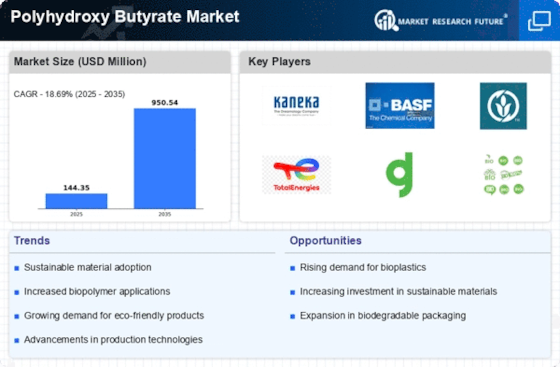
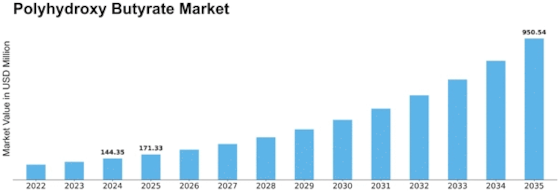
As per Market Research Future analysis, the Polyhydroxy Butyrate Market Size was estimated at 144.35 USD Million in 2024. The Polyhydroxy Butyrate industry is projected to grow from USD 171.33 Million in 2025 to USD 950.54 Million by 2035, exhibiting a compound annual growth rate (CAGR) of 18.69% during the forecast period 2025 - 2035

Key Market Trends & Highlights

The Polyhydroxy Butyrate Market is experiencing robust growth driven by sustainability and innovation.

  • The market is increasingly oriented towards sustainability, reflecting a broader global trend in materials science.
  • Technological advancements are enhancing production efficiency, thereby reducing costs and improving product quality.
  • North America remains the largest market, while Asia-Pacific is emerging as the fastest-growing region for Polyhydroxy Butyrate applications.
  • The rising demand for biodegradable plastics and supportive regulatory frameworks are key drivers propelling market expansion.

Market Size & Forecast

2024 Market Size 144.35 (USD Million)
2035 Market Size 950.54 (USD Million)
CAGR (2025 - 2035) 18.69%
Largest Regional Market Share in 2024 Europe

Major Players

Kaneka Corporation (JP), BASF SE (DE), NatureWorks LLC (US), TotalEnergies SE (FR), Green Dot Bioplastics (US), Bio-on S.p.A. (IT), Futerro (BE), Novamont S.p.A. (IT), Praj Industries Ltd. (IN)

Market Trends

The Polyhydroxy Butyrate Market is currently experiencing a notable transformation, driven by increasing awareness regarding environmental sustainability and the need for biodegradable materials. This biopolymer, derived from microbial fermentation, is gaining traction across various industries, including packaging, agriculture, and biomedical applications. As consumers and manufacturers alike seek alternatives to conventional plastics, the demand for Polyhydroxy Butyrate is likely to rise. Furthermore, advancements in production technologies and processes may enhance the efficiency and cost-effectiveness of Polyhydroxy Butyrate, making it a more viable option for widespread use. In addition to environmental considerations, the Polyhydroxy Butyrate Market is influenced by regulatory frameworks that promote the use of sustainable materials. Governments around the world are implementing policies that encourage the adoption of biodegradable products, which could further bolster market growth. The versatility of Polyhydroxy Butyrate, combined with its favorable properties such as biodegradability and biocompatibility, positions it as a promising candidate for various applications. As the market evolves, ongoing research and development efforts may unlock new potential uses, thereby expanding its reach and impact across multiple sectors.

Sustainability Focus

The increasing emphasis on sustainable practices is shaping the Polyhydroxy Butyrate Market. As industries strive to reduce their carbon footprint, the demand for biodegradable materials is surging. This trend reflects a broader societal shift towards eco-friendly solutions.

Technological Advancements

Innovations in production techniques are likely to enhance the efficiency of Polyhydroxy Butyrate manufacturing. These advancements may lead to reduced costs and improved scalability, making the biopolymer more accessible to various sectors.

Regulatory Support

Government policies promoting biodegradable materials are influencing the Polyhydroxy Butyrate Market. Regulatory frameworks that incentivize the use of sustainable products could drive market growth and encourage wider adoption.

Polyhydroxybutyrate Market Market Drivers

Supportive Regulatory Frameworks

The establishment of supportive regulatory frameworks is playing a crucial role in the growth of the Polyhydroxy Butyrate Market. Governments across various regions are implementing policies that promote the use of biodegradable materials, including polyhydroxy butyrate, to combat plastic pollution. For instance, regulations that mandate the reduction of single-use plastics are encouraging industries to transition towards sustainable alternatives. This regulatory push is likely to create a favorable environment for the polyhydroxy butyrate market, as companies seek compliance with environmental standards. Furthermore, incentives for research and development in biodegradable materials are expected to stimulate innovation within the Polyhydroxy Butyrate Market, leading to enhanced product offerings and increased market penetration.

Growing Applications in Packaging

The packaging sector is increasingly recognizing the benefits of polyhydroxy butyrate, which is driving its adoption within the Polyhydroxy Butyrate Market. As consumer preferences shift towards sustainable packaging solutions, polyhydroxy butyrate is emerging as a viable alternative to traditional plastics. Recent market analyses suggest that the demand for biodegradable packaging is expected to grow at a rate of 15% annually. This trend is likely to be fueled by the rising consumer awareness regarding environmental issues and the desire for eco-friendly products. Consequently, manufacturers are exploring innovative packaging solutions that incorporate polyhydroxy butyrate, thereby enhancing the material's visibility and application scope. The growing emphasis on sustainable packaging is poised to be a key driver for the Polyhydroxy Butyrate Market.

Increased Investment in Bioplastics

Investment in bioplastics, including polyhydroxy butyrate, is on the rise, indicating a robust growth trajectory for the Polyhydroxy Butyrate Market. Venture capital and corporate investments are increasingly directed towards companies specializing in bioplastics, driven by the potential for high returns in a market that is rapidly evolving. Recent reports indicate that investments in bioplastics are expected to exceed USD 10 billion by 2027, reflecting a growing confidence in the sector. This influx of capital is likely to facilitate research and development, leading to enhanced product performance and broader applications for polyhydroxy butyrate. As the market matures, the increased investment landscape is anticipated to be a significant driver for the Polyhydroxy Butyrate Market.

Innovations in Production Techniques

Advancements in production techniques for polyhydroxy butyrate are significantly influencing the Polyhydroxy Butyrate Market. Innovations such as fermentation processes using renewable resources are enhancing the efficiency and cost-effectiveness of polyhydroxy butyrate production. Recent developments indicate that the production costs have decreased by approximately 30% due to these technological improvements. This reduction in costs is likely to make polyhydroxy butyrate more accessible to various industries, thereby expanding its application range. Additionally, the ability to produce polyhydroxy butyrate from waste materials aligns with sustainability goals, further driving its adoption. As production methods continue to evolve, the Polyhydroxy Butyrate Market is expected to experience robust growth, attracting investments and fostering new applications.

Rising Demand for Biodegradable Plastics

The increasing awareness regarding environmental sustainability is driving the demand for biodegradable plastics, including polyhydroxy butyrate. As consumers and industries alike seek alternatives to conventional plastics, the Polyhydroxy Butyrate Market is witnessing a surge in interest. According to recent estimates, the biodegradable plastics market is projected to grow at a compound annual growth rate of over 20% in the coming years. This trend is likely to bolster the adoption of polyhydroxy butyrate, as it offers a sustainable solution that decomposes naturally, reducing plastic waste. Furthermore, industries such as packaging, agriculture, and textiles are increasingly incorporating polyhydroxy butyrate into their products, further propelling market growth. The shift towards eco-friendly materials appears to be a pivotal driver for the Polyhydroxy Butyrate Market.

Market Segment Insights

By Type: Granules (Largest) vs. Film (Fastest-Growing)

<p>In the Polyhydroxy Butyrate Market, the granular type segment holds a significant share, positioning itself as the largest segment in terms of volume and revenue. Following granules, the sheet type, film type, and powder type segments maintain a competitive presence but do not overshadow the dominance of granules. This distribution highlights a clear preference for granules in applications such as medical and packaging, where performance and quality are paramount. The sheet type holds a steady position, while film type and powder type are gaining attention due to their versatility in various applications.</p>

<p>Granules (Dominant) vs. Film (Emerging)</p>

<p>Granules represent a dominant force in the Polyhydroxy Butyrate Market due to their robust applications in biodegradable products and packaging solutions. The characteristics of granules include excellent mechanical properties and biodegradability, making them a preferred choice for manufacturers aiming for sustainable solutions. On the other hand, film type is emerging rapidly, propelled by increasing demand in <a href="https://www.marketresearchfuture.com/reports/food-packaging-market-2086" target="_blank" title="food packaging">food packaging</a> and agricultural sectors. The film type is noted for its lightweight, flexibility, and barrier properties, appealing to manufacturers looking to innovate in biodegradable films. As consumer awareness of sustainability rises, both segments are expected to evolve, with granules sustaining their leadership and film types rapidly catching up.</p>

By End-User Industry: Packaging (Largest) vs. Biomedical (Fastest-Growing)

<p>The Polyhydroxy Butyrate Market shows a diverse distribution among its end-user industries. The packaging industry holds the largest market share, driven by increasing demand for sustainable materials and eco-friendly packaging solutions. Following closely, the agriculture and consumer goods industries also contribute significantly, focusing on biodegradable alternatives in various applications. Meanwhile, the biomedical sector is emerging robustly as it shifts toward environmentally-friendly solutions for medical applications, creating a dynamic landscape for Polyhydroxy Butyrate.</p>

<p>Packaging (Dominant) vs. Biomedical (Emerging)</p>

<p>The packaging industry stands as the dominant force in the Polyhydroxy Butyrate Market, characterized by its widespread adoption of biodegradable and compostable materials for various applications, including food packaging and retail. This segment benefits from heightened consumer awareness and regulatory pressures favoring sustainable solutions. In contrast, the biomedical industry is rapidly emerging, utilizing Polyhydroxy Butyrate's biocompatibility for applications in drug delivery systems, tissue engineering, and surgical sutures. This sector's growth is driven by innovation in healthcare requirements, increased investment in research, and a shift towards environmentally friendly materials, positioning it as a key player in the evolving landscape of <a href="https://www.marketresearchfuture.com/reports/biodegradable-polymer-market-11302" target="_blank" title="biodegradable polymer">biodegradable polymers</a>.</p>

Get more detailed insights about Polyhydroxy butyrate Market Research Report - Global Forecast till 2035

Regional Insights

North America : Innovation and Sustainability Leader

North America is the largest market for Polyhydroxy Butyrate (PHB), accounting for approximately 40% of the global market share. The region's growth is driven by increasing demand for biodegradable plastics, stringent environmental regulations, and a strong focus on sustainability. The U.S. and Canada are leading this trend, with government initiatives promoting the use of bioplastics in various applications, including packaging and agriculture. The competitive landscape in North America is robust, featuring key players such as NatureWorks LLC and Green Dot Bioplastics. These companies are investing heavily in R&D to enhance PHB production processes and expand their product offerings. The presence of established firms and innovative startups fosters a dynamic market environment, positioning North America as a leader in the bioplastics sector.

Europe : Regulatory Framework and Innovation

Europe is the second-largest market for Polyhydroxy Butyrate (PHB), holding around 30% of the global market share. The region's growth is propelled by stringent EU regulations aimed at reducing plastic waste and promoting sustainable materials. Initiatives like the European Green Deal and Circular Economy Action Plan are significant drivers, encouraging the adoption of bioplastics across various sectors, including packaging and automotive. Leading countries in Europe include Germany, France, and Italy, where companies like BASF SE and Novamont S.p.A. are at the forefront of PHB production. The competitive landscape is characterized by a mix of established corporations and innovative startups, all striving to meet the growing demand for sustainable materials. The European market is expected to continue expanding as regulations tighten and consumer preferences shift towards eco-friendly products.

Asia-Pacific : Emerging Market with High Potential

Asia-Pacific is rapidly emerging as a significant market for Polyhydroxy Butyrate (PHB), accounting for approximately 25% of the global market share. The region's growth is driven by increasing environmental awareness, government support for bioplastics, and rising demand from industries such as packaging and textiles. Countries like China and India are leading this trend, with initiatives aimed at reducing plastic pollution and promoting sustainable alternatives. The competitive landscape in Asia-Pacific is evolving, with key players like Praj Industries Ltd. and Kaneka Corporation making strides in PHB production. The region is witnessing a surge in investments in bioplastics technology, fostering innovation and collaboration among industry stakeholders. As consumer preferences shift towards sustainable products, the Asia-Pacific market is poised for significant growth in the coming years.

Middle East and Africa : Resource-Rich with Emerging Opportunities

The Middle East and Africa (MEA) region is gradually developing its market for Polyhydroxy Butyrate (PHB), currently holding about 5% of the global market share. The growth in this region is primarily driven by increasing awareness of environmental issues and the need for sustainable materials in various industries. Countries like South Africa and the UAE are beginning to adopt bioplastics, supported by government initiatives aimed at reducing plastic waste and promoting eco-friendly alternatives. The competitive landscape in MEA is still in its nascent stages, with a few key players exploring opportunities in PHB production. The region's resource-rich environment offers potential for growth, particularly in sectors such as packaging and agriculture. As awareness and demand for sustainable materials increase, the MEA market is expected to expand, attracting investments and fostering innovation in bioplastics.

Key Players and Competitive Insights

The Polyhydroxy Butyrate Market is currently characterized by a dynamic competitive landscape, driven by increasing demand for sustainable materials and bioplastics. Key players such as Kaneka Corporation (Japan), BASF SE (Germany), and NatureWorks LLC (United States) are at the forefront, each adopting distinct strategies to enhance their market positioning. Kaneka Corporation (Japan) focuses on innovation in biopolymer production, emphasizing the development of high-performance materials that cater to diverse applications. Meanwhile, BASF SE (Germany) is leveraging its extensive research capabilities to enhance product offerings and expand its portfolio in the bioplastics sector. NatureWorks LLC (United States) is strategically investing in partnerships to bolster its supply chain and enhance production efficiency, thereby solidifying its competitive edge in the market.

The business tactics employed by these companies reflect a concerted effort to optimize operations and adapt to market demands. Localizing manufacturing and optimizing supply chains are prevalent strategies, allowing companies to respond swiftly to regional market needs. The Polyhydroxy Butyrate Market appears moderately fragmented, with a mix of established players and emerging companies vying for market share. The collective influence of these key players shapes the competitive structure, fostering an environment where innovation and sustainability are paramount.

In August 2025, Kaneka Corporation (Japan) announced the launch of a new line of biodegradable packaging materials derived from Polyhydroxy Butyrate, aimed at reducing plastic waste in the food industry. This strategic move underscores Kaneka's commitment to sustainability and positions the company as a leader in eco-friendly packaging solutions. The introduction of these materials is likely to attract environmentally conscious consumers and businesses, enhancing Kaneka's market presence.

In September 2025, BASF SE (Germany) revealed a partnership with a leading agricultural firm to develop bioplastics tailored for agricultural applications. This collaboration is expected to leverage BASF's expertise in biopolymer technology, potentially leading to innovative solutions that address the specific needs of the agricultural sector. Such strategic alliances may enhance BASF's competitive positioning by diversifying its product offerings and expanding its customer base.

In July 2025, NatureWorks LLC (United States) secured a significant investment to expand its production capacity for Polyhydroxy Butyrate. This expansion is anticipated to meet the growing demand for sustainable materials across various industries, including packaging and textiles. By increasing production capabilities, NatureWorks is likely to strengthen its market position and respond effectively to the rising consumer preference for biodegradable products.

As of October 2025, the competitive trends in the Polyhydroxy Butyrate Market are increasingly defined by digitalization, sustainability, and the integration of advanced technologies. Companies are forming strategic alliances to enhance their innovation capabilities and streamline operations. The shift from price-based competition to a focus on technological advancement and supply chain reliability is evident, suggesting that future competitive differentiation will hinge on the ability to innovate and deliver sustainable solutions.

Key Companies in the Polyhydroxybutyrate Market include

Industry Developments

Aug 2021 Nike has teamed up with Newlight Technologies, a biotechnology business, to lower its carbon impact. Nike intends to investigate the usage of AirCarbon, a carbon-negative biomaterial created by ocean microorganisms and developed by Newlight. The material's creation also makes use of the exchange of greenhouse gases. By developing this plastic alternative, Newlight hopes to contribute to the fight against plastic pollution and climate change. The material is currently utilized as a plastic leather alternative for bags, eyewear, and wallets.

Newlight uses ocean microorganisms to manufacture AirCarbon, which absorbs greenhouse gases and air before converting it inside the material's cells. As a result, AirCarbon, also known as polyhydroxybutyrate (PHB), is an energy storage substance made up of 40% oxygen from the air and 60% carbon from greenhouse gases.Jun 2021 A RUDN University scientist has discovered how the environment affects the nanofibers of two organic plastics: polyhydroxybutyrate and polylactide. Using the electrospinning method, the researchers produced six types of fibres from polylactide granules and polyhydroxybutyrate powder.

The polymer solution was placed in an electric field with a high voltage, which "pulled" the fluid into narrow jets. They transformed into fibers when they cooled.

Six different types of finished fibers were obtained, each with a different polymer content, ranging from pure polyhydroxybutyrate and polylactide to their blends in various ratios.The largest market share in the polyhydroxy butyrate market is held by the European region owing to increasing demand for sophisticated biopolymers coupled with a reduction in the dependence on fossil fuels drives the market growth.Tianjin GreenBio Materials Co., Ltd. (China) is spending a huge sum of money on research and development to get an upper edge over its competitors.

This will help the company by increasing the sales revenue.Being the fastest-growing region, the Asia-Pacific region projects higher market share owing to increasing personal disposable income coupled with increasing industrialization.All the major key players are highly investing in new product launches, mergers, and acquisitions, and joint ventures.

Future Outlook

Polyhydroxybutyrate Market Future Outlook

The Polyhydroxy Butyrate Market is projected to grow at an 18.69% CAGR from 2024 to 2035, driven by increasing demand for biodegradable plastics and sustainable materials.

New opportunities lie in:

  • Development of biodegradable packaging solutions for food and consumer goods.
  • Investment in R&D for enhanced production techniques to reduce costs.
  • Partnerships with agricultural sectors for PHB-based bioplastics in farming applications.

By 2035, the Polyhydroxy Butyrate Market is expected to be a leader in sustainable materials.

Market Segmentation

Polyhydroxybutyrate Market Type Outlook

  • granules type
  • sheet type
  • film type
  • powder type

Polyhydroxybutyrate Market End-User Industry Outlook

  • agriculture industry
  • consumer goods industry
  • biomedical industry
  • packaging industry
  • others

Report Scope

MARKET SIZE 2024144.35(USD Million)
MARKET SIZE 2025171.33(USD Million)
MARKET SIZE 2035950.54(USD Million)
COMPOUND ANNUAL GROWTH RATE (CAGR)18.69% (2024 - 2035)
REPORT COVERAGERevenue Forecast, Competitive Landscape, Growth Factors, and Trends
BASE YEAR2024
Market Forecast Period2025 - 2035
Historical Data2019 - 2024
Market Forecast UnitsUSD Million
Key Companies ProfiledMarket analysis in progress
Segments CoveredMarket segmentation analysis in progress
Key Market OpportunitiesGrowing demand for biodegradable plastics drives innovation in the Polyhydroxy Butyrate Market.
Key Market DynamicsRising demand for biodegradable plastics drives innovation and competition in the Polyhydroxy Butyrate market.
Countries CoveredNorth America, Europe, APAC, South America, MEA

FAQs

What is the projected market valuation of the Polyhydroxy Butyrate Market by 2035?

<p>The Polyhydroxy Butyrate Market is projected to reach a valuation of 950.54 USD Million by 2035.</p>

What was the market valuation of Polyhydroxy Butyrate in 2024?

<p>In 2024, the overall market valuation of Polyhydroxy Butyrate was 144.35 USD Million.</p>

What is the expected CAGR for the Polyhydroxy Butyrate Market during the forecast period 2025 - 2035?

<p>The expected CAGR for the Polyhydroxy Butyrate Market during the forecast period 2025 - 2035 is 18.69%.</p>

Which industries are the primary end-users of Polyhydroxy Butyrate?

<p>The primary end-user industries for Polyhydroxy Butyrate include packaging, consumer goods, biomedical, agriculture, and others.</p>

What are the valuation ranges for the packaging industry segment of Polyhydroxy Butyrate?

<p>The packaging industry segment of Polyhydroxy Butyrate has a valuation range from 50.0 to 350.0 USD Million.</p>

Who are the key players in the Polyhydroxy Butyrate Market?

<p>Key players in the Polyhydroxy Butyrate Market include Kaneka Corporation, BASF SE, NatureWorks LLC, and TotalEnergies SE.</p>

What is the valuation range for the film type segment of Polyhydroxy Butyrate?

<p>The film type segment of Polyhydroxy Butyrate has a valuation range from 35.0 to 220.0 USD Million.</p>

How does the granules type segment perform in terms of valuation?

<p>The granules type segment of Polyhydroxy Butyrate has a valuation range from 30.0 to 180.0 USD Million.</p>

What is the valuation range for the biomedical industry segment of Polyhydroxy Butyrate?

<p>The biomedical industry segment of Polyhydroxy Butyrate has a valuation range from 25.0 to 150.0 USD Million.</p>

What is the expected performance of the Polyhydroxy Butyrate Market in the coming years?

<p>The Polyhydroxy Butyrate Market is expected to experience robust growth, driven by an anticipated CAGR of 18.69% from 2025 to 2035.</p>

  1. SECTION I: EXECUTIVE SUMMARY AND KEY HIGHLIGHTS
    1. | 1.1 EXECUTIVE SUMMARY
    2. | | 1.1.1 Market Overview
    3. | | 1.1.2 Key Findings
    4. | | 1.1.3 Market Segmentation
    5. | | 1.1.4 Competitive Landscape
    6. | | 1.1.5 Challenges and Opportunities
    7. | | 1.1.6 Future Outlook
  2. SECTION II: SCOPING, METHODOLOGY AND MARKET STRUCTURE
    1. | 2.1 MARKET INTRODUCTION
    2. | | 2.1.1 Definition
    3. | | 2.1.2 Scope of the study
    4. | | | 2.1.2.1 Research Objective
    5. | | | 2.1.2.2 Assumption
    6. | | | 2.1.2.3 Limitations
    7. | 2.2 RESEARCH METHODOLOGY
    8. | | 2.2.1 Overview
    9. | | 2.2.2 Data Mining
    10. | | 2.2.3 Secondary Research
    11. | | 2.2.4 Primary Research
    12. | | | 2.2.4.1 Primary Interviews and Information Gathering Process
    13. | | | 2.2.4.2 Breakdown of Primary Respondents
    14. | | 2.2.5 Forecasting Model
    15. | | 2.2.6 Market Size Estimation
    16. | | | 2.2.6.1 Bottom-Up Approach
    17. | | | 2.2.6.2 Top-Down Approach
    18. | | 2.2.7 Data Triangulation
    19. | | 2.2.8 Validation
  3. SECTION III: QUALITATIVE ANALYSIS
    1. | 3.1 MARKET DYNAMICS
    2. | | 3.1.1 Overview
    3. | | 3.1.2 Drivers
    4. | | 3.1.3 Restraints
    5. | | 3.1.4 Opportunities
    6. | 3.2 MARKET FACTOR ANALYSIS
    7. | | 3.2.1 Value chain Analysis
    8. | | 3.2.2 Porter's Five Forces Analysis
    9. | | | 3.2.2.1 Bargaining Power of Suppliers
    10. | | | 3.2.2.2 Bargaining Power of Buyers
    11. | | | 3.2.2.3 Threat of New Entrants
    12. | | | 3.2.2.4 Threat of Substitutes
    13. | | | 3.2.2.5 Intensity of Rivalry
    14. | | 3.2.3 COVID-19 Impact Analysis
    15. | | | 3.2.3.1 Market Impact Analysis
    16. | | | 3.2.3.2 Regional Impact
    17. | | | 3.2.3.3 Opportunity and Threat Analysis
  4. SECTION IV: QUANTITATIVE ANALYSIS
    1. | 4.1 Chemicals and Materials, BY Type (USD Million)
    2. | | 4.1.1 granules type
    3. | | 4.1.2 sheet type
    4. | | 4.1.3 film type
    5. | | 4.1.4 powder type
    6. | 4.2 Chemicals and Materials, BY End-User Industry (USD Million)
    7. | | 4.2.1 agriculture industry
    8. | | 4.2.2 consumer goods industry
    9. | | 4.2.3 biomedical industry
    10. | | 4.2.4 packaging industry
    11. | | 4.2.5 others
    12. | 4.3 Chemicals and Materials, BY Region (USD Million)
    13. | | 4.3.1 North America
    14. | | | 4.3.1.1 US
    15. | | | 4.3.1.2 Canada
    16. | | 4.3.2 Europe
    17. | | | 4.3.2.1 Germany
    18. | | | 4.3.2.2 UK
    19. | | | 4.3.2.3 France
    20. | | | 4.3.2.4 Russia
    21. | | | 4.3.2.5 Italy
    22. | | | 4.3.2.6 Spain
    23. | | | 4.3.2.7 Rest of Europe
    24. | | 4.3.3 APAC
    25. | | | 4.3.3.1 China
    26. | | | 4.3.3.2 India
    27. | | | 4.3.3.3 Japan
    28. | | | 4.3.3.4 South Korea
    29. | | | 4.3.3.5 Malaysia
    30. | | | 4.3.3.6 Thailand
    31. | | | 4.3.3.7 Indonesia
    32. | | | 4.3.3.8 Rest of APAC
    33. | | 4.3.4 South America
    34. | | | 4.3.4.1 Brazil
    35. | | | 4.3.4.2 Mexico
    36. | | | 4.3.4.3 Argentina
    37. | | | 4.3.4.4 Rest of South America
    38. | | 4.3.5 MEA
    39. | | | 4.3.5.1 GCC Countries
    40. | | | 4.3.5.2 South Africa
    41. | | | 4.3.5.3 Rest of MEA
  5. SECTION V: COMPETITIVE ANALYSIS
    1. | 5.1 Competitive Landscape
    2. | | 5.1.1 Overview
    3. | | 5.1.2 Competitive Analysis
    4. | | 5.1.3 Market share Analysis
    5. | | 5.1.4 Major Growth Strategy in the Chemicals and Materials
    6. | | 5.1.5 Competitive Benchmarking
    7. | | 5.1.6 Leading Players in Terms of Number of Developments in the Chemicals and Materials
    8. | | 5.1.7 Key developments and growth strategies
    9. | | | 5.1.7.1 New Product Launch/Service Deployment
    10. | | | 5.1.7.2 Merger & Acquisitions
    11. | | | 5.1.7.3 Joint Ventures
    12. | | 5.1.8 Major Players Financial Matrix
    13. | | | 5.1.8.1 Sales and Operating Income
    14. | | | 5.1.8.2 Major Players R&D Expenditure. 2023
    15. | 5.2 Company Profiles
    16. | | 5.2.1 Kaneka Corporation (JP)
    17. | | | 5.2.1.1 Financial Overview
    18. | | | 5.2.1.2 Products Offered
    19. | | | 5.2.1.3 Key Developments
    20. | | | 5.2.1.4 SWOT Analysis
    21. | | | 5.2.1.5 Key Strategies
    22. | | 5.2.2 BASF SE (DE)
    23. | | | 5.2.2.1 Financial Overview
    24. | | | 5.2.2.2 Products Offered
    25. | | | 5.2.2.3 Key Developments
    26. | | | 5.2.2.4 SWOT Analysis
    27. | | | 5.2.2.5 Key Strategies
    28. | | 5.2.3 NatureWorks LLC (US)
    29. | | | 5.2.3.1 Financial Overview
    30. | | | 5.2.3.2 Products Offered
    31. | | | 5.2.3.3 Key Developments
    32. | | | 5.2.3.4 SWOT Analysis
    33. | | | 5.2.3.5 Key Strategies
    34. | | 5.2.4 TotalEnergies SE (FR)
    35. | | | 5.2.4.1 Financial Overview
    36. | | | 5.2.4.2 Products Offered
    37. | | | 5.2.4.3 Key Developments
    38. | | | 5.2.4.4 SWOT Analysis
    39. | | | 5.2.4.5 Key Strategies
    40. | | 5.2.5 Green Dot Bioplastics (US)
    41. | | | 5.2.5.1 Financial Overview
    42. | | | 5.2.5.2 Products Offered
    43. | | | 5.2.5.3 Key Developments
    44. | | | 5.2.5.4 SWOT Analysis
    45. | | | 5.2.5.5 Key Strategies
    46. | | 5.2.6 Bio-on S.p.A. (IT)
    47. | | | 5.2.6.1 Financial Overview
    48. | | | 5.2.6.2 Products Offered
    49. | | | 5.2.6.3 Key Developments
    50. | | | 5.2.6.4 SWOT Analysis
    51. | | | 5.2.6.5 Key Strategies
    52. | | 5.2.7 Futerro (BE)
    53. | | | 5.2.7.1 Financial Overview
    54. | | | 5.2.7.2 Products Offered
    55. | | | 5.2.7.3 Key Developments
    56. | | | 5.2.7.4 SWOT Analysis
    57. | | | 5.2.7.5 Key Strategies
    58. | | 5.2.8 Novamont S.p.A. (IT)
    59. | | | 5.2.8.1 Financial Overview
    60. | | | 5.2.8.2 Products Offered
    61. | | | 5.2.8.3 Key Developments
    62. | | | 5.2.8.4 SWOT Analysis
    63. | | | 5.2.8.5 Key Strategies
    64. | | 5.2.9 Praj Industries Ltd. (IN)
    65. | | | 5.2.9.1 Financial Overview
    66. | | | 5.2.9.2 Products Offered
    67. | | | 5.2.9.3 Key Developments
    68. | | | 5.2.9.4 SWOT Analysis
    69. | | | 5.2.9.5 Key Strategies
    70. | 5.3 Appendix
    71. | | 5.3.1 References
    72. | | 5.3.2 Related Reports
  6. LIST OF FIGURES
    1. | 6.1 MARKET SYNOPSIS
    2. | 6.2 NORTH AMERICA MARKET ANALYSIS
    3. | 6.3 US MARKET ANALYSIS BY TYPE
    4. | 6.4 US MARKET ANALYSIS BY END-USER INDUSTRY
    5. | 6.5 CANADA MARKET ANALYSIS BY TYPE
    6. | 6.6 CANADA MARKET ANALYSIS BY END-USER INDUSTRY
    7. | 6.7 EUROPE MARKET ANALYSIS
    8. | 6.8 GERMANY MARKET ANALYSIS BY TYPE
    9. | 6.9 GERMANY MARKET ANALYSIS BY END-USER INDUSTRY
    10. | 6.10 UK MARKET ANALYSIS BY TYPE
    11. | 6.11 UK MARKET ANALYSIS BY END-USER INDUSTRY
    12. | 6.12 FRANCE MARKET ANALYSIS BY TYPE
    13. | 6.13 FRANCE MARKET ANALYSIS BY END-USER INDUSTRY
    14. | 6.14 RUSSIA MARKET ANALYSIS BY TYPE
    15. | 6.15 RUSSIA MARKET ANALYSIS BY END-USER INDUSTRY
    16. | 6.16 ITALY MARKET ANALYSIS BY TYPE
    17. | 6.17 ITALY MARKET ANALYSIS BY END-USER INDUSTRY
    18. | 6.18 SPAIN MARKET ANALYSIS BY TYPE
    19. | 6.19 SPAIN MARKET ANALYSIS BY END-USER INDUSTRY
    20. | 6.20 REST OF EUROPE MARKET ANALYSIS BY TYPE
    21. | 6.21 REST OF EUROPE MARKET ANALYSIS BY END-USER INDUSTRY
    22. | 6.22 APAC MARKET ANALYSIS
    23. | 6.23 CHINA MARKET ANALYSIS BY TYPE
    24. | 6.24 CHINA MARKET ANALYSIS BY END-USER INDUSTRY
    25. | 6.25 INDIA MARKET ANALYSIS BY TYPE
    26. | 6.26 INDIA MARKET ANALYSIS BY END-USER INDUSTRY
    27. | 6.27 JAPAN MARKET ANALYSIS BY TYPE
    28. | 6.28 JAPAN MARKET ANALYSIS BY END-USER INDUSTRY
    29. | 6.29 SOUTH KOREA MARKET ANALYSIS BY TYPE
    30. | 6.30 SOUTH KOREA MARKET ANALYSIS BY END-USER INDUSTRY
    31. | 6.31 MALAYSIA MARKET ANALYSIS BY TYPE
    32. | 6.32 MALAYSIA MARKET ANALYSIS BY END-USER INDUSTRY
    33. | 6.33 THAILAND MARKET ANALYSIS BY TYPE
    34. | 6.34 THAILAND MARKET ANALYSIS BY END-USER INDUSTRY
    35. | 6.35 INDONESIA MARKET ANALYSIS BY TYPE
    36. | 6.36 INDONESIA MARKET ANALYSIS BY END-USER INDUSTRY
    37. | 6.37 REST OF APAC MARKET ANALYSIS BY TYPE
    38. | 6.38 REST OF APAC MARKET ANALYSIS BY END-USER INDUSTRY
    39. | 6.39 SOUTH AMERICA MARKET ANALYSIS
    40. | 6.40 BRAZIL MARKET ANALYSIS BY TYPE
    41. | 6.41 BRAZIL MARKET ANALYSIS BY END-USER INDUSTRY
    42. | 6.42 MEXICO MARKET ANALYSIS BY TYPE
    43. | 6.43 MEXICO MARKET ANALYSIS BY END-USER INDUSTRY
    44. | 6.44 ARGENTINA MARKET ANALYSIS BY TYPE
    45. | 6.45 ARGENTINA MARKET ANALYSIS BY END-USER INDUSTRY
    46. | 6.46 REST OF SOUTH AMERICA MARKET ANALYSIS BY TYPE
    47. | 6.47 REST OF SOUTH AMERICA MARKET ANALYSIS BY END-USER INDUSTRY
    48. | 6.48 MEA MARKET ANALYSIS
    49. | 6.49 GCC COUNTRIES MARKET ANALYSIS BY TYPE
    50. | 6.50 GCC COUNTRIES MARKET ANALYSIS BY END-USER INDUSTRY
    51. | 6.51 SOUTH AFRICA MARKET ANALYSIS BY TYPE
    52. | 6.52 SOUTH AFRICA MARKET ANALYSIS BY END-USER INDUSTRY
    53. | 6.53 REST OF MEA MARKET ANALYSIS BY TYPE
    54. | 6.54 REST OF MEA MARKET ANALYSIS BY END-USER INDUSTRY
    55. | 6.55 KEY BUYING CRITERIA OF CHEMICALS AND MATERIALS
    56. | 6.56 RESEARCH PROCESS OF MRFR
    57. | 6.57 DRO ANALYSIS OF CHEMICALS AND MATERIALS
    58. | 6.58 DRIVERS IMPACT ANALYSIS: CHEMICALS AND MATERIALS
    59. | 6.59 RESTRAINTS IMPACT ANALYSIS: CHEMICALS AND MATERIALS
    60. | 6.60 SUPPLY / VALUE CHAIN: CHEMICALS AND MATERIALS
    61. | 6.61 CHEMICALS AND MATERIALS, BY TYPE, 2024 (% SHARE)
    62. | 6.62 CHEMICALS AND MATERIALS, BY TYPE, 2024 TO 2035 (USD Million)
    63. | 6.63 CHEMICALS AND MATERIALS, BY END-USER INDUSTRY, 2024 (% SHARE)
    64. | 6.64 CHEMICALS AND MATERIALS, BY END-USER INDUSTRY, 2024 TO 2035 (USD Million)
    65. | 6.65 BENCHMARKING OF MAJOR COMPETITORS
  7. LIST OF TABLES
    1. | 7.1 LIST OF ASSUMPTIONS
    2. | | 7.1.1
    3. | 7.2 North America MARKET SIZE ESTIMATES; FORECAST
    4. | | 7.2.1 BY TYPE, 2025-2035 (USD Million)
    5. | | 7.2.2 BY END-USER INDUSTRY, 2025-2035 (USD Million)
    6. | 7.3 US MARKET SIZE ESTIMATES; FORECAST
    7. | | 7.3.1 BY TYPE, 2025-2035 (USD Million)
    8. | | 7.3.2 BY END-USER INDUSTRY, 2025-2035 (USD Million)
    9. | 7.4 Canada MARKET SIZE ESTIMATES; FORECAST
    10. | | 7.4.1 BY TYPE, 2025-2035 (USD Million)
    11. | | 7.4.2 BY END-USER INDUSTRY, 2025-2035 (USD Million)
    12. | 7.5 Europe MARKET SIZE ESTIMATES; FORECAST
    13. | | 7.5.1 BY TYPE, 2025-2035 (USD Million)
    14. | | 7.5.2 BY END-USER INDUSTRY, 2025-2035 (USD Million)
    15. | 7.6 Germany MARKET SIZE ESTIMATES; FORECAST
    16. | | 7.6.1 BY TYPE, 2025-2035 (USD Million)
    17. | | 7.6.2 BY END-USER INDUSTRY, 2025-2035 (USD Million)
    18. | 7.7 UK MARKET SIZE ESTIMATES; FORECAST
    19. | | 7.7.1 BY TYPE, 2025-2035 (USD Million)
    20. | | 7.7.2 BY END-USER INDUSTRY, 2025-2035 (USD Million)
    21. | 7.8 France MARKET SIZE ESTIMATES; FORECAST
    22. | | 7.8.1 BY TYPE, 2025-2035 (USD Million)
    23. | | 7.8.2 BY END-USER INDUSTRY, 2025-2035 (USD Million)
    24. | 7.9 Russia MARKET SIZE ESTIMATES; FORECAST
    25. | | 7.9.1 BY TYPE, 2025-2035 (USD Million)
    26. | | 7.9.2 BY END-USER INDUSTRY, 2025-2035 (USD Million)
    27. | 7.10 Italy MARKET SIZE ESTIMATES; FORECAST
    28. | | 7.10.1 BY TYPE, 2025-2035 (USD Million)
    29. | | 7.10.2 BY END-USER INDUSTRY, 2025-2035 (USD Million)
    30. | 7.11 Spain MARKET SIZE ESTIMATES; FORECAST
    31. | | 7.11.1 BY TYPE, 2025-2035 (USD Million)
    32. | | 7.11.2 BY END-USER INDUSTRY, 2025-2035 (USD Million)
    33. | 7.12 Rest of Europe MARKET SIZE ESTIMATES; FORECAST
    34. | | 7.12.1 BY TYPE, 2025-2035 (USD Million)
    35. | | 7.12.2 BY END-USER INDUSTRY, 2025-2035 (USD Million)
    36. | 7.13 APAC MARKET SIZE ESTIMATES; FORECAST
    37. | | 7.13.1 BY TYPE, 2025-2035 (USD Million)
    38. | | 7.13.2 BY END-USER INDUSTRY, 2025-2035 (USD Million)
    39. | 7.14 China MARKET SIZE ESTIMATES; FORECAST
    40. | | 7.14.1 BY TYPE, 2025-2035 (USD Million)
    41. | | 7.14.2 BY END-USER INDUSTRY, 2025-2035 (USD Million)
    42. | 7.15 India MARKET SIZE ESTIMATES; FORECAST
    43. | | 7.15.1 BY TYPE, 2025-2035 (USD Million)
    44. | | 7.15.2 BY END-USER INDUSTRY, 2025-2035 (USD Million)
    45. | 7.16 Japan MARKET SIZE ESTIMATES; FORECAST
    46. | | 7.16.1 BY TYPE, 2025-2035 (USD Million)
    47. | | 7.16.2 BY END-USER INDUSTRY, 2025-2035 (USD Million)
    48. | 7.17 South Korea MARKET SIZE ESTIMATES; FORECAST
    49. | | 7.17.1 BY TYPE, 2025-2035 (USD Million)
    50. | | 7.17.2 BY END-USER INDUSTRY, 2025-2035 (USD Million)
    51. | 7.18 Malaysia MARKET SIZE ESTIMATES; FORECAST
    52. | | 7.18.1 BY TYPE, 2025-2035 (USD Million)
    53. | | 7.18.2 BY END-USER INDUSTRY, 2025-2035 (USD Million)
    54. | 7.19 Thailand MARKET SIZE ESTIMATES; FORECAST
    55. | | 7.19.1 BY TYPE, 2025-2035 (USD Million)
    56. | | 7.19.2 BY END-USER INDUSTRY, 2025-2035 (USD Million)
    57. | 7.20 Indonesia MARKET SIZE ESTIMATES; FORECAST
    58. | | 7.20.1 BY TYPE, 2025-2035 (USD Million)
    59. | | 7.20.2 BY END-USER INDUSTRY, 2025-2035 (USD Million)
    60. | 7.21 Rest of APAC MARKET SIZE ESTIMATES; FORECAST
    61. | | 7.21.1 BY TYPE, 2025-2035 (USD Million)
    62. | | 7.21.2 BY END-USER INDUSTRY, 2025-2035 (USD Million)
    63. | 7.22 South America MARKET SIZE ESTIMATES; FORECAST
    64. | | 7.22.1 BY TYPE, 2025-2035 (USD Million)
    65. | | 7.22.2 BY END-USER INDUSTRY, 2025-2035 (USD Million)
    66. | 7.23 Brazil MARKET SIZE ESTIMATES; FORECAST
    67. | | 7.23.1 BY TYPE, 2025-2035 (USD Million)
    68. | | 7.23.2 BY END-USER INDUSTRY, 2025-2035 (USD Million)
    69. | 7.24 Mexico MARKET SIZE ESTIMATES; FORECAST
    70. | | 7.24.1 BY TYPE, 2025-2035 (USD Million)
    71. | | 7.24.2 BY END-USER INDUSTRY, 2025-2035 (USD Million)
    72. | 7.25 Argentina MARKET SIZE ESTIMATES; FORECAST
    73. | | 7.25.1 BY TYPE, 2025-2035 (USD Million)
    74. | | 7.25.2 BY END-USER INDUSTRY, 2025-2035 (USD Million)
    75. | 7.26 Rest of South America MARKET SIZE ESTIMATES; FORECAST
    76. | | 7.26.1 BY TYPE, 2025-2035 (USD Million)
    77. | | 7.26.2 BY END-USER INDUSTRY, 2025-2035 (USD Million)
    78. | 7.27 MEA MARKET SIZE ESTIMATES; FORECAST
    79. | | 7.27.1 BY TYPE, 2025-2035 (USD Million)
    80. | | 7.27.2 BY END-USER INDUSTRY, 2025-2035 (USD Million)
    81. | 7.28 GCC Countries MARKET SIZE ESTIMATES; FORECAST
    82. | | 7.28.1 BY TYPE, 2025-2035 (USD Million)
    83. | | 7.28.2 BY END-USER INDUSTRY, 2025-2035 (USD Million)
    84. | 7.29 South Africa MARKET SIZE ESTIMATES; FORECAST
    85. | | 7.29.1 BY TYPE, 2025-2035 (USD Million)
    86. | | 7.29.2 BY END-USER INDUSTRY, 2025-2035 (USD Million)
    87. | 7.30 Rest of MEA MARKET SIZE ESTIMATES; FORECAST
    88. | | 7.30.1 BY TYPE, 2025-2035 (USD Million)
    89. | | 7.30.2 BY END-USER INDUSTRY, 2025-2035 (USD Million)
    90. | 7.31 PRODUCT LAUNCH/PRODUCT DEVELOPMENT/APPROVAL
    91. | | 7.31.1
    92. | 7.32 ACQUISITION/PARTNERSHIP
    93. | | 7.32.1

Chemicals and Materials Market Segmentation

Chemicals and Materials By Type (USD Million, 2025-2035)

  • granules type
  • sheet type
  • film type
  • powder type

Chemicals and Materials By End-User Industry (USD Million, 2025-2035)

  • agriculture industry
  • consumer goods industry
  • biomedical industry
  • packaging industry
  • others
Infographic

Free Sample Request

Kindly complete the form below to receive a free sample of this Report

Get Free Sample

Customer Strories

Compare Licence

×
Features License Type
Single User Multiuser License Enterprise User
Price $4,950 $5,950 $7,250
Maximum User Access Limit 1 User Upto 10 Users Unrestricted Access Throughout the Organization
Free Customization
Direct Access to Analyst
Deliverable Format
Platform Access
Discount on Next Purchase 10% 15% 15%
Printable Versions