×
Request Free Sample ×

Kindly complete the form below to receive a free sample of this Report

* Please use a valid business email

Leading companies partner with us for data-driven Insights

clients tt-cursor
Hero Background
English
Chinese
French
Japanese
Korean
German
Spanish

Polyglycerol Market Size

ID: MRFR/CnM/3876-HCR
139 Pages
Priya Nagrale
October 2025

Polyglycerol Market Research Report Information by Product Type (PG 2, PG 3, PG 4, PG 6, and PG 10), End-Use Industry (Food & Beverage, Personal Care & Cosmetics, Pharmaceuticals, Automotive, Oil & Gas, Plastics, and Others), and Region (North America, Europe, Asia-Pacific, Latin America, and the Middle East & Africa) - Forecast till 2035

Share:
Download PDF ×

We do not share your information with anyone. However, we may send you emails based on your report interest from time to time. You may contact us at any time to opt-out.

Polyglycerol Market Infographic
×
Polyglycerol Market Infographic Full View
Purchase Options

Polyglycerol Size

Polyglycerol Market Growth Projections and Opportunities

The Polyglycerol market encounters the effect of assorted market factors that on the whole shape its direction, request, and cutthroat elements. From modern applications to maintainability contemplations, these elements assume a crucial part in characterizing the scene of the polyglycerol area. Here is a brief investigation introduced in a section design with pointers: Restorative and Individual Consideration Industry Development: The polyglycerol market is significantly influenced by the cosmetic and personal care industry. Due to its emollient and humectant properties, polyglycerol is widely used in cosmetic, haircare, and skincare formulations. The business' consistent development, driven by purchaser interest for imaginative and successful individual consideration items, adds to the rising interest for polyglycerol. Adaptability in Food and Drink Applications: Polyglycerol's flexibility is apparent in its applications inside the food and drink industry. It fills in as an emulsifier, stabilizer, and thickening specialist in different food items, including dessert shop, heated merchandise, and drinks. Polyglycerol is still favoured by the food industry when it comes to functional ingredients that improve product quality and shelf life. Rising Interest in Drug Plans: The drug area adds to the interest in polyglycerol, especially in the detailing of oral prescriptions and skin drugs. Because it is a stabilizer and solubilizer polyglycerol is suitable for making some drugs more bioavailable & keeping pharmaceutical formulations balanced. Alternatives that are biobased and long-lasting: With a rising accentuation on maintainability, the market is affected by the interest for bio-based other options. Polyglycerol, got from inexhaustible sources, lines up with the developing inclination for practical fixings. As customer familiarity with eco-accommodating items rises, the interest for bio-based polyglycerol is supposed to increment. Polyglycerol Esters in Lubricants for Industrial Use: Polyglycerol esters find applications in modern oils, giving benefits, for example, further developed thickness control and warm security. The development of assembling and modern exercises, combined with the requirement for elite execution oils, adds to the interest in polyglycerol esters in the modern area. Material Industry Prerequisites for Polyglycerol Ethers: Polyglycerol ethers are used as softening agents in fabric treatments and as antistatic agents in the textile industry. As the material market encounters headways and advancements, the interest in polyglycerol ethers in material applications is supposed to stay vigorous. Headways in Polyglycerol Assembling Cycles: Continuous improvements in assembling processes impact the polyglycerol market by affecting creation productivity and cost-adequacy. Developments in union strategies add to the versatility and nature of polyglycerol, guaranteeing its accessibility for different ventures at cutthroat costs. Worldwide Wellbeing and Health Patterns: The rising spotlight on wellbeing and health universally influences the polyglycerol market. As buyers look for items with less added substances and allergens, polyglycerol's standing as a protected and very much endured fixing upgrades its allure in details, adding to its proceeded with market development. Administrative Scene and Consistence Necessities: The polyglycerol market is dependent upon administrative structures administering its utilization in various ventures. Adherence to consistence norms and guidelines is significant for makers, guaranteeing the protected and endorsed utilization of polyglycerol in assorted applications. Bundling Industry Interest for Polyglycerol-Based Plastics: Polyglycerol's similarity with plastics makes it a sought-after fixing in the bundling business. As the interest for reasonable and biodegradable bundling materials increments, polyglycerol-based plastics offer a suitable arrangement, adding to the market's development with regards to developing bundling inclination
Polyglycerol Market Size Graph
Author
Priya Nagrale
Senior Research Analyst

With an experience of over five years in market research industry (Chemicals & Materials domain), I gather and analyze market data from diverse sources to produce results, which are then presented back to a client. Also, provide recommendations based on the findings. As a Senior Research Analyst, I perform quality checks (QC) for market estimations, QC for reports, and handle queries and work extensively on client customizations. Also, handle the responsibilities of client proposals, report planning, report finalization, and execution

Leave a Comment

FAQs

At what CAGR is the polyglycerol market expected to grow over the forecast period?

The polyglycerol market is predicted to grow at a 8.03% CAGR between 2025-2035.

Which region is predicted to have the largest share in the polyglycerol market?

The APAC region is predicted to have the largest share in the polyglycerol market.

Who are the key players profiled in the polyglycerol market?

Key players profiled in the polyglycerol market include Spiga Nord S.p.A. (Italy), Sakamoto Yakuhin Kogyo Co., Ltd. (Japan), The Good Scents Company (US), Cargill, Incorporated (US), Stepan Company (US), THE HERSHEY COMPANY (US), Godrej Industries Limited (India), Lonza (Switzerland), Dow (US), Unilever (England), Solvay (Belgium), and Procter & Gamble (US).

What are the strategies adopted by the key players to create a niche in the polyglycerol market?

Key players have adopted different strategies such as acquisitions, mergers, R&D activities, expansions, and others to create a niche in the polyglycerol market.

Which factors may act as market deterrents in the polyglycerol market?

Volatile raw material prices may deter the polyglycerol market growth.

Market Summary

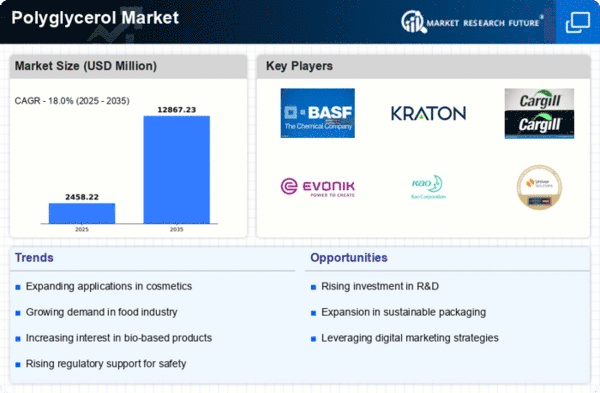
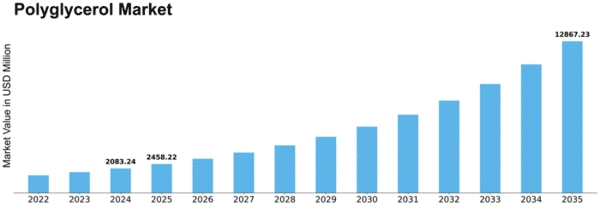
As per MRFR analysis, the Polyglycerol Market Size was estimated at 2083.24 USD Million in 2024. The Polyglycerol industry is projected to grow from 2458.25 in 2025 to 12867.23 by 2035, exhibiting a compound annual growth rate (CAGR) of 18.0 during the forecast period 2025 - 2035.

Key Market Trends & Highlights

The Polyglycerol Market is poised for growth driven by sustainability and innovation.

  • The market is witnessing a pronounced shift towards sustainability, influencing product development and consumer preferences.
  • North America remains the largest market, while Asia-Pacific is emerging as the fastest-growing region for polyglycerol applications.
  • In the food industry, polyglycerol serves as a key emulsifier, whereas the cosmetics segment is rapidly expanding due to innovative formulations.
  • Rising demand for natural ingredients and increased regulatory support for natural emulsifiers are significant drivers of market growth.

Market Size & Forecast

2024 Market Size 2083.24 (USD Million)
2035 Market Size 12867.23 (USD Million)
CAGR (2025 - 2035) 18.0%
Largest Regional Market Share in 2024 North America

Major Players

BASF SE (DE), Kraton Corporation (US), Cargill, Incorporated (US), Evonik Industries AG (DE), Kao Corporation (JP), Univar Solutions Inc. (US), Solvay S.A. (BE), Croda International Plc (GB), Mitsubishi Chemical Corporation (JP)

Market Trends

The Polyglycerol Market is currently experiencing a notable transformation, driven by increasing demand across various sectors, including food, cosmetics, and pharmaceuticals. This versatile compound, known for its emulsifying and stabilizing properties, is gaining traction as consumers and manufacturers alike seek cleaner and more sustainable ingredients. The growing awareness regarding health and wellness is prompting a shift towards natural and plant-based products, which further fuels the interest in polyglycerol. As a result, manufacturers are likely to innovate and expand their product offerings to meet the evolving preferences of consumers. Moreover, the regulatory landscape surrounding food and cosmetic ingredients is becoming increasingly stringent, compelling companies to prioritize transparency and safety in their formulations. This trend may lead to a greater emphasis on sourcing high-quality raw materials and adopting sustainable production practices. Additionally, the rise of e-commerce platforms is facilitating easier access to polyglycerol products, allowing smaller brands to enter the market and cater to niche segments. Overall, the Polyglycerol Market appears poised for growth, with a focus on sustainability, innovation, and consumer-centric approaches shaping its future.

Sustainability Focus

The Polyglycerol Market is witnessing a pronounced shift towards sustainability, as consumers increasingly favor eco-friendly products. This trend encourages manufacturers to adopt greener practices, such as sourcing renewable raw materials and minimizing waste during production.

Innovation in Applications

There is a growing trend of innovation in the applications of polyglycerol, particularly in the food and cosmetics industries. Companies are exploring new formulations that leverage the unique properties of polyglycerol, enhancing product performance and consumer appeal.

Regulatory Compliance and Transparency

As regulations surrounding food and cosmetic ingredients tighten, the Polyglycerol Market is adapting by prioritizing compliance and transparency. This shift compels manufacturers to provide clear information about ingredient sourcing and safety, fostering consumer trust.

Polyglycerol Market Market Drivers

Rising Demand in Food Industry

The Global Polyglycerol Market Industry experiences a notable surge in demand from the food sector, primarily due to its application as an emulsifier and stabilizer in various food products. Polyglycerol Market enhances texture and shelf life, which aligns with consumer preferences for quality and longevity in food items. As the global food industry continues to expand, the demand for polyglycerol is projected to increase significantly. In 2024, the market value is estimated at 3.37 USD Billion, with expectations to reach 7.43 USD Billion by 2035, reflecting a robust growth trajectory driven by evolving consumer trends.

Market Segment Insights

By Application: Food Industry (Largest) vs. Cosmetics (Fastest-Growing)

In the Polyglycerol Market, the application segments showcase a diverse distribution of market share, with the food industry taking the lead as the largest segment. The food industry utilizes polyglycerols as emulsifiers and stabilizers, capitalizing on their ability to enhance texture and extend shelf life. Following closely is the cosmetics segment, which is experiencing rapid growth due to the increasing demand for natural and skin-friendly ingredients. The continual innovation in product formulations is driving market shifts towards polyglycerol-based solutions in beauty and personal care products.

Food Industry (Dominant) vs. Cosmetics (Emerging)

The food industry is regarded as the dominant force in the Polyglycerol Market, primarily due to its extensive application in various food products, where it serves multifaceted roles as an emulsifier, humectant, and stabilizer. Its widespread acceptance, driven by consumer preferences for healthier and cleaner ingredients, positions it at the forefront of market demand. On the other hand, the cosmetics sector has emerged rapidly, fueled by consumer trends favoring natural and environmentally friendly formulations. Polyglycerols in cosmetics are appreciated for their gentle properties and effectiveness in maintaining skin hydration, making them a preferred choice among formulators. This growing awareness among consumers and manufacturers alike has positioned the cosmetics segment as a key player in the Polyglycerol Market.

By End Use: Emulsifiers (Largest) vs. Surfactants (Fastest-Growing)

The Polyglycerol Market exhibits a diverse array of end-use applications, with emulsifiers holding the largest share among segment values due to their critical role in food, cosmetics, and pharmaceuticals. Stabilizers and thickeners follow in significance, contributing to product consistency and shelf stability, while surfactants and humectants are expanding their presence, catering to the growing demand for multifunctional components in various formulations. The distribution illustrates a robust consumer preference for stable and high-quality products, primarily driven by the food industry, which heavily relies on emulsifiers for improved texture and flavor profile.

Emulsifiers (Dominant) vs. Surfactants (Emerging)

Emulsifiers are positioned as the dominant force within the Polyglycerol Market, predominantly utilized in sectors such as food and beverages, where they enhance texture and prolong shelf life. Their widespread application stems from the increasing demand for processed foods and cosmetics, where emulsifiers improve product stability and sensory properties. On the other hand, surfactants are emerging as a rapidly growing segment, fueled by innovations in personal care and household products. Their multifunctional attributes, including wetting, spreading, and foaming properties, cater to a diverse range of applications and consumer preferences, making them integral to the evolving landscape of the Polyglycerol Market.

By Source: Vegetable Oils (Largest) vs. Bio-based (Fastest-Growing)

In the Polyglycerol Market, the source segment exhibits a varied distribution among its key components: Vegetable Oils, Animal Fats, Synthetic, Natural, and Bio-based. Vegetable Oils hold the largest share, driven by their widespread use in food, cosmetics, and pharmaceuticals. This reflects a growing trend towards natural and cleaner labels among consumers, bolstering the market for plant-derived products. Other segments like Animal Fats and Synthetic sources also play significant roles, but their market shares are comparatively smaller due to rising concerns over sustainability and ethical sourcing. On the growth front, Bio-based sources are emerging as the fastest-growing segment within the Polyglycerol Market. This surge is attributed to increasing environmental awareness and a shift towards biodegradable materials in various industries. As innovations in bioprocessing and advancements in raw material sourcing continue, the appeal for Bio-based Polyglycerol is set to grow. Furthermore, regulatory frameworks supporting sustainable practices fuel market expansion for bio-based products, making them an attractive option for producers and consumers alike.

Vegetable Oils (Dominant) vs. Synthetic (Emerging)

Vegetable Oils are currently dominating the Polyglycerol Market due to their versatility and high demand across various applications, including food emulsification, personal care, and pharmaceuticals. These oils are prized for their natural properties and consumer familiarity, making them an ideal choice for manufacturers seeking to meet growing consumer preferences for plant-based ingredients. On the other hand, Synthetic sources, while still emerging, are gaining traction particularly due to technological advancements that allow for the cost-effective production of polyglycerol. This makes Synthetic Polyglycerol a viable alternative for sectors where performance characteristics are prioritized over natural labels. The growing emphasis on customization and specific functional attributes is likely to enhance the appeal of Synthetic sources, though they will continue to contend with the dominant position of Vegetable Oils.

By Form: Liquid (Largest) vs. Powder (Fastest-Growing)

The Polyglycerol Market exhibits a diverse distribution of forms, with the liquid segment holding the largest share. Offering ease of use and versatility in various applications, liquid polyglycerols are favored in food, cosmetics, and pharmaceutical industries. Meanwhile, the powder form is witnessing rapid adoption, particularly in food processing and nutritional supplements. As consumers continue to seek convenient and shelf-stable options, the demand for powdered polyglycerols is expected to escalate. Growth in the polyglycerol market's form segment is driven by evolving consumer preferences and technological advancements in production processes. Liquid forms remain dominant due to their widespread applications, while powders are appealing to manufacturers looking to enhance product functionality and stability. The rise of natural and clean-label products is further propelling the growth of both liquid and powdered forms across various sectors, leading to dynamic changes in market positioning.

Liquid (Dominant) vs. Gel (Emerging)

In the polyglycerol market, liquid polyglycerols are recognized as the dominant form due to their broad applicability and ease of incorporation in diverse products. They are primarily used in emulsion stabilizers and humectants, benefiting from their compatibility across multiple formulations. On the other hand, gel forms are emerging as a compelling option in applications requiring a thicker consistency, such as in personal care products and specialty food items. Gels offer unique textural benefits and improved stability, making them attractive to manufacturers aiming to create innovative products. As consumer demands shift toward multifunctional ingredients, the gel segment is set to expand, complementing the established liquid form.

Get more detailed insights about Polyglycerol Market Research Report - Forecast Till 2035

Regional Insights

North America : Market Leader in Polyglycerol

North America is poised to maintain its leadership in the Polyglycerol market, holding a significant market share of 1041.62 million in 2024. The region's growth is driven by increasing demand in food, cosmetics, and pharmaceuticals, alongside favorable regulations promoting the use of bio-based products. The trend towards sustainable and natural ingredients is further propelling market expansion, supported by government initiatives aimed at reducing synthetic additives. The United States stands as the primary contributor, with key players like BASF SE, Cargill, and Kraton Corporation leading the charge. The competitive landscape is characterized by innovation and strategic partnerships, enhancing product offerings. The presence of established companies ensures a robust supply chain, catering to diverse applications across various industries, solidifying North America's position as a market powerhouse.

Europe : Emerging Market with Potential

Europe's Polyglycerol market is valued at 625.0 million, reflecting a growing interest in sustainable and natural ingredients across various sectors. The region is witnessing a shift towards eco-friendly products, driven by stringent regulations and consumer demand for transparency in ingredient sourcing. The European Union's Green Deal and other initiatives are catalyzing the adoption of bio-based alternatives, positioning Polyglycerol as a favorable option in food and cosmetics. Leading countries such as Germany, France, and the UK are at the forefront of this market, with companies like Evonik Industries and Croda International Plc playing pivotal roles. The competitive landscape is marked by innovation and collaboration among industry players, enhancing product development. As the market evolves, Europe is set to capitalize on its regulatory framework to foster growth and attract investments in the Polyglycerol sector.

Asia-Pacific : Rapid Growth and Adoption

The Asia-Pacific region, with a market size of 350.0 million, is experiencing rapid growth in the Polyglycerol sector, driven by increasing consumer awareness and demand for natural ingredients. Countries like Japan and China are leading this trend, supported by rising disposable incomes and a shift towards healthier lifestyle choices. Regulatory support for bio-based products is further enhancing market dynamics, making Polyglycerol a preferred choice in various applications. The competitive landscape is evolving, with key players such as Kao Corporation and Mitsubishi Chemical Corporation actively expanding their portfolios. The region's market is characterized by a mix of established companies and emerging players, fostering innovation and competitive pricing. As demand continues to rise, Asia-Pacific is set to become a significant player in The Polyglycerol, leveraging its manufacturing capabilities and growing consumer base.

Middle East and Africa : Niche Market with Growth Potential

The Middle East and Africa region, with a market size of 66.62 million, presents a niche yet promising opportunity in the Polyglycerol market. The growth is primarily driven by increasing awareness of natural ingredients in personal care and food products. Regulatory frameworks are gradually evolving to support the use of bio-based alternatives, which is expected to enhance market penetration in the coming years. The region's diverse consumer base is beginning to favor products that align with sustainability trends. Countries like South Africa and the UAE are emerging as key players in this market, with local manufacturers exploring opportunities to introduce Polyglycerol-based products. The competitive landscape is still developing, with a focus on innovation and meeting local consumer preferences. As the market matures, the Middle East and Africa are likely to see increased investments and collaborations, paving the way for growth in the Polyglycerol sector.

Key Players and Competitive Insights

The Polyglycerol Market is currently characterized by a dynamic competitive landscape, driven by increasing demand for natural emulsifiers and surfactants across various industries, including food, cosmetics, and pharmaceuticals. Key players such as BASF SE (DE), Kraton Corporation (US), and Cargill, Incorporated (US) are strategically positioning themselves through innovation and sustainability initiatives. For instance, BASF SE (DE) has focused on enhancing its product portfolio with bio-based polyglycerols, which aligns with the growing consumer preference for sustainable products. This collective emphasis on innovation and sustainability among major players is shaping a competitive environment that prioritizes eco-friendly solutions and advanced formulations.In terms of business tactics, companies are increasingly localizing manufacturing to reduce lead times and optimize supply chains. The market structure appears moderately fragmented, with several key players holding substantial market shares while also facing competition from smaller, niche manufacturers. This fragmentation allows for diverse product offerings and fosters innovation, as companies strive to differentiate themselves in a crowded marketplace.

In November Kraton Corporation (US) announced the launch of a new line of polyglycerol-based surfactants designed specifically for the personal care industry. This strategic move is significant as it not only expands Kraton's product offerings but also positions the company to capitalize on the growing demand for sustainable and biodegradable ingredients in personal care formulations. The introduction of these surfactants is likely to enhance Kraton's competitive edge in a market increasingly focused on eco-friendly solutions.

In October Cargill, Incorporated (US) entered into a partnership with a leading cosmetics manufacturer to develop innovative polyglycerol emulsifiers tailored for high-performance skincare products. This collaboration underscores Cargill's commitment to leveraging partnerships to drive product innovation and meet the evolving needs of the cosmetics sector. By aligning with a prominent player in the industry, Cargill is poised to enhance its market presence and respond effectively to consumer trends favoring natural and effective ingredients.

In September Evonik Industries AG (DE) unveiled a new production facility dedicated to the manufacturing of polyglycerol derivatives in Asia. This strategic investment reflects Evonik's focus on expanding its operational footprint in high-growth regions, thereby enhancing its ability to serve local markets more efficiently. The establishment of this facility is expected to bolster Evonik's supply chain capabilities and reinforce its position as a leading supplier of polyglycerol products in the region.

As of December the Polyglycerol Market is witnessing trends such as digitalization, sustainability, and the integration of AI technologies. These trends are reshaping competitive dynamics, with companies increasingly forming strategic alliances to enhance their innovation capabilities and market reach. The shift from price-based competition to a focus on technological advancement and supply chain reliability is becoming evident. Moving forward, competitive differentiation will likely hinge on the ability to innovate and deliver sustainable solutions that meet the demands of a conscientious consumer base.

Key Companies in the Polyglycerol Market include

Industry Developments

Future Outlook

Polyglycerol Market Future Outlook

The Polyglycerol Market is projected to grow at an 18.0% CAGR from 2024 to 2035, driven by increasing demand in food, cosmetics, and pharmaceuticals.

New opportunities lie in:

  • Development of biodegradable polyglycerol-based packaging solutions.
  • Expansion into emerging markets with tailored product formulations.
  • Investment in R&D for innovative applications in personal care products.

By 2035, the Polyglycerol Market is expected to achieve substantial growth, solidifying its position as a key ingredient across various industries.

Market Segmentation

Polyglycerol Market Form Outlook

  • Liquid
  • Solid
  • Powder
  • Gel
  • Paste

Polyglycerol Market Source Outlook

  • Vegetable Oils
  • Animal Fats
  • Synthetic
  • Natural
  • Bio-based

Polyglycerol Market End Use Outlook

  • Emulsifiers
  • Stabilizers
  • Thickeners
  • Surfactants
  • Humectants

Polyglycerol Market Application Outlook

  • Food Industry
  • Cosmetics
  • Pharmaceuticals
  • Personal Care
  • Industrial

Report Scope

MARKET SIZE 20242083.24(USD Million)
MARKET SIZE 20252458.25(USD Million)
MARKET SIZE 203512867.23(USD Million)
COMPOUND ANNUAL GROWTH RATE (CAGR)18.0% (2025 - 2035)
REPORT COVERAGERevenue Forecast, Competitive Landscape, Growth Factors, and Trends
BASE YEAR2024
Market Forecast Period2025 - 2035
Historical Data2019 - 2024
Market Forecast UnitsUSD Million
Key Companies ProfiledBASF SE (DE), Kraton Corporation (US), Cargill, Incorporated (US), Evonik Industries AG (DE), Kao Corporation (JP), Univar Solutions Inc. (US), Solvay S.A. (BE), Croda International Plc (GB), Mitsubishi Chemical Corporation (JP)
Segments CoveredApplication, End Use, Source, Form
Key Market OpportunitiesGrowing demand for natural emulsifiers in food and cosmetics drives opportunities in the Polyglycerol Market.
Key Market DynamicsRising demand for natural emulsifiers drives innovation and competition in the polyglycerol market.
Countries CoveredNorth America, Europe, APAC, South America, MEA

FAQs

At what CAGR is the polyglycerol market expected to grow over the forecast period?

The polyglycerol market is predicted to grow at a 8.03% CAGR between 2025-2035.

Which region is predicted to have the largest share in the polyglycerol market?

The APAC region is predicted to have the largest share in the polyglycerol market.

Who are the key players profiled in the polyglycerol market?

Key players profiled in the polyglycerol market include Spiga Nord S.p.A. (Italy), Sakamoto Yakuhin Kogyo Co., Ltd. (Japan), The Good Scents Company (US), Cargill, Incorporated (US), Stepan Company (US), THE HERSHEY COMPANY (US), Godrej Industries Limited (India), Lonza (Switzerland), Dow (US), Unilever (England), Solvay (Belgium), and Procter & Gamble (US).

What are the strategies adopted by the key players to create a niche in the polyglycerol market?

Key players have adopted different strategies such as acquisitions, mergers, R&D activities, expansions, and others to create a niche in the polyglycerol market.

Which factors may act as market deterrents in the polyglycerol market?

Volatile raw material prices may deter the polyglycerol market growth.

  1. SECTION I: EXECUTIVE SUMMARY AND KEY HIGHLIGHTS
    1. | 1.1 EXECUTIVE SUMMARY
  2. SECTION II: SCOPING, METHODOLOGY AND MARKET STRUCTURE
    1. | 2.1 MARKET INTRODUCTION
    2. | 2.2 RESEARCH METHODOLOGY
  3. SECTION III: QUALITATIVE ANALYSIS
    1. | 3.1 MARKET DYNAMICS
    2. | 3.2 MARKET FACTOR ANALYSIS
  4. SECTION IV: QUANTITATIVE ANALYSIS
    1. | 4.1 Chemicals and Materials, BY Application (USD Million)
    2. | 4.2 Chemicals and Materials, BY End Use (USD Million)
    3. | 4.3 Chemicals and Materials, BY Source (USD Million)
    4. | 4.4 Chemicals and Materials, BY Form (USD Million)
    5. | 4.5 Chemicals and Materials, BY Region (USD Million)
  5. SECTION V: COMPETITIVE ANALYSIS
    1. | 5.1 Competitive Landscape
    2. | 5.2 Company Profiles
    3. | 5.3 Appendix

Polyglycerol Market Segmentation

Market Segmentation Overview

  • Detailed segmentation data will be available in the full report
  • Comprehensive analysis by multiple parameters
  • Regional and country-level breakdowns
  • Market size forecasts by segment
Infographic

Free Sample Request

Kindly complete the form below to receive a free sample of this Report

Get Free Sample

Customer Strories

Compare Licence

×
Features License Type
Single User Multiuser License Enterprise User
Price $4,950 $5,950 $7,250
Maximum User Access Limit 1 User Upto 10 Users Unrestricted Access Throughout the Organization
Free Customization
Direct Access to Analyst
Deliverable Format
Platform Access
Discount on Next Purchase 10% 15% 15%
Printable Versions