×
Request Free Sample ×

Kindly complete the form below to receive a free sample of this Report

* Please use a valid business email

Leading companies partner with us for data-driven Insights

clients tt-cursor
Hero Background
English
Chinese
French
Japanese
Korean
German
Spanish

Polycarbonate Composites Market Trends

ID: MRFR/CnM/6559-HCR
140 Pages
Chitranshi Jaiswal
October 2025

Polycarbonate Composites Market Research Report Information by Reinforcement (Glass Fiber Filled, Carbon Fiber Filled, Aramid Fibers Filled, Graphene and others), Application (Automotive Plastic, Medical Instruments, Electrical Engineering, Consumer Electronics and others) and Region (North America, Europe, Latin America, Asia-Pacific and Middle East & Africa) - Forecast till 2035

Share:
Download PDF ×

We do not share your information with anyone. However, we may send you emails based on your report interest from time to time. You may contact us at any time to opt-out.

Polycarbonate Composites Market Infographic
Purchase Options

Market Trends

Key Emerging Trends in the Polycarbonate Composites Market

The Polycarbonate Composites Market is dynamic and impacted by several variables. Due to its strength, impact resistance, and adaptability, polycarbonate composites are in demand throughout sectors. This market is driven by the use of lightweight materials in production. Polycarbonate composites can improve fuel efficiency and weight in automotive and aeronautical applications. Its strength and lightweight profile make it a popular choice in these fields.

The trend toward eco-friendly materials is another big one. Manufacturers are seeking performance-environmental solutions as environmental consciousness grows. These trends are supported by polycarbonate composites' recyclability and promise to reduce industrial carbon emissions. The polycarbonate composites market is likely to develop as decision-makers prioritize sustainability.

Technological advances also influence market trends. Continuous R&D has improved polycarbonate composite characteristics and expanded their applications. Advanced moulding and nanotechnology integration help create high-performance composites. These advancements meet the needs of many industries and provide new opportunities, pushing polycarbonate composite usage across diverse applications.

The construction sector also boosts the market. Polycarbonate composites can be used for roofing, panels, and structural parts. Modern construction projects favour the material's durability and aesthetics. Polycarbonate composites will become more popular as the construction industry adapts to new design and sustainability standards.

Global economic factors can influence market trends. Key economies' recovery and expansion affect polycarbonate composite demand across industries. Polycarbonate composites will remain a major materials industry participant as the market evolves and more sectors use them.


Author
Chitranshi Jaiswal
Research Analyst Level I

In her 3 years of experience in the market research field, she has handled critical cross-domain projects. She has an in-depth knowledge of market estimation & analysis, problem-solving, primary as well as secondary research, and team management.She holds an engineering degree and is an MBA professional from a well-known university, capable of evaluating the market and competitive conditions. An exceptional strategist with excellent communication skills and a passion for delivering cutting-edge & practical insights for the market. Proficient in multi-tasking, and can successfully deal with competing demands, while maintaining complete confidentiality. Generated business through active client and project development, networking, and high-quality responses. Her knowledge and skills have helped in making solid business decisions, securing funding from investors, and avoiding business failures.

Leave a Comment

FAQs

How much is the global Polycarbonate Composites Market worth in the future?

Valuation of the global Polycarbonate Composites Market is estimated to reach USD 3.5 BN by the end of 2035

At what CAGR is the global Polycarbonate Composites Market projected to grow during the forecast period (2025-2035)?

Polycarbonate Composites Market is projected to expand at over 5.8% CAGR during the assessment period (2025-2035).

Which is the largest application segment in the global Polycarbonate Composites Market?

Automotive is the largest application segment in the global Polycarbonate Composites Market.

Which region holds the largest share in the global Polycarbonate Composites Market?

Asia Pacific holds the largest share in the global Polycarbonate Composites Market, followed by North America and Europe, respectively.

Who are the top players in the global Polycarbonate Composites Market?

Chi Mei Corporation (China), The Bond Laminates GmbH (Germany), SABIC (Saudi Arabia), LG Chem (South Korea), Asahi Kasei Advance Corporation (Japan), Formosa Chemicals & Fibre Corporation (China), Mitsubishi Chemical Corporation (Japan), Trinseo (US), Teijin Limited (Japan), Nudec (Spain), Samyang Corporation (South Korea), and Covestro (Germany), are some of the major players operating in the Polycarbonate Composites Market.

Market Summary

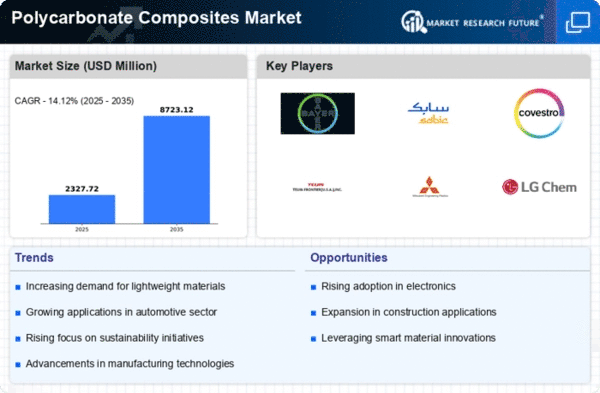
As per MRFR analysis, the Polycarbonate Composites Market Size was estimated at 2039.71 USD Million in 2024. The Polycarbonate Composites industry is projected to grow from 2327.77 USD Million in 2025 to 8723.12 USD Million by 2035, exhibiting a compound annual growth rate (CAGR) of 14.12 during the forecast period 2025 - 2035.

Key Market Trends & Highlights

The Polycarbonate Composites Market is poised for robust growth driven by sustainability and technological advancements.

  • North America remains the largest market for polycarbonate composites, reflecting a strong demand across various industries.
  • The Asia-Pacific region is emerging as the fastest-growing market, fueled by rapid industrialization and urbanization.
  • The automotive segment leads in market share, while the electronics segment is witnessing the fastest growth due to increasing smart technology integration.
  • Key market drivers include rising demand in the automotive sector and advancements in manufacturing technologies, which are shaping the industry's future.

Market Size & Forecast

2024 Market Size 2039.71 (USD Million)
2035 Market Size 8723.12 (USD Million)
CAGR (2025 - 2035) 14.12%
Largest Regional Market Share in 2024 North America

Major Players

Bayer AG (DE), SABIC (SA), Covestro AG (DE), Teijin Limited (JP), Mitsubishi Engineering-Plastics Corporation (JP), LG Chem (KR), Trinseo S.A. (US), Royal DSM (NL), Polycasa (BE)

Market Trends

The Polycarbonate Composites Market is currently experiencing a notable transformation, driven by advancements in material science and increasing demand across various industries. These composites, known for their lightweight and durable properties, are finding applications in sectors such as automotive, construction, and electronics. The growing emphasis on sustainability and energy efficiency is prompting manufacturers to explore innovative solutions that incorporate polycarbonate composites, which are often perceived as environmentally friendly alternatives to traditional materials. As a result, the market landscape is evolving, with new players entering and established companies adapting to changing consumer preferences. In addition to sustainability, the Polycarbonate Composites Market is influenced by technological advancements that enhance product performance. Innovations in processing techniques and formulations are enabling the development of composites with superior mechanical properties and enhanced resistance to environmental factors. This trend is likely to foster greater adoption in high-performance applications, where reliability and longevity are paramount. Furthermore, the increasing integration of smart technologies into products is expected to create new opportunities for polycarbonate composites, as they can be engineered to support advanced functionalities. Overall, the market appears poised for growth, driven by a combination of environmental considerations and technological progress.

Sustainability Focus

The emphasis on sustainable materials is reshaping the Polycarbonate Composites Market. Manufacturers are increasingly prioritizing eco-friendly practices, leading to the development of composites that minimize environmental impact. This trend aligns with global efforts to reduce carbon footprints and promote recycling, making polycarbonate composites a preferred choice in various applications.

Technological Advancements

Innovations in processing and formulation techniques are enhancing the performance of polycarbonate composites. These advancements allow for the creation of materials with improved mechanical properties and resistance to environmental factors. As a result, industries are likely to adopt these composites for high-performance applications, where durability and reliability are crucial.

Integration of Smart Technologies

The rise of smart technologies is influencing the Polycarbonate Composites Market. As products become increasingly integrated with advanced functionalities, there is a growing demand for composites that can support these innovations. This trend suggests a potential for polycarbonate composites to play a significant role in the development of next-generation products.

Polycarbonate Composites Market Market Drivers

Rising Demand in Automotive Sector

The Global Polycarbonate Composites Market Industry experiences a notable surge in demand from the automotive sector, driven by the need for lightweight materials that enhance fuel efficiency and reduce emissions. Polycarbonate composites are increasingly utilized in manufacturing components such as dashboards, lighting systems, and windows. As automotive manufacturers aim to meet stringent environmental regulations, the adoption of polycarbonate composites is projected to grow. The market is expected to reach 2.19 USD Billion in 2024, reflecting a robust growth trajectory as automakers prioritize sustainable materials to improve vehicle performance and safety.

Increasing Adoption in Construction Sector

The Global Polycarbonate Composites Market Industry is witnessing increased adoption in the construction sector, where these materials are utilized for their strength, lightweight nature, and thermal insulation properties. Polycarbonate composites are commonly employed in roofing, glazing, and façade applications, providing energy-efficient solutions that align with contemporary architectural trends. As urbanization accelerates globally, the demand for innovative building materials is expected to rise. This trend may drive the market forward, with a projected CAGR of 7.05% from 2025 to 2035, reflecting the growing emphasis on sustainable construction practices.

Technological Advancements in Material Science

The Global Polycarbonate Composites Market Industry is significantly influenced by technological advancements in material science, which enhance the performance characteristics of polycarbonate composites. Innovations in manufacturing processes and formulations are leading to improved mechanical properties, UV resistance, and thermal stability. These advancements enable the development of high-performance composites suitable for diverse applications, including automotive, aerospace, and consumer goods. As industries seek to leverage these enhanced materials, the market is poised for growth, with manufacturers increasingly investing in research and development to explore new applications and improve product offerings.

Growth in Electronics and Electrical Applications

The Global Polycarbonate Composites Market Industry benefits from the expanding electronics and electrical applications, where polycarbonate composites are favored for their excellent electrical insulation properties and impact resistance. These materials are commonly used in the production of housings, connectors, and circuit boards. As the demand for consumer electronics continues to rise, manufacturers are increasingly turning to polycarbonate composites to ensure durability and reliability in their products. This trend is likely to contribute to the market's growth, with projections indicating a market size of 4.64 USD Billion by 2035, underscoring the material's relevance in modern technology.

Environmental Regulations and Sustainability Initiatives

The Global Polycarbonate Composites Market Industry is shaped by stringent environmental regulations and sustainability initiatives that encourage the use of eco-friendly materials. Governments worldwide are implementing policies aimed at reducing carbon footprints and promoting the use of recyclable materials in various industries. Polycarbonate composites, known for their recyclability and lower environmental impact compared to traditional materials, are becoming increasingly attractive to manufacturers. This shift towards sustainable practices is likely to bolster market growth, as companies strive to comply with regulations while meeting consumer demand for environmentally responsible products.

Market Segment Insights

By Application: Automotive (Largest) vs. Electronics (Fastest-Growing)

In the Polycarbonate Composites Market, the automotive sector occupies the largest share, driven by the increasing demand for lightweight materials that enhance fuel efficiency and safety. This segment is favored for its durability and versatility in manufacturing various parts such as panels, bumpers, and interior components. Following closely is the electronics segment, which is witnessing rapid growth due to the rising need for high-performance materials in consumer electronics, devices, and appliances that require impact resistance and lightweight properties. As technology evolves, the trend towards lightweight and high-strength materials is reshaping the application landscape. Innovations in manufacturing processes, such as 3D printing, are facilitating the production of complex geometries in automotive and electronics applications. The push for sustainability and energy efficiency is further bolstering growth, especially in sectors prioritizing advanced materials to meet regulatory requirements and consumer preferences for eco-friendly products.

Automotive: Structural Parts (Dominant) vs. Electronics: Consumer Devices (Emerging)

Within the automotive application of polycarbonate composites, structural parts are recognized as the dominant segment. These materials offer exceptional impact resistance, lightweight characteristics, and design flexibility, making them ideal for critical automotive applications. Manufacturers are increasingly shifting toward polycarbonate composites to enhance vehicle performance and safety, as these materials contribute to improved fuel efficiency by reducing overall vehicle weight. On the other hand, electronics, particularly in consumer devices, represents an emerging segment, showcasing rapid adoption due to the growing demand for lightweight, durable materials in smartphones, tablets, and wearables. The combination of aesthetic appeal and mechanical properties makes polycarbonate composites a preferred choice in this sector, positioning it for significant growth in the coming years.

By End Use: Consumer Goods (Largest) vs. Healthcare (Fastest-Growing)

The Polycarbonate Composites Market shows a diverse distribution of market share across various end-use segments. The Consumer Goods sector holds the largest share, driven by its extensive application in products such as electronics, home appliances, and sporting goods. In contrast, the Healthcare sector is witnessing rapid adoption of polycarbonate composites, primarily due to increasing demand for medical devices, safety equipment, and packaging solutions that require strength, clarity, and durability. Growth trends within the Polycarbonate Composites Market are influenced by several factors, including rising consumer preference for lightweight, high-performance materials. The Healthcare sector's growth is particularly notable, driven by advancements in medical technologies and an increasing focus on patient safety. Additionally, efforts towards sustainability and recycling are pushing innovation in both the Consumer Goods and Healthcare segments, as manufacturers seek eco-friendly alternatives without compromising on quality.

Consumer Goods: Dominant vs. Healthcare: Emerging

The Consumer Goods segment remains dominant in the Polycarbonate Composites Market, characterized by its broad application range and consistent demand from electronics, automotive interiors, and various consumer products. This segment benefits from the material's excellent impact resistance and transparency, making it ideal for products that require both aesthetics and durability. On the other hand, the Healthcare segment is emerging rapidly, driven by innovations in medical devices and protective equipment. As regulations tighten and the demand for safety and performance increases, polycarbonate composites are becoming preferred choices for manufacturing syringes, surgical trays, and other medical components. This dual focus on consumer goods and healthcare exemplifies the versatility of polycarbonate composites, catering to both established and emerging market demands.

By Type: Polycarbonate Sheet (Largest) vs. Polycarbonate Film (Fastest-Growing)

The Polycarbonate Composites Market exhibits a diverse distribution across its segment values, with polycarbonate sheets leading the market in terms of share. These sheets are favored for their blend of strength and lightweight properties, making them ideal for various applications, including construction and automotive sectors. In contrast, polycarbonate film, while currently trailing in market share, is witnessing rapid growth due to its expanding usage in electronic displays and protective coatings.

Polycarbonate Sheet (Dominant) vs. Polycarbonate Film (Emerging)

Polycarbonate sheets dominate the Polycarbonate Composites Market due to their superior impact resistance and optical clarity, making them suitable for a range of demanding applications. They are particularly prevalent in the construction industry for roofing, glazing, and signage. Meanwhile, polycarbonate film is emerging as a dynamic competitor, leveraged for its lightweight properties and exceptional flexibility. This film is increasingly being adopted in various sectors, including electronics, where it serves a critical role in enhancing product durability and performance. The demand for polycarbonate film is anticipated to surge as manufacturers seek lighter and more efficient materials.

By Manufacturing Process: Injection Molding (Largest) vs. Extrusion (Fastest-Growing)

The manufacturing process segment in the polycarbonate composites market is primarily dominated by injection molding, which holds a significant share due to its versatility and efficiency in producing complex shapes with great precision. Following closely is the extrusion process, which is gaining traction for its ability to produce continuous lengths of material, appealing to manufacturers targeting high-volume production. Other methods like thermoforming, blow molding, and compression molding represent a smaller market share but contribute to the diversity of manufacturing capabilities in the industry. Growth trends within this segment are driven by the increased demand for lightweight and durable materials in various end-use sectors, including automotive, electronics, and construction. Injection molding remains a preferred choice due to its speed and cost-effectiveness, while extrusion is emerging rapidly due to the rise in demand for long-lasting and sustainable solutions, spurred by innovations in materials technology. Overall, these manufacturing processes are expected to evolve continuously to meet the dynamic market needs of polycarbonate composites.

Injection Molding (Dominant) vs. Extrusion (Emerging)

Injection molding is the cornerstone of polycarbonate composites manufacturing, known for its ability to create intricate designs and high-strength products efficiently. Its adaptability makes it highly suitable for various applications, from automotive parts to consumer goods. In contrast, extrusion is emerging as a significant process in the industry, facilitating the continuous production of polycarbonate profiles and sheets for a wide array of applications. Manufacturers are increasingly adopting extrusion due to its efficiency and the lower costs associated with large-scale production. Both methods are crucial in meeting the evolving demands for lightweight, durable materials in multiple sectors, with injection molding leading the way while extrusion captures a growing share of the market.

By Reinforcement Type: Glass Fiber Reinforced (Largest) vs. Carbon Fiber Reinforced (Fastest-Growing)

In the Polycarbonate Composites Market, the reinforcement type significantly influences the overall performance and application of the material. Glass Fiber Reinforced (GFRP) composites hold the largest share due to their excellent mechanical properties, affordability, and accessibility. They are frequently utilized in diverse industries, including automotive and construction. In contrast, Carbon Fiber Reinforced (CFRP) composites, known for their superior strength-to-weight ratio and rigidity, are experiencing robust growth. While currently smaller in market share, the increasing adoption in high-performance applications is boosting their market presence.

Reinforcement Types: Glass Fiber Reinforced (Dominant) vs. Carbon Fiber Reinforced (Emerging)

Glass Fiber Reinforced (GFR) polycarbonate composites are recognized for their versatility, affordability, and excellent strength characteristics, making them a dominant choice in various sectors including automotive, aerospace, and electronics. They provide significant weight savings and enhanced durability, which are critical for many applications. On the other hand, Carbon Fiber Reinforced (CFR) composites, though emerging, are rapidly gaining traction due to their unparalleled strength and lightweight properties. The growing demand for high-performance materials in advanced engineering and manufacturing processes is propelling CFR composites into the spotlight, attracting investments and driving innovation.

Get more detailed insights about Polycarbonate Composites Market Research Report - Global Forecast till 2035

Regional Insights

North America : Market Leader in Composites

North America is poised to maintain its leadership in the polycarbonate composites market, holding a significant share of 1015.0 million. The region's growth is driven by increasing demand in automotive, electronics, and construction sectors, alongside favorable regulations promoting lightweight materials. The push for sustainability and energy efficiency further catalyzes market expansion, with innovations in manufacturing processes enhancing product performance. The competitive landscape is robust, featuring key players such as Bayer AG, SABIC, and Covestro AG. The U.S. stands out as a major contributor, supported by advanced research and development initiatives. The presence of established companies fosters a dynamic environment for innovation, ensuring that North America remains at the forefront of polycarbonate composite advancements. The region's strategic investments in technology and infrastructure are expected to bolster its market position further.

Europe : Innovation and Sustainability Focus

Europe's polycarbonate composites market is projected to reach 650.0 million, driven by stringent environmental regulations and a strong emphasis on sustainability. The region is witnessing a shift towards eco-friendly materials, with policies encouraging the use of recyclable composites. This regulatory landscape is a key catalyst for growth, as industries seek to comply with EU directives on waste management and carbon emissions reduction. Leading countries such as Germany, France, and the UK are at the forefront of this transition, with significant investments in research and development. Major players like Covestro AG and Royal DSM are actively involved in developing innovative solutions that meet market demands. The competitive environment is characterized by collaborations between manufacturers and research institutions, enhancing the region's capability to deliver high-performance polycarbonate composites that align with sustainability goals.

Asia-Pacific : Emerging Market Potential

The Asia-Pacific region is experiencing rapid growth in the polycarbonate composites market, projected to reach 300.0 million. This growth is fueled by increasing industrialization, urbanization, and rising demand from sectors such as automotive and electronics. Countries like China and India are leading this trend, supported by government initiatives aimed at boosting manufacturing capabilities and infrastructure development. The region's favorable economic conditions and growing middle class further drive demand for advanced materials. China is the dominant player in the market, with significant contributions from local manufacturers and multinational corporations. Key players like Teijin Limited and Mitsubishi Engineering-Plastics Corporation are expanding their operations to meet the rising demand. The competitive landscape is evolving, with a focus on innovation and cost-effective solutions, positioning Asia-Pacific as a vital hub for polycarbonate composites production and consumption.

Middle East and Africa : Untapped Market Opportunities

The Middle East and Africa region, with a market size of 74.71 million, presents untapped opportunities in the polycarbonate composites sector. The growth is driven by increasing investments in infrastructure and construction projects, particularly in the Gulf Cooperation Council (GCC) countries. The region's focus on diversifying its economy away from oil dependency is fostering demand for advanced materials in various applications, including automotive and consumer goods. Countries like the UAE and South Africa are emerging as key players in the market, with local manufacturers beginning to explore polycarbonate composites. The competitive landscape is still developing, with opportunities for international players to enter and establish a presence. As the region continues to invest in modernization and innovation, the demand for high-performance composites is expected to rise significantly, paving the way for future growth.

Key Players and Competitive Insights

The Polycarbonate Composites Market is currently characterized by a dynamic competitive landscape, driven by innovation, sustainability, and strategic partnerships. Key players such as Bayer AG (DE), SABIC (SA), and Covestro AG (DE) are at the forefront, each adopting distinct strategies to enhance their market positioning. Bayer AG (DE) focuses on expanding its product portfolio through research and development, particularly in high-performance applications. Meanwhile, SABIC (SA) emphasizes sustainability, aiming to reduce its carbon footprint through eco-friendly production methods. Covestro AG (DE) is actively pursuing digital transformation initiatives, integrating advanced technologies to optimize manufacturing processes and improve product quality. Collectively, these strategies contribute to a competitive environment that is increasingly oriented towards innovation and sustainability.In terms of business tactics, companies are localizing manufacturing to better serve regional markets and optimize supply chains. The market structure appears moderately fragmented, with several key players exerting influence while also allowing for niche competitors to thrive. This fragmentation is indicative of a landscape where collaboration and strategic alliances are becoming essential for maintaining competitive advantage.

In November Bayer AG (DE) announced a partnership with a leading automotive manufacturer to develop lightweight polycarbonate composites aimed at enhancing vehicle efficiency. This collaboration is strategically significant as it aligns with the automotive industry's shift towards lighter materials, potentially increasing Bayer's market share in the automotive sector.

In October SABIC (SA) launched a new line of sustainable polycarbonate composites derived from bio-based feedstocks. This initiative not only reinforces SABIC's commitment to sustainability but also positions the company as a leader in the eco-friendly materials segment, appealing to environmentally conscious consumers and businesses alike.

In September Covestro AG (DE) unveiled a state-of-the-art digital manufacturing facility in Germany, which utilizes AI and IoT technologies to enhance production efficiency. This move is indicative of Covestro's focus on digitalization, allowing for real-time monitoring and optimization of production processes, thereby reducing costs and improving product quality.

As of December the competitive trends in the Polycarbonate Composites Market are increasingly defined by digitalization, sustainability, and the integration of advanced technologies. Strategic alliances are shaping the landscape, enabling companies to leverage each other's strengths and innovate more rapidly. The shift from price-based competition to a focus on innovation, technology, and supply chain reliability is evident, suggesting that future competitive differentiation will hinge on these factors.

Key Companies in the Polycarbonate Composites Market include

Industry Developments

Future Outlook

Polycarbonate Composites Market Future Outlook

The Polycarbonate Composites Market is projected to grow at a 14.12% CAGR from 2025 to 2035, driven by increasing demand in automotive, construction, and electronics sectors.

New opportunities lie in:

  • Development of lightweight automotive components for fuel efficiency
  • Expansion into renewable energy applications, such as solar panel covers
  • Innovative packaging solutions leveraging polycarbonate's durability and clarity

By 2035, the market is expected to achieve substantial growth, solidifying its position in various industries.

Market Segmentation

Polycarbonate Composites Market Type Outlook

  • Polycarbonate Sheet
  • Polycarbonate Film
  • Polycarbonate Resin
  • Polycarbonate Blends
  • Polycarbonate Composites

Polycarbonate Composites Market End Use Outlook

  • Consumer Goods
  • Industrial
  • Transportation
  • Healthcare
  • Telecommunications

Polycarbonate Composites Market Application Outlook

  • Automotive
  • Electronics
  • Construction
  • Medical
  • Aerospace

Polycarbonate Composites Market Reinforcement Type Outlook

  • Glass Fiber Reinforced
  • Carbon Fiber Reinforced
  • Natural Fiber Reinforced
  • Mineral Reinforced
  • Hybrid Reinforced

Polycarbonate Composites Market Manufacturing Process Outlook

  • Injection Molding
  • Extrusion
  • Thermoforming
  • Blow Molding
  • Compression Molding

Report Scope

MARKET SIZE 20242039.71(USD Million)
MARKET SIZE 20252327.77(USD Million)
MARKET SIZE 20358723.12(USD Million)
COMPOUND ANNUAL GROWTH RATE (CAGR)14.12% (2025 - 2035)
REPORT COVERAGERevenue Forecast, Competitive Landscape, Growth Factors, and Trends
BASE YEAR2024
Market Forecast Period2025 - 2035
Historical Data2019 - 2024
Market Forecast UnitsUSD Million
Key Companies ProfiledBayer AG (DE), SABIC (SA), Covestro AG (DE), Teijin Limited (JP), Mitsubishi Engineering-Plastics Corporation (JP), LG Chem (KR), Trinseo S.A. (US), Royal DSM (NL), Polycasa (BE)
Segments CoveredApplication, End Use, Type, Manufacturing Process, Reinforcement Type
Key Market OpportunitiesGrowing demand for lightweight, durable materials in automotive and construction sectors drives Polycarbonate Composites Market expansion.
Key Market DynamicsRising demand for lightweight materials drives innovation and competition in the polycarbonate composites market.
Countries CoveredNorth America, Europe, APAC, South America, MEA

FAQs

How much is the global Polycarbonate Composites Market worth in the future?

Valuation of the global Polycarbonate Composites Market is estimated to reach USD 3.5 BN by the end of 2035

At what CAGR is the global Polycarbonate Composites Market projected to grow during the forecast period (2025-2035)?

Polycarbonate Composites Market is projected to expand at over 5.8% CAGR during the assessment period (2025-2035).

Which is the largest application segment in the global Polycarbonate Composites Market?

Automotive is the largest application segment in the global Polycarbonate Composites Market.

Which region holds the largest share in the global Polycarbonate Composites Market?

Asia Pacific holds the largest share in the global Polycarbonate Composites Market, followed by North America and Europe, respectively.

Who are the top players in the global Polycarbonate Composites Market?

Chi Mei Corporation (China), The Bond Laminates GmbH (Germany), SABIC (Saudi Arabia), LG Chem (South Korea), Asahi Kasei Advance Corporation (Japan), Formosa Chemicals & Fibre Corporation (China), Mitsubishi Chemical Corporation (Japan), Trinseo (US), Teijin Limited (Japan), Nudec (Spain), Samyang Corporation (South Korea), and Covestro (Germany), are some of the major players operating in the Polycarbonate Composites Market.

  1. SECTION I: EXECUTIVE SUMMARY AND KEY HIGHLIGHTS
    1. | 1.1 EXECUTIVE SUMMARY
    2. | 1.1.1 Market Overview
    3. | 1.1.2 Key Findings
    4. | 1.1.3 Market Segmentation
    5. | 1.1.4 Competitive Landscape
    6. | 1.1.5 Challenges and Opportunities
    7. | 1.1.6 Future Outlook
  2. SECTION II: SCOPING, METHODOLOGY AND MARKET STRUCTURE
    1. | 2.1 MARKET INTRODUCTION
    2. | 2.1.1 Definition
    3. | 2.1.2 Scope of the study
    4. |-- 2.1.2.1 Research Objective
    5. |-- 2.1.2.2 Assumption
    6. |-- 2.1.2.3 Limitations
    7. | 2.2 RESEARCH METHODOLOGY
    8. | 2.2.1 Overview
    9. | 2.2.2 Data Mining
    10. | 2.2.3 Secondary Research
    11. | 2.2.4 Primary Research
    12. |-- 2.2.4.1 Primary Interviews and Information Gathering Process
    13. |-- 2.2.4.2 Breakdown of Primary Respondents
    14. | 2.2.5 Forecasting Model
    15. | 2.2.6 Market Size Estimation
    16. |-- 2.2.6.1 Bottom-Up Approach
    17. |-- 2.2.6.2 Top-Down Approach
    18. | 2.2.7 Data Triangulation
    19. | 2.2.8 Validation
  3. SECTION III: QUALITATIVE ANALYSIS
    1. | 3.1 MARKET DYNAMICS
    2. | 3.1.1 Overview
    3. | 3.1.2 Drivers
    4. | 3.1.3 Restraints
    5. | 3.1.4 Opportunities
    6. | 3.2 MARKET FACTOR ANALYSIS
    7. | 3.2.1 Value chain Analysis
    8. | 3.2.2 Porter's Five Forces Analysis
    9. |-- 3.2.2.1 Bargaining Power of Suppliers
    10. |-- 3.2.2.2 Bargaining Power of Buyers
    11. |-- 3.2.2.3 Threat of New Entrants
    12. |-- 3.2.2.4 Threat of Substitutes
    13. |-- 3.2.2.5 Intensity of Rivalry
    14. | 3.2.3 COVID-19 Impact Analysis
    15. |-- 3.2.3.1 Market Impact Analysis
    16. |-- 3.2.3.2 Regional Impact
    17. |-- 3.2.3.3 Opportunity and Threat Analysis
  4. SECTION IV: QUANTITATIVE ANALYSIS
    1. | 4.1 Chemicals and Materials, BY Application (USD Million)
    2. | 4.1.1 Automotive
    3. | 4.1.2 Electronics
    4. | 4.1.3 Construction
    5. | 4.1.4 Medical
    6. | 4.1.5 Aerospace
    7. | 4.2 Chemicals and Materials, BY End Use (USD Million)
    8. | 4.2.1 Consumer Goods
    9. | 4.2.2 Industrial
    10. | 4.2.3 Transportation
    11. | 4.2.4 Healthcare
    12. | 4.2.5 Telecommunications
    13. | 4.3 Chemicals and Materials, BY Type (USD Million)
    14. | 4.3.1 Polycarbonate Sheet
    15. | 4.3.2 Polycarbonate Film
    16. | 4.3.3 Polycarbonate Resin
    17. | 4.3.4 Polycarbonate Blends
    18. | 4.3.5 Polycarbonate Composites
    19. | 4.4 Chemicals and Materials, BY Manufacturing Process (USD Million)
    20. | 4.4.1 Injection Molding
    21. | 4.4.2 Extrusion
    22. | 4.4.3 Thermoforming
    23. | 4.4.4 Blow Molding
    24. | 4.4.5 Compression Molding
    25. | 4.5 Chemicals and Materials, BY Reinforcement Type (USD Million)
    26. | 4.5.1 Glass Fiber Reinforced
    27. | 4.5.2 Carbon Fiber Reinforced
    28. | 4.5.3 Natural Fiber Reinforced
    29. | 4.5.4 Mineral Reinforced
    30. | 4.5.5 Hybrid Reinforced
    31. | 4.6 Chemicals and Materials, BY Region (USD Million)
    32. | 4.6.1 North America
    33. |-- 4.6.1.1 US
    34. |-- 4.6.1.2 Canada
    35. | 4.6.2 Europe
    36. |-- 4.6.2.1 Germany
    37. |-- 4.6.2.2 UK
    38. |-- 4.6.2.3 France
    39. |-- 4.6.2.4 Russia
    40. |-- 4.6.2.5 Italy
    41. |-- 4.6.2.6 Spain
    42. |-- 4.6.2.7 Rest of Europe
    43. | 4.6.3 APAC
    44. |-- 4.6.3.1 China
    45. |-- 4.6.3.2 India
    46. |-- 4.6.3.3 Japan
    47. |-- 4.6.3.4 South Korea
    48. |-- 4.6.3.5 Malaysia
    49. |-- 4.6.3.6 Thailand
    50. |-- 4.6.3.7 Indonesia
    51. |-- 4.6.3.8 Rest of APAC
    52. | 4.6.4 South America
    53. |-- 4.6.4.1 Brazil
    54. |-- 4.6.4.2 Mexico
    55. |-- 4.6.4.3 Argentina
    56. |-- 4.6.4.4 Rest of South America
    57. | 4.6.5 MEA
    58. |-- 4.6.5.1 GCC Countries
    59. |-- 4.6.5.2 South Africa
    60. |-- 4.6.5.3 Rest of MEA
  5. SECTION V: COMPETITIVE ANALYSIS
    1. | 5.1 Competitive Landscape
    2. | 5.1.1 Overview
    3. | 5.1.2 Competitive Analysis
    4. | 5.1.3 Market share Analysis
    5. | 5.1.4 Major Growth Strategy in the Chemicals and Materials
    6. | 5.1.5 Competitive Benchmarking
    7. | 5.1.6 Leading Players in Terms of Number of Developments in the Chemicals and Materials
    8. | 5.1.7 Key developments and growth strategies
    9. |-- 5.1.7.1 New Product Launch/Service Deployment
    10. |-- 5.1.7.2 Merger & Acquisitions
    11. |-- 5.1.7.3 Joint Ventures
    12. | 5.1.8 Major Players Financial Matrix
    13. |-- 5.1.8.1 Sales and Operating Income
    14. |-- 5.1.8.2 Major Players R&D Expenditure. 2023
    15. | 5.2 Company Profiles
    16. | 5.2.1 Bayer AG (DE)
    17. |-- 5.2.1.1 Financial Overview
    18. |-- 5.2.1.2 Products Offered
    19. |-- 5.2.1.3 Key Developments
    20. |-- 5.2.1.4 SWOT Analysis
    21. |-- 5.2.1.5 Key Strategies
    22. | 5.2.2 SABIC (SA)
    23. |-- 5.2.2.1 Financial Overview
    24. |-- 5.2.2.2 Products Offered
    25. |-- 5.2.2.3 Key Developments
    26. |-- 5.2.2.4 SWOT Analysis
    27. |-- 5.2.2.5 Key Strategies
    28. | 5.2.3 Covestro AG (DE)
    29. |-- 5.2.3.1 Financial Overview
    30. |-- 5.2.3.2 Products Offered
    31. |-- 5.2.3.3 Key Developments
    32. |-- 5.2.3.4 SWOT Analysis
    33. |-- 5.2.3.5 Key Strategies
    34. | 5.2.4 Teijin Limited (JP)
    35. |-- 5.2.4.1 Financial Overview
    36. |-- 5.2.4.2 Products Offered
    37. |-- 5.2.4.3 Key Developments
    38. |-- 5.2.4.4 SWOT Analysis
    39. |-- 5.2.4.5 Key Strategies
    40. | 5.2.5 Mitsubishi Engineering-Plastics Corporation (JP)
    41. |-- 5.2.5.1 Financial Overview
    42. |-- 5.2.5.2 Products Offered
    43. |-- 5.2.5.3 Key Developments
    44. |-- 5.2.5.4 SWOT Analysis
    45. |-- 5.2.5.5 Key Strategies
    46. | 5.2.6 LG Chem (KR)
    47. |-- 5.2.6.1 Financial Overview
    48. |-- 5.2.6.2 Products Offered
    49. |-- 5.2.6.3 Key Developments
    50. |-- 5.2.6.4 SWOT Analysis
    51. |-- 5.2.6.5 Key Strategies
    52. | 5.2.7 Trinseo S.A. (US)
    53. |-- 5.2.7.1 Financial Overview
    54. |-- 5.2.7.2 Products Offered
    55. |-- 5.2.7.3 Key Developments
    56. |-- 5.2.7.4 SWOT Analysis
    57. |-- 5.2.7.5 Key Strategies
    58. | 5.2.8 Royal DSM (NL)
    59. |-- 5.2.8.1 Financial Overview
    60. |-- 5.2.8.2 Products Offered
    61. |-- 5.2.8.3 Key Developments
    62. |-- 5.2.8.4 SWOT Analysis
    63. |-- 5.2.8.5 Key Strategies
    64. | 5.2.9 Polycasa (BE)
    65. |-- 5.2.9.1 Financial Overview
    66. |-- 5.2.9.2 Products Offered
    67. |-- 5.2.9.3 Key Developments
    68. |-- 5.2.9.4 SWOT Analysis
    69. |-- 5.2.9.5 Key Strategies
    70. | 5.3 Appendix
    71. | 5.3.1 References
    72. | 5.3.2 Related Reports

Chemicals and Materials Market Segmentation

Chemicals and Materials By Application (USD Million, 2025-2035)

  • Automotive
  • Electronics
  • Construction
  • Medical
  • Aerospace

Chemicals and Materials By End Use (USD Million, 2025-2035)

  • Consumer Goods
  • Industrial
  • Transportation
  • Healthcare
  • Telecommunications

Chemicals and Materials By Type (USD Million, 2025-2035)

  • Polycarbonate Sheet
  • Polycarbonate Film
  • Polycarbonate Resin
  • Polycarbonate Blends
  • Polycarbonate Composites

Chemicals and Materials By Manufacturing Process (USD Million, 2025-2035)

  • Injection Molding
  • Extrusion
  • Thermoforming
  • Blow Molding
  • Compression Molding

Chemicals and Materials By Reinforcement Type (USD Million, 2025-2035)

  • Glass Fiber Reinforced
  • Carbon Fiber Reinforced
  • Natural Fiber Reinforced
  • Mineral Reinforced
  • Hybrid Reinforced
Infographic

Free Sample Request

Kindly complete the form below to receive a free sample of this Report

Get Free Sample

Customer Strories

Compare Licence

×
Features License Type
Single User Multiuser License Enterprise User
Price $4,950 $5,950 $7,250
Maximum User Access Limit 1 User Upto 10 Users Unrestricted Access Throughout the Organization
Free Customization
Direct Access to Analyst
Deliverable Format
Platform Access
Discount on Next Purchase 10% 15% 15%
Printable Versions