

×
Hero Background
English
Chinese
French
Japanese
Korean
German
Spanish

Polyacetal Market Size

ID: MRFR/CnM/11104-HCR
128 Pages
Priya Nagrale
October 2025

Polyacetal Market Research Report Information By Type (Copolymer and Homopolymer), By Grade (Standard, Reinforced, Impact Modified, Recycled, UV Stabilized, and Special Grade), By Application (Automotive, Consumer Goods, Industrial, Electrical and electronics, and Others) And By Region (North America, Europe, Asia-Pacific, And Rest Of The World) –Market Forecast Till 2035

Share:
Download PDF ×

We do not share your information with anyone. However, we may send you emails based on your report interest from time to time. You may contact us at any time to opt-out.

Polyacetal Market Infographic
Purchase Options

Polyacetal Size

Polyacetal Market Growth Projections and Opportunities

The dynamics and performance of the Polyacetal market are influenced by several factors. One of them is equilibrium between supply and demand. Polyacetal is widely used in different industries like automotive, electronics and consumer goods as a high performance engineering plastic. The growth of the market closely depends on demand for such end-use products. Changing preferences, economic climate and innovations in technologies directly affect polyacetal consumption patterns subsequently impacting market trends.

Another important factor in the market is the raw materials context. Formaldehyde gives birth to polyacetal otherwise referred to as polyoxymethylene (POM). As a consequence any interruptions within formaldehyde’s supply chain due to either environmental regulations or shortages of materials can have substantial effects on production and pricing of polyacetal. These aspects are closely monitored by producers with an aim of avoiding potential threats and keeping a steady supply chain.

The competitive landscape has a significant impact on Polyacetal industry. Presence of key players, their market shares, strategic moves determine overall market dynamics. Introduction of advanced grades with better mechanical and thermal properties as part of product development initiatives can stimulate growth in this segment . Mergers, acquisition, and partnerships among industry participants also contribute to changes that take place in its competitive structure.

Another significant element within the market is environmental regulation and sustainability considerations. Manufacturers working in this field usually face stringent environmental standards as global emphasis on eco-friendly practices increases rapidly. To illustrate this phenomenon; there has been the emergence of bio-based alternatives alongside recyclable polyacetal items which reveals both making efforts by companies towards adhering to changing ecological norms as well as customers’ tastes.

Global economic conditions have an impact on Polyalcetal’s growth rate too.Gradual recession will cause reduction in manufacturing activities thus decreasing demand for these products based on polycalcetals.Likewise during periods marked by increased consumer spending coupled with industrial production it leads to increased use of this products hence market expansion.

Technological advancements are one of the major forces behind change within the sector of Polyacetal. Novel manufacturing processes and improved formulations usually result from ongoing research and development activities. These innovations not only improve performance characteristics but also contribute to cost efficiencies that enhance competitiveness in the market for polyacetal.

Lastly, consumer preferences are always changing and this affects Polyacetal market significantly. The need for light weight materials that have high performance and durability matches properties inherent in poliacetals indicating its suitability across different applications. Understanding these changing tastes so as to remain relevant is essential to any player in the industry who desires to make most out of new opportunities at hand.

Polyacetal Market Size Graph
Author
Priya Nagrale
Senior Research Analyst

With an experience of over five years in market research industry (Chemicals & Materials domain), I gather and analyze market data from diverse sources to produce results, which are then presented back to a client. Also, provide recommendations based on the findings. As a Senior Research Analyst, I perform quality checks (QC) for market estimations, QC for reports, and handle queries and work extensively on client customizations. Also, handle the responsibilities of client proposals, report planning, report finalization, and execution

Leave a Comment

FAQs

What is the projected market valuation of the Polyacetal Market by 2035?

The Polyacetal Market is projected to reach a valuation of 9.036 USD Billion by 2035.

What was the market valuation of the Polyacetal Market in 2024?

In 2024, the Polyacetal Market had a valuation of 4.408 USD Billion.

What is the expected CAGR for the Polyacetal Market during the forecast period 2025 - 2035?

The expected CAGR for the Polyacetal Market during the forecast period 2025 - 2035 is 6.74%.

Which companies are considered key players in the Polyacetal Market?

Key players in the Polyacetal Market include DuPont, BASF, Celanese, Mitsubishi Engineering-Plastics Corporation, Polyplastics, Sabic, LG Chem, Ensinger, and RTP Company.

What are the projected valuations for the Copolymer and Homopolymer segments by 2035?

By 2035, the Copolymer segment is projected to reach 4.508 USD Billion, while the Homopolymer segment is expected to reach 4.528 USD Billion.

How do the different grades of Polyacetal compare in terms of market valuation?

By 2035, the Standard grade is projected at 3.0 USD Billion, followed by Reinforced at 2.0 USD Billion, and Impact Modified at 1.5 USD Billion.

Market Summary

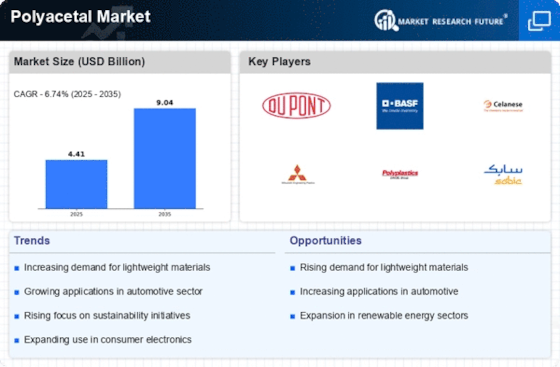
As per Market Research Future analysis, the Polyacetal Market Size was estimated at 4.408 USD Billion in 2024. The Polyacetal industry is projected to grow from 4.706 USD Billion in 2025 to 9.036 USD Billion by 2035, exhibiting a compound annual growth rate (CAGR) of 6.74% during the forecast period 2025 - 2035

Key Market Trends & Highlights

The Polyacetal Market is currently experiencing robust growth driven by diverse applications and technological advancements.

  • The automotive sector exhibits a rising demand for polyacetal, particularly in North America, which remains the largest market.
  • Asia-Pacific is emerging as the fastest-growing region, fueled by increasing industrialization and consumer demand.
  • Homopolymer polyacetal continues to dominate the market, while the copolymer segment is witnessing rapid growth due to its enhanced properties.
  • Key market drivers include the increasing applications in consumer goods and a strong focus on sustainability and eco-friendly materials.

Market Size & Forecast

2024 Market Size 4.408 (USD Billion)
2035 Market Size 9.036 (USD Billion)
CAGR (2025 - 2035) 6.74%
Largest Regional Market Share in 2024 North America

Major Players

<p>DuPont (US), BASF (DE), Celanese (US), Mitsubishi Engineering-Plastics Corporation (JP), Polyplastics (JP), Sabic (SA), LG Chem (KR), Ensinger (DE), RTP Company (US)</p>

Market Trends

The Polyacetal Market is currently experiencing a dynamic phase characterized by evolving applications and increasing demand across various sectors. This engineering thermoplastic, known for its excellent mechanical properties and low friction, is finding its way into automotive, consumer goods, and industrial applications. The material's ability to withstand harsh environments and its superior dimensional stability make it a preferred choice for manufacturers. As industries continue to innovate, the Polyacetal Market appears poised for growth, driven by advancements in technology and material science. Moreover, sustainability concerns are influencing the Polyacetal Market, as manufacturers seek eco-friendly alternatives and production methods. The shift towards greener practices is prompting companies to explore bio-based polyacetals and recycling initiatives. This trend not only aligns with global environmental goals but also caters to the increasing consumer demand for sustainable products. As the market evolves, it is likely that the Polyacetal Market will adapt to these changes, potentially leading to new opportunities and challenges for stakeholders.

Rising Demand in Automotive Sector

The automotive industry is increasingly adopting polyacetal due to its lightweight and durable characteristics. This trend suggests a shift towards materials that enhance fuel efficiency and performance, indicating a growing reliance on advanced engineering plastics.

Focus on Sustainability

There is a noticeable emphasis on sustainable practices within the Polyacetal Market. Manufacturers are exploring bio-based alternatives and recycling methods, reflecting a broader commitment to environmental responsibility and responding to consumer preferences for greener products.

Technological Advancements

Innovations in processing techniques and material formulations are shaping the Polyacetal Market. These advancements may lead to enhanced properties and new applications, suggesting a potential for expanded market reach and improved product performance.

Polyacetal Market Market Drivers

Growth in the Electronics Sector

The Polyacetal Market is significantly influenced by the growth in the electronics sector. Polyacetal Market's unique properties, such as high dimensional stability and electrical insulation, make it an ideal choice for various electronic components, including connectors, switches, and housings. As the electronics industry continues to expand, driven by advancements in technology and increasing consumer demand for electronic devices, the need for high-performance materials like polyacetal is likely to grow. Market data suggests that the electronics sector is projected to contribute a notable percentage to the overall polyacetal market, with an expected compound annual growth rate of around 6% in the coming years. This growth is indicative of the material's critical role in supporting the innovation and functionality of modern electronic products.

Rising Demand in the Automotive Sector

The Polyacetal Market is experiencing a notable increase in demand from the automotive sector. Polyacetal Market's properties, such as high strength, stiffness, and resistance to wear, make it an attractive material for automotive applications, including fuel systems, interior components, and safety features. As automotive manufacturers seek to enhance vehicle performance and fuel efficiency, the use of lightweight materials like polyacetal is becoming more prevalent. Recent statistics indicate that the automotive sector represents a significant portion of the polyacetal market, with expectations of a growth rate of approximately 4% annually. This trend reflects the industry's ongoing commitment to innovation and sustainability, as manufacturers increasingly prioritize materials that contribute to overall vehicle efficiency.

Increasing Applications in Consumer Goods

The Polyacetal Market is witnessing a surge in demand due to its increasing applications in consumer goods. Polyacetal Market, known for its excellent mechanical properties and low friction, is extensively used in manufacturing various household items, including kitchenware and electronic devices. The versatility of polyacetal allows it to replace metals in many applications, which is particularly appealing to manufacturers aiming to reduce weight and enhance performance. As consumer preferences shift towards durable and lightweight products, the demand for polyacetal is expected to rise. Recent data indicates that the consumer goods sector accounts for a substantial share of the polyacetal market, with projections suggesting a growth rate of approximately 5% annually over the next few years. This trend underscores the material's importance in the evolving landscape of consumer products.

Focus on Sustainability and Eco-Friendly Materials

The Polyacetal Market is increasingly shaped by a focus on sustainability and the demand for eco-friendly materials. As environmental concerns gain prominence, manufacturers are seeking alternatives that minimize ecological impact. Polyacetal Market, being recyclable and offering a longer lifespan compared to traditional materials, aligns well with these sustainability goals. The market is witnessing a shift towards bio-based polyacetal options, which could further enhance its appeal among environmentally conscious consumers and businesses. Data suggests that the demand for sustainable materials is expected to grow at a rate of 7% annually, indicating a strong potential for polyacetal to capture market share in this evolving landscape. This focus on sustainability not only benefits the environment but also positions polyacetal as a forward-thinking choice for manufacturers.

Technological Advancements in Manufacturing Processes

The Polyacetal Market is benefiting from technological advancements in manufacturing processes. Innovations in production techniques, such as improved polymerization methods and enhanced processing technologies, are enabling manufacturers to produce polyacetal with superior properties and at lower costs. These advancements are likely to enhance the material's competitiveness against other engineering plastics. Furthermore, the integration of automation and smart manufacturing practices is streamlining production, thereby increasing efficiency and reducing waste. Market analysis indicates that these technological improvements could lead to a reduction in production costs by up to 10%, making polyacetal more accessible to a broader range of industries. As these technologies continue to evolve, they are expected to drive further growth in the polyacetal market, reinforcing its position as a preferred material in various applications.

Market Segment Insights

Polyacetal Market Type Insights

<p>The Polyacetal Market segmentation, based on type, includes Copolymer and Homopolymer. The copolymer segment dominates the market, accounting for the largest market revenue due to its enhanced properties and versatility, offering a combination of strength, impact resistance, and improved thermal stability. These copolymers often outperform homopolymers in various applications, making them preferred choices for manufacturers seeking tailored solutions for demanding industries, such as automotive, electronics, and consumer goods. The ability to fine-tune material characteristics through copolymerization allows for a wider range of applications and contributes to their dominance in the polyacetal market.</p>

Polyacetal Market Grade Insights

<p>The Polyacetal Market segmentation, based on grade, includes Standard, Reinforced, Impact Modified, Recycled, UV Stabilized, and Special Grade. The standard category dominated the market due to its widespread applicability and cost-effectiveness, making it a preferred choice for various industries. Its versatility, which includes excellent mechanical properties, good chemical resistance, and ease of processing, positions it as a go-to material for manufacturers. Additionally, standard-grade polyacetal's ability to meet essential performance requirements across diverse applications cements its leading position in the market.</p>

Polyacetal Market Application Insights

<p>The Polyacetal Market segmentation, based on application, includes Automotive, Consumer Goods, Industrial, Electrical &amp; Electronics, and Others. The consumer goods category dominates the market due to the material's suitability for producing high-quality and precision components, such as gears, handles, and connectors, in a wide range of consumer products. The demand is fueled by consumers' expectations for enhanced product performance and durability, making polyacetal a preferred choice for manufacturers looking to deliver reliable and long-lasting goods.</p>

<p>Moreover, the growth of e-commerce and the need for efficient, low-friction, and wear-resistant components in products like appliances, sporting equipment, and electronic gadgets further amplify polyacetal's significance in the consumer goods sector.</p>

<p>Figure 1: Polyacetal Market, by Application, 2022 &amp; 2032 (USD Billion)</p>

Get more detailed insights about Polyacetal Market Research Report—Global Forecast till 2035

Regional Insights

North America : Innovation and Demand Surge

North America is witnessing robust growth in the polyacetal market, driven by increasing demand in automotive and consumer goods sectors. The region holds approximately 40% of the global market share, making it the largest market for polyacetal. Regulatory support for advanced materials and sustainability initiatives further catalyze this growth, with a focus on reducing environmental impact and enhancing product performance. The United States and Canada are the leading countries in this region, with major players like DuPont and Celanese dominating the landscape. The competitive environment is characterized by innovation and strategic partnerships, as companies invest in R&D to develop high-performance polyacetal products. The presence of established manufacturers and a growing emphasis on lightweight materials in automotive applications are key factors driving market expansion.

Europe : Sustainability and Innovation Focus

Europe is emerging as a significant player in the polyacetal market, driven by stringent environmental regulations and a strong focus on sustainability. The region accounts for approximately 30% of the global market share, making it the second-largest market. Regulatory frameworks promoting eco-friendly materials and recycling initiatives are key growth drivers, encouraging manufacturers to innovate and adapt to changing consumer preferences. Germany and France are at the forefront of this market, with key players like BASF and Ensinger leading the charge. The competitive landscape is marked by a strong emphasis on research and development, as companies strive to create high-performance, sustainable polyacetal solutions. Collaborative efforts between industry and academia are fostering innovation, ensuring that Europe remains a hub for advanced material technologies.

Asia-Pacific : Rapid Industrialization and Growth

Asia-Pacific is rapidly becoming a powerhouse in the polyacetal market, fueled by industrialization and increasing demand from the automotive and electronics sectors. The region holds about 25% of the global market share, reflecting its significant growth potential. Government initiatives aimed at boosting manufacturing capabilities and attracting foreign investment are key drivers of this expansion, alongside rising consumer demand for durable materials. China and Japan are the leading countries in this region, with major companies like Mitsubishi Engineering-Plastics and Polyplastics playing pivotal roles. The competitive landscape is characterized by a mix of local and international players, all vying for market share. Investments in technology and innovation are crucial as companies seek to enhance product quality and meet the evolving needs of various industries.

Middle East and Africa : Emerging Markets and Opportunities

The Middle East and Africa region is witnessing emerging opportunities in the polyacetal market, driven by increasing industrial activities and infrastructure development. This region currently holds about 5% of the global market share, indicating significant growth potential. Government initiatives aimed at diversifying economies and promoting manufacturing are key catalysts for market expansion, alongside rising demand for high-performance materials in various applications. Countries like South Africa and the UAE are leading the charge, with a growing number of local and international players entering the market. The competitive landscape is evolving, with companies focusing on innovation and strategic partnerships to enhance their product offerings. As the region continues to develop, the demand for polyacetal is expected to rise, driven by advancements in technology and manufacturing capabilities.

Key Players and Competitive Insights

Leading market players are investing heavily in research and development in order to expand their product lines, which will help the Polyacetal Market grow even more. Market participants are also undertaking a variety of strategic activities to expand their global footprint, with important market developments including new product launches, contractual agreements, mergers and acquisitions, higher investments, and collaboration with other organizations. To expand and survive in a more competitive and rising market climate, the Polyacetal industry must offer cost-effective items.

Manufacturing locally to minimize operational costs is one of the key business tactics used by manufacturers in the global Polyacetal industry to benefit clients and increase the market sector. In recent years, the Polyacetal industry has offered some of the most significant advantages to several industries. Major players in the Polyacetal Market, including Celanese Corporation, China BlueChemical Ltd., Daicel Corporation, DuPont, Henan Energy Group Co., Ltd., Kolon BASF innoPOM, Inc., Korea Engineering Plastics Co., Ltd., Mitsubishi Chemical Corporation, SABIC, Yuntianhua Group Co., Ltd., and others, are attempting to increase market demand by investing in research and development operations.

Celanese is a diversified company that produces a wide range of chemical products and materials with a focus on innovation and technology. Their products are used in various industries, including automotive, electronics, consumer goods, industrial applications, and more. The company produces a broad spectrum of chemicals, polymers, and specialty materials, including engineered materials, acetyl products, and other high-performance products. Their offerings include materials used in the manufacture of everything from automotive components to consumer electronics and medical devices.

Celanese places a strong emphasis on research and development, and they have a history of developing innovative materials and solutions for a wide range of industries. They work closely with their customers to provide tailored solutions. In January 2023, Celanese Corporation and BASF announced a partnership to develop and commercialize new polyacetal-based materials for the automotive industry. The partnership will focus on developing materials that are lighter, stronger, and more durable than traditional polyacetal resins.

BASF is a diversified chemical company involved in the production of a wide range of chemical products, including chemicals, plastics, performance products, agricultural solutions, and oil and gas. They are a leader in the chemical industry and serve various sectors, such as automotive, construction, agriculture, pharmaceuticals, and consumer goods. BASF offers a vast array of products, including chemicals, plastics, coatings, performance materials, catalysts, agricultural solutions (seeds and crop protection products), and more. They are known for their innovation and the development of advanced materials used in a wide range of industries.

BASF is committed to corporate social responsibility and is involved in various initiatives related to safety, ethics, and community engagement. In July 2023, BASF announced the development of a new polyacetal resin that is specifically designed for use in medical device applications. The new resin has excellent biocompatibility, sterilizability, and purity, making it ideal for use in implants and other critical medical devices.

Key Companies in the Polyacetal Market market include

Industry Developments

August 2023: SABIC announced the launch of a new grade of polyacetal resin that is specifically designed for use in automotive applications. The new resin has improved strength, stiffness, and heat resistance, making it ideal for use in under-the-hood components.

December 2022: BASF SE and Evonik Industries AG announced a partnership to develop and commercialize new polyacetal-based materials for the automotive and electronics industries. The two companies will combine their expertise in polymer chemistry and processing to create new materials with improved performance and durability.

November 2022: DuPont de Nemours, Inc. and DSM N.V. signed a joint development agreement to develop new polyacetal-based composites for use in the aerospace and defense industries. The two companies will leverage their combined expertise in materials science and engineering to create new materials with reduced weight and increased strength.

Future Outlook

Polyacetal Market Future Outlook

<p>The Polyacetal Market is projected to grow at a 6.74% CAGR from 2024 to 2035, driven by increasing demand in automotive and electronics sectors.</p>

New opportunities lie in:

  • <p>Expansion into bio-based polyacetal production for sustainable applications.</p>
  • <p>Development of high-performance polyacetal grades for specialized industries.</p>
  • <p>Strategic partnerships with automotive manufacturers for tailored solutions.</p>

<p>By 2035, the Polyacetal Market is expected to solidify its position as a key player in advanced material solutions.</p>

Market Segmentation

Polyacetal Market Type Outlook

  • Copolymer
  • Homopolymer

Polyacetal Market Grade Outlook

  • Standard
  • Reinforced
  • Impact Modified
  • Recycled
  • UV Stabilized
  • Special Grade

Polyacetal Market Application Outlook

  • Automotive
  • Consumer Goods
  • Industrial
  • Electrical & Electronics
  • Others

Report Scope

MARKET SIZE 20244.408(USD Billion)
MARKET SIZE 20254.706(USD Billion)
MARKET SIZE 20359.036(USD Billion)
COMPOUND ANNUAL GROWTH RATE (CAGR)6.74% (2024 - 2035)
REPORT COVERAGERevenue Forecast, Competitive Landscape, Growth Factors, and Trends
BASE YEAR2024
Market Forecast Period2025 - 2035
Historical Data2019 - 2024
Market Forecast UnitsUSD Billion
Key Companies ProfiledDuPont (US), BASF (DE), Celanese (US), Mitsubishi Engineering-Plastics Corporation (JP), Polyplastics (JP), Sabic (SA), LG Chem (KR), Ensinger (DE), RTP Company (US)
Segments CoveredType, Grade, Application, Region
Key Market OpportunitiesGrowing demand for lightweight, high-performance materials in automotive and electronics sectors drives Polyacetal Market opportunities.
Key Market DynamicsRising demand for lightweight materials drives innovation and competition in the Polyacetal Market.
Countries CoveredNorth America, Europe, APAC, South America, MEA

FAQs

What is the projected market valuation of the Polyacetal Market by 2035?

The Polyacetal Market is projected to reach a valuation of 9.036 USD Billion by 2035.

What was the market valuation of the Polyacetal Market in 2024?

In 2024, the Polyacetal Market had a valuation of 4.408 USD Billion.

What is the expected CAGR for the Polyacetal Market during the forecast period 2025 - 2035?

The expected CAGR for the Polyacetal Market during the forecast period 2025 - 2035 is 6.74%.

Which companies are considered key players in the Polyacetal Market?

Key players in the Polyacetal Market include DuPont, BASF, Celanese, Mitsubishi Engineering-Plastics Corporation, Polyplastics, Sabic, LG Chem, Ensinger, and RTP Company.

What are the projected valuations for the Copolymer and Homopolymer segments by 2035?

By 2035, the Copolymer segment is projected to reach 4.508 USD Billion, while the Homopolymer segment is expected to reach 4.528 USD Billion.

How do the different grades of Polyacetal compare in terms of market valuation?

By 2035, the Standard grade is projected at 3.0 USD Billion, followed by Reinforced at 2.0 USD Billion, and Impact Modified at 1.5 USD Billion.

  1. SECTION I: EXECUTIVE SUMMARY AND KEY HIGHLIGHTS
    1. EXECUTIVE SUMMARY
      1. Market Overview
      2. Key Findings
      3. Market Segmentation
      4. Competitive Landscape
      5. Challenges and Opportunities
      6. Future Outlook
  2. SECTION II: SCOPING, METHODOLOGY AND MARKET STRUCTURE
    1. MARKET INTRODUCTION
      1. Definition
      2. Scope of the study
    2. RESEARCH METHODOLOGY
      1. Overview
      2. Data Mining
      3. Secondary Research
      4. Primary Research
      5. Forecasting Model
      6. Market Size Estimation
      7. Data Triangulation
      8. Validation
  3. SECTION III: QUALITATIVE ANALYSIS
    1. MARKET DYNAMICS
      1. Overview
      2. Drivers
      3. Restraints
      4. Opportunities
    2. MARKET FACTOR ANALYSIS
      1. Value chain Analysis
      2. Porter's Five Forces Analysis
      3. COVID-19 Impact Analysis
  4. SECTION IV: QUANTITATIVE ANALYSIS
    1. Chemicals and Materials, BY Type (USD Billion)
      1. Copolymer
      2. Homopolymer
    2. Chemicals and Materials, BY Grade (USD Billion)
      1. Standard
      2. Reinforced
      3. Impact Modified
      4. Recycled
      5. UV Stabilized
      6. Special Grade
    3. Chemicals and Materials, BY Application (USD Billion)
      1. Automotive
      2. Consumer Goods
      3. Industrial
      4. Electrical & Electronics
      5. Others
    4. Chemicals and Materials, BY Region (USD Billion)
      1. North America
      2. Europe
      3. APAC
      4. South America
      5. MEA
  5. SECTION V: COMPETITIVE ANALYSIS
    1. Competitive Landscape
      1. Overview
      2. Competitive Analysis
      3. Market share Analysis
      4. Major Growth Strategy in the Chemicals and Materials
      5. Competitive Benchmarking
      6. Leading Players in Terms of Number of Developments in the Chemicals and Materials
      7. Key developments and growth strategies
      8. Major Players Financial Matrix
    2. Company Profiles
      1. DuPont (US)
      2. BASF (DE)
      3. Celanese (US)
      4. Mitsubishi Engineering-Plastics Corporation (JP)
      5. Polyplastics (JP)
      6. Sabic (SA)
      7. LG Chem (KR)
      8. Ensinger (DE)
      9. RTP Company (US)
    3. Appendix
      1. References
      2. Related Reports
  6. LIST OF FIGURES
    1. MARKET SYNOPSIS
    2. NORTH AMERICA MARKET ANALYSIS
    3. US MARKET ANALYSIS BY TYPE
    4. US MARKET ANALYSIS BY GRADE
    5. US MARKET ANALYSIS BY APPLICATION
    6. CANADA MARKET ANALYSIS BY TYPE
    7. CANADA MARKET ANALYSIS BY GRADE
    8. CANADA MARKET ANALYSIS BY APPLICATION
    9. EUROPE MARKET ANALYSIS
    10. GERMANY MARKET ANALYSIS BY TYPE
    11. GERMANY MARKET ANALYSIS BY GRADE
    12. GERMANY MARKET ANALYSIS BY APPLICATION
    13. UK MARKET ANALYSIS BY TYPE
    14. UK MARKET ANALYSIS BY GRADE
    15. UK MARKET ANALYSIS BY APPLICATION
    16. FRANCE MARKET ANALYSIS BY TYPE
    17. FRANCE MARKET ANALYSIS BY GRADE
    18. FRANCE MARKET ANALYSIS BY APPLICATION
    19. RUSSIA MARKET ANALYSIS BY TYPE
    20. RUSSIA MARKET ANALYSIS BY GRADE
    21. RUSSIA MARKET ANALYSIS BY APPLICATION
    22. ITALY MARKET ANALYSIS BY TYPE
    23. ITALY MARKET ANALYSIS BY GRADE
    24. ITALY MARKET ANALYSIS BY APPLICATION
    25. SPAIN MARKET ANALYSIS BY TYPE
    26. SPAIN MARKET ANALYSIS BY GRADE
    27. SPAIN MARKET ANALYSIS BY APPLICATION
    28. REST OF EUROPE MARKET ANALYSIS BY TYPE
    29. REST OF EUROPE MARKET ANALYSIS BY GRADE
    30. REST OF EUROPE MARKET ANALYSIS BY APPLICATION
    31. APAC MARKET ANALYSIS
    32. CHINA MARKET ANALYSIS BY TYPE
    33. CHINA MARKET ANALYSIS BY GRADE
    34. CHINA MARKET ANALYSIS BY APPLICATION
    35. INDIA MARKET ANALYSIS BY TYPE
    36. INDIA MARKET ANALYSIS BY GRADE
    37. INDIA MARKET ANALYSIS BY APPLICATION
    38. JAPAN MARKET ANALYSIS BY TYPE
    39. JAPAN MARKET ANALYSIS BY GRADE
    40. JAPAN MARKET ANALYSIS BY APPLICATION
    41. SOUTH KOREA MARKET ANALYSIS BY TYPE
    42. SOUTH KOREA MARKET ANALYSIS BY GRADE
    43. SOUTH KOREA MARKET ANALYSIS BY APPLICATION
    44. MALAYSIA MARKET ANALYSIS BY TYPE
    45. MALAYSIA MARKET ANALYSIS BY GRADE
    46. MALAYSIA MARKET ANALYSIS BY APPLICATION
    47. THAILAND MARKET ANALYSIS BY TYPE
    48. THAILAND MARKET ANALYSIS BY GRADE
    49. THAILAND MARKET ANALYSIS BY APPLICATION
    50. INDONESIA MARKET ANALYSIS BY TYPE
    51. INDONESIA MARKET ANALYSIS BY GRADE
    52. INDONESIA MARKET ANALYSIS BY APPLICATION
    53. REST OF APAC MARKET ANALYSIS BY TYPE
    54. REST OF APAC MARKET ANALYSIS BY GRADE
    55. REST OF APAC MARKET ANALYSIS BY APPLICATION
    56. SOUTH AMERICA MARKET ANALYSIS
    57. BRAZIL MARKET ANALYSIS BY TYPE
    58. BRAZIL MARKET ANALYSIS BY GRADE
    59. BRAZIL MARKET ANALYSIS BY APPLICATION
    60. MEXICO MARKET ANALYSIS BY TYPE
    61. MEXICO MARKET ANALYSIS BY GRADE
    62. MEXICO MARKET ANALYSIS BY APPLICATION
    63. ARGENTINA MARKET ANALYSIS BY TYPE
    64. ARGENTINA MARKET ANALYSIS BY GRADE
    65. ARGENTINA MARKET ANALYSIS BY APPLICATION
    66. REST OF SOUTH AMERICA MARKET ANALYSIS BY TYPE
    67. REST OF SOUTH AMERICA MARKET ANALYSIS BY GRADE
    68. REST OF SOUTH AMERICA MARKET ANALYSIS BY APPLICATION
    69. MEA MARKET ANALYSIS
    70. GCC COUNTRIES MARKET ANALYSIS BY TYPE
    71. GCC COUNTRIES MARKET ANALYSIS BY GRADE
    72. GCC COUNTRIES MARKET ANALYSIS BY APPLICATION
    73. SOUTH AFRICA MARKET ANALYSIS BY TYPE
    74. SOUTH AFRICA MARKET ANALYSIS BY GRADE
    75. SOUTH AFRICA MARKET ANALYSIS BY APPLICATION
    76. REST OF MEA MARKET ANALYSIS BY TYPE
    77. REST OF MEA MARKET ANALYSIS BY GRADE
    78. REST OF MEA MARKET ANALYSIS BY APPLICATION
    79. KEY BUYING CRITERIA OF CHEMICALS AND MATERIALS
    80. RESEARCH PROCESS OF MRFR
    81. DRO ANALYSIS OF CHEMICALS AND MATERIALS
    82. DRIVERS IMPACT ANALYSIS: CHEMICALS AND MATERIALS
    83. RESTRAINTS IMPACT ANALYSIS: CHEMICALS AND MATERIALS
    84. SUPPLY / VALUE CHAIN: CHEMICALS AND MATERIALS
    85. CHEMICALS AND MATERIALS, BY TYPE, 2024 (% SHARE)
    86. CHEMICALS AND MATERIALS, BY TYPE, 2024 TO 2035 (USD Billion)
    87. CHEMICALS AND MATERIALS, BY GRADE, 2024 (% SHARE)
    88. CHEMICALS AND MATERIALS, BY GRADE, 2024 TO 2035 (USD Billion)
    89. CHEMICALS AND MATERIALS, BY APPLICATION, 2024 (% SHARE)
    90. CHEMICALS AND MATERIALS, BY APPLICATION, 2024 TO 2035 (USD Billion)
    91. BENCHMARKING OF MAJOR COMPETITORS
  7. LIST OF TABLES
    1. LIST OF ASSUMPTIONS
    2. North America MARKET SIZE ESTIMATES; FORECAST
      1. BY TYPE, 2025-2035 (USD Billion)
      2. BY GRADE, 2025-2035 (USD Billion)
      3. BY APPLICATION, 2025-2035 (USD Billion)
    3. US MARKET SIZE ESTIMATES; FORECAST
      1. BY TYPE, 2025-2035 (USD Billion)
      2. BY GRADE, 2025-2035 (USD Billion)
      3. BY APPLICATION, 2025-2035 (USD Billion)
    4. Canada MARKET SIZE ESTIMATES; FORECAST
      1. BY TYPE, 2025-2035 (USD Billion)
      2. BY GRADE, 2025-2035 (USD Billion)
      3. BY APPLICATION, 2025-2035 (USD Billion)
    5. Europe MARKET SIZE ESTIMATES; FORECAST
      1. BY TYPE, 2025-2035 (USD Billion)
      2. BY GRADE, 2025-2035 (USD Billion)
      3. BY APPLICATION, 2025-2035 (USD Billion)
    6. Germany MARKET SIZE ESTIMATES; FORECAST
      1. BY TYPE, 2025-2035 (USD Billion)
      2. BY GRADE, 2025-2035 (USD Billion)
      3. BY APPLICATION, 2025-2035 (USD Billion)
    7. UK MARKET SIZE ESTIMATES; FORECAST
      1. BY TYPE, 2025-2035 (USD Billion)
      2. BY GRADE, 2025-2035 (USD Billion)
      3. BY APPLICATION, 2025-2035 (USD Billion)
    8. France MARKET SIZE ESTIMATES; FORECAST
      1. BY TYPE, 2025-2035 (USD Billion)
      2. BY GRADE, 2025-2035 (USD Billion)
      3. BY APPLICATION, 2025-2035 (USD Billion)
    9. Russia MARKET SIZE ESTIMATES; FORECAST
      1. BY TYPE, 2025-2035 (USD Billion)
      2. BY GRADE, 2025-2035 (USD Billion)
      3. BY APPLICATION, 2025-2035 (USD Billion)
    10. Italy MARKET SIZE ESTIMATES; FORECAST
      1. BY TYPE, 2025-2035 (USD Billion)
      2. BY GRADE, 2025-2035 (USD Billion)
      3. BY APPLICATION, 2025-2035 (USD Billion)
    11. Spain MARKET SIZE ESTIMATES; FORECAST
      1. BY TYPE, 2025-2035 (USD Billion)
      2. BY GRADE, 2025-2035 (USD Billion)
      3. BY APPLICATION, 2025-2035 (USD Billion)
    12. Rest of Europe MARKET SIZE ESTIMATES; FORECAST
      1. BY TYPE, 2025-2035 (USD Billion)
      2. BY GRADE, 2025-2035 (USD Billion)
      3. BY APPLICATION, 2025-2035 (USD Billion)
    13. APAC MARKET SIZE ESTIMATES; FORECAST
      1. BY TYPE, 2025-2035 (USD Billion)
      2. BY GRADE, 2025-2035 (USD Billion)
      3. BY APPLICATION, 2025-2035 (USD Billion)
    14. China MARKET SIZE ESTIMATES; FORECAST
      1. BY TYPE, 2025-2035 (USD Billion)
      2. BY GRADE, 2025-2035 (USD Billion)
      3. BY APPLICATION, 2025-2035 (USD Billion)
    15. India MARKET SIZE ESTIMATES; FORECAST
      1. BY TYPE, 2025-2035 (USD Billion)
      2. BY GRADE, 2025-2035 (USD Billion)
      3. BY APPLICATION, 2025-2035 (USD Billion)
    16. Japan MARKET SIZE ESTIMATES; FORECAST
      1. BY TYPE, 2025-2035 (USD Billion)
      2. BY GRADE, 2025-2035 (USD Billion)
      3. BY APPLICATION, 2025-2035 (USD Billion)
    17. South Korea MARKET SIZE ESTIMATES; FORECAST
      1. BY TYPE, 2025-2035 (USD Billion)
      2. BY GRADE, 2025-2035 (USD Billion)
      3. BY APPLICATION, 2025-2035 (USD Billion)
    18. Malaysia MARKET SIZE ESTIMATES; FORECAST
      1. BY TYPE, 2025-2035 (USD Billion)
      2. BY GRADE, 2025-2035 (USD Billion)
      3. BY APPLICATION, 2025-2035 (USD Billion)
    19. Thailand MARKET SIZE ESTIMATES; FORECAST
      1. BY TYPE, 2025-2035 (USD Billion)
      2. BY GRADE, 2025-2035 (USD Billion)
      3. BY APPLICATION, 2025-2035 (USD Billion)
    20. Indonesia MARKET SIZE ESTIMATES; FORECAST
      1. BY TYPE, 2025-2035 (USD Billion)
      2. BY GRADE, 2025-2035 (USD Billion)
      3. BY APPLICATION, 2025-2035 (USD Billion)
    21. Rest of APAC MARKET SIZE ESTIMATES; FORECAST
      1. BY TYPE, 2025-2035 (USD Billion)
      2. BY GRADE, 2025-2035 (USD Billion)
      3. BY APPLICATION, 2025-2035 (USD Billion)
    22. South America MARKET SIZE ESTIMATES; FORECAST
      1. BY TYPE, 2025-2035 (USD Billion)
      2. BY GRADE, 2025-2035 (USD Billion)
      3. BY APPLICATION, 2025-2035 (USD Billion)
    23. Brazil MARKET SIZE ESTIMATES; FORECAST
      1. BY TYPE, 2025-2035 (USD Billion)
      2. BY GRADE, 2025-2035 (USD Billion)
      3. BY APPLICATION, 2025-2035 (USD Billion)
    24. Mexico MARKET SIZE ESTIMATES; FORECAST
      1. BY TYPE, 2025-2035 (USD Billion)
      2. BY GRADE, 2025-2035 (USD Billion)
      3. BY APPLICATION, 2025-2035 (USD Billion)
    25. Argentina MARKET SIZE ESTIMATES; FORECAST
      1. BY TYPE, 2025-2035 (USD Billion)
      2. BY GRADE, 2025-2035 (USD Billion)
      3. BY APPLICATION, 2025-2035 (USD Billion)
    26. Rest of South America MARKET SIZE ESTIMATES; FORECAST
      1. BY TYPE, 2025-2035 (USD Billion)
      2. BY GRADE, 2025-2035 (USD Billion)
      3. BY APPLICATION, 2025-2035 (USD Billion)
    27. MEA MARKET SIZE ESTIMATES; FORECAST
      1. BY TYPE, 2025-2035 (USD Billion)
      2. BY GRADE, 2025-2035 (USD Billion)
      3. BY APPLICATION, 2025-2035 (USD Billion)
    28. GCC Countries MARKET SIZE ESTIMATES; FORECAST
      1. BY TYPE, 2025-2035 (USD Billion)
      2. BY GRADE, 2025-2035 (USD Billion)
      3. BY APPLICATION, 2025-2035 (USD Billion)
    29. South Africa MARKET SIZE ESTIMATES; FORECAST
      1. BY TYPE, 2025-2035 (USD Billion)
      2. BY GRADE, 2025-2035 (USD Billion)
      3. BY APPLICATION, 2025-2035 (USD Billion)
    30. Rest of MEA MARKET SIZE ESTIMATES; FORECAST
      1. BY TYPE, 2025-2035 (USD Billion)
      2. BY GRADE, 2025-2035 (USD Billion)
      3. BY APPLICATION, 2025-2035 (USD Billion)
    31. PRODUCT LAUNCH/PRODUCT DEVELOPMENT/APPROVAL
    32. ACQUISITION/PARTNERSHIP

Polyacetal Market Segmentation

Polyacetal Type Outlook (USD Billion, 2018-2032)

  • Copolymer
  • Homopolymer

Polyacetal Grade Outlook (USD Billion, 2018-2032)

  • Standard
  • Reinforced
  • Impact Modified
  • Recycled
  • UV Stabilized
  • Special Grade

Polyacetal Application Outlook (USD Billion, 2018-2032)

  • Automotive
  • Consumer Goods
  • Industrial
  • Electrical & Electronics
  • Others

Polyacetal Regional Outlook (USD Billion, 2018-2032)

  • North America Outlook (USD Billion, 2018-2032)
    • North America Polyacetal by Type
      • Copolymer
      • Homopolymer
    • North America Polyacetal by Grade
      • Standard
      • Reinforced
      • Impact Modified
      • Recycled
      • UV Stabilized
      • Special Grade
    • North America Polyacetal by Application
      • Automotive
      • Consumer Goods
      • Industrial
      • Electrical & Electronics
      • Others
    • US Outlook (USD Billion, 2018-2032)
    • US Polyacetal by Type
      • Copolymer
      • Homopolymer
    • US Polyacetal by Grade
      • Standard
      • Reinforced
      • Impact Modified
      • Recycled
      • UV Stabilized
      • Special Grade
    • US Polyacetal by Application
      • Automotive
      • Consumer Goods
      • Industrial
      • Electrical & Electronics
      • Others
    • CANADA Outlook (USD Billion, 2018-2032)
    • CANADA Polyacetal by Type
      • Copolymer
      • Homopolymer
    • CANADA Polyacetal by Grade
      • Standard
      • Reinforced
      • Impact Modified
      • Recycled
      • UV Stabilized
      • Special Grade
    • CANADA Polyacetal by Application
      • Automotive
      • Consumer Goods
      • Industrial
      • Electrical & Electronics
      • Others
    • Europe Outlook (USD Billion, 2018-2032)
      • Europe Polyacetal by Type
        • Copolymer
        • Homopolymer
      • Europe Polyacetal by Grade
        • Standard
        • Reinforced
        • Impact Modified
        • Recycled
        • UV Stabilized
        • Special Grade
      • Europe Polyacetal by Application
        • Automotive
        • Consumer Goods
        • Industrial
        • Electrical & Electronics
        • Others
      • Germany Outlook (USD Billion, 2018-2032)
      • Germany Polyacetal by Type
        • Copolymer
        • Homopolymer
      • Germany Polyacetal by Grade
        • Standard
        • Reinforced
        • Impact Modified
        • Recycled
        • UV Stabilized
        • Special Grade
      • Germany Polyacetal by Application
        • Automotive
        • Consumer Goods
        • Industrial
        • Electrical & Electronics
        • Others
      • France Outlook (USD Billion, 2018-2032)
      • France Polyacetal by Type
        • Copolymer
        • Homopolymer
      • France Polyacetal by Grade
        • Standard
        • Reinforced
        • Impact Modified
        • Recycled
        • UV Stabilized
        • Special Grade
      • France Polyacetal by Application
        • Automotive
        • Consumer Goods
        • Industrial
        • Electrical & Electronics
        • Others
      • UK Outlook (USD Billion, 2018-2032)
      • UK Polyacetal by Type
        • Copolymer
        • Homopolymer
      • UK Polyacetal by Grade
        • Standard
        • Reinforced
        • Impact Modified
        • Recycled
        • UV Stabilized
        • Special Grade
      • UK Polyacetal by Application
        • Automotive
        • Consumer Goods
        • Industrial
        • Electrical & Electronics
        • Others
      • ITALY Outlook (USD Billion, 2018-2032)
      • ITALY Polyacetal by Type
        • Copolymer
        • Homopolymer
      • ITALY Polyacetal by Grade
        • Standard
        • Reinforced
        • Impact Modified
        • Recycled
        • UV Stabilized
        • Special Grade
      • ITALY Polyacetal by Application
        • Automotive
        • Consumer Goods
        • Industrial
        • Electrical & Electronics
        • Others
      • SPAIN Outlook (USD Billion, 2018-2032)
      • Spain Polyacetal by Type
        • Copolymer
        • Homopolymer
      • Spain Polyacetal by Grade
        • Standard
        • Reinforced
        • Impact Modified
        • Recycled
        • UV Stabilized
        • Special Grade
      • Spain Polyacetal by Application
        • Automotive
        • Consumer Goods
        • Industrial
        • Electrical & Electronics
        • Others
      • Rest Of Europe Outlook (USD Billion, 2018-2032)
      • Rest Of Europe Polyacetal by Type
        • Copolymer
        • Homopolymer
      • REST OF EUROPE Polyacetal by Grade
        • Standard
        • Reinforced
        • Impact Modified
        • Recycled
        • UV Stabilized
        • Special Grade
      • REST OF EUROPE Polyacetal by Application
        • Automotive
        • Consumer Goods
        • Industrial
        • Electrical & Electronics
        • Others
      • Asia-Pacific Outlook (USD Billion, 2018-2032)
        • Asia-Pacific Polyacetal by Type
          • Copolymer
          • Homopolymer
        • Asia-Pacific Polyacetal by Grade
          • Standard
          • Reinforced
          • Impact Modified
          • Recycled
          • UV Stabilized
          • Special Grade
        • Asia-Pacific Polyacetal by Application
          • Automotive
          • Consumer Goods
          • Industrial
          • Electrical & Electronics
          • Others
        • China Outlook (USD Billion, 2018-2032)
        • China Polyacetal by Type
          • Copolymer
          • Homopolymer
        • China Polyacetal by Grade
          • Standard
          • Reinforced
          • Impact Modified
          • Recycled
          • UV Stabilized
          • Special Grade
        • China Polyacetal by Application
          • Automotive
          • Consumer Goods
          • Industrial
          • Electrical & Electronics
          • Others
        • Japan Outlook (USD Billion, 2018-2032)
        • Japan Polyacetal by Type
          • Copolymer
          • Homopolymer
        • Japan Polyacetal by Grade
          • Standard
          • Reinforced
          • Impact Modified
          • Recycled
          • UV Stabilized
          • Special Grade
        • Japan Polyacetal by Application
          • Automotive
          • Consumer Goods
          • Industrial
          • Electrical & Electronics
          • Others
        • India Outlook (USD Billion, 2018-2032)
        • India Polyacetal by Type
          • Copolymer
          • Homopolymer
        • India Polyacetal by Grade
          • Standard
          • Reinforced
          • Impact Modified
          • Recycled
          • UV Stabilized
          • Special Grade
        • India Polyacetal by Application
          • Automotive
          • Consumer Goods
          • Industrial
          • Electrical & Electronics
          • Others
        • Australia Outlook (USD Billion, 2018-2032)
        • Australia Polyacetal by Type
          • Copolymer
          • Homopolymer
        • Australia Polyacetal by Grade
          • Standard
          • Reinforced
          • Impact Modified
          • Recycled
          • UV Stabilized
          • Special Grade
        • Australia Polyacetal by Application
          • Automotive
          • Consumer Goods
          • Industrial
          • Electrical & Electronics
          • Others
        • Rest of Asia-Pacific Outlook (USD Billion, 2018-2032)
        • Rest of Asia-Pacific Polyacetal by Type
          • Copolymer
          • Homopolymer
        • Rest of Asia-Pacific Polyacetal by Grade
          • Standard
          • Reinforced
          • Impact Modified
          • Recycled
          • UV Stabilized
          • Special Grade
        • Rest of Asia-Pacific Polyacetal by Application
          • Automotive
          • Consumer Goods
          • Industrial
          • Electrical & Electronics
          • Others
        • Rest of the World Outlook (USD Billion, 2018-2032)
          • Rest of the World Polyacetal by Type
            • Copolymer
            • Homopolymer
          • Rest of the World Polyacetal by Grade
            • Standard
            • Reinforced
            • Impact Modified
            • Recycled
            • UV Stabilized
            • Special Grade
          • Rest of the World Polyacetal by Application
            • Automotive
            • Consumer Goods
            • Industrial
            • Electrical & Electronics
            • Others
          • Middle East Outlook (USD Billion, 2018-2032)
          • Middle East Polyacetal by Type
            • Copolymer
            • Homopolymer
          • Middle East Polyacetal by Grade
            • Standard
            • Reinforced
            • Impact Modified
            • Recycled
            • UV Stabilized
            • Special Grade
          • Middle East Polyacetal by Application
            • Automotive
            • Consumer Goods
            • Industrial
            • Electrical & Electronics
            • Others
          • Africa Outlook (USD Billion, 2018-2032)
          • Africa Polyacetal by Type
            • Copolymer
            • Homopolymer
          • Africa Polyacetal by Grade
            • Standard
            • Reinforced
            • Impact Modified
            • Recycled
            • UV Stabilized
            • Special Grade
          • Africa Polyacetal by Application
            • Automotive
            • Consumer Goods
            • Industrial
            • Electrical & Electronics
            • Others
          • Latin America Outlook (USD Billion, 2018-2032)
          • Latin America Polyacetal by Type
            • Copolymer
            • Homopolymer
          • Latin America Polyacetal by Grade
            • Standard
            • Reinforced
            • Impact Modified
            • Recycled
            • UV Stabilized
            • Special Grade
          • Latin America Polyacetal by Application
            • Automotive
            • Consumer Goods
            • Industrial
            • Electrical & Electronics
            • Others
Infographic

Free Sample Request

Kindly complete the form below to receive a free sample of this Report

Get Free Sample

Customer Strories

Compare Licence

×
Features License Type
Single User Multiuser License Enterprise User
Price $4,950 $5,950 $7,250
Maximum User Access Limit 1 User Upto 10 Users Unrestricted Access Throughout the Organization
Free Customization
Direct Access to Analyst
Deliverable Format
Platform Access
Discount on Next Purchase 10% 15% 15%
Printable Versions















