
×
Request Free Sample ×

Kindly complete the form below to receive a free sample of this Report

* Please use a valid business email

Leading companies partner with us for data-driven Insights

clients tt-cursor
Hero Background
English
Chinese
French
Japanese
Korean
German
Spanish

PNP Transistors Market Analysis

ID: MRFR/SEM/15657-HCR
128 Pages
Ankit Gupta
October 2025

PNP Transistors Market Size, Share and Research Report By Application (Inverter Circuits, Interface Circuits, Driver Circuits and Others), By Type (Bipolar Transistors and Field-effect Transistors) And By Region (North America, Europe, Asia-Pacific, And Rest Of The World) –Industry Forecast Till 2035

Share:
Download PDF ×

We do not share your information with anyone. However, we may send you emails based on your report interest from time to time. You may contact us at any time to opt-out.

PNP Transistors Market Infographic
Purchase Options

Market Analysis

In-depth Analysis of PNP Transistors Market Industry Landscape

The PNP (Positive-Negative-Positive) transistors market is subject to a dynamic interplay of various factors that collectively shape its market dynamics. Technological advancements stand out as a primary driving force. As electronic devices continue to evolve, the demand for PNP transistors—integral components in signal amplification and switching—experiences a corresponding surge. This technological progression not only fuels market growth but also prompts manufacturers to innovate, producing smaller, more efficient, and powerful PNP transistors to meet the ever-evolving demands of diverse applications.

Economic conditions on a global scale significantly influence the market dynamics of PNP transistors. Currency exchange rates, inflation rates, and overall economic stability impact the pricing and availability of raw materials, thereby affecting manufacturing costs. Economic downturns can lead to reduced consumer spending and a subsequent decline in demand for electronic devices, affecting the market adversely. Conversely, periods of economic growth and increased consumer spending tend to stimulate the PNP transistors market as the demand for electronic products rises.

Government regulations and policies play a crucial role in shaping the market dynamics of PNP transistors. Environmental regulations, safety standards, and trade policies impact manufacturing processes, material choices, and market entry barriers for manufacturers. Compliance with international standards becomes imperative for market players to ensure the acceptance and sale of their PNP transistors in different regions. Additionally, government initiatives and investments in research and development can drive innovation in the market, fostering growth and competitiveness.

Competitive forces within the industry contribute significantly to the market dynamics of PNP transistors. Manufacturers employ various strategies, such as mergers, acquisitions, collaborations, and partnerships, to enhance their market position and expand their product portfolios. The competitive landscape is also influenced by technological collaborations and partnerships with end-users, facilitating the development of application-specific PNP transistors catering to diverse industries, including telecommunications, automotive, and consumer electronics.

End-user preferences and industry trends play a crucial role in shaping the market dynamics of PNP transistors. As consumers increasingly seek smaller, more energy-efficient electronic devices with enhanced performance, the demand for advanced PNP transistors rises. The growing popularity of electric vehicles, smart home devices, and 5G technology further propels the demand for PNP transistors with specific characteristics such as high power efficiency and low heat generation.

Supply chain dynamics are integral to the market dynamics of PNP transistors, influencing manufacturing lead times, product availability, and pricing. Given the global nature of the semiconductor industry, disruptions in the supply chain, such as natural disasters, geopolitical tensions, or pandemics, can have profound effects on the market. Establishing resilient and diversified supply chains becomes imperative to mitigate risks and ensure a stable PNP transistors market.


Author
Ankit Gupta
Senior Research Analyst

Ankit Gupta is an analyst in market research industry in ICT and SEMI industry. With post-graduation in "Telecom and Marketing Management" and graduation in "Electronics and Telecommunication" vertical he is well versed with recent development in ICT industry as a whole. Having worked on more than 150+ reports including consultation for fortune 500 companies such as Microsoft and Rio Tinto in identifying solutions with respect to business problems his opinions are inclined towards mixture of technical and managerial aspects.

Leave a Comment

FAQs

How much is the PNP transistors market?

The PNP Transistors Market size was valued at USD Significant Value in 2024.

What is the growth rate of the PNP transistors market?

The global market is projected to grow at a CAGR of 0.00% during the forecast period, 2025 to 2035.

Which region held the largest market share in the PNP transistors market?

North America had the largest share in the global market

Who are the key players in the PNP transistors market?

The key players in the market are Rohm Semiconductor, Microchip Technology, Central Semiconductor, Renesas Electronics, Infineon Technologies and Optek Electronics.

Which application led the PNP transistors market?

The inverter circuits category dominated the market in 2022.

Which type had the largest market share in the PNP transistors market?

The bipolar transistor category had the largest share in the global market.

Market Summary

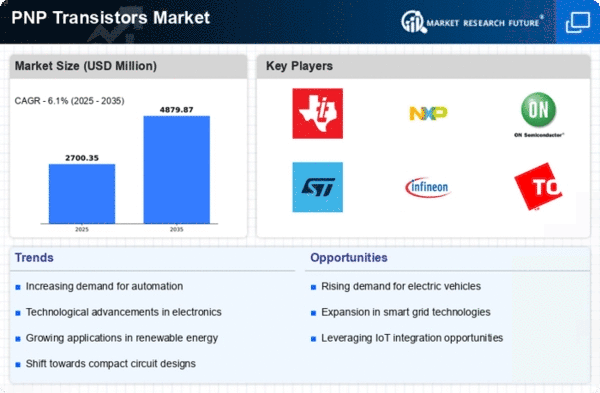
As per MRFR analysis, the PNP Transistors Market Size was estimated at 2545.1 USD Million in 2024. The PNP Transistors industry is projected to grow from 2700.87 in 2025 to 4879.87 by 2035, exhibiting a compound annual growth rate (CAGR) of 6.1 during the forecast period 2025 - 2035.

Key Market Trends & Highlights

The PNP Transistors Market is poised for substantial growth driven by technological advancements and increasing demand across various sectors.

  • Technological advancements are propelling the PNP transistors market, particularly in North America, which remains the largest market. The automotive sector is experiencing a surge in demand for PNP transistors, indicating a shift towards more advanced automotive technologies. Asia-Pacific is emerging as the fastest-growing region, driven by rapid industrialization and increasing consumer electronics production. Technological innovations in electronics and advancements in automotive technology are key drivers fueling market expansion.

Market Size & Forecast

2024 Market Size 2545.1 (USD Million)
2035 Market Size 4879.87 (USD Million)
CAGR (2025 - 2035) 6.1%
Largest Regional Market Share in 2024 Asia-Pacific

Major Players

Texas Instruments (US), NXP Semiconductors (NL), ON Semiconductor (US), STMicroelectronics (FR), Infineon Technologies (DE), Toshiba (JP), Renesas Electronics (JP), Microchip Technology (US)

Market Trends

The PNP Transistors Market is currently experiencing a dynamic phase characterized by evolving technological advancements and increasing demand across various sectors. The integration of PNP transistors in consumer electronics, automotive applications, and industrial machinery appears to be driving growth. As industries seek to enhance efficiency and performance, the adoption of these components is likely to rise. Furthermore, the trend towards miniaturization in electronic devices suggests a potential increase in the utilization of PNP transistors, as they offer compact solutions for power management and signal amplification. In addition, the growing emphasis on renewable energy sources and electric vehicles may further bolster the PNP Transistors Market. Manufacturers are focusing on innovation to meet the changing needs of consumers and industries alike. This shift towards sustainable technologies indicates a promising future for PNP transistors, as they play a crucial role in the development of energy-efficient systems. Overall, the market appears poised for continued expansion, driven by technological progress and a shift towards greener solutions.

Technological Advancements

The PNP Transistors Market is witnessing rapid technological innovations that enhance performance and efficiency. New manufacturing techniques and materials are being developed, which may lead to improved transistor characteristics, such as faster switching speeds and lower power consumption. This trend suggests that manufacturers are increasingly focused on meeting the demands of modern electronic applications.

Growing Demand in Automotive Sector

The automotive industry is increasingly adopting PNP transistors for various applications, including power management and signal processing. As vehicles become more sophisticated with advanced electronic systems, the need for reliable and efficient components is likely to rise. This trend indicates a significant opportunity for growth within the PNP Transistors Market.

Shift Towards Renewable Energy

There is a noticeable shift towards renewable energy solutions, which may positively impact the PNP Transistors Market. As the world moves towards sustainable energy sources, the demand for efficient power management systems is expected to increase. PNP transistors play a vital role in optimizing energy usage, suggesting a growing relevance in this sector.

PNP Transistors Market Market Drivers

Market Growth Projections

The Global PNP Transistors Market Industry is projected to experience substantial growth, with estimates indicating a market value of 2.67 USD Billion in 2024 and a remarkable increase to 5.75 USD Billion by 2035. This growth corresponds to a compound annual growth rate (CAGR) of 7.21% from 2025 to 2035. Such projections reflect the increasing reliance on PNP transistors across various sectors, including consumer electronics, automotive, and renewable energy. As technological advancements continue to shape the landscape, the Global PNP Transistors Market Industry is poised for significant expansion, driven by the demand for efficient and reliable electronic components.

Rise of Renewable Energy Solutions

The Global PNP Transistors Market Industry is positively impacted by the increasing adoption of renewable energy solutions. As countries strive to reduce carbon emissions and transition towards sustainable energy sources, the demand for efficient power conversion systems rises. PNP transistors are integral in solar inverters and wind turbine controllers, ensuring optimal energy conversion and management. This trend aligns with global initiatives aimed at enhancing energy efficiency and sustainability. The anticipated growth in the renewable energy sector further supports the expansion of the Global PNP Transistors Market Industry, as these components become vital in modern energy systems.

Advancements in Automotive Technology

The automotive sector is undergoing a transformation with the integration of advanced electronic systems, which significantly influences the Global PNP Transistors Market Industry. As electric vehicles (EVs) and hybrid vehicles gain traction, the demand for efficient power management solutions increases. PNP transistors are essential in these applications, facilitating better energy efficiency and performance. The automotive electronics market is expected to grow substantially, contributing to the projected growth of the Global PNP Transistors Market Industry, which is anticipated to reach 5.75 USD Billion by 2035. This shift towards electrification in the automotive sector underscores the importance of PNP transistors.

Growing Demand for Consumer Electronics

The Global PNP Transistors Market Industry experiences a surge in demand driven by the increasing consumption of consumer electronics. Devices such as smartphones, tablets, and laptops require efficient power management, where PNP transistors play a crucial role. As the global market for consumer electronics is projected to reach 2.67 USD Billion in 2024, the need for reliable and efficient components like PNP transistors becomes paramount. This trend indicates a robust growth trajectory, as manufacturers seek to enhance device performance and energy efficiency, thereby propelling the Global PNP Transistors Market Industry forward.

Miniaturization of Electronic Components

The trend towards miniaturization in electronics significantly influences the Global PNP Transistors Market Industry. As devices become smaller and more compact, the demand for high-performance transistors that occupy less space increases. PNP transistors, known for their efficiency and reliability, are increasingly utilized in miniaturized applications across various sectors, including telecommunications and consumer electronics. This trend is expected to drive innovation and development within the industry, as manufacturers seek to create smaller, more efficient devices. The growth in miniaturization is likely to contribute to the overall expansion of the Global PNP Transistors Market Industry in the coming years.

Technological Innovations in Semiconductor Manufacturing

Technological advancements in semiconductor manufacturing processes are pivotal for the Global PNP Transistors Market Industry. Innovations such as improved fabrication techniques and materials enhance the performance and efficiency of PNP transistors. These advancements enable manufacturers to produce transistors that meet the growing demands of various applications, from consumer electronics to industrial systems. As the industry evolves, the introduction of new technologies is expected to drive competition and growth within the Global PNP Transistors Market Industry. This dynamic environment fosters continuous improvement and adaptation, ensuring that PNP transistors remain integral to modern electronic systems.

Market Segment Insights

By Application: Amplifiers (Largest) vs. Switching Circuits (Fastest-Growing)

In the PNP Transistors Market, the application segment exhibits a diverse distribution of market share among its key values. Amplifiers hold the largest share due to their widespread use in various electronic devices, including audio systems and telecommunications equipment. Following amplifiers, switching circuits have carved a significant space in the market, driven by their integral role in modern electronic applications, although their share is comparatively smaller than that of amplifiers.

Amplifiers (Dominant) vs. Signal Processing (Emerging)

Amplifiers represent the dominant application in the PNP transistors market, characterized by their essential function in signal enhancement and audio applications. They are used extensively in consumer electronics and industrial equipment, which allows them to maintain a stable market presence. Signal processing, on the other hand, is an emerging segment, reflecting rapid technological advancements and increasing demand for high-speed communication devices. As networks evolve and the need for efficient data transmission rises, signal processing applications are becoming pivotal, indicating a robust growth trajectory in the coming years.

By End Use: Consumer Electronics (Largest) vs. Automotive (Fastest-Growing)

The PNP Transistors Market shows a diverse distribution across various end-use segments, with Consumer Electronics holding the largest share. This segment's dominance is fueled by the increasing demand for gadgets like smartphones, tablets, and wearable technology, where PNP transistors serve crucial roles in signal amplification and switching. Following closely is the Automotive sector, where the transition towards electric vehicles is showcasing significant growth potential, making it a vital area for development in PNP transistor applications. In terms of growth trends, the Automotive segment is emerging as the fastest-growing area within the PNP Transistors Market, primarily due to heightened integration of electronic components in vehicles, coupled with advancements in automotive technologies. The demand for more efficient and reliable electronic systems is driving manufacturers to innovate, thereby accelerating adoption in this sector. The push for smart and connected vehicles, including those equipped with autonomous technologies, further emphasizes the pivotal role of PNP transistors in meeting these evolving requirements.

Consumer Electronics: Dominant vs. Automotive: Emerging

The Consumer Electronics segment remains the dominant player in the PNP Transistors Market, characterized by a high demand for advanced electronic devices. PNP transistors in this sector are integral for circuit design, enabling compact, high-efficiency electronics that cater to consumer preferences for performance and portability. On the other hand, the Automotive segment is labeled as emerging, with rapid advancements in electric vehicles and smart technology integration paving the way for increased utilization of PNP transistors. This shift is driven by the need for enhanced power management systems and improved electronic controls, which are critical for modern automotive applications. Both segments are pivotal in shaping the future landscape of PNP transistor applications.

By Material Type: Silicon (Largest) vs. Silicon Carbide (Fastest-Growing)

In the PNP Transistors Market, Silicon emerges as the largest segment, offering a robust foothold due to its established manufacturing processes and cost-effectiveness. This material has been the backbone of the market, capturing a significant market share owing to its widespread usage in various electronic applications. Comparatively, Silicon Carbide, although smaller in share, is rapidly gaining traction as new applications in high-power and high-temperature environments are being developed, broadening its appeal among manufacturers in the semiconductor space.

Silicon (Dominant) vs. Silicon Carbide (Emerging)

Silicon continues to dominate the PNP Transistors Market due to its versatility and proven performance in electronic components. It offers advantages like lower costs and ease of fabrication, making it the preferred choice for a vast array of applications. On the other hand, Silicon Carbide is an emerging favorite, especially for applications demanding higher efficiency and thermal conductivity. As technology progresses, its ability to handle high voltages and temperatures positions it uniquely for growth in sectors like automotive and renewable energy, promising a transformative impact on the market dynamics in the coming years.

By Packaging Type: Surface Mount Device (Largest) vs. Through Hole (Fastest-Growing)

In the PNP transistors market, the packaging type segment showcases a diverse distribution of market shares. Leading the pack, the Surface Mount Device (SMD) packaging is recognized for its superior performance in compactness and efficiency, making it the largest segment in this category. Following closely, the Through Hole technology, while traditionally favored for its robustness, is witnessing a significant resurgence due to increasing demand in power electronics applications.

Packaging Type: Surface Mount Device (Dominant) vs. Through Hole (Emerging)

The Surface Mount Device (SMD) technology is characterized by its compact size and ability to support high-density arrangements, which are critical in today's miniaturized electronics. Its dominance is largely attributed to its suitability for automated production processes, reducing assembly costs and errors. On the other hand, the Through Hole technology, once viewed as declining, is making a comeback as it offers excellent thermal and electrical performance in high-power applications. As industries look for reliable solutions for tougher environments, Through Hole’s robust construction is gaining traction, positioning it as an emerging choice in the PNP transistors market.

By Power Rating: Medium Power (Largest) vs. High Power (Fastest-Growing)

In the PNP Transistors Market, the power rating segment showcases a diverse landscape, primarily characterized by Low Power, Medium Power, and High Power transistors. Among these, Medium Power transistors hold the largest market share, attributed to their versatility in various applications. Low Power transistors, while significant, represent a smaller portion of the market due to their niche applications. High Power transistors, although currently lesser in market share compared to Medium Power, are on the rise, indicating a shift in consumer demand toward higher energy efficiency and reliability. The trends in power rating are reflective of the broader technological advancements in the transistor market.

Medium Power (Dominant) vs. High Power (Emerging)

Medium Power transistors serve as the backbone of numerous electronic applications, offering a balanced combination of performance and energy efficiency. They dominate the market due to their adaptability in both consumer and industrial applications, producing reliable outputs without excessive energy consumption. In contrast, High Power transistors are emerging as a vital segment driven by increasing demands in high-performance computing, electric vehicles, and renewable energy sectors. Their ability to handle higher voltages and currents positions them favorably in markets requiring superior power management and efficiency. As technology advances, the demand for High Power transistors is expected to rise, enhancing their market position.

Get more detailed insights about PNP Transistors Market Research Report — Global Forecast till 2035

Regional Insights

North America : Innovation and Growth Hub

North America is witnessing robust growth in the PNP transistors market, driven by increasing demand in sectors like automotive, telecommunications, and consumer electronics. The market size reached $763.0M in 2025, reflecting a significant share of the global market. Regulatory support for semiconductor manufacturing and innovation initiatives further catalyze this growth, positioning the region as a leader in technology advancements. The competitive landscape is characterized by key players such as Texas Instruments, ON Semiconductor, and Microchip Technology, which are investing heavily in R&D to enhance product offerings. The U.S. remains the largest market, with Canada and Mexico also contributing to the growth. The presence of established companies and a strong supply chain network bolster the region's market position, ensuring a steady supply of high-quality PNP transistors.

Europe : Emerging Technology Landscape

Europe's PNP transistors market is evolving, with a market size of $508.0M in 2025. The region is experiencing growth driven by increasing investments in renewable energy and electric vehicles, which require efficient semiconductor solutions. Regulatory frameworks promoting sustainability and innovation are key catalysts for market expansion, encouraging companies to adopt advanced technologies and improve energy efficiency in their products. Leading countries like Germany, France, and the Netherlands are at the forefront of this growth, with major players such as NXP Semiconductors and STMicroelectronics leading the charge. The competitive landscape is marked by collaborations and partnerships aimed at enhancing technological capabilities. The European market is poised for further growth as it aligns with global trends towards sustainability and digital transformation.

Asia-Pacific : Dominant Market Leader

Asia-Pacific dominates the PNP transistors market with a substantial market size of $1270.0M in 2025, accounting for the largest share globally. The region's growth is fueled by rapid industrialization, increasing consumer electronics demand, and advancements in automotive technologies. Countries like China, Japan, and South Korea are leading the charge, supported by favorable government policies and investments in semiconductor manufacturing. The competitive landscape is vibrant, with key players such as Toshiba, Renesas Electronics, and Infineon Technologies driving innovation and market expansion. The presence of a robust supply chain and a skilled workforce further enhances the region's capabilities. As the demand for high-performance transistors continues to rise, Asia-Pacific is well-positioned to maintain its leadership in the global market.

Middle East and Africa : Emerging Market Potential

The Middle East and Africa (MEA) region presents a nascent but promising market for PNP transistors, with a market size of $4.1M in 2025. Growth is primarily driven by increasing investments in electronics and telecommunications, as well as government initiatives aimed at boosting local manufacturing capabilities. The region's market is still developing, but there is a growing recognition of the importance of semiconductors in various applications, including renewable energy and smart technologies. Countries like South Africa and the UAE are emerging as key players in the electronics sector, with local companies beginning to invest in semiconductor technologies. The competitive landscape is evolving, with international firms exploring partnerships to tap into the region's potential. As infrastructure improves and demand for electronic devices rises, the MEA market is expected to grow steadily in the coming years.

Key Players and Competitive Insights

The PNP Transistors Market is currently characterized by a dynamic competitive landscape, driven by technological advancements and increasing demand across various sectors, including automotive, consumer electronics, and industrial applications. Major players such as Texas Instruments (US), NXP Semiconductors (NL), and ON Semiconductor (US) are strategically positioned to leverage their extensive R&D capabilities and robust product portfolios. Texas Instruments (US) focuses on innovation in analog and embedded processing, while NXP Semiconductors (NL) emphasizes its strength in automotive and IoT applications. ON Semiconductor (US) is enhancing its market presence through strategic acquisitions and partnerships, which collectively shape a competitive environment that is increasingly focused on technological differentiation and customer-centric solutions.
Key business tactics employed by these companies include localizing manufacturing to reduce costs and optimize supply chains, which is particularly crucial in the current global economic climate. The market structure appears moderately fragmented, with a mix of established players and emerging companies vying for market share. The collective influence of these key players fosters a competitive atmosphere where innovation and operational efficiency are paramount.
In November 2025, Texas Instruments (US) announced the launch of a new series of PNP transistors designed for high-efficiency power management applications. This strategic move is likely to enhance their product offerings and cater to the growing demand for energy-efficient solutions, thereby reinforcing their competitive edge in the market. The introduction of these advanced components aligns with the broader industry trend towards sustainability and energy conservation.
In October 2025, NXP Semiconductors (NL) unveiled a partnership with a leading automotive manufacturer to develop next-generation electric vehicle (EV) systems utilizing their PNP transistor technology. This collaboration not only signifies NXP's commitment to the automotive sector but also positions them favorably in the rapidly evolving EV market, where performance and reliability are critical.
In September 2025, ON Semiconductor (US) completed the acquisition of a smaller semiconductor firm specializing in PNP transistor technology. This acquisition is expected to bolster ON Semiconductor's capabilities in high-performance applications, allowing them to expand their market reach and enhance their technological expertise. Such strategic actions reflect a trend towards consolidation in the industry, as companies seek to strengthen their competitive positions through enhanced capabilities.
As of December 2025, the competitive trends in the PNP Transistors Market are increasingly defined by digitalization, sustainability, and the integration of AI technologies. Strategic alliances are becoming more prevalent, as companies recognize the value of collaboration in driving innovation and addressing market demands. Looking ahead, competitive differentiation is likely to evolve from traditional price-based competition to a focus on technological innovation, supply chain reliability, and sustainable practices, indicating a shift towards a more sophisticated competitive landscape.

Key Companies in the PNP Transistors Market include

Industry Developments

Future Outlook

PNP Transistors Market Future Outlook

The PNP Transistors Market is projected to grow at a 6.1% CAGR from 2025 to 2035, driven by advancements in consumer electronics, automotive applications, and renewable energy technologies.

New opportunities lie in:

  • Development of high-efficiency power amplifiers for telecommunications.
  • Expansion into emerging markets with tailored product offerings.
  • Integration of PNP transistors in smart grid technologies for energy management.

By 2035, the PNP Transistors Market is expected to achieve robust growth, reflecting evolving technological demands.

Market Segmentation

PNP Transistors Market End Use Outlook

  • Consumer Electronics
  • Automotive
  • Telecommunications
  • Industrial Equipment

PNP Transistors Market Application Outlook

  • Amplifiers
  • Switching Circuits
  • Signal Processing
  • Voltage Regulation

PNP Transistors Market Power Rating Outlook

  • Low Power
  • Medium Power
  • High Power

PNP Transistors Market Material Type Outlook

  • Silicon
  • Gallium Arsenide
  • Silicon Carbide

PNP Transistors Market Packaging Type Outlook

  • Surface Mount Device
  • Through Hole
  • Chip

Report Scope

MARKET SIZE 2024 2545.1(USD Million)
MARKET SIZE 2025 2700.87(USD Million)
MARKET SIZE 2035 4879.87(USD Million)
COMPOUND ANNUAL GROWTH RATE (CAGR) 6.1% (2025 - 2035)
REPORT COVERAGE Revenue Forecast, Competitive Landscape, Growth Factors, and Trends
BASE YEAR 2024
Market Forecast Period 2025 - 2035
Historical Data 2019 - 2024
Market Forecast Units USD Million
Key Companies Profiled Texas Instruments (US), NXP Semiconductors (NL), ON Semiconductor (US), STMicroelectronics (FR), Infineon Technologies (DE), Toshiba (JP), Renesas Electronics (JP), Microchip Technology (US)
Segments Covered Application, End Use, Material Type, Packaging Type, Power Rating
Key Market Opportunities Growing demand for energy-efficient devices drives innovation in the PNP Transistors Market.
Key Market Dynamics Rising demand for energy-efficient electronics drives innovation and competition in the PNP transistors market.

Countries Covered North America, Europe, APAC, South America, MEA

FAQs

How much is the PNP transistors market?

The PNP Transistors Market size was valued at USD Significant Value in 2024.

What is the growth rate of the PNP transistors market?

The global market is projected to grow at a CAGR of 0.00% during the forecast period, 2025 to 2035.

Which region held the largest market share in the PNP transistors market?

North America had the largest share in the global market

Who are the key players in the PNP transistors market?

The key players in the market are Rohm Semiconductor, Microchip Technology, Central Semiconductor, Renesas Electronics, Infineon Technologies and Optek Electronics.

Which application led the PNP transistors market?

The inverter circuits category dominated the market in 2022.

Which type had the largest market share in the PNP transistors market?

The bipolar transistor category had the largest share in the global market.

  1. SECTION I: EXECUTIVE SUMMARY AND KEY HIGHLIGHTS
    1. | 1.1 EXECUTIVE SUMMARY
    2. | 1.1.1 Market Overview
    3. | 1.1.2 Key Findings
    4. | 1.1.3 Market Segmentation
    5. | 1.1.4 Competitive Landscape
    6. | 1.1.5 Challenges and Opportunities
    7. | 1.1.6 Future Outlook
  2. SECTION II: SCOPING, METHODOLOGY AND MARKET STRUCTURE
    1. | 2.1 MARKET INTRODUCTION
    2. | 2.1.1 Definition
    3. | 2.1.2 Scope of the study
    4. |-- 2.1.2.1 Research Objective
    5. |-- 2.1.2.2 Assumption
    6. |-- 2.1.2.3 Limitations
    7. | 2.2 RESEARCH METHODOLOGY
    8. | 2.2.1 Overview
    9. | 2.2.2 Data Mining
    10. | 2.2.3 Secondary Research
    11. | 2.2.4 Primary Research
    12. |-- 2.2.4.1 Primary Interviews and Information Gathering Process
    13. |-- 2.2.4.2 Breakdown of Primary Respondents
    14. | 2.2.5 Forecasting Model
    15. | 2.2.6 Market Size Estimation
    16. |-- 2.2.6.1 Bottom-Up Approach
    17. |-- 2.2.6.2 Top-Down Approach
    18. | 2.2.7 Data Triangulation
    19. | 2.2.8 Validation
  3. SECTION III: QUALITATIVE ANALYSIS
    1. | 3.1 MARKET DYNAMICS
    2. | 3.1.1 Overview
    3. | 3.1.2 Drivers
    4. | 3.1.3 Restraints
    5. | 3.1.4 Opportunities
    6. | 3.2 MARKET FACTOR ANALYSIS
    7. | 3.2.1 Value chain Analysis
    8. | 3.2.2 Porter's Five Forces Analysis
    9. |-- 3.2.2.1 Bargaining Power of Suppliers
    10. |-- 3.2.2.2 Bargaining Power of Buyers
    11. |-- 3.2.2.3 Threat of New Entrants
    12. |-- 3.2.2.4 Threat of Substitutes
    13. |-- 3.2.2.5 Intensity of Rivalry
    14. | 3.2.3 COVID-19 Impact Analysis
    15. |-- 3.2.3.1 Market Impact Analysis
    16. |-- 3.2.3.2 Regional Impact
    17. |-- 3.2.3.3 Opportunity and Threat Analysis
  4. SECTION IV: QUANTITATIVE ANALYSIS
    1. | 4.1 Semiconductor & Electronics, BY Application (USD Million)
    2. | 4.1.1 Amplifiers
    3. | 4.1.2 Switching Circuits
    4. | 4.1.3 Signal Processing
    5. | 4.1.4 Voltage Regulation
    6. | 4.2 Semiconductor & Electronics, BY End Use (USD Million)
    7. | 4.2.1 Consumer Electronics
    8. | 4.2.2 Automotive
    9. | 4.2.3 Telecommunications
    10. | 4.2.4 Industrial Equipment
    11. | 4.3 Semiconductor & Electronics, BY Material Type (USD Million)
    12. | 4.3.1 Silicon
    13. | 4.3.2 Gallium Arsenide
    14. | 4.3.3 Silicon Carbide
    15. | 4.4 Semiconductor & Electronics, BY Packaging Type (USD Million)
    16. | 4.4.1 Surface Mount Device
    17. | 4.4.2 Through Hole
    18. | 4.4.3 Chip
    19. | 4.5 Semiconductor & Electronics, BY Power Rating (USD Million)
    20. | 4.5.1 Low Power
    21. | 4.5.2 Medium Power
    22. | 4.5.3 High Power
    23. | 4.6 Semiconductor & Electronics, BY Region (USD Million)
    24. | 4.6.1 North America
    25. |-- 4.6.1.1 US
    26. |-- 4.6.1.2 Canada
    27. | 4.6.2 Europe
    28. |-- 4.6.2.1 Germany
    29. |-- 4.6.2.2 UK
    30. |-- 4.6.2.3 France
    31. |-- 4.6.2.4 Russia
    32. |-- 4.6.2.5 Italy
    33. |-- 4.6.2.6 Spain
    34. |-- 4.6.2.7 Rest of Europe
    35. | 4.6.3 APAC
    36. |-- 4.6.3.1 China
    37. |-- 4.6.3.2 India
    38. |-- 4.6.3.3 Japan
    39. |-- 4.6.3.4 South Korea
    40. |-- 4.6.3.5 Malaysia
    41. |-- 4.6.3.6 Thailand
    42. |-- 4.6.3.7 Indonesia
    43. |-- 4.6.3.8 Rest of APAC
    44. | 4.6.4 South America
    45. |-- 4.6.4.1 Brazil
    46. |-- 4.6.4.2 Mexico
    47. |-- 4.6.4.3 Argentina
    48. |-- 4.6.4.4 Rest of South America
    49. | 4.6.5 MEA
    50. |-- 4.6.5.1 GCC Countries
    51. |-- 4.6.5.2 South Africa
    52. |-- 4.6.5.3 Rest of MEA
  5. SECTION V: COMPETITIVE ANALYSIS
    1. | 5.1 Competitive Landscape
    2. | 5.1.1 Overview
    3. | 5.1.2 Competitive Analysis
    4. | 5.1.3 Market share Analysis
    5. | 5.1.4 Major Growth Strategy in the Semiconductor & Electronics
    6. | 5.1.5 Competitive Benchmarking
    7. | 5.1.6 Leading Players in Terms of Number of Developments in the Semiconductor & Electronics
    8. | 5.1.7 Key developments and growth strategies
    9. |-- 5.1.7.1 New Product Launch/Service Deployment
    10. |-- 5.1.7.2 Merger & Acquisitions
    11. |-- 5.1.7.3 Joint Ventures
    12. | 5.1.8 Major Players Financial Matrix
    13. |-- 5.1.8.1 Sales and Operating Income
    14. |-- 5.1.8.2 Major Players R&D Expenditure. 2023
    15. | 5.2 Company Profiles
    16. | 5.2.1 Texas Instruments (US)
    17. |-- 5.2.1.1 Financial Overview
    18. |-- 5.2.1.2 Products Offered
    19. |-- 5.2.1.3 Key Developments
    20. |-- 5.2.1.4 SWOT Analysis
    21. |-- 5.2.1.5 Key Strategies
    22. | 5.2.2 NXP Semiconductors (NL)
    23. |-- 5.2.2.1 Financial Overview
    24. |-- 5.2.2.2 Products Offered
    25. |-- 5.2.2.3 Key Developments
    26. |-- 5.2.2.4 SWOT Analysis
    27. |-- 5.2.2.5 Key Strategies
    28. | 5.2.3 ON Semiconductor (US)
    29. |-- 5.2.3.1 Financial Overview
    30. |-- 5.2.3.2 Products Offered
    31. |-- 5.2.3.3 Key Developments
    32. |-- 5.2.3.4 SWOT Analysis
    33. |-- 5.2.3.5 Key Strategies
    34. | 5.2.4 STMicroelectronics (FR)
    35. |-- 5.2.4.1 Financial Overview
    36. |-- 5.2.4.2 Products Offered
    37. |-- 5.2.4.3 Key Developments
    38. |-- 5.2.4.4 SWOT Analysis
    39. |-- 5.2.4.5 Key Strategies
    40. | 5.2.5 Infineon Technologies (DE)
    41. |-- 5.2.5.1 Financial Overview
    42. |-- 5.2.5.2 Products Offered
    43. |-- 5.2.5.3 Key Developments
    44. |-- 5.2.5.4 SWOT Analysis
    45. |-- 5.2.5.5 Key Strategies
    46. | 5.2.6 Toshiba (JP)
    47. |-- 5.2.6.1 Financial Overview
    48. |-- 5.2.6.2 Products Offered
    49. |-- 5.2.6.3 Key Developments
    50. |-- 5.2.6.4 SWOT Analysis
    51. |-- 5.2.6.5 Key Strategies
    52. | 5.2.7 Renesas Electronics (JP)
    53. |-- 5.2.7.1 Financial Overview
    54. |-- 5.2.7.2 Products Offered
    55. |-- 5.2.7.3 Key Developments
    56. |-- 5.2.7.4 SWOT Analysis
    57. |-- 5.2.7.5 Key Strategies
    58. | 5.2.8 Microchip Technology (US)
    59. |-- 5.2.8.1 Financial Overview
    60. |-- 5.2.8.2 Products Offered
    61. |-- 5.2.8.3 Key Developments
    62. |-- 5.2.8.4 SWOT Analysis
    63. |-- 5.2.8.5 Key Strategies
    64. | 5.3 Appendix
    65. | 5.3.1 References
    66. | 5.3.2 Related Reports

Semiconductor & Electronics Market Segmentation

Semiconductor & Electronics By Application (USD Million, 2025-2035)

  • Amplifiers
  • Switching Circuits
  • Signal Processing
  • Voltage Regulation

Semiconductor & Electronics By End Use (USD Million, 2025-2035)

  • Consumer Electronics
  • Automotive
  • Telecommunications
  • Industrial Equipment

Semiconductor & Electronics By Material Type (USD Million, 2025-2035)

  • Silicon
  • Gallium Arsenide
  • Silicon Carbide

Semiconductor & Electronics By Packaging Type (USD Million, 2025-2035)

  • Surface Mount Device
  • Through Hole
  • Chip

Semiconductor & Electronics By Power Rating (USD Million, 2025-2035)

  • Low Power
  • Medium Power
  • High Power
Infographic

Free Sample Request

Kindly complete the form below to receive a free sample of this Report

Get Free Sample

Customer Strories

Compare Licence

×
Features License Type
Single User Multiuser License Enterprise User
Price $4,950 $5,950 $7,250
Maximum User Access Limit 1 User Upto 10 Users Unrestricted Access Throughout the Organization
Free Customization
Direct Access to Analyst
Deliverable Format
Platform Access
Discount on Next Purchase 10% 15% 15%
Printable Versions