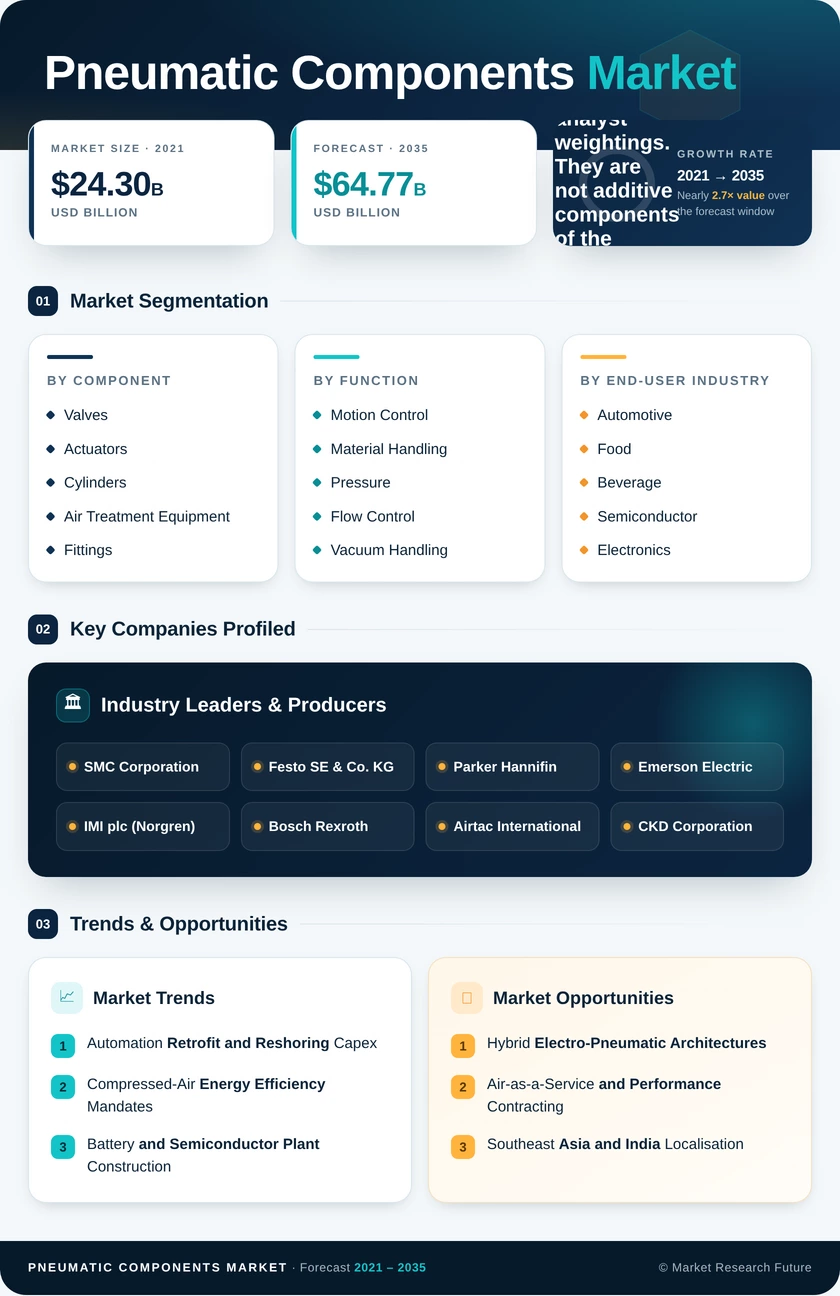
Segmentation Quick Reference
| Dimension | Sub-Segments | Dominant Segment | Fastest Growing Segment |
| By Component | Valves; Actuators and Cylinders; Air Treatment Equipment; Fittings and Tubing; Vacuum and Gripping Devices; Other Components | Valves | Actuators and Cylinders |
| By Function | Motion Control; Material Handling; Pressure and Flow Control; Vacuum Handling | Motion Control | Material Handling |
| By End-User Industry | Automotive; Food and Beverage; Semiconductor and Electronics; Machine Tools and General Manufacturing; Packaging; Life Sciences and Pharmaceuticals; Oil, Gas and Chemicals; Other Industries | Automotive | Life Sciences and Pharmaceuticals |
| By Pressure Range | Low Pressure (up to 5 bar); Medium Pressure (5–10 bar); High Pressure (above 10 bar) | Low Pressure | High Pressure |
| By Region | North America; Europe; Asia-Pacific; South America; Middle East & Africa | North America | Asia-Pacific |
Market Segmentation Overview
By Component
| Sub-Segment | Key Trend |
| Valves | Migration from discrete valves to networked terminals with IO-Link diagnostics |
| Actuators and Cylinders | Standardised mounting interfaces enabling multi-brand sourcing and faster replacement |
| Air Treatment Equipment | Purity class upgrades driven by hygienic and clean-room specifications |
| Fittings and Tubing | Leak-reduction programs favouring higher-integrity connector designs |
| Vacuum and Gripping Devices | Growth tied to collaborative robot and end-of-arm tooling deployments |
| Other Components | Sensor and accessory content rising per machine as monitoring spreads |
Component revenue concentrates in valves and actuation, which together account for close to six of every ten dollars spent. Air treatment is the quiet outperformer in value terms, as filtration and drying specifications climb in regulated industries. Fittings and tubing punch above their share of the bill of materials because they sit at the centre of every leak-reduction campaign.
By Function
| Sub-Segment | Key Trend |
| Motion Control | Adaptive pressure regulation trimming supply to per-cycle force requirements |
| Material Handling | Expansion of line-side and warehouse automation across all end-user industries |
| Pressure and Flow Control | Tighter regulation accuracy demanded in continuous process plants |
| Vacuum Handling | Electronics and packaging throughput driving generator and cup demand |
Functional demand is shifting from static clamping toward dynamic transfer. Material handling now grows faster than motion control in every region tracked, reflecting how automation budgets are being allocated. Pressure and flow control remains the most defensible niche for incumbent process suppliers, since qualification cycles are long and switching costs are high.
By End-User Industry
| Sub-Segment | Key Trend |
| Automotive | Application mix rotating from powertrain machining toward battery and e-drive assembly |
| Food and Beverage | Washdown and hygienic design requirements lifting realized price per unit |
| Semiconductor and Electronics | Clean-room grade specifications tied to fab commissioning schedules |
| Machine Tools and General Manufacturing | Workholding and chip management sustaining steady replacement demand |
| Packaging | Higher line speeds and rapid format changeover raising component counts |
| Life Sciences and Pharmaceuticals | Validated components and change-control documentation creating switching costs |
| Oil, Gas and Chemicals | Turnaround cycles governing process valve actuation spend |
| Other Industries | Mining, textiles and printing contributing stable replacement volume |
End-user concentration has narrowed since 2021, which reduces the sector's exposure to automotive cycles. Regulated industries — pharma, food and semiconductors — now supply the highest-margin demand because their specifications restrict the qualified supplier pool. General manufacturing continues to provide the broad replacement base that stabilises revenue between capex cycles.
By Pressure Range
| Sub-Segment | Key Trend |
| Low Pressure (up to 5 bar) | Demand-side regulation lowering set points to cut energy consumption |
| Medium Pressure (5–10 bar) | Standard shop-air band retaining the largest installed circuit population |
| High Pressure (above 10 bar) | PET blow moulding, test benches and hydrogen handling driving premium demand |
Pressure banding matters commercially because it determines sealing technology, material selection and certification burden. Low and medium bands together cover most installed circuits and behave like a mature replacement market. High-pressure hardware grows fastest and carries the widest margins, since few suppliers hold the certifications required for hydrogen-adjacent and high-cycle blow-moulding applications.


 Noah Malgeri
Co-Founder

 Peter Groot koerkamp
Account and Business Manager

 Younghwan Choi
Senior Retail Manager

 Mark Irwin
Management Consultant

 Akif Moroglu
Strategy & Business Development Director

 Guilherme Gomes Martins
Product Management Director

 Joseph Aguayo
Sales Operations & Pricing Manager

 La Terria Dodd
Program Support Specialist

 Rob Kooiker
Group Product Manager HVAC & Fire Protection GMA