Request Free Sample ×

Kindly complete the form below to receive a free sample of this Report

* Please use a valid business email

Leading companies partner with us for data-driven Insights

clients tt-cursor
Hero Background
English
Chinese
French
Japanese
Korean
German
Spanish

Plywood Market Trends

ID: MRFR/PCM/8884-HCR
110 Pages
Varsha More
March 2026

Plywood Market Research Report Information, By Grade (MR Grade, BWR Grade, Fire Resistant Grade, BWP Grade, and Structural Grade), By Wood Type (Softwood and Hardwood), By Application (Furniture, Flooring & Construction, Automotive Interior, Packaging, Marine, and Others), And By Region (North America, Europe, Asia-Pacific, And Rest Of The World) – Market Forecast Till 2035

Share:
Download PDF ×

We do not share your information with anyone. However, we may send you emails based on your report interest from time to time. You may contact us at any time to opt-out.

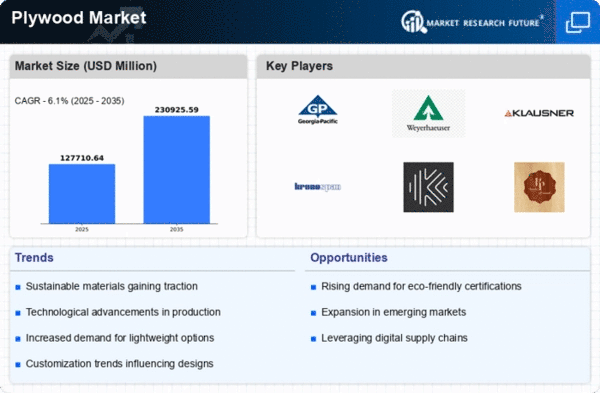
Plywood Market Infographic
Purchase Options

Market Trends

Key Emerging Trends in the Plywood Market

The Plywood Market is experiencing outstanding developments motivated by factors consisting of modifications in production practices, sustainability issues, technological improvements, and global financial dynamics. These developments are reshaping the plywood industry and impacting numerous sectors that depend upon this flexible building material. A good-sized fashion in the Plywood Market is the growing demand for sustainable and certified merchandise. Consumers and industries are increasingly aware of environmental impacts, mainly due to a preference for plywood licensed via corporations like the Forest Stewardship Council (FSC). This fashion displays a broader shift closer to accountable sourcing and sustainable forestry practices. The construction and real estate sectors are using the increase in the Plywood Market. With multiplied production activities globally, there is a surge in demand for plywood as an essential building cloth. The Plywood Market is going through challenges from alternative substances and substitutes, which include engineered wooden merchandise and synthetic materials. While plywood remains a dominant desire, competition from substitutes is prompting producers to recognize innovation, exceptional improvement, and value-effectiveness to keep their marketplace share. Plywood production is sensitive to fluctuations in uncooked cloth fees, specifically timber expenses. The Plywood Market is encouraged by the provision and price of raw materials, including timber. External elements, together with climate situations and global supply chain disruptions, can impact the pricing dynamics inside the plywood enterprise, affecting manufacturers and purchasers alike. The Plywood Market is stimulated via global alternate dynamics and supply chain demanding situations. Factors along with tariffs, exchange guidelines, and geopolitical events can affect the supply and pricing of plywood in special areas. In areas prone to wildfires and where constructing codes require fire-resistant substances, there may be a developing fashion closer to the use of hearth-retardant plywood. Treated plywood with greater resistance to moisture, bugs, and rot is also gaining a reputation, especially in packages where durability is vital. Plywood manufacturers are responding to a demand for custom-designed and aesthetically attractive products. This includes imparting a variety of finishes, textures, and ornamental veneers. Architects are more and more incorporating plywood with precise visible characteristics into their projects, using the demand for strong points and designer plywood products. The Plywood Market is adapting to converting buying patterns, with an increasing presence on e-commerce systems and a focus on virtual advertising and marketing.


Author
Author Profile
Varsha More
Senior Research Analyst

Experienced business professional with a demonstrated history of working in the CFnB industry. Skilled in market research, and market estimation. Strong professional with a Masters focused in marketing management.

Leave a Comment

FAQs

What is the current valuation of the Plywood Market as of 2024?

<p>The overall market valuation of the Plywood Market was 120368.18 USD Million in 2024.</p>

What is the projected market valuation for the Plywood Market in 2035?

<p>The projected valuation for the Plywood Market in 2035 is 230925.59 USD Million.</p>

What is the expected CAGR for the Plywood Market during the forecast period 2025 - 2035?

<p>The expected CAGR for the Plywood Market during the forecast period 2025 - 2035 is 6.1%.</p>

Which companies are considered key players in the Plywood Market?

<p>Key players in the Plywood Market include Georgia-Pacific LLC, Weyerhaeuser Company, Klausner Holz Niedersachsen GmbH, and Kronospan.</p>

What are the major applications of plywood and their market valuations?

<p>Major applications include Construction valued at 96000.0 USD Million and Furniture valued at 48000.0 USD Million.</p>

How is the Plywood Market segmented by end use?

<p>The market is segmented by end use with Residential valued at 60000.0 USD Million and Commercial at 50000.0 USD Million.</p>

What are the different material types of plywood and their valuations?

<p>Material types include Softwood Plywood valued at 80000.0 USD Million and Hardwood Plywood at 60000.0 USD Million.</p>

What thickness categories exist in the Plywood Market?

Thickness categories include Thick Plywood valued at 109000.0 USD Million and Medium Plywood at 96000.0 USD Million.

What is the market valuation for the packaging application of plywood?

The market valuation for the packaging application of plywood is 24000.0 USD Million.

How does the Plywood Market's growth potential appear in the coming years?

The Plywood Market's growth potential appears robust, with a projected increase in valuation and a steady CAGR of 6.1% from 2025 - 2035.

Market Summary

As per MRFR analysis, the The Plywood Market Size was estimated at 50.63 USD Billion in 2024. The Plywood industry is projected to grow from 53.2 USD Billion in 2025 to 86.6 USD Billion by 2035, exhibiting a compound annual growth rate (CAGR) of 5% during the forecast period 2025 - 2035.

Key Market Trends & Highlights

The plywood market is experiencing a dynamic shift towards sustainability and customization, driven by urbanization and technological advancements.

  • The North American plywood market remains the largest, driven by robust demand in the furniture segment. Asia-Pacific is the fastest-growing region, with increasing urbanization fueling the construction segment. Customization demand is rising as consumers seek tailored solutions in both furniture and construction applications. Technological advancements and the expansion of the furniture industry are key drivers propelling market growth.

Market Size & Forecast

2024 Market Size 50.63 (USD Billion)
2035 Market Size 86.6 (USD Billion)
CAGR (2025 - 2035) 5%
Largest Regional Market Share in 2024 Asia-Pacific

Major Players

Weyerhaeuser, Georgia‑Pacific, Boise Cascade, UPM‑Kymmene, SVEZA Group, West Fraser Timber, Metsä Group, Arauco, Greenply Industries, and Century Plyboards.

Market Trends

The The Plywood Market is currently experiencing a dynamic phase characterized by evolving consumer preferences and technological advancements. As sustainability becomes a focal point for many industries, the demand for eco-friendly plywood options appears to be on the rise. Manufacturers are increasingly adopting sustainable practices, which may enhance their market positioning and appeal to environmentally conscious consumers. Furthermore, innovations in production techniques are likely to improve the quality and durability of plywood products, potentially leading to broader applications across various sectors, including construction and furniture manufacturing. In addition to sustainability, the Plywood Market is witnessing a shift towards customization. Consumers are seeking tailored solutions that meet specific design and functional requirements. This trend suggests that manufacturers who can offer bespoke products may gain a competitive edge. Moreover, the growing trend of urbanization and infrastructure development in emerging economies could further stimulate demand for plywood, as it is a preferred material for both residential and commercial projects. Overall, the Plywood Market appears poised for growth, driven by these multifaceted trends that reflect changing consumer needs and industry innovations.

Sustainability Focus

The emphasis on sustainable practices is reshaping the Plywood Market. Manufacturers are increasingly prioritizing eco-friendly materials and production methods, which may attract environmentally aware consumers.

Customization Demand

There is a noticeable shift towards customized plywood solutions. Consumers are looking for products that cater to specific needs, suggesting that companies offering tailored options could stand out in the market.

Urbanization Impact

The ongoing urbanization and infrastructure development in various regions are likely to boost the demand for plywood. As cities expand, the need for versatile building materials becomes more pronounced.

Plywood Market Market Drivers

Market Growth Projections

The Global Plywood Market Industry is projected to experience substantial growth, with estimates indicating a market value of 230.9 USD Billion by 2035. This growth trajectory is supported by various factors, including rising construction activities, increasing demand from the furniture sector, and technological advancements in production processes. The anticipated CAGR of 6.1% from 2025 to 2035 further underscores the industry's potential for expansion. Market dynamics suggest that plywood will continue to play a crucial role in multiple sectors, reinforcing its position as a preferred material in both residential and commercial applications.

Rising Construction Activities

The Global Plywood Market Industry experiences a notable surge due to increasing construction activities worldwide. As urbanization accelerates, particularly in developing nations, the demand for plywood in residential and commercial projects rises. In 2024, the market is valued at approximately 120.4 USD Billion, reflecting the industry's robust growth. Plywood Market serves as a preferred material for flooring, roofing, and wall sheathing, owing to its strength and versatility. The construction sector's expansion, driven by government initiatives and private investments, suggests a sustained upward trajectory for plywood consumption, indicating its integral role in modern architecture.

Sustainable Building Practices

The Global Plywood Market Industry is significantly influenced by the growing emphasis on sustainable building practices. As environmental concerns gain prominence, builders and architects increasingly prefer plywood due to its renewable nature and lower carbon footprint compared to alternative materials. This shift towards eco-friendly construction is evident in various regions, where regulations encourage the use of sustainable materials. The market's projected growth, with a CAGR of 6.1% from 2025 to 2035, underscores the potential for plywood as a sustainable choice in the construction industry. This trend not only aligns with global sustainability goals but also enhances the market's appeal to environmentally conscious consumers.

Expansion of Automotive Applications

The Global Plywood Market Industry is witnessing an expansion in automotive applications, where plywood is increasingly utilized for interior components and lightweight structures. The automotive sector's focus on reducing vehicle weight to improve fuel efficiency aligns with plywood's lightweight properties. As manufacturers seek sustainable alternatives to traditional materials, plywood emerges as a viable option for interior panels and other components. This trend suggests a diversification of plywood applications beyond construction and furniture, potentially driving market growth. The integration of plywood in automotive design reflects the industry's adaptability and responsiveness to evolving consumer demands.

Growing Demand from Furniture Industry

The Global Plywood Market Industry benefits from the burgeoning demand for plywood in the furniture sector. As consumer preferences shift towards stylish and functional furniture, plywood's versatility and aesthetic appeal make it a favored choice among manufacturers. The rise of e-commerce and online furniture retailing further fuels this demand, as consumers seek customizable and affordable options. The industry's growth trajectory is supported by the increasing value of the furniture market, which is expected to enhance plywood consumption significantly. This trend indicates that the furniture industry's evolution is likely to play a pivotal role in shaping the future of the plywood market.

Technological Advancements in Production

Technological advancements in plywood production processes are reshaping the Global Plywood Market Industry. Innovations such as improved adhesive formulations and advanced manufacturing techniques enhance product quality and durability. These advancements enable manufacturers to produce plywood that meets stringent performance standards, catering to diverse applications in construction and furniture. As a result, the market is poised for growth, with projections indicating a rise to 230.9 USD Billion by 2035. Enhanced production efficiency also contributes to cost reductions, making plywood a more competitive option against alternative materials. This technological evolution appears to be a key driver in sustaining the industry's momentum.

Market Segment Insights

By Application: Furniture (Largest) vs. Construction (Fastest-Growing)

In the plywood market, the application segment is predominantly driven by furniture, which holds the largest market share due to its versatility and aesthetic appeal in home and office environments. Construction follows closely, leveraging plywood for its structural integrity and lightweight properties, making it a preferred choice among builders and contractors. Other segments like interior design, packaging, and flooring also contribute to the market, albeit at smaller scales, showcasing a diverse range of applications.

Furniture (Dominant) vs. Construction (Emerging)

The furniture sector remains the dominant force within the plywood application segment, recognized for its adaptation to various design trends and consumer preferences. It encompasses a wide range of products, from residential furnishings to office setups, emphasizing aesthetics and functionality. Conversely, the construction segment is emerging rapidly, spurred by increased infrastructure developments and a shift toward sustainable building materials. Plywood's attributes, such as ease of installation and cost-effectiveness, position it as a favorable alternative in modern construction projects. As both segments evolve, furniture will likely maintain its dominant status, while construction is poised for significant growth, driven by ongoing urbanization trends and regulatory shifts favoring eco-friendly materials.

By End Use: Residential (Largest) vs. Commercial (Fastest-Growing)

<p>In the Plywood Market, the distribution of market share across end-use segments reveals that the Residential sector holds the largest share, driven by the continuous demand for housing and home improvement projects. The Commercial segment follows, primarily influenced by increased investments in office buildings, retail spaces, and hospitality projects. Meanwhile, the Institutional and Industrial segments are also significant but represent a smaller portion of the overall market, catering to specific applications such as schools, hospitals, and manufacturing facilities.</p>

<p>Residential (Dominant) vs. Commercial (Emerging)</p>

<p>The Residential segment is characterized by its robust demand due to the growth in the housing sector and home renovations. It has established itself as the dominant force in the plywood market, largely fueled by trends in sustainable building practices and aesthetic preferences for natural wood finishes. Conversely, the Commercial segment is emerging rapidly, spurred by rising commercial construction projects and the need for durable, versatile materials. Both segments are essential, with Residential prioritizing stability and familiarity, while Commercial focuses on innovative designs and functionality. The interplay between these segments highlights evolving trends in consumer preferences, where sustainability and design are paramount.</p>

By Material Type: Hardwood Plywood (Largest) vs. Softwood Plywood (Fastest-Growing)

<p>In the plywood market, the distribution of market share across the material types reveals that hardwood plywood holds the largest share due to its high durability and aesthetic appeal, making it a preferred choice for furniture and high-end construction applications. Meanwhile, softwood plywood, characterized by its light weight and cost-effectiveness, is gaining traction and is expected to showcase significant growth trends as demand increases in the construction and DIY sectors.</p>

<p>Hardwood Plywood: Dominant vs. Softwood Plywood: Emerging</p>

<p>Hardwood plywood is renowned for its superior quality and strength, making it the dominant player in the market, particularly favored in applications that demand durability and visual appeal. Its use in luxury furniture and cabinetry underlines its position. On the other hand, softwood plywood, although traditionally perceived as less premium, is emerging rapidly due to its affordability and versatility, allowing for mass production and widespread use in residential and commercial construction projects. Its increasing adoption in green building initiatives further highlights its potential growth.</p>

By Thickness: Thick Plywood (Largest) vs. Thin Plywood (Fastest-Growing)

<p>The plywood market exhibits a diverse distribution of thickness segments, with Thick Plywood currently dominating the market. The preference for thicker plywood arises from its robust properties, making it ideal for heavy-duty applications in construction and furniture manufacturing. Meanwhile, Thin Plywood, gaining traction due to its lightweight nature and versatility, is witnessing an impressive rise in market share as consumers seek solutions that optimize space without compromising quality.</p>

<p>Thickness: Thick Plywood (Dominant) vs. Thin Plywood (Emerging)</p>

<p>Thick Plywood is recognized for its superior durability and strength, making it the go-to choice for structural applications. Its application spans commercial and residential sectors where load-bearing capabilities are paramount. Conversely, Thin Plywood is becoming increasingly popular in DIY projects, interior design, and lightweight furniture due to its ease of handling and lower material costs. This emerging segment is leveraging trends towards minimalistic designs and sustainable materials, appealing to a broader consumer base looking for functional yet stylish solutions.</p>

By Finish Type: Natural (Largest) vs. Laminated (Fastest-Growing)

In the plywood market, the Finish Type segment displays a diverse distribution of market share among its key categories: Natural, Laminated, Painted, and Textured. Natural finish holds the largest portion of the market, appealing to environmentally conscious consumers with its organic aesthetics. Following it, Laminated finish is rapidly gaining traction due to its versatility and innovative designs. Painted and Textured finishes cater to niche markets, though they occupy smaller shares comparatively, providing unique options for specific applications where aesthetics are critical.

Natural (Dominant) vs. Laminated (Emerging)

Natural finish plywood represents a dominant choice in the market, prized for its authenticity and ecological appeal. It finds applications in furniture, cabinetry, and architectural elements, where organic beauty is paramount. On the other hand, Laminated finish plywood is emerging as a popular alternative, favored for its robust surface properties and design flexibility. This type is often used in high-traffic areas, providing durability without compromising on style. The innovation in laminated finishes, such as high-resolution printing and textures, is driving its growth, making it a competitive choice against natural finishes.

Get more detailed insights about Plywood Market Research Report - Global Forecast till 2035

Regional Insights

North America : Established Market Leaders

The North American plywood market is projected to reach $30,000 million by December 2025, driven by robust construction activities and increasing demand for sustainable building materials. Regulatory support for eco-friendly products and innovations in manufacturing processes are key growth catalysts. The region's market share reflects a strong commitment to sustainable forestry practices and compliance with environmental regulations, enhancing consumer confidence. Leading players such as Georgia-Pacific LLC and Weyerhaeuser Company dominate the market, leveraging advanced technologies and extensive distribution networks. The competitive landscape is characterized by a focus on product quality and sustainability, with companies investing in R&D to meet evolving consumer preferences. The U.S. remains the largest market, while Canada is also witnessing significant growth in plywood consumption.

Europe : Sustainable Innovation Hub

Europe's plywood market is expected to reach €25,000 million by December 2025, driven by increasing demand for eco-friendly construction materials and stringent regulations promoting sustainability. The region's market share is bolstered by initiatives aimed at reducing carbon footprints and enhancing energy efficiency in buildings. Regulatory frameworks across EU member states are encouraging the use of certified wood products, fostering a shift towards sustainable practices in the industry. Germany, Austria, and the UK are leading countries in plywood production and consumption, with key players like Klausner Holz Niedersachsen GmbH and Kronospan at the forefront. The competitive landscape is marked by innovation in product offerings, including engineered wood products that meet diverse consumer needs. The focus on sustainability and compliance with EU regulations positions Europe as a leader in The Plywood.

Asia-Pacific : Emerging Powerhouse in Plywood

The Asia-Pacific plywood market is projected to reach $60,000 million by December 2025, making it the largest regional market. Rapid urbanization, population growth, and increasing construction activities are driving demand for plywood products. The region's market share reflects a strong focus on affordable housing and infrastructure development, supported by government initiatives and investments in the construction sector. China and India are the leading countries in plywood production and consumption, with significant contributions from local manufacturers. Key players like Katerra and Kraft Plywood are expanding their operations to meet the growing demand. The competitive landscape is characterized by a mix of established companies and emerging players, all striving to innovate and enhance product offerings to capture market share in this dynamic region.

Middle East and Africa : Growing Market Potential

The Middle East and Africa plywood market is expected to reach $5,008.18 million by December 2025, driven by increasing construction activities and a growing focus on sustainable building materials. The region's market share is gradually expanding as governments invest in infrastructure projects and promote the use of eco-friendly products. Regulatory frameworks are evolving to support sustainable practices, enhancing market growth prospects. Countries like South Africa and the UAE are leading the way in plywood consumption, with local manufacturers and importers working to meet rising demand. The competitive landscape is characterized by a mix of established players and new entrants, all aiming to capitalize on the growing market potential. Key players such as Kuwait Plywood Company are focusing on innovation and quality to strengthen their market position.

Key Players and Competitive Insights

The Plywood Market is currently characterized by a dynamic competitive landscape, driven by factors such as increasing demand for sustainable building materials, technological advancements, and a growing emphasis on eco-friendly production processes. Major players like Georgia-Pacific LLC (US), Weyerhaeuser Company (US), and Klausner Holz Niedersachsen GmbH (DE) are strategically positioning themselves to capitalize on these trends. Georgia-Pacific LLC (US) focuses on innovation in product development, particularly in engineered wood products, which enhances its market presence. Weyerhaeuser Company (US) emphasizes sustainable forestry practices, aligning its operations with environmental standards, while Klausner Holz Niedersachsen GmbH (DE) is expanding its production capacity to meet rising demand in Europe, thereby shaping the competitive environment through operational efficiency and sustainability initiatives.Key business tactics within the Plywood Market include localizing manufacturing and optimizing supply chains to enhance responsiveness to regional demands. The market structure appears moderately fragmented, with several key players exerting influence over pricing and product offerings. This fragmentation allows for a diverse range of products, catering to various customer preferences, while also fostering competition among established and emerging companies.
In November Weyerhaeuser Company (US) announced a partnership with a leading technology firm to develop AI-driven solutions for optimizing its supply chain management. This strategic move is likely to enhance operational efficiency and reduce costs, positioning Weyerhaeuser as a leader in technological integration within the industry. The partnership underscores the growing importance of digital transformation in the Plywood Market, as companies seek to leverage technology for competitive advantage.
In October Klausner Holz Niedersachsen GmbH (DE) unveiled plans to invest €50 million in expanding its production facilities in Germany. This expansion is expected to increase output capacity by 30%, allowing the company to better serve the European market. The investment reflects Klausner's commitment to meeting the rising demand for high-quality plywood products and reinforces its competitive position in a rapidly evolving market.
In September Georgia-Pacific LLC (US) launched a new line of eco-friendly plywood products made from sustainably sourced materials. This initiative not only caters to the growing consumer preference for sustainable products but also enhances Georgia-Pacific's brand image as a responsible manufacturer. The introduction of these products is indicative of a broader trend towards sustainability in the Plywood Market, where companies are increasingly focusing on environmentally friendly practices.
As of December current competitive trends in the Plywood Market are heavily influenced by digitalization, sustainability, and the integration of advanced technologies. Strategic alliances are becoming more prevalent, as companies recognize the need to collaborate to enhance innovation and efficiency. The competitive differentiation is likely to evolve from traditional price-based competition to a focus on innovation, technology adoption, and supply chain reliability, reflecting a shift in market dynamics that prioritizes long-term sustainability and customer-centric solutions.

Key Companies in the Plywood Market include

Industry Developments

June 2021: A sawmill was constructed by Canfor close to DeRidder, Louisiana, with an estimated USD 160.00 million investment. This new sawmill will have the versatility and manufacturing capacity to produce a range of high-value wood products. For the business to expand in the market, this will assist it in expanding its operational footprint and manufacturing capacity.

February 2021: The high-quality Alabama timberlands will be purchased by Weyerhaeuser Company from Soterra for 69,200 acres. For about $149.00 million, the business bought these timberlands. In addition to growing its clientele and potential export markets, the company will improve its operations in the timberland sector.

May 2023 Greenply Industries (India) developed a fire-retardant plywood that addresses hazardous fires in residential and commercial spaces, advancing FR grade market development

February 2023: Lumin to Invest $136M in New Plywood Market Mill in Uruguay, Expanding Production Capacity to Nearly 500,000 m3.Lumin, a leading timberland and forest products company, will invest ~US$ 136 million to build its third industrial plant in Uruguay, which is expected to create more than 300 jobs and significantly increase the country’s sustainable plywood production.

The announcement was made this afternoon in Melo at an event attended by the President of Uruguay, Luis Lacalle Pou, the Mayor of Cerro Largo Department, José Yurramendi, and Lumin’s CEO, Álvaro Molinari.February 2023: Plyneer Plans to cross Rs 100 CR revenue by launching its services in more than 20 Indian cities and towns.Plyneer's diverse range of product portfolio now includes commercial Plywood Market, mdf, Hdihmr, Laminates, Veneers, Fingerjoint Boards, Flexi Ply, Acrylic, wpc and many more. What makes Plyneer stand out from its market peers is its careful attention to after-sales services.

The brand offers a guaranteed replacement for any quality issues and solves any other issues at the site.July 2022: Century Ply lines up Rs 900 crore capex for capacity expansion.Century Ply lines up Rs 900 crore capex for capacity expansion.Century Plyboards has lined up investments of over Rs 900 crore over the coming two fiscal years to increase its manufacturing capacity for MDF (Medium Density Fibreboard) and laminates as its plants run close to full capacity.The company will be investing Rs 543 crore by the end of FY24 towards a greenfield MDF plant in Andhra Pradesh.

The company has already invested Rs 57 crore in this plant, bringing the total investment to Rs 600 crore.

Future Outlook

Plywood Market Future Outlook

The Plywood is projected to grow at a 5% CAGR from 2025 to 2035, driven by rising construction activities, sustainable materials demand, and technological advancements.

New opportunities lie in:

  • <p>Expansion into eco-friendly plywood production lines Development of modular plywood solutions for rapid construction Investment in automated manufacturing technologies for efficiency</p>

By 2035, the plywood market is expected to achieve robust growth, driven by innovation and sustainability.

Market Segmentation

Plywood Market End Use Outlook

  • Residential
  • Commercial
  • Industrial
  • Institutional

Plywood Market Thickness Outlook

  • Thin
  • Medium
  • Thick
  • Extra Thick

Plywood Market Application Outlook

  • Furniture
  • Construction
  • Interior Design
  • Packaging
  • Flooring

Plywood Market Finish Type Outlook

  • Natural
  • Laminated
  • Painted
  • Textured

Plywood Market Material Type Outlook

  • Hardwood
  • Softwood
  • Engineered Wood
  • Veneer

Report Scope

MARKET SIZE 2024 50.63 (USD Billion)
MARKET SIZE 2025 53.2 (USD Billion)
MARKET SIZE 2035 86.6 (USD Billion)
COMPOUND ANNUAL GROWTH RATE (CAGR) 5% (2025 - 2035)
REPORT COVERAGE Revenue Forecast, Competitive Landscape, Growth Factors, and Trends
BASE YEAR 2024
Market Forecast Period 2025 - 2035
Historical Data 2019 - 2024
Market Forecast Units USD Million
Key Companies Profiled Weyerhaeuser, Georgia‑Pacific, Boise Cascade, UPM‑Kymmene, SVEZA Group, West Fraser Timber, Metsä Group, Arauco, Greenply Industries, and Century Plyboards.
Segments Covered Application, End Use, Material Type, Thickness, Finish Type
Key Market Opportunities Growing demand for sustainable and eco-friendly materials in the Plywood Market presents significant opportunities.
Key Market Dynamics Rising demand for sustainable materials drives innovation and competition in the plywood market.
Countries Covered North America, Europe, APAC, South America, MEA

FAQs

What is the current valuation of the Plywood Market as of 2024?

<p>The overall market valuation of the Plywood Market was 120368.18 USD Million in 2024.</p>

What is the projected market valuation for the Plywood Market in 2035?

<p>The projected valuation for the Plywood Market in 2035 is 230925.59 USD Million.</p>

What is the expected CAGR for the Plywood Market during the forecast period 2025 - 2035?

<p>The expected CAGR for the Plywood Market during the forecast period 2025 - 2035 is 6.1%.</p>

Which companies are considered key players in the Plywood Market?

<p>Key players in the Plywood Market include Georgia-Pacific LLC, Weyerhaeuser Company, Klausner Holz Niedersachsen GmbH, and Kronospan.</p>

What are the major applications of plywood and their market valuations?

<p>Major applications include Construction valued at 96000.0 USD Million and Furniture valued at 48000.0 USD Million.</p>

How is the Plywood Market segmented by end use?

<p>The market is segmented by end use with Residential valued at 60000.0 USD Million and Commercial at 50000.0 USD Million.</p>

What are the different material types of plywood and their valuations?

<p>Material types include Softwood Plywood valued at 80000.0 USD Million and Hardwood Plywood at 60000.0 USD Million.</p>

What thickness categories exist in the Plywood Market?

Thickness categories include Thick Plywood valued at 109000.0 USD Million and Medium Plywood at 96000.0 USD Million.

What is the market valuation for the packaging application of plywood?

The market valuation for the packaging application of plywood is 24000.0 USD Million.

How does the Plywood Market's growth potential appear in the coming years?

The Plywood Market's growth potential appears robust, with a projected increase in valuation and a steady CAGR of 6.1% from 2025 - 2035.

  1. SECTION I: EXECUTIVE SUMMARY AND KEY HIGHLIGHTS
    1. | 1.1 EXECUTIVE SUMMARY
    2. | | 1.1.1 Market Overview
    3. | | 1.1.2 Key Findings
    4. | | 1.1.3 Market Segmentation
    5. | | 1.1.4 Competitive Landscape
    6. | | 1.1.5 Challenges and Opportunities
    7. | | 1.1.6 Future Outlook
  2. SECTION II: SCOPING, METHODOLOGY AND MARKET STRUCTURE
    1. | 2.1 MARKET INTRODUCTION
    2. | | 2.1.1 Definition
    3. | | 2.1.2 Scope of the study
    4. | | | 2.1.2.1 Research Objective
    5. | | | 2.1.2.2 Assumption
    6. | | | 2.1.2.3 Limitations
    7. | 2.2 RESEARCH METHODOLOGY
    8. | | 2.2.1 Overview
    9. | | 2.2.2 Data Mining
    10. | | 2.2.3 Secondary Research
    11. | | 2.2.4 Primary Research
    12. | | | 2.2.4.1 Primary Interviews and Information Gathering Process
    13. | | | 2.2.4.2 Breakdown of Primary Respondents
    14. | | 2.2.5 Forecasting Model
    15. | | 2.2.6 Market Size Estimation
    16. | | | 2.2.6.1 Bottom-Up Approach
    17. | | | 2.2.6.2 Top-Down Approach
    18. | | 2.2.7 Data Triangulation
    19. | | 2.2.8 Validation
  3. SECTION III: QUALITATIVE ANALYSIS
    1. | 3.1 MARKET DYNAMICS
    2. | | 3.1.1 Overview
    3. | | 3.1.2 Drivers
    4. | | 3.1.3 Restraints
    5. | | 3.1.4 Opportunities
    6. | 3.2 MARKET FACTOR ANALYSIS
    7. | | 3.2.1 Value chain Analysis
    8. | | 3.2.2 Porter's Five Forces Analysis
    9. | | | 3.2.2.1 Bargaining Power of Suppliers
    10. | | | 3.2.2.2 Bargaining Power of Buyers
    11. | | | 3.2.2.3 Threat of New Entrants
    12. | | | 3.2.2.4 Threat of Substitutes
    13. | | | 3.2.2.5 Intensity of Rivalry
    14. | | 3.2.3 COVID-19 Impact Analysis
    15. | | | 3.2.3.1 Market Impact Analysis
    16. | | | 3.2.3.2 Regional Impact
    17. | | | 3.2.3.3 Opportunity and Threat Analysis
  4. SECTION IV: QUANTITATIVE ANALYSIS
    1. | 4.1 Packaging & Transport, BY Application (USD Million)
    2. | | 4.1.1 Furniture
    3. | | 4.1.2 Construction
    4. | | 4.1.3 Interior Design
    5. | | 4.1.4 Packaging
    6. | | 4.1.5 Flooring
    7. | 4.2 Packaging & Transport, BY End Use (USD Million)
    8. | | 4.2.1 Residential
    9. | | 4.2.2 Commercial
    10. | | 4.2.3 Industrial
    11. | | 4.2.4 Institutional
    12. | 4.3 Packaging & Transport, BY Material Type (USD Million)
    13. | | 4.3.1 Hardwood Plywood
    14. | | 4.3.2 Softwood Plywood
    15. | | 4.3.3 Tropical Plywood
    16. | | 4.3.4 Decorative Plywood
    17. | 4.4 Packaging & Transport, BY Thickness (USD Million)
    18. | | 4.4.1 Thin Plywood
    19. | | 4.4.2 Medium Plywood
    20. | | 4.4.3 Thick Plywood
    21. | 4.5 Packaging & Transport, BY Region (USD Million)
    22. | | 4.5.1 North America
    23. | | | 4.5.1.1 US
    24. | | | 4.5.1.2 Canada
    25. | | 4.5.2 Europe
    26. | | | 4.5.2.1 Germany
    27. | | | 4.5.2.2 UK
    28. | | | 4.5.2.3 France
    29. | | | 4.5.2.4 Russia
    30. | | | 4.5.2.5 Italy
    31. | | | 4.5.2.6 Spain
    32. | | | 4.5.2.7 Rest of Europe
    33. | | 4.5.3 APAC
    34. | | | 4.5.3.1 China
    35. | | | 4.5.3.2 India
    36. | | | 4.5.3.3 Japan
    37. | | | 4.5.3.4 South Korea
    38. | | | 4.5.3.5 Malaysia
    39. | | | 4.5.3.6 Thailand
    40. | | | 4.5.3.7 Indonesia
    41. | | | 4.5.3.8 Rest of APAC
    42. | | 4.5.4 South America
    43. | | | 4.5.4.1 Brazil
    44. | | | 4.5.4.2 Mexico
    45. | | | 4.5.4.3 Argentina
    46. | | | 4.5.4.4 Rest of South America
    47. | | 4.5.5 MEA
    48. | | | 4.5.5.1 GCC Countries
    49. | | | 4.5.5.2 South Africa
    50. | | | 4.5.5.3 Rest of MEA
  5. SECTION V: COMPETITIVE ANALYSIS
    1. | 5.1 Competitive Landscape
    2. | | 5.1.1 Overview
    3. | | 5.1.2 Competitive Analysis
    4. | | 5.1.3 Market share Analysis
    5. | | 5.1.4 Major Growth Strategy in the Packaging & Transport
    6. | | 5.1.5 Competitive Benchmarking
    7. | | 5.1.6 Leading Players in Terms of Number of Developments in the Packaging & Transport
    8. | | 5.1.7 Key developments and growth strategies
    9. | | | 5.1.7.1 New Product Launch/Service Deployment
    10. | | | 5.1.7.2 Merger & Acquisitions
    11. | | | 5.1.7.3 Joint Ventures
    12. | | 5.1.8 Major Players Financial Matrix
    13. | | | 5.1.8.1 Sales and Operating Income
    14. | | | 5.1.8.2 Major Players R&D Expenditure. 2023
    15. | 5.2 Company Profiles
    16. | | 5.2.1 Georgia-Pacific LLC (US)
    17. | | | 5.2.1.1 Financial Overview
    18. | | | 5.2.1.2 Products Offered
    19. | | | 5.2.1.3 Key Developments
    20. | | | 5.2.1.4 SWOT Analysis
    21. | | | 5.2.1.5 Key Strategies
    22. | | 5.2.2 Weyerhaeuser Company (US)
    23. | | | 5.2.2.1 Financial Overview
    24. | | | 5.2.2.2 Products Offered
    25. | | | 5.2.2.3 Key Developments
    26. | | | 5.2.2.4 SWOT Analysis
    27. | | | 5.2.2.5 Key Strategies
    28. | | 5.2.3 Klausner Holz Niedersachsen GmbH (DE)
    29. | | | 5.2.3.1 Financial Overview
    30. | | | 5.2.3.2 Products Offered
    31. | | | 5.2.3.3 Key Developments
    32. | | | 5.2.3.4 SWOT Analysis
    33. | | | 5.2.3.5 Key Strategies
    34. | | 5.2.4 Kronospan (AT)
    35. | | | 5.2.4.1 Financial Overview
    36. | | | 5.2.4.2 Products Offered
    37. | | | 5.2.4.3 Key Developments
    38. | | | 5.2.4.4 SWOT Analysis
    39. | | | 5.2.4.5 Key Strategies
    40. | | 5.2.5 Katerra (US)
    41. | | | 5.2.5.1 Financial Overview
    42. | | | 5.2.5.2 Products Offered
    43. | | | 5.2.5.3 Key Developments
    44. | | | 5.2.5.4 SWOT Analysis
    45. | | | 5.2.5.5 Key Strategies
    46. | | 5.2.6 Kuwait Plywood Company (KW)
    47. | | | 5.2.6.1 Financial Overview
    48. | | | 5.2.6.2 Products Offered
    49. | | | 5.2.6.3 Key Developments
    50. | | | 5.2.6.4 SWOT Analysis
    51. | | | 5.2.6.5 Key Strategies
    52. | | 5.2.7 SVEZA (RU)
    53. | | | 5.2.7.1 Financial Overview
    54. | | | 5.2.7.2 Products Offered
    55. | | | 5.2.7.3 Key Developments
    56. | | | 5.2.7.4 SWOT Analysis
    57. | | | 5.2.7.5 Key Strategies
    58. | | 5.2.8 Kronospan (BG)
    59. | | | 5.2.8.1 Financial Overview
    60. | | | 5.2.8.2 Products Offered
    61. | | | 5.2.8.3 Key Developments
    62. | | | 5.2.8.4 SWOT Analysis
    63. | | | 5.2.8.5 Key Strategies
    64. | | 5.2.9 Kraft Plywood (IN)
    65. | | | 5.2.9.1 Financial Overview
    66. | | | 5.2.9.2 Products Offered
    67. | | | 5.2.9.3 Key Developments
    68. | | | 5.2.9.4 SWOT Analysis
    69. | | | 5.2.9.5 Key Strategies
    70. | 5.3 Appendix
    71. | | 5.3.1 References
    72. | | 5.3.2 Related Reports
  6. LIST OF FIGURES
    1. | 6.1 MARKET SYNOPSIS
    2. | 6.2 NORTH AMERICA MARKET ANALYSIS
    3. | 6.3 US MARKET ANALYSIS BY APPLICATION
    4. | 6.4 US MARKET ANALYSIS BY END USE
    5. | 6.5 US MARKET ANALYSIS BY MATERIAL TYPE
    6. | 6.6 US MARKET ANALYSIS BY THICKNESS
    7. | 6.7 CANADA MARKET ANALYSIS BY APPLICATION
    8. | 6.8 CANADA MARKET ANALYSIS BY END USE
    9. | 6.9 CANADA MARKET ANALYSIS BY MATERIAL TYPE
    10. | 6.10 CANADA MARKET ANALYSIS BY THICKNESS
    11. | 6.11 EUROPE MARKET ANALYSIS
    12. | 6.12 GERMANY MARKET ANALYSIS BY APPLICATION
    13. | 6.13 GERMANY MARKET ANALYSIS BY END USE
    14. | 6.14 GERMANY MARKET ANALYSIS BY MATERIAL TYPE
    15. | 6.15 GERMANY MARKET ANALYSIS BY THICKNESS
    16. | 6.16 UK MARKET ANALYSIS BY APPLICATION
    17. | 6.17 UK MARKET ANALYSIS BY END USE
    18. | 6.18 UK MARKET ANALYSIS BY MATERIAL TYPE
    19. | 6.19 UK MARKET ANALYSIS BY THICKNESS
    20. | 6.20 FRANCE MARKET ANALYSIS BY APPLICATION
    21. | 6.21 FRANCE MARKET ANALYSIS BY END USE
    22. | 6.22 FRANCE MARKET ANALYSIS BY MATERIAL TYPE
    23. | 6.23 FRANCE MARKET ANALYSIS BY THICKNESS
    24. | 6.24 RUSSIA MARKET ANALYSIS BY APPLICATION
    25. | 6.25 RUSSIA MARKET ANALYSIS BY END USE
    26. | 6.26 RUSSIA MARKET ANALYSIS BY MATERIAL TYPE
    27. | 6.27 RUSSIA MARKET ANALYSIS BY THICKNESS
    28. | 6.28 ITALY MARKET ANALYSIS BY APPLICATION
    29. | 6.29 ITALY MARKET ANALYSIS BY END USE
    30. | 6.30 ITALY MARKET ANALYSIS BY MATERIAL TYPE
    31. | 6.31 ITALY MARKET ANALYSIS BY THICKNESS
    32. | 6.32 SPAIN MARKET ANALYSIS BY APPLICATION
    33. | 6.33 SPAIN MARKET ANALYSIS BY END USE
    34. | 6.34 SPAIN MARKET ANALYSIS BY MATERIAL TYPE
    35. | 6.35 SPAIN MARKET ANALYSIS BY THICKNESS
    36. | 6.36 REST OF EUROPE MARKET ANALYSIS BY APPLICATION
    37. | 6.37 REST OF EUROPE MARKET ANALYSIS BY END USE
    38. | 6.38 REST OF EUROPE MARKET ANALYSIS BY MATERIAL TYPE
    39. | 6.39 REST OF EUROPE MARKET ANALYSIS BY THICKNESS
    40. | 6.40 APAC MARKET ANALYSIS
    41. | 6.41 CHINA MARKET ANALYSIS BY APPLICATION
    42. | 6.42 CHINA MARKET ANALYSIS BY END USE
    43. | 6.43 CHINA MARKET ANALYSIS BY MATERIAL TYPE
    44. | 6.44 CHINA MARKET ANALYSIS BY THICKNESS
    45. | 6.45 INDIA MARKET ANALYSIS BY APPLICATION
    46. | 6.46 INDIA MARKET ANALYSIS BY END USE
    47. | 6.47 INDIA MARKET ANALYSIS BY MATERIAL TYPE
    48. | 6.48 INDIA MARKET ANALYSIS BY THICKNESS
    49. | 6.49 JAPAN MARKET ANALYSIS BY APPLICATION
    50. | 6.50 JAPAN MARKET ANALYSIS BY END USE
    51. | 6.51 JAPAN MARKET ANALYSIS BY MATERIAL TYPE
    52. | 6.52 JAPAN MARKET ANALYSIS BY THICKNESS
    53. | 6.53 SOUTH KOREA MARKET ANALYSIS BY APPLICATION
    54. | 6.54 SOUTH KOREA MARKET ANALYSIS BY END USE
    55. | 6.55 SOUTH KOREA MARKET ANALYSIS BY MATERIAL TYPE
    56. | 6.56 SOUTH KOREA MARKET ANALYSIS BY THICKNESS
    57. | 6.57 MALAYSIA MARKET ANALYSIS BY APPLICATION
    58. | 6.58 MALAYSIA MARKET ANALYSIS BY END USE
    59. | 6.59 MALAYSIA MARKET ANALYSIS BY MATERIAL TYPE
    60. | 6.60 MALAYSIA MARKET ANALYSIS BY THICKNESS
    61. | 6.61 THAILAND MARKET ANALYSIS BY APPLICATION
    62. | 6.62 THAILAND MARKET ANALYSIS BY END USE
    63. | 6.63 THAILAND MARKET ANALYSIS BY MATERIAL TYPE
    64. | 6.64 THAILAND MARKET ANALYSIS BY THICKNESS
    65. | 6.65 INDONESIA MARKET ANALYSIS BY APPLICATION
    66. | 6.66 INDONESIA MARKET ANALYSIS BY END USE
    67. | 6.67 INDONESIA MARKET ANALYSIS BY MATERIAL TYPE
    68. | 6.68 INDONESIA MARKET ANALYSIS BY THICKNESS
    69. | 6.69 REST OF APAC MARKET ANALYSIS BY APPLICATION
    70. | 6.70 REST OF APAC MARKET ANALYSIS BY END USE
    71. | 6.71 REST OF APAC MARKET ANALYSIS BY MATERIAL TYPE
    72. | 6.72 REST OF APAC MARKET ANALYSIS BY THICKNESS
    73. | 6.73 SOUTH AMERICA MARKET ANALYSIS
    74. | 6.74 BRAZIL MARKET ANALYSIS BY APPLICATION
    75. | 6.75 BRAZIL MARKET ANALYSIS BY END USE
    76. | 6.76 BRAZIL MARKET ANALYSIS BY MATERIAL TYPE
    77. | 6.77 BRAZIL MARKET ANALYSIS BY THICKNESS
    78. | 6.78 MEXICO MARKET ANALYSIS BY APPLICATION
    79. | 6.79 MEXICO MARKET ANALYSIS BY END USE
    80. | 6.80 MEXICO MARKET ANALYSIS BY MATERIAL TYPE
    81. | 6.81 MEXICO MARKET ANALYSIS BY THICKNESS
    82. | 6.82 ARGENTINA MARKET ANALYSIS BY APPLICATION
    83. | 6.83 ARGENTINA MARKET ANALYSIS BY END USE
    84. | 6.84 ARGENTINA MARKET ANALYSIS BY MATERIAL TYPE
    85. | 6.85 ARGENTINA MARKET ANALYSIS BY THICKNESS
    86. | 6.86 REST OF SOUTH AMERICA MARKET ANALYSIS BY APPLICATION
    87. | 6.87 REST OF SOUTH AMERICA MARKET ANALYSIS BY END USE
    88. | 6.88 REST OF SOUTH AMERICA MARKET ANALYSIS BY MATERIAL TYPE
    89. | 6.89 REST OF SOUTH AMERICA MARKET ANALYSIS BY THICKNESS
    90. | 6.90 MEA MARKET ANALYSIS
    91. | 6.91 GCC COUNTRIES MARKET ANALYSIS BY APPLICATION
    92. | 6.92 GCC COUNTRIES MARKET ANALYSIS BY END USE
    93. | 6.93 GCC COUNTRIES MARKET ANALYSIS BY MATERIAL TYPE
    94. | 6.94 GCC COUNTRIES MARKET ANALYSIS BY THICKNESS
    95. | 6.95 SOUTH AFRICA MARKET ANALYSIS BY APPLICATION
    96. | 6.96 SOUTH AFRICA MARKET ANALYSIS BY END USE
    97. | 6.97 SOUTH AFRICA MARKET ANALYSIS BY MATERIAL TYPE
    98. | 6.98 SOUTH AFRICA MARKET ANALYSIS BY THICKNESS
    99. | 6.99 REST OF MEA MARKET ANALYSIS BY APPLICATION
    100. | 6.100 REST OF MEA MARKET ANALYSIS BY END USE
    101. | 6.101 REST OF MEA MARKET ANALYSIS BY MATERIAL TYPE
    102. | 6.102 REST OF MEA MARKET ANALYSIS BY THICKNESS
    103. | 6.103 KEY BUYING CRITERIA OF PACKAGING & TRANSPORT
    104. | 6.104 RESEARCH PROCESS OF MRFR
    105. | 6.105 DRO ANALYSIS OF PACKAGING & TRANSPORT
    106. | 6.106 DRIVERS IMPACT ANALYSIS: PACKAGING & TRANSPORT
    107. | 6.107 RESTRAINTS IMPACT ANALYSIS: PACKAGING & TRANSPORT
    108. | 6.108 SUPPLY / VALUE CHAIN: PACKAGING & TRANSPORT
    109. | 6.109 PACKAGING & TRANSPORT, BY APPLICATION, 2024 (% SHARE)
    110. | 6.110 PACKAGING & TRANSPORT, BY APPLICATION, 2024 TO 2035 (USD Million)
    111. | 6.111 PACKAGING & TRANSPORT, BY END USE, 2024 (% SHARE)
    112. | 6.112 PACKAGING & TRANSPORT, BY END USE, 2024 TO 2035 (USD Million)
    113. | 6.113 PACKAGING & TRANSPORT, BY MATERIAL TYPE, 2024 (% SHARE)
    114. | 6.114 PACKAGING & TRANSPORT, BY MATERIAL TYPE, 2024 TO 2035 (USD Million)
    115. | 6.115 PACKAGING & TRANSPORT, BY THICKNESS, 2024 (% SHARE)
    116. | 6.116 PACKAGING & TRANSPORT, BY THICKNESS, 2024 TO 2035 (USD Million)
    117. | 6.117 BENCHMARKING OF MAJOR COMPETITORS
  7. LIST OF TABLES
    1. | 7.1 LIST OF ASSUMPTIONS
    2. | | 7.1.1
    3. | 7.2 North America MARKET SIZE ESTIMATES; FORECAST
    4. | | 7.2.1 BY APPLICATION, 2025-2035 (USD Million)
    5. | | 7.2.2 BY END USE, 2025-2035 (USD Million)
    6. | | 7.2.3 BY MATERIAL TYPE, 2025-2035 (USD Million)
    7. | | 7.2.4 BY THICKNESS, 2025-2035 (USD Million)
    8. | 7.3 US MARKET SIZE ESTIMATES; FORECAST
    9. | | 7.3.1 BY APPLICATION, 2025-2035 (USD Million)
    10. | | 7.3.2 BY END USE, 2025-2035 (USD Million)
    11. | | 7.3.3 BY MATERIAL TYPE, 2025-2035 (USD Million)
    12. | | 7.3.4 BY THICKNESS, 2025-2035 (USD Million)
    13. | 7.4 Canada MARKET SIZE ESTIMATES; FORECAST
    14. | | 7.4.1 BY APPLICATION, 2025-2035 (USD Million)
    15. | | 7.4.2 BY END USE, 2025-2035 (USD Million)
    16. | | 7.4.3 BY MATERIAL TYPE, 2025-2035 (USD Million)
    17. | | 7.4.4 BY THICKNESS, 2025-2035 (USD Million)
    18. | 7.5 Europe MARKET SIZE ESTIMATES; FORECAST
    19. | | 7.5.1 BY APPLICATION, 2025-2035 (USD Million)
    20. | | 7.5.2 BY END USE, 2025-2035 (USD Million)
    21. | | 7.5.3 BY MATERIAL TYPE, 2025-2035 (USD Million)
    22. | | 7.5.4 BY THICKNESS, 2025-2035 (USD Million)
    23. | 7.6 Germany MARKET SIZE ESTIMATES; FORECAST
    24. | | 7.6.1 BY APPLICATION, 2025-2035 (USD Million)
    25. | | 7.6.2 BY END USE, 2025-2035 (USD Million)
    26. | | 7.6.3 BY MATERIAL TYPE, 2025-2035 (USD Million)
    27. | | 7.6.4 BY THICKNESS, 2025-2035 (USD Million)
    28. | 7.7 UK MARKET SIZE ESTIMATES; FORECAST
    29. | | 7.7.1 BY APPLICATION, 2025-2035 (USD Million)
    30. | | 7.7.2 BY END USE, 2025-2035 (USD Million)
    31. | | 7.7.3 BY MATERIAL TYPE, 2025-2035 (USD Million)
    32. | | 7.7.4 BY THICKNESS, 2025-2035 (USD Million)
    33. | 7.8 France MARKET SIZE ESTIMATES; FORECAST
    34. | | 7.8.1 BY APPLICATION, 2025-2035 (USD Million)
    35. | | 7.8.2 BY END USE, 2025-2035 (USD Million)
    36. | | 7.8.3 BY MATERIAL TYPE, 2025-2035 (USD Million)
    37. | | 7.8.4 BY THICKNESS, 2025-2035 (USD Million)
    38. | 7.9 Russia MARKET SIZE ESTIMATES; FORECAST
    39. | | 7.9.1 BY APPLICATION, 2025-2035 (USD Million)
    40. | | 7.9.2 BY END USE, 2025-2035 (USD Million)
    41. | | 7.9.3 BY MATERIAL TYPE, 2025-2035 (USD Million)
    42. | | 7.9.4 BY THICKNESS, 2025-2035 (USD Million)
    43. | 7.10 Italy MARKET SIZE ESTIMATES; FORECAST
    44. | | 7.10.1 BY APPLICATION, 2025-2035 (USD Million)
    45. | | 7.10.2 BY END USE, 2025-2035 (USD Million)
    46. | | 7.10.3 BY MATERIAL TYPE, 2025-2035 (USD Million)
    47. | | 7.10.4 BY THICKNESS, 2025-2035 (USD Million)
    48. | 7.11 Spain MARKET SIZE ESTIMATES; FORECAST
    49. | | 7.11.1 BY APPLICATION, 2025-2035 (USD Million)
    50. | | 7.11.2 BY END USE, 2025-2035 (USD Million)
    51. | | 7.11.3 BY MATERIAL TYPE, 2025-2035 (USD Million)
    52. | | 7.11.4 BY THICKNESS, 2025-2035 (USD Million)
    53. | 7.12 Rest of Europe MARKET SIZE ESTIMATES; FORECAST
    54. | | 7.12.1 BY APPLICATION, 2025-2035 (USD Million)
    55. | | 7.12.2 BY END USE, 2025-2035 (USD Million)
    56. | | 7.12.3 BY MATERIAL TYPE, 2025-2035 (USD Million)
    57. | | 7.12.4 BY THICKNESS, 2025-2035 (USD Million)
    58. | 7.13 APAC MARKET SIZE ESTIMATES; FORECAST
    59. | | 7.13.1 BY APPLICATION, 2025-2035 (USD Million)
    60. | | 7.13.2 BY END USE, 2025-2035 (USD Million)
    61. | | 7.13.3 BY MATERIAL TYPE, 2025-2035 (USD Million)
    62. | | 7.13.4 BY THICKNESS, 2025-2035 (USD Million)
    63. | 7.14 China MARKET SIZE ESTIMATES; FORECAST
    64. | | 7.14.1 BY APPLICATION, 2025-2035 (USD Million)
    65. | | 7.14.2 BY END USE, 2025-2035 (USD Million)
    66. | | 7.14.3 BY MATERIAL TYPE, 2025-2035 (USD Million)
    67. | | 7.14.4 BY THICKNESS, 2025-2035 (USD Million)
    68. | 7.15 India MARKET SIZE ESTIMATES; FORECAST
    69. | | 7.15.1 BY APPLICATION, 2025-2035 (USD Million)
    70. | | 7.15.2 BY END USE, 2025-2035 (USD Million)
    71. | | 7.15.3 BY MATERIAL TYPE, 2025-2035 (USD Million)
    72. | | 7.15.4 BY THICKNESS, 2025-2035 (USD Million)
    73. | 7.16 Japan MARKET SIZE ESTIMATES; FORECAST
    74. | | 7.16.1 BY APPLICATION, 2025-2035 (USD Million)
    75. | | 7.16.2 BY END USE, 2025-2035 (USD Million)
    76. | | 7.16.3 BY MATERIAL TYPE, 2025-2035 (USD Million)
    77. | | 7.16.4 BY THICKNESS, 2025-2035 (USD Million)
    78. | 7.17 South Korea MARKET SIZE ESTIMATES; FORECAST
    79. | | 7.17.1 BY APPLICATION, 2025-2035 (USD Million)
    80. | | 7.17.2 BY END USE, 2025-2035 (USD Million)
    81. | | 7.17.3 BY MATERIAL TYPE, 2025-2035 (USD Million)
    82. | | 7.17.4 BY THICKNESS, 2025-2035 (USD Million)
    83. | 7.18 Malaysia MARKET SIZE ESTIMATES; FORECAST
    84. | | 7.18.1 BY APPLICATION, 2025-2035 (USD Million)
    85. | | 7.18.2 BY END USE, 2025-2035 (USD Million)
    86. | | 7.18.3 BY MATERIAL TYPE, 2025-2035 (USD Million)
    87. | | 7.18.4 BY THICKNESS, 2025-2035 (USD Million)
    88. | 7.19 Thailand MARKET SIZE ESTIMATES; FORECAST
    89. | | 7.19.1 BY APPLICATION, 2025-2035 (USD Million)
    90. | | 7.19.2 BY END USE, 2025-2035 (USD Million)
    91. | | 7.19.3 BY MATERIAL TYPE, 2025-2035 (USD Million)
    92. | | 7.19.4 BY THICKNESS, 2025-2035 (USD Million)
    93. | 7.20 Indonesia MARKET SIZE ESTIMATES; FORECAST
    94. | | 7.20.1 BY APPLICATION, 2025-2035 (USD Million)
    95. | | 7.20.2 BY END USE, 2025-2035 (USD Million)
    96. | | 7.20.3 BY MATERIAL TYPE, 2025-2035 (USD Million)
    97. | | 7.20.4 BY THICKNESS, 2025-2035 (USD Million)
    98. | 7.21 Rest of APAC MARKET SIZE ESTIMATES; FORECAST
    99. | | 7.21.1 BY APPLICATION, 2025-2035 (USD Million)
    100. | | 7.21.2 BY END USE, 2025-2035 (USD Million)
    101. | | 7.21.3 BY MATERIAL TYPE, 2025-2035 (USD Million)
    102. | | 7.21.4 BY THICKNESS, 2025-2035 (USD Million)
    103. | 7.22 South America MARKET SIZE ESTIMATES; FORECAST
    104. | | 7.22.1 BY APPLICATION, 2025-2035 (USD Million)
    105. | | 7.22.2 BY END USE, 2025-2035 (USD Million)
    106. | | 7.22.3 BY MATERIAL TYPE, 2025-2035 (USD Million)
    107. | | 7.22.4 BY THICKNESS, 2025-2035 (USD Million)
    108. | 7.23 Brazil MARKET SIZE ESTIMATES; FORECAST
    109. | | 7.23.1 BY APPLICATION, 2025-2035 (USD Million)
    110. | | 7.23.2 BY END USE, 2025-2035 (USD Million)
    111. | | 7.23.3 BY MATERIAL TYPE, 2025-2035 (USD Million)
    112. | | 7.23.4 BY THICKNESS, 2025-2035 (USD Million)
    113. | 7.24 Mexico MARKET SIZE ESTIMATES; FORECAST
    114. | | 7.24.1 BY APPLICATION, 2025-2035 (USD Million)
    115. | | 7.24.2 BY END USE, 2025-2035 (USD Million)
    116. | | 7.24.3 BY MATERIAL TYPE, 2025-2035 (USD Million)
    117. | | 7.24.4 BY THICKNESS, 2025-2035 (USD Million)
    118. | 7.25 Argentina MARKET SIZE ESTIMATES; FORECAST
    119. | | 7.25.1 BY APPLICATION, 2025-2035 (USD Million)
    120. | | 7.25.2 BY END USE, 2025-2035 (USD Million)
    121. | | 7.25.3 BY MATERIAL TYPE, 2025-2035 (USD Million)
    122. | | 7.25.4 BY THICKNESS, 2025-2035 (USD Million)
    123. | 7.26 Rest of South America MARKET SIZE ESTIMATES; FORECAST
    124. | | 7.26.1 BY APPLICATION, 2025-2035 (USD Million)
    125. | | 7.26.2 BY END USE, 2025-2035 (USD Million)
    126. | | 7.26.3 BY MATERIAL TYPE, 2025-2035 (USD Million)
    127. | | 7.26.4 BY THICKNESS, 2025-2035 (USD Million)
    128. | 7.27 MEA MARKET SIZE ESTIMATES; FORECAST
    129. | | 7.27.1 BY APPLICATION, 2025-2035 (USD Million)
    130. | | 7.27.2 BY END USE, 2025-2035 (USD Million)
    131. | | 7.27.3 BY MATERIAL TYPE, 2025-2035 (USD Million)
    132. | | 7.27.4 BY THICKNESS, 2025-2035 (USD Million)
    133. | 7.28 GCC Countries MARKET SIZE ESTIMATES; FORECAST
    134. | | 7.28.1 BY APPLICATION, 2025-2035 (USD Million)
    135. | | 7.28.2 BY END USE, 2025-2035 (USD Million)
    136. | | 7.28.3 BY MATERIAL TYPE, 2025-2035 (USD Million)
    137. | | 7.28.4 BY THICKNESS, 2025-2035 (USD Million)
    138. | 7.29 South Africa MARKET SIZE ESTIMATES; FORECAST
    139. | | 7.29.1 BY APPLICATION, 2025-2035 (USD Million)
    140. | | 7.29.2 BY END USE, 2025-2035 (USD Million)
    141. | | 7.29.3 BY MATERIAL TYPE, 2025-2035 (USD Million)
    142. | | 7.29.4 BY THICKNESS, 2025-2035 (USD Million)
    143. | 7.30 Rest of MEA MARKET SIZE ESTIMATES; FORECAST
    144. | | 7.30.1 BY APPLICATION, 2025-2035 (USD Million)
    145. | | 7.30.2 BY END USE, 2025-2035 (USD Million)
    146. | | 7.30.3 BY MATERIAL TYPE, 2025-2035 (USD Million)
    147. | | 7.30.4 BY THICKNESS, 2025-2035 (USD Million)
    148. | 7.31 PRODUCT LAUNCH/PRODUCT DEVELOPMENT/APPROVAL
    149. | | 7.31.1
    150. | 7.32 ACQUISITION/PARTNERSHIP
    151. | | 7.32.1

Packaging & Transport Market Segmentation

Packaging & Transport By Application (USD Million, 2025-2035)

  • Furniture
  • Construction
  • Interior Design
  • Packaging
  • Flooring

Packaging & Transport By End Use (USD Million, 2025-2035)

  • Residential
  • Commercial
  • Industrial
  • Institutional

Packaging & Transport By Material Type (USD Million, 2025-2035)

  • Hardwood Plywood
  • Softwood Plywood
  • Tropical Plywood
  • Decorative Plywood

Packaging & Transport By Thickness (USD Million, 2025-2035)

  • Thin Plywood
  • Medium Plywood
  • Thick Plywood
Infographic

Free Sample Request

Kindly complete the form below to receive a free sample of this Report

Get Free Sample

Customer Strories

Compare Licence

×
Features License Type
Single User Multiuser License Enterprise User
Price $4,950 $5,950 $7,250
Maximum User Access Limit 1 User Upto 10 Users Unrestricted Access Throughout the Organization
Free Customization
Direct Access to Analyst
Deliverable Format
Platform Access
Discount on Next Purchase 10% 15% 15%
Printable Versions