Request Free Sample ×

Kindly complete the form below to receive a free sample of this Report

* Please use a valid business email

Leading companies partner with us for data-driven Insights

clients tt-cursor
Hero Background
English
Chinese
French
Japanese
Korean
German
Spanish

plastic container market Analysis

ID: MRFR/PCM/1487-HCR
111 Pages
Snehal Singh
March 2026

Plastic Container Market Research Report By Application (Food Packaging, Beverage Packaging, Personal Care Products, Household Products, Pharmaceuticals), By Material Type (Polyethylene, Polypropylene, Polyvinyl Chloride, Polystyrene, Others), By Container Type (Bottles, Cans, Boxes, Jars, Trays), By End Use (Residential, Commercial, Industrial) and By Regional (North America, Europe, South America, Asia Pacific, Middle East and Africa) - Forecast to 2035.

Share:
Download PDF ×

We do not share your information with anyone. However, we may send you emails based on your report interest from time to time. You may contact us at any time to opt-out.

plastic container market Infographic
Purchase Options

Market Analysis

In-depth Analysis of plastic container market Industry Landscape

The global plastic container market is dynamic and growing, playing a vital role in packaging, food and drink, medicines, and personal care. Mechanical advances, buyer preferences, administrative changes, and environmental concerns affect this industry's market.

The plastic container industry is driven by demand for lightweight, cost-effective packing. Plastic containers are sturdy, adaptable, and flexible. They are known for bundling products across industries due to these traits. With a focus on accommodation and fast-moving commodities, customer demand for simple bundling has grown, boosting the plastic container market.

Global plastic container market growth is driven by the food and beverage industries. Plastic containers repel outside contaminants, ensuring food and drink safety and authenticity. Resealable and easy-to-open plastic containers have also increased their popularity among buyers and manufacturers.

The constant focus on efficient packing arrangements shapes market aspects. Single-use plastics have raised environmental concerns worldwide, prompting increased research and regulation. This has prompted companies to explore eco-friendly alternatives and invest in novel plastic packaging. To address environmental issues, the market is improving bio-based and repurposed plastic containers.

Unofficial laws and strategies also affect plastic container market aspects. Increasing awareness of plastic waste's environmental impact has led some nations to impose strict single-use plastic limits and reuse rules. These principles are encouraging makers to approach plastic container planning, production, and disposal more rationally.

In addition, assembling innovations are growing the plastic container market. Blow trim and infusion shaping are examples of creative production methods that involve intricate and modified container layouts. This enhances the aesthetics of plastic containers and meets business needs.

Global financial and international factors affect market elements. Plastic container demand is affected by economic growth in new regions, population trends, and buyer purchasing patterns. Exchange plans and global relations might affect the inventory network and valuing factors, affecting the global market.

Author
Author Profile
Snehal Singh
Manager - Research

High acumen in analyzing complex macro & micro markets with more than 6 years of work experience in the field of market research. By implementing her analytical skills in forecasting and estimation into market research reports, she has expertise in Packaging, Construction, and Equipment domains. She handles a team size of 20-25 resources and ensures smooth running of the projects, associated marketing activities, and client servicing.

Leave a Comment

FAQs

What is the current valuation of the Plastic Container Market as of 2024?

<p>The overall market valuation of the Plastic Container Market was 43.37 USD Billion in 2024.</p>

What is the projected market size for the Plastic Container Market by 2035?

<p>The Plastic Container Market is projected to reach 69.51 USD Billion by 2035.</p>

What is the expected CAGR for the Plastic Container Market during the forecast period 2025 - 2035?

<p>The expected CAGR for the Plastic Container Market during the forecast period 2025 - 2035 is 4.38%.</p>

Which application segment is expected to have the highest valuation in 2035?

<p>The Food Packaging segment is expected to reach a valuation of 24.0 USD Billion by 2035.</p>

What are the key materials used in the Plastic Container Market?

<p>The primary materials include Polyethylene, Polypropylene, Polyvinyl Chloride, and Polystyrene.</p>

Which container type is projected to dominate the market by 2035?

<p>Trays are projected to dominate the market with a valuation of 22.51 USD Billion by 2035.</p>

What is the expected valuation for the Pharmaceuticals segment by 2035?

<p>The Pharmaceuticals segment is expected to reach a valuation of 9.51 USD Billion by 2035.</p>

Who are the leading companies in the Plastic Container Market?

<p>Key players include Berry Global Inc, Amcor plc, Sealed Air Corporation, and Plastipak Holdings, Inc.</p>

What is the projected valuation for the Commercial end-use segment by 2035?

<p>The Commercial end-use segment is projected to reach a valuation of 20.0 USD Billion by 2035.</p>

How does the market for Household Products compare to other segments by 2035?

The Household Products segment is expected to reach 8.0 USD Billion by 2035, indicating moderate growth compared to others.

Market Summary

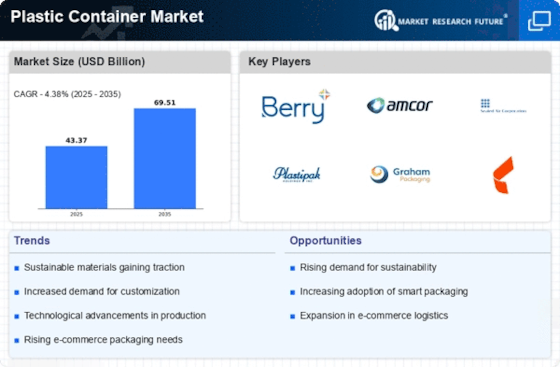
As per Market Research Future analysis, the Plastic Container Market Size was estimated at 43.37 USD Billion in 2024. The Plastic Container industry is projected to grow from 45.27 USD Billion in 2025 to 69.51 USD Billion by 2035, exhibiting a compound annual growth rate (CAGR) of 4.38% during the forecast period 2025 - 2035

Key Market Trends & Highlights

The Plastic Container Market is experiencing a dynamic shift towards sustainability and technological integration.

  • North America remains the largest market for plastic containers, driven by robust demand across various sectors. The Asia-Pacific region is emerging as the fastest-growing market, fueled by increasing urbanization and consumer spending. Food packaging continues to dominate the market, while beverage packaging is witnessing rapid growth due to changing consumer preferences. Rising demand for convenience packaging and sustainability initiatives are key drivers propelling market expansion.

Market Size & Forecast

2024 Market Size 43.37 (USD Billion)
2035 Market Size 69.51 (USD Billion)
CAGR (2025 - 2035) 4.38%
Largest Regional Market Share in 2024 North America

Major Players

Berry Global Inc (US), Amcor plc (AU), Sealed Air Corporation (US), Plastipak Holdings, Inc. (US), Graham Packaging Company (US), Mondi Group (GB), Sonoco Products Company (US), ALPLA Werke Alwin Lehner GmbH &amp; Co KG (AT)

Market Trends

The Plastic Container Market is currently experiencing a dynamic evolution, driven by various factors including sustainability concerns and technological advancements. As consumers become increasingly aware of environmental issues, there is a noticeable shift towards eco-friendly materials and practices. This shift is shaping key plastic container market trends, prompting manufacturers to innovate and develop biodegradable and recyclable options, which may enhance their market appeal.  Additionally, the rise of e-commerce is influencing packaging requirements, as businesses seek durable and lightweight solutions to ensure product safety during transit. This evolving landscape suggests that companies must adapt to changing consumer preferences and regulatory pressures to remain competitive in the expanding plastic container market size landscape. 

Moreover, the demand for plastic containers is likely to expand across multiple sectors, including food and beverage, pharmaceuticals, and personal care. Each of these industries presents unique challenges and opportunities, necessitating tailored approaches to packaging design and functionality. The integration of smart technologies into packaging solutions could further transform the Plastic Container Market, offering enhanced tracking and user engagement. As the market continues to evolve, stakeholders must remain vigilant and responsive to emerging trends and consumer expectations, ensuring that they are well-positioned for future growth.

Sustainability Initiatives

The Plastic Container Market is witnessing a pronounced emphasis on sustainability, as companies increasingly prioritize eco-friendly materials and practices. This trend reflects a broader societal shift towards environmental responsibility, compelling manufacturers to explore biodegradable and recyclable options.

E-commerce Influence

The rise of e-commerce is reshaping the Plastic Container Market, as businesses seek packaging solutions that are both durable and lightweight. This shift is driven by the need to protect products during transit while also appealing to environmentally conscious consumers.

Technological Integration

The incorporation of smart technologies into packaging is emerging as a transformative trend within the Plastic Container Market. Innovations such as tracking systems and interactive features may enhance consumer engagement and streamline supply chain processes.

plastic container market Market Drivers

Growth of the Food and Beverage Sector

The expansion of the food and beverage sector serves as a significant driver for the Plastic Container Market. With the increasing global population and urbanization, the demand for packaged food and beverages continues to rise. In 2025, the food packaging market is expected to surpass 400 billion dollars, with plastic containers playing a crucial role in preserving product freshness and extending shelf life. This growth is particularly evident in sectors such as dairy, snacks, and beverages, where plastic containers are favored for their versatility and cost-effectiveness. As the food and beverage industry evolves, the Plastic Container Market is poised to capitalize on these trends, providing innovative packaging solutions that cater to diverse consumer preferences.

Rising Demand for Convenience Packaging

The increasing consumer preference for convenience packaging is a notable driver in the Plastic Container Market. As lifestyles become busier, consumers are gravitating towards products that offer ease of use and portability. This trend is reflected in the growing demand for ready-to-eat meals and on-the-go snacks, which often utilize plastic containers for their lightweight and durable properties. In 2025, the convenience food sector is projected to reach a market value of approximately 300 billion dollars, further emphasizing the role of plastic containers in meeting consumer needs. The Plastic Container Market is likely to benefit from this shift, as manufacturers innovate to create packaging solutions that align with consumer expectations for convenience.

Sustainability and Recycling Initiatives

Sustainability initiatives are increasingly influencing the Plastic Container Market. As environmental concerns gain prominence, consumers and businesses alike are advocating for eco-friendly packaging solutions. The push for recycling and the use of recycled materials in plastic containers is becoming a focal point for manufacturers. In 2025, it is estimated that the market for recycled plastic containers will grow by 15%, driven by regulatory pressures and consumer demand for sustainable products. Companies are investing in research and development to create biodegradable and recyclable plastic options, which could reshape the landscape of the Plastic Container Market. This shift towards sustainability not only addresses environmental issues but also aligns with the values of a growing segment of eco-conscious consumers.

E-commerce Growth and Packaging Solutions

The rise of e-commerce is a pivotal driver for the Plastic Container Market. As online shopping becomes more prevalent, the demand for effective packaging solutions that ensure product safety during transit is escalating. In 2025, the e-commerce packaging market is expected to reach a valuation of over 100 billion dollars, with plastic containers being a preferred choice due to their lightweight and protective qualities. This trend is particularly evident in sectors such as cosmetics, food delivery, and consumer electronics, where packaging integrity is paramount. The Plastic Container Market must adapt to these evolving needs, providing innovative packaging solutions that cater to the unique challenges posed by e-commerce logistics.

Technological Advancements in Manufacturing

Technological advancements in manufacturing processes are transforming the Plastic Container Market. Innovations such as automation, 3D printing, and advanced molding techniques are enhancing production efficiency and reducing costs. In 2025, the adoption of smart manufacturing technologies is projected to increase by 20%, allowing companies to produce high-quality plastic containers at a faster rate. These advancements enable manufacturers to respond swiftly to market demands and customize products to meet specific consumer needs. As technology continues to evolve, the Plastic Container Market is likely to experience increased competitiveness and improved product offerings, positioning itself favorably in a rapidly changing market landscape.

Market Segment Insights

By Application: Food Packaging (Largest) vs. Beverage Packaging (Fastest-Growing)

The Plastic Container Market showcases significant diversity within its application segment, with food packaging commanding the largest share. This is primarily driven by the increasing demand for ready-to-eat meals and convenience foods, as consumers shift towards packaged solutions. This sector benefits from innovations in packaging technology that enhance the preservation and transportation of perishable goods. Beverage <a href="https://www.marketresearchfuture.com/reports/packaging-market-10902">packaging</a> follows as the fastest-growing segment due to a surge in demand for bottled water, energy drinks, and other beverages. The shift towards healthier options and on-the-go products elevates the significance of efficient beverage packaging solutions.

Food Packaging: Dominant vs. Beverage Packaging: Emerging

In the world of plastic containers, food packaging holds a dominant position due to its essential role in maintaining food safety and quality preservation. This segment emphasizes innovation with recyclable materials and eco-friendly solutions leading the charge for sustainability. On the other hand, beverage packaging is emerging as a key player, driven by changing consumer preferences towards bottled drinks. With the rise of health consciousness, the demand for lightweight, portable, and <a href="https://www.marketresearchfuture.com/reports/sustainable-packaging-market-5247">sustainable packaging</a> options is increasing. Both segments are characterized by evolving design trends and technological advancements aimed at enhancing user experience and reducing environmental impact.

By Material Type: Polyethylene (Largest) vs. Polypropylene (Fastest-Growing)

The Plastic Container market is primarily dominated by <a href="https://www.marketresearchfuture.com/reports/polyethylene-market-1056">Polyethylene</a>, which holds the largest market share due to its widespread application in various sectors including food and beverage, personal care, and household products. Polyethylene's excellent flexibility, durability, and resistance to impact make it a preferred choice among manufacturers. In contrast, <a href="https://www.marketresearchfuture.com/reports/polypropylene-market-1063" target="_blank" title="polypropylene">Polypropylene</a> has been gaining traction, rapidly establishing itself as a competitive alternative due to its superior heat resistance and versatility, catering to a wider array of products like containers for automotive and medical applications.

Polyethylene (Dominant) vs. Polypropylene (Emerging)

Polyethylene has solidified its stronghold in the Plastic Container market, commonly utilized for making items such as bottles, bags, and food containers. This material's excellent chemical resistance, low cost, and recyclability contribute to its enduring dominance. On the other hand, Polypropylene is emerging as a formidable contender, prized for its robustness and lightweight nature. It is increasingly favored for products requiring higher thermal tolerance and is making significant inroads in sectors demanding higher chemical resistance. As consumer preferences shift towards more sustainable options, both materials will continue to play crucial roles in shaping the future of the plastic container Market landscape.

By Container Type: Bottles (Largest) vs. Trays (Fastest-Growing)

The Plastic Container Market showcases a diverse distribution of container types, where bottles dominate the market landscape, driven by their extensive utility in sectors like beverages and personal care. Following bottles, jars and cans also hold significant shares due to their robust adoption in food packaging. Boxes and trays, while less prevalent, are increasingly finding their niche applications, particularly in e-commerce and food delivery, thus contributing to a segmented market landscape with varied consumer preferences. In terms of growth trends, the segment is influenced by several factors, including sustainability initiatives that drive demand for recycled materials. Bottles remain the leading category, while trays are gaining traction as consumers seek eco-friendly packaging options. Innovations that enhance functionality and convenience are propelling cans and jars, demonstrating a dynamic shift in consumer behavior towards convenience and environmental consciousness.

Bottles: Dominant vs. Trays: Emerging

Bottles have established themselves as the dominant force in the Plastic Container Market, renowned for their versatility and adaptability across numerous applications, particularly in beverages and personal care products. Their widespread appeal is bolstered by innovations in design, such as convenience features and enhanced recyclability, catering to the evolving consumer preferences. Conversely, trays are emerging as a significant player, particularly in the e-commerce and food delivery sectors. Their lightweight and stackable nature make them an attractive option for modern logistical needs. As sustainability becomes a priority, both segments are showing responsiveness to eco-friendly materials, with trays adapting rapidly to capitalize on organic growth trends within the market.

By End Use: Residential (Largest) vs. Commercial (Fastest-Growing)

The Plastic Container Market is characterized by its diverse end-use segments, with residential applications holding the largest market share. This dominance is driven by the increasing consumer demand for packaged goods, catering to convenience and efficiency in daily life. Residential consumers increasingly rely on plastic containers for food storage and organization, contributing significantly to the market's overall volume. On the other hand, the commercial sector, including <a href="https://www.marketresearchfuture.com/reports/food-service-market-11595" target="_blank" title="food service">food service</a> and retail applications, is rapidly growing, fueled by the rise of e-commerce and takeout/delivery services.

Residential (Dominant) vs. Commercial (Emerging)

The residential segment in the Plastic Container Market remains dominant due to its widespread use for various domestic purposes, including food storage, organization, and convenience. Consumers favor lightweight, durable, and versatile containers that meet their daily needs. In contrast, the commercial segment is emerging as a key player, driven by the increasing demand for packaging solutions in food service, catering, and e-commerce sectors. Commercial applications often require larger volumes and robust designs to accommodate bulk items, indicating a shift towards innovative packaging solutions to enhance customer convenience and streamline operations.

Get more detailed insights about Plastic Container Market Research Report- Forecast 2035

Regional Insights

The Plastic Container Market was poised for growth across various regions, with distinct contributions from each area. In 2024, North America led with a market value of 12.0 USD Billion, reflecting a significant demand driven by the booming food and beverage sector.Europe followed closely, valued at 10.0 USD Billion, emphasizing its commitment to sustainability and innovation in packaging solutions.

The Asia-Pacific (APAC) region, valued at 9.5 USD Billion, witnessed rapid growth due to urbanization and increasing disposable incomes, contributing to a surge in consumer goods packaging.South America, with a valuation of 4.0 USD Billion, was gradually expanding as emerging economies promote the use of plastic containers in various industries.

The Middle East and Africa (MEA) segment, valued at 2.4 USD Billion in 2024, was developing due to infrastructural advancements and increasing demand for packaged goods.Overall, the Plastic Container Market segmentation illustrated how diverse regional trends and demands shaped the industry, creating opportunities while also presenting challenges related to environmental sustainability and regulatory compliance.

Key Players and Competitive Insights

The Plastic Container Market is characterized by a diverse array of players competing across various segments, including rigid and flexible containers, catering to the rising demand from multiple sectors such as food and beverage, personal care, and pharmaceuticals.As sustainability concerns gain traction globally, companies within this market are increasingly focusing on eco-friendly materials and innovative designs that enhance the user experience while reducing environmental impact.The competitive landscape reveals a mix of established giants and emerging players, each striving to carve out a niche by leveraging technological advancements, strategic partnerships, and a wide-reaching distribution network to bolster their market presence.This landscape is dynamic and continually shaped by evolving consumer preferences, regulatory standards, and economic factors that influence production and supply chain processes.Amcor stands out in the Plastic Container Market due to its strong emphasis on sustainability and innovation. The company has proven its capability to meet the diverse packaging needs of various industries while maintaining a focus on reducing environmental impact.One of the notable strengths of Amcor is its commitment to producing packaging that is not only functional but also recyclable and sourced from sustainable materials. This dedication positions Amcor as a leader in offering solutions that cater to the increasing demand for eco-friendly packaging.Furthermore, Amcor’s extensive footprint allows it to serve a wide range of customers across multiple geographical regions, enhancing its competitive edge in the market. Its dedication to continuous improvement and research & development has fostered an environment where innovation leads to enhanced product offerings, ensuring that the company remains at the forefront of the industry.Greif plays a significant role in the Plastic Container Market, particularly known for its comprehensive range of rigid containers and associated services. The company's product portfolio includes intermediate bulk containers, drums, and other industrial packaging that are crucial for various sectors like chemicals, food, and pharmaceuticals.Greif’s operations ensure that it has a substantial presence in key markets, allowing it to respond effectively to customer demands across different regions. A noteworthy strength of Greif is its ability to leverage strategic mergers and acquisitions to expand its capabilities and market outreach. This approach has facilitated the integration of new technologies and product lines into its offerings.By focusing on customer-centric solutions, Greif is able to maintain strong relationships with clients while continually adapting to market trends and regulatory requirements. The combination of its robust product range and strategic growth initiatives positions Greif competitively within the plastic container Market landscape.

Key Companies in the plastic container market include

Industry Developments

The Plastic Container Market has witnessed significant developments recently. Amcor has made strides with innovations in sustainable packaging, catering to the increasing demand for eco-friendly solutions.Notably, in September 2023, Greif announced its acquisition of a plant in Europe to enhance production capabilities and expand its product line. In August 2023, Berry disclosed a partnership aimed at recycling initiatives that enhance the circular economy in plastic packaging.

On the financial front, Sealed Air reported a rise in its quarterly revenue driven by increased demand for food packaging solutions.Furthermore, Silgan Holdings has observed strong growth in market valuation, reflecting the overall industry's resilience and adaptability to shifting consumer trends.

Recent market dynamics emphasize a growing preference for recyclable and reusable packaging solutions, with companies across the sector prioritizing Research and Development for sustainable practices.Over the past two to three years, key events include Novolex expanding its product offerings through strategic acquisitions, while International Paper's focus on sustainable packaging has gained traction in various markets, responding to changing regulatory landscapes and consumer preferences. These developments collectively illustrate the ongoing evolution within the Plastic Container Market.

Future Outlook

plastic container market Future Outlook

The Plastic Container Market is projected to grow at a 4.38% CAGR from 2025 to 2035, driven by sustainability initiatives, technological advancements, and increasing demand across various sectors.

New opportunities lie in:

  • <p>Expansion into biodegradable plastic container Market production Development of smart packaging solutions with IoT integration Investment in recycling technologies for closed-loop systems</p>

By 2035, the market is expected to achieve robust growth, driven by innovation and sustainability.

Market Segmentation

plastic container market End Use Outlook

  • Residential
  • Commercial
  • Industrial

plastic container market Application Outlook

  • Food Packaging
  • Beverage Packaging
  • Personal Care Products
  • Household Products
  • Pharmaceuticals

plastic container market Material Type Outlook

  • Polyethylene
  • Polypropylene
  • Polyvinyl Chloride
  • Polystyrene
  • Others

plastic container market Container Type Outlook

  • Bottles
  • Cans
  • Boxes
  • Jars
  • Trays

Report Scope

MARKET SIZE 2024 43.37(USD Billion)
MARKET SIZE 2025 45.27(USD Billion)
MARKET SIZE 2035 69.51(USD Billion)
COMPOUND ANNUAL GROWTH RATE (CAGR) 4.38% (2025 - 2035)
REPORT COVERAGE Revenue Forecast, Competitive Landscape, Growth Factors, and Trends
BASE YEAR 2024
Market Forecast Period 2025 - 2035
Historical Data 2019 - 2024
Market Forecast Units USD Billion
Key Companies Profiled Berry Global Inc (US), Amcor plc (AU), Sealed Air Corporation (US), Plastipak Holdings, Inc. (US), Graham Packaging Company (US), Mondi Group (GB), Sonoco Products Company (US), ALPLA Werke Alwin Lehner GmbH & Co KG (AT)
Segments Covered Application, Material Type, Container Type, End Use, Regional
Key Market Opportunities Growing demand for sustainable packaging solutions drives innovation in the Plastic Container Market.
Key Market Dynamics Rising consumer preference for sustainable packaging drives innovation and competition in the plastic container market.
Countries Covered North America, Europe, APAC, South America, MEA

FAQs

What is the current valuation of the Plastic Container Market as of 2024?

<p>The overall market valuation of the Plastic Container Market was 43.37 USD Billion in 2024.</p>

What is the projected market size for the Plastic Container Market by 2035?

<p>The Plastic Container Market is projected to reach 69.51 USD Billion by 2035.</p>

What is the expected CAGR for the Plastic Container Market during the forecast period 2025 - 2035?

<p>The expected CAGR for the Plastic Container Market during the forecast period 2025 - 2035 is 4.38%.</p>

Which application segment is expected to have the highest valuation in 2035?

<p>The Food Packaging segment is expected to reach a valuation of 24.0 USD Billion by 2035.</p>

What are the key materials used in the Plastic Container Market?

<p>The primary materials include Polyethylene, Polypropylene, Polyvinyl Chloride, and Polystyrene.</p>

Which container type is projected to dominate the market by 2035?

<p>Trays are projected to dominate the market with a valuation of 22.51 USD Billion by 2035.</p>

What is the expected valuation for the Pharmaceuticals segment by 2035?

<p>The Pharmaceuticals segment is expected to reach a valuation of 9.51 USD Billion by 2035.</p>

Who are the leading companies in the Plastic Container Market?

<p>Key players include Berry Global Inc, Amcor plc, Sealed Air Corporation, and Plastipak Holdings, Inc.</p>

What is the projected valuation for the Commercial end-use segment by 2035?

<p>The Commercial end-use segment is projected to reach a valuation of 20.0 USD Billion by 2035.</p>

How does the market for Household Products compare to other segments by 2035?

The Household Products segment is expected to reach 8.0 USD Billion by 2035, indicating moderate growth compared to others.

  1. SECTION I: EXECUTIVE SUMMARY AND KEY HIGHLIGHTS
    1. | 1.1 EXECUTIVE SUMMARY
    2. | | 1.1.1 Market Overview
    3. | | 1.1.2 Key Findings
    4. | | 1.1.3 Market Segmentation
    5. | | 1.1.4 Competitive Landscape
    6. | | 1.1.5 Challenges and Opportunities
    7. | | 1.1.6 Future Outlook
  2. SECTION II: SCOPING, METHODOLOGY AND MARKET STRUCTURE
    1. | 2.1 MARKET INTRODUCTION
    2. | | 2.1.1 Definition
    3. | | 2.1.2 Scope of the study
    4. | | | 2.1.2.1 Research Objective
    5. | | | 2.1.2.2 Assumption
    6. | | | 2.1.2.3 Limitations
    7. | 2.2 RESEARCH METHODOLOGY
    8. | | 2.2.1 Overview
    9. | | 2.2.2 Data Mining
    10. | | 2.2.3 Secondary Research
    11. | | 2.2.4 Primary Research
    12. | | | 2.2.4.1 Primary Interviews and Information Gathering Process
    13. | | | 2.2.4.2 Breakdown of Primary Respondents
    14. | | 2.2.5 Forecasting Model
    15. | | 2.2.6 Market Size Estimation
    16. | | | 2.2.6.1 Bottom-Up Approach
    17. | | | 2.2.6.2 Top-Down Approach
    18. | | 2.2.7 Data Triangulation
    19. | | 2.2.8 Validation
  3. SECTION III: QUALITATIVE ANALYSIS
    1. | 3.1 MARKET DYNAMICS
    2. | | 3.1.1 Overview
    3. | | 3.1.2 Drivers
    4. | | 3.1.3 Restraints
    5. | | 3.1.4 Opportunities
    6. | 3.2 MARKET FACTOR ANALYSIS
    7. | | 3.2.1 Value chain Analysis
    8. | | 3.2.2 Porter's Five Forces Analysis
    9. | | | 3.2.2.1 Bargaining Power of Suppliers
    10. | | | 3.2.2.2 Bargaining Power of Buyers
    11. | | | 3.2.2.3 Threat of New Entrants
    12. | | | 3.2.2.4 Threat of Substitutes
    13. | | | 3.2.2.5 Intensity of Rivalry
    14. | | 3.2.3 COVID-19 Impact Analysis
    15. | | | 3.2.3.1 Market Impact Analysis
    16. | | | 3.2.3.2 Regional Impact
    17. | | | 3.2.3.3 Opportunity and Threat Analysis
  4. SECTION IV: QUANTITATIVE ANALYSIS
    1. | 4.1 Packaging & Transport, BY Application (USD Billion)
    2. | | 4.1.1 Food Packaging
    3. | | 4.1.2 Beverage Packaging
    4. | | 4.1.3 Personal Care Products
    5. | | 4.1.4 Household Products
    6. | | 4.1.5 Pharmaceuticals
    7. | 4.2 Packaging & Transport, BY Material Type (USD Billion)
    8. | | 4.2.1 Polyethylene
    9. | | 4.2.2 Polypropylene
    10. | | 4.2.3 Polyvinyl Chloride
    11. | | 4.2.4 Polystyrene
    12. | | 4.2.5 Others
    13. | 4.3 Packaging & Transport, BY Container Type (USD Billion)
    14. | | 4.3.1 Bottles
    15. | | 4.3.2 Cans
    16. | | 4.3.3 Boxes
    17. | | 4.3.4 Jars
    18. | | 4.3.5 Trays
    19. | 4.4 Packaging & Transport, BY End Use (USD Billion)
    20. | | 4.4.1 Residential
    21. | | 4.4.2 Commercial
    22. | | 4.4.3 Industrial
    23. | 4.5 Packaging & Transport, BY Region (USD Billion)
    24. | | 4.5.1 North America
    25. | | | 4.5.1.1 US
    26. | | | 4.5.1.2 Canada
    27. | | 4.5.2 Europe
    28. | | | 4.5.2.1 Germany
    29. | | | 4.5.2.2 UK
    30. | | | 4.5.2.3 France
    31. | | | 4.5.2.4 Russia
    32. | | | 4.5.2.5 Italy
    33. | | | 4.5.2.6 Spain
    34. | | | 4.5.2.7 Rest of Europe
    35. | | 4.5.3 APAC
    36. | | | 4.5.3.1 China
    37. | | | 4.5.3.2 India
    38. | | | 4.5.3.3 Japan
    39. | | | 4.5.3.4 South Korea
    40. | | | 4.5.3.5 Malaysia
    41. | | | 4.5.3.6 Thailand
    42. | | | 4.5.3.7 Indonesia
    43. | | | 4.5.3.8 Rest of APAC
    44. | | 4.5.4 South America
    45. | | | 4.5.4.1 Brazil
    46. | | | 4.5.4.2 Mexico
    47. | | | 4.5.4.3 Argentina
    48. | | | 4.5.4.4 Rest of South America
    49. | | 4.5.5 MEA
    50. | | | 4.5.5.1 GCC Countries
    51. | | | 4.5.5.2 South Africa
    52. | | | 4.5.5.3 Rest of MEA
  5. SECTION V: COMPETITIVE ANALYSIS
    1. | 5.1 Competitive Landscape
    2. | | 5.1.1 Overview
    3. | | 5.1.2 Competitive Analysis
    4. | | 5.1.3 Market share Analysis
    5. | | 5.1.4 Major Growth Strategy in the Packaging & Transport
    6. | | 5.1.5 Competitive Benchmarking
    7. | | 5.1.6 Leading Players in Terms of Number of Developments in the Packaging & Transport
    8. | | 5.1.7 Key developments and growth strategies
    9. | | | 5.1.7.1 New Product Launch/Service Deployment
    10. | | | 5.1.7.2 Merger & Acquisitions
    11. | | | 5.1.7.3 Joint Ventures
    12. | | 5.1.8 Major Players Financial Matrix
    13. | | | 5.1.8.1 Sales and Operating Income
    14. | | | 5.1.8.2 Major Players R&D Expenditure. 2023
    15. | 5.2 Company Profiles
    16. | | 5.2.1 Berry Global Inc (US)
    17. | | | 5.2.1.1 Financial Overview
    18. | | | 5.2.1.2 Products Offered
    19. | | | 5.2.1.3 Key Developments
    20. | | | 5.2.1.4 SWOT Analysis
    21. | | | 5.2.1.5 Key Strategies
    22. | | 5.2.2 Amcor plc (AU)
    23. | | | 5.2.2.1 Financial Overview
    24. | | | 5.2.2.2 Products Offered
    25. | | | 5.2.2.3 Key Developments
    26. | | | 5.2.2.4 SWOT Analysis
    27. | | | 5.2.2.5 Key Strategies
    28. | | 5.2.3 Sealed Air Corporation (US)
    29. | | | 5.2.3.1 Financial Overview
    30. | | | 5.2.3.2 Products Offered
    31. | | | 5.2.3.3 Key Developments
    32. | | | 5.2.3.4 SWOT Analysis
    33. | | | 5.2.3.5 Key Strategies
    34. | | 5.2.4 Plastipak Holdings, Inc. (US)
    35. | | | 5.2.4.1 Financial Overview
    36. | | | 5.2.4.2 Products Offered
    37. | | | 5.2.4.3 Key Developments
    38. | | | 5.2.4.4 SWOT Analysis
    39. | | | 5.2.4.5 Key Strategies
    40. | | 5.2.5 Graham Packaging Company (US)
    41. | | | 5.2.5.1 Financial Overview
    42. | | | 5.2.5.2 Products Offered
    43. | | | 5.2.5.3 Key Developments
    44. | | | 5.2.5.4 SWOT Analysis
    45. | | | 5.2.5.5 Key Strategies
    46. | | 5.2.6 Mondi Group (GB)
    47. | | | 5.2.6.1 Financial Overview
    48. | | | 5.2.6.2 Products Offered
    49. | | | 5.2.6.3 Key Developments
    50. | | | 5.2.6.4 SWOT Analysis
    51. | | | 5.2.6.5 Key Strategies
    52. | | 5.2.7 Sonoco Products Company (US)
    53. | | | 5.2.7.1 Financial Overview
    54. | | | 5.2.7.2 Products Offered
    55. | | | 5.2.7.3 Key Developments
    56. | | | 5.2.7.4 SWOT Analysis
    57. | | | 5.2.7.5 Key Strategies
    58. | | 5.2.8 ALPLA Werke Alwin Lehner GmbH & Co KG (AT)
    59. | | | 5.2.8.1 Financial Overview
    60. | | | 5.2.8.2 Products Offered
    61. | | | 5.2.8.3 Key Developments
    62. | | | 5.2.8.4 SWOT Analysis
    63. | | | 5.2.8.5 Key Strategies
    64. | 5.3 Appendix
    65. | | 5.3.1 References
    66. | | 5.3.2 Related Reports
  6. LIST OF FIGURES
    1. | 6.1 MARKET SYNOPSIS
    2. | 6.2 NORTH AMERICA MARKET ANALYSIS
    3. | 6.3 US MARKET ANALYSIS BY APPLICATION
    4. | 6.4 US MARKET ANALYSIS BY MATERIAL TYPE
    5. | 6.5 US MARKET ANALYSIS BY CONTAINER TYPE
    6. | 6.6 US MARKET ANALYSIS BY END USE
    7. | 6.7 CANADA MARKET ANALYSIS BY APPLICATION
    8. | 6.8 CANADA MARKET ANALYSIS BY MATERIAL TYPE
    9. | 6.9 CANADA MARKET ANALYSIS BY CONTAINER TYPE
    10. | 6.10 CANADA MARKET ANALYSIS BY END USE
    11. | 6.11 EUROPE MARKET ANALYSIS
    12. | 6.12 GERMANY MARKET ANALYSIS BY APPLICATION
    13. | 6.13 GERMANY MARKET ANALYSIS BY MATERIAL TYPE
    14. | 6.14 GERMANY MARKET ANALYSIS BY CONTAINER TYPE
    15. | 6.15 GERMANY MARKET ANALYSIS BY END USE
    16. | 6.16 UK MARKET ANALYSIS BY APPLICATION
    17. | 6.17 UK MARKET ANALYSIS BY MATERIAL TYPE
    18. | 6.18 UK MARKET ANALYSIS BY CONTAINER TYPE
    19. | 6.19 UK MARKET ANALYSIS BY END USE
    20. | 6.20 FRANCE MARKET ANALYSIS BY APPLICATION
    21. | 6.21 FRANCE MARKET ANALYSIS BY MATERIAL TYPE
    22. | 6.22 FRANCE MARKET ANALYSIS BY CONTAINER TYPE
    23. | 6.23 FRANCE MARKET ANALYSIS BY END USE
    24. | 6.24 RUSSIA MARKET ANALYSIS BY APPLICATION
    25. | 6.25 RUSSIA MARKET ANALYSIS BY MATERIAL TYPE
    26. | 6.26 RUSSIA MARKET ANALYSIS BY CONTAINER TYPE
    27. | 6.27 RUSSIA MARKET ANALYSIS BY END USE
    28. | 6.28 ITALY MARKET ANALYSIS BY APPLICATION
    29. | 6.29 ITALY MARKET ANALYSIS BY MATERIAL TYPE
    30. | 6.30 ITALY MARKET ANALYSIS BY CONTAINER TYPE
    31. | 6.31 ITALY MARKET ANALYSIS BY END USE
    32. | 6.32 SPAIN MARKET ANALYSIS BY APPLICATION
    33. | 6.33 SPAIN MARKET ANALYSIS BY MATERIAL TYPE
    34. | 6.34 SPAIN MARKET ANALYSIS BY CONTAINER TYPE
    35. | 6.35 SPAIN MARKET ANALYSIS BY END USE
    36. | 6.36 REST OF EUROPE MARKET ANALYSIS BY APPLICATION
    37. | 6.37 REST OF EUROPE MARKET ANALYSIS BY MATERIAL TYPE
    38. | 6.38 REST OF EUROPE MARKET ANALYSIS BY CONTAINER TYPE
    39. | 6.39 REST OF EUROPE MARKET ANALYSIS BY END USE
    40. | 6.40 APAC MARKET ANALYSIS
    41. | 6.41 CHINA MARKET ANALYSIS BY APPLICATION
    42. | 6.42 CHINA MARKET ANALYSIS BY MATERIAL TYPE
    43. | 6.43 CHINA MARKET ANALYSIS BY CONTAINER TYPE
    44. | 6.44 CHINA MARKET ANALYSIS BY END USE
    45. | 6.45 INDIA MARKET ANALYSIS BY APPLICATION
    46. | 6.46 INDIA MARKET ANALYSIS BY MATERIAL TYPE
    47. | 6.47 INDIA MARKET ANALYSIS BY CONTAINER TYPE
    48. | 6.48 INDIA MARKET ANALYSIS BY END USE
    49. | 6.49 JAPAN MARKET ANALYSIS BY APPLICATION
    50. | 6.50 JAPAN MARKET ANALYSIS BY MATERIAL TYPE
    51. | 6.51 JAPAN MARKET ANALYSIS BY CONTAINER TYPE
    52. | 6.52 JAPAN MARKET ANALYSIS BY END USE
    53. | 6.53 SOUTH KOREA MARKET ANALYSIS BY APPLICATION
    54. | 6.54 SOUTH KOREA MARKET ANALYSIS BY MATERIAL TYPE
    55. | 6.55 SOUTH KOREA MARKET ANALYSIS BY CONTAINER TYPE
    56. | 6.56 SOUTH KOREA MARKET ANALYSIS BY END USE
    57. | 6.57 MALAYSIA MARKET ANALYSIS BY APPLICATION
    58. | 6.58 MALAYSIA MARKET ANALYSIS BY MATERIAL TYPE
    59. | 6.59 MALAYSIA MARKET ANALYSIS BY CONTAINER TYPE
    60. | 6.60 MALAYSIA MARKET ANALYSIS BY END USE
    61. | 6.61 THAILAND MARKET ANALYSIS BY APPLICATION
    62. | 6.62 THAILAND MARKET ANALYSIS BY MATERIAL TYPE
    63. | 6.63 THAILAND MARKET ANALYSIS BY CONTAINER TYPE
    64. | 6.64 THAILAND MARKET ANALYSIS BY END USE
    65. | 6.65 INDONESIA MARKET ANALYSIS BY APPLICATION
    66. | 6.66 INDONESIA MARKET ANALYSIS BY MATERIAL TYPE
    67. | 6.67 INDONESIA MARKET ANALYSIS BY CONTAINER TYPE
    68. | 6.68 INDONESIA MARKET ANALYSIS BY END USE
    69. | 6.69 REST OF APAC MARKET ANALYSIS BY APPLICATION
    70. | 6.70 REST OF APAC MARKET ANALYSIS BY MATERIAL TYPE
    71. | 6.71 REST OF APAC MARKET ANALYSIS BY CONTAINER TYPE
    72. | 6.72 REST OF APAC MARKET ANALYSIS BY END USE
    73. | 6.73 SOUTH AMERICA MARKET ANALYSIS
    74. | 6.74 BRAZIL MARKET ANALYSIS BY APPLICATION
    75. | 6.75 BRAZIL MARKET ANALYSIS BY MATERIAL TYPE
    76. | 6.76 BRAZIL MARKET ANALYSIS BY CONTAINER TYPE
    77. | 6.77 BRAZIL MARKET ANALYSIS BY END USE
    78. | 6.78 MEXICO MARKET ANALYSIS BY APPLICATION
    79. | 6.79 MEXICO MARKET ANALYSIS BY MATERIAL TYPE
    80. | 6.80 MEXICO MARKET ANALYSIS BY CONTAINER TYPE
    81. | 6.81 MEXICO MARKET ANALYSIS BY END USE
    82. | 6.82 ARGENTINA MARKET ANALYSIS BY APPLICATION
    83. | 6.83 ARGENTINA MARKET ANALYSIS BY MATERIAL TYPE
    84. | 6.84 ARGENTINA MARKET ANALYSIS BY CONTAINER TYPE
    85. | 6.85 ARGENTINA MARKET ANALYSIS BY END USE
    86. | 6.86 REST OF SOUTH AMERICA MARKET ANALYSIS BY APPLICATION
    87. | 6.87 REST OF SOUTH AMERICA MARKET ANALYSIS BY MATERIAL TYPE
    88. | 6.88 REST OF SOUTH AMERICA MARKET ANALYSIS BY CONTAINER TYPE
    89. | 6.89 REST OF SOUTH AMERICA MARKET ANALYSIS BY END USE
    90. | 6.90 MEA MARKET ANALYSIS
    91. | 6.91 GCC COUNTRIES MARKET ANALYSIS BY APPLICATION
    92. | 6.92 GCC COUNTRIES MARKET ANALYSIS BY MATERIAL TYPE
    93. | 6.93 GCC COUNTRIES MARKET ANALYSIS BY CONTAINER TYPE
    94. | 6.94 GCC COUNTRIES MARKET ANALYSIS BY END USE
    95. | 6.95 SOUTH AFRICA MARKET ANALYSIS BY APPLICATION
    96. | 6.96 SOUTH AFRICA MARKET ANALYSIS BY MATERIAL TYPE
    97. | 6.97 SOUTH AFRICA MARKET ANALYSIS BY CONTAINER TYPE
    98. | 6.98 SOUTH AFRICA MARKET ANALYSIS BY END USE
    99. | 6.99 REST OF MEA MARKET ANALYSIS BY APPLICATION
    100. | 6.100 REST OF MEA MARKET ANALYSIS BY MATERIAL TYPE
    101. | 6.101 REST OF MEA MARKET ANALYSIS BY CONTAINER TYPE
    102. | 6.102 REST OF MEA MARKET ANALYSIS BY END USE
    103. | 6.103 KEY BUYING CRITERIA OF PACKAGING & TRANSPORT
    104. | 6.104 RESEARCH PROCESS OF MRFR
    105. | 6.105 DRO ANALYSIS OF PACKAGING & TRANSPORT
    106. | 6.106 DRIVERS IMPACT ANALYSIS: PACKAGING & TRANSPORT
    107. | 6.107 RESTRAINTS IMPACT ANALYSIS: PACKAGING & TRANSPORT
    108. | 6.108 SUPPLY / VALUE CHAIN: PACKAGING & TRANSPORT
    109. | 6.109 PACKAGING & TRANSPORT, BY APPLICATION, 2024 (% SHARE)
    110. | 6.110 PACKAGING & TRANSPORT, BY APPLICATION, 2024 TO 2035 (USD Billion)
    111. | 6.111 PACKAGING & TRANSPORT, BY MATERIAL TYPE, 2024 (% SHARE)
    112. | 6.112 PACKAGING & TRANSPORT, BY MATERIAL TYPE, 2024 TO 2035 (USD Billion)
    113. | 6.113 PACKAGING & TRANSPORT, BY CONTAINER TYPE, 2024 (% SHARE)
    114. | 6.114 PACKAGING & TRANSPORT, BY CONTAINER TYPE, 2024 TO 2035 (USD Billion)
    115. | 6.115 PACKAGING & TRANSPORT, BY END USE, 2024 (% SHARE)
    116. | 6.116 PACKAGING & TRANSPORT, BY END USE, 2024 TO 2035 (USD Billion)
    117. | 6.117 BENCHMARKING OF MAJOR COMPETITORS
  7. LIST OF TABLES
    1. | 7.1 LIST OF ASSUMPTIONS
    2. | | 7.1.1
    3. | 7.2 North America MARKET SIZE ESTIMATES; FORECAST
    4. | | 7.2.1 BY APPLICATION, 2025-2035 (USD Billion)
    5. | | 7.2.2 BY MATERIAL TYPE, 2025-2035 (USD Billion)
    6. | | 7.2.3 BY CONTAINER TYPE, 2025-2035 (USD Billion)
    7. | | 7.2.4 BY END USE, 2025-2035 (USD Billion)
    8. | 7.3 US MARKET SIZE ESTIMATES; FORECAST
    9. | | 7.3.1 BY APPLICATION, 2025-2035 (USD Billion)
    10. | | 7.3.2 BY MATERIAL TYPE, 2025-2035 (USD Billion)
    11. | | 7.3.3 BY CONTAINER TYPE, 2025-2035 (USD Billion)
    12. | | 7.3.4 BY END USE, 2025-2035 (USD Billion)
    13. | 7.4 Canada MARKET SIZE ESTIMATES; FORECAST
    14. | | 7.4.1 BY APPLICATION, 2025-2035 (USD Billion)
    15. | | 7.4.2 BY MATERIAL TYPE, 2025-2035 (USD Billion)
    16. | | 7.4.3 BY CONTAINER TYPE, 2025-2035 (USD Billion)
    17. | | 7.4.4 BY END USE, 2025-2035 (USD Billion)
    18. | 7.5 Europe MARKET SIZE ESTIMATES; FORECAST
    19. | | 7.5.1 BY APPLICATION, 2025-2035 (USD Billion)
    20. | | 7.5.2 BY MATERIAL TYPE, 2025-2035 (USD Billion)
    21. | | 7.5.3 BY CONTAINER TYPE, 2025-2035 (USD Billion)
    22. | | 7.5.4 BY END USE, 2025-2035 (USD Billion)
    23. | 7.6 Germany MARKET SIZE ESTIMATES; FORECAST
    24. | | 7.6.1 BY APPLICATION, 2025-2035 (USD Billion)
    25. | | 7.6.2 BY MATERIAL TYPE, 2025-2035 (USD Billion)
    26. | | 7.6.3 BY CONTAINER TYPE, 2025-2035 (USD Billion)
    27. | | 7.6.4 BY END USE, 2025-2035 (USD Billion)
    28. | 7.7 UK MARKET SIZE ESTIMATES; FORECAST
    29. | | 7.7.1 BY APPLICATION, 2025-2035 (USD Billion)
    30. | | 7.7.2 BY MATERIAL TYPE, 2025-2035 (USD Billion)
    31. | | 7.7.3 BY CONTAINER TYPE, 2025-2035 (USD Billion)
    32. | | 7.7.4 BY END USE, 2025-2035 (USD Billion)
    33. | 7.8 France MARKET SIZE ESTIMATES; FORECAST
    34. | | 7.8.1 BY APPLICATION, 2025-2035 (USD Billion)
    35. | | 7.8.2 BY MATERIAL TYPE, 2025-2035 (USD Billion)
    36. | | 7.8.3 BY CONTAINER TYPE, 2025-2035 (USD Billion)
    37. | | 7.8.4 BY END USE, 2025-2035 (USD Billion)
    38. | 7.9 Russia MARKET SIZE ESTIMATES; FORECAST
    39. | | 7.9.1 BY APPLICATION, 2025-2035 (USD Billion)
    40. | | 7.9.2 BY MATERIAL TYPE, 2025-2035 (USD Billion)
    41. | | 7.9.3 BY CONTAINER TYPE, 2025-2035 (USD Billion)
    42. | | 7.9.4 BY END USE, 2025-2035 (USD Billion)
    43. | 7.10 Italy MARKET SIZE ESTIMATES; FORECAST
    44. | | 7.10.1 BY APPLICATION, 2025-2035 (USD Billion)
    45. | | 7.10.2 BY MATERIAL TYPE, 2025-2035 (USD Billion)
    46. | | 7.10.3 BY CONTAINER TYPE, 2025-2035 (USD Billion)
    47. | | 7.10.4 BY END USE, 2025-2035 (USD Billion)
    48. | 7.11 Spain MARKET SIZE ESTIMATES; FORECAST
    49. | | 7.11.1 BY APPLICATION, 2025-2035 (USD Billion)
    50. | | 7.11.2 BY MATERIAL TYPE, 2025-2035 (USD Billion)
    51. | | 7.11.3 BY CONTAINER TYPE, 2025-2035 (USD Billion)
    52. | | 7.11.4 BY END USE, 2025-2035 (USD Billion)
    53. | 7.12 Rest of Europe MARKET SIZE ESTIMATES; FORECAST
    54. | | 7.12.1 BY APPLICATION, 2025-2035 (USD Billion)
    55. | | 7.12.2 BY MATERIAL TYPE, 2025-2035 (USD Billion)
    56. | | 7.12.3 BY CONTAINER TYPE, 2025-2035 (USD Billion)
    57. | | 7.12.4 BY END USE, 2025-2035 (USD Billion)
    58. | 7.13 APAC MARKET SIZE ESTIMATES; FORECAST
    59. | | 7.13.1 BY APPLICATION, 2025-2035 (USD Billion)
    60. | | 7.13.2 BY MATERIAL TYPE, 2025-2035 (USD Billion)
    61. | | 7.13.3 BY CONTAINER TYPE, 2025-2035 (USD Billion)
    62. | | 7.13.4 BY END USE, 2025-2035 (USD Billion)
    63. | 7.14 China MARKET SIZE ESTIMATES; FORECAST
    64. | | 7.14.1 BY APPLICATION, 2025-2035 (USD Billion)
    65. | | 7.14.2 BY MATERIAL TYPE, 2025-2035 (USD Billion)
    66. | | 7.14.3 BY CONTAINER TYPE, 2025-2035 (USD Billion)
    67. | | 7.14.4 BY END USE, 2025-2035 (USD Billion)
    68. | 7.15 India MARKET SIZE ESTIMATES; FORECAST
    69. | | 7.15.1 BY APPLICATION, 2025-2035 (USD Billion)
    70. | | 7.15.2 BY MATERIAL TYPE, 2025-2035 (USD Billion)
    71. | | 7.15.3 BY CONTAINER TYPE, 2025-2035 (USD Billion)
    72. | | 7.15.4 BY END USE, 2025-2035 (USD Billion)
    73. | 7.16 Japan MARKET SIZE ESTIMATES; FORECAST
    74. | | 7.16.1 BY APPLICATION, 2025-2035 (USD Billion)
    75. | | 7.16.2 BY MATERIAL TYPE, 2025-2035 (USD Billion)
    76. | | 7.16.3 BY CONTAINER TYPE, 2025-2035 (USD Billion)
    77. | | 7.16.4 BY END USE, 2025-2035 (USD Billion)
    78. | 7.17 South Korea MARKET SIZE ESTIMATES; FORECAST
    79. | | 7.17.1 BY APPLICATION, 2025-2035 (USD Billion)
    80. | | 7.17.2 BY MATERIAL TYPE, 2025-2035 (USD Billion)
    81. | | 7.17.3 BY CONTAINER TYPE, 2025-2035 (USD Billion)
    82. | | 7.17.4 BY END USE, 2025-2035 (USD Billion)
    83. | 7.18 Malaysia MARKET SIZE ESTIMATES; FORECAST
    84. | | 7.18.1 BY APPLICATION, 2025-2035 (USD Billion)
    85. | | 7.18.2 BY MATERIAL TYPE, 2025-2035 (USD Billion)
    86. | | 7.18.3 BY CONTAINER TYPE, 2025-2035 (USD Billion)
    87. | | 7.18.4 BY END USE, 2025-2035 (USD Billion)
    88. | 7.19 Thailand MARKET SIZE ESTIMATES; FORECAST
    89. | | 7.19.1 BY APPLICATION, 2025-2035 (USD Billion)
    90. | | 7.19.2 BY MATERIAL TYPE, 2025-2035 (USD Billion)
    91. | | 7.19.3 BY CONTAINER TYPE, 2025-2035 (USD Billion)
    92. | | 7.19.4 BY END USE, 2025-2035 (USD Billion)
    93. | 7.20 Indonesia MARKET SIZE ESTIMATES; FORECAST
    94. | | 7.20.1 BY APPLICATION, 2025-2035 (USD Billion)
    95. | | 7.20.2 BY MATERIAL TYPE, 2025-2035 (USD Billion)
    96. | | 7.20.3 BY CONTAINER TYPE, 2025-2035 (USD Billion)
    97. | | 7.20.4 BY END USE, 2025-2035 (USD Billion)
    98. | 7.21 Rest of APAC MARKET SIZE ESTIMATES; FORECAST
    99. | | 7.21.1 BY APPLICATION, 2025-2035 (USD Billion)
    100. | | 7.21.2 BY MATERIAL TYPE, 2025-2035 (USD Billion)
    101. | | 7.21.3 BY CONTAINER TYPE, 2025-2035 (USD Billion)
    102. | | 7.21.4 BY END USE, 2025-2035 (USD Billion)
    103. | 7.22 South America MARKET SIZE ESTIMATES; FORECAST
    104. | | 7.22.1 BY APPLICATION, 2025-2035 (USD Billion)
    105. | | 7.22.2 BY MATERIAL TYPE, 2025-2035 (USD Billion)
    106. | | 7.22.3 BY CONTAINER TYPE, 2025-2035 (USD Billion)
    107. | | 7.22.4 BY END USE, 2025-2035 (USD Billion)
    108. | 7.23 Brazil MARKET SIZE ESTIMATES; FORECAST
    109. | | 7.23.1 BY APPLICATION, 2025-2035 (USD Billion)
    110. | | 7.23.2 BY MATERIAL TYPE, 2025-2035 (USD Billion)
    111. | | 7.23.3 BY CONTAINER TYPE, 2025-2035 (USD Billion)
    112. | | 7.23.4 BY END USE, 2025-2035 (USD Billion)
    113. | 7.24 Mexico MARKET SIZE ESTIMATES; FORECAST
    114. | | 7.24.1 BY APPLICATION, 2025-2035 (USD Billion)
    115. | | 7.24.2 BY MATERIAL TYPE, 2025-2035 (USD Billion)
    116. | | 7.24.3 BY CONTAINER TYPE, 2025-2035 (USD Billion)
    117. | | 7.24.4 BY END USE, 2025-2035 (USD Billion)
    118. | 7.25 Argentina MARKET SIZE ESTIMATES; FORECAST
    119. | | 7.25.1 BY APPLICATION, 2025-2035 (USD Billion)
    120. | | 7.25.2 BY MATERIAL TYPE, 2025-2035 (USD Billion)
    121. | | 7.25.3 BY CONTAINER TYPE, 2025-2035 (USD Billion)
    122. | | 7.25.4 BY END USE, 2025-2035 (USD Billion)
    123. | 7.26 Rest of South America MARKET SIZE ESTIMATES; FORECAST
    124. | | 7.26.1 BY APPLICATION, 2025-2035 (USD Billion)
    125. | | 7.26.2 BY MATERIAL TYPE, 2025-2035 (USD Billion)
    126. | | 7.26.3 BY CONTAINER TYPE, 2025-2035 (USD Billion)
    127. | | 7.26.4 BY END USE, 2025-2035 (USD Billion)
    128. | 7.27 MEA MARKET SIZE ESTIMATES; FORECAST
    129. | | 7.27.1 BY APPLICATION, 2025-2035 (USD Billion)
    130. | | 7.27.2 BY MATERIAL TYPE, 2025-2035 (USD Billion)
    131. | | 7.27.3 BY CONTAINER TYPE, 2025-2035 (USD Billion)
    132. | | 7.27.4 BY END USE, 2025-2035 (USD Billion)
    133. | 7.28 GCC Countries MARKET SIZE ESTIMATES; FORECAST
    134. | | 7.28.1 BY APPLICATION, 2025-2035 (USD Billion)
    135. | | 7.28.2 BY MATERIAL TYPE, 2025-2035 (USD Billion)
    136. | | 7.28.3 BY CONTAINER TYPE, 2025-2035 (USD Billion)
    137. | | 7.28.4 BY END USE, 2025-2035 (USD Billion)
    138. | 7.29 South Africa MARKET SIZE ESTIMATES; FORECAST
    139. | | 7.29.1 BY APPLICATION, 2025-2035 (USD Billion)
    140. | | 7.29.2 BY MATERIAL TYPE, 2025-2035 (USD Billion)
    141. | | 7.29.3 BY CONTAINER TYPE, 2025-2035 (USD Billion)
    142. | | 7.29.4 BY END USE, 2025-2035 (USD Billion)
    143. | 7.30 Rest of MEA MARKET SIZE ESTIMATES; FORECAST
    144. | | 7.30.1 BY APPLICATION, 2025-2035 (USD Billion)
    145. | | 7.30.2 BY MATERIAL TYPE, 2025-2035 (USD Billion)
    146. | | 7.30.3 BY CONTAINER TYPE, 2025-2035 (USD Billion)
    147. | | 7.30.4 BY END USE, 2025-2035 (USD Billion)
    148. | 7.31 PRODUCT LAUNCH/PRODUCT DEVELOPMENT/APPROVAL
    149. | | 7.31.1
    150. | 7.32 ACQUISITION/PARTNERSHIP
    151. | | 7.32.1

Packaging & Transport Market Segmentation

Packaging & Transport By Application (USD Billion, 2025-2035)

  • Food Packaging
  • Beverage Packaging
  • Personal Care Products
  • Household Products
  • Pharmaceuticals

Packaging & Transport By Material Type (USD Billion, 2025-2035)

  • Polyethylene
  • Polypropylene
  • Polyvinyl Chloride
  • Polystyrene
  • Others

Packaging & Transport By Container Type (USD Billion, 2025-2035)

  • Bottles
  • Cans
  • Boxes
  • Jars
  • Trays

Packaging & Transport By End Use (USD Billion, 2025-2035)

  • Residential
  • Commercial
  • Industrial
Infographic

Free Sample Request

Kindly complete the form below to receive a free sample of this Report

Get Free Sample

Customer Strories

Compare Licence

×
Features License Type
Single User Multiuser License Enterprise User
Price $4,950 $5,950 $7,250
Maximum User Access Limit 1 User Upto 10 Users Unrestricted Access Throughout the Organization
Free Customization
Direct Access to Analyst
Deliverable Format
Platform Access
Discount on Next Purchase 10% 15% 15%
Printable Versions