Request Free Sample ×

Kindly complete the form below to receive a free sample of this Report

* Please use a valid business email

Leading companies partner with us for data-driven Insights

clients tt-cursor
Hero Background
English
Chinese
French
Japanese
Korean
German
Spanish

Plastic Bottle Recycling Market Trends

ID: MRFR/PCM/1533-HCR
117 Pages
Sakshi Gupta
December 2024

Plastic Bottle Recycling Market By Material (PET, PP, HDPE, PVC, LDPE, and others), By Application (Food & Beverages, Personal Care, Pharmaceutical, Consumer goods, and others) - Forecast 2032

Share:
Download PDF ×

We do not share your information with anyone. However, we may send you emails based on your report interest from time to time. You may contact us at any time to opt-out.

Plastic Bottle Recycling Market Infographic
Purchase Options

Market Trends

Key Emerging Trends in the Plastic Bottle Recycling Market

Recent trend towards globally plastic bottle recycling business has shown an increasing environmental consciousness thus a shift toward sustainable methods. There are different ways minimizing overall impacts caused by plastic on environment including recycle bottles made from plastics commonly known as Polyethylene Terephthalate (PET).

One major trend characterizing worldwide plastic bottle recovery industry is growing demand for recyclables. Most households and industries presently prefer products produced from recycled raw materials like used water bottles. This has increased demand for Recycled PET bottles thereby leading producers have resorted into its use as a raw material whose demand has increased for recycled bottles of PET.

Market trends are also influenced by government initiatives and regulations. Recycling laws that are strict have been enacted in several countries and regions which encourage recycling while at the same time reducing the environmental impact of plastic disposal. These may include targets regarding recycling rates, extended producer responsibility programs, etc., aimed at enhancing proper disposal and recycle used water containers. Consequently, many companies are now taking up practices that fit into an overall sustainable development agenda thus building this sector.

Similarly, technological changes have shaped the dynamics of the market. There were breakthroughs in recycling technologies which led to a greater value of plastics recovery than it had ever been before. This was because technological advancements improved sorting and processing as well as raised reusability through enhancing plastic qualities. Thus it became possible to provide more total recycling capacity and also raised competition among recycled plastics within commerce.

These advances are indicators of sustainable development though there are still some challenges in the global plastic bottles recycling industry. One of these is that collection and recycling infrastructure especially in developing countries must be increased. In many parts of the world, PET bottle recycling is not done effectively due to improper waste management practices and inadequate material recovery facilities.

Author
Author Profile
Sakshi Gupta
Team Lead - Research

Currently a Team Lead in consumer goods, FMCG, and F&B, she translates rigorous research into decisive strategy. She develops GTM roadmaps, pricing architectures, and competitive benchmarks for companies across Europe, the US, and APAC. She synthesize insights, align cross-functional teams, and drive execution from brief to measurable outcomes. She leads end-to-end engagements with crisp analysis, compelling storytelling, and a strong command of Power BI, Tableau, SQL, and advanced research platforms.

Leave a Comment

FAQs

What is the current valuation of the plastic bottle recycling market in 2025?

<p>The plastic bottle recycling market is valued at 4.5 USD Billion in 2024 and is projected to grow to 7.5 USD Billion by 2035.</p>

What is the expected CAGR for the plastic bottle recycling market from 2025 to 2035?

<p>The expected CAGR for the plastic bottle recycling market during the forecast period 2025 - 2035 is 4.75%.</p>

Which companies are the key players in the plastic bottle recycling market?

<p>Key players in the plastic bottle recycling market include Veolia, SUEZ, Coca-Cola, PepsiCo, Unilever, Nestle, Recycling Technologies, Plastipak, ALBA Group, and Biffa.</p>

How is the plastic bottle recycling market segmented by application?

<p>The market is segmented by application, with Beverage Packaging valued at 3.0 USD Billion and Food Packaging at 2.0 USD Billion in 2035.</p>

What are the projected values for the plastic bottle recycling market by end use in 2035?

<p>By 2035, the projected values for end use include Recycling Facilities at 2.0 USD Billion and Manufacturers at 2.5 USD Billion.</p>

What materials are primarily used in plastic bottle recycling?

<p>The primary materials in plastic bottle recycling include Polyethylene Terephthalate, projected to reach 3.0 USD Billion by 2035.</p>

What collection methods are utilized in the plastic bottle recycling market?

<p>Collection methods include Curbside Collection, expected to be valued at 3.0 USD Billion by 2035, and Drop-off Centers at 1.5 USD Billion.</p>

What processing technologies are employed in the plastic bottle recycling market?

<p>The market employs various processing technologies, with Mechanical Recycling projected to reach 2.5 USD Billion by 2035.</p>

How does the market for plastic bottle recycling compare across different segments?

<p>In 2035, Beverage Packaging leads the application segment, while Recycling Facilities dominate the end use segment.</p>

What trends are influencing the growth of the plastic bottle recycling market?

<p>Trends such as increased consumer awareness and regulatory support are likely to drive the growth of the plastic bottle recycling market through 2035.</p>

Market Summary

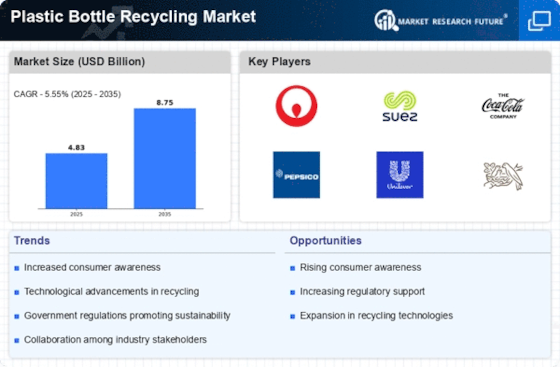
As per Market Research Future analysis, the Plastic Bottle Recycling Market Size was estimated at 4.83 USD Billion in 2024. The Plastic Bottle Recycling industry is projected to grow from 5.098 USD Billion in 2025 to 8.751 USD Billion by 2035, exhibiting a compound annual growth rate (CAGR) of 5.55% during the forecast period 2025 - 2035

Key Market Trends & Highlights

The Plastic Bottle Recycling Market is poised for substantial growth driven by technological advancements and increasing consumer demand for sustainability.

  • Technological advancements in recycling processes are enhancing efficiency and effectiveness in the Plastic Bottle Recycling Market. North America remains the largest market, while the Asia-Pacific region is emerging as the fastest-growing area for plastic recycling. Plastic Bottles dominate the market, whereas Plastic Films are experiencing the fastest growth in demand. Increasing environmental awareness and government regulations are key drivers propelling the market forward.

Market Size & Forecast

2024 Market Size 4.83 (USD Billion)
2035 Market Size 8.751 (USD Billion)
CAGR (2025 - 2035) 5.55%
Largest Regional Market Share in 2024 North America

Major Players

Veolia (FR), SUEZ (FR), Coca-Cola (US), PepsiCo (US), Unilever (GB), Nestle (CH), Recycling Technologies (GB), Plastipak (US), ALBA Group (DE)

Market Trends

The Plastic Bottle Recycling Market is currently experiencing a transformative phase, driven by increasing environmental awareness and regulatory pressures. Stakeholders across various sectors are recognizing the necessity of sustainable practices, which has led to a surge in initiatives aimed at enhancing recycling rates. This market is characterized by a growing emphasis on innovative technologies that facilitate the efficient processing of plastic waste. Moreover, the collaboration between governments, private enterprises, and non-profit organizations appears to be fostering a more robust recycling infrastructure, thereby promoting circular economy principles. In addition, consumer behavior is shifting towards eco-friendly products, which is likely to influence manufacturers to adopt sustainable packaging solutions. The rise of biodegradable alternatives and advancements in recycling technologies may further reshape the landscape of the Plastic Bottle Recycling Market. As the global community continues to prioritize sustainability, the market is poised for significant evolution, with potential for increased investment and development in recycling facilities and technologies. This trend suggests a promising future for the industry, as it aligns with broader environmental goals and consumer expectations.

Technological Advancements in Recycling Processes

Recent innovations in recycling technologies are enhancing the efficiency and effectiveness of plastic bottle processing. These advancements may include improved sorting mechanisms, chemical recycling methods, and automated systems that streamline operations. Such developments are likely to reduce costs and increase the volume of recycled materials, thereby supporting the overall growth of the Plastic Bottle Recycling Market.

Regulatory Support and Policy Initiatives

Governments worldwide are implementing stricter regulations and policies aimed at reducing plastic waste. This regulatory environment appears to encourage businesses to adopt sustainable practices, including increased investment in recycling infrastructure. As compliance becomes essential, the Plastic Bottle Recycling Market is expected to benefit from enhanced support and funding for recycling initiatives.

Consumer Demand for Sustainable Products

There is a noticeable shift in consumer preferences towards products that are environmentally friendly. This trend suggests that manufacturers are increasingly motivated to utilize recycled materials in their packaging. As consumers become more conscious of their environmental impact, the Plastic Bottle Recycling Market may see a rise in demand for recycled content, driving further investment in recycling capabilities.

Plastic Bottle Recycling Market Market Drivers

Increasing Environmental Awareness

The rising consciousness regarding environmental issues appears to be a pivotal driver for the Plastic Bottle Recycling Market. As consumers become more informed about the detrimental effects of plastic waste on ecosystems, there is a growing demand for sustainable practices. This shift in consumer behavior is reflected in market data, indicating that approximately 70% of consumers are willing to pay a premium for products made from recycled materials. Consequently, businesses are increasingly adopting recycling initiatives to align with consumer preferences, thereby enhancing their brand image and market competitiveness. The Plastic Bottle Recycling Market is likely to benefit from this trend, as companies strive to meet the expectations of environmentally conscious consumers.

Government Regulations and Policies

Government regulations and policies play a crucial role in shaping the Plastic Bottle Recycling Market. Many countries have implemented stringent regulations aimed at reducing plastic waste and promoting recycling. For instance, extended producer responsibility (EPR) laws require manufacturers to take responsibility for the entire lifecycle of their products, including post-consumer waste. This regulatory framework encourages companies to invest in recycling technologies and infrastructure. Market data suggests that regions with robust regulatory frameworks experience higher recycling rates, which in turn stimulates the growth of the Plastic Bottle Recycling Market. As governments continue to prioritize sustainability, the industry is expected to expand in response to these regulatory pressures.

Rising Demand for Recycled Plastics

The increasing demand for recycled plastics is a significant driver of the Plastic Bottle Recycling Market. As industries seek to reduce their carbon footprint and reliance on virgin materials, the demand for high-quality recycled plastics is surging. Market data indicates that the global demand for recycled plastics is projected to grow at a compound annual growth rate of over 10% in the coming years. This trend is encouraging investments in recycling facilities and technologies, thereby enhancing the overall capacity of the Plastic Bottle Recycling Market. As businesses strive to meet this demand, the industry is likely to experience robust growth, fostering a circular economy.

Corporate Sustainability Initiatives

Corporate sustainability initiatives are emerging as a vital driver for the Plastic Bottle Recycling Market. Many companies are setting ambitious sustainability goals, including commitments to use recycled materials in their products. This trend is not only driven by consumer demand but also by the need for companies to mitigate risks associated with plastic waste. Market data reveals that businesses that actively engage in sustainability practices tend to outperform their competitors in terms of brand loyalty and market share. As more corporations recognize the value of integrating recycling into their operations, the Plastic Bottle Recycling Market is poised for substantial growth, reflecting a broader commitment to environmental stewardship.

Technological Innovations in Recycling

Technological advancements in recycling processes are significantly influencing the Plastic Bottle Recycling Market. Innovations such as advanced sorting technologies, chemical recycling, and improved processing methods enhance the efficiency and effectiveness of recycling operations. For example, the introduction of AI-driven sorting systems has increased the accuracy of material separation, leading to higher quality recycled products. Market data indicates that the adoption of such technologies could potentially increase recycling rates by up to 30%. As these technologies become more accessible, they are likely to drive growth in the Plastic Bottle Recycling Market, enabling companies to meet the rising demand for recycled materials.

Market Segment Insights

By Application: Beverage Packaging (Largest) vs. Personal Care Products (Fastest-Growing)

<p>The plastic bottle recycling market by application reveals a diverse distribution of market share across various segments. Beverage packaging dominates the landscape, reflecting consumers' increasing demand for convenient and portable solutions. This segment not only leads in volume but also benefits from heightened regulatory attention towards sustainability, resulting in wider acceptance of recycled materials in beverage containers. Food packaging follows as a substantial segment, while personal care products are emerging rapidly, drawing interest due to shifting consumer preferences towards eco-friendly products.</p>

<p>Beverage Packaging (Dominant) vs. Personal Care Products (Emerging)</p>

<p>Beverage packaging stands as the dominant force in the plastic bottle recycling market, characterized by its resilience and strong consumer demand. This segment benefits from high production volumes and significant consumer awareness about recycling, which amplifies the overall sustainability narrative. In contrast, personal care products are recognized as an emerging segment, driven by changing consumer perceptions and a growing inclination towards sustainable products across personal care brands. With brands increasingly adopting recycled materials in packaging, this segment is witnessing rapid growth, responding to consumer demand for eco-friendly and sustainable packaging solutions.</p>

By End Use: Manufacturers (Largest) vs. Retailers (Fastest-Growing)

<p>In the plastic bottle recycling market, the end use segment is significantly defined by manufacturers, who dominate the landscape due to their large-scale operations and capability to integrate recycled materials into new products. Manufacturers leverage recycled plastics to produce containers, which form a substantial portion of the market share. Retailers, on the other hand, are emerging as a key player, increasingly recognizing their role in the recycling ecosystem through initiatives that promote sustainable practices and consumer awareness.</p>

<p>Manufacturers (Dominant) vs. Retailers (Emerging)</p>

<p>Manufacturers in the plastic bottle recycling market hold a dominant position as they are the primary consumers of recycled materials, directly influencing demand through their production capabilities. They embody a critical link in the recycling chain, utilizing collected plastic bottles to generate new products while optimizing production processes to reduce waste. Retailers, categorized as an emerging segment, are rapidly adapting to consumer preferences for sustainability. By implementing recycling programs and collaborating with manufacturers, they enhance their brand loyalty and attract environmentally-conscious consumers, which fosters growth and positions them as vital enablers in the circular economy.</p>

By Material Type: Polyethylene Terephthalate (Largest) vs. Polypropylene (Fastest-Growing)

<p>The plastic bottle recycling market showcases a diverse distribution among various material types, with Polyethylene Terephthalate (PET) holding the largest share due to its extensive use in beverage packaging. Following closely is High-Density Polyethylene (HDPE), which is favored for its versatility and strength. Polypropylene (PP) and Polyvinyl Chloride (PVC) make up a smaller portion of the market but are nonetheless critical for specific applications, particularly in food packaging and household products. This distribution reflects consumer preferences and industry trends in sustainability and recycling.</p>

<p>Polyethylene Terephthalate (Dominant) vs. Polypropylene (Emerging)</p>

<p>Polyethylene Terephthalate (PET) is the dominant material in the plastic bottle recycling segment, recognized for its ability to be recycled multiple times without significant degradation in quality. It is widely used in beverage bottles and packaging, allowing for efficient recycling processes. In contrast, Polypropylene (PP) is emerging rapidly, gaining traction due to its lightweight nature and favorable recycling properties. PP bottles, while traditionally less recycled than PET, are seeing increased adoption as recycling technologies improve and consumers become more environmentally conscious. This shift is driven by the material's resilience and the growing demand for sustainable packaging solutions.</p>

By Collection Method: Curbside Collection (Largest) vs. Drop-off Centers (Fastest-Growing)

<p>In the plastic bottle recycling market, the distribution of collection methods reveals that curbside collection remains the largest contributor, serving as a primary access point for consumers. This method is preferred for its convenience, facilitating higher participation rates in recycling programs. On the other hand, drop-off centers, while smaller in market share, are gaining attention for their eco-friendly initiatives and community-driven approaches, encouraging local recycling efforts. The upward trends in the drop-off centers segment point towards a growing environmental consciousness among consumers. Additionally, initiatives from municipalities and private organizations are enhancing the accessibility of these centers. Reverse vending machines are also contributing to growth by incorporating technology that incentivizes recycling behaviors. Meanwhile, deposit return schemes are emerging as powerful motivators, with various regions implementing successful programs that promote recycling and waste reduction.</p>

<p>Curbside Collection (Dominant) vs. Drop-off Centers (Emerging)</p>

<p>Curbside collection stands as the dominant method for collecting recycled plastic bottles, thanks to its convenience for households. This method updates traditional waste collections by integrating recycling into regular trash pickup, resulting in significant community engagement and higher recycling rates. In contrast, drop-off centers represent an emerging method, appealing to environmentally conscious individuals who prefer a proactive approach to recycling. These centers offer a controlled environment for recycling, capitalizing on the trend of local sustainability initiatives. They often provide additional services, such as educational resources about recycling best practices. The contrasting characteristics of these two methods highlight a shifting landscape in the recycling market, where convenience meets community involvement.</p>

By Processing Technology: Mechanical Recycling (Largest) vs. Chemical Recycling (Fastest-Growing)

<p>The plastic bottle recycling market is diversifying with prominent shares held by various processing technologies. Mechanical recycling remains the dominant force, leveraging established methods to process bottles efficiently and economically. It is favored for its simplicity and effectiveness, making it the go-to choice for many recyclers. Conversely, chemical recycling, which breaks down plastics into their original monomers, is gaining traction and is recognized as the fastest-growing segment, driven by the increasing need for innovative solutions to meet sustainability goals and manage plastic waste effectively.</p>

<p>Processing Technology: Mechanical Recycling (Dominant) vs. Chemical Recycling (Emerging)</p>

<p>Mechanical recycling is acknowledged as the dominant processing technology in the plastic bottle recycling market. This method focuses on grinding, washing, and re-extruding plastics, enabling the recovery of high-quality recycled materials while maintaining economic viability. On the other hand, chemical recycling is emerging as a significant player, employing advanced technologies to decompose plastics into their fundamental building blocks. This method not only enhances the recyclability of complex plastics but also aligns with circular economy principles. The growth of chemical recycling is fueled by advancements in technology and a rising demand for sustainable materials, positioning it as an innovative alternative to traditional mechanical approaches.</p>

Get more detailed insights about Global Plastic Bottle Recycling Market Research Report - Forecast to 2035

Regional Insights

North America : Sustainability Leader

North America is the largest market for plastic bottle recycling, holding approximately 40% of the global share. The region's growth is driven by stringent regulations aimed at reducing plastic waste, increasing consumer awareness, and corporate sustainability initiatives. The demand for recycled materials is on the rise, supported by government incentives and recycling programs that encourage participation from both consumers and businesses. The United States and Canada are the leading countries in this market, with major players like Coca-Cola, PepsiCo, and Veolia actively investing in recycling technologies. The competitive landscape is characterized by partnerships between corporations and recycling firms, enhancing the efficiency of recycling processes. The presence of established companies and innovative startups is fostering a robust ecosystem for plastic bottle recycling.

Europe : Regulatory Framework Strength

Europe is the second-largest market for plastic bottle recycling, accounting for approximately 30% of the global market share. The region's growth is propelled by comprehensive regulations such as the EU Plastics Strategy, which aims to make all plastic packaging recyclable by 2030. This regulatory framework, combined with increasing public awareness and corporate responsibility, is driving demand for recycled plastic products across various sectors. Leading countries in this market include Germany, France, and the UK, where companies like SUEZ and Unilever are at the forefront of recycling initiatives. The competitive landscape is marked by collaboration between governments and private sectors to enhance recycling rates. The presence of innovative technologies and a strong commitment to sustainability are key factors contributing to the region's leadership in plastic bottle recycling.

Asia-Pacific : Emerging Market Potential

Asia-Pacific is witnessing significant growth in the plastic bottle recycling market, accounting for approximately 20% of the global share. The region's expansion is driven by increasing urbanization, rising disposable incomes, and growing environmental awareness among consumers. Governments are implementing stricter regulations to manage plastic waste, which is further propelling the demand for recycling solutions and technologies. Countries like China, India, and Japan are leading the charge in this market, with major players such as Nestle and Plastipak investing in advanced recycling technologies. The competitive landscape is evolving, with both local and international companies striving to enhance recycling capabilities. Collaborative efforts between governments and private sectors are crucial in establishing efficient recycling systems and promoting sustainable practices across the region.

Middle East and Africa : Resource-Rich Frontier

The Middle East and Africa represent a growing market for plastic bottle recycling, holding approximately 10% of the global share. The region's growth is driven by increasing awareness of environmental issues and the need for sustainable waste management solutions. Governments are beginning to implement regulations aimed at reducing plastic waste, which is fostering demand for recycling initiatives and infrastructure development. Leading countries in this market include South Africa and the UAE, where investments in recycling facilities are on the rise. The competitive landscape is characterized by a mix of local and international players, with companies like ALBA Group making significant contributions to recycling efforts. The region's potential for growth is substantial, as more stakeholders recognize the importance of sustainable practices in addressing plastic waste challenges.

Key Players and Competitive Insights

The Plastic Bottle Recycling Market is currently characterized by a dynamic competitive landscape, driven by increasing environmental awareness and regulatory pressures aimed at reducing plastic waste. Major players are actively engaging in innovative strategies to enhance their operational efficiencies and market presence. Companies such as Coca-Cola (US) and PepsiCo (US) are focusing on sustainability initiatives, including commitments to use recycled materials in their packaging. This trend towards circular economy practices is reshaping the competitive environment, as firms strive to differentiate themselves through eco-friendly solutions and advanced recycling technologies.
In terms of business tactics, key players are increasingly localizing their manufacturing processes and optimizing supply chains to reduce costs and improve sustainability. The market appears moderately fragmented, with a mix of large multinational corporations and smaller specialized firms. This structure allows for a diverse range of strategies, as companies leverage their unique strengths to capture market share and respond to evolving consumer preferences.
In August 2025, Veolia (FR) announced a strategic partnership with a leading technology firm to enhance its recycling capabilities through advanced AI-driven sorting technologies. This move is likely to bolster Veolia's operational efficiency and improve the quality of recycled materials, positioning the company as a leader in the sustainable waste management sector. Such technological advancements may also set a benchmark for competitors, pushing the industry towards greater innovation.
In September 2025, Unilever (GB) unveiled a new initiative aimed at increasing the use of post-consumer recycled plastic in its product lines. This initiative not only aligns with global sustainability goals but also reflects Unilever's commitment to reducing its carbon footprint. By integrating more recycled content into its packaging, Unilever is likely to enhance its brand reputation and appeal to environmentally conscious consumers, thereby strengthening its competitive position in the market.
In October 2025, Recycling Technologies (GB) launched a pilot program for a new chemical recycling process that promises to convert plastic waste back into virgin-quality materials. This innovative approach could significantly disrupt traditional recycling methods and provide a sustainable solution to the growing plastic waste crisis. The success of this pilot may position Recycling Technologies as a key player in the future of plastic recycling, potentially attracting partnerships and investments from larger corporations seeking to enhance their sustainability efforts.
As of October 2025, the competitive trends in the Plastic Bottle Recycling Market are increasingly defined by digitalization, sustainability, and the integration of advanced technologies. Strategic alliances among key players are becoming more prevalent, as companies recognize the need to collaborate in order to innovate and meet regulatory demands. Looking ahead, it appears that competitive differentiation will increasingly hinge on innovation and technological advancements rather than solely on price. Firms that can effectively leverage technology and optimize their supply chains are likely to emerge as leaders in this evolving market.

Key Companies in the Plastic Bottle Recycling Market include

Industry Developments

The plastic bottle recycling market is moderately competitive and there are several production companies that are in the market but few major players are dominant. These share a prominent share in the global market and are expanding their boundaries across the globe. The initiatives have been taken and the new technical strategies and collaborations have increased the profitability of these companies.

List of the key major companies in the Global Plastic Bottle Recycling Market are

    • Cospack America Corporation
    • Amcor Limited
    • BERICAP GmbH & Co. KG
    • Rexam, Inc.
    • Berry Global, Inc
    • Graham Packaging Company Inc.
    • Container Corporation of Canada
    • Ontario Plastic Container Producers Ltd.
    • Constar Internationals, Inc.
    • Alpha Packaging
    • Alpack Plastics
    • Plastipak Holdings, Inc.
    • Resilux NV

COVID-19 Analysis

The COVID-19 outbreak is affecting the countries and the global plastic bottle recycling market at a wider level. The supply-chain demand market has been affected so vigorously. The single-use plastic packaging and medical supplies are at the surge. Also, the governments have suspended the ban on single-use plastic bags and bottles. This is one of the factors that has dipped the global market shares of the Global Plastic Bottle Recycling Market.

There was a negative impact on the engineering plastic industry during the Covid-19 outbreak. On the other side, there are several difficulties in collection and sorting of mixed plastics, however, the less availability of resources had an adverse effect on the plastic bottle recycling market as per the report analysis.

Plastic Bottle Recycling Market Segment Overview

The Global Plastic Bottle Recycling Market is segmented on the basis of Source, Raw Material, Recycling Methods, End User and the region.For Example:

    • By SourcePlastic Bottles

Plastic FilmsSynthetic FibersRigid Plastics & FoamsOthers (auto-parts, electrical goods, furniture and others)

    • By Raw Material TypePolyethylene Terephthalate (PET)

Polyethylene (PE) – LPDE & HDPEPolypropylene (PP)Polyvinyl Chloride (PVC)Polystyrene (PS)Polyamide (PA)PolycarbonateAcrylonitrile-butadiene StyreneOther plastics under SPI code 7

    • By Recycling MethodThermal decomposition

Heat compressionDistributed recyclingPyrolysisOthers

    • By End-UserPackaging (Bottles, Containers, Bags & Films, Strapping, Others)

Building & Construction (Lumber, Pipe, Furnishings, and Carpets & Rugs and Others)TextilesAutomotive (Batteries, Others)Electrical & ElectronicsOthers (Agriculture, Aerospace and other industries)

    • By RegionAsia Pacific

North AmericaEuropeMiddle East & AfricaSouth America

Market Dynamics

The plastic bottle recycle market is picking up the pace and is expected to grow at a steady rate in the near future, boosted by increased demand for recycled plastic bottles. The low cost, light weight, and easy handling of the plastic packaging has made this market really popular in the past few years and is growing rapidly. The manufacturers also prefer the usage of plastic packaging as it is a cheap mode of production and will not hamper the quality of the product.

There are various factors that are boosting the Plastic Bottle Recycling Market such as energy conservation, reduced pollution and the reduced emission of the greenhouse gases. Moreover, almost all the governments of the countries are taking initiatives to enhance the awareness for the increased production of the recycling products. Plastic is one of the major products in this area that has been recycled for several applications. It is expected that with the increased demands and the usage of such products the production will increase and will show staggering growth during the forecast period.

    • Drivers

      The plastic is used in many types and the disposal of plastic is done in an inappropriate way that causes air, water and land pollution. With the increased awareness towards the environment the advanced recycling processes have been introduced and it is the major driver that has increased the Global Plastic Bottle Recycling Market share during the past years. The resources were depleting because of the plastic pollution and recycling the waste plastic has played a significant role. 
    • Opportunities

      In the developed countries like the US, Europe and North America there are many social groups that are actively into recycling related programs and the public-sector is funding more than $100 millions for the advancement of such sectors. The increased awareness has offered the recycling market with many superior benefits such as reduction in the collection cost, increased market share percentages and tax exemptions as well. So, such initiatives should be taken at a global level so as the plastic bottle recycling market growth can be accelerated.
    • Restraints

      The proper collection of the raw material is highly required for the plastic recycling market. If we consider globally, only 14% of the plastic waste has been used for the recycling and that can be used further as per the requirements. The biodiversity is impacted and the aquatic lives are living on a stake due to this reason. Many associations and governments are helping to get the market growth by regulating the disposal of the waste plastics.
    • Challenges

      The major challenge is to export the plastic trash from other countries to the manufacturing or recycling plants. In 2016, China imported 51% of the global plastic from the other regions of the world and that is very cost effective in terms of the carriage charges and importing the plastic waste. So, countries decide to collect the waste from their native sources and try to propel in the global plastic bottle recycling market.

The recycling of plastic bottles is becoming one of the major markets and is being carried out at a very large scale. The recycling is the only process wherein the reuse of the plastics is done. The recycling helps the environment to lower the pollution levels by converting the lower grade plastic to usable products. The disposal of waste has been a major concern to reduce the CO2 emissions and to lower the pollution levels.

The advanced technologies and new processes have introduced various collection, sorting and reprocessing of the plastics and this has created new opportunities for the Global Plastic Bottle Recycling Market.The waste plastics are converted into a polymer that is known as Polyethylene terephthalate (PET) that refers to a thermoplastic polymer resin and this is highly used for the manufacturing of the plastic bottles. The PET bottles are more lighteighted, durable, non-reactive, transparent and thermally stable in nature. These bottles are getting more popularity in the market because of the various shapes and less manufacturing cost.

The packaging of drinking water and other sweet beverages is really in service these days. The other applications for the PET bottles are used in packaging solutions for salad dressings, medicines, dish detergents, household cleaners, and mouthwashes.

Competitive Landscape

    • In February 2020, Amcor PLC, showcased a development and launched the PET container that is made up of 100% post-consumer recycled content (PCR) resin. It was a box for multivitamins that was launched in two sizes one is 100 cubic centimeters and other is 150 cubic centimeters.
    • In October 2019, Bericap GmbH & Co KG launched the tethered caps and it helped in the reduction of pollution and this innovative solution added security and regulated the collecting agencies and the cap will remain attached to the bottle during the consumption and afterwards as well.
    • In November 2017, SUEZ and LyondellBasell signed a joint venture that focused on high-quality circular polymers and developing high-standard products. These companies produced PP and HDPE recycled plastics.
    • Q2 2025: Rigid Polyolefins Recycling Market Hits Standstill Plastics Recyclers Europe reported that the growth of high-density polyethylene (HDPE) and polypropylene (PP) recycling capacities plateaued in 2023, with installed recycling capacities in EU27+3 reaching 1.7 million tonnes for HDPE and 1.8 million tonnes for PP, and approximately 300 recycling facilities operating. The stagnation is attributed to weaker demand, global polyolefin oversupply, high inflation, energy costs, and competition from lower-cost imports.


Future Outlook

Plastic Bottle Recycling Market Future Outlook

The Plastic Bottle Recycling Market is projected to grow at a 5.55% CAGR from 2025 to 2035, driven by increasing environmental regulations, consumer awareness, and technological advancements.

New opportunities lie in:

  • Expansion of automated sorting technologies for enhanced efficiency.
  • Development of biodegradable alternatives to traditional plastics.
  • Partnerships with beverage companies for closed-loop recycling systems.

By 2035, the market is expected to be robust, driven by innovation and sustainability initiatives.

Market Segmentation

Plastic Bottle Recycling Market Source Outlook

  • Plastic Bottles
  • Plastic Films
  • Synthetic Fibers
  • Rigid Plastics & Foams
  • Others (auto-parts
  • electrical goods
  • furniture and others)

Plastic Bottle Recycling Market End-User Outlook

  • Packaging (Bottles
  • Containers
  • Bags & Films
  • Strapping
  • Others)
  • Building & Construction (Lumber
  • Pipe
  • Furnishings
  • and Carpets & Rugs and Others)
  • Textiles
  • Automotive (Batteries
  • Others)
  • Electrical & Electronics
  • Others (Agriculture
  • Aerospace and other industries)

Plastic Bottle Recycling Market Recycling Method Outlook

  • Thermal decomposition
  • Heat compression
  • Distributed recycling
  • Pyrolysis
  • Others

Plastic Bottle Recycling Market Raw Material Type Outlook

  • Polyethylene Terephthalate (PET)
  • Polyethylene (PE) – LPDE & HDPE
  • Polypropylene (PP)
  • Polyvinyl Chloride (PVC)
  • Polystyrene (PS)
  • Polyamide (PA)
  • Polycarbonate
  • Acrylonitrile-butadiene Styrene
  • Other plastics under SPI code 7

Report Scope

MARKET SIZE 2024 4.83(USD Billion)
MARKET SIZE 2025 5.098(USD Billion)
MARKET SIZE 2035 8.751(USD Billion)
COMPOUND ANNUAL GROWTH RATE (CAGR) 5.55% (2025 - 2035)
REPORT COVERAGE Revenue Forecast, Competitive Landscape, Growth Factors, and Trends
BASE YEAR 2024
Market Forecast Period 2025 - 2035
Historical Data 2019 - 2024
Market Forecast Units USD Billion
Key Companies Profiled Veolia (FR), SUEZ (FR), Coca-Cola (US), PepsiCo (US), Unilever (GB), Nestle (CH), Recycling Technologies (GB), Plastipak (US), ALBA Group (DE)
Segments Covered Material, Application
Key Market Opportunities Advancements in recycling technologies enhance efficiency and sustainability in the Plastic Bottle Recycling Market.
Key Market Dynamics Rising consumer awareness drives demand for sustainable practices in the plastic bottle recycling market.
Countries Covered North America, Europe, APAC, South America, MEA

FAQs

What is the current valuation of the plastic bottle recycling market in 2025?

<p>The plastic bottle recycling market is valued at 4.5 USD Billion in 2024 and is projected to grow to 7.5 USD Billion by 2035.</p>

What is the expected CAGR for the plastic bottle recycling market from 2025 to 2035?

<p>The expected CAGR for the plastic bottle recycling market during the forecast period 2025 - 2035 is 4.75%.</p>

Which companies are the key players in the plastic bottle recycling market?

<p>Key players in the plastic bottle recycling market include Veolia, SUEZ, Coca-Cola, PepsiCo, Unilever, Nestle, Recycling Technologies, Plastipak, ALBA Group, and Biffa.</p>

How is the plastic bottle recycling market segmented by application?

<p>The market is segmented by application, with Beverage Packaging valued at 3.0 USD Billion and Food Packaging at 2.0 USD Billion in 2035.</p>

What are the projected values for the plastic bottle recycling market by end use in 2035?

<p>By 2035, the projected values for end use include Recycling Facilities at 2.0 USD Billion and Manufacturers at 2.5 USD Billion.</p>

What materials are primarily used in plastic bottle recycling?

<p>The primary materials in plastic bottle recycling include Polyethylene Terephthalate, projected to reach 3.0 USD Billion by 2035.</p>

What collection methods are utilized in the plastic bottle recycling market?

<p>Collection methods include Curbside Collection, expected to be valued at 3.0 USD Billion by 2035, and Drop-off Centers at 1.5 USD Billion.</p>

What processing technologies are employed in the plastic bottle recycling market?

<p>The market employs various processing technologies, with Mechanical Recycling projected to reach 2.5 USD Billion by 2035.</p>

How does the market for plastic bottle recycling compare across different segments?

<p>In 2035, Beverage Packaging leads the application segment, while Recycling Facilities dominate the end use segment.</p>

What trends are influencing the growth of the plastic bottle recycling market?

<p>Trends such as increased consumer awareness and regulatory support are likely to drive the growth of the plastic bottle recycling market through 2035.</p>

  1. SECTION I: EXECUTIVE SUMMARY AND KEY HIGHLIGHTS
    1. | 1.1 EXECUTIVE SUMMARY
    2. | | 1.1.1 Market Overview
    3. | | 1.1.2 Key Findings
    4. | | 1.1.3 Market Segmentation
    5. | | 1.1.4 Competitive Landscape
    6. | | 1.1.5 Challenges and Opportunities
    7. | | 1.1.6 Future Outlook
  2. SECTION II: SCOPING, METHODOLOGY AND MARKET STRUCTURE
    1. | 2.1 MARKET INTRODUCTION
    2. | | 2.1.1 Definition
    3. | | 2.1.2 Scope of the study
    4. | | | 2.1.2.1 Research Objective
    5. | | | 2.1.2.2 Assumption
    6. | | | 2.1.2.3 Limitations
    7. | 2.2 RESEARCH METHODOLOGY
    8. | | 2.2.1 Overview
    9. | | 2.2.2 Data Mining
    10. | | 2.2.3 Secondary Research
    11. | | 2.2.4 Primary Research
    12. | | | 2.2.4.1 Primary Interviews and Information Gathering Process
    13. | | | 2.2.4.2 Breakdown of Primary Respondents
    14. | | 2.2.5 Forecasting Model
    15. | | 2.2.6 Market Size Estimation
    16. | | | 2.2.6.1 Bottom-Up Approach
    17. | | | 2.2.6.2 Top-Down Approach
    18. | | 2.2.7 Data Triangulation
    19. | | 2.2.8 Validation
  3. SECTION III: QUALITATIVE ANALYSIS
    1. | 3.1 MARKET DYNAMICS
    2. | | 3.1.1 Overview
    3. | | 3.1.2 Drivers
    4. | | 3.1.3 Restraints
    5. | | 3.1.4 Opportunities
    6. | 3.2 MARKET FACTOR ANALYSIS
    7. | | 3.2.1 Value chain Analysis
    8. | | 3.2.2 Porter's Five Forces Analysis
    9. | | | 3.2.2.1 Bargaining Power of Suppliers
    10. | | | 3.2.2.2 Bargaining Power of Buyers
    11. | | | 3.2.2.3 Threat of New Entrants
    12. | | | 3.2.2.4 Threat of Substitutes
    13. | | | 3.2.2.5 Intensity of Rivalry
    14. | | 3.2.3 COVID-19 Impact Analysis
    15. | | | 3.2.3.1 Market Impact Analysis
    16. | | | 3.2.3.2 Regional Impact
    17. | | | 3.2.3.3 Opportunity and Threat Analysis
  4. SECTION IV: QUANTITATIVE ANALYSIS
    1. | 4.1 Packaging & Transport, BY Application (USD Billion)
    2. | | 4.1.1 Beverage Packaging
    3. | | 4.1.2 Food Packaging
    4. | | 4.1.3 Personal Care Products
    5. | | 4.1.4 Household Products
    6. | 4.2 Packaging & Transport, BY End Use (USD Billion)
    7. | | 4.2.1 Recycling Facilities
    8. | | 4.2.2 Manufacturers
    9. | | 4.2.3 Retailers
    10. | | 4.2.4 Consumers
    11. | 4.3 Packaging & Transport, BY Material Type (USD Billion)
    12. | | 4.3.1 Polyethylene Terephthalate
    13. | | 4.3.2 High-Density Polyethylene
    14. | | 4.3.3 Polypropylene
    15. | | 4.3.4 Polyvinyl Chloride
    16. | 4.4 Packaging & Transport, BY Collection Method (USD Billion)
    17. | | 4.4.1 Curbside Collection
    18. | | 4.4.2 Drop-off Centers
    19. | | 4.4.3 Reverse Vending Machines
    20. | | 4.4.4 Deposit Return Schemes
    21. | 4.5 Packaging & Transport, BY Processing Technology (USD Billion)
    22. | | 4.5.1 Mechanical Recycling
    23. | | 4.5.2 Chemical Recycling
    24. | | 4.5.3 Thermal Recycling
    25. | | 4.5.4 Biological Recycling
    26. | 4.6 Packaging & Transport, BY Region (USD Billion)
    27. | | 4.6.1 North America
    28. | | | 4.6.1.1 US
    29. | | | 4.6.1.2 Canada
    30. | | 4.6.2 Europe
    31. | | | 4.6.2.1 Germany
    32. | | | 4.6.2.2 UK
    33. | | | 4.6.2.3 France
    34. | | | 4.6.2.4 Russia
    35. | | | 4.6.2.5 Italy
    36. | | | 4.6.2.6 Spain
    37. | | | 4.6.2.7 Rest of Europe
    38. | | 4.6.3 APAC
    39. | | | 4.6.3.1 China
    40. | | | 4.6.3.2 India
    41. | | | 4.6.3.3 Japan
    42. | | | 4.6.3.4 South Korea
    43. | | | 4.6.3.5 Malaysia
    44. | | | 4.6.3.6 Thailand
    45. | | | 4.6.3.7 Indonesia
    46. | | | 4.6.3.8 Rest of APAC
    47. | | 4.6.4 South America
    48. | | | 4.6.4.1 Brazil
    49. | | | 4.6.4.2 Mexico
    50. | | | 4.6.4.3 Argentina
    51. | | | 4.6.4.4 Rest of South America
    52. | | 4.6.5 MEA
    53. | | | 4.6.5.1 GCC Countries
    54. | | | 4.6.5.2 South Africa
    55. | | | 4.6.5.3 Rest of MEA
  5. SECTION V: COMPETITIVE ANALYSIS
    1. | 5.1 Competitive Landscape
    2. | | 5.1.1 Overview
    3. | | 5.1.2 Competitive Analysis
    4. | | 5.1.3 Market share Analysis
    5. | | 5.1.4 Major Growth Strategy in the Packaging & Transport
    6. | | 5.1.5 Competitive Benchmarking
    7. | | 5.1.6 Leading Players in Terms of Number of Developments in the Packaging & Transport
    8. | | 5.1.7 Key developments and growth strategies
    9. | | | 5.1.7.1 New Product Launch/Service Deployment
    10. | | | 5.1.7.2 Merger & Acquisitions
    11. | | | 5.1.7.3 Joint Ventures
    12. | | 5.1.8 Major Players Financial Matrix
    13. | | | 5.1.8.1 Sales and Operating Income
    14. | | | 5.1.8.2 Major Players R&D Expenditure. 2023
    15. | 5.2 Company Profiles
    16. | | 5.2.1 Veolia (FR)
    17. | | | 5.2.1.1 Financial Overview
    18. | | | 5.2.1.2 Products Offered
    19. | | | 5.2.1.3 Key Developments
    20. | | | 5.2.1.4 SWOT Analysis
    21. | | | 5.2.1.5 Key Strategies
    22. | | 5.2.2 SUEZ (FR)
    23. | | | 5.2.2.1 Financial Overview
    24. | | | 5.2.2.2 Products Offered
    25. | | | 5.2.2.3 Key Developments
    26. | | | 5.2.2.4 SWOT Analysis
    27. | | | 5.2.2.5 Key Strategies
    28. | | 5.2.3 Coca-Cola (US)
    29. | | | 5.2.3.1 Financial Overview
    30. | | | 5.2.3.2 Products Offered
    31. | | | 5.2.3.3 Key Developments
    32. | | | 5.2.3.4 SWOT Analysis
    33. | | | 5.2.3.5 Key Strategies
    34. | | 5.2.4 PepsiCo (US)
    35. | | | 5.2.4.1 Financial Overview
    36. | | | 5.2.4.2 Products Offered
    37. | | | 5.2.4.3 Key Developments
    38. | | | 5.2.4.4 SWOT Analysis
    39. | | | 5.2.4.5 Key Strategies
    40. | | 5.2.5 Unilever (GB)
    41. | | | 5.2.5.1 Financial Overview
    42. | | | 5.2.5.2 Products Offered
    43. | | | 5.2.5.3 Key Developments
    44. | | | 5.2.5.4 SWOT Analysis
    45. | | | 5.2.5.5 Key Strategies
    46. | | 5.2.6 Nestle (CH)
    47. | | | 5.2.6.1 Financial Overview
    48. | | | 5.2.6.2 Products Offered
    49. | | | 5.2.6.3 Key Developments
    50. | | | 5.2.6.4 SWOT Analysis
    51. | | | 5.2.6.5 Key Strategies
    52. | | 5.2.7 Recycling Technologies (GB)
    53. | | | 5.2.7.1 Financial Overview
    54. | | | 5.2.7.2 Products Offered
    55. | | | 5.2.7.3 Key Developments
    56. | | | 5.2.7.4 SWOT Analysis
    57. | | | 5.2.7.5 Key Strategies
    58. | | 5.2.8 Plastipak (US)
    59. | | | 5.2.8.1 Financial Overview
    60. | | | 5.2.8.2 Products Offered
    61. | | | 5.2.8.3 Key Developments
    62. | | | 5.2.8.4 SWOT Analysis
    63. | | | 5.2.8.5 Key Strategies
    64. | | 5.2.9 ALBA Group (DE)
    65. | | | 5.2.9.1 Financial Overview
    66. | | | 5.2.9.2 Products Offered
    67. | | | 5.2.9.3 Key Developments
    68. | | | 5.2.9.4 SWOT Analysis
    69. | | | 5.2.9.5 Key Strategies
    70. | | 5.2.10 Biffa (GB)
    71. | | | 5.2.10.1 Financial Overview
    72. | | | 5.2.10.2 Products Offered
    73. | | | 5.2.10.3 Key Developments
    74. | | | 5.2.10.4 SWOT Analysis
    75. | | | 5.2.10.5 Key Strategies
    76. | 5.3 Appendix
    77. | | 5.3.1 References
    78. | | 5.3.2 Related Reports
  6. LIST OF FIGURES
    1. | 6.1 MARKET SYNOPSIS
    2. | 6.2 NORTH AMERICA MARKET ANALYSIS
    3. | 6.3 US MARKET ANALYSIS BY APPLICATION
    4. | 6.4 US MARKET ANALYSIS BY END USE
    5. | 6.5 US MARKET ANALYSIS BY MATERIAL TYPE
    6. | 6.6 US MARKET ANALYSIS BY COLLECTION METHOD
    7. | 6.7 US MARKET ANALYSIS BY PROCESSING TECHNOLOGY
    8. | 6.8 CANADA MARKET ANALYSIS BY APPLICATION
    9. | 6.9 CANADA MARKET ANALYSIS BY END USE
    10. | 6.10 CANADA MARKET ANALYSIS BY MATERIAL TYPE
    11. | 6.11 CANADA MARKET ANALYSIS BY COLLECTION METHOD
    12. | 6.12 CANADA MARKET ANALYSIS BY PROCESSING TECHNOLOGY
    13. | 6.13 EUROPE MARKET ANALYSIS
    14. | 6.14 GERMANY MARKET ANALYSIS BY APPLICATION
    15. | 6.15 GERMANY MARKET ANALYSIS BY END USE
    16. | 6.16 GERMANY MARKET ANALYSIS BY MATERIAL TYPE
    17. | 6.17 GERMANY MARKET ANALYSIS BY COLLECTION METHOD
    18. | 6.18 GERMANY MARKET ANALYSIS BY PROCESSING TECHNOLOGY
    19. | 6.19 UK MARKET ANALYSIS BY APPLICATION
    20. | 6.20 UK MARKET ANALYSIS BY END USE
    21. | 6.21 UK MARKET ANALYSIS BY MATERIAL TYPE
    22. | 6.22 UK MARKET ANALYSIS BY COLLECTION METHOD
    23. | 6.23 UK MARKET ANALYSIS BY PROCESSING TECHNOLOGY
    24. | 6.24 FRANCE MARKET ANALYSIS BY APPLICATION
    25. | 6.25 FRANCE MARKET ANALYSIS BY END USE
    26. | 6.26 FRANCE MARKET ANALYSIS BY MATERIAL TYPE
    27. | 6.27 FRANCE MARKET ANALYSIS BY COLLECTION METHOD
    28. | 6.28 FRANCE MARKET ANALYSIS BY PROCESSING TECHNOLOGY
    29. | 6.29 RUSSIA MARKET ANALYSIS BY APPLICATION
    30. | 6.30 RUSSIA MARKET ANALYSIS BY END USE
    31. | 6.31 RUSSIA MARKET ANALYSIS BY MATERIAL TYPE
    32. | 6.32 RUSSIA MARKET ANALYSIS BY COLLECTION METHOD
    33. | 6.33 RUSSIA MARKET ANALYSIS BY PROCESSING TECHNOLOGY
    34. | 6.34 ITALY MARKET ANALYSIS BY APPLICATION
    35. | 6.35 ITALY MARKET ANALYSIS BY END USE
    36. | 6.36 ITALY MARKET ANALYSIS BY MATERIAL TYPE
    37. | 6.37 ITALY MARKET ANALYSIS BY COLLECTION METHOD
    38. | 6.38 ITALY MARKET ANALYSIS BY PROCESSING TECHNOLOGY
    39. | 6.39 SPAIN MARKET ANALYSIS BY APPLICATION
    40. | 6.40 SPAIN MARKET ANALYSIS BY END USE
    41. | 6.41 SPAIN MARKET ANALYSIS BY MATERIAL TYPE
    42. | 6.42 SPAIN MARKET ANALYSIS BY COLLECTION METHOD
    43. | 6.43 SPAIN MARKET ANALYSIS BY PROCESSING TECHNOLOGY
    44. | 6.44 REST OF EUROPE MARKET ANALYSIS BY APPLICATION
    45. | 6.45 REST OF EUROPE MARKET ANALYSIS BY END USE
    46. | 6.46 REST OF EUROPE MARKET ANALYSIS BY MATERIAL TYPE
    47. | 6.47 REST OF EUROPE MARKET ANALYSIS BY COLLECTION METHOD
    48. | 6.48 REST OF EUROPE MARKET ANALYSIS BY PROCESSING TECHNOLOGY
    49. | 6.49 APAC MARKET ANALYSIS
    50. | 6.50 CHINA MARKET ANALYSIS BY APPLICATION
    51. | 6.51 CHINA MARKET ANALYSIS BY END USE
    52. | 6.52 CHINA MARKET ANALYSIS BY MATERIAL TYPE
    53. | 6.53 CHINA MARKET ANALYSIS BY COLLECTION METHOD
    54. | 6.54 CHINA MARKET ANALYSIS BY PROCESSING TECHNOLOGY
    55. | 6.55 INDIA MARKET ANALYSIS BY APPLICATION
    56. | 6.56 INDIA MARKET ANALYSIS BY END USE
    57. | 6.57 INDIA MARKET ANALYSIS BY MATERIAL TYPE
    58. | 6.58 INDIA MARKET ANALYSIS BY COLLECTION METHOD
    59. | 6.59 INDIA MARKET ANALYSIS BY PROCESSING TECHNOLOGY
    60. | 6.60 JAPAN MARKET ANALYSIS BY APPLICATION
    61. | 6.61 JAPAN MARKET ANALYSIS BY END USE
    62. | 6.62 JAPAN MARKET ANALYSIS BY MATERIAL TYPE
    63. | 6.63 JAPAN MARKET ANALYSIS BY COLLECTION METHOD
    64. | 6.64 JAPAN MARKET ANALYSIS BY PROCESSING TECHNOLOGY
    65. | 6.65 SOUTH KOREA MARKET ANALYSIS BY APPLICATION
    66. | 6.66 SOUTH KOREA MARKET ANALYSIS BY END USE
    67. | 6.67 SOUTH KOREA MARKET ANALYSIS BY MATERIAL TYPE
    68. | 6.68 SOUTH KOREA MARKET ANALYSIS BY COLLECTION METHOD
    69. | 6.69 SOUTH KOREA MARKET ANALYSIS BY PROCESSING TECHNOLOGY
    70. | 6.70 MALAYSIA MARKET ANALYSIS BY APPLICATION
    71. | 6.71 MALAYSIA MARKET ANALYSIS BY END USE
    72. | 6.72 MALAYSIA MARKET ANALYSIS BY MATERIAL TYPE
    73. | 6.73 MALAYSIA MARKET ANALYSIS BY COLLECTION METHOD
    74. | 6.74 MALAYSIA MARKET ANALYSIS BY PROCESSING TECHNOLOGY
    75. | 6.75 THAILAND MARKET ANALYSIS BY APPLICATION
    76. | 6.76 THAILAND MARKET ANALYSIS BY END USE
    77. | 6.77 THAILAND MARKET ANALYSIS BY MATERIAL TYPE
    78. | 6.78 THAILAND MARKET ANALYSIS BY COLLECTION METHOD
    79. | 6.79 THAILAND MARKET ANALYSIS BY PROCESSING TECHNOLOGY
    80. | 6.80 INDONESIA MARKET ANALYSIS BY APPLICATION
    81. | 6.81 INDONESIA MARKET ANALYSIS BY END USE
    82. | 6.82 INDONESIA MARKET ANALYSIS BY MATERIAL TYPE
    83. | 6.83 INDONESIA MARKET ANALYSIS BY COLLECTION METHOD
    84. | 6.84 INDONESIA MARKET ANALYSIS BY PROCESSING TECHNOLOGY
    85. | 6.85 REST OF APAC MARKET ANALYSIS BY APPLICATION
    86. | 6.86 REST OF APAC MARKET ANALYSIS BY END USE
    87. | 6.87 REST OF APAC MARKET ANALYSIS BY MATERIAL TYPE
    88. | 6.88 REST OF APAC MARKET ANALYSIS BY COLLECTION METHOD
    89. | 6.89 REST OF APAC MARKET ANALYSIS BY PROCESSING TECHNOLOGY
    90. | 6.90 SOUTH AMERICA MARKET ANALYSIS
    91. | 6.91 BRAZIL MARKET ANALYSIS BY APPLICATION
    92. | 6.92 BRAZIL MARKET ANALYSIS BY END USE
    93. | 6.93 BRAZIL MARKET ANALYSIS BY MATERIAL TYPE
    94. | 6.94 BRAZIL MARKET ANALYSIS BY COLLECTION METHOD
    95. | 6.95 BRAZIL MARKET ANALYSIS BY PROCESSING TECHNOLOGY
    96. | 6.96 MEXICO MARKET ANALYSIS BY APPLICATION
    97. | 6.97 MEXICO MARKET ANALYSIS BY END USE
    98. | 6.98 MEXICO MARKET ANALYSIS BY MATERIAL TYPE
    99. | 6.99 MEXICO MARKET ANALYSIS BY COLLECTION METHOD
    100. | 6.100 MEXICO MARKET ANALYSIS BY PROCESSING TECHNOLOGY
    101. | 6.101 ARGENTINA MARKET ANALYSIS BY APPLICATION
    102. | 6.102 ARGENTINA MARKET ANALYSIS BY END USE
    103. | 6.103 ARGENTINA MARKET ANALYSIS BY MATERIAL TYPE
    104. | 6.104 ARGENTINA MARKET ANALYSIS BY COLLECTION METHOD
    105. | 6.105 ARGENTINA MARKET ANALYSIS BY PROCESSING TECHNOLOGY
    106. | 6.106 REST OF SOUTH AMERICA MARKET ANALYSIS BY APPLICATION
    107. | 6.107 REST OF SOUTH AMERICA MARKET ANALYSIS BY END USE
    108. | 6.108 REST OF SOUTH AMERICA MARKET ANALYSIS BY MATERIAL TYPE
    109. | 6.109 REST OF SOUTH AMERICA MARKET ANALYSIS BY COLLECTION METHOD
    110. | 6.110 REST OF SOUTH AMERICA MARKET ANALYSIS BY PROCESSING TECHNOLOGY
    111. | 6.111 MEA MARKET ANALYSIS
    112. | 6.112 GCC COUNTRIES MARKET ANALYSIS BY APPLICATION
    113. | 6.113 GCC COUNTRIES MARKET ANALYSIS BY END USE
    114. | 6.114 GCC COUNTRIES MARKET ANALYSIS BY MATERIAL TYPE
    115. | 6.115 GCC COUNTRIES MARKET ANALYSIS BY COLLECTION METHOD
    116. | 6.116 GCC COUNTRIES MARKET ANALYSIS BY PROCESSING TECHNOLOGY
    117. | 6.117 SOUTH AFRICA MARKET ANALYSIS BY APPLICATION
    118. | 6.118 SOUTH AFRICA MARKET ANALYSIS BY END USE
    119. | 6.119 SOUTH AFRICA MARKET ANALYSIS BY MATERIAL TYPE
    120. | 6.120 SOUTH AFRICA MARKET ANALYSIS BY COLLECTION METHOD
    121. | 6.121 SOUTH AFRICA MARKET ANALYSIS BY PROCESSING TECHNOLOGY
    122. | 6.122 REST OF MEA MARKET ANALYSIS BY APPLICATION
    123. | 6.123 REST OF MEA MARKET ANALYSIS BY END USE
    124. | 6.124 REST OF MEA MARKET ANALYSIS BY MATERIAL TYPE
    125. | 6.125 REST OF MEA MARKET ANALYSIS BY COLLECTION METHOD
    126. | 6.126 REST OF MEA MARKET ANALYSIS BY PROCESSING TECHNOLOGY
    127. | 6.127 KEY BUYING CRITERIA OF PACKAGING & TRANSPORT
    128. | 6.128 RESEARCH PROCESS OF MRFR
    129. | 6.129 DRO ANALYSIS OF PACKAGING & TRANSPORT
    130. | 6.130 DRIVERS IMPACT ANALYSIS: PACKAGING & TRANSPORT
    131. | 6.131 RESTRAINTS IMPACT ANALYSIS: PACKAGING & TRANSPORT
    132. | 6.132 SUPPLY / VALUE CHAIN: PACKAGING & TRANSPORT
    133. | 6.133 PACKAGING & TRANSPORT, BY APPLICATION, 2024 (% SHARE)
    134. | 6.134 PACKAGING & TRANSPORT, BY APPLICATION, 2024 TO 2035 (USD Billion)
    135. | 6.135 PACKAGING & TRANSPORT, BY END USE, 2024 (% SHARE)
    136. | 6.136 PACKAGING & TRANSPORT, BY END USE, 2024 TO 2035 (USD Billion)
    137. | 6.137 PACKAGING & TRANSPORT, BY MATERIAL TYPE, 2024 (% SHARE)
    138. | 6.138 PACKAGING & TRANSPORT, BY MATERIAL TYPE, 2024 TO 2035 (USD Billion)
    139. | 6.139 PACKAGING & TRANSPORT, BY COLLECTION METHOD, 2024 (% SHARE)
    140. | 6.140 PACKAGING & TRANSPORT, BY COLLECTION METHOD, 2024 TO 2035 (USD Billion)
    141. | 6.141 PACKAGING & TRANSPORT, BY PROCESSING TECHNOLOGY, 2024 (% SHARE)
    142. | 6.142 PACKAGING & TRANSPORT, BY PROCESSING TECHNOLOGY, 2024 TO 2035 (USD Billion)
    143. | 6.143 BENCHMARKING OF MAJOR COMPETITORS
  7. LIST OF TABLES
    1. | 7.1 LIST OF ASSUMPTIONS
    2. | | 7.1.1
    3. | 7.2 North America MARKET SIZE ESTIMATES; FORECAST
    4. | | 7.2.1 BY APPLICATION, 2025-2035 (USD Billion)
    5. | | 7.2.2 BY END USE, 2025-2035 (USD Billion)
    6. | | 7.2.3 BY MATERIAL TYPE, 2025-2035 (USD Billion)
    7. | | 7.2.4 BY COLLECTION METHOD, 2025-2035 (USD Billion)
    8. | | 7.2.5 BY PROCESSING TECHNOLOGY, 2025-2035 (USD Billion)
    9. | 7.3 US MARKET SIZE ESTIMATES; FORECAST
    10. | | 7.3.1 BY APPLICATION, 2025-2035 (USD Billion)
    11. | | 7.3.2 BY END USE, 2025-2035 (USD Billion)
    12. | | 7.3.3 BY MATERIAL TYPE, 2025-2035 (USD Billion)
    13. | | 7.3.4 BY COLLECTION METHOD, 2025-2035 (USD Billion)
    14. | | 7.3.5 BY PROCESSING TECHNOLOGY, 2025-2035 (USD Billion)
    15. | 7.4 Canada MARKET SIZE ESTIMATES; FORECAST
    16. | | 7.4.1 BY APPLICATION, 2025-2035 (USD Billion)
    17. | | 7.4.2 BY END USE, 2025-2035 (USD Billion)
    18. | | 7.4.3 BY MATERIAL TYPE, 2025-2035 (USD Billion)
    19. | | 7.4.4 BY COLLECTION METHOD, 2025-2035 (USD Billion)
    20. | | 7.4.5 BY PROCESSING TECHNOLOGY, 2025-2035 (USD Billion)
    21. | 7.5 Europe MARKET SIZE ESTIMATES; FORECAST
    22. | | 7.5.1 BY APPLICATION, 2025-2035 (USD Billion)
    23. | | 7.5.2 BY END USE, 2025-2035 (USD Billion)
    24. | | 7.5.3 BY MATERIAL TYPE, 2025-2035 (USD Billion)
    25. | | 7.5.4 BY COLLECTION METHOD, 2025-2035 (USD Billion)
    26. | | 7.5.5 BY PROCESSING TECHNOLOGY, 2025-2035 (USD Billion)
    27. | 7.6 Germany MARKET SIZE ESTIMATES; FORECAST
    28. | | 7.6.1 BY APPLICATION, 2025-2035 (USD Billion)
    29. | | 7.6.2 BY END USE, 2025-2035 (USD Billion)
    30. | | 7.6.3 BY MATERIAL TYPE, 2025-2035 (USD Billion)
    31. | | 7.6.4 BY COLLECTION METHOD, 2025-2035 (USD Billion)
    32. | | 7.6.5 BY PROCESSING TECHNOLOGY, 2025-2035 (USD Billion)
    33. | 7.7 UK MARKET SIZE ESTIMATES; FORECAST
    34. | | 7.7.1 BY APPLICATION, 2025-2035 (USD Billion)
    35. | | 7.7.2 BY END USE, 2025-2035 (USD Billion)
    36. | | 7.7.3 BY MATERIAL TYPE, 2025-2035 (USD Billion)
    37. | | 7.7.4 BY COLLECTION METHOD, 2025-2035 (USD Billion)
    38. | | 7.7.5 BY PROCESSING TECHNOLOGY, 2025-2035 (USD Billion)
    39. | 7.8 France MARKET SIZE ESTIMATES; FORECAST
    40. | | 7.8.1 BY APPLICATION, 2025-2035 (USD Billion)
    41. | | 7.8.2 BY END USE, 2025-2035 (USD Billion)
    42. | | 7.8.3 BY MATERIAL TYPE, 2025-2035 (USD Billion)
    43. | | 7.8.4 BY COLLECTION METHOD, 2025-2035 (USD Billion)
    44. | | 7.8.5 BY PROCESSING TECHNOLOGY, 2025-2035 (USD Billion)
    45. | 7.9 Russia MARKET SIZE ESTIMATES; FORECAST
    46. | | 7.9.1 BY APPLICATION, 2025-2035 (USD Billion)
    47. | | 7.9.2 BY END USE, 2025-2035 (USD Billion)
    48. | | 7.9.3 BY MATERIAL TYPE, 2025-2035 (USD Billion)
    49. | | 7.9.4 BY COLLECTION METHOD, 2025-2035 (USD Billion)
    50. | | 7.9.5 BY PROCESSING TECHNOLOGY, 2025-2035 (USD Billion)
    51. | 7.10 Italy MARKET SIZE ESTIMATES; FORECAST
    52. | | 7.10.1 BY APPLICATION, 2025-2035 (USD Billion)
    53. | | 7.10.2 BY END USE, 2025-2035 (USD Billion)
    54. | | 7.10.3 BY MATERIAL TYPE, 2025-2035 (USD Billion)
    55. | | 7.10.4 BY COLLECTION METHOD, 2025-2035 (USD Billion)
    56. | | 7.10.5 BY PROCESSING TECHNOLOGY, 2025-2035 (USD Billion)
    57. | 7.11 Spain MARKET SIZE ESTIMATES; FORECAST
    58. | | 7.11.1 BY APPLICATION, 2025-2035 (USD Billion)
    59. | | 7.11.2 BY END USE, 2025-2035 (USD Billion)
    60. | | 7.11.3 BY MATERIAL TYPE, 2025-2035 (USD Billion)
    61. | | 7.11.4 BY COLLECTION METHOD, 2025-2035 (USD Billion)
    62. | | 7.11.5 BY PROCESSING TECHNOLOGY, 2025-2035 (USD Billion)
    63. | 7.12 Rest of Europe MARKET SIZE ESTIMATES; FORECAST
    64. | | 7.12.1 BY APPLICATION, 2025-2035 (USD Billion)
    65. | | 7.12.2 BY END USE, 2025-2035 (USD Billion)
    66. | | 7.12.3 BY MATERIAL TYPE, 2025-2035 (USD Billion)
    67. | | 7.12.4 BY COLLECTION METHOD, 2025-2035 (USD Billion)
    68. | | 7.12.5 BY PROCESSING TECHNOLOGY, 2025-2035 (USD Billion)
    69. | 7.13 APAC MARKET SIZE ESTIMATES; FORECAST
    70. | | 7.13.1 BY APPLICATION, 2025-2035 (USD Billion)
    71. | | 7.13.2 BY END USE, 2025-2035 (USD Billion)
    72. | | 7.13.3 BY MATERIAL TYPE, 2025-2035 (USD Billion)
    73. | | 7.13.4 BY COLLECTION METHOD, 2025-2035 (USD Billion)
    74. | | 7.13.5 BY PROCESSING TECHNOLOGY, 2025-2035 (USD Billion)
    75. | 7.14 China MARKET SIZE ESTIMATES; FORECAST
    76. | | 7.14.1 BY APPLICATION, 2025-2035 (USD Billion)
    77. | | 7.14.2 BY END USE, 2025-2035 (USD Billion)
    78. | | 7.14.3 BY MATERIAL TYPE, 2025-2035 (USD Billion)
    79. | | 7.14.4 BY COLLECTION METHOD, 2025-2035 (USD Billion)
    80. | | 7.14.5 BY PROCESSING TECHNOLOGY, 2025-2035 (USD Billion)
    81. | 7.15 India MARKET SIZE ESTIMATES; FORECAST
    82. | | 7.15.1 BY APPLICATION, 2025-2035 (USD Billion)
    83. | | 7.15.2 BY END USE, 2025-2035 (USD Billion)
    84. | | 7.15.3 BY MATERIAL TYPE, 2025-2035 (USD Billion)
    85. | | 7.15.4 BY COLLECTION METHOD, 2025-2035 (USD Billion)
    86. | | 7.15.5 BY PROCESSING TECHNOLOGY, 2025-2035 (USD Billion)
    87. | 7.16 Japan MARKET SIZE ESTIMATES; FORECAST
    88. | | 7.16.1 BY APPLICATION, 2025-2035 (USD Billion)
    89. | | 7.16.2 BY END USE, 2025-2035 (USD Billion)
    90. | | 7.16.3 BY MATERIAL TYPE, 2025-2035 (USD Billion)
    91. | | 7.16.4 BY COLLECTION METHOD, 2025-2035 (USD Billion)
    92. | | 7.16.5 BY PROCESSING TECHNOLOGY, 2025-2035 (USD Billion)
    93. | 7.17 South Korea MARKET SIZE ESTIMATES; FORECAST
    94. | | 7.17.1 BY APPLICATION, 2025-2035 (USD Billion)
    95. | | 7.17.2 BY END USE, 2025-2035 (USD Billion)
    96. | | 7.17.3 BY MATERIAL TYPE, 2025-2035 (USD Billion)
    97. | | 7.17.4 BY COLLECTION METHOD, 2025-2035 (USD Billion)
    98. | | 7.17.5 BY PROCESSING TECHNOLOGY, 2025-2035 (USD Billion)
    99. | 7.18 Malaysia MARKET SIZE ESTIMATES; FORECAST
    100. | | 7.18.1 BY APPLICATION, 2025-2035 (USD Billion)
    101. | | 7.18.2 BY END USE, 2025-2035 (USD Billion)
    102. | | 7.18.3 BY MATERIAL TYPE, 2025-2035 (USD Billion)
    103. | | 7.18.4 BY COLLECTION METHOD, 2025-2035 (USD Billion)
    104. | | 7.18.5 BY PROCESSING TECHNOLOGY, 2025-2035 (USD Billion)
    105. | 7.19 Thailand MARKET SIZE ESTIMATES; FORECAST
    106. | | 7.19.1 BY APPLICATION, 2025-2035 (USD Billion)
    107. | | 7.19.2 BY END USE, 2025-2035 (USD Billion)
    108. | | 7.19.3 BY MATERIAL TYPE, 2025-2035 (USD Billion)
    109. | | 7.19.4 BY COLLECTION METHOD, 2025-2035 (USD Billion)
    110. | | 7.19.5 BY PROCESSING TECHNOLOGY, 2025-2035 (USD Billion)
    111. | 7.20 Indonesia MARKET SIZE ESTIMATES; FORECAST
    112. | | 7.20.1 BY APPLICATION, 2025-2035 (USD Billion)
    113. | | 7.20.2 BY END USE, 2025-2035 (USD Billion)
    114. | | 7.20.3 BY MATERIAL TYPE, 2025-2035 (USD Billion)
    115. | | 7.20.4 BY COLLECTION METHOD, 2025-2035 (USD Billion)
    116. | | 7.20.5 BY PROCESSING TECHNOLOGY, 2025-2035 (USD Billion)
    117. | 7.21 Rest of APAC MARKET SIZE ESTIMATES; FORECAST
    118. | | 7.21.1 BY APPLICATION, 2025-2035 (USD Billion)
    119. | | 7.21.2 BY END USE, 2025-2035 (USD Billion)
    120. | | 7.21.3 BY MATERIAL TYPE, 2025-2035 (USD Billion)
    121. | | 7.21.4 BY COLLECTION METHOD, 2025-2035 (USD Billion)
    122. | | 7.21.5 BY PROCESSING TECHNOLOGY, 2025-2035 (USD Billion)
    123. | 7.22 South America MARKET SIZE ESTIMATES; FORECAST
    124. | | 7.22.1 BY APPLICATION, 2025-2035 (USD Billion)
    125. | | 7.22.2 BY END USE, 2025-2035 (USD Billion)
    126. | | 7.22.3 BY MATERIAL TYPE, 2025-2035 (USD Billion)
    127. | | 7.22.4 BY COLLECTION METHOD, 2025-2035 (USD Billion)
    128. | | 7.22.5 BY PROCESSING TECHNOLOGY, 2025-2035 (USD Billion)
    129. | 7.23 Brazil MARKET SIZE ESTIMATES; FORECAST
    130. | | 7.23.1 BY APPLICATION, 2025-2035 (USD Billion)
    131. | | 7.23.2 BY END USE, 2025-2035 (USD Billion)
    132. | | 7.23.3 BY MATERIAL TYPE, 2025-2035 (USD Billion)
    133. | | 7.23.4 BY COLLECTION METHOD, 2025-2035 (USD Billion)
    134. | | 7.23.5 BY PROCESSING TECHNOLOGY, 2025-2035 (USD Billion)
    135. | 7.24 Mexico MARKET SIZE ESTIMATES; FORECAST
    136. | | 7.24.1 BY APPLICATION, 2025-2035 (USD Billion)
    137. | | 7.24.2 BY END USE, 2025-2035 (USD Billion)
    138. | | 7.24.3 BY MATERIAL TYPE, 2025-2035 (USD Billion)
    139. | | 7.24.4 BY COLLECTION METHOD, 2025-2035 (USD Billion)
    140. | | 7.24.5 BY PROCESSING TECHNOLOGY, 2025-2035 (USD Billion)
    141. | 7.25 Argentina MARKET SIZE ESTIMATES; FORECAST
    142. | | 7.25.1 BY APPLICATION, 2025-2035 (USD Billion)
    143. | | 7.25.2 BY END USE, 2025-2035 (USD Billion)
    144. | | 7.25.3 BY MATERIAL TYPE, 2025-2035 (USD Billion)
    145. | | 7.25.4 BY COLLECTION METHOD, 2025-2035 (USD Billion)
    146. | | 7.25.5 BY PROCESSING TECHNOLOGY, 2025-2035 (USD Billion)
    147. | 7.26 Rest of South America MARKET SIZE ESTIMATES; FORECAST
    148. | | 7.26.1 BY APPLICATION, 2025-2035 (USD Billion)
    149. | | 7.26.2 BY END USE, 2025-2035 (USD Billion)
    150. | | 7.26.3 BY MATERIAL TYPE, 2025-2035 (USD Billion)
    151. | | 7.26.4 BY COLLECTION METHOD, 2025-2035 (USD Billion)
    152. | | 7.26.5 BY PROCESSING TECHNOLOGY, 2025-2035 (USD Billion)
    153. | 7.27 MEA MARKET SIZE ESTIMATES; FORECAST
    154. | | 7.27.1 BY APPLICATION, 2025-2035 (USD Billion)
    155. | | 7.27.2 BY END USE, 2025-2035 (USD Billion)
    156. | | 7.27.3 BY MATERIAL TYPE, 2025-2035 (USD Billion)
    157. | | 7.27.4 BY COLLECTION METHOD, 2025-2035 (USD Billion)
    158. | | 7.27.5 BY PROCESSING TECHNOLOGY, 2025-2035 (USD Billion)
    159. | 7.28 GCC Countries MARKET SIZE ESTIMATES; FORECAST
    160. | | 7.28.1 BY APPLICATION, 2025-2035 (USD Billion)
    161. | | 7.28.2 BY END USE, 2025-2035 (USD Billion)
    162. | | 7.28.3 BY MATERIAL TYPE, 2025-2035 (USD Billion)
    163. | | 7.28.4 BY COLLECTION METHOD, 2025-2035 (USD Billion)
    164. | | 7.28.5 BY PROCESSING TECHNOLOGY, 2025-2035 (USD Billion)
    165. | 7.29 South Africa MARKET SIZE ESTIMATES; FORECAST
    166. | | 7.29.1 BY APPLICATION, 2025-2035 (USD Billion)
    167. | | 7.29.2 BY END USE, 2025-2035 (USD Billion)
    168. | | 7.29.3 BY MATERIAL TYPE, 2025-2035 (USD Billion)
    169. | | 7.29.4 BY COLLECTION METHOD, 2025-2035 (USD Billion)
    170. | | 7.29.5 BY PROCESSING TECHNOLOGY, 2025-2035 (USD Billion)
    171. | 7.30 Rest of MEA MARKET SIZE ESTIMATES; FORECAST
    172. | | 7.30.1 BY APPLICATION, 2025-2035 (USD Billion)
    173. | | 7.30.2 BY END USE, 2025-2035 (USD Billion)
    174. | | 7.30.3 BY MATERIAL TYPE, 2025-2035 (USD Billion)
    175. | | 7.30.4 BY COLLECTION METHOD, 2025-2035 (USD Billion)
    176. | | 7.30.5 BY PROCESSING TECHNOLOGY, 2025-2035 (USD Billion)
    177. | 7.31 PRODUCT LAUNCH/PRODUCT DEVELOPMENT/APPROVAL
    178. | | 7.31.1
    179. | 7.32 ACQUISITION/PARTNERSHIP
    180. | | 7.32.1

Packaging & Transport Market Segmentation

Packaging & Transport By Application (USD Billion, 2025-2035)

  • Beverage Packaging
  • Food Packaging
  • Personal Care Products
  • Household Products

Packaging & Transport By End Use (USD Billion, 2025-2035)

  • Recycling Facilities
  • Manufacturers
  • Retailers
  • Consumers

Packaging & Transport By Material Type (USD Billion, 2025-2035)

  • Polyethylene Terephthalate
  • High-Density Polyethylene
  • Polypropylene
  • Polyvinyl Chloride

Packaging & Transport By Collection Method (USD Billion, 2025-2035)

  • Curbside Collection
  • Drop-off Centers
  • Reverse Vending Machines
  • Deposit Return Schemes

Packaging & Transport By Processing Technology (USD Billion, 2025-2035)

  • Mechanical Recycling
  • Chemical Recycling
  • Thermal Recycling
  • Biological Recycling
Infographic

Free Sample Request

Kindly complete the form below to receive a free sample of this Report

Get Free Sample

Customer Strories

Compare Licence

×
Features License Type
Single User Multiuser License Enterprise User
Price $4,950 $5,950 $7,250
Maximum User Access Limit 1 User Upto 10 Users Unrestricted Access Throughout the Organization
Free Customization
Direct Access to Analyst
Deliverable Format
Platform Access
Discount on Next Purchase 10% 15% 15%
Printable Versions