Request Free Sample ×

Kindly complete the form below to receive a free sample of this Report

* Please use a valid business email

Leading companies partner with us for data-driven Insights

clients tt-cursor
Hero Background
English
Chinese
French
Japanese
Korean
German
Spanish

Plant Based Bars Market Size

ID: MRFR/FnB/10897-CR
128 Pages
Snehal Singh
October 2023

Plant-based Bars Market Size, Share, Industry Trend & Analysis Research Report Information By Type (Cereal/Granola Bars, Protein Bars, Energy Bars/Meal Replacement Bars, Fruit & Nut Bars And Others), By Distribution Channel (Supermarkets/Hypermarkets, Specialty Stores, Convenience Stores, Online Retail Stores And Others) And By Region (North America, Europe, Asia-Pacific, And Rest Of The World) – Forecast Till 2035

Share:
Download PDF ×

We do not share your information with anyone. However, we may send you emails based on your report interest from time to time. You may contact us at any time to opt-out.

Plant Based Bars Market Infographic
Purchase Options

Plant Based Bars Size

Plant Based Bars Market Growth Projections and Opportunities

The market of plant-based bars continues quickly rising, due to a number of key market drivers which reflect altering consumer preferences and a growing emphasis on health and conservation of the environment. One of the key drivers associated with the plant-based bar sector has been a rising awareness of the health advantages of plant-based eating. As people grow more health-conscious, they actively seek healthier alternatives to typical snacks. Plant-based bars, whose content is high in organic ingredients and typically free of artificial chemicals, fit within this trend, offering an easy and nutritious option for people attempting to maintain a balanced diet. Environmental concerns have a big influence on the plant-based bar sector. Consumer have started selecting safer alternatives, such as plant-based meals, as they gets more aware about the way their dietary decisions influence the environment. Those who worry about the planet will be drawn to plant-based bars, since they typically have a smaller environmental impact than animal-based bars. The industry for plant-based bars has much to gain from this shift in consumer perceptions, as demand for green and environmentally friendly goods grows. Another important market driver boosting plant-based bar success is the increasing frequency of food choices and habits, especially veganism and vegetarianism. Easy-to-find plant-based snacks will become more and more necessary as more individuals adopt these lifestyles. For those on certain diets, plant-based bars can serve as a convenient and delightful substitute. They come in a variety of textures and calories in order to accommodate a wide range of preferences and palates. The rise from the plant-based bar market has been driven by food industry innovation. Food makers are always creating new and improved formulas using unique ingredients to increase taste, appearance, and nutritional value. This ongoing innovation offers a vibrant and interesting selection of plant-based bar alternatives that not only draws in new customers but also keeps the ones it already has. The market's general appeal is influenced by its versatility and readiness to try new flavors and ingredients. The market for plant-based bars is also influenced by the retail environment, since they are becoming more and more common at niche health food stores and large supermarkets. These goods' availability in traditional retail establishments increases their market penetration and increases the number of consumers who may purchase plant-based bars. This has led to more consumer exposure to and temptation from plant-based alternatives for those who might have not actively sought them out, which has helped the industry grow. In summary, a number of elements are coming together to create a robust market for plant-based bars. These market dynamics—which range from an increased emphasis on sustainability and health to the emergence of food tastes and ongoing industry innovation all work together to drive the growing appeal of plant-based bars. The market for plant-based bars is anticipated to continue growing as long as customers emphasize wholesome and ecologically friendly solutions. These bars provide a satisfying and healthy option for people looking for quick and health-conscious snacks.

Plant Based Bars Market Size Graph
Author
Author Profile
Snehal Singh
Manager - Research

High acumen in analyzing complex macro & micro markets with more than 6 years of work experience in the field of market research. By implementing her analytical skills in forecasting and estimation into market research reports, she has expertise in Packaging, Construction, and Equipment domains. She handles a team size of 20-25 resources and ensures smooth running of the projects, associated marketing activities, and client servicing.

Leave a Comment

FAQs

What is the current valuation of the Plant-based Bars Market as of 2024?

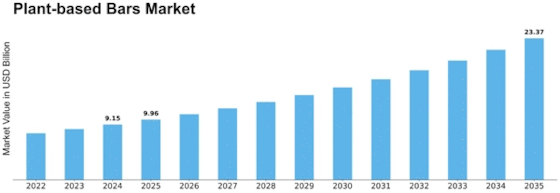
<p>The Plant-based Bars Market was valued at 9.148 USD Billion in 2024.</p>

What is the projected market size for the Plant-based Bars Market by 2035?

<p>The market is projected to reach 23.37 USD Billion by 2035.</p>

What is the expected CAGR for the Plant-based Bars Market during the forecast period 2025 - 2035?

<p>The expected CAGR for the Plant-based Bars Market during 2025 - 2035 is 8.9%.</p>

Which segment of the Plant-based Bars Market had the highest valuation in 2024?

<p>In 2024, the Cereal/Granola Bars segment had the highest valuation at 6.5 USD Billion.</p>

What are the key distribution channels for Plant-based Bars?

<p>Key distribution channels include Supermarkets/Hypermarkets, Specialty Stores, Convenience Stores, and Online Retail Stores.</p>

How much is the Protein Bars segment projected to be worth by 2035?

<p>The Protein Bars segment is projected to reach 5.0 USD Billion by 2035.</p>

Which companies are considered key players in the Plant-based Bars Market?

<p>Key players include Clif Bar, RXBAR, LÄRABAR, KIND, GoMacro, Health Warrior, No Cow, and Nutritional Outlook.</p>

What is the projected valuation for the Fruit & Nut Bars segment by 2035?

The Fruit &amp; Nut Bars segment is projected to reach 5.0 USD Billion by 2035.

What is the expected growth for the Convenience Stores distribution channel by 2035?

<p>The Convenience Stores distribution channel is expected to grow to 4.0 USD Billion by 2035.</p>

How does the market valuation of the Plant-based Bars compare between 2024 and 2035?

<p>The market valuation is expected to increase from 9.148 USD Billion in 2024 to 23.37 USD Billion by 2035.</p>

Market Summary

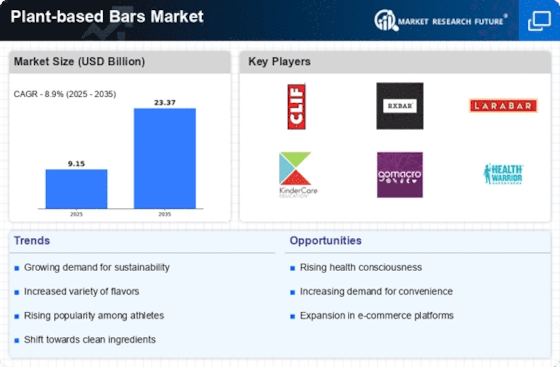
As per Market Research Future analysis, the Plant-based Bars Market Size was estimated at 9.148 USD Billion in 2024. The Plant-based Bars industry is projected to grow from 9.962 USD Billion in 2025 to 23.37 USD Billion by 2035, exhibiting a compound annual growth rate (CAGR) of 8.9% during the forecast period 2025 - 2035

Key Market Trends & Highlights

The Plant-based Bars Market is experiencing robust growth driven by health consciousness and sustainability.

  • The market is characterized by a strong focus on health and wellness, appealing to increasingly health-conscious consumers. Sustainability and ethical sourcing are becoming pivotal, particularly in North America, where consumers prioritize environmentally friendly products. Flavor innovation and variety are essential, with protein bars emerging as the fastest-growing segment in the Asia-Pacific region. Rising demand for nutritional snacks and increased awareness of environmental impact are key drivers propelling market expansion.

Market Size & Forecast

2024 Market Size 9.148 (USD Billion)
2035 Market Size 23.37 (USD Billion)
CAGR (2025 - 2035) 8.9%
Largest Regional Market Share in 2024 North America

Major Players

Clif Bar (US), RXBAR (US), LÄRABAR (US), KIND (US), GoMacro (US), Health Warrior (US), No Cow (US), Nutritional Outlook (US)

Market Trends

The plant-based bars market is currently experiencing a notable transformation, driven by a growing consumer preference for healthier and more sustainable snack options and evolving plant based bars market trends. This shift appears to be influenced by an increasing awareness of the environmental impact of traditional food production methods, alongside a rising interest in plant-based diets. As consumers become more health-conscious, they seem to gravitate towards products that not only offer nutritional benefits but also align with their ethical values. Consequently, manufacturers are innovating to create bars that are not only delicious but also rich in protein, fiber, and essential nutrients, catering to a diverse range of dietary needs.

Moreover, the plant-based bars market is likely to witness a surge in product diversification, as brands explore unique flavor combinations and functional ingredients. This development reflects the evolving plant based bars market analysis, which highlights growing consumer demand for innovative plant-based snack products. This trend suggests that consumers are seeking more than just a snack; they desire an experience that satisfies their taste buds while providing health benefits. The market landscape is evolving, with companies increasingly focusing on transparency in sourcing and production processes, which may enhance consumer trust and loyalty. As the demand for plant-based options continues to rise, the market is poised for further growth, potentially leading to new entrants and innovations that redefine the snacking experience across the global plant based bars market.

Health and Wellness Focus

The plant-based bars market is increasingly characterized by a strong emphasis on health and wellness. Consumers are actively seeking snacks that contribute positively to their overall well-being, prompting manufacturers to formulate bars that are low in sugar, high in protein, and rich in vitamins and minerals, shaping emerging plant based bars market trends.

Sustainability and Ethical Sourcing

Sustainability is becoming a core principle within the plant-based bars market. Brands are prioritizing ethically sourced ingredients and environmentally friendly packaging, appealing to consumers who are concerned about their ecological footprint and the impact of their food choices.

Flavor Innovation and Variety

Innovation in flavor profiles is a prominent trend within the plant-based bars market. Companies are experimenting with unique ingredients and combinations, aiming to provide consumers with a diverse range of options that cater to various taste preferences and dietary restrictions. These innovations are widely covered in ongoing plant based bars market analysis reports.

Plant Based Bars Market Market Drivers

Rising Demand for Nutritional Snacks

The Plant-based Bars Market is experiencing a notable increase in demand for nutritional snacks, driven by a growing consumer preference for healthier food options. As individuals become more health-conscious, they seek snacks that not only satisfy hunger but also provide essential nutrients. According to recent data, the plant-based snack segment is projected to grow at a compound annual growth rate of approximately 8% over the next five years. This trend indicates a shift towards plant-based bars that offer high protein, fiber, and low sugar content, appealing to fitness enthusiasts and health-conscious consumers alike. The Plant-based Bars Market is thus positioned to capitalize on this trend, as manufacturers innovate to create bars that meet these nutritional demands.

Convenience and On-the-Go Consumption

The Plant-based Bars Market is increasingly shaped by the demand for convenience and on-the-go consumption. As lifestyles become busier, consumers are seeking quick and easy snack options that fit into their hectic schedules. Plant-based bars offer a portable solution that can be consumed anytime, anywhere, making them an attractive choice for busy professionals and active individuals. Data indicates that nearly 70% of consumers prefer snacks that are easy to carry and require no preparation. This trend underscores the importance of convenience in the Plant-based Bars Market, as brands that prioritize portability and ease of use are likely to capture a larger share of the market.

Growing Vegan and Vegetarian Population

The Plant-based Bars Market is benefiting from the increasing population of vegans and vegetarians worldwide. As dietary preferences shift towards plant-based lifestyles, the demand for convenient and nutritious snacks rises correspondingly. Recent statistics suggest that the number of individuals identifying as vegan has increased by over 300% in the last decade. This demographic shift creates a substantial market for plant-based bars that cater specifically to these consumers. Brands that effectively target this growing segment by offering a variety of flavors and nutritional benefits are likely to thrive in the Plant-based Bars Market, as they align their products with the values and needs of this expanding consumer base.

Innovative Flavor Profiles and Ingredients

The Plant-based Bars Market is witnessing a surge in innovative flavor profiles and unique ingredients, catering to diverse consumer preferences. As competition intensifies, manufacturers are experimenting with exotic flavors, superfoods, and functional ingredients to differentiate their products. This trend is supported by data showing that consumers are increasingly willing to try new flavors, with over 60% expressing interest in trying bars that incorporate unique ingredients such as adaptogens or ancient grains. This innovation not only enhances the appeal of plant-based bars but also positions them as versatile snacks suitable for various occasions. The Plant-based Bars Market is thus evolving to meet the demands of adventurous consumers seeking novel taste experiences.

Increased Awareness of Environmental Impact

The Plant-based Bars Market is significantly influenced by the rising awareness of environmental issues among consumers. As more individuals recognize the ecological footprint of their dietary choices, there is a marked shift towards plant-based products. Research indicates that plant-based diets can reduce greenhouse gas emissions by up to 50% compared to traditional meat-based diets. This awareness drives consumers to seek out plant-based bars that align with their values of sustainability and ethical consumption. Consequently, brands that emphasize eco-friendly sourcing and production methods are likely to gain a competitive edge in the Plant-based Bars Market, appealing to environmentally conscious consumers.

Market Segment Insights

By Type: Cereal/Granola Bars (Largest) vs. Protein Bars (Fastest-Growing)

In the plant-based bars market, the segment distribution shows that Cereal/Granola Bars hold the largest share, attributed to their widespread consumption and appeal among health-conscious consumers. Popular for their taste and texture, these bars have become a staple for those seeking nutritious snacks. Meanwhile, Protein Bars are rapidly gaining traction, especially among fitness enthusiasts and those looking to incorporate more protein into their diets. As awareness grows, this segment is expanding significantly. The growth trends in this market segment are influenced by changing consumer preferences towards healthy snacking, with Protein Bars being driven by the increasing demand for high-protein products. These developments are highlighted in several plant based bars market analysis studies.

Cereal/Granola Bars (Dominant) vs. Fruit &amp; Nut Bars (Emerging)

In the Plant-based Bars Market, Cereal/Granola Bars are viewed as the dominant segment, characterized by their traditional appeal and substantial consumer base. They often contain oats, nuts, and dried fruits, making them a nutritious option for breakfast or snacks. Their familiarity and taste have solidified their position in the market. On the other hand, Fruit &amp; Nut Bars represent an emerging segment, gaining popularity due to their clean label profiles and minimal ingredients. These bars attract health-conscious consumers looking for convenient nutrition options without additives. Their unique flavor combinations and chewy textures have contributed to their rise, positioning them as a strong competitor to long-established Cereal/Granola Bars.

By Distribution Channel: Supermarkets/Hypermarkets (Largest) vs. Online Retail Stores (Fastest-Growing)

In the Plant-based Bars Market, the distribution channel landscape is primarily dominated by Supermarkets and Hypermarkets, accounting for a significant share. These channels benefit from their wide reach and established consumer trust, making them the preferred shopping destination for health-conscious shoppers. Specialty Stores and Convenience Stores also play important roles, appealing to niche consumer segments, however, they hold a smaller market share compared to the giants of the sector. Online Retail Stores have made notable inroads recently, showing substantial potential for growth as e-commerce becomes more entrenched in consumer buying habits. The growth in this segment is driven by the increasing consumer preference for convenience and a shift towards online shopping. Online Retail Stores are revolutionizing the way consumers access Plant-based Bars, bolstered by fast delivery options and greater product variety. This shift is coupled with the growing emphasis on health and wellness, prompting consumers to seek out convenient purchasing options for their dietary needs, further propelling online growth. The rise of digital marketing and social media influence also plays a crucial role in cultivating demand within this segment, particularly among younger, tech-savvy consumers.

Supermarkets/Hypermarkets (Dominant) vs. Online Retail Stores (Emerging)

Supermarkets and Hypermarkets remain the dominant players in the Plant-based Bars market, offering a vast array of products and significant shelf space dedicated to health foods. Their strategic locations and operational scale allow them to leverage purchasing power and negotiate better terms with suppliers, thus providing competitive pricing to consumers. Meanwhile, Online Retail Stores represent the emerging force in this segment, flourishing through technological advancements that cater to the evolving preferences of consumers seeking convenience. They provide detailed product information, customer reviews, and tailored recommendations, enhancing the customer shopping experience. This digital approach appeals particularly to younger consumers who prioritize convenience, making Online Retail Stores an essential consideration for brands looking to capitalize on the growing demand in the Plant-based Bars sector.

Get more detailed insights about Plant-based Bars Market Research Report - Forecast till 2035

Regional Insights

By region, the study provides the market insights into North America, Europe, Asia-Pacific and Rest of the World. The In 2022, North America will be the market's dominant participant. The rising demand for healthy meal replacement choices that can be consumed on the go is being driven by the rising consumption of plant-based protein bars as a result of the burgeoning trend of healthy snacking. Furthermore, the increasing number of innovations and new product developments are likely to boost plant-based sales across the region.

Further, the major countries studied in the market report are The US, Canada, German, France, the UK, Italy, Spain, China, Japan, India, Australia, South Korea, and Brazil.

Figure2: PLANT-BASED BARS MARKET SHARE BY REGION 2022 (USD Billion)

Europe Plant-based Bars Market accounts for the second-largest market share because of the growing customer preference for clean-label convenience foods. Furthermore, increased animal welfare awareness and the evolving trend of veganism in the region are projected to propel the region's market expansion. Further, the German Plant-based Bars Market held the largest market share, and the UK Plant-based Bars Market was the fastest growing market in the European region

The Asia-Pacific Plant-based Bars Market is expected to grow at the fastest CAGR from 2023 to 2032. This is due increased demand for health and wellness products across the region. The sports industries in Australia, China, and India are expanding, which boosts demand for nutrition-enriched bars across the market. Moreover, China’s Plant-based Bars Market held the largest market share, and the Indian Plant-based Bars Market was the fastest growing market in the Asia-Pacific region.

Key Players and Competitive Insights

Leading market players are investing heavily in research and development in order to expand their product lines, which will help the Plant-based Bars Market, grow even more. Market participants are also undertaking a variety of strategic activities to expand their  footprint, with important market developments including new product launches, contractual agreements, mergers and acquisitions, higher investments, and collaboration with other organizations. To expand and survive in a more competitive and rising market climate, Plant-based Barsindustry must offer cost-effective items.
Manufacturing locally to minimize operational costs is one of the key business tactics used by manufacturers in the  Plant-based Bars industry to benefit clients and increase the market sector. In recent years, the Plant-based Bars industry has offered some of the most significant advantages to medicine. Major players in the Plant-based Bars Market, including Kellogg’s Company (U.S.), Green’s Gone Wild, LLC (U.S.), General Mills Inc. (U.S.), 88 Acres (U.S.), LoveRaw (U.K.), GNC Holdings LLC (U.S.), Raw Bite (Germany), Rise Bar (U.S.) and others, are attempting to increase market demand by investing in research and development operations.
A protein bar made by Kellogg's-owned Chicago Bar Co. is called an RXBAR. It's created using egg whites, dates, almonds, and dried fruit. In 2013, co-founder Jared Smith and Peter Rahal created the first RXBAR in their parents' Glen Ellyn basement. 75 people were employed at Chicago Bar Co. as of 2017. The company was purchased by Kellogg's for $600 million in October 2017. The business debuted a range of nut butters in March 2018 that include egg whites for extra protein.
In June RXBAR introduced its first plant-based protein bar.
The new RXBAR Plant product replaces the egg whites in traditional RXBAR bars with 10 grams of plant-based protein. RXBAR's official website as well as other retail shops such as Kroger, Target, and others sell the product.
Bobo's is an American snack manufacturer. Beryl Stafford and her daughter "Bobo" founded the company in Boulder, Colorado in 2003. Bobo's objective was to produce more nutritious and healthy snacks. Oats, oil, brown sugar, and brown rice syrup were used to make the first oat bar. The simple oat bars, baked in the shape of a rectangle, were later packed for production in 2004. January 2023, Bobo's has introduced a new range of protein bars with 15 grams of protein and manufactured with clean and simple ingredients.
The protein bar comes in two flavours: double chocolate almond butter and chocolate chip peanut butter. Furthermore, these new protein bars are kosher, gluten-free, and non-GMO.

Key Companies in the Plant Based Bars Market include

Industry Developments

June 2022, Laird Superfood has introduced plant-based proteins including adaptogens. To fulfill the growing customer demand for functional superfoods, the brand introduced its first snack with functional characteristics. The newly released protein bar contains 10 grams of protein derived from peas.

January 2022, ALOHA announced the nationwide availability of their organic plant-based bars in four new flavours at Whole Foods Market: cookie dough, peanut butter cup, coconut chocolate almond, and peanut butter chocolate chip.

January 2021, Whole Truth Foods has introduced a line of dairy and whey-free energy bars. These vegan-certified plant-based bars are totally plant-based. They also do not include gluten, added sugar, soy, or preservatives. The new collection of bars from the brand comes in five distinct flavours: mocha almond fudge, cocoa cranberry fudge, fig apricot orange, peanut choco fudge, and almond choco fudge.

Future Outlook

Plant Based Bars Market Future Outlook

The Plant-based Bars Market is projected to grow at an 8.9% CAGR from 2025 to 2035, driven by increasing health consciousness, sustainability trends, and innovation in product formulations.

New opportunities lie in:

  • <p>Expansion into emerging markets with tailored product lines Partnerships with fitness centers for exclusive offerings Development of subscription-based delivery services for convenience</p>

By 2035, the market is expected to solidify its position as a leader in the health food sector.

Market Segmentation

Plant Based Bars Market Type Outlook

  • Cereal/Granola Bars
  • Protein Bars
  • Energy Bars/Meal Replacement Bars
  • Fruit & Nut Bars
  • Others

Plant Based Bars Market Distribution Channel Outlook

  • Supermarkets/Hypermarkets
  • Specialty Stores
  • Convenience Stores
  • Online Retail Stores
  • Others

Report Scope

MARKET SIZE 2024 9.148(USD Billion)
MARKET SIZE 2025 9.962(USD Billion)
MARKET SIZE 2035 23.37(USD Billion)
COMPOUND ANNUAL GROWTH RATE (CAGR) 8.9% (2025 - 2035)
REPORT COVERAGE Revenue Forecast, Competitive Landscape, Growth Factors, and Trends
BASE YEAR 2024
Market Forecast Period 2025 - 2035
Historical Data 2019 - 2024
Market Forecast Units USD Billion
Key Companies Profiled Clif Bar (US), RXBAR (US), LÄRABAR (US), KIND (US), GoMacro (US), Health Warrior (US), No Cow (US), Nutritional Outlook (US)
Segments Covered Type, Distribution Channel, Region
Key Market Opportunities Growing consumer demand for nutritious, convenient snacks drives innovation in the Plant-based Bars Market.
Key Market Dynamics Rising consumer demand for healthier snacks drives innovation and competition in the plant-based bars market.
Countries Covered North America, Europe, APAC, South America, MEA

FAQs

What is the current valuation of the Plant-based Bars Market as of 2024?

<p>The Plant-based Bars Market was valued at 9.148 USD Billion in 2024.</p>

What is the projected market size for the Plant-based Bars Market by 2035?

<p>The market is projected to reach 23.37 USD Billion by 2035.</p>

What is the expected CAGR for the Plant-based Bars Market during the forecast period 2025 - 2035?

<p>The expected CAGR for the Plant-based Bars Market during 2025 - 2035 is 8.9%.</p>

Which segment of the Plant-based Bars Market had the highest valuation in 2024?

<p>In 2024, the Cereal/Granola Bars segment had the highest valuation at 6.5 USD Billion.</p>

What are the key distribution channels for Plant-based Bars?

<p>Key distribution channels include Supermarkets/Hypermarkets, Specialty Stores, Convenience Stores, and Online Retail Stores.</p>

How much is the Protein Bars segment projected to be worth by 2035?

<p>The Protein Bars segment is projected to reach 5.0 USD Billion by 2035.</p>

Which companies are considered key players in the Plant-based Bars Market?

<p>Key players include Clif Bar, RXBAR, LÄRABAR, KIND, GoMacro, Health Warrior, No Cow, and Nutritional Outlook.</p>

What is the projected valuation for the Fruit & Nut Bars segment by 2035?

The Fruit &amp; Nut Bars segment is projected to reach 5.0 USD Billion by 2035.

What is the expected growth for the Convenience Stores distribution channel by 2035?

<p>The Convenience Stores distribution channel is expected to grow to 4.0 USD Billion by 2035.</p>

How does the market valuation of the Plant-based Bars compare between 2024 and 2035?

<p>The market valuation is expected to increase from 9.148 USD Billion in 2024 to 23.37 USD Billion by 2035.</p>

  1. SECTION I: EXECUTIVE SUMMARY AND KEY HIGHLIGHTS |
    1. EXECUTIVE SUMMARY | |
      1. Market Overview | |
      2. Key Findings | |
      3. Market Segmentation | |
      4. Competitive Landscape | |
      5. Challenges and Opportunities | |
      6. Future Outlook 2
  2. SECTION II: SCOPING, METHODOLOGY AND MARKET STRUCTURE |
    1. MARKET INTRODUCTION | |
      1. Definition | |
      2. Scope of the study | | |
    2. RESEARCH METHODOLOGY | |
      1. Overview | |
      2. Data Mining | |
      3. Secondary Research | |
      4. Primary Research | | |
      5. Forecasting Model | |
      6. Market Size Estimation | | |
      7. Data Triangulation | |
      8. Validation 3
  3. SECTION III: QUALITATIVE ANALYSIS |
    1. MARKET DYNAMICS | |
      1. Overview | |
      2. Drivers | |
      3. Restraints | |
      4. Opportunities |
    2. MARKET FACTOR ANALYSIS | |
      1. Value chain Analysis | |
      2. Porter's Five Forces Analysis | | |
      3. COVID-19 Impact Analysis | | |
  4. SECTION IV: QUANTITATIVE ANALYSIS |
    1. Food, Beverages & Nutrition, BY Type (USD Billion) | |
      1. Cereal/Granola Bars | |
      2. Protein Bars | |
      3. Energy Bars/Meal Replacement Bars | |
      4. Fruit & Nut Bars | |
      5. Others |
    2. Food, Beverages & Nutrition, BY Distribution Channel (USD Billion) | |
      1. Supermarkets/Hypermarkets | |
      2. Specialty Stores | |
      3. Convenience Stores | |
      4. Online Retail Stores | |
      5. Others |
    3. Food, Beverages & Nutrition, BY Region (USD Billion) | |
      1. North America | | |
      2. Europe | | |
      3. APAC | | |
      4. South America | | |
      5. MEA | | |
  5. SECTION V: COMPETITIVE ANALYSIS |
    1. Competitive Landscape | |
      1. Overview | |
      2. Competitive Analysis | |
      3. Market share Analysis | |
      4. Major Growth Strategy in the Food, Beverages & Nutrition | |
      5. Competitive Benchmarking | |
      6. Leading Players in Terms of Number of Developments in the Food, Beverages & Nutrition | |
      7. Key developments and growth strategies | | |
      8. Major Players Financial Matrix | | |
    2. Company Profiles | |
      1. Clif Bar (US) | | |
      2. RXBAR (US) | | |
      3. LÄRABAR (US) | | |
      4. KIND (US) | | |
      5. GoMacro (US) | | |
      6. Health Warrior (US) | | |
      7. No Cow (US) | | |
      8. Nutritional Outlook (US) | | |
    3. Appendix | |
      1. References | |
      2. Related Reports 6 LIST OF FIGURES |
    4. MARKET SYNOPSIS |
    5. NORTH AMERICA MARKET ANALYSIS |
    6. US MARKET ANALYSIS BY TYPE |
    7. US MARKET ANALYSIS BY DISTRIBUTION CHANNEL |
    8. CANADA MARKET ANALYSIS BY TYPE |
    9. CANADA MARKET ANALYSIS BY DISTRIBUTION CHANNEL |
    10. EUROPE MARKET ANALYSIS |
    11. GERMANY MARKET ANALYSIS BY TYPE |
    12. GERMANY MARKET ANALYSIS BY DISTRIBUTION CHANNEL |
    13. UK MARKET ANALYSIS BY TYPE |
    14. UK MARKET ANALYSIS BY DISTRIBUTION CHANNEL |
    15. FRANCE MARKET ANALYSIS BY TYPE |
    16. FRANCE MARKET ANALYSIS BY DISTRIBUTION CHANNEL |
    17. RUSSIA MARKET ANALYSIS BY TYPE |
    18. RUSSIA MARKET ANALYSIS BY DISTRIBUTION CHANNEL |
    19. ITALY MARKET ANALYSIS BY TYPE |
    20. ITALY MARKET ANALYSIS BY DISTRIBUTION CHANNEL |
    21. SPAIN MARKET ANALYSIS BY TYPE |
    22. SPAIN MARKET ANALYSIS BY DISTRIBUTION CHANNEL |
    23. REST OF EUROPE MARKET ANALYSIS BY TYPE |
    24. REST OF EUROPE MARKET ANALYSIS BY DISTRIBUTION CHANNEL |
    25. APAC MARKET ANALYSIS |
    26. CHINA MARKET ANALYSIS BY TYPE |
    27. CHINA MARKET ANALYSIS BY DISTRIBUTION CHANNEL |
    28. INDIA MARKET ANALYSIS BY TYPE |
    29. INDIA MARKET ANALYSIS BY DISTRIBUTION CHANNEL |
    30. JAPAN MARKET ANALYSIS BY TYPE |
    31. JAPAN MARKET ANALYSIS BY DISTRIBUTION CHANNEL |
    32. SOUTH KOREA MARKET ANALYSIS BY TYPE |
    33. SOUTH KOREA MARKET ANALYSIS BY DISTRIBUTION CHANNEL |
    34. MALAYSIA MARKET ANALYSIS BY TYPE |
    35. MALAYSIA MARKET ANALYSIS BY DISTRIBUTION CHANNEL |
    36. THAILAND MARKET ANALYSIS BY TYPE |
    37. THAILAND MARKET ANALYSIS BY DISTRIBUTION CHANNEL |
    38. INDONESIA MARKET ANALYSIS BY TYPE |
    39. INDONESIA MARKET ANALYSIS BY DISTRIBUTION CHANNEL |
    40. REST OF APAC MARKET ANALYSIS BY TYPE |
    41. REST OF APAC MARKET ANALYSIS BY DISTRIBUTION CHANNEL |
    42. SOUTH AMERICA MARKET ANALYSIS |
    43. BRAZIL MARKET ANALYSIS BY TYPE |
    44. BRAZIL MARKET ANALYSIS BY DISTRIBUTION CHANNEL |
    45. MEXICO MARKET ANALYSIS BY TYPE |
    46. MEXICO MARKET ANALYSIS BY DISTRIBUTION CHANNEL |
    47. ARGENTINA MARKET ANALYSIS BY TYPE |
    48. ARGENTINA MARKET ANALYSIS BY DISTRIBUTION CHANNEL |
    49. REST OF SOUTH AMERICA MARKET ANALYSIS BY TYPE |
    50. REST OF SOUTH AMERICA MARKET ANALYSIS BY DISTRIBUTION CHANNEL |
    51. MEA MARKET ANALYSIS |
    52. GCC COUNTRIES MARKET ANALYSIS BY TYPE |
    53. GCC COUNTRIES MARKET ANALYSIS BY DISTRIBUTION CHANNEL |
    54. SOUTH AFRICA MARKET ANALYSIS BY TYPE |
    55. SOUTH AFRICA MARKET ANALYSIS BY DISTRIBUTION CHANNEL |
    56. REST OF MEA MARKET ANALYSIS BY TYPE |
    57. REST OF MEA MARKET ANALYSIS BY DISTRIBUTION CHANNEL |
    58. KEY BUYING CRITERIA OF FOOD, BEVERAGES & NUTRITION |
    59. RESEARCH PROCESS OF MRFR |
    60. DRO ANALYSIS OF FOOD, BEVERAGES & NUTRITION |
    61. DRIVERS IMPACT ANALYSIS: FOOD, BEVERAGES & NUTRITION |
    62. RESTRAINTS IMPACT ANALYSIS: FOOD, BEVERAGES & NUTRITION |
    63. SUPPLY / VALUE CHAIN: FOOD, BEVERAGES & NUTRITION |
    64. FOOD, BEVERAGES & NUTRITION, BY TYPE, 2024 (% SHARE) |
    65. FOOD, BEVERAGES & NUTRITION, BY TYPE, 2024 TO 2035 (USD Billion) |
    66. FOOD, BEVERAGES & NUTRITION, BY DISTRIBUTION CHANNEL, 2024 (% SHARE) |
    67. FOOD, BEVERAGES & NUTRITION, BY DISTRIBUTION CHANNEL, 2024 TO 2035 (USD Billion) |
    68. BENCHMARKING OF MAJOR COMPETITORS 7 LIST OF TABLES |
    69. LIST OF ASSUMPTIONS | |
      1. |
    70. North America MARKET SIZE ESTIMATES; FORECAST | |
      1. BY TYPE, 2025-2035 (USD Billion) | |
      2. BY DISTRIBUTION CHANNEL, 2025-2035 (USD Billion) |
    71. US MARKET SIZE ESTIMATES; FORECAST | |
      1. BY TYPE, 2025-2035 (USD Billion) | |
      2. BY DISTRIBUTION CHANNEL, 2025-2035 (USD Billion) |
    72. Canada MARKET SIZE ESTIMATES; FORECAST | |
      1. BY TYPE, 2025-2035 (USD Billion) | |
      2. BY DISTRIBUTION CHANNEL, 2025-2035 (USD Billion) |
    73. Europe MARKET SIZE ESTIMATES; FORECAST | |
      1. BY TYPE, 2025-2035 (USD Billion) | |
      2. BY DISTRIBUTION CHANNEL, 2025-2035 (USD Billion) |
    74. Germany MARKET SIZE ESTIMATES; FORECAST | |
      1. BY TYPE, 2025-2035 (USD Billion) | |
      2. BY DISTRIBUTION CHANNEL, 2025-2035 (USD Billion) |
    75. UK MARKET SIZE ESTIMATES; FORECAST | |
      1. BY TYPE, 2025-2035 (USD Billion) | |
      2. BY DISTRIBUTION CHANNEL, 2025-2035 (USD Billion) |
    76. France MARKET SIZE ESTIMATES; FORECAST | |
      1. BY TYPE, 2025-2035 (USD Billion) | |
      2. BY DISTRIBUTION CHANNEL, 2025-2035 (USD Billion) |
    77. Russia MARKET SIZE ESTIMATES; FORECAST | |
      1. BY TYPE, 2025-2035 (USD Billion) | |
      2. BY DISTRIBUTION CHANNEL, 2025-2035 (USD Billion) |
    78. Italy MARKET SIZE ESTIMATES; FORECAST | |
      1. BY TYPE, 2025-2035 (USD Billion) | |
      2. BY DISTRIBUTION CHANNEL, 2025-2035 (USD Billion) |
    79. Spain MARKET SIZE ESTIMATES; FORECAST | |
      1. BY TYPE, 2025-2035 (USD Billion) | |
      2. BY DISTRIBUTION CHANNEL, 2025-2035 (USD Billion) |
    80. Rest of Europe MARKET SIZE ESTIMATES; FORECAST | |
      1. BY TYPE, 2025-2035 (USD Billion) | |
      2. BY DISTRIBUTION CHANNEL, 2025-2035 (USD Billion) |
    81. APAC MARKET SIZE ESTIMATES; FORECAST | |
      1. BY TYPE, 2025-2035 (USD Billion) | |
      2. BY DISTRIBUTION CHANNEL, 2025-2035 (USD Billion) |
    82. China MARKET SIZE ESTIMATES; FORECAST | |
      1. BY TYPE, 2025-2035 (USD Billion) | |
      2. BY DISTRIBUTION CHANNEL, 2025-2035 (USD Billion) |
    83. India MARKET SIZE ESTIMATES; FORECAST | |
      1. BY TYPE, 2025-2035 (USD Billion) | |
      2. BY DISTRIBUTION CHANNEL, 2025-2035 (USD Billion) |
    84. Japan MARKET SIZE ESTIMATES; FORECAST | |
      1. BY TYPE, 2025-2035 (USD Billion) | |
      2. BY DISTRIBUTION CHANNEL, 2025-2035 (USD Billion) |
    85. South Korea MARKET SIZE ESTIMATES; FORECAST | |
      1. BY TYPE, 2025-2035 (USD Billion) | |
      2. BY DISTRIBUTION CHANNEL, 2025-2035 (USD Billion) |
    86. Malaysia MARKET SIZE ESTIMATES; FORECAST | |
      1. BY TYPE, 2025-2035 (USD Billion) | |
      2. BY DISTRIBUTION CHANNEL, 2025-2035 (USD Billion) |
    87. Thailand MARKET SIZE ESTIMATES; FORECAST | |
      1. BY TYPE, 2025-2035 (USD Billion) | |
      2. BY DISTRIBUTION CHANNEL, 2025-2035 (USD Billion) |
    88. Indonesia MARKET SIZE ESTIMATES; FORECAST | |
      1. BY TYPE, 2025-2035 (USD Billion) | |
      2. BY DISTRIBUTION CHANNEL, 2025-2035 (USD Billion) |
    89. Rest of APAC MARKET SIZE ESTIMATES; FORECAST | |
      1. BY TYPE, 2025-2035 (USD Billion) | |
      2. BY DISTRIBUTION CHANNEL, 2025-2035 (USD Billion) |
    90. South America MARKET SIZE ESTIMATES; FORECAST | |
      1. BY TYPE, 2025-2035 (USD Billion) | |
      2. BY DISTRIBUTION CHANNEL, 2025-2035 (USD Billion) |
    91. Brazil MARKET SIZE ESTIMATES; FORECAST | |
      1. BY TYPE, 2025-2035 (USD Billion) | |
      2. BY DISTRIBUTION CHANNEL, 2025-2035 (USD Billion) |
    92. Mexico MARKET SIZE ESTIMATES; FORECAST | |
      1. BY TYPE, 2025-2035 (USD Billion) | |
      2. BY DISTRIBUTION CHANNEL, 2025-2035 (USD Billion) |
    93. Argentina MARKET SIZE ESTIMATES; FORECAST | |
      1. BY TYPE, 2025-2035 (USD Billion) | |
      2. BY DISTRIBUTION CHANNEL, 2025-2035 (USD Billion) |
    94. Rest of South America MARKET SIZE ESTIMATES; FORECAST | |
      1. BY TYPE, 2025-2035 (USD Billion) | |
      2. BY DISTRIBUTION CHANNEL, 2025-2035 (USD Billion) |
    95. MEA MARKET SIZE ESTIMATES; FORECAST | |
      1. BY TYPE, 2025-2035 (USD Billion) | |
      2. BY DISTRIBUTION CHANNEL, 2025-2035 (USD Billion) |
    96. GCC Countries MARKET SIZE ESTIMATES; FORECAST | |
      1. BY TYPE, 2025-2035 (USD Billion) | |
      2. BY DISTRIBUTION CHANNEL, 2025-2035 (USD Billion) |
    97. South Africa MARKET SIZE ESTIMATES; FORECAST | |
      1. BY TYPE, 2025-2035 (USD Billion) | |
      2. BY DISTRIBUTION CHANNEL, 2025-2035 (USD Billion) |
    98. Rest of MEA MARKET SIZE ESTIMATES; FORECAST | |
      1. BY TYPE, 2025-2035 (USD Billion) | |
      2. BY DISTRIBUTION CHANNEL, 2025-2035 (USD Billion) |
    99. PRODUCT LAUNCH/PRODUCT DEVELOPMENT/APPROVAL | |
      1. |
    100. ACQUISITION/PARTNERSHIP | |

Food, Beverages & Nutrition Market Segmentation

Food, Beverages & Nutrition By Type (USD Billion, 2025-2035)

  • Cereal/Granola Bars
  • Protein Bars
  • Energy Bars/Meal Replacement Bars
  • Fruit & Nut Bars
  • Others

Food, Beverages & Nutrition By Distribution Channel (USD Billion, 2025-2035)

  • Supermarkets/Hypermarkets
  • Specialty Stores
  • Convenience Stores
  • Online Retail Stores
  • Others
Infographic

Free Sample Request

Kindly complete the form below to receive a free sample of this Report

Get Free Sample

Customer Strories

Compare Licence

×
Features License Type
Single User Multiuser License Enterprise User
Price $4,950 $5,950 $7,250
Maximum User Access Limit 1 User Upto 10 Users Unrestricted Access Throughout the Organization
Free Customization
Direct Access to Analyst
Deliverable Format
Platform Access
Discount on Next Purchase 10% 15% 15%
Printable Versions
%>