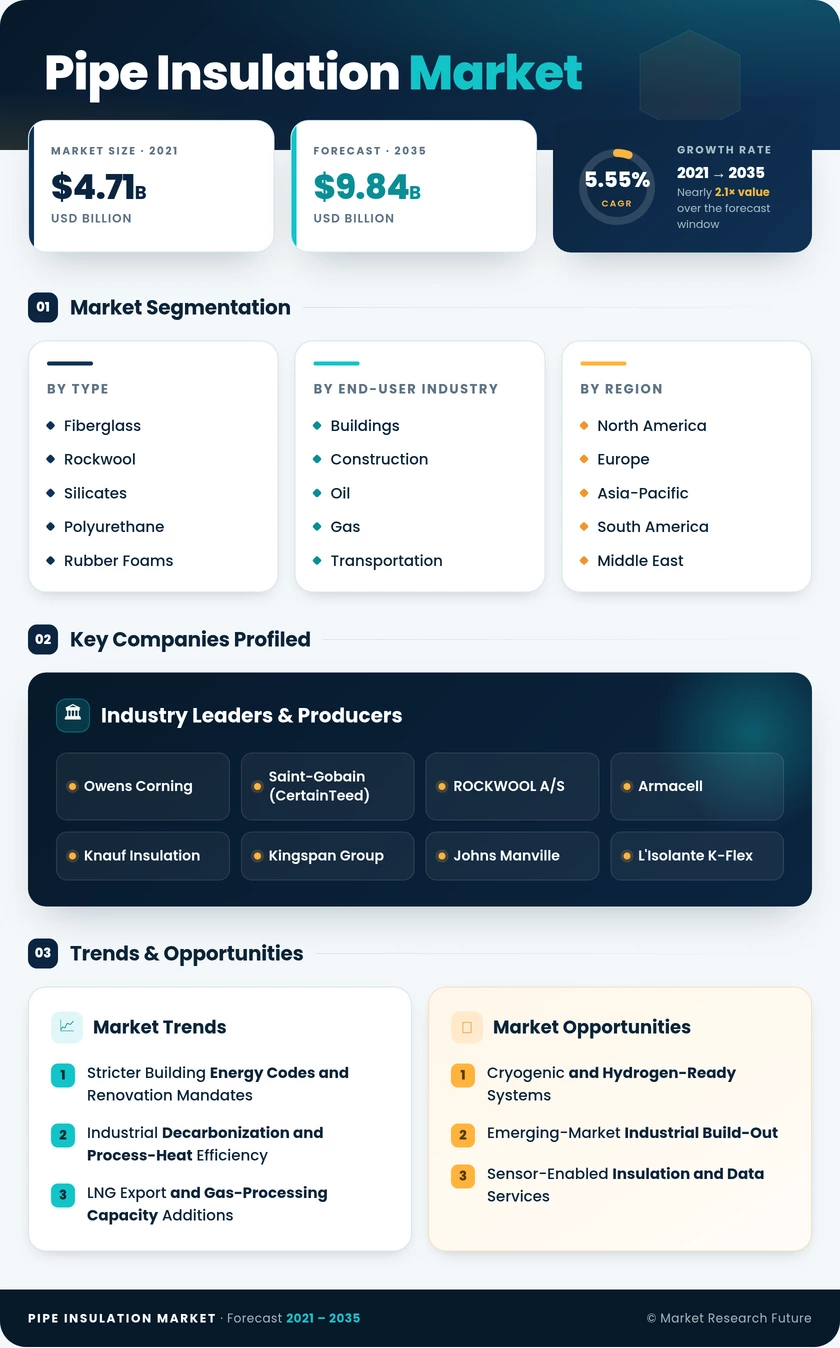
Segmentation Quick Reference
| Dimension | Sub-Segments | Dominant Segment | Fastest Growing Segment |
|---|
| By Type | Fiberglass, Rockwool, Silicates, Polyurethane, Rubber Foams, Other Types | Fiberglass (36.8% share) | Other Types (6.7% CAGR, 2026–2035) |
| By End-User Industry | Buildings and Construction, Oil and Gas, Transportation, General Industrial, Other End-User Industries | Buildings and Construction (39.3% share) | Other End-User Industries (6.5% CAGR, 2026–2035) |
| By Region | North America, Europe, Asia-Pacific, South America, Middle East and Africa | Asia-Pacific (41.5% share) | Asia-Pacific (41.5% share) |
Market Segmentation Overview
| Sub-Segment | Key Trend |
|---|
| Fiberglass | Default choice for code-compliant HVAC and plumbing lines |
| Rockwool | Gaining in fire-rated plant rooms and industrial process lines |
| Silicates | Holding refinery and power applications above 600 °C |
|---|
| Polyurethane | Core material for pre-insulated district heating pipe |
| Rubber Foams | Standard for flexible refrigerant and chilled-water runs. |
| Other Types | Aerogel and cellular glass adopted for LNG and tight retrofits |
Fiberglass leads on installed base because it meets building-code thickness tables at the lowest cost per metre, giving it a 36.8% share. Other Types grow fastest at a 6.7% CAGR because LNG and space-constrained retrofit projects will pay for aerogel's thinner profile and the zero water absorption of cellular glass. Rockwool and Silicates hold the high-temperature and fire-rated niches, while Rubber Foams and Polyurethane split HVAC and chilled-water lines.
| Sub-Segment | Key Trend |
|---|
| Buildings and Construction | Code-driven retrofits and prefabricated jacketing modules |
| Oil and Gas | Cryogenic LNG systems and CUI-resistant replacements |
| Transportation | LNG carrier and marine HVAC insulation |
| General Industrial | Process-heat audits in food, pharma and pulp mills |
| Other End-User Industries | Sensor-equipped wraps in power and chemical plants |
Buildings and Construction leads with a 39.3% share because energy codes require insulated hot-water and HVAC piping in every new commercial project. Other End-User Industries expand fastest at a 6.5% CAGR, as power producers and chemical plants chase decarbonization credits and adopt sensor-equipped wraps. Oil and Gas remains the most specification-intensive buyer, with cryogenic LNG lines that need multilayer systems.


 Noah Malgeri
Co-Founder

 Peter Groot koerkamp
Account and Business Manager

 Younghwan Choi
Senior Retail Manager

 Mark Irwin
Management Consultant

 Akif Moroglu
Strategy & Business Development Director

 Guilherme Gomes Martins
Product Management Director

 Joseph Aguayo
Sales Operations & Pricing Manager

 La Terria Dodd
Program Support Specialist

 Rob Kooiker
Group Product Manager HVAC & Fire Protection GMA