×
Hero Background
English
Chinese
French
Japanese
Korean
German
Spanish

Phosphate Fertilizer Market Share

ID: MRFR/Agri/10162-HCR
128 Pages
Sakshi Gupta
October 2025

Phosphate Fertilizer Market Research Report Information By Product (Monoammonium Phosphate (MAP), Diammonium Phosphate (DAP), Single Superphosphate (SSP), Triple Superphosphate (TSP) and Others), By Application (Cereals & Grains, Oilseeds & Pulses, Fruits & Vegetables and Others) And By Region (North America, Europe, Asia-Pacific, And Rest Of The World) –Market Forecast Till 2035

Share:
Download PDF ×

We do not share your information with anyone. However, we may send you emails based on your report interest from time to time. You may contact us at any time to opt-out.

Phosphate Fertilizer Market Infographic
Purchase Options

Market Share

Phosphate Fertilizer Market Share Analysis

Phosphate Fertilizer Market is a vital component of the global agricultural industry, providing essential nutrients to crops for optimal growth and yield. To establish and maintain a competitive edge in this market, companies employ various market share positioning strategies:

Product Differentiation: Companies focus on developing a diverse range of phosphate fertilizer products tailored to meet the specific needs of different crops, soil types, and growing conditions. This may include various formulations such as monoammonium phosphate (MAP), diammonium phosphate (DAP), and triple superphosphate (TSP), each offering unique nutrient compositions and application methods. By offering differentiated products that address the diverse requirements of farmers, companies can attract a broader customer base and capture market share.

Brand Recognition and Reputation: Building a strong brand image and reputation is essential for gaining trust and credibility in the phosphate fertilizer market. Companies invest in branding initiatives, advertising campaigns, and participation in agricultural events to increase visibility and awareness of their products. Positive testimonials and endorsements from agronomists, agricultural experts, and satisfied customers further enhance brand recognition and foster consumer confidence.

Market Segmentation: Understanding the diverse needs of farmers and agricultural practices across different regions is crucial for effective market segmentation. Companies identify different market segments such as row crops, fruits and vegetables, and specialty crops, and tailor their marketing strategies to target each segment effectively. By offering products and solutions that cater to the specific requirements of different crop types and farming systems, companies can maximize their market penetration and capture a larger share of the phosphate fertilizer market.

Distribution Channels: Establishing an efficient distribution network is essential for ensuring widespread availability of phosphate fertilizer products. Companies partner with distributors, retailers, agricultural cooperatives, and online platforms to expand their reach and make their products accessible to farmers across different regions. By optimizing distribution channels and ensuring timely delivery, companies can increase product visibility and capture market share in both traditional and emerging markets.

Product Innovation and Research: Continuous innovation and research are essential for staying ahead of competitors and meeting the evolving needs of farmers in the phosphate fertilizer market. Companies invest in research and development to develop new and improved fertilizer formulations, as well as to explore alternative nutrient delivery technologies. By offering innovative solutions that deliver superior performance, efficiency, and environmental sustainability, companies can differentiate themselves and attract discerning customers.

Price Competitiveness and Value Proposition: While maintaining product quality and innovation, companies also need to ensure that their pricing is competitive in the market. Offering competitive pricing strategies such as volume discounts, seasonal promotions, and bundled packages can help attract price-sensitive farmers and drive sales. Emphasizing the value proposition of phosphate fertilizer products, such as their role in improving soil fertility, increasing crop yields, and maximizing return on investment, can justify premium pricing and enhance perceived value among farmers.

Sustainability and Environmental Stewardship: With growing concerns about environmental conservation and sustainable agriculture, companies in the phosphate fertilizer market are increasingly focusing on developing environmentally friendly products and promoting sustainable farming practices. By offering fertilizers with reduced environmental impact, such as slow-release formulations or products with lower nutrient runoff, companies can appeal to environmentally conscious farmers and differentiate themselves from competitors. Emphasizing sustainability in product marketing and corporate messaging can also enhance brand reputation and contribute to long-term market share growth.

Author
Sakshi Gupta
Research Analyst Level II

I have about two years of experience working in the consumer goods and retail industries and I am a biotech graduate.A tech-savvy analytically focused professional with a strong capabilities in identification, concept generation, and strategy evaluation. I can produce data-driven solutions while fusing unusual viewpoints with original concepts. I have been extensively working on business case studies, competitive & comparative analyses, and strategic reports. My primary areas of experience include client management, financial analysis, supply chain evaluation, market entry strategy evaluation, and estimating and forecasting market size.

Leave a Comment

FAQs

What is the current valuation of the Phosphate Fertilizer Market?

The Phosphate Fertilizer Market was valued at 69.68 USD Billion in 2024.

Market Summary

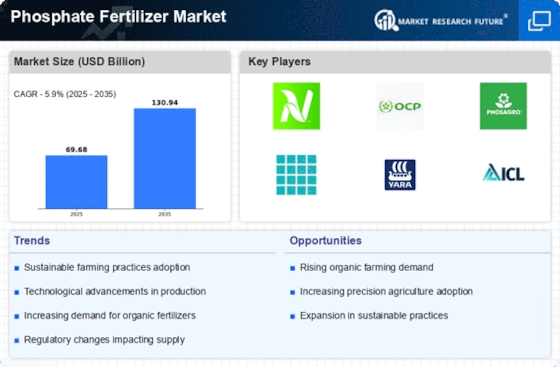
As per MRFR analysis, the Phosphate Fertilizer Market Size was estimated at 69.68 USD Billion in 2024. The Phosphate Fertilizer industry is projected to grow from 73.8 USD Billion in 2025 to 130.94 USD Billion by 2035, exhibiting a compound annual growth rate (CAGR) of 5.9 during the forecast period 2025 - 2035.

Key Market Trends & Highlights

The Phosphate Fertilizer Market is poised for growth driven by sustainability and technological advancements.

  • Sustainable agriculture practices are increasingly influencing fertilizer application methods in North America. Technological advancements in fertilizer production are enhancing the efficiency of Diammonium Phosphate (DAP) in the market. The Asia-Pacific region is experiencing rapid growth in the Monoammonium Phosphate (MAP) segment, particularly for fruits and vegetables. Rising food demand and soil health awareness are key drivers propelling the phosphate fertilizer market forward.

Market Size & Forecast

2024 Market Size 69.68 (USD Billion)
2035 Market Size 130.94 (USD Billion)
CAGR (2025 - 2035) 5.9%
Largest Regional Market Share in 2024 Asia Pacific

Major Players

<p>Nutrien (CA), OCP Group (MA), PhosAgro (RU), <a href="https://mosaicco.com/">Mosaic Company (US),</a> Yara International (NO), ICL Group (IL), K+S AG (DE), Jordan Phosphate Mines Company (JO), Saudi Arabian Mining Company (SA)</p>

Market Trends

The Phosphate Fertilizer Market is currently experiencing a dynamic phase characterized by evolving agricultural practices and increasing global food demand. As farmers seek to enhance crop yields and improve soil health, the adoption of phosphate fertilizers appears to be on the rise. This trend is likely driven by the need for sustainable farming solutions that can support food security while minimizing environmental impact. Furthermore, advancements in fertilizer technology may contribute to more efficient nutrient delivery, thereby optimizing agricultural productivity. In addition, the Phosphate Fertilizer Market is influenced by regulatory frameworks and environmental considerations. Governments worldwide are implementing policies aimed at promoting sustainable agricultural practices, which may encourage the use of phosphate fertilizers that align with these objectives. The market landscape seems to be shifting towards products that not only enhance crop performance but also adhere to stricter environmental standards. As such, stakeholders in the industry must remain vigilant to adapt to these changes and capitalize on emerging opportunities.

Sustainable Agriculture Practices

The Phosphate Fertilizer Market is witnessing a shift towards sustainable agricultural practices. Farmers are increasingly adopting fertilizers that promote environmental stewardship while enhancing crop productivity. This trend reflects a growing awareness of the need to balance agricultural output with ecological preservation.

Technological Advancements in Fertilizers

Innovations in fertilizer technology are reshaping the Phosphate Fertilizer Market. Enhanced formulations and application methods are being developed to improve nutrient efficiency and reduce waste. These advancements may lead to better crop yields and lower environmental impact.

Regulatory Influences on Fertilizer Use

The Phosphate Fertilizer Market is subject to evolving regulatory frameworks that aim to promote sustainable farming. Governments are implementing policies that encourage the use of environmentally friendly fertilizers, which could drive demand for phosphate products that meet these new standards.

Phosphate Fertilizer Market Market Drivers

Rising Food Demand

The increasing global population and changing dietary preferences are driving the demand for food production, which in turn propels the Phosphate Fertilizer Market. As populations grow, the need for higher agricultural yields becomes paramount. According to recent estimates, food production must increase by approximately 70% by 2050 to meet the needs of the burgeoning population. This surge in food demand necessitates the use of phosphate fertilizers, which are essential for enhancing crop productivity. Farmers are increasingly relying on these fertilizers to ensure that they can meet the nutritional needs of their communities. Consequently, the Phosphate Fertilizer Market is likely to experience substantial growth as agricultural practices adapt to these demands.

Global Trade Dynamics

The dynamics of The Phosphate Fertilizer Industry. Trade agreements and tariffs can affect the availability and pricing of phosphate fertilizers across different regions. Countries that are major producers of phosphate rock, such as Morocco and the United States, play a pivotal role in the supply chain. Changes in trade policies or geopolitical tensions can lead to fluctuations in supply, impacting prices and availability in various markets. As nations strive for self-sufficiency in food production, the demand for locally sourced phosphate fertilizers may increase, further shaping the Phosphate Fertilizer Market. Understanding these trade dynamics is essential for stakeholders looking to navigate the complexities of the market.

Soil Health Awareness

There is a growing recognition of the importance of soil health in sustainable agriculture, which is influencing the Phosphate Fertilizer Market. Farmers and agricultural stakeholders are becoming more aware of how phosphate fertilizers contribute to soil fertility and crop health. Enhanced soil health leads to improved crop yields and resilience against pests and diseases. Recent studies indicate that phosphate fertilizers can significantly improve soil nutrient levels, which is crucial for sustainable farming practices. As awareness of soil health continues to rise, the demand for phosphate fertilizers is expected to increase, thereby driving growth in the Phosphate Fertilizer Market. This trend reflects a broader shift towards sustainable agricultural practices that prioritize long-term soil vitality.

Government Policies and Subsidies

Government policies and subsidies play a crucial role in shaping the Phosphate Fertilizer Market. Many governments are implementing policies aimed at promoting agricultural productivity and sustainability, which often include financial incentives for the use of phosphate fertilizers. These subsidies can lower the cost of fertilizers for farmers, encouraging their use and thereby boosting demand. Additionally, regulatory frameworks that support sustainable farming practices can further enhance the market for phosphate fertilizers. As governments recognize the importance of food security and environmental sustainability, the Phosphate Fertilizer Market is likely to benefit from favorable policy environments that promote the use of these essential agricultural inputs.

Technological Innovations in Fertilizer Production

Advancements in fertilizer production technologies are reshaping the Phosphate Fertilizer Market. Innovations such as precision agriculture and enhanced efficiency fertilizers are being adopted to optimize nutrient delivery to crops. These technologies not only improve the effectiveness of phosphate fertilizers but also reduce environmental impacts. For instance, the development of slow-release phosphate fertilizers allows for more efficient nutrient uptake by plants, minimizing waste and runoff. As these technologies become more prevalent, they are likely to enhance the overall productivity of phosphate fertilizers, thereby stimulating growth in the Phosphate Fertilizer Market. The integration of technology in fertilizer production is expected to play a pivotal role in meeting the increasing agricultural demands.

Market Segment Insights

By Product: Diammonium Phosphate (DAP) (Largest) vs. Monoammonium Phosphate (MAP) (Fastest-Growing)

<p>In the Phosphate Fertilizer Market, Diammonium Phosphate (DAP) stands out as the largest segment, dominating market share due to its high nutrient content and widespread usage across various crops. This segment appeals to a significant agricultural base, resulting in extensive demand. Monoammonium Phosphate (MAP), while smaller in market share compared to DAP, is recognized as the fastest-growing segment. Its unique formulation is particularly beneficial for early-stage plant development, leading to rising popularity among farmers seeking effective solutions to enhance crop yields. The growth trends for these products are driven by the increasing global population and the corresponding need for improved agricultural productivity. Advances in agricultural techniques and the push towards sustainable practices also contribute to the accelerated adoption of MAP, as more farmers opt for fertilizers that support environmentally friendly farming. Moreover, DAP benefits from its versatile application in various soil types, securing its position as a staple in fertilizer practices worldwide.</p>

<p>Diammonium Phosphate (DAP) (Dominant) vs. Single Superphosphate (SSP) (Emerging)</p>

<p>Diammonium Phosphate (DAP) remains the dominant player in the Phosphate Fertilizer Market, known for its high nitrogen and phosphorus content, which supports robust plant growth. Its ability to improve crop yield and quality makes it a preferred choice for a variety of crops, including cereals and pulses. On the other hand, Single Superphosphate (SSP) is emerging as a relevant alternative, especially in developing regions where cost-effectiveness is paramount. SSP contains a lower concentration of phosphorus compared to DAP, yet it is still effective in enhancing soil nutrient levels. As farmers transition to more sustainable practices, the demand for SSP is expected to rise, driven by its relative affordability and contributions to soil health. While DAP dominates, SSP is carving out its share, particularly in price-sensitive markets.</p>

By Application: Cereals & Grains (Largest) vs. Fruits & Vegetables (Fastest-Growing)

<p>In the phosphate fertilizer market, the application segment exhibits a diverse distribution with cereals and grains accounting for the largest share. This segment's significant consumption is driven by the vast-scale cultivation of staple crops which require high nutrient inputs to achieve optimal yields. Oilseeds and pulses also play a crucial role, although they hold a smaller market share in comparison. Furthermore, fruits and vegetables are emerging as a strong contender due to rising health awareness and the growing demand for fresh produce.</p>

<p>Cereals &amp; Grains (Dominant) vs. Fruits &amp; Vegetables (Emerging)</p>

<p>The cereals and grains segment remains dominant in the phosphate fertilizer market due to the high nutritional needs of grains such as wheat, rice, and corn. Farmers heavily rely on phosphate fertilizers to enhance yield and support healthy crop development. In contrast, the fruits and vegetables segment is emerging rapidly, reflecting changing consumer preferences towards healthier diets. This shift drives growers to invest in higher quality fertilizers, ensuring better production, flavor, and shelf life. This segment is characterized by its potential for innovation, as agriculture practices continue to evolve towards sustainability and organic options.</p>

Get more detailed insights about Phosphate Fertilizer Market Research Report-Global Forecast till 2035

Regional Insights

North America : Fertility and Sustainability Focus

The North American phosphate fertilizer market is driven by increasing agricultural productivity and sustainable farming practices. The U.S. and Canada are the largest markets, holding approximately 60% of the regional share. Regulatory support for sustainable agriculture and environmental protection is fostering growth, with initiatives aimed at reducing nutrient runoff and enhancing soil health. Leading players like Nutrien and Mosaic Company dominate the market, leveraging advanced technologies and sustainable practices. The competitive landscape is characterized by innovation in product offerings and a focus on efficiency. The presence of established companies ensures a robust supply chain, meeting the growing demand for phosphate fertilizers in the region.

Europe : Innovation and Regulation Driven

Europe's phosphate fertilizer market is characterized by stringent regulations aimed at environmental sustainability and resource efficiency. The region is witnessing a shift towards organic and sustainable fertilizers, with countries like France and Germany leading the market, collectively holding around 50% of the share. Regulatory frameworks, such as the EU Fertilizers Regulation, are driving innovation and compliance in the industry. Key players like Yara International and ICL Group are adapting to these regulations by investing in sustainable practices and technologies. The competitive landscape is evolving, with a focus on reducing environmental impact while meeting the growing demand for fertilizers. The presence of established companies ensures a stable supply chain, catering to the diverse agricultural needs across Europe.

Asia-Pacific : Emerging Markets and Growth

The Asia-Pacific region is experiencing rapid growth in the phosphate fertilizer market, driven by increasing food production needs and rising population. Countries like China and India are the largest markets, accounting for approximately 70% of the regional share. The demand for fertilizers is further fueled by government initiatives to enhance agricultural productivity and food security. The competitive landscape is marked by the presence of key players such as PhosAgro and Jordan Phosphate Mines Company, who are expanding their operations to meet the growing demand. The region is also witnessing investments in technology and sustainable practices, ensuring a balance between productivity and environmental responsibility. This dynamic market is poised for significant growth in the coming years.

Middle East and Africa : Resource-Rich and Growing Demand

The Middle East and Africa region is rich in phosphate resources, with countries like Morocco and Saudi Arabia leading the market. The region holds approximately 40% of the global phosphate reserves, driving significant growth in the fertilizer market. Increasing agricultural activities and government support for food security are key growth drivers, alongside rising demand for fertilizers in emerging economies. Key players such as OCP Group and Saudi Arabian Mining Company are expanding their production capacities to meet the growing demand. The competitive landscape is evolving, with a focus on sustainable practices and technological advancements. The region's strategic location also facilitates exports, enhancing its role in The Phosphate Fertilizer Market.

Key Players and Competitive Insights

The Phosphate Fertilizer Market is characterized by a complex interplay of competitive dynamics, driven by increasing global food demand and the necessity for sustainable agricultural practices. Key players such as Nutrien (CA), OCP Group (MA), and Mosaic Company (US) are strategically positioned to leverage their extensive operational capabilities and innovative approaches. Nutrien (CA) focuses on enhancing its product offerings through technological advancements, while OCP Group (MA) emphasizes sustainable mining practices and regional expansion in Africa. Mosaic Company (US) is actively pursuing digital transformation initiatives to optimize its supply chain and improve customer engagement. Collectively, these strategies not only enhance their competitive edge but also contribute to a more resilient market structure.

The business tactics employed by these companies reflect a concerted effort to localize manufacturing and optimize supply chains, which is crucial in a moderately fragmented market. The competitive structure is shaped by the collective influence of these key players, who are increasingly adopting strategies that prioritize sustainability and efficiency. This approach not only addresses the immediate needs of the market but also positions them favorably against emerging competitors.

In August 2025, Nutrien (CA) announced a partnership with a leading agricultural technology firm to develop precision agriculture solutions aimed at improving fertilizer application efficiency. This strategic move is significant as it aligns with the growing trend towards digital agriculture, potentially enhancing Nutrien's market share by offering innovative solutions that meet the evolving needs of farmers.

In September 2025, OCP Group (MA) launched a new line of eco-friendly phosphate fertilizers designed to minimize environmental impact while maximizing crop yield. This initiative underscores OCP's commitment to sustainability and positions the company as a leader in environmentally responsible practices within the phosphate fertilizer sector. Such innovations are likely to resonate well with environmentally conscious consumers and regulatory bodies alike.

In July 2025, Mosaic Company (US) completed the acquisition of a regional fertilizer distributor, thereby expanding its distribution network across the Midwest. This acquisition is strategically important as it enhances Mosaic's ability to deliver products more efficiently to a broader customer base, thereby strengthening its competitive position in a key agricultural region.

As of October 2025, the Phosphate Fertilizer Market is witnessing a shift towards digitalization, sustainability, and the integration of artificial intelligence in production processes. Strategic alliances are increasingly shaping the competitive landscape, enabling companies to pool resources and expertise to drive innovation. The evolution of competitive differentiation appears to be moving away from traditional price-based competition towards a focus on technological advancements, sustainable practices, and supply chain reliability. This trend suggests that companies that can effectively innovate and adapt to changing market demands will likely emerge as leaders in the phosphate fertilizer sector.

Key Companies in the Phosphate Fertilizer Market market include

Industry Developments

February 2022 Brazilian phosphate project Serra do Salitre was purchased by EuroChem Group AG, a major worldwide fertilizer manufacturer. The advanced mine and factory in Minas Gerais have been taken over by it. The project includes phosphoric acid and sulfuric acid manufacturing facilities, as well as a urea and potassium chloride storage facility. A 500 KMT per year of phosphate rock is produced by the mine and processing facility, which are both in use. The corporation hopes the acquisition would open up markets in South America.

December 2020 An agreement for collaboration between PhosAgro-Region and Exact Farming has been struck on the creation of digital services for Russian users of PhosAgro's mineral fertilizers. The businesses want to work together to create applications for remote monitoring, assessing and enhancing the performance of mineral feeding systems based on PhosAgro products, and creating and disseminating agronomic knowledge.


Future Outlook

Phosphate Fertilizer Market Future Outlook

<p>The Phosphate Fertilizer Market is projected to grow at a 5.9% CAGR from 2024 to 2035, driven by increasing agricultural demand, technological advancements, and sustainable practices.</p>

New opportunities lie in:

  • <p>Development of precision agriculture technologies for optimized fertilizer application.</p><p>Expansion into emerging markets with tailored phosphate solutions.</p><p>Investment in eco-friendly phosphate recycling initiatives to enhance sustainability.</p>

<p>By 2035, the market is expected to solidify its position as a key player in global agriculture.</p>

Market Segmentation

Phosphate Fertilizer Market Product Outlook

  • Monoammonium Phosphate (MAP)
  • Diammonium Phosphate (DAP)
  • Single Superphosphate (SSP)
  • Triple Superphosphate (TSP)
  • Others

Phosphate Fertilizer Market Application Outlook

  • Cereals & Grains
  • Oilseeds & Pulses
  • Fruits & Vegetables
  • Others

Report Scope

MARKET SIZE 202469.68(USD Billion)
MARKET SIZE 202573.8(USD Billion)
MARKET SIZE 2035130.94(USD Billion)
COMPOUND ANNUAL GROWTH RATE (CAGR)5.9% (2024 - 2035)
REPORT COVERAGERevenue Forecast, Competitive Landscape, Growth Factors, and Trends
BASE YEAR2024
Market Forecast Period2025 - 2035
Historical Data2019 - 2024
Market Forecast UnitsUSD Billion
Key Companies ProfiledMarket analysis in progress
Segments CoveredMarket segmentation analysis in progress
Key Market OpportunitiesAdoption of precision agriculture technologies enhances efficiency in the Phosphate Fertilizer Market.
Key Market DynamicsRising demand for sustainable agriculture drives innovation and competition in the phosphate fertilizer market.
Countries CoveredNorth America, Europe, APAC, South America, MEA

FAQs

What is the current valuation of the Phosphate Fertilizer Market?

The Phosphate Fertilizer Market was valued at 69.68 USD Billion in 2024.

  1. SECTION I: EXECUTIVE SUMMARY AND KEY HIGHLIGHTS
    1. EXECUTIVE SUMMARY
      1. Market Overview
      2. Key Findings
      3. Market Segmentation
      4. Competitive Landscape
      5. Challenges and Opportunities
      6. Future Outlook
  2. SECTION II: SCOPING, METHODOLOGY AND MARKET STRUCTURE
    1. MARKET INTRODUCTION
      1. Definition
      2. Scope of the study
    2. RESEARCH METHODOLOGY
      1. Overview
      2. Data Mining
      3. Secondary Research
      4. Primary Research
      5. Forecasting Model
      6. Market Size Estimation
      7. Data Triangulation
      8. Validation
  3. SECTION III: QUALITATIVE ANALYSIS
    1. MARKET DYNAMICS
      1. Overview
      2. Drivers
      3. Restraints
      4. Opportunities
    2. MARKET FACTOR ANALYSIS
      1. Value chain Analysis
      2. Porter's Five Forces Analysis
      3. COVID-19 Impact Analysis
  4. SECTION IV: QUANTITATIVE ANALYSIS
    1. Food, Beverages & Nutrition, BY Product (USD Billion)
      1. Monoammonium Phosphate (MAP)
      2. Diammonium Phosphate (DAP)
      3. Single Superphosphate (SSP)
      4. Triple Superphosphate (TSP)
      5. Others
    2. Food, Beverages & Nutrition, BY Application (USD Billion)
      1. Cereals & Grains
      2. Oilseeds & Pulses
      3. Fruits & Vegetables
      4. Others
    3. Food, Beverages & Nutrition, BY Region (USD Billion)
      1. North America
      2. Europe
      3. APAC
      4. South America
      5. MEA
  5. SECTION V: COMPETITIVE ANALYSIS
    1. Competitive Landscape
      1. Overview
      2. Competitive Analysis
      3. Market share Analysis
      4. Major Growth Strategy in the Food, Beverages & Nutrition
      5. Competitive Benchmarking
      6. Leading Players in Terms of Number of Developments in the Food, Beverages & Nutrition
      7. Key developments and growth strategies
      8. Major Players Financial Matrix
    2. Company Profiles
      1. Nutrien (CA)
      2. OCP Group (MA)
      3. PhosAgro (RU)
      4. Mosaic Company (US)
      5. Yara International (NO)
      6. ICL Group (IL)
      7. K+S AG (DE)
      8. Jordan Phosphate Mines Company (JO)
      9. Saudi Arabian Mining Company (SA)
    3. Appendix
      1. References
      2. Related Reports
  6. LIST OF FIGURES
    1. MARKET SYNOPSIS
    2. NORTH AMERICA MARKET ANALYSIS
    3. US MARKET ANALYSIS BY PRODUCT
    4. US MARKET ANALYSIS BY APPLICATION
    5. CANADA MARKET ANALYSIS BY PRODUCT
    6. CANADA MARKET ANALYSIS BY APPLICATION
    7. EUROPE MARKET ANALYSIS
    8. GERMANY MARKET ANALYSIS BY PRODUCT
    9. GERMANY MARKET ANALYSIS BY APPLICATION
    10. UK MARKET ANALYSIS BY PRODUCT
    11. UK MARKET ANALYSIS BY APPLICATION
    12. FRANCE MARKET ANALYSIS BY PRODUCT
    13. FRANCE MARKET ANALYSIS BY APPLICATION
    14. RUSSIA MARKET ANALYSIS BY PRODUCT
    15. RUSSIA MARKET ANALYSIS BY APPLICATION
    16. ITALY MARKET ANALYSIS BY PRODUCT
    17. ITALY MARKET ANALYSIS BY APPLICATION
    18. SPAIN MARKET ANALYSIS BY PRODUCT
    19. SPAIN MARKET ANALYSIS BY APPLICATION
    20. REST OF EUROPE MARKET ANALYSIS BY PRODUCT
    21. REST OF EUROPE MARKET ANALYSIS BY APPLICATION
    22. APAC MARKET ANALYSIS
    23. CHINA MARKET ANALYSIS BY PRODUCT
    24. CHINA MARKET ANALYSIS BY APPLICATION
    25. INDIA MARKET ANALYSIS BY PRODUCT
    26. INDIA MARKET ANALYSIS BY APPLICATION
    27. JAPAN MARKET ANALYSIS BY PRODUCT
    28. JAPAN MARKET ANALYSIS BY APPLICATION
    29. SOUTH KOREA MARKET ANALYSIS BY PRODUCT
    30. SOUTH KOREA MARKET ANALYSIS BY APPLICATION
    31. MALAYSIA MARKET ANALYSIS BY PRODUCT
    32. MALAYSIA MARKET ANALYSIS BY APPLICATION
    33. THAILAND MARKET ANALYSIS BY PRODUCT
    34. THAILAND MARKET ANALYSIS BY APPLICATION
    35. INDONESIA MARKET ANALYSIS BY PRODUCT
    36. INDONESIA MARKET ANALYSIS BY APPLICATION
    37. REST OF APAC MARKET ANALYSIS BY PRODUCT
    38. REST OF APAC MARKET ANALYSIS BY APPLICATION
    39. SOUTH AMERICA MARKET ANALYSIS
    40. BRAZIL MARKET ANALYSIS BY PRODUCT
    41. BRAZIL MARKET ANALYSIS BY APPLICATION
    42. MEXICO MARKET ANALYSIS BY PRODUCT
    43. MEXICO MARKET ANALYSIS BY APPLICATION
    44. ARGENTINA MARKET ANALYSIS BY PRODUCT
    45. ARGENTINA MARKET ANALYSIS BY APPLICATION
    46. REST OF SOUTH AMERICA MARKET ANALYSIS BY PRODUCT
    47. REST OF SOUTH AMERICA MARKET ANALYSIS BY APPLICATION
    48. MEA MARKET ANALYSIS
    49. GCC COUNTRIES MARKET ANALYSIS BY PRODUCT
    50. GCC COUNTRIES MARKET ANALYSIS BY APPLICATION
    51. SOUTH AFRICA MARKET ANALYSIS BY PRODUCT
    52. SOUTH AFRICA MARKET ANALYSIS BY APPLICATION
    53. REST OF MEA MARKET ANALYSIS BY PRODUCT
    54. REST OF MEA MARKET ANALYSIS BY APPLICATION
    55. KEY BUYING CRITERIA OF FOOD, BEVERAGES & NUTRITION
    56. RESEARCH PROCESS OF MRFR
    57. DRO ANALYSIS OF FOOD, BEVERAGES & NUTRITION
    58. DRIVERS IMPACT ANALYSIS: FOOD, BEVERAGES & NUTRITION
    59. RESTRAINTS IMPACT ANALYSIS: FOOD, BEVERAGES & NUTRITION
    60. SUPPLY / VALUE CHAIN: FOOD, BEVERAGES & NUTRITION
    61. FOOD, BEVERAGES & NUTRITION, BY PRODUCT, 2024 (% SHARE)
    62. FOOD, BEVERAGES & NUTRITION, BY PRODUCT, 2024 TO 2035 (USD Billion)
    63. FOOD, BEVERAGES & NUTRITION, BY APPLICATION, 2024 (% SHARE)
    64. FOOD, BEVERAGES & NUTRITION, BY APPLICATION, 2024 TO 2035 (USD Billion)
    65. BENCHMARKING OF MAJOR COMPETITORS
  7. LIST OF TABLES
    1. LIST OF ASSUMPTIONS
    2. North America MARKET SIZE ESTIMATES; FORECAST
      1. BY PRODUCT, 2025-2035 (USD Billion)
      2. BY APPLICATION, 2025-2035 (USD Billion)
    3. US MARKET SIZE ESTIMATES; FORECAST
      1. BY PRODUCT, 2025-2035 (USD Billion)
      2. BY APPLICATION, 2025-2035 (USD Billion)
    4. Canada MARKET SIZE ESTIMATES; FORECAST
      1. BY PRODUCT, 2025-2035 (USD Billion)
      2. BY APPLICATION, 2025-2035 (USD Billion)
    5. Europe MARKET SIZE ESTIMATES; FORECAST
      1. BY PRODUCT, 2025-2035 (USD Billion)
      2. BY APPLICATION, 2025-2035 (USD Billion)
    6. Germany MARKET SIZE ESTIMATES; FORECAST
      1. BY PRODUCT, 2025-2035 (USD Billion)
      2. BY APPLICATION, 2025-2035 (USD Billion)
    7. UK MARKET SIZE ESTIMATES; FORECAST
      1. BY PRODUCT, 2025-2035 (USD Billion)
      2. BY APPLICATION, 2025-2035 (USD Billion)
    8. France MARKET SIZE ESTIMATES; FORECAST
      1. BY PRODUCT, 2025-2035 (USD Billion)
      2. BY APPLICATION, 2025-2035 (USD Billion)
    9. Russia MARKET SIZE ESTIMATES; FORECAST
      1. BY PRODUCT, 2025-2035 (USD Billion)
      2. BY APPLICATION, 2025-2035 (USD Billion)
    10. Italy MARKET SIZE ESTIMATES; FORECAST
      1. BY PRODUCT, 2025-2035 (USD Billion)
      2. BY APPLICATION, 2025-2035 (USD Billion)
    11. Spain MARKET SIZE ESTIMATES; FORECAST
      1. BY PRODUCT, 2025-2035 (USD Billion)
      2. BY APPLICATION, 2025-2035 (USD Billion)
    12. Rest of Europe MARKET SIZE ESTIMATES; FORECAST
      1. BY PRODUCT, 2025-2035 (USD Billion)
      2. BY APPLICATION, 2025-2035 (USD Billion)
    13. APAC MARKET SIZE ESTIMATES; FORECAST
      1. BY PRODUCT, 2025-2035 (USD Billion)
      2. BY APPLICATION, 2025-2035 (USD Billion)
    14. China MARKET SIZE ESTIMATES; FORECAST
      1. BY PRODUCT, 2025-2035 (USD Billion)
      2. BY APPLICATION, 2025-2035 (USD Billion)
    15. India MARKET SIZE ESTIMATES; FORECAST
      1. BY PRODUCT, 2025-2035 (USD Billion)
      2. BY APPLICATION, 2025-2035 (USD Billion)
    16. Japan MARKET SIZE ESTIMATES; FORECAST
      1. BY PRODUCT, 2025-2035 (USD Billion)
      2. BY APPLICATION, 2025-2035 (USD Billion)
    17. South Korea MARKET SIZE ESTIMATES; FORECAST
      1. BY PRODUCT, 2025-2035 (USD Billion)
      2. BY APPLICATION, 2025-2035 (USD Billion)
    18. Malaysia MARKET SIZE ESTIMATES; FORECAST
      1. BY PRODUCT, 2025-2035 (USD Billion)
      2. BY APPLICATION, 2025-2035 (USD Billion)
    19. Thailand MARKET SIZE ESTIMATES; FORECAST
      1. BY PRODUCT, 2025-2035 (USD Billion)
      2. BY APPLICATION, 2025-2035 (USD Billion)
    20. Indonesia MARKET SIZE ESTIMATES; FORECAST
      1. BY PRODUCT, 2025-2035 (USD Billion)
      2. BY APPLICATION, 2025-2035 (USD Billion)
    21. Rest of APAC MARKET SIZE ESTIMATES; FORECAST
      1. BY PRODUCT, 2025-2035 (USD Billion)
      2. BY APPLICATION, 2025-2035 (USD Billion)
    22. South America MARKET SIZE ESTIMATES; FORECAST
      1. BY PRODUCT, 2025-2035 (USD Billion)
      2. BY APPLICATION, 2025-2035 (USD Billion)
    23. Brazil MARKET SIZE ESTIMATES; FORECAST
      1. BY PRODUCT, 2025-2035 (USD Billion)
      2. BY APPLICATION, 2025-2035 (USD Billion)
    24. Mexico MARKET SIZE ESTIMATES; FORECAST
      1. BY PRODUCT, 2025-2035 (USD Billion)
      2. BY APPLICATION, 2025-2035 (USD Billion)
    25. Argentina MARKET SIZE ESTIMATES; FORECAST
      1. BY PRODUCT, 2025-2035 (USD Billion)
      2. BY APPLICATION, 2025-2035 (USD Billion)
    26. Rest of South America MARKET SIZE ESTIMATES; FORECAST
      1. BY PRODUCT, 2025-2035 (USD Billion)
      2. BY APPLICATION, 2025-2035 (USD Billion)
    27. MEA MARKET SIZE ESTIMATES; FORECAST
      1. BY PRODUCT, 2025-2035 (USD Billion)
      2. BY APPLICATION, 2025-2035 (USD Billion)
    28. GCC Countries MARKET SIZE ESTIMATES; FORECAST
      1. BY PRODUCT, 2025-2035 (USD Billion)
      2. BY APPLICATION, 2025-2035 (USD Billion)
    29. South Africa MARKET SIZE ESTIMATES; FORECAST
      1. BY PRODUCT, 2025-2035 (USD Billion)
      2. BY APPLICATION, 2025-2035 (USD Billion)
    30. Rest of MEA MARKET SIZE ESTIMATES; FORECAST
      1. BY PRODUCT, 2025-2035 (USD Billion)
      2. BY APPLICATION, 2025-2035 (USD Billion)
    31. PRODUCT LAUNCH/PRODUCT DEVELOPMENT/APPROVAL
    32. ACQUISITION/PARTNERSHIP

Phosphate Fertilizer Market Segmentation

Phosphate Fertilizer Product Outlook (USD Billion, 2018-2032)

Monoammonium Phosphate (MAP)

Diammonium Phosphate (DAP)

Single Superphosphate (SSP)

Triple Superphosphate (TSP)

Others

Phosphate Fertilizer Application Outlook (USD Billion, 2018-2032)

Cereals & Grains

Oilseeds & Pulses

Fruits & Vegetables

Others

Phosphate Fertilizer Regional Outlook (USD Billion, 2018-2032)

North America Outlook (USD Billion, 2018-2032)

North America Phosphate Fertilizer by Product

Monoammonium Phosphate (MAP)

Diammonium Phosphate (DAP)

Single Superphosphate (SSP)

Triple Superphosphate (TSP)

Others

North America Phosphate Fertilizer by Application

Cereals & Grains

Oilseeds & Pulses

Fruits & Vegetables

Others

US Outlook (USD Billion, 2018-2032)

US Phosphate Fertilizer by Product

Monoammonium Phosphate (MAP)

Diammonium Phosphate (DAP)

Single Superphosphate (SSP)

Triple Superphosphate (TSP)

Others

US Phosphate Fertilizer by Application

Cereals & Grains

Oilseeds & Pulses

Fruits & Vegetables

Others

CANADA Outlook (USD Billion, 2018-2032)

CANADA Phosphate Fertilizer by Product

Monoammonium Phosphate (MAP)

Diammonium Phosphate (DAP)

Single Superphosphate (SSP)

Triple Superphosphate (TSP)

Others

CANADA Phosphate Fertilizer by Application

Cereals & Grains

Oilseeds & Pulses

Fruits & Vegetables

Others

Europe Outlook (USD Billion, 2018-2032)

Europe Phosphate Fertilizer by Product

Monoammonium Phosphate (MAP)

Diammonium Phosphate (DAP)

Single Superphosphate (SSP)

Triple Superphosphate (TSP)

Others

Europe Phosphate Fertilizer by Application

Cereals & Grains

Oilseeds & Pulses

Fruits & Vegetables

Others

Germany Outlook (USD Billion, 2018-2032)

Germany Phosphate Fertilizer by Product

Monoammonium Phosphate (MAP)

Diammonium Phosphate (DAP)

Single Superphosphate (SSP)

Triple Superphosphate (TSP)

Others

Germany Phosphate Fertilizer by Application

Cereals & Grains

Oilseeds & Pulses

Fruits & Vegetables

Others

France Outlook (USD Billion, 2018-2032)

France Phosphate Fertilizer by Product

Monoammonium Phosphate (MAP)

Diammonium Phosphate (DAP)

Single Superphosphate (SSP)

Triple Superphosphate (TSP)

Others

France Phosphate Fertilizer by Application

Cereals & Grains

Oilseeds & Pulses

Fruits & Vegetables

Others

UK Outlook (USD Billion, 2018-2032)

UK Phosphate Fertilizer by Product

Monoammonium Phosphate (MAP)

Diammonium Phosphate (DAP)

Single Superphosphate (SSP)

Triple Superphosphate (TSP)

Others

UK Phosphate Fertilizer by Application

Cereals & Grains

Oilseeds & Pulses

Fruits & Vegetables

Others

ITALY Outlook (USD Billion, 2018-2032)

ITALY Phosphate Fertilizer by Product

Monoammonium Phosphate (MAP)

Diammonium Phosphate (DAP)

Single Superphosphate (SSP)

Triple Superphosphate (TSP)

Others

ITALY Phosphate Fertilizer by Application

Cereals & Grains

Oilseeds & Pulses

Fruits & Vegetables

Others

SPAIN Outlook (USD Billion, 2018-2032)

Spain Phosphate Fertilizer by Product

Monoammonium Phosphate (MAP)

Diammonium Phosphate (DAP)

Single Superphosphate (SSP)

Triple Superphosphate (TSP)

Others

Spain Phosphate Fertilizer by Application

Cereals & Grains

Oilseeds & Pulses

Fruits & Vegetables

Others

Rest Of Europe Outlook (USD Billion, 2018-2032)

Rest Of Europe Phosphate Fertilizer by Product

Monoammonium Phosphate (MAP)

Diammonium Phosphate (DAP)

Single Superphosphate (SSP)

Triple Superphosphate (TSP)

Others

REST OF EUROPE Phosphate Fertilizer by Application

Cereals & Grains

Oilseeds & Pulses

Fruits & Vegetables

Others

Asia-Pacific Outlook (USD Billion, 2018-2032)

Asia-Pacific Phosphate Fertilizer by Product

Monoammonium Phosphate (MAP)

Diammonium Phosphate (DAP)

Single Superphosphate (SSP)

Triple Superphosphate (TSP)

Others

Asia-Pacific Phosphate Fertilizer by Application

Cereals & Grains

Oilseeds & Pulses

Fruits & Vegetables

Others

China Outlook (USD Billion, 2018-2032)

China Phosphate Fertilizer by Product

Monoammonium Phosphate (MAP)

Diammonium Phosphate (DAP)

Single Superphosphate (SSP)

Triple Superphosphate (TSP)

Others

China Phosphate Fertilizer by Application

Cereals & Grains

Oilseeds & Pulses

Fruits & Vegetables

Others

Japan Outlook (USD Billion, 2018-2032)

Japan Phosphate Fertilizer by Product

Monoammonium Phosphate (MAP)

Diammonium Phosphate (DAP)

Single Superphosphate (SSP)

Triple Superphosphate (TSP)

Others

Japan Phosphate Fertilizer by Application

Cereals & Grains

Oilseeds & Pulses

Fruits & Vegetables

Others

India Outlook (USD Billion, 2018-2032)

India Phosphate Fertilizer by Product

Monoammonium Phosphate (MAP)

Diammonium Phosphate (DAP)

Single Superphosphate (SSP)

Triple Superphosphate (TSP)

Others

India Phosphate Fertilizer by Application

Cereals & Grains

Oilseeds & Pulses

Fruits & Vegetables

Others

Australia Outlook (USD Billion, 2018-2032)

Australia Phosphate Fertilizer by Product

Monoammonium Phosphate (MAP)

Diammonium Phosphate (DAP)

Single Superphosphate (SSP)

Triple Superphosphate (TSP)

Others

Australia Phosphate Fertilizer by Application

Cereals & Grains

Oilseeds & Pulses

Fruits & Vegetables

Others

Rest of Asia-Pacific Outlook (USD Billion, 2018-2032)

Rest of Asia-Pacific Phosphate Fertilizer by Product

Monoammonium Phosphate (MAP)

Diammonium Phosphate (DAP)

Single Superphosphate (SSP)

Triple Superphosphate (TSP)

Others

Rest of Asia-Pacific Phosphate Fertilizer by Application

Cereals & Grains

Oilseeds & Pulses

Fruits & Vegetables

Others

Rest of the World Outlook (USD Billion, 2018-2032)

Rest of the World Phosphate Fertilizer by Product

Monoammonium Phosphate (MAP)

Diammonium Phosphate (DAP)

Single Superphosphate (SSP)

Triple Superphosphate (TSP)

Others

Rest of the World Phosphate Fertilizer by Application

Cereals & Grains

Oilseeds & Pulses

Fruits & Vegetables

Others

Middle East Outlook (USD Billion, 2018-2032)

Middle East Phosphate Fertilizer by Product

Monoammonium Phosphate (MAP)

Diammonium Phosphate (DAP)

Single Superphosphate (SSP)

Triple Superphosphate (TSP)

Others

Middle East Phosphate Fertilizer by Application

Cereals & Grains

Oilseeds & Pulses

Fruits & Vegetables

Others

Africa Outlook (USD Billion, 2018-2032)

Africa Phosphate Fertilizer by Product

Monoammonium Phosphate (MAP)

Diammonium Phosphate (DAP)

Single Superphosphate (SSP)

Triple Superphosphate (TSP)

Others

Africa Phosphate Fertilizer by Application

Cereals & Grains

Oilseeds & Pulses

Fruits & Vegetables

Others

Latin America Outlook (USD Billion, 2018-2032)

Latin America Phosphate Fertilizer by Product

Monoammonium Phosphate (MAP)

Diammonium Phosphate (DAP)

Single Superphosphate (SSP)

Triple Superphosphate (TSP)

Others

Latin America Phosphate Fertilizer by Application

Cereals & Grains

Oilseeds & Pulses

Fruits & Vegetables

Others


Infographic

Free Sample Request

Kindly complete the form below to receive a free sample of this Report

Get Free Sample

Customer Strories

Compare Licence

×
Features License Type
Single User Multiuser License Enterprise User
Price $4,950 $5,950 $7,250
Maximum User Access Limit 1 User Upto 10 Users Unrestricted Access Throughout the Organization
Free Customization
Direct Access to Analyst
Deliverable Format
Platform Access
Discount on Next Purchase 10% 15% 15%
Printable Versions