Request Free Sample ×

Kindly complete the form below to receive a free sample of this Report

* Please use a valid business email

Leading companies partner with us for data-driven Insights

clients tt-cursor
Hero Background
English
Chinese
French
Japanese
Korean
German
Spanish

Pharmacy Market Analysis

ID: MRFR/HC/10482-HCR
200 Pages
Rahul Gotadki
March 2026

Pharmacy Market Research Report: Size, Share, Trend Analysis By Product Type (Prescription Drugs, Over-The-Counter Drugs, Vaccines, Homeopathic Medicine), By Distribution Channel (Retail Pharmacy, Hospital Pharmacy, Online Pharmacy, Specialty Pharmacy), By Therapeutic Area (Cardiovascular, Oncology, Diabetes, Neurology, Infectious Diseases), By Formulation (Tablets, Injectables, Topicals, Liquids) and By Regional (North America, Europe, South America, Asia Pacific, Middle East and Africa) - Growth Outlook & Industry Forecast 2025 To 2035

Share:
Download PDF ×

We do not share your information with anyone. However, we may send you emails based on your report interest from time to time. You may contact us at any time to opt-out.

Pharmacy Market Infographic
Purchase Options

Market Analysis

In-depth Analysis of Pharmacy Market Industry Landscape

The global pharmacy market is set to reach US$ 1522.1 BN by 2032, at a 4.60% CAGR between years 2023-2032. Pharmacy market sits at the cutting edge of healthcare, in a world where politics and policies are solidified with demographic tendencies as well as successes or failures of magic cast spells by technological progress. The aging of global population is one of the major drives. The market for the pharmacy goes up on growing demand raising with an increase in old population due to a greater number of people handling this kind of medication and medical assistance. Moreover, due to this high rate of the prevalence of chronic diseases among Americans, there is a continuous demand for prescription medicines as well as over-the-counter drugs and other pharmaceutical products. Innovation technologies serve the key role in shaping pharmacy market generated dynamics. Digital technologies, automation, and electronic health records have been used to facilitate processes such that prescription management is strengthened through increasing the overall level of care provided to patients. The possibilities also evolve from online pharmacies and mobile health applications that enable patients to refill prescription medications conveniently, control their treatment course, and use virtual monitoring systems. Most of this is discussed via the regulatory findings that put a huge impact on the pharmacy market. Restriction laws control the prescription drugs dispenses into the consumers and thereby uphold quantity of drug quality sectors used for clients. Regulatorily standards requirement affects the strategies of pharmacies directly impacting operational processes, record-keeping, and emergent technology uptake. The dynamic environment of the regulatory sphere, involving reforms in reimbursement systems and regulatory changes in telemedicine, is also experienced as part of shaping pharmacy market’s interactions. A number of economic factors are considered to define market dynamics as such healthcare expenditure and insurance coverage issues can be listed among the most relevant ones. Consumer perspective generally relates to prices and availability of drugs. Any changes in healthcare policies, insurance plans and government programs are most likely to be responsible for the increased or decreased levels of patient accessibility to prescription medications that then results in impact to this type of demand arising from its pharma market. Using globalization and advancement in technology feeds into the market dynamics for the pharmacy. International partnerships, the sharing of knowledge and the globalization of pharmaceuticals networks manage to determine the medicine availability state worldwide. The global inter twining nature of the pharmacy system through knowledge sharing, innovation drives more harmonized approach to pharmaceutical activities across states. Demographics, including city development balances and lifestyle changes, will also influence market dynamics. Increased population in urban areas present higher demands for pharmacy services that take place due to an upsurge in the health care facility infrastructure supplemented with ease of accessibility. Among the concerns fueling demand for medications that treat other conditions are lifestyle conditions like diabetes, cardiovascular diseases, and mental health remedies. The features of the environmental issues that are gaining relevance in today’s pharmacy market comprise sustainability and waste reduction. Mentions of reducing environmental damage, for instance taking appropriate waste disposal decisions and using environmentally friendly packaging signal to the value of sustainability beyond the healthcare domain.


Author
Author Profile
Rahul Gotadki
Research Manager

He holds an experience of about 9+ years in Market Research and Business Consulting, working under the spectrum of Life Sciences and Healthcare domains. Rahul conceptualizes and implements a scalable business strategy and provides strategic leadership to the clients. His expertise lies in market estimation, competitive intelligence, pipeline analysis, customer assessment, etc.

Leave a Comment

FAQs

What is the projected market valuation of the Pharmacy Market by 2035?

<p>The Pharmacy Market is projected to reach a valuation of 1822.58 USD Billion by 2035.</p>

What was the overall market valuation of the market in 2024?

In 2024, the overall market valuation of the market was 1111.08 USD Billion.

What is the expected CAGR for the Pharmacy Market during the forecast period 2025 - 2035?

<p>The expected CAGR for the Pharmacy Market during the forecast period 2025 - 2035 is 4.6%.</p>

Which company is a key player in the market?

CVS Health is one of the key players in the market.

What are the projected revenues for Prescription Drugs by 2035?

<p>By 2035, the projected revenues for Prescription Drugs are expected to reach 950.0 USD Billion.</p>

How much is the Online Pharmacy segment expected to generate by 2035?

<p>The Online Pharmacy segment is expected to generate revenues of 350.0 USD Billion by 2035.</p>

What is the projected market size for the Oncology therapeutic area by 2035?

<p>The projected market size for the Oncology therapeutic area is anticipated to be 400.0 USD Billion by 2035.</p>

What revenue is expected from Injectables in the Pharmacy Market by 2035?

<p>Revenues from Injectables in the Pharmacy Market are expected to reach 400.0 USD Billion by 2035.</p>

What is the expected revenue for the Specialty Pharmacy segment by 2035?

<p>The Specialty Pharmacy segment is expected to generate revenues of 322.58 USD Billion by 2035.</p>

What is the projected revenue for the Infectious Diseases therapeutic area by 2035?

<p>The projected revenue for the Infectious Diseases therapeutic area is expected to be 572.58 USD Billion by 2035.</p>

Market Summary

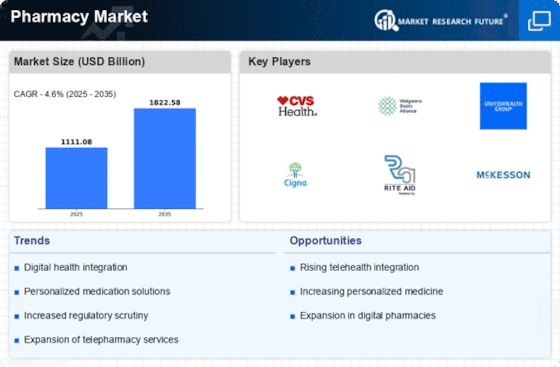
According to Market Research Future analysis, the Pharmacy Market size was valued at USD 1,111.08 Billion in 2024. The market is projected to grow from USD 1,162.21 Billion in 2025 to USD 1,822.58 Billion by 2035, exhibiting a CAGR of 4.6% during the forecast period 2025–2035. North America led the market with over 45.00% share, generating around USD 500 billion in revenue.
 
Rising prevalence of chronic diseases and expanding global healthcare access are key growth drivers for the Pharmacy Market. Increasing demand for prescription medications, coupled with aging populations and improved healthcare infrastructure, is significantly boosting pharmacy service utilization worldwide.
 
According to the World Health Organization, noncommunicable diseases account for 74% of global deaths annually, while the Institute for Health Metrics and Evaluation reports chronic conditions contribute to over 60% of global disease burden, supporting sustained demand for pharmacy-based treatment and medication access worldwide.

Key Market Trends & Highlights

The Pharmacy Market is experiencing a transformative shift towards personalized and digital health solutions.

  • North America leads with 45% share in 2024, supported by strong healthcare infrastructure and high drug utilization. Europe holds 30% share, valued at USD 333.32 billion in 2024, driven by established pharmaceutical markets. Prescription drugs dominate with 52% share, driven by rising chronic disease burden and long-term medication demand globally. Retail pharmacies lead with 48% share, while online pharmacies grow rapidly due to increasing digital healthcare adoption. Tablets hold 58% share, while injectables expand quickly with rising biologics and advanced therapy demand globally.

Market Size & Forecast

2024 Market Size 1111.08 (USD Billion)
2035 Market Size 1822.58 (USD Billion)
CAGR (2025 - 2035) 4.60%
Largest Regional Market Share in 2024 North America

Major Players

Companies such as <a href="https://www.cvshealth.com/services/pharmacy.html">CVS Health</a> (US), Walgreens Boots Alliance (US), UnitedHealth Group (US), Cigna (US), Rite Aid (US), <a href="https://www.mckesson.com/business-solutions/pharmacy-services/">McKesson Corporation</a> (US), AmerisourceBergen (US), Cardinal Health (US) are some of the major participants in the global market.

Market Trends

The global Pharmacy Market is currently experiencing a dynamic transformation, driven by various factors that influence consumer behavior and technological advancements. The increasing demand for personalized medicine and the growing emphasis on preventive healthcare are reshaping the landscape of pharmaceutical services.

Furthermore, the integration of digital health solutions, such as telepharmacy and mobile health applications, appears to enhance patient engagement and streamline medication management. According to pharmacy trends, this shift towards a more patient-centric approach indicates a potential evolution in how worldwide pharmacies operate, focusing on delivering tailored services that meet individual needs. In addition, the Pharmacy Market is witnessing a rise in the importance of sustainability and ethical practices.

Pharmacy outlook suggest that consumers are becoming more aware of the environmental impact of their choices, prompting worldwide pharmacies to adopt greener practices and offer eco-friendly products. This trend suggests that pharmacies may need to align their business strategies with broader societal values to remain competitive. Overall, the market is poised for continued growth, with innovations and changing consumer expectations likely to shape its future trajectory.

Personalized Medicine

The trend towards personalized medicine is gaining momentum within the global Pharmacy Market. This approach tailors treatments to individual patient profiles, enhancing efficacy and minimizing adverse effects. As patients increasingly seek customized healthcare solutions, pharmacies are adapting their services to provide more targeted therapies.

The Centers for Disease Control and Prevention highlights that over 6 in 10 adults in the U.S. have at least one chronic disease, while the Pan American Health Organization emphasizes increasing adoption of precision medicine approaches across the Americas, supporting tailored therapies and driving pharmacies to expand personalized medication services for improved treatment outcomes.

Digital Health Integration

The integration of digital health technologies is transforming the global Pharmacy Market. Telepharmacy and mobile health applications are becoming essential tools for enhancing patient access to medications and healthcare services. This trend indicates a shift towards more convenient and efficient pharmacy operations.

The European Centre for Disease Prevention and Control reports increasing digital health adoption across European healthcare systems, while the United Nations Population Fund projects the global population aged 65+ will reach 1.6 billion by 2050, accelerating telehealth and mobile health usage, enabling pharmacies to improve medication access, adherence, and patient engagement through digital platforms.

Sustainability Initiatives

Sustainability is emerging as a critical focus in the global Pharmacy Market. Pharmacies are increasingly adopting eco-friendly practices and offering sustainable products in response to consumer demand for environmentally responsible options. This trend reflects a broader societal shift towards sustainability in healthcare.

The United Nations Children's Fund notes that over 2 billion people lack access to safely managed healthcare waste services, highlighting the importance of sustainable practices, while Médecins Sans Frontières emphasizes eco-friendly healthcare delivery in multiple regions, encouraging pharmacies to adopt greener operations and reduce environmental impact across pharmaceutical supply chains globally.

Pharmacy Market Market Drivers

Aging Population

The aging population is a crucial driver of the Pharmacy Market. As individuals age, they typically experience a higher prevalence of chronic diseases, necessitating increased medication use. According to recent statistics, the proportion of individuals aged 65 and older is projected to rise significantly, leading to a greater demand for pharmaceutical products and services.
 
This demographic shift compels pharmacies to adapt their offerings, focusing on geriatric care and medication management. Furthermore, the market must enhance its services to cater to the unique needs of older adults, including medication adherence programs and specialized consultations. The increasing life expectancy and the associated rise in healthcare needs suggest that the market will continue to expand in response to this demographic trend.

Technological Advancements

Technological advancements are reshaping the Pharmacy Market in profound ways. Innovations such as telepharmacy, electronic prescriptions, and automated dispensing systems are enhancing operational efficiency and patient care. The integration of artificial intelligence and machine learning into pharmacy operations allows for improved inventory management and personalized medication therapy management.
 
Data indicates that pharmacies adopting these technologies experience increased customer satisfaction and operational efficiency. Moreover, the rise of mobile health applications enables patients to manage their medications more effectively, fostering a more engaged patient population. As technology continues to evolve, the market is likely to see further enhancements in service delivery, ultimately improving health outcomes and patient experiences.

Rising Healthcare Expenditure

Rising healthcare expenditure is a significant driver of the Pharmacy Market. As healthcare costs continue to escalate, there is an increasing focus on medication management and preventive care. Governments and private sectors are investing heavily in healthcare infrastructure, which includes pharmacies as essential components of the healthcare system.
 
Reports indicate that healthcare spending is expected to grow, leading to higher demand for pharmaceutical products and services. This trend compels pharmacies to expand their roles, offering more comprehensive health services, including immunizations and health screenings. The market must adapt to these changes by enhancing service offerings and ensuring accessibility to medications, thereby positioning itself as a vital player in the broader healthcare landscape.

Consumer Demand for Convenience

Consumer demand for convenience is a pivotal driver of the Pharmacy Market. Modern consumers increasingly seek accessible and efficient healthcare solutions, prompting pharmacies to innovate their service delivery models. The rise of online pharmacies and home delivery services reflects this trend, as patients prefer the convenience of obtaining medications without visiting physical locations.
 
Data suggests that pharmacies offering digital services experience higher customer retention rates and satisfaction levels. Additionally, the integration of mobile applications for prescription refills and medication reminders caters to the fast-paced lifestyles of consumers. As the demand for convenience continues to grow, the market must evolve to meet these expectations, ensuring that services are not only accessible but also user-friendly.

Regulatory Changes and Policies

Regulatory changes and policies significantly influence the Pharmacy Market. Governments worldwide are implementing new regulations aimed at improving medication safety, accessibility, and affordability. These changes often require pharmacies to adapt their practices, ensuring compliance with evolving standards. For instance, recent policies promoting the use of generic medications have impacted pricing strategies within the market.
 
Additionally, regulations surrounding telehealth and pharmacy services are expanding, allowing pharmacies to offer more comprehensive care. The market must remain agile in response to these regulatory shifts, as they can create both challenges and opportunities for growth. By aligning with regulatory requirements, pharmacies can enhance their service offerings and improve patient outcomes.

Market Segment Insights

By Product Type: Prescription Drugs (Largest) vs. Vaccines (Fastest-Growing)

The worldwide pharmacy market is segmented by product type into Prescription Drugs, Over-the-Counter Drugs, Vaccines, and Homeopathic Medicine. Among these, Prescription Drugs dominate the market, accounting for the largest share at 52% due to their critical role in chronic disease management and treatment. Over-The-Counter Drugs also hold a significant market portion, appealing to consumers seeking immediate relief without physician consultations. Vaccines, meanwhile, represent a rapidly growing segment, reflecting the increasing focus on preventive healthcare, especially in the wake of global health crises. The growth trends in this segment highlight a rising demand for Prescription Drugs, fueled by an aging population and the prevalence of chronic diseases. The emergence of innovative therapies and personalized medicine further propels this category. Conversely, the Vaccines segment is experiencing the fastest growth driven by heightened awareness of vaccination importance and governmental support for immunization programs. This dynamic landscape reflects changing consumer preferences and a continuous evolution in healthcare strategies.

Prescription Drugs (Dominant) vs. Homeopathic Medicine (Emerging)

Prescription Drugs are the backbone of the global market share, characterized by their extensive range, effectiveness in treating various health conditions, and strong endorsement from healthcare professionals. They often come with regulatory oversight, ensuring safety and efficacy. This dominance is complemented by constant innovation, with new drugs frequently emerging to meet patient needs. In contrast, Homeopathic Medicine is gaining traction as an alternative treatment option, supported by a growing consumer preference for natural and holistic therapies. While still considered an emerging segment compared to Prescription Drugs, it appeals to a niche market that values personalized and non-invasive solutions. Homeopathic products are often viewed as complements to conventional medicine, promoting a coexistence of treatment philosophies in the pharmacy landscape.

By Distribution Channel: Retail Pharmacy (Largest) vs. Online Pharmacy (Fastest-Growing)

The market is significantly shaped by various distribution channels, with Retail Pharmacy leading the Pharmacy Market with a 48% share. It caters to a broad customer base, providing essential medications and health products directly to consumers. In contrast, the Online Pharmacy segment is rapidly gaining traction, driven by the convenience of digital access and delivery services, making it the fastest-growing sector within this market.

Retail Pharmacy (Dominant) vs. Online Pharmacy (Emerging)

Retail Pharmacy stands as the dominant distribution channel in the market, characterized by its physical presence and ability to provide personalized service. These pharmacies are often strategically located to maximize customer access and are integral in community healthcare. Conversely, Online Pharmacy is an emerging segment that appeals to tech-savvy consumers looking for convenience and accessibility. This channel is characterized by its focus on e-commerce, with many offering competitive pricing and home delivery services, catering to the evolving preferences of modern consumers.

By Therapeutic Area: Cardiovascular (Largest) vs. Oncology (Fastest-Growing)

In the global Pharmacy Market, the distribution of market share among the therapeutic areas shows that Cardiovascular drugs currently dominate the landscape, capturing the largest segment of sales. Following closely are Oncology products, which have been rapidly gaining traction due to the increasing prevalence of cancer and advancements in targeted therapies. Diabetes and Neurology segments hold significant portions as well, supported by growing patient populations and ongoing research driving medications. Infectious Diseases remain a crucial segment, albeit with fluctuating demand driven by emerging threats and antibiotic resistance. The growth trends within these therapeutic areas reveal that Oncology is experiencing the fastest expansion, fueled by innovations in immunotherapy and personalized medicine. Cardiovascular treatments, while dominant, face competition from advancements in Diabetes care as well, reflecting a shift towards managing lifestyle diseases. Infectious Diseases show volatility driven by global health concerns, while Neurology is benefitting from increased awareness and investment in mental health therapies, highlighting the evolving needs in the global market.

Cardiovascular (Dominant) vs. Oncology (Emerging)

The Cardiovascular segment in the worldwide pharmacy market is characterized by a strong focus on chronic disease management, with a wide array of medications targeting hypertension, heart failure, and hyperlipidemia. This segment is well-established, boasting a broad portfolio including generics and branded drugs. In contrast, the Oncology segment, while emerging, is distinguished by rapid innovation and significant investment in research and development. The rise of biologics and targeted therapies in Oncology is enhancing treatment outcomes and patient survival rates, making it a vital area of focus. As the pharmacy market continues evolving, both segments will play crucial roles but will cater to different patient needs and therapeutic advancements.

By Formulation: Tablets (Largest) vs. Injectables (Fastest-Growing)

In the Pharmacy Market, tablets dominate the formulation segment with a 58% market share due to their convenience, ease of consumption, and cost-effectiveness, capturing a significant portion of the market. Injectables, while smaller in comparison, are witnessing rapid growth due to the increasing need for quick drug delivery and the rise of biologics, making them a crucial part of current pharmaceutical strategies, augmenting the drug industry.

Tablets (Dominant) vs. Injectables (Emerging)

Tablets are considered the dominant force in the market share, appealing to a wide range of consumers with their user-friendly format. They offer stability, precise dosing, and a long shelf life. On the other hand, injectables present an emerging trend characterized by advanced delivery methods and an increasing focus on chronic disease management. This segment is experiencing a surge due to innovations in drug formulation and delivery technologies, addressing urgent medical needs effectively, thereby driving the drug industry growth.

Get more detailed insights about Pharmacy Market Research Report—Global Forecast till 2035

Regional Insights

North America : Pharmacy Market Powerhouse

North America leads in the Pharmacy Market Size, accounting for over 45.00% of the global revenue in 2024. Key growth drivers include an aging population, increasing chronic diseases, and advancements in telehealth services. Regulatory support, such as the Affordable Care Act, has also catalyzed market expansion by increasing access to healthcare services.

The United States is the leading country in this region, with major players like CVS Health, Walgreens Boots Alliance, and UnitedHealth Group dominating the landscape. The competitive environment is characterized by mergers and acquisitions, enhancing service offerings and market reach. The presence of large pharmacy chains ensures a robust distribution network, catering to diverse consumer needs.

Europe : Emerging Pharmacy Market Innovations

Europe Pharmacy Market size was valued at USD 333.32 billion in 2024, making it the second-largest regional market with a 30% share, driven by increasing healthcare expenditure and a rising demand for personalized medicine. The region holds approximately 30% of the global market share, with Germany and France being the largest contributors.

Regulatory frameworks, such as the European Medicines Agency guidelines, are fostering innovation and ensuring safety in pharmaceutical distribution. Leading countries like Germany, France, and the UK are home to key players such as Boots UK and Sanofi. The competitive landscape is marked by a mix of traditional worldwide pharmacies and online platforms, enhancing accessibility, as per the pharmacy trends. The presence of strong regulatory bodies ensures compliance and quality, further strengthening the market's foundation.

Asia-Pacific : Rapidly Growing Market

Asia-Pacific is emerging as a significant player in the pharmacy market, accounting for about 20% of the global share. The region's growth is fueled by increasing healthcare access, rising disposable incomes, and a growing awareness of health and wellness. China and India market are leading this growth, supported by favorable government policies and investments in healthcare infrastructure.

China is the largest market in the region, with a competitive landscape featuring both local and international players. Companies like Sinopharm and Shanghai Pharmaceuticals are prominent, alongside global giants. The market is characterized by rapid digital transformation, with e-pharmacy platforms gaining traction, enhancing consumer convenience and access to medications.

Middle East and Africa : Untapped Market Potential

The Middle East and Africa represent an untapped market in the pharmacy sector, holding approximately 5% of the global market share. Growth drivers include increasing healthcare investments, a rising population, and a growing prevalence of chronic diseases. Countries like South Africa and the UAE are at the forefront, with government initiatives aimed at improving healthcare access and quality.

In South Africa, local players dominate the market, while the UAE sees a mix of local and international pharmacy chains. The competitive landscape is evolving, with a focus on enhancing service delivery and expanding distribution networks. Regulatory bodies are increasingly emphasizing quality control and compliance, which is crucial for market growth.

Key Players and Competitive Insights

The competitive insights of the Pharmacy Market reveal a dynamic landscape characterized by significant innovation, ongoing regulatory changes, and an increasing emphasis on patient-centered care. With the growing demand for pharmaceuticals influenced by aging populations and the prevalence of chronic diseases, companies in this sector are increasingly focusing on expanding their product offerings and enhancing their service delivery. The market is not only driven by established players but also sees an influx of new entrants that leverage technology to improve customer experience and operational efficiency.
 
The competitive rivalry among key players is substantial, urging companies to adopt strategies such as mergers and acquisitions, partnerships, and the integration of advanced technologies to maintain their competitive edge. Understanding market trends, consumer behavior, and regulatory environments is crucial for stakeholders looking to navigate this intricate market successfully.CVS Health has established a formidable presence in the Pharmacy Market, distinguished by its comprehensive range of services that extend beyond traditional pharmacy offerings.
 
The company's robust infrastructure includes thousands of retail locations and a strong online platform, enabling it to serve a diverse customer base effectively. One of CVS Health's key strengths lies in its integration of pharmacy services with health insurance and pharmacy benefit management, creating a seamless experience for consumers seeking healthcare solutions. The company's investment in technology has positioned it well to meet the evolving needs of patients, including telehealth services and personalized medication management.
 
Furthermore, its extensive network allows CVS Health to negotiate competitive pricing with suppliers, strengthening its position within the market. By continually expanding its service portfolio and pursuing innovative approaches, CVS Health remains a leading competitor in the market.Teva Pharmaceutical Industries operates as a prominent player in the market, focusing primarily on generic and specialty pharmaceuticals.
 
The company holds a diversified product portfolio that includes a wide array of medications across numerous therapeutic areas, catering to both developing and developed markets. Teva's strengths are manifested in its substantial research and development capabilities, enabling the introduction of new generic drugs and complex generics that meet patient needs globally. The company has made strategic acquisitions to enhance its product offerings and bolster its market position, which supports its operational resilience and ability to adapt to changing market demands.
 
Teva's commitment to affordability and accessibility aligns well with the increasing emphasis on cost-effective healthcare solutions, thereby reinforcing its reputation among healthcare providers and patients. With a focus on innovation and an expansive distribution network, Teva Pharmaceutical Industries continues to be an influential contributor to the competitive dynamics of the Pharmacy Market.

Key Companies in the Pharmacy Market include

Industry Developments

Recent developments in the Pharmacy Market indicate significant activity among major players. CVS Health has expanded its healthcare services in 2023, seeking to integrate more personalized care. Teva Pharmaceutical Industries is focusing on bolstering its generic drug portfolio amidst competitive pressures. Alibaba Health continues to strengthen its online pharmaceutical platform, enhancing telemedicine services to meet growing demand. UnitedHealth Group has reported notable growth driven by its diversified health services, while Sagent Pharmaceuticals is increasing production capacities for critical medications. In April 2023, AmerisourceBergen announced its acquisition of a specialty pharmaceutical distributor to enhance its supply chain capabilities.

Walgreens Boots Alliance is undergoing strategic realignment, announcing plans to open more primary care facilities. McKesson is investing in technology to streamline operations, and Express Scripts is expanding its formulary options for greater accessibility. Rite Aid is restructuring to address financial challenges, while Cardinal Health is focusing on supply chain resilience. Ahold Delhaize has increased its focus on sustainability, impacting supply sourcing strategies. Cigna is also expanding its integrated health services to adapt to changing consumer preferences, reflecting a broader trend in the market towards integrated healthcare solutions.

Future Outlook

Pharmacy Market Future Outlook

The Pharmacy Market size is projected to reach USD 1,822.58 billion by 2035, growing at a CAGR of 4.6%, driven by technological advancements, increasing healthcare demands, and evolving consumer preferences.

New opportunities lie in:

  • <p>Expansion of <a href="https://www.marketresearchfuture.com/reports/telepharmacy-market-42383">telepharmacy</a> services to enhance patient access. Integration of AI-driven inventory management systems. Development of personalized medication adherence programs.</p>

By 2035, the global Pharmacy Market is expected to be robust, reflecting sustained growth and innovation.

Market Segmentation

Pharmacy Market Formulation Outlook

  • Tablets
  • Injectables
  • Topicals
  • Liquids

Pharmacy Market Product Type Outlook

  • Prescription Drugs
  • Over-The-Counter Drugs
  • Vaccines
  • Homeopathic Medicine

Pharmacy Market Therapeutic Area Outlook

  • Cardiovascular
  • Oncology
  • Diabetes
  • Neurology
  • Infectious Diseases

Pharmacy Market Distribution Channel Outlook

  • Retail Pharmacy
  • Hospital Pharmacy
  • Online Pharmacy
  • Specialty Pharmacy

Report Scope

MARKET SIZE 2024 1111.08(USD Billion)
MARKET SIZE 2025 1162.21(USD Billion)
MARKET SIZE 2035 1822.58(USD Billion)
COMPOUND ANNUAL GROWTH RATE (CAGR) 4.6% (2025 - 2035)
REPORT COVERAGE Revenue Forecast, Competitive Landscape, Growth Factors, and Trends
BASE YEAR 2024
Market Forecast Period 2025 - 2035
Historical Data 2019 - 2024
Market Forecast Units USD Billion
Key Companies Profiled CVS Health (US), Walgreens Boots Alliance (US), UnitedHealth Group (US), Cigna (US), Rite Aid (US), McKesson Corporation (US), AmerisourceBergen (US), Cardinal Health (US)
Segments Covered Product Type, Distribution Channel, Therapeutic Area, Formulation, Regional
Key Market Opportunities Integration of telepharmacy services to enhance patient access and medication management in the market.
Key Market Dynamics Rising consumer demand for personalized medicine drives innovation and competition within the market.
Countries Covered North America, Europe, APAC, South America, MEA

FAQs

What is the projected market valuation of the Pharmacy Market by 2035?

<p>The Pharmacy Market is projected to reach a valuation of 1822.58 USD Billion by 2035.</p>

What was the overall market valuation of the market in 2024?

In 2024, the overall market valuation of the market was 1111.08 USD Billion.

What is the expected CAGR for the Pharmacy Market during the forecast period 2025 - 2035?

<p>The expected CAGR for the Pharmacy Market during the forecast period 2025 - 2035 is 4.6%.</p>

Which company is a key player in the market?

CVS Health is one of the key players in the market.

What are the projected revenues for Prescription Drugs by 2035?

<p>By 2035, the projected revenues for Prescription Drugs are expected to reach 950.0 USD Billion.</p>

How much is the Online Pharmacy segment expected to generate by 2035?

<p>The Online Pharmacy segment is expected to generate revenues of 350.0 USD Billion by 2035.</p>

What is the projected market size for the Oncology therapeutic area by 2035?

<p>The projected market size for the Oncology therapeutic area is anticipated to be 400.0 USD Billion by 2035.</p>

What revenue is expected from Injectables in the Pharmacy Market by 2035?

<p>Revenues from Injectables in the Pharmacy Market are expected to reach 400.0 USD Billion by 2035.</p>

What is the expected revenue for the Specialty Pharmacy segment by 2035?

<p>The Specialty Pharmacy segment is expected to generate revenues of 322.58 USD Billion by 2035.</p>

What is the projected revenue for the Infectious Diseases therapeutic area by 2035?

<p>The projected revenue for the Infectious Diseases therapeutic area is expected to be 572.58 USD Billion by 2035.</p>

  1. SECTION I: EXECUTIVE SUMMARY AND KEY HIGHLIGHTS |
    1. EXECUTIVE SUMMARY | |
      1. Market Overview | |
      2. Key Findings | |
      3. Market Segmentation | |
      4. Competitive Landscape | |
      5. Challenges and Opportunities | |
      6. Future Outlook 2
  2. SECTION II: SCOPING, METHODOLOGY AND MARKET STRUCTURE |
    1. MARKET INTRODUCTION | |
      1. Definition | |
      2. Scope of the study | | |
    2. RESEARCH METHODOLOGY | |
      1. Overview | |
      2. Data Mining | |
      3. Secondary Research | |
      4. Primary Research | | |
      5. Forecasting Model | |
      6. Market Size Estimation | | |
      7. Data Triangulation | |
      8. Validation 3
  3. SECTION III: QUALITATIVE ANALYSIS |
    1. MARKET DYNAMICS | |
      1. Overview | |
      2. Drivers | |
      3. Restraints | |
      4. Opportunities |
    2. MARKET FACTOR ANALYSIS | |
      1. Value chain Analysis | |
      2. Porter's Five Forces Analysis | | |
      3. COVID-19 Impact Analysis | | |
  4. SECTION IV: QUANTITATIVE ANALYSIS |
    1. Healthcare, BY Product Type (USD Billion) | |
      1. Prescription Drugs | |
      2. Over-The-Counter Drugs | |
      3. Vaccines | |
      4. Homeopathic Medicine |
    2. Healthcare, BY Distribution Channel (USD Billion) | |
      1. Retail Pharmacy | |
      2. Hospital Pharmacy | |
      3. Online Pharmacy | |
      4. Specialty Pharmacy |
    3. Healthcare, BY Therapeutic Area (USD Billion) | |
      1. Cardiovascular | |
      2. Oncology | |
      3. Diabetes | |
      4. Neurology | |
      5. Infectious Diseases |
    4. Healthcare, BY Formulation (USD Billion) | |
      1. Tablets | |
      2. Injectables | |
      3. Topicals | |
      4. Liquids |
    5. Healthcare, BY Region (USD Billion) | |
      1. North America | | |
      2. Europe | | |
      3. APAC | | |
      4. South America | | |
      5. MEA | | |
  5. SECTION V: COMPETITIVE ANALYSIS |
    1. Competitive Landscape | |
      1. Overview | |
      2. Competitive Analysis | |
      3. Market share Analysis | |
      4. Major Growth Strategy in the Healthcare | |
      5. Competitive Benchmarking | |
      6. Leading Players in Terms of Number of Developments in the Healthcare | |
      7. Key developments and growth strategies | | |
      8. Major Players Financial Matrix | | |
    2. Company Profiles | |
      1. CVS Health (US) | | |
      2. Walgreens Boots Alliance (US) | | |
      3. UnitedHealth Group (US) | | |
      4. Cigna (US) | | |
      5. Rite Aid (US) | | |
      6. McKesson Corporation (US) | | |
      7. AmerisourceBergen (US) | | |
      8. Cardinal Health (US) | | |
    3. Appendix | |
      1. References | |
      2. Related Reports 6 LIST OF FIGURES |
    4. MARKET SYNOPSIS |
    5. NORTH AMERICA MARKET ANALYSIS |
    6. US MARKET ANALYSIS BY PRODUCT TYPE |
    7. US MARKET ANALYSIS BY DISTRIBUTION CHANNEL |
    8. US MARKET ANALYSIS BY THERAPEUTIC AREA |
    9. US MARKET ANALYSIS BY FORMULATION |
    10. CANADA MARKET ANALYSIS BY PRODUCT TYPE |
    11. CANADA MARKET ANALYSIS BY DISTRIBUTION CHANNEL |
    12. CANADA MARKET ANALYSIS BY THERAPEUTIC AREA |
    13. CANADA MARKET ANALYSIS BY FORMULATION |
    14. EUROPE MARKET ANALYSIS |
    15. GERMANY MARKET ANALYSIS BY PRODUCT TYPE |
    16. GERMANY MARKET ANALYSIS BY DISTRIBUTION CHANNEL |
    17. GERMANY MARKET ANALYSIS BY THERAPEUTIC AREA |
    18. GERMANY MARKET ANALYSIS BY FORMULATION |
    19. UK MARKET ANALYSIS BY PRODUCT TYPE |
    20. UK MARKET ANALYSIS BY DISTRIBUTION CHANNEL |
    21. UK MARKET ANALYSIS BY THERAPEUTIC AREA |
    22. UK MARKET ANALYSIS BY FORMULATION |
    23. FRANCE MARKET ANALYSIS BY PRODUCT TYPE |
    24. FRANCE MARKET ANALYSIS BY DISTRIBUTION CHANNEL |
    25. FRANCE MARKET ANALYSIS BY THERAPEUTIC AREA |
    26. FRANCE MARKET ANALYSIS BY FORMULATION |
    27. RUSSIA MARKET ANALYSIS BY PRODUCT TYPE |
    28. RUSSIA MARKET ANALYSIS BY DISTRIBUTION CHANNEL |
    29. RUSSIA MARKET ANALYSIS BY THERAPEUTIC AREA |
    30. RUSSIA MARKET ANALYSIS BY FORMULATION |
    31. ITALY MARKET ANALYSIS BY PRODUCT TYPE |
    32. ITALY MARKET ANALYSIS BY DISTRIBUTION CHANNEL |
    33. ITALY MARKET ANALYSIS BY THERAPEUTIC AREA |
    34. ITALY MARKET ANALYSIS BY FORMULATION |
    35. SPAIN MARKET ANALYSIS BY PRODUCT TYPE |
    36. SPAIN MARKET ANALYSIS BY DISTRIBUTION CHANNEL |
    37. SPAIN MARKET ANALYSIS BY THERAPEUTIC AREA |
    38. SPAIN MARKET ANALYSIS BY FORMULATION |
    39. REST OF EUROPE MARKET ANALYSIS BY PRODUCT TYPE |
    40. REST OF EUROPE MARKET ANALYSIS BY DISTRIBUTION CHANNEL |
    41. REST OF EUROPE MARKET ANALYSIS BY THERAPEUTIC AREA |
    42. REST OF EUROPE MARKET ANALYSIS BY FORMULATION |
    43. APAC MARKET ANALYSIS |
    44. CHINA MARKET ANALYSIS BY PRODUCT TYPE |
    45. CHINA MARKET ANALYSIS BY DISTRIBUTION CHANNEL |
    46. CHINA MARKET ANALYSIS BY THERAPEUTIC AREA |
    47. CHINA MARKET ANALYSIS BY FORMULATION |
    48. INDIA MARKET ANALYSIS BY PRODUCT TYPE |
    49. INDIA MARKET ANALYSIS BY DISTRIBUTION CHANNEL |
    50. INDIA MARKET ANALYSIS BY THERAPEUTIC AREA |
    51. INDIA MARKET ANALYSIS BY FORMULATION |
    52. JAPAN MARKET ANALYSIS BY PRODUCT TYPE |
    53. JAPAN MARKET ANALYSIS BY DISTRIBUTION CHANNEL |
    54. JAPAN MARKET ANALYSIS BY THERAPEUTIC AREA |
    55. JAPAN MARKET ANALYSIS BY FORMULATION |
    56. SOUTH KOREA MARKET ANALYSIS BY PRODUCT TYPE |
    57. SOUTH KOREA MARKET ANALYSIS BY DISTRIBUTION CHANNEL |
    58. SOUTH KOREA MARKET ANALYSIS BY THERAPEUTIC AREA |
    59. SOUTH KOREA MARKET ANALYSIS BY FORMULATION |
    60. MALAYSIA MARKET ANALYSIS BY PRODUCT TYPE |
    61. MALAYSIA MARKET ANALYSIS BY DISTRIBUTION CHANNEL |
    62. MALAYSIA MARKET ANALYSIS BY THERAPEUTIC AREA |
    63. MALAYSIA MARKET ANALYSIS BY FORMULATION |
    64. THAILAND MARKET ANALYSIS BY PRODUCT TYPE |
    65. THAILAND MARKET ANALYSIS BY DISTRIBUTION CHANNEL |
    66. THAILAND MARKET ANALYSIS BY THERAPEUTIC AREA |
    67. THAILAND MARKET ANALYSIS BY FORMULATION |
    68. INDONESIA MARKET ANALYSIS BY PRODUCT TYPE |
    69. INDONESIA MARKET ANALYSIS BY DISTRIBUTION CHANNEL |
    70. INDONESIA MARKET ANALYSIS BY THERAPEUTIC AREA |
    71. INDONESIA MARKET ANALYSIS BY FORMULATION |
    72. REST OF APAC MARKET ANALYSIS BY PRODUCT TYPE |
    73. REST OF APAC MARKET ANALYSIS BY DISTRIBUTION CHANNEL |
    74. REST OF APAC MARKET ANALYSIS BY THERAPEUTIC AREA |
    75. REST OF APAC MARKET ANALYSIS BY FORMULATION |
    76. SOUTH AMERICA MARKET ANALYSIS |
    77. BRAZIL MARKET ANALYSIS BY PRODUCT TYPE |
    78. BRAZIL MARKET ANALYSIS BY DISTRIBUTION CHANNEL |
    79. BRAZIL MARKET ANALYSIS BY THERAPEUTIC AREA |
    80. BRAZIL MARKET ANALYSIS BY FORMULATION |
    81. MEXICO MARKET ANALYSIS BY PRODUCT TYPE |
    82. MEXICO MARKET ANALYSIS BY DISTRIBUTION CHANNEL |
    83. MEXICO MARKET ANALYSIS BY THERAPEUTIC AREA |
    84. MEXICO MARKET ANALYSIS BY FORMULATION |
    85. ARGENTINA MARKET ANALYSIS BY PRODUCT TYPE |
    86. ARGENTINA MARKET ANALYSIS BY DISTRIBUTION CHANNEL |
    87. ARGENTINA MARKET ANALYSIS BY THERAPEUTIC AREA |
    88. ARGENTINA MARKET ANALYSIS BY FORMULATION |
    89. REST OF SOUTH AMERICA MARKET ANALYSIS BY PRODUCT TYPE |
    90. REST OF SOUTH AMERICA MARKET ANALYSIS BY DISTRIBUTION CHANNEL |
    91. REST OF SOUTH AMERICA MARKET ANALYSIS BY THERAPEUTIC AREA |
    92. REST OF SOUTH AMERICA MARKET ANALYSIS BY FORMULATION |
    93. MEA MARKET ANALYSIS |
    94. GCC COUNTRIES MARKET ANALYSIS BY PRODUCT TYPE |
    95. GCC COUNTRIES MARKET ANALYSIS BY DISTRIBUTION CHANNEL |
    96. GCC COUNTRIES MARKET ANALYSIS BY THERAPEUTIC AREA |
    97. GCC COUNTRIES MARKET ANALYSIS BY FORMULATION |
    98. SOUTH AFRICA MARKET ANALYSIS BY PRODUCT TYPE |
    99. SOUTH AFRICA MARKET ANALYSIS BY DISTRIBUTION CHANNEL |
    100. SOUTH AFRICA MARKET ANALYSIS BY THERAPEUTIC AREA |
    101. SOUTH AFRICA MARKET ANALYSIS BY FORMULATION |
    102. REST OF MEA MARKET ANALYSIS BY PRODUCT TYPE |
    103. REST OF MEA MARKET ANALYSIS BY DISTRIBUTION CHANNEL |
    104. REST OF MEA MARKET ANALYSIS BY THERAPEUTIC AREA |
    105. REST OF MEA MARKET ANALYSIS BY FORMULATION |
    106. KEY BUYING CRITERIA OF HEALTHCARE |
    107. RESEARCH PROCESS OF MRFR |
    108. DRO ANALYSIS OF HEALTHCARE |
    109. DRIVERS IMPACT ANALYSIS: HEALTHCARE |
    110. RESTRAINTS IMPACT ANALYSIS: HEALTHCARE |
    111. SUPPLY / VALUE CHAIN: HEALTHCARE |
    112. HEALTHCARE, BY PRODUCT TYPE, 2024 (% SHARE) |
    113. HEALTHCARE, BY PRODUCT TYPE, 2024 TO 2035 (USD Billion) |
    114. HEALTHCARE, BY DISTRIBUTION CHANNEL, 2024 (% SHARE) |
    115. HEALTHCARE, BY DISTRIBUTION CHANNEL, 2024 TO 2035 (USD Billion) |
    116. HEALTHCARE, BY THERAPEUTIC AREA, 2024 (% SHARE) |
    117. HEALTHCARE, BY THERAPEUTIC AREA, 2024 TO 2035 (USD Billion) |
    118. HEALTHCARE, BY FORMULATION, 2024 (% SHARE) |
    119. HEALTHCARE, BY FORMULATION, 2024 TO 2035 (USD Billion) |
    120. BENCHMARKING OF MAJOR COMPETITORS 7 LIST OF TABLES |
    121. LIST OF ASSUMPTIONS | |
      1. |
    122. North America MARKET SIZE ESTIMATES; FORECAST | |
      1. BY PRODUCT TYPE, 2025-2035 (USD Billion) | |
      2. BY DISTRIBUTION CHANNEL, 2025-2035 (USD Billion) | |
      3. BY THERAPEUTIC AREA, 2025-2035 (USD Billion) | |
      4. BY FORMULATION, 2025-2035 (USD Billion) |
    123. US MARKET SIZE ESTIMATES; FORECAST | |
      1. BY PRODUCT TYPE, 2025-2035 (USD Billion) | |
      2. BY DISTRIBUTION CHANNEL, 2025-2035 (USD Billion) | |
      3. BY THERAPEUTIC AREA, 2025-2035 (USD Billion) | |
      4. BY FORMULATION, 2025-2035 (USD Billion) |
    124. Canada MARKET SIZE ESTIMATES; FORECAST | |
      1. BY PRODUCT TYPE, 2025-2035 (USD Billion) | |
      2. BY DISTRIBUTION CHANNEL, 2025-2035 (USD Billion) | |
      3. BY THERAPEUTIC AREA, 2025-2035 (USD Billion) | |
      4. BY FORMULATION, 2025-2035 (USD Billion) |
    125. Europe MARKET SIZE ESTIMATES; FORECAST | |
      1. BY PRODUCT TYPE, 2025-2035 (USD Billion) | |
      2. BY DISTRIBUTION CHANNEL, 2025-2035 (USD Billion) | |
      3. BY THERAPEUTIC AREA, 2025-2035 (USD Billion) | |
      4. BY FORMULATION, 2025-2035 (USD Billion) |
    126. Germany MARKET SIZE ESTIMATES; FORECAST | |
      1. BY PRODUCT TYPE, 2025-2035 (USD Billion) | |
      2. BY DISTRIBUTION CHANNEL, 2025-2035 (USD Billion) | |
      3. BY THERAPEUTIC AREA, 2025-2035 (USD Billion) | |
      4. BY FORMULATION, 2025-2035 (USD Billion) |
    127. UK MARKET SIZE ESTIMATES; FORECAST | |
      1. BY PRODUCT TYPE, 2025-2035 (USD Billion) | |
      2. BY DISTRIBUTION CHANNEL, 2025-2035 (USD Billion) | |
      3. BY THERAPEUTIC AREA, 2025-2035 (USD Billion) | |
      4. BY FORMULATION, 2025-2035 (USD Billion) |
    128. France MARKET SIZE ESTIMATES; FORECAST | |
      1. BY PRODUCT TYPE, 2025-2035 (USD Billion) | |
      2. BY DISTRIBUTION CHANNEL, 2025-2035 (USD Billion) | |
      3. BY THERAPEUTIC AREA, 2025-2035 (USD Billion) | |
      4. BY FORMULATION, 2025-2035 (USD Billion) |
    129. Russia MARKET SIZE ESTIMATES; FORECAST | |
      1. BY PRODUCT TYPE, 2025-2035 (USD Billion) | |
      2. BY DISTRIBUTION CHANNEL, 2025-2035 (USD Billion) | |
      3. BY THERAPEUTIC AREA, 2025-2035 (USD Billion) | |
      4. BY FORMULATION, 2025-2035 (USD Billion) |
    130. Italy MARKET SIZE ESTIMATES; FORECAST | |
      1. BY PRODUCT TYPE, 2025-2035 (USD Billion) | |
      2. BY DISTRIBUTION CHANNEL, 2025-2035 (USD Billion) | |
      3. BY THERAPEUTIC AREA, 2025-2035 (USD Billion) | |
      4. BY FORMULATION, 2025-2035 (USD Billion) |
    131. Spain MARKET SIZE ESTIMATES; FORECAST | |
      1. BY PRODUCT TYPE, 2025-2035 (USD Billion) | |
      2. BY DISTRIBUTION CHANNEL, 2025-2035 (USD Billion) | |
      3. BY THERAPEUTIC AREA, 2025-2035 (USD Billion) | |
      4. BY FORMULATION, 2025-2035 (USD Billion) |
    132. Rest of Europe MARKET SIZE ESTIMATES; FORECAST | |
      1. BY PRODUCT TYPE, 2025-2035 (USD Billion) | |
      2. BY DISTRIBUTION CHANNEL, 2025-2035 (USD Billion) | |
      3. BY THERAPEUTIC AREA, 2025-2035 (USD Billion) | |
      4. BY FORMULATION, 2025-2035 (USD Billion) |
    133. APAC MARKET SIZE ESTIMATES; FORECAST | |
      1. BY PRODUCT TYPE, 2025-2035 (USD Billion) | |
      2. BY DISTRIBUTION CHANNEL, 2025-2035 (USD Billion) | |
      3. BY THERAPEUTIC AREA, 2025-2035 (USD Billion) | |
      4. BY FORMULATION, 2025-2035 (USD Billion) |
    134. China MARKET SIZE ESTIMATES; FORECAST | |
      1. BY PRODUCT TYPE, 2025-2035 (USD Billion) | |
      2. BY DISTRIBUTION CHANNEL, 2025-2035 (USD Billion) | |
      3. BY THERAPEUTIC AREA, 2025-2035 (USD Billion) | |
      4. BY FORMULATION, 2025-2035 (USD Billion) |
    135. India MARKET SIZE ESTIMATES; FORECAST | |
      1. BY PRODUCT TYPE, 2025-2035 (USD Billion) | |
      2. BY DISTRIBUTION CHANNEL, 2025-2035 (USD Billion) | |
      3. BY THERAPEUTIC AREA, 2025-2035 (USD Billion) | |
      4. BY FORMULATION, 2025-2035 (USD Billion) |
    136. Japan MARKET SIZE ESTIMATES; FORECAST | |
      1. BY PRODUCT TYPE, 2025-2035 (USD Billion) | |
      2. BY DISTRIBUTION CHANNEL, 2025-2035 (USD Billion) | |
      3. BY THERAPEUTIC AREA, 2025-2035 (USD Billion) | |
      4. BY FORMULATION, 2025-2035 (USD Billion) |
    137. South Korea MARKET SIZE ESTIMATES; FORECAST | |
      1. BY PRODUCT TYPE, 2025-2035 (USD Billion) | |
      2. BY DISTRIBUTION CHANNEL, 2025-2035 (USD Billion) | |
      3. BY THERAPEUTIC AREA, 2025-2035 (USD Billion) | |
      4. BY FORMULATION, 2025-2035 (USD Billion) |
    138. Malaysia MARKET SIZE ESTIMATES; FORECAST | |
      1. BY PRODUCT TYPE, 2025-2035 (USD Billion) | |
      2. BY DISTRIBUTION CHANNEL, 2025-2035 (USD Billion) | |
      3. BY THERAPEUTIC AREA, 2025-2035 (USD Billion) | |
      4. BY FORMULATION, 2025-2035 (USD Billion) |
    139. Thailand MARKET SIZE ESTIMATES; FORECAST | |
      1. BY PRODUCT TYPE, 2025-2035 (USD Billion) | |
      2. BY DISTRIBUTION CHANNEL, 2025-2035 (USD Billion) | |
      3. BY THERAPEUTIC AREA, 2025-2035 (USD Billion) | |
      4. BY FORMULATION, 2025-2035 (USD Billion) |
    140. Indonesia MARKET SIZE ESTIMATES; FORECAST | |
      1. BY PRODUCT TYPE, 2025-2035 (USD Billion) | |
      2. BY DISTRIBUTION CHANNEL, 2025-2035 (USD Billion) | |
      3. BY THERAPEUTIC AREA, 2025-2035 (USD Billion) | |
      4. BY FORMULATION, 2025-2035 (USD Billion) |
    141. Rest of APAC MARKET SIZE ESTIMATES; FORECAST | |
      1. BY PRODUCT TYPE, 2025-2035 (USD Billion) | |
      2. BY DISTRIBUTION CHANNEL, 2025-2035 (USD Billion) | |
      3. BY THERAPEUTIC AREA, 2025-2035 (USD Billion) | |
      4. BY FORMULATION, 2025-2035 (USD Billion) |
    142. South America MARKET SIZE ESTIMATES; FORECAST | |
      1. BY PRODUCT TYPE, 2025-2035 (USD Billion) | |
      2. BY DISTRIBUTION CHANNEL, 2025-2035 (USD Billion) | |
      3. BY THERAPEUTIC AREA, 2025-2035 (USD Billion) | |
      4. BY FORMULATION, 2025-2035 (USD Billion) |
    143. Brazil MARKET SIZE ESTIMATES; FORECAST | |
      1. BY PRODUCT TYPE, 2025-2035 (USD Billion) | |
      2. BY DISTRIBUTION CHANNEL, 2025-2035 (USD Billion) | |
      3. BY THERAPEUTIC AREA, 2025-2035 (USD Billion) | |
      4. BY FORMULATION, 2025-2035 (USD Billion) |
    144. Mexico MARKET SIZE ESTIMATES; FORECAST | |
      1. BY PRODUCT TYPE, 2025-2035 (USD Billion) | |
      2. BY DISTRIBUTION CHANNEL, 2025-2035 (USD Billion) | |
      3. BY THERAPEUTIC AREA, 2025-2035 (USD Billion) | |
      4. BY FORMULATION, 2025-2035 (USD Billion) |
    145. Argentina MARKET SIZE ESTIMATES; FORECAST | |
      1. BY PRODUCT TYPE, 2025-2035 (USD Billion) | |
      2. BY DISTRIBUTION CHANNEL, 2025-2035 (USD Billion) | |
      3. BY THERAPEUTIC AREA, 2025-2035 (USD Billion) | |
      4. BY FORMULATION, 2025-2035 (USD Billion) |
    146. Rest of South America MARKET SIZE ESTIMATES; FORECAST | |
      1. BY PRODUCT TYPE, 2025-2035 (USD Billion) | |
      2. BY DISTRIBUTION CHANNEL, 2025-2035 (USD Billion) | |
      3. BY THERAPEUTIC AREA, 2025-2035 (USD Billion) | |
      4. BY FORMULATION, 2025-2035 (USD Billion) |
    147. MEA MARKET SIZE ESTIMATES; FORECAST | |
      1. BY PRODUCT TYPE, 2025-2035 (USD Billion) | |
      2. BY DISTRIBUTION CHANNEL, 2025-2035 (USD Billion) | |
      3. BY THERAPEUTIC AREA, 2025-2035 (USD Billion) | |
      4. BY FORMULATION, 2025-2035 (USD Billion) |
    148. GCC Countries MARKET SIZE ESTIMATES; FORECAST | |
      1. BY PRODUCT TYPE, 2025-2035 (USD Billion) | |
      2. BY DISTRIBUTION CHANNEL, 2025-2035 (USD Billion) | |
      3. BY THERAPEUTIC AREA, 2025-2035 (USD Billion) | |
      4. BY FORMULATION, 2025-2035 (USD Billion) |
    149. South Africa MARKET SIZE ESTIMATES; FORECAST | |
      1. BY PRODUCT TYPE, 2025-2035 (USD Billion) | |
      2. BY DISTRIBUTION CHANNEL, 2025-2035 (USD Billion) | |
      3. BY THERAPEUTIC AREA, 2025-2035 (USD Billion) | |
      4. BY FORMULATION, 2025-2035 (USD Billion) |
    150. Rest of MEA MARKET SIZE ESTIMATES; FORECAST | |
      1. BY PRODUCT TYPE, 2025-2035 (USD Billion) | |
      2. BY DISTRIBUTION CHANNEL, 2025-2035 (USD Billion) | |
      3. BY THERAPEUTIC AREA, 2025-2035 (USD Billion) | |
      4. BY FORMULATION, 2025-2035 (USD Billion) |
    151. PRODUCT LAUNCH/PRODUCT DEVELOPMENT/APPROVAL | |
      1. |
    152. ACQUISITION/PARTNERSHIP | |

Healthcare Market Segmentation

Healthcare By Product Type (USD Billion, 2025-2035)

  • Prescription Drugs
  • Over-The-Counter Drugs
  • Vaccines
  • Homeopathic Medicine

Healthcare By Distribution Channel (USD Billion, 2025-2035)

  • Retail Pharmacy
  • Hospital Pharmacy
  • Online Pharmacy
  • Specialty Pharmacy

Healthcare By Therapeutic Area (USD Billion, 2025-2035)

  • Cardiovascular
  • Oncology
  • Diabetes
  • Neurology
  • Infectious Diseases

Healthcare By Formulation (USD Billion, 2025-2035)

  • Tablets
  • Injectables
  • Topicals
  • Liquids
Infographic

Free Sample Request

Kindly complete the form below to receive a free sample of this Report

Get Free Sample

Customer Strories

Compare Licence

×
Features License Type
Single User Multiuser License Enterprise User
Price $4,950 $5,950 $7,250
Maximum User Access Limit 1 User Upto 10 Users Unrestricted Access Throughout the Organization
Free Customization
Direct Access to Analyst
Deliverable Format
Platform Access
Discount on Next Purchase 10% 15% 15%
Printable Versions