×
Request Free Sample ×

Kindly complete the form below to receive a free sample of this Report

* Please use a valid business email

Leading companies partner with us for data-driven Insights

clients tt-cursor
Hero Background
English
Chinese
French
Japanese
Korean
German
Spanish

Pharmaceutical Warehousing Market Share

ID: MRFR/PCM/10042-HCR
111 Pages
Snehal Singh
October 2025

Pharmaceutical Warehousing Market Research Report: Information by Service Type (Storage, Distribution, Inventory Management, Packaging, and Others), By Mode (Cold Chain Warehouses and Non-cold Chain Warehouses), By End User (Pharmaceutical Companies, Hospitals & Clinics, Research Institutes & Government Agencies, and Others), and By Region (North America, Europe, Asia-Pacific, and Rest of the World) - Forecast till 2035

Share:
Download PDF ×

We do not share your information with anyone. However, we may send you emails based on your report interest from time to time. You may contact us at any time to opt-out.

Pharmaceutical Warehousing Market Infographic
×
Pharmaceutical Warehousing Market Infographic Full View
Purchase Options

Market Share

Pharmaceutical Warehousing Market Share Analysis

The pharmaceutical warehousing market which belongs to the nineth sphere of the health care supply chain (HSC) has become an arena that is an extremely competitive one with commodity goods and limited opportunities for growth and has a noticeable and continuing growth in demand for efficient utilization of warehouse logistics and storage of pharmaceutical products. The corporate entities which offer telecommunication services use diverse strategies in market share positioning to gain a foothold or even to become the leading entity within this industry.

Firstly, many of them have adopted the strategy for differentiation that entails spectacular and unique services to help them stand out of the competition. This could be in the form of incorporating advanced technology for the management of stocks, strict adherence to perceived standards of regulators or providing bespoke solutions depending on the particular need of a manufacturer in the pharmaceutical sector. Companies are thus striving for market distinction in this regards by offering high-quality, reliable, and innovative solutions to pharmaceutical logistic services.

The cost leadership is another substantial strategy within Pharmaceutical Warehousing Market as well. Certain organizations concentrate on management of resources, fastening their capability to deliver efficient warehousing services at an affordable price. With this strategy in place, we spot the goal of maintaining efficiency and quality standards across the supply chain of the manufacturer without inward compromise on services. Implementation of advanced automation, well designed warehouse structures, and development of strategic partnerships that deliver cost reductions are strategies that can be used to achieve cost leadership.

Strategies on partnership and alliance management are of major importance in this success of the company accounts for positioning market share in the Pharmaceutical Warehousing Market. Partnerships may be formed between the companies and pharmaceutical manufacturers, logistics firms and technology suppliers, for instance, to see the processing of the supply chain through to its completion. Through establishing cooperation agreements, companies are able to reach their targets fast, while exchanging knowledge and complimenting strengths in the value chain, resulting in an appetizing package of services to customers. This alliance allows to have an access to larger market to come up with increased market share through joint resources and skills.

As a market share positioning tactic frequently used for pharmaceutical logistics, expansion of geographical reach comes to mind. Therefore pharmaceutical companies’ global outreach widens as a result they look for warehousing partners that have a network that is extensive and seamless. Companies that establish their warehouses in either the most important pharmaceutical hubs or strategic logistic locations can leverage on pharmaceutical logistics firms reliance on this rapidly growing demand. This approach, however, not only allows companies to increase their positioning but also it enables them to reach customer services in a worldwide scale, which gives them a competitive edge in the interlinked pharmaceutical industry.


Author
Snehal Singh
Assistant Manager - Research

High acumen in analyzing complex macro & micro markets with more than 6 years of work experience in the field of market research. By implementing her analytical skills in forecasting and estimation into market research reports, she has expertise in Packaging, Construction, and Equipment domains. She handles a team size of 20-25 resources and ensures smooth running of the projects, associated marketing activities, and client servicing.

Leave a Comment

FAQs

How much is the Pharmaceutical Warehousing Market?

Pharmaceutical Warehousing Market is expected to grow with a CAGR of 6.28% in the period 2025-2035

How big is the US pharmaceutical warehousing market?

The US held the largest market with a 65-75% share of the North America market for pharmaceutical warehousing market in 2022.

What is the growth rate of the Pharmaceutical Warehousing Market?

Pharmaceutical Warehousing Market is projected to grow at a CAGR of 6.28% during the forecast period, 2025-2035

Which region held the largest market share in 2024 in the Pharmaceutical Warehousing Market?

The North America region market held the largest market share in 2024 in the Pharmaceutical Warehousing Market.

Who are the key players in the Pharmaceutical Warehousing Market?

The key players include DB Schenker (Germany), Thermo Fisher Scientific, Inc. (US), UPS (US), SGA S.A. (Switzerland), Cargo-Partner (Austria), FedEx (US), CEVA Logistics (France), DHL (Germany), Agility (Kuwait), Kuehne + Nagel (Switzerland) and others.

Which service type led the Pharmaceutical Warehousing Market?

The storage service type segment led the Pharmaceutical Warehousing Market in 2022 with a market share of approximately 20-25%.

Market Summary

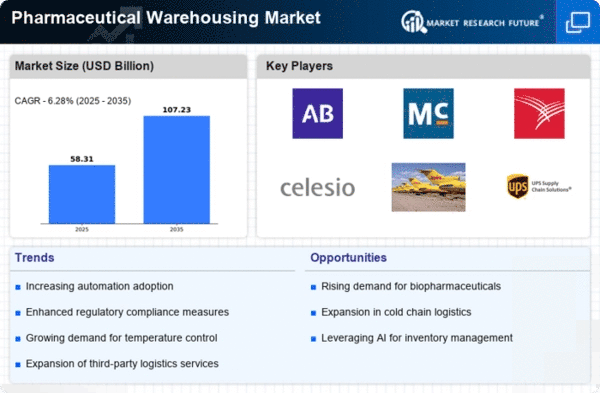
As per MRFR analysis, the Pharmaceutical Warehousing Market was estimated at 54.86 USD Billion in 2024. The Pharmaceutical Warehousing industry is projected to grow from 58.31 USD Billion in 2025 to 107.23 USD Billion by 2035, exhibiting a compound annual growth rate (CAGR) of 6.28 during the forecast period 2025 - 2035.

Key Market Trends & Highlights

The Pharmaceutical Warehousing Market is experiencing robust growth driven by technological advancements and increasing regulatory compliance.

  • North America remains the largest market for pharmaceutical warehousing, driven by a well-established healthcare infrastructure.
  • The Asia-Pacific region is emerging as the fastest-growing market, fueled by rapid urbanization and increasing healthcare investments.
  • Cold chain logistics dominate the market, while temperature-controlled storage is witnessing the fastest growth due to rising biopharmaceutical demand.
  • Key market drivers include the rising demand for biopharmaceuticals and the expansion of supply chain networks, which are reshaping warehousing strategies.

Market Size & Forecast

2024 Market Size 54.86 (USD Billion)
2035 Market Size 107.23 (USD Billion)
CAGR (2025 - 2035) 6.28%
Largest Regional Market Share in 2024 North America

Major Players

<p>AmerisourceBergen (US), McKesson (US), Cardinal Health (US), Celesio (DE), Kuehne + Nagel (CH), DHL Supply Chain (DE), UPS Supply Chain Solutions (US), XPO Logistics (US), Rhenus Logistics (DE)</p>

Market Trends

The Pharmaceutical Warehousing Market is currently experiencing a transformative phase, driven by the increasing complexity of supply chains and the growing demand for temperature-sensitive products. As pharmaceutical companies expand their portfolios to include biologics and specialty drugs, the need for sophisticated warehousing solutions becomes paramount. This market appears to be evolving towards more automated and technologically advanced facilities, which could enhance efficiency and reduce operational costs. Furthermore, regulatory compliance remains a critical factor, as companies must adhere to stringent guidelines regarding storage conditions and inventory management. In addition, the rise of e-commerce in the pharmaceutical sector is reshaping traditional warehousing practices. Companies are likely to invest in logistics capabilities that support direct-to-consumer models, thereby necessitating a reevaluation of distribution strategies. The integration of advanced technologies, such as artificial intelligence and the Internet of Things, may facilitate real-time tracking and monitoring of inventory, ensuring that products are stored and delivered under optimal conditions. Overall, the Pharmaceutical Warehousing Market is poised for growth, with innovations and strategic adaptations likely to define its future landscape.

Technological Advancements

The integration of advanced technologies in the Pharmaceutical Warehousing Market is becoming increasingly prevalent. Automation, robotics, and artificial intelligence are being adopted to streamline operations, enhance accuracy, and improve inventory management. These innovations may lead to reduced labor costs and increased efficiency, allowing companies to respond more swiftly to market demands.

Regulatory Compliance

Regulatory compliance continues to be a driving force in the Pharmaceutical Warehousing Market. Companies are required to adhere to strict guidelines regarding the storage and handling of pharmaceutical products. This focus on compliance may lead to increased investments in infrastructure and training, ensuring that facilities meet the necessary standards for safety and quality.

E-commerce Growth

The expansion of e-commerce within the pharmaceutical sector is reshaping warehousing strategies. As more consumers seek direct access to medications and health products online, companies are likely to adapt their logistics and distribution models. This shift may necessitate the development of specialized warehousing solutions that cater to the unique needs of online sales.

Pharmaceutical Warehousing Market Market Drivers

Market Growth Projections

The Global Pharmaceutical Warehousing Market Industry is poised for substantial growth, with projections indicating a market value of 54.9 USD Billion in 2024 and an expected increase to 107.3 USD Billion by 2035. This growth trajectory suggests a compound annual growth rate (CAGR) of 6.28% from 2025 to 2035. Such figures highlight the increasing importance of efficient warehousing solutions in the pharmaceutical sector, driven by factors such as technological advancements, regulatory compliance, and the expansion of e-commerce. Companies are likely to focus on enhancing their warehousing capabilities to capitalize on this growth, ensuring they remain competitive in a rapidly evolving market.

Growing Demand for Biopharmaceuticals

The increasing prevalence of chronic diseases and the rising demand for biopharmaceuticals are driving the Global Pharmaceutical Warehousing Market Industry. As biopharmaceuticals often require specialized storage conditions, the need for advanced warehousing solutions is paramount. In 2024, the market is valued at approximately 54.9 USD Billion, reflecting the industry's adaptation to these complex storage requirements. Furthermore, the biopharmaceutical sector is projected to expand significantly, necessitating enhanced warehousing capabilities to manage the distribution of these products effectively. This trend indicates a robust growth trajectory for the warehousing sector, as it aligns with the evolving landscape of pharmaceutical manufacturing.

Technological Advancements in Warehousing

Technological innovations, such as automation and real-time tracking systems, are transforming the Global Pharmaceutical Warehousing Market Industry. These advancements enhance operational efficiency, reduce human error, and ensure compliance with stringent regulatory standards. For instance, the integration of Internet of Things (IoT) devices allows for continuous monitoring of storage conditions, which is critical for temperature-sensitive pharmaceuticals. As the industry embraces these technologies, it is likely to see a surge in demand, contributing to the market's growth. The anticipated CAGR of 6.28% from 2025 to 2035 underscores the potential for technological enhancements to reshape warehousing practices in the pharmaceutical sector.

Expansion of E-commerce in Pharmaceuticals

The rise of e-commerce in the pharmaceutical sector is significantly influencing the Global Pharmaceutical Warehousing Market Industry. As consumers increasingly turn to online platforms for medication purchases, the demand for efficient warehousing solutions that can support rapid order fulfillment is growing. This trend necessitates the establishment of strategically located distribution centers to ensure timely delivery. The market's projected growth to 107.3 USD Billion by 2035 highlights the importance of adapting warehousing strategies to meet the evolving needs of e-commerce. Companies that invest in modern warehousing capabilities are likely to gain a competitive edge in this expanding market, as they can better serve the needs of online consumers.

Regulatory Compliance and Quality Assurance

Regulatory compliance remains a crucial driver for the Global Pharmaceutical Warehousing Market Industry. Stringent regulations imposed by health authorities necessitate that warehousing facilities adhere to high standards of quality assurance. This compliance ensures the safety and efficacy of pharmaceutical products throughout the supply chain. Facilities must implement rigorous protocols for inventory management, temperature control, and documentation to meet these requirements. As the industry continues to evolve, the emphasis on compliance is expected to intensify, thereby driving investment in advanced warehousing solutions. This focus on quality assurance is likely to contribute to the overall growth of the market, as companies seek to mitigate risks associated with non-compliance.

Globalization of Pharmaceutical Supply Chains

The globalization of pharmaceutical supply chains is a significant driver of the Global Pharmaceutical Warehousing Market Industry. As companies expand their operations internationally, the need for efficient warehousing solutions that can accommodate diverse regulatory environments becomes critical. This globalization trend necessitates the establishment of warehouses that can manage the complexities of international logistics, including customs regulations and varying storage requirements. The anticipated growth of the market, alongside the increasing interconnectedness of global supply chains, suggests that companies will need to invest in adaptable warehousing strategies. This investment is essential for ensuring the seamless distribution of pharmaceutical products across borders.

Market Segment Insights

By Application: Cold Chain Logistics (Largest) vs. Temperature Controlled Storage (Fastest-Growing)

<p>In the Pharmaceutical Warehousing Market, the application segment is prominently characterized by Cold Chain Logistics, which holds the largest market share due to its critical role in maintaining the quality of temperature-sensitive pharmaceuticals. This segment is responsible for ensuring that products like vaccines and biologics are stored and transported within strict temperature ranges, which has bolstered its dominance in the market. Following closely is Temperature Controlled Storage, which, while smaller in share, is rapidly gaining traction as more pharmaceuticals require specialized storage solutions beyond traditional cold chain methods. The increasing complexity of drug formulations is shifting the focus towards advanced storage technologies.</p>

<p>Inventory Management (Dominant) vs. Distribution Services (Emerging)</p>

<p>Inventory Management serves as a dominant force within the Pharmaceutical Warehousing Market, driven by enhanced efficiency and precision in handling vast amounts of pharmaceutical products. Its importance lies in the ability to minimize waste and ensure timely replenishment of stock, especially with the growing range of medications needing stringent handling and storage. Conversely, Distribution Services are emerging as a crucial component of this market, reflecting a shift towards holistic, integrated solutions that encompass logistics and customer delivery. This segment is gaining ground as companies seek to optimize their supply chains, focusing on faster turnaround times and improved service levels in the delivery of pharmaceutical products.</p>

By End Use: Pharmaceutical Manufacturers (Largest) vs. Retail Pharmacies (Fastest-Growing)

<p>The Pharmaceutical Warehousing Market showcases a diverse distribution among its end-use segments. Pharmaceutical Manufacturers hold the largest market share, catering to the storage needs of various drug formulations and maintaining conditions for shipment. In contrast, Retail Pharmacies, while smaller in share, are rapidly growing due to increased consumer demand and the rise of e-commerce, necessitating improved warehousing strategies to ensure timely delivery of pharmaceuticals. Growth trends in the end-use segment of pharmaceutical warehousing show a significant shift towards Retail Pharmacies, which are adapting to changing consumer behaviors and preferences. The increasing trend of online prescriptions and home deliveries has pushed the need for efficient warehousing solutions. Moreover, Pharmaceutical Manufacturers continue to invest in advanced storage technologies, ensuring compliance with regulatory standards and enhancing overall supply chain efficiency.</p>

<p>Pharmaceutical Manufacturers (Dominant) vs. Contract Research Organizations (Emerging)</p>

<p>Pharmaceutical Manufacturers are the dominant players in the Pharmaceutical Warehousing Market, characterized by their extensive networks that support large-scale production and distribution of drugs. Their warehouses are often equipped with advanced climate control systems, ensuring that sensitive products are stored under optimal conditions. In contrast, Contract Research Organizations (CROs) are emerging as key players, offering specialized warehousing solutions tailored to the needs of clinical trials and research. Their warehouses prioritize flexibility and adaptability, catering to short-term studies and accommodating a variety of substances while meeting stringent regulatory requirements. This dynamic showcases a significant evolution in warehousing strategies, focusing on innovation and responsiveness to industry demands.</p>

By Storage Type: Refrigerated Storage (Largest) vs. Frozen Storage (Fastest-Growing)

<p>The Pharmaceutical Warehousing market showcases a diverse range of storage types, with refrigerated storage leading the market due to its critical role in preserving temperature-sensitive pharmaceuticals. Ambient storage follows closely, catering to non-perishable items, while frozen storage demonstrates significant potential as it serves a growing number of biologics and specialty drugs that require lower temperatures. Controlled environment storage plays a crucial role in maintaining strict humidity and temperature control, appealing particularly to high-value therapeutics and advanced biopharmaceuticals.</p>

<p>Refrigerated Storage (Dominant) vs. Frozen Storage (Emerging)</p>

<p>Refrigerated storage represents the dominant force in the pharmaceutical warehousing market, essential for maintaining the integrity of temperature-sensitive medications, such as vaccines and insulin. This storage type is characterized by stringent temperature controls and robust monitoring systems to ensure compliance with regulatory standards. On the other hand, frozen storage is emerging rapidly, driven by the increasing demand for biologics and new therapies that require deep cooling. This segment is witnessing significant innovations, including advanced insulation technologies and energy-efficient solutions, catering to the unique storage needs of pharmaceuticals while addressing growth in specialty pharmaceuticals.</p>

By Service Type: Warehousing Services (Largest) vs. Transportation Services (Fastest-Growing)

<p>In the Pharmaceutical Warehousing Market, service types are segmented primarily into Warehousing Services, Transportation Services, Value-Added Services, and Inventory Management Services. Among these segments, Warehousing Services commands the largest share, providing essential storage solutions for pharmaceutical products. This dominance stems from the necessity of maintaining stringent storage conditions and compliance with regulatory standards, which are critical for the safe storage of drugs and medical supplies. Transportation Services, while being the fastest-growing segment, highlights the increasing need for efficient logistics and supply chain management in the pharmaceutical sector, driven by the demand for timely delivery of products to healthcare facilities and pharmacies.</p>

<p>Warehousing Services: Dominant vs. Transportation Services: Emerging</p>

<p>Warehousing Services in the pharmaceutical sector plays a crucial role in ensuring that drugs are stored under optimal conditions, maintaining their efficacy and compliance with health regulations. This segment typically includes temperature-controlled storage and specialized facilities that cater to various types of pharmaceuticals, including biologics and controlled substances. Conversely, Transportation Services is emerging as a key component, expanding rapidly due to advancements in logistics technology and an increasing emphasis on supply chain efficiency. The growth in e-commerce and direct-to-consumer models has necessitated better transport solutions, making this segment vital for timely product delivery and overall market responsiveness.</p>

Get more detailed insights about Pharmaceutical Warehousing Market Research Report - Forecast to 2035

Regional Insights

North America : Market Leader in Warehousing

North America is poised to maintain its leadership in the pharmaceutical warehousing market, holding a significant market share of 27.43% as of 2024. The region's growth is driven by increasing demand for efficient supply chain solutions, stringent regulatory requirements, and advancements in technology. The rise in e-commerce and the need for temperature-controlled logistics further fuel this demand, ensuring compliance with FDA regulations and enhancing operational efficiency. The competitive landscape in North America is robust, featuring key players such as AmerisourceBergen, McKesson, and Cardinal Health. These companies leverage advanced logistics technologies and extensive distribution networks to meet the growing needs of the pharmaceutical sector. The presence of established firms and continuous investments in infrastructure solidify North America's position as a critical hub for pharmaceutical warehousing, catering to both domestic and international markets.

Europe : Emerging Market Dynamics

Europe's pharmaceutical warehousing market is evolving, with a market size of €15.0 million. The region benefits from a strong regulatory framework and increasing demand for pharmaceutical products, driven by an aging population and rising healthcare expenditures. The European Medicines Agency (EMA) plays a crucial role in ensuring compliance and safety, which propels the growth of warehousing solutions tailored for pharmaceuticals, including temperature-sensitive products. Leading countries such as Germany, France, and the UK are at the forefront of this market, with significant investments in logistics infrastructure. Key players like Celesio and DHL Supply Chain are enhancing their capabilities to meet the growing demand. The competitive landscape is characterized by innovation and strategic partnerships, ensuring that Europe remains a vital player in The Pharmaceutical Warehousing.

Asia-Pacific : Rapid Growth and Expansion

The Asia-Pacific region is witnessing rapid growth in the pharmaceutical warehousing market, with a market size of $10.0 million. This growth is driven by increasing healthcare investments, a rising population, and the expansion of pharmaceutical manufacturing. Regulatory bodies are enhancing compliance measures, which in turn boosts the demand for specialized warehousing solutions that ensure product integrity and safety during transportation and storage. Countries like China, India, and Japan are leading the charge, with significant contributions from local and international players. The competitive landscape includes firms such as Kuehne + Nagel and UPS Supply Chain Solutions, which are investing in advanced technologies and infrastructure. This dynamic environment is fostering innovation and efficiency, positioning Asia-Pacific as a key player in The Pharmaceutical Warehousing.

Middle East and Africa : Emerging Opportunities Ahead

The Middle East and Africa (MEA) region is gradually emerging in the pharmaceutical warehousing market, with a market size of $2.43 million. The growth is primarily driven by increasing healthcare needs, government initiatives to improve healthcare infrastructure, and rising investments in the pharmaceutical sector. Regulatory frameworks are evolving, which encourages the establishment of modern warehousing facilities to meet international standards and enhance supply chain efficiency. Countries like South Africa and the UAE are leading the market, with a growing presence of key players such as Rhenus Logistics. The competitive landscape is characterized by a mix of local and international firms striving to capture market share. As the region continues to develop its healthcare capabilities, the demand for efficient pharmaceutical warehousing solutions is expected to rise significantly, presenting numerous opportunities for growth.

Key Players and Competitive Insights

The Pharmaceutical Warehousing Market is characterized by a dynamic competitive landscape, driven by the increasing demand for efficient logistics solutions and the growing complexity of pharmaceutical supply chains. Key players such as AmerisourceBergen (US), McKesson (US), and Cardinal Health (US) are strategically positioned to leverage their extensive networks and technological capabilities. AmerisourceBergen (US) focuses on enhancing its distribution efficiency through advanced data analytics and automation, while McKesson (US) emphasizes strategic partnerships to expand its service offerings. Cardinal Health (US) is investing in digital transformation initiatives to streamline operations and improve customer engagement. Collectively, these strategies contribute to a competitive environment that prioritizes innovation and operational excellence.

In terms of business tactics, companies are increasingly localizing their operations to better serve regional markets and optimize supply chains. The market appears moderately fragmented, with a mix of large multinational corporations and smaller regional players. The influence of key players is substantial, as they set industry standards and drive advancements in warehousing technologies and practices.

In November 2025, Kuehne + Nagel (CH) announced a strategic partnership with a leading biotechnology firm to enhance its cold chain logistics capabilities. This collaboration is expected to improve the handling of temperature-sensitive products, which is critical in the pharmaceutical sector. The strategic importance of this move lies in Kuehne + Nagel's commitment to maintaining high standards of product integrity, thereby reinforcing its competitive position in the market.

In October 2025, DHL Supply Chain (DE) unveiled a new automated warehousing facility designed specifically for pharmaceutical products. This facility incorporates cutting-edge robotics and AI-driven inventory management systems, which are anticipated to significantly reduce operational costs and improve order accuracy. The establishment of this facility underscores DHL's focus on innovation and efficiency, positioning it as a leader in the logistics of pharmaceutical warehousing.

In September 2025, UPS Supply Chain Solutions (US) expanded its global footprint by acquiring a regional logistics provider specializing in healthcare. This acquisition is likely to enhance UPS's service capabilities and provide a more integrated approach to pharmaceutical logistics. The strategic rationale behind this move is to capitalize on the growing demand for comprehensive supply chain solutions in the healthcare sector, thereby strengthening UPS's market presence.

As of December 2025, current competitive trends in the Pharmaceutical Warehousing Market are heavily influenced by digitalization, sustainability initiatives, and the integration of AI technologies. Strategic alliances are increasingly shaping the landscape, as companies seek to enhance their service offerings and operational efficiencies. Looking ahead, competitive differentiation is expected to evolve from traditional price-based competition to a focus on innovation, technological advancements, and supply chain reliability. This shift indicates a growing recognition of the importance of quality and service in maintaining a competitive edge.

Key Companies in the Pharmaceutical Warehousing Market include

Industry Developments

March 2023:

Cargo-partner (Austria) launched the Pharma Competence Center in Shanghai, China, to meet the demand of customers in the increasingly important consumer market in China for pharmaceuticals and healthcare products.

September 2020:

DB Schenker (Germany) launched its largest warehousing facility in Gurugram, India, in order to strengthen its footprint in India. This warehouse provides pharmaceutical services to meet the demands of customers.

Future Outlook

Pharmaceutical Warehousing Market Future Outlook

<p>The Pharmaceutical Warehousing Market is projected to grow at a 6.28% CAGR from 2024 to 2035, driven by technological advancements, regulatory compliance, and increasing demand for pharmaceuticals.</p>

New opportunities lie in:

  • <p>Implementation of automated inventory management systems</p>
  • <p>Expansion of temperature-controlled storage solutions</p>
  • <p>Development of integrated logistics platforms for real-time tracking</p>

<p>By 2035, the market is expected to achieve robust growth, positioning itself as a critical component of the pharmaceutical supply chain.</p>

Market Segmentation

Pharmaceutical Warehousing Market End Use Outlook

  • Pharmaceutical Manufacturers
  • Contract Research Organizations
  • Healthcare Providers
  • Retail Pharmacies

Pharmaceutical Warehousing Market Application Outlook

  • Cold Chain Logistics
  • Temperature Controlled Storage
  • Inventory Management
  • Distribution Services

Pharmaceutical Warehousing Market Service Type Outlook

  • Warehousing Services
  • Transportation Services
  • Value-Added Services
  • Inventory Management Services

Pharmaceutical Warehousing Market Storage Type Outlook

  • Ambient Storage
  • Refrigerated Storage
  • Frozen Storage
  • Controlled Environment Storage

Report Scope

MARKET SIZE 202454.86(USD Billion)
MARKET SIZE 202558.31(USD Billion)
MARKET SIZE 2035107.23(USD Billion)
COMPOUND ANNUAL GROWTH RATE (CAGR)6.28% (2024 - 2035)
REPORT COVERAGERevenue Forecast, Competitive Landscape, Growth Factors, and Trends
BASE YEAR2024
Market Forecast Period2025 - 2035
Historical Data2019 - 2024
Market Forecast UnitsUSD Billion
Key Companies ProfiledAmerisourceBergen (US), McKesson (US), Cardinal Health (US), Celesio (DE), Kuehne + Nagel (CH), DHL Supply Chain (DE), UPS Supply Chain Solutions (US), XPO Logistics (US), Rhenus Logistics (DE)
Segments CoveredApplication, End Use, Storage Type, Service Type
Key Market OpportunitiesIntegration of advanced automation and temperature control technologies enhances efficiency in the Pharmaceutical Warehousing Market.
Key Market DynamicsRising demand for temperature-controlled storage solutions drives innovation in pharmaceutical warehousing and supply chain efficiency.
Countries CoveredNorth America, Europe, APAC, South America, MEA

FAQs

How much is the Pharmaceutical Warehousing Market?

Pharmaceutical Warehousing Market is expected to grow with a CAGR of 6.28% in the period 2025-2035

How big is the US pharmaceutical warehousing market?

The US held the largest market with a 65-75% share of the North America market for pharmaceutical warehousing market in 2022.

What is the growth rate of the Pharmaceutical Warehousing Market?

Pharmaceutical Warehousing Market is projected to grow at a CAGR of 6.28% during the forecast period, 2025-2035

Which region held the largest market share in 2024 in the Pharmaceutical Warehousing Market?

The North America region market held the largest market share in 2024 in the Pharmaceutical Warehousing Market.

Who are the key players in the Pharmaceutical Warehousing Market?

The key players include DB Schenker (Germany), Thermo Fisher Scientific, Inc. (US), UPS (US), SGA S.A. (Switzerland), Cargo-Partner (Austria), FedEx (US), CEVA Logistics (France), DHL (Germany), Agility (Kuwait), Kuehne + Nagel (Switzerland) and others.

Which service type led the Pharmaceutical Warehousing Market?

The storage service type segment led the Pharmaceutical Warehousing Market in 2022 with a market share of approximately 20-25%.

  1. SECTION I: EXECUTIVE SUMMARY AND KEY HIGHLIGHTS
    1. | 1.1 EXECUTIVE SUMMARY
  2. SECTION II: SCOPING, METHODOLOGY AND MARKET STRUCTURE
    1. | 2.1 MARKET INTRODUCTION
    2. | 2.2 RESEARCH METHODOLOGY
  3. SECTION III: QUALITATIVE ANALYSIS
    1. | 3.1 MARKET DYNAMICS
    2. | 3.2 MARKET FACTOR ANALYSIS
  4. SECTION IV: QUANTITATIVE ANALYSIS
    1. | 4.1 Packaging & Transport, BY Application (USD Billion)
    2. | 4.2 Packaging & Transport, BY End Use (USD Billion)
    3. | 4.3 Packaging & Transport, BY Storage Type (USD Billion)
    4. | 4.4 Packaging & Transport, BY Service Type (USD Billion)
    5. | 4.5 Packaging & Transport, BY Region (USD Billion)
  5. SECTION V: COMPETITIVE ANALYSIS
    1. | 5.1 Competitive Landscape
    2. | 5.2 Company Profiles
    3. | 5.3 Appendix

Pharmaceutical Warehousing Market Segmentation

Market Segmentation Overview

  • Detailed segmentation data will be available in the full report
  • Comprehensive analysis by multiple parameters
  • Regional and country-level breakdowns
  • Market size forecasts by segment
Infographic

Free Sample Request

Kindly complete the form below to receive a free sample of this Report

Get Free Sample

Customer Strories

Compare Licence

×
Features License Type
Single User Multiuser License Enterprise User
Price $4,950 $5,950 $7,250
Maximum User Access Limit 1 User Upto 10 Users Unrestricted Access Throughout the Organization
Free Customization
Direct Access to Analyst
Deliverable Format
Platform Access
Discount on Next Purchase 10% 15% 15%
Printable Versions