Request Free Sample ×

Kindly complete the form below to receive a free sample of this Report

* Please use a valid business email

Leading companies partner with us for data-driven Insights

clients tt-cursor
Hero Background
English
Chinese
French
Japanese
Korean
German
Spanish

Pharmaceutical Filtration Devices Market Share

ID: MRFR/LS/1799-HCR
128 Pages
Satyendra Maurya
Last Updated: April 15, 2026

Pharmaceutical Filtration Devices Market Research Report By Application (Biopharmaceutical Filtration, Sterile Filtration, Protein Purification, Cell Culture Filtration), By Product Type (Filters, Filtration Devices, Filtration Media), By End Use (Pharmaceutical Companies, Biotechnology Companies, Contract Manufacturing Organizations, Academic Research Institutions), By Filter Type (Microfiltration, Ultrafiltration, Nanofiltration, Reverse Osmosis) and By Regional (North America, Europe, South America, Asia Pacific, Middle East and Africa) - Growth & Industry Forecast 2025 To 2035

Share:
Download PDF ×

We do not share your information with anyone. However, we may send you emails based on your report interest from time to time. You may contact us at any time to opt-out.

Pharmaceutical Filtration Devices Market Infographic
Purchase Options

Market Share

Pharmaceutical Filtration Devices Market Share Analysis

Companies need strategic market share positioning to succeed in the pharmaceutical filtration equipment industry, which is essential to pharmaceutical manufacture. The industry needs strong strategies to stay competitive and succeed. Due to rapid technology advances and changing regulatory requirements. Many of the biggest pharmaceutical filtration device firms prioritize filtration technology development. Research and development are underway to improve pharmaceutical product quality, processing speed, and filtering efficiency. Because they prioritize technological innovation, pharmaceutical businesses can fulfill the industry's changing needs with cutting-edge solutions. Strategic market leaders understand the advantages of a varied product line. Companies purposely provide a variety of filtering systems for various pharmaceutical manufacturing phases. This avoids concentrating on one filtering device type. This method guarantees a wide choice of options to meet pharmaceutical companies' numerous demands. Customizing filtration devices for pharmaceutical applications is a key market positioning strategy. Businesses provide several configurations, materials, and filter sizes to satisfy pharmaceutical manufacturing needs. People are better and more loyal with this way because it works with what pharmaceutical firms want. It is very important for people who work in pharmacies to follow the rules set by lawmakers. The people who work in the filtration device market put following the law at the top of their list of goals to make sure their products meet quality and safety standards. Because of this dedication, drug companies trust the group to make great medicines. Partnerships with pharmaceutical companies are essential for market share positioning. These strategic alliances help filtering equipment makers understand pharmaceutical manufacturers' demands and concerns. Collaboration often leads to customized solutions and smooth integration of filtering equipment into pharmaceutical drug manufacturing. Since the pharmaceutical sector is worldwide, successful companies purposefully develop their markets abroad. Companies expanding into overseas markets face several regulatory and manufacturing challenges. In addition, they expand their consumer base. Firms actively serve select areas to become global pharmaceutical filtration leaders. One strategic concern for industry leaders is the transition toward single-use technologies. Single-use filtration systems reduce pollution, operational costs, and production flexibility. Companies that prioritize single-use filtration device research, development, and marketing may stay competitive and keep up with industry advances. Strategic positioning to establish thought leadership in the pharmaceutical filtration device industry is working. Famous companies demonstrate their expertise via educational initiatives, training programs, and industry conferences. Due to their contributions to filtering technology knowledge and regulatory compliance, these enterprises improve their reputation and market perception. Effective marketing is needed to have a strong brand presence for market share assessment. Businesses must engage in persuasive and clear marketing to emphasize their filtration systems' unique features and advantages. To dominate the market, you need to build brand recognition and link the firm to innovation, customization, dependability, and rules.


Author
Author Profile
Satyendra Maurya
Research Analyst

An accomplished research analyst with high proficiency in market forecasting, data visualization, competitive benchmarking, and others. He holds a pronounced track record in research and consulting projects for sectors such as life sciences, medical devices, and healthcare IT. His capabilities in qualitative and quantitative analysis have resulted in positive client outcomes. Working on niche market trends, opportunities, sales, and forecasted value is part of his skill set.

Leave a Comment

FAQs

What is the projected market valuation of the Pharmaceutical Filtration Devices Market by 2035?

<p>The market is projected to reach a valuation of 12.13 USD Billion by 2035.</p>

What was the market valuation of the Pharmaceutical Filtration Devices Market in 2024?

<p>In 2024, the market valuation was 6.411 USD Billion.</p>

What is the expected CAGR for the Pharmaceutical Filtration Devices Market during the forecast period 2025 - 2035?

<p>The expected CAGR for the market during this period is 5.97%.</p>

Which application segment is anticipated to grow the most by 2035?

<p>The Biopharmaceutical Filtration segment is expected to grow from 2.5 USD Billion in 2024 to 4.5 USD Billion by 2035.</p>

What are the key product types in the Pharmaceutical Filtration Devices Market?

<p>Key product types include Filters, Filtration Devices, and Filtration Media, with Filters projected to grow from 2.5 USD Billion to 4.5 USD Billion by 2035.</p>

Which end-use segment is likely to see the highest growth by 2035?

<p>The Pharmaceutical Companies segment is projected to increase from 2.5 USD Billion in 2024 to 4.8 USD Billion by 2035.</p>

What filter types are included in the Pharmaceutical Filtration Devices Market?

<p>The market includes Microfiltration, Ultrafiltration, Nanofiltration, and Reverse Osmosis, with Microfiltration expected to grow from 2.0 USD Billion to 4.0 USD Billion by 2035.</p>

Who are the leading companies in the Pharmaceutical Filtration Devices Market?

<p>Key players include Merck KGaA, Pall Corporation, Thermo Fisher Scientific Inc., and Sartorius AG.</p>

What is the growth potential of the Filtration Media segment by 2035?

<p>The Filtration Media segment is expected to grow from 1.911 USD Billion in 2024 to 3.63 USD Billion by 2035.</p>

How do Contract Manufacturing Organizations contribute to the market?

<p>Contract Manufacturing Organizations are projected to grow from 1.0 USD Billion in 2024 to 2.2 USD Billion by 2035, indicating their increasing role in the market.</p>

Market Summary

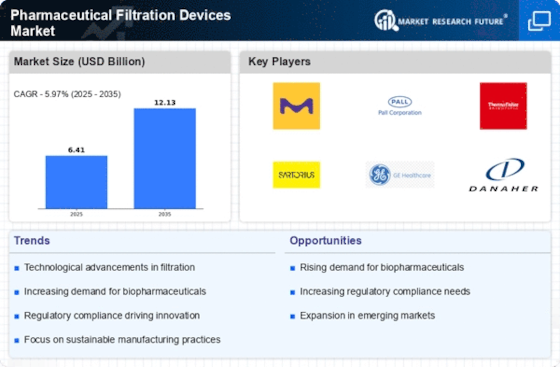
As per Market Research Future analysis, the Pharmaceutical Filtration Devices Market was estimated at 6.411 USD Billion in 2024. The Pharmaceutical Filtration Devices industry is projected to grow from 6.794 USD Billion in 2025 to 12.13 USD Billion by 2035, exhibiting a compound annual growth rate (CAGR) of 5.97% during the forecast period 2025 - 2035

Key Market Trends & Highlights

The Pharmaceutical Filtration Devices Market is experiencing robust growth driven by technological advancements and increasing regulatory compliance.

  • Technological advancements are enhancing the efficiency and effectiveness of filtration devices in the pharmaceutical sector. North America remains the largest market for pharmaceutical filtration devices, while Asia-Pacific is emerging as the fastest-growing region. The biopharmaceutical filtration segment dominates the market, whereas the sterile filtration segment is witnessing the most rapid growth. Key market drivers include the rising demand for sterile filtration and the expansion of pharmaceutical manufacturing facilities.

Market Size & Forecast

2024 Market Size 6.411 (USD Billion)
2035 Market Size 12.13 (USD Billion)
CAGR (2025 - 2035) 5.97%
Largest Regional Market Share in 2024 North America

Major Players

<a title="Merck KGaA" href="https://www.merckmillipore.com/IN/en/life-science-research/chromatography-sample-preparation/filtration-products/O3Wb.qB.CnUAAAFBw_plvzI_,nav?ReferrerURL=https%3A%2F%2Fwww.google.com%2F" target="_blank" rel="noopener">Merck KGaA</a> (DE), Pall Corporation (US), Thermo Fisher Scientific Inc. (US), Sartorius AG (DE), GE Healthcare (US), Danaher Corporation (US), Eaton Corporation (US), 3M Company (US), Filtration Group (US)

Market Trends

The Pharmaceutical Filtration Devices Market is currently experiencing a transformative phase, driven by advancements in technology and increasing regulatory demands. The need for high-quality filtration solutions is paramount, as pharmaceutical companies strive to ensure product safety and efficacy. Innovations in membrane technology and the development of single-use systems are reshaping the landscape, allowing for greater flexibility and efficiency in manufacturing processes. Furthermore, the growing emphasis on biopharmaceuticals and personalized medicine is likely to propel the demand for specialized filtration devices, as these products are essential for maintaining the integrity of sensitive biological materials. In addition, the market appears to be influenced by a rising awareness of contamination risks and the importance of sterility in drug production. As regulatory bodies continue to enforce stringent guidelines, pharmaceutical manufacturers are increasingly investing in advanced filtration technologies to comply with these standards. This trend suggests a robust future for the Pharmaceutical Filtration Devices Market, as companies seek to enhance their operational capabilities while ensuring the highest levels of quality control. Overall, the convergence of innovation, regulatory pressures, and market demands indicates a dynamic environment for stakeholders in this sector.

Technological Advancements

The Pharmaceutical Filtration Devices Market is witnessing rapid technological advancements, particularly in membrane filtration and automation. These innovations enhance the efficiency and effectiveness of filtration processes, allowing for improved product quality and reduced operational costs.

Regulatory Compliance

Increasing regulatory scrutiny is driving pharmaceutical companies to adopt advanced filtration solutions. Compliance with stringent guidelines necessitates the use of high-quality filtration devices, which are essential for ensuring product safety and efficacy.

Growth in Biopharmaceuticals

The rise of biopharmaceuticals is significantly impacting the Pharmaceutical Filtration Devices Market. As the demand for biologics increases, specialized filtration solutions are becoming crucial for maintaining the integrity of sensitive biological materials.

Pharmaceutical Filtration Devices Market Market Drivers

Stringent Regulatory Standards

The Pharmaceutical Filtration Devices Market is significantly influenced by stringent regulatory standards imposed by health authorities. Regulatory bodies, such as the FDA and EMA, enforce rigorous guidelines to ensure the safety and efficacy of pharmaceutical products. Compliance with these regulations necessitates the use of high-quality filtration devices that can effectively remove contaminants and ensure product integrity. As regulations become more stringent, pharmaceutical companies are compelled to invest in advanced filtration technologies to meet these requirements. This trend is expected to drive the market for filtration devices, as companies seek to avoid costly penalties and product recalls. Furthermore, the increasing emphasis on quality assurance and control in pharmaceutical manufacturing is likely to bolster the demand for reliable filtration solutions, thereby contributing to the overall growth of the market.

Rising Biopharmaceutical Production

The Pharmaceutical Filtration Devices Market is experiencing a surge in demand due to the rising production of biopharmaceuticals. As the biopharmaceutical sector expands, the need for effective filtration solutions becomes increasingly critical. Biopharmaceuticals, which include monoclonal antibodies and vaccines, require stringent filtration processes to ensure purity and safety. The market for biopharmaceuticals is expected to reach unprecedented levels, with projections indicating a growth rate of approximately 8% annually. This growth is likely to drive the demand for filtration devices that can handle complex biological materials. Furthermore, the increasing prevalence of chronic diseases necessitates the development of new biopharmaceutical products, further propelling the need for advanced filtration technologies. As a result, companies are focusing on enhancing their filtration capabilities to meet the specific requirements of biopharmaceutical production.

Technological Innovations in Filtration

Technological innovations play a pivotal role in shaping the Pharmaceutical Filtration Devices Market. The introduction of advanced filtration technologies, such as membrane filtration and depth filtration, has revolutionized the way pharmaceutical products are processed. These innovations not only improve the efficiency of filtration processes but also enhance the quality of the final products. For instance, the development of single-use filtration systems has gained traction, offering flexibility and reducing the risk of cross-contamination. Additionally, automation and digitalization in filtration processes are becoming increasingly prevalent, allowing for real-time monitoring and control. This trend is expected to continue, with market analysts predicting a significant increase in the adoption of smart filtration devices. As pharmaceutical companies seek to optimize their production processes, the demand for innovative filtration solutions is likely to rise, further driving market growth.

Increasing Demand for Sterile Filtration

The rising demand for sterile filtration in the Pharmaceutical Filtration Devices Market is driven by the need for high-quality and contamination-free products. As pharmaceutical companies strive to meet stringent regulatory standards, the adoption of advanced filtration technologies becomes paramount. The market for sterile filtration is projected to grow significantly, with estimates suggesting a compound annual growth rate of over 10% in the coming years. This growth is largely attributed to the increasing focus on patient safety and the efficacy of pharmaceutical products. Moreover, the shift towards biologics and biosimilars necessitates the use of sophisticated filtration devices to ensure product integrity. Consequently, manufacturers are investing in innovative filtration solutions to cater to this burgeoning demand, thereby enhancing their market presence.

Expansion of Pharmaceutical Manufacturing Facilities

The expansion of pharmaceutical manufacturing facilities is a key driver of the Pharmaceutical Filtration Devices Market. As companies seek to increase production capacity and meet the growing demand for pharmaceutical products, the establishment of new manufacturing plants is on the rise. This expansion often necessitates the implementation of advanced filtration systems to ensure compliance with quality standards. Market data indicates that the pharmaceutical manufacturing sector is projected to grow at a rate of approximately 6% annually, leading to increased investments in filtration technologies. Additionally, the trend towards outsourcing manufacturing processes to contract manufacturing organizations (CMOs) further amplifies the need for effective filtration solutions. As CMOs expand their capabilities, the demand for reliable and efficient filtration devices is likely to increase, thereby driving market growth.

Market Segment Insights

By Application: Biopharmaceutical Filtration (Largest) vs. Sterile Filtration (Fastest-Growing)

The Pharmaceutical Filtration Devices Market is segmented into various applications, with biopharmaceutical filtration dominating the landscape. This segment holds the largest market share, driven by the increasing demand for biopharmaceutical products and the need for efficient filtration processes. <a href="https://www.marketresearchfuture.com/reports/sterile-filtration-market-42210">Sterile filtration</a>, on the other hand, is witnessing rapid growth, fueled by a heightened focus on contamination prevention in drug formulations and the rise in biologics production. As the biopharmaceutical filtration segment continues to thrive, it benefits from technological advancements and a growing emphasis on high-quality production processes. The demand for sterile filtration is also increasing due to stringent regulatory requirements and the growing preference for sterile injectable drugs. These trends indicate a robust growth trajectory, with both segments poised for continued expansion in the coming years.

Biopharmaceutical Filtration (Dominant) vs. Cell Culture Filtration (Emerging)

Biopharmaceutical filtration is characterized by its pivotal role in the development and production of biopharmaceuticals, ensuring the purification of biologically derived drugs while minimizing contaminants. This segment is well-established, supported by the rising prevalence of <a title="chronic diseases" href="https://www.marketresearchfuture.com/reports/chronic-disease-management-market-981" target="_blank" rel="noopener">chronic diseases</a> and the increase in biologics manufacturing. In contrast, cell culture filtration is emerging as a significant player, driven by advancements in bioprocessing techniques and the growing demand for monoclonal antibodies. Cell culture filtration techniques are increasingly adopted to maintain sterility and performance in bioprocesses, offering innovative solutions for effective cell harvesting and media purification, thus enhancing overall yield. Together, these segments represent the dynamic nature of the Pharmaceutical Filtration Devices Market, catering to evolving healthcare needs.

By Product Type: Filters (Largest) vs. Filtration Media (Fastest-Growing)

The Pharmaceutical Filtration Devices Market is distinctly characterized by its diverse product types, primarily including Filters, Filtration Devices, and Filtration Media. Filters represent the largest share within this segment, being essential for ensuring the purity and safety of pharmaceutical products. Filtration Media, while smaller in market share, is rapidly gaining traction due to innovations that enhance filtration efficiency and effectiveness. The segmentation illustrates a well-defined distribution where Filters dominate, followed closely by Filtration Devices and Filtration Media, reflecting their core relevance in pharmaceutical processes.

Filters (Dominant) vs. Filtration Devices (Emerging)

Filters play a pivotal role in the Pharmaceutical Filtration Devices Market, characterized by their ability to provide high-level purification and contamination control, essential in biopharmaceutical processes. These devices not only meet regulatory requirements but also enhance product quality, making them the dominant choice among manufacturers. Conversely, Filtration Devices are emerging as significant players, driven by advancements in technology and increased demand for efficiency in pharmaceutical manufacturing. Their versatility and ability to integrate with various processes signify their growing importance in the market, complementing the established dominance of Filters.

By End Use: Pharmaceutical Companies (Largest) vs. Biotechnology Companies (Fastest-Growing)

The Pharmaceutical Filtration Devices Market exhibits a diverse distribution among its key segment values. Pharmaceutical companies account for the largest share, driven by their substantial production capacities and regulatory requirements that mandate high-quality filtration processes. Biotechnology companies are seeing an increase in adoption as they emphasize innovative drug development; they currently represent a smaller but rapidly growing segment of the market. Contract Manufacturing Organizations (CMOs) and Academic Research Institutions also contribute to the market, albeit at a lesser scale, focusing on custom solutions and experimental research, respectively.

Pharmaceutical Companies (Dominant) vs. Biotechnology Companies (Emerging)

Pharmaceutical companies dominate the Pharmaceutical Filtration Devices Market due to their established infrastructures and extensive resources. They invest heavily in filtration technology to ensure compliance with stringent regulations and to enhance product purity. Conversely, biotechnology companies are emerging as significant players, driven by their focus on developing biologics and biosimilars that require specialized filtration processes. This segment is characterized by rapid innovation and adaptability, making them a key driver of growth in the market. With the increasing demand for biopharmaceuticals, biotechnology companies are poised to increase their market share, fostering competition and innovation within the industry.

By Filter Type: Microfiltration (Largest) vs. Ultrafiltration (Fastest-Growing)

The Pharmaceutical Filtration Devices Market showcases a diverse distribution of filter types, with microfiltration holding the largest share. This segment is predominantly utilized for its efficiency in clarifying large volumes of liquids, which is crucial in pharmaceutical manufacturing. Ultrafiltration, while smaller in share compared to microfiltration, has emerged as a significant player due to its advanced capabilities in separating proteins and larger molecules, essential in biopharmaceutical applications. The growth trends in this segment are propelled by technological advancements and rising demand for high-purity pharmaceutical products. The need for stringent quality control and regulatory compliance is driving the adoption of ultrafiltration systems among manufacturers. Microfiltration continues to thrive due to its versatility, while ultrafiltration is rapidly gaining traction in specialized applications, aligning with the industry's increasing focus on biologics and personalized medicine.

Microfiltration (Dominant) vs. Reverse Osmosis (Emerging)

Microfiltration has firmly established itself as the dominant filter type in the Pharmaceutical Filtration Devices Market, renowned for its ability to efficiently remove bacteria and particulates from solutions. This filtering method is extensively used in various stages of drug development and production, owing to its cost-effectiveness and reliability. In contrast, reverse osmosis is emerging as a key player, particularly notable for its role in concentrating and purifying water and other liquids used in pharmaceutical processes. As regulations around water quality grow more stringent, the demand for reverse osmosis systems is surging, reflecting a shift towards technology that ensures higher purity levels. Both microfiltration and reverse osmosis cater to distinct needs within the pharmaceutical sector, highlighting their complementary roles in ensuring product quality and safety.

Get more detailed insights about Pharmaceutical Filtration Devices Market Research Report - Forecast To 2035

Regional Insights

The Pharmaceutical Filtration Devices Market exhibits substantial growth across various regional segments, with North America holding a majority share, valued at 2.75 USD Billion in 2023, and projected to reach 4.6 USD Billion by 2032. This dominance can be attributed to the advanced healthcare infrastructure and significant investments in biopharmaceuticals.

Europe follows with a valuation of 1.8 USD Billion in 2023, rising to 2.9 USD Billion, driven by stringent regulatory requirements and the rising need for filtration solutions in drug development.The APAC region, at 1.25 USD Billion in 2023 and expected to grow to 2.0 USD Billion, showcases significant opportunities due to increasing healthcare spending and a growing pharmaceutical industry. Meanwhile, South America and MEA are smaller markets, valued at 0.75 USD Billion and 0.5 USD Billion, respectively, in 2023, highlighting emerging opportunities yet facing challenges like economic fluctuations and regulatory hurdles.

Overall, the Pharmaceutical Filtration Devices Market segmentation demonstrates clear trends showing regional variations that reflect broader industry growth dynamics, showcasing each area's unique challenges and opportunities within the pharmaceutical landscape.

Source Primary Research, Secondary Research, Market Research Future Database and Analyst Review

Key Players and Competitive Insights

The Pharmaceutical Filtration Devices Market represents a critical segment within the healthcare and pharmaceutical industries, focusing on the purification and sterilization of products to ensure their safety and efficacy. In an era where regulatory compliance and patient safety are paramount, the demand for advanced filtration solutions has soared. The market is characterized by a diverse array of products, including filters for air, water, and other media, tailored specifically for the pharmaceutical sector. Competitive dynamics are shaped by factors such as technological advancements, the increasing prevalence of chronic diseases, and the focus on biopharmaceuticals, leading to innovative filtration solutions aimed at meeting stringent regulatory standards. Players in this market are continually investing in research and development to enhance product performance, meet the evolving needs of their clients, and maintain a competitive edge.Rephine Limited stands out in the Pharmaceutical Filtration Devices Market with its robust portfolio of filtration solutions designed to meet specific pharmaceutical needs. The company excels in providing high-quality filters that help ensure product safety throughout the manufacturing process.Rephine Limited boasts a strong market presence, leveraging its advanced technological capabilities and commitment to customer service, which has solidified its reputation among industry stakeholders. The company's emphasis on compliance with global regulatory standards further enhances its appeal, positioning it as a trusted partner for pharmaceutical manufacturers.Through continuous innovation and a customer-centric approach, Rephine Limited effectively addresses the challenges faced by the industry, ensuring that its filtration devices remain at the forefront of market trends.Filtration Group is another key player in the Pharmaceutical Filtration Devices Market, recognized for its wide range of filtration products that cater to the needs of the pharmaceutical sector. The company has developed a reputation for quality and performance, focusing on technological advancements that provide effective solutions for various filtration challenges.Filtration Group's strong presence in the market is underpinned by its ability to offer customized filtration systems, making it a preferred choice for manufacturers looking to enhance their processes. The organization's deep industry knowledge and commitment to innovation allow it to rapidly adapt to changing market conditions and regulatory requirements. By prioritizing sustainability and efficiency in its product offerings, Filtration Group reinforces its position as a significant contributor to the pharmaceutical filtration landscape, effectively supporting the industry in achieving safe and compliant operations.

Key Companies in the Pharmaceutical Filtration Devices Market include

Industry Developments

Recent developments in the Pharmaceutical Filtration Devices Market reveal positive trends and significant activities. Companies like and Thermo Fisher Scientific are innovating filtration technologies, enhancing their product offerings to cater to the growing demand driven by increasing investments in biotechnology and biopharmaceutical research. In terms of mergers and acquisitions, Danaher Corporation continues to expand its portfolio, while Sartorius AG is reportedly looking to strengthen its position through strategic acquisitions. Additionally, the market has witnessed growth in valuation and expansion efforts from key players such as MilliporeSigma and GE Healthcare, as they aim to capture a larger market share driven by advancements in filtration methods. Filtration Group and ASCO Filtration are also recognized for their enhanced operational capabilities, contributing to overall market expansion. The escalating need for advanced filtration devices due to stricter regulatory requirements and rising contamination concerns is further fueling growth as major players enhance their production capabilities and focus on research and development to meet the evolving demands of the pharmaceutical industry. The investments and innovations from significant companies underscore the dynamic nature of the market. 

Future Outlook

Pharmaceutical Filtration Devices Market Future Outlook

The Pharmaceutical Filtration Devices Market is projected to grow at a 5.97% CAGR from 2025 to 2035, driven by increasing demand for biopharmaceuticals and stringent regulatory standards.

New opportunities lie in:

  • <p>Development of advanced membrane filtration technologies for biopharmaceutical applications.</p>
  • <p> </p>
  • <p>Expansion into emerging markets with tailored filtration solutions.</p>
  • <p>Integration of IoT for real-time monitoring and optimization of filtration processes.</p>

By 2035, the market is expected to achieve robust growth, reflecting evolving industry needs and technological advancements.

Market Segmentation

Pharmaceutical Filtration Devices Market End Use Outlook

  • Pharmaceutical Companies
  • Biotechnology Companies
  • Contract Manufacturing Organizations
  • Academic Research Institutions

Pharmaceutical Filtration Devices Market Application Outlook

  • Biopharmaceutical Filtration
  • Sterile Filtration
  • Protein Purification
  • Cell Culture Filtration

Pharmaceutical Filtration Devices Market Filter Type Outlook

  • Microfiltration
  • Ultrafiltration
  • Nanofiltration
  • Reverse Osmosis

Pharmaceutical Filtration Devices Market Product Type Outlook

  • Filters
  • Filtration Devices
  • Filtration Media

Report Scope

MARKET SIZE 2024 6.411(USD Billion)
MARKET SIZE 2025 6.794(USD Billion)
MARKET SIZE 2035 12.13(USD Billion)
COMPOUND ANNUAL GROWTH RATE (CAGR) 5.97% (2025 - 2035)
REPORT COVERAGE Revenue Forecast, Competitive Landscape, Growth Factors, and Trends
BASE YEAR 2024
Market Forecast Period 2025 - 2035
Historical Data 2019 - 2024
Market Forecast Units USD Billion
Key Companies Profiled Merck KGaA (DE), Pall Corporation (US), Thermo Fisher Scientific Inc. (US), Sartorius AG (DE), GE Healthcare (US), Danaher Corporation (US), Eaton Corporation (US), 3M Company (US), Filtration Group (US)
Segments Covered Application, Product Type, End Use, Filter Type, Regional
Key Market Opportunities Advancements in nanofiltration technology enhance efficiency in the Pharmaceutical Filtration Devices Market.
Key Market Dynamics Rising demand for advanced filtration technologies drives innovation and competition in the Pharmaceutical Filtration Devices Market.
Countries Covered North America, Europe, APAC, South America, MEA

FAQs

What is the projected market valuation of the Pharmaceutical Filtration Devices Market by 2035?

<p>The market is projected to reach a valuation of 12.13 USD Billion by 2035.</p>

What was the market valuation of the Pharmaceutical Filtration Devices Market in 2024?

<p>In 2024, the market valuation was 6.411 USD Billion.</p>

What is the expected CAGR for the Pharmaceutical Filtration Devices Market during the forecast period 2025 - 2035?

<p>The expected CAGR for the market during this period is 5.97%.</p>

Which application segment is anticipated to grow the most by 2035?

<p>The Biopharmaceutical Filtration segment is expected to grow from 2.5 USD Billion in 2024 to 4.5 USD Billion by 2035.</p>

What are the key product types in the Pharmaceutical Filtration Devices Market?

<p>Key product types include Filters, Filtration Devices, and Filtration Media, with Filters projected to grow from 2.5 USD Billion to 4.5 USD Billion by 2035.</p>

Which end-use segment is likely to see the highest growth by 2035?

<p>The Pharmaceutical Companies segment is projected to increase from 2.5 USD Billion in 2024 to 4.8 USD Billion by 2035.</p>

What filter types are included in the Pharmaceutical Filtration Devices Market?

<p>The market includes Microfiltration, Ultrafiltration, Nanofiltration, and Reverse Osmosis, with Microfiltration expected to grow from 2.0 USD Billion to 4.0 USD Billion by 2035.</p>

Who are the leading companies in the Pharmaceutical Filtration Devices Market?

<p>Key players include Merck KGaA, Pall Corporation, Thermo Fisher Scientific Inc., and Sartorius AG.</p>

What is the growth potential of the Filtration Media segment by 2035?

<p>The Filtration Media segment is expected to grow from 1.911 USD Billion in 2024 to 3.63 USD Billion by 2035.</p>

How do Contract Manufacturing Organizations contribute to the market?

<p>Contract Manufacturing Organizations are projected to grow from 1.0 USD Billion in 2024 to 2.2 USD Billion by 2035, indicating their increasing role in the market.</p>

  1. SECTION I: EXECUTIVE SUMMARY AND KEY HIGHLIGHTS |
    1. EXECUTIVE SUMMARY | |
      1. Market Overview | |
      2. Key Findings | |
      3. Market Segmentation | |
      4. Competitive Landscape | |
      5. Challenges and Opportunities | |
      6. Future Outlook 2
  2. SECTION II: SCOPING, METHODOLOGY AND MARKET STRUCTURE |
    1. MARKET INTRODUCTION | |
      1. Definition | |
      2. Scope of the study | | |
    2. RESEARCH METHODOLOGY | |
      1. Overview | |
      2. Data Mining | |
      3. Secondary Research | |
      4. Primary Research | | |
      5. Forecasting Model | |
      6. Market Size Estimation | | |
      7. Data Triangulation | |
      8. Validation 3
  3. SECTION III: QUALITATIVE ANALYSIS |
    1. MARKET DYNAMICS | |
      1. Overview | |
      2. Drivers | |
      3. Restraints | |
      4. Opportunities |
    2. MARKET FACTOR ANALYSIS | |
      1. Value chain Analysis | |
      2. Porter's Five Forces Analysis | | |
      3. COVID-19 Impact Analysis | | |
  4. SECTION IV: QUANTITATIVE ANALYSIS |
    1. Healthcare, BY Application (USD Billion) | |
      1. Biopharmaceutical Filtration | |
      2. Sterile Filtration | |
      3. Protein Purification | |
      4. Cell Culture Filtration |
    2. Healthcare, BY Product Type (USD Billion) | |
      1. Filters | |
      2. Filtration Devices | |
      3. Filtration Media |
    3. Healthcare, BY End Use (USD Billion) | |
      1. Pharmaceutical Companies | |
      2. Biotechnology Companies | |
      3. Contract Manufacturing Organizations | |
      4. Academic Research Institutions |
    4. Healthcare, BY Filter Type (USD Billion) | |
      1. Microfiltration | |
      2. Ultrafiltration | |
      3. Nanofiltration | |
      4. Reverse Osmosis |
    5. Healthcare, BY Region (USD Billion) | |
      1. North America | | |
      2. Europe | | |
      3. APAC | | |
      4. South America | | |
      5. MEA | | |
  5. SECTION V: COMPETITIVE ANALYSIS |
    1. Competitive Landscape | |
      1. Overview | |
      2. Competitive Analysis | |
      3. Market share Analysis | |
      4. Major Growth Strategy in the Healthcare | |
      5. Competitive Benchmarking | |
      6. Leading Players in Terms of Number of Developments in the Healthcare | |
      7. Key developments and growth strategies | | |
      8. Major Players Financial Matrix | | |
    2. Company Profiles | |
      1. Merck KGaA (DE) | | |
      2. Pall Corporation (US) | | |
      3. Thermo Fisher Scientific Inc. (US) | | |
      4. Sartorius AG (DE) | | |
      5. GE Healthcare (US) | | |
      6. Danaher Corporation (US) | | |
      7. Eaton Corporation (US) | | |
      8. 3M Company (US) | | |
      9. Filtration Group (US) | | |
    3. Appendix | |
      1. References | |
      2. Related Reports 6 LIST OF FIGURES |
    4. MARKET SYNOPSIS |
    5. NORTH AMERICA MARKET ANALYSIS |
    6. US MARKET ANALYSIS BY APPLICATION |
    7. US MARKET ANALYSIS BY PRODUCT TYPE |
    8. US MARKET ANALYSIS BY END USE |
    9. US MARKET ANALYSIS BY FILTER TYPE |
    10. CANADA MARKET ANALYSIS BY APPLICATION |
    11. CANADA MARKET ANALYSIS BY PRODUCT TYPE |
    12. CANADA MARKET ANALYSIS BY END USE |
    13. CANADA MARKET ANALYSIS BY FILTER TYPE |
    14. EUROPE MARKET ANALYSIS |
    15. GERMANY MARKET ANALYSIS BY APPLICATION |
    16. GERMANY MARKET ANALYSIS BY PRODUCT TYPE |
    17. GERMANY MARKET ANALYSIS BY END USE |
    18. GERMANY MARKET ANALYSIS BY FILTER TYPE |
    19. UK MARKET ANALYSIS BY APPLICATION |
    20. UK MARKET ANALYSIS BY PRODUCT TYPE |
    21. UK MARKET ANALYSIS BY END USE |
    22. UK MARKET ANALYSIS BY FILTER TYPE |
    23. FRANCE MARKET ANALYSIS BY APPLICATION |
    24. FRANCE MARKET ANALYSIS BY PRODUCT TYPE |
    25. FRANCE MARKET ANALYSIS BY END USE |
    26. FRANCE MARKET ANALYSIS BY FILTER TYPE |
    27. RUSSIA MARKET ANALYSIS BY APPLICATION |
    28. RUSSIA MARKET ANALYSIS BY PRODUCT TYPE |
    29. RUSSIA MARKET ANALYSIS BY END USE |
    30. RUSSIA MARKET ANALYSIS BY FILTER TYPE |
    31. ITALY MARKET ANALYSIS BY APPLICATION |
    32. ITALY MARKET ANALYSIS BY PRODUCT TYPE |
    33. ITALY MARKET ANALYSIS BY END USE |
    34. ITALY MARKET ANALYSIS BY FILTER TYPE |
    35. SPAIN MARKET ANALYSIS BY APPLICATION |
    36. SPAIN MARKET ANALYSIS BY PRODUCT TYPE |
    37. SPAIN MARKET ANALYSIS BY END USE |
    38. SPAIN MARKET ANALYSIS BY FILTER TYPE |
    39. REST OF EUROPE MARKET ANALYSIS BY APPLICATION |
    40. REST OF EUROPE MARKET ANALYSIS BY PRODUCT TYPE |
    41. REST OF EUROPE MARKET ANALYSIS BY END USE |
    42. REST OF EUROPE MARKET ANALYSIS BY FILTER TYPE |
    43. APAC MARKET ANALYSIS |
    44. CHINA MARKET ANALYSIS BY APPLICATION |
    45. CHINA MARKET ANALYSIS BY PRODUCT TYPE |
    46. CHINA MARKET ANALYSIS BY END USE |
    47. CHINA MARKET ANALYSIS BY FILTER TYPE |
    48. INDIA MARKET ANALYSIS BY APPLICATION |
    49. INDIA MARKET ANALYSIS BY PRODUCT TYPE |
    50. INDIA MARKET ANALYSIS BY END USE |
    51. INDIA MARKET ANALYSIS BY FILTER TYPE |
    52. JAPAN MARKET ANALYSIS BY APPLICATION |
    53. JAPAN MARKET ANALYSIS BY PRODUCT TYPE |
    54. JAPAN MARKET ANALYSIS BY END USE |
    55. JAPAN MARKET ANALYSIS BY FILTER TYPE |
    56. SOUTH KOREA MARKET ANALYSIS BY APPLICATION |
    57. SOUTH KOREA MARKET ANALYSIS BY PRODUCT TYPE |
    58. SOUTH KOREA MARKET ANALYSIS BY END USE |
    59. SOUTH KOREA MARKET ANALYSIS BY FILTER TYPE |
    60. MALAYSIA MARKET ANALYSIS BY APPLICATION |
    61. MALAYSIA MARKET ANALYSIS BY PRODUCT TYPE |
    62. MALAYSIA MARKET ANALYSIS BY END USE |
    63. MALAYSIA MARKET ANALYSIS BY FILTER TYPE |
    64. THAILAND MARKET ANALYSIS BY APPLICATION |
    65. THAILAND MARKET ANALYSIS BY PRODUCT TYPE |
    66. THAILAND MARKET ANALYSIS BY END USE |
    67. THAILAND MARKET ANALYSIS BY FILTER TYPE |
    68. INDONESIA MARKET ANALYSIS BY APPLICATION |
    69. INDONESIA MARKET ANALYSIS BY PRODUCT TYPE |
    70. INDONESIA MARKET ANALYSIS BY END USE |
    71. INDONESIA MARKET ANALYSIS BY FILTER TYPE |
    72. REST OF APAC MARKET ANALYSIS BY APPLICATION |
    73. REST OF APAC MARKET ANALYSIS BY PRODUCT TYPE |
    74. REST OF APAC MARKET ANALYSIS BY END USE |
    75. REST OF APAC MARKET ANALYSIS BY FILTER TYPE |
    76. SOUTH AMERICA MARKET ANALYSIS |
    77. BRAZIL MARKET ANALYSIS BY APPLICATION |
    78. BRAZIL MARKET ANALYSIS BY PRODUCT TYPE |
    79. BRAZIL MARKET ANALYSIS BY END USE |
    80. BRAZIL MARKET ANALYSIS BY FILTER TYPE |
    81. MEXICO MARKET ANALYSIS BY APPLICATION |
    82. MEXICO MARKET ANALYSIS BY PRODUCT TYPE |
    83. MEXICO MARKET ANALYSIS BY END USE |
    84. MEXICO MARKET ANALYSIS BY FILTER TYPE |
    85. ARGENTINA MARKET ANALYSIS BY APPLICATION |
    86. ARGENTINA MARKET ANALYSIS BY PRODUCT TYPE |
    87. ARGENTINA MARKET ANALYSIS BY END USE |
    88. ARGENTINA MARKET ANALYSIS BY FILTER TYPE |
    89. REST OF SOUTH AMERICA MARKET ANALYSIS BY APPLICATION |
    90. REST OF SOUTH AMERICA MARKET ANALYSIS BY PRODUCT TYPE |
    91. REST OF SOUTH AMERICA MARKET ANALYSIS BY END USE |
    92. REST OF SOUTH AMERICA MARKET ANALYSIS BY FILTER TYPE |
    93. MEA MARKET ANALYSIS |
    94. GCC COUNTRIES MARKET ANALYSIS BY APPLICATION |
    95. GCC COUNTRIES MARKET ANALYSIS BY PRODUCT TYPE |
    96. GCC COUNTRIES MARKET ANALYSIS BY END USE |
    97. GCC COUNTRIES MARKET ANALYSIS BY FILTER TYPE |
    98. SOUTH AFRICA MARKET ANALYSIS BY APPLICATION |
    99. SOUTH AFRICA MARKET ANALYSIS BY PRODUCT TYPE |
    100. SOUTH AFRICA MARKET ANALYSIS BY END USE |
    101. SOUTH AFRICA MARKET ANALYSIS BY FILTER TYPE |
    102. REST OF MEA MARKET ANALYSIS BY APPLICATION |
    103. REST OF MEA MARKET ANALYSIS BY PRODUCT TYPE |
    104. REST OF MEA MARKET ANALYSIS BY END USE |
    105. REST OF MEA MARKET ANALYSIS BY FILTER TYPE |
    106. KEY BUYING CRITERIA OF HEALTHCARE |
    107. RESEARCH PROCESS OF MRFR |
    108. DRO ANALYSIS OF HEALTHCARE |
    109. DRIVERS IMPACT ANALYSIS: HEALTHCARE |
    110. RESTRAINTS IMPACT ANALYSIS: HEALTHCARE |
    111. SUPPLY / VALUE CHAIN: HEALTHCARE |
    112. HEALTHCARE, BY APPLICATION, 2024 (% SHARE) |
    113. HEALTHCARE, BY APPLICATION, 2024 TO 2035 (USD Billion) |
    114. HEALTHCARE, BY PRODUCT TYPE, 2024 (% SHARE) |
    115. HEALTHCARE, BY PRODUCT TYPE, 2024 TO 2035 (USD Billion) |
    116. HEALTHCARE, BY END USE, 2024 (% SHARE) |
    117. HEALTHCARE, BY END USE, 2024 TO 2035 (USD Billion) |
    118. HEALTHCARE, BY FILTER TYPE, 2024 (% SHARE) |
    119. HEALTHCARE, BY FILTER TYPE, 2024 TO 2035 (USD Billion) |
    120. BENCHMARKING OF MAJOR COMPETITORS 7 LIST OF TABLES |
    121. LIST OF ASSUMPTIONS | |
      1. |
    122. North America MARKET SIZE ESTIMATES; FORECAST | |
      1. BY APPLICATION, 2025-2035 (USD Billion) | |
      2. BY PRODUCT TYPE, 2025-2035 (USD Billion) | |
      3. BY END USE, 2025-2035 (USD Billion) | |
      4. BY FILTER TYPE, 2025-2035 (USD Billion) |
    123. US MARKET SIZE ESTIMATES; FORECAST | |
      1. BY APPLICATION, 2025-2035 (USD Billion) | |
      2. BY PRODUCT TYPE, 2025-2035 (USD Billion) | |
      3. BY END USE, 2025-2035 (USD Billion) | |
      4. BY FILTER TYPE, 2025-2035 (USD Billion) |
    124. Canada MARKET SIZE ESTIMATES; FORECAST | |
      1. BY APPLICATION, 2025-2035 (USD Billion) | |
      2. BY PRODUCT TYPE, 2025-2035 (USD Billion) | |
      3. BY END USE, 2025-2035 (USD Billion) | |
      4. BY FILTER TYPE, 2025-2035 (USD Billion) |
    125. Europe MARKET SIZE ESTIMATES; FORECAST | |
      1. BY APPLICATION, 2025-2035 (USD Billion) | |
      2. BY PRODUCT TYPE, 2025-2035 (USD Billion) | |
      3. BY END USE, 2025-2035 (USD Billion) | |
      4. BY FILTER TYPE, 2025-2035 (USD Billion) |
    126. Germany MARKET SIZE ESTIMATES; FORECAST | |
      1. BY APPLICATION, 2025-2035 (USD Billion) | |
      2. BY PRODUCT TYPE, 2025-2035 (USD Billion) | |
      3. BY END USE, 2025-2035 (USD Billion) | |
      4. BY FILTER TYPE, 2025-2035 (USD Billion) |
    127. UK MARKET SIZE ESTIMATES; FORECAST | |
      1. BY APPLICATION, 2025-2035 (USD Billion) | |
      2. BY PRODUCT TYPE, 2025-2035 (USD Billion) | |
      3. BY END USE, 2025-2035 (USD Billion) | |
      4. BY FILTER TYPE, 2025-2035 (USD Billion) |
    128. France MARKET SIZE ESTIMATES; FORECAST | |
      1. BY APPLICATION, 2025-2035 (USD Billion) | |
      2. BY PRODUCT TYPE, 2025-2035 (USD Billion) | |
      3. BY END USE, 2025-2035 (USD Billion) | |
      4. BY FILTER TYPE, 2025-2035 (USD Billion) |
    129. Russia MARKET SIZE ESTIMATES; FORECAST | |
      1. BY APPLICATION, 2025-2035 (USD Billion) | |
      2. BY PRODUCT TYPE, 2025-2035 (USD Billion) | |
      3. BY END USE, 2025-2035 (USD Billion) | |
      4. BY FILTER TYPE, 2025-2035 (USD Billion) |
    130. Italy MARKET SIZE ESTIMATES; FORECAST | |
      1. BY APPLICATION, 2025-2035 (USD Billion) | |
      2. BY PRODUCT TYPE, 2025-2035 (USD Billion) | |
      3. BY END USE, 2025-2035 (USD Billion) | |
      4. BY FILTER TYPE, 2025-2035 (USD Billion) |
    131. Spain MARKET SIZE ESTIMATES; FORECAST | |
      1. BY APPLICATION, 2025-2035 (USD Billion) | |
      2. BY PRODUCT TYPE, 2025-2035 (USD Billion) | |
      3. BY END USE, 2025-2035 (USD Billion) | |
      4. BY FILTER TYPE, 2025-2035 (USD Billion) |
    132. Rest of Europe MARKET SIZE ESTIMATES; FORECAST | |
      1. BY APPLICATION, 2025-2035 (USD Billion) | |
      2. BY PRODUCT TYPE, 2025-2035 (USD Billion) | |
      3. BY END USE, 2025-2035 (USD Billion) | |
      4. BY FILTER TYPE, 2025-2035 (USD Billion) |
    133. APAC MARKET SIZE ESTIMATES; FORECAST | |
      1. BY APPLICATION, 2025-2035 (USD Billion) | |
      2. BY PRODUCT TYPE, 2025-2035 (USD Billion) | |
      3. BY END USE, 2025-2035 (USD Billion) | |
      4. BY FILTER TYPE, 2025-2035 (USD Billion) |
    134. China MARKET SIZE ESTIMATES; FORECAST | |
      1. BY APPLICATION, 2025-2035 (USD Billion) | |
      2. BY PRODUCT TYPE, 2025-2035 (USD Billion) | |
      3. BY END USE, 2025-2035 (USD Billion) | |
      4. BY FILTER TYPE, 2025-2035 (USD Billion) |
    135. India MARKET SIZE ESTIMATES; FORECAST | |
      1. BY APPLICATION, 2025-2035 (USD Billion) | |
      2. BY PRODUCT TYPE, 2025-2035 (USD Billion) | |
      3. BY END USE, 2025-2035 (USD Billion) | |
      4. BY FILTER TYPE, 2025-2035 (USD Billion) |
    136. Japan MARKET SIZE ESTIMATES; FORECAST | |
      1. BY APPLICATION, 2025-2035 (USD Billion) | |
      2. BY PRODUCT TYPE, 2025-2035 (USD Billion) | |
      3. BY END USE, 2025-2035 (USD Billion) | |
      4. BY FILTER TYPE, 2025-2035 (USD Billion) |
    137. South Korea MARKET SIZE ESTIMATES; FORECAST | |
      1. BY APPLICATION, 2025-2035 (USD Billion) | |
      2. BY PRODUCT TYPE, 2025-2035 (USD Billion) | |
      3. BY END USE, 2025-2035 (USD Billion) | |
      4. BY FILTER TYPE, 2025-2035 (USD Billion) |
    138. Malaysia MARKET SIZE ESTIMATES; FORECAST | |
      1. BY APPLICATION, 2025-2035 (USD Billion) | |
      2. BY PRODUCT TYPE, 2025-2035 (USD Billion) | |
      3. BY END USE, 2025-2035 (USD Billion) | |
      4. BY FILTER TYPE, 2025-2035 (USD Billion) |
    139. Thailand MARKET SIZE ESTIMATES; FORECAST | |
      1. BY APPLICATION, 2025-2035 (USD Billion) | |
      2. BY PRODUCT TYPE, 2025-2035 (USD Billion) | |
      3. BY END USE, 2025-2035 (USD Billion) | |
      4. BY FILTER TYPE, 2025-2035 (USD Billion) |
    140. Indonesia MARKET SIZE ESTIMATES; FORECAST | |
      1. BY APPLICATION, 2025-2035 (USD Billion) | |
      2. BY PRODUCT TYPE, 2025-2035 (USD Billion) | |
      3. BY END USE, 2025-2035 (USD Billion) | |
      4. BY FILTER TYPE, 2025-2035 (USD Billion) |
    141. Rest of APAC MARKET SIZE ESTIMATES; FORECAST | |
      1. BY APPLICATION, 2025-2035 (USD Billion) | |
      2. BY PRODUCT TYPE, 2025-2035 (USD Billion) | |
      3. BY END USE, 2025-2035 (USD Billion) | |
      4. BY FILTER TYPE, 2025-2035 (USD Billion) |
    142. South America MARKET SIZE ESTIMATES; FORECAST | |
      1. BY APPLICATION, 2025-2035 (USD Billion) | |
      2. BY PRODUCT TYPE, 2025-2035 (USD Billion) | |
      3. BY END USE, 2025-2035 (USD Billion) | |
      4. BY FILTER TYPE, 2025-2035 (USD Billion) |
    143. Brazil MARKET SIZE ESTIMATES; FORECAST | |
      1. BY APPLICATION, 2025-2035 (USD Billion) | |
      2. BY PRODUCT TYPE, 2025-2035 (USD Billion) | |
      3. BY END USE, 2025-2035 (USD Billion) | |
      4. BY FILTER TYPE, 2025-2035 (USD Billion) |
    144. Mexico MARKET SIZE ESTIMATES; FORECAST | |
      1. BY APPLICATION, 2025-2035 (USD Billion) | |
      2. BY PRODUCT TYPE, 2025-2035 (USD Billion) | |
      3. BY END USE, 2025-2035 (USD Billion) | |
      4. BY FILTER TYPE, 2025-2035 (USD Billion) |
    145. Argentina MARKET SIZE ESTIMATES; FORECAST | |
      1. BY APPLICATION, 2025-2035 (USD Billion) | |
      2. BY PRODUCT TYPE, 2025-2035 (USD Billion) | |
      3. BY END USE, 2025-2035 (USD Billion) | |
      4. BY FILTER TYPE, 2025-2035 (USD Billion) |
    146. Rest of South America MARKET SIZE ESTIMATES; FORECAST | |
      1. BY APPLICATION, 2025-2035 (USD Billion) | |
      2. BY PRODUCT TYPE, 2025-2035 (USD Billion) | |
      3. BY END USE, 2025-2035 (USD Billion) | |
      4. BY FILTER TYPE, 2025-2035 (USD Billion) |
    147. MEA MARKET SIZE ESTIMATES; FORECAST | |
      1. BY APPLICATION, 2025-2035 (USD Billion) | |
      2. BY PRODUCT TYPE, 2025-2035 (USD Billion) | |
      3. BY END USE, 2025-2035 (USD Billion) | |
      4. BY FILTER TYPE, 2025-2035 (USD Billion) |
    148. GCC Countries MARKET SIZE ESTIMATES; FORECAST | |
      1. BY APPLICATION, 2025-2035 (USD Billion) | |
      2. BY PRODUCT TYPE, 2025-2035 (USD Billion) | |
      3. BY END USE, 2025-2035 (USD Billion) | |
      4. BY FILTER TYPE, 2025-2035 (USD Billion) |
    149. South Africa MARKET SIZE ESTIMATES; FORECAST | |
      1. BY APPLICATION, 2025-2035 (USD Billion) | |
      2. BY PRODUCT TYPE, 2025-2035 (USD Billion) | |
      3. BY END USE, 2025-2035 (USD Billion) | |
      4. BY FILTER TYPE, 2025-2035 (USD Billion) |
    150. Rest of MEA MARKET SIZE ESTIMATES; FORECAST | |
      1. BY APPLICATION, 2025-2035 (USD Billion) | |
      2. BY PRODUCT TYPE, 2025-2035 (USD Billion) | |
      3. BY END USE, 2025-2035 (USD Billion) | |
      4. BY FILTER TYPE, 2025-2035 (USD Billion) |
    151. PRODUCT LAUNCH/PRODUCT DEVELOPMENT/APPROVAL | |
      1. |
    152. ACQUISITION/PARTNERSHIP | |

Healthcare Market Segmentation

Healthcare By Application (USD Billion, 2025-2035)

  • Biopharmaceutical Filtration
  • Sterile Filtration
  • Protein Purification
  • Cell Culture Filtration

Healthcare By Product Type (USD Billion, 2025-2035)

  • Filters
  • Filtration Devices
  • Filtration Media

Healthcare By End Use (USD Billion, 2025-2035)

  • Pharmaceutical Companies
  • Biotechnology Companies
  • Contract Manufacturing Organizations
  • Academic Research Institutions

Healthcare By Filter Type (USD Billion, 2025-2035)

  • Microfiltration
  • Ultrafiltration
  • Nanofiltration
  • Reverse Osmosis
Infographic

Free Sample Request

Kindly complete the form below to receive a free sample of this Report

Get Free Sample

Customer Strories

Compare Licence

×
Features License Type
Single User Multiuser License Enterprise User
Price $4,950 $5,950 $7,250
Maximum User Access Limit 1 User Upto 10 Users Unrestricted Access Throughout the Organization
Free Customization
Direct Access to Analyst
Deliverable Format
Platform Access
Discount on Next Purchase 10% 15% 15%
Printable Versions