Request Free Sample ×

Kindly complete the form below to receive a free sample of this Report

* Please use a valid business email

Leading companies partner with us for data-driven Insights

clients tt-cursor
Hero Background
English
Chinese
French
Japanese
Korean
German
Spanish

Pharmaceutical Contract Manufacturing Market Analysis

ID: MRFR/HC/1003-CR
200 Pages
Nidhi Mandole
July 2025

Pharmaceutical Contract Manufacturing Market Research Report By Manufacturing Type (Active Pharmaceutical Ingredients, Formulated Products, Packaging Services), By Service Type (Contract Manufacturing, Contract Research, Product Development), By Therapeutic Area (Oncology, Cardiology, Neurology, Infectious Diseases), By End User (Pharmaceutical Companies, Biotechnology Companies, Generic Drug Manufacturers) and By Regional (North America, Europe, South America, Asia Pacific, Middle East and Africa) - Growth & Industry Forecast 2025 To 2035

Share:
Download PDF ×

We do not share your information with anyone. However, we may send you emails based on your report interest from time to time. You may contact us at any time to opt-out.

Pharmaceutical Contract Manufacturing Market Infographic
Purchase Options

Market Analysis

In-depth Analysis of Pharmaceutical Contract Manufacturing Market Industry Landscape

A lot of big pharmaceutical companies are outsourcing their production so they can focus on research and development, which is what they do best. Only 20% of the nine hundred CMOs that work in the US can package their products. This makes the prices of supplies for research trials go up.

The market, on the other hand, is mostly affected by the complicated process of making pharmaceuticals, which itself lacks quality control. These contract makers must follow Parts 210 and 211 of Title 21 CFR (Code of Federal Regulations). These rules are set by the FDA. There are many parts to packaging a finished product, such as design and sample services that need to be done before mass production can begin.

With this situation, drug companies will still need to rely on contract producers to meet their needs. Many drugs and other medical goods are made by CMOs for different pharmaceutical businesses around the world. This industry has grown very important. Because of this, these companies work directly with clients that include generics providers and new biotech companies. Because of this, there has been a growing movement toward using contract producers more and more.

The pharmaceutical contract manufacturing business is going through big changes because of globalization, the way markets work, and the need for more flexible and efficient pharmaceutical production. The growing trend of transferring production tasks to Contract production Organizations (CMOs) is a big change in the pharmaceutical industry. Drug companies can focus on their main skills, like research and development, by changing their business plans in this way. At the same time, they can use CMO's unique skills to make drug substances and finished dose forms. The trend is in line with how cost-effective, flexible, and quick it is for this sector to adopt new technologies that are useful.

More biopharmaceuticals and complicated treatments are being made, which has an effect on pharmaceutical contract production. Complex drug types like biologics and gene treatments are becoming more popular. Making them, however, is harder than ever and needs special equipment and knowledge. The number of CMOs offering expertise in bioprocessing, cell culture, aseptic processing is increasing as owners look for partners who have the ability to manage complexities around advanced therapy manufacturing.

In the context of contract pharmaceutical production one notable shift concerns quality improvement and adherence to regulatory standards. This calls for continuous investment by CMOs into quality systems, cGMP compliance as well as robust manufacturing procedures due to stringent regulatory frameworks within the pharma sector that must be complied with. This means that companies will rely on CM contractors who strictly follow regulations thereby ensuring quality safety efficacy throughout.


Author
Author Profile
Nidhi Mandole
Senior Research Analyst

She is an extremely curious individual currently working in Healthcare and Medical Devices Domain. Nidhi is comfortably versed in data centric research backed by healthcare educational background. She leverages extensive data mining and analytics tools such as Primary and Secondary Research, Statistical Analysis, Machine Learning, Data Modelling. Her key role also involves Technical Sales Support, Client Interaction and Project management within the Healthcare team. Lastly, she showcases extensive affinity towards learning new skills and remain fascinated in implementing them.

Leave a Comment

FAQs

What is the projected market valuation of the Pharmaceutical Contract Manufacturing Market by 2035?

<p>The market is projected to reach approximately 315.91 USD Billion by 2035.</p>

What was the overall market valuation of the Pharmaceutical Contract Manufacturing Market in 2024?

<p>In 2024, the overall market valuation was 200.92 USD Billion.</p>

What is the expected CAGR for the Pharmaceutical Contract Manufacturing Market during the forecast period 2025 - 2035?

<p>The expected CAGR for the market during the forecast period 2025 - 2035 is 4.2%.</p>

Which segment of the Pharmaceutical Contract Manufacturing Market had the highest valuation in 2024?

<p>The 'Formulated Products' segment had the highest valuation at 90.0 USD Billion in 2024.</p>

What are the key therapeutic areas driving growth in the Pharmaceutical Contract Manufacturing Market?

<p>Key therapeutic areas include Oncology, Cardiology, Neurology, and Infectious Diseases, with Oncology valued at 40.0 USD Billion in 2024.</p>

Who are the leading players in the Pharmaceutical Contract Manufacturing Market?

<p>Leading players include Lonza, Catalent, Samsung Biologics, and Boehringer Ingelheim.</p>

What was the valuation of the Contract Manufacturing segment in 2024?

<p>The Contract Manufacturing segment was valued at 80.0 USD Billion in 2024.</p>

How does the market valuation of Biotechnology Companies compare to Pharmaceutical Companies in 2024?

<p>In 2024, Biotechnology Companies were valued at 60.27 USD Billion, significantly lower than Pharmaceutical Companies at 100.46 USD Billion.</p>

What is the projected growth for the Packaging Services segment by 2035?

<p>The Packaging Services segment is expected to grow from 30.92 USD Billion in 2024 to a projected 55.91 USD Billion by 2035.</p>

What is the anticipated market trend for Contract Research services in the coming years?

<p>The Contract Research segment is projected to grow from 60.0 USD Billion in 2024 to 90.0 USD Billion by 2035.</p>

Market Summary

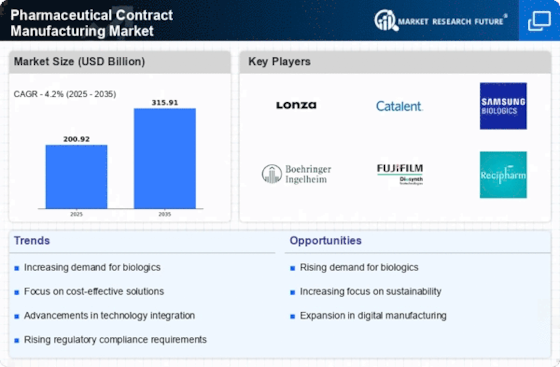
As per Market Research Future analysis, the Pharmaceutical Contract Manufacturing Market was estimated at 200.92 USD Billion in 2024. The Pharmaceutical Contract Manufacturing industry is projected to grow from 209.36 USD Billion in 2025 to 315.91 USD Billion by 2035, exhibiting a compound annual growth rate (CAGR) of 4% during the forecast period 2025 - 2035

Key Market Trends & Highlights

The Pharmaceutical Contract Manufacturing Market is experiencing robust growth driven by technological advancements and increasing demand for biologics.

  • The market is witnessing a rising demand for biologics, particularly in North America, which remains the largest market. Technological advancements in manufacturing processes are enhancing efficiency and quality across the sector. The Asia-Pacific region is emerging as the fastest-growing area, driven by increasing investments in pharmaceutical R&D activities. Key market drivers include the increasing demand for personalized medicine and the need for cost efficiency and resource optimization.

Market Size & Forecast

2024 Market Size 200.92 (USD Billion)
2035 Market Size 315.91 (USD Billion)
CAGR (2025 - 2035) 4.2%
Largest Regional Market Share in 2024 North America

Major Players

Lonza (CH), Catalent (US), Samsung Biologics (KR), Boehringer Ingelheim (DE), Fujifilm Diosynth Biotechnologies (JP), Recipharm (SE), WuXi AppTec (CN), Patheon (US), <a href="https://www.aenova-group.com/en/manufacturing">Aenova</a> (DE)

Market Trends

The Pharmaceutical Contract Manufacturing Market is currently experiencing a dynamic evolution, driven by various factors that shape its landscape. The increasing complexity of drug formulations and the rising demand for specialized manufacturing capabilities appear to be pivotal in influencing market growth. As contract manufacturing pharma companies seek to optimize their operations, outsourcing manufacturing processes to specialized contract pharmaceutical manufacturers seems to provide a strategic advantage. This trend not only allows for cost efficiency but also enables contract manufacturing pharmaceutical companies to focus on core competencies such as research and development. Furthermore, the growing emphasis on regulatory compliance and quality assurance is likely to propel the demand for contract manufacturing for pharmaceuticals, as firms strive to meet stringent industry standards. In addition, the Pharmaceutical Contract Manufacturing Market is witnessing a shift towards more flexible and scalable production solutions. This adaptability is essential in responding to fluctuating market demands and the need for rapid product launches. The integration of advanced technologies, such as automation and digitalization, may enhance operational efficiency and reduce time-to-market for new drugs. Overall, the market appears poised for continued growth, driven by innovation, strategic partnerships, and an increasing focus on quality and compliance in contract pharmaceutical manufacturing processes.

Rising Demand for Biologics

The Pharmaceutical Contract Manufacturing Market is observing a notable increase in the demand for biologics. This trend is largely attributed to the growing prevalence of chronic diseases and the need for targeted therapies. Contract manufacturers are adapting their capabilities to accommodate the complexities associated with biologic production, which often requires specialized processes and stringent pharmaceutical industry quality controls.

Focus on Sustainability

Sustainability is becoming a critical consideration within the Pharmaceutical Contract Manufacturing Market. Companies are increasingly seeking eco-friendly contract pharmaceutical manufacturing practices and materials. This shift not only aligns with global sustainability goals but also appeals to consumers who are more environmentally conscious. As a result, contract manufacturers are exploring innovative solutions to minimize waste and reduce their carbon footprint.

Technological Advancements in Manufacturing

Technological advancements are significantly transforming the Pharmaceutical Contract Manufacturing Market. The adoption of automation, artificial intelligence, and data analytics is enhancing production efficiency and accuracy. These innovations enable manufacturers to streamline operations, improve quality control in pharma company, and respond more swiftly to market changes, thereby positioning themselves competitively in a rapidly evolving landscape.

Pharmaceutical Contract Manufacturing Market Market Drivers

Cost Efficiency and Resource Optimization

The Pharmaceutical Contract Manufacturing Market is increasingly driven by the need for cost efficiency and resource optimization. Pharmaceutical companies are under constant pressure to reduce production costs while maintaining high-quality standards. By outsourcing manufacturing processes to contract manufacturers, companies can achieve significant cost savings through economies of scale and reduced capital expenditures. This trend is particularly evident in the production of generic drugs, where contract manufacturers can leverage their established infrastructure to deliver cost-effective solutions. As the market for generics continues to grow, with projections indicating a value of USD 500 billion by 2025, the role of contract manufacturers in providing affordable production options becomes even more critical. This focus on cost efficiency allows pharmaceutical companies to allocate resources more effectively, ultimately enhancing their competitive positioning.

Expansion of Pharmaceutical R&D Activities

The Pharmaceutical Contract Manufacturing Market is significantly influenced by the expansion of research and development (R&D) activities within the pharmaceutical sector. As companies strive to innovate and bring new drugs to market, the need for specialized manufacturing services becomes increasingly apparent. In recent years, pharmaceutical companies have allocated a larger portion of their budgets to R&D, with expenditures reaching approximately USD 200 billion annually. This trend underscores the reliance on contract manufacturers to provide the necessary expertise and infrastructure to support complex drug development processes. By outsourcing manufacturing, pharmaceutical firms can focus on their core competencies while leveraging the capabilities of contract manufacturers to enhance efficiency and reduce time-to-market for new products.

Increasing Demand for Personalized Medicine

The Pharmaceutical Contract Manufacturing Market is experiencing a notable shift towards personalized medicine, driven by advancements in genomics and biotechnology. This trend is characterized by the growing need for tailored therapies that cater to individual patient profiles. As healthcare providers increasingly adopt precision medicine approaches, contract manufacturers are required to develop specialized production processes that accommodate small batch sizes and unique formulations. According to industry estimates, the market for personalized medicine is projected to reach USD 2 trillion by 2025, indicating a substantial opportunity for contract manufacturers to expand their capabilities. This demand for customized solutions necessitates a flexible and responsive manufacturing environment, positioning contract manufacturers as critical partners in the development of innovative therapies.

Regulatory Compliance and Quality Assurance

The Pharmaceutical Contract Manufacturing Market is heavily influenced by the stringent regulatory landscape governing drug production. Compliance with regulations set forth by authorities such as the FDA and EMA is paramount for contract manufacturers. These regulations ensure that products meet safety and efficacy standards, which is critical for maintaining market access. As the industry evolves, the emphasis on quality assurance and regulatory compliance has intensified, leading to increased demand for contract manufacturing services that can navigate these complexities. Companies that demonstrate robust quality management systems and adherence to Good Manufacturing Practices (GMP) are likely to gain a competitive edge. This focus on compliance not only mitigates risks but also enhances the reputation of contract manufacturers in the eyes of pharmaceutical clients.

Emergence of Advanced Manufacturing Technologies

The Pharmaceutical Contract Manufacturing Market is witnessing a transformative phase with the emergence of advanced manufacturing technologies. Innovations such as continuous manufacturing, automation, and artificial intelligence are reshaping production processes, enabling contract manufacturers to enhance efficiency and reduce lead times. These technologies facilitate real-time monitoring and data analytics, which can lead to improved quality control and reduced waste. As pharmaceutical companies increasingly seek to adopt these advanced methodologies, contract manufacturers that invest in cutting-edge technologies are likely to gain a competitive advantage. The integration of these technologies not only streamlines operations but also aligns with the industry's push towards sustainability and environmental responsibility. This trend indicates a promising future for contract manufacturers that can adapt to the evolving technological landscape.

Market Segment Insights

By Manufacturing Type: Active Pharmaceutical Ingredients (Largest) vs. Formulated Products (Fastest-Growing)

The Pharmaceutical Contract Manufacturing Market has a diverse distribution among its primary segments. Active Pharmaceutical Ingredients (APIs) hold the largest share as they are fundamental in drug development, directly influencing the efficacy of medical formulations. Meanwhile, formulated products have garnered swift attention, reflecting the industry's shift towards more tailored and complex therapies that cater to specific patient needs. This evolution illustrates how manufacturers are adapting to the increasing demand for innovative drug solutions. Within the Pharmaceutical Contract Manufacturing Market, growth trends are propelled by various factors such as rising R&amp;D investments and the growing prevalence of chronic diseases. The shift in focus towards personalized medicine enhances the demand for formulated products. Additionally, outsourcing contract pharmaceutical manufacturing processes is becoming a strategic move for pharmaceutical contracting companies to optimize operations and costs, resulting in an overall expansion of the market landscape.

Active Pharmaceutical Ingredients (Dominant) vs. Packaging Services (Emerging)

Active Pharmaceutical Ingredients are the backbone of the Pharmaceutical Contract Manufacturing Market, driving innovation and ensuring drug effectiveness. They are deeply integrated into the production of various pharmaceuticals, making them essential for manufacturers. In contrast, Packaging Services, while currently viewed as an emerging segment, play a vital role in ensuring product safety and compliance with regulatory standards. The trends indicate that as pharmaceutical regulations become stricter, the importance of packaging will grow, leading to innovative solutions that enhance the usability and shelf life of pharmaceutical products. Together, these segments highlight how the market is evolving, emphasizing both the foundational role of APIs and the growing significance of efficient and compliant packaging solutions.

By Service Type: Contract Manufacturing (Largest) vs. Contract Research (Fastest-Growing)

In the Pharmaceutical Contract Manufacturing Market, the service type segment is characterized by three primary values: Contract Manufacturing, Contract Research, and Product Development. Among these, contract manufacturing for pharmaceuticals holds the largest share, driven by the increasing demand for outsourced manufacturing to enhance efficiency and reduce costs. Contract Research follows closely, capturing a significant portion of the market as pharmaceutical contracting companies increasingly seek specialized research services to support drug development. Meanwhile, Product Development, although smaller in share, plays a crucial role in bridging the gap between initial research and final product offerings, thereby supporting the overall growth of the pharmaceutical sector.

Contract Manufacturing (Dominant) vs. Contract Research (Emerging)

Contract Manufacturing is the dominant service type in the Pharmaceutical Contract Manufacturing Market, characterized by its ability to offer scale, flexibility, and specialized capabilities that drive efficiency in production processes. This segment benefits from established relationships between pharmaceutical contracting companies and contract manufacturers, who can leverage advanced technologies for large-scale production. On the other hand, Contract Research is emerging rapidly, as more pharmaceutical contracting companies recognize the value of outsourcing research functions to enhance innovation and speed up development timelines. This segment focuses on providing tailored research solutions that can adapt to the evolving needs of clients, thereby positioning itself as a vital partner in the drug development lifecycle.

By Therapeutic Area: Oncology (Largest) vs. Cardiology (Fastest-Growing)

The Pharmaceutical Contract Manufacturing Market is experiencing a robust distribution of market shares across various therapeutic areas. Oncology holds the largest share due to the increasing prevalence of cancer globally and the subsequent demand for specialized manufacturing processes. Cardiology, while currently smaller, is gaining traction as cardiovascular diseases rise sharply, positioning it as a key area of focus for contract manufacturers.

Oncology (Dominant) vs. Cardiology (Emerging)

Oncology is regarded as the dominant therapeutic area in the pharmaceutical contract manufacturing market. The complexity of drug formulations and the requirement for advanced manufacturing capabilities have resulted in significant investments within this segment. In contrast, Cardiology represents an emerging growth area. Increased incidences of heart disease and an aging population drive innovation and demand for cardiovascular drugs, leading manufacturers to pivot strategies towards developing niche therapies and personalized medicine initiatives.

By End User: Pharmaceutical Companies (Largest) vs. Biotechnology Companies (Fastest-Growing)

In the Pharmaceutical Contract Manufacturing Market, Pharmaceutical Companies hold the largest share due to their established infrastructure and ongoing demand for high-quality production services. These organizations often collaborate with contract manufacturers to scale their operations, allowing them to focus on research and development while outsourcing production. In contrast, Biotechnology Companies, while smaller in market share, are rapidly adopting contract manufacturing solutions, driven by the need for specialized processes and innovative drug development.

Pharmaceutical Companies (Dominant) vs. Biotechnology Companies (Emerging)

Pharmaceutical Companies are characterized by their significant market presence and established supply chains in the contract manufacturing for pharmaceuticals sector. They often have extensive product portfolios and a consistent demand for manufacturing services, which positions them as dominant players in this market. On the other hand, Biotechnology Companies represent an emerging segment, gaining traction due to their focus on niche markets and advanced therapies. These contract pharmaceutical companies require flexible, specialized manufacturing capabilities to support the rapid development of biologics and personalized medicine, making them vital to the future evolution of pharmaceutical manufacturing.

Get more detailed insights about Pharmaceutical Contract Manufacturing Market Research Report-Forecast to 2035

Regional Insights

North America : Pharmaceutical Innovation Leader

North America is the largest market for pharmaceutical contract manufacturing, holding approximately 45% of the global share. The region benefits from a robust healthcare infrastructure, significant R&D investments, and a growing demand for biologics and biosimilars. Regulatory support from agencies like the FDA further catalyzes market growth, ensuring compliance and safety in manufacturing processes. The United States leads the market, followed by Canada, with key players such as Catalent and Patheon driving innovation and capacity expansion. The competitive landscape is characterized by strategic partnerships and mergers, enhancing service offerings. The presence of major contract pharmaceutical companies fosters a conducive environment for contract manufacturers, ensuring a steady demand for outsourced services.

Europe : Regulatory Framework Strength

Europe is the second-largest market for contract manufacturing for pharmaceuticals, accounting for around 30% of the global market share. The region's growth is driven by stringent regulatory frameworks and a focus on quality assurance. The European Medicines Agency (EMA) plays a crucial role in ensuring compliance, which boosts confidence among contract pharmaceutical manufacturers and clients alike, fostering a stable market environment. Germany and the United Kingdom are the leading countries in this sector, with significant contributions from contract pharmaceutical companies like Boehringer Ingelheim and Aenova. The competitive landscape is marked by a mix of established players and emerging firms, all striving to meet the increasing demand for personalized medicine and biologics. The presence of advanced manufacturing technologies further enhances the region's attractiveness for contract manufacturing.

Asia-Pacific : Emerging Market Potential

Asia-Pacific is rapidly emerging as a significant player in the pharmaceutical contract manufacturing market, holding approximately 20% of the global share. The region's growth is fueled by increasing healthcare expenditures, a rising population, and a shift towards outsourcing manufacturing processes. Countries like China and India are becoming hubs for cost-effective production, attracting global contract pharmaceutical companies seeking to optimize their supply chains. China is the largest market in the region, with a growing number of contract pharmaceutical manufacturers like WuXi AppTec leading the charge. India follows closely, supported by a robust generics industry. The competitive landscape is evolving, with local firms expanding capabilities and international players establishing partnerships to enhance their market presence. This dynamic environment is set to drive further growth in the coming years.

Middle East and Africa : Untapped Market Opportunities

The Middle East and Africa region is witnessing gradual growth in the pharmaceutical contract manufacturing market, currently holding about 5% of the global share. The growth is primarily driven by increasing healthcare needs, investments in healthcare infrastructure, and a rising demand for generic drugs. Governments are actively promoting local manufacturing to reduce dependency on imports, which is a significant catalyst for market expansion. South Africa and the UAE are the leading countries in this region, with several initiatives aimed at enhancing local production capabilities. The competitive landscape is characterized by a mix of local and international players, with investments in technology and innovation becoming crucial for success. As the region continues to develop its pharmaceutical sector, contract manufacturing is expected to play a vital role in meeting local and regional demands.

Key Players and Competitive Insights

The Pharmaceutical Contract Manufacturing Market is characterized by a dynamic competitive landscape, driven by increasing demand for outsourcing manufacturing processes and the need for cost-effective solutions. Key players such as Lonza (CH), Catalent (US), and Samsung Biologics (KR) are strategically positioned to leverage their extensive capabilities in biologics and small molecule production. These pharma contract manufacturing companies focus on innovation and operational efficiency, with a notable emphasis on expanding their service offerings and enhancing production capacities to meet the growing needs of pharmaceutical clients. Their collective strategies contribute to a competitive environment that is increasingly shaped by technological advancements and the pursuit of operational excellence.
In terms of business tactics, pharma contract manufacturing companies are increasingly localizing manufacturing to reduce lead times and enhance supply chain resilience. The market structure appears moderately fragmented, with several players vying for market share while also forming strategic partnerships to bolster their capabilities. This collective influence of key players fosters a competitive atmosphere where agility and responsiveness to market demands are paramount.
In August 2025, Lonza (CH) announced the expansion of its biologics manufacturing facility in Switzerland, a move aimed at increasing its production capacity for monoclonal antibodies. This strategic expansion is likely to enhance Lonza's position in the biologics sector, allowing it to better serve its clients and respond to the rising demand for complex biologics. The investment underscores Lonza's commitment to innovation and operational excellence, reinforcing its competitive edge in the market.
In September 2025, Catalent (US) unveiled a new state-of-the-art facility in Indiana, designed specifically for the production of gene therapies. This facility is expected to significantly enhance Catalent's capabilities in the rapidly growing gene therapy market. The establishment of this facility not only reflects Catalent's strategic focus on high-growth areas but also positions the company to capitalize on the increasing demand for advanced therapeutic solutions, thereby strengthening its market presence.
In July 2025, Samsung Biologics (KR) entered into a partnership with a leading biopharmaceutical company to provide contract manufacturing services for a new monoclonal antibody product. This collaboration is indicative of Samsung's strategy to expand its service offerings and enhance its technological capabilities. By aligning with a prominent player in the biopharmaceutical sector, Samsung Biologics is likely to bolster its reputation and operational capacity, further solidifying its position in the competitive landscape.
As of October 2025, the competitive trends in the Pharmaceutical Contract Manufacturing Market are increasingly defined by digitalization, sustainability, and the integration of artificial intelligence. Strategic alliances are becoming more prevalent, as pharma contract manufacturing companies seek to enhance their technological capabilities and operational efficiencies. The shift from price-based competition to a focus on innovation, technology, and supply chain reliability is evident, suggesting that future competitive differentiation will hinge on the ability to adapt to these evolving trends.

Key Companies in the Pharmaceutical Contract Manufacturing Market include

Industry Developments

The Pharmaceutical Contract Manufacturing Market has seen significant developments recently. In June 2022, Lonza entered an agreement with a major pharmaceutical firm to co-develop cell and gene therapies. Additionally, in July 2021, AMRI expanded its presence in Europe by acquiring a facility in Sweden, reflecting the ongoing trend of consolidation within the market.

These movements underline the dynamic nature of the Pharmaceutical Contract Manufacturing Market and the ongoing push for innovation and capacity enhancement. In June 2023, Broke ground on Plant 5 within Bio Campus II in South Korea, adding 180,000 L capacity to reach 784,000 L total; first phase to be operational by April 2025.

Future Outlook

Pharmaceutical Contract Manufacturing Market Future Outlook

The Pharmaceutical Contract Manufacturing Market is projected to grow at a 4.2% CAGR from 2025 to 2035, driven by increasing outsourcing, technological advancements, and regulatory compliance demands.

New opportunities lie in:

  • <p>Expansion into biologics manufacturing capabilities Investment in advanced analytics for supply chain optimization Development of <a href="https://www.marketresearchfuture.com/reports/sustainable-packaging-solutions-market">sustainable packaging solutions</a> for pharmaceuticals</p>

By 2035, the market is expected to be robust, reflecting strong growth and innovation.

Market Segmentation

Pharmaceutical Contract Manufacturing Market End User Outlook

  • Pharmaceutical Companies
  • Biotechnology Companies
  • Generic Drug Manufacturers

Pharmaceutical Contract Manufacturing Market Service Type Outlook

  • Contract Manufacturing
  • Contract Research
  • Product Development

Pharmaceutical Contract Manufacturing Market Therapeutic Area Outlook

  • Oncology
  • Cardiology
  • Neurology
  • Infectious Diseases

Pharmaceutical Contract Manufacturing Market Manufacturing Type Outlook

  • Active Pharmaceutical Ingredients
  • Formulated Products
  • Packaging Services

Report Scope

MARKET SIZE 2024 200.92(USD Billion)
MARKET SIZE 2025 209.36(USD Billion)
MARKET SIZE 2035 315.91(USD Billion)
COMPOUND ANNUAL GROWTH RATE (CAGR) 4.2% (2025 - 2035)
REPORT COVERAGE Revenue Forecast, Competitive Landscape, Growth Factors, and Trends
BASE YEAR 2024
Market Forecast Period 2025 - 2035
Historical Data 2019 - 2024
Market Forecast Units USD Billion
Key Companies Profiled Lonza (CH), Catalent (US), Samsung Biologics (KR), Boehringer Ingelheim (DE), Fujifilm Diosynth Biotechnologies (JP), Recipharm (SE), WuXi AppTec (CN), Patheon (US), Aenova (DE)
Segments Covered Manufacturing Type, Service Type, Therapeutic Area, End User, Regional
Key Market Opportunities Integration of advanced technologies enhances efficiency in the Pharmaceutical Contract Manufacturing Market.
Key Market Dynamics Rising demand for personalized medicine drives innovation and competition in the Pharmaceutical Contract Manufacturing Market.
Countries Covered North America, Europe, APAC, South America, MEA

FAQs

What is the projected market valuation of the Pharmaceutical Contract Manufacturing Market by 2035?

<p>The market is projected to reach approximately 315.91 USD Billion by 2035.</p>

What was the overall market valuation of the Pharmaceutical Contract Manufacturing Market in 2024?

<p>In 2024, the overall market valuation was 200.92 USD Billion.</p>

What is the expected CAGR for the Pharmaceutical Contract Manufacturing Market during the forecast period 2025 - 2035?

<p>The expected CAGR for the market during the forecast period 2025 - 2035 is 4.2%.</p>

Which segment of the Pharmaceutical Contract Manufacturing Market had the highest valuation in 2024?

<p>The 'Formulated Products' segment had the highest valuation at 90.0 USD Billion in 2024.</p>

What are the key therapeutic areas driving growth in the Pharmaceutical Contract Manufacturing Market?

<p>Key therapeutic areas include Oncology, Cardiology, Neurology, and Infectious Diseases, with Oncology valued at 40.0 USD Billion in 2024.</p>

Who are the leading players in the Pharmaceutical Contract Manufacturing Market?

<p>Leading players include Lonza, Catalent, Samsung Biologics, and Boehringer Ingelheim.</p>

What was the valuation of the Contract Manufacturing segment in 2024?

<p>The Contract Manufacturing segment was valued at 80.0 USD Billion in 2024.</p>

How does the market valuation of Biotechnology Companies compare to Pharmaceutical Companies in 2024?

<p>In 2024, Biotechnology Companies were valued at 60.27 USD Billion, significantly lower than Pharmaceutical Companies at 100.46 USD Billion.</p>

What is the projected growth for the Packaging Services segment by 2035?

<p>The Packaging Services segment is expected to grow from 30.92 USD Billion in 2024 to a projected 55.91 USD Billion by 2035.</p>

What is the anticipated market trend for Contract Research services in the coming years?

<p>The Contract Research segment is projected to grow from 60.0 USD Billion in 2024 to 90.0 USD Billion by 2035.</p>

  1. SECTION I: EXECUTIVE SUMMARY AND KEY HIGHLIGHTS
    1. | 1.1 EXECUTIVE SUMMARY
    2. | | 1.1.1 Market Overview
    3. | | 1.1.2 Key Findings
    4. | | 1.1.3 Market Segmentation
    5. | | 1.1.4 Competitive Landscape
    6. | | 1.1.5 Challenges and Opportunities
    7. | | 1.1.6 Future Outlook
  2. SECTION II: SCOPING, METHODOLOGY AND MARKET STRUCTURE
    1. | 2.1 MARKET INTRODUCTION
    2. | | 2.1.1 Definition
    3. | | 2.1.2 Scope of the study
    4. | | | 2.1.2.1 Research Objective
    5. | | | 2.1.2.2 Assumption
    6. | | | 2.1.2.3 Limitations
    7. | 2.2 RESEARCH METHODOLOGY
    8. | | 2.2.1 Overview
    9. | | 2.2.2 Data Mining
    10. | | 2.2.3 Secondary Research
    11. | | 2.2.4 Primary Research
    12. | | | 2.2.4.1 Primary Interviews and Information Gathering Process
    13. | | | 2.2.4.2 Breakdown of Primary Respondents
    14. | | 2.2.5 Forecasting Model
    15. | | 2.2.6 Market Size Estimation
    16. | | | 2.2.6.1 Bottom-Up Approach
    17. | | | 2.2.6.2 Top-Down Approach
    18. | | 2.2.7 Data Triangulation
    19. | | 2.2.8 Validation
  3. SECTION III: QUALITATIVE ANALYSIS
    1. | 3.1 MARKET DYNAMICS
    2. | | 3.1.1 Overview
    3. | | 3.1.2 Drivers
    4. | | 3.1.3 Restraints
    5. | | 3.1.4 Opportunities
    6. | 3.2 MARKET FACTOR ANALYSIS
    7. | | 3.2.1 Value chain Analysis
    8. | | 3.2.2 Porter's Five Forces Analysis
    9. | | | 3.2.2.1 Bargaining Power of Suppliers
    10. | | | 3.2.2.2 Bargaining Power of Buyers
    11. | | | 3.2.2.3 Threat of New Entrants
    12. | | | 3.2.2.4 Threat of Substitutes
    13. | | | 3.2.2.5 Intensity of Rivalry
    14. | | 3.2.3 COVID-19 Impact Analysis
    15. | | | 3.2.3.1 Market Impact Analysis
    16. | | | 3.2.3.2 Regional Impact
    17. | | | 3.2.3.3 Opportunity and Threat Analysis
  4. SECTION IV: QUANTITATIVE ANALYSIS
    1. | 4.1 Healthcare, BY Manufacturing Type (USD Billion)
    2. | | 4.1.1 Active Pharmaceutical Ingredients
    3. | | 4.1.2 Formulated Products
    4. | | 4.1.3 Packaging Services
    5. | 4.2 Healthcare, BY Service Type (USD Billion)
    6. | | 4.2.1 Contract Manufacturing
    7. | | 4.2.2 Contract Research
    8. | | 4.2.3 Product Development
    9. | 4.3 Healthcare, BY Therapeutic Area (USD Billion)
    10. | | 4.3.1 Oncology
    11. | | 4.3.2 Cardiology
    12. | | 4.3.3 Neurology
    13. | | 4.3.4 Infectious Diseases
    14. | 4.4 Healthcare, BY End User (USD Billion)
    15. | | 4.4.1 Pharmaceutical Companies
    16. | | 4.4.2 Biotechnology Companies
    17. | | 4.4.3 Generic Drug Manufacturers
    18. | 4.5 Healthcare, BY Region (USD Billion)
    19. | | 4.5.1 North America
    20. | | | 4.5.1.1 US
    21. | | | 4.5.1.2 Canada
    22. | | 4.5.2 Europe
    23. | | | 4.5.2.1 Germany
    24. | | | 4.5.2.2 UK
    25. | | | 4.5.2.3 France
    26. | | | 4.5.2.4 Russia
    27. | | | 4.5.2.5 Italy
    28. | | | 4.5.2.6 Spain
    29. | | | 4.5.2.7 Rest of Europe
    30. | | 4.5.3 APAC
    31. | | | 4.5.3.1 China
    32. | | | 4.5.3.2 India
    33. | | | 4.5.3.3 Japan
    34. | | | 4.5.3.4 South Korea
    35. | | | 4.5.3.5 Malaysia
    36. | | | 4.5.3.6 Thailand
    37. | | | 4.5.3.7 Indonesia
    38. | | | 4.5.3.8 Rest of APAC
    39. | | 4.5.4 South America
    40. | | | 4.5.4.1 Brazil
    41. | | | 4.5.4.2 Mexico
    42. | | | 4.5.4.3 Argentina
    43. | | | 4.5.4.4 Rest of South America
    44. | | 4.5.5 MEA
    45. | | | 4.5.5.1 GCC Countries
    46. | | | 4.5.5.2 South Africa
    47. | | | 4.5.5.3 Rest of MEA
  5. SECTION V: COMPETITIVE ANALYSIS
    1. | 5.1 Competitive Landscape
    2. | | 5.1.1 Overview
    3. | | 5.1.2 Competitive Analysis
    4. | | 5.1.3 Market share Analysis
    5. | | 5.1.4 Major Growth Strategy in the Healthcare
    6. | | 5.1.5 Competitive Benchmarking
    7. | | 5.1.6 Leading Players in Terms of Number of Developments in the Healthcare
    8. | | 5.1.7 Key developments and growth strategies
    9. | | | 5.1.7.1 New Product Launch/Service Deployment
    10. | | | 5.1.7.2 Merger & Acquisitions
    11. | | | 5.1.7.3 Joint Ventures
    12. | | 5.1.8 Major Players Financial Matrix
    13. | | | 5.1.8.1 Sales and Operating Income
    14. | | | 5.1.8.2 Major Players R&D Expenditure. 2023
    15. | 5.2 Company Profiles
    16. | | 5.2.1 Lonza (CH)
    17. | | | 5.2.1.1 Financial Overview
    18. | | | 5.2.1.2 Products Offered
    19. | | | 5.2.1.3 Key Developments
    20. | | | 5.2.1.4 SWOT Analysis
    21. | | | 5.2.1.5 Key Strategies
    22. | | 5.2.2 Catalent (US)
    23. | | | 5.2.2.1 Financial Overview
    24. | | | 5.2.2.2 Products Offered
    25. | | | 5.2.2.3 Key Developments
    26. | | | 5.2.2.4 SWOT Analysis
    27. | | | 5.2.2.5 Key Strategies
    28. | | 5.2.3 Samsung Biologics (KR)
    29. | | | 5.2.3.1 Financial Overview
    30. | | | 5.2.3.2 Products Offered
    31. | | | 5.2.3.3 Key Developments
    32. | | | 5.2.3.4 SWOT Analysis
    33. | | | 5.2.3.5 Key Strategies
    34. | | 5.2.4 Boehringer Ingelheim (DE)
    35. | | | 5.2.4.1 Financial Overview
    36. | | | 5.2.4.2 Products Offered
    37. | | | 5.2.4.3 Key Developments
    38. | | | 5.2.4.4 SWOT Analysis
    39. | | | 5.2.4.5 Key Strategies
    40. | | 5.2.5 Fujifilm Diosynth Biotechnologies (JP)
    41. | | | 5.2.5.1 Financial Overview
    42. | | | 5.2.5.2 Products Offered
    43. | | | 5.2.5.3 Key Developments
    44. | | | 5.2.5.4 SWOT Analysis
    45. | | | 5.2.5.5 Key Strategies
    46. | | 5.2.6 Recipharm (SE)
    47. | | | 5.2.6.1 Financial Overview
    48. | | | 5.2.6.2 Products Offered
    49. | | | 5.2.6.3 Key Developments
    50. | | | 5.2.6.4 SWOT Analysis
    51. | | | 5.2.6.5 Key Strategies
    52. | | 5.2.7 WuXi AppTec (CN)
    53. | | | 5.2.7.1 Financial Overview
    54. | | | 5.2.7.2 Products Offered
    55. | | | 5.2.7.3 Key Developments
    56. | | | 5.2.7.4 SWOT Analysis
    57. | | | 5.2.7.5 Key Strategies
    58. | | 5.2.8 Patheon (US)
    59. | | | 5.2.8.1 Financial Overview
    60. | | | 5.2.8.2 Products Offered
    61. | | | 5.2.8.3 Key Developments
    62. | | | 5.2.8.4 SWOT Analysis
    63. | | | 5.2.8.5 Key Strategies
    64. | | 5.2.9 Aenova (DE)
    65. | | | 5.2.9.1 Financial Overview
    66. | | | 5.2.9.2 Products Offered
    67. | | | 5.2.9.3 Key Developments
    68. | | | 5.2.9.4 SWOT Analysis
    69. | | | 5.2.9.5 Key Strategies
    70. | 5.3 Appendix
    71. | | 5.3.1 References
    72. | | 5.3.2 Related Reports
  6. LIST OF FIGURES
    1. | 6.1 MARKET SYNOPSIS
    2. | 6.2 NORTH AMERICA MARKET ANALYSIS
    3. | 6.3 US MARKET ANALYSIS BY MANUFACTURING TYPE
    4. | 6.4 US MARKET ANALYSIS BY SERVICE TYPE
    5. | 6.5 US MARKET ANALYSIS BY THERAPEUTIC AREA
    6. | 6.6 US MARKET ANALYSIS BY END USER
    7. | 6.7 CANADA MARKET ANALYSIS BY MANUFACTURING TYPE
    8. | 6.8 CANADA MARKET ANALYSIS BY SERVICE TYPE
    9. | 6.9 CANADA MARKET ANALYSIS BY THERAPEUTIC AREA
    10. | 6.10 CANADA MARKET ANALYSIS BY END USER
    11. | 6.11 EUROPE MARKET ANALYSIS
    12. | 6.12 GERMANY MARKET ANALYSIS BY MANUFACTURING TYPE
    13. | 6.13 GERMANY MARKET ANALYSIS BY SERVICE TYPE
    14. | 6.14 GERMANY MARKET ANALYSIS BY THERAPEUTIC AREA
    15. | 6.15 GERMANY MARKET ANALYSIS BY END USER
    16. | 6.16 UK MARKET ANALYSIS BY MANUFACTURING TYPE
    17. | 6.17 UK MARKET ANALYSIS BY SERVICE TYPE
    18. | 6.18 UK MARKET ANALYSIS BY THERAPEUTIC AREA
    19. | 6.19 UK MARKET ANALYSIS BY END USER
    20. | 6.20 FRANCE MARKET ANALYSIS BY MANUFACTURING TYPE
    21. | 6.21 FRANCE MARKET ANALYSIS BY SERVICE TYPE
    22. | 6.22 FRANCE MARKET ANALYSIS BY THERAPEUTIC AREA
    23. | 6.23 FRANCE MARKET ANALYSIS BY END USER
    24. | 6.24 RUSSIA MARKET ANALYSIS BY MANUFACTURING TYPE
    25. | 6.25 RUSSIA MARKET ANALYSIS BY SERVICE TYPE
    26. | 6.26 RUSSIA MARKET ANALYSIS BY THERAPEUTIC AREA
    27. | 6.27 RUSSIA MARKET ANALYSIS BY END USER
    28. | 6.28 ITALY MARKET ANALYSIS BY MANUFACTURING TYPE
    29. | 6.29 ITALY MARKET ANALYSIS BY SERVICE TYPE
    30. | 6.30 ITALY MARKET ANALYSIS BY THERAPEUTIC AREA
    31. | 6.31 ITALY MARKET ANALYSIS BY END USER
    32. | 6.32 SPAIN MARKET ANALYSIS BY MANUFACTURING TYPE
    33. | 6.33 SPAIN MARKET ANALYSIS BY SERVICE TYPE
    34. | 6.34 SPAIN MARKET ANALYSIS BY THERAPEUTIC AREA
    35. | 6.35 SPAIN MARKET ANALYSIS BY END USER
    36. | 6.36 REST OF EUROPE MARKET ANALYSIS BY MANUFACTURING TYPE
    37. | 6.37 REST OF EUROPE MARKET ANALYSIS BY SERVICE TYPE
    38. | 6.38 REST OF EUROPE MARKET ANALYSIS BY THERAPEUTIC AREA
    39. | 6.39 REST OF EUROPE MARKET ANALYSIS BY END USER
    40. | 6.40 APAC MARKET ANALYSIS
    41. | 6.41 CHINA MARKET ANALYSIS BY MANUFACTURING TYPE
    42. | 6.42 CHINA MARKET ANALYSIS BY SERVICE TYPE
    43. | 6.43 CHINA MARKET ANALYSIS BY THERAPEUTIC AREA
    44. | 6.44 CHINA MARKET ANALYSIS BY END USER
    45. | 6.45 INDIA MARKET ANALYSIS BY MANUFACTURING TYPE
    46. | 6.46 INDIA MARKET ANALYSIS BY SERVICE TYPE
    47. | 6.47 INDIA MARKET ANALYSIS BY THERAPEUTIC AREA
    48. | 6.48 INDIA MARKET ANALYSIS BY END USER
    49. | 6.49 JAPAN MARKET ANALYSIS BY MANUFACTURING TYPE
    50. | 6.50 JAPAN MARKET ANALYSIS BY SERVICE TYPE
    51. | 6.51 JAPAN MARKET ANALYSIS BY THERAPEUTIC AREA
    52. | 6.52 JAPAN MARKET ANALYSIS BY END USER
    53. | 6.53 SOUTH KOREA MARKET ANALYSIS BY MANUFACTURING TYPE
    54. | 6.54 SOUTH KOREA MARKET ANALYSIS BY SERVICE TYPE
    55. | 6.55 SOUTH KOREA MARKET ANALYSIS BY THERAPEUTIC AREA
    56. | 6.56 SOUTH KOREA MARKET ANALYSIS BY END USER
    57. | 6.57 MALAYSIA MARKET ANALYSIS BY MANUFACTURING TYPE
    58. | 6.58 MALAYSIA MARKET ANALYSIS BY SERVICE TYPE
    59. | 6.59 MALAYSIA MARKET ANALYSIS BY THERAPEUTIC AREA
    60. | 6.60 MALAYSIA MARKET ANALYSIS BY END USER
    61. | 6.61 THAILAND MARKET ANALYSIS BY MANUFACTURING TYPE
    62. | 6.62 THAILAND MARKET ANALYSIS BY SERVICE TYPE
    63. | 6.63 THAILAND MARKET ANALYSIS BY THERAPEUTIC AREA
    64. | 6.64 THAILAND MARKET ANALYSIS BY END USER
    65. | 6.65 INDONESIA MARKET ANALYSIS BY MANUFACTURING TYPE
    66. | 6.66 INDONESIA MARKET ANALYSIS BY SERVICE TYPE
    67. | 6.67 INDONESIA MARKET ANALYSIS BY THERAPEUTIC AREA
    68. | 6.68 INDONESIA MARKET ANALYSIS BY END USER
    69. | 6.69 REST OF APAC MARKET ANALYSIS BY MANUFACTURING TYPE
    70. | 6.70 REST OF APAC MARKET ANALYSIS BY SERVICE TYPE
    71. | 6.71 REST OF APAC MARKET ANALYSIS BY THERAPEUTIC AREA
    72. | 6.72 REST OF APAC MARKET ANALYSIS BY END USER
    73. | 6.73 SOUTH AMERICA MARKET ANALYSIS
    74. | 6.74 BRAZIL MARKET ANALYSIS BY MANUFACTURING TYPE
    75. | 6.75 BRAZIL MARKET ANALYSIS BY SERVICE TYPE
    76. | 6.76 BRAZIL MARKET ANALYSIS BY THERAPEUTIC AREA
    77. | 6.77 BRAZIL MARKET ANALYSIS BY END USER
    78. | 6.78 MEXICO MARKET ANALYSIS BY MANUFACTURING TYPE
    79. | 6.79 MEXICO MARKET ANALYSIS BY SERVICE TYPE
    80. | 6.80 MEXICO MARKET ANALYSIS BY THERAPEUTIC AREA
    81. | 6.81 MEXICO MARKET ANALYSIS BY END USER
    82. | 6.82 ARGENTINA MARKET ANALYSIS BY MANUFACTURING TYPE
    83. | 6.83 ARGENTINA MARKET ANALYSIS BY SERVICE TYPE
    84. | 6.84 ARGENTINA MARKET ANALYSIS BY THERAPEUTIC AREA
    85. | 6.85 ARGENTINA MARKET ANALYSIS BY END USER
    86. | 6.86 REST OF SOUTH AMERICA MARKET ANALYSIS BY MANUFACTURING TYPE
    87. | 6.87 REST OF SOUTH AMERICA MARKET ANALYSIS BY SERVICE TYPE
    88. | 6.88 REST OF SOUTH AMERICA MARKET ANALYSIS BY THERAPEUTIC AREA
    89. | 6.89 REST OF SOUTH AMERICA MARKET ANALYSIS BY END USER
    90. | 6.90 MEA MARKET ANALYSIS
    91. | 6.91 GCC COUNTRIES MARKET ANALYSIS BY MANUFACTURING TYPE
    92. | 6.92 GCC COUNTRIES MARKET ANALYSIS BY SERVICE TYPE
    93. | 6.93 GCC COUNTRIES MARKET ANALYSIS BY THERAPEUTIC AREA
    94. | 6.94 GCC COUNTRIES MARKET ANALYSIS BY END USER
    95. | 6.95 SOUTH AFRICA MARKET ANALYSIS BY MANUFACTURING TYPE
    96. | 6.96 SOUTH AFRICA MARKET ANALYSIS BY SERVICE TYPE
    97. | 6.97 SOUTH AFRICA MARKET ANALYSIS BY THERAPEUTIC AREA
    98. | 6.98 SOUTH AFRICA MARKET ANALYSIS BY END USER
    99. | 6.99 REST OF MEA MARKET ANALYSIS BY MANUFACTURING TYPE
    100. | 6.100 REST OF MEA MARKET ANALYSIS BY SERVICE TYPE
    101. | 6.101 REST OF MEA MARKET ANALYSIS BY THERAPEUTIC AREA
    102. | 6.102 REST OF MEA MARKET ANALYSIS BY END USER
    103. | 6.103 KEY BUYING CRITERIA OF HEALTHCARE
    104. | 6.104 RESEARCH PROCESS OF MRFR
    105. | 6.105 DRO ANALYSIS OF HEALTHCARE
    106. | 6.106 DRIVERS IMPACT ANALYSIS: HEALTHCARE
    107. | 6.107 RESTRAINTS IMPACT ANALYSIS: HEALTHCARE
    108. | 6.108 SUPPLY / VALUE CHAIN: HEALTHCARE
    109. | 6.109 HEALTHCARE, BY MANUFACTURING TYPE, 2024 (% SHARE)
    110. | 6.110 HEALTHCARE, BY MANUFACTURING TYPE, 2024 TO 2035 (USD Billion)
    111. | 6.111 HEALTHCARE, BY SERVICE TYPE, 2024 (% SHARE)
    112. | 6.112 HEALTHCARE, BY SERVICE TYPE, 2024 TO 2035 (USD Billion)
    113. | 6.113 HEALTHCARE, BY THERAPEUTIC AREA, 2024 (% SHARE)
    114. | 6.114 HEALTHCARE, BY THERAPEUTIC AREA, 2024 TO 2035 (USD Billion)
    115. | 6.115 HEALTHCARE, BY END USER, 2024 (% SHARE)
    116. | 6.116 HEALTHCARE, BY END USER, 2024 TO 2035 (USD Billion)
    117. | 6.117 BENCHMARKING OF MAJOR COMPETITORS
  7. LIST OF TABLES
    1. | 7.1 LIST OF ASSUMPTIONS
    2. | | 7.1.1
    3. | 7.2 North America MARKET SIZE ESTIMATES; FORECAST
    4. | | 7.2.1 BY MANUFACTURING TYPE, 2025-2035 (USD Billion)
    5. | | 7.2.2 BY SERVICE TYPE, 2025-2035 (USD Billion)
    6. | | 7.2.3 BY THERAPEUTIC AREA, 2025-2035 (USD Billion)
    7. | | 7.2.4 BY END USER, 2025-2035 (USD Billion)
    8. | 7.3 US MARKET SIZE ESTIMATES; FORECAST
    9. | | 7.3.1 BY MANUFACTURING TYPE, 2025-2035 (USD Billion)
    10. | | 7.3.2 BY SERVICE TYPE, 2025-2035 (USD Billion)
    11. | | 7.3.3 BY THERAPEUTIC AREA, 2025-2035 (USD Billion)
    12. | | 7.3.4 BY END USER, 2025-2035 (USD Billion)
    13. | 7.4 Canada MARKET SIZE ESTIMATES; FORECAST
    14. | | 7.4.1 BY MANUFACTURING TYPE, 2025-2035 (USD Billion)
    15. | | 7.4.2 BY SERVICE TYPE, 2025-2035 (USD Billion)
    16. | | 7.4.3 BY THERAPEUTIC AREA, 2025-2035 (USD Billion)
    17. | | 7.4.4 BY END USER, 2025-2035 (USD Billion)
    18. | 7.5 Europe MARKET SIZE ESTIMATES; FORECAST
    19. | | 7.5.1 BY MANUFACTURING TYPE, 2025-2035 (USD Billion)
    20. | | 7.5.2 BY SERVICE TYPE, 2025-2035 (USD Billion)
    21. | | 7.5.3 BY THERAPEUTIC AREA, 2025-2035 (USD Billion)
    22. | | 7.5.4 BY END USER, 2025-2035 (USD Billion)
    23. | 7.6 Germany MARKET SIZE ESTIMATES; FORECAST
    24. | | 7.6.1 BY MANUFACTURING TYPE, 2025-2035 (USD Billion)
    25. | | 7.6.2 BY SERVICE TYPE, 2025-2035 (USD Billion)
    26. | | 7.6.3 BY THERAPEUTIC AREA, 2025-2035 (USD Billion)
    27. | | 7.6.4 BY END USER, 2025-2035 (USD Billion)
    28. | 7.7 UK MARKET SIZE ESTIMATES; FORECAST
    29. | | 7.7.1 BY MANUFACTURING TYPE, 2025-2035 (USD Billion)
    30. | | 7.7.2 BY SERVICE TYPE, 2025-2035 (USD Billion)
    31. | | 7.7.3 BY THERAPEUTIC AREA, 2025-2035 (USD Billion)
    32. | | 7.7.4 BY END USER, 2025-2035 (USD Billion)
    33. | 7.8 France MARKET SIZE ESTIMATES; FORECAST
    34. | | 7.8.1 BY MANUFACTURING TYPE, 2025-2035 (USD Billion)
    35. | | 7.8.2 BY SERVICE TYPE, 2025-2035 (USD Billion)
    36. | | 7.8.3 BY THERAPEUTIC AREA, 2025-2035 (USD Billion)
    37. | | 7.8.4 BY END USER, 2025-2035 (USD Billion)
    38. | 7.9 Russia MARKET SIZE ESTIMATES; FORECAST
    39. | | 7.9.1 BY MANUFACTURING TYPE, 2025-2035 (USD Billion)
    40. | | 7.9.2 BY SERVICE TYPE, 2025-2035 (USD Billion)
    41. | | 7.9.3 BY THERAPEUTIC AREA, 2025-2035 (USD Billion)
    42. | | 7.9.4 BY END USER, 2025-2035 (USD Billion)
    43. | 7.10 Italy MARKET SIZE ESTIMATES; FORECAST
    44. | | 7.10.1 BY MANUFACTURING TYPE, 2025-2035 (USD Billion)
    45. | | 7.10.2 BY SERVICE TYPE, 2025-2035 (USD Billion)
    46. | | 7.10.3 BY THERAPEUTIC AREA, 2025-2035 (USD Billion)
    47. | | 7.10.4 BY END USER, 2025-2035 (USD Billion)
    48. | 7.11 Spain MARKET SIZE ESTIMATES; FORECAST
    49. | | 7.11.1 BY MANUFACTURING TYPE, 2025-2035 (USD Billion)
    50. | | 7.11.2 BY SERVICE TYPE, 2025-2035 (USD Billion)
    51. | | 7.11.3 BY THERAPEUTIC AREA, 2025-2035 (USD Billion)
    52. | | 7.11.4 BY END USER, 2025-2035 (USD Billion)
    53. | 7.12 Rest of Europe MARKET SIZE ESTIMATES; FORECAST
    54. | | 7.12.1 BY MANUFACTURING TYPE, 2025-2035 (USD Billion)
    55. | | 7.12.2 BY SERVICE TYPE, 2025-2035 (USD Billion)
    56. | | 7.12.3 BY THERAPEUTIC AREA, 2025-2035 (USD Billion)
    57. | | 7.12.4 BY END USER, 2025-2035 (USD Billion)
    58. | 7.13 APAC MARKET SIZE ESTIMATES; FORECAST
    59. | | 7.13.1 BY MANUFACTURING TYPE, 2025-2035 (USD Billion)
    60. | | 7.13.2 BY SERVICE TYPE, 2025-2035 (USD Billion)
    61. | | 7.13.3 BY THERAPEUTIC AREA, 2025-2035 (USD Billion)
    62. | | 7.13.4 BY END USER, 2025-2035 (USD Billion)
    63. | 7.14 China MARKET SIZE ESTIMATES; FORECAST
    64. | | 7.14.1 BY MANUFACTURING TYPE, 2025-2035 (USD Billion)
    65. | | 7.14.2 BY SERVICE TYPE, 2025-2035 (USD Billion)
    66. | | 7.14.3 BY THERAPEUTIC AREA, 2025-2035 (USD Billion)
    67. | | 7.14.4 BY END USER, 2025-2035 (USD Billion)
    68. | 7.15 India MARKET SIZE ESTIMATES; FORECAST
    69. | | 7.15.1 BY MANUFACTURING TYPE, 2025-2035 (USD Billion)
    70. | | 7.15.2 BY SERVICE TYPE, 2025-2035 (USD Billion)
    71. | | 7.15.3 BY THERAPEUTIC AREA, 2025-2035 (USD Billion)
    72. | | 7.15.4 BY END USER, 2025-2035 (USD Billion)
    73. | 7.16 Japan MARKET SIZE ESTIMATES; FORECAST
    74. | | 7.16.1 BY MANUFACTURING TYPE, 2025-2035 (USD Billion)
    75. | | 7.16.2 BY SERVICE TYPE, 2025-2035 (USD Billion)
    76. | | 7.16.3 BY THERAPEUTIC AREA, 2025-2035 (USD Billion)
    77. | | 7.16.4 BY END USER, 2025-2035 (USD Billion)
    78. | 7.17 South Korea MARKET SIZE ESTIMATES; FORECAST
    79. | | 7.17.1 BY MANUFACTURING TYPE, 2025-2035 (USD Billion)
    80. | | 7.17.2 BY SERVICE TYPE, 2025-2035 (USD Billion)
    81. | | 7.17.3 BY THERAPEUTIC AREA, 2025-2035 (USD Billion)
    82. | | 7.17.4 BY END USER, 2025-2035 (USD Billion)
    83. | 7.18 Malaysia MARKET SIZE ESTIMATES; FORECAST
    84. | | 7.18.1 BY MANUFACTURING TYPE, 2025-2035 (USD Billion)
    85. | | 7.18.2 BY SERVICE TYPE, 2025-2035 (USD Billion)
    86. | | 7.18.3 BY THERAPEUTIC AREA, 2025-2035 (USD Billion)
    87. | | 7.18.4 BY END USER, 2025-2035 (USD Billion)
    88. | 7.19 Thailand MARKET SIZE ESTIMATES; FORECAST
    89. | | 7.19.1 BY MANUFACTURING TYPE, 2025-2035 (USD Billion)
    90. | | 7.19.2 BY SERVICE TYPE, 2025-2035 (USD Billion)
    91. | | 7.19.3 BY THERAPEUTIC AREA, 2025-2035 (USD Billion)
    92. | | 7.19.4 BY END USER, 2025-2035 (USD Billion)
    93. | 7.20 Indonesia MARKET SIZE ESTIMATES; FORECAST
    94. | | 7.20.1 BY MANUFACTURING TYPE, 2025-2035 (USD Billion)
    95. | | 7.20.2 BY SERVICE TYPE, 2025-2035 (USD Billion)
    96. | | 7.20.3 BY THERAPEUTIC AREA, 2025-2035 (USD Billion)
    97. | | 7.20.4 BY END USER, 2025-2035 (USD Billion)
    98. | 7.21 Rest of APAC MARKET SIZE ESTIMATES; FORECAST
    99. | | 7.21.1 BY MANUFACTURING TYPE, 2025-2035 (USD Billion)
    100. | | 7.21.2 BY SERVICE TYPE, 2025-2035 (USD Billion)
    101. | | 7.21.3 BY THERAPEUTIC AREA, 2025-2035 (USD Billion)
    102. | | 7.21.4 BY END USER, 2025-2035 (USD Billion)
    103. | 7.22 South America MARKET SIZE ESTIMATES; FORECAST
    104. | | 7.22.1 BY MANUFACTURING TYPE, 2025-2035 (USD Billion)
    105. | | 7.22.2 BY SERVICE TYPE, 2025-2035 (USD Billion)
    106. | | 7.22.3 BY THERAPEUTIC AREA, 2025-2035 (USD Billion)
    107. | | 7.22.4 BY END USER, 2025-2035 (USD Billion)
    108. | 7.23 Brazil MARKET SIZE ESTIMATES; FORECAST
    109. | | 7.23.1 BY MANUFACTURING TYPE, 2025-2035 (USD Billion)
    110. | | 7.23.2 BY SERVICE TYPE, 2025-2035 (USD Billion)
    111. | | 7.23.3 BY THERAPEUTIC AREA, 2025-2035 (USD Billion)
    112. | | 7.23.4 BY END USER, 2025-2035 (USD Billion)
    113. | 7.24 Mexico MARKET SIZE ESTIMATES; FORECAST
    114. | | 7.24.1 BY MANUFACTURING TYPE, 2025-2035 (USD Billion)
    115. | | 7.24.2 BY SERVICE TYPE, 2025-2035 (USD Billion)
    116. | | 7.24.3 BY THERAPEUTIC AREA, 2025-2035 (USD Billion)
    117. | | 7.24.4 BY END USER, 2025-2035 (USD Billion)
    118. | 7.25 Argentina MARKET SIZE ESTIMATES; FORECAST
    119. | | 7.25.1 BY MANUFACTURING TYPE, 2025-2035 (USD Billion)
    120. | | 7.25.2 BY SERVICE TYPE, 2025-2035 (USD Billion)
    121. | | 7.25.3 BY THERAPEUTIC AREA, 2025-2035 (USD Billion)
    122. | | 7.25.4 BY END USER, 2025-2035 (USD Billion)
    123. | 7.26 Rest of South America MARKET SIZE ESTIMATES; FORECAST
    124. | | 7.26.1 BY MANUFACTURING TYPE, 2025-2035 (USD Billion)
    125. | | 7.26.2 BY SERVICE TYPE, 2025-2035 (USD Billion)
    126. | | 7.26.3 BY THERAPEUTIC AREA, 2025-2035 (USD Billion)
    127. | | 7.26.4 BY END USER, 2025-2035 (USD Billion)
    128. | 7.27 MEA MARKET SIZE ESTIMATES; FORECAST
    129. | | 7.27.1 BY MANUFACTURING TYPE, 2025-2035 (USD Billion)
    130. | | 7.27.2 BY SERVICE TYPE, 2025-2035 (USD Billion)
    131. | | 7.27.3 BY THERAPEUTIC AREA, 2025-2035 (USD Billion)
    132. | | 7.27.4 BY END USER, 2025-2035 (USD Billion)
    133. | 7.28 GCC Countries MARKET SIZE ESTIMATES; FORECAST
    134. | | 7.28.1 BY MANUFACTURING TYPE, 2025-2035 (USD Billion)
    135. | | 7.28.2 BY SERVICE TYPE, 2025-2035 (USD Billion)
    136. | | 7.28.3 BY THERAPEUTIC AREA, 2025-2035 (USD Billion)
    137. | | 7.28.4 BY END USER, 2025-2035 (USD Billion)
    138. | 7.29 South Africa MARKET SIZE ESTIMATES; FORECAST
    139. | | 7.29.1 BY MANUFACTURING TYPE, 2025-2035 (USD Billion)
    140. | | 7.29.2 BY SERVICE TYPE, 2025-2035 (USD Billion)
    141. | | 7.29.3 BY THERAPEUTIC AREA, 2025-2035 (USD Billion)
    142. | | 7.29.4 BY END USER, 2025-2035 (USD Billion)
    143. | 7.30 Rest of MEA MARKET SIZE ESTIMATES; FORECAST
    144. | | 7.30.1 BY MANUFACTURING TYPE, 2025-2035 (USD Billion)
    145. | | 7.30.2 BY SERVICE TYPE, 2025-2035 (USD Billion)
    146. | | 7.30.3 BY THERAPEUTIC AREA, 2025-2035 (USD Billion)
    147. | | 7.30.4 BY END USER, 2025-2035 (USD Billion)
    148. | 7.31 PRODUCT LAUNCH/PRODUCT DEVELOPMENT/APPROVAL
    149. | | 7.31.1
    150. | 7.32 ACQUISITION/PARTNERSHIP
    151. | | 7.32.1

Healthcare Market Segmentation

Healthcare By Manufacturing Type (USD Billion, 2025-2035)

  • Active Pharmaceutical Ingredients
  • Formulated Products
  • Packaging Services

Healthcare By Service Type (USD Billion, 2025-2035)

  • Contract Manufacturing
  • Contract Research
  • Product Development

Healthcare By Therapeutic Area (USD Billion, 2025-2035)

  • Oncology
  • Cardiology
  • Neurology
  • Infectious Diseases

Healthcare By End User (USD Billion, 2025-2035)

  • Pharmaceutical Companies
  • Biotechnology Companies
  • Generic Drug Manufacturers
Infographic

Free Sample Request

Kindly complete the form below to receive a free sample of this Report

Get Free Sample

Customer Strories

Compare Licence

×
Features License Type
Single User Multiuser License Enterprise User
Price $4,950 $5,950 $7,250
Maximum User Access Limit 1 User Upto 10 Users Unrestricted Access Throughout the Organization
Free Customization
Direct Access to Analyst
Deliverable Format
Platform Access
Discount on Next Purchase 10% 15% 15%
Printable Versions