Request Free Sample ×

Kindly complete the form below to receive a free sample of this Report

* Please use a valid business email

Leading companies partner with us for data-driven Insights

clients tt-cursor
Hero Background
English
Chinese
French
Japanese
Korean
German
Spanish

Petroleum Jelly Market Analysis

ID: MRFR/CnM/17356-HCR
128 Pages
Anshula Mandaokar
Last Updated: April 07, 2026

Petroleum Jelly Market Research Report Information By Grade (Industrial, Medical and Cosmetic), By End-User (Pharmaceuticals, Cosmetic & Personal Care, Food, Textile, Leather and Others) And By Region (North America, Europe, Asia-Pacific, And Rest Of The World) –Market Forecast Till 2035

Share:
Download PDF ×

We do not share your information with anyone. However, we may send you emails based on your report interest from time to time. You may contact us at any time to opt-out.

Petroleum Jelly Market Infographic
Purchase Options

Market Analysis

In-depth Analysis of Petroleum Jelly Market Industry Landscape

The petroleum jelly market dynamics are influenced by various factors that impact its demand, supply, and overall growth trajectory. Petroleum jelly, also known as petrolatum, is a versatile and widely used product with applications in skincare, pharmaceuticals, cosmetics, and industrial sectors. Market dynamics in this industry are driven by changes in consumer preferences, regulatory policies, technological advancements, and competitive pressures.

One of the primary drivers of market dynamics in the petroleum jelly industry is shifting consumer preferences and lifestyle trends. As consumers become more health-conscious and seek natural and organic alternatives in skincare products, the demand for petroleum jelly faces some challenges. However, petroleum jelly remains popular due to its effectiveness as a moisturizer, protectant, and barrier agent, particularly in harsh weather conditions or for treating dry skin and minor cuts or burns. Moreover, its affordability and long shelf life continue to attract consumers, especially in developing regions where access to alternative products may be limited.

Technological advancements play a significant role in shaping the dynamics of the petroleum jelly market. Innovations in refining processes, formulation techniques, and packaging technologies have led to improvements in product quality, purity, and usability. Manufacturers are investing in research and development to enhance the texture, consistency, and performance of petroleum jelly while minimizing impurities and odors. Additionally, advancements in packaging, such as convenient squeeze tubes and portable containers, contribute to the convenience and accessibility of petroleum jelly products for consumers.

Furthermore, regulatory factors influence the dynamics of the petroleum jelly market, particularly in terms of quality standards, labeling requirements, and safety regulations. Regulatory agencies impose stringent guidelines to ensure the purity, safety, and efficacy of petroleum jelly products, thereby enhancing consumer confidence and market credibility. Compliance with these regulations is essential for manufacturers to maintain market access, avoid product recalls or legal liabilities, and uphold brand reputation. Moreover, growing awareness of environmental issues and sustainability concerns may lead to increased scrutiny of petroleum jelly production processes and raw material sourcing practices, prompting companies to adopt eco-friendly and ethical manufacturing practices to mitigate environmental impacts.

Competitive pressures also shape the dynamics of the petroleum jelly market, with numerous players vying for market share through product differentiation, pricing strategies, and marketing initiatives. The market is characterized by the presence of both established multinational corporations and smaller regional players offering a wide range of petroleum jelly products targeted at different consumer segments. Intense competition drives innovation and drives companies to develop value-added products, such as scented or flavored variants, specialized formulations for specific skincare needs, or packaging innovations that enhance convenience and portability. Additionally, strategic partnerships, collaborations, and acquisitions enable companies to expand their product portfolios, access new markets, and leverage synergies to gain a competitive edge in the marketplace.

Economic factors also influence the dynamics of the petroleum jelly market, including disposable income levels, population growth, and economic development. As disposable incomes rise and living standards improve, consumers are more likely to spend on personal care and grooming products, including petroleum jelly. Moreover, population growth, urbanization, and changing lifestyles contribute to increased demand for skincare products, driving market growth in both developed and emerging markets. However, economic downturns or fluctuations may impact consumer spending habits and purchasing power, leading to shifts in market demand and sales performance.

Author
Author Profile
Anshula Mandaokar
Team Lead - Research

Anshula Mandaokar holds an academic degree in Chemical Engineering and has been contributing to the field for more than 5 years. She has expertise in Market Research and Business Consulting and serves as a Team Lead for a reputed Market Research firm under the Chemicals and Materials domain spectrum. She has worked on multiple projects, generating explicit results in a quick turnaround time. Her understanding of data interpretation justifies her role as a leader.

Leave a Comment

FAQs

What is the current valuation of the Petroleum Jelly Market as of 2024?

<p>The Petroleum Jelly Market was valued at 0.5528 USD Billion in 2024.</p>

What is the projected market valuation for Petroleum Jelly by 2035?

<p>The market is projected to reach a valuation of 0.8786 USD Billion by 2035.</p>

What is the expected CAGR for the Petroleum Jelly Market during the forecast period 2025 - 2035?

<p>The expected CAGR for the Petroleum Jelly Market during 2025 - 2035 is 4.3%.</p>

Which segments are included in the Petroleum Jelly Market data?

<p>The market segments include Industrial, Medical, and Cosmetic grades.</p>

What were the valuations for the Medical segment in 2024?

<p>The Medical segment was valued at 0.2278 USD Billion in 2024.</p>

How does the Cosmetic segment's valuation compare between 2024 and projected figures for 2035?

<p>The Cosmetic segment was valued at 0.1592 USD Billion in 2024 and is expected to grow to 0.2637 USD Billion by 2035.</p>

Who are the key players in the Petroleum Jelly Market?

Key players include Vaseline, Unilever, Procter &amp; Gamble, and Reckitt Benckiser.

What is the projected growth for the Pharmaceutical end-user segment by 2035?

The Pharmaceutical end-user segment is projected to grow from 0.15 USD Billion in 2024 to 0.25 USD Billion by 2035.

What is the valuation range for the Food end-user segment in 2024?

The Food end-user segment was valued between 0.05 and 0.1 USD Billion in 2024.

What trends are influencing the growth of the Petroleum Jelly Market?

Trends such as increased demand in cosmetic and personal care applications are likely influencing market growth.

What is the difference between "Petrolatum" and "Petroleum Jelly"?

"Petrolatum" is the technical chemical name for the substance. "Petroleum Jelly" is the common consumer name. In the industry, "White Petrolatum" refers to the highly refined version used in medicine and cosmetics.

Market Summary

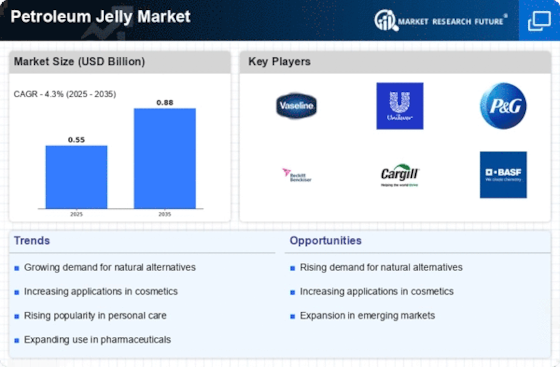
As per Market Research Future analysis, the Petroleum Jelly Market Size was estimated at 0.5528 USD Billion in 2024. The Petroleum Jelly industry is projected to grow from USD 0.5766 Billion in 2025 to USD 0.8786 Billion by 2035, exhibiting a compound annual growth rate (CAGR) of 4.3% during the forecast period 2025 - 2035

Key Market Trends & Highlights

The Petroleum Jelly Market is experiencing notable growth driven by diverse applications and evolving consumer preferences.

  • North America remains the largest market for petroleum jelly, driven by its extensive use in cosmetic and personal care products. Asia-Pacific is identified as the fastest-growing region, reflecting increasing demand in both industrial and medical applications. The industrial segment leads in market share, while the pharmaceutical segment is witnessing rapid growth due to rising health awareness. Key market drivers include the increasing use of petroleum jelly in cosmetics and the rising demand in pharmaceutical applications. Rising demand for USP (United States Pharmacopeia) grade jelly in the pharmaceutical and medical sectors for wound care and dermatological treatments.

Market Size & Forecast

2024 Market Size 0.5528 (USD Billion)
2035 Market Size 0.8786 (USD Billion)
CAGR (2025 - 2035) 4.3%
Largest Regional Market Share in 2024 North America

Major Players

Vaseline (GB), Unilever (GB), Procter &amp; Gamble (US), Reckitt Benckiser (GB), Cargill (US), BASF (DE), Colgate-Palmolive (US), Henkel (DE), Kao Corporation (JP)

Market Trends

The Petroleum Jelly Market is currently experiencing a notable evolution, driven by various factors that influence consumer preferences and industry dynamics. The versatility of petroleum jelly, recognized for its moisturizing properties and protective qualities, positions it as a staple in personal care and pharmaceutical applications. As consumers increasingly seek natural and multifunctional products, the demand for petroleum jelly appears to be on the rise. This trend is further supported by the growing awareness of skin health and the importance of using effective barrier products. Moreover, the market landscape is shifting as manufacturers innovate to enhance product formulations, incorporating additional beneficial ingredients. This adaptation not only caters to the evolving needs of consumers but also aligns with the broader trend of sustainability in product development. The Petroleum Jelly Market seems poised for growth, with potential opportunities emerging in various sectors, including cosmetics, healthcare, and even industrial applications. As the market continues to evolve, stakeholders must remain vigilant to emerging trends and consumer preferences that could shape the future of petroleum jelly products.

Rising Demand for Natural Ingredients

There is a growing consumer preference for products that contain natural and organic components. This trend is influencing the Petroleum Jelly Market, as manufacturers explore ways to incorporate natural additives while maintaining the efficacy of traditional formulations.

Expansion in Personal Care Applications

The use of petroleum jelly in personal care products is expanding, with brands increasingly integrating it into formulations for lip care, moisturizers, and skin treatments. This diversification reflects a broader trend towards multifunctional products that cater to various consumer needs.

Sustainability Initiatives in Production

Sustainability is becoming a focal point in the Petroleum Jelly Market, with companies exploring eco-friendly production methods and packaging solutions. This shift not only addresses environmental concerns but also appeals to a growing segment of environmentally conscious consumers.

Petroleum Jelly Market Market Drivers

Increasing Use in Cosmetics

The Petroleum Jelly Market experiences a notable surge in demand due to its extensive application in cosmetics. As consumers increasingly seek products that provide hydration and protection, petroleum jelly serves as a versatile ingredient in lip balms, moisturizers, and skin protectants. The market data indicates that the cosmetics segment accounts for a substantial share of the petroleum jelly market, driven by the growing trend of multifunctional beauty products. This trend is likely to continue as brands innovate to meet consumer preferences for effective and safe formulations. Furthermore, the rise of e-commerce platforms facilitates access to a wider range of cosmetic products containing petroleum jelly, thereby enhancing market growth. As a result, the petroleum jelly market is poised to benefit from the ongoing expansion of the cosmetics sector.

Expanding Use in Food Industry

The Petroleum Jelly Market is witnessing an intriguing trend with the expanding use of petroleum jelly in the food industry. It is utilized as a food-grade lubricant and release agent in various food processing applications. The market data indicates that the food sector's demand for petroleum jelly is on the rise, driven by the need for safe and effective solutions to enhance production efficiency. As food manufacturers increasingly prioritize hygiene and safety, the use of food-grade petroleum jelly is likely to gain traction. This trend may lead to new opportunities for growth within the petroleum jelly market, as companies explore innovative applications in food processing and packaging. The intersection of food safety and petroleum jelly's properties could potentially reshape market dynamics in the coming years.

Consumer Awareness and Education

The Petroleum Jelly Market is positively impacted by increasing consumer awareness and education regarding the benefits of petroleum jelly. As consumers become more informed about skincare and personal care products, they are more likely to seek out petroleum jelly for its moisturizing and protective properties. Market data indicates that educational campaigns and social media influence play a crucial role in shaping consumer perceptions and preferences. This heightened awareness is likely to drive demand for petroleum jelly across various applications, including personal care, cosmetics, and pharmaceuticals. Additionally, as consumers prioritize safety and efficacy in their product choices, the petroleum jelly market may experience a shift towards higher-quality formulations. This trend underscores the importance of consumer education in fostering growth within the petroleum jelly market.

Growth in Industrial Applications

The Petroleum Jelly Market is experiencing growth due to its diverse applications in various industrial sectors. Industries such as automotive, manufacturing, and construction utilize petroleum jelly for its lubricating and protective properties. Market data reveals that the industrial segment is expanding, driven by the need for effective lubrication solutions that enhance equipment performance and longevity. As industries increasingly focus on maintenance and operational efficiency, the demand for petroleum jelly as a cost-effective lubricant is likely to rise. Furthermore, the versatility of petroleum jelly in protecting metal surfaces from corrosion and rust adds to its appeal in industrial applications. This trend suggests a promising outlook for the petroleum jelly market as it continues to cater to the evolving needs of various industries.

Rising Demand in Pharmaceutical Applications

The Petroleum Jelly Market is significantly influenced by its increasing utilization in pharmaceutical applications. Petroleum jelly is widely recognized for its emollient properties, making it an essential ingredient in ointments, creams, and other topical formulations. Market data suggests that the pharmaceutical segment is experiencing robust growth, driven by the rising prevalence of skin-related ailments and the need for effective treatment options. Additionally, the growing awareness of the benefits of petroleum jelly in wound care and skin protection further propels its demand in the pharmaceutical sector. As healthcare professionals increasingly recommend petroleum jelly for its protective and soothing qualities, the market is likely to witness sustained growth in this segment, contributing positively to the overall petroleum jelly market.

Market Segment Insights

By Grade: Industrial (Largest) vs. Medical (Fastest-Growing)

In the Petroleum Jelly Market, the Grade segment is primarily divided into Industrial, Medical, and Cosmetic categories. The Industrial segment holds the largest market share, driven by the demand for petroleum jelly in manufacturing processes, lubrication, and protective coatings. Meanwhile, the Medical segment is rapidly gaining traction, fueled by the increasing use of petroleum jelly in healthcare settings for its soothing and protective properties.<br> <br>Pharmaceutical (USP) Grade: The highest value segment. It is ultra-pure, non-comedogenic, and odorless, making it the gold standard for clinical wound dressings, ophthalmic ointments, and infant skincare.<br> <br>Cosmetic Grade: Widely utilized in the personal care industry as an occlusive emollient in lotions, lip balms, and hair care products. It is valued for its ability to lock in moisture and protect the skin barrier.<br> <br>Industrial Grade: Used primarily as a moisture repellent, anti-corrosion agent for battery terminals, and a release agent in various manufacturing processes.

Medical (Dominant) vs. Cosmetic (Emerging)

The Medical grade petroleum jelly is leading the way in the market due to its extensive applications in hospitals and clinics, particularly in wound care, skin protection, and as a base for ointments. Its purity and hypoallergenic properties make it indispensable in medical environments. Conversely, the Cosmetic segment, while emerging, is gaining popularity as consumers seek petroleum jelly for personal care products, including moisturizers and lip balms. This surge is driven by the growing trend of using simple, effective ingredients in beauty products, positioning the Cosmetic segment as a potential growth driver in the coming years.

By End-User: Cosmetic & Personal Care (Largest) vs. Pharmaceuticals (Fastest-Growing)

In the Petroleum Jelly Market, the End-User segment exhibits a diverse distribution of demand across various industries. The Cosmetic &amp; Personal Care sector dominates this market, largely due to the increasing consumer inclination toward multifunctional skincare products that leverage the moisturizing and protective properties of petroleum jelly. Other segments like Pharmaceuticals and Food utilize petroleum jelly but with lower market shares, focusing primarily on specific applications such as ointments and food-grade lubricants. Growth trends within the Petroleum Jelly Market are driven by the rising awareness of the benefits of petroleum jelly across various sectors. The Pharmaceutical sector is anticipated to witness unprecedented growth as innovations and advancements in drug formulations integrate more of this ingredient. Meanwhile, the Cosmetic &amp; Personal Care sector continues robustly with a surge in demand for natural and effective skincare solutions, solidifying its position as the largest segment.<br> <br>Pharmaceuticals &amp; Healthcare: Driven by a global aging population and the increasing prevalence of chronic skin conditions. It is a fundamental ingredient in "slugging" routines and post-operative care.<br> <br>Cosmetics &amp; Personal Care (Dominant): Holds the largest revenue share. Petroleum jelly is favored by manufacturers for its cost-effectiveness, long shelf life, and hypoallergenic properties.<br> <br>Industrial &amp; Shipping: Utilized for rust prevention and as a component in cable filling compounds and specialized greases.

Cosmetic &amp; Personal Care: Dominant vs. Pharmaceuticals: Emerging

The Cosmetic &amp; Personal Care segment is characterized by its extensive application of petroleum jelly in skin care products, lip balms, and hair treatments, making it a dominant force in the industry. The appeal stems from its ability to hydrate and protect the skin, catering to a vast consumer demographic. On the other hand, the Pharmaceuticals segment, while currently emerging, is rapidly gaining traction due to the increase in healthcare awareness and the development of new therapeutic applications. This segment primarily utilizes petroleum jelly for its emollient properties in topical formulations, positioning it as a vital ingredient in composing ointments and bulk drug manufacturing. The growing trend towards natural and hypoallergenic products is paving the way for both segments to explore innovative uses of petroleum jelly.

Get more detailed insights about Petroleum Jelly Market Research Report - Global Forecast by 2035

Regional Insights

North America : Market Leader in Demand

North America is the largest market for petroleum jelly, accounting for approximately 40% of global consumption. The region's growth is driven by increasing demand in personal care and pharmaceutical applications, alongside a robust regulatory framework that ensures product safety and quality. The presence of major players like Procter & Gamble and Unilever further fuels market expansion, supported by rising consumer awareness regarding skin care products. The United States leads the North American market, followed by Canada, which contributes significantly to the overall demand. The competitive landscape is characterized by established brands such as Vaseline and Colgate-Palmolive, which dominate the market share. The focus on innovation and sustainable practices among these key players is expected to enhance product offerings, catering to evolving consumer preferences.

Europe : Regulatory Framework Drives Growth

Europe is witnessing a steady growth in the petroleum jelly market, holding approximately 30% of the global share. The region's growth is propelled by stringent regulations that ensure product safety and efficacy, particularly in cosmetics and pharmaceuticals. Countries like Germany and the UK are at the forefront, with increasing consumer demand for natural and organic products driving innovation in formulations and packaging. Germany is the largest market in Europe, followed closely by the UK and France. The competitive landscape features key players such as Reckitt Benckiser and BASF, who are investing in research and development to meet regulatory standards and consumer expectations. The presence of a well-established distribution network further enhances market accessibility, making petroleum jelly a staple in households across the region.

Asia-Pacific : Emerging Market Potential

Asia-Pacific is rapidly emerging as a significant player in the petroleum jelly market, accounting for about 25% of global consumption. The region's growth is driven by increasing urbanization, rising disposable incomes, and a growing awareness of personal care products. Countries like China and India are leading this trend, with a surge in demand for skincare and cosmetic products, supported by favorable government policies promoting the cosmetics industry. China is the largest market in the region, followed by India, where the presence of local and international brands is intensifying competition. Key players such as Kao Corporation and Unilever are expanding their product lines to cater to diverse consumer needs. The competitive landscape is characterized by a mix of established brands and emerging local players, driving innovation and affordability in the market.

Middle East and Africa : Untapped Market Opportunities

The Middle East and Africa region is gradually developing its petroleum jelly market, currently holding about 5% of the global share. The growth is primarily driven by increasing consumer awareness regarding skincare and the rising demand for personal care products. Countries like South Africa and the UAE are leading the market, supported by a growing middle class and urbanization trends that enhance product accessibility. South Africa is the largest market in the region, with the UAE following closely. The competitive landscape is evolving, with both local and international brands vying for market share. Key players such as Cargill and Henkel are focusing on expanding their distribution networks and product offerings to tap into the growing demand, while also addressing the unique needs of consumers in this diverse region.

Key Players and Competitive Insights

Leading players in the Petroleum Jelly Market are focusing on product innovation, sustainability, and expanding their presence. Companies invest in research and development to create specialized formulations for various end-user industries, including personal care, pharmaceuticals, and food. Emphasis on sustainable sourcing, eco-friendly packaging, and adherence to quality standards contributes to diverse market developments. Strategic collaborations, mergers, and acquisitions are common, enabling these players to strengthen their market position, diversify their product portfolios, and adapt to evolving consumer preferences.Manufacturing locally to minimize operational costs is one of the key business tactics used by manufacturers in the Petroleum Jelly industry to benefit clients and increase the market sector. In recent years, the Petroleum Jelly industry has offered some of the most significant advantages to medicine. Major players in the Petroleum Jelly Market, including CITGO Petroleum Corporation, Exxon Mobil Corporation, Royal Dutch Shell plc, Calumet Specialty Products Partners, L.P., Eastern Petroleum Pvt.Ltd., Hindustan Unilever Limited, The Procter & Gamble Company, Vaseline (Unilever), Sonneborn, LLC and Renova and others, are attempting to increase market demand by investing in research and development operations.CITGO Petroleum Corporation, a prominent player in the petroleum industry, contributes to the Petroleum Jelly Market. The company is involved in the refining, marketing, and distribution of various petroleum products, including Petroleum Jelly Market. With a focus on quality and innovation, CITGO serves diverse industries, such as personal care, pharmaceuticals, and industrial applications. Leveraging its refining capabilities, the company ensures the production of high-quality Petroleum Jelly Market for a range of end-users. CITGO's commitment to sustainability and adherence to industry standards further strengthens its position in the competitive Petroleum Jelly Market, offering reliable solutions to meet the diverse needs of its customers.Hindustan Unilever Limited (HUL) is a leading player in the Petroleum Jelly Market, recognized for its diverse range of consumer goods. With a strong presence in the personal care segment, HUL offers Petroleum Jelly Market under brands like Vaseline. The company emphasizes product innovation, quality, and sustainability. Leveraging its expertise and distribution network, HUL caters to a wide consumer base in the personal care and pharmaceutical sectors.The brand's commitment to meeting evolving consumer preferences and delivering effective skincare solutions positions Hindustan Unilever as a key contributor to the Petroleum Jelly Market, where Vaseline has become a trusted and widely used brand.

Key Companies in the Petroleum Jelly Market include

Industry Developments

September 2022: "Color cosmetics packaging has introduced sustainable ingredients and packaging solutions for various products, ranging from palettes to glass jars. These advancements underscore the ongoing expansion within the beauty sector. The most recent addition to the Roberts Beauty Innovation program is Tip Tubes, unveiled at Makeup in New York in 2022, showcasing the industry's commitment to innovation and meeting evolving consumer expectations."

July 2022: "Chinese consumers can now buy onTop's innovative Renewal Oil Cream with packaging molecularly recycled through a collaboration with Eastman and WWP Beauty. onTop cosmetics proudly stands as the inaugural Chinese beauty brand to adopt Cristal Renew, a sustainable resin facilitated by Eastman's molecular recycling technologies. This cutting-edge skincare packaging is a product of the collaborative efforts among onTop and its value chain partners."

Future Outlook

Petroleum Jelly Market Future Outlook

The Petroleum Jelly Market is projected to grow at a 4.3% CAGR from 2025 to 2035, driven by increasing demand in personal care and industrial applications.

New opportunities lie in:

  • <p>Expansion into eco-friendly petroleum jelly formulations Development of specialized petroleum jelly for medical applications Strategic partnerships with e-commerce platforms for direct sales</p>

By 2035, the market is expected to solidify its position as a key player in personal care and industrial sectors.

Market Segmentation

Petroleum Jelly Market Grade Outlook

  • Industrial
  • Medical
  • Cosmetic

Petroleum Jelly Market End-User Outlook

  • Pharmaceuticals
  • Cosmetic & Personal Care
  • Food
  • Textile
  • Leather
  • Others

Report Scope

MARKET SIZE 2024 0.5528(USD Billion)
MARKET SIZE 2025 0.5766(USD Billion)
MARKET SIZE 2035 0.8786(USD Billion)
COMPOUND ANNUAL GROWTH RATE (CAGR) 4.3% (2025 - 2035)
REPORT COVERAGE Revenue Forecast, Competitive Landscape, Growth Factors, and Trends
BASE YEAR 2024
Market Forecast Period 2025 - 2035
Historical Data 2019 - 2024
Market Forecast Units USD Billion
Key Companies Profiled Vaseline (GB), Unilever (GB), Procter & Gamble (US), Reckitt Benckiser (GB), Cargill (US), BASF (DE), Colgate-Palmolive (US), Henkel (DE), Kao Corporation (JP)
Segments Covered Grade, End-User, Region
Key Market Opportunities Growing demand for natural and organic formulations in the Petroleum Jelly Market presents significant opportunities.
Key Market Dynamics Rising consumer preference for natural ingredients drives innovation and competition in the petroleum jelly market.
Countries Covered North America, Europe, APAC, South America, MEA

FAQs

What is the current valuation of the Petroleum Jelly Market as of 2024?

<p>The Petroleum Jelly Market was valued at 0.5528 USD Billion in 2024.</p>

What is the projected market valuation for Petroleum Jelly by 2035?

<p>The market is projected to reach a valuation of 0.8786 USD Billion by 2035.</p>

What is the expected CAGR for the Petroleum Jelly Market during the forecast period 2025 - 2035?

<p>The expected CAGR for the Petroleum Jelly Market during 2025 - 2035 is 4.3%.</p>

Which segments are included in the Petroleum Jelly Market data?

<p>The market segments include Industrial, Medical, and Cosmetic grades.</p>

What were the valuations for the Medical segment in 2024?

<p>The Medical segment was valued at 0.2278 USD Billion in 2024.</p>

How does the Cosmetic segment's valuation compare between 2024 and projected figures for 2035?

<p>The Cosmetic segment was valued at 0.1592 USD Billion in 2024 and is expected to grow to 0.2637 USD Billion by 2035.</p>

Who are the key players in the Petroleum Jelly Market?

Key players include Vaseline, Unilever, Procter &amp; Gamble, and Reckitt Benckiser.

What is the projected growth for the Pharmaceutical end-user segment by 2035?

The Pharmaceutical end-user segment is projected to grow from 0.15 USD Billion in 2024 to 0.25 USD Billion by 2035.

What is the valuation range for the Food end-user segment in 2024?

The Food end-user segment was valued between 0.05 and 0.1 USD Billion in 2024.

What trends are influencing the growth of the Petroleum Jelly Market?

Trends such as increased demand in cosmetic and personal care applications are likely influencing market growth.

What is the difference between "Petrolatum" and "Petroleum Jelly"?

"Petrolatum" is the technical chemical name for the substance. "Petroleum Jelly" is the common consumer name. In the industry, "White Petrolatum" refers to the highly refined version used in medicine and cosmetics.

  1. SECTION I: EXECUTIVE SUMMARY AND KEY HIGHLIGHTS |
    1. EXECUTIVE SUMMARY | |
      1. Market Overview | |
      2. Key Findings | |
      3. Market Segmentation | |
      4. Competitive Landscape | |
      5. Challenges and Opportunities | |
      6. Future Outlook 2
  2. SECTION II: SCOPING, METHODOLOGY AND MARKET STRUCTURE |
    1. MARKET INTRODUCTION | |
      1. Definition | |
      2. Scope of the study | | |
    2. RESEARCH METHODOLOGY | |
      1. Overview | |
      2. Data Mining | |
      3. Secondary Research | |
      4. Primary Research | | |
      5. Forecasting Model | |
      6. Market Size Estimation | | |
      7. Data Triangulation | |
      8. Validation 3
  3. SECTION III: QUALITATIVE ANALYSIS |
    1. MARKET DYNAMICS | |
      1. Overview | |
      2. Drivers | |
      3. Restraints | |
      4. Opportunities |
    2. MARKET FACTOR ANALYSIS | |
      1. Value chain Analysis | |
      2. Porter's Five Forces Analysis | | |
      3. COVID-19 Impact Analysis | | |
  4. SECTION IV: QUANTITATIVE ANALYSIS |
    1. Chemicals and Materials, BY Grade (USD Billion) | |
      1. Industrial | |
      2. Medical | |
      3. Cosmetic |
    2. Chemicals and Materials, BY End-User (USD Billion) | |
      1. Pharmaceuticals | |
      2. Cosmetic & Personal Care | |
      3. Food | |
      4. Textile | |
      5. Leather | |
      6. Others |
    3. Chemicals and Materials, BY Region (USD Billion) | |
      1. North America | | |
      2. Europe | | |
      3. APAC | | |
      4. South America | | |
      5. MEA | | |
  5. SECTION V: COMPETITIVE ANALYSIS |
    1. Competitive Landscape | |
      1. Overview | |
      2. Competitive Analysis | |
      3. Market share Analysis | |
      4. Major Growth Strategy in the Chemicals and Materials | |
      5. Competitive Benchmarking | |
      6. Leading Players in Terms of Number of Developments in the Chemicals and Materials | |
      7. Key developments and growth strategies | | |
      8. Major Players Financial Matrix | | |
    2. Company Profiles | |
      1. Vaseline (GB) | | |
      2. Unilever (GB) | | |
      3. Procter & Gamble (US) | | |
      4. Reckitt Benckiser (GB) | | |
      5. Cargill (US) | | |
      6. BASF (DE) | | |
      7. Colgate-Palmolive (US) | | |
      8. Henkel (DE) | | |
      9. Kao Corporation (JP) | | |
    3. Appendix | |
      1. References | |
      2. Related Reports 6 LIST OF FIGURES |
    4. MARKET SYNOPSIS |
    5. NORTH AMERICA MARKET ANALYSIS |
    6. US MARKET ANALYSIS BY GRADE |
    7. US MARKET ANALYSIS BY END-USER |
    8. CANADA MARKET ANALYSIS BY GRADE |
    9. CANADA MARKET ANALYSIS BY END-USER |
    10. EUROPE MARKET ANALYSIS |
    11. GERMANY MARKET ANALYSIS BY GRADE |
    12. GERMANY MARKET ANALYSIS BY END-USER |
    13. UK MARKET ANALYSIS BY GRADE |
    14. UK MARKET ANALYSIS BY END-USER |
    15. FRANCE MARKET ANALYSIS BY GRADE |
    16. FRANCE MARKET ANALYSIS BY END-USER |
    17. RUSSIA MARKET ANALYSIS BY GRADE |
    18. RUSSIA MARKET ANALYSIS BY END-USER |
    19. ITALY MARKET ANALYSIS BY GRADE |
    20. ITALY MARKET ANALYSIS BY END-USER |
    21. SPAIN MARKET ANALYSIS BY GRADE |
    22. SPAIN MARKET ANALYSIS BY END-USER |
    23. REST OF EUROPE MARKET ANALYSIS BY GRADE |
    24. REST OF EUROPE MARKET ANALYSIS BY END-USER |
    25. APAC MARKET ANALYSIS |
    26. CHINA MARKET ANALYSIS BY GRADE |
    27. CHINA MARKET ANALYSIS BY END-USER |
    28. INDIA MARKET ANALYSIS BY GRADE |
    29. INDIA MARKET ANALYSIS BY END-USER |
    30. JAPAN MARKET ANALYSIS BY GRADE |
    31. JAPAN MARKET ANALYSIS BY END-USER |
    32. SOUTH KOREA MARKET ANALYSIS BY GRADE |
    33. SOUTH KOREA MARKET ANALYSIS BY END-USER |
    34. MALAYSIA MARKET ANALYSIS BY GRADE |
    35. MALAYSIA MARKET ANALYSIS BY END-USER |
    36. THAILAND MARKET ANALYSIS BY GRADE |
    37. THAILAND MARKET ANALYSIS BY END-USER |
    38. INDONESIA MARKET ANALYSIS BY GRADE |
    39. INDONESIA MARKET ANALYSIS BY END-USER |
    40. REST OF APAC MARKET ANALYSIS BY GRADE |
    41. REST OF APAC MARKET ANALYSIS BY END-USER |
    42. SOUTH AMERICA MARKET ANALYSIS |
    43. BRAZIL MARKET ANALYSIS BY GRADE |
    44. BRAZIL MARKET ANALYSIS BY END-USER |
    45. MEXICO MARKET ANALYSIS BY GRADE |
    46. MEXICO MARKET ANALYSIS BY END-USER |
    47. ARGENTINA MARKET ANALYSIS BY GRADE |
    48. ARGENTINA MARKET ANALYSIS BY END-USER |
    49. REST OF SOUTH AMERICA MARKET ANALYSIS BY GRADE |
    50. REST OF SOUTH AMERICA MARKET ANALYSIS BY END-USER |
    51. MEA MARKET ANALYSIS |
    52. GCC COUNTRIES MARKET ANALYSIS BY GRADE |
    53. GCC COUNTRIES MARKET ANALYSIS BY END-USER |
    54. SOUTH AFRICA MARKET ANALYSIS BY GRADE |
    55. SOUTH AFRICA MARKET ANALYSIS BY END-USER |
    56. REST OF MEA MARKET ANALYSIS BY GRADE |
    57. REST OF MEA MARKET ANALYSIS BY END-USER |
    58. KEY BUYING CRITERIA OF CHEMICALS AND MATERIALS |
    59. RESEARCH PROCESS OF MRFR |
    60. DRO ANALYSIS OF CHEMICALS AND MATERIALS |
    61. DRIVERS IMPACT ANALYSIS: CHEMICALS AND MATERIALS |
    62. RESTRAINTS IMPACT ANALYSIS: CHEMICALS AND MATERIALS |
    63. SUPPLY / VALUE CHAIN: CHEMICALS AND MATERIALS |
    64. CHEMICALS AND MATERIALS, BY GRADE, 2024 (% SHARE) |
    65. CHEMICALS AND MATERIALS, BY GRADE, 2024 TO 2035 (USD Billion) |
    66. CHEMICALS AND MATERIALS, BY END-USER, 2024 (% SHARE) |
    67. CHEMICALS AND MATERIALS, BY END-USER, 2024 TO 2035 (USD Billion) |
    68. BENCHMARKING OF MAJOR COMPETITORS 7 LIST OF TABLES |
    69. LIST OF ASSUMPTIONS | |
      1. |
    70. North America MARKET SIZE ESTIMATES; FORECAST | |
      1. BY GRADE, 2025-2035 (USD Billion) | |
      2. BY END-USER, 2025-2035 (USD Billion) |
    71. US MARKET SIZE ESTIMATES; FORECAST | |
      1. BY GRADE, 2025-2035 (USD Billion) | |
      2. BY END-USER, 2025-2035 (USD Billion) |
    72. Canada MARKET SIZE ESTIMATES; FORECAST | |
      1. BY GRADE, 2025-2035 (USD Billion) | |
      2. BY END-USER, 2025-2035 (USD Billion) |
    73. Europe MARKET SIZE ESTIMATES; FORECAST | |
      1. BY GRADE, 2025-2035 (USD Billion) | |
      2. BY END-USER, 2025-2035 (USD Billion) |
    74. Germany MARKET SIZE ESTIMATES; FORECAST | |
      1. BY GRADE, 2025-2035 (USD Billion) | |
      2. BY END-USER, 2025-2035 (USD Billion) |
    75. UK MARKET SIZE ESTIMATES; FORECAST | |
      1. BY GRADE, 2025-2035 (USD Billion) | |
      2. BY END-USER, 2025-2035 (USD Billion) |
    76. France MARKET SIZE ESTIMATES; FORECAST | |
      1. BY GRADE, 2025-2035 (USD Billion) | |
      2. BY END-USER, 2025-2035 (USD Billion) |
    77. Russia MARKET SIZE ESTIMATES; FORECAST | |
      1. BY GRADE, 2025-2035 (USD Billion) | |
      2. BY END-USER, 2025-2035 (USD Billion) |
    78. Italy MARKET SIZE ESTIMATES; FORECAST | |
      1. BY GRADE, 2025-2035 (USD Billion) | |
      2. BY END-USER, 2025-2035 (USD Billion) |
    79. Spain MARKET SIZE ESTIMATES; FORECAST | |
      1. BY GRADE, 2025-2035 (USD Billion) | |
      2. BY END-USER, 2025-2035 (USD Billion) |
    80. Rest of Europe MARKET SIZE ESTIMATES; FORECAST | |
      1. BY GRADE, 2025-2035 (USD Billion) | |
      2. BY END-USER, 2025-2035 (USD Billion) |
    81. APAC MARKET SIZE ESTIMATES; FORECAST | |
      1. BY GRADE, 2025-2035 (USD Billion) | |
      2. BY END-USER, 2025-2035 (USD Billion) |
    82. China MARKET SIZE ESTIMATES; FORECAST | |
      1. BY GRADE, 2025-2035 (USD Billion) | |
      2. BY END-USER, 2025-2035 (USD Billion) |
    83. India MARKET SIZE ESTIMATES; FORECAST | |
      1. BY GRADE, 2025-2035 (USD Billion) | |
      2. BY END-USER, 2025-2035 (USD Billion) |
    84. Japan MARKET SIZE ESTIMATES; FORECAST | |
      1. BY GRADE, 2025-2035 (USD Billion) | |
      2. BY END-USER, 2025-2035 (USD Billion) |
    85. South Korea MARKET SIZE ESTIMATES; FORECAST | |
      1. BY GRADE, 2025-2035 (USD Billion) | |
      2. BY END-USER, 2025-2035 (USD Billion) |
    86. Malaysia MARKET SIZE ESTIMATES; FORECAST | |
      1. BY GRADE, 2025-2035 (USD Billion) | |
      2. BY END-USER, 2025-2035 (USD Billion) |
    87. Thailand MARKET SIZE ESTIMATES; FORECAST | |
      1. BY GRADE, 2025-2035 (USD Billion) | |
      2. BY END-USER, 2025-2035 (USD Billion) |
    88. Indonesia MARKET SIZE ESTIMATES; FORECAST | |
      1. BY GRADE, 2025-2035 (USD Billion) | |
      2. BY END-USER, 2025-2035 (USD Billion) |
    89. Rest of APAC MARKET SIZE ESTIMATES; FORECAST | |
      1. BY GRADE, 2025-2035 (USD Billion) | |
      2. BY END-USER, 2025-2035 (USD Billion) |
    90. South America MARKET SIZE ESTIMATES; FORECAST | |
      1. BY GRADE, 2025-2035 (USD Billion) | |
      2. BY END-USER, 2025-2035 (USD Billion) |
    91. Brazil MARKET SIZE ESTIMATES; FORECAST | |
      1. BY GRADE, 2025-2035 (USD Billion) | |
      2. BY END-USER, 2025-2035 (USD Billion) |
    92. Mexico MARKET SIZE ESTIMATES; FORECAST | |
      1. BY GRADE, 2025-2035 (USD Billion) | |
      2. BY END-USER, 2025-2035 (USD Billion) |
    93. Argentina MARKET SIZE ESTIMATES; FORECAST | |
      1. BY GRADE, 2025-2035 (USD Billion) | |
      2. BY END-USER, 2025-2035 (USD Billion) |
    94. Rest of South America MARKET SIZE ESTIMATES; FORECAST | |
      1. BY GRADE, 2025-2035 (USD Billion) | |
      2. BY END-USER, 2025-2035 (USD Billion) |
    95. MEA MARKET SIZE ESTIMATES; FORECAST | |
      1. BY GRADE, 2025-2035 (USD Billion) | |
      2. BY END-USER, 2025-2035 (USD Billion) |
    96. GCC Countries MARKET SIZE ESTIMATES; FORECAST | |
      1. BY GRADE, 2025-2035 (USD Billion) | |
      2. BY END-USER, 2025-2035 (USD Billion) |
    97. South Africa MARKET SIZE ESTIMATES; FORECAST | |
      1. BY GRADE, 2025-2035 (USD Billion) | |
      2. BY END-USER, 2025-2035 (USD Billion) |
    98. Rest of MEA MARKET SIZE ESTIMATES; FORECAST | |
      1. BY GRADE, 2025-2035 (USD Billion) | |
      2. BY END-USER, 2025-2035 (USD Billion) |
    99. PRODUCT LAUNCH/PRODUCT DEVELOPMENT/APPROVAL | |
      1. |
    100. ACQUISITION/PARTNERSHIP | |

Chemicals and Materials Market Segmentation

Chemicals and Materials By Grade (USD Billion, 2025-2035)

  • Industrial
  • Medical
  • Cosmetic

Chemicals and Materials By End-User (USD Billion, 2025-2035)

  • Pharmaceuticals
  • Cosmetic & Personal Care
  • Food
  • Textile
  • Leather
  • Others
Infographic

Free Sample Request

Kindly complete the form below to receive a free sample of this Report

Get Free Sample

Customer Strories

Compare Licence

×
Features License Type
Single User Multiuser License Enterprise User
Price $4,950 $5,950 $7,250
Maximum User Access Limit 1 User Upto 10 Users Unrestricted Access Throughout the Organization
Free Customization
Direct Access to Analyst
Deliverable Format
Platform Access
Discount on Next Purchase 10% 15% 15%
Printable Versions