Request Free Sample ×

Kindly complete the form below to receive a free sample of this Report

* Please use a valid business email

Leading companies partner with us for data-driven Insights

clients tt-cursor
Hero Background
English
Chinese
French
Japanese
Korean
German
Spanish

Persulfates Market Share

ID: MRFR/CnM/4667-HCR
100 Pages
Priya Nagrale
March 2026

Persulfates Market Research Report Information By Type (Ammonium, Sodium, Potassium), By End-use (Polymers, Electronics, Oil & Gas), And By Region (North America, Europe, Asia-Pacific, And Rest Of The World) – Market Forecast Till 2035

Share:
Download PDF ×

We do not share your information with anyone. However, we may send you emails based on your report interest from time to time. You may contact us at any time to opt-out.

Persulfates Market Infographic
Purchase Options

Market Share

Persulfates Market Share Analysis

The global cosmetics market has consistently demonstrated year-on-year growth since 2014, with particular emphasis on the skincare products sector. Notably, the skincare products market, a significant consumer of anti-aging products, has exhibited almost double the growth rate of the overall cosmetics market. In 2019, it recorded a remarkable 9% growth, surpassing the 5% growth observed in the global cosmetics market during the same period. Within the realm of cosmetics, inorganic salts such as ammonium persulfate, potassium persulfate, and sodium persulfate play crucial roles as oxidizing agents. These persulfates, either individually or in combinations, find applications in various cosmetic products. Mixtures of ammonium persulfate, potassium persulfate, and sodium persulfate, for instance, are integral components in formulations for hair colorants, hair lighteners, and hair bleaches. Ammonium persulfates specifically contribute to eye makeup preparations, tonics, dressings, and other hair grooming aids, while sodium persulfates are employed in dentifrices. Potassium persulfates, on the other hand, feature prominently in tonics, dressings, and other hair grooming aids.

An analysis of ingredients used in cosmetics, specifically in hair coloring and hair bleaching products, reveals shifting trends over the years. According to 2017 VCRP data comparing concentrations between 1995 and 2015, ammonium persulfate decreased from 60% in 1995 to 44.1% in 2015, potassium persulfate increased from 60% to 72.5%, and sodium persulfate decreased from 60% to 33.4%. This evolving landscape indicates a dynamic industry responding to changing consumer preferences and technological advancements.

As individuals increasingly allocate resources to cosmetic products, the demand for persulfates is anticipated to witness a significant upswing in the coming years. Several factors contribute to the robust growth of the cosmetics market, including the expansion of the middle and upper-income classes, the identification of new consumer demographics such as seniors and men, the impact of the digital revolution in engaging with consumers online, and the prevalence of e-commerce, which extends the beauty industry's reach to a more extensive global consumer base. In essence, these drivers underscore the thriving and evolving nature of the cosmetics market, with persulfates playing a vital role in its continued advancement.

Author
Author Profile
Priya Nagrale
Senior Research Analyst

With an experience of over five years in market research industry (Chemicals & Materials domain), I gather and analyze market data from diverse sources to produce results, which are then presented back to a client. Also, provide recommendations based on the findings. As a Senior Research Analyst, I perform quality checks (QC) for market estimations, QC for reports, and handle queries and work extensively on client customizations. Also, handle the responsibilities of client proposals, report planning, report finalization, and execution

Leave a Comment

FAQs

What is the current valuation of the Persulfates Market as of 2024?

<p>The Persulfates Market was valued at 0.8672 USD Billion in 2024.</p>

What is the projected market size for the Persulfates Market in 2035?

<p>The market is projected to reach 1.604 USD Billion by 2035.</p>

What is the expected CAGR for the Persulfates Market during the forecast period 2025 - 2035?

<p>The expected CAGR for the Persulfates Market during 2025 - 2035 is 5.75%.</p>

Which companies are considered key players in the Persulfates Market?

<p>Key players in the market include PeroxyChem, AkzoNobel, BASF, Evonik Industries, Fujifilm, Mitsubishi Gas Chemical, Sodium Persulfate, Hawkins, and Solvay.</p>

What are the main types of persulfates in the market and their valuations?

<p>The main types include Ammonium Persulfate valued at 0.3 to 0.55 USD Billion, Sodium Persulfate at 0.4 to 0.8 USD Billion, and Potassium Persulfate at 0.1672 to 0.254 USD Billion.</p>

What are the primary end-use segments for persulfates and their market values?

<p>Primary end-use segments include Polymers valued at 0.3 to 0.55 USD Billion, Electronics at 0.25 to 0.45 USD Billion, and Oil & Gas at 0.3172 to 0.604 USD Billion.</p>

How does the growth of the Persulfates Market compare to other chemical markets?

<p>The growth of the Persulfates Market, with a projected CAGR of 5.75%, suggests a robust performance compared to other chemical markets.</p>

What factors are driving the growth of the Persulfates Market?

<p>Factors driving growth may include increasing demand in various industries such as polymers, electronics, and oil & gas.</p>

How does the market valuation of 2024 compare to the projected valuation in 2035?

<p>The market valuation increased from 0.8672 USD Billion in 2024 to a projected 1.604 USD Billion in 2035.</p>

What role do key players like BASF and AkzoNobel play in the Persulfates Market?

<p>Key players like BASF and AkzoNobel likely influence market dynamics through innovation and competitive strategies.</p>

Market Summary

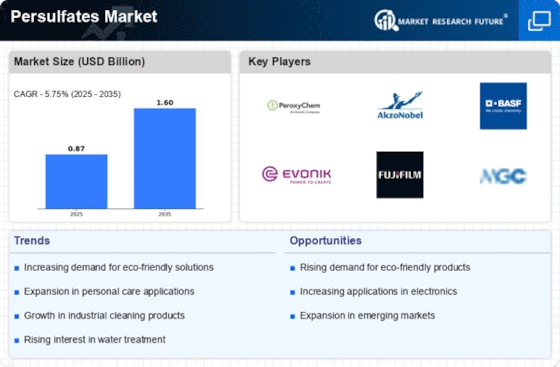
As per Market Research Future analysis, the Persulfates Market Size was estimated at 0.8672 USD Billion in 2024. The Persulfates industry is projected to grow from 0.917 USD Billion in 2025 to 1.604 USD Billion by 2035, exhibiting a compound annual growth rate (CAGR) of 5.75% during the forecast period 2025 - 2035

Key Market Trends & Highlights

The Persulfates Market is experiencing robust growth driven by diverse applications and technological advancements.

  • The North American region remains the largest market for persulfates, driven by extensive industrial applications. Asia-Pacific is emerging as the fastest-growing region, fueled by increasing demand in various sectors. Ammonium persulfate holds the largest market share, while sodium persulfate is witnessing rapid growth due to its versatility. Key market drivers include the rising demand in the textile industry and the expansion in electronics manufacturing.

Market Size & Forecast

2024 Market Size 0.8672 (USD Billion)
2035 Market Size 1.604 (USD Billion)
CAGR (2025 - 2035) 5.75%
Largest Regional Market Share in 2024 Asia Pacific

Major Players

PeroxyChem (US), AkzoNobel (NL), BASF (DE), Evonik Industries (DE), Fujifilm (JP), Mitsubishi Gas Chemical (JP), Sodium Persulfate (US), Hawkins (US), Solvay (BE)

Market Trends

The Persulfates Market is currently experiencing a notable evolution, driven by various factors that influence its demand and application across multiple industries. The increasing utilization of persulfates in sectors such as cosmetics, electronics, and water treatment appears to be a primary catalyst for market growth. Furthermore, the rising awareness regarding environmental sustainability may lead to a shift towards more eco-friendly alternatives, thereby impacting the production and consumption patterns within this market. As industries seek to enhance their operational efficiency, the demand for high-purity persulfates is likely to rise, suggesting a potential shift in manufacturing processes to accommodate this need. In addition, The Persulfates Market could witness advancements in production technologies. This may result in improved product quality and reduced environmental impact. Moreover, the expansion of distribution networks and the emergence of new applications for persulfates could further stimulate market dynamics. Overall, the Persulfates Market seems poised for growth, with various trends shaping its future trajectory, reflecting the interplay between technological advancements and evolving consumer preferences.

Rising Demand in Water Treatment

The increasing focus on water purification and treatment processes is driving the demand for persulfates. These compounds are utilized as oxidizing agents in various applications, enhancing the effectiveness of water treatment solutions. As environmental regulations become more stringent, industries are likely to adopt persulfates to meet compliance standards.

Growth in Cosmetic Applications

The cosmetic industry is witnessing a surge in the use of persulfates for their bleaching and oxidizing properties. This trend is fueled by consumer preferences for products that offer enhanced performance and safety. As brands innovate and expand their product lines, the role of persulfates in cosmetics is expected to grow.

Technological Advancements in Production

Innovations in manufacturing processes are anticipated to transform the Persulfates Market. Enhanced production techniques may lead to higher purity levels and reduced environmental impact. This evolution could attract new players and foster competition, ultimately benefiting consumers with improved product offerings.

Persulfates Market Market Drivers

Growth in Environmental Applications

The persulfates market is experiencing growth due to the increasing emphasis on environmental applications. Persulfates Market are recognized for their effectiveness in soil and groundwater remediation, particularly in the treatment of contaminated sites. As regulatory frameworks become more stringent regarding environmental protection, the demand for persulfates in remediation projects is likely to rise. Recent data indicates that the environmental sector could represent a growing segment of the persulfates market, with an anticipated growth rate of around 5% annually. This trend reflects a broader commitment to sustainability and environmental stewardship, positioning persulfates as a vital component in addressing environmental challenges.

Increasing Demand in Textile Industry

The persulfates market is experiencing a notable surge in demand from the textile sector. This growth is primarily driven by the need for effective bleaching agents and oxidizing agents in fabric processing. As manufacturers seek to enhance the quality and durability of textiles, persulfates are increasingly utilized for their superior performance in dyeing and finishing processes. Recent data indicates that the textile industry accounts for a significant portion of persulfate consumption, with projections suggesting a compound annual growth rate of approximately 5% over the next few years. This trend underscores the pivotal role of persulfates in meeting the evolving needs of textile manufacturers, thereby solidifying their position within the persulfates market.

Expansion in Electronics Manufacturing

The persulfates market is witnessing substantial growth due to the expansion of the electronics manufacturing sector. Persulfates Market are essential in the production of printed circuit boards and semiconductor devices, where they serve as etching agents and oxidizers. The increasing demand for electronic devices, driven by advancements in technology and consumer electronics, is likely to propel the consumption of persulfates. Market analysis suggests that the electronics sector could account for a significant share of the persulfates market, with an expected growth rate of around 6% annually. This trend highlights the critical importance of persulfates in supporting the technological advancements within the electronics manufacturing landscape.

Innovations in Industrial Cleaning Solutions

The persulfates market is poised for growth due to innovations in industrial cleaning solutions. Persulfates Market are increasingly employed as powerful cleaning agents in various industrial applications, including the removal of organic contaminants and stains. The demand for effective cleaning solutions in industries such as food processing, pharmaceuticals, and manufacturing is driving the adoption of persulfates. Market trends suggest that the industrial cleaning sector may see a growth rate of approximately 5% in the coming years, as companies seek to enhance their cleaning protocols and ensure compliance with health and safety regulations. This trend underscores the versatility and effectiveness of persulfates in meeting the diverse cleaning needs of various industries.

Rising Adoption in Pharmaceutical Applications

The persulfates market is benefiting from the rising adoption of persulfates in pharmaceutical applications. These compounds are utilized as oxidizing agents in the synthesis of various pharmaceutical intermediates and active ingredients. The increasing focus on developing new drugs and therapies is likely to drive the demand for high-purity persulfates, which are essential for maintaining the integrity of pharmaceutical products. Recent estimates suggest that the pharmaceutical sector may contribute significantly to the overall growth of the persulfates market, with a projected increase in demand of approximately 4% per year. This trend indicates a growing recognition of the value of persulfates in enhancing pharmaceutical manufacturing processes.

Market Segment Insights

By Type: Ammonium (Largest) vs. Sodium (Fastest-Growing)

In the Persulfates Market, the segment distribution showcases Ammonium persulfate as the largest player, holding a significant share. This type is prominently utilized in various applications, such as polymerization and etching in electronics, contributing to its dominance. Sodium persulfate, while smaller in share, is gaining traction due to its versatile applications, including as an oxidative agent in various industries, which is driving its demand.

Ammonium (Dominant) vs. Sodium (Emerging)

Ammonium persulfate is widely recognized for its stability and effectiveness as a strong oxidizing agent, which makes it a dominant choice in the persulfate market. Its extensive use in polymer chemistry and as a bleaching agent highlights its versatility and well-established market presence. In contrast, Sodium persulfate is emerging, primarily due to its environmentally friendly profile and growing adoption in newer applications, such as in the water treatment and energy sectors. The shift towards green chemistry is favoring sodium persulfate's growth, allowing it to carve out a niche in markets focusing on sustainability.

By End-use: Polymers (Largest) vs. Oil & Gas (Fastest-Growing)

In the Persulfates Market, the end-use segment is significantly characterized by its diverse applications, with polymers leading the market share due to their extensive utilization in various industries such as textiles, <a href="https://www.marketresearchfuture.com/reports/plastics-market-8347">plastics</a>, and adhesives. The demand for persulfates derived from detergents and surfactants supports this predominance, which showcases a robust established user base against emerging applications in other sectors. On the other hand, the oil and gas sector represents the fastest-growing application of persulfates, driven largely by the increasing need for enhanced oil recovery and chemical stimulation processes. This growth is supported by the expansion of oil exploration activities and the adoption of innovative extraction technologies, presenting lucrative opportunities for persulfate manufacturers aiming to address evolving needs in this dynamic industry.

Polymers (Dominant) vs. Electronics (Emerging)

The polymers segment dominates the Persulfates Market due to its well-established applications, which include the production of synthetic polymers through oxidation processes. This segment benefits from the reliability and effectiveness of persulfates as initiators, enabling significant growth in various downstream applications. Conversely, the electronics segment, while emerging, is gaining traction due to the increasing demand for semiconductor manufacturing and related processes. As industries innovate and evolve, persulfates are finding new applications in the etching and cleaning of critical electronic components. The electronics segment, although smaller, is poised for growth as technological advancements continue, providing a unique opportunity for persulfate utilization in high-tech applications.

Get more detailed insights about Persulfates Market Research Report – Forecast to 2035

Regional Insights

By region, the study provides market insights into North America, Europe, Asia-Pacific, and the Rest of the World. Asia-Pacific holds the Persulfates Market share on the back of the large consumption of plastics, electronics, and cosmetics & personal care industry. China, South Korea, Taiwan, Japan, Thailand, and India are amongst the top consumers of persulfates in the region. The United States drives the demand in the North America region. The implementation of stringent health and safety regulations in the cosmetic industry may impact the adoption and usage of persulfates in cosmetic products in the region.

The Persulfates Market  in Europe is expected to witness slow growth on the back of a possible ban on persulfates for use in cosmetics. The European Union has voted out to completely ban single-use plastics by 2021, which will severely impact the Persulfates Market as these are used as polymerization initiators in the plastics industry and specifically plastics such as polystyrene that are exposed to the risk of ban. The oil & gas and plastics industry in the Middle East & Africa region drives the demand for persulfates in the region. However, the market is expected to witness slow to moderate growth over the forecast period due to political turbulence in the region.

Mexico & Brazil drives the Persulfates Market in the Latin America region. Emerging economies in the region such as Chile are expected to create new growth opportunities. However, the political & social instability in Latin America is expected to hamper the market growth over the forecast period.

Key Players and Competitive Insights

Major market players are spending a lot of money on R&D to increase their product lines, which will help the Persulfates Market grow even more. Market participants are also taking a range of strategic initiatives to grow their worldwide footprint, with key market developments such as new product launches, contractual agreements, mergers and acquisitions, increased investments, and collaboration with other organizations. Competitors in the Persulfates industry must offer cost-effective items to expand and survive in an increasingly competitive and rising market environment. The major market players are investing a lot of money in R&D to expand their product lines, which will spur further market growth for Persulfates Market. With significant market development like new product releases, contractual agreements, mergers and acquisitions, increased investments, and collaboration with other organizations, market participants are also undertaking various strategic activities to expand their presence. To grow and thrive in a market climate that is becoming more competitive and growing, competitors in the Persulfates industry must offer affordable products. Manufacturing locally to cut operating costs is one of the main business tactics manufacturers use in the Persulfates industry to benefit customers and expand the market sector. The Low-Profile Additives market has recently given medicine some of the most important advantages. Major Persulfates Market players, including Mitsubishi Gas Chemical Company (Japan), Ak-Kim Kimya (Turkey), Adeka Corporation (Japan), Fujian Zhanhua Chemicals (China), and others, are attempting to increase market demand by funding R&D initiatives. Mitsubishi Gas Chemical Company (MGC) is a manufacturer and supplier of chemical products. It offers organic and inorganic chemicals, synthetic resins and rubber, dyes, pigments, paints, adhesives, polymers, and more. The company’s products are used in pharmaceuticals, agriculture, coating compounds, food, and other applications. Also, Fujian ZhanHua Chemical Co., Ltd. was established in 2004, with a registered capital of 30 million yuan. Being a key enterprise of Fujian Province, the company specializes in manufacturing a series of persulfates products. It has the largest specialized industry.

Key Companies in the Persulfates Market include

Industry Developments

  • Q2 2025: A leading U.S. specialty chemicals company announced the launch of a next-generation high-purity ammonium persulfate product aimed at improving efficiency in semiconductor etching applications. In May 2025, a major U.S. specialty chemicals manufacturer introduced a new high-purity ammonium persulfate product designed to enhance performance in semiconductor etching, targeting the electronics sector's demand for advanced materials.


Future Outlook

Persulfates Market Future Outlook

The Persulfates Market is projected to grow at a 5.75% CAGR from 2025 to 2035, driven by increasing demand in various applications and technological advancements. The Persulfates Market is expanding as demand for high-purity oxidizing agents surges. Growth is driven by advanced semiconductor etching, soil remediation projects, and the rising adoption of water-borne polymers in sustainable construction.

New opportunities lie in:

  • <p>Expansion into emerging markets with tailored product offerings. Development of eco-friendly persulfate alternatives for sustainable applications. Investment in advanced manufacturing technologies to enhance production efficiency.</p>

By 2035, the Persulfates Market is expected to achieve robust growth, solidifying its position in diverse industries.

Market Segmentation

Persulfates Market Type Outlook

  • Ammonium
  • Sodium
  • Potassium

Persulfates Market End-use Outlook

  • Polymers
  • Electronics
  • Oil & Gas

Report Scope

MARKET SIZE 2024 0.8672(USD Billion)
MARKET SIZE 2025 0.917(USD Billion)
MARKET SIZE 2035 1.604(USD Billion)
COMPOUND ANNUAL GROWTH RATE (CAGR) 5.75% (2025 - 2035)
REPORT COVERAGE Revenue Forecast, Competitive Landscape, Growth Factors, and Trends
BASE YEAR 2024
Market Forecast Period 2025 - 2035
Historical Data 2019 - 2024
Market Forecast Units USD Billion
Key Companies Profiled PeroxyChem (US), AkzoNobel (NL), BASF (DE), Evonik Industries (DE), Fujifilm (JP), Mitsubishi Gas Chemical (JP), Sodium Persulfate (US), Hawkins (US), Solvay (BE)
Segments Covered Type, End-use, Region
Key Market Opportunities Growing demand for eco-friendly bleaching agents in the Persulfates Market presents significant growth opportunities.
Key Market Dynamics Rising demand for eco-friendly bleaching agents drives innovation and competition in the persulfates market.
Countries Covered North America, Europe, APAC, South America, MEA

FAQs

What is the current valuation of the Persulfates Market as of 2024?

<p>The Persulfates Market was valued at 0.8672 USD Billion in 2024.</p>

What is the projected market size for the Persulfates Market in 2035?

<p>The market is projected to reach 1.604 USD Billion by 2035.</p>

What is the expected CAGR for the Persulfates Market during the forecast period 2025 - 2035?

<p>The expected CAGR for the Persulfates Market during 2025 - 2035 is 5.75%.</p>

Which companies are considered key players in the Persulfates Market?

<p>Key players in the market include PeroxyChem, AkzoNobel, BASF, Evonik Industries, Fujifilm, Mitsubishi Gas Chemical, Sodium Persulfate, Hawkins, and Solvay.</p>

What are the main types of persulfates in the market and their valuations?

<p>The main types include Ammonium Persulfate valued at 0.3 to 0.55 USD Billion, Sodium Persulfate at 0.4 to 0.8 USD Billion, and Potassium Persulfate at 0.1672 to 0.254 USD Billion.</p>

What are the primary end-use segments for persulfates and their market values?

<p>Primary end-use segments include Polymers valued at 0.3 to 0.55 USD Billion, Electronics at 0.25 to 0.45 USD Billion, and Oil & Gas at 0.3172 to 0.604 USD Billion.</p>

How does the growth of the Persulfates Market compare to other chemical markets?

<p>The growth of the Persulfates Market, with a projected CAGR of 5.75%, suggests a robust performance compared to other chemical markets.</p>

What factors are driving the growth of the Persulfates Market?

<p>Factors driving growth may include increasing demand in various industries such as polymers, electronics, and oil & gas.</p>

How does the market valuation of 2024 compare to the projected valuation in 2035?

<p>The market valuation increased from 0.8672 USD Billion in 2024 to a projected 1.604 USD Billion in 2035.</p>

What role do key players like BASF and AkzoNobel play in the Persulfates Market?

<p>Key players like BASF and AkzoNobel likely influence market dynamics through innovation and competitive strategies.</p>

  1. SECTION I: EXECUTIVE SUMMARY AND KEY HIGHLIGHTS
    1. | 1.1 EXECUTIVE SUMMARY
    2. | | 1.1.1 Market Overview
    3. | | 1.1.2 Key Findings
    4. | | 1.1.3 Market Segmentation
    5. | | 1.1.4 Competitive Landscape
    6. | | 1.1.5 Challenges and Opportunities
    7. | | 1.1.6 Future Outlook
  2. SECTION II: SCOPING, METHODOLOGY AND MARKET STRUCTURE
    1. | 2.1 MARKET INTRODUCTION
    2. | | 2.1.1 Definition
    3. | | 2.1.2 Scope of the study
    4. | | | 2.1.2.1 Research Objective
    5. | | | 2.1.2.2 Assumption
    6. | | | 2.1.2.3 Limitations
    7. | 2.2 RESEARCH METHODOLOGY
    8. | | 2.2.1 Overview
    9. | | 2.2.2 Data Mining
    10. | | 2.2.3 Secondary Research
    11. | | 2.2.4 Primary Research
    12. | | | 2.2.4.1 Primary Interviews and Information Gathering Process
    13. | | | 2.2.4.2 Breakdown of Primary Respondents
    14. | | 2.2.5 Forecasting Model
    15. | | 2.2.6 Market Size Estimation
    16. | | | 2.2.6.1 Bottom-Up Approach
    17. | | | 2.2.6.2 Top-Down Approach
    18. | | 2.2.7 Data Triangulation
    19. | | 2.2.8 Validation
  3. SECTION III: QUALITATIVE ANALYSIS
    1. | 3.1 MARKET DYNAMICS
    2. | | 3.1.1 Overview
    3. | | 3.1.2 Drivers
    4. | | 3.1.3 Restraints
    5. | | 3.1.4 Opportunities
    6. | 3.2 MARKET FACTOR ANALYSIS
    7. | | 3.2.1 Value chain Analysis
    8. | | 3.2.2 Porter's Five Forces Analysis
    9. | | | 3.2.2.1 Bargaining Power of Suppliers
    10. | | | 3.2.2.2 Bargaining Power of Buyers
    11. | | | 3.2.2.3 Threat of New Entrants
    12. | | | 3.2.2.4 Threat of Substitutes
    13. | | | 3.2.2.5 Intensity of Rivalry
    14. | | 3.2.3 COVID-19 Impact Analysis
    15. | | | 3.2.3.1 Market Impact Analysis
    16. | | | 3.2.3.2 Regional Impact
    17. | | | 3.2.3.3 Opportunity and Threat Analysis
  4. SECTION IV: QUANTITATIVE ANALYSIS
    1. | 4.1 Chemicals and Materials, BY Type (USD Billion)
    2. | | 4.1.1 Ammonium
    3. | | 4.1.2 Sodium
    4. | | 4.1.3 Potassium
    5. | 4.2 Chemicals and Materials, BY End-use (USD Billion)
    6. | | 4.2.1 Polymers
    7. | | 4.2.2 Electronics
    8. | | 4.2.3 Oil & Gas
    9. | 4.3 Chemicals and Materials, BY Region (USD Billion)
    10. | | 4.3.1 North America
    11. | | | 4.3.1.1 US
    12. | | | 4.3.1.2 Canada
    13. | | 4.3.2 Europe
    14. | | | 4.3.2.1 Germany
    15. | | | 4.3.2.2 UK
    16. | | | 4.3.2.3 France
    17. | | | 4.3.2.4 Russia
    18. | | | 4.3.2.5 Italy
    19. | | | 4.3.2.6 Spain
    20. | | | 4.3.2.7 Rest of Europe
    21. | | 4.3.3 APAC
    22. | | | 4.3.3.1 China
    23. | | | 4.3.3.2 India
    24. | | | 4.3.3.3 Japan
    25. | | | 4.3.3.4 South Korea
    26. | | | 4.3.3.5 Malaysia
    27. | | | 4.3.3.6 Thailand
    28. | | | 4.3.3.7 Indonesia
    29. | | | 4.3.3.8 Rest of APAC
    30. | | 4.3.4 South America
    31. | | | 4.3.4.1 Brazil
    32. | | | 4.3.4.2 Mexico
    33. | | | 4.3.4.3 Argentina
    34. | | | 4.3.4.4 Rest of South America
    35. | | 4.3.5 MEA
    36. | | | 4.3.5.1 GCC Countries
    37. | | | 4.3.5.2 South Africa
    38. | | | 4.3.5.3 Rest of MEA
  5. SECTION V: COMPETITIVE ANALYSIS
    1. | 5.1 Competitive Landscape
    2. | | 5.1.1 Overview
    3. | | 5.1.2 Competitive Analysis
    4. | | 5.1.3 Market share Analysis
    5. | | 5.1.4 Major Growth Strategy in the Chemicals and Materials
    6. | | 5.1.5 Competitive Benchmarking
    7. | | 5.1.6 Leading Players in Terms of Number of Developments in the Chemicals and Materials
    8. | | 5.1.7 Key developments and growth strategies
    9. | | | 5.1.7.1 New Product Launch/Service Deployment
    10. | | | 5.1.7.2 Merger & Acquisitions
    11. | | | 5.1.7.3 Joint Ventures
    12. | | 5.1.8 Major Players Financial Matrix
    13. | | | 5.1.8.1 Sales and Operating Income
    14. | | | 5.1.8.2 Major Players R&D Expenditure. 2023
    15. | 5.2 Company Profiles
    16. | | 5.2.1 PeroxyChem (US)
    17. | | | 5.2.1.1 Financial Overview
    18. | | | 5.2.1.2 Products Offered
    19. | | | 5.2.1.3 Key Developments
    20. | | | 5.2.1.4 SWOT Analysis
    21. | | | 5.2.1.5 Key Strategies
    22. | | 5.2.2 AkzoNobel (NL)
    23. | | | 5.2.2.1 Financial Overview
    24. | | | 5.2.2.2 Products Offered
    25. | | | 5.2.2.3 Key Developments
    26. | | | 5.2.2.4 SWOT Analysis
    27. | | | 5.2.2.5 Key Strategies
    28. | | 5.2.3 BASF (DE)
    29. | | | 5.2.3.1 Financial Overview
    30. | | | 5.2.3.2 Products Offered
    31. | | | 5.2.3.3 Key Developments
    32. | | | 5.2.3.4 SWOT Analysis
    33. | | | 5.2.3.5 Key Strategies
    34. | | 5.2.4 Evonik Industries (DE)
    35. | | | 5.2.4.1 Financial Overview
    36. | | | 5.2.4.2 Products Offered
    37. | | | 5.2.4.3 Key Developments
    38. | | | 5.2.4.4 SWOT Analysis
    39. | | | 5.2.4.5 Key Strategies
    40. | | 5.2.5 Fujifilm (JP)
    41. | | | 5.2.5.1 Financial Overview
    42. | | | 5.2.5.2 Products Offered
    43. | | | 5.2.5.3 Key Developments
    44. | | | 5.2.5.4 SWOT Analysis
    45. | | | 5.2.5.5 Key Strategies
    46. | | 5.2.6 Mitsubishi Gas Chemical (JP)
    47. | | | 5.2.6.1 Financial Overview
    48. | | | 5.2.6.2 Products Offered
    49. | | | 5.2.6.3 Key Developments
    50. | | | 5.2.6.4 SWOT Analysis
    51. | | | 5.2.6.5 Key Strategies
    52. | | 5.2.7 Sodium Persulfate (US)
    53. | | | 5.2.7.1 Financial Overview
    54. | | | 5.2.7.2 Products Offered
    55. | | | 5.2.7.3 Key Developments
    56. | | | 5.2.7.4 SWOT Analysis
    57. | | | 5.2.7.5 Key Strategies
    58. | | 5.2.8 Hawkins (US)
    59. | | | 5.2.8.1 Financial Overview
    60. | | | 5.2.8.2 Products Offered
    61. | | | 5.2.8.3 Key Developments
    62. | | | 5.2.8.4 SWOT Analysis
    63. | | | 5.2.8.5 Key Strategies
    64. | | 5.2.9 Solvay (BE)
    65. | | | 5.2.9.1 Financial Overview
    66. | | | 5.2.9.2 Products Offered
    67. | | | 5.2.9.3 Key Developments
    68. | | | 5.2.9.4 SWOT Analysis
    69. | | | 5.2.9.5 Key Strategies
    70. | 5.3 Appendix
    71. | | 5.3.1 References
    72. | | 5.3.2 Related Reports
  6. LIST OF FIGURES
    1. | 6.1 MARKET SYNOPSIS
    2. | 6.2 NORTH AMERICA MARKET ANALYSIS
    3. | 6.3 US MARKET ANALYSIS BY TYPE
    4. | 6.4 US MARKET ANALYSIS BY END-USE
    5. | 6.5 CANADA MARKET ANALYSIS BY TYPE
    6. | 6.6 CANADA MARKET ANALYSIS BY END-USE
    7. | 6.7 EUROPE MARKET ANALYSIS
    8. | 6.8 GERMANY MARKET ANALYSIS BY TYPE
    9. | 6.9 GERMANY MARKET ANALYSIS BY END-USE
    10. | 6.10 UK MARKET ANALYSIS BY TYPE
    11. | 6.11 UK MARKET ANALYSIS BY END-USE
    12. | 6.12 FRANCE MARKET ANALYSIS BY TYPE
    13. | 6.13 FRANCE MARKET ANALYSIS BY END-USE
    14. | 6.14 RUSSIA MARKET ANALYSIS BY TYPE
    15. | 6.15 RUSSIA MARKET ANALYSIS BY END-USE
    16. | 6.16 ITALY MARKET ANALYSIS BY TYPE
    17. | 6.17 ITALY MARKET ANALYSIS BY END-USE
    18. | 6.18 SPAIN MARKET ANALYSIS BY TYPE
    19. | 6.19 SPAIN MARKET ANALYSIS BY END-USE
    20. | 6.20 REST OF EUROPE MARKET ANALYSIS BY TYPE
    21. | 6.21 REST OF EUROPE MARKET ANALYSIS BY END-USE
    22. | 6.22 APAC MARKET ANALYSIS
    23. | 6.23 CHINA MARKET ANALYSIS BY TYPE
    24. | 6.24 CHINA MARKET ANALYSIS BY END-USE
    25. | 6.25 INDIA MARKET ANALYSIS BY TYPE
    26. | 6.26 INDIA MARKET ANALYSIS BY END-USE
    27. | 6.27 JAPAN MARKET ANALYSIS BY TYPE
    28. | 6.28 JAPAN MARKET ANALYSIS BY END-USE
    29. | 6.29 SOUTH KOREA MARKET ANALYSIS BY TYPE
    30. | 6.30 SOUTH KOREA MARKET ANALYSIS BY END-USE
    31. | 6.31 MALAYSIA MARKET ANALYSIS BY TYPE
    32. | 6.32 MALAYSIA MARKET ANALYSIS BY END-USE
    33. | 6.33 THAILAND MARKET ANALYSIS BY TYPE
    34. | 6.34 THAILAND MARKET ANALYSIS BY END-USE
    35. | 6.35 INDONESIA MARKET ANALYSIS BY TYPE
    36. | 6.36 INDONESIA MARKET ANALYSIS BY END-USE
    37. | 6.37 REST OF APAC MARKET ANALYSIS BY TYPE
    38. | 6.38 REST OF APAC MARKET ANALYSIS BY END-USE
    39. | 6.39 SOUTH AMERICA MARKET ANALYSIS
    40. | 6.40 BRAZIL MARKET ANALYSIS BY TYPE
    41. | 6.41 BRAZIL MARKET ANALYSIS BY END-USE
    42. | 6.42 MEXICO MARKET ANALYSIS BY TYPE
    43. | 6.43 MEXICO MARKET ANALYSIS BY END-USE
    44. | 6.44 ARGENTINA MARKET ANALYSIS BY TYPE
    45. | 6.45 ARGENTINA MARKET ANALYSIS BY END-USE
    46. | 6.46 REST OF SOUTH AMERICA MARKET ANALYSIS BY TYPE
    47. | 6.47 REST OF SOUTH AMERICA MARKET ANALYSIS BY END-USE
    48. | 6.48 MEA MARKET ANALYSIS
    49. | 6.49 GCC COUNTRIES MARKET ANALYSIS BY TYPE
    50. | 6.50 GCC COUNTRIES MARKET ANALYSIS BY END-USE
    51. | 6.51 SOUTH AFRICA MARKET ANALYSIS BY TYPE
    52. | 6.52 SOUTH AFRICA MARKET ANALYSIS BY END-USE
    53. | 6.53 REST OF MEA MARKET ANALYSIS BY TYPE
    54. | 6.54 REST OF MEA MARKET ANALYSIS BY END-USE
    55. | 6.55 KEY BUYING CRITERIA OF CHEMICALS AND MATERIALS
    56. | 6.56 RESEARCH PROCESS OF MRFR
    57. | 6.57 DRO ANALYSIS OF CHEMICALS AND MATERIALS
    58. | 6.58 DRIVERS IMPACT ANALYSIS: CHEMICALS AND MATERIALS
    59. | 6.59 RESTRAINTS IMPACT ANALYSIS: CHEMICALS AND MATERIALS
    60. | 6.60 SUPPLY / VALUE CHAIN: CHEMICALS AND MATERIALS
    61. | 6.61 CHEMICALS AND MATERIALS, BY TYPE, 2024 (% SHARE)
    62. | 6.62 CHEMICALS AND MATERIALS, BY TYPE, 2024 TO 2035 (USD Billion)
    63. | 6.63 CHEMICALS AND MATERIALS, BY END-USE, 2024 (% SHARE)
    64. | 6.64 CHEMICALS AND MATERIALS, BY END-USE, 2024 TO 2035 (USD Billion)
    65. | 6.65 BENCHMARKING OF MAJOR COMPETITORS
  7. LIST OF TABLES
    1. | 7.1 LIST OF ASSUMPTIONS
    2. | | 7.1.1
    3. | 7.2 North America MARKET SIZE ESTIMATES; FORECAST
    4. | | 7.2.1 BY TYPE, 2025-2035 (USD Billion)
    5. | | 7.2.2 BY END-USE, 2025-2035 (USD Billion)
    6. | 7.3 US MARKET SIZE ESTIMATES; FORECAST
    7. | | 7.3.1 BY TYPE, 2025-2035 (USD Billion)
    8. | | 7.3.2 BY END-USE, 2025-2035 (USD Billion)
    9. | 7.4 Canada MARKET SIZE ESTIMATES; FORECAST
    10. | | 7.4.1 BY TYPE, 2025-2035 (USD Billion)
    11. | | 7.4.2 BY END-USE, 2025-2035 (USD Billion)
    12. | 7.5 Europe MARKET SIZE ESTIMATES; FORECAST
    13. | | 7.5.1 BY TYPE, 2025-2035 (USD Billion)
    14. | | 7.5.2 BY END-USE, 2025-2035 (USD Billion)
    15. | 7.6 Germany MARKET SIZE ESTIMATES; FORECAST
    16. | | 7.6.1 BY TYPE, 2025-2035 (USD Billion)
    17. | | 7.6.2 BY END-USE, 2025-2035 (USD Billion)
    18. | 7.7 UK MARKET SIZE ESTIMATES; FORECAST
    19. | | 7.7.1 BY TYPE, 2025-2035 (USD Billion)
    20. | | 7.7.2 BY END-USE, 2025-2035 (USD Billion)
    21. | 7.8 France MARKET SIZE ESTIMATES; FORECAST
    22. | | 7.8.1 BY TYPE, 2025-2035 (USD Billion)
    23. | | 7.8.2 BY END-USE, 2025-2035 (USD Billion)
    24. | 7.9 Russia MARKET SIZE ESTIMATES; FORECAST
    25. | | 7.9.1 BY TYPE, 2025-2035 (USD Billion)
    26. | | 7.9.2 BY END-USE, 2025-2035 (USD Billion)
    27. | 7.10 Italy MARKET SIZE ESTIMATES; FORECAST
    28. | | 7.10.1 BY TYPE, 2025-2035 (USD Billion)
    29. | | 7.10.2 BY END-USE, 2025-2035 (USD Billion)
    30. | 7.11 Spain MARKET SIZE ESTIMATES; FORECAST
    31. | | 7.11.1 BY TYPE, 2025-2035 (USD Billion)
    32. | | 7.11.2 BY END-USE, 2025-2035 (USD Billion)
    33. | 7.12 Rest of Europe MARKET SIZE ESTIMATES; FORECAST
    34. | | 7.12.1 BY TYPE, 2025-2035 (USD Billion)
    35. | | 7.12.2 BY END-USE, 2025-2035 (USD Billion)
    36. | 7.13 APAC MARKET SIZE ESTIMATES; FORECAST
    37. | | 7.13.1 BY TYPE, 2025-2035 (USD Billion)
    38. | | 7.13.2 BY END-USE, 2025-2035 (USD Billion)
    39. | 7.14 China MARKET SIZE ESTIMATES; FORECAST
    40. | | 7.14.1 BY TYPE, 2025-2035 (USD Billion)
    41. | | 7.14.2 BY END-USE, 2025-2035 (USD Billion)
    42. | 7.15 India MARKET SIZE ESTIMATES; FORECAST
    43. | | 7.15.1 BY TYPE, 2025-2035 (USD Billion)
    44. | | 7.15.2 BY END-USE, 2025-2035 (USD Billion)
    45. | 7.16 Japan MARKET SIZE ESTIMATES; FORECAST
    46. | | 7.16.1 BY TYPE, 2025-2035 (USD Billion)
    47. | | 7.16.2 BY END-USE, 2025-2035 (USD Billion)
    48. | 7.17 South Korea MARKET SIZE ESTIMATES; FORECAST
    49. | | 7.17.1 BY TYPE, 2025-2035 (USD Billion)
    50. | | 7.17.2 BY END-USE, 2025-2035 (USD Billion)
    51. | 7.18 Malaysia MARKET SIZE ESTIMATES; FORECAST
    52. | | 7.18.1 BY TYPE, 2025-2035 (USD Billion)
    53. | | 7.18.2 BY END-USE, 2025-2035 (USD Billion)
    54. | 7.19 Thailand MARKET SIZE ESTIMATES; FORECAST
    55. | | 7.19.1 BY TYPE, 2025-2035 (USD Billion)
    56. | | 7.19.2 BY END-USE, 2025-2035 (USD Billion)
    57. | 7.20 Indonesia MARKET SIZE ESTIMATES; FORECAST
    58. | | 7.20.1 BY TYPE, 2025-2035 (USD Billion)
    59. | | 7.20.2 BY END-USE, 2025-2035 (USD Billion)
    60. | 7.21 Rest of APAC MARKET SIZE ESTIMATES; FORECAST
    61. | | 7.21.1 BY TYPE, 2025-2035 (USD Billion)
    62. | | 7.21.2 BY END-USE, 2025-2035 (USD Billion)
    63. | 7.22 South America MARKET SIZE ESTIMATES; FORECAST
    64. | | 7.22.1 BY TYPE, 2025-2035 (USD Billion)
    65. | | 7.22.2 BY END-USE, 2025-2035 (USD Billion)
    66. | 7.23 Brazil MARKET SIZE ESTIMATES; FORECAST
    67. | | 7.23.1 BY TYPE, 2025-2035 (USD Billion)
    68. | | 7.23.2 BY END-USE, 2025-2035 (USD Billion)
    69. | 7.24 Mexico MARKET SIZE ESTIMATES; FORECAST
    70. | | 7.24.1 BY TYPE, 2025-2035 (USD Billion)
    71. | | 7.24.2 BY END-USE, 2025-2035 (USD Billion)
    72. | 7.25 Argentina MARKET SIZE ESTIMATES; FORECAST
    73. | | 7.25.1 BY TYPE, 2025-2035 (USD Billion)
    74. | | 7.25.2 BY END-USE, 2025-2035 (USD Billion)
    75. | 7.26 Rest of South America MARKET SIZE ESTIMATES; FORECAST
    76. | | 7.26.1 BY TYPE, 2025-2035 (USD Billion)
    77. | | 7.26.2 BY END-USE, 2025-2035 (USD Billion)
    78. | 7.27 MEA MARKET SIZE ESTIMATES; FORECAST
    79. | | 7.27.1 BY TYPE, 2025-2035 (USD Billion)
    80. | | 7.27.2 BY END-USE, 2025-2035 (USD Billion)
    81. | 7.28 GCC Countries MARKET SIZE ESTIMATES; FORECAST
    82. | | 7.28.1 BY TYPE, 2025-2035 (USD Billion)
    83. | | 7.28.2 BY END-USE, 2025-2035 (USD Billion)
    84. | 7.29 South Africa MARKET SIZE ESTIMATES; FORECAST
    85. | | 7.29.1 BY TYPE, 2025-2035 (USD Billion)
    86. | | 7.29.2 BY END-USE, 2025-2035 (USD Billion)
    87. | 7.30 Rest of MEA MARKET SIZE ESTIMATES; FORECAST
    88. | | 7.30.1 BY TYPE, 2025-2035 (USD Billion)
    89. | | 7.30.2 BY END-USE, 2025-2035 (USD Billion)
    90. | 7.31 PRODUCT LAUNCH/PRODUCT DEVELOPMENT/APPROVAL
    91. | | 7.31.1
    92. | 7.32 ACQUISITION/PARTNERSHIP
    93. | | 7.32.1

Chemicals and Materials Market Segmentation

Chemicals and Materials By Type (USD Billion, 2025-2035)

  • Ammonium
  • Sodium
  • Potassium

Chemicals and Materials By End-use (USD Billion, 2025-2035)

  • Polymers
  • Electronics
  • Oil & Gas
Infographic

Free Sample Request

Kindly complete the form below to receive a free sample of this Report

Get Free Sample

Customer Strories

Compare Licence

×
Features License Type
Single User Multiuser License Enterprise User
Price $4,950 $5,950 $7,250
Maximum User Access Limit 1 User Upto 10 Users Unrestricted Access Throughout the Organization
Free Customization
Direct Access to Analyst
Deliverable Format
Platform Access
Discount on Next Purchase 10% 15% 15%
Printable Versions