
×
Request Free Sample ×

Kindly complete the form below to receive a free sample of this Report

* Please use a valid business email

Leading companies partner with us for data-driven Insights

clients tt-cursor
Hero Background
English
Chinese
French
Japanese
Korean
German
Spanish

Personal Loans Market Analysis

ID: MRFR/BS/10499-HCR
200 Pages
Shubham Munde
February 2026

Personal Loans Market Size, Share and Research Report By Loan Type (Secured Loans, Unsecured Loans, Debt Consolidation Loans, Personal Lines of Credit), By Borrower Type (Individual Borrowers, Joint Borrowers, Borrowers with Bad Credit, First-Time Borrowers), By Purpose of Loan (Home Improvement, Medical Expenses, Education Expenses, Travel and Vacation), By Loan Tenure (Short-Term Loans, Medium-Term Loans, Long-Term Loans) and By Regional (North America, Europe, South America, Asia Pacific, Middle East and Africa) - Industry Forecast Till 2035

Share:
Download PDF ×

We do not share your information with anyone. However, we may send you emails based on your report interest from time to time. You may contact us at any time to opt-out.

Personal Loans Market Infographic
Purchase Options

Market Analysis

In-depth Analysis of Personal Loans Market Industry Landscape

The dynamics of the personal loans market present a process of enormous adjustments as more and more people are looking for admission to flexible and convenient financing alternatives. Personal loans, additionally known as unsecured loans, are economic products that offer borrowers a budget for numerous functions, which include debt consolidation, domestic upgrades, fundamental purchases, and sudden expenses. The market dynamics of personal loans are formed via numerous key factors that impact their availability, affordability, and patron demand. One of the number one drivers of the personal loans market dynamics is the shift closer to digital lending systems and online financial offerings. As the era continues to transform the monetary landscape, consumers are increasingly turning to digital channels to analyze, examine, and observe personal loans. The growing availability of online lending platforms, cellular packages, and streamlined mortgage approval techniques has expanded the accessibility of personal loans, accordingly driving the market's growth. Furthermore, the evolving regulatory landscape and patron protection measures additionally contribute to the market dynamics of personal loans. Regulatory modifications, which include purchaser lending rules, facts privacy laws, and responsible lending practices, have a positive effect on the personal loans market, influencing lending standards, hazard assessment, and borrower eligibility criteria. The market dynamics are trended with the aid of the imperative to uphold regulatory compliance at the same time as assembly client demand for available and transparent loan products. However, the market dynamics of personal loans also face demanding situations associated with credit score chance management, default costs, and the want for responsible lending practices. Lenders ought to navigate the complexities of assessing creditworthiness, dealing with mortgage portfolios, and mitigating default risks, even striving to fulfill customer demand for handy and cheap personal loans. These challenges affect the market dynamics and the improvement of revolutionary credit scoring models and risk management techniques.


Author
Shubham Munde
Team Lead - Research

Shubham brings over 7 years of expertise in Market Intelligence and Strategic Consulting, with a strong focus on the Automotive, Aerospace, and Defense sectors. Backed by a solid foundation in semiconductors, electronics, and software, he has successfully delivered high-impact syndicated and custom research on a global scale. His core strengths include market sizing, forecasting, competitive intelligence, consumer insights, and supply chain mapping. Widely recognized for developing scalable growth strategies, Shubham empowers clients to navigate complex markets and achieve a lasting competitive edge. Trusted by start-ups and Fortune 500 companies alike, he consistently converts challenges into strategic opportunities that drive sustainable growth.

Leave a Comment

FAQs

What is the current valuation of the Personal Loans Market as of 2024?

<p>The overall market valuation was 86.52 USD Billion in 2024.</p>

What is the projected market size for the Personal Loans Market by 2035?

<p>The projected valuation for the Personal Loans Market is 1912.42 USD Billion by 2035.</p>

What is the expected CAGR for the Personal Loans Market during the forecast period 2025 - 2035?

<p>The expected CAGR for the Personal Loans Market during the forecast period 2025 - 2035 is 32.5%.</p>

Which companies are considered key players in the Personal Loans Market?

<p>Key players in the market include JPMorgan Chase, Wells Fargo, Bank of America, Citigroup, Discover Financial Services, American Express, PNC Financial Services, U.S. Bank, and LendingClub.</p>

What are the main segments of the Personal Loans Market based on loan type?

<p>The main segments based on loan type include Secured Loans valued at 800.0 USD Billion, Unsecured Loans at 600.0 USD Billion, Debt Consolidation Loans at 300.0 USD Billion, and Personal Lines of Credit at 212.42 USD Billion.</p>

How do borrower types affect the Personal Loans Market?

<p>Individual Borrowers represent a market value of 800.0 USD Billion, while Joint Borrowers account for 600.0 USD Billion, indicating diverse borrowing preferences.</p>

What are the primary purposes for which personal loans are utilized?

<p>The primary purposes for personal loans include Travel and Vacation at 962.42 USD Billion, Home Improvement at 450.0 USD Billion, Medical Expenses at 300.0 USD Billion, and Education Expenses at 200.0 USD Billion.</p>

What is the distribution of personal loans based on loan tenure?

<p>The distribution of personal loans based on tenure includes Short-Term Loans at 408.1 USD Billion, Medium-Term Loans at 765.3 USD Billion, and Long-Term Loans at 739.02 USD Billion.</p>

How does the market size for personal loans compare between secured and unsecured loans?

<p>Secured Loans dominate the market with a valuation of 800.0 USD Billion, whereas Unsecured Loans follow with a valuation of 600.0 USD Billion.</p>

What trends are anticipated in the Personal Loans Market as it approaches 2035?

<p>The Personal Loans Market is likely to experience substantial growth, potentially reaching 1912.42 USD Billion by 2035, driven by a CAGR of 32.5%.</p>

Market Summary

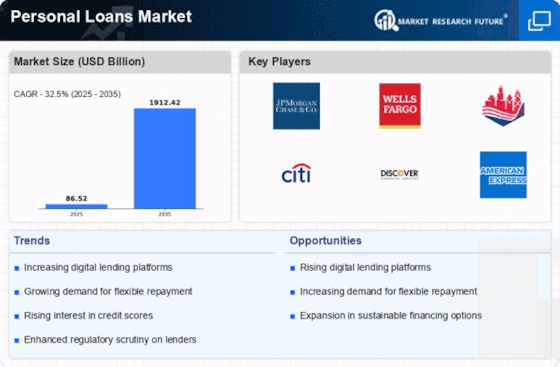
As per Market Research Future analysis, the Personal Loans Market was estimated at 86.52 USD Billion in 2024. The Personal Loans industry is projected to grow from 114.65 USD Billion in 2025 to 1912.42 USD Billion by 2035, exhibiting a compound annual growth rate (CAGR) of 32.5% during the forecast period 2025 - 2035

Key Market Trends & Highlights

The Personal Loans Market is experiencing a dynamic shift towards digitalization and personalization, driven by evolving consumer preferences.

  • Digital transformation in lending is reshaping the personal loans landscape, particularly in North America. Increased focus on financial literacy is empowering consumers to make informed borrowing decisions across Asia-Pacific. Personalization of loan products is becoming essential to meet the diverse needs of individual borrowers, the largest segment. Rising consumer demand for personal loans and competitive interest rates are key drivers fueling market growth.

Market Size & Forecast

2024 Market Size 86.52 (USD Billion)
2035 Market Size 1912.42 (USD Billion)
CAGR (2025 - 2035) 32.5%
Largest Regional Market Share in 2024 North America

Major Players

JPMorgan Chase (US), Wells Fargo (US), Bank of America (US), Citigroup (US), Discover Financial Services (US), American Express (US), PNC Financial Services (US), U.S. Bank (US), LendingClub (US)

Market Trends

The personal loan market is currently experiencing a dynamic evolution, characterized by a growing demand for flexible financing options among consumers. This shift appears to be driven by various factors, including increased consumer awareness regarding financial products and a rising inclination towards digital lending platforms. As individuals seek to manage their financial obligations more effectively, personal loans from Regions Bank are becoming an attractive solution, offering borrowers the ability to consolidate debt, fund major purchases, or cover unexpected expenses. Furthermore, the competitive landscape is intensifying, with traditional banks and fintech companies vying for market for loans, leading to innovative offerings and improved customer experiences. In addition, regulatory changes and advancements in technology are likely to shape the future of the personal loans market. Lenders are increasingly adopting data analytics and artificial intelligence to assess creditworthiness, which may enhance the efficiency of the lending process. This trend suggests a potential shift towards more personalized loan products tailored to individual borrower profiles. As the market continues to evolve, stakeholders must remain vigilant to emerging trends and consumer preferences, ensuring they adapt their strategies accordingly to maintain relevance in this rapidly changing environment.

Digital Transformation in Lending

The loan lending industry is witnessing a significant shift towards digital platforms, as consumers increasingly prefer online applications and instant approvals. This trend indicates a growing reliance on technology to streamline the borrowing process, making it more accessible and efficient.

Increased Focus on Financial Literacy

There is a noticeable emphasis on enhancing financial literacy among consumers, which appears to be influencing borrowing behaviors. As individuals become more informed about personal finance, they are likely to make more prudent decisions regarding personal loan industry products.

Personalization of Loan Products

Lenders are increasingly focusing on personalizing loan offerings to meet the unique needs of borrowers. This trend suggests a move towards tailored solutions that consider individual financial situations, potentially improving customer satisfaction and loyalty.

Personal Loans Market Market Drivers

Rising Consumer Demand for Personal Loans

The Personal Loans Market is currently experiencing a notable increase in consumer demand. This trend is driven by various factors, including the need for immediate financial assistance for personal expenses such as home renovations, medical bills, and education costs. Recent data indicates that personal loan origination volumes have surged, with a year-on-year growth rate of approximately 10%. This heightened demand suggests that consumers are increasingly turning to personal loans as a viable option for financing their needs, thereby propelling the overall growth of the Personal Loans Market.

Increased Financial Literacy Among Consumers

The Personal Loans Market is witnessing a positive impact from the growing emphasis on financial literacy. As consumers become more educated about their financial options, they are more likely to seek personal loans for various purposes. Educational initiatives and resources provided by financial institutions have contributed to this trend, empowering individuals to make informed decisions. Recent surveys reveal that approximately 70% of consumers now understand the terms and conditions associated with personal loans, which may lead to a more responsible borrowing culture. This shift in consumer awareness is expected to bolster the Personal Loans Market.

Competitive Interest Rates and Flexible Terms

The Personal Loans Market is characterized by competitive interest rates and flexible repayment terms, which are attracting a diverse range of borrowers. Lenders are increasingly offering personalized loan products tailored to meet the specific needs of consumers, thereby enhancing their appeal. Current market data indicates that the average interest rate for personal loans has decreased, making borrowing more affordable. Additionally, the availability of various repayment options allows consumers to choose plans that align with their financial situations. This competitive landscape is likely to stimulate further growth in the Personal Loans Market.

Rising Awareness of Debt Consolidation Benefits

The Personal Loans Market is benefiting from a growing awareness of the advantages of debt consolidation. Many consumers are recognizing that personal loans can serve as an effective tool for consolidating high-interest debts, such as credit card balances. This realization is prompting individuals to seek personal loans as a means to simplify their financial obligations and reduce overall interest costs. Recent statistics suggest that nearly 40% of personal loans are utilized for debt consolidation purposes. This trend not only aids consumers in managing their finances but also contributes to the expansion of the Personal Loans Market.

Technological Advancements in Lending Platforms

Technological innovations are reshaping the Personal Loans Market, facilitating a more efficient lending process. The integration of artificial intelligence and machine learning in underwriting processes has streamlined loan approvals, reducing the time taken for consumers to access funds. Furthermore, the rise of online lending platforms has made personal loans more accessible to a broader audience. Data shows that over 60% of personal loans are now originated through digital channels, indicating a shift in consumer behavior towards online solutions. This technological evolution is likely to continue driving growth within the Personal Loans Market.

Market Segment Insights

By Type: Secured Loans (Largest) vs. Unsecured Loans (Fastest-Growing)

In the personal loans market, Secured Loans hold the largest share, driven by their lower interest rates and reduced risk for lenders. Borrowers are increasingly attracted to the tangibility of assets that secure these loans, making them a preferred choice for home improvements and major purchases. On the other hand, regions bank unsecured personal loans are gaining momentum, appealing to individuals who may lack collateral but need quick access to funds, which is driving their rapid adoption across various demographics.

Secured Loans (Dominant) vs. Unsecured Loans (Emerging)

Secured Loans are characterized by their backing through collateral, significantly lowering the lender's risk. This appeal makes them suitable for borrowers with substantial assets, leading to competitive interest rates. Their stability in the market is evident, displaying consistent demand, especially among homeowners looking to leverage their equity. Conversely, regions bank unsecured personal loans are emerging as a vital solution for consumers requiring flexibility and quick access to funds without collateral. Their appeal rests in their simpler application process and speed of approval, catering to a younger demographic and those looking to consolidate debts or finance personal projects without risking their assets.

By Borrower Type: Individual Borrowers (Largest) vs. Joint Borrowers (Fastest-Growing)

In the personal loans market, Individual Borrowers account for the largest portion of the market share, reflecting a strong preference for personal loans among single borrowers. This segment benefits from streamlined application processes and flexible loan options, making it particularly appealing for those seeking quick access to funds for personal needs such as debt consolidation, home improvement, or unexpected expenses. Joint Borrowers, while currently a smaller segment, represent a growing trend as couples or partners combine their financial profiles to qualify for larger loan amounts and better interest rates, appealing to a shared financial strategy that is becoming more common. Growth trends indicate a shift in preferences towards Joint Borrowers, driven by rising housing costs and the need for substantial funding for joint projects like home purchases or renovations. Additionally, the increase in awareness regarding credit scores and financial health has encouraged more couples to consider joint loans. Moreover, lenders are innovating to cater to this segment, promoting joint borrowing products that provide incentives such as lower rates and favorable repayment terms, thereby enhancing personal loans market growth and competitiveness within the segment. Both segments reflect different needs but are contributing significantly to the evolving landscape of personal loans market

Individual Borrowers (Dominant) vs. Joint Borrowers (Emerging)

Individual Borrowers dominate the Personal Loans Market, characterized by their adaptability and the straightforward nature of their borrowing needs. This segment typically consists of individuals seeking funds for personal expenses, and they are often more financially stable, allowing for quicker approvals and flexible repayment options. In contrast, Joint Borrowers are emerging as a significant force, as they represent couples or partners seeking to pool their financial resources. This approach not only enhances their borrowing capacity but also offers advantages such as reduced interest rates and shared repayment responsibilities. Together, these segments showcase distinct but complementary borrowing behaviors, with Individual Borrowers constituting the backbone of the market and Joint Borrowers symbolizing a growing shift towards collaborative financial decision-making.

By Purpose of Loan: Home Improvement (Largest) vs. Medical Expenses (Fastest-Growing)

In the Personal Loans Market, the distribution among the purposes of loans reveals a clear dominance of Home Improvement loans, which are the largest segment, primarily driven by the increasing trend of home renovation and upgrades. This segment appeals to homeowners wishing to enhance their living spaces, reflecting a stable consumer preference for investing in property improvements. Following closely are Medical Expenses loans, which are gaining traction due to rising healthcare costs, a critical factor that drives borrowing in this category. These loans provide necessary financial relief, helping individuals cover unexpected medical expenses.

Home Improvement (Dominant) vs. Medical Expenses (Emerging)

The Home Improvement loan segment stands as a dominant force in the Personal Loans Market, characterized by a consistent demand as homeowners prioritize renovating and upgrading their properties. This segment enjoys robust backing from a culture that values home aesthetics and functionality, leading to steady growth. On the other hand, Medical Expenses loans are emerging as a significant player, driven by escalating healthcare expenses and an increased awareness of health issues. This segment resonates with consumers looking for immediate financial assistance for healthcare services. The juxtaposition of these two segments highlights a contrasting focus on personal investment versus essential health-related needs, illustrating varying consumer priorities.

By Loan Tenure: Long-Term Loans (Largest) vs. Short-Term Loans (Fastest-Growing)

In the Personal Loans Market, loan tenure plays a vital role in shaping consumer preferences and lending trends. Long-term loans currently dominate the market, capturing a significant share as borrowers often seek extended repayment periods to manage monthly expenses. Medium-term loans also hold a notable position, appealing to consumers looking for a balance between repayment period and interest rates. In contrast, short-term loans, although smaller in share, have gained traction due to the increasing demand for quick financial solutions, particularly among younger consumers looking for flexibility. Growth trends within the loan tenure segment are influenced by various factors, including changing consumer behavior and economic conditions. The rise of digital lending platforms has accelerated the popularity of short-term loans, making it easier for consumers to access funds promptly. Moreover, <a href="https://www.marketresearchfuture.com/reports/long-term-care-insurance-market-24594">long-term</a> loans are experiencing steady growth as more individuals prefer manageable payment structures over extended periods, driven by a growing trend towards financial stability. The evolving landscape emphasizes the importance of adapting loan offerings to meet consumer demand and preferences.

Long-Term Loans (Dominant) vs. Short-Term Loans (Emerging)

Long-term loans, characterized by their extended repayment periods, cater to borrowers seeking financial stability and larger loan amounts. This segment attracts individuals looking for mortgage financing, student loans, or personal loans for major purchases, offering lower monthly payments over time. Meanwhile, short-term loans, often featuring higher interest rates, provide instant financial relief for urgent needs like medical bills or unexpected expenses, appealing particularly to younger consumers. This emerging segment benefits from the convenience of quick approval and minimal documentation, making it an attractive option. Both segments exhibit unique characteristics that serve distinct consumer needs, driving competition and innovation within the Personal Loans Market.

Get more detailed insights about Personal Loans Market Research Report - Global Forecast till 2035

Regional Insights

North America : Market Leader in Personal Loans Market

North America is the largest market for personal loans, accounting for approximately 45% of the global share. The region's growth is driven by increasing consumer demand for credit, favorable interest rates, and a robust regulatory framework that supports lending practices. The U.S. is the primary contributor, followed by Canada, which holds around 10% of the market share. Regulatory catalysts, such as the Consumer Financial Protection Bureau's guidelines, further enhance market stability. North America is characterized by major players like JPMorgan Chase, Wells Fargo, and Bank of America, which dominate the personal loan industry. These institutions leverage advanced technology and customer-centric services to attract borrowers. The presence of online lending platforms like LendingClub also adds to the competitive dynamics, catering to a tech-savvy consumer base seeking quick and accessible loan options. The regions personal loan interest rates are also influencing market adoption.

Europe : Emerging Market with Potential

Europe is witnessing a significant rise in personal loan demand, driven by low-interest rates and increasing consumer confidence. The region holds approximately 25% of the global market share, with Germany and the UK being the largest contributors, accounting for about 12% and 10% respectively. Regulatory frameworks, such as the EU Consumer Credit Directive, are designed to protect borrowers and promote responsible lending, further stimulating market for loans growth. Leading countries in Europe are focusing on enhancing digital lending platforms to meet consumer needs. The competitive landscape includes traditional banks and emerging fintech companies, which are reshaping the market with innovative solutions. Key players like BNP Paribas and Santander are investing in technology to streamline the loan application process, making it easier for consumers to access personal loans market products. This shift towards digitalization is expected to drive further growth in the sector.

Asia-Pacific : Rapid Growth in Personal Loans Market

Asia-Pacific is rapidly emerging as a powerhouse in the personal loans market, driven by increasing disposable incomes and a growing middle class. The region holds approximately 20% of the global market share, with China and India leading the way, contributing around 10% and 5% respectively. Regulatory support, such as the Reserve Bank of India's initiatives to promote financial inclusion, is catalyzing personal loan market size in India expansion and encouraging responsible lending practices. The competitive landscape in Asia-Pacific is diverse, featuring both traditional banks and a surge of fintech companies. Major players like HDFC Bank and ICICI Bank are expanding their offerings to cater to the evolving needs of consumers. The rise of digital lending platforms is transforming the personal loans market, providing consumers with quick access to personal loans and enhancing overall customer experience. This trend is expected to continue, further solidifying the region's position in the global market.

Middle East and Africa : Untapped Market Opportunities

The Middle East and Africa region presents untapped opportunities in the personal loans market, with a current market share of approximately 10%. The growth is driven by increasing urbanization, a young population, and rising financial literacy. Countries like South Africa and the UAE are leading the market, accounting for about 5% and 3% respectively. Regulatory frameworks are evolving to support lending practices, with initiatives aimed at enhancing consumer protection and promoting financial inclusion. The competitive landscape is characterized by a mix of traditional banks and emerging fintech solutions. Key players such as Standard Bank and First National Bank are expanding their services to meet the growing demand for personal loans. The rise of digital platforms is also facilitating access to credit, particularly for underserved populations. As the region continues to develop, the personal loans market is expected to experience significant growth, driven by innovation and regulatory support.

Key Players and Competitive Insights

The Global Personal Loans Market is characterized by a diverse array of financial service providers offering consumers various lending options to meet their personal financial needs. As the demand for accessible financing continues to rise, numerous players are vying for market share by enhancing their product offerings, improving customer engagement, and adopting innovative technologies.Competitive insights into this market reveal that companies focus on differentiating themselves through interest rates, loan terms, user-friendly digital platforms, and exceptional customer service.Factors such as regulatory changes, economic conditions, and consumer behavior shifts are continuously shaping the competitive landscape, prompting companies to adopt strategic initiatives to secure their positions within the market.Focusing on Synchrony Financial, the company has established a robust presence within the Global Personal Loans Market through its commitment to consumer financing solutions. Recognized for its strong brand reputation, Synchrony Financial leverages its extensive experience in providing personal loans that are tailored to meet the varying needs of individual customers.The company's strength lies in its ability to provide competitive interest rates and flexible repayment options, appealing to a broad audience. Additionally, Synchrony Financial has excelled in creating strategic partnerships with a multitude of retailers and service providers, extending its reach and enhancing its product accessibility. This collaborative approach not only enriches the customer experience but also amplifies Synchrony Financial's market positioning as a reliable personal loan provider.Turning to JPMorgan Chase, the company boasts a significant foothold in the Global Personal Loans Market, characterized by its diverse portfolio of financial products and services. With a focus on personal loans, JPMorgan Chase offers competitive offerings that include unsecured loans, secured loans, and attractive promotional rates for customers.The company's market presence is bolstered by its well-established digital and mobile lending platforms, providing consumers with seamless application experience. Strengthened by its robust financial stability, JPMorgan Chase pursues strategic mergers and acquisitions to enhance its capabilities and market share, thereby expanding its reach further into the personal loans sector. The synergy created through these initiatives contributes to JPMorgan Chase's reputation for reliability and innovation, ultimately positioning it as a leading player in the global personal loans arena.

Key Companies in the Personal Loans Market include

Industry Developments

Recent developments in the Global Personal Loans Market indicate a dynamic landscape influenced by various financial institutions. Notably, Synchrony Financial and American Express have recently reported growth in loan origination, highlighting increased consumer demand.

In September 2023, JPMorgan Chase announced strategic expansion plans that include enhanced personal loan offerings, aiming to capture a larger market share. Meanwhile, Capital One and Wells Fargo are focusing on digital transformation to streamline the personal loan application process, enhancing user experience.

Merger and acquisition activity has been relatively subdued in this sector; however, throughout 2022, HSBC strategically acquired a small fintech firm to bolster its personal loans segment. The overall market valuation for personal loans has been on the rise, driven by favorable interest rates and a current recovery in consumer spending post-pandemic.

Furthermore, SoFi has reported an increase in loan volume, reflecting evolving consumer behaviors and preferences. In the broader scope, regulatory changes influenced by government initiatives are also shaping lending criteria across the global landscape, facilitating easier access to personal loans for diverse demographic segments.

Future Outlook

Personal Loans Market Future Outlook

The Personal Loans Market is projected to grow at a 32.5% CAGR from 2025 to 2035, driven by digital transformation, increased consumer demand, and competitive lending practices.

New opportunities lie in:

  • <p>Integration of AI-driven credit scoring systems</p>
  • <p> </p>
  • <p>Expansion of mobile lending platforms</p>
  • <p>Development of personalized loan products for niche markets</p>

By 2035, the personal loan market is expected to be robust, reflecting substantial growth and innovation.

Market Segmentation

Personal Loans Market Type Outlook

  • Secured Loans
  • Unsecured Loans
  • Debt Consolidation Loans
  • Personal Lines of Credit

Personal Loans Market Loan Tenure Outlook

  • Short-Term Loans
  • Medium-Term Loans
  • Long-Term Loans

Personal Loans Market Borrower Type Outlook

  • Individual Borrowers
  • Joint Borrowers
  • Borrowers with Bad Credit
  • First-Time Borrowers

Personal Loans Market Purpose of Loan Outlook

  • Home Improvement
  • Medical Expenses
  • Education Expenses
  • Travel and Vacation

Report Scope

MARKET SIZE 2024 86.52(USD Billion)
MARKET SIZE 2025 114.65(USD Billion)
MARKET SIZE 2035 1912.42(USD Billion)
COMPOUND ANNUAL GROWTH RATE (CAGR) 32.5% (2025 - 2035)
REPORT COVERAGE Revenue Forecast, Competitive Landscape, Growth Factors, and Trends
BASE YEAR 2024
Market Forecast Period 2025 - 2035
Historical Data 2019 - 2024
Market Forecast Units USD Billion
Key Companies Profiled JPMorgan Chase (US), Wells Fargo (US), Bank of America (US), Citigroup (US), Discover Financial Services (US), American Express (US), PNC Financial Services (US), U.S. Bank (US), LendingClub (US)
Segments Covered Loan Type, Borrower Type, Purpose of Loan, Loan Tenure, Regional
Key Market Opportunities Integration of digital platforms enhances accessibility and personalization in the Personal Loans Market.
Key Market Dynamics Rising consumer demand for flexible repayment options drives innovation and competition in the personal loans market.
Countries Covered North America, Europe, APAC, South America, MEA

FAQs

What is the current valuation of the Personal Loans Market as of 2024?

<p>The overall market valuation was 86.52 USD Billion in 2024.</p>

What is the projected market size for the Personal Loans Market by 2035?

<p>The projected valuation for the Personal Loans Market is 1912.42 USD Billion by 2035.</p>

What is the expected CAGR for the Personal Loans Market during the forecast period 2025 - 2035?

<p>The expected CAGR for the Personal Loans Market during the forecast period 2025 - 2035 is 32.5%.</p>

Which companies are considered key players in the Personal Loans Market?

<p>Key players in the market include JPMorgan Chase, Wells Fargo, Bank of America, Citigroup, Discover Financial Services, American Express, PNC Financial Services, U.S. Bank, and LendingClub.</p>

What are the main segments of the Personal Loans Market based on loan type?

<p>The main segments based on loan type include Secured Loans valued at 800.0 USD Billion, Unsecured Loans at 600.0 USD Billion, Debt Consolidation Loans at 300.0 USD Billion, and Personal Lines of Credit at 212.42 USD Billion.</p>

How do borrower types affect the Personal Loans Market?

<p>Individual Borrowers represent a market value of 800.0 USD Billion, while Joint Borrowers account for 600.0 USD Billion, indicating diverse borrowing preferences.</p>

What are the primary purposes for which personal loans are utilized?

<p>The primary purposes for personal loans include Travel and Vacation at 962.42 USD Billion, Home Improvement at 450.0 USD Billion, Medical Expenses at 300.0 USD Billion, and Education Expenses at 200.0 USD Billion.</p>

What is the distribution of personal loans based on loan tenure?

<p>The distribution of personal loans based on tenure includes Short-Term Loans at 408.1 USD Billion, Medium-Term Loans at 765.3 USD Billion, and Long-Term Loans at 739.02 USD Billion.</p>

How does the market size for personal loans compare between secured and unsecured loans?

<p>Secured Loans dominate the market with a valuation of 800.0 USD Billion, whereas Unsecured Loans follow with a valuation of 600.0 USD Billion.</p>

What trends are anticipated in the Personal Loans Market as it approaches 2035?

<p>The Personal Loans Market is likely to experience substantial growth, potentially reaching 1912.42 USD Billion by 2035, driven by a CAGR of 32.5%.</p>

  1. SECTION I: EXECUTIVE SUMMARY AND KEY HIGHLIGHTS
    1. | 1.1 EXECUTIVE SUMMARY
    2. | | 1.1.1 Market Overview
    3. | | 1.1.2 Key Findings
    4. | | 1.1.3 Market Segmentation
    5. | | 1.1.4 Competitive Landscape
    6. | | 1.1.5 Challenges and Opportunities
    7. | | 1.1.6 Future Outlook
  2. SECTION II: SCOPING, METHODOLOGY AND MARKET STRUCTURE
    1. | 2.1 MARKET INTRODUCTION
    2. | | 2.1.1 Definition
    3. | | 2.1.2 Scope of the study
    4. | | | 2.1.2.1 Research Objective
    5. | | | 2.1.2.2 Assumption
    6. | | | 2.1.2.3 Limitations
    7. | 2.2 RESEARCH METHODOLOGY
    8. | | 2.2.1 Overview
    9. | | 2.2.2 Data Mining
    10. | | 2.2.3 Secondary Research
    11. | | 2.2.4 Primary Research
    12. | | | 2.2.4.1 Primary Interviews and Information Gathering Process
    13. | | | 2.2.4.2 Breakdown of Primary Respondents
    14. | | 2.2.5 Forecasting Model
    15. | | 2.2.6 Market Size Estimation
    16. | | | 2.2.6.1 Bottom-Up Approach
    17. | | | 2.2.6.2 Top-Down Approach
    18. | | 2.2.7 Data Triangulation
    19. | | 2.2.8 Validation
  3. SECTION III: QUALITATIVE ANALYSIS
    1. | 3.1 MARKET DYNAMICS
    2. | | 3.1.1 Overview
    3. | | 3.1.2 Drivers
    4. | | 3.1.3 Restraints
    5. | | 3.1.4 Opportunities
    6. | 3.2 MARKET FACTOR ANALYSIS
    7. | | 3.2.1 Value chain Analysis
    8. | | 3.2.2 Porter's Five Forces Analysis
    9. | | | 3.2.2.1 Bargaining Power of Suppliers
    10. | | | 3.2.2.2 Bargaining Power of Buyers
    11. | | | 3.2.2.3 Threat of New Entrants
    12. | | | 3.2.2.4 Threat of Substitutes
    13. | | | 3.2.2.5 Intensity of Rivalry
    14. | | 3.2.3 COVID-19 Impact Analysis
    15. | | | 3.2.3.1 Market Impact Analysis
    16. | | | 3.2.3.2 Regional Impact
    17. | | | 3.2.3.3 Opportunity and Threat Analysis
  4. SECTION IV: QUANTITATIVE ANALYSIS
    1. | 4.1 BFSI, BY Type (USD Billion)
    2. | | 4.1.1 Secured Loans
    3. | | 4.1.2 Unsecured Loans
    4. | | 4.1.3 Debt Consolidation Loans
    5. | | 4.1.4 Personal Lines of Credit
    6. | 4.2 BFSI, BY Borrower Type (USD Billion)
    7. | | 4.2.1 Individual Borrowers
    8. | | 4.2.2 Joint Borrowers
    9. | | 4.2.3 Borrowers with Bad Credit
    10. | | 4.2.4 First-Time Borrowers
    11. | 4.3 BFSI, BY Purpose of Loan (USD Billion)
    12. | | 4.3.1 Home Improvement
    13. | | 4.3.2 Medical Expenses
    14. | | 4.3.3 Education Expenses
    15. | | 4.3.4 Travel and Vacation
    16. | 4.4 BFSI, BY Loan Tenure (USD Billion)
    17. | | 4.4.1 Short-Term Loans
    18. | | 4.4.2 Medium-Term Loans
    19. | | 4.4.3 Long-Term Loans
    20. | 4.5 BFSI, BY Region (USD Billion)
    21. | | 4.5.1 North America
    22. | | | 4.5.1.1 US
    23. | | | 4.5.1.2 Canada
    24. | | 4.5.2 Europe
    25. | | | 4.5.2.1 Germany
    26. | | | 4.5.2.2 UK
    27. | | | 4.5.2.3 France
    28. | | | 4.5.2.4 Russia
    29. | | | 4.5.2.5 Italy
    30. | | | 4.5.2.6 Spain
    31. | | | 4.5.2.7 Rest of Europe
    32. | | 4.5.3 APAC
    33. | | | 4.5.3.1 China
    34. | | | 4.5.3.2 India
    35. | | | 4.5.3.3 Japan
    36. | | | 4.5.3.4 South Korea
    37. | | | 4.5.3.5 Malaysia
    38. | | | 4.5.3.6 Thailand
    39. | | | 4.5.3.7 Indonesia
    40. | | | 4.5.3.8 Rest of APAC
    41. | | 4.5.4 South America
    42. | | | 4.5.4.1 Brazil
    43. | | | 4.5.4.2 Mexico
    44. | | | 4.5.4.3 Argentina
    45. | | | 4.5.4.4 Rest of South America
    46. | | 4.5.5 MEA
    47. | | | 4.5.5.1 GCC Countries
    48. | | | 4.5.5.2 South Africa
    49. | | | 4.5.5.3 Rest of MEA
  5. SECTION V: COMPETITIVE ANALYSIS
    1. | 5.1 Competitive Landscape
    2. | | 5.1.1 Overview
    3. | | 5.1.2 Competitive Analysis
    4. | | 5.1.3 Market share Analysis
    5. | | 5.1.4 Major Growth Strategy in the BFSI
    6. | | 5.1.5 Competitive Benchmarking
    7. | | 5.1.6 Leading Players in Terms of Number of Developments in the BFSI
    8. | | 5.1.7 Key developments and growth strategies
    9. | | | 5.1.7.1 New Product Launch/Service Deployment
    10. | | | 5.1.7.2 Merger & Acquisitions
    11. | | | 5.1.7.3 Joint Ventures
    12. | | 5.1.8 Major Players Financial Matrix
    13. | | | 5.1.8.1 Sales and Operating Income
    14. | | | 5.1.8.2 Major Players R&D Expenditure. 2023
    15. | 5.2 Company Profiles
    16. | | 5.2.1 JPMorgan Chase (US)
    17. | | | 5.2.1.1 Financial Overview
    18. | | | 5.2.1.2 Products Offered
    19. | | | 5.2.1.3 Key Developments
    20. | | | 5.2.1.4 SWOT Analysis
    21. | | | 5.2.1.5 Key Strategies
    22. | | 5.2.2 Wells Fargo (US)
    23. | | | 5.2.2.1 Financial Overview
    24. | | | 5.2.2.2 Products Offered
    25. | | | 5.2.2.3 Key Developments
    26. | | | 5.2.2.4 SWOT Analysis
    27. | | | 5.2.2.5 Key Strategies
    28. | | 5.2.3 Bank of America (US)
    29. | | | 5.2.3.1 Financial Overview
    30. | | | 5.2.3.2 Products Offered
    31. | | | 5.2.3.3 Key Developments
    32. | | | 5.2.3.4 SWOT Analysis
    33. | | | 5.2.3.5 Key Strategies
    34. | | 5.2.4 Citigroup (US)
    35. | | | 5.2.4.1 Financial Overview
    36. | | | 5.2.4.2 Products Offered
    37. | | | 5.2.4.3 Key Developments
    38. | | | 5.2.4.4 SWOT Analysis
    39. | | | 5.2.4.5 Key Strategies
    40. | | 5.2.5 Discover Financial Services (US)
    41. | | | 5.2.5.1 Financial Overview
    42. | | | 5.2.5.2 Products Offered
    43. | | | 5.2.5.3 Key Developments
    44. | | | 5.2.5.4 SWOT Analysis
    45. | | | 5.2.5.5 Key Strategies
    46. | | 5.2.6 American Express (US)
    47. | | | 5.2.6.1 Financial Overview
    48. | | | 5.2.6.2 Products Offered
    49. | | | 5.2.6.3 Key Developments
    50. | | | 5.2.6.4 SWOT Analysis
    51. | | | 5.2.6.5 Key Strategies
    52. | | 5.2.7 PNC Financial Services (US)
    53. | | | 5.2.7.1 Financial Overview
    54. | | | 5.2.7.2 Products Offered
    55. | | | 5.2.7.3 Key Developments
    56. | | | 5.2.7.4 SWOT Analysis
    57. | | | 5.2.7.5 Key Strategies
    58. | | 5.2.8 U.S. Bank (US)
    59. | | | 5.2.8.1 Financial Overview
    60. | | | 5.2.8.2 Products Offered
    61. | | | 5.2.8.3 Key Developments
    62. | | | 5.2.8.4 SWOT Analysis
    63. | | | 5.2.8.5 Key Strategies
    64. | | 5.2.9 LendingClub (US)
    65. | | | 5.2.9.1 Financial Overview
    66. | | | 5.2.9.2 Products Offered
    67. | | | 5.2.9.3 Key Developments
    68. | | | 5.2.9.4 SWOT Analysis
    69. | | | 5.2.9.5 Key Strategies
    70. | 5.3 Appendix
    71. | | 5.3.1 References
    72. | | 5.3.2 Related Reports
  6. LIST OF FIGURES
    1. | 6.1 MARKET SYNOPSIS
    2. | 6.2 NORTH AMERICA MARKET ANALYSIS
    3. | 6.3 US MARKET ANALYSIS BY TYPE
    4. | 6.4 US MARKET ANALYSIS BY BORROWER TYPE
    5. | 6.5 US MARKET ANALYSIS BY PURPOSE OF LOAN
    6. | 6.6 US MARKET ANALYSIS BY LOAN TENURE
    7. | 6.7 CANADA MARKET ANALYSIS BY TYPE
    8. | 6.8 CANADA MARKET ANALYSIS BY BORROWER TYPE
    9. | 6.9 CANADA MARKET ANALYSIS BY PURPOSE OF LOAN
    10. | 6.10 CANADA MARKET ANALYSIS BY LOAN TENURE
    11. | 6.11 EUROPE MARKET ANALYSIS
    12. | 6.12 GERMANY MARKET ANALYSIS BY TYPE
    13. | 6.13 GERMANY MARKET ANALYSIS BY BORROWER TYPE
    14. | 6.14 GERMANY MARKET ANALYSIS BY PURPOSE OF LOAN
    15. | 6.15 GERMANY MARKET ANALYSIS BY LOAN TENURE
    16. | 6.16 UK MARKET ANALYSIS BY TYPE
    17. | 6.17 UK MARKET ANALYSIS BY BORROWER TYPE
    18. | 6.18 UK MARKET ANALYSIS BY PURPOSE OF LOAN
    19. | 6.19 UK MARKET ANALYSIS BY LOAN TENURE
    20. | 6.20 FRANCE MARKET ANALYSIS BY TYPE
    21. | 6.21 FRANCE MARKET ANALYSIS BY BORROWER TYPE
    22. | 6.22 FRANCE MARKET ANALYSIS BY PURPOSE OF LOAN
    23. | 6.23 FRANCE MARKET ANALYSIS BY LOAN TENURE
    24. | 6.24 RUSSIA MARKET ANALYSIS BY TYPE
    25. | 6.25 RUSSIA MARKET ANALYSIS BY BORROWER TYPE
    26. | 6.26 RUSSIA MARKET ANALYSIS BY PURPOSE OF LOAN
    27. | 6.27 RUSSIA MARKET ANALYSIS BY LOAN TENURE
    28. | 6.28 ITALY MARKET ANALYSIS BY TYPE
    29. | 6.29 ITALY MARKET ANALYSIS BY BORROWER TYPE
    30. | 6.30 ITALY MARKET ANALYSIS BY PURPOSE OF LOAN
    31. | 6.31 ITALY MARKET ANALYSIS BY LOAN TENURE
    32. | 6.32 SPAIN MARKET ANALYSIS BY TYPE
    33. | 6.33 SPAIN MARKET ANALYSIS BY BORROWER TYPE
    34. | 6.34 SPAIN MARKET ANALYSIS BY PURPOSE OF LOAN
    35. | 6.35 SPAIN MARKET ANALYSIS BY LOAN TENURE
    36. | 6.36 REST OF EUROPE MARKET ANALYSIS BY TYPE
    37. | 6.37 REST OF EUROPE MARKET ANALYSIS BY BORROWER TYPE
    38. | 6.38 REST OF EUROPE MARKET ANALYSIS BY PURPOSE OF LOAN
    39. | 6.39 REST OF EUROPE MARKET ANALYSIS BY LOAN TENURE
    40. | 6.40 APAC MARKET ANALYSIS
    41. | 6.41 CHINA MARKET ANALYSIS BY TYPE
    42. | 6.42 CHINA MARKET ANALYSIS BY BORROWER TYPE
    43. | 6.43 CHINA MARKET ANALYSIS BY PURPOSE OF LOAN
    44. | 6.44 CHINA MARKET ANALYSIS BY LOAN TENURE
    45. | 6.45 INDIA MARKET ANALYSIS BY TYPE
    46. | 6.46 INDIA MARKET ANALYSIS BY BORROWER TYPE
    47. | 6.47 INDIA MARKET ANALYSIS BY PURPOSE OF LOAN
    48. | 6.48 INDIA MARKET ANALYSIS BY LOAN TENURE
    49. | 6.49 JAPAN MARKET ANALYSIS BY TYPE
    50. | 6.50 JAPAN MARKET ANALYSIS BY BORROWER TYPE
    51. | 6.51 JAPAN MARKET ANALYSIS BY PURPOSE OF LOAN
    52. | 6.52 JAPAN MARKET ANALYSIS BY LOAN TENURE
    53. | 6.53 SOUTH KOREA MARKET ANALYSIS BY TYPE
    54. | 6.54 SOUTH KOREA MARKET ANALYSIS BY BORROWER TYPE
    55. | 6.55 SOUTH KOREA MARKET ANALYSIS BY PURPOSE OF LOAN
    56. | 6.56 SOUTH KOREA MARKET ANALYSIS BY LOAN TENURE
    57. | 6.57 MALAYSIA MARKET ANALYSIS BY TYPE
    58. | 6.58 MALAYSIA MARKET ANALYSIS BY BORROWER TYPE
    59. | 6.59 MALAYSIA MARKET ANALYSIS BY PURPOSE OF LOAN
    60. | 6.60 MALAYSIA MARKET ANALYSIS BY LOAN TENURE
    61. | 6.61 THAILAND MARKET ANALYSIS BY TYPE
    62. | 6.62 THAILAND MARKET ANALYSIS BY BORROWER TYPE
    63. | 6.63 THAILAND MARKET ANALYSIS BY PURPOSE OF LOAN
    64. | 6.64 THAILAND MARKET ANALYSIS BY LOAN TENURE
    65. | 6.65 INDONESIA MARKET ANALYSIS BY TYPE
    66. | 6.66 INDONESIA MARKET ANALYSIS BY BORROWER TYPE
    67. | 6.67 INDONESIA MARKET ANALYSIS BY PURPOSE OF LOAN
    68. | 6.68 INDONESIA MARKET ANALYSIS BY LOAN TENURE
    69. | 6.69 REST OF APAC MARKET ANALYSIS BY TYPE
    70. | 6.70 REST OF APAC MARKET ANALYSIS BY BORROWER TYPE
    71. | 6.71 REST OF APAC MARKET ANALYSIS BY PURPOSE OF LOAN
    72. | 6.72 REST OF APAC MARKET ANALYSIS BY LOAN TENURE
    73. | 6.73 SOUTH AMERICA MARKET ANALYSIS
    74. | 6.74 BRAZIL MARKET ANALYSIS BY TYPE
    75. | 6.75 BRAZIL MARKET ANALYSIS BY BORROWER TYPE
    76. | 6.76 BRAZIL MARKET ANALYSIS BY PURPOSE OF LOAN
    77. | 6.77 BRAZIL MARKET ANALYSIS BY LOAN TENURE
    78. | 6.78 MEXICO MARKET ANALYSIS BY TYPE
    79. | 6.79 MEXICO MARKET ANALYSIS BY BORROWER TYPE
    80. | 6.80 MEXICO MARKET ANALYSIS BY PURPOSE OF LOAN
    81. | 6.81 MEXICO MARKET ANALYSIS BY LOAN TENURE
    82. | 6.82 ARGENTINA MARKET ANALYSIS BY TYPE
    83. | 6.83 ARGENTINA MARKET ANALYSIS BY BORROWER TYPE
    84. | 6.84 ARGENTINA MARKET ANALYSIS BY PURPOSE OF LOAN
    85. | 6.85 ARGENTINA MARKET ANALYSIS BY LOAN TENURE
    86. | 6.86 REST OF SOUTH AMERICA MARKET ANALYSIS BY TYPE
    87. | 6.87 REST OF SOUTH AMERICA MARKET ANALYSIS BY BORROWER TYPE
    88. | 6.88 REST OF SOUTH AMERICA MARKET ANALYSIS BY PURPOSE OF LOAN
    89. | 6.89 REST OF SOUTH AMERICA MARKET ANALYSIS BY LOAN TENURE
    90. | 6.90 MEA MARKET ANALYSIS
    91. | 6.91 GCC COUNTRIES MARKET ANALYSIS BY TYPE
    92. | 6.92 GCC COUNTRIES MARKET ANALYSIS BY BORROWER TYPE
    93. | 6.93 GCC COUNTRIES MARKET ANALYSIS BY PURPOSE OF LOAN
    94. | 6.94 GCC COUNTRIES MARKET ANALYSIS BY LOAN TENURE
    95. | 6.95 SOUTH AFRICA MARKET ANALYSIS BY TYPE
    96. | 6.96 SOUTH AFRICA MARKET ANALYSIS BY BORROWER TYPE
    97. | 6.97 SOUTH AFRICA MARKET ANALYSIS BY PURPOSE OF LOAN
    98. | 6.98 SOUTH AFRICA MARKET ANALYSIS BY LOAN TENURE
    99. | 6.99 REST OF MEA MARKET ANALYSIS BY TYPE
    100. | 6.100 REST OF MEA MARKET ANALYSIS BY BORROWER TYPE
    101. | 6.101 REST OF MEA MARKET ANALYSIS BY PURPOSE OF LOAN
    102. | 6.102 REST OF MEA MARKET ANALYSIS BY LOAN TENURE
    103. | 6.103 KEY BUYING CRITERIA OF BFSI
    104. | 6.104 RESEARCH PROCESS OF MRFR
    105. | 6.105 DRO ANALYSIS OF BFSI
    106. | 6.106 DRIVERS IMPACT ANALYSIS: BFSI
    107. | 6.107 RESTRAINTS IMPACT ANALYSIS: BFSI
    108. | 6.108 SUPPLY / VALUE CHAIN: BFSI
    109. | 6.109 BFSI, BY TYPE, 2024 (% SHARE)
    110. | 6.110 BFSI, BY TYPE, 2024 TO 2035 (USD Billion)
    111. | 6.111 BFSI, BY BORROWER TYPE, 2024 (% SHARE)
    112. | 6.112 BFSI, BY BORROWER TYPE, 2024 TO 2035 (USD Billion)
    113. | 6.113 BFSI, BY PURPOSE OF LOAN, 2024 (% SHARE)
    114. | 6.114 BFSI, BY PURPOSE OF LOAN, 2024 TO 2035 (USD Billion)
    115. | 6.115 BFSI, BY LOAN TENURE, 2024 (% SHARE)
    116. | 6.116 BFSI, BY LOAN TENURE, 2024 TO 2035 (USD Billion)
    117. | 6.117 BENCHMARKING OF MAJOR COMPETITORS
  7. LIST OF TABLES
    1. | 7.1 LIST OF ASSUMPTIONS
    2. | | 7.1.1
    3. | 7.2 North America MARKET SIZE ESTIMATES; FORECAST
    4. | | 7.2.1 BY TYPE, 2025-2035 (USD Billion)
    5. | | 7.2.2 BY BORROWER TYPE, 2025-2035 (USD Billion)
    6. | | 7.2.3 BY PURPOSE OF LOAN, 2025-2035 (USD Billion)
    7. | | 7.2.4 BY LOAN TENURE, 2025-2035 (USD Billion)
    8. | 7.3 US MARKET SIZE ESTIMATES; FORECAST
    9. | | 7.3.1 BY TYPE, 2025-2035 (USD Billion)
    10. | | 7.3.2 BY BORROWER TYPE, 2025-2035 (USD Billion)
    11. | | 7.3.3 BY PURPOSE OF LOAN, 2025-2035 (USD Billion)
    12. | | 7.3.4 BY LOAN TENURE, 2025-2035 (USD Billion)
    13. | 7.4 Canada MARKET SIZE ESTIMATES; FORECAST
    14. | | 7.4.1 BY TYPE, 2025-2035 (USD Billion)
    15. | | 7.4.2 BY BORROWER TYPE, 2025-2035 (USD Billion)
    16. | | 7.4.3 BY PURPOSE OF LOAN, 2025-2035 (USD Billion)
    17. | | 7.4.4 BY LOAN TENURE, 2025-2035 (USD Billion)
    18. | 7.5 Europe MARKET SIZE ESTIMATES; FORECAST
    19. | | 7.5.1 BY TYPE, 2025-2035 (USD Billion)
    20. | | 7.5.2 BY BORROWER TYPE, 2025-2035 (USD Billion)
    21. | | 7.5.3 BY PURPOSE OF LOAN, 2025-2035 (USD Billion)
    22. | | 7.5.4 BY LOAN TENURE, 2025-2035 (USD Billion)
    23. | 7.6 Germany MARKET SIZE ESTIMATES; FORECAST
    24. | | 7.6.1 BY TYPE, 2025-2035 (USD Billion)
    25. | | 7.6.2 BY BORROWER TYPE, 2025-2035 (USD Billion)
    26. | | 7.6.3 BY PURPOSE OF LOAN, 2025-2035 (USD Billion)
    27. | | 7.6.4 BY LOAN TENURE, 2025-2035 (USD Billion)
    28. | 7.7 UK MARKET SIZE ESTIMATES; FORECAST
    29. | | 7.7.1 BY TYPE, 2025-2035 (USD Billion)
    30. | | 7.7.2 BY BORROWER TYPE, 2025-2035 (USD Billion)
    31. | | 7.7.3 BY PURPOSE OF LOAN, 2025-2035 (USD Billion)
    32. | | 7.7.4 BY LOAN TENURE, 2025-2035 (USD Billion)
    33. | 7.8 France MARKET SIZE ESTIMATES; FORECAST
    34. | | 7.8.1 BY TYPE, 2025-2035 (USD Billion)
    35. | | 7.8.2 BY BORROWER TYPE, 2025-2035 (USD Billion)
    36. | | 7.8.3 BY PURPOSE OF LOAN, 2025-2035 (USD Billion)
    37. | | 7.8.4 BY LOAN TENURE, 2025-2035 (USD Billion)
    38. | 7.9 Russia MARKET SIZE ESTIMATES; FORECAST
    39. | | 7.9.1 BY TYPE, 2025-2035 (USD Billion)
    40. | | 7.9.2 BY BORROWER TYPE, 2025-2035 (USD Billion)
    41. | | 7.9.3 BY PURPOSE OF LOAN, 2025-2035 (USD Billion)
    42. | | 7.9.4 BY LOAN TENURE, 2025-2035 (USD Billion)
    43. | 7.10 Italy MARKET SIZE ESTIMATES; FORECAST
    44. | | 7.10.1 BY TYPE, 2025-2035 (USD Billion)
    45. | | 7.10.2 BY BORROWER TYPE, 2025-2035 (USD Billion)
    46. | | 7.10.3 BY PURPOSE OF LOAN, 2025-2035 (USD Billion)
    47. | | 7.10.4 BY LOAN TENURE, 2025-2035 (USD Billion)
    48. | 7.11 Spain MARKET SIZE ESTIMATES; FORECAST
    49. | | 7.11.1 BY TYPE, 2025-2035 (USD Billion)
    50. | | 7.11.2 BY BORROWER TYPE, 2025-2035 (USD Billion)
    51. | | 7.11.3 BY PURPOSE OF LOAN, 2025-2035 (USD Billion)
    52. | | 7.11.4 BY LOAN TENURE, 2025-2035 (USD Billion)
    53. | 7.12 Rest of Europe MARKET SIZE ESTIMATES; FORECAST
    54. | | 7.12.1 BY TYPE, 2025-2035 (USD Billion)
    55. | | 7.12.2 BY BORROWER TYPE, 2025-2035 (USD Billion)
    56. | | 7.12.3 BY PURPOSE OF LOAN, 2025-2035 (USD Billion)
    57. | | 7.12.4 BY LOAN TENURE, 2025-2035 (USD Billion)
    58. | 7.13 APAC MARKET SIZE ESTIMATES; FORECAST
    59. | | 7.13.1 BY TYPE, 2025-2035 (USD Billion)
    60. | | 7.13.2 BY BORROWER TYPE, 2025-2035 (USD Billion)
    61. | | 7.13.3 BY PURPOSE OF LOAN, 2025-2035 (USD Billion)
    62. | | 7.13.4 BY LOAN TENURE, 2025-2035 (USD Billion)
    63. | 7.14 China MARKET SIZE ESTIMATES; FORECAST
    64. | | 7.14.1 BY TYPE, 2025-2035 (USD Billion)
    65. | | 7.14.2 BY BORROWER TYPE, 2025-2035 (USD Billion)
    66. | | 7.14.3 BY PURPOSE OF LOAN, 2025-2035 (USD Billion)
    67. | | 7.14.4 BY LOAN TENURE, 2025-2035 (USD Billion)
    68. | 7.15 India MARKET SIZE ESTIMATES; FORECAST
    69. | | 7.15.1 BY TYPE, 2025-2035 (USD Billion)
    70. | | 7.15.2 BY BORROWER TYPE, 2025-2035 (USD Billion)
    71. | | 7.15.3 BY PURPOSE OF LOAN, 2025-2035 (USD Billion)
    72. | | 7.15.4 BY LOAN TENURE, 2025-2035 (USD Billion)
    73. | 7.16 Japan MARKET SIZE ESTIMATES; FORECAST
    74. | | 7.16.1 BY TYPE, 2025-2035 (USD Billion)
    75. | | 7.16.2 BY BORROWER TYPE, 2025-2035 (USD Billion)
    76. | | 7.16.3 BY PURPOSE OF LOAN, 2025-2035 (USD Billion)
    77. | | 7.16.4 BY LOAN TENURE, 2025-2035 (USD Billion)
    78. | 7.17 South Korea MARKET SIZE ESTIMATES; FORECAST
    79. | | 7.17.1 BY TYPE, 2025-2035 (USD Billion)
    80. | | 7.17.2 BY BORROWER TYPE, 2025-2035 (USD Billion)
    81. | | 7.17.3 BY PURPOSE OF LOAN, 2025-2035 (USD Billion)
    82. | | 7.17.4 BY LOAN TENURE, 2025-2035 (USD Billion)
    83. | 7.18 Malaysia MARKET SIZE ESTIMATES; FORECAST
    84. | | 7.18.1 BY TYPE, 2025-2035 (USD Billion)
    85. | | 7.18.2 BY BORROWER TYPE, 2025-2035 (USD Billion)
    86. | | 7.18.3 BY PURPOSE OF LOAN, 2025-2035 (USD Billion)
    87. | | 7.18.4 BY LOAN TENURE, 2025-2035 (USD Billion)
    88. | 7.19 Thailand MARKET SIZE ESTIMATES; FORECAST
    89. | | 7.19.1 BY TYPE, 2025-2035 (USD Billion)
    90. | | 7.19.2 BY BORROWER TYPE, 2025-2035 (USD Billion)
    91. | | 7.19.3 BY PURPOSE OF LOAN, 2025-2035 (USD Billion)
    92. | | 7.19.4 BY LOAN TENURE, 2025-2035 (USD Billion)
    93. | 7.20 Indonesia MARKET SIZE ESTIMATES; FORECAST
    94. | | 7.20.1 BY TYPE, 2025-2035 (USD Billion)
    95. | | 7.20.2 BY BORROWER TYPE, 2025-2035 (USD Billion)
    96. | | 7.20.3 BY PURPOSE OF LOAN, 2025-2035 (USD Billion)
    97. | | 7.20.4 BY LOAN TENURE, 2025-2035 (USD Billion)
    98. | 7.21 Rest of APAC MARKET SIZE ESTIMATES; FORECAST
    99. | | 7.21.1 BY TYPE, 2025-2035 (USD Billion)
    100. | | 7.21.2 BY BORROWER TYPE, 2025-2035 (USD Billion)
    101. | | 7.21.3 BY PURPOSE OF LOAN, 2025-2035 (USD Billion)
    102. | | 7.21.4 BY LOAN TENURE, 2025-2035 (USD Billion)
    103. | 7.22 South America MARKET SIZE ESTIMATES; FORECAST
    104. | | 7.22.1 BY TYPE, 2025-2035 (USD Billion)
    105. | | 7.22.2 BY BORROWER TYPE, 2025-2035 (USD Billion)
    106. | | 7.22.3 BY PURPOSE OF LOAN, 2025-2035 (USD Billion)
    107. | | 7.22.4 BY LOAN TENURE, 2025-2035 (USD Billion)
    108. | 7.23 Brazil MARKET SIZE ESTIMATES; FORECAST
    109. | | 7.23.1 BY TYPE, 2025-2035 (USD Billion)
    110. | | 7.23.2 BY BORROWER TYPE, 2025-2035 (USD Billion)
    111. | | 7.23.3 BY PURPOSE OF LOAN, 2025-2035 (USD Billion)
    112. | | 7.23.4 BY LOAN TENURE, 2025-2035 (USD Billion)
    113. | 7.24 Mexico MARKET SIZE ESTIMATES; FORECAST
    114. | | 7.24.1 BY TYPE, 2025-2035 (USD Billion)
    115. | | 7.24.2 BY BORROWER TYPE, 2025-2035 (USD Billion)
    116. | | 7.24.3 BY PURPOSE OF LOAN, 2025-2035 (USD Billion)
    117. | | 7.24.4 BY LOAN TENURE, 2025-2035 (USD Billion)
    118. | 7.25 Argentina MARKET SIZE ESTIMATES; FORECAST
    119. | | 7.25.1 BY TYPE, 2025-2035 (USD Billion)
    120. | | 7.25.2 BY BORROWER TYPE, 2025-2035 (USD Billion)
    121. | | 7.25.3 BY PURPOSE OF LOAN, 2025-2035 (USD Billion)
    122. | | 7.25.4 BY LOAN TENURE, 2025-2035 (USD Billion)
    123. | 7.26 Rest of South America MARKET SIZE ESTIMATES; FORECAST
    124. | | 7.26.1 BY TYPE, 2025-2035 (USD Billion)
    125. | | 7.26.2 BY BORROWER TYPE, 2025-2035 (USD Billion)
    126. | | 7.26.3 BY PURPOSE OF LOAN, 2025-2035 (USD Billion)
    127. | | 7.26.4 BY LOAN TENURE, 2025-2035 (USD Billion)
    128. | 7.27 MEA MARKET SIZE ESTIMATES; FORECAST
    129. | | 7.27.1 BY TYPE, 2025-2035 (USD Billion)
    130. | | 7.27.2 BY BORROWER TYPE, 2025-2035 (USD Billion)
    131. | | 7.27.3 BY PURPOSE OF LOAN, 2025-2035 (USD Billion)
    132. | | 7.27.4 BY LOAN TENURE, 2025-2035 (USD Billion)
    133. | 7.28 GCC Countries MARKET SIZE ESTIMATES; FORECAST
    134. | | 7.28.1 BY TYPE, 2025-2035 (USD Billion)
    135. | | 7.28.2 BY BORROWER TYPE, 2025-2035 (USD Billion)
    136. | | 7.28.3 BY PURPOSE OF LOAN, 2025-2035 (USD Billion)
    137. | | 7.28.4 BY LOAN TENURE, 2025-2035 (USD Billion)
    138. | 7.29 South Africa MARKET SIZE ESTIMATES; FORECAST
    139. | | 7.29.1 BY TYPE, 2025-2035 (USD Billion)
    140. | | 7.29.2 BY BORROWER TYPE, 2025-2035 (USD Billion)
    141. | | 7.29.3 BY PURPOSE OF LOAN, 2025-2035 (USD Billion)
    142. | | 7.29.4 BY LOAN TENURE, 2025-2035 (USD Billion)
    143. | 7.30 Rest of MEA MARKET SIZE ESTIMATES; FORECAST
    144. | | 7.30.1 BY TYPE, 2025-2035 (USD Billion)
    145. | | 7.30.2 BY BORROWER TYPE, 2025-2035 (USD Billion)
    146. | | 7.30.3 BY PURPOSE OF LOAN, 2025-2035 (USD Billion)
    147. | | 7.30.4 BY LOAN TENURE, 2025-2035 (USD Billion)
    148. | 7.31 PRODUCT LAUNCH/PRODUCT DEVELOPMENT/APPROVAL
    149. | | 7.31.1
    150. | 7.32 ACQUISITION/PARTNERSHIP
    151. | | 7.32.1

BFSI Market Segmentation

BFSI By Type (USD Billion, 2025-2035)

  • Secured Loans
  • Unsecured Loans
  • Debt Consolidation Loans
  • Personal Lines of Credit

BFSI By Borrower Type (USD Billion, 2025-2035)

  • Individual Borrowers
  • Joint Borrowers
  • Borrowers with Bad Credit
  • First-Time Borrowers

BFSI By Purpose of Loan (USD Billion, 2025-2035)

  • Home Improvement
  • Medical Expenses
  • Education Expenses
  • Travel and Vacation

BFSI By Loan Tenure (USD Billion, 2025-2035)

  • Short-Term Loans
  • Medium-Term Loans
  • Long-Term Loans
Infographic

Free Sample Request

Kindly complete the form below to receive a free sample of this Report

Get Free Sample

Customer Strories

Compare Licence

×
Features License Type
Single User Multiuser License Enterprise User
Price $4,950 $5,950 $7,250
Maximum User Access Limit 1 User Upto 10 Users Unrestricted Access Throughout the Organization
Free Customization
Direct Access to Analyst
Deliverable Format
Platform Access
Discount on Next Purchase 10% 15% 15%
Printable Versions