
Request Free Sample ×

Kindly complete the form below to receive a free sample of this Report

* Please use a valid business email

Leading companies partner with us for data-driven Insights

clients tt-cursor
Hero Background
English
Chinese
French
Japanese
Korean
German
Spanish

Personal Cloud Market Size

ID: MRFR/ICT/5576-HCR
100 Pages
Shubham Munde
December 2024

Personal Cloud Market Size, Share and Research Report: By Type (Online Cloud, Server Device Cloud, Network- Attached Storage Cloud) And By Region (North America, Europe, Asia-Pacific, And Rest Of The World) –Market Forecast Till 2035.

Share:
Download PDF ×

We do not share your information with anyone. However, we may send you emails based on your report interest from time to time. You may contact us at any time to opt-out.

Personal Cloud Market Infographic
Purchase Options

Personal Cloud Size

Market Size Snapshot

Year Value
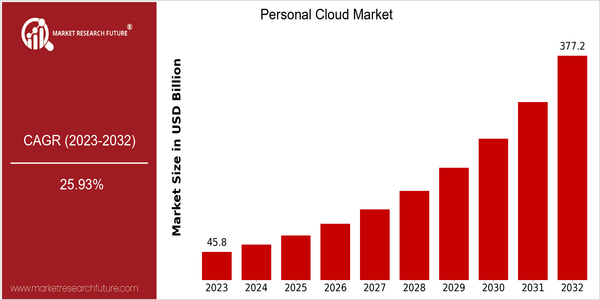
2023 USD 45.81 Billion
2032 USD 377.17 Billion
CAGR (2024-2032) 25.93 %

Note – Market size depicts the revenue generated over the financial year

Personal Cloud Market - Expected to Grow at a Fast Pace, Worth $ 45.81 Billion in 2023, and Worth $ 377.17 Billion by 2032. Its CAGR from 2024 to 2032 is expected to be 25.93%. The main factors driving the market are the increasing importance of digital storage and the wide use of smart devices, and the demand for secure and convenient data management. Also, the rise of remote work and the need for remote collaboration tools will drive the market. Also, the technological advances, such as the improvement of encryption, the increase in speed, and the integration of artificial intelligence into cloud services, will drive the market. Also, the major players in the industry, such as Google, Microsoft and Dropbox, have been actively investing in research and development and strategic cooperation to enhance their market positions. Product launches that focus on easy-to-use UIs and increased storage capacity can attract more users, and thus further establish their positions in the market.
home-ubuntu-www-mrf_ne_design-batch-6-cp-personal-cloud-market size

Regional Market Size

Regional Deep Dive

The Personal Cloud Market is experiencing significant growth in all regions. This growth is mainly due to the growing demand for data storage solutions, enhanced security features and the proliferation of smart devices. In North America, the market is characterized by high cloud adoption rates for both consumers and businesses, technological developments, and a high level of concern for data security. In Europe, the market is characterized by a diverse landscape, where the GDPR and other data protection regulations affect the trust of consumers and the dynamics of the market. In Asia-Pacific, the digital transformation is very strong, and the growing middle class and the increasing penetration of the Internet lead to a significant increase in the adoption of personal cloud services. The Middle East and Africa region is gradually embracing cloud technology, which is supported by government initiatives to digitalize. Latin America is also on the rise, with the focus on the provision of affordable cloud solutions for small and medium-sized businesses.

Europe

  • The implementation of the General Data Protection Regulation (GDPR) has led to a heightened focus on data security and privacy, compelling cloud service providers to enhance their compliance measures.
  • European companies such as OVHcloud are innovating by offering localized cloud solutions that prioritize data sovereignty, appealing to consumers concerned about data privacy.

Asia Pacific

  • The rapid growth of the digital economy in countries like India and China is driving the demand for personal cloud services, with local players like Alibaba Cloud and Tencent Cloud expanding their offerings.
  • Government initiatives promoting digital literacy and infrastructure development are facilitating the adoption of personal cloud solutions, particularly among small businesses and individual users.

Latin America

  • The increasing smartphone penetration in Latin America is driving the demand for personal cloud services, with companies like UOL Diveo offering affordable solutions tailored to local consumers.
  • Government programs aimed at boosting digital infrastructure are expected to enhance access to personal cloud services, particularly in rural areas.

North America

  • The rise of remote work has significantly increased the demand for personal cloud solutions, with companies like Dropbox and Google Drive enhancing their offerings to cater to this trend.
  • Regulatory changes, particularly around data privacy laws, have prompted organizations to invest in more secure personal cloud solutions, with companies like Microsoft leading the charge in compliance and security features.

Middle East And Africa

  • Countries in the Middle East, such as the UAE, are investing heavily in smart city initiatives, which are expected to drive demand for personal cloud services as part of their digital transformation strategies.
  • Local startups are emerging in the personal cloud space, with companies like Cloud4C providing tailored solutions to meet the unique needs of businesses in the region.

Did You Know?

“As of 2023, over 60% of consumers in North America are using at least one personal cloud service for data storage and sharing, reflecting a significant shift towards digital solutions.” — example.com

Segmental Market Size

Personal Clouds are an important part of the Cloud, and they are now enjoying a steady growth, due to the increasing demand for privacy and control over their own data. The need for remote access to personal files, especially in the post-pandemic world, is growing. The new regulations such as the General Data Protection Regulation (GDPR) also force individuals and companies to look for more secure solutions. Personal Cloud solutions are currently in the mass deployment stage, and companies like Synology and Western Digital are leading the way with their easy-to-use Personal Cloud appliances. The main applications are home media, file sharing and backup, with notable applications in the creative industries, where large files need to be accessed remotely. The trend to remote work and the green agenda are also driving the market, while the edge and the increased encryption will shape the evolution and ensure that Personal Clouds remain relevant and secure.

Future Outlook

Personal Cloud Market will grow from $46.8 billion in 2023 to $377.7 billion in 2032, at a CAGR of 25.93%. This growth will be driven by an increasing demand for data storage services, improved security, and the proliferation of smart devices. In the next few years, as more and more consumers and businesses recognize the importance of data ownership and control, the penetration of personal cloud solutions is expected to rise significantly, and it could exceed 60% of households by 2032. In addition, technological advancements, such as improved encryption, AI-driven data management, and IoT-enabled device integration, will further accelerate the development of the market. In addition, the increasing trend of remote work and digital collaboration will also drive the demand for reliable and accessible cloud storage solutions. Moreover, government regulations such as data protection laws and the growing awareness of cyber threats will also play an important role in promoting the development of the market. As the public awareness of data rights and the benefits of personal cloud services increases, the market will continue to develop, thereby promoting innovation and competition among service providers.

Personal Cloud Market Size Graph
Author
Shubham Munde
Team Lead - Research

Shubham brings over 7 years of expertise in Market Intelligence and Strategic Consulting, with a strong focus on the Automotive, Aerospace, and Defense sectors. Backed by a solid foundation in semiconductors, electronics, and software, he has successfully delivered high-impact syndicated and custom research on a global scale. His core strengths include market sizing, forecasting, competitive intelligence, consumer insights, and supply chain mapping. Widely recognized for developing scalable growth strategies, Shubham empowers clients to navigate complex markets and achieve a lasting competitive edge. Trusted by start-ups and Fortune 500 companies alike, he consistently converts challenges into strategic opportunities that drive sustainable growth.

Leave a Comment

FAQs

What is the current valuation of the Personal Cloud Market?

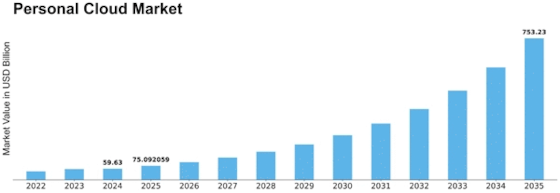
<p>The Personal Cloud Market was valued at 59.63 USD Billion in 2024.</p>

What is the projected market size for the Personal Cloud Market by 2035?

<p>The market is projected to reach 753.23 USD Billion by 2035.</p>

What is the expected CAGR for the Personal Cloud Market during the forecast period 2025 - 2035?

<p>The expected CAGR for the Personal Cloud Market during 2025 - 2035 is 25.93%.</p>

Which companies are considered key players in the Personal Cloud Market?

<p>Key players include Amazon, Google, Microsoft, Apple, Dropbox, Box, pCloud, Synology, and Western Digital.</p>

What are the main segments of the Personal Cloud Market?

<p>The main segments include Online Cloud, Server Device Cloud, and Network-Attached Storage Cloud.</p>

How did the Online Cloud segment perform in terms of valuation?

<p>The Online Cloud segment was valued at 23.85 USD Billion in 2024 and is expected to grow significantly.</p>

What was the valuation of the Server Device Cloud segment in 2024?

The Server Device Cloud segment was valued at 18.45 USD Billion in 2024.

What is the valuation of the Network-Attached Storage Cloud segment as of 2024?

The Network-Attached Storage Cloud segment was valued at 17.33 USD Billion in 2024.

How do the key players influence the Personal Cloud Market?

Key players like Amazon and Google likely drive innovation and competition within the Personal Cloud Market.

What trends are expected to shape the Personal Cloud Market in the coming years?

Trends such as increased data storage needs and advancements in cloud technology may shape the market through 2035.

Market Summary

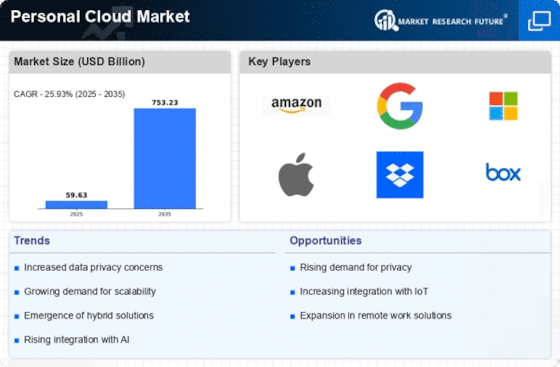
As per Market Research Future analysis, the Personal Cloud Market Size was estimated at 59.63 USD Billion in 2024. The Personal Cloud industry is projected to grow from 75.09 USD Billion in 2025 to 753.23 USD Billion by 2035, exhibiting a compound annual growth rate (CAGR) of 25.93% during the forecast period 2025 - 2035

Key Market Trends & Highlights

The Personal Cloud Market is experiencing robust growth driven by evolving consumer needs and technological advancements.

  • The market is witnessing an increased focus on data privacy as consumers become more aware of their digital footprints. Integration with smart devices is becoming a prevalent trend, enhancing user experience and accessibility. Customization and personalization options are gaining traction, allowing users to tailor their cloud solutions to specific needs. Rising demand for data storage solutions and advancements in cloud technology are key drivers propelling growth in North America and Asia-Pacific, particularly in the Online Cloud and Network-Attached Storage Cloud segments.

Market Size & Forecast

2024 Market Size 59.63 (USD Billion)
2035 Market Size 753.23 (USD Billion)
CAGR (2025 - 2035) 25.93%
Largest Regional Market Share in 2024 North America

Major Players

Amazon (US), Google (US), <a href="https://www.microsoft.com/en-us/microsoft-365/onedrive/online-cloud-storage">Microsoft</a> (US), Apple (US), Dropbox (US), Box (US), pCloud (CH), Synology (TW), Western Digital (US)

Market Trends

The Personal Cloud Market is currently experiencing a transformative phase, characterized by a growing demand for data storage solutions that prioritize user control and privacy. As individuals and businesses increasingly seek alternatives to traditional cloud services, the emphasis on personal data sovereignty has become paramount. This shift is driven by a heightened awareness of data security issues and a desire for customized storage options. Furthermore, advancements in technology are enabling more seamless integration of personal cloud solutions with various devices, enhancing user experience and accessibility. The market appears poised for continued growth as consumers become more discerning about their digital footprints and the services they utilize. In addition, the Personal Cloud Market is witnessing a surge in innovative offerings that cater to diverse user needs. Companies are developing solutions that not only provide storage but also facilitate collaboration and sharing among users.

This trend suggests a potential for increased engagement and satisfaction among consumers, as they find tools that align with their specific requirements. As the landscape evolves, it is likely that competition will intensify, prompting providers to enhance their features and services to attract a broader audience. Overall, the Personal Cloud Market is on a trajectory that reflects changing consumer preferences and technological advancements, indicating a dynamic future ahead. The personal cloud market is entering a strong growth phase, driven by rising data generation, increasing demand for secure storage solutions, and evolving consumer preferences toward decentralized cloud services. Personal cloud computing enables users to store, manage, and access digital content securely across devices while maintaining greater control over data ownership and privacy.

Increased Focus on Data Privacy

There is a notable trend towards prioritizing data privacy within the Personal Cloud Market. Users are becoming more aware of the implications of data breaches and are seeking solutions that offer enhanced security features. This shift is prompting providers to implement robust encryption methods and transparent data handling practices.

Integration with Smart Devices

The integration of personal cloud solutions with smart devices is gaining traction. As the Internet of Things continues to expand, users are looking for seamless connectivity between their devices and cloud storage. This trend indicates a growing demand for solutions that facilitate easy access and management of data across multiple platforms.

Customization and Personalization

Customization is emerging as a key factor in the Personal Cloud Market. Users are increasingly seeking tailored solutions that meet their specific needs, whether for personal use or business applications. This trend suggests that providers may need to offer more flexible options to cater to diverse user preferences.

Personal Cloud Market Market Drivers

Advancements in Cloud Technology

The Personal Cloud Market benefits from continuous advancements in cloud technology. Innovations such as artificial intelligence and machine learning are enhancing the functionality and efficiency of personal cloud solutions. These technologies enable better data management, predictive analytics, and improved user experiences. For instance, AI-driven features can automate file organization and optimize storage usage, making personal cloud services more appealing to users. As these technological advancements unfold, the Personal Cloud Market is likely to expand, attracting tech-savvy consumers who seek cutting-edge solutions for their data storage needs.

Growing Adoption of Mobile Devices

The Personal Cloud Market is significantly impacted by the growing adoption of mobile devices. As smartphones and tablets become ubiquitous, users increasingly rely on personal cloud solutions to access their data on the go. Recent statistics reveal that mobile device usage has surpassed desktop usage, indicating a shift in how individuals interact with their data. This trend suggests that personal cloud services must cater to mobile users by providing intuitive interfaces and seamless synchronization across devices. Consequently, the Personal Cloud Market is poised for growth as it adapts to the evolving preferences of a mobile-centric consumer base.

Increased Awareness of Data Security

The Personal Cloud Market is witnessing a heightened awareness of data security among consumers. With the rise in cyber threats and data breaches, individuals are becoming more cautious about where and how their data is stored. Recent surveys indicate that approximately 60% of users prioritize security features when selecting a cloud service provider. This growing concern drives demand for personal cloud solutions that offer robust encryption and privacy controls. As a result, the Personal Cloud Market is adapting to these needs by enhancing security measures, thereby attracting users who seek peace of mind regarding their sensitive information.

Rising Demand for Data Storage Solutions

The Personal Cloud Market experiences a notable surge in demand for data storage solutions. As individuals and businesses generate vast amounts of data, the need for secure and accessible storage options becomes paramount. According to recent statistics, the data generated globally is expected to reach 175 zettabytes by 2025, driving the necessity for personal cloud solutions. This trend indicates that consumers are increasingly seeking reliable platforms that offer not only storage but also enhanced security features. The Personal Cloud Market is thus positioned to benefit from this growing demand, as users prioritize solutions that provide both convenience and protection for their valuable data.

Shift Towards Remote Work and Collaboration

The Personal Cloud Market is significantly influenced by the shift towards remote work and collaboration. As organizations adapt to flexible work environments, the reliance on cloud-based solutions for file sharing and collaboration has intensified. Recent data suggests that over 70% of companies are now utilizing cloud services to facilitate remote work. This trend underscores the importance of personal cloud solutions that enable seamless access to files and applications from various devices. Consequently, the Personal Cloud Market is likely to see continued growth as businesses and individuals seek efficient ways to collaborate and share information in a remote setting.

Market Segment Insights

By Type: Online Cloud (Largest) vs. Network-Attached Storage Cloud (Fastest-Growing)

In the Personal Cloud Market, the distribution among types prominently features the Online Cloud, which stands out as the largest segment. This segment encompasses various services that allow users to store and manage data remotely through internet-based platforms. Following this, the Network-Attached Storage (NAS) cloud has emerged as the fastest-growing segment, catering to both individual consumers and businesses looking for efficient storage solutions and data accessibility. As we analyze the growth trends within this market, it is evident that increased digital content generation and the surge in remote working practices have propelled demand for online cloud solutions. Additionally, advancements in technology and competitive pricing in network-attached storage have resulted in significant adoption rates, especially among small to medium businesses seeking robust storage options that offer flexibility and control.

Online Cloud (Dominant) vs. NAS Cloud (Emerging)

The Online Cloud segment remains dominant within the Personal Cloud Market, characterized by its user-friendly interfaces and extensive storage capabilities. It primarily services individuals and enterprises seeking ease of access and collaboration on stored data through the internet. Meanwhile, the NAS Cloud is emerging as a viable alternative, particularly appealing to users who require direct data control and enhanced security features. Unlike traditional online cloud services, NAS solutions provide local storage along with the flexibility to access data remotely, making them an attractive option for tech-savvy users and businesses that demand efficiency and security. As both segments evolve, the competition among them is spurring innovations that ultimately benefit consumers.

Get more detailed insights about Personal Cloud Market Research Report - Global Forecast till 2035

Regional Insights

North America : Leading Innovation and Adoption

North America is the largest market for personal cloud services, holding approximately 45% of the global market share. The region's growth is driven by increasing demand for data storage solutions, enhanced security measures, and the proliferation of smart devices. Regulatory support, particularly around data privacy and security, has further catalyzed market expansion, making it a hub for innovation in cloud technologies. The competitive landscape is characterized by major players such as Amazon, Google, and Microsoft, which dominate the market with their extensive service offerings. The presence of these tech giants fosters a robust ecosystem, encouraging startups and smaller companies to innovate. Additionally, the U.S. government’s initiatives to promote cloud adoption in various sectors contribute to the region's strong market position.

Europe : Regulatory Framework and Growth

Europe is the second-largest market for personal cloud services, accounting for around 30% of the global market share. The region's growth is significantly influenced by stringent data protection regulations, such as the GDPR, which drive demand for secure cloud solutions. Additionally, the increasing adoption of remote work and digital transformation initiatives across various industries are key growth drivers in this region. Leading countries in Europe include Germany, the UK, and France, where local players like pCloud and Box are gaining traction alongside global giants. The competitive landscape is marked by a focus on compliance and security, with companies investing heavily in meeting regulatory standards. This focus not only enhances consumer trust but also positions Europe as a leader in secure cloud services.

Asia-Pacific : Rapid Growth and Adoption

Asia-Pacific is witnessing rapid growth in the personal cloud market, driven by increasing internet penetration and smartphone adoption. The region holds approximately 20% of the global market share, with countries like China and India leading the charge. The demand for cloud services is further fueled by the rise of e-commerce and digital content consumption, making it a vibrant market for personal cloud solutions. The competitive landscape is diverse, with both local and international players vying for market share. Companies like Synology and Western Digital are expanding their offerings to cater to the growing consumer base. Additionally, government initiatives promoting digital infrastructure development are expected to bolster market growth, making Asia-Pacific a key player in the global personal cloud landscape.

Middle East and Africa : Emerging Market with Potential

The Middle East and Africa region is an emerging market for personal cloud services, currently holding about 5% of the global market share. The growth is driven by increasing internet connectivity and a rising number of tech-savvy consumers. Governments in the region are investing in digital transformation initiatives, which are expected to enhance the adoption of cloud services in various sectors, including education and healthcare. Leading countries in this region include South Africa and the UAE, where local startups are beginning to emerge alongside established global players. The competitive landscape is still developing, with opportunities for growth as more businesses recognize the benefits of cloud solutions. As infrastructure improves, the region is poised for significant advancements in personal cloud adoption.

Key Players and Competitive Insights

The Personal Cloud Market is currently characterized by a dynamic competitive landscape, driven by increasing demand for data storage solutions and the growing need for secure, accessible cloud services. Major players such as Amazon (US), Google (US), and Microsoft (US) are at the forefront, leveraging their technological prowess and extensive resources to enhance their offerings. Amazon (US) focuses on integrating artificial intelligence into its cloud services, while Google (US) emphasizes user-friendly interfaces and seamless integration with its suite of applications. Microsoft (US) continues to expand its Azure platform, catering to both individual and enterprise needs, thereby shaping a competitive environment that is increasingly reliant on innovation and customer-centric strategies.In terms of business tactics, companies are localizing their operations to better serve regional markets, optimizing supply chains to enhance efficiency, and investing in advanced technologies to improve service delivery. The market appears moderately fragmented, with a mix of established giants and emerging players. This structure allows for a diverse range of offerings, yet the collective influence of key players like Dropbox (US) and Box (US) ensures that competition remains robust, pushing all companies to continuously innovate and adapt.
In August Amazon (US) announced the launch of its new AI-driven data management tool, which aims to streamline user experience and enhance data security. This strategic move is significant as it not only reinforces Amazon's commitment to innovation but also positions it as a leader in the integration of AI within personal cloud services. The tool is expected to attract a broader customer base, particularly among tech-savvy users seeking advanced functionalities.
In September Google (US) unveiled a partnership with several educational institutions to provide enhanced cloud storage solutions tailored for academic use. This initiative is strategically important as it not only expands Google's market reach but also aligns with its goal of fostering digital education. By catering to the specific needs of educational institutions, Google is likely to strengthen its brand loyalty and establish long-term relationships with key stakeholders in the education sector.
In July Microsoft (US) launched a new sustainability initiative aimed at reducing the carbon footprint of its Azure cloud services. This initiative is crucial as it reflects the growing trend towards sustainability in technology. By prioritizing eco-friendly practices, Microsoft is not only enhancing its corporate responsibility profile but also appealing to environmentally conscious consumers and businesses, thereby differentiating itself in a competitive market.
As of October the Personal Cloud Market is witnessing trends that emphasize digitalization, sustainability, and the integration of artificial intelligence. Strategic alliances are increasingly shaping the competitive landscape, allowing companies to pool resources and expertise to enhance their service offerings. Looking ahead, it appears that competitive differentiation will evolve from traditional price-based strategies to a focus on innovation, technological advancement, and supply chain reliability. This shift suggests that companies that prioritize these elements will likely emerge as leaders in the rapidly evolving personal cloud sector.

Key Companies in the Personal Cloud Market include

Industry Developments

  • Q1 2024: Amidata Unveils New Cloud-Based Storage Service Built on Quantum ActiveScale Amidata launched a new cloud-based storage service leveraging Quantum ActiveScale, aiming to deliver innovative backup-as-a-service solutions with Quantum DXi Backup Appliances for efficient and dependable data protection.

Future Outlook

Personal Cloud Market Future Outlook

The Personal Cloud Market is projected to grow at a 25.93% CAGR from 2025 to 2035, driven by increasing data storage needs and enhanced security features.

New opportunities lie in:

  • <p>Development of AI-driven data management solutions</p>
  • <p> </p>
  • <p>Expansion of subscription-based storage services</p>
  • <p>Integration of IoT devices for seamless cloud access</p>

By 2035, the Personal Cloud Market is expected to be a dominant force in digital storage solutions.

Market Segmentation

Personal Cloud Market Type Outlook

  • Online cloud
  • Server device cloud
  • Network-attached storage cloud

Report Scope

MARKET SIZE 2024 59.63(USD Billion)
MARKET SIZE 2025 75.09(USD Billion)
MARKET SIZE 2035 753.23(USD Billion)
COMPOUND ANNUAL GROWTH RATE (CAGR) 25.93% (2025 - 2035)
REPORT COVERAGE Revenue Forecast, Competitive Landscape, Growth Factors, and Trends
BASE YEAR 2024
Market Forecast Period 2025 - 2035
Historical Data 2019 - 2024
Market Forecast Units USD Billion
Key Companies Profiled Amazon (US), Google (US), Microsoft (US), Apple (US), Dropbox (US), Box (US), pCloud (CH), Synology (TW), Western Digital (US)
Segments Covered Type, Region
Key Market Opportunities Growing demand for secure, scalable storage solutions drives innovation in the Personal Cloud Market.
Key Market Dynamics Rising consumer demand for data privacy drives innovation and competition in the Personal Cloud Market.
Countries Covered North America, Europe, APAC, South America, MEA

FAQs

What is the current valuation of the Personal Cloud Market?

<p>The Personal Cloud Market was valued at 59.63 USD Billion in 2024.</p>

What is the projected market size for the Personal Cloud Market by 2035?

<p>The market is projected to reach 753.23 USD Billion by 2035.</p>

What is the expected CAGR for the Personal Cloud Market during the forecast period 2025 - 2035?

<p>The expected CAGR for the Personal Cloud Market during 2025 - 2035 is 25.93%.</p>

Which companies are considered key players in the Personal Cloud Market?

<p>Key players include Amazon, Google, Microsoft, Apple, Dropbox, Box, pCloud, Synology, and Western Digital.</p>

What are the main segments of the Personal Cloud Market?

<p>The main segments include Online Cloud, Server Device Cloud, and Network-Attached Storage Cloud.</p>

How did the Online Cloud segment perform in terms of valuation?

<p>The Online Cloud segment was valued at 23.85 USD Billion in 2024 and is expected to grow significantly.</p>

What was the valuation of the Server Device Cloud segment in 2024?

The Server Device Cloud segment was valued at 18.45 USD Billion in 2024.

What is the valuation of the Network-Attached Storage Cloud segment as of 2024?

The Network-Attached Storage Cloud segment was valued at 17.33 USD Billion in 2024.

How do the key players influence the Personal Cloud Market?

Key players like Amazon and Google likely drive innovation and competition within the Personal Cloud Market.

What trends are expected to shape the Personal Cloud Market in the coming years?

Trends such as increased data storage needs and advancements in cloud technology may shape the market through 2035.

  1. SECTION I: EXECUTIVE SUMMARY AND KEY HIGHLIGHTS
    1. | 1.1 EXECUTIVE SUMMARY
    2. | | 1.1.1 Market Overview
    3. | | 1.1.2 Key Findings
    4. | | 1.1.3 Market Segmentation
    5. | | 1.1.4 Competitive Landscape
    6. | | 1.1.5 Challenges and Opportunities
    7. | | 1.1.6 Future Outlook
  2. SECTION II: SCOPING, METHODOLOGY AND MARKET STRUCTURE
    1. | 2.1 MARKET INTRODUCTION
    2. | | 2.1.1 Definition
    3. | | 2.1.2 Scope of the study
    4. | | | 2.1.2.1 Research Objective
    5. | | | 2.1.2.2 Assumption
    6. | | | 2.1.2.3 Limitations
    7. | 2.2 RESEARCH METHODOLOGY
    8. | | 2.2.1 Overview
    9. | | 2.2.2 Data Mining
    10. | | 2.2.3 Secondary Research
    11. | | 2.2.4 Primary Research
    12. | | | 2.2.4.1 Primary Interviews and Information Gathering Process
    13. | | | 2.2.4.2 Breakdown of Primary Respondents
    14. | | 2.2.5 Forecasting Model
    15. | | 2.2.6 Market Size Estimation
    16. | | | 2.2.6.1 Bottom-Up Approach
    17. | | | 2.2.6.2 Top-Down Approach
    18. | | 2.2.7 Data Triangulation
    19. | | 2.2.8 Validation
  3. SECTION III: QUALITATIVE ANALYSIS
    1. | 3.1 MARKET DYNAMICS
    2. | | 3.1.1 Overview
    3. | | 3.1.2 Drivers
    4. | | 3.1.3 Restraints
    5. | | 3.1.4 Opportunities
    6. | 3.2 MARKET FACTOR ANALYSIS
    7. | | 3.2.1 Value chain Analysis
    8. | | 3.2.2 Porter's Five Forces Analysis
    9. | | | 3.2.2.1 Bargaining Power of Suppliers
    10. | | | 3.2.2.2 Bargaining Power of Buyers
    11. | | | 3.2.2.3 Threat of New Entrants
    12. | | | 3.2.2.4 Threat of Substitutes
    13. | | | 3.2.2.5 Intensity of Rivalry
    14. | | 3.2.3 COVID-19 Impact Analysis
    15. | | | 3.2.3.1 Market Impact Analysis
    16. | | | 3.2.3.2 Regional Impact
    17. | | | 3.2.3.3 Opportunity and Threat Analysis
  4. SECTION IV: QUANTITATIVE ANALYSIS
    1. | 4.1 Information and Communications Technology, BY Type (USD Billion)
    2. | | 4.1.1 Online cloud
    3. | | 4.1.2 Server device cloud
    4. | | 4.1.3 Network-attached storage cloud
    5. | 4.2 Information and Communications Technology, BY Region (USD Billion)
    6. | | 4.2.1 North America
    7. | | | 4.2.1.1 US
    8. | | | 4.2.1.2 Canada
    9. | | 4.2.2 Europe
    10. | | | 4.2.2.1 Germany
    11. | | | 4.2.2.2 UK
    12. | | | 4.2.2.3 France
    13. | | | 4.2.2.4 Russia
    14. | | | 4.2.2.5 Italy
    15. | | | 4.2.2.6 Spain
    16. | | | 4.2.2.7 Rest of Europe
    17. | | 4.2.3 APAC
    18. | | | 4.2.3.1 China
    19. | | | 4.2.3.2 India
    20. | | | 4.2.3.3 Japan
    21. | | | 4.2.3.4 South Korea
    22. | | | 4.2.3.5 Malaysia
    23. | | | 4.2.3.6 Thailand
    24. | | | 4.2.3.7 Indonesia
    25. | | | 4.2.3.8 Rest of APAC
    26. | | 4.2.4 South America
    27. | | | 4.2.4.1 Brazil
    28. | | | 4.2.4.2 Mexico
    29. | | | 4.2.4.3 Argentina
    30. | | | 4.2.4.4 Rest of South America
    31. | | 4.2.5 MEA
    32. | | | 4.2.5.1 GCC Countries
    33. | | | 4.2.5.2 South Africa
    34. | | | 4.2.5.3 Rest of MEA
  5. SECTION V: COMPETITIVE ANALYSIS
    1. | 5.1 Competitive Landscape
    2. | | 5.1.1 Overview
    3. | | 5.1.2 Competitive Analysis
    4. | | 5.1.3 Market share Analysis
    5. | | 5.1.4 Major Growth Strategy in the Information and Communications Technology
    6. | | 5.1.5 Competitive Benchmarking
    7. | | 5.1.6 Leading Players in Terms of Number of Developments in the Information and Communications Technology
    8. | | 5.1.7 Key developments and growth strategies
    9. | | | 5.1.7.1 New Product Launch/Service Deployment
    10. | | | 5.1.7.2 Merger & Acquisitions
    11. | | | 5.1.7.3 Joint Ventures
    12. | | 5.1.8 Major Players Financial Matrix
    13. | | | 5.1.8.1 Sales and Operating Income
    14. | | | 5.1.8.2 Major Players R&D Expenditure. 2023
    15. | 5.2 Company Profiles
    16. | | 5.2.1 Amazon (US)
    17. | | | 5.2.1.1 Financial Overview
    18. | | | 5.2.1.2 Products Offered
    19. | | | 5.2.1.3 Key Developments
    20. | | | 5.2.1.4 SWOT Analysis
    21. | | | 5.2.1.5 Key Strategies
    22. | | 5.2.2 Google (US)
    23. | | | 5.2.2.1 Financial Overview
    24. | | | 5.2.2.2 Products Offered
    25. | | | 5.2.2.3 Key Developments
    26. | | | 5.2.2.4 SWOT Analysis
    27. | | | 5.2.2.5 Key Strategies
    28. | | 5.2.3 Microsoft (US)
    29. | | | 5.2.3.1 Financial Overview
    30. | | | 5.2.3.2 Products Offered
    31. | | | 5.2.3.3 Key Developments
    32. | | | 5.2.3.4 SWOT Analysis
    33. | | | 5.2.3.5 Key Strategies
    34. | | 5.2.4 Apple (US)
    35. | | | 5.2.4.1 Financial Overview
    36. | | | 5.2.4.2 Products Offered
    37. | | | 5.2.4.3 Key Developments
    38. | | | 5.2.4.4 SWOT Analysis
    39. | | | 5.2.4.5 Key Strategies
    40. | | 5.2.5 Dropbox (US)
    41. | | | 5.2.5.1 Financial Overview
    42. | | | 5.2.5.2 Products Offered
    43. | | | 5.2.5.3 Key Developments
    44. | | | 5.2.5.4 SWOT Analysis
    45. | | | 5.2.5.5 Key Strategies
    46. | | 5.2.6 Box (US)
    47. | | | 5.2.6.1 Financial Overview
    48. | | | 5.2.6.2 Products Offered
    49. | | | 5.2.6.3 Key Developments
    50. | | | 5.2.6.4 SWOT Analysis
    51. | | | 5.2.6.5 Key Strategies
    52. | | 5.2.7 pCloud (CH)
    53. | | | 5.2.7.1 Financial Overview
    54. | | | 5.2.7.2 Products Offered
    55. | | | 5.2.7.3 Key Developments
    56. | | | 5.2.7.4 SWOT Analysis
    57. | | | 5.2.7.5 Key Strategies
    58. | | 5.2.8 Synology (TW)
    59. | | | 5.2.8.1 Financial Overview
    60. | | | 5.2.8.2 Products Offered
    61. | | | 5.2.8.3 Key Developments
    62. | | | 5.2.8.4 SWOT Analysis
    63. | | | 5.2.8.5 Key Strategies
    64. | | 5.2.9 Western Digital (US)
    65. | | | 5.2.9.1 Financial Overview
    66. | | | 5.2.9.2 Products Offered
    67. | | | 5.2.9.3 Key Developments
    68. | | | 5.2.9.4 SWOT Analysis
    69. | | | 5.2.9.5 Key Strategies
    70. | 5.3 Appendix
    71. | | 5.3.1 References
    72. | | 5.3.2 Related Reports
  6. LIST OF FIGURES
    1. | 6.1 MARKET SYNOPSIS
    2. | 6.2 NORTH AMERICA MARKET ANALYSIS
    3. | 6.3 US MARKET ANALYSIS BY TYPE
    4. | 6.4 CANADA MARKET ANALYSIS BY TYPE
    5. | 6.5 EUROPE MARKET ANALYSIS
    6. | 6.6 GERMANY MARKET ANALYSIS BY TYPE
    7. | 6.7 UK MARKET ANALYSIS BY TYPE
    8. | 6.8 FRANCE MARKET ANALYSIS BY TYPE
    9. | 6.9 RUSSIA MARKET ANALYSIS BY TYPE
    10. | 6.10 ITALY MARKET ANALYSIS BY TYPE
    11. | 6.11 SPAIN MARKET ANALYSIS BY TYPE
    12. | 6.12 REST OF EUROPE MARKET ANALYSIS BY TYPE
    13. | 6.13 APAC MARKET ANALYSIS
    14. | 6.14 CHINA MARKET ANALYSIS BY TYPE
    15. | 6.15 INDIA MARKET ANALYSIS BY TYPE
    16. | 6.16 JAPAN MARKET ANALYSIS BY TYPE
    17. | 6.17 SOUTH KOREA MARKET ANALYSIS BY TYPE
    18. | 6.18 MALAYSIA MARKET ANALYSIS BY TYPE
    19. | 6.19 THAILAND MARKET ANALYSIS BY TYPE
    20. | 6.20 INDONESIA MARKET ANALYSIS BY TYPE
    21. | 6.21 REST OF APAC MARKET ANALYSIS BY TYPE
    22. | 6.22 SOUTH AMERICA MARKET ANALYSIS
    23. | 6.23 BRAZIL MARKET ANALYSIS BY TYPE
    24. | 6.24 MEXICO MARKET ANALYSIS BY TYPE
    25. | 6.25 ARGENTINA MARKET ANALYSIS BY TYPE
    26. | 6.26 REST OF SOUTH AMERICA MARKET ANALYSIS BY TYPE
    27. | 6.27 MEA MARKET ANALYSIS
    28. | 6.28 GCC COUNTRIES MARKET ANALYSIS BY TYPE
    29. | 6.29 SOUTH AFRICA MARKET ANALYSIS BY TYPE
    30. | 6.30 REST OF MEA MARKET ANALYSIS BY TYPE
    31. | 6.31 KEY BUYING CRITERIA OF INFORMATION AND COMMUNICATIONS TECHNOLOGY
    32. | 6.32 RESEARCH PROCESS OF MRFR
    33. | 6.33 DRO ANALYSIS OF INFORMATION AND COMMUNICATIONS TECHNOLOGY
    34. | 6.34 DRIVERS IMPACT ANALYSIS: INFORMATION AND COMMUNICATIONS TECHNOLOGY
    35. | 6.35 RESTRAINTS IMPACT ANALYSIS: INFORMATION AND COMMUNICATIONS TECHNOLOGY
    36. | 6.36 SUPPLY / VALUE CHAIN: INFORMATION AND COMMUNICATIONS TECHNOLOGY
    37. | 6.37 INFORMATION AND COMMUNICATIONS TECHNOLOGY, BY TYPE, 2024 (% SHARE)
    38. | 6.38 INFORMATION AND COMMUNICATIONS TECHNOLOGY, BY TYPE, 2024 TO 2035 (USD Billion)
    39. | 6.39 BENCHMARKING OF MAJOR COMPETITORS
  7. LIST OF TABLES
    1. | 7.1 LIST OF ASSUMPTIONS
    2. | | 7.1.1
    3. | 7.2 North America MARKET SIZE ESTIMATES; FORECAST
    4. | | 7.2.1 BY TYPE, 2025-2035 (USD Billion)
    5. | 7.3 US MARKET SIZE ESTIMATES; FORECAST
    6. | | 7.3.1 BY TYPE, 2025-2035 (USD Billion)
    7. | 7.4 Canada MARKET SIZE ESTIMATES; FORECAST
    8. | | 7.4.1 BY TYPE, 2025-2035 (USD Billion)
    9. | 7.5 Europe MARKET SIZE ESTIMATES; FORECAST
    10. | | 7.5.1 BY TYPE, 2025-2035 (USD Billion)
    11. | 7.6 Germany MARKET SIZE ESTIMATES; FORECAST
    12. | | 7.6.1 BY TYPE, 2025-2035 (USD Billion)
    13. | 7.7 UK MARKET SIZE ESTIMATES; FORECAST
    14. | | 7.7.1 BY TYPE, 2025-2035 (USD Billion)
    15. | 7.8 France MARKET SIZE ESTIMATES; FORECAST
    16. | | 7.8.1 BY TYPE, 2025-2035 (USD Billion)
    17. | 7.9 Russia MARKET SIZE ESTIMATES; FORECAST
    18. | | 7.9.1 BY TYPE, 2025-2035 (USD Billion)
    19. | 7.10 Italy MARKET SIZE ESTIMATES; FORECAST
    20. | | 7.10.1 BY TYPE, 2025-2035 (USD Billion)
    21. | 7.11 Spain MARKET SIZE ESTIMATES; FORECAST
    22. | | 7.11.1 BY TYPE, 2025-2035 (USD Billion)
    23. | 7.12 Rest of Europe MARKET SIZE ESTIMATES; FORECAST
    24. | | 7.12.1 BY TYPE, 2025-2035 (USD Billion)
    25. | 7.13 APAC MARKET SIZE ESTIMATES; FORECAST
    26. | | 7.13.1 BY TYPE, 2025-2035 (USD Billion)
    27. | 7.14 China MARKET SIZE ESTIMATES; FORECAST
    28. | | 7.14.1 BY TYPE, 2025-2035 (USD Billion)
    29. | 7.15 India MARKET SIZE ESTIMATES; FORECAST
    30. | | 7.15.1 BY TYPE, 2025-2035 (USD Billion)
    31. | 7.16 Japan MARKET SIZE ESTIMATES; FORECAST
    32. | | 7.16.1 BY TYPE, 2025-2035 (USD Billion)
    33. | 7.17 South Korea MARKET SIZE ESTIMATES; FORECAST
    34. | | 7.17.1 BY TYPE, 2025-2035 (USD Billion)
    35. | 7.18 Malaysia MARKET SIZE ESTIMATES; FORECAST
    36. | | 7.18.1 BY TYPE, 2025-2035 (USD Billion)
    37. | 7.19 Thailand MARKET SIZE ESTIMATES; FORECAST
    38. | | 7.19.1 BY TYPE, 2025-2035 (USD Billion)
    39. | 7.20 Indonesia MARKET SIZE ESTIMATES; FORECAST
    40. | | 7.20.1 BY TYPE, 2025-2035 (USD Billion)
    41. | 7.21 Rest of APAC MARKET SIZE ESTIMATES; FORECAST
    42. | | 7.21.1 BY TYPE, 2025-2035 (USD Billion)
    43. | 7.22 South America MARKET SIZE ESTIMATES; FORECAST
    44. | | 7.22.1 BY TYPE, 2025-2035 (USD Billion)
    45. | 7.23 Brazil MARKET SIZE ESTIMATES; FORECAST
    46. | | 7.23.1 BY TYPE, 2025-2035 (USD Billion)
    47. | 7.24 Mexico MARKET SIZE ESTIMATES; FORECAST
    48. | | 7.24.1 BY TYPE, 2025-2035 (USD Billion)
    49. | 7.25 Argentina MARKET SIZE ESTIMATES; FORECAST
    50. | | 7.25.1 BY TYPE, 2025-2035 (USD Billion)
    51. | 7.26 Rest of South America MARKET SIZE ESTIMATES; FORECAST
    52. | | 7.26.1 BY TYPE, 2025-2035 (USD Billion)
    53. | 7.27 MEA MARKET SIZE ESTIMATES; FORECAST
    54. | | 7.27.1 BY TYPE, 2025-2035 (USD Billion)
    55. | 7.28 GCC Countries MARKET SIZE ESTIMATES; FORECAST
    56. | | 7.28.1 BY TYPE, 2025-2035 (USD Billion)
    57. | 7.29 South Africa MARKET SIZE ESTIMATES; FORECAST
    58. | | 7.29.1 BY TYPE, 2025-2035 (USD Billion)
    59. | 7.30 Rest of MEA MARKET SIZE ESTIMATES; FORECAST
    60. | | 7.30.1 BY TYPE, 2025-2035 (USD Billion)
    61. | 7.31 PRODUCT LAUNCH/PRODUCT DEVELOPMENT/APPROVAL
    62. | | 7.31.1
    63. | 7.32 ACQUISITION/PARTNERSHIP
    64. | | 7.32.1

Information and Communications Technology Market Segmentation

Information and Communications Technology By Type (USD Billion, 2025-2035)

  • Online cloud
  • Server device cloud
  • Network-attached storage cloud
Infographic

Free Sample Request

Kindly complete the form below to receive a free sample of this Report

Get Free Sample

Customer Strories

Compare Licence

×
Features License Type
Single User Multiuser License Enterprise User
Price $4,950 $5,950 $7,250
Maximum User Access Limit 1 User Upto 10 Users Unrestricted Access Throughout the Organization
Free Customization
Direct Access to Analyst
Deliverable Format
Platform Access
Discount on Next Purchase 10% 15% 15%
Printable Versions