×
Request Free Sample ×

Kindly complete the form below to receive a free sample of this Report

* Please use a valid business email

Leading companies partner with us for data-driven Insights

clients tt-cursor
Hero Background
English
Chinese
French
Japanese
Korean
German
Spanish

Pericarditis Market Trends

ID: MRFR/Pharma/1315-CR
156 Pages
Rahul Gotadki
August 2019

Global Pericarditis Market Research Report Information by Type (Acute Pericarditis, Recurrent Pericarditis and Chronic Pericarditis), Diagnosis & Treatment [Diagnosis (Electrocardiogram (ECG), Echocardiogram, Computerized Tomography (CT) and X-Ray) and Treatment (Medication (Non-Steroidal Anti-Inflammatory Drugs (NSAIDs) and Colchicine) and Surgical Treatment), End User (Hospitals & Clinics and Medical Institutes & Research Laboratories) and Region (Americas, Europe, Asia-Pacific and Middle East & Africa) - Forecast till 2035

Share:
Download PDF ×

We do not share your information with anyone. However, we may send you emails based on your report interest from time to time. You may contact us at any time to opt-out.

Pericarditis Market Infographic
×
Pericarditis Market Infographic Full View
Purchase Options

Market Trends

Key Emerging Trends in the Pericarditis Market

The Pericarditis market is undergoing dynamic changes influenced by advancements in diagnostic techniques, evolving treatment strategies, and a deeper understanding of the underlying causes of pericardial inflammation. Pericarditis, characterized by inflammation of the pericardium, has spurred innovations in therapeutics and diagnostic tools to address the diverse spectrum of this cardiac condition. One of the significant trends in the Pericarditis market is the integration of advanced imaging technologies for accurate diagnosis. Echocardiography, cardiac MRI, and CT scans are becoming pivotal in precisely assessing pericardial inflammation, guiding clinicians in formulating tailored treatment plans. Biomarkers for pericarditis is of the cutting edge of clinical applications in the current market and assists in early detection and prompt response. The framed markers like C-react (CRP) and troponin help to diagnose pericarditis, tracking and monitoring the disease activity, therefore calling for a more interactive control plan. Giving NSAIDs permits to play the role of the cornerstone in the treating pericarditis, serving as the primary approach to reduce inflammation, as well as the symptoms. Research and development dedicated to this type of regimen shows that the right balance is necessary to take into account the effectiveness of the drugs as well as the possibility of side effects that may vary among the different patient populations. As more evidence emerges, colchicine is rapidly gaining popularity for its proprietary role in the pericarditis market, specifically in preventing relapsing pericarditis. Demonstrated in studies, colchicine is found to be a helpful combo-medication in the management of pericarditis, which lowers the probability of recurrences and ensures a better overall condition is achieved. Investment in novel commercial solutions, such as, biologics is on the rise on the grounds of advanced stage diseases when oncologic standard treatments are futile. Biologics are new drugs targeting one or several inflammatory pathways (like the cell that produced interleukin-1 or IL-1)-innovative diagnostics for management of specific patients with chronic or recurrent (unsatisfactory response to standard) pericarditis. Amongst the nuances of Pericarditis market, the handling of complications such as cardiac tamponade is included as well. Expansion in special physcardiocentesis techniques, hemodynamic control and percutaneous drainage is leading development on dealing with critical cases where fluid housing to the heart is accumulated. Immunomodulators are the new shiny faces of the market, with how immune system alterations are increasingly becoming the main focus in treatment of pericarditis. Agents such as IVIG and immunosuppressants, that have been proposed for potentially mediating immune reactions in distinct pools of pericarditis patients are worthy of study at this point.


Author
Rahul Gotadki
Assistant Manager

He holds an experience of about 7+ years in Market Research and Business Consulting, working under the spectrum of Life Sciences and Healthcare domains. Rahul conceptualizes and implements a scalable business strategy and provides strategic leadership to the clients. His expertise lies in market estimation, competitive intelligence, pipeline analysis, customer assessment, etc. In addition to the above, his other responsibility includes strategic tracking of high growth markets & advising clients on the potential areas of focus they could direct their business initiatives

Leave a Comment

FAQs

At what CAGR is the global pericarditis market projected to grow in the forecast period (2024-2032)?

Pericarditis market projected to grow at approximately 5.56% CAGR during the assessment period (2024-2032).

How much is the global pericarditis market worth in the future?

The valuation of the global pericarditis market is estimated to increase to USD 6.09 Billion by the end of 2032.

Which is the major segment in the global pericarditis market?

On the basis of type, acute pericarditis holds majority shares in the global pericarditis market.

What are the major tailwinds pushing the growth of the global pericarditis market?

Rising preference for minimally invasive diagnostic and treatment procedures and the popularity of robot-assisted cardiac surgeries are major tailwinds pushing the growth of the global pericarditis market.

Which region holds the largest share in the global pericarditis market?

North America holds the largest share in the global pericarditis market, followed by Europe and the Asia Pacific, respectively.

Who are the top players in the global pericarditis market?

Sakura Finetek USA, Inc. (U.S.), Hitachi High-Technologies Corporation (Japan), Leica Biosystems Nussloch GmbH (Germany), Euromex Microscopen BV (The Netherlands), ZEISS International (Germany), Celestron LLC (U.S.), Labomed, Inc. (U.S.), Olympus Corporation (Japan), Bruker Corporation (U.S.), and Nikon Corporation (Japan), are some of the top players operating in the global pericarditis market.

Market Summary

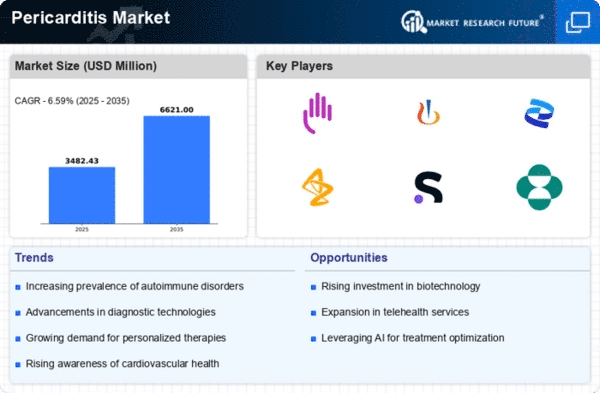
As per MRFR analysis, the Pericarditis Market Size was estimated at 3267.13 USD Million in 2024. The Pericarditis industry is projected to grow from 3519.87 in 2025 to 6621.0 by 2035, exhibiting a compound annual growth rate (CAGR) of 6.59 during the forecast period 2025 - 2035.

Key Market Trends & Highlights

The Pericarditis Market is experiencing notable growth driven by advancements in treatment and rising awareness of cardiovascular health.

  • North America remains the largest market for pericarditis treatments, reflecting a robust healthcare infrastructure.
  • The Asia-Pacific region is identified as the fastest-growing market, driven by increasing healthcare investments and awareness.
  • Acute pericarditis represents the largest segment, while chronic pericarditis is emerging as the fastest-growing segment in the market.
  • Key market drivers include the increasing incidence of pericarditis and advancements in treatment modalities, which are shaping market dynamics.

Market Size & Forecast

2024 Market Size 3267.13 (USD Million)
2035 Market Size 6621.0 (USD Million)
CAGR (2025 - 2035) 6.59%
Largest Regional Market Share in 2024 North America

Major Players

<p>Bristol-Myers Squibb (US), Novartis (CH), Pfizer (US), AstraZeneca (GB), Sanofi (FR), Merck & Co. (US), Gilead Sciences (US), Roche (CH)</p>

Market Trends

The Pericarditis Market is currently experiencing notable developments, driven by a combination of increasing awareness regarding cardiovascular diseases and advancements in diagnostic technologies. As healthcare systems evolve, there is a growing emphasis on early detection and effective management of pericarditis, which is a condition characterized by inflammation of the pericardium. This heightened focus appears to be fostering a more proactive approach among healthcare providers, leading to improved patient outcomes. Furthermore, the integration of telemedicine and digital health solutions is likely enhancing access to specialized care, thereby expanding the market's reach. In addition, the Pericarditis Market seems to be influenced by ongoing research and innovation in treatment modalities. Emerging therapies, including biologics and novel anti-inflammatory agents, may offer new avenues for managing this condition. The collaboration between pharmaceutical companies and research institutions indicates a commitment to addressing unmet medical needs. As the landscape continues to evolve, stakeholders in the Pericarditis Market are likely to adapt their strategies to align with these trends, ensuring that they remain competitive and responsive to patient demands.

Rising Awareness of Cardiovascular Health

There is an increasing recognition of the importance of cardiovascular health, which is driving demand for effective management of pericarditis. Educational initiatives and public health campaigns are contributing to this trend, encouraging individuals to seek timely medical attention.

Advancements in Diagnostic Technologies

Innovations in diagnostic tools are enhancing the ability to accurately identify pericarditis. Improved imaging techniques and biomarkers are facilitating earlier diagnosis, which may lead to better treatment outcomes and increased market growth.

Emerging Treatment Options

The development of new therapeutic agents is reshaping the treatment landscape for pericarditis. Research into biologics and targeted therapies suggests a potential shift towards more personalized medicine, which could significantly impact patient care.

Pericarditis Market Market Drivers

Emerging Therapeutic Options

The development of novel therapeutic agents for pericarditis is reshaping the Global Pericarditis Market Industry. Recent advancements in pharmacotherapy, including biologics and targeted therapies, offer new avenues for treatment, particularly for patients with recurrent or chronic pericarditis. These emerging options are designed to improve efficacy and reduce side effects compared to traditional treatments. As clinical trials yield promising results, the market is poised for expansion, with stakeholders keen to capitalize on these innovations. The anticipated growth trajectory suggests a market value of 7.16 USD Billion by 2035, reflecting the potential impact of these therapeutic advancements.

Rising Incidence of Pericarditis

The increasing prevalence of pericarditis globally is a primary driver for the Global Pericarditis Market Industry. Factors such as autoimmune diseases, infections, and post-surgical complications contribute to this rise. For instance, studies indicate that pericarditis affects approximately 27 per 100,000 individuals annually, with higher rates observed in specific demographics. This growing patient population necessitates enhanced diagnostic and therapeutic options, thereby expanding market opportunities. As the market is projected to reach 3.74 USD Billion in 2024, addressing this rising incidence is crucial for stakeholders in the Global Pericarditis Market Industry.

Increased Awareness and Education

Growing awareness about pericarditis among healthcare professionals and the general public is driving the Global Pericarditis Market Industry. Educational initiatives and campaigns aimed at recognizing symptoms and understanding treatment options are essential for early diagnosis and management. This heightened awareness leads to increased patient consultations and demand for medical interventions. Furthermore, as healthcare systems prioritize patient education, the market is expected to benefit from a more informed patient base. This trend aligns with the projected compound annual growth rate of 6.09% from 2025 to 2035, indicating a robust future for the industry.

Advancements in Diagnostic Technologies

Technological innovations in diagnostic tools are significantly influencing the Global Pericarditis Market Industry. Enhanced imaging techniques, such as echocardiography and MRI, allow for more accurate and timely diagnosis of pericarditis. These advancements facilitate early intervention, which is essential for improving patient outcomes. Moreover, the integration of artificial intelligence in diagnostic processes is expected to streamline workflows and reduce diagnostic errors. As these technologies become more widely adopted, they are likely to contribute to the market's growth, with projections indicating a market value of 7.16 USD Billion by 2035.

Rising Investment in Healthcare Infrastructure

The expansion of healthcare infrastructure globally is a significant factor propelling the Global Pericarditis Market Industry. Governments and private entities are investing in healthcare facilities and services, particularly in developing regions. This investment enhances access to medical care, including specialized treatments for pericarditis. Improved healthcare infrastructure facilitates better patient management and follow-up care, which is crucial for chronic conditions like pericarditis. As healthcare systems evolve, the market is likely to experience growth, supported by the increasing availability of resources and services tailored to pericarditis management.

Market Segment Insights

By Type of Pericarditis: Acute Pericarditis (Largest) vs. Chronic Pericarditis (Fastest-Growing)

<p>The Pericarditis Market is primarily dominated by Acute Pericarditis, which represents the largest share due to its widespread prevalence and recognition as a common cardiac condition. Chronic Pericarditis, while less prevalent than its acute counterpart, is gaining significant attention in the market, reflecting its increasing diagnosis and management. This dynamic distribution indicates a sector wherein acute cases lead, yet chronic instances are on the rise, influencing treatment protocols and market dynamics.</p>

<p>Acute Pericarditis (Dominant) vs. Recurrent Pericarditis (Emerging)</p>

<p>Acute Pericarditis is characterized by inflammation of the pericardial sac and is often linked to viral infections, leading to a higher incidence rate. Its dominance in the market can be attributed to a well-established treatment landscape, including non-steroidal anti-inflammatory drugs and corticosteroids, which provide effective management. In contrast, Recurrent Pericarditis is emerging as a significant focus for research and innovative treatments, driven by the need for long-term management options for patients experiencing repeated episodes. This segment is attracting attention due to the complexities involved in its treatment and the potential for novel therapeutic interventions, making it a crucial area for market growth.</p>

By Treatment Approach: Medication (Largest) vs. Surgical Intervention (Fastest-Growing)

<p>In the Pericarditis market, medication constitutes the largest treatment approach, emphasizing its pivotal role in managing the condition through anti-inflammatory drugs, corticosteroids, and pain relievers. This segment captures a substantial share of the treatment landscape due to its accessibility and effectiveness in mitigating symptoms. Meanwhile, surgical intervention is emerging as the fastest-growing approach, driven by an increasing recognition of its necessity in severe cases, such as constrictive pericarditis, where surgery can dramatically improve patient outcomes. The growth of the Treatment Approach segment is primarily fueled by advancements in medical research and technology, enabling more effective drug formulations and surgical techniques. Additionally, rising awareness about pericarditis and its debilitating effects has led to greater patient engagement in treatment decisions, further propelling the adoption of all treatment modalities. As healthcare providers recognize the need for personalized treatment plans, the combination of medication, surgery, and lifestyle changes is becoming increasingly common, adapting to the unique needs of patients experiencing pericarditis.</p>

<p>Medication (Dominant) vs. Surgical Intervention (Emerging)</p>

<p>Medication remains the dominant treatment approach in managing pericarditis due to its non-invasive nature and established efficacy in alleviating symptoms. This segment includes non-steroidal anti-inflammatory drugs, corticosteroids, and the appropriate use of colchicine, which are widely prescribed to help reduce inflammation and pain. In contrast, surgical intervention is gaining momentum as an emerging approach, particularly for patients with recurrent or persistent symptoms unresponsive to medication. Procedures such as pericardiectomy are becoming more prevalent, supported by research demonstrating their effectiveness in addressing specific complications of pericarditis. As healthcare professionals weigh the benefits of both approaches, there is a growing trend towards integrating medication management with surgical options to optimize patient care.</p>

By Patient Demographics: Age Group (Largest) vs. Comorbid Conditions (Fastest-Growing)

<p>In the Pericarditis Market, the distribution of patient demographics reveals that the age group is the largest segment, primarily consisting of older adults, particularly those aged 60 and above. This demographic holds a significant share in the overall prevalence of pericarditis. Following this group, the presence of comorbid conditions, such as hypertension and diabetes, is becoming increasingly important as a rapidly expanding segment. These comorbidities play a crucial role in the manifestation and complication of pericarditis among patients.</p>

<p>Age Group: 60+ (Dominant) vs. Comorbid Conditions: Hypertension (Emerging)</p>

<p>The dominant age group for pericarditis patients comprises individuals aged 60 and above, who often face various health adversities due to age-related vulnerabilities. This demographic is characterized by higher susceptibility to cardiac conditions, which subsequently elevates their risk of developing pericarditis. Conversely, comorbid conditions such as hypertension are emerging as significant factors influencing the prevalence of pericarditis. Hypertension not only exacerbates the existing health issues among older adults but also serves as a precursor condition contributing to inflammatory responses in the pericardium. As health policies shift towards integrated care for patients with multiple comorbidities, understanding the interaction between these demographics will be crucial in managing and treating pericarditis.</p>

By Diagnosis Method: Imaging Techniques (Largest) vs. Blood Tests (Fastest-Growing)

<p>In the Pericarditis Market, imaging techniques dominate the diagnosis method segment, capturing the largest share due to their ability to provide detailed visualization of the pericardium and surrounding structures. This includes echocardiography, CT scans, and MRI, which are pivotal in diagnosing the condition accurately. Meanwhile, blood tests, while traditionally considered ancillary, are experiencing growth as they provide quick and informative results regarding inflammation and infection, making them increasingly relevant in the overall diagnostic process.</p>

<p>Imaging Techniques (Dominant) vs. Blood Tests (Emerging)</p>

<p>Imaging techniques, particularly echocardiography, are established as the dominant method in the diagnosis of pericarditis, offering high accuracy and detailed anatomical assessment. These techniques allow clinicians to visualize fluid accumulation and other changes in the pericardium, leading to timely and effective treatment. In contrast, blood tests are emerging as an essential part of the diagnostic landscape, helping to identify biomarkers of inflammation. As healthcare evolves and focuses on rapid diagnostics, the demand for blood tests is increasing, showcasing their potential to complement traditional imaging techniques and enhance patient care.</p>

Get more detailed insights about Pericarditis Market Research Report— Global Forecast till 2035

Regional Insights

North America : Market Leader in Pericarditis

North America is poised to maintain its leadership in the Pericarditis market, holding a significant market share of $1630.0M in 2024. The region's growth is driven by increasing prevalence of cardiovascular diseases, advancements in treatment options, and supportive regulatory frameworks. The demand for innovative therapies is further fueled by rising healthcare expenditures and a focus on patient-centric care. The competitive landscape in North America is robust, featuring key players such as Bristol-Myers Squibb, Pfizer, and Merck & Co. These companies are actively engaged in research and development to enhance treatment efficacy. The U.S. remains the largest market, supported by a well-established healthcare infrastructure and a high rate of clinical trials, ensuring a steady pipeline of new therapies.

Europe : Emerging Market Dynamics

Europe is witnessing a growing interest in the Pericarditis market, with a market size of $900.0M. The region benefits from a strong regulatory environment that encourages innovation and the introduction of new therapies. Increasing awareness of cardiovascular health and the aging population are significant growth drivers. Additionally, collaborative efforts among healthcare providers and pharmaceutical companies are enhancing treatment accessibility. Leading countries such as Germany, France, and the UK are at the forefront of this market, with a competitive landscape featuring major players like Novartis and Roche. The European market is characterized by a mix of established therapies and emerging treatments, ensuring a diverse range of options for patients. The European Medicines Agency continues to support advancements in treatment protocols, fostering a favorable environment for market growth.

Asia-Pacific : Rapidly Growing Market Potential

The Asia-Pacific region is emerging as a significant player in the Pericarditis market, with a market size of $600.0M. Factors such as increasing healthcare investments, rising awareness of cardiovascular diseases, and a growing patient population are driving demand. Regulatory bodies are also becoming more supportive of new drug approvals, which is expected to enhance market growth in the coming years. Countries like Japan, China, and India are leading the charge in this region, with a competitive landscape that includes both local and international players. Companies such as AstraZeneca and Gilead Sciences are actively involved in expanding their presence. The region's diverse healthcare systems and varying levels of access to treatment present both challenges and opportunities for market players, making it a dynamic environment for growth.

Middle East and Africa : Untapped Market Opportunities

The Middle East and Africa (MEA) region is gradually developing its Pericarditis market, currently valued at $137.13M. The growth is driven by increasing healthcare investments and a rising prevalence of cardiovascular diseases. However, challenges such as limited access to healthcare and varying regulatory frameworks can hinder rapid growth. Efforts to improve healthcare infrastructure are essential for market expansion. Countries like South Africa and the UAE are leading the market, with a focus on enhancing treatment options. The competitive landscape is still evolving, with both local and international companies exploring opportunities. As awareness of cardiovascular health increases, the MEA region is expected to attract more investments, paving the way for future growth in the Pericarditis market.

Key Players and Competitive Insights

The Pericarditis Market is currently characterized by a dynamic competitive landscape, driven by increasing incidences of the condition and a growing demand for effective treatment options. Major players such as Bristol-Myers Squibb (US), Novartis (CH), and Pfizer (US) are strategically positioned to leverage their extensive research and development capabilities. Bristol-Myers Squibb (US) focuses on innovative therapies, while Novartis (CH) emphasizes partnerships to enhance its product pipeline. Pfizer (US) is actively pursuing digital transformation initiatives to streamline operations and improve patient engagement. Collectively, these strategies contribute to a competitive environment that is increasingly focused on innovation and patient-centric solutions.

Key business tactics within the Pericarditis Market include localizing manufacturing and optimizing supply chains to enhance efficiency and reduce costs. The market structure appears moderately fragmented, with several key players exerting influence over various segments. This fragmentation allows for a diverse range of treatment options, although it also necessitates strategic collaborations among companies to maintain competitive advantage.

In November 2025, Novartis (CH) announced a strategic partnership with a leading biotechnology firm to co-develop a novel therapeutic agent for pericarditis. This collaboration is expected to accelerate the development timeline and enhance the efficacy of treatment options available in the market. The strategic importance of this partnership lies in its potential to combine Novartis's extensive resources with innovative approaches from the biotech sector, thereby positioning the company as a leader in the treatment of pericarditis.

In October 2025, Pfizer (US) launched a new digital health platform aimed at improving patient adherence to prescribed therapies for pericarditis. This initiative reflects a growing trend towards integrating technology into healthcare, allowing for real-time monitoring and personalized treatment plans. The strategic significance of this move is underscored by the increasing demand for digital solutions in healthcare, which may enhance patient outcomes and foster brand loyalty.

In September 2025, Bristol-Myers Squibb (US) expanded its clinical trial program for a promising new drug targeting pericarditis, indicating a strong commitment to research and development. This expansion not only demonstrates the company's dedication to addressing unmet medical needs but also positions it to capture a larger market share as new therapies emerge. The strategic focus on clinical trials is likely to yield valuable data that can inform future product development and marketing strategies.

As of December 2025, current competitive trends in the Pericarditis Market are increasingly defined by digitalization, sustainability, and the integration of artificial intelligence (AI) into treatment protocols. Strategic alliances are shaping the landscape, enabling companies to pool resources and expertise to drive innovation. Looking ahead, competitive differentiation is expected to evolve, with a shift from price-based competition towards a focus on technological advancements, innovative therapies, and reliable supply chains. This transition may ultimately enhance patient care and foster long-term growth within the market.

Key Companies in the Pericarditis Market include

Industry Developments

Future Outlook

Pericarditis Market Future Outlook

<p>The Pericarditis Market is projected to grow at a 6.59% CAGR from 2024 to 2035, driven by advancements in treatment options, increasing awareness, and rising healthcare expenditures.</p>

New opportunities lie in:

  • <p>Development of targeted biologic therapies for chronic pericarditis management.</p>
  • <p>Expansion of telemedicine platforms for remote patient monitoring.</p>
  • <p>Investment in AI-driven diagnostic tools for early detection of pericarditis.</p>

<p>By 2035, the Pericarditis Market is expected to achieve substantial growth and innovation.</p>

Market Segmentation

Pericarditis Market Diagnosis Method Outlook

  • Imaging Techniques
  • Blood Tests
  • Electrocardiogram
  • Physical Examination

Pericarditis Market Treatment Approach Outlook

  • Medication
  • Surgical Intervention
  • Lifestyle Modification
  • Monitoring and Follow-up

Pericarditis Market Patient Demographics Outlook

  • Age Group
  • Gender
  • Comorbid Conditions
  • Socioeconomic Status

Pericarditis Market Type of Pericarditis Outlook

  • Acute Pericarditis
  • Chronic Pericarditis
  • Recurrent Pericarditis
  • Constrictive Pericarditis

Report Scope

MARKET SIZE 20243267.13(USD Million)
MARKET SIZE 20253519.87(USD Million)
MARKET SIZE 20356621.0(USD Million)
COMPOUND ANNUAL GROWTH RATE (CAGR)6.59% (2024 - 2035)
REPORT COVERAGERevenue Forecast, Competitive Landscape, Growth Factors, and Trends
BASE YEAR2024
Market Forecast Period2025 - 2035
Historical Data2019 - 2024
Market Forecast UnitsUSD Million
Key Companies ProfiledBristol-Myers Squibb (US), Novartis (CH), Pfizer (US), AstraZeneca (GB), Sanofi (FR), Merck & Co. (US), Gilead Sciences (US), Roche (CH)
Segments CoveredType of Pericarditis, Treatment Approach, Patient Demographics, Diagnosis Method
Key Market OpportunitiesAdvancements in targeted therapies and diagnostics enhance treatment options in the Pericarditis Market.
Key Market DynamicsRising demand for innovative therapies drives competitive dynamics in the Pericarditis Market.
Countries CoveredNorth America, Europe, APAC, South America, MEA

FAQs

At what CAGR is the global pericarditis market projected to grow in the forecast period (2024-2032)?

Pericarditis market projected to grow at approximately 5.56% CAGR during the assessment period (2024-2032).

How much is the global pericarditis market worth in the future?

The valuation of the global pericarditis market is estimated to increase to USD 6.09 Billion by the end of 2032.

Which is the major segment in the global pericarditis market?

On the basis of type, acute pericarditis holds majority shares in the global pericarditis market.

What are the major tailwinds pushing the growth of the global pericarditis market?

Rising preference for minimally invasive diagnostic and treatment procedures and the popularity of robot-assisted cardiac surgeries are major tailwinds pushing the growth of the global pericarditis market.

Which region holds the largest share in the global pericarditis market?

North America holds the largest share in the global pericarditis market, followed by Europe and the Asia Pacific, respectively.

Who are the top players in the global pericarditis market?

Sakura Finetek USA, Inc. (U.S.), Hitachi High-Technologies Corporation (Japan), Leica Biosystems Nussloch GmbH (Germany), Euromex Microscopen BV (The Netherlands), ZEISS International (Germany), Celestron LLC (U.S.), Labomed, Inc. (U.S.), Olympus Corporation (Japan), Bruker Corporation (U.S.), and Nikon Corporation (Japan), are some of the top players operating in the global pericarditis market.

  1. SECTION I: EXECUTIVE SUMMARY AND KEY HIGHLIGHTS
    1. | 1.1 EXECUTIVE SUMMARY
  2. SECTION II: SCOPING, METHODOLOGY AND MARKET STRUCTURE
    1. | 2.1 MARKET INTRODUCTION
    2. | 2.2 RESEARCH METHODOLOGY
  3. SECTION III: QUALITATIVE ANALYSIS
    1. | 3.1 MARKET DYNAMICS
    2. | 3.2 MARKET FACTOR ANALYSIS
  4. SECTION IV: QUANTITATIVE ANALYSIS
    1. | 4.1 Healthcare, BY Type of Pericarditis (USD Million)
    2. | 4.2 Healthcare, BY Treatment Approach (USD Million)
    3. | 4.3 Healthcare, BY Patient Demographics (USD Million)
    4. | 4.4 Healthcare, BY Diagnosis Method (USD Million)
    5. | 4.5 Healthcare, BY Region (USD Million)
  5. SECTION V: COMPETITIVE ANALYSIS
    1. | 5.1 Competitive Landscape
    2. | 5.2 Company Profiles
    3. | 5.3 Appendix

Pericarditis Market Segmentation

Market Segmentation Overview

  • Detailed segmentation data will be available in the full report
  • Comprehensive analysis by multiple parameters
  • Regional and country-level breakdowns
  • Market size forecasts by segment
Infographic

Free Sample Request

Kindly complete the form below to receive a free sample of this Report

Get Free Sample

Customer Strories

Compare Licence

×
Features License Type
Single User Multiuser License Enterprise User
Price $4,950 $5,950 $7,250
Maximum User Access Limit 1 User Upto 10 Users Unrestricted Access Throughout the Organization
Free Customization
Direct Access to Analyst
Deliverable Format
Platform Access
Discount on Next Purchase 10% 15% 15%
Printable Versions