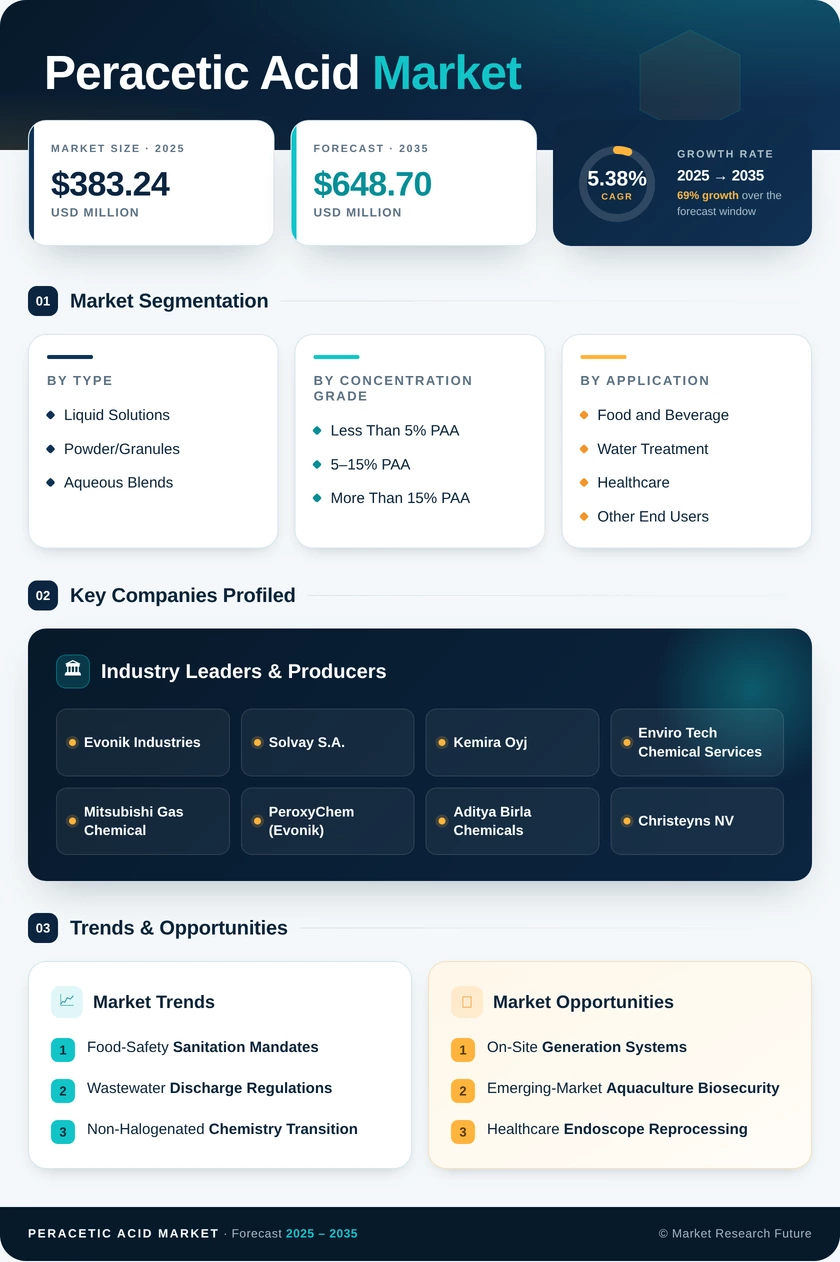
Segmentation Quick Reference
| Dimension | Sub-Segments | Dominant Segment | Fastest Growing Segment |
| Product Form | Liquid Solutions, Powder/Granules, Aqueous Blends | Liquid Solutions | Aqueous Blends |
| Concentration Grade | Less Than 5% PAA, 5–15% PAA, More Than 15% PAA | 5–15% PAA | More Than 15% PAA |
| Application | Disinfectant, Oxidizer, Other Applications | Disinfectant | Oxidizer |
| End-User Industry | Food and Beverage, Water Treatment, Peracetic Acid Market, Other End Users | Food and Beverage | Water Treatment |
| Region | Asia-Pacific, North America, Europe, South America, the Middle East & Africa | Asia-Pacific | Asia-Pacific |
Market Segmentation Overview
By Product Form
| Sub-Segment | Key Trend |
| Liquid Solutions | Remains the standard format for CIP systems in food and beverage plants; it accounts for the largest volume share globally. |
| Powder/Granules | Growing adoption in remote aquaculture and agricultural settings where cold-chain logistics are impractical |
| Aqueous Blends | On-site blending systems are gaining traction in municipal water treatment and mid-scale food processing facilities. |
Liquid solutions continue to anchor the product-form landscape because they integrate seamlessly into automated dosing and clean-in-place infrastructure. Powder and granular formats are carving out a share in tropical and remote-location applications where extended shelf life outweighs higher per-unit costs.
By Concentration Grade
| Sub-Segment | Key Trend |
| Less Than 5% PAA | Preferred for healthcare high-level disinfection where low-concentration, ready-to-use formats minimize handling risk |
| 5–15% PAA | Workhorse grade for food-contact sanitation and municipal water treatment, balancing efficacy and safety compliance |
| More Than 15% PAA | Expanding into industrial oxidizer applications, including TCF pulp bleaching and heavy-duty textile processing |
The 5–15% PAA grade dominates because most food-safety and water-treatment regulations are written around this concentration window. Above-15% formulations serve specialized industrial oxidizer niches where higher active-ingredient loading justifies the additional storage and transport precautions.
By Application
| Sub-Segment | Key Trend |
| Disinfectant | Core application driven by global regulatory mandates replacing chlorine-based chemicals across food, water, and healthcare |
| Oxidizer | Growing as pulp mills and textile processors seek chlorine-free bleaching and brightening alternatives. |
| Other Applications | Includes soil fumigation, oil-field biocide injection, and specialty chemical synthesis |
Disinfectant use cases represent nearly half of all peracetic acid consumption, reflecting the compound's broad-spectrum antimicrobial efficacy and favorable regulatory profile. Oxidizer applications are the fastest-growing category as sustainability-driven bleaching conversions accelerate globally.
By End-User Industry
| Sub-Segment | Key Trend |
| Food and Beverage | Largest consumer; driven by no-rinse sanitation mandates for poultry, dairy, produce, and ready-to-eat lines |
| Water Treatment | Fastest-growing major end use: municipal and industrial wastewater plants switching from chlorination to PAA dosing |
| Peracetic Acid Market | Concentrated in high-level disinfection of heat-sensitive medical devices, especially flexible endoscopes |
| Other End Users | Encompasses pulp and paper, oil and gas, aquaculture, and textile processing |
Food and beverage processing dominates end-user demand because peracetic acid is one of the few antimicrobial compounds approved for direct food-contact use without a mandatory rinse step. Water treatment is accelerating as discharge regulations tighten globally and utilities seek halogen-free alternatives that eliminate trihalomethane formation.

 Noah Malgeri
Co-Founder
Noah Malgeri
Co-Founder

 Peter Groot koerkamp
Account and Business Manager
Peter Groot koerkamp
Account and Business Manager

 Younghwan Choi
Senior Retail Manager
Younghwan Choi
Senior Retail Manager

 Mark Irwin
Management Consultant
Mark Irwin
Management Consultant

 Akif Moroglu
Strategy & Business Development Director
Akif Moroglu
Strategy & Business Development Director

 Guilherme Gomes Martins
Product Management Director
Guilherme Gomes Martins
Product Management Director

 Joseph Aguayo
Sales Operations & Pricing Manager
Joseph Aguayo
Sales Operations & Pricing Manager

 La Terria Dodd
Program Support Specialist
La Terria Dodd
Program Support Specialist

 Rob Kooiker
Group Product Manager HVAC & Fire Protection GMA
Rob Kooiker
Group Product Manager HVAC & Fire Protection GMA