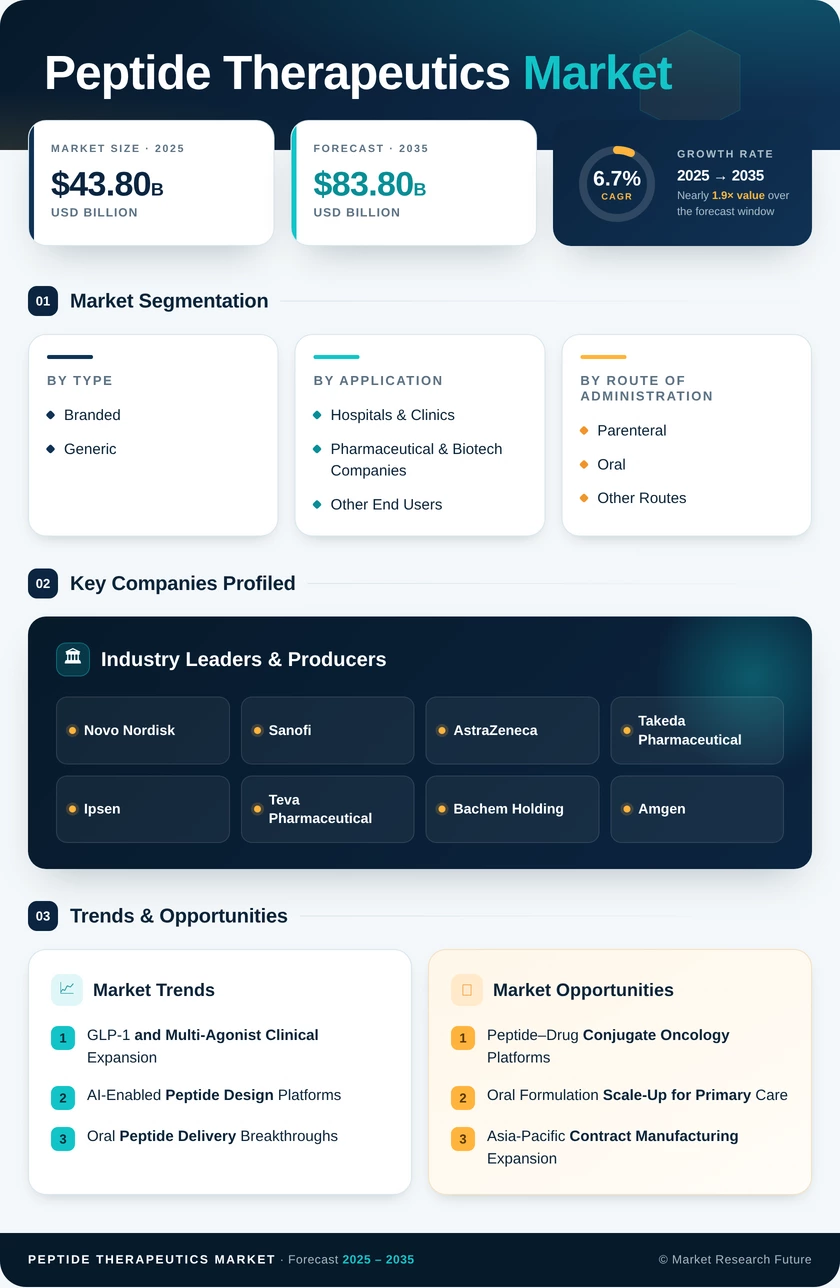
Segmentation Quick Reference
| Dimension | Sub-Segments | Dominant Segment | Fastest Growing Segment |
| Marketing Type | Branded, Generic | Branded (66.0% share, 2025) | Generic (8.9% CAGR) |
| Application | Oncology, Gastrointestinal Disorders, Metabolic Disorders, Other | Oncology (38.2% share, 2025) | Gastrointestinal Disorders (12.7% CAGR) |
| Route of Administration | Parenteral, Oral, Other | Parenteral (75.0% share, 2025) | Oral (13.8% CAGR) |
| Technology | Solid-Phase Peptide Synthesis (SPPS), Recombinant Expression, Other | SPPS (48.3% share, 2025) | Recombinant Expression (14.7% CAGR) |
| End User | Hospitals & Clinics, Pharmaceutical & Biotech Companies, Other | Hospitals & Clinics (45.2% share, 2025) | Pharmaceutical & Biotech Companies (13.5% CAGR) |
Market Segmentation Overview
By Marketing Type
| Sub-Segment | Key Trend |
| Branded | Patent-protected incretin therapies sustaining premium pricing through late 2020s |
| Generic | Patent expirations triggering accelerated ANDA and biosimilar filings from 2028 |
Branded peptides continue to drive the majority of market revenue, anchored by semaglutide and tirzepatide franchises. Generic entrants will reshape competitive dynamics as key patents expire, particularly in metabolic and oncology segments.
By Application
| Sub-Segment | Key Trend |
| Oncology | Radioligand peptide therapies and PDCs expanding approved indications |
| Gastrointestinal Disorders | GLP-1 label extensions into NASH and inflammatory bowel disease |
| Metabolic Disorders | Dual- and triple-agonist peptides broadening therapeutic reach |
| Other Applications | Antimicrobial peptides and CNS-targeting candidates entering late-stage trials |
Oncology remains the largest revenue contributor, while gastrointestinal applications represent the fastest growth trajectory as incretin-class peptides gain new indications.
By Route of Administration
| Sub-Segment | Key Trend |
| Parenteral | Subcutaneous auto-injectors and prefilled pen devices improving adherence |
| Oral | SNAC-based and ionic-liquid oral delivery systems advancing through Phase III |
| Other Routes | Nasal and transdermal peptide delivery technologies in early clinical stages |
Parenteral delivery dominates current volumes, but oral formulation breakthroughs are expected to capture an increasing share of new prescriptions over the forecast period.
By Technology
| Sub-Segment | Key Trend |
| Solid-Phase Peptide Synthesis (SPPS) | Continuous-flow SPPS platforms lowering production costs and cycle times |
| Recombinant Expression | Scaling for sequences above 50 residues with improved yield economics |
| Other Technologies | Enzymatic ligation and hybrid approaches gaining R&D investment |
SPPS remains the established manufacturing backbone, while recombinant expression is emerging as the preferred route for longer, more complex peptide sequences.
By End User
| Sub-Segment | Key Trend |
| Hospitals & Clinics | Infusion-administered oncology and metabolic peptide therapies driving volumes |
| Pharmaceutical & Biotech Companies | Pipeline-driven R&D spending and in-house peptide manufacturing investments |
| Other End Users | Academic research institutions and specialty compounding pharmacies expanding use |
Hospitals and clinics account for the largest end-user share, reflecting the clinical administration requirements of most approved peptide therapies.


 Noah Malgeri
Co-Founder

 Peter Groot koerkamp
Account and Business Manager

 Younghwan Choi
Senior Retail Manager

 Mark Irwin
Management Consultant

 Akif Moroglu
Strategy & Business Development Director

 Guilherme Gomes Martins
Product Management Director

 Joseph Aguayo
Sales Operations & Pricing Manager

 La Terria Dodd
Program Support Specialist

 Rob Kooiker
Group Product Manager HVAC & Fire Protection GMA