Request Free Sample ×

Kindly complete the form below to receive a free sample of this Report

* Please use a valid business email

Leading companies partner with us for data-driven Insights

clients tt-cursor
Hero Background
English
Chinese
French
Japanese
Korean
German
Spanish

Pediatric Medical Device Market Trends

ID: MRFR/MED/0474-HCR
80 Pages
Satyendra Maurya
Last Updated: April 06, 2026

Pediatric Medical Devices Market Size, Growth Research Report By Product (Cardiology Devices, In Vitro Diagnostic (IVD) Devices, Diagnostic Imaging Devices, Telemedicine, Anesthesia & Respiratory Care Devices, Neonatal ICU Devices, Monitoring Devices, and Others), by End User (Hospitals, Pediatric Clinics, Ambulatory Surgical Centers, Research and Academic Institutes, and Others) - Competitor Industry Analysis and Trends Forecast Till 2035

Share:
Download PDF ×

We do not share your information with anyone. However, we may send you emails based on your report interest from time to time. You may contact us at any time to opt-out.

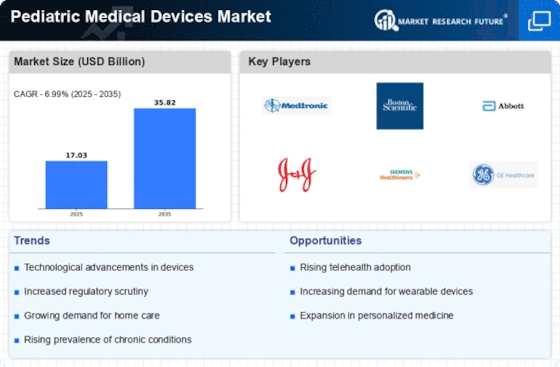
Pediatric Medical Device Market Infographic
Purchase Options

Market Trends

Key Emerging Trends in the Pediatric Medical Device Market

The Pediatric Medical Device Market has noticed some trends driven by technological advancement, increased awareness about pediatric health needs, and a focus on developing child-friendly medical devices. The growth is mainly due to increasing recognition that children possess physiological and developmental characteristics different from those of adults hence causing an increased demand for pediatrics related medical apparatuses. This realization has stimulated research into specialized medicine tailor made for kids starting from newborns all through adolescence.

The development of trends within the pediatric medical device market is also significantly influenced by advancements in technology. Such advances like miniaturization, telemedicine and wearable gadgets are utilized towards generation of pediatric medical devices that are more accurate, less invasive as well as remote monitorable in nature. By so doing, it’s not just diagnosis or treatment capabilities improved for children but also their experience changed by providing them with painless procedures.

Another important trend is that of child friendly design as well as usability aspects within pediatrics’ medical products. Recognizing how fear and anxiety can be reduced among young patients; manufactures have been concentrating on making good looking items while at the same time being non-threatening or rather interactive ones. This goes further than physical make-up such as user interfaces of these gadgets to patient engagement features allowing better experiences for children patients including their attendants.

Specific shifts within this field come about due to growing prevalence rates chronic diseases affecting kids such as diabetes mellitus plus many respiratory conditions . For instance there exists a rising requirement for diabetic children continuous glucose monitoring systems alongside smart inhalers plus respiratory devices for children with asthma or other breathing complications. These devices allow real time monitoring, provide valuable data to parents and caregivers and improve disease management among pediatric populations.

The Pediatric Medical Device Market is experiencing a trend towards greater partnerships and collaborations between different players. Addressing unique challenges and complexities associated with pediatric medical device development require cooperation between health providers, industry stakeholders, academic researchers as well as regulatory bodies. These relationships help in pooling of knowledge, inspiring innovation and generally contributing towards better child care.

Moreover, telehealth and remote patient monitoring have become more influential in pediatrics impacting the trends within the pediatric medical device marketplace. Among other things that are being enabled by these telehealth services’ extension is an increasing call for distant tracking tools meant for pediatric patients who need healthcare practitioner’s care from a distance. This has been particularly emphasized with regards to managing chronic childhood diseases as well as ensuring continuity of care especially within rural areas.

The trend of pediatric patient safety is an important one in the medical device market. As a way of making pediatric medical devices safer, alarms are being added to them, there are fail-safes included and the user interface is made friendlier. This trend serves compliance with approaches aimed at minimizing risks and adverse events associated with medical interventions in children.


Author
Author Profile
Satyendra Maurya
Research Analyst

An accomplished research analyst with high proficiency in market forecasting, data visualization, competitive benchmarking, and others. He holds a pronounced track record in research and consulting projects for sectors such as life sciences, medical devices, and healthcare IT. His capabilities in qualitative and quantitative analysis have resulted in positive client outcomes. Working on niche market trends, opportunities, sales, and forecasted value is part of his skill set.

Leave a Comment

FAQs

What is the projected market valuation of the Pediatric Medical Devices Market by 2035?

<p>The Pediatric Medical Devices Market is projected to reach a valuation of 35.82 USD Billion by 2035.</p>

What was the market valuation of the Pediatric Medical Devices Market in 2024?

<p>In 2024, the market valuation of the Pediatric Medical Devices Market was 17.03 USD Billion.</p>

What is the expected CAGR for the Pediatric Medical Devices Market during the forecast period 2025 - 2035?

<p>The expected CAGR for the Pediatric Medical Devices Market during the forecast period 2025 - 2035 is 6.99%.</p>

Which segments are included in the Pediatric Medical Devices Market?

<p>The market includes segments such as Cardiology Devices, In Vitro Diagnostic Devices, and Telemedicine, among others.</p>

What is the projected valuation for Cardiology Devices by 2035?

<p>The projected valuation for Cardiology Devices is expected to increase from 2.5 USD Billion in 2024 to 5.5 USD Billion by 2035.</p>

Who are the key players in the Pediatric Medical Devices Market?

<p>Key players in the market include Medtronic, Boston Scientific, and Abbott Laboratories, among others.</p>

What is the expected growth for In Vitro Diagnostic Devices from 2024 to 2035?

<p>In Vitro Diagnostic Devices are projected to grow from 3.0 USD Billion in 2024 to 6.5 USD Billion by 2035.</p>

How does the market for Pediatric Clinics compare to that of Hospitals in 2025?

In 2025, the market for Pediatric Clinics is expected to be valued at 3.0 USD Billion, while Hospitals are projected at 6.5 USD Billion.

What is the anticipated growth for Monitoring Devices by 2035?

Monitoring Devices are anticipated to grow from 2.0 USD Billion in 2024 to 4.5 USD Billion by 2035.

What role do companies like Siemens Healthineers and GE Healthcare play in the market?

Companies like Siemens Healthineers and GE Healthcare are pivotal in driving innovation and market growth within the Pediatric Medical Devices sector.

Market Summary

As per Market Research Future analysis, the Pediatric Medical Devices Market was estimated at 17.03 USD Billion in 2024. The Pediatric Medical Devices industry is projected to grow from 18.22 USD Billion in 2025 to 35.82 USD Billion by 2035, exhibiting a compound annual growth rate (CAGR) of 6.99% during the forecast period 2025 - 2035

Key Market Trends & Highlights

The Pediatric Medical Devices Market is poised for substantial growth driven by technological advancements and increasing healthcare investments.

  • Technological advancements are reshaping the Pediatric Medical Devices Market, enhancing device efficacy and safety. North America remains the largest market, while the Asia-Pacific region is emerging as the fastest-growing area for pediatric medical devices. Monitoring devices dominate the market, whereas telemedicine solutions are rapidly gaining traction among healthcare providers. The rising prevalence of pediatric diseases and increased investment in pediatric healthcare are key drivers propelling market expansion.

Market Size & Forecast

2024 Market Size 17.03 (USD Billion)
2035 Market Size 35.82 (USD Billion)
CAGR (2025 - 2035) 6.99%
Largest Regional Market Share in 2024 North America

Major Players

<p>Medtronic (US), Boston Scientific (US), Abbott Laboratories (US), Johnson &amp; Johnson (US), <a title="Siemens Healthineers" href="https://www.siemens-healthineers.com/en-us/clinical-specialities/pediatrics" target="_blank" rel="noopener">Siemens Healthineers</a> (DE), GE Healthcare (US), <a title="Philips Healthcare" href="https://www.usa.philips.com/healthcare?srsltid=AfmBOor4NSNdyASYtZ4mK34mNb1jUikwczVs79y1CcjgAf5q1SBsNNnA" target="_blank" rel="noopener">Philips Healthcare</a> (NL), B. Braun Melsungen AG (DE), Stryker Corporation (US)</p>

Market Trends

The Pediatric Medical Devices Market is currently experiencing a transformative phase, characterized by rapid advancements in technology and an increasing focus on specialized healthcare solutions for children. This market encompasses a wide array of devices, including diagnostic tools, therapeutic equipment, and monitoring systems tailored specifically for pediatric patients. The growing awareness of the unique medical needs of children, coupled with a rise in chronic conditions among the younger population, drives innovation and investment in this sector. Furthermore, regulatory bodies are increasingly emphasizing the importance of safety and efficacy in pediatric devices, which may lead to more stringent approval processes but ultimately enhances product quality and reliability.

In addition, the Pediatric Medical Devices Market is likely to benefit from the integration of digital health technologies, such as telemedicine and mobile health applications. These innovations appear to facilitate better access to healthcare services for children, particularly in underserved regions. As healthcare providers and manufacturers collaborate to develop solutions that address the specific requirements of pediatric patients, the market is poised for sustained growth. The emphasis on personalized medicine and patient-centered care may further influence the development of devices that cater to the diverse needs of children, ensuring that they receive optimal treatment and support throughout their healthcare journey.

Technological Advancements

The Pediatric Medical Devices Market is witnessing a surge in technological innovations, particularly in areas such as miniaturization and connectivity. These advancements enable the creation of devices that are not only more effective but also easier to use for both healthcare providers and young patients. As technology continues to evolve, it is likely that new solutions will emerge, enhancing the overall quality of care.

Regulatory Focus on Safety

There is an increasing emphasis on regulatory frameworks that prioritize the safety and efficacy of pediatric medical devices. This trend suggests that manufacturers may face more rigorous testing and approval processes, which could lead to higher standards in product development. Consequently, this focus on safety may foster greater trust among healthcare providers and parents.

Integration of Digital Health Solutions

The integration of digital health technologies into the Pediatric Medical Devices Market appears to be a growing trend. Telehealth services and mobile applications are becoming more prevalent, potentially improving access to healthcare for children. This shift may enhance patient engagement and facilitate better management of pediatric health conditions.

Pediatric Medical Device Market Market Drivers

Rising Prevalence of Pediatric Diseases

The increasing incidence of pediatric diseases is a primary driver for the Pediatric Medical Devices Market. Conditions such as asthma, diabetes, and congenital heart defects are becoming more prevalent among children, necessitating advanced medical devices for diagnosis and treatment. According to recent data, the prevalence of childhood obesity has tripled in the last few decades, leading to a surge in related health issues. This trend indicates a growing demand for specialized medical devices tailored for pediatric patients, which is expected to propel market growth. Furthermore, the rising awareness among parents regarding the importance of early diagnosis and intervention is likely to further stimulate the Pediatric Medical Devices Market, as healthcare providers seek innovative solutions to address these challenges.

Regulatory Support for Pediatric Devices

Regulatory bodies are increasingly focusing on the safety and efficacy of pediatric medical devices, which is a key driver for the Pediatric Medical Devices Market. Initiatives aimed at streamlining the approval process for pediatric devices are being implemented, encouraging manufacturers to invest in this sector. For example, the establishment of specific guidelines for pediatric device development has led to a more favorable environment for innovation. This regulatory support not only enhances the safety profile of devices but also instills confidence among healthcare providers and parents. As a result, the Pediatric Medical Devices Market is likely to experience growth as more companies enter the market with compliant and effective solutions.

Growing Awareness of Pediatric Health Issues

There is a rising awareness regarding pediatric health issues, which significantly influences the Pediatric Medical Devices Market. Parents and caregivers are becoming more informed about the importance of early detection and treatment of health conditions in children. This heightened awareness is driving demand for medical devices that cater specifically to pediatric needs. Educational campaigns and community health initiatives are playing a pivotal role in disseminating information about pediatric health, thereby encouraging parents to seek medical attention for their children. Consequently, this trend is expected to bolster the Pediatric Medical Devices Market, as healthcare providers respond to the increasing demand for specialized devices that address the unique health challenges faced by children.

Increased Investment in Pediatric Healthcare

Investment in pediatric healthcare is witnessing a notable increase, which serves as a significant driver for the Pediatric Medical Devices Market. Governments and private entities are recognizing the need for specialized healthcare solutions for children, leading to enhanced funding for research and development. This influx of capital is likely to foster innovation in medical devices designed specifically for pediatric use. Furthermore, initiatives aimed at improving healthcare infrastructure for children are being implemented, which may lead to a higher demand for advanced medical devices. As a result, the Pediatric Medical Devices Market is expected to benefit from this growing investment landscape, potentially leading to the introduction of new and improved products.

Technological Innovations in Medical Devices

Technological advancements play a crucial role in shaping the Pediatric Medical Devices Market. Innovations such as miniaturization, enhanced imaging techniques, and the development of smart devices are transforming the landscape of pediatric healthcare. For instance, the introduction of wearable devices that monitor vital signs in real-time has gained traction among healthcare providers and parents alike. The market for pediatric medical devices is projected to grow significantly, with estimates suggesting a compound annual growth rate of over 8% in the coming years. These advancements not only improve the efficacy of treatments but also enhance the overall patient experience, making them a vital component of the Pediatric Medical Devices Market.

Market Segment Insights

By Product: Monitoring Devices (Largest) vs. Telemedicine (Fastest-Growing)

<p>The Pediatric Medical Devices market exemplifies a diverse landscape where various product segments vie for market dominance. Among these, Monitoring Devices hold the largest share, primarily due to their critical role in patient care, ensuring continuous observation of vitals for pediatric patients. In contrast, Telemedicine is rapidly gaining traction, reflecting changes in healthcare delivery, especially in the wake of the pandemic, where remote monitoring and consultations have become a necessity.</p>

<p>Monitoring Devices (Dominant) vs. Telemedicine (Emerging)</p>

<p>Monitoring Devices are crucial in the Pediatric Medical Devices Market, ensuring that healthcare providers can track vital signs and detect potential health issues early. These devices are essential in critical care settings and have seen advancements in technology, making them more accurate and user-friendly. Conversely, Telemedicine is emerging as a transformative force, providing access to care in a more accessible and efficient manner. It allows pediatric patients and their families to connect with healthcare providers remotely, expanding the reach of pediatric care and enabling faster response times. As technology evolves, both segments will continue to shape the future landscape of pediatric healthcare.</p>

By End User: Hospitals (Largest) vs. Pediatric Clinics (Fastest-Growing)

<p>In the Pediatric Medical Devices Market, hospitals represent the largest end user segment, commanding a significant market share due to their comprehensive care capabilities and integration of advanced medical technologies. Pediatric clinics follow as an important segment, capturing a noteworthy portion of the market as they cater specifically to children's health needs, providing specialized care and tailored medical devices.</p>

<p>Hospitals (Dominant) vs. Pediatric Clinics (Emerging)</p>

<p>Hospitals serve as the dominant end user of pediatric medical devices, leveraging their extensive resources to offer a wide range of advanced treatment options. They are equipped to handle complex pediatric cases, which drives the demand for sophisticated medical devices. In contrast, pediatric clinics are emerging as a vital segment, focusing on routine check-ups, preventive care, and minor procedures. These clinics emphasize accessibility and patient-centered care, increasingly adopting medical devices tailored to enhance pediatric outcomes, thus reflecting the growing trend of specialized and personalized healthcare in the pediatric field.</p>

Get more detailed insights about Pediatric Medical Devices Market Research Report- Forecast till 2035

Regional Insights

By Region, the study segments the market into North America, Europe, Asia-Pacific, and Rest of the World. North America pediatric medical devices market was accounted for the largest market share in 2022, due to presence of key players, high prevalence of pediatric chronic diseases in the region, established healthcare infrastructure, and launch of new products.

In addition, according to a study released in October 2021 by the Centers for Disease Control and Prevention (CDC), more than 40% of school-aged children and teenagers in the United States have at least one chronic health condition, such as asthma, obesity, other physical diseases, and behavior/learning problems. Therefore, pediatric medical devices are created in order to offer better care, which will have a big effect on the market.

Further, the major countries studied are The US, Canada, Germany, France, UK, Italy, Spain, China, Japan, India, Australia, South Korea, and Brazil.

Source Secondary Research, Primary Research, MRFR Database and Analyst Review

Europe pediatric medical devices market accounted for the second-largest market share in 2022. This is due to the increasing demand for medical devices, growing research, and development in the field of medical technology, rising numbers of hospitals that are dedicated pediatric facilities.in the region. Additionally, a sizable patient base with low birth weight and an uptick in preterm deliveries are expected to drive market expansion in Europe.

Furthermore, the Germany pediatric medical devices market was attributed to hold the largest market share, and the UK pediatric medical devices market is estimated to be the fastest growing market in the Europe region. Furthermore, growing parental awareness programs and increase in investment in research and development activities is driving the France pediatric medical devices market.

The Asia-Pacific pediatric medical devices market is expected to grow at a significant share from 2024 to 2032. This is due to increasing initiatives by private and government agencies, rising awareness programs for newborn care, and increasing birth rates in the Asia-Pacific region. Moreover, China pediatric medical devices market attributed to hold the largest market share in 2022 and is estimated to be the fastest growing market in the Asia-Pacific region.

Key Players and Competitive Insights

Major market players are spending a lot of money on R&D to increase their product lines, which will help the pediatric medical devices market grow even more. Market participants are also taking a range of strategic initiatives to grow their worldwide footprint, including new product launches, contractual agreements, mergers and acquisitions, increased investments, and collaboration with other organizations. Competitors in the pediatric medical devices industry must offer cost-effective items to expand and survive in an increasingly competitive and rising market environment. Abbott Laboratories (Abbott) discovers, develops, manufactures, and sells healthcare products across the globe. The company operates through four reportable segments, namely, established pharmaceutical products, diagnostic products, nutritional products, and vascular products. The established pharmaceutical products segment offers a broad range of branded & generic pharmaceutical products. The nutritional products segment sells & distributes adult and pediatric nutritional products. Diagnostic products segments offer diagnostic tests & instruments for blood banks, hospitals, and commercial laboratories. The medical devices segment offers devices for a range of treatment including cardiac arrhythmias & heart failure, vascular, neuromodulation, structural heart, and diabetes care. Abbott sells its products to customers in more than 160 countries. For instance, in June 2021, Abbott (US) launched Amplatzer Piccolo Occluder in India, the world's first medical device that can be implanted in the tiniest babies (weighing as little as 700 gms) using a minimally invasive procedure to treat patent ductus arteriosus, or PDA. Also, Boston Scientific Corporation is a worldwide developer, manufacturer, and marketer of medical devices used in various interventional medical specialties. Its product portfolio is majorly divided into six business divisions endoscopy, interventional cardiology, neuromodulation, peripheral interventions, rhythm management, and urology & pelvic health. Boston Scientific Corporation's manufacturing facilities are located across Malaysia, the US, and Ireland. Apart from this, it has a presence in Japan, Netherlands, France, Poland, India, China, Turkey, South Africa, and Singapore.

Key Companies in the Pediatric Medical Device Market include

Industry Developments

  • Q4 2024: In November 2024, the FDA approved Nerivio, a migraine device for patients aged 8 and older The FDA granted approval for Theranica's Nerivio, a non-invasive, wearable device for acute migraine treatment in children aged 8 and above, marking a significant regulatory milestone in pediatric medical devices.

Future Outlook

Pediatric Medical Device Market Future Outlook

<p>The Pediatric Medical Devices Market is projected to grow at a 6.99% CAGR from 2025 to 2035, driven by technological advancements, increasing healthcare expenditure, and rising awareness of pediatric health.</p>

New opportunities lie in:

  • <p>Development of telehealth platforms for remote pediatric consultations. Integration of AI-driven diagnostics in pediatric devices. Expansion of portable medical devices for home care settings.</p>

<p>By 2035, the market is expected to be robust, reflecting substantial growth and innovation.</p>

Market Segmentation

Pediatric Medical Device Market Product Outlook

  • Cardiology Devices
  • In Vitro Diagnostic (IVD) Devices
  • Diagnostic Imaging Devices
  • Telemedicine
  • Anesthesia & Respiratory Care Devices
  • Neonatal ICU Devices
  • Monitoring Devices
  • Others

Pediatric Medical Device Market End User Outlook

  • Hospitals
  • Pediatric Clinics
  • Ambulatory Surgical Centers
  • Research and Academic Institutes
  • Others

Report Scope

MARKET SIZE 2024 17.03(USD Billion)
MARKET SIZE 2025 18.22(USD Billion)
MARKET SIZE 2035 35.82(USD Billion)
COMPOUND ANNUAL GROWTH RATE (CAGR) 6.99% (2025 - 2035)
REPORT COVERAGE Revenue Forecast, Competitive Landscape, Growth Factors, and Trends
BASE YEAR 2024
Market Forecast Period 2025 - 2035
Historical Data 2019 - 2024
Market Forecast Units USD Billion
Key Companies Profiled Medtronic (US), Boston Scientific (US), Abbott Laboratories (US), Johnson & Johnson (US), Siemens Healthineers (DE), GE Healthcare (US), Philips Healthcare (NL), B. Braun Melsungen AG (DE), Stryker Corporation (US)
Segments Covered Product, End User
Key Market Opportunities Integration of advanced digital health technologies enhances patient monitoring in the Pediatric Medical Devices Market.
Key Market Dynamics Rising demand for innovative pediatric medical devices drives competitive forces and regulatory adaptations in the healthcare sector.
Countries Covered North America, Europe, APAC, South America, MEA

FAQs

What is the projected market valuation of the Pediatric Medical Devices Market by 2035?

<p>The Pediatric Medical Devices Market is projected to reach a valuation of 35.82 USD Billion by 2035.</p>

What was the market valuation of the Pediatric Medical Devices Market in 2024?

<p>In 2024, the market valuation of the Pediatric Medical Devices Market was 17.03 USD Billion.</p>

What is the expected CAGR for the Pediatric Medical Devices Market during the forecast period 2025 - 2035?

<p>The expected CAGR for the Pediatric Medical Devices Market during the forecast period 2025 - 2035 is 6.99%.</p>

Which segments are included in the Pediatric Medical Devices Market?

<p>The market includes segments such as Cardiology Devices, In Vitro Diagnostic Devices, and Telemedicine, among others.</p>

What is the projected valuation for Cardiology Devices by 2035?

<p>The projected valuation for Cardiology Devices is expected to increase from 2.5 USD Billion in 2024 to 5.5 USD Billion by 2035.</p>

Who are the key players in the Pediatric Medical Devices Market?

<p>Key players in the market include Medtronic, Boston Scientific, and Abbott Laboratories, among others.</p>

What is the expected growth for In Vitro Diagnostic Devices from 2024 to 2035?

<p>In Vitro Diagnostic Devices are projected to grow from 3.0 USD Billion in 2024 to 6.5 USD Billion by 2035.</p>

How does the market for Pediatric Clinics compare to that of Hospitals in 2025?

In 2025, the market for Pediatric Clinics is expected to be valued at 3.0 USD Billion, while Hospitals are projected at 6.5 USD Billion.

What is the anticipated growth for Monitoring Devices by 2035?

Monitoring Devices are anticipated to grow from 2.0 USD Billion in 2024 to 4.5 USD Billion by 2035.

What role do companies like Siemens Healthineers and GE Healthcare play in the market?

Companies like Siemens Healthineers and GE Healthcare are pivotal in driving innovation and market growth within the Pediatric Medical Devices sector.

  1. SECTION I: EXECUTIVE SUMMARY AND KEY HIGHLIGHTS
    1. | 1.1 EXECUTIVE SUMMARY
    2. | | 1.1.1 Market Overview
    3. | | 1.1.2 Key Findings
    4. | | 1.1.3 Market Segmentation
    5. | | 1.1.4 Competitive Landscape
    6. | | 1.1.5 Challenges and Opportunities
    7. | | 1.1.6 Future Outlook
  2. SECTION II: SCOPING, METHODOLOGY AND MARKET STRUCTURE
    1. | 2.1 MARKET INTRODUCTION
    2. | | 2.1.1 Definition
    3. | | 2.1.2 Scope of the study
    4. | | | 2.1.2.1 Research Objective
    5. | | | 2.1.2.2 Assumption
    6. | | | 2.1.2.3 Limitations
    7. | 2.2 RESEARCH METHODOLOGY
    8. | | 2.2.1 Overview
    9. | | 2.2.2 Data Mining
    10. | | 2.2.3 Secondary Research
    11. | | 2.2.4 Primary Research
    12. | | | 2.2.4.1 Primary Interviews and Information Gathering Process
    13. | | | 2.2.4.2 Breakdown of Primary Respondents
    14. | | 2.2.5 Forecasting Model
    15. | | 2.2.6 Market Size Estimation
    16. | | | 2.2.6.1 Bottom-Up Approach
    17. | | | 2.2.6.2 Top-Down Approach
    18. | | 2.2.7 Data Triangulation
    19. | | 2.2.8 Validation
  3. SECTION III: QUALITATIVE ANALYSIS
    1. | 3.1 MARKET DYNAMICS
    2. | | 3.1.1 Overview
    3. | | 3.1.2 Drivers
    4. | | 3.1.3 Restraints
    5. | | 3.1.4 Opportunities
    6. | 3.2 MARKET FACTOR ANALYSIS
    7. | | 3.2.1 Value chain Analysis
    8. | | 3.2.2 Porter's Five Forces Analysis
    9. | | | 3.2.2.1 Bargaining Power of Suppliers
    10. | | | 3.2.2.2 Bargaining Power of Buyers
    11. | | | 3.2.2.3 Threat of New Entrants
    12. | | | 3.2.2.4 Threat of Substitutes
    13. | | | 3.2.2.5 Intensity of Rivalry
    14. | | 3.2.3 COVID-19 Impact Analysis
    15. | | | 3.2.3.1 Market Impact Analysis
    16. | | | 3.2.3.2 Regional Impact
    17. | | | 3.2.3.3 Opportunity and Threat Analysis
  4. SECTION IV: QUANTITATIVE ANALYSIS
    1. | 4.1 Healthcare, BY Product (USD Billion)
    2. | | 4.1.1 Cardiology Devices
    3. | | 4.1.2 In Vitro Diagnostic (IVD) Devices
    4. | | 4.1.3 Diagnostic Imaging Devices
    5. | | 4.1.4 Telemedicine
    6. | | 4.1.5 Anesthesia & Respiratory Care Devices
    7. | | 4.1.6 Neonatal ICU Devices
    8. | | 4.1.7 Monitoring Devices
    9. | | 4.1.8 Others
    10. | 4.2 Healthcare, BY End User (USD Billion)
    11. | | 4.2.1 Hospitals
    12. | | 4.2.2 Pediatric Clinics
    13. | | 4.2.3 Ambulatory Surgical Centers
    14. | | 4.2.4 Research and Academic Institutes
    15. | | 4.2.5 Others
    16. | 4.3 Healthcare, BY Region (USD Billion)
    17. | | 4.3.1 North America
    18. | | | 4.3.1.1 US
    19. | | | 4.3.1.2 Canada
    20. | | 4.3.2 Europe
    21. | | | 4.3.2.1 Germany
    22. | | | 4.3.2.2 UK
    23. | | | 4.3.2.3 France
    24. | | | 4.3.2.4 Russia
    25. | | | 4.3.2.5 Italy
    26. | | | 4.3.2.6 Spain
    27. | | | 4.3.2.7 Rest of Europe
    28. | | 4.3.3 APAC
    29. | | | 4.3.3.1 China
    30. | | | 4.3.3.2 India
    31. | | | 4.3.3.3 Japan
    32. | | | 4.3.3.4 South Korea
    33. | | | 4.3.3.5 Malaysia
    34. | | | 4.3.3.6 Thailand
    35. | | | 4.3.3.7 Indonesia
    36. | | | 4.3.3.8 Rest of APAC
    37. | | 4.3.4 South America
    38. | | | 4.3.4.1 Brazil
    39. | | | 4.3.4.2 Mexico
    40. | | | 4.3.4.3 Argentina
    41. | | | 4.3.4.4 Rest of South America
    42. | | 4.3.5 MEA
    43. | | | 4.3.5.1 GCC Countries
    44. | | | 4.3.5.2 South Africa
    45. | | | 4.3.5.3 Rest of MEA
  5. SECTION V: COMPETITIVE ANALYSIS
    1. | 5.1 Competitive Landscape
    2. | | 5.1.1 Overview
    3. | | 5.1.2 Competitive Analysis
    4. | | 5.1.3 Market share Analysis
    5. | | 5.1.4 Major Growth Strategy in the Healthcare
    6. | | 5.1.5 Competitive Benchmarking
    7. | | 5.1.6 Leading Players in Terms of Number of Developments in the Healthcare
    8. | | 5.1.7 Key developments and growth strategies
    9. | | | 5.1.7.1 New Product Launch/Service Deployment
    10. | | | 5.1.7.2 Merger & Acquisitions
    11. | | | 5.1.7.3 Joint Ventures
    12. | | 5.1.8 Major Players Financial Matrix
    13. | | | 5.1.8.1 Sales and Operating Income
    14. | | | 5.1.8.2 Major Players R&D Expenditure. 2023
    15. | 5.2 Company Profiles
    16. | | 5.2.1 Medtronic (US)
    17. | | | 5.2.1.1 Financial Overview
    18. | | | 5.2.1.2 Products Offered
    19. | | | 5.2.1.3 Key Developments
    20. | | | 5.2.1.4 SWOT Analysis
    21. | | | 5.2.1.5 Key Strategies
    22. | | 5.2.2 Boston Scientific (US)
    23. | | | 5.2.2.1 Financial Overview
    24. | | | 5.2.2.2 Products Offered
    25. | | | 5.2.2.3 Key Developments
    26. | | | 5.2.2.4 SWOT Analysis
    27. | | | 5.2.2.5 Key Strategies
    28. | | 5.2.3 Abbott Laboratories (US)
    29. | | | 5.2.3.1 Financial Overview
    30. | | | 5.2.3.2 Products Offered
    31. | | | 5.2.3.3 Key Developments
    32. | | | 5.2.3.4 SWOT Analysis
    33. | | | 5.2.3.5 Key Strategies
    34. | | 5.2.4 Johnson & Johnson (US)
    35. | | | 5.2.4.1 Financial Overview
    36. | | | 5.2.4.2 Products Offered
    37. | | | 5.2.4.3 Key Developments
    38. | | | 5.2.4.4 SWOT Analysis
    39. | | | 5.2.4.5 Key Strategies
    40. | | 5.2.5 Siemens Healthineers (DE)
    41. | | | 5.2.5.1 Financial Overview
    42. | | | 5.2.5.2 Products Offered
    43. | | | 5.2.5.3 Key Developments
    44. | | | 5.2.5.4 SWOT Analysis
    45. | | | 5.2.5.5 Key Strategies
    46. | | 5.2.6 GE Healthcare (US)
    47. | | | 5.2.6.1 Financial Overview
    48. | | | 5.2.6.2 Products Offered
    49. | | | 5.2.6.3 Key Developments
    50. | | | 5.2.6.4 SWOT Analysis
    51. | | | 5.2.6.5 Key Strategies
    52. | | 5.2.7 Philips Healthcare (NL)
    53. | | | 5.2.7.1 Financial Overview
    54. | | | 5.2.7.2 Products Offered
    55. | | | 5.2.7.3 Key Developments
    56. | | | 5.2.7.4 SWOT Analysis
    57. | | | 5.2.7.5 Key Strategies
    58. | | 5.2.8 B. Braun Melsungen AG (DE)
    59. | | | 5.2.8.1 Financial Overview
    60. | | | 5.2.8.2 Products Offered
    61. | | | 5.2.8.3 Key Developments
    62. | | | 5.2.8.4 SWOT Analysis
    63. | | | 5.2.8.5 Key Strategies
    64. | | 5.2.9 Stryker Corporation (US)
    65. | | | 5.2.9.1 Financial Overview
    66. | | | 5.2.9.2 Products Offered
    67. | | | 5.2.9.3 Key Developments
    68. | | | 5.2.9.4 SWOT Analysis
    69. | | | 5.2.9.5 Key Strategies
    70. | 5.3 Appendix
    71. | | 5.3.1 References
    72. | | 5.3.2 Related Reports
  6. LIST OF FIGURES
    1. | 6.1 MARKET SYNOPSIS
    2. | 6.2 NORTH AMERICA MARKET ANALYSIS
    3. | 6.3 US MARKET ANALYSIS BY PRODUCT
    4. | 6.4 US MARKET ANALYSIS BY END USER
    5. | 6.5 CANADA MARKET ANALYSIS BY PRODUCT
    6. | 6.6 CANADA MARKET ANALYSIS BY END USER
    7. | 6.7 EUROPE MARKET ANALYSIS
    8. | 6.8 GERMANY MARKET ANALYSIS BY PRODUCT
    9. | 6.9 GERMANY MARKET ANALYSIS BY END USER
    10. | 6.10 UK MARKET ANALYSIS BY PRODUCT
    11. | 6.11 UK MARKET ANALYSIS BY END USER
    12. | 6.12 FRANCE MARKET ANALYSIS BY PRODUCT
    13. | 6.13 FRANCE MARKET ANALYSIS BY END USER
    14. | 6.14 RUSSIA MARKET ANALYSIS BY PRODUCT
    15. | 6.15 RUSSIA MARKET ANALYSIS BY END USER
    16. | 6.16 ITALY MARKET ANALYSIS BY PRODUCT
    17. | 6.17 ITALY MARKET ANALYSIS BY END USER
    18. | 6.18 SPAIN MARKET ANALYSIS BY PRODUCT
    19. | 6.19 SPAIN MARKET ANALYSIS BY END USER
    20. | 6.20 REST OF EUROPE MARKET ANALYSIS BY PRODUCT
    21. | 6.21 REST OF EUROPE MARKET ANALYSIS BY END USER
    22. | 6.22 APAC MARKET ANALYSIS
    23. | 6.23 CHINA MARKET ANALYSIS BY PRODUCT
    24. | 6.24 CHINA MARKET ANALYSIS BY END USER
    25. | 6.25 INDIA MARKET ANALYSIS BY PRODUCT
    26. | 6.26 INDIA MARKET ANALYSIS BY END USER
    27. | 6.27 JAPAN MARKET ANALYSIS BY PRODUCT
    28. | 6.28 JAPAN MARKET ANALYSIS BY END USER
    29. | 6.29 SOUTH KOREA MARKET ANALYSIS BY PRODUCT
    30. | 6.30 SOUTH KOREA MARKET ANALYSIS BY END USER
    31. | 6.31 MALAYSIA MARKET ANALYSIS BY PRODUCT
    32. | 6.32 MALAYSIA MARKET ANALYSIS BY END USER
    33. | 6.33 THAILAND MARKET ANALYSIS BY PRODUCT
    34. | 6.34 THAILAND MARKET ANALYSIS BY END USER
    35. | 6.35 INDONESIA MARKET ANALYSIS BY PRODUCT
    36. | 6.36 INDONESIA MARKET ANALYSIS BY END USER
    37. | 6.37 REST OF APAC MARKET ANALYSIS BY PRODUCT
    38. | 6.38 REST OF APAC MARKET ANALYSIS BY END USER
    39. | 6.39 SOUTH AMERICA MARKET ANALYSIS
    40. | 6.40 BRAZIL MARKET ANALYSIS BY PRODUCT
    41. | 6.41 BRAZIL MARKET ANALYSIS BY END USER
    42. | 6.42 MEXICO MARKET ANALYSIS BY PRODUCT
    43. | 6.43 MEXICO MARKET ANALYSIS BY END USER
    44. | 6.44 ARGENTINA MARKET ANALYSIS BY PRODUCT
    45. | 6.45 ARGENTINA MARKET ANALYSIS BY END USER
    46. | 6.46 REST OF SOUTH AMERICA MARKET ANALYSIS BY PRODUCT
    47. | 6.47 REST OF SOUTH AMERICA MARKET ANALYSIS BY END USER
    48. | 6.48 MEA MARKET ANALYSIS
    49. | 6.49 GCC COUNTRIES MARKET ANALYSIS BY PRODUCT
    50. | 6.50 GCC COUNTRIES MARKET ANALYSIS BY END USER
    51. | 6.51 SOUTH AFRICA MARKET ANALYSIS BY PRODUCT
    52. | 6.52 SOUTH AFRICA MARKET ANALYSIS BY END USER
    53. | 6.53 REST OF MEA MARKET ANALYSIS BY PRODUCT
    54. | 6.54 REST OF MEA MARKET ANALYSIS BY END USER
    55. | 6.55 KEY BUYING CRITERIA OF HEALTHCARE
    56. | 6.56 RESEARCH PROCESS OF MRFR
    57. | 6.57 DRO ANALYSIS OF HEALTHCARE
    58. | 6.58 DRIVERS IMPACT ANALYSIS: HEALTHCARE
    59. | 6.59 RESTRAINTS IMPACT ANALYSIS: HEALTHCARE
    60. | 6.60 SUPPLY / VALUE CHAIN: HEALTHCARE
    61. | 6.61 HEALTHCARE, BY PRODUCT, 2024 (% SHARE)
    62. | 6.62 HEALTHCARE, BY PRODUCT, 2024 TO 2035 (USD Billion)
    63. | 6.63 HEALTHCARE, BY END USER, 2024 (% SHARE)
    64. | 6.64 HEALTHCARE, BY END USER, 2024 TO 2035 (USD Billion)
    65. | 6.65 BENCHMARKING OF MAJOR COMPETITORS
  7. LIST OF TABLES
    1. | 7.1 LIST OF ASSUMPTIONS
    2. | | 7.1.1
    3. | 7.2 North America MARKET SIZE ESTIMATES; FORECAST
    4. | | 7.2.1 BY PRODUCT, 2025-2035 (USD Billion)
    5. | | 7.2.2 BY END USER, 2025-2035 (USD Billion)
    6. | 7.3 US MARKET SIZE ESTIMATES; FORECAST
    7. | | 7.3.1 BY PRODUCT, 2025-2035 (USD Billion)
    8. | | 7.3.2 BY END USER, 2025-2035 (USD Billion)
    9. | 7.4 Canada MARKET SIZE ESTIMATES; FORECAST
    10. | | 7.4.1 BY PRODUCT, 2025-2035 (USD Billion)
    11. | | 7.4.2 BY END USER, 2025-2035 (USD Billion)
    12. | 7.5 Europe MARKET SIZE ESTIMATES; FORECAST
    13. | | 7.5.1 BY PRODUCT, 2025-2035 (USD Billion)
    14. | | 7.5.2 BY END USER, 2025-2035 (USD Billion)
    15. | 7.6 Germany MARKET SIZE ESTIMATES; FORECAST
    16. | | 7.6.1 BY PRODUCT, 2025-2035 (USD Billion)
    17. | | 7.6.2 BY END USER, 2025-2035 (USD Billion)
    18. | 7.7 UK MARKET SIZE ESTIMATES; FORECAST
    19. | | 7.7.1 BY PRODUCT, 2025-2035 (USD Billion)
    20. | | 7.7.2 BY END USER, 2025-2035 (USD Billion)
    21. | 7.8 France MARKET SIZE ESTIMATES; FORECAST
    22. | | 7.8.1 BY PRODUCT, 2025-2035 (USD Billion)
    23. | | 7.8.2 BY END USER, 2025-2035 (USD Billion)
    24. | 7.9 Russia MARKET SIZE ESTIMATES; FORECAST
    25. | | 7.9.1 BY PRODUCT, 2025-2035 (USD Billion)
    26. | | 7.9.2 BY END USER, 2025-2035 (USD Billion)
    27. | 7.10 Italy MARKET SIZE ESTIMATES; FORECAST
    28. | | 7.10.1 BY PRODUCT, 2025-2035 (USD Billion)
    29. | | 7.10.2 BY END USER, 2025-2035 (USD Billion)
    30. | 7.11 Spain MARKET SIZE ESTIMATES; FORECAST
    31. | | 7.11.1 BY PRODUCT, 2025-2035 (USD Billion)
    32. | | 7.11.2 BY END USER, 2025-2035 (USD Billion)
    33. | 7.12 Rest of Europe MARKET SIZE ESTIMATES; FORECAST
    34. | | 7.12.1 BY PRODUCT, 2025-2035 (USD Billion)
    35. | | 7.12.2 BY END USER, 2025-2035 (USD Billion)
    36. | 7.13 APAC MARKET SIZE ESTIMATES; FORECAST
    37. | | 7.13.1 BY PRODUCT, 2025-2035 (USD Billion)
    38. | | 7.13.2 BY END USER, 2025-2035 (USD Billion)
    39. | 7.14 China MARKET SIZE ESTIMATES; FORECAST
    40. | | 7.14.1 BY PRODUCT, 2025-2035 (USD Billion)
    41. | | 7.14.2 BY END USER, 2025-2035 (USD Billion)
    42. | 7.15 India MARKET SIZE ESTIMATES; FORECAST
    43. | | 7.15.1 BY PRODUCT, 2025-2035 (USD Billion)
    44. | | 7.15.2 BY END USER, 2025-2035 (USD Billion)
    45. | 7.16 Japan MARKET SIZE ESTIMATES; FORECAST
    46. | | 7.16.1 BY PRODUCT, 2025-2035 (USD Billion)
    47. | | 7.16.2 BY END USER, 2025-2035 (USD Billion)
    48. | 7.17 South Korea MARKET SIZE ESTIMATES; FORECAST
    49. | | 7.17.1 BY PRODUCT, 2025-2035 (USD Billion)
    50. | | 7.17.2 BY END USER, 2025-2035 (USD Billion)
    51. | 7.18 Malaysia MARKET SIZE ESTIMATES; FORECAST
    52. | | 7.18.1 BY PRODUCT, 2025-2035 (USD Billion)
    53. | | 7.18.2 BY END USER, 2025-2035 (USD Billion)
    54. | 7.19 Thailand MARKET SIZE ESTIMATES; FORECAST
    55. | | 7.19.1 BY PRODUCT, 2025-2035 (USD Billion)
    56. | | 7.19.2 BY END USER, 2025-2035 (USD Billion)
    57. | 7.20 Indonesia MARKET SIZE ESTIMATES; FORECAST
    58. | | 7.20.1 BY PRODUCT, 2025-2035 (USD Billion)
    59. | | 7.20.2 BY END USER, 2025-2035 (USD Billion)
    60. | 7.21 Rest of APAC MARKET SIZE ESTIMATES; FORECAST
    61. | | 7.21.1 BY PRODUCT, 2025-2035 (USD Billion)
    62. | | 7.21.2 BY END USER, 2025-2035 (USD Billion)
    63. | 7.22 South America MARKET SIZE ESTIMATES; FORECAST
    64. | | 7.22.1 BY PRODUCT, 2025-2035 (USD Billion)
    65. | | 7.22.2 BY END USER, 2025-2035 (USD Billion)
    66. | 7.23 Brazil MARKET SIZE ESTIMATES; FORECAST
    67. | | 7.23.1 BY PRODUCT, 2025-2035 (USD Billion)
    68. | | 7.23.2 BY END USER, 2025-2035 (USD Billion)
    69. | 7.24 Mexico MARKET SIZE ESTIMATES; FORECAST
    70. | | 7.24.1 BY PRODUCT, 2025-2035 (USD Billion)
    71. | | 7.24.2 BY END USER, 2025-2035 (USD Billion)
    72. | 7.25 Argentina MARKET SIZE ESTIMATES; FORECAST
    73. | | 7.25.1 BY PRODUCT, 2025-2035 (USD Billion)
    74. | | 7.25.2 BY END USER, 2025-2035 (USD Billion)
    75. | 7.26 Rest of South America MARKET SIZE ESTIMATES; FORECAST
    76. | | 7.26.1 BY PRODUCT, 2025-2035 (USD Billion)
    77. | | 7.26.2 BY END USER, 2025-2035 (USD Billion)
    78. | 7.27 MEA MARKET SIZE ESTIMATES; FORECAST
    79. | | 7.27.1 BY PRODUCT, 2025-2035 (USD Billion)
    80. | | 7.27.2 BY END USER, 2025-2035 (USD Billion)
    81. | 7.28 GCC Countries MARKET SIZE ESTIMATES; FORECAST
    82. | | 7.28.1 BY PRODUCT, 2025-2035 (USD Billion)
    83. | | 7.28.2 BY END USER, 2025-2035 (USD Billion)
    84. | 7.29 South Africa MARKET SIZE ESTIMATES; FORECAST
    85. | | 7.29.1 BY PRODUCT, 2025-2035 (USD Billion)
    86. | | 7.29.2 BY END USER, 2025-2035 (USD Billion)
    87. | 7.30 Rest of MEA MARKET SIZE ESTIMATES; FORECAST
    88. | | 7.30.1 BY PRODUCT, 2025-2035 (USD Billion)
    89. | | 7.30.2 BY END USER, 2025-2035 (USD Billion)
    90. | 7.31 PRODUCT LAUNCH/PRODUCT DEVELOPMENT/APPROVAL
    91. | | 7.31.1
    92. | 7.32 ACQUISITION/PARTNERSHIP
    93. | | 7.32.1

Healthcare Market Segmentation

Healthcare By Product (USD Billion, 2025-2035)

  • Cardiology Devices
  • In Vitro Diagnostic (IVD) Devices
  • Diagnostic Imaging Devices
  • Telemedicine
  • Anesthesia & Respiratory Care Devices
  • Neonatal ICU Devices
  • Monitoring Devices
  • Others

Healthcare By End User (USD Billion, 2025-2035)

  • Hospitals
  • Pediatric Clinics
  • Ambulatory Surgical Centers
  • Research and Academic Institutes
  • Others
Infographic

Free Sample Request

Kindly complete the form below to receive a free sample of this Report

Get Free Sample

Customer Strories

Compare Licence

×
Features License Type
Single User Multiuser License Enterprise User
Price $4,950 $5,950 $7,250
Maximum User Access Limit 1 User Upto 10 Users Unrestricted Access Throughout the Organization
Free Customization
Direct Access to Analyst
Deliverable Format
Platform Access
Discount on Next Purchase 10% 15% 15%
Printable Versions