
×
  • Cat-intel
  • MedIntelliX
  • Resources
  • About Us
  • Hero Background
    English
    Chinese
    French
    Japanese
    Korean
    German
    Spanish

    PCB Design Software Market Size

    ID: MRFR/ICT/4644-CR
    100 Pages
    Ankit Gupta
    May 2023

    PCB Design Software Market Research Report: Information By Component (Software/Tools (PCB CAM, Spice, Cable/Wire Harness, PCB Analytics Tools, AI), and Services), Design Complexities (Low-End Design, Medium-End Design, High-End Design), Type (PCB Layout, Schematic Capture), Deployment Type (Cloud, and On-Premise), Industry (Transportation, Consumer Electronics, Telecommunication, Semiconductors...

    Share:
    Download PDF ×

    We do not share your information with anyone. However, we may send you emails based on your report interest from time to time. You may contact us at any time to opt-out.

    PCB Design Software Market Infographic
    Purchase Options

    Pcb Design Software Size

    PCB Design Software Market Growth Projections and Opportunities

    The global Printed Circuit Board (PCB) design software market is anticipated to exhibit a Compound Annual Growth Rate (CAGR) of 10.18% during the forecast period from 2021 to 2027, with an estimated valuation of USD 2,584.30 million by 2027. PCB design software plays a pivotal role in the manufacturing of circuit layouts for electronic devices. It enables the mounting of electronic components such as resistors, capacitors, transistors, Integrated Circuits (ICs), diodes, and more onto PCBs. Notably, connecting small-sized components to a breadboard can be challenging, but PCBs facilitate the seamless integration of such components. Furthermore, PCB design software serves a dual purpose: testing the functionality and providing a visual representation of the circuit. This software significantly enhances the accuracy and productivity of the PCB design process. Its applications are widespread, covering various industries including automotive, communication devices, medical and healthcare, as well as building and construction equipment. The global PCB design software market is systematically segmented based on components, design complexity, type, deployment type, industry, and region. In terms of components, the market is divided into software/tools and services. The services/tools sub-segment includes specialized functionalities such as PCB CAM, PCB SPICE, cable/wire harness, PCB analysis tools, and PCB AI. The market is further categorized based on design complexity into low-end design, medium-end design, and high-end design. The types of PCB design are differentiated into PCB layout and schematic capture. Deployment types encompass cloud and on-premise solutions. The industry segment showcases a diverse range, including transportation, consumer electronics, telecommunications, semiconductors, aerospace and defense, healthcare, industrial automation and control, as well as education and research. The geographical analysis spans major regions, namely North America, Europe, Asia Pacific, the Middle East & Africa, and South America. In essence, the anticipated growth of the global PCB design software market highlights the increasing significance of these tools in the realm of electronic device manufacturing. The diverse applications, ranging from connecting small-sized components to providing visualizations of complex circuits, underscore the pivotal role that PCB design software plays in advancing accuracy and productivity across various industries. As technological advancements continue to shape the global landscape, the demand for robust PCB design solutions is expected to rise, making this market a crucial player in the evolving world of electronics and technology.
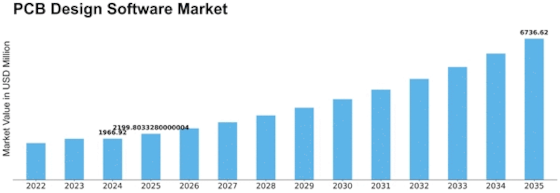
    PCB Design Software Market Size Graph
    Author
    Ankit Gupta
    Senior Research Analyst

    Ankit Gupta is an analyst in market research industry in ICT and SEMI industry. With post-graduation in "Telecom and Marketing Management" and graduation in "Electronics and Telecommunication" vertical he is well versed with recent development in ICT industry as a whole. Having worked on more than 150+ reports including consultation for fortune 500 companies such as Microsoft and Rio Tinto in identifying solutions with respect to business problems his opinions are inclined towards mixture of technical and managerial aspects.

    Leave a Comment

    FAQs

    What is the current valuation of the PCB Design Software Market?

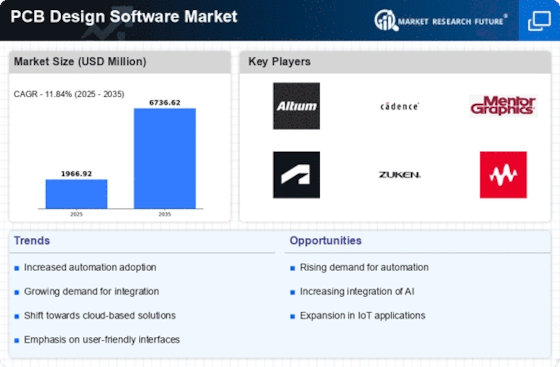
    As of 2024, the PCB Design Software Market was valued at 1966.92 USD Million.

    What is the projected market size for the PCB Design Software Market by 2035?

    The market is projected to reach 6736.62 USD Million by 2035.

    What is the expected CAGR for the PCB Design Software Market during the forecast period?

    The expected CAGR for the PCB Design Software Market from 2025 to 2035 is 11.84%.

    Who are the key players in the PCB Design Software Market?

    Key players include Altium, Cadence Design Systems, Mentor Graphics, Autodesk, Zuken, Keysight Technologies, SolidWorks, DipTrace, and EasyEDA.

    What are the main segments of the PCB Design Software Market?

    The main segments include Components, Design Complexities, Type, Deployment, and Industry.

    Market Summary

    As per MRFR analysis, the PCB Design Software Market Size was estimated at 1966.92 USD Million in 2024. The PCB Design Software industry is projected to grow from 2199.84 USD Million in 2025 to 6736.62 USD Million by 2035, exhibiting a compound annual growth rate (CAGR) of 11.84 during the forecast period 2025 - 2035.

    Key Market Trends & Highlights

    The PCB Design Software Market is experiencing robust growth driven by technological advancements and increasing demand for innovative solutions.

    • The integration of AI and automation is transforming PCB design processes, enhancing efficiency and accuracy.
    • Cloud-based solutions are gaining traction, enabling collaborative design and remote access to tools.
    • Sustainability is becoming a focal point, with companies prioritizing eco-friendly practices in their design methodologies.
    • Rising demand for electronics and advancements in automotive technology are key drivers propelling market expansion, particularly in North America and Asia-Pacific.

    Market Size & Forecast

    2024 Market Size 1966.92 (USD Million)
    2035 Market Size 6736.62 (USD Million)
    CAGR (2025 - 2035) 11.84%
    Largest Regional Market Share in 2024 North America

    Major Players

    <p>Altium (AU), Cadence Design Systems (US), Mentor Graphics (US), Autodesk (US), Zuken (JP), Keysight Technologies (US), SolidWorks (US), DipTrace (RU), EasyEDA (CN)</p>

    Market Trends

    The PCB Design Software Market is currently experiencing a dynamic evolution, driven by the increasing complexity of electronic devices and the growing demand for miniaturization. As industries such as automotive, telecommunications, and consumer electronics continue to expand, the need for sophisticated design tools becomes more pronounced. This market appears to be characterized by a shift towards integrated solutions that facilitate collaboration among design teams, thereby enhancing productivity and reducing time-to-market. Furthermore, the rise of automation and artificial intelligence in design processes suggests a transformative phase, where traditional methodologies are being redefined to accommodate modern requirements. In addition, the PCB Design Software Market seems to be influenced by the ongoing advancements in technology, particularly in areas such as Internet of Things (IoT) and wearable devices. These innovations necessitate more efficient design practices, prompting software developers to innovate continuously. The integration of cloud-based solutions is also noteworthy, as it allows for greater accessibility and flexibility in design workflows. Overall, the market is poised for substantial growth, with emerging trends indicating a robust future for PCB design tools that can adapt to the evolving landscape of electronic design.

    Integration of AI and Automation

    The incorporation of artificial intelligence and automation in PCB design software is becoming increasingly prevalent. This trend suggests that design processes may become more efficient, allowing engineers to focus on higher-level tasks while software handles routine functions. Such advancements could lead to faster prototyping and reduced errors in design.

    Cloud-Based Solutions

    The shift towards cloud-based PCB design software appears to be gaining momentum. This transition enables teams to collaborate in real-time, regardless of geographical constraints. The flexibility and scalability offered by cloud solutions may enhance productivity and streamline workflows, making them attractive to various industries.

    Focus on Sustainability

    There is a growing emphasis on sustainability within the PCB Design Software Market. As environmental concerns rise, software developers are likely to prioritize features that support eco-friendly practices. This trend may include tools for optimizing material usage and minimizing waste during the design process.

    PCB Design Software Market Market Drivers

    Increased Investment in R&D

    Investment in research and development (R&D) within the electronics sector is a significant driver for the PCB Design Software Market. Companies are increasingly allocating resources to innovate and develop new technologies, which necessitates advanced PCB design capabilities. This trend is reflected in the growing number of patents filed in the electronics domain, indicating a robust focus on innovation. As organizations strive to enhance product performance and reduce time-to-market, the demand for sophisticated PCB design software rises. Industry expert's reveal that R&D spending in the electronics industry is expected to grow, further fueling the need for effective design tools. The PCB Design Software Market stands to benefit from this trend, as companies seek to leverage cutting-edge software solutions to support their R&D initiatives.

    Emergence of IoT Applications

    The proliferation of Internet of Things (IoT) devices is reshaping various industries, creating a substantial impact on the PCB Design Software Market. IoT applications require a multitude of interconnected devices, each necessitating unique PCB designs to ensure functionality and efficiency. The market for IoT devices is anticipated to expand significantly, with estimates indicating a growth rate of approximately 25% annually. This surge in IoT adoption compels manufacturers to invest in advanced PCB design software that can handle the specific requirements of these devices, such as miniaturization and energy efficiency. As a result, the PCB Design Software Market is likely to experience increased demand as companies strive to innovate and remain competitive in the rapidly evolving IoT landscape.

    Rising Demand for Electronics

    The increasing demand for consumer electronics, such as smartphones, tablets, and wearables, drives the PCB Design Software Market. As technology advances, the complexity of electronic devices escalates, necessitating sophisticated PCB designs. According to recent data, the electronics sector is projected to grow at a compound annual growth rate of approximately 5% over the next few years. This growth translates into a heightened need for efficient PCB design solutions that can accommodate intricate layouts and high-density interconnections. Consequently, PCB design software becomes essential for manufacturers aiming to meet consumer expectations while maintaining production efficiency. The PCB Design Software Market is thus positioned to benefit from this trend, as companies seek innovative tools to streamline their design processes and enhance product performance.

    Growing Focus on Miniaturization

    The trend towards miniaturization in electronics is a critical driver for the PCB Design Software Market. As devices become smaller and more compact, the need for intricate PCB designs that maximize space while maintaining performance becomes essential. This trend is particularly evident in sectors such as consumer electronics and medical devices, where size constraints are paramount. Market data suggests that the miniaturization trend is expected to continue, with a projected increase in demand for compact electronic solutions. Consequently, PCB design software must evolve to support these requirements, offering features that facilitate the design of high-density interconnects and multi-layer boards. The PCB Design Software Market is thus likely to thrive as manufacturers seek tools that enable them to create smaller, more efficient products.

    Advancements in Automotive Technology

    The automotive industry is undergoing a transformation with the rise of electric vehicles (EVs) and autonomous driving technologies. This shift significantly impacts the PCB Design Software Market, as modern vehicles increasingly rely on complex electronic systems. The integration of advanced driver-assistance systems (ADAS) and infotainment features necessitates the use of sophisticated PCBs, which in turn drives demand for specialized design software. Market analysis indicates that the automotive electronics market is expected to grow substantially, with projections suggesting a CAGR of around 7% in the coming years. As automotive manufacturers invest in innovative technologies, the need for advanced PCB design solutions becomes paramount, positioning the PCB Design Software Market for growth.

    Market Segment Insights

    By Components: Software/Tools (Largest) vs. Services (Fastest-Growing)

    <p>In the PCB Design Software Market, the distribution of market share shows that Software/Tools currently holds the largest slice, reflecting its integral role in the design process. This segment benefits from the continuous advancements in technology, providing a robust array of features that cater to designers' needs. On the other hand, Services are emerging as a dynamic segment, capturing attention for their essential support in implementation, training, and optimization, thereby accounting for a significant and increasing share of the market.</p>

    <p>Software/Tools (Dominant) vs. Services (Emerging)</p>

    <p>Software/Tools in the PCB Design Software Market are characterized by their comprehensive capabilities, enabling engineers to design complex circuits efficiently and effectively. This dominance is attributed to a growing reliance on advanced software solutions that offer automation, simulation, and integration with other tools. Conversely, Services are gaining prominence as emerging players, focusing on providing tailored support to users. This includes technical support, customization, and training, ensuring that organizations can maximize their investment in software. The interplay between these segments signifies a trend towards holistic solutions that combine both powerful design tools and essential support services.</p>

    By Design Complexities: Medium-End Design (Largest) vs. High-End Design (Fastest-Growing)

    <p>In the PCB Design Software Market, the design complexity segments exhibit a clear differentiation in market share distribution. The medium-end design segment holds the largest share due to its balanced features that cater to a wide range of users, from hobbyists to small enterprises. In contrast, the low-end design segment has a smaller share, primarily appealing to casual users or educational sectors, while the high-end design segment, although currently smaller, is rapidly gaining interest from advanced professionals and large corporations due to the increasing complexity of electronic devices.</p>

    <p>Design Complexity: Medium-End Design (Dominant) vs. High-End Design (Emerging)</p>

    <p>Medium-end design software is characterized by its user-friendly interface and a robust set of tools that suits a broad user base including engineers and makers looking for a reliable solution without needing the extensive capabilities of high-end options. On the other hand, high-end design software is focused on complex and intricate circuit designs, often incorporating advanced simulations, analysis tools, and 3D modeling capabilities. This segment is emerging as more industries adopt sophisticated electronics, driving demand for tools that can handle greater complexity. As technology evolves, high-end design solutions are poised for expansive growth, offering high precision and capabilities tailored for professional-grade applications.</p>

    By Type: Schematic Capture (Largest) vs. PCB Layout (Fastest-Growing)

    <p>In the PCB Design Software Market, the segment is dominated by Schematic Capture, which holds the largest share due to its critical role in the initial design phase of printed circuit boards. This segment's prominence is attributed to its foundational function in creating circuit diagrams that are essential for successfully developing complex electronic products. On the other hand, PCB Layout is gaining traction, serving an essential role in optimizing the physical arrangement of the circuit components, thus enhancing demand for software tools that assist in this process.</p>

    <p>Design Method: Schematic Capture (Dominant) vs. PCB Layout (Emerging)</p>

    <p>Schematic Capture has established itself as a dominant force in the PCB Design Software Market, primarily due to its importance in accurately representing electrical connections and ensuring the reliability of electronic designs. This method allows designers to visualize and modify the layout before the manufacturing stage, leading to fewer errors and faster production times. Meanwhile, PCB Layout is emerging as a significant growth area, driven by the increasing complexity of modern electronics and the need for efficient space utilization. The tools aiding PCB Layout enable users to optimize component placement and routing, which is becoming crucial as products demand higher performance in smaller form factors. The integration of advanced algorithms and AI technologies is further propelling the adoption of PCB Layout, making it a key area to watch in this market.</p>

    By Deployment: Cloud (Largest) vs. On-Premise (Fastest-Growing)

    <p>In the PCB Design Software Market, the deployment segment is primarily dominated by cloud solutions, which offer greater accessibility and collaboration features, thus capturing a significant portion of the market. On-premise solutions, however, are witnessing a resurgence due to increased security concerns and preference from industries handling sensitive data, although their market share remains comparatively smaller.</p>

    <p>Deployment: Cloud (Dominant) vs. On-Premise (Emerging)</p>

    <p>Cloud-based PCB design software has emerged as the dominant deployment option due to its scalability, cost-effectiveness, and ease of access from anywhere, promoting real-time collaboration among design teams. In contrast, on-premise solutions are increasingly regarded as an emerging choice for organizations requiring maximum control and security over their design processes. This preference is driven by a growing number of businesses that emphasize adherence to regulations and a desire to customize their software solutions to fit specific operational needs. As both segments evolve, the focus will remain on enhancing features that cater to their respective user bases.</p>

    By Industry: Consumer Electronics (Largest) vs. Aerospace & Defense (Fastest-Growing)

    <p>The PCB Design Software Market is significantly influenced by various industry segments, with Consumer Electronics leading in market share due to the persistent demand for innovative electronic devices such as smartphones, tablets, and wearables. Other notable segments include Telecommunications and Industrial Automation, which contribute to the overall market but do not match the dominance of Consumer Electronics. As industries increasingly integrate advanced technologies into their operations, the distribution among these segments continues to evolve, showcasing the varied applications of PCB design.</p>

    <p>Consumer Electronics (Dominant) vs. Aerospace & Defense (Emerging)</p>

    <p>Consumer Electronics remains the dominant segment in the PCB Design Software Market, driven by continuous innovation and mass production of electronic devices. This segment is characterized by high volume demand and rapid product cycles, which require efficient design tools to meet consumer expectations. Conversely, Aerospace & Defense is emerging as a significant player, propelled by heightened investments in military technologies and exploration missions. The increasing complexity of aerospace applications demands sophisticated PCB design capabilities, making the segment a priority for software developers aiming to enhance reliability and functionality in critical systems.</p>

    Get more detailed insights about PCB Design Software Market Research Report - Forecast to 2035

    Regional Insights

    By Region, the study segments the market into North America, Europe, Asia-Pacific, Middle East & Africa, and South America. Throughout the forecast period, the North American PCB Design Software market is expected to be dominant. This region's growth is expected to be spearheaded by economies such as Canada and the United States. North America is the dominating the global semiconductor market in terms of chip design and semiconductor R&D. In chip design, the major success factors in USA are access to highly skilled engineering human source and a strong innovation ecosystem, leading by universities.

    For instance,10 out of the top 20 semiconductor design companies (comprising both fabless and IDMs (Integrated Device Manufacturers)), along with 4 of the top 5 EDA and core IP enterprises by 2019 revenue, are headquartered in the US.

    Asia-Pacific is the fastest growing region. The increase in the scope of R&D expenditures in the semiconductor industry by various countries and growing purchaser surmise and flourish demand of consumer electronics are driving the growth of the EDA market in the Asia Pacific region. The positive PCB manufacturing in the region have significant market share, heavy demand of electronics products in emerging countries and government supports to provide favorable environment for semiconductor industry is driving the growth of PCB design software market in Asia-pacific.

    Europe is expected to register a significantly rapid revenue growth rate during the forecast period owing to increasing implementation of PCB design software in the electronics sector. Rising demand of PCB design software in the field of telecommunications is also boosting market growth. Germany is the most important actor in the EDA European market, followed by UK.

    Even in the case of the European industry, electronic components and systems are strong supporters of the development of innovation and productivity in the entire European market and the PCB manufacturers are mainly involved in producing high end PCBs with sophisticated design, but lack in low and medium end PCBs as market is acquired by Asian countries.

    In case of the Middle East and Africa, most of the electronics equipment demand is fulfilled by import of Asia-pacific region due to lack of financial and human resources, political unrest, lack of investment and high cost in developing required infrastructure. Still due to presence of number of emerging countries such as Nigeria, South Africa and Israel, there is steady growth in the demand of PCBs in this region which is expected to imitate and propel the growth of PCB design software market in this region.

    FIGURE 3: PCB DESIGN SOFTWARE MARKET VALUE BY REGION 2022 VS 2032 (USD Million)

    PCB DESIGN SOFTWARE MARKET VALUE BY REGION 2022 VS 2032

    Source: Secondary Research, Primary Research, Market Research Future Database, and Analyst Review

    Further, the countries considered in the scope of the PCB Design Software market are the US, Canada, Mexico, UK, Germany, France, Italy, Spain, Switzerland, Austria, Belgium, Denmark, Finland, Greece, Hungary, Italy, Luxembourg, Netherlands, Norway, Poland, Portugal, Slovakia, Sweden, Romania, Ireland, China, Japan, Singapore, Malaysia, Indonesia, Philippines, South Korea, Hong Kong, Macau, Singapore, Brunei, India, Australia & New Zealand, South Africa, Egypt, Nigeria, Saudi Arabia, Qatar, United Arab Emirates, Bahrain, Kuwait, and Oman, Brazil, Argentina, Chile, and others.

    Key Players and Competitive Insights

    The PCB Design Software Market is currently characterized by a dynamic competitive landscape, driven by rapid technological advancements and increasing demand for efficient design solutions. Major players such as Altium (AU), Cadence Design Systems (US), and Autodesk (US) are strategically positioning themselves through innovation and partnerships. Altium (AU) focuses on enhancing user experience and integration capabilities, while Cadence Design Systems (US) emphasizes AI-driven design tools to streamline workflows. Autodesk (US) is leveraging its extensive ecosystem to provide comprehensive solutions that cater to diverse industry needs. Collectively, these strategies foster a competitive environment that prioritizes technological innovation and customer-centric solutions.

    Key business tactics within the PCB Design Software Market include localizing manufacturing and optimizing supply chains to enhance responsiveness to market demands. The market structure appears moderately fragmented, with several key players exerting influence over various segments. This fragmentation allows for niche players to thrive, while larger companies leverage their resources to capture significant market share. The collective influence of these key players shapes the competitive dynamics, as they continuously adapt to emerging trends and customer preferences.

    In August 2025, Altium (AU) announced a strategic partnership with a leading electronics manufacturer to co-develop advanced PCB design tools tailored for high-frequency applications. This collaboration is likely to enhance Altium's product offerings and expand its market reach, particularly in sectors requiring specialized design capabilities. The partnership underscores Altium's commitment to innovation and its proactive approach to addressing evolving customer needs.

    In September 2025, Cadence Design Systems (US) unveiled a new AI-driven PCB design platform aimed at automating complex design tasks. This launch is significant as it positions Cadence at the forefront of digital transformation within the industry, potentially reducing design time and improving accuracy. The integration of AI into their offerings may attract a broader customer base, particularly among companies seeking to enhance operational efficiency.

    In July 2025, Autodesk (US) expanded its PCB design software suite by incorporating cloud-based collaboration features. This enhancement is indicative of a growing trend towards digitalization in the PCB design process, allowing teams to work seamlessly across geographies. By facilitating real-time collaboration, Autodesk is likely to strengthen its competitive position and appeal to organizations prioritizing remote work capabilities.

    As of October 2025, current competitive trends in the PCB Design Software Market are heavily influenced by digitalization, sustainability, and the integration of AI technologies. Strategic alliances are increasingly shaping the landscape, enabling companies to pool resources and expertise to drive innovation. Looking ahead, competitive differentiation is expected to evolve, with a notable shift from price-based competition towards a focus on technological advancements, innovation, and supply chain reliability. This transition may redefine how companies position themselves in the market, emphasizing the importance of delivering value through cutting-edge solutions.

    Key Companies in the PCB Design Software Market market include

    Industry Developments

    January 2022 Zuken and SnapEDA, a provider of verified online electronic components, are announcing a new capability that provides eCADstar users direct access to SnapEDA’s online library.

    June 2021 Cadence Design Systems, Inc debuted the Cadence Allegro X Design Platform, the industry’s first engineering platform for system design that unifies schematic, layout, analysis, design collaboration and data management. Built upon proven Allegro and OrCAD core technology, the new Allegro X platform revolutionizes and streamlines the system design process for engineers—offering unparalleled collaboration across all engineering disciplines, integration with best-in-class Cadence signoff-level simulation and analysis products, and greater layout performance.

    Future Outlook

    PCB Design Software Market Future Outlook

    <p>The PCB Design Software Market is projected to grow at 11.84% CAGR from 2024 to 2035, driven by advancements in technology, increasing demand for miniaturization, and the rise of IoT applications.</p>

    New opportunities lie in:

    • <p>Integration of AI-driven design tools for enhanced efficiency.</p>
    • <p>Development of cloud-based collaboration platforms for remote teams.</p>
    • <p>Expansion into emerging markets with localized software solutions.</p>

    <p>By 2035, the PCB Design Software Market is expected to be robust, reflecting substantial growth and innovation.</p>

    Market Segmentation

    PCB Design Software Market Type Outlook

    • PCB Layout
    • Schematic Capture

    PCB Design Software Market Industry Outlook

    • Transportation
    • Consumer Electronics
    • Telecommunications
    • Semiconductors
    • Aerospace & Defense
    • Healthcare
    • Industrial Automation & Control
    • Education & Research

    PCB Design Software Market Components Outlook

    • Software/Tools
    • Services

    PCB Design Software Market Deployment Outlook

    • Cloud
    • On-Premise

    PCB Design Software Market Design Complexities Outlook

    • Low-End Design
    • Medium-End Design
    • High-End Design

    Report Scope

    MARKET SIZE 20241966.92(USD Million)
    MARKET SIZE 20252199.84(USD Million)
    MARKET SIZE 20356736.62(USD Million)
    COMPOUND ANNUAL GROWTH RATE (CAGR)11.84% (2024 - 2035)
    REPORT COVERAGERevenue Forecast, Competitive Landscape, Growth Factors, and Trends
    BASE YEAR2024
    Market Forecast Period2025 - 2035
    Historical Data2019 - 2024
    Market Forecast UnitsUSD Million
    Key Companies ProfiledMarket analysis in progress
    Segments CoveredMarket segmentation analysis in progress
    Key Market OpportunitiesIntegration of artificial intelligence in PCB Design Software enhances design efficiency and accuracy.
    Key Market DynamicsRising demand for advanced features in PCB design software drives competitive innovation and market consolidation.
    Countries CoveredNorth America, Europe, APAC, South America, MEA

    FAQs

    What is the current valuation of the PCB Design Software Market?

    As of 2024, the PCB Design Software Market was valued at 1966.92 USD Million.

    What is the projected market size for the PCB Design Software Market by 2035?

    The market is projected to reach 6736.62 USD Million by 2035.

    What is the expected CAGR for the PCB Design Software Market during the forecast period?

    The expected CAGR for the PCB Design Software Market from 2025 to 2035 is 11.84%.

    Who are the key players in the PCB Design Software Market?

    Key players include Altium, Cadence Design Systems, Mentor Graphics, Autodesk, Zuken, Keysight Technologies, SolidWorks, DipTrace, and EasyEDA.

    What are the main segments of the PCB Design Software Market?

    The main segments include Components, Design Complexities, Type, Deployment, and Industry.

    1. SECTION I: EXECUTIVE SUMMARY AND KEY HIGHLIGHTS
      1. | 1.1 EXECUTIVE SUMMARY
      2. | | 1.1.1 Market Overview
      3. | | 1.1.2 Key Findings
      4. | | 1.1.3 Market Segmentation
      5. | | 1.1.4 Competitive Landscape
      6. | | 1.1.5 Challenges and Opportunities
      7. | | 1.1.6 Future Outlook
    2. SECTION II: SCOPING, METHODOLOGY AND MARKET STRUCTURE
      1. | 2.1 MARKET INTRODUCTION
      2. | | 2.1.1 Definition
      3. | | 2.1.2 Scope of the study
      4. | | | 2.1.2.1 Research Objective
      5. | | | 2.1.2.2 Assumption
      6. | | | 2.1.2.3 Limitations
      7. | 2.2 RESEARCH METHODOLOGY
      8. | | 2.2.1 Overview
      9. | | 2.2.2 Data Mining
      10. | | 2.2.3 Secondary Research
      11. | | 2.2.4 Primary Research
      12. | | | 2.2.4.1 Primary Interviews and Information Gathering Process
      13. | | | 2.2.4.2 Breakdown of Primary Respondents
      14. | | 2.2.5 Forecasting Model
      15. | | 2.2.6 Market Size Estimation
      16. | | | 2.2.6.1 Bottom-Up Approach
      17. | | | 2.2.6.2 Top-Down Approach
      18. | | 2.2.7 Data Triangulation
      19. | | 2.2.8 Validation
    3. SECTION III: QUALITATIVE ANALYSIS
      1. | 3.1 MARKET DYNAMICS
      2. | | 3.1.1 Overview
      3. | | 3.1.2 Drivers
      4. | | 3.1.3 Restraints
      5. | | 3.1.4 Opportunities
      6. | 3.2 MARKET FACTOR ANALYSIS
      7. | | 3.2.1 Value chain Analysis
      8. | | 3.2.2 Porter's Five Forces Analysis
      9. | | | 3.2.2.1 Bargaining Power of Suppliers
      10. | | | 3.2.2.2 Bargaining Power of Buyers
      11. | | | 3.2.2.3 Threat of New Entrants
      12. | | | 3.2.2.4 Threat of Substitutes
      13. | | | 3.2.2.5 Intensity of Rivalry
      14. | | 3.2.3 COVID-19 Impact Analysis
      15. | | | 3.2.3.1 Market Impact Analysis
      16. | | | 3.2.3.2 Regional Impact
      17. | | | 3.2.3.3 Opportunity and Threat Analysis
    4. SECTION IV: QUANTITATIVE ANALYSIS
      1. | 4.1 Information and Communications Technology, BY Components (USD Million)
      2. | | 4.1.1 Software/Tools
      3. | | 4.1.2 Services
      4. | 4.2 Information and Communications Technology, BY Design Complexities (USD Million)
      5. | | 4.2.1 Low-End Design
      6. | | 4.2.2 Medium-End Design
      7. | | 4.2.3 High-End Design
      8. | 4.3 Information and Communications Technology, BY Type (USD Million)
      9. | | 4.3.1 PCB Layout
      10. | | 4.3.2 Schematic Capture
      11. | 4.4 Information and Communications Technology, BY Deployment (USD Million)
      12. | | 4.4.1 Cloud
      13. | | 4.4.2 On-Premise
      14. | 4.5 Information and Communications Technology, BY Industry (USD Million)
      15. | | 4.5.1 Transportation
      16. | | 4.5.2 Consumer Electronics
      17. | | 4.5.3 Telecommunications
      18. | | 4.5.4 Semiconductors
      19. | | 4.5.5 Aerospace & Defense
      20. | | 4.5.6 Healthcare
      21. | | 4.5.7 Industrial Automation & Control
      22. | | 4.5.8 Education & Research
      23. | 4.6 Information and Communications Technology, BY Region (USD Million)
      24. | | 4.6.1 North America
      25. | | | 4.6.1.1 US
      26. | | | 4.6.1.2 Canada
      27. | | 4.6.2 Europe
      28. | | | 4.6.2.1 Germany
      29. | | | 4.6.2.2 UK
      30. | | | 4.6.2.3 France
      31. | | | 4.6.2.4 Russia
      32. | | | 4.6.2.5 Italy
      33. | | | 4.6.2.6 Spain
      34. | | | 4.6.2.7 Rest of Europe
      35. | | 4.6.3 APAC
      36. | | | 4.6.3.1 China
      37. | | | 4.6.3.2 India
      38. | | | 4.6.3.3 Japan
      39. | | | 4.6.3.4 South Korea
      40. | | | 4.6.3.5 Malaysia
      41. | | | 4.6.3.6 Thailand
      42. | | | 4.6.3.7 Indonesia
      43. | | | 4.6.3.8 Rest of APAC
      44. | | 4.6.4 South America
      45. | | | 4.6.4.1 Brazil
      46. | | | 4.6.4.2 Mexico
      47. | | | 4.6.4.3 Argentina
      48. | | | 4.6.4.4 Rest of South America
      49. | | 4.6.5 MEA
      50. | | | 4.6.5.1 GCC Countries
      51. | | | 4.6.5.2 South Africa
      52. | | | 4.6.5.3 Rest of MEA
    5. SECTION V: COMPETITIVE ANALYSIS
      1. | 5.1 Competitive Landscape
      2. | | 5.1.1 Overview
      3. | | 5.1.2 Competitive Analysis
      4. | | 5.1.3 Market share Analysis
      5. | | 5.1.4 Major Growth Strategy in the Information and Communications Technology
      6. | | 5.1.5 Competitive Benchmarking
      7. | | 5.1.6 Leading Players in Terms of Number of Developments in the Information and Communications Technology
      8. | | 5.1.7 Key developments and growth strategies
      9. | | | 5.1.7.1 New Product Launch/Service Deployment
      10. | | | 5.1.7.2 Merger & Acquisitions
      11. | | | 5.1.7.3 Joint Ventures
      12. | | 5.1.8 Major Players Financial Matrix
      13. | | | 5.1.8.1 Sales and Operating Income
      14. | | | 5.1.8.2 Major Players R&D Expenditure. 2023
      15. | 5.2 Company Profiles
      16. | | 5.2.1 Altium (AU)
      17. | | | 5.2.1.1 Financial Overview
      18. | | | 5.2.1.2 Products Offered
      19. | | | 5.2.1.3 Key Developments
      20. | | | 5.2.1.4 SWOT Analysis
      21. | | | 5.2.1.5 Key Strategies
      22. | | 5.2.2 Cadence Design Systems (US)
      23. | | | 5.2.2.1 Financial Overview
      24. | | | 5.2.2.2 Products Offered
      25. | | | 5.2.2.3 Key Developments
      26. | | | 5.2.2.4 SWOT Analysis
      27. | | | 5.2.2.5 Key Strategies
      28. | | 5.2.3 Mentor Graphics (US)
      29. | | | 5.2.3.1 Financial Overview
      30. | | | 5.2.3.2 Products Offered
      31. | | | 5.2.3.3 Key Developments
      32. | | | 5.2.3.4 SWOT Analysis
      33. | | | 5.2.3.5 Key Strategies
      34. | | 5.2.4 Autodesk (US)
      35. | | | 5.2.4.1 Financial Overview
      36. | | | 5.2.4.2 Products Offered
      37. | | | 5.2.4.3 Key Developments
      38. | | | 5.2.4.4 SWOT Analysis
      39. | | | 5.2.4.5 Key Strategies
      40. | | 5.2.5 Zuken (JP)
      41. | | | 5.2.5.1 Financial Overview
      42. | | | 5.2.5.2 Products Offered
      43. | | | 5.2.5.3 Key Developments
      44. | | | 5.2.5.4 SWOT Analysis
      45. | | | 5.2.5.5 Key Strategies
      46. | | 5.2.6 Keysight Technologies (US)
      47. | | | 5.2.6.1 Financial Overview
      48. | | | 5.2.6.2 Products Offered
      49. | | | 5.2.6.3 Key Developments
      50. | | | 5.2.6.4 SWOT Analysis
      51. | | | 5.2.6.5 Key Strategies
      52. | | 5.2.7 SolidWorks (US)
      53. | | | 5.2.7.1 Financial Overview
      54. | | | 5.2.7.2 Products Offered
      55. | | | 5.2.7.3 Key Developments
      56. | | | 5.2.7.4 SWOT Analysis
      57. | | | 5.2.7.5 Key Strategies
      58. | | 5.2.8 DipTrace (RU)
      59. | | | 5.2.8.1 Financial Overview
      60. | | | 5.2.8.2 Products Offered
      61. | | | 5.2.8.3 Key Developments
      62. | | | 5.2.8.4 SWOT Analysis
      63. | | | 5.2.8.5 Key Strategies
      64. | | 5.2.9 EasyEDA (CN)
      65. | | | 5.2.9.1 Financial Overview
      66. | | | 5.2.9.2 Products Offered
      67. | | | 5.2.9.3 Key Developments
      68. | | | 5.2.9.4 SWOT Analysis
      69. | | | 5.2.9.5 Key Strategies
      70. | 5.3 Appendix
      71. | | 5.3.1 References
      72. | | 5.3.2 Related Reports
    6. LIST OF FIGURES
      1. | 6.1 MARKET SYNOPSIS
      2. | 6.2 NORTH AMERICA MARKET ANALYSIS
      3. | 6.3 US MARKET ANALYSIS BY COMPONENTS
      4. | 6.4 US MARKET ANALYSIS BY DESIGN COMPLEXITIES
      5. | 6.5 US MARKET ANALYSIS BY TYPE
      6. | 6.6 US MARKET ANALYSIS BY DEPLOYMENT
      7. | 6.7 US MARKET ANALYSIS BY INDUSTRY
      8. | 6.8 CANADA MARKET ANALYSIS BY COMPONENTS
      9. | 6.9 CANADA MARKET ANALYSIS BY DESIGN COMPLEXITIES
      10. | 6.10 CANADA MARKET ANALYSIS BY TYPE
      11. | 6.11 CANADA MARKET ANALYSIS BY DEPLOYMENT
      12. | 6.12 CANADA MARKET ANALYSIS BY INDUSTRY
      13. | 6.13 EUROPE MARKET ANALYSIS
      14. | 6.14 GERMANY MARKET ANALYSIS BY COMPONENTS
      15. | 6.15 GERMANY MARKET ANALYSIS BY DESIGN COMPLEXITIES
      16. | 6.16 GERMANY MARKET ANALYSIS BY TYPE
      17. | 6.17 GERMANY MARKET ANALYSIS BY DEPLOYMENT
      18. | 6.18 GERMANY MARKET ANALYSIS BY INDUSTRY
      19. | 6.19 UK MARKET ANALYSIS BY COMPONENTS
      20. | 6.20 UK MARKET ANALYSIS BY DESIGN COMPLEXITIES
      21. | 6.21 UK MARKET ANALYSIS BY TYPE
      22. | 6.22 UK MARKET ANALYSIS BY DEPLOYMENT
      23. | 6.23 UK MARKET ANALYSIS BY INDUSTRY
      24. | 6.24 FRANCE MARKET ANALYSIS BY COMPONENTS
      25. | 6.25 FRANCE MARKET ANALYSIS BY DESIGN COMPLEXITIES
      26. | 6.26 FRANCE MARKET ANALYSIS BY TYPE
      27. | 6.27 FRANCE MARKET ANALYSIS BY DEPLOYMENT
      28. | 6.28 FRANCE MARKET ANALYSIS BY INDUSTRY
      29. | 6.29 RUSSIA MARKET ANALYSIS BY COMPONENTS
      30. | 6.30 RUSSIA MARKET ANALYSIS BY DESIGN COMPLEXITIES
      31. | 6.31 RUSSIA MARKET ANALYSIS BY TYPE
      32. | 6.32 RUSSIA MARKET ANALYSIS BY DEPLOYMENT
      33. | 6.33 RUSSIA MARKET ANALYSIS BY INDUSTRY
      34. | 6.34 ITALY MARKET ANALYSIS BY COMPONENTS
      35. | 6.35 ITALY MARKET ANALYSIS BY DESIGN COMPLEXITIES
      36. | 6.36 ITALY MARKET ANALYSIS BY TYPE
      37. | 6.37 ITALY MARKET ANALYSIS BY DEPLOYMENT
      38. | 6.38 ITALY MARKET ANALYSIS BY INDUSTRY
      39. | 6.39 SPAIN MARKET ANALYSIS BY COMPONENTS
      40. | 6.40 SPAIN MARKET ANALYSIS BY DESIGN COMPLEXITIES
      41. | 6.41 SPAIN MARKET ANALYSIS BY TYPE
      42. | 6.42 SPAIN MARKET ANALYSIS BY DEPLOYMENT
      43. | 6.43 SPAIN MARKET ANALYSIS BY INDUSTRY
      44. | 6.44 REST OF EUROPE MARKET ANALYSIS BY COMPONENTS
      45. | 6.45 REST OF EUROPE MARKET ANALYSIS BY DESIGN COMPLEXITIES
      46. | 6.46 REST OF EUROPE MARKET ANALYSIS BY TYPE
      47. | 6.47 REST OF EUROPE MARKET ANALYSIS BY DEPLOYMENT
      48. | 6.48 REST OF EUROPE MARKET ANALYSIS BY INDUSTRY
      49. | 6.49 APAC MARKET ANALYSIS
      50. | 6.50 CHINA MARKET ANALYSIS BY COMPONENTS
      51. | 6.51 CHINA MARKET ANALYSIS BY DESIGN COMPLEXITIES
      52. | 6.52 CHINA MARKET ANALYSIS BY TYPE
      53. | 6.53 CHINA MARKET ANALYSIS BY DEPLOYMENT
      54. | 6.54 CHINA MARKET ANALYSIS BY INDUSTRY
      55. | 6.55 INDIA MARKET ANALYSIS BY COMPONENTS
      56. | 6.56 INDIA MARKET ANALYSIS BY DESIGN COMPLEXITIES
      57. | 6.57 INDIA MARKET ANALYSIS BY TYPE
      58. | 6.58 INDIA MARKET ANALYSIS BY DEPLOYMENT
      59. | 6.59 INDIA MARKET ANALYSIS BY INDUSTRY
      60. | 6.60 JAPAN MARKET ANALYSIS BY COMPONENTS
      61. | 6.61 JAPAN MARKET ANALYSIS BY DESIGN COMPLEXITIES
      62. | 6.62 JAPAN MARKET ANALYSIS BY TYPE
      63. | 6.63 JAPAN MARKET ANALYSIS BY DEPLOYMENT
      64. | 6.64 JAPAN MARKET ANALYSIS BY INDUSTRY
      65. | 6.65 SOUTH KOREA MARKET ANALYSIS BY COMPONENTS
      66. | 6.66 SOUTH KOREA MARKET ANALYSIS BY DESIGN COMPLEXITIES
      67. | 6.67 SOUTH KOREA MARKET ANALYSIS BY TYPE
      68. | 6.68 SOUTH KOREA MARKET ANALYSIS BY DEPLOYMENT
      69. | 6.69 SOUTH KOREA MARKET ANALYSIS BY INDUSTRY
      70. | 6.70 MALAYSIA MARKET ANALYSIS BY COMPONENTS
      71. | 6.71 MALAYSIA MARKET ANALYSIS BY DESIGN COMPLEXITIES
      72. | 6.72 MALAYSIA MARKET ANALYSIS BY TYPE
      73. | 6.73 MALAYSIA MARKET ANALYSIS BY DEPLOYMENT
      74. | 6.74 MALAYSIA MARKET ANALYSIS BY INDUSTRY
      75. | 6.75 THAILAND MARKET ANALYSIS BY COMPONENTS
      76. | 6.76 THAILAND MARKET ANALYSIS BY DESIGN COMPLEXITIES
      77. | 6.77 THAILAND MARKET ANALYSIS BY TYPE
      78. | 6.78 THAILAND MARKET ANALYSIS BY DEPLOYMENT
      79. | 6.79 THAILAND MARKET ANALYSIS BY INDUSTRY
      80. | 6.80 INDONESIA MARKET ANALYSIS BY COMPONENTS
      81. | 6.81 INDONESIA MARKET ANALYSIS BY DESIGN COMPLEXITIES
      82. | 6.82 INDONESIA MARKET ANALYSIS BY TYPE
      83. | 6.83 INDONESIA MARKET ANALYSIS BY DEPLOYMENT
      84. | 6.84 INDONESIA MARKET ANALYSIS BY INDUSTRY
      85. | 6.85 REST OF APAC MARKET ANALYSIS BY COMPONENTS
      86. | 6.86 REST OF APAC MARKET ANALYSIS BY DESIGN COMPLEXITIES
      87. | 6.87 REST OF APAC MARKET ANALYSIS BY TYPE
      88. | 6.88 REST OF APAC MARKET ANALYSIS BY DEPLOYMENT
      89. | 6.89 REST OF APAC MARKET ANALYSIS BY INDUSTRY
      90. | 6.90 SOUTH AMERICA MARKET ANALYSIS
      91. | 6.91 BRAZIL MARKET ANALYSIS BY COMPONENTS
      92. | 6.92 BRAZIL MARKET ANALYSIS BY DESIGN COMPLEXITIES
      93. | 6.93 BRAZIL MARKET ANALYSIS BY TYPE
      94. | 6.94 BRAZIL MARKET ANALYSIS BY DEPLOYMENT
      95. | 6.95 BRAZIL MARKET ANALYSIS BY INDUSTRY
      96. | 6.96 MEXICO MARKET ANALYSIS BY COMPONENTS
      97. | 6.97 MEXICO MARKET ANALYSIS BY DESIGN COMPLEXITIES
      98. | 6.98 MEXICO MARKET ANALYSIS BY TYPE
      99. | 6.99 MEXICO MARKET ANALYSIS BY DEPLOYMENT
      100. | 6.100 MEXICO MARKET ANALYSIS BY INDUSTRY
      101. | 6.101 ARGENTINA MARKET ANALYSIS BY COMPONENTS
      102. | 6.102 ARGENTINA MARKET ANALYSIS BY DESIGN COMPLEXITIES
      103. | 6.103 ARGENTINA MARKET ANALYSIS BY TYPE
      104. | 6.104 ARGENTINA MARKET ANALYSIS BY DEPLOYMENT
      105. | 6.105 ARGENTINA MARKET ANALYSIS BY INDUSTRY
      106. | 6.106 REST OF SOUTH AMERICA MARKET ANALYSIS BY COMPONENTS
      107. | 6.107 REST OF SOUTH AMERICA MARKET ANALYSIS BY DESIGN COMPLEXITIES
      108. | 6.108 REST OF SOUTH AMERICA MARKET ANALYSIS BY TYPE
      109. | 6.109 REST OF SOUTH AMERICA MARKET ANALYSIS BY DEPLOYMENT
      110. | 6.110 REST OF SOUTH AMERICA MARKET ANALYSIS BY INDUSTRY
      111. | 6.111 MEA MARKET ANALYSIS
      112. | 6.112 GCC COUNTRIES MARKET ANALYSIS BY COMPONENTS
      113. | 6.113 GCC COUNTRIES MARKET ANALYSIS BY DESIGN COMPLEXITIES
      114. | 6.114 GCC COUNTRIES MARKET ANALYSIS BY TYPE
      115. | 6.115 GCC COUNTRIES MARKET ANALYSIS BY DEPLOYMENT
      116. | 6.116 GCC COUNTRIES MARKET ANALYSIS BY INDUSTRY
      117. | 6.117 SOUTH AFRICA MARKET ANALYSIS BY COMPONENTS
      118. | 6.118 SOUTH AFRICA MARKET ANALYSIS BY DESIGN COMPLEXITIES
      119. | 6.119 SOUTH AFRICA MARKET ANALYSIS BY TYPE
      120. | 6.120 SOUTH AFRICA MARKET ANALYSIS BY DEPLOYMENT
      121. | 6.121 SOUTH AFRICA MARKET ANALYSIS BY INDUSTRY
      122. | 6.122 REST OF MEA MARKET ANALYSIS BY COMPONENTS
      123. | 6.123 REST OF MEA MARKET ANALYSIS BY DESIGN COMPLEXITIES
      124. | 6.124 REST OF MEA MARKET ANALYSIS BY TYPE
      125. | 6.125 REST OF MEA MARKET ANALYSIS BY DEPLOYMENT
      126. | 6.126 REST OF MEA MARKET ANALYSIS BY INDUSTRY
      127. | 6.127 KEY BUYING CRITERIA OF INFORMATION AND COMMUNICATIONS TECHNOLOGY
      128. | 6.128 RESEARCH PROCESS OF MRFR
      129. | 6.129 DRO ANALYSIS OF INFORMATION AND COMMUNICATIONS TECHNOLOGY
      130. | 6.130 DRIVERS IMPACT ANALYSIS: INFORMATION AND COMMUNICATIONS TECHNOLOGY
      131. | 6.131 RESTRAINTS IMPACT ANALYSIS: INFORMATION AND COMMUNICATIONS TECHNOLOGY
      132. | 6.132 SUPPLY / VALUE CHAIN: INFORMATION AND COMMUNICATIONS TECHNOLOGY
      133. | 6.133 INFORMATION AND COMMUNICATIONS TECHNOLOGY, BY COMPONENTS, 2024 (% SHARE)
      134. | 6.134 INFORMATION AND COMMUNICATIONS TECHNOLOGY, BY COMPONENTS, 2024 TO 2035 (USD Million)
      135. | 6.135 INFORMATION AND COMMUNICATIONS TECHNOLOGY, BY DESIGN COMPLEXITIES, 2024 (% SHARE)
      136. | 6.136 INFORMATION AND COMMUNICATIONS TECHNOLOGY, BY DESIGN COMPLEXITIES, 2024 TO 2035 (USD Million)
      137. | 6.137 INFORMATION AND COMMUNICATIONS TECHNOLOGY, BY TYPE, 2024 (% SHARE)
      138. | 6.138 INFORMATION AND COMMUNICATIONS TECHNOLOGY, BY TYPE, 2024 TO 2035 (USD Million)
      139. | 6.139 INFORMATION AND COMMUNICATIONS TECHNOLOGY, BY DEPLOYMENT, 2024 (% SHARE)
      140. | 6.140 INFORMATION AND COMMUNICATIONS TECHNOLOGY, BY DEPLOYMENT, 2024 TO 2035 (USD Million)
      141. | 6.141 INFORMATION AND COMMUNICATIONS TECHNOLOGY, BY INDUSTRY, 2024 (% SHARE)
      142. | 6.142 INFORMATION AND COMMUNICATIONS TECHNOLOGY, BY INDUSTRY, 2024 TO 2035 (USD Million)
      143. | 6.143 BENCHMARKING OF MAJOR COMPETITORS
    7. LIST OF TABLES
      1. | 7.1 LIST OF ASSUMPTIONS
      2. | | 7.1.1
      3. | 7.2 North America MARKET SIZE ESTIMATES; FORECAST
      4. | | 7.2.1 BY COMPONENTS, 2025-2035 (USD Million)
      5. | | 7.2.2 BY DESIGN COMPLEXITIES, 2025-2035 (USD Million)
      6. | | 7.2.3 BY TYPE, 2025-2035 (USD Million)
      7. | | 7.2.4 BY DEPLOYMENT, 2025-2035 (USD Million)
      8. | | 7.2.5 BY INDUSTRY, 2025-2035 (USD Million)
      9. | 7.3 US MARKET SIZE ESTIMATES; FORECAST
      10. | | 7.3.1 BY COMPONENTS, 2025-2035 (USD Million)
      11. | | 7.3.2 BY DESIGN COMPLEXITIES, 2025-2035 (USD Million)
      12. | | 7.3.3 BY TYPE, 2025-2035 (USD Million)
      13. | | 7.3.4 BY DEPLOYMENT, 2025-2035 (USD Million)
      14. | | 7.3.5 BY INDUSTRY, 2025-2035 (USD Million)
      15. | 7.4 Canada MARKET SIZE ESTIMATES; FORECAST
      16. | | 7.4.1 BY COMPONENTS, 2025-2035 (USD Million)
      17. | | 7.4.2 BY DESIGN COMPLEXITIES, 2025-2035 (USD Million)
      18. | | 7.4.3 BY TYPE, 2025-2035 (USD Million)
      19. | | 7.4.4 BY DEPLOYMENT, 2025-2035 (USD Million)
      20. | | 7.4.5 BY INDUSTRY, 2025-2035 (USD Million)
      21. | 7.5 Europe MARKET SIZE ESTIMATES; FORECAST
      22. | | 7.5.1 BY COMPONENTS, 2025-2035 (USD Million)
      23. | | 7.5.2 BY DESIGN COMPLEXITIES, 2025-2035 (USD Million)
      24. | | 7.5.3 BY TYPE, 2025-2035 (USD Million)
      25. | | 7.5.4 BY DEPLOYMENT, 2025-2035 (USD Million)
      26. | | 7.5.5 BY INDUSTRY, 2025-2035 (USD Million)
      27. | 7.6 Germany MARKET SIZE ESTIMATES; FORECAST
      28. | | 7.6.1 BY COMPONENTS, 2025-2035 (USD Million)
      29. | | 7.6.2 BY DESIGN COMPLEXITIES, 2025-2035 (USD Million)
      30. | | 7.6.3 BY TYPE, 2025-2035 (USD Million)
      31. | | 7.6.4 BY DEPLOYMENT, 2025-2035 (USD Million)
      32. | | 7.6.5 BY INDUSTRY, 2025-2035 (USD Million)
      33. | 7.7 UK MARKET SIZE ESTIMATES; FORECAST
      34. | | 7.7.1 BY COMPONENTS, 2025-2035 (USD Million)
      35. | | 7.7.2 BY DESIGN COMPLEXITIES, 2025-2035 (USD Million)
      36. | | 7.7.3 BY TYPE, 2025-2035 (USD Million)
      37. | | 7.7.4 BY DEPLOYMENT, 2025-2035 (USD Million)
      38. | | 7.7.5 BY INDUSTRY, 2025-2035 (USD Million)
      39. | 7.8 France MARKET SIZE ESTIMATES; FORECAST
      40. | | 7.8.1 BY COMPONENTS, 2025-2035 (USD Million)
      41. | | 7.8.2 BY DESIGN COMPLEXITIES, 2025-2035 (USD Million)
      42. | | 7.8.3 BY TYPE, 2025-2035 (USD Million)
      43. | | 7.8.4 BY DEPLOYMENT, 2025-2035 (USD Million)
      44. | | 7.8.5 BY INDUSTRY, 2025-2035 (USD Million)
      45. | 7.9 Russia MARKET SIZE ESTIMATES; FORECAST
      46. | | 7.9.1 BY COMPONENTS, 2025-2035 (USD Million)
      47. | | 7.9.2 BY DESIGN COMPLEXITIES, 2025-2035 (USD Million)
      48. | | 7.9.3 BY TYPE, 2025-2035 (USD Million)
      49. | | 7.9.4 BY DEPLOYMENT, 2025-2035 (USD Million)
      50. | | 7.9.5 BY INDUSTRY, 2025-2035 (USD Million)
      51. | 7.10 Italy MARKET SIZE ESTIMATES; FORECAST
      52. | | 7.10.1 BY COMPONENTS, 2025-2035 (USD Million)
      53. | | 7.10.2 BY DESIGN COMPLEXITIES, 2025-2035 (USD Million)
      54. | | 7.10.3 BY TYPE, 2025-2035 (USD Million)
      55. | | 7.10.4 BY DEPLOYMENT, 2025-2035 (USD Million)
      56. | | 7.10.5 BY INDUSTRY, 2025-2035 (USD Million)
      57. | 7.11 Spain MARKET SIZE ESTIMATES; FORECAST
      58. | | 7.11.1 BY COMPONENTS, 2025-2035 (USD Million)
      59. | | 7.11.2 BY DESIGN COMPLEXITIES, 2025-2035 (USD Million)
      60. | | 7.11.3 BY TYPE, 2025-2035 (USD Million)
      61. | | 7.11.4 BY DEPLOYMENT, 2025-2035 (USD Million)
      62. | | 7.11.5 BY INDUSTRY, 2025-2035 (USD Million)
      63. | 7.12 Rest of Europe MARKET SIZE ESTIMATES; FORECAST
      64. | | 7.12.1 BY COMPONENTS, 2025-2035 (USD Million)
      65. | | 7.12.2 BY DESIGN COMPLEXITIES, 2025-2035 (USD Million)
      66. | | 7.12.3 BY TYPE, 2025-2035 (USD Million)
      67. | | 7.12.4 BY DEPLOYMENT, 2025-2035 (USD Million)
      68. | | 7.12.5 BY INDUSTRY, 2025-2035 (USD Million)
      69. | 7.13 APAC MARKET SIZE ESTIMATES; FORECAST
      70. | | 7.13.1 BY COMPONENTS, 2025-2035 (USD Million)
      71. | | 7.13.2 BY DESIGN COMPLEXITIES, 2025-2035 (USD Million)
      72. | | 7.13.3 BY TYPE, 2025-2035 (USD Million)
      73. | | 7.13.4 BY DEPLOYMENT, 2025-2035 (USD Million)
      74. | | 7.13.5 BY INDUSTRY, 2025-2035 (USD Million)
      75. | 7.14 China MARKET SIZE ESTIMATES; FORECAST
      76. | | 7.14.1 BY COMPONENTS, 2025-2035 (USD Million)
      77. | | 7.14.2 BY DESIGN COMPLEXITIES, 2025-2035 (USD Million)
      78. | | 7.14.3 BY TYPE, 2025-2035 (USD Million)
      79. | | 7.14.4 BY DEPLOYMENT, 2025-2035 (USD Million)
      80. | | 7.14.5 BY INDUSTRY, 2025-2035 (USD Million)
      81. | 7.15 India MARKET SIZE ESTIMATES; FORECAST
      82. | | 7.15.1 BY COMPONENTS, 2025-2035 (USD Million)
      83. | | 7.15.2 BY DESIGN COMPLEXITIES, 2025-2035 (USD Million)
      84. | | 7.15.3 BY TYPE, 2025-2035 (USD Million)
      85. | | 7.15.4 BY DEPLOYMENT, 2025-2035 (USD Million)
      86. | | 7.15.5 BY INDUSTRY, 2025-2035 (USD Million)
      87. | 7.16 Japan MARKET SIZE ESTIMATES; FORECAST
      88. | | 7.16.1 BY COMPONENTS, 2025-2035 (USD Million)
      89. | | 7.16.2 BY DESIGN COMPLEXITIES, 2025-2035 (USD Million)
      90. | | 7.16.3 BY TYPE, 2025-2035 (USD Million)
      91. | | 7.16.4 BY DEPLOYMENT, 2025-2035 (USD Million)
      92. | | 7.16.5 BY INDUSTRY, 2025-2035 (USD Million)
      93. | 7.17 South Korea MARKET SIZE ESTIMATES; FORECAST
      94. | | 7.17.1 BY COMPONENTS, 2025-2035 (USD Million)
      95. | | 7.17.2 BY DESIGN COMPLEXITIES, 2025-2035 (USD Million)
      96. | | 7.17.3 BY TYPE, 2025-2035 (USD Million)
      97. | | 7.17.4 BY DEPLOYMENT, 2025-2035 (USD Million)
      98. | | 7.17.5 BY INDUSTRY, 2025-2035 (USD Million)
      99. | 7.18 Malaysia MARKET SIZE ESTIMATES; FORECAST
      100. | | 7.18.1 BY COMPONENTS, 2025-2035 (USD Million)
      101. | | 7.18.2 BY DESIGN COMPLEXITIES, 2025-2035 (USD Million)
      102. | | 7.18.3 BY TYPE, 2025-2035 (USD Million)
      103. | | 7.18.4 BY DEPLOYMENT, 2025-2035 (USD Million)
      104. | | 7.18.5 BY INDUSTRY, 2025-2035 (USD Million)
      105. | 7.19 Thailand MARKET SIZE ESTIMATES; FORECAST
      106. | | 7.19.1 BY COMPONENTS, 2025-2035 (USD Million)
      107. | | 7.19.2 BY DESIGN COMPLEXITIES, 2025-2035 (USD Million)
      108. | | 7.19.3 BY TYPE, 2025-2035 (USD Million)
      109. | | 7.19.4 BY DEPLOYMENT, 2025-2035 (USD Million)
      110. | | 7.19.5 BY INDUSTRY, 2025-2035 (USD Million)
      111. | 7.20 Indonesia MARKET SIZE ESTIMATES; FORECAST
      112. | | 7.20.1 BY COMPONENTS, 2025-2035 (USD Million)
      113. | | 7.20.2 BY DESIGN COMPLEXITIES, 2025-2035 (USD Million)
      114. | | 7.20.3 BY TYPE, 2025-2035 (USD Million)
      115. | | 7.20.4 BY DEPLOYMENT, 2025-2035 (USD Million)
      116. | | 7.20.5 BY INDUSTRY, 2025-2035 (USD Million)
      117. | 7.21 Rest of APAC MARKET SIZE ESTIMATES; FORECAST
      118. | | 7.21.1 BY COMPONENTS, 2025-2035 (USD Million)
      119. | | 7.21.2 BY DESIGN COMPLEXITIES, 2025-2035 (USD Million)
      120. | | 7.21.3 BY TYPE, 2025-2035 (USD Million)
      121. | | 7.21.4 BY DEPLOYMENT, 2025-2035 (USD Million)
      122. | | 7.21.5 BY INDUSTRY, 2025-2035 (USD Million)
      123. | 7.22 South America MARKET SIZE ESTIMATES; FORECAST
      124. | | 7.22.1 BY COMPONENTS, 2025-2035 (USD Million)
      125. | | 7.22.2 BY DESIGN COMPLEXITIES, 2025-2035 (USD Million)
      126. | | 7.22.3 BY TYPE, 2025-2035 (USD Million)
      127. | | 7.22.4 BY DEPLOYMENT, 2025-2035 (USD Million)
      128. | | 7.22.5 BY INDUSTRY, 2025-2035 (USD Million)
      129. | 7.23 Brazil MARKET SIZE ESTIMATES; FORECAST
      130. | | 7.23.1 BY COMPONENTS, 2025-2035 (USD Million)
      131. | | 7.23.2 BY DESIGN COMPLEXITIES, 2025-2035 (USD Million)
      132. | | 7.23.3 BY TYPE, 2025-2035 (USD Million)
      133. | | 7.23.4 BY DEPLOYMENT, 2025-2035 (USD Million)
      134. | | 7.23.5 BY INDUSTRY, 2025-2035 (USD Million)
      135. | 7.24 Mexico MARKET SIZE ESTIMATES; FORECAST
      136. | | 7.24.1 BY COMPONENTS, 2025-2035 (USD Million)
      137. | | 7.24.2 BY DESIGN COMPLEXITIES, 2025-2035 (USD Million)
      138. | | 7.24.3 BY TYPE, 2025-2035 (USD Million)
      139. | | 7.24.4 BY DEPLOYMENT, 2025-2035 (USD Million)
      140. | | 7.24.5 BY INDUSTRY, 2025-2035 (USD Million)
      141. | 7.25 Argentina MARKET SIZE ESTIMATES; FORECAST
      142. | | 7.25.1 BY COMPONENTS, 2025-2035 (USD Million)
      143. | | 7.25.2 BY DESIGN COMPLEXITIES, 2025-2035 (USD Million)
      144. | | 7.25.3 BY TYPE, 2025-2035 (USD Million)
      145. | | 7.25.4 BY DEPLOYMENT, 2025-2035 (USD Million)
      146. | | 7.25.5 BY INDUSTRY, 2025-2035 (USD Million)
      147. | 7.26 Rest of South America MARKET SIZE ESTIMATES; FORECAST
      148. | | 7.26.1 BY COMPONENTS, 2025-2035 (USD Million)
      149. | | 7.26.2 BY DESIGN COMPLEXITIES, 2025-2035 (USD Million)
      150. | | 7.26.3 BY TYPE, 2025-2035 (USD Million)
      151. | | 7.26.4 BY DEPLOYMENT, 2025-2035 (USD Million)
      152. | | 7.26.5 BY INDUSTRY, 2025-2035 (USD Million)
      153. | 7.27 MEA MARKET SIZE ESTIMATES; FORECAST
      154. | | 7.27.1 BY COMPONENTS, 2025-2035 (USD Million)
      155. | | 7.27.2 BY DESIGN COMPLEXITIES, 2025-2035 (USD Million)
      156. | | 7.27.3 BY TYPE, 2025-2035 (USD Million)
      157. | | 7.27.4 BY DEPLOYMENT, 2025-2035 (USD Million)
      158. | | 7.27.5 BY INDUSTRY, 2025-2035 (USD Million)
      159. | 7.28 GCC Countries MARKET SIZE ESTIMATES; FORECAST
      160. | | 7.28.1 BY COMPONENTS, 2025-2035 (USD Million)
      161. | | 7.28.2 BY DESIGN COMPLEXITIES, 2025-2035 (USD Million)
      162. | | 7.28.3 BY TYPE, 2025-2035 (USD Million)
      163. | | 7.28.4 BY DEPLOYMENT, 2025-2035 (USD Million)
      164. | | 7.28.5 BY INDUSTRY, 2025-2035 (USD Million)
      165. | 7.29 South Africa MARKET SIZE ESTIMATES; FORECAST
      166. | | 7.29.1 BY COMPONENTS, 2025-2035 (USD Million)
      167. | | 7.29.2 BY DESIGN COMPLEXITIES, 2025-2035 (USD Million)
      168. | | 7.29.3 BY TYPE, 2025-2035 (USD Million)
      169. | | 7.29.4 BY DEPLOYMENT, 2025-2035 (USD Million)
      170. | | 7.29.5 BY INDUSTRY, 2025-2035 (USD Million)
      171. | 7.30 Rest of MEA MARKET SIZE ESTIMATES; FORECAST
      172. | | 7.30.1 BY COMPONENTS, 2025-2035 (USD Million)
      173. | | 7.30.2 BY DESIGN COMPLEXITIES, 2025-2035 (USD Million)
      174. | | 7.30.3 BY TYPE, 2025-2035 (USD Million)
      175. | | 7.30.4 BY DEPLOYMENT, 2025-2035 (USD Million)
      176. | | 7.30.5 BY INDUSTRY, 2025-2035 (USD Million)
      177. | 7.31 PRODUCT LAUNCH/PRODUCT DEVELOPMENT/APPROVAL
      178. | | 7.31.1
      179. | 7.32 ACQUISITION/PARTNERSHIP
      180. | | 7.32.1

    PCB Design Software Market Segmentation

    Global PCB Design Software, By Component Outlook (USD Million, 2019–2032)

    Software/Tools

    PCB CAM

    PCB SPICE

    Cable/Wire Harness

    PCB Analysis Tools

    PCB AI

    Services

    Global PCB Design Software, By Design Complexity (USD Million, 2019–2032)

    Low-End Design

    Medium-End Design

    High-End Design

    Global PCB Design Software, By Type Outlook (USD Million, 2019–2032)

    PCB Layout

    Schematic Capture

    Global PCB Design Software, By Deployment Type Outlook (USD Million, 2019–2032)

    Cloud

    On-Premise

    Global PCB Design Software, By Industry Outlook (USD Million, 2019–2032)

    Transportation

    Consumer Electronics

    Telecommunications

    Semiconductors

    Aerospace & Defense

    Healthcare

    Industrial Automation & Control

    Education & Research

    Global PCB Design Software Regional Outlook (USD Million, 2019–2032)

    North America Outlook (USD Million, 2019–2032)

    North America PCB Design Software, By Component Outlook (USD Million, 2019–2032)

    Software/Tools

    PCB CAM

    PCB SPICE

    Cable/Wire Harness

    PCB Analysis Tools

    PCB AI

    Services

    North America PCB Design Software, By Design Complexity (USD Million, 2019–2032)

    Low-End Design

    Medium-End Design

    High-End Design

    North America PCB Design Software, By Type Outlook (USD Million, 2019–2032)

    PCB Layout

    Schematic Capture

    North America PCB Design Software, By Deployment Type Outlook (USD Million, 2019–2032)

    Cloud

    On-Premise

    North America PCB Design Software, By Industry Outlook (USD Million, 2019–2032)

    Transportation

    Consumer Electronics

    Telecommunications

    Semiconductors

    Aerospace & Defense

    Healthcare

    Industrial Automation & Control

    Education & Research


    US Outlook (USD Million, 2019–2032)

    US PCB Design Software, By Component Outlook (USD Million, 2019–2032)

    Software/Tools

    PCB CAM

    PCB SPICE

    Cable/Wire Harness

    PCB Analysis Tools

    PCB AI

    Services

    US PCB Design Software, By Design Complexity (USD Million, 2019–2032)

    Low-End Design

    Medium-End Design

    High-End Design

    US PCB Design Software, By Type Outlook (USD Million, 2019–2032)

    PCB Layout

    Schematic Capture

    US PCB Design Software, By Deployment Type Outlook (USD Million, 2019–2032)

    Cloud

    On-Premise

    US PCB Design Software, By Industry Outlook (USD Million, 2019–2032)

    Transportation

    Consumer Electronics

    Telecommunications

    Semiconductors

    Aerospace & Defense

    Healthcare

    Industrial Automation & Control

    Education & Research

    Canada Outlook (USD Million, 2019–2032)

    Canada PCB Design Software, By Component Outlook (USD Million, 2019–2032)

    Software/Tools

    PCB CAM

    PCB SPICE

    Cable/Wire Harness

    PCB Analysis Tools

    PCB AI

    Services

    Canada PCB Design Software, By Design Complexity (USD Million, 2019–2032)

    Low-End Design

    Medium-End Design

    High-End Design

    Canada PCB Design Software, By Type Outlook (USD Million, 2019–2032)

    PCB Layout

    Schematic Capture

    Canada PCB Design Software, By Deployment Type Outlook (USD Million, 2019–2032)

    Cloud

    On-Premise

    Canada PCB Design Software, By Industry Outlook (USD Million, 2019–2032)

    Transportation

    Consumer Electronics

    Telecommunications

    Semiconductors

    Aerospace & Defense

    Healthcare

    Industrial Automation & Control

    Education & Research

    Mexico Outlook (USD Million, 2019–2032)

    Mexico PCB Design Software, By Component Outlook (USD Million, 2019–2032)

    Software/Tools

    PCB CAM

    PCB SPICE

    Cable/Wire Harness

    PCB Analysis Tools

    PCB AI

    Services

    Mexico PCB Design Software, By Design Complexity (USD Million, 2019–2032)

    Low-End Design

    Medium-End Design

    High-End Design

    Mexico PCB Design Software, By Type Outlook (USD Million, 2019–2032)

    PCB Layout

    Schematic Capture

    Mexico PCB Design Software, By Deployment Type Outlook (USD Million, 2019–2032)

    Cloud

    On-Premise

    Mexico PCB Design Software, By Industry Outlook (USD Million, 2019–2032)

    Transportation

    Consumer Electronics

    Telecommunications

    Semiconductors

    Aerospace & Defense

    Healthcare

    Industrial Automation & Control

    Education & Research


    Europe Outlook (USD Million, 2019–2032)

    Europe PCB Design Software, By Component Outlook (USD Million, 2019–2032)

    Software/Tools

    PCB CAM

    PCB SPICE

    Cable/Wire Harness

    PCB Analysis Tools

    PCB AI

    Services

    Europe PCB Design Software, By Design Complexity (USD Million, 2019–2032)

    Low-End Design

    Medium-End Design

    High-End Design

    Europe PCB Design Software, By Type Outlook (USD Million, 2019–2032)

    PCB Layout

    Schematic Capture

    Europe PCB Design Software, By Deployment Type Outlook (USD Million, 2019–2032)

    Cloud

    On-Premise

    Europe PCB Design Software, By Industry Outlook (USD Million, 2019–2032)

    Transportation

    Consumer Electronics

    Telecommunications

    Semiconductors

    Aerospace & Defense

    Healthcare

    Industrial Automation & Control

    Education & Research


    Germany Outlook (USD Million, 2019–2032)

    Germany PCB Design Software, By Component Outlook (USD Million, 2019–2032)

    Software/Tools

    PCB CAM

    PCB SPICE

    Cable/Wire Harness

    PCB Analysis Tools

    PCB AI

    Services

    Germany PCB Design Software, By Design Complexity (USD Million, 2019–2032)

    Low-End Design

    Medium-End Design

    High-End Design

    Germany PCB Design Software, By Type Outlook (USD Million, 2019–2032)

    PCB Layout

    Schematic Capture

    Germany PCB Design Software, By Deployment Type Outlook (USD Million, 2019–2032)

    Cloud

    On-Premise

    Germany PCB Design Software, By Industry Outlook (USD Million, 2019–2032)

    Transportation

    Consumer Electronics

    Telecommunications

    Semiconductors

    Aerospace & Defense

    Healthcare

    Industrial Automation & Control

    Education & Research


    France Outlook (USD Million, 2019–2032)

    France PCB Design Software, By Component Outlook (USD Million, 2019–2032)

    Software/Tools

    PCB CAM

    PCB SPICE

    Cable/Wire Harness

    PCB Analysis Tools

    PCB AI

    Services

    France PCB Design Software, By Design Complexity (USD Million, 2019–2032)

    Low-End Design

    Medium-End Design

    High-End Design

    France PCB Design Software, By Type Outlook (USD Million, 2019–2032)

    PCB Layout

    Schematic Capture

    France PCB Design Software, By Deployment Type Outlook (USD Million, 2019–2032)

    Cloud

    On-Premise

    France PCB Design Software, By Industry Outlook (USD Million, 2019–2032)

    Transportation

    Consumer Electronics

    Telecommunications

    Semiconductors

    Aerospace & Defense

    Healthcare

    Industrial Automation & Control

    Education & Research


    UK Outlook (USD Million, 2019–2032)

    UK PCB Design Software, By Component Outlook (USD Million, 2019–2032)

    Software/Tools

    PCB CAM

    PCB SPICE

    Cable/Wire Harness

    PCB Analysis Tools

    PCB AI

    Services

    UK PCB Design Software, By Design Complexity (USD Million, 2019–2032)

    Low-End Design

    Medium-End Design

    High-End Design

    UK PCB Design Software, By Type Outlook (USD Million, 2019–2032)

    PCB Layout

    Schematic Capture

    UK PCB Design Software, By Deployment Type Outlook (USD Million, 2019–2032)

    Cloud

    On-Premise

    UK PCB Design Software, By Industry Outlook (USD Million, 2019–2032)

    Transportation

    Consumer Electronics

    Telecommunications

    Semiconductors

    Aerospace & Defense

    Healthcare

    Industrial Automation & Control

    Education & Research


    Italy Outlook (USD Million, 2019–2032)

    Italy PCB Design Software, By Component Outlook (USD Million, 2019–2032)

    Software/Tools

    PCB CAM

    PCB SPICE

    Cable/Wire Harness

    PCB Analysis Tools

    PCB AI

    Services

    Italy PCB Design Software, By Design Complexity (USD Million, 2019–2032)

    Low-End Design

    Medium-End Design

    High-End Design

    Italy PCB Design Software, By Type Outlook (USD Million, 2019–2032)

    PCB Layout

    Schematic Capture

    Italy PCB Design Software, By Deployment Type Outlook (USD Million, 2019–2032)

    Cloud

    On-Premise

    Italy PCB Design Software, By Industry Outlook (USD Million, 2019–2032)

    Transportation

    Consumer Electronics

    Telecommunications

    Semiconductors

    Aerospace & Defense

    Healthcare

    Industrial Automation & Control

    Education & Research


    Rest of Europe Outlook (USD Million, 2019–2032)

    Rest of Europe PCB Design Software, By Component Outlook (USD Million, 2019–2032)

    Software/Tools

    PCB CAM

    PCB SPICE

    Cable/Wire Harness

    PCB Analysis Tools

    PCB AI

    Services

    Rest of Europe PCB Design Software, By Design Complexity (USD Million, 2019–2032)

    Low-End Design

    Medium-End Design

    High-End Design

    Rest of Europe PCB Design Software, By Type Outlook (USD Million, 2019–2032)

    PCB Layout

    Schematic Capture

    Rest of Europe PCB Design Software, By Deployment Type Outlook (USD Million, 2019–2032)

    Cloud

    On-Premise

    Rest of Europe PCB Design Software, By Industry Outlook (USD Million, 2019–2032)

    Transportation

    Consumer Electronics

    Telecommunications

    Semiconductors

    Aerospace & Defense

    Healthcare

    Industrial Automation & Control

    Education & Research


    Asia-Pacific Outlook (USD Million, 2019–2032)

    Asia-Pacific PCB Design Software, By Component Outlook (USD Million, 2019–2032)

    Software/Tools

    PCB CAM

    PCB SPICE

    Cable/Wire Harness

    PCB Analysis Tools

    PCB AI

    Services

    Asia-Pacific PCB Design Software, By Design Complexity (USD Million, 2019–2032)

    Low-End Design

    Medium-End Design

    High-End Design

    Asia-Pacific PCB Design Software, By Type Outlook (USD Million, 2019–2032)

    PCB Layout

    Schematic Capture

    Asia-Pacific PCB Design Software, By Deployment Type Outlook (USD Million, 2019–2032)

    Cloud

    On-Premise

    Asia-Pacific PCB Design Software, By Industry Outlook (USD Million, 2019–2032)

    Transportation

    Consumer Electronics

    Telecommunications

    Semiconductors

    Aerospace & Defense

    Healthcare

    Industrial Automation & Control

    Education & Research


    China Outlook (USD Million, 2019–2032)

    China PCB Design Software, By Component Outlook (USD Million, 2019–2032)

    Software/Tools

    PCB CAM

    PCB SPICE

    Cable/Wire Harness

    PCB Analysis Tools

    PCB AI

    Services

    China PCB Design Software, By Design Complexity (USD Million, 2019–2032)

    Low-End Design

    Medium-End Design

    High-End Design

    China PCB Design Software, By Type Outlook (USD Million, 2019–2032)

    PCB Layout

    Schematic Capture

    China PCB Design Software, By Deployment Type Outlook (USD Million, 2019–2032)

    Cloud

    On-Premise

    China PCB Design Software, By Industry Outlook (USD Million, 2019–2032)

    Transportation

    Consumer Electronics

    Telecommunications

    Semiconductors

    Aerospace & Defense

    Healthcare

    Industrial Automation & Control

    Education & Research


    India Outlook (USD Million, 2019–2032)

    India PCB Design Software, By Component Outlook (USD Million, 2019–2032)

    Software/Tools

    PCB CAM

    PCB SPICE

    Cable/Wire Harness

    PCB Analysis Tools

    PCB AI

    Services

    India PCB Design Software, By Design Complexity (USD Million, 2019–2032)

    Low-End Design

    Medium-End Design

    High-End Design

    India PCB Design Software, By Type Outlook (USD Million, 2019–2032)

    PCB Layout

    Schematic Capture

    India PCB Design Software, By Deployment Type Outlook (USD Million, 2019–2032)

    Cloud

    On-Premise

    India PCB Design Software, By Industry Outlook (USD Million, 2019–2032)

    Transportation

    Consumer Electronics

    Telecommunications

    Semiconductors

    Aerospace & Defense

    Healthcare

    Industrial Automation & Control

    Education & Research


    Japan Outlook (USD Million, 2019–2032)

    Japan PCB Design Software, By Component Outlook (USD Million, 2019–2032)

    Software/Tools

    PCB CAM

    PCB SPICE

    Cable/Wire Harness

    PCB Analysis Tools

    PCB AI

    Services

    Japan PCB Design Software, By Design Complexity (USD Million, 2019–2032)

    Low-End Design

    Medium-End Design

    High-End Design

    Japan PCB Design Software, By Type Outlook (USD Million, 2019–2032)

    PCB Layout

    Schematic Capture

    Japan PCB Design Software, By Deployment Type Outlook (USD Million, 2019–2032)

    Cloud

    On-Premise

    Japan PCB Design Software, By Industry Outlook (USD Million, 2019–2032)

    Transportation

    Consumer Electronics

    Telecommunications

    Semiconductors

    Aerospace & Defense

    Healthcare

    Industrial Automation & Control

    Education & Research

    South Korea Outlook (USD Million, 2019–2032)

    South Korea PCB Design Software, By Component Outlook (USD Million, 2019–2032)

    Software/Tools

    PCB CAM

    PCB SPICE

    Cable/Wire Harness

    PCB Analysis Tools

    PCB AI

    Services

    South Korea PCB Design Software, By Design Complexity (USD Million, 2019–2032)

    Low-End Design

    Medium-End Design

    High-End Design

    South Korea PCB Design Software, By Type Outlook (USD Million, 2019–2032)

    PCB Layout

    Schematic Capture

    South Korea PCB Design Software, By Deployment Type Outlook (USD Million, 2019–2032)

    Cloud

    On-Premise

    South Korea PCB Design Software, By Industry Outlook (USD Million, 2019–2032)

    Transportation

    Consumer Electronics

    Telecommunications

    Semiconductors

    Aerospace & Defense

    Healthcare

    Industrial Automation & Control

    Education & Research


    Rest of Asia-Pacific Outlook (USD Million, 2019–2032)

    Rest of Asia-Pacific PCB Design Software, By Component Outlook (USD Million, 2019–2032)

    Software/Tools

    PCB CAM

    PCB SPICE

    Cable/Wire Harness

    PCB Analysis Tools

    PCB AI

    Services

    Rest of Asia-Pacific PCB Design Software, By Design Complexity (USD Million, 2019–2032)

    Low-End Design

    Medium-End Design

    High-End Design

    Rest of Asia-Pacific PCB Design Software, By Type Outlook (USD Million, 2019–2032)

    PCB Layout

    Schematic Capture

    Rest of Asia-Pacific PCB Design Software, By Deployment Type Outlook (USD Million, 2019–2032)

    Cloud

    On-Premise

    Rest of Asia-Pacific PCB Design Software, By Industry Outlook (USD Million, 2019–2032)

    Transportation

    Consumer Electronics

    Telecommunications

    Semiconductors

    Aerospace & Defense

    Healthcare

    Industrial Automation & Control

    Education & Research


    Middle East & Africa Outlook (USD Million, 2019–2032)

    Middle East & Africa PCB Design Software, By Component Outlook (USD Million, 2019–2032)

    Software/Tools

    PCB CAM

    PCB SPICE

    Cable/Wire Harness

    PCB Analysis Tools

    PCB AI

    Services

    Middle East & Africa PCB Design Software, By Design Complexity (USD Million, 2019–2032)

    Low-End Design

    Medium-End Design

    High-End Design

    Middle East & Africa PCB Design Software, By Type Outlook (USD Million, 2019–2032)

    PCB Layout

    Schematic Capture

    Middle East & Africa PCB Design Software, By Deployment Type Outlook (USD Million, 2019–2032)

    Cloud

    On-Premise

    Middle East & Africa PCB Design Software, By Industry Outlook (USD Million, 2019–2032)

    Transportation

    Consumer Electronics

    Telecommunications

    Semiconductors

    Aerospace & Defense

    Healthcare

    Industrial Automation & Control

    Education & Research

    South America Outlook (USD Million, 2019–2032)

    South America PCB Design Software, By Component Outlook (USD Million, 2019–2032)

    Software/Tools

    PCB CAM

    PCB SPICE

    Cable/Wire Harness

    PCB Analysis Tools

    PCB AI

    Services

    South America PCB Design Software, By Design Complexity (USD Million, 2019–2032)

    Low-End Design

    Medium-End Design

    High-End Design

    South America PCB Design Software, By Type Outlook (USD Million, 2019–2032)

    PCB Layout

    Schematic Capture

    South America PCB Design Software, By Deployment Type Outlook (USD Million, 2019–2032)

    Cloud

    On-Premise

    South America PCB Design Software, By Industry Outlook (USD Million, 2019–2032)

    Transportation

    Consumer Electronics

    Telecommunications

    Semiconductors

    Aerospace & Defense

    Healthcare

    Industrial Automation & Control

    Education & Research

    Infographic

    Free Sample Request

    Kindly complete the form below to receive a free sample of this Report

    Get Free Sample

    Customer Strories

    “I am very pleased with how market segments have been defined in a relevant way for my purposes (such as "Portable Freezers & refrigerators" and "last-mile"). In general the report is well structured. Thanks very much for your efforts.”

    Victoria Milne

    Founder
    Case Study
    Chemicals and Materials

    Compare Licence

    ×
    Features License Type
    Single User Multiuser License Enterprise User
    Price $4,950 $5,950 $7,250
    Maximum User Access Limit 1 User Upto 10 Users Unrestricted Access Throughout the Organization
    Free Customization
    Direct Access to Analyst
    Deliverable Format
    Platform Access
    Discount on Next Purchase 10% 15% 15%
    Printable Versions