Request Free Sample ×

Kindly complete the form below to receive a free sample of this Report

* Please use a valid business email

Leading companies partner with us for data-driven Insights

clients tt-cursor
Hero Background
English
Chinese
French
Japanese
Korean
German
Spanish

Payment Security Market Size

ID: MRFR/ICT/2670-HCR
100 Pages
Ankit Gupta
March 2026

Payment Security Market Size, Share and Trends Analysis Report By Authentication Method (Two-Factor Authentication, Biometric Authentication, Tokenization, Password-Based Authentication), By Application (E-Commerce, Banking, Insurance, Healthcare), By Deployment Type (On-Premises, Cloud-Based), By End Use (Retail, Corporate, Government) and By Regional (North America, Europe, South America, Asia Pacific, Middle East and Africa) - Forecast to 2035

Share:
Download PDF ×

We do not share your information with anyone. However, we may send you emails based on your report interest from time to time. You may contact us at any time to opt-out.

Payment Security Market Infographic
Purchase Options

Payment Security Size

Payment Security Market Growth Projections and Opportunities

The Payment Security Market is a rapidly growing sector that focuses on providing secure payment solutions to individuals and businesses. As the industry expands, companies are constantly seeking effective market share positioning strategies to gain a competitive edge.

One common strategy is differentiation. Companies in the Payment Security Market strive to differentiate themselves from their competitors by offering unique features or services. For example, some companies may specialize in providing advanced encryption technology to protect sensitive customer data, while others may focus on offering comprehensive fraud detection and prevention systems. By highlighting these distinctive features, companies can attract customers who prioritize specific security measures, ultimately increasing their market share.

Another popular strategy is cost leadership. Some companies in the Payment Security Market aim to offer their services at a lower price compared to their competitors. This strategy appeals to cost-conscious customers who prioritize affordability. By leveraging economies of scale and adopting efficient processes, companies can reduce their costs and pass on the savings to their customers. This approach helps these companies capture a larger market share, particularly among price-sensitive customers.

Companies in the Payment Security Market also employ a strategy known as niche marketing. Rather than targeting a broad customer base, niche marketing involves focusing on a specific segment of the market with unique needs or preferences. For instance, a company may specialize in providing payment security solutions for small businesses or e-commerce platforms. By catering to the specific requirements of these niche segments, companies can establish themselves as experts in their respective fields and capture a significant share of the target market.

Collaboration and partnerships are also vital market share positioning strategies in the Payment Security Market. Companies often collaborate with other organizations to offer integrated solutions that combine payment security with other services. For example, a payment processing company may partner with a fraud detection software provider to offer a comprehensive payment security package. By leveraging each other's strengths, companies can provide customers with a more holistic solution, enhancing their market share and customer loyalty.

Furthermore, continuous innovation is crucial in the Payment Security Market. Companies must constantly evolve their products and services to keep up with emerging threats and changing customer demands. This can involve investing in research and development to develop cutting-edge security technologies or enhancing existing solutions based on customer feedback. By staying at the forefront of innovation, companies can position themselves as leaders in the market and attract customers seeking the latest and most effective payment security solutions.
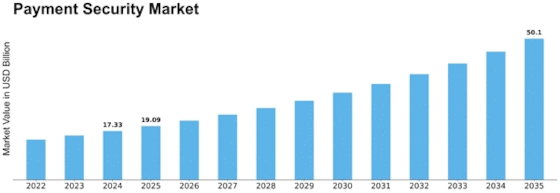
Payment Security Market Size Graph
Author
Author Profile
Ankit Gupta
Team Lead - Research

Ankit Gupta is a seasoned market intelligence and strategic research professional with over six plus years of experience in the ICT and Semiconductor industries. With academic roots in Telecom, Marketing, and Electronics, he blends technical insight with business strategy. Ankit has led 200+ projects, including work for Fortune 500 clients like Microsoft and Rio Tinto, covering market sizing, tech forecasting, and go-to-market strategies. Known for bridging engineering and enterprise decision-making, his insights support growth, innovation, and investment planning across diverse technology markets.

Leave a Comment

FAQs

What is the projected market valuation of the Payment Security Market by 2035?

<p>The Payment Security Market is projected to reach a valuation of 50.1 USD Billion by 2035.</p>

What was the market valuation of the Payment Security Market in 2024?

<p>In 2024, the Payment Security Market was valued at 17.33 USD Billion.</p>

What is the expected CAGR for the Payment Security Market during the forecast period 2025 - 2035?

<p>The expected CAGR for the Payment Security Market during the forecast period 2025 - 2035 is 10.13%.</p>

Which authentication methods are expected to see significant growth in the Payment Security Market?

<p>Authentication methods such as Tokenization and Biometric Authentication are expected to grow significantly, with projected valuations of 15.0 USD Billion and 12.0 USD Billion respectively by 2035.</p>

How does the market for cloud-based payment security solutions compare to on-premises solutions?

<p>By 2035, the market for cloud-based payment security solutions is projected to reach 31.0 USD Billion, significantly outpacing the on-premises solutions, which are expected to reach 19.1 USD Billion.</p>

What are the key applications driving growth in the Payment Security Market?

<p>Key applications driving growth include Banking and E-Commerce, with projected valuations of 18.0 USD Billion and 15.0 USD Billion respectively by 2035.</p>

Which companies are considered key players in the Payment Security Market?

<p>Key players in the Payment Security Market include Visa Inc, Mastercard Inc, American Express Co, and PayPal Holdings Inc.</p>

What is the projected growth for the retail sector within the Payment Security Market?

<p>The retail sector is projected to grow to 19.8 USD Billion by 2035, indicating a robust demand for payment security solutions.</p>

How does the Payment Security Market's growth in 2025 compare to its growth in 2024?

<p>The Payment Security Market is expected to experience substantial growth in 2025, building on its valuation of 17.33 USD Billion in 2024.</p>

What is the expected market size for the insurance sector in the Payment Security Market by 2035?

<p>The insurance sector is expected to reach a market size of 9.0 USD Billion by 2035, reflecting increasing investment in payment security.</p>

Market Summary

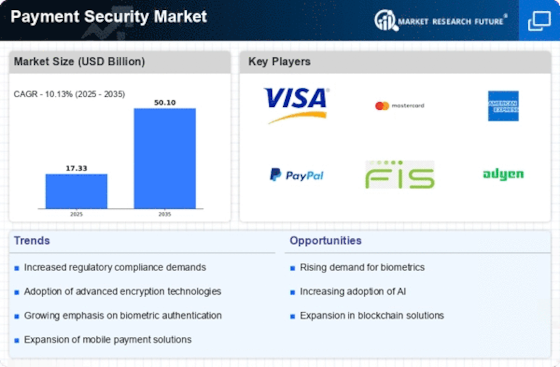
As per Market Research Future analysis, the Payment Security Market Size was estimated at 17.33 USD Billion in 2024. The Payment Security industry is projected to grow from 19.09 USD Billion in 2025 to 50.1 USD Billion by 2035, exhibiting a compound annual growth rate (CAGR) of 10.13% during the forecast period 2025 - 2035

Key Market Trends & Highlights

The Payment Security Market is experiencing robust growth driven by technological advancements and increasing consumer demand for secure transactions.

  • The integration of Artificial Intelligence is transforming security protocols across various payment platforms. Biometric Authentication remains the largest segment, while Two-Factor Authentication is rapidly gaining traction in the market. North America leads the market, whereas the Asia-Pacific region is emerging as the fastest-growing area for payment security solutions. Increasing cybersecurity threats and regulatory pressures are key drivers propelling the demand for advanced payment security measures.

Market Size & Forecast

2024 Market Size 17.33 (USD Billion)
2035 Market Size 50.1 (USD Billion)
CAGR (2025 - 2035) 10.13%
Largest Regional Market Share in 2024 North America

Major Players

Visa Inc (US), Mastercard Inc (US), American Express Co (US), PayPal Holdings Inc (US), FIS Inc (US), Adyen NV (NL), Square Inc (US), Nets Group A/S (DK), Worldpay Inc (US)

Market Trends

The Payment Security Market is currently experiencing a transformative phase, driven by the increasing need for robust security measures in financial transactions. As digital payment methods proliferate, the demand for advanced security solutions has escalated. Organizations are prioritizing the protection of sensitive customer data, which has led to the adoption of innovative technologies such as encryption, tokenization, and biometric authentication. This heightened focus on security is not merely a response to regulatory requirements but also a strategic initiative to enhance consumer trust and loyalty.

Furthermore, the rise of e-commerce and mobile payments has necessitated a reevaluation of existing security frameworks, prompting businesses to invest in comprehensive security strategies that can adapt to evolving threats. This payment security market analysis highlights how organizations are shifting toward layered protection frameworks that combine authentication, encryption, and real-time monitoring to counter evolving cyber threats. The rapid expansion of mobile commerce is also accelerating growth in the mobile payment security software market, as enterprises deploy adaptive fraud detection and endpoint protection to secure smartphone-based transactions.

In addition, the Payment Security Market is witnessing a surge in collaboration between technology providers and financial institutions. This partnership approach aims to create integrated solutions that address the multifaceted challenges of payment security. As cyber threats become increasingly sophisticated, the need for real-time monitoring and response mechanisms is paramount. Consequently, organizations are exploring artificial intelligence and machine learning to bolster their security infrastructures. The ongoing evolution of payment technologies, coupled with the growing awareness of security risks, suggests that the Payment Security Market will continue to expand, driven by innovation and a commitment to safeguarding financial transactions.

Growing adoption of layered verification frameworks is reinforcing momentum within the 3d secure payment authentication market, where advanced authentication protocols are strengthening transaction integrity and reducing knowing fraud risks. This deployment evolution reflects broader expansion in the payment security software market, where scalable platforms are enabling organizations to integrate encryption, tokenization, and fraud analytics within unified environments.

Integration of Artificial Intelligence

The Payment Security Market is increasingly incorporating artificial intelligence to enhance fraud detection and prevention. AI algorithms analyze transaction patterns in real-time, identifying anomalies that may indicate fraudulent activity. This proactive approach not only mitigates risks but also streamlines the transaction process, improving overall efficiency.

Rise of Biometric Authentication

Biometric authentication is gaining traction within the Payment Security Market as a reliable method for verifying user identities. Techniques such as fingerprint scanning and facial recognition offer enhanced security compared to traditional passwords. This trend reflects a broader shift towards more user-friendly and secure authentication methods.

Regulatory Compliance and Standards

The Payment Security Market is heavily influenced by evolving regulatory frameworks aimed at protecting consumer data. Organizations are increasingly focusing on compliance with standards such as PCI DSS and GDPR. This emphasis on regulatory adherence not only safeguards customer information but also fosters trust in digital payment systems.

Payment Security Market Market Drivers

Increasing Cybersecurity Threats

The Payment Security Market is experiencing heightened demand due to the increasing frequency and sophistication of cyberattacks. Organizations are compelled to invest in advanced security measures to protect sensitive financial data. In 2025, it is estimated that cybercrime will cost businesses over 10 trillion dollars annually, underscoring the urgency for robust payment security solutions. As threats evolve, companies are prioritizing the implementation of comprehensive security frameworks, which include encryption, tokenization, and multi-factor authentication. This trend indicates a growing recognition of the need for proactive measures to safeguard against potential breaches, thereby driving growth in the Payment Security Market.

Regulatory Pressures and Compliance

Regulatory pressures are a significant driver in the Payment Security Market, as governments and financial institutions impose stringent compliance requirements. Regulations such as the Payment Card Industry Data Security Standard (PCI DSS) mandate that organizations adhere to specific security protocols to protect cardholder data. Non-compliance can result in hefty fines and reputational damage, prompting businesses to invest in payment security solutions. In 2025, the compliance market is expected to grow substantially, as organizations seek to align with evolving regulations. This trend indicates that the Payment Security Market will continue to expand as companies prioritize compliance to mitigate risks associated with data breaches.

Adoption of Digital Payment Solutions

The rapid adoption of digital payment solutions is a key driver in the Payment Security Market. As consumers increasingly prefer online transactions, businesses are required to enhance their payment security protocols to maintain customer trust. In 2025, it is projected that digital payment transactions will surpass 7 trillion dollars, highlighting the necessity for secure payment gateways. This surge in digital transactions has prompted organizations to invest in innovative security technologies, such as blockchain and secure payment processing systems. Consequently, the Payment Security Market is likely to witness significant growth as companies strive to protect their customers' financial information.

Consumer Awareness and Demand for Security

Consumer awareness regarding payment security is increasingly influencing the Payment Security Market. As individuals become more informed about the risks associated with online transactions, they are demanding higher levels of security from businesses. Surveys indicate that over 70% of consumers are concerned about the safety of their financial information, prompting companies to enhance their security measures. This growing demand for secure payment options is driving organizations to adopt advanced technologies, such as artificial intelligence and machine learning, to detect and prevent fraud. As a result, the Payment Security Market is likely to experience robust growth as businesses respond to consumer expectations.

Technological Advancements in Security Solutions

Technological advancements are playing a pivotal role in shaping the Payment Security Market. Innovations such as artificial intelligence, machine learning, and blockchain technology are revolutionizing the way payment security is approached. These technologies enable organizations to detect fraudulent activities in real-time and enhance the overall security of payment systems. In 2025, the market for AI-driven security solutions is projected to reach 20 billion dollars, reflecting the increasing reliance on technology to combat security threats. As businesses seek to leverage these advancements, the Payment Security Market is expected to grow, driven by the need for more sophisticated and effective security measures.

Market Segment Insights

By Authentication Method: Biometric Authentication (Largest) vs. Two-Factor Authentication (Fastest-Growing)

In the Payment Security Market, the distribution of market share among authentication methods reveals a significant preference for biometric authentication, which has established itself as the largest segment. Biometric technologies utilize unique biological traits, making them more secure and user-friendly. Two-factor authentication follows closely behind, gaining traction as businesses strive for enhanced security measures, reflecting a robust shift towards layered security solutions among consumers and enterprises alike. This preference underscores the growing importance of secure digital payment methods in today's world. The growth trends in authentication methods are driven by the surge in cyber threats, prompting organizations to adopt advanced security technologies. Biometric authentication's user-friendly interface, combined with the widespread use of mobile devices, positions it favorably to capture the majority of the market share. Furthermore, two-factor authentication is witnessing rapid adoption, particularly among businesses aiming to mitigate fraud risks. The increasing regulatory emphasis on data security will likely accelerate the adoption of these methodologies, driving innovation and expansion in the payment security market.

Biometric Authentication (Dominant) vs. Tokenization (Emerging)

Biometric authentication stands as the dominant player in the payment security landscape, favored for its ability to deliver enhanced user experience and robust security through unique biological traits like fingerprints and facial recognition. This authentication method has not only simplified the payment process for consumers but also set higher standards for security, helping to reduce fraud significantly. On the other hand, tokenization is emerging as a viable solution, especially within organizations looking to enhance data protection during transactions. It involves replacing sensitive payment information with non-sensitive tokens, ensuring that actual data is not exposed during transactions. While tokenization is still finding its footing compared to biometric authentication, its acceptance is growing, driven by increasing concerns around data breaches and the need for secure transaction methods without compromising user experience.

By Application: E-Commerce (Largest) vs. Banking (Fastest-Growing)

The Payment Security Market is predominantly driven by the E-Commerce segment, which holds the largest market share among all applications. E-Commerce's rapid digitalization and commercialization continue to enhance its appeal, making it a cornerstone in payment security solutions. As businesses move toward online platforms, the demand for secure transactions is unwavering, positioning E-Commerce as a dominant force. Banking follows as the fastest-growing segment, experiencing significant investments in security technologies to fortify customer confidence and operational safety.

E-Commerce (Dominant) vs. Banking (Emerging)

E-Commerce stands out as the dominant application in the Payment Security Market, supported by the ongoing growth of online shopping and evolving consumer behaviors. It emphasizes secure payment gateways, fraud detection, and data encryption, making it a critical area for service providers. In contrast, the Banking application is emerging rapidly, driven by the necessity for enhanced security in digital banking services. Financial institutions are increasingly adopting advanced security measures like biometrics and multi-factor authentication to protect customers’ sensitive information. As e-banking evolves and cyber threats expand, the banking sector's transformation reinforces its importance and growth potential in the payment security landscape.

By Deployment Type: Cloud-Based (Largest) vs. On-Premises (Fastest-Growing)

The Payment Security Market is witnessing a significant distribution of market share between On-Premises and Cloud-Based deployment types. Currently, Cloud-Based solutions dominate the market, leveraging their scalability, accessibility, and lower maintenance costs, which appeal to a broad range of businesses. On-Premises solutions cater to clients with stringent data security requirements and regulatory compliance concerns, resulting in a smaller but stable market share.

Deployment Type: Cloud-Based (Dominant) vs. On-Premises (Emerging)

In the realm of payment security, Cloud-Based deployment stands out as the dominant solution, favored for its flexibility and ability to integrate advanced security features swiftly. Organizations increasingly prefer this model for its cost-effective nature and seamless updates. However, On-Premises deployment types are not far behind; they are experiencing rapid growth as organizations seek greater control over their data and security processes. This segment is particularly appealing to industries with high compliance requirements, where maintaining data sovereignty is crucial, thus highlighting a dichotomy between flexibility in the Cloud and control in On-Premises solutions.

By End Use: Retail (Largest) vs. Government (Fastest-Growing)

The Payment Security Market demonstrates a notable distribution in its end-use segment, with the Retail sector commanding the largest share. Retailers leverage payment security solutions to safeguard transactions and foster consumer trust, leading to a high adoption rate. In contrast, Government institutions have been increasingly prioritizing payment security to protect sensitive information and comply with stringent regulatory requirements, marking them as the fastest-growing segment.

Retail (Dominant) vs. Government (Emerging)

The Retail sector remains a dominant force in the Payment Security Market, driven by the necessity for robust solutions to handle large volumes of transactions securely. Retailers invest in advanced technologies such as encryption and tokenization to protect customer payment data and enhance the shopping experience. On the other hand, the Government sector is emerging as a key player due to the rising threats of cyber attacks and the need for secure payment protocols. Government agencies are introducing initiatives to modernize payment infrastructures, which fuels the demand for specialized payment security solutions, thereby solidifying their position in this space.

Get more detailed insights about Payment Security Market Research Report – Forecast Till 2035

Regional Insights

The Payment Security Market is projected to achieve a value of 15.74 USD Billion in 2023, reflecting a robust need for secure financial transactions across various regions. North America holds the majority share, valued at 6.5 USD Billion, and is expected to grow significantly to 15.5 USD Billion by 2032, driven by advanced technological infrastructure and high adoption rates of payment security solutions. Europe follows, accounting for 4.0 USD Billion in 2023 and expected to rise to 9.5 USD Billion, benefiting from stringent regulations and increased concern over data breaches.

The APAC region, valued at 3.0 USD Billion in 2023, is anticipated to reach 8.0 USD Billion, with rapid digitalization and a rising middle class contributing to its growth. South America and MEA, valued at 1.0 USD Billion and 1.24 USD Billion, respectively, in 2023, exhibit potential for growth, leveraging the increasing penetration of digital payment systems in these regions. As businesses and consumers alike prioritize security amid rising cyber threats, the significance of the Payment Security Market is underscored as it adapts to these evolving challenges and opportunities.

Key Players and Competitive Insights

The Payment Security Market has become increasingly competitive as digital transactions continue to rise, driven by the advent of e-commerce and mobile payments. The complexity and sophistication of cyber threats targeting financial data have prompted businesses to prioritize secure payment solutions. This market encompasses a wide range of technologies and services, including encryption, tokenization, and multi-factor authentication, all aimed at safeguarding sensitive transaction information. Competitive insights into this landscape reveal a shifting focus towards integrated solutions that can provide extensive protection while maintaining user experience. Companies innovating in this space are not just competing on technology but also on the ability to enhance consumer trust and maintain brand reputation as security breaches become more common. PayPal stands out in the Payment Security Market due to its established reputation and robust security measures, which have garnered user trust. With a strong market presence and a vast user base, PayPal employs advanced encryption technologies and fraud detection systems that consistently monitor transactions for suspicious activities. Moreover, its commitment to regulatory compliance enhances its credibility in the industry, allowing it to provide secure payment options across numerous platforms and devices. PayPal’s ability to adapt to changing security challenges has made it a preferred choice among consumers and businesses alike. The seamless integration of security features into its user experience not only protects customer data but also drives user engagement, solidifying its position as a key player in the payment security domain. Trend Micro offers a unique approach to security in the Payment Security Market, focusing heavily on advanced threat detection and cybersecurity solutions tailored for financial transactions. The company's extensive experience in cybersecurity allows it to provide comprehensive protection against a wide array of online threats that could compromise payment systems. Trend Micro's solutions utilize machine learning and artificial intelligence to identify and neutralize potential security risks before they impact transactions, making it a strong option for organizations looking for proactive measures. Their ability to collaborate with various financial institutions enhances their credibility, enabling them to deliver specialized solutions that defend against evolving threats. By continually innovating in security technology, Trend Micro remains a significant contender in ensuring the integrity of payment systems worldwide.

Key Companies in the Payment Security Market include

Industry Developments

Recent developments in the Payment Security Market reveal a growing emphasis on advanced fraud detection methods and secure payment solutions driven by increasing cyber threats. Companies like PayPal and Mastercard are continually innovating their payment platforms to enhance security features to meet evolving customer expectations. Trend Micro recently launched new cybersecurity solutions aimed at protecting online transactions, reinforcing the need for robust payment security infrastructure. 

On the mergers and acquisitions front, Fiserv has completed its acquisition of a payment technology firm to strengthen its portfolio, which reflects an overarching trend among major players, such as IBM and Oracle, seeking to consolidate their presence in the market. Visa is also enhancing its security measures through partnerships with companies like Thales to improve end-to-end encryption and tokenization for card transactions.

With market valuations increasing significantly for security firms like Symantec and McAfee, this influx of investments is indicative of the industry's robust growth trajectory, as organizations prioritize securing financial transactions amidst escalating digital risks spurred by advances in technology and increasing regulatory compliance requirements across different regions.

Future Outlook

Payment Security Market Future Outlook

The Payment Security Market is projected to grow at a 10.13% CAGR from 2025 to 2035, driven by increasing digital transactions, regulatory compliance, and evolving cybersecurity threats.

New opportunities lie in:

  • <p>Integration of AI-driven fraud detection systems Expansion of biometric authentication solutions Development of blockchain-based payment security frameworks</p>

By 2035, the Payment Security Market is expected to be robust, driven by innovative technologies and heightened security demands.

Market Segmentation

Payment Security Market End Use Outlook

  • Retail
  • Corporate
  • Government

Payment Security Market Application Outlook

  • E-Commerce
  • Banking
  • Insurance
  • Healthcare

Payment Security Market Deployment Type Outlook

  • On-Premises
  • Cloud-Based

Payment Security Market Authentication Method Outlook

  • Two-Factor Authentication
  • Biometric Authentication
  • Tokenization
  • Password-Based Authentication

Report Scope

MARKET SIZE 2024 17.33(USD Billion)
MARKET SIZE 2025 19.09(USD Billion)
MARKET SIZE 2035 50.1(USD Billion)
COMPOUND ANNUAL GROWTH RATE (CAGR) 10.13% (2025 - 2035)
REPORT COVERAGE Revenue Forecast, Competitive Landscape, Growth Factors, and Trends
BASE YEAR 2024
Market Forecast Period 2025 - 2035
Historical Data 2019 - 2024
Market Forecast Units USD Billion
Key Companies Profiled Visa Inc (US), Mastercard Inc (US), American Express Co (US), PayPal Holdings Inc (US), FIS Inc (US), Adyen NV (NL), Square Inc (US), Nets Group A/S (DK), Worldpay Inc (US)
Segments Covered Authentication Method, Application, Deployment Type, End Use, Regional
Key Market Opportunities Integration of advanced biometric authentication technologies enhances security in the Payment Security Market.
Key Market Dynamics Rising regulatory scrutiny and technological advancements drive innovation in the Payment Security Market.
Countries Covered North America, Europe, APAC, South America, MEA

FAQs

What is the projected market valuation of the Payment Security Market by 2035?

<p>The Payment Security Market is projected to reach a valuation of 50.1 USD Billion by 2035.</p>

What was the market valuation of the Payment Security Market in 2024?

<p>In 2024, the Payment Security Market was valued at 17.33 USD Billion.</p>

What is the expected CAGR for the Payment Security Market during the forecast period 2025 - 2035?

<p>The expected CAGR for the Payment Security Market during the forecast period 2025 - 2035 is 10.13%.</p>

Which authentication methods are expected to see significant growth in the Payment Security Market?

<p>Authentication methods such as Tokenization and Biometric Authentication are expected to grow significantly, with projected valuations of 15.0 USD Billion and 12.0 USD Billion respectively by 2035.</p>

How does the market for cloud-based payment security solutions compare to on-premises solutions?

<p>By 2035, the market for cloud-based payment security solutions is projected to reach 31.0 USD Billion, significantly outpacing the on-premises solutions, which are expected to reach 19.1 USD Billion.</p>

What are the key applications driving growth in the Payment Security Market?

<p>Key applications driving growth include Banking and E-Commerce, with projected valuations of 18.0 USD Billion and 15.0 USD Billion respectively by 2035.</p>

Which companies are considered key players in the Payment Security Market?

<p>Key players in the Payment Security Market include Visa Inc, Mastercard Inc, American Express Co, and PayPal Holdings Inc.</p>

What is the projected growth for the retail sector within the Payment Security Market?

<p>The retail sector is projected to grow to 19.8 USD Billion by 2035, indicating a robust demand for payment security solutions.</p>

How does the Payment Security Market's growth in 2025 compare to its growth in 2024?

<p>The Payment Security Market is expected to experience substantial growth in 2025, building on its valuation of 17.33 USD Billion in 2024.</p>

What is the expected market size for the insurance sector in the Payment Security Market by 2035?

<p>The insurance sector is expected to reach a market size of 9.0 USD Billion by 2035, reflecting increasing investment in payment security.</p>

  1. SECTION I: EXECUTIVE SUMMARY AND KEY HIGHLIGHTS
    1. | 1.1 EXECUTIVE SUMMARY
    2. | | 1.1.1 Market Overview
    3. | | 1.1.2 Key Findings
    4. | | 1.1.3 Market Segmentation
    5. | | 1.1.4 Competitive Landscape
    6. | | 1.1.5 Challenges and Opportunities
    7. | | 1.1.6 Future Outlook
  2. SECTION II: SCOPING, METHODOLOGY AND MARKET STRUCTURE
    1. | 2.1 MARKET INTRODUCTION
    2. | | 2.1.1 Definition
    3. | | 2.1.2 Scope of the study
    4. | | | 2.1.2.1 Research Objective
    5. | | | 2.1.2.2 Assumption
    6. | | | 2.1.2.3 Limitations
    7. | 2.2 RESEARCH METHODOLOGY
    8. | | 2.2.1 Overview
    9. | | 2.2.2 Data Mining
    10. | | 2.2.3 Secondary Research
    11. | | 2.2.4 Primary Research
    12. | | | 2.2.4.1 Primary Interviews and Information Gathering Process
    13. | | | 2.2.4.2 Breakdown of Primary Respondents
    14. | | 2.2.5 Forecasting Model
    15. | | 2.2.6 Market Size Estimation
    16. | | | 2.2.6.1 Bottom-Up Approach
    17. | | | 2.2.6.2 Top-Down Approach
    18. | | 2.2.7 Data Triangulation
    19. | | 2.2.8 Validation
  3. SECTION III: QUALITATIVE ANALYSIS
    1. | 3.1 MARKET DYNAMICS
    2. | | 3.1.1 Overview
    3. | | 3.1.2 Drivers
    4. | | 3.1.3 Restraints
    5. | | 3.1.4 Opportunities
    6. | 3.2 MARKET FACTOR ANALYSIS
    7. | | 3.2.1 Value chain Analysis
    8. | | 3.2.2 Porter's Five Forces Analysis
    9. | | | 3.2.2.1 Bargaining Power of Suppliers
    10. | | | 3.2.2.2 Bargaining Power of Buyers
    11. | | | 3.2.2.3 Threat of New Entrants
    12. | | | 3.2.2.4 Threat of Substitutes
    13. | | | 3.2.2.5 Intensity of Rivalry
    14. | | 3.2.3 COVID-19 Impact Analysis
    15. | | | 3.2.3.1 Market Impact Analysis
    16. | | | 3.2.3.2 Regional Impact
    17. | | | 3.2.3.3 Opportunity and Threat Analysis
  4. SECTION IV: QUANTITATIVE ANALYSIS
    1. | 4.1 Information and Communications Technology, BY Authentication Method (USD Billion)
    2. | | 4.1.1 Two-Factor Authentication
    3. | | 4.1.2 Biometric Authentication
    4. | | 4.1.3 Tokenization
    5. | | 4.1.4 Password-Based Authentication
    6. | 4.2 Information and Communications Technology, BY Application (USD Billion)
    7. | | 4.2.1 E-Commerce
    8. | | 4.2.2 Banking
    9. | | 4.2.3 Insurance
    10. | | 4.2.4 Healthcare
    11. | 4.3 Information and Communications Technology, BY Deployment Type (USD Billion)
    12. | | 4.3.1 On-Premises
    13. | | 4.3.2 Cloud-Based
    14. | 4.4 Information and Communications Technology, BY End Use (USD Billion)
    15. | | 4.4.1 Retail
    16. | | 4.4.2 Corporate
    17. | | 4.4.3 Government
    18. | 4.5 Information and Communications Technology, BY Region (USD Billion)
    19. | | 4.5.1 North America
    20. | | | 4.5.1.1 US
    21. | | | 4.5.1.2 Canada
    22. | | 4.5.2 Europe
    23. | | | 4.5.2.1 Germany
    24. | | | 4.5.2.2 UK
    25. | | | 4.5.2.3 France
    26. | | | 4.5.2.4 Russia
    27. | | | 4.5.2.5 Italy
    28. | | | 4.5.2.6 Spain
    29. | | | 4.5.2.7 Rest of Europe
    30. | | 4.5.3 APAC
    31. | | | 4.5.3.1 China
    32. | | | 4.5.3.2 India
    33. | | | 4.5.3.3 Japan
    34. | | | 4.5.3.4 South Korea
    35. | | | 4.5.3.5 Malaysia
    36. | | | 4.5.3.6 Thailand
    37. | | | 4.5.3.7 Indonesia
    38. | | | 4.5.3.8 Rest of APAC
    39. | | 4.5.4 South America
    40. | | | 4.5.4.1 Brazil
    41. | | | 4.5.4.2 Mexico
    42. | | | 4.5.4.3 Argentina
    43. | | | 4.5.4.4 Rest of South America
    44. | | 4.5.5 MEA
    45. | | | 4.5.5.1 GCC Countries
    46. | | | 4.5.5.2 South Africa
    47. | | | 4.5.5.3 Rest of MEA
  5. SECTION V: COMPETITIVE ANALYSIS
    1. | 5.1 Competitive Landscape
    2. | | 5.1.1 Overview
    3. | | 5.1.2 Competitive Analysis
    4. | | 5.1.3 Market share Analysis
    5. | | 5.1.4 Major Growth Strategy in the Information and Communications Technology
    6. | | 5.1.5 Competitive Benchmarking
    7. | | 5.1.6 Leading Players in Terms of Number of Developments in the Information and Communications Technology
    8. | | 5.1.7 Key developments and growth strategies
    9. | | | 5.1.7.1 New Product Launch/Service Deployment
    10. | | | 5.1.7.2 Merger & Acquisitions
    11. | | | 5.1.7.3 Joint Ventures
    12. | | 5.1.8 Major Players Financial Matrix
    13. | | | 5.1.8.1 Sales and Operating Income
    14. | | | 5.1.8.2 Major Players R&D Expenditure. 2023
    15. | 5.2 Company Profiles
    16. | | 5.2.1 Visa Inc (US)
    17. | | | 5.2.1.1 Financial Overview
    18. | | | 5.2.1.2 Products Offered
    19. | | | 5.2.1.3 Key Developments
    20. | | | 5.2.1.4 SWOT Analysis
    21. | | | 5.2.1.5 Key Strategies
    22. | | 5.2.2 Mastercard Inc (US)
    23. | | | 5.2.2.1 Financial Overview
    24. | | | 5.2.2.2 Products Offered
    25. | | | 5.2.2.3 Key Developments
    26. | | | 5.2.2.4 SWOT Analysis
    27. | | | 5.2.2.5 Key Strategies
    28. | | 5.2.3 American Express Co (US)
    29. | | | 5.2.3.1 Financial Overview
    30. | | | 5.2.3.2 Products Offered
    31. | | | 5.2.3.3 Key Developments
    32. | | | 5.2.3.4 SWOT Analysis
    33. | | | 5.2.3.5 Key Strategies
    34. | | 5.2.4 PayPal Holdings Inc (US)
    35. | | | 5.2.4.1 Financial Overview
    36. | | | 5.2.4.2 Products Offered
    37. | | | 5.2.4.3 Key Developments
    38. | | | 5.2.4.4 SWOT Analysis
    39. | | | 5.2.4.5 Key Strategies
    40. | | 5.2.5 FIS Inc (US)
    41. | | | 5.2.5.1 Financial Overview
    42. | | | 5.2.5.2 Products Offered
    43. | | | 5.2.5.3 Key Developments
    44. | | | 5.2.5.4 SWOT Analysis
    45. | | | 5.2.5.5 Key Strategies
    46. | | 5.2.6 Adyen NV (NL)
    47. | | | 5.2.6.1 Financial Overview
    48. | | | 5.2.6.2 Products Offered
    49. | | | 5.2.6.3 Key Developments
    50. | | | 5.2.6.4 SWOT Analysis
    51. | | | 5.2.6.5 Key Strategies
    52. | | 5.2.7 Square Inc (US)
    53. | | | 5.2.7.1 Financial Overview
    54. | | | 5.2.7.2 Products Offered
    55. | | | 5.2.7.3 Key Developments
    56. | | | 5.2.7.4 SWOT Analysis
    57. | | | 5.2.7.5 Key Strategies
    58. | | 5.2.8 Nets Group A/S (DK)
    59. | | | 5.2.8.1 Financial Overview
    60. | | | 5.2.8.2 Products Offered
    61. | | | 5.2.8.3 Key Developments
    62. | | | 5.2.8.4 SWOT Analysis
    63. | | | 5.2.8.5 Key Strategies
    64. | | 5.2.9 Worldpay Inc (US)
    65. | | | 5.2.9.1 Financial Overview
    66. | | | 5.2.9.2 Products Offered
    67. | | | 5.2.9.3 Key Developments
    68. | | | 5.2.9.4 SWOT Analysis
    69. | | | 5.2.9.5 Key Strategies
    70. | 5.3 Appendix
    71. | | 5.3.1 References
    72. | | 5.3.2 Related Reports
  6. LIST OF FIGURES
    1. | 6.1 MARKET SYNOPSIS
    2. | 6.2 NORTH AMERICA MARKET ANALYSIS
    3. | 6.3 US MARKET ANALYSIS BY AUTHENTICATION METHOD
    4. | 6.4 US MARKET ANALYSIS BY APPLICATION
    5. | 6.5 US MARKET ANALYSIS BY DEPLOYMENT TYPE
    6. | 6.6 US MARKET ANALYSIS BY END USE
    7. | 6.7 CANADA MARKET ANALYSIS BY AUTHENTICATION METHOD
    8. | 6.8 CANADA MARKET ANALYSIS BY APPLICATION
    9. | 6.9 CANADA MARKET ANALYSIS BY DEPLOYMENT TYPE
    10. | 6.10 CANADA MARKET ANALYSIS BY END USE
    11. | 6.11 EUROPE MARKET ANALYSIS
    12. | 6.12 GERMANY MARKET ANALYSIS BY AUTHENTICATION METHOD
    13. | 6.13 GERMANY MARKET ANALYSIS BY APPLICATION
    14. | 6.14 GERMANY MARKET ANALYSIS BY DEPLOYMENT TYPE
    15. | 6.15 GERMANY MARKET ANALYSIS BY END USE
    16. | 6.16 UK MARKET ANALYSIS BY AUTHENTICATION METHOD
    17. | 6.17 UK MARKET ANALYSIS BY APPLICATION
    18. | 6.18 UK MARKET ANALYSIS BY DEPLOYMENT TYPE
    19. | 6.19 UK MARKET ANALYSIS BY END USE
    20. | 6.20 FRANCE MARKET ANALYSIS BY AUTHENTICATION METHOD
    21. | 6.21 FRANCE MARKET ANALYSIS BY APPLICATION
    22. | 6.22 FRANCE MARKET ANALYSIS BY DEPLOYMENT TYPE
    23. | 6.23 FRANCE MARKET ANALYSIS BY END USE
    24. | 6.24 RUSSIA MARKET ANALYSIS BY AUTHENTICATION METHOD
    25. | 6.25 RUSSIA MARKET ANALYSIS BY APPLICATION
    26. | 6.26 RUSSIA MARKET ANALYSIS BY DEPLOYMENT TYPE
    27. | 6.27 RUSSIA MARKET ANALYSIS BY END USE
    28. | 6.28 ITALY MARKET ANALYSIS BY AUTHENTICATION METHOD
    29. | 6.29 ITALY MARKET ANALYSIS BY APPLICATION
    30. | 6.30 ITALY MARKET ANALYSIS BY DEPLOYMENT TYPE
    31. | 6.31 ITALY MARKET ANALYSIS BY END USE
    32. | 6.32 SPAIN MARKET ANALYSIS BY AUTHENTICATION METHOD
    33. | 6.33 SPAIN MARKET ANALYSIS BY APPLICATION
    34. | 6.34 SPAIN MARKET ANALYSIS BY DEPLOYMENT TYPE
    35. | 6.35 SPAIN MARKET ANALYSIS BY END USE
    36. | 6.36 REST OF EUROPE MARKET ANALYSIS BY AUTHENTICATION METHOD
    37. | 6.37 REST OF EUROPE MARKET ANALYSIS BY APPLICATION
    38. | 6.38 REST OF EUROPE MARKET ANALYSIS BY DEPLOYMENT TYPE
    39. | 6.39 REST OF EUROPE MARKET ANALYSIS BY END USE
    40. | 6.40 APAC MARKET ANALYSIS
    41. | 6.41 CHINA MARKET ANALYSIS BY AUTHENTICATION METHOD
    42. | 6.42 CHINA MARKET ANALYSIS BY APPLICATION
    43. | 6.43 CHINA MARKET ANALYSIS BY DEPLOYMENT TYPE
    44. | 6.44 CHINA MARKET ANALYSIS BY END USE
    45. | 6.45 INDIA MARKET ANALYSIS BY AUTHENTICATION METHOD
    46. | 6.46 INDIA MARKET ANALYSIS BY APPLICATION
    47. | 6.47 INDIA MARKET ANALYSIS BY DEPLOYMENT TYPE
    48. | 6.48 INDIA MARKET ANALYSIS BY END USE
    49. | 6.49 JAPAN MARKET ANALYSIS BY AUTHENTICATION METHOD
    50. | 6.50 JAPAN MARKET ANALYSIS BY APPLICATION
    51. | 6.51 JAPAN MARKET ANALYSIS BY DEPLOYMENT TYPE
    52. | 6.52 JAPAN MARKET ANALYSIS BY END USE
    53. | 6.53 SOUTH KOREA MARKET ANALYSIS BY AUTHENTICATION METHOD
    54. | 6.54 SOUTH KOREA MARKET ANALYSIS BY APPLICATION
    55. | 6.55 SOUTH KOREA MARKET ANALYSIS BY DEPLOYMENT TYPE
    56. | 6.56 SOUTH KOREA MARKET ANALYSIS BY END USE
    57. | 6.57 MALAYSIA MARKET ANALYSIS BY AUTHENTICATION METHOD
    58. | 6.58 MALAYSIA MARKET ANALYSIS BY APPLICATION
    59. | 6.59 MALAYSIA MARKET ANALYSIS BY DEPLOYMENT TYPE
    60. | 6.60 MALAYSIA MARKET ANALYSIS BY END USE
    61. | 6.61 THAILAND MARKET ANALYSIS BY AUTHENTICATION METHOD
    62. | 6.62 THAILAND MARKET ANALYSIS BY APPLICATION
    63. | 6.63 THAILAND MARKET ANALYSIS BY DEPLOYMENT TYPE
    64. | 6.64 THAILAND MARKET ANALYSIS BY END USE
    65. | 6.65 INDONESIA MARKET ANALYSIS BY AUTHENTICATION METHOD
    66. | 6.66 INDONESIA MARKET ANALYSIS BY APPLICATION
    67. | 6.67 INDONESIA MARKET ANALYSIS BY DEPLOYMENT TYPE
    68. | 6.68 INDONESIA MARKET ANALYSIS BY END USE
    69. | 6.69 REST OF APAC MARKET ANALYSIS BY AUTHENTICATION METHOD
    70. | 6.70 REST OF APAC MARKET ANALYSIS BY APPLICATION
    71. | 6.71 REST OF APAC MARKET ANALYSIS BY DEPLOYMENT TYPE
    72. | 6.72 REST OF APAC MARKET ANALYSIS BY END USE
    73. | 6.73 SOUTH AMERICA MARKET ANALYSIS
    74. | 6.74 BRAZIL MARKET ANALYSIS BY AUTHENTICATION METHOD
    75. | 6.75 BRAZIL MARKET ANALYSIS BY APPLICATION
    76. | 6.76 BRAZIL MARKET ANALYSIS BY DEPLOYMENT TYPE
    77. | 6.77 BRAZIL MARKET ANALYSIS BY END USE
    78. | 6.78 MEXICO MARKET ANALYSIS BY AUTHENTICATION METHOD
    79. | 6.79 MEXICO MARKET ANALYSIS BY APPLICATION
    80. | 6.80 MEXICO MARKET ANALYSIS BY DEPLOYMENT TYPE
    81. | 6.81 MEXICO MARKET ANALYSIS BY END USE
    82. | 6.82 ARGENTINA MARKET ANALYSIS BY AUTHENTICATION METHOD
    83. | 6.83 ARGENTINA MARKET ANALYSIS BY APPLICATION
    84. | 6.84 ARGENTINA MARKET ANALYSIS BY DEPLOYMENT TYPE
    85. | 6.85 ARGENTINA MARKET ANALYSIS BY END USE
    86. | 6.86 REST OF SOUTH AMERICA MARKET ANALYSIS BY AUTHENTICATION METHOD
    87. | 6.87 REST OF SOUTH AMERICA MARKET ANALYSIS BY APPLICATION
    88. | 6.88 REST OF SOUTH AMERICA MARKET ANALYSIS BY DEPLOYMENT TYPE
    89. | 6.89 REST OF SOUTH AMERICA MARKET ANALYSIS BY END USE
    90. | 6.90 MEA MARKET ANALYSIS
    91. | 6.91 GCC COUNTRIES MARKET ANALYSIS BY AUTHENTICATION METHOD
    92. | 6.92 GCC COUNTRIES MARKET ANALYSIS BY APPLICATION
    93. | 6.93 GCC COUNTRIES MARKET ANALYSIS BY DEPLOYMENT TYPE
    94. | 6.94 GCC COUNTRIES MARKET ANALYSIS BY END USE
    95. | 6.95 SOUTH AFRICA MARKET ANALYSIS BY AUTHENTICATION METHOD
    96. | 6.96 SOUTH AFRICA MARKET ANALYSIS BY APPLICATION
    97. | 6.97 SOUTH AFRICA MARKET ANALYSIS BY DEPLOYMENT TYPE
    98. | 6.98 SOUTH AFRICA MARKET ANALYSIS BY END USE
    99. | 6.99 REST OF MEA MARKET ANALYSIS BY AUTHENTICATION METHOD
    100. | 6.100 REST OF MEA MARKET ANALYSIS BY APPLICATION
    101. | 6.101 REST OF MEA MARKET ANALYSIS BY DEPLOYMENT TYPE
    102. | 6.102 REST OF MEA MARKET ANALYSIS BY END USE
    103. | 6.103 KEY BUYING CRITERIA OF INFORMATION AND COMMUNICATIONS TECHNOLOGY
    104. | 6.104 RESEARCH PROCESS OF MRFR
    105. | 6.105 DRO ANALYSIS OF INFORMATION AND COMMUNICATIONS TECHNOLOGY
    106. | 6.106 DRIVERS IMPACT ANALYSIS: INFORMATION AND COMMUNICATIONS TECHNOLOGY
    107. | 6.107 RESTRAINTS IMPACT ANALYSIS: INFORMATION AND COMMUNICATIONS TECHNOLOGY
    108. | 6.108 SUPPLY / VALUE CHAIN: INFORMATION AND COMMUNICATIONS TECHNOLOGY
    109. | 6.109 INFORMATION AND COMMUNICATIONS TECHNOLOGY, BY AUTHENTICATION METHOD, 2024 (% SHARE)
    110. | 6.110 INFORMATION AND COMMUNICATIONS TECHNOLOGY, BY AUTHENTICATION METHOD, 2024 TO 2035 (USD Billion)
    111. | 6.111 INFORMATION AND COMMUNICATIONS TECHNOLOGY, BY APPLICATION, 2024 (% SHARE)
    112. | 6.112 INFORMATION AND COMMUNICATIONS TECHNOLOGY, BY APPLICATION, 2024 TO 2035 (USD Billion)
    113. | 6.113 INFORMATION AND COMMUNICATIONS TECHNOLOGY, BY DEPLOYMENT TYPE, 2024 (% SHARE)
    114. | 6.114 INFORMATION AND COMMUNICATIONS TECHNOLOGY, BY DEPLOYMENT TYPE, 2024 TO 2035 (USD Billion)
    115. | 6.115 INFORMATION AND COMMUNICATIONS TECHNOLOGY, BY END USE, 2024 (% SHARE)
    116. | 6.116 INFORMATION AND COMMUNICATIONS TECHNOLOGY, BY END USE, 2024 TO 2035 (USD Billion)
    117. | 6.117 BENCHMARKING OF MAJOR COMPETITORS
  7. LIST OF TABLES
    1. | 7.1 LIST OF ASSUMPTIONS
    2. | | 7.1.1
    3. | 7.2 North America MARKET SIZE ESTIMATES; FORECAST
    4. | | 7.2.1 BY AUTHENTICATION METHOD, 2025-2035 (USD Billion)
    5. | | 7.2.2 BY APPLICATION, 2025-2035 (USD Billion)
    6. | | 7.2.3 BY DEPLOYMENT TYPE, 2025-2035 (USD Billion)
    7. | | 7.2.4 BY END USE, 2025-2035 (USD Billion)
    8. | 7.3 US MARKET SIZE ESTIMATES; FORECAST
    9. | | 7.3.1 BY AUTHENTICATION METHOD, 2025-2035 (USD Billion)
    10. | | 7.3.2 BY APPLICATION, 2025-2035 (USD Billion)
    11. | | 7.3.3 BY DEPLOYMENT TYPE, 2025-2035 (USD Billion)
    12. | | 7.3.4 BY END USE, 2025-2035 (USD Billion)
    13. | 7.4 Canada MARKET SIZE ESTIMATES; FORECAST
    14. | | 7.4.1 BY AUTHENTICATION METHOD, 2025-2035 (USD Billion)
    15. | | 7.4.2 BY APPLICATION, 2025-2035 (USD Billion)
    16. | | 7.4.3 BY DEPLOYMENT TYPE, 2025-2035 (USD Billion)
    17. | | 7.4.4 BY END USE, 2025-2035 (USD Billion)
    18. | 7.5 Europe MARKET SIZE ESTIMATES; FORECAST
    19. | | 7.5.1 BY AUTHENTICATION METHOD, 2025-2035 (USD Billion)
    20. | | 7.5.2 BY APPLICATION, 2025-2035 (USD Billion)
    21. | | 7.5.3 BY DEPLOYMENT TYPE, 2025-2035 (USD Billion)
    22. | | 7.5.4 BY END USE, 2025-2035 (USD Billion)
    23. | 7.6 Germany MARKET SIZE ESTIMATES; FORECAST
    24. | | 7.6.1 BY AUTHENTICATION METHOD, 2025-2035 (USD Billion)
    25. | | 7.6.2 BY APPLICATION, 2025-2035 (USD Billion)
    26. | | 7.6.3 BY DEPLOYMENT TYPE, 2025-2035 (USD Billion)
    27. | | 7.6.4 BY END USE, 2025-2035 (USD Billion)
    28. | 7.7 UK MARKET SIZE ESTIMATES; FORECAST
    29. | | 7.7.1 BY AUTHENTICATION METHOD, 2025-2035 (USD Billion)
    30. | | 7.7.2 BY APPLICATION, 2025-2035 (USD Billion)
    31. | | 7.7.3 BY DEPLOYMENT TYPE, 2025-2035 (USD Billion)
    32. | | 7.7.4 BY END USE, 2025-2035 (USD Billion)
    33. | 7.8 France MARKET SIZE ESTIMATES; FORECAST
    34. | | 7.8.1 BY AUTHENTICATION METHOD, 2025-2035 (USD Billion)
    35. | | 7.8.2 BY APPLICATION, 2025-2035 (USD Billion)
    36. | | 7.8.3 BY DEPLOYMENT TYPE, 2025-2035 (USD Billion)
    37. | | 7.8.4 BY END USE, 2025-2035 (USD Billion)
    38. | 7.9 Russia MARKET SIZE ESTIMATES; FORECAST
    39. | | 7.9.1 BY AUTHENTICATION METHOD, 2025-2035 (USD Billion)
    40. | | 7.9.2 BY APPLICATION, 2025-2035 (USD Billion)
    41. | | 7.9.3 BY DEPLOYMENT TYPE, 2025-2035 (USD Billion)
    42. | | 7.9.4 BY END USE, 2025-2035 (USD Billion)
    43. | 7.10 Italy MARKET SIZE ESTIMATES; FORECAST
    44. | | 7.10.1 BY AUTHENTICATION METHOD, 2025-2035 (USD Billion)
    45. | | 7.10.2 BY APPLICATION, 2025-2035 (USD Billion)
    46. | | 7.10.3 BY DEPLOYMENT TYPE, 2025-2035 (USD Billion)
    47. | | 7.10.4 BY END USE, 2025-2035 (USD Billion)
    48. | 7.11 Spain MARKET SIZE ESTIMATES; FORECAST
    49. | | 7.11.1 BY AUTHENTICATION METHOD, 2025-2035 (USD Billion)
    50. | | 7.11.2 BY APPLICATION, 2025-2035 (USD Billion)
    51. | | 7.11.3 BY DEPLOYMENT TYPE, 2025-2035 (USD Billion)
    52. | | 7.11.4 BY END USE, 2025-2035 (USD Billion)
    53. | 7.12 Rest of Europe MARKET SIZE ESTIMATES; FORECAST
    54. | | 7.12.1 BY AUTHENTICATION METHOD, 2025-2035 (USD Billion)
    55. | | 7.12.2 BY APPLICATION, 2025-2035 (USD Billion)
    56. | | 7.12.3 BY DEPLOYMENT TYPE, 2025-2035 (USD Billion)
    57. | | 7.12.4 BY END USE, 2025-2035 (USD Billion)
    58. | 7.13 APAC MARKET SIZE ESTIMATES; FORECAST
    59. | | 7.13.1 BY AUTHENTICATION METHOD, 2025-2035 (USD Billion)
    60. | | 7.13.2 BY APPLICATION, 2025-2035 (USD Billion)
    61. | | 7.13.3 BY DEPLOYMENT TYPE, 2025-2035 (USD Billion)
    62. | | 7.13.4 BY END USE, 2025-2035 (USD Billion)
    63. | 7.14 China MARKET SIZE ESTIMATES; FORECAST
    64. | | 7.14.1 BY AUTHENTICATION METHOD, 2025-2035 (USD Billion)
    65. | | 7.14.2 BY APPLICATION, 2025-2035 (USD Billion)
    66. | | 7.14.3 BY DEPLOYMENT TYPE, 2025-2035 (USD Billion)
    67. | | 7.14.4 BY END USE, 2025-2035 (USD Billion)
    68. | 7.15 India MARKET SIZE ESTIMATES; FORECAST
    69. | | 7.15.1 BY AUTHENTICATION METHOD, 2025-2035 (USD Billion)
    70. | | 7.15.2 BY APPLICATION, 2025-2035 (USD Billion)
    71. | | 7.15.3 BY DEPLOYMENT TYPE, 2025-2035 (USD Billion)
    72. | | 7.15.4 BY END USE, 2025-2035 (USD Billion)
    73. | 7.16 Japan MARKET SIZE ESTIMATES; FORECAST
    74. | | 7.16.1 BY AUTHENTICATION METHOD, 2025-2035 (USD Billion)
    75. | | 7.16.2 BY APPLICATION, 2025-2035 (USD Billion)
    76. | | 7.16.3 BY DEPLOYMENT TYPE, 2025-2035 (USD Billion)
    77. | | 7.16.4 BY END USE, 2025-2035 (USD Billion)
    78. | 7.17 South Korea MARKET SIZE ESTIMATES; FORECAST
    79. | | 7.17.1 BY AUTHENTICATION METHOD, 2025-2035 (USD Billion)
    80. | | 7.17.2 BY APPLICATION, 2025-2035 (USD Billion)
    81. | | 7.17.3 BY DEPLOYMENT TYPE, 2025-2035 (USD Billion)
    82. | | 7.17.4 BY END USE, 2025-2035 (USD Billion)
    83. | 7.18 Malaysia MARKET SIZE ESTIMATES; FORECAST
    84. | | 7.18.1 BY AUTHENTICATION METHOD, 2025-2035 (USD Billion)
    85. | | 7.18.2 BY APPLICATION, 2025-2035 (USD Billion)
    86. | | 7.18.3 BY DEPLOYMENT TYPE, 2025-2035 (USD Billion)
    87. | | 7.18.4 BY END USE, 2025-2035 (USD Billion)
    88. | 7.19 Thailand MARKET SIZE ESTIMATES; FORECAST
    89. | | 7.19.1 BY AUTHENTICATION METHOD, 2025-2035 (USD Billion)
    90. | | 7.19.2 BY APPLICATION, 2025-2035 (USD Billion)
    91. | | 7.19.3 BY DEPLOYMENT TYPE, 2025-2035 (USD Billion)
    92. | | 7.19.4 BY END USE, 2025-2035 (USD Billion)
    93. | 7.20 Indonesia MARKET SIZE ESTIMATES; FORECAST
    94. | | 7.20.1 BY AUTHENTICATION METHOD, 2025-2035 (USD Billion)
    95. | | 7.20.2 BY APPLICATION, 2025-2035 (USD Billion)
    96. | | 7.20.3 BY DEPLOYMENT TYPE, 2025-2035 (USD Billion)
    97. | | 7.20.4 BY END USE, 2025-2035 (USD Billion)
    98. | 7.21 Rest of APAC MARKET SIZE ESTIMATES; FORECAST
    99. | | 7.21.1 BY AUTHENTICATION METHOD, 2025-2035 (USD Billion)
    100. | | 7.21.2 BY APPLICATION, 2025-2035 (USD Billion)
    101. | | 7.21.3 BY DEPLOYMENT TYPE, 2025-2035 (USD Billion)
    102. | | 7.21.4 BY END USE, 2025-2035 (USD Billion)
    103. | 7.22 South America MARKET SIZE ESTIMATES; FORECAST
    104. | | 7.22.1 BY AUTHENTICATION METHOD, 2025-2035 (USD Billion)
    105. | | 7.22.2 BY APPLICATION, 2025-2035 (USD Billion)
    106. | | 7.22.3 BY DEPLOYMENT TYPE, 2025-2035 (USD Billion)
    107. | | 7.22.4 BY END USE, 2025-2035 (USD Billion)
    108. | 7.23 Brazil MARKET SIZE ESTIMATES; FORECAST
    109. | | 7.23.1 BY AUTHENTICATION METHOD, 2025-2035 (USD Billion)
    110. | | 7.23.2 BY APPLICATION, 2025-2035 (USD Billion)
    111. | | 7.23.3 BY DEPLOYMENT TYPE, 2025-2035 (USD Billion)
    112. | | 7.23.4 BY END USE, 2025-2035 (USD Billion)
    113. | 7.24 Mexico MARKET SIZE ESTIMATES; FORECAST
    114. | | 7.24.1 BY AUTHENTICATION METHOD, 2025-2035 (USD Billion)
    115. | | 7.24.2 BY APPLICATION, 2025-2035 (USD Billion)
    116. | | 7.24.3 BY DEPLOYMENT TYPE, 2025-2035 (USD Billion)
    117. | | 7.24.4 BY END USE, 2025-2035 (USD Billion)
    118. | 7.25 Argentina MARKET SIZE ESTIMATES; FORECAST
    119. | | 7.25.1 BY AUTHENTICATION METHOD, 2025-2035 (USD Billion)
    120. | | 7.25.2 BY APPLICATION, 2025-2035 (USD Billion)
    121. | | 7.25.3 BY DEPLOYMENT TYPE, 2025-2035 (USD Billion)
    122. | | 7.25.4 BY END USE, 2025-2035 (USD Billion)
    123. | 7.26 Rest of South America MARKET SIZE ESTIMATES; FORECAST
    124. | | 7.26.1 BY AUTHENTICATION METHOD, 2025-2035 (USD Billion)
    125. | | 7.26.2 BY APPLICATION, 2025-2035 (USD Billion)
    126. | | 7.26.3 BY DEPLOYMENT TYPE, 2025-2035 (USD Billion)
    127. | | 7.26.4 BY END USE, 2025-2035 (USD Billion)
    128. | 7.27 MEA MARKET SIZE ESTIMATES; FORECAST
    129. | | 7.27.1 BY AUTHENTICATION METHOD, 2025-2035 (USD Billion)
    130. | | 7.27.2 BY APPLICATION, 2025-2035 (USD Billion)
    131. | | 7.27.3 BY DEPLOYMENT TYPE, 2025-2035 (USD Billion)
    132. | | 7.27.4 BY END USE, 2025-2035 (USD Billion)
    133. | 7.28 GCC Countries MARKET SIZE ESTIMATES; FORECAST
    134. | | 7.28.1 BY AUTHENTICATION METHOD, 2025-2035 (USD Billion)
    135. | | 7.28.2 BY APPLICATION, 2025-2035 (USD Billion)
    136. | | 7.28.3 BY DEPLOYMENT TYPE, 2025-2035 (USD Billion)
    137. | | 7.28.4 BY END USE, 2025-2035 (USD Billion)
    138. | 7.29 South Africa MARKET SIZE ESTIMATES; FORECAST
    139. | | 7.29.1 BY AUTHENTICATION METHOD, 2025-2035 (USD Billion)
    140. | | 7.29.2 BY APPLICATION, 2025-2035 (USD Billion)
    141. | | 7.29.3 BY DEPLOYMENT TYPE, 2025-2035 (USD Billion)
    142. | | 7.29.4 BY END USE, 2025-2035 (USD Billion)
    143. | 7.30 Rest of MEA MARKET SIZE ESTIMATES; FORECAST
    144. | | 7.30.1 BY AUTHENTICATION METHOD, 2025-2035 (USD Billion)
    145. | | 7.30.2 BY APPLICATION, 2025-2035 (USD Billion)
    146. | | 7.30.3 BY DEPLOYMENT TYPE, 2025-2035 (USD Billion)
    147. | | 7.30.4 BY END USE, 2025-2035 (USD Billion)
    148. | 7.31 PRODUCT LAUNCH/PRODUCT DEVELOPMENT/APPROVAL
    149. | | 7.31.1
    150. | 7.32 ACQUISITION/PARTNERSHIP
    151. | | 7.32.1

Information and Communications Technology Market Segmentation

Information and Communications Technology By Authentication Method (USD Billion, 2025-2035)

  • Two-Factor Authentication
  • Biometric Authentication
  • Tokenization
  • Password-Based Authentication

Information and Communications Technology By Application (USD Billion, 2025-2035)

  • E-Commerce
  • Banking
  • Insurance
  • Healthcare

Information and Communications Technology By Deployment Type (USD Billion, 2025-2035)

  • On-Premises
  • Cloud-Based

Information and Communications Technology By End Use (USD Billion, 2025-2035)

  • Retail
  • Corporate
  • Government
Infographic

Free Sample Request

Kindly complete the form below to receive a free sample of this Report

Get Free Sample

Customer Strories

Compare Licence

×
Features License Type
Single User Multiuser License Enterprise User
Price $4,950 $5,950 $7,250
Maximum User Access Limit 1 User Upto 10 Users Unrestricted Access Throughout the Organization
Free Customization
Direct Access to Analyst
Deliverable Format
Platform Access
Discount on Next Purchase 10% 15% 15%
Printable Versions