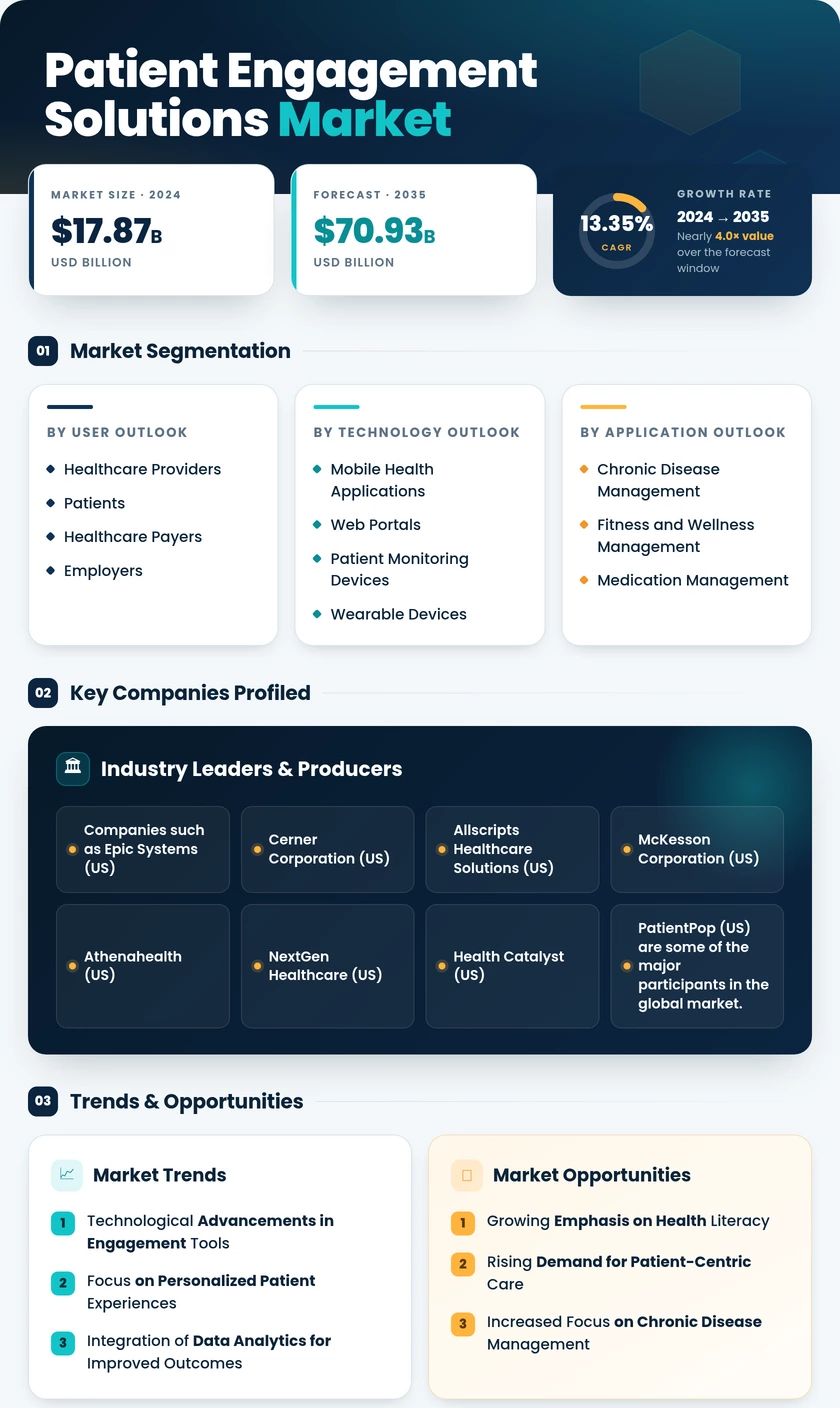
Segmentation Quick Reference
| Dimension | Sub-Segments | Dominant Segment | Fastest Growing Segment |
| By Component | Hardware; Software; Services | Software (52.4% share) | Services (14.9% CAGR) |
| By Delivery Mode | Web-Based and Cloud-Based; On-Premise | Web-Based and Cloud-Based (65.4% share) | Web-Based and Cloud-Based (65.4% share) |
| By Application | Social and Behavioral Management; Population Health Management; Home Healthcare Management; Financial Management; Fitness and Health Management | Population Health Management (26.4% share) | Home Healthcare Management (16.4% CAGR) |
| By End User | Providers (Hospitals, Clinics, ACOs); Payers; Others | Providers (Hospitals, Clinics, ACOs) (58.2% share) | Payers (14.2% CAGR) |
Market Segmentation Overview
By Component
| Sub-Segment | Key Trend |
| Hardware | Kiosk and bedside tablet refresh cycles tied to facility construction |
| Software | Consolidation onto fewer authenticated platforms per health system |
| Services | Rising attach rates for integration, change management, and optimisation |
Software leads this dimension at 52.4% of 2025 revenue because licences recur annually while Hardware refreshes only on multi-year capital cycles. Services grow fastest at a 14.9% CAGR, reflecting buyer recognition that portal activation depends on clinical workflow redesign rather than software installation, and that internal IT teams rarely have capacity for it. Hardware stays essential in acute inpatient settings, where lobby kiosks and bedside devices are the only reliable interface for patients without smartphones.
By Delivery Mode
| Sub-Segment | Key Trend |
| Web-Based and Cloud-Based | Per-user-per-month pricing opens the mid-market and rural segment |
| On-Premise | Retained for data-residency mandates and low-connectivity environments |
Web-Based and Cloud-Based deployment holds 65.4% of 2025 revenue and is also the fastest-expanding mode, since subscription pricing removes the capital hurdle that historically excluded critical-access hospitals and independent physician groups. On-Premise persists at 34.6% where sovereign data-residency rules, defence health requirements, or unreliable connectivity make hosted delivery impractical. That base contracts steadily as cloud vendors obtain certifications individual hospital IT departments cannot maintain internally.
By Application
| Sub-Segment | Key Trend |
| Social and Behavioral Management | Screening mandates generate structured data requiring downstream workflow |
| Population Health Management | Gap closure tied directly to risk-contract and quality measure performance |
| Home Healthcare Management | Hospital-at-home waivers and monitoring codes make continuous contact billable |
| Financial Management | Price transparency rules and rising patient out-of-pocket responsibility |
| Fitness and Health Management | Employer wellness programmes migrating into preventive care pathways |
Population Health Management leads applications at 26.4% share because it maps onto the exact quality measures that determine payment under risk-bearing contracts, making its business case the easiest to defend. Home Healthcare Management grows fastest at a 16.4% CAGR, pulled by acute-care-at-home programmes where the platform becomes the monitoring station rather than a convenience layer. Social and Behavioral Management trails both but expands steadily as screening requirements create referral workflows that no existing system handles.
By End User
| Sub-Segment | Key Trend |
| Providers (Hospitals, Clinics, ACOs) | Information-blocking compliance plus downside risk exposure |
| Payers | Star ratings, HEDIS gap closure, and member retention economics |
| Others | Employers, public health agencies, and life sciences sponsors |
Providers (Hospitals, Clinics, ACOs) dominate at 58.2% of 2025 revenue because they carry both the statutory data-access obligation and the clinical relationship that makes outreach credible. Payers grow fastest at a 14.2% CAGR, since Medicare Advantage bonus payments respond sharply to rating movements that engagement tooling directly influences. Others remain a smaller pool, but employer wellness and trial-recruitment use cases give it disproportionate strategic value to vendors seeking non-provider revenue.


 Noah Malgeri
Co-Founder

 Peter Groot koerkamp
Account and Business Manager

 Younghwan Choi
Senior Retail Manager

 Mark Irwin
Management Consultant

 Akif Moroglu
Strategy & Business Development Director

 Guilherme Gomes Martins
Product Management Director

 Joseph Aguayo
Sales Operations & Pricing Manager

 La Terria Dodd
Program Support Specialist

 Rob Kooiker
Group Product Manager HVAC & Fire Protection GMA