Request Free Sample ×

Kindly complete the form below to receive a free sample of this Report

* Please use a valid business email

Leading companies partner with us for data-driven Insights

clients tt-cursor
Hero Background
English
Chinese
French
Japanese
Korean
German
Spanish

Patient Engagement Solutions Market Share

ID: MRFR/HC/6901-HCR
200 Pages
Nidhi Mandole
April 2026

Patient Engagement Solutions Market Size, Growth Research Report By Technology (Mobile Health Applications, Web Portals, Patient Monitoring Devices, Wearable Devices), By Deployment Mode (On-Premises, Cloud-Based, Hybrid), By End User (Healthcare Providers, Patients, Healthcare Payers, Employers), By Application (Chronic Disease Management, Fitness and Wellness Management, Medication Management) and By Regional (North America, Europe, South America, Asia Pacific, Middle East and Africa) -Competitor Industry Analysis and Trends Forecast Till 2035

Share:
Download PDF ×

We do not share your information with anyone. However, we may send you emails based on your report interest from time to time. You may contact us at any time to opt-out.

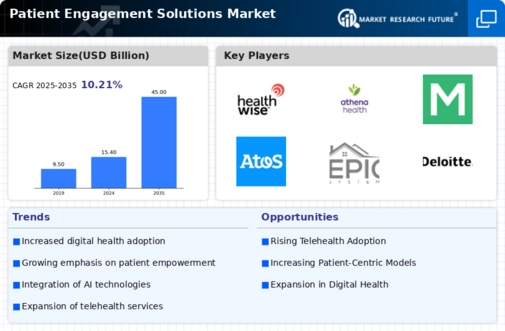
Patient Engagement Solutions Market Infographic
Purchase Options

Market Share

Patient Engagement Solutions Market Share Analysis

In the dynamic landscape of the Patient Engagement Solution (PES) market, successful market percentage positioning starts off evolving with deep expertise of consumer wishes. Companies ought to conduct thorough studies to pick out gaps in current answers and gain insights into the evolving requirements of healthcare vendors and patients. Tailoring PES to fulfill unique client wishes is a pivotal method. Offering customizable solutions guarantees that healthcare groups can integrate patient engagement seamlessly into their existing structures. Flexibility in implementation is vital because it allows for scalability and adaptability to unique healthcare settings. Given the sensitive nature of healthcare facts, stringent security features and compliance with regulatory standards are paramount. Companies positioning themselves efficiently in the market prioritize robust facts protection protocols, making sure that patient facts remain personal and guarded in opposition to capacity breaches. Beyond the software program itself, organizations can differentiate by providing considerable instructional sources and guide services. Offering schooling programs for the healthcare workforce and academic substances for patients contributes to successful implementation and sustained engagement, improving the general fee proposition. Establishing strategic partnerships with healthcare vendors, pharmaceutical businesses, and different stakeholders can considerably affect market share positioning. Collaborations allow for a broader attain, multiplied credibility, and entry to new market segments, facilitating the boom of Patient Engagement Solutions. Stagnation may be unfavorable within the hastily evolving healthcare generation panorama. Companies vying for market share have to put money into non-stop innovation, staying in advance of rising trends. Incorporating capabilities like telehealth integration, AI-driven analytics, and remote patient monitoring positions a PES issuer as forward-wondering and adaptive. Healthcare groups are scrutinizing the ROI of generation investments in an increasing number of ways. Successful PES providers are adept at demonstrating the tangible benefits of their answers, whether or not through improved affected person outcomes, reduced health facility readmissions, or accelerated operational efficiencies. Clear and measurable ROI builds are accepted as true and attract extra customers. To enhance market proportion, PES carriers ought not to forget to expand globally. Understanding and adapting to the unique healthcare landscapes of various regions is crucial. Localization, compliance with worldwide requirements, and addressing various cultural concerns are vital aspects of a successful global market positioning approach. Affordability and scalability are vital elements, in particular for smaller healthcare companies. Excellent customer support is a differentiator in the aggressive PES market. Companies that provide proactive and responsive customer support addressing problems promptly and effectively, make contributions to patron delight. Positive purchaser reports result in repeat business and nice phrase-of-mouth guidelines, assisting in market proportion increase.


Author
Author Profile
Nidhi Mandole
Senior Research Analyst

She is an extremely curious individual currently working in Healthcare and Medical Devices Domain. Nidhi is comfortably versed in data centric research backed by healthcare educational background. She leverages extensive data mining and analytics tools such as Primary and Secondary Research, Statistical Analysis, Machine Learning, Data Modelling. Her key role also involves Technical Sales Support, Client Interaction and Project management within the Healthcare team. Lastly, she showcases extensive affinity towards learning new skills and remain fascinated in implementing them.

Leave a Comment

FAQs

What is the projected market valuation of the market by 2035?

The market is projected to reach a valuation of 70.93 USD Billion by 2035.

What was the market valuation of the Patient Engagement Solutions Market in 2024?

<p>In 2024, the market valuation of the Patient Engagement Solutions Market was 17.87 USD Billion.</p>

What is the expected CAGR for the market from 2025 to 2035?

The expected CAGR for the market during the forecast period 2025 - 2035 is 13.35%.

Which technology segments are driving growth in the Patient Engagement Solutions Market?

<p>Key technology segments include Mobile Health Applications, Web Portals, Patient Monitoring Devices, and Wearable Devices, with valuations ranging from 5.0 to 22.93 USD Billion.</p>

How does the deployment mode impact the Patient Engagement Solutions Market?

<p>The market is segmented into On-Premises, Cloud-Based, and Hybrid deployment modes, with Cloud-Based solutions projected to grow from 9.0 to 38.0 USD Billion.</p>

Who are the primary end users of Patient Engagement Solutions?

<p>Primary end users include Healthcare Providers, Patients, Healthcare Payers, and Employers, with Healthcare Providers expected to grow from 7.5 to 30.0 USD Billion.</p>

What applications are most prevalent in the Patient Engagement Solutions Market?

<p>Chronic Disease Management, Fitness and Wellness Management, and Medication Management are key applications, with Medication Management projected to grow from 8.28 to 32.83 USD Billion.</p>

Which companies are considered key players in the market?

Key players in the market include Epic Systems, Cerner Corporation, Allscripts Healthcare Solutions, McKesson Corporation, Athenahealth, NextGen Healthcare, Health Catalyst, and PatientPop.

What trends are influencing the growth of the market?

Trends such as increased adoption of digital health technologies and a focus on patient-centered care are likely influencing the growth of the market.

How do wearable devices contribute to the Patient Engagement Solutions Market?

<p>Wearable Devices are projected to grow from 5.87 to 22.93 USD Billion, indicating their increasing importance in patient engagement and monitoring.</p>

Market Summary

As per Market Research Future analysis, the Patient Engagement Solutions Market size was valued at USD 17.87 Billion in 2024. The market is projected to grow from USD 20.26 Billion in 2025 to USD 70.93 Billion by 2035, exhibiting a CAGR of 13.3% during the forecast period 2025-2035. North America led the market with over 45% share, generating around USD 8.0 billion in revenue.
 
Increasing adoption of patient engagement solutions is driven by the digital transformation of healthcare, empowered by mobile apps, telehealth platforms, and patient‑centric strategies that enhance communication, self‑management, and care coordination across providers and patients globally.
 
According to CDC, 6 in 10 U.S. adults live with a chronic disease and 4 in 10 have multiple conditions, fueling demand for engagement platforms that improve self‑management, adherence, and outcomes.

Key Market Trends & Highlights

The Patient Engagement Solutions Market is experiencing robust growth driven by technological advancements and a focus on personalized care.

  • North America led patient engagement solution revenue, securing 45 % of global market share in 2024 through robust digital health adoption. Europe’s patient engagement market was valued at USD 5.36 billion in 2024, ranking second with 30 % share. Mobile health applications dominated with 65 % share in 2024, driven by widespread smartphone use and real‑time engagement capability. Cloud‑based deployment captured 55 % share in 2024, enabling scalable remote access and real‑time patient interactions. Chronic disease management accounted for 40 % share in 2024, reflecting high demand for long‑term engagement and self‑care solutions.

Market Size & Forecast

2024 Market Size 17.87 (USD Billion)
2035 Market Size 70.93 (USD Billion)
CAGR (2025 - 2035) 13.35%
Largest Regional Market Share in 2024 North America

Major Players

Companies such as <a href="https://www.epic.com/software/patient-experience/">Epic Systems</a> (US), Cerner Corporation (US), Allscripts Healthcare Solutions (US), <a href="https://www.mckesson.com/pharmacy-technology/patient-adherence-wellness/engagement/">McKesson Corporation</a> (US), Athenahealth (US), NextGen Healthcare (US), Health Catalyst (US), PatientPop (US) are some of the major participants in the global market.

Market Trends

The Patient Engagement Solutions Market is currently experiencing a transformative phase, characterized by a growing emphasis on enhancing patient involvement in their own healthcare journeys. This shift appears to stem from a broader recognition of the importance of patient-centered care, which emphasizes the need for healthcare providers to engage patients actively. As technology continues to evolve, solutions that facilitate communication, education, and self-management are becoming increasingly prevalent.

These innovations not only empower patients but also aim to improve health outcomes and satisfaction levels. Furthermore, the integration of data analytics and artificial intelligence into patient engagement tools suggests a potential for more personalized experiences, tailoring interactions to individual needs and preferences. In addition, the market seems to be influenced by regulatory changes and a heightened focus on value-based care.

Healthcare organizations are likely to adopt solutions that align with these new paradigms, fostering a culture of accountability and transparency. This trend indicates a shift towards more collaborative relationships between patients and providers, where shared decision-making is prioritized. As the patient engagement solution market evolves, it may also witness the emergence of new players and innovative business models, further enriching the landscape of patient engagement solutions.

Technological Advancements in Engagement Tools

The market is witnessing a surge in technological innovations that enhance patient interaction. Tools such as mobile applications, telehealth platforms, and wearable devices are becoming integral to patient engagement strategies that have surged the demand for intelligent patient engagement solutions. These advancements facilitate real-time communication and provide patients with access to their health information, thereby promoting proactive health management.

The WHO’s Global Strategy on Digital Health promotes digital solutions to enhance patient care, aiming to strengthen health systems and expand equitable access to technologies like telehealth and mobile health apps that improve real‑time engagement and patient‑provider communication.

Focus on Personalized Patient Experiences

There is a growing trend towards personalizing patient engagement strategies within the market. Healthcare providers are increasingly recognizing the value of tailoring interactions based on individual patient preferences and needs. This approach not only fosters stronger relationships but also enhances patient satisfaction and adherence to treatment plans.

Digital health tools significantly enhance chronic disease self‑management and patient communication: in 77 % of digital platform studies, patients reported improved quality of life and self‑management outcomes through tailored engagement interventions.

Integration of Data Analytics for Improved Outcomes

The integration of data analytics into patient engagement solutions is becoming more prevalent. By leveraging data, healthcare organizations can gain insights into patient behaviors and preferences, allowing for more effective engagement strategies. This trend indicates a shift towards data-driven decision-making, which may lead to improved health outcomes and more efficient care delivery.

The CDC reports that chronic diseases affect most U.S. adults and represent the majority of healthcare costs; patient engagement analytics help tailor interventions for this large disease burden, increasing efficiency and personalized care delivery.

Patient Engagement Solutions Market Market Drivers

Growing Emphasis on Health Literacy

Health literacy is increasingly recognized as a crucial factor in patient engagement and health outcomes. The Patient Engagement Solutions Market is responding to this need by developing solutions that enhance health literacy among patients. By providing accessible information and educational resources, these solutions aim to empower patients to make informed decisions about their health.
 
Research suggests that individuals with higher health literacy are more likely to engage in preventive care and adhere to treatment plans. This correlation underscores the potential for growth in the market as healthcare providers seek to improve health literacy and, consequently, patient engagement.

Rising Demand for Patient-Centric Care

The Patient Engagement Solutions Market is experiencing a notable shift towards patient-centric care models. This trend is driven by an increasing recognition of the importance of patient involvement in their own healthcare decisions. As healthcare providers strive to enhance patient satisfaction and outcomes, they are adopting solutions that facilitate better communication and engagement.
 
According to recent data, approximately 70% of patients express a desire to be more involved in their treatment plans. This growing demand for personalized care is prompting healthcare organizations to invest in patient engagement technologies, thereby expanding the market.

Increased Focus on Chronic Disease Management

Chronic diseases are a significant burden on healthcare systems, necessitating effective management strategies. The Patient Engagement Solutions Market is witnessing a heightened focus on solutions that empower patients to manage their chronic conditions. By providing tools for self-monitoring, education, and communication with healthcare providers, these solutions aim to improve health outcomes and reduce hospitalizations.
 
Data indicates that nearly 60% of adults with chronic conditions report a lack of engagement in their care. This gap presents a substantial opportunity for the market to develop targeted interventions that enhance patient involvement in chronic disease management.

Regulatory Support for Engagement Initiatives

Regulatory bodies are increasingly advocating for patient engagement as a critical component of healthcare delivery. The Patient Engagement Solutions Market benefits from policies that encourage transparency and patient involvement in care processes. For instance, initiatives aimed at improving patient access to health information and promoting shared decision-making are gaining traction.
 
These regulatory frameworks not only support the adoption of engagement solutions but also incentivize healthcare providers to implement them. As a result, the market is likely to see a surge in demand for tools that align with these regulatory expectations, fostering growth in the market.

Technological Innovations Enhancing Engagement

Technological advancements are playing a pivotal role in shaping the Patient Engagement Solutions Market. Innovations such as mobile health applications, telehealth platforms, and wearable devices are transforming how patients interact with healthcare providers. These technologies enable real-time communication, personalized health tracking, and access to educational resources, thereby enhancing patient engagement.
 
Recent statistics indicate that the use of mobile health applications has increased by over 50% in the past few years, reflecting a growing reliance on technology for health management. This trend suggests a robust future for the market as more patients embrace digital health tools.

Market Segment Insights

By Technology: Mobile Health Applications (Largest) vs. Wearable Devices (Fastest-Growing)

The Patient Engagement Solutions Market shows a significant distribution, with technological segments holding a 65% share. Mobile Health Applications dominate the landscape, benefiting from widespread adoption due to their accessibility and ability to facilitate direct communication between patients and healthcare providers. Following closely are Web Portals and <a title="patient monitoring devices" href="https://www.marketresearchfuture.com/reports/patient-monitoring-devices-market-2484" target="_blank" rel="noopener">Patient Monitoring Devices</a>, which are essential for centralizing patient data and enhancing user engagement. Wearable Devices, meanwhile, are gaining traction but still hold a smaller share compared to Mobile Health Applications.

Mobile Health Applications: Dominant vs. Wearable Devices: Emerging

Mobile Health Applications represent the dominant force within the market share, leveraging user-friendly interfaces and integration with healthcare systems to enhance patient self-management and engagement. They also provide features such as medication reminders, appointment scheduling, and personalized health monitoring, which are crucial for chronic disease management. In contrast, Wearable Devices are emerging rapidly, driven by advances in technology and increasing consumer interest in personal health tracking. These devices offer real-time data collection and feedback, appealing particularly to tech-savvy patients. The growth of Wearable Devices is also supported by an increase in healthcare initiatives aimed at promoting wellness and preventive care.

By Deployment Mode: Cloud-Based (Largest) vs. On-Premises (Fastest-Growing)

In the Patient Engagement Solutions Market, the distribution of deployment modes reflects a varied preference among healthcare organizations. Currently, cloud-based solutions dominate the patient engagement solution market, offering scalability and ease of access. On-premises solutions are also significant but have been slower to adapt to changes in technology and patient needs. Hybrid approaches are gaining traction as they combine the benefits of both cloud and on-premises solutions, catering to organizations with specific regulatory and operational needs.

On-Premises (Dominant) vs. Hybrid (Emerging)

On-premises deployment modes are historically seen as dominant in the market share, providing extensive customization and control over sensitive patient data. However, they require substantial infrastructure investments and ongoing maintenance. Conversely, hybrid deployment models are emerging as a popular alternative. This approach enables healthcare organizations to leverage the flexibility of the cloud while maintaining certain critical processes on-premises. This adaptability allows organizations to address compliance and security concerns while simultaneously enhancing patient engagement and accessibility through innovative cloud features.

By End User: Healthcare Providers (Largest) vs. Patients (Fastest-Growing)

The healthcare providers segment commands the largest Patient Engagement Solutions Market share at 70%, fueled by rising adoption of digital health technologies and the demand for enhanced patient outcomes. Healthcare providers are leveraging these solutions to enhance communication, streamline operations, and promote patient-centered care, thereby cementing their position as market leaders. The patients segment follows closely, exhibiting strong growth due to rising consumer interest in managing their own health through mobile applications and telehealth services. This increased engagement is reshaping healthcare delivery and encouraging a more proactive approach to personal health management.

Healthcare Providers (Dominant) vs. Patients (Emerging)

Healthcare providers, as the dominant players in the market share, focus on implementing technology that enhances patient interaction and care management. They often invest in sophisticated engagement platforms that help in tracking patient behavior, adherence to treatment plans, and overall satisfaction. On the other hand, the patients segment is emerging prominently, as individuals increasingly demand access to personalized health information and tools. Patient engagement solutions tailored for this segment emphasize user-friendly experiences through mobile devices, making healthcare more accessible and empowering patients to take control of their health. As these segments evolve, they complement each other and drive overall patient engagement solution market growth, with healthcare providers adapting to the increasing expectations of their patient populations.

By Application: Chronic Disease Management (Largest) vs. Fitness and Wellness Management (Fastest-Growing)

Chronic Disease Management currently holds the largest share in the Patient Engagement Solutions Market at 40% among application segments. This sector addresses various chronic conditions, leveraging technology to enable patient self-management and improve health outcomes. Conversely, Fitness and Wellness Management, although smaller in share, is rapidly gaining traction, appealing to a broad audience seeking to enhance their overall well-being through digital solutions. These trends highlight a dynamic patient engagement solution market where patient preferences and health trends dictate engagement strategies. As the healthcare landscape evolves, the growth trends reveal that Chronic Disease Management continues to benefit from increased focus on holistic patient care. Healthcare providers are actively investing in technologies that foster patient adherence and chronic condition monitoring, including telehealth and mobile health applications. Fitness and Wellness Management is emerging as the fastest-growing segment, driven by a shift towards preventive healthcare and self-care practices, particularly among tech-savvy consumers. This change reflects a societal emphasis on health maintenance, encouraging innovation and enhancement of digital wellness solutions.

Chronic Disease Management (Dominant) vs. Medication Management (Emerging)

Chronic Disease Management remains the dominant application within the market share, characterized by its comprehensive approach to managing long-term health conditions through proactive monitoring and care coordination. This segment significantly contributes to improved patient outcomes and sustained engagement with healthcare providers. On the other hand, Medication Management is an emerging segment, focusing on optimizing medication adherence and reducing errors. The growing emphasis on <a title="personalized medicine" href="https://www.marketresearchfuture.com/reports/personalized-medicine-market-2937" target="_blank" rel="noopener">personalized medicine</a> makes this sector increasingly important, with technologies designed to remind patients about their medication schedules and automate refills. The synergy between these segments highlights the broader objective of enhancing patient engagement and treatment effectiveness in a rapidly evolving healthcare environment.

Get more detailed insights about Patient Engagement Solutions Market Research Report-Forecast to 2035

Regional Insights

North America : Leading Innovation and Adoption

North America dominated the global Patient Engagement Solutions Market in 2024, reaching a market size of USD 8.0 billion. The region's growth is driven by increasing healthcare expenditure, a strong emphasis on patient-centered care, and regulatory support for digital health initiatives. The U.S. government has implemented various policies to enhance healthcare IT adoption, further fueling demand for these solutions. 

The competitive landscape in North America is robust, with key players like Epic Systems, Cerner Corporation, and McKesson Corporation leading the charge. The U.S. is the primary market, followed by Canada, which is also witnessing significant growth due to rising investments in healthcare technology. The presence of established patient engagement companies and innovative startups contributes to a dynamic market environment, ensuring continuous advancements in patient engagement solutions.

North America’s strong engagement solution growth is supported by high chronic disease prevalence and digital health adoption; CDC indicates 6 in 10 U.S. adults have a chronic disease and digital solutions improve self‑management and provider communication.

Europe : Emerging Market with Growth Potential

Europe is witnessing a growing demand for market, accounting for approximately 30% of the global market share. The region's growth is propelled by increasing awareness of patient rights, the push for digital health transformation, and supportive regulations from the European Union. Initiatives like the European Health Data Space aim to enhance patient engagement and data accessibility, driving market expansion.

Leading countries in Europe include Germany, the UK, and France, where healthcare systems are increasingly adopting digital solutions. The competitive landscape features both established players and innovative startups, fostering a vibrant ecosystem. Patient engagement companies like Allscripts and Health Catalyst are making significant inroads, while local firms are also emerging to meet specific regional needs. This combination of established and new players is shaping the future of patient engagement in Europe.

Europe’s demand for patient engagement solutions aligns with WHO’s digital health strategy to enhance quality and access; national digital health initiatives support systems that improve care coordination and patient‑centric service delivery.

Asia-Pacific : Rapid Growth and Adoption

Asia-Pacific is rapidly emerging as a significant market for market, holding around 20% of the global market share. The region's growth is driven by increasing smartphone penetration, rising healthcare costs, and a growing focus on patient-centric care. Countries like India and China are leading the charge, supported by government initiatives aimed at improving healthcare access and quality through digital solutions. The competitive landscape in Asia-Pacific is diverse, with a mix of local and international players.

Key countries such as Japan and Australia are also investing heavily in healthcare technology, fostering innovation. Patient engagement companies like NextGen Healthcare and PatientPop are expanding their presence, while local startups are addressing unique regional challenges. This dynamic environment is set to propel the market forward, making Asia-Pacific a key player in patient engagement solutions.

Middle East and Africa : Untapped Potential and Growth

The Middle East and Africa region is gradually emerging in the market, currently holding about 5% of the global market share. The growth is driven by increasing healthcare investments, a rising focus on patient engagement, and government initiatives aimed at improving healthcare delivery. Countries like the UAE and South Africa are leading the way, with significant investments in healthcare infrastructure and technology.

The competitive landscape is still developing, with a mix of local and international players entering the market. The presence of key players is growing, but challenges such as regulatory hurdles and varying healthcare standards remain. However, the potential for growth is substantial, as governments prioritize digital health solutions to enhance patient engagement and improve healthcare outcomes across the region.

Key Players and Competitive Insights

The Patient Engagement Solutions Market is currently characterized by a dynamic competitive landscape, driven by the increasing demand for enhanced patient experiences and improved healthcare outcomes. Key players such as Epic Systems (US), Cerner Corporation (US), and Allscripts Healthcare Solutions (US) are at the forefront, each adopting distinct strategies to solidify their market positions. Epic Systems (US) focuses on innovation through the development of advanced electronic health record (EHR) systems that integrate patient engagement tools, thereby enhancing user experience. Cerner Corporation (US) emphasizes partnerships with healthcare providers to expand its reach and improve service delivery, while Allscripts Healthcare Solutions (US) is investing in digital transformation initiatives to streamline patient interactions and data management. Collectively, these strategies contribute to a competitive environment that is increasingly centered on technological advancement and patient-centric solutions.
 
In terms of business tactics, patient engagement companies are increasingly localizing their operations and optimizing supply chains to enhance service delivery and responsiveness. The market appears moderately fragmented, with several players vying for dominance. However, the collective influence of major patient engagement companies like McKesson Corporation (US) and Athenahealth (US) is notable, as they leverage their extensive networks and resources to shape market dynamics. This competitive structure fosters innovation and encourages smaller firms to adopt similar strategies to remain relevant.
 
In August 2025, McKesson Corporation (US) announced a strategic partnership with a leading telehealth provider to enhance its patient engagement platform. This collaboration aims to integrate telehealth services into McKesson's existing solutions, thereby facilitating seamless communication between patients and healthcare providers. The strategic importance of this move lies in its potential to expand McKesson's service offerings and improve patient access to care, aligning with the growing trend of telehealth adoption.
 
In September 2025, Athenahealth (US) launched a new AI-driven patient engagement tool designed to personalize communication and improve patient adherence to treatment plans. This initiative reflects Athenahealth's commitment to leveraging technology to enhance patient experiences. The strategic significance of this development is underscored by the increasing reliance on AI in healthcare, suggesting that Athenahealth is positioning itself as a leader in this emerging area.
 
In October 2025, NextGen Healthcare (US) unveiled a comprehensive suite of patient engagement solutions aimed at improving health literacy among patients. This initiative is particularly relevant as it addresses the critical need for effective communication in healthcare. The strategic importance of this launch lies in its potential to empower patients, thereby fostering better health outcomes and enhancing the overall patient experience.
 
As of October 2025, the competitive trends in the market are increasingly defined by digitalization, sustainability, and the integration of artificial intelligence. Strategic alliances are playing a pivotal role in shaping the current landscape, as patient engagement software companies seek to enhance their capabilities and expand their market reach. Looking ahead, it appears that competitive differentiation will evolve from traditional price-based competition to a focus on innovation, technological advancements, and supply chain reliability, indicating a shift towards more sustainable and patient-centered approaches.

Key Companies in the Patient Engagement Solutions Market include

Industry Developments

The Patient Engagement Solutions Market has seen significant developments, particularly in the area of technology integration and mergers. Recent advancements in the patient engagement software market and innovation in tools have been introduced by key players such as Healthwise and Philips Healthcare, focusing on enhancing user experiences and outcomes. In September 2023, Cerner Corporation announced a partnership with IBM Watson Health to leverage artificial intelligence in patient engagement strategies, aiming to improve clinical decision-making and patient satisfaction. In terms of mergers and acquisitions, Allscripts Healthcare Solutions acquired a smaller health tech firm to enhance its portfolio in patient engagement solutions, announced in October 2023.

Meanwhile, Meditech and Epic Systems continue to expand their market share through technological advancements and strategic partnerships, promoting interoperability in patient data exchange. The market valuation has been positively impacted, showing growth due to the increased demand for patient-centric solutions and digital health strategies, enabling healthcare providers to improve communication and effectiveness in managing patient care. Over the last two to three years, the urgency of patient engagement has heightened, especially during the COVID-19 pandemic, driving innovations across the industry ecosystem.

Future Outlook

Patient Engagement Solutions Market Future Outlook

The Patient Engagement Solutions Market size is projected to reach USD 70.93 Billion by 2035, growing at a CAGR of 13.35%, driven by technological advancements, increasing patient awareness, and regulatory support.

New opportunities lie in:

  • <p>Integration of AI-driven analytics for personalized patient communication. Development of <a href="https://www.marketresearchfuture.com/reports/mhealth-applications-market-3195">mobile health applications</a> for chronic disease management. Expansion of telehealth platforms to enhance patient-provider interactions.</p>

By 2035, the market is expected to be robust, reflecting substantial growth and innovation.

Market Segmentation

Patient Engagement Solutions Market End User Outlook

  • Healthcare Providers
  • Patients
  • Healthcare Payers
  • Employers

Patient Engagement Solutions Market Technology Outlook

  • Mobile Health Applications
  • Web Portals
  • Patient Monitoring Devices
  • Wearable Devices

Patient Engagement Solutions Market Application Outlook

  • Chronic Disease Management
  • Fitness and Wellness Management
  • Medication Management

Patient Engagement Solutions Market Deployment Mode Outlook

  • On-Premises
  • Cloud-Based
  • Hybrid

Report Scope

MARKET SIZE 2024 17.87(USD Billion)
MARKET SIZE 2025 20.26(USD Billion)
MARKET SIZE 2035 70.93(USD Billion)
COMPOUND ANNUAL GROWTH RATE (CAGR) 13.35% (2025 - 2035)
REPORT COVERAGE Revenue Forecast, Competitive Landscape, Growth Factors, and Trends
BASE YEAR 2024
Market Forecast Period 2025 - 2035
Historical Data 2019 - 2024
Market Forecast Units USD Billion
Key Companies Profiled Epic Systems (US), Cerner Corporation (US), Allscripts Healthcare Solutions (US), McKesson Corporation (US), Athenahealth (US), NextGen Healthcare (US), Health Catalyst (US), PatientPop (US)
Segments Covered Technology, Deployment Mode, End User, Application, Regional
Key Market Opportunities Integration of artificial intelligence to enhance personalized patient engagement and improve health outcomes.
Key Market Dynamics Rising demand for personalized healthcare drives innovation in patient engagement solutions and enhances provider-patient communication.
Countries Covered North America, Europe, APAC, South America, MEA

FAQs

What is the projected market valuation of the market by 2035?

The market is projected to reach a valuation of 70.93 USD Billion by 2035.

What was the market valuation of the Patient Engagement Solutions Market in 2024?

<p>In 2024, the market valuation of the Patient Engagement Solutions Market was 17.87 USD Billion.</p>

What is the expected CAGR for the market from 2025 to 2035?

The expected CAGR for the market during the forecast period 2025 - 2035 is 13.35%.

Which technology segments are driving growth in the Patient Engagement Solutions Market?

<p>Key technology segments include Mobile Health Applications, Web Portals, Patient Monitoring Devices, and Wearable Devices, with valuations ranging from 5.0 to 22.93 USD Billion.</p>

How does the deployment mode impact the Patient Engagement Solutions Market?

<p>The market is segmented into On-Premises, Cloud-Based, and Hybrid deployment modes, with Cloud-Based solutions projected to grow from 9.0 to 38.0 USD Billion.</p>

Who are the primary end users of Patient Engagement Solutions?

<p>Primary end users include Healthcare Providers, Patients, Healthcare Payers, and Employers, with Healthcare Providers expected to grow from 7.5 to 30.0 USD Billion.</p>

What applications are most prevalent in the Patient Engagement Solutions Market?

<p>Chronic Disease Management, Fitness and Wellness Management, and Medication Management are key applications, with Medication Management projected to grow from 8.28 to 32.83 USD Billion.</p>

Which companies are considered key players in the market?

Key players in the market include Epic Systems, Cerner Corporation, Allscripts Healthcare Solutions, McKesson Corporation, Athenahealth, NextGen Healthcare, Health Catalyst, and PatientPop.

What trends are influencing the growth of the market?

Trends such as increased adoption of digital health technologies and a focus on patient-centered care are likely influencing the growth of the market.

How do wearable devices contribute to the Patient Engagement Solutions Market?

<p>Wearable Devices are projected to grow from 5.87 to 22.93 USD Billion, indicating their increasing importance in patient engagement and monitoring.</p>

  1. SECTION I: EXECUTIVE SUMMARY AND KEY HIGHLIGHTS |
    1. EXECUTIVE SUMMARY | |
      1. Market Overview | |
      2. Key Findings | |
      3. Market Segmentation | |
      4. Competitive Landscape | |
      5. Challenges and Opportunities | |
      6. Future Outlook 2
  2. SECTION II: SCOPING, METHODOLOGY AND MARKET STRUCTURE |
    1. MARKET INTRODUCTION | |
      1. Definition | |
      2. Scope of the study | | |
    2. RESEARCH METHODOLOGY | |
      1. Overview | |
      2. Data Mining | |
      3. Secondary Research | |
      4. Primary Research | | |
      5. Forecasting Model | |
      6. Market Size Estimation | | |
      7. Data Triangulation | |
      8. Validation 3
  3. SECTION III: QUALITATIVE ANALYSIS |
    1. MARKET DYNAMICS | |
      1. Overview | |
      2. Drivers | |
      3. Restraints | |
      4. Opportunities |
    2. MARKET FACTOR ANALYSIS | |
      1. Value chain Analysis | |
      2. Porter's Five Forces Analysis | | |
      3. COVID-19 Impact Analysis | | |
  4. SECTION IV: QUANTITATIVE ANALYSIS |
    1. Healthcare, BY Technology (USD Billion) | |
      1. Mobile Health Applications | |
      2. Web Portals | |
      3. Patient Monitoring Devices | |
      4. Wearable Devices |
    2. Healthcare, BY Deployment Mode (USD Billion) | |
      1. On-Premises | |
      2. Cloud-Based | |
      3. Hybrid |
    3. Healthcare, BY End User (USD Billion) | |
      1. Healthcare Providers | |
      2. Patients | |
      3. Healthcare Payers | |
      4. Employers |
    4. Healthcare, BY Application (USD Billion) | |
      1. Chronic Disease Management | |
      2. Fitness and Wellness Management | |
      3. Medication Management |
    5. Healthcare, BY Region (USD Billion) | |
      1. North America | | |
      2. Europe | | |
      3. APAC | | |
      4. South America | | |
      5. MEA | | |
  5. SECTION V: COMPETITIVE ANALYSIS |
    1. Competitive Landscape | |
      1. Overview | |
      2. Competitive Analysis | |
      3. Market share Analysis | |
      4. Major Growth Strategy in the Healthcare | |
      5. Competitive Benchmarking | |
      6. Leading Players in Terms of Number of Developments in the Healthcare | |
      7. Key developments and growth strategies | | |
      8. Major Players Financial Matrix | | |
    2. Company Profiles | |
      1. Epic Systems (US) | | |
      2. Cerner Corporation (US) | | |
      3. Allscripts Healthcare Solutions (US) | | |
      4. McKesson Corporation (US) | | |
      5. Athenahealth (US) | | |
      6. NextGen Healthcare (US) | | |
      7. Health Catalyst (US) | | |
      8. PatientPop (US) | | |
    3. Appendix | |
      1. References | |
      2. Related Reports 6 LIST OF FIGURES |
    4. MARKET SYNOPSIS |
    5. NORTH AMERICA MARKET ANALYSIS |
    6. US MARKET ANALYSIS BY TECHNOLOGY |
    7. US MARKET ANALYSIS BY DEPLOYMENT MODE |
    8. US MARKET ANALYSIS BY END USER |
    9. US MARKET ANALYSIS BY APPLICATION |
    10. CANADA MARKET ANALYSIS BY TECHNOLOGY |
    11. CANADA MARKET ANALYSIS BY DEPLOYMENT MODE |
    12. CANADA MARKET ANALYSIS BY END USER |
    13. CANADA MARKET ANALYSIS BY APPLICATION |
    14. EUROPE MARKET ANALYSIS |
    15. GERMANY MARKET ANALYSIS BY TECHNOLOGY |
    16. GERMANY MARKET ANALYSIS BY DEPLOYMENT MODE |
    17. GERMANY MARKET ANALYSIS BY END USER |
    18. GERMANY MARKET ANALYSIS BY APPLICATION |
    19. UK MARKET ANALYSIS BY TECHNOLOGY |
    20. UK MARKET ANALYSIS BY DEPLOYMENT MODE |
    21. UK MARKET ANALYSIS BY END USER |
    22. UK MARKET ANALYSIS BY APPLICATION |
    23. FRANCE MARKET ANALYSIS BY TECHNOLOGY |
    24. FRANCE MARKET ANALYSIS BY DEPLOYMENT MODE |
    25. FRANCE MARKET ANALYSIS BY END USER |
    26. FRANCE MARKET ANALYSIS BY APPLICATION |
    27. RUSSIA MARKET ANALYSIS BY TECHNOLOGY |
    28. RUSSIA MARKET ANALYSIS BY DEPLOYMENT MODE |
    29. RUSSIA MARKET ANALYSIS BY END USER |
    30. RUSSIA MARKET ANALYSIS BY APPLICATION |
    31. ITALY MARKET ANALYSIS BY TECHNOLOGY |
    32. ITALY MARKET ANALYSIS BY DEPLOYMENT MODE |
    33. ITALY MARKET ANALYSIS BY END USER |
    34. ITALY MARKET ANALYSIS BY APPLICATION |
    35. SPAIN MARKET ANALYSIS BY TECHNOLOGY |
    36. SPAIN MARKET ANALYSIS BY DEPLOYMENT MODE |
    37. SPAIN MARKET ANALYSIS BY END USER |
    38. SPAIN MARKET ANALYSIS BY APPLICATION |
    39. REST OF EUROPE MARKET ANALYSIS BY TECHNOLOGY |
    40. REST OF EUROPE MARKET ANALYSIS BY DEPLOYMENT MODE |
    41. REST OF EUROPE MARKET ANALYSIS BY END USER |
    42. REST OF EUROPE MARKET ANALYSIS BY APPLICATION |
    43. APAC MARKET ANALYSIS |
    44. CHINA MARKET ANALYSIS BY TECHNOLOGY |
    45. CHINA MARKET ANALYSIS BY DEPLOYMENT MODE |
    46. CHINA MARKET ANALYSIS BY END USER |
    47. CHINA MARKET ANALYSIS BY APPLICATION |
    48. INDIA MARKET ANALYSIS BY TECHNOLOGY |
    49. INDIA MARKET ANALYSIS BY DEPLOYMENT MODE |
    50. INDIA MARKET ANALYSIS BY END USER |
    51. INDIA MARKET ANALYSIS BY APPLICATION |
    52. JAPAN MARKET ANALYSIS BY TECHNOLOGY |
    53. JAPAN MARKET ANALYSIS BY DEPLOYMENT MODE |
    54. JAPAN MARKET ANALYSIS BY END USER |
    55. JAPAN MARKET ANALYSIS BY APPLICATION |
    56. SOUTH KOREA MARKET ANALYSIS BY TECHNOLOGY |
    57. SOUTH KOREA MARKET ANALYSIS BY DEPLOYMENT MODE |
    58. SOUTH KOREA MARKET ANALYSIS BY END USER |
    59. SOUTH KOREA MARKET ANALYSIS BY APPLICATION |
    60. MALAYSIA MARKET ANALYSIS BY TECHNOLOGY |
    61. MALAYSIA MARKET ANALYSIS BY DEPLOYMENT MODE |
    62. MALAYSIA MARKET ANALYSIS BY END USER |
    63. MALAYSIA MARKET ANALYSIS BY APPLICATION |
    64. THAILAND MARKET ANALYSIS BY TECHNOLOGY |
    65. THAILAND MARKET ANALYSIS BY DEPLOYMENT MODE |
    66. THAILAND MARKET ANALYSIS BY END USER |
    67. THAILAND MARKET ANALYSIS BY APPLICATION |
    68. INDONESIA MARKET ANALYSIS BY TECHNOLOGY |
    69. INDONESIA MARKET ANALYSIS BY DEPLOYMENT MODE |
    70. INDONESIA MARKET ANALYSIS BY END USER |
    71. INDONESIA MARKET ANALYSIS BY APPLICATION |
    72. REST OF APAC MARKET ANALYSIS BY TECHNOLOGY |
    73. REST OF APAC MARKET ANALYSIS BY DEPLOYMENT MODE |
    74. REST OF APAC MARKET ANALYSIS BY END USER |
    75. REST OF APAC MARKET ANALYSIS BY APPLICATION |
    76. SOUTH AMERICA MARKET ANALYSIS |
    77. BRAZIL MARKET ANALYSIS BY TECHNOLOGY |
    78. BRAZIL MARKET ANALYSIS BY DEPLOYMENT MODE |
    79. BRAZIL MARKET ANALYSIS BY END USER |
    80. BRAZIL MARKET ANALYSIS BY APPLICATION |
    81. MEXICO MARKET ANALYSIS BY TECHNOLOGY |
    82. MEXICO MARKET ANALYSIS BY DEPLOYMENT MODE |
    83. MEXICO MARKET ANALYSIS BY END USER |
    84. MEXICO MARKET ANALYSIS BY APPLICATION |
    85. ARGENTINA MARKET ANALYSIS BY TECHNOLOGY |
    86. ARGENTINA MARKET ANALYSIS BY DEPLOYMENT MODE |
    87. ARGENTINA MARKET ANALYSIS BY END USER |
    88. ARGENTINA MARKET ANALYSIS BY APPLICATION |
    89. REST OF SOUTH AMERICA MARKET ANALYSIS BY TECHNOLOGY |
    90. REST OF SOUTH AMERICA MARKET ANALYSIS BY DEPLOYMENT MODE |
    91. REST OF SOUTH AMERICA MARKET ANALYSIS BY END USER |
    92. REST OF SOUTH AMERICA MARKET ANALYSIS BY APPLICATION |
    93. MEA MARKET ANALYSIS |
    94. GCC COUNTRIES MARKET ANALYSIS BY TECHNOLOGY |
    95. GCC COUNTRIES MARKET ANALYSIS BY DEPLOYMENT MODE |
    96. GCC COUNTRIES MARKET ANALYSIS BY END USER |
    97. GCC COUNTRIES MARKET ANALYSIS BY APPLICATION |
    98. SOUTH AFRICA MARKET ANALYSIS BY TECHNOLOGY |
    99. SOUTH AFRICA MARKET ANALYSIS BY DEPLOYMENT MODE |
    100. SOUTH AFRICA MARKET ANALYSIS BY END USER |
    101. SOUTH AFRICA MARKET ANALYSIS BY APPLICATION |
    102. REST OF MEA MARKET ANALYSIS BY TECHNOLOGY |
    103. REST OF MEA MARKET ANALYSIS BY DEPLOYMENT MODE |
    104. REST OF MEA MARKET ANALYSIS BY END USER |
    105. REST OF MEA MARKET ANALYSIS BY APPLICATION |
    106. KEY BUYING CRITERIA OF HEALTHCARE |
    107. RESEARCH PROCESS OF MRFR |
    108. DRO ANALYSIS OF HEALTHCARE |
    109. DRIVERS IMPACT ANALYSIS: HEALTHCARE |
    110. RESTRAINTS IMPACT ANALYSIS: HEALTHCARE |
    111. SUPPLY / VALUE CHAIN: HEALTHCARE |
    112. HEALTHCARE, BY TECHNOLOGY, 2024 (% SHARE) |
    113. HEALTHCARE, BY TECHNOLOGY, 2024 TO 2035 (USD Billion) |
    114. HEALTHCARE, BY DEPLOYMENT MODE, 2024 (% SHARE) |
    115. HEALTHCARE, BY DEPLOYMENT MODE, 2024 TO 2035 (USD Billion) |
    116. HEALTHCARE, BY END USER, 2024 (% SHARE) |
    117. HEALTHCARE, BY END USER, 2024 TO 2035 (USD Billion) |
    118. HEALTHCARE, BY APPLICATION, 2024 (% SHARE) |
    119. HEALTHCARE, BY APPLICATION, 2024 TO 2035 (USD Billion) |
    120. BENCHMARKING OF MAJOR COMPETITORS 7 LIST OF TABLES |
    121. LIST OF ASSUMPTIONS | |
      1. |
    122. North America MARKET SIZE ESTIMATES; FORECAST | |
      1. BY TECHNOLOGY, 2025-2035 (USD Billion) | |
      2. BY DEPLOYMENT MODE, 2025-2035 (USD Billion) | |
      3. BY END USER, 2025-2035 (USD Billion) | |
      4. BY APPLICATION, 2025-2035 (USD Billion) |
    123. US MARKET SIZE ESTIMATES; FORECAST | |
      1. BY TECHNOLOGY, 2025-2035 (USD Billion) | |
      2. BY DEPLOYMENT MODE, 2025-2035 (USD Billion) | |
      3. BY END USER, 2025-2035 (USD Billion) | |
      4. BY APPLICATION, 2025-2035 (USD Billion) |
    124. Canada MARKET SIZE ESTIMATES; FORECAST | |
      1. BY TECHNOLOGY, 2025-2035 (USD Billion) | |
      2. BY DEPLOYMENT MODE, 2025-2035 (USD Billion) | |
      3. BY END USER, 2025-2035 (USD Billion) | |
      4. BY APPLICATION, 2025-2035 (USD Billion) |
    125. Europe MARKET SIZE ESTIMATES; FORECAST | |
      1. BY TECHNOLOGY, 2025-2035 (USD Billion) | |
      2. BY DEPLOYMENT MODE, 2025-2035 (USD Billion) | |
      3. BY END USER, 2025-2035 (USD Billion) | |
      4. BY APPLICATION, 2025-2035 (USD Billion) |
    126. Germany MARKET SIZE ESTIMATES; FORECAST | |
      1. BY TECHNOLOGY, 2025-2035 (USD Billion) | |
      2. BY DEPLOYMENT MODE, 2025-2035 (USD Billion) | |
      3. BY END USER, 2025-2035 (USD Billion) | |
      4. BY APPLICATION, 2025-2035 (USD Billion) |
    127. UK MARKET SIZE ESTIMATES; FORECAST | |
      1. BY TECHNOLOGY, 2025-2035 (USD Billion) | |
      2. BY DEPLOYMENT MODE, 2025-2035 (USD Billion) | |
      3. BY END USER, 2025-2035 (USD Billion) | |
      4. BY APPLICATION, 2025-2035 (USD Billion) |
    128. France MARKET SIZE ESTIMATES; FORECAST | |
      1. BY TECHNOLOGY, 2025-2035 (USD Billion) | |
      2. BY DEPLOYMENT MODE, 2025-2035 (USD Billion) | |
      3. BY END USER, 2025-2035 (USD Billion) | |
      4. BY APPLICATION, 2025-2035 (USD Billion) |
    129. Russia MARKET SIZE ESTIMATES; FORECAST | |
      1. BY TECHNOLOGY, 2025-2035 (USD Billion) | |
      2. BY DEPLOYMENT MODE, 2025-2035 (USD Billion) | |
      3. BY END USER, 2025-2035 (USD Billion) | |
      4. BY APPLICATION, 2025-2035 (USD Billion) |
    130. Italy MARKET SIZE ESTIMATES; FORECAST | |
      1. BY TECHNOLOGY, 2025-2035 (USD Billion) | |
      2. BY DEPLOYMENT MODE, 2025-2035 (USD Billion) | |
      3. BY END USER, 2025-2035 (USD Billion) | |
      4. BY APPLICATION, 2025-2035 (USD Billion) |
    131. Spain MARKET SIZE ESTIMATES; FORECAST | |
      1. BY TECHNOLOGY, 2025-2035 (USD Billion) | |
      2. BY DEPLOYMENT MODE, 2025-2035 (USD Billion) | |
      3. BY END USER, 2025-2035 (USD Billion) | |
      4. BY APPLICATION, 2025-2035 (USD Billion) |
    132. Rest of Europe MARKET SIZE ESTIMATES; FORECAST | |
      1. BY TECHNOLOGY, 2025-2035 (USD Billion) | |
      2. BY DEPLOYMENT MODE, 2025-2035 (USD Billion) | |
      3. BY END USER, 2025-2035 (USD Billion) | |
      4. BY APPLICATION, 2025-2035 (USD Billion) |
    133. APAC MARKET SIZE ESTIMATES; FORECAST | |
      1. BY TECHNOLOGY, 2025-2035 (USD Billion) | |
      2. BY DEPLOYMENT MODE, 2025-2035 (USD Billion) | |
      3. BY END USER, 2025-2035 (USD Billion) | |
      4. BY APPLICATION, 2025-2035 (USD Billion) |
    134. China MARKET SIZE ESTIMATES; FORECAST | |
      1. BY TECHNOLOGY, 2025-2035 (USD Billion) | |
      2. BY DEPLOYMENT MODE, 2025-2035 (USD Billion) | |
      3. BY END USER, 2025-2035 (USD Billion) | |
      4. BY APPLICATION, 2025-2035 (USD Billion) |
    135. India MARKET SIZE ESTIMATES; FORECAST | |
      1. BY TECHNOLOGY, 2025-2035 (USD Billion) | |
      2. BY DEPLOYMENT MODE, 2025-2035 (USD Billion) | |
      3. BY END USER, 2025-2035 (USD Billion) | |
      4. BY APPLICATION, 2025-2035 (USD Billion) |
    136. Japan MARKET SIZE ESTIMATES; FORECAST | |
      1. BY TECHNOLOGY, 2025-2035 (USD Billion) | |
      2. BY DEPLOYMENT MODE, 2025-2035 (USD Billion) | |
      3. BY END USER, 2025-2035 (USD Billion) | |
      4. BY APPLICATION, 2025-2035 (USD Billion) |
    137. South Korea MARKET SIZE ESTIMATES; FORECAST | |
      1. BY TECHNOLOGY, 2025-2035 (USD Billion) | |
      2. BY DEPLOYMENT MODE, 2025-2035 (USD Billion) | |
      3. BY END USER, 2025-2035 (USD Billion) | |
      4. BY APPLICATION, 2025-2035 (USD Billion) |
    138. Malaysia MARKET SIZE ESTIMATES; FORECAST | |
      1. BY TECHNOLOGY, 2025-2035 (USD Billion) | |
      2. BY DEPLOYMENT MODE, 2025-2035 (USD Billion) | |
      3. BY END USER, 2025-2035 (USD Billion) | |
      4. BY APPLICATION, 2025-2035 (USD Billion) |
    139. Thailand MARKET SIZE ESTIMATES; FORECAST | |
      1. BY TECHNOLOGY, 2025-2035 (USD Billion) | |
      2. BY DEPLOYMENT MODE, 2025-2035 (USD Billion) | |
      3. BY END USER, 2025-2035 (USD Billion) | |
      4. BY APPLICATION, 2025-2035 (USD Billion) |
    140. Indonesia MARKET SIZE ESTIMATES; FORECAST | |
      1. BY TECHNOLOGY, 2025-2035 (USD Billion) | |
      2. BY DEPLOYMENT MODE, 2025-2035 (USD Billion) | |
      3. BY END USER, 2025-2035 (USD Billion) | |
      4. BY APPLICATION, 2025-2035 (USD Billion) |
    141. Rest of APAC MARKET SIZE ESTIMATES; FORECAST | |
      1. BY TECHNOLOGY, 2025-2035 (USD Billion) | |
      2. BY DEPLOYMENT MODE, 2025-2035 (USD Billion) | |
      3. BY END USER, 2025-2035 (USD Billion) | |
      4. BY APPLICATION, 2025-2035 (USD Billion) |
    142. South America MARKET SIZE ESTIMATES; FORECAST | |
      1. BY TECHNOLOGY, 2025-2035 (USD Billion) | |
      2. BY DEPLOYMENT MODE, 2025-2035 (USD Billion) | |
      3. BY END USER, 2025-2035 (USD Billion) | |
      4. BY APPLICATION, 2025-2035 (USD Billion) |
    143. Brazil MARKET SIZE ESTIMATES; FORECAST | |
      1. BY TECHNOLOGY, 2025-2035 (USD Billion) | |
      2. BY DEPLOYMENT MODE, 2025-2035 (USD Billion) | |
      3. BY END USER, 2025-2035 (USD Billion) | |
      4. BY APPLICATION, 2025-2035 (USD Billion) |
    144. Mexico MARKET SIZE ESTIMATES; FORECAST | |
      1. BY TECHNOLOGY, 2025-2035 (USD Billion) | |
      2. BY DEPLOYMENT MODE, 2025-2035 (USD Billion) | |
      3. BY END USER, 2025-2035 (USD Billion) | |
      4. BY APPLICATION, 2025-2035 (USD Billion) |
    145. Argentina MARKET SIZE ESTIMATES; FORECAST | |
      1. BY TECHNOLOGY, 2025-2035 (USD Billion) | |
      2. BY DEPLOYMENT MODE, 2025-2035 (USD Billion) | |
      3. BY END USER, 2025-2035 (USD Billion) | |
      4. BY APPLICATION, 2025-2035 (USD Billion) |
    146. Rest of South America MARKET SIZE ESTIMATES; FORECAST | |
      1. BY TECHNOLOGY, 2025-2035 (USD Billion) | |
      2. BY DEPLOYMENT MODE, 2025-2035 (USD Billion) | |
      3. BY END USER, 2025-2035 (USD Billion) | |
      4. BY APPLICATION, 2025-2035 (USD Billion) |
    147. MEA MARKET SIZE ESTIMATES; FORECAST | |
      1. BY TECHNOLOGY, 2025-2035 (USD Billion) | |
      2. BY DEPLOYMENT MODE, 2025-2035 (USD Billion) | |
      3. BY END USER, 2025-2035 (USD Billion) | |
      4. BY APPLICATION, 2025-2035 (USD Billion) |
    148. GCC Countries MARKET SIZE ESTIMATES; FORECAST | |
      1. BY TECHNOLOGY, 2025-2035 (USD Billion) | |
      2. BY DEPLOYMENT MODE, 2025-2035 (USD Billion) | |
      3. BY END USER, 2025-2035 (USD Billion) | |
      4. BY APPLICATION, 2025-2035 (USD Billion) |
    149. South Africa MARKET SIZE ESTIMATES; FORECAST | |
      1. BY TECHNOLOGY, 2025-2035 (USD Billion) | |
      2. BY DEPLOYMENT MODE, 2025-2035 (USD Billion) | |
      3. BY END USER, 2025-2035 (USD Billion) | |
      4. BY APPLICATION, 2025-2035 (USD Billion) |
    150. Rest of MEA MARKET SIZE ESTIMATES; FORECAST | |
      1. BY TECHNOLOGY, 2025-2035 (USD Billion) | |
      2. BY DEPLOYMENT MODE, 2025-2035 (USD Billion) | |
      3. BY END USER, 2025-2035 (USD Billion) | |
      4. BY APPLICATION, 2025-2035 (USD Billion) |
    151. PRODUCT LAUNCH/PRODUCT DEVELOPMENT/APPROVAL | |
      1. |
    152. ACQUISITION/PARTNERSHIP | |

Healthcare Market Segmentation

Healthcare By Technology (USD Billion, 2025-2035)

  • Mobile Health Applications
  • Web Portals
  • Patient Monitoring Devices
  • Wearable Devices

Healthcare By Deployment Mode (USD Billion, 2025-2035)

  • On-Premises
  • Cloud-Based
  • Hybrid

Healthcare By End User (USD Billion, 2025-2035)

  • Healthcare Providers
  • Patients
  • Healthcare Payers
  • Employers

Healthcare By Application (USD Billion, 2025-2035)

  • Chronic Disease Management
  • Fitness and Wellness Management
  • Medication Management
Infographic

Free Sample Request

Kindly complete the form below to receive a free sample of this Report

Get Free Sample

Customer Strories

Compare Licence

×
Features License Type
Single User Multiuser License Enterprise User
Price $4,950 $5,950 $7,250
Maximum User Access Limit 1 User Upto 10 Users Unrestricted Access Throughout the Organization
Free Customization
Direct Access to Analyst
Deliverable Format
Platform Access
Discount on Next Purchase 10% 15% 15%
Printable Versions
%>