
Request Free Sample ×

Kindly complete the form below to receive a free sample of this Report

* Please use a valid business email

Leading companies partner with us for data-driven Insights

clients tt-cursor
Hero Background
English
Chinese
French
Japanese
Korean
German
Spanish

Particulate Matter Monitoring Market Analysis

ID: MRFR/SEM/10834-HCR
128 Pages
Ankit Gupta
Last Updated: April 16, 2026

Particulate Matter Monitoring Market Size, Share and Research Report By Particle Size (PM1, PM2.5, PM5, and PM10), By Type (Indoor Monitoring and Outdoor Monitoring), by Technology (Light Scattering, Beta-Attenuation, Gravimetric, Opacity and Others), by Application (Process Industries, Ambient Air Monitoring, Indoor Air Monitoring, Healthcare, and Others), And By Region (North America, Europe, Asia-Pacific, And Rest Of The World) – Industry Forecast Till 2035

Share:
Download PDF ×

We do not share your information with anyone. However, we may send you emails based on your report interest from time to time. You may contact us at any time to opt-out.

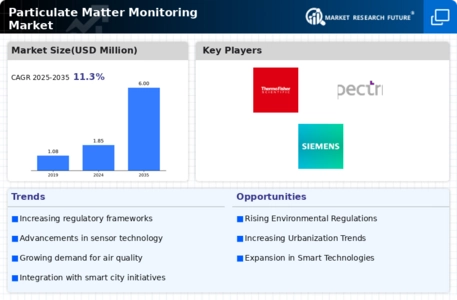
Particulate Matter Monitoring Market Infographic
Purchase Options

Market Analysis

In-depth Analysis of Particulate Matter Monitoring Market Industry Landscape

The Particulate Matter Monitoring Market is influenced by dynamic factors that shape its overall landscape. One of the key dynamics is the increasing awareness and concern regarding air quality worldwide. As urbanization and industrial activities continue to rise, the levels of particulate matter in the air have become a major environmental and health issue. This heightened awareness has led to the implementation of stringent regulations by governments and environmental agencies, driving the demand for effective particulate matter monitoring solutions. The dynamic nature of these regulations and the evolving standards contribute to the constant adaptation required by companies operating in this market.

Technological advancements represent a significant dynamic force in the Particulate Matter Monitoring Market. The continuous development of monitoring technologies, including sensors, data analytics, and connectivity solutions, plays a crucial role in shaping the market dynamics. Companies strive to stay at the forefront of innovation to offer more accurate, reliable, and efficient monitoring solutions. The integration of cutting-edge technologies not only enhances the performance of monitoring devices but also opens up opportunities for new applications and functionalities, contributing to the dynamic evolution of the market.

Government policies and regulatory frameworks are key drivers of market dynamics in the Particulate Matter Monitoring Market. Governments worldwide are increasingly recognizing the importance of monitoring and controlling air pollution. The dynamic nature of these policies, often influenced by environmental concerns and public health issues, creates a challenging yet opportunity-rich environment for market players. Companies must stay abreast of changing regulations, ensuring that their monitoring solutions align with the latest standards to meet the compliance needs of various industries.

Market competition is a pervasive dynamic in the Particulate Matter Monitoring Market. With the growing demand for monitoring solutions, numerous players enter the market, leading to intense competition. The dynamic nature of this competition drives continuous innovation as companies strive to differentiate themselves. This includes developing cost-effective solutions, expanding product portfolios, and enhancing overall value propositions. The competitive landscape influences pricing strategies, customer engagement, and the pace of technological advancements, making it imperative for companies to stay agile and responsive to market dynamics.

The global economic landscape is another dynamic factor impacting the Particulate Matter Monitoring Market. Economic growth and industrial activities directly influence air quality, affecting the demand for monitoring solutions. The dynamic nature of economic conditions, including recessions, expansions, and regional disparities, poses challenges and opportunities for market players. Adapting to economic changes, identifying emerging markets, and aligning strategies with economic trends are crucial aspects of navigating the dynamic economic landscape within the particulate matter monitoring industry.

Societal awareness and expectations contribute significantly to the market dynamics of Particulate Matter Monitoring. The dynamic shift in public consciousness towards environmental issues and sustainable practices has influenced businesses and industries to prioritize clean air initiatives. This societal pressure prompts companies to invest in advanced monitoring technologies and sustainable practices, aligning their strategies with the expectations of environmentally conscious consumers. The dynamic interplay between societal values and market dynamics creates a push for continuous improvement and responsible business practices within the particulate matter monitoring sector.


Author
Author Profile
Ankit Gupta
Team Lead - Research

Ankit Gupta is a seasoned market intelligence and strategic research professional with over six plus years of experience in the ICT and Semiconductor industries. With academic roots in Telecom, Marketing, and Electronics, he blends technical insight with business strategy. Ankit has led 200+ projects, including work for Fortune 500 clients like Microsoft and Rio Tinto, covering market sizing, tech forecasting, and go-to-market strategies. Known for bridging engineering and enterprise decision-making, his insights support growth, innovation, and investment planning across diverse technology markets.

Leave a Comment

FAQs

What is the current valuation of the Particulate Matter Monitoring Market?

<p>The market valuation reached 1.848 USD Billion in 2024.</p>

What is the projected market size for the Particulate Matter Monitoring Market by 2035?

<p>The market is expected to grow to 6.0 USD Billion by 2035.</p>

What is the expected CAGR for the Particulate Matter Monitoring Market during the forecast period 2025 - 2035?

<p>The market is projected to experience a CAGR of 11.3% from 2025 to 2035.</p>

Which companies are considered key players in the Particulate Matter Monitoring Market?

<p>Key players include Thermo Fisher Scientific, Horiba, Teledyne Technologies, and Aeroqual, among others.</p>

What are the primary segments of the Particulate Matter Monitoring Market?

<p>The market segments include Particle Size, Type, Technology, and Application.</p>

How does the market for PM2.5 monitoring compare to PM10 monitoring in terms of valuation?

<p>PM2.5 monitoring is valued at 1.8 USD Billion, while PM10 monitoring is valued at 2.4 USD Billion.</p>

What is the valuation of the Indoor Monitoring segment in the Particulate Matter Monitoring Market?

The Indoor Monitoring segment was valued at 2.1 USD Billion in 2024.

What technology segments are included in the Particulate Matter Monitoring Market?

Technology segments include Light Scattering, Beta-Attenuation, Gravimetric, and Opacity.

Which application segment is projected to have the highest growth in the Particulate Matter Monitoring Market?

The Ambient Air Monitoring application segment is expected to grow to 2.0 USD Billion by 2035.

What is the projected valuation for the Outdoor Monitoring segment by 2035?

The Outdoor Monitoring segment is anticipated to reach 3.9 USD Billion by 2035.

Market Summary

As per Market Research Future analysis, the Particulate Matter Monitoring Market Size was estimated at 1.848 USD Billion in 2024. The particulate matter monitoring industry is projected to grow from 2.056 USD Billion in 2025 to 6.0 USD Billion by 2035, exhibiting a compound annual growth rate (CAGR) of 11.3% during the forecast period 2025 - 2035

Key Market Trends & Highlights

The Particulate Matter Monitoring Market is experiencing robust growth driven by regulatory frameworks and technological advancements.

  • North America remains the largest market for particulate matter monitoring, driven by stringent regulatory measures. Asia-Pacific is emerging as the fastest-growing region, fueled by increasing urbanization and environmental awareness. The PM2.5 segment dominates the market, while the PM1 segment is witnessing rapid growth due to heightened health concerns. Key market drivers include health concerns related to air quality and industrial emissions regulations, which are shaping demand across both indoor and outdoor monitoring segments.

Market Size & Forecast

2024 Market Size 1.848 (USD Billion)
2035 Market Size 6.0 (USD Billion)
CAGR (2025 - 2035) 11.3%
Largest Regional Market Share in 2024 Asia Pacific

Major Players

Thermo Fisher Scientific (US), Horiba (JP), Teledyne Technologies (US), Aeroqual (NZ), Met One Instruments (US), TSI Incorporated (US), Grimm Aerosol Technik (DE), Palas GmbH (DE), Acoem (FR)

Market Trends

The Particulate Matter Monitoring Market is currently experiencing a notable evolution, driven by increasing awareness of air quality issues and the health implications associated with particulate matter exposure. Regulatory bodies across various regions are implementing stricter air quality standards, which in turn compels industries to adopt advanced monitoring technologies. This shift is not merely a response to regulatory pressures; it also reflects a growing societal demand for transparency regarding environmental conditions. As a result, the market is witnessing a surge in innovative solutions that enhance the accuracy and efficiency of particulate matter detection. Moreover, technological advancements are playing a pivotal role in shaping the landscape of the Particulate Matter Monitoring Market. The integration of IoT and artificial intelligence into monitoring systems appears to enhance data collection and analysis capabilities. This trend suggests a movement towards more automated and real-time monitoring solutions, which could potentially lead to improved decision-making processes for both public health officials and industries. As stakeholders increasingly recognize the importance of maintaining air quality, the market is likely to expand further, fostering a competitive environment that encourages continuous innovation and development of more sophisticated monitoring tools.

Regulatory Influence

The influence of regulatory frameworks on the Particulate Matter Monitoring Market is becoming increasingly pronounced. Governments are establishing more stringent air quality regulations, which necessitate the adoption of advanced monitoring technologies. This trend indicates a proactive approach to managing air pollution and protecting public health.

Technological Advancements

Technological advancements are significantly shaping the Particulate Matter Monitoring Market. The integration of IoT and AI into monitoring systems enhances data accuracy and real-time analysis. This evolution suggests a shift towards more automated solutions, potentially improving the efficiency of air quality management.

Public Awareness and Demand

Growing public awareness regarding air quality issues is driving demand within the Particulate Matter Monitoring Market. As communities become more informed about the health risks associated with particulate matter, there is an increasing expectation for transparency and accountability from both industries and governments.

Particulate Matter Monitoring Market Market Drivers

Technological Innovations

Technological advancements are reshaping the landscape of the Particulate Matter Monitoring Market. Innovations in sensor technology, data analytics, and IoT integration are enhancing the accuracy and efficiency of monitoring systems. These advancements allow for real-time data collection and analysis, enabling stakeholders to make informed decisions regarding air quality management. The introduction of portable and cost-effective monitoring devices is also expanding the market reach, making it accessible to smaller organizations and municipalities. As technology continues to evolve, the market is likely to experience a surge in demand for sophisticated monitoring solutions that can provide comprehensive insights into particulate matter levels. By 2025, the integration of advanced technologies is expected to play a crucial role in driving market growth.

Health Concerns and Air Quality

The increasing awareness of health issues related to air quality is a primary driver for the Particulate Matter Monitoring Market. Studies indicate that exposure to particulate matter can lead to respiratory diseases, cardiovascular problems, and other health complications. As urbanization continues to rise, the demand for effective monitoring solutions becomes more pronounced. Governments and health organizations are advocating for stringent air quality standards, which further propels the need for advanced monitoring technologies. The market is projected to grow as more entities recognize the importance of maintaining air quality to safeguard public health. In 2025, the market is expected to witness a surge in demand for monitoring devices that can accurately measure particulate matter levels, thereby enhancing public health initiatives.

Industrial Emissions Regulations

Regulatory frameworks aimed at controlling industrial emissions are significantly influencing the Particulate Matter Monitoring Market. Various countries have implemented stringent regulations to limit emissions from factories and power plants, necessitating the use of monitoring systems to ensure compliance. The enforcement of these regulations has led to an increased demand for particulate matter monitoring solutions across various sectors, including manufacturing, energy, and transportation. As industries strive to meet these regulatory requirements, investments in monitoring technologies are likely to rise. The market is expected to expand as companies seek to avoid penalties and enhance their sustainability practices. By 2025, the emphasis on compliance with environmental regulations is anticipated to drive substantial growth in the monitoring market.

Environmental Awareness and Advocacy

The rising tide of environmental awareness and advocacy is a significant driver for the Particulate Matter Monitoring Market. As communities become more engaged in environmental issues, there is a growing demand for transparency regarding air quality. Non-governmental organizations and advocacy groups are pushing for better monitoring practices and more stringent air quality standards. This heightened awareness is prompting governments and businesses to invest in monitoring technologies to address public concerns. The market is likely to benefit from increased funding for environmental initiatives and research aimed at understanding the impacts of particulate matter. By 2025, the influence of advocacy efforts is expected to catalyze further growth in the monitoring market.

Urbanization and Infrastructure Development

The rapid pace of urbanization and infrastructure development is driving the demand for the Particulate Matter Monitoring Market. As cities expand, the concentration of vehicles and industrial activities increases, leading to higher levels of particulate matter in the air. This urban growth necessitates the implementation of effective monitoring systems to assess air quality and mitigate pollution. Governments and urban planners are recognizing the importance of integrating monitoring solutions into urban development projects to ensure sustainable growth. The market is projected to grow as cities invest in smart technologies that include air quality monitoring as a key component. By 2025, the impact of urbanization on air quality is expected to significantly influence the demand for monitoring solutions.

Market Segment Insights

By Particle Size: PM2.5 (Largest) vs. PM1 (Fastest-Growing)

The particulate matter monitoring market showcases a varied distribution across different particle sizes, with PM2.5 holding the largest market share. This segment is crucial as PM2.5 particles are significantly harmful, leading to increased demand among regulatory bodies and industries for effective monitoring solutions. Consequently, PM10 and PM5 follow, both contributing to the market yet not matching the prominence of PM2.5. PM1, while currently smaller in market share, is gaining traction due to rising awareness regarding the health impacts of fine particulate matter.

PM2.5 (Dominant) vs. PM1 (Emerging)

PM2.5 stands as the dominant particle size in the particulate matter monitoring market, primarily because of its association with severe health issues like respiratory disorders and cardiovascular diseases. Its extensive regulation and monitoring have led to heightened adoption across various industries. Conversely, PM1 is emerging rapidly, driven by heightened health concerns and technological advancements in monitoring capabilities. As awareness grows regarding the adverse effects of ultrafine particles, PM1 monitoring is seeing increased research and investment, thereby carving out its position in the market.

By Type: Indoor Monitoring (Largest) vs. Outdoor Monitoring (Fastest-Growing)

The particulate matter monitoring market is witnessing a steady distribution between indoor and outdoor monitoring systems. Currently, indoor monitoring holds the largest share, driven by growing concerns over indoor air quality and health implications associated with particulate matter exposure. Residential and commercial spaces increasingly invest in advanced monitoring solutions to ensure compliance with health standards and improve air quality for inhabitants. This surge in demand solidifies indoor monitoring's leading position within the market.

Monitoring Type: Indoor (Dominant) vs. Outdoor (Emerging)

Indoor monitoring systems are becoming increasingly prevalent as they cater to the essential need for maintaining indoor air quality. These systems are extensively utilized in residential, educational, and commercial settings where particulate matter can severely impact health. Conversely, outdoor monitoring systems are emerging rapidly due to more stringent government regulations and heightened public awareness regarding air quality issues in urban areas. Both segments are essential; however, outdoor monitoring's growth is particularly accelerated by ongoing environmental initiatives and technological advancements in sensor precision, ultimately enhancing the ability to monitor and address air quality issues effectively.

By Technology: Light Scattering (Largest) vs. Beta-Attenuation (Fastest-Growing)

In the Particulate Matter Monitoring Market, Light Scattering technology holds the largest share due to its widespread adoption in various applications, including <a title="air quality monitoring" href="https://www.marketresearchfuture.com/reports/air-quality-monitoring-market-8859" target="_blank" rel="noopener">air quality monitoring</a> and industrial emissions control. It effectively measures particulates by analyzing light scattered by particles, making it a preferred choice among end users. Meanwhile, Beta-Attenuation technology is gaining traction and is recognized as the fastest-growing segment. This growth can be attributed to its accuracy in measuring mass concentrations of particulate matter, appealing to both regulatory and industrial segments.

Technology: Light Scattering (Dominant) vs. Beta-Attenuation (Emerging)

Light Scattering technology is the dominant segment in the Particulate Matter Monitoring Market, favored for its real-time data analysis and versatility in various environmental applications. It operates on the principle of measuring light dispersion caused by particles, thus providing reliable insight into air quality and pollutant levels. In contrast, Beta-Attenuation is an emerging technology known for its precision in quantifying particulate mass, gaining popularity in regulatory compliance and research contexts. Its ability to offer consistent measurements under various conditions positions it as a key player in evolving monitoring requirements, making it particularly attractive to industries increasingly focused on environmental concerns.

By Application: Ambient Air Monitoring (Largest) vs. Indoor Air Monitoring (Fastest-Growing)

In the particulate matter monitoring market, the application segment is primarily dominated by Ambient Air Monitoring, capturing the largest market share due to its necessity in both regulatory compliance and public health initiatives. This segment addresses critical needs for monitoring air quality in urban environments and industrial areas, which has led to its widespread adoption by governments and environmental organizations. Meanwhile, Indoor Air Monitoring is emerging as a vital segment, rapidly gaining traction as awareness of indoor air quality issues becomes more prevalent across residential, commercial, and healthcare settings.

Process Industries (Dominant) vs. Healthcare (Emerging)

Within the particulate matter monitoring market, Process Industries are regarded as a dominant application due to their stringent regulations requiring continuous air quality monitoring to ensure worker safety and compliance with environmental standards. Industries such as manufacturing, oil and gas, and mining significantly depend on these monitoring systems. Conversely, the Healthcare application is an emerging segment that is gaining momentum as hospitals and clinics recognize the critical impact of air quality on patient health and infection control. The drive towards cleaner and safer indoor air environments in healthcare settings is spurred by regulatory pressures and a growing focus on patient-centered care, contributing to its rapid growth.

Get more detailed insights about Particulate Matter Monitoring Market Research Report—Global Forecast till 2035

Regional Insights

North America : Regulatory Leader in Monitoring

North America is the largest market for particulate matter monitoring, holding approximately 40% of the global share. The region's growth is driven by stringent environmental regulations and increasing public awareness of air quality issues. The U.S. Environmental Protection Agency (EPA) has implemented various standards that mandate monitoring, thus fueling demand for advanced monitoring technologies. The competitive landscape is dominated by key players such as Thermo Fisher Scientific, Teledyne Technologies, and Met One Instruments. The U.S. leads in technological advancements, while Canada is also emerging with significant investments in environmental monitoring. The presence of established companies ensures a robust supply chain and innovation in monitoring solutions.

Europe : Innovative Solutions and Regulations

Europe is the second-largest market for particulate matter monitoring, accounting for approximately 30% of the global market share. The region's growth is propelled by the European Union's stringent air quality directives and national regulations aimed at reducing pollution levels. Countries like Germany and France are at the forefront, implementing advanced monitoring systems to comply with EU standards. Leading countries in this region include Germany, France, and the UK, with a competitive landscape featuring companies like Grimm Aerosol Technik and Palas GmbH. The European market is characterized by innovation, with a focus on integrating IoT technologies into monitoring systems. This trend is supported by government initiatives promoting smart city projects and environmental sustainability.

Asia-Pacific : Emerging Markets and Growth

Asia-Pacific is witnessing rapid growth in the particulate matter monitoring market, holding about 20% of the global share. The region's expansion is driven by increasing industrialization, urbanization, and rising awareness of air quality issues. Countries like China and India are implementing stricter regulations to combat pollution, which is significantly boosting demand for monitoring solutions. China is the largest market in the region, followed by India and Japan. The competitive landscape includes key players like Horiba and Aeroqual, who are focusing on developing cost-effective monitoring solutions. The presence of government initiatives aimed at improving air quality further enhances market opportunities, making Asia-Pacific a vital region for future growth.

Middle East and Africa : Growing Awareness and Investment

The Middle East and Africa region is gradually emerging in the particulate matter monitoring market, holding around 10% of the global share. The growth is primarily driven by increasing awareness of air quality issues and investments in environmental monitoring technologies. Countries like South Africa and the UAE are taking steps to enhance air quality monitoring, supported by government initiatives and international collaborations. South Africa leads the market in this region, with a growing number of monitoring stations and regulatory frameworks. The competitive landscape is still developing, with opportunities for both local and international players. The presence of key companies is expected to grow as governments prioritize environmental health and sustainability initiatives.

Key Players and Competitive Insights

Leading market players are investing heavily in research and development to expand their product lines, which will help the Particulate Matter Monitoring Market, grow even more. Market participants are also undertaking a variety of strategic activities to expand their global footprint, with important market developments including new product launches, contractual agreements, mergers and acquisitions, higher investments, and collaboration with other organizations. To expand and survive in a more competitive and rising market climate, the Particulate Matter Monitoring industry must offer cost-effective items.
Manufacturing locally to minimize operational costs is one of the key business tactics used by manufacturers in the global Particulate Matter monitoring industry to benefit clients and increase the market sector. In recent years, the Particulate Matter Monitoring industry has offered some of the most significant advantages to environmental protection and public health. Major players in the Particulate Matter Monitoring Market, including Thermo Fisher Scientific, Inc. (US), AMETEK (US), Spectris plc (UK), ACOEM Group (France), and Siemens (Germany), are attempting to increase market demand by investing in research and development operations.
AMETEK is a prominent manufacturer specializing in electronic products, including a diverse range of electronic instruments and electromechanical devices. The company's extensive product portfolio encompasses medical materials, motion control systems, sub-assemblies, connectors, electrical cord reels, gauges, titanium alloys, and various other offerings.
In October AMETEK introduced two cutting-edge continuous emission monitoring systems (PM-CEMS), namely the 4650-PM and 4750-PM. These systems were designed to deliver highly precise and dependable measurements of particulate matter generated during industrial combustion processes in exhaust stacks and ducts.
Notably, the 4650-PM and 4750-PM systems were engineered for easy installation and aimed to provide extended trouble-free operation with reduced routine maintenance requirements.
Siemens is a prominent technology company operating at the forefront of the electrification, automation, and digitalization sectors. The company specializes in designing, developing, manufacturing, and implementing a wide array of products and complex systems. Siemens is known for tailoring its offerings to meet the unique needs of its diverse clientele. Siemens places its strategic focus on power generation, distribution, and advanced infrastructure solutions for both buildings and distributed energy systems.
In March Siemens introduced the Connect Box, a smart IoT solution tailored for managing smaller buildings.
This user-friendly solution is designed to monitor building performance, optimize energy efficiency, and enhance indoor air quality in small to medium-sized structures, such as schools, retail establishments, apartments, or small offices.

Key Companies in the Particulate Matter Monitoring Market include

Industry Developments

December 2021: AMETEK completed its acquisition of Alphasense, a prominent provider of gas and particulate sensors used in applications related to environmental monitoring, health and safety, and air quality assessment. This strategic acquisition served to enhance AMETEK's sensor portfolio and bolster its footprint in the lucrative environmental health and safety sector.

August 2020: Siemens Healthineers successfully acquired Varian Medical Systems, an American company specializing in radiation oncology treatment and software development. This acquisition was a strategic move by Siemens Healthineers to reinforce its position within the embolization particles market.

Future Outlook

Particulate Matter Monitoring Market Future Outlook

The Particulate Matter Monitoring Market is projected to grow at 11.3% CAGR from 2025 to 2035, driven by regulatory pressures, technological advancements, and increasing public awareness.

New opportunities lie in:

  • <p>Development of portable PM monitoring devices for urban environments. Integration of AI analytics for real-time data interpretation. Expansion into emerging markets with tailored monitoring solutions.</p>

By 2035, the market is expected to be robust, driven by innovation and increased demand for air quality management.

Market Segmentation

Particulate Matter Monitoring Market Type Outlook

  • Indoor Monitoring
  • Outdoor Monitoring

Particulate Matter Monitoring Market Technology Outlook

  • Light Scattering
  • Beta-Attenuation
  • Gravimetric
  • Opacity
  • Others

Particulate Matter Monitoring Market Application Outlook

  • Process Industries
  • Ambient Air Monitoring
  • Indoor Air Monitoring
  • Healthcare
  • Others

Particulate Matter Monitoring Market Particle Size Outlook

  • PM1
  • PM2.5
  • PM5
  • PM10

Report Scope

MARKET SIZE 2024 1.848(USD Billion)
MARKET SIZE 2025 2.056(USD Billion)
MARKET SIZE 2035 6.0(USD Billion)
COMPOUND ANNUAL GROWTH RATE (CAGR) 11.3% (2025 - 2035)
REPORT COVERAGE Revenue Forecast, Competitive Landscape, Growth Factors, and Trends
BASE YEAR 2024
Market Forecast Period 2025 - 2035
Historical Data 2019 - 2024
Market Forecast Units USD Billion
Key Companies Profiled Thermo Fisher Scientific (US), Horiba (JP), Teledyne Technologies (US), Aeroqual (NZ), Met One Instruments (US), TSI Incorporated (US), Grimm Aerosol Technik (DE), Palas GmbH (DE), Acoem (FR)
Segments Covered Particle Size, Type, Technology, Application, Region
Key Market Opportunities Integration of advanced sensor technologies enhances real-time monitoring capabilities in the Particulate Matter Monitoring Market.
Key Market Dynamics Rising regulatory pressures drive demand for advanced particulate matter monitoring technologies across various industries.
Countries Covered North America, Europe, APAC, South America, MEA

FAQs

What is the current valuation of the Particulate Matter Monitoring Market?

<p>The market valuation reached 1.848 USD Billion in 2024.</p>

What is the projected market size for the Particulate Matter Monitoring Market by 2035?

<p>The market is expected to grow to 6.0 USD Billion by 2035.</p>

What is the expected CAGR for the Particulate Matter Monitoring Market during the forecast period 2025 - 2035?

<p>The market is projected to experience a CAGR of 11.3% from 2025 to 2035.</p>

Which companies are considered key players in the Particulate Matter Monitoring Market?

<p>Key players include Thermo Fisher Scientific, Horiba, Teledyne Technologies, and Aeroqual, among others.</p>

What are the primary segments of the Particulate Matter Monitoring Market?

<p>The market segments include Particle Size, Type, Technology, and Application.</p>

How does the market for PM2.5 monitoring compare to PM10 monitoring in terms of valuation?

<p>PM2.5 monitoring is valued at 1.8 USD Billion, while PM10 monitoring is valued at 2.4 USD Billion.</p>

What is the valuation of the Indoor Monitoring segment in the Particulate Matter Monitoring Market?

The Indoor Monitoring segment was valued at 2.1 USD Billion in 2024.

What technology segments are included in the Particulate Matter Monitoring Market?

Technology segments include Light Scattering, Beta-Attenuation, Gravimetric, and Opacity.

Which application segment is projected to have the highest growth in the Particulate Matter Monitoring Market?

The Ambient Air Monitoring application segment is expected to grow to 2.0 USD Billion by 2035.

What is the projected valuation for the Outdoor Monitoring segment by 2035?

The Outdoor Monitoring segment is anticipated to reach 3.9 USD Billion by 2035.

  1. SECTION I: EXECUTIVE SUMMARY AND KEY HIGHLIGHTS |
    1. EXECUTIVE SUMMARY | |
      1. Market Overview | |
      2. Key Findings | |
      3. Market Segmentation | |
      4. Competitive Landscape | |
      5. Challenges and Opportunities | |
      6. Future Outlook 2
  2. SECTION II: SCOPING, METHODOLOGY AND MARKET STRUCTURE |
    1. MARKET INTRODUCTION | |
      1. Definition | |
      2. Scope of the study | | |
    2. RESEARCH METHODOLOGY | |
      1. Overview | |
      2. Data Mining | |
      3. Secondary Research | |
      4. Primary Research | | |
      5. Forecasting Model | |
      6. Market Size Estimation | | |
      7. Data Triangulation | |
      8. Validation 3
  3. SECTION III: QUALITATIVE ANALYSIS |
    1. MARKET DYNAMICS | |
      1. Overview | |
      2. Drivers | |
      3. Restraints | |
      4. Opportunities |
    2. MARKET FACTOR ANALYSIS | |
      1. Value chain Analysis | |
      2. Porter's Five Forces Analysis | | |
      3. COVID-19 Impact Analysis | | |
  4. SECTION IV: QUANTITATIVE ANALYSIS |
    1. Semiconductor & Electronics, BY Particle Size (USD Billion) | |
      1. PM1 | |
      2. PM2.5 | |
      3. PM5 | |
      4. PM10 |
    2. Semiconductor & Electronics, BY Type (USD Billion) | |
      1. Indoor Monitoring | |
      2. Outdoor Monitoring |
    3. Semiconductor & Electronics, BY Technology (USD Billion) | |
      1. Light Scattering | |
      2. Beta-Attenuation | |
      3. Gravimetric | |
      4. Opacity | |
      5. Others |
    4. Semiconductor & Electronics, BY Application (USD Billion) | |
      1. Process Industries | |
      2. Ambient Air Monitoring | |
      3. Indoor Air Monitoring | |
      4. Healthcare | |
      5. Others |
    5. Semiconductor & Electronics, BY Region (USD Billion) | |
      1. North America | | |
      2. Europe | | |
      3. APAC | | |
      4. South America | | |
      5. MEA | | |
  5. SECTION V: COMPETITIVE ANALYSIS |
    1. Competitive Landscape | |
      1. Overview | |
      2. Competitive Analysis | |
      3. Market share Analysis | |
      4. Major Growth Strategy in the Semiconductor & Electronics | |
      5. Competitive Benchmarking | |
      6. Leading Players in Terms of Number of Developments in the Semiconductor & Electronics | |
      7. Key developments and growth strategies | | |
      8. Major Players Financial Matrix | | |
    2. Company Profiles | |
      1. Thermo Fisher Scientific (US) | | |
      2. Horiba (JP) | | |
      3. Teledyne Technologies (US) | | |
      4. Aeroqual (NZ) | | |
      5. Met One Instruments (US) | | |
      6. TSI Incorporated (US) | | |
      7. Grimm Aerosol Technik (DE) | | |
      8. Palas GmbH (DE) | | |
      9. Acoem (FR) | | |
    3. Appendix | |
      1. References | |
      2. Related Reports 6 LIST OF FIGURES |
    4. MARKET SYNOPSIS |
    5. NORTH AMERICA MARKET ANALYSIS |
    6. US MARKET ANALYSIS BY PARTICLE SIZE |
    7. US MARKET ANALYSIS BY TYPE |
    8. US MARKET ANALYSIS BY TECHNOLOGY |
    9. US MARKET ANALYSIS BY APPLICATION |
    10. CANADA MARKET ANALYSIS BY PARTICLE SIZE |
    11. CANADA MARKET ANALYSIS BY TYPE |
    12. CANADA MARKET ANALYSIS BY TECHNOLOGY |
    13. CANADA MARKET ANALYSIS BY APPLICATION |
    14. EUROPE MARKET ANALYSIS |
    15. GERMANY MARKET ANALYSIS BY PARTICLE SIZE |
    16. GERMANY MARKET ANALYSIS BY TYPE |
    17. GERMANY MARKET ANALYSIS BY TECHNOLOGY |
    18. GERMANY MARKET ANALYSIS BY APPLICATION |
    19. UK MARKET ANALYSIS BY PARTICLE SIZE |
    20. UK MARKET ANALYSIS BY TYPE |
    21. UK MARKET ANALYSIS BY TECHNOLOGY |
    22. UK MARKET ANALYSIS BY APPLICATION |
    23. FRANCE MARKET ANALYSIS BY PARTICLE SIZE |
    24. FRANCE MARKET ANALYSIS BY TYPE |
    25. FRANCE MARKET ANALYSIS BY TECHNOLOGY |
    26. FRANCE MARKET ANALYSIS BY APPLICATION |
    27. RUSSIA MARKET ANALYSIS BY PARTICLE SIZE |
    28. RUSSIA MARKET ANALYSIS BY TYPE |
    29. RUSSIA MARKET ANALYSIS BY TECHNOLOGY |
    30. RUSSIA MARKET ANALYSIS BY APPLICATION |
    31. ITALY MARKET ANALYSIS BY PARTICLE SIZE |
    32. ITALY MARKET ANALYSIS BY TYPE |
    33. ITALY MARKET ANALYSIS BY TECHNOLOGY |
    34. ITALY MARKET ANALYSIS BY APPLICATION |
    35. SPAIN MARKET ANALYSIS BY PARTICLE SIZE |
    36. SPAIN MARKET ANALYSIS BY TYPE |
    37. SPAIN MARKET ANALYSIS BY TECHNOLOGY |
    38. SPAIN MARKET ANALYSIS BY APPLICATION |
    39. REST OF EUROPE MARKET ANALYSIS BY PARTICLE SIZE |
    40. REST OF EUROPE MARKET ANALYSIS BY TYPE |
    41. REST OF EUROPE MARKET ANALYSIS BY TECHNOLOGY |
    42. REST OF EUROPE MARKET ANALYSIS BY APPLICATION |
    43. APAC MARKET ANALYSIS |
    44. CHINA MARKET ANALYSIS BY PARTICLE SIZE |
    45. CHINA MARKET ANALYSIS BY TYPE |
    46. CHINA MARKET ANALYSIS BY TECHNOLOGY |
    47. CHINA MARKET ANALYSIS BY APPLICATION |
    48. INDIA MARKET ANALYSIS BY PARTICLE SIZE |
    49. INDIA MARKET ANALYSIS BY TYPE |
    50. INDIA MARKET ANALYSIS BY TECHNOLOGY |
    51. INDIA MARKET ANALYSIS BY APPLICATION |
    52. JAPAN MARKET ANALYSIS BY PARTICLE SIZE |
    53. JAPAN MARKET ANALYSIS BY TYPE |
    54. JAPAN MARKET ANALYSIS BY TECHNOLOGY |
    55. JAPAN MARKET ANALYSIS BY APPLICATION |
    56. SOUTH KOREA MARKET ANALYSIS BY PARTICLE SIZE |
    57. SOUTH KOREA MARKET ANALYSIS BY TYPE |
    58. SOUTH KOREA MARKET ANALYSIS BY TECHNOLOGY |
    59. SOUTH KOREA MARKET ANALYSIS BY APPLICATION |
    60. MALAYSIA MARKET ANALYSIS BY PARTICLE SIZE |
    61. MALAYSIA MARKET ANALYSIS BY TYPE |
    62. MALAYSIA MARKET ANALYSIS BY TECHNOLOGY |
    63. MALAYSIA MARKET ANALYSIS BY APPLICATION |
    64. THAILAND MARKET ANALYSIS BY PARTICLE SIZE |
    65. THAILAND MARKET ANALYSIS BY TYPE |
    66. THAILAND MARKET ANALYSIS BY TECHNOLOGY |
    67. THAILAND MARKET ANALYSIS BY APPLICATION |
    68. INDONESIA MARKET ANALYSIS BY PARTICLE SIZE |
    69. INDONESIA MARKET ANALYSIS BY TYPE |
    70. INDONESIA MARKET ANALYSIS BY TECHNOLOGY |
    71. INDONESIA MARKET ANALYSIS BY APPLICATION |
    72. REST OF APAC MARKET ANALYSIS BY PARTICLE SIZE |
    73. REST OF APAC MARKET ANALYSIS BY TYPE |
    74. REST OF APAC MARKET ANALYSIS BY TECHNOLOGY |
    75. REST OF APAC MARKET ANALYSIS BY APPLICATION |
    76. SOUTH AMERICA MARKET ANALYSIS |
    77. BRAZIL MARKET ANALYSIS BY PARTICLE SIZE |
    78. BRAZIL MARKET ANALYSIS BY TYPE |
    79. BRAZIL MARKET ANALYSIS BY TECHNOLOGY |
    80. BRAZIL MARKET ANALYSIS BY APPLICATION |
    81. MEXICO MARKET ANALYSIS BY PARTICLE SIZE |
    82. MEXICO MARKET ANALYSIS BY TYPE |
    83. MEXICO MARKET ANALYSIS BY TECHNOLOGY |
    84. MEXICO MARKET ANALYSIS BY APPLICATION |
    85. ARGENTINA MARKET ANALYSIS BY PARTICLE SIZE |
    86. ARGENTINA MARKET ANALYSIS BY TYPE |
    87. ARGENTINA MARKET ANALYSIS BY TECHNOLOGY |
    88. ARGENTINA MARKET ANALYSIS BY APPLICATION |
    89. REST OF SOUTH AMERICA MARKET ANALYSIS BY PARTICLE SIZE |
    90. REST OF SOUTH AMERICA MARKET ANALYSIS BY TYPE |
    91. REST OF SOUTH AMERICA MARKET ANALYSIS BY TECHNOLOGY |
    92. REST OF SOUTH AMERICA MARKET ANALYSIS BY APPLICATION |
    93. MEA MARKET ANALYSIS |
    94. GCC COUNTRIES MARKET ANALYSIS BY PARTICLE SIZE |
    95. GCC COUNTRIES MARKET ANALYSIS BY TYPE |
    96. GCC COUNTRIES MARKET ANALYSIS BY TECHNOLOGY |
    97. GCC COUNTRIES MARKET ANALYSIS BY APPLICATION |
    98. SOUTH AFRICA MARKET ANALYSIS BY PARTICLE SIZE |
    99. SOUTH AFRICA MARKET ANALYSIS BY TYPE |
    100. SOUTH AFRICA MARKET ANALYSIS BY TECHNOLOGY |
    101. SOUTH AFRICA MARKET ANALYSIS BY APPLICATION |
    102. REST OF MEA MARKET ANALYSIS BY PARTICLE SIZE |
    103. REST OF MEA MARKET ANALYSIS BY TYPE |
    104. REST OF MEA MARKET ANALYSIS BY TECHNOLOGY |
    105. REST OF MEA MARKET ANALYSIS BY APPLICATION |
    106. KEY BUYING CRITERIA OF SEMICONDUCTOR & ELECTRONICS |
    107. RESEARCH PROCESS OF MRFR |
    108. DRO ANALYSIS OF SEMICONDUCTOR & ELECTRONICS |
    109. DRIVERS IMPACT ANALYSIS: SEMICONDUCTOR & ELECTRONICS |
    110. RESTRAINTS IMPACT ANALYSIS: SEMICONDUCTOR & ELECTRONICS |
    111. SUPPLY / VALUE CHAIN: SEMICONDUCTOR & ELECTRONICS |
    112. SEMICONDUCTOR & ELECTRONICS, BY PARTICLE SIZE, 2024 (% SHARE) |
    113. SEMICONDUCTOR & ELECTRONICS, BY PARTICLE SIZE, 2024 TO 2035 (USD Billion) |
    114. SEMICONDUCTOR & ELECTRONICS, BY TYPE, 2024 (% SHARE) |
    115. SEMICONDUCTOR & ELECTRONICS, BY TYPE, 2024 TO 2035 (USD Billion) |
    116. SEMICONDUCTOR & ELECTRONICS, BY TECHNOLOGY, 2024 (% SHARE) |
    117. SEMICONDUCTOR & ELECTRONICS, BY TECHNOLOGY, 2024 TO 2035 (USD Billion) |
    118. SEMICONDUCTOR & ELECTRONICS, BY APPLICATION, 2024 (% SHARE) |
    119. SEMICONDUCTOR & ELECTRONICS, BY APPLICATION, 2024 TO 2035 (USD Billion) |
    120. BENCHMARKING OF MAJOR COMPETITORS 7 LIST OF TABLES |
    121. LIST OF ASSUMPTIONS | |
      1. |
    122. North America MARKET SIZE ESTIMATES; FORECAST | |
      1. BY PARTICLE SIZE, 2025-2035 (USD Billion) | |
      2. BY TYPE, 2025-2035 (USD Billion) | |
      3. BY TECHNOLOGY, 2025-2035 (USD Billion) | |
      4. BY APPLICATION, 2025-2035 (USD Billion) |
    123. US MARKET SIZE ESTIMATES; FORECAST | |
      1. BY PARTICLE SIZE, 2025-2035 (USD Billion) | |
      2. BY TYPE, 2025-2035 (USD Billion) | |
      3. BY TECHNOLOGY, 2025-2035 (USD Billion) | |
      4. BY APPLICATION, 2025-2035 (USD Billion) |
    124. Canada MARKET SIZE ESTIMATES; FORECAST | |
      1. BY PARTICLE SIZE, 2025-2035 (USD Billion) | |
      2. BY TYPE, 2025-2035 (USD Billion) | |
      3. BY TECHNOLOGY, 2025-2035 (USD Billion) | |
      4. BY APPLICATION, 2025-2035 (USD Billion) |
    125. Europe MARKET SIZE ESTIMATES; FORECAST | |
      1. BY PARTICLE SIZE, 2025-2035 (USD Billion) | |
      2. BY TYPE, 2025-2035 (USD Billion) | |
      3. BY TECHNOLOGY, 2025-2035 (USD Billion) | |
      4. BY APPLICATION, 2025-2035 (USD Billion) |
    126. Germany MARKET SIZE ESTIMATES; FORECAST | |
      1. BY PARTICLE SIZE, 2025-2035 (USD Billion) | |
      2. BY TYPE, 2025-2035 (USD Billion) | |
      3. BY TECHNOLOGY, 2025-2035 (USD Billion) | |
      4. BY APPLICATION, 2025-2035 (USD Billion) |
    127. UK MARKET SIZE ESTIMATES; FORECAST | |
      1. BY PARTICLE SIZE, 2025-2035 (USD Billion) | |
      2. BY TYPE, 2025-2035 (USD Billion) | |
      3. BY TECHNOLOGY, 2025-2035 (USD Billion) | |
      4. BY APPLICATION, 2025-2035 (USD Billion) |
    128. France MARKET SIZE ESTIMATES; FORECAST | |
      1. BY PARTICLE SIZE, 2025-2035 (USD Billion) | |
      2. BY TYPE, 2025-2035 (USD Billion) | |
      3. BY TECHNOLOGY, 2025-2035 (USD Billion) | |
      4. BY APPLICATION, 2025-2035 (USD Billion) |
    129. Russia MARKET SIZE ESTIMATES; FORECAST | |
      1. BY PARTICLE SIZE, 2025-2035 (USD Billion) | |
      2. BY TYPE, 2025-2035 (USD Billion) | |
      3. BY TECHNOLOGY, 2025-2035 (USD Billion) | |
      4. BY APPLICATION, 2025-2035 (USD Billion) |
    130. Italy MARKET SIZE ESTIMATES; FORECAST | |
      1. BY PARTICLE SIZE, 2025-2035 (USD Billion) | |
      2. BY TYPE, 2025-2035 (USD Billion) | |
      3. BY TECHNOLOGY, 2025-2035 (USD Billion) | |
      4. BY APPLICATION, 2025-2035 (USD Billion) |
    131. Spain MARKET SIZE ESTIMATES; FORECAST | |
      1. BY PARTICLE SIZE, 2025-2035 (USD Billion) | |
      2. BY TYPE, 2025-2035 (USD Billion) | |
      3. BY TECHNOLOGY, 2025-2035 (USD Billion) | |
      4. BY APPLICATION, 2025-2035 (USD Billion) |
    132. Rest of Europe MARKET SIZE ESTIMATES; FORECAST | |
      1. BY PARTICLE SIZE, 2025-2035 (USD Billion) | |
      2. BY TYPE, 2025-2035 (USD Billion) | |
      3. BY TECHNOLOGY, 2025-2035 (USD Billion) | |
      4. BY APPLICATION, 2025-2035 (USD Billion) |
    133. APAC MARKET SIZE ESTIMATES; FORECAST | |
      1. BY PARTICLE SIZE, 2025-2035 (USD Billion) | |
      2. BY TYPE, 2025-2035 (USD Billion) | |
      3. BY TECHNOLOGY, 2025-2035 (USD Billion) | |
      4. BY APPLICATION, 2025-2035 (USD Billion) |
    134. China MARKET SIZE ESTIMATES; FORECAST | |
      1. BY PARTICLE SIZE, 2025-2035 (USD Billion) | |
      2. BY TYPE, 2025-2035 (USD Billion) | |
      3. BY TECHNOLOGY, 2025-2035 (USD Billion) | |
      4. BY APPLICATION, 2025-2035 (USD Billion) |
    135. India MARKET SIZE ESTIMATES; FORECAST | |
      1. BY PARTICLE SIZE, 2025-2035 (USD Billion) | |
      2. BY TYPE, 2025-2035 (USD Billion) | |
      3. BY TECHNOLOGY, 2025-2035 (USD Billion) | |
      4. BY APPLICATION, 2025-2035 (USD Billion) |
    136. Japan MARKET SIZE ESTIMATES; FORECAST | |
      1. BY PARTICLE SIZE, 2025-2035 (USD Billion) | |
      2. BY TYPE, 2025-2035 (USD Billion) | |
      3. BY TECHNOLOGY, 2025-2035 (USD Billion) | |
      4. BY APPLICATION, 2025-2035 (USD Billion) |
    137. South Korea MARKET SIZE ESTIMATES; FORECAST | |
      1. BY PARTICLE SIZE, 2025-2035 (USD Billion) | |
      2. BY TYPE, 2025-2035 (USD Billion) | |
      3. BY TECHNOLOGY, 2025-2035 (USD Billion) | |
      4. BY APPLICATION, 2025-2035 (USD Billion) |
    138. Malaysia MARKET SIZE ESTIMATES; FORECAST | |
      1. BY PARTICLE SIZE, 2025-2035 (USD Billion) | |
      2. BY TYPE, 2025-2035 (USD Billion) | |
      3. BY TECHNOLOGY, 2025-2035 (USD Billion) | |
      4. BY APPLICATION, 2025-2035 (USD Billion) |
    139. Thailand MARKET SIZE ESTIMATES; FORECAST | |
      1. BY PARTICLE SIZE, 2025-2035 (USD Billion) | |
      2. BY TYPE, 2025-2035 (USD Billion) | |
      3. BY TECHNOLOGY, 2025-2035 (USD Billion) | |
      4. BY APPLICATION, 2025-2035 (USD Billion) |
    140. Indonesia MARKET SIZE ESTIMATES; FORECAST | |
      1. BY PARTICLE SIZE, 2025-2035 (USD Billion) | |
      2. BY TYPE, 2025-2035 (USD Billion) | |
      3. BY TECHNOLOGY, 2025-2035 (USD Billion) | |
      4. BY APPLICATION, 2025-2035 (USD Billion) |
    141. Rest of APAC MARKET SIZE ESTIMATES; FORECAST | |
      1. BY PARTICLE SIZE, 2025-2035 (USD Billion) | |
      2. BY TYPE, 2025-2035 (USD Billion) | |
      3. BY TECHNOLOGY, 2025-2035 (USD Billion) | |
      4. BY APPLICATION, 2025-2035 (USD Billion) |
    142. South America MARKET SIZE ESTIMATES; FORECAST | |
      1. BY PARTICLE SIZE, 2025-2035 (USD Billion) | |
      2. BY TYPE, 2025-2035 (USD Billion) | |
      3. BY TECHNOLOGY, 2025-2035 (USD Billion) | |
      4. BY APPLICATION, 2025-2035 (USD Billion) |
    143. Brazil MARKET SIZE ESTIMATES; FORECAST | |
      1. BY PARTICLE SIZE, 2025-2035 (USD Billion) | |
      2. BY TYPE, 2025-2035 (USD Billion) | |
      3. BY TECHNOLOGY, 2025-2035 (USD Billion) | |
      4. BY APPLICATION, 2025-2035 (USD Billion) |
    144. Mexico MARKET SIZE ESTIMATES; FORECAST | |
      1. BY PARTICLE SIZE, 2025-2035 (USD Billion) | |
      2. BY TYPE, 2025-2035 (USD Billion) | |
      3. BY TECHNOLOGY, 2025-2035 (USD Billion) | |
      4. BY APPLICATION, 2025-2035 (USD Billion) |
    145. Argentina MARKET SIZE ESTIMATES; FORECAST | |
      1. BY PARTICLE SIZE, 2025-2035 (USD Billion) | |
      2. BY TYPE, 2025-2035 (USD Billion) | |
      3. BY TECHNOLOGY, 2025-2035 (USD Billion) | |
      4. BY APPLICATION, 2025-2035 (USD Billion) |
    146. Rest of South America MARKET SIZE ESTIMATES; FORECAST | |
      1. BY PARTICLE SIZE, 2025-2035 (USD Billion) | |
      2. BY TYPE, 2025-2035 (USD Billion) | |
      3. BY TECHNOLOGY, 2025-2035 (USD Billion) | |
      4. BY APPLICATION, 2025-2035 (USD Billion) |
    147. MEA MARKET SIZE ESTIMATES; FORECAST | |
      1. BY PARTICLE SIZE, 2025-2035 (USD Billion) | |
      2. BY TYPE, 2025-2035 (USD Billion) | |
      3. BY TECHNOLOGY, 2025-2035 (USD Billion) | |
      4. BY APPLICATION, 2025-2035 (USD Billion) |
    148. GCC Countries MARKET SIZE ESTIMATES; FORECAST | |
      1. BY PARTICLE SIZE, 2025-2035 (USD Billion) | |
      2. BY TYPE, 2025-2035 (USD Billion) | |
      3. BY TECHNOLOGY, 2025-2035 (USD Billion) | |
      4. BY APPLICATION, 2025-2035 (USD Billion) |
    149. South Africa MARKET SIZE ESTIMATES; FORECAST | |
      1. BY PARTICLE SIZE, 2025-2035 (USD Billion) | |
      2. BY TYPE, 2025-2035 (USD Billion) | |
      3. BY TECHNOLOGY, 2025-2035 (USD Billion) | |
      4. BY APPLICATION, 2025-2035 (USD Billion) |
    150. Rest of MEA MARKET SIZE ESTIMATES; FORECAST | |
      1. BY PARTICLE SIZE, 2025-2035 (USD Billion) | |
      2. BY TYPE, 2025-2035 (USD Billion) | |
      3. BY TECHNOLOGY, 2025-2035 (USD Billion) | |
      4. BY APPLICATION, 2025-2035 (USD Billion) |
    151. PRODUCT LAUNCH/PRODUCT DEVELOPMENT/APPROVAL | |
      1. |
    152. ACQUISITION/PARTNERSHIP | |

Semiconductor & Electronics Market Segmentation

Semiconductor & Electronics By Particle Size (USD Billion, 2025-2035)

  • PM1
  • PM2.5
  • PM5
  • PM10

Semiconductor & Electronics By Type (USD Billion, 2025-2035)

  • Indoor Monitoring
  • Outdoor Monitoring

Semiconductor & Electronics By Technology (USD Billion, 2025-2035)

  • Light Scattering
  • Beta-Attenuation
  • Gravimetric
  • Opacity
  • Others

Semiconductor & Electronics By Application (USD Billion, 2025-2035)

  • Process Industries
  • Ambient Air Monitoring
  • Indoor Air Monitoring
  • Healthcare
  • Others
Infographic

Free Sample Request

Kindly complete the form below to receive a free sample of this Report

Get Free Sample

Customer Strories

Compare Licence

×
Features License Type
Single User Multiuser License Enterprise User
Price $4,950 $5,950 $7,250
Maximum User Access Limit 1 User Upto 10 Users Unrestricted Access Throughout the Organization
Free Customization
Direct Access to Analyst
Deliverable Format
Platform Access
Discount on Next Purchase 10% 15% 15%
Printable Versions