Request Free Sample ×

Kindly complete the form below to receive a free sample of this Report

* Please use a valid business email

Leading companies partner with us for data-driven Insights

clients tt-cursor
Hero Background
English
Chinese
French
Japanese
Korean
German
Spanish

Palm Recognition Market Trends

ID: MRFR/ICT/10674-HCR
200 Pages
Aarti Dhapte
March 2026

Palm Recognition Market Research Report Information by Offering (Hardware, and Software & Services), By Product (Finger Vein Biometrics, and Palm Vein Biometrics), By Authentication (Unimodal Biometric System, and Multimodal Biometric System), By Functionality (Physical Access Control & Biometric Identification, Logical Access Control & Biometric Identification, and Embedded System), By Vertical (BFSI, Commercial, Industrial, and Others), By Application and By Region - Forecast till 2035

Share:
Download PDF ×

We do not share your information with anyone. However, we may send you emails based on your report interest from time to time. You may contact us at any time to opt-out.

Palm Recognition Market Infographic
Purchase Options

Market Trends

Key Emerging Trends in the Palm Recognition Market

The palm recognition market has been displaying marked growth in the last few years, due to several market trends that have emerged to meet the present high demand for secure and contactless biometric identification technology.

An increasing demand for accurate biometric security systems is a market trend that is enhancing the growth of the palm recognition market. Today, the legacy methods of authentication, including password and PIN, have grown less secure, being prone to breach. As a consequence, more and more companies and organizations deploy biometric authentication technology to protect their assets and information. Biometrics is appealing, especially palm recognition, which allows a highly accurate identification of users and offers a secure and convenient substitute mode of verification. In just few years, this tendency has led to a rising demand for palm recognition technologies making the palm recognition market to grow faster and faster.

Moreover, the environment is going to see the introduction of contactless biometric technologies. The current coronavirus outbreak has made establishing physical boundaries and eliminating the chance of infection a prime concern. Palm recognition technology is a versatile technology as it depends on a contactless authentication method, users only have to put their palm close to a sensor for the identification. This all touchless experience, with improved hygiene measures but also convenience and speed, assure the security of authentication. A great number of sectors, such as health care, finance, and transportation observed significant rise in the demand for contactless biometric solutions based on palm recognition.

Besides that the share in palm recognition usage in access control and time attendance systems also increases. Palm recognition is becoming preferred biometric technology by organizations and businesses for security enhancement and attendance tracking efficiency. The feature of the invisible palm recognition system that can promptly and accurately identify people opens the possibility of using it for access control and time tracking systems. This trend is becoming increasingly popular as organizations are looking for strong and efficient systems to monitor the participation of employees and to restrict access to the physical sites.

Besides trend in palm recognition market is integration with other systems as well as technologies. Palm scanning technology is one of the currently most used biometric authentication methods, and it already can be integrated with different devices and platforms, for example, smartphones and smart locks. With this implementation, users unlock the capability to authenticate themselves via palm biometrics for various apps and devices on different platforms thus making the experience more convenient and secure. The palm recognition has been incorporated with the existing access control systems, that is automatically taking place without the significant disruption of regular workflow for the organizations.


Author
Aarti Dhapte
AVP - Research

A consulting professional focused on helping businesses navigate complex markets through structured research and strategic insights. I partner with clients to solve high-impact business problems across market entry strategy, competitive intelligence, and opportunity assessment. Over the course of my experience, I have led and contributed to 100+ market research and consulting engagements, delivering insights across multiple industries and geographies, and supporting strategic decisions linked to $500M+ market opportunities. My core expertise lies in building robust market sizing, forecasting, and commercial models (top-down and bottom-up), alongside deep-dive competitive and industry analysis. I have played a key role in shaping go-to-market strategies, investment cases, and growth roadmaps, enabling clients to make confident, data-backed decisions in dynamic markets.

Leave a Comment

FAQs

What is the current valuation of the Palm Recognition Market as of 2024?

<p>The Palm Recognition Market was valued at 1015.15 USD Million in 2024.</p>

What is the projected market size for the Palm Recognition Market in 2035?

<p>The market is projected to reach 3643.92 USD Million by 2035.</p>

What is the expected CAGR for the Palm Recognition Market during the forecast period 2025 - 2035?

<p>The expected CAGR for the Palm Recognition Market during 2025 - 2035 is 12.32%.</p>

Which companies are considered key players in the Palm Recognition Market?

<p>Key players include Fujitsu, NEC Corporation, M2SYS Technology, SecuGen Corporation, Innovatrics, PalmSecure, IDEMIA, and Crossmatch.</p>

What are the main segments of the Palm Recognition Market?

<p>The main segments include Offering, Product, Authentication, Functionality, Vertical, and Application.</p>

How does the valuation of Palm Vein Biometrics compare to Finger Vein Biometrics?

In 2024, Palm Vein Biometrics was valued at 715.15 USD Million, while Finger Vein Biometrics was valued at 300.0 USD Million.

What is the valuation of the Hardware segment in the Palm Recognition Market?

The Hardware segment was valued at 405.15 USD Million in 2024 and is expected to grow significantly.

What verticals are driving growth in the Palm Recognition Market?

The BFSI, Commercial, Industrial, and Other sectors are driving growth, with BFSI valued at 300.0 USD Million in 2024.

What functionalities are included in the Palm Recognition Market?

Functionalities include Physical Access Control, Logical Access Control, and Embedded Systems, with Physical Access Control valued at 405.0 USD Million in 2024.

What applications are being developed within the Palm Recognition Market?

Applications include Access Control, OEM Terminal Devices, and User Authentication, with Access Control valued at 405.0 USD Million in 2024.

Market Summary

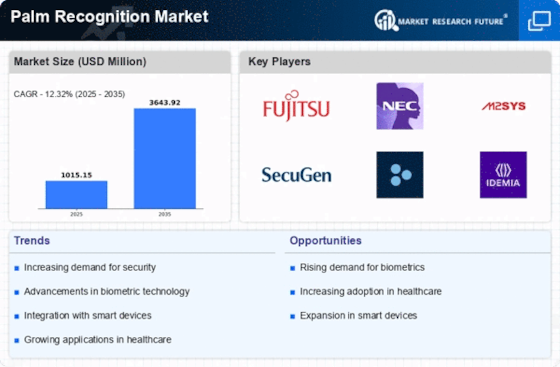
As per Market Research Future analysis, the Palm Recognition Market Size was estimated at 1015.15 USD Million in 2024. The Palm Recognition industry is projected to grow from 1140.22 USD Million in 2025 to 3643.92 USD Million by 2035, exhibiting a compound annual growth rate (CAGR) of 12.32% during the forecast period 2025 - 2035

Key Market Trends & Highlights

The Palm Recognition Market is poised for substantial growth driven by technological advancements and increasing demand for security solutions.

  • The market is witnessing a notable integration with IoT devices, enhancing user convenience and functionality. There is a pronounced focus on privacy and data security, reflecting consumer concerns in an increasingly digital world. Emerging markets are experiencing rapid expansion, particularly in Asia-Pacific, which is currently the fastest-growing region. Technological advancements in biometrics and the rising demand for contactless solutions are key drivers propelling the market forward.

Market Size & Forecast

2024 Market Size 1015.15 (USD Million)
2035 Market Size 3643.92 (USD Million)
CAGR (2025 - 2035) 12.32%
Largest Regional Market Share in 2024 Asia Pacific

Major Players

Fujitsu (JP), NEC Corporation (JP), M2SYS Technology (US), SecuGen Corporation (US), Innovatrics (SK), PalmSecure (JP), IDEMIA (FR), Crossmatch (US)

Market Trends

The Palm Recognition Market is currently experiencing a notable evolution, driven by advancements in biometric technology and increasing demand for secure authentication methods. Organizations across various sectors, including finance, healthcare, and retail, are increasingly adopting palm recognition systems to enhance security protocols and streamline user experiences. This technology offers a unique advantage by utilizing the distinct patterns of veins and ridges in an individual's palm, which are difficult to replicate. As a result, the market is witnessing a surge in interest from both consumers and enterprises seeking reliable identification solutions. Moreover, the integration of palm recognition with other biometric modalities, such as facial recognition and fingerprint scanning, appears to be a growing trend. This convergence may lead to more comprehensive security systems that provide multi-layered protection. Additionally, the rising awareness of privacy concerns and the need for contactless solutions are likely to further propel the adoption of palm recognition technology. As the market continues to mature, it seems poised for significant growth, with innovations and applications expanding across various industries, thereby enhancing overall user safety and convenience.

Integration with IoT Devices

The Palm Recognition Market is increasingly integrating with Internet of Things (IoT) devices, enhancing user convenience and security. This trend suggests that palm recognition technology may soon be embedded in everyday devices, such as smart home systems and wearable technology, allowing for seamless authentication processes.

Focus on Privacy and Data Security

There is a growing emphasis on privacy and data security within the Palm Recognition Market. As consumers become more aware of data protection issues, companies are likely to prioritize secure data handling practices, ensuring that biometric information is stored and processed with the utmost care.

Expansion in Emerging Markets

The Palm Recognition Market appears to be expanding into emerging markets, where the demand for advanced security solutions is on the rise. This trend indicates that businesses in these regions may increasingly adopt palm recognition technology to address security challenges and improve operational efficiency.

Palm Recognition Market Market Drivers

Expansion of Smart Home Technologies

The Palm Recognition Market is benefiting from the expansion of smart home technologies. As consumers increasingly seek convenience and security in their homes, palm recognition systems are being integrated into smart home devices for seamless access control. This integration allows homeowners to utilize their unique palm patterns for secure entry, thereby enhancing the overall user experience. Market trends indicate that the smart home market is projected to grow significantly, with biometric solutions playing a pivotal role in this evolution. The adoption of palm recognition technology in smart homes not only provides enhanced security but also aligns with the growing trend of automation and connectivity in residential environments.

Growing Adoption in Financial Services

The Palm Recognition Market is experiencing significant growth within the financial services sector. Banks and financial institutions are increasingly implementing palm recognition systems to enhance customer authentication processes and streamline operations. The technology not only improves security but also facilitates faster transactions, thereby enhancing customer satisfaction. Market analysis reveals that the financial services sector is one of the largest adopters of biometric technologies, with palm recognition being a preferred choice due to its accuracy and ease of use. As the competition among financial institutions intensifies, the integration of advanced biometric solutions like palm recognition is likely to become a standard practice, further driving market growth.

Rising Demand for Contactless Solutions

The Palm Recognition Market is witnessing a notable increase in demand for contactless biometric solutions. As organizations prioritize health and safety, the appeal of palm recognition systems, which require no physical contact, has grown significantly. This trend is particularly evident in sectors such as banking, healthcare, and retail, where minimizing physical interactions is crucial. Market data suggests that the contactless biometric segment is expected to account for a substantial share of the overall biometric market, further propelling the adoption of palm recognition technologies. This shift towards contactless solutions not only enhances user experience but also aligns with the increasing emphasis on hygiene and safety in public spaces.

Technological Advancements in Biometrics

The Palm Recognition Market is experiencing a surge due to rapid technological advancements in biometric systems. Innovations in sensor technology and image processing algorithms have enhanced the accuracy and speed of palm recognition systems. For instance, the introduction of 3D palm recognition technology has improved the ability to capture detailed palm features, thereby increasing the reliability of identification processes. According to recent data, the biometric market is projected to grow at a compound annual growth rate of over 20%, indicating a robust demand for advanced biometric solutions. This growth is likely to drive investments in palm recognition technologies, as organizations seek to adopt more secure and efficient identification methods.

Increased Focus on Security and Fraud Prevention

The Palm Recognition Market is driven by an escalating focus on security and fraud prevention measures across various sectors. Organizations are increasingly adopting biometric solutions to mitigate risks associated with identity theft and unauthorized access. The palm recognition technology offers a unique advantage due to its ability to capture distinct palm patterns, making it difficult to replicate. Recent statistics indicate that the global cost of cybercrime is projected to reach trillions of dollars, underscoring the urgent need for robust security measures. As businesses seek to protect sensitive information and assets, the demand for palm recognition systems is likely to rise, positioning them as a critical component of comprehensive security strategies.

Market Segment Insights

By Offering: Hardware (Largest) vs. Software & Services (Fastest-Growing)

In the Palm Recognition Market, the segment distribution indicates a significant lead by Hardware solutions, which encompass the physical devices necessary for palm recognition technology. Hardware accounts for the largest market share, attributed to its fundamental role in deploying palm recognition systems, making it a critical component for end-users. On the other hand, Software &amp; Services are emerging as a vital part of the overall market, reflecting a growing trend towards integrated solutions that enhance user experience and operational efficiency.

Hardware (Dominant) vs. Software &amp; Services (Emerging)

The dominant Hardware segment in the Palm Recognition Market comprises essential physical devices like scanners and biometric readers that users rely on for accurate and reliable palm authentication. As technology evolves, these devices have become increasingly sophisticated, offering enhanced performance and security features. In contrast, the Software &amp; Services segment is emerging rapidly due to the rising demand for comprehensive ecosystem solutions that not only manage hardware but also enable data analytics and improve system integration. This combination allows businesses to streamline operations, which is essential for the growing adoption of palm recognition across various sectors, including security and access control.

By Product: Palm Vein Biometrics (Largest) vs. Finger Vein Biometrics (Fastest-Growing)

The Palm Recognition Market showcases a division in product offerings, where Palm Vein Biometrics holds a dominant position in terms of market share due to its widespread acceptance across various sectors including healthcare, banking, and security. This segment benefits from advanced technological integration, enhancing user experience and operational efficiency. Conversely, Finger Vein Biometrics, while currently smaller in share, is experiencing rapid growth for its convenience and simplicity, appealing to consumer electronics and access control applications.

Product Type: Palm Vein Biometrics (Dominant) vs. Finger Vein Biometrics (Emerging)

Palm Vein Biometrics stands out as a dominant technology in the Palm Recognition Market, appreciated for its accuracy and low false acceptance rates. This technology employs infrared light to capture unique vein patterns in the palm, ensuring high security for various applications. In contrast, Finger Vein Biometrics, although emerging, is gaining traction due to its usability in personal devices and authentication systems. This method is typically less intrusive and offers quick recognition, attracting markets focused on user-friendly solutions. Both segments illustrate distinct approaches to biometric security, with Palm Vein solutions currently leading while Finger Vein solutions rapidly evolve to meet consumer demand.

By Authentication: Unimodal Biometric System (Largest) vs. Multimodal Biometric System (Fastest-Growing)

In the Palm Recognition Market, the Unimodal Biometric System holds a significant share, attributed to its established technology and widespread adoption in security systems and access control. This system primarily relies on a single biometric characteristic, making it cost-effective and easier to implement. Meanwhile, the Multimodal Biometric System is gaining traction due to its enhanced security features and flexibility, allowing for the integration of multiple biometric traits, thus appealing to industries demanding higher security measures.

Authentication: Unimodal Biometric System (Dominant) vs. Multimodal Biometric System (Emerging)

The Unimodal Biometric System, being the dominant player in the Palm Recognition Market, utilizes a single palm feature for identification, which simplifies the authentication process and reduces system complexity. This system is widely favored in various applications, from corporate security to personal device unlock features. On the other hand, the Multimodal Biometric System is emerging rapidly, providing a multi-faceted approach to palm recognition that incorporates various biometric identifiers, such as fingerprints or facial recognition. This system enhances reliability and accuracy, catering to industries that prioritize top-tier security and user convenience.

By Functionality: Physical Access Control & Biometric Identification (Largest) vs. Logical Access Control & Biometric Identification (Fastest-Growing)

In the Palm Recognition Market, the Physical Access Control &amp; Biometric Identification segment holds the largest market share due to its extensive applications in security-sensitive environments. This segment's dominance can be attributed to the increasing demand for secure access solutions across various sectors, including government, corporate, and educational institutions. Logical Access Control &amp; <a title="Biometric Identification" href="https://www.marketresearchfuture.com/reports/biometric-identification-market-29843">Biometric Identification</a> follows closely, gaining traction with the rise in remote working and the need for secure digital identities. This segment caters to organizations aiming to enhance security protocols and reduce identity fraud. The growth of these segments is driven by advancements in biometric technologies and the rising emphasis on security in both physical and digital realms. Enhanced user experiences, coupled with strict regulatory requirements for secure access, are propelling these segments forward. Moreover, innovations such as mobile biometric systems and cloud-based solutions are boosting the demand for Logical Access Control &amp; Biometric Identification, making it the fastest-growing area. Both segments are expected to benefit from increasing consumer awareness related to security enhancements and convenience in identification processes.

Security: Physical Access Control (Dominant) vs. Logical Access Control (Emerging)

The Physical Access Control segment is characterized by its robustness in safeguarding entry points in high-security areas through palm recognition technology, making it a preferred choice for many organizations. This segment not only leads in market share but also sets the standard for biometric solutions in physical environments. In contrast, the Logical Access Control segment, while currently emerging, is rapidly gaining popularity due to the increasing transition towards digital workflows and the need for securing online access. This segment utilizes palm recognition to provide seamless identity verification, making it essential for businesses looking to enhance cybersecurity and remotely manage access. Together, these segments highlight the dual focus on physical and digital security in the evolving landscape of biometric identification.

By Vertical: BFSI (Largest) vs. Commercial (Fastest-Growing)

The Palm Recognition Market is experiencing diverse growth across its vertical segments, with the Banking, Financial Services, and Insurance (BFSI) sector commanding the largest share. This dominance is primarily due to heightened security concerns and the increasing need for biometric authentication to prevent fraud. Additionally, as financial institutions adopt advanced technologies, they are integrating palm recognition systems to streamline operations and enhance customer experience. In contrast, the Commercial segment is recognized as the fastest-growing segment in the palm recognition market. The rise in <a title="contactless payment" href="https://www.marketresearchfuture.com/reports/contactless-payment-market-9558" target="_blank" rel="noopener">contactless payment</a> options and heightened security measures in retail and commercial sectors are driving this growth. More businesses are exploring biometric solutions to facilitate quick transactions while ensuring customer safety, further fueling expansion in this vertical.

BFSI: Dominant vs. Commercial: Emerging

The BFSI segment remains dominant in the palm recognition market, leveraging its extensive infrastructure and emphasizing customer security. Banks and financial institutions are aggressively adopting palm recognition technologies as part of their security frameworks, ensuring that financial transactions are secure and efficient. On the other hand, the Commercial segment is emerging quickly, driven by the increasing need for enhanced security measures and seamless customer experiences. Retailers are implementing palm recognition for faster transaction processes, which not only improves customer satisfaction but also reduces theft and fraud. Together, these segments illustrate a robust interplay between stringent security needs and the quest for convenience in the evolving market.

By Application: Access Control & Biometric Identification (Largest) vs. User Authentication (Fastest-Growing)

The Palm Recognition Market is primarily segmented into Access Control &amp; Biometric Identification, OEM Terminal Devices, User Authentication, and Others. Access Control &amp; Biometric Identification holds the largest market share, fueled by the increasing need for security in various sectors such as banking, healthcare, and public safety. OEM Terminal Devices also contribute significantly, catering to manufacturers seeking integrated biometric solutions, while User Authentication, though currently smaller in share, is rapidly expanding due to the growing emphasis on personal device security and online transactions. The growth trends for the Palm Recognition Market applications are largely driven by technological advancements and heightened security awareness among users. User Authentication is witnessing a surge in adoption, driven by the increase in cyber threats and the demand for more secure methods to access personal and professional data. Access Control &amp; Biometric Identification is propelled by regulatory requirements in multiple industries and consumer demand for efficient, secure entry solutions, establishing a robust growth trajectory for these segments in the foreseeable future.

Access Control &amp; Biometric Identification (Dominant) vs. User Authentication (Emerging)

Access Control &amp; Biometric Identification is the dominant segment in the Palm Recognition Market due to its extensive application in various high-security industries. This segment is marked by its integration into security systems, providing safe and reliable entry points for facilities. The technology uses unique palm patterns to offer strong authentication, making it a preferred choice for institutions prioritizing security. Conversely, User Authentication is emerging as a key growth area, fueled by the increasing use of smart devices and reliance on digital transactions. This segment focuses on personal security solutions, utilizing palm recognition for secure access to devices and sensitive information. The rise in remote working and online services enhances the relevance of User Authentication, positioning it for significant expansion.

Get more detailed insights about Palm Recognition Market Research Report - Global Forecast till 2035

Regional Insights

North America : Technological Innovation Leader

North America is the largest market for palm recognition technology, holding approximately 40% of the global share. The region's growth is driven by increasing demand for secure authentication methods across various sectors, including finance and healthcare. Regulatory support for biometric technologies further fuels this growth, with initiatives aimed at enhancing security protocols. The U.S. and Canada are the primary contributors to this market, showcasing a robust adoption of advanced biometric systems. The competitive landscape in North America is characterized by the presence of key players such as M2SYS Technology, SecuGen Corporation, and IDEMIA. These companies are at the forefront of innovation, developing cutting-edge solutions that cater to diverse applications. The region's focus on research and development, coupled with a favorable regulatory environment, positions it as a leader in the palm recognition market, driving advancements and setting industry standards.

Europe : Emerging Market with Regulations

Europe is witnessing significant growth in the palm recognition market, accounting for approximately 30% of the global share. The region's expansion is driven by stringent data protection regulations and a growing emphasis on security in public and private sectors. Countries like Germany and the UK are leading this trend, implementing policies that encourage the adoption of biometric technologies for identity verification and access control. The regulatory landscape is a key catalyst for market growth, ensuring compliance and fostering consumer trust. Leading countries in Europe include Germany, the UK, and France, where companies like IDEMIA and Innovatrics are making substantial inroads. The competitive environment is marked by collaborations between technology providers and government agencies to enhance security measures. The presence of established players and a focus on innovation are propelling the market forward, making Europe a significant player in the palm recognition landscape.

Asia-Pacific : Rapid Growth and Adoption

Asia-Pacific is emerging as a powerhouse in the palm recognition market, holding approximately 25% of the global share. The region's growth is fueled by increasing urbanization, rising security concerns, and the adoption of smart technologies across various sectors. Countries like China and Japan are at the forefront, investing heavily in biometric solutions to enhance security in public spaces and financial institutions. The demand for efficient and secure authentication methods is driving market expansion in this dynamic region. The competitive landscape in Asia-Pacific features key players such as Fujitsu and NEC Corporation, who are leading the charge in innovation and technology development. The region is characterized by a mix of established companies and startups, fostering a vibrant ecosystem for palm recognition solutions. Government initiatives aimed at promoting digital security further bolster the market, making Asia-Pacific a critical area for growth in the palm recognition sector.

Middle East and Africa : Emerging Market with Potential

The Middle East and Africa (MEA) region is gradually emerging in the palm recognition market, currently holding about 5% of the global share. The growth is driven by increasing investments in security infrastructure and a rising demand for biometric solutions in sectors such as banking and government services. Countries like the UAE and South Africa are leading the way, implementing advanced security measures to combat rising crime rates and enhance public safety. The region's potential for growth is significant, with ongoing projects aimed at integrating biometric technologies into various applications. In the MEA region, the competitive landscape is still developing, with a mix of local and international players entering the market. Companies are focusing on partnerships and collaborations to enhance their offerings and expand their reach. The presence of key players is growing, and as awareness of biometric solutions increases, the market is expected to witness substantial growth in the coming years, driven by both public and private sector initiatives.

Key Players and Competitive Insights

The Palm Recognition Market is currently characterized by a dynamic competitive landscape, driven by technological advancements and increasing demand for secure biometric solutions. Key players such as Fujitsu (Japan), NEC Corporation (Japan), and IDEMIA (France) are at the forefront, each adopting distinct strategies to enhance their market positioning. Fujitsu (Japan) focuses on innovation through continuous research and development, particularly in enhancing the accuracy and speed of palm recognition systems. Meanwhile, NEC Corporation (Japan) emphasizes strategic partnerships, collaborating with various technology firms to integrate palm recognition into broader security solutions. IDEMIA (France) is leveraging its expertise in identity management to expand its offerings, indicating a trend towards comprehensive biometric solutions that include palm recognition as a key component.The business tactics employed by these companies reflect a concerted effort to optimize operations and adapt to market demands. Localizing manufacturing and optimizing supply chains are prevalent strategies, allowing companies to respond swiftly to regional market needs. The competitive structure of the Palm Recognition Market appears moderately fragmented, with several players vying for market share, yet the influence of major companies remains substantial, shaping industry standards and customer expectations.
In August Fujitsu (Japan) announced the launch of its latest palm recognition technology, which reportedly enhances user experience through faster processing times and improved accuracy. This strategic move not only reinforces Fujitsu's commitment to innovation but also positions the company to capture a larger share of the growing demand for biometric security solutions in various sectors, including finance and healthcare. The introduction of this technology could potentially set new benchmarks for performance in the industry.
In September NEC Corporation (Japan) entered into a partnership with a leading cybersecurity firm to integrate its palm recognition systems into advanced security frameworks. This collaboration is indicative of NEC's strategy to broaden its technological ecosystem, enhancing the security features of its biometric solutions. By aligning with a cybersecurity expert, NEC aims to address the increasing concerns surrounding data protection and privacy, thereby strengthening its market position.
In July IDEMIA (France) expanded its biometric offerings by acquiring a smaller tech firm specializing in AI-driven biometric solutions. This acquisition is likely to enhance IDEMIA's capabilities in integrating artificial intelligence with palm recognition technology, allowing for more sophisticated and adaptive security measures. Such strategic actions suggest a trend towards the convergence of AI and biometric technologies, which could redefine user authentication processes.
As of October the competitive trends in the Palm Recognition Market are increasingly influenced by digitalization, sustainability, and the integration of artificial intelligence. Strategic alliances are becoming more prevalent, as companies recognize the need to collaborate to enhance their technological capabilities and market reach. Looking ahead, it appears that competitive differentiation will increasingly hinge on innovation and technological advancements rather than solely on price. The emphasis on supply chain reliability and the ability to deliver cutting-edge solutions will likely define the future landscape of the Palm Recognition Market.

Key Companies in the Palm Recognition Market include

Industry Developments

April 2023: Amazon-owned retail chain, Whole Foods Market stores has rolled out Amazon One biometric palm-recognition technology at 11 outlets across greater Denver area in the US state of Colorado. It is also implementing Amazon’s Dash Cart smart shopping trolley at its outlet in SouthGlenn which tracks the items customers scan as they shop and enables them to exit the store without needing to visit a physical checkout.

December 2021: Hudson integrates Amazon’s palm-recognition payments at Hudson Nonstop, powered by Just Walk Out technology, at Dallas Love Field Airport (DAL). The integration of Amazon One into the company's technology portfolio demonstrates Hudson’s unique ability to continually redefine and elevate the travel experience.

Future Outlook

Palm Recognition Market Future Outlook

The Palm Recognition Market is projected to grow at a 12.32% CAGR from 2025 to 2035, driven by advancements in biometric technology and increasing security demands.

New opportunities lie in:

  • <p>Integration of palm recognition in mobile payment systems Development of palm-based access control solutions for enterprises Expansion into healthcare for patient identification and record management</p>

By 2035, the market is expected to be robust, driven by innovative applications and widespread adoption.

Market Segmentation

Palm Recognition Market Product Outlook

  • Finger Vein Biometrics
  • Palm Vein Biometrics

Palm Recognition Market Offering Outlook

  • Hardware
  • Software & Services

Palm Recognition Market Vertical Outlook

  • BFSI
  • Commercial
  • Industrial
  • Others

Palm Recognition Market Application Outlook

  • Access Control & Biometric Identification
  • OEM Terminal Devices
  • User Authentication
  • Others

Palm Recognition Market Functionality Outlook

  • Physical Access Control & Biometric Identification
  • Logical Access Control & Biometric Identification
  • Embedded System

Palm Recognition Market Authentication Outlook

  • Unimodal Biometric System
  • Multimodal Biometric System

Report Scope

MARKET SIZE 2024 1015.15(USD Million)
MARKET SIZE 2025 1140.22(USD Million)
MARKET SIZE 2035 3643.92(USD Million)
COMPOUND ANNUAL GROWTH RATE (CAGR) 12.32% (2025 - 2035)
REPORT COVERAGE Revenue Forecast, Competitive Landscape, Growth Factors, and Trends
BASE YEAR 2024
Market Forecast Period 2025 - 2035
Historical Data 2019 - 2024
Market Forecast Units USD Million
Key Companies Profiled Fujitsu (JP), NEC Corporation (JP), M2SYS Technology (US), SecuGen Corporation (US), Innovatrics (SK), PalmSecure (JP), IDEMIA (FR), Crossmatch (US)
Segments Covered Offering, Product, Authentication, Functionality, Vertical, Application and By Region - Forecast till 2035
Key Market Opportunities Integration of artificial intelligence enhances accuracy and efficiency in the Palm Recognition Market.
Key Market Dynamics Rising demand for secure authentication drives innovation and competition in the palm recognition technology sector.
Countries Covered North America, Europe, APAC, South America, MEA

FAQs

What is the current valuation of the Palm Recognition Market as of 2024?

<p>The Palm Recognition Market was valued at 1015.15 USD Million in 2024.</p>

What is the projected market size for the Palm Recognition Market in 2035?

<p>The market is projected to reach 3643.92 USD Million by 2035.</p>

What is the expected CAGR for the Palm Recognition Market during the forecast period 2025 - 2035?

<p>The expected CAGR for the Palm Recognition Market during 2025 - 2035 is 12.32%.</p>

Which companies are considered key players in the Palm Recognition Market?

<p>Key players include Fujitsu, NEC Corporation, M2SYS Technology, SecuGen Corporation, Innovatrics, PalmSecure, IDEMIA, and Crossmatch.</p>

What are the main segments of the Palm Recognition Market?

<p>The main segments include Offering, Product, Authentication, Functionality, Vertical, and Application.</p>

How does the valuation of Palm Vein Biometrics compare to Finger Vein Biometrics?

In 2024, Palm Vein Biometrics was valued at 715.15 USD Million, while Finger Vein Biometrics was valued at 300.0 USD Million.

What is the valuation of the Hardware segment in the Palm Recognition Market?

The Hardware segment was valued at 405.15 USD Million in 2024 and is expected to grow significantly.

What verticals are driving growth in the Palm Recognition Market?

The BFSI, Commercial, Industrial, and Other sectors are driving growth, with BFSI valued at 300.0 USD Million in 2024.

What functionalities are included in the Palm Recognition Market?

Functionalities include Physical Access Control, Logical Access Control, and Embedded Systems, with Physical Access Control valued at 405.0 USD Million in 2024.

What applications are being developed within the Palm Recognition Market?

Applications include Access Control, OEM Terminal Devices, and User Authentication, with Access Control valued at 405.0 USD Million in 2024.

  1. SECTION I: EXECUTIVE SUMMARY AND KEY HIGHLIGHTS
    1. | 1.1 EXECUTIVE SUMMARY
    2. | | 1.1.1 Market Overview
    3. | | 1.1.2 Key Findings
    4. | | 1.1.3 Market Segmentation
    5. | | 1.1.4 Competitive Landscape
    6. | | 1.1.5 Challenges and Opportunities
    7. | | 1.1.6 Future Outlook
  2. SECTION II: SCOPING, METHODOLOGY AND MARKET STRUCTURE
    1. | 2.1 MARKET INTRODUCTION
    2. | | 2.1.1 Definition
    3. | | 2.1.2 Scope of the study
    4. | | | 2.1.2.1 Research Objective
    5. | | | 2.1.2.2 Assumption
    6. | | | 2.1.2.3 Limitations
    7. | 2.2 RESEARCH METHODOLOGY
    8. | | 2.2.1 Overview
    9. | | 2.2.2 Data Mining
    10. | | 2.2.3 Secondary Research
    11. | | 2.2.4 Primary Research
    12. | | | 2.2.4.1 Primary Interviews and Information Gathering Process
    13. | | | 2.2.4.2 Breakdown of Primary Respondents
    14. | | 2.2.5 Forecasting Model
    15. | | 2.2.6 Market Size Estimation
    16. | | | 2.2.6.1 Bottom-Up Approach
    17. | | | 2.2.6.2 Top-Down Approach
    18. | | 2.2.7 Data Triangulation
    19. | | 2.2.8 Validation
  3. SECTION III: QUALITATIVE ANALYSIS
    1. | 3.1 MARKET DYNAMICS
    2. | | 3.1.1 Overview
    3. | | 3.1.2 Drivers
    4. | | 3.1.3 Restraints
    5. | | 3.1.4 Opportunities
    6. | 3.2 MARKET FACTOR ANALYSIS
    7. | | 3.2.1 Value chain Analysis
    8. | | 3.2.2 Porter's Five Forces Analysis
    9. | | | 3.2.2.1 Bargaining Power of Suppliers
    10. | | | 3.2.2.2 Bargaining Power of Buyers
    11. | | | 3.2.2.3 Threat of New Entrants
    12. | | | 3.2.2.4 Threat of Substitutes
    13. | | | 3.2.2.5 Intensity of Rivalry
    14. | | 3.2.3 COVID-19 Impact Analysis
    15. | | | 3.2.3.1 Market Impact Analysis
    16. | | | 3.2.3.2 Regional Impact
    17. | | | 3.2.3.3 Opportunity and Threat Analysis
  4. SECTION IV: QUANTITATIVE ANALYSIS
    1. | 4.1 Information and Communications Technology, BY Offering (USD Million)
    2. | | 4.1.1 Hardware
    3. | | 4.1.2 Software & Services
    4. | 4.2 Information and Communications Technology, BY Product (USD Million)
    5. | | 4.2.1 Finger Vein Biometrics
    6. | | 4.2.2 Palm Vein Biometrics
    7. | 4.3 Information and Communications Technology, BY Authentication (USD Million)
    8. | | 4.3.1 Unimodal Biometric System
    9. | | 4.3.2 Multimodal Biometric System
    10. | 4.4 Information and Communications Technology, BY Functionality (USD Million)
    11. | | 4.4.1 Physical Access Control & Biometric Identification
    12. | | 4.4.2 Logical Access Control & Biometric Identification
    13. | | 4.4.3 Embedded System
    14. | 4.5 Information and Communications Technology, BY Vertical (USD Million)
    15. | | 4.5.1 BFSI
    16. | | 4.5.2 Commercial
    17. | | 4.5.3 Industrial
    18. | | 4.5.4 Others
    19. | 4.6 Information and Communications Technology, BY Application (USD Million)
    20. | | 4.6.1 Access Control & Biometric Identification
    21. | | 4.6.2 OEM Terminal Devices
    22. | | 4.6.3 User Authentication
    23. | | 4.6.4 Others
    24. | 4.7 Information and Communications Technology, BY Region (USD Million)
    25. | | 4.7.1 North America
    26. | | | 4.7.1.1 US
    27. | | | 4.7.1.2 Canada
    28. | | 4.7.2 Europe
    29. | | | 4.7.2.1 Germany
    30. | | | 4.7.2.2 UK
    31. | | | 4.7.2.3 France
    32. | | | 4.7.2.4 Russia
    33. | | | 4.7.2.5 Italy
    34. | | | 4.7.2.6 Spain
    35. | | | 4.7.2.7 Rest of Europe
    36. | | 4.7.3 APAC
    37. | | | 4.7.3.1 China
    38. | | | 4.7.3.2 India
    39. | | | 4.7.3.3 Japan
    40. | | | 4.7.3.4 South Korea
    41. | | | 4.7.3.5 Malaysia
    42. | | | 4.7.3.6 Thailand
    43. | | | 4.7.3.7 Indonesia
    44. | | | 4.7.3.8 Rest of APAC
    45. | | 4.7.4 South America
    46. | | | 4.7.4.1 Brazil
    47. | | | 4.7.4.2 Mexico
    48. | | | 4.7.4.3 Argentina
    49. | | | 4.7.4.4 Rest of South America
    50. | | 4.7.5 MEA
    51. | | | 4.7.5.1 GCC Countries
    52. | | | 4.7.5.2 South Africa
    53. | | | 4.7.5.3 Rest of MEA
  5. SECTION V: COMPETITIVE ANALYSIS
    1. | 5.1 Competitive Landscape
    2. | | 5.1.1 Overview
    3. | | 5.1.2 Competitive Analysis
    4. | | 5.1.3 Market share Analysis
    5. | | 5.1.4 Major Growth Strategy in the Information and Communications Technology
    6. | | 5.1.5 Competitive Benchmarking
    7. | | 5.1.6 Leading Players in Terms of Number of Developments in the Information and Communications Technology
    8. | | 5.1.7 Key developments and growth strategies
    9. | | | 5.1.7.1 New Product Launch/Service Deployment
    10. | | | 5.1.7.2 Merger & Acquisitions
    11. | | | 5.1.7.3 Joint Ventures
    12. | | 5.1.8 Major Players Financial Matrix
    13. | | | 5.1.8.1 Sales and Operating Income
    14. | | | 5.1.8.2 Major Players R&D Expenditure. 2023
    15. | 5.2 Company Profiles
    16. | | 5.2.1 Fujitsu (JP)
    17. | | | 5.2.1.1 Financial Overview
    18. | | | 5.2.1.2 Products Offered
    19. | | | 5.2.1.3 Key Developments
    20. | | | 5.2.1.4 SWOT Analysis
    21. | | | 5.2.1.5 Key Strategies
    22. | | 5.2.2 NEC Corporation (JP)
    23. | | | 5.2.2.1 Financial Overview
    24. | | | 5.2.2.2 Products Offered
    25. | | | 5.2.2.3 Key Developments
    26. | | | 5.2.2.4 SWOT Analysis
    27. | | | 5.2.2.5 Key Strategies
    28. | | 5.2.3 M2SYS Technology (US)
    29. | | | 5.2.3.1 Financial Overview
    30. | | | 5.2.3.2 Products Offered
    31. | | | 5.2.3.3 Key Developments
    32. | | | 5.2.3.4 SWOT Analysis
    33. | | | 5.2.3.5 Key Strategies
    34. | | 5.2.4 SecuGen Corporation (US)
    35. | | | 5.2.4.1 Financial Overview
    36. | | | 5.2.4.2 Products Offered
    37. | | | 5.2.4.3 Key Developments
    38. | | | 5.2.4.4 SWOT Analysis
    39. | | | 5.2.4.5 Key Strategies
    40. | | 5.2.5 Innovatrics (SK)
    41. | | | 5.2.5.1 Financial Overview
    42. | | | 5.2.5.2 Products Offered
    43. | | | 5.2.5.3 Key Developments
    44. | | | 5.2.5.4 SWOT Analysis
    45. | | | 5.2.5.5 Key Strategies
    46. | | 5.2.6 PalmSecure (JP)
    47. | | | 5.2.6.1 Financial Overview
    48. | | | 5.2.6.2 Products Offered
    49. | | | 5.2.6.3 Key Developments
    50. | | | 5.2.6.4 SWOT Analysis
    51. | | | 5.2.6.5 Key Strategies
    52. | | 5.2.7 IDEMIA (FR)
    53. | | | 5.2.7.1 Financial Overview
    54. | | | 5.2.7.2 Products Offered
    55. | | | 5.2.7.3 Key Developments
    56. | | | 5.2.7.4 SWOT Analysis
    57. | | | 5.2.7.5 Key Strategies
    58. | | 5.2.8 Crossmatch (US)
    59. | | | 5.2.8.1 Financial Overview
    60. | | | 5.2.8.2 Products Offered
    61. | | | 5.2.8.3 Key Developments
    62. | | | 5.2.8.4 SWOT Analysis
    63. | | | 5.2.8.5 Key Strategies
    64. | 5.3 Appendix
    65. | | 5.3.1 References
    66. | | 5.3.2 Related Reports
  6. LIST OF FIGURES
    1. | 6.1 MARKET SYNOPSIS
    2. | 6.2 NORTH AMERICA MARKET ANALYSIS
    3. | 6.3 US MARKET ANALYSIS BY OFFERING
    4. | 6.4 US MARKET ANALYSIS BY PRODUCT
    5. | 6.5 US MARKET ANALYSIS BY AUTHENTICATION
    6. | 6.6 US MARKET ANALYSIS BY FUNCTIONALITY
    7. | 6.7 US MARKET ANALYSIS BY VERTICAL
    8. | 6.8 US MARKET ANALYSIS BY APPLICATION
    9. | 6.9 CANADA MARKET ANALYSIS BY OFFERING
    10. | 6.10 CANADA MARKET ANALYSIS BY PRODUCT
    11. | 6.11 CANADA MARKET ANALYSIS BY AUTHENTICATION
    12. | 6.12 CANADA MARKET ANALYSIS BY FUNCTIONALITY
    13. | 6.13 CANADA MARKET ANALYSIS BY VERTICAL
    14. | 6.14 CANADA MARKET ANALYSIS BY APPLICATION
    15. | 6.15 EUROPE MARKET ANALYSIS
    16. | 6.16 GERMANY MARKET ANALYSIS BY OFFERING
    17. | 6.17 GERMANY MARKET ANALYSIS BY PRODUCT
    18. | 6.18 GERMANY MARKET ANALYSIS BY AUTHENTICATION
    19. | 6.19 GERMANY MARKET ANALYSIS BY FUNCTIONALITY
    20. | 6.20 GERMANY MARKET ANALYSIS BY VERTICAL
    21. | 6.21 GERMANY MARKET ANALYSIS BY APPLICATION
    22. | 6.22 UK MARKET ANALYSIS BY OFFERING
    23. | 6.23 UK MARKET ANALYSIS BY PRODUCT
    24. | 6.24 UK MARKET ANALYSIS BY AUTHENTICATION
    25. | 6.25 UK MARKET ANALYSIS BY FUNCTIONALITY
    26. | 6.26 UK MARKET ANALYSIS BY VERTICAL
    27. | 6.27 UK MARKET ANALYSIS BY APPLICATION
    28. | 6.28 FRANCE MARKET ANALYSIS BY OFFERING
    29. | 6.29 FRANCE MARKET ANALYSIS BY PRODUCT
    30. | 6.30 FRANCE MARKET ANALYSIS BY AUTHENTICATION
    31. | 6.31 FRANCE MARKET ANALYSIS BY FUNCTIONALITY
    32. | 6.32 FRANCE MARKET ANALYSIS BY VERTICAL
    33. | 6.33 FRANCE MARKET ANALYSIS BY APPLICATION
    34. | 6.34 RUSSIA MARKET ANALYSIS BY OFFERING
    35. | 6.35 RUSSIA MARKET ANALYSIS BY PRODUCT
    36. | 6.36 RUSSIA MARKET ANALYSIS BY AUTHENTICATION
    37. | 6.37 RUSSIA MARKET ANALYSIS BY FUNCTIONALITY
    38. | 6.38 RUSSIA MARKET ANALYSIS BY VERTICAL
    39. | 6.39 RUSSIA MARKET ANALYSIS BY APPLICATION
    40. | 6.40 ITALY MARKET ANALYSIS BY OFFERING
    41. | 6.41 ITALY MARKET ANALYSIS BY PRODUCT
    42. | 6.42 ITALY MARKET ANALYSIS BY AUTHENTICATION
    43. | 6.43 ITALY MARKET ANALYSIS BY FUNCTIONALITY
    44. | 6.44 ITALY MARKET ANALYSIS BY VERTICAL
    45. | 6.45 ITALY MARKET ANALYSIS BY APPLICATION
    46. | 6.46 SPAIN MARKET ANALYSIS BY OFFERING
    47. | 6.47 SPAIN MARKET ANALYSIS BY PRODUCT
    48. | 6.48 SPAIN MARKET ANALYSIS BY AUTHENTICATION
    49. | 6.49 SPAIN MARKET ANALYSIS BY FUNCTIONALITY
    50. | 6.50 SPAIN MARKET ANALYSIS BY VERTICAL
    51. | 6.51 SPAIN MARKET ANALYSIS BY APPLICATION
    52. | 6.52 REST OF EUROPE MARKET ANALYSIS BY OFFERING
    53. | 6.53 REST OF EUROPE MARKET ANALYSIS BY PRODUCT
    54. | 6.54 REST OF EUROPE MARKET ANALYSIS BY AUTHENTICATION
    55. | 6.55 REST OF EUROPE MARKET ANALYSIS BY FUNCTIONALITY
    56. | 6.56 REST OF EUROPE MARKET ANALYSIS BY VERTICAL
    57. | 6.57 REST OF EUROPE MARKET ANALYSIS BY APPLICATION
    58. | 6.58 APAC MARKET ANALYSIS
    59. | 6.59 CHINA MARKET ANALYSIS BY OFFERING
    60. | 6.60 CHINA MARKET ANALYSIS BY PRODUCT
    61. | 6.61 CHINA MARKET ANALYSIS BY AUTHENTICATION
    62. | 6.62 CHINA MARKET ANALYSIS BY FUNCTIONALITY
    63. | 6.63 CHINA MARKET ANALYSIS BY VERTICAL
    64. | 6.64 CHINA MARKET ANALYSIS BY APPLICATION
    65. | 6.65 INDIA MARKET ANALYSIS BY OFFERING
    66. | 6.66 INDIA MARKET ANALYSIS BY PRODUCT
    67. | 6.67 INDIA MARKET ANALYSIS BY AUTHENTICATION
    68. | 6.68 INDIA MARKET ANALYSIS BY FUNCTIONALITY
    69. | 6.69 INDIA MARKET ANALYSIS BY VERTICAL
    70. | 6.70 INDIA MARKET ANALYSIS BY APPLICATION
    71. | 6.71 JAPAN MARKET ANALYSIS BY OFFERING
    72. | 6.72 JAPAN MARKET ANALYSIS BY PRODUCT
    73. | 6.73 JAPAN MARKET ANALYSIS BY AUTHENTICATION
    74. | 6.74 JAPAN MARKET ANALYSIS BY FUNCTIONALITY
    75. | 6.75 JAPAN MARKET ANALYSIS BY VERTICAL
    76. | 6.76 JAPAN MARKET ANALYSIS BY APPLICATION
    77. | 6.77 SOUTH KOREA MARKET ANALYSIS BY OFFERING
    78. | 6.78 SOUTH KOREA MARKET ANALYSIS BY PRODUCT
    79. | 6.79 SOUTH KOREA MARKET ANALYSIS BY AUTHENTICATION
    80. | 6.80 SOUTH KOREA MARKET ANALYSIS BY FUNCTIONALITY
    81. | 6.81 SOUTH KOREA MARKET ANALYSIS BY VERTICAL
    82. | 6.82 SOUTH KOREA MARKET ANALYSIS BY APPLICATION
    83. | 6.83 MALAYSIA MARKET ANALYSIS BY OFFERING
    84. | 6.84 MALAYSIA MARKET ANALYSIS BY PRODUCT
    85. | 6.85 MALAYSIA MARKET ANALYSIS BY AUTHENTICATION
    86. | 6.86 MALAYSIA MARKET ANALYSIS BY FUNCTIONALITY
    87. | 6.87 MALAYSIA MARKET ANALYSIS BY VERTICAL
    88. | 6.88 MALAYSIA MARKET ANALYSIS BY APPLICATION
    89. | 6.89 THAILAND MARKET ANALYSIS BY OFFERING
    90. | 6.90 THAILAND MARKET ANALYSIS BY PRODUCT
    91. | 6.91 THAILAND MARKET ANALYSIS BY AUTHENTICATION
    92. | 6.92 THAILAND MARKET ANALYSIS BY FUNCTIONALITY
    93. | 6.93 THAILAND MARKET ANALYSIS BY VERTICAL
    94. | 6.94 THAILAND MARKET ANALYSIS BY APPLICATION
    95. | 6.95 INDONESIA MARKET ANALYSIS BY OFFERING
    96. | 6.96 INDONESIA MARKET ANALYSIS BY PRODUCT
    97. | 6.97 INDONESIA MARKET ANALYSIS BY AUTHENTICATION
    98. | 6.98 INDONESIA MARKET ANALYSIS BY FUNCTIONALITY
    99. | 6.99 INDONESIA MARKET ANALYSIS BY VERTICAL
    100. | 6.100 INDONESIA MARKET ANALYSIS BY APPLICATION
    101. | 6.101 REST OF APAC MARKET ANALYSIS BY OFFERING
    102. | 6.102 REST OF APAC MARKET ANALYSIS BY PRODUCT
    103. | 6.103 REST OF APAC MARKET ANALYSIS BY AUTHENTICATION
    104. | 6.104 REST OF APAC MARKET ANALYSIS BY FUNCTIONALITY
    105. | 6.105 REST OF APAC MARKET ANALYSIS BY VERTICAL
    106. | 6.106 REST OF APAC MARKET ANALYSIS BY APPLICATION
    107. | 6.107 SOUTH AMERICA MARKET ANALYSIS
    108. | 6.108 BRAZIL MARKET ANALYSIS BY OFFERING
    109. | 6.109 BRAZIL MARKET ANALYSIS BY PRODUCT
    110. | 6.110 BRAZIL MARKET ANALYSIS BY AUTHENTICATION
    111. | 6.111 BRAZIL MARKET ANALYSIS BY FUNCTIONALITY
    112. | 6.112 BRAZIL MARKET ANALYSIS BY VERTICAL
    113. | 6.113 BRAZIL MARKET ANALYSIS BY APPLICATION
    114. | 6.114 MEXICO MARKET ANALYSIS BY OFFERING
    115. | 6.115 MEXICO MARKET ANALYSIS BY PRODUCT
    116. | 6.116 MEXICO MARKET ANALYSIS BY AUTHENTICATION
    117. | 6.117 MEXICO MARKET ANALYSIS BY FUNCTIONALITY
    118. | 6.118 MEXICO MARKET ANALYSIS BY VERTICAL
    119. | 6.119 MEXICO MARKET ANALYSIS BY APPLICATION
    120. | 6.120 ARGENTINA MARKET ANALYSIS BY OFFERING
    121. | 6.121 ARGENTINA MARKET ANALYSIS BY PRODUCT
    122. | 6.122 ARGENTINA MARKET ANALYSIS BY AUTHENTICATION
    123. | 6.123 ARGENTINA MARKET ANALYSIS BY FUNCTIONALITY
    124. | 6.124 ARGENTINA MARKET ANALYSIS BY VERTICAL
    125. | 6.125 ARGENTINA MARKET ANALYSIS BY APPLICATION
    126. | 6.126 REST OF SOUTH AMERICA MARKET ANALYSIS BY OFFERING
    127. | 6.127 REST OF SOUTH AMERICA MARKET ANALYSIS BY PRODUCT
    128. | 6.128 REST OF SOUTH AMERICA MARKET ANALYSIS BY AUTHENTICATION
    129. | 6.129 REST OF SOUTH AMERICA MARKET ANALYSIS BY FUNCTIONALITY
    130. | 6.130 REST OF SOUTH AMERICA MARKET ANALYSIS BY VERTICAL
    131. | 6.131 REST OF SOUTH AMERICA MARKET ANALYSIS BY APPLICATION
    132. | 6.132 MEA MARKET ANALYSIS
    133. | 6.133 GCC COUNTRIES MARKET ANALYSIS BY OFFERING
    134. | 6.134 GCC COUNTRIES MARKET ANALYSIS BY PRODUCT
    135. | 6.135 GCC COUNTRIES MARKET ANALYSIS BY AUTHENTICATION
    136. | 6.136 GCC COUNTRIES MARKET ANALYSIS BY FUNCTIONALITY
    137. | 6.137 GCC COUNTRIES MARKET ANALYSIS BY VERTICAL
    138. | 6.138 GCC COUNTRIES MARKET ANALYSIS BY APPLICATION
    139. | 6.139 SOUTH AFRICA MARKET ANALYSIS BY OFFERING
    140. | 6.140 SOUTH AFRICA MARKET ANALYSIS BY PRODUCT
    141. | 6.141 SOUTH AFRICA MARKET ANALYSIS BY AUTHENTICATION
    142. | 6.142 SOUTH AFRICA MARKET ANALYSIS BY FUNCTIONALITY
    143. | 6.143 SOUTH AFRICA MARKET ANALYSIS BY VERTICAL
    144. | 6.144 SOUTH AFRICA MARKET ANALYSIS BY APPLICATION
    145. | 6.145 REST OF MEA MARKET ANALYSIS BY OFFERING
    146. | 6.146 REST OF MEA MARKET ANALYSIS BY PRODUCT
    147. | 6.147 REST OF MEA MARKET ANALYSIS BY AUTHENTICATION
    148. | 6.148 REST OF MEA MARKET ANALYSIS BY FUNCTIONALITY
    149. | 6.149 REST OF MEA MARKET ANALYSIS BY VERTICAL
    150. | 6.150 REST OF MEA MARKET ANALYSIS BY APPLICATION
    151. | 6.151 KEY BUYING CRITERIA OF INFORMATION AND COMMUNICATIONS TECHNOLOGY
    152. | 6.152 RESEARCH PROCESS OF MRFR
    153. | 6.153 DRO ANALYSIS OF INFORMATION AND COMMUNICATIONS TECHNOLOGY
    154. | 6.154 DRIVERS IMPACT ANALYSIS: INFORMATION AND COMMUNICATIONS TECHNOLOGY
    155. | 6.155 RESTRAINTS IMPACT ANALYSIS: INFORMATION AND COMMUNICATIONS TECHNOLOGY
    156. | 6.156 SUPPLY / VALUE CHAIN: INFORMATION AND COMMUNICATIONS TECHNOLOGY
    157. | 6.157 INFORMATION AND COMMUNICATIONS TECHNOLOGY, BY OFFERING, 2024 (% SHARE)
    158. | 6.158 INFORMATION AND COMMUNICATIONS TECHNOLOGY, BY OFFERING, 2024 TO 2035 (USD Million)
    159. | 6.159 INFORMATION AND COMMUNICATIONS TECHNOLOGY, BY PRODUCT, 2024 (% SHARE)
    160. | 6.160 INFORMATION AND COMMUNICATIONS TECHNOLOGY, BY PRODUCT, 2024 TO 2035 (USD Million)
    161. | 6.161 INFORMATION AND COMMUNICATIONS TECHNOLOGY, BY AUTHENTICATION, 2024 (% SHARE)
    162. | 6.162 INFORMATION AND COMMUNICATIONS TECHNOLOGY, BY AUTHENTICATION, 2024 TO 2035 (USD Million)
    163. | 6.163 INFORMATION AND COMMUNICATIONS TECHNOLOGY, BY FUNCTIONALITY, 2024 (% SHARE)
    164. | 6.164 INFORMATION AND COMMUNICATIONS TECHNOLOGY, BY FUNCTIONALITY, 2024 TO 2035 (USD Million)
    165. | 6.165 INFORMATION AND COMMUNICATIONS TECHNOLOGY, BY VERTICAL, 2024 (% SHARE)
    166. | 6.166 INFORMATION AND COMMUNICATIONS TECHNOLOGY, BY VERTICAL, 2024 TO 2035 (USD Million)
    167. | 6.167 INFORMATION AND COMMUNICATIONS TECHNOLOGY, BY APPLICATION, 2024 (% SHARE)
    168. | 6.168 INFORMATION AND COMMUNICATIONS TECHNOLOGY, BY APPLICATION, 2024 TO 2035 (USD Million)
    169. | 6.169 BENCHMARKING OF MAJOR COMPETITORS
  7. LIST OF TABLES
    1. | 7.1 LIST OF ASSUMPTIONS
    2. | | 7.1.1
    3. | 7.2 North America MARKET SIZE ESTIMATES; FORECAST
    4. | | 7.2.1 BY OFFERING, 2025-2035 (USD Million)
    5. | | 7.2.2 BY PRODUCT, 2025-2035 (USD Million)
    6. | | 7.2.3 BY AUTHENTICATION, 2025-2035 (USD Million)
    7. | | 7.2.4 BY FUNCTIONALITY, 2025-2035 (USD Million)
    8. | | 7.2.5 BY VERTICAL, 2025-2035 (USD Million)
    9. | | 7.2.6 BY APPLICATION, 2025-2035 (USD Million)
    10. | 7.3 US MARKET SIZE ESTIMATES; FORECAST
    11. | | 7.3.1 BY OFFERING, 2025-2035 (USD Million)
    12. | | 7.3.2 BY PRODUCT, 2025-2035 (USD Million)
    13. | | 7.3.3 BY AUTHENTICATION, 2025-2035 (USD Million)
    14. | | 7.3.4 BY FUNCTIONALITY, 2025-2035 (USD Million)
    15. | | 7.3.5 BY VERTICAL, 2025-2035 (USD Million)
    16. | | 7.3.6 BY APPLICATION, 2025-2035 (USD Million)
    17. | 7.4 Canada MARKET SIZE ESTIMATES; FORECAST
    18. | | 7.4.1 BY OFFERING, 2025-2035 (USD Million)
    19. | | 7.4.2 BY PRODUCT, 2025-2035 (USD Million)
    20. | | 7.4.3 BY AUTHENTICATION, 2025-2035 (USD Million)
    21. | | 7.4.4 BY FUNCTIONALITY, 2025-2035 (USD Million)
    22. | | 7.4.5 BY VERTICAL, 2025-2035 (USD Million)
    23. | | 7.4.6 BY APPLICATION, 2025-2035 (USD Million)
    24. | 7.5 Europe MARKET SIZE ESTIMATES; FORECAST
    25. | | 7.5.1 BY OFFERING, 2025-2035 (USD Million)
    26. | | 7.5.2 BY PRODUCT, 2025-2035 (USD Million)
    27. | | 7.5.3 BY AUTHENTICATION, 2025-2035 (USD Million)
    28. | | 7.5.4 BY FUNCTIONALITY, 2025-2035 (USD Million)
    29. | | 7.5.5 BY VERTICAL, 2025-2035 (USD Million)
    30. | | 7.5.6 BY APPLICATION, 2025-2035 (USD Million)
    31. | 7.6 Germany MARKET SIZE ESTIMATES; FORECAST
    32. | | 7.6.1 BY OFFERING, 2025-2035 (USD Million)
    33. | | 7.6.2 BY PRODUCT, 2025-2035 (USD Million)
    34. | | 7.6.3 BY AUTHENTICATION, 2025-2035 (USD Million)
    35. | | 7.6.4 BY FUNCTIONALITY, 2025-2035 (USD Million)
    36. | | 7.6.5 BY VERTICAL, 2025-2035 (USD Million)
    37. | | 7.6.6 BY APPLICATION, 2025-2035 (USD Million)
    38. | 7.7 UK MARKET SIZE ESTIMATES; FORECAST
    39. | | 7.7.1 BY OFFERING, 2025-2035 (USD Million)
    40. | | 7.7.2 BY PRODUCT, 2025-2035 (USD Million)
    41. | | 7.7.3 BY AUTHENTICATION, 2025-2035 (USD Million)
    42. | | 7.7.4 BY FUNCTIONALITY, 2025-2035 (USD Million)
    43. | | 7.7.5 BY VERTICAL, 2025-2035 (USD Million)
    44. | | 7.7.6 BY APPLICATION, 2025-2035 (USD Million)
    45. | 7.8 France MARKET SIZE ESTIMATES; FORECAST
    46. | | 7.8.1 BY OFFERING, 2025-2035 (USD Million)
    47. | | 7.8.2 BY PRODUCT, 2025-2035 (USD Million)
    48. | | 7.8.3 BY AUTHENTICATION, 2025-2035 (USD Million)
    49. | | 7.8.4 BY FUNCTIONALITY, 2025-2035 (USD Million)
    50. | | 7.8.5 BY VERTICAL, 2025-2035 (USD Million)
    51. | | 7.8.6 BY APPLICATION, 2025-2035 (USD Million)
    52. | 7.9 Russia MARKET SIZE ESTIMATES; FORECAST
    53. | | 7.9.1 BY OFFERING, 2025-2035 (USD Million)
    54. | | 7.9.2 BY PRODUCT, 2025-2035 (USD Million)
    55. | | 7.9.3 BY AUTHENTICATION, 2025-2035 (USD Million)
    56. | | 7.9.4 BY FUNCTIONALITY, 2025-2035 (USD Million)
    57. | | 7.9.5 BY VERTICAL, 2025-2035 (USD Million)
    58. | | 7.9.6 BY APPLICATION, 2025-2035 (USD Million)
    59. | 7.10 Italy MARKET SIZE ESTIMATES; FORECAST
    60. | | 7.10.1 BY OFFERING, 2025-2035 (USD Million)
    61. | | 7.10.2 BY PRODUCT, 2025-2035 (USD Million)
    62. | | 7.10.3 BY AUTHENTICATION, 2025-2035 (USD Million)
    63. | | 7.10.4 BY FUNCTIONALITY, 2025-2035 (USD Million)
    64. | | 7.10.5 BY VERTICAL, 2025-2035 (USD Million)
    65. | | 7.10.6 BY APPLICATION, 2025-2035 (USD Million)
    66. | 7.11 Spain MARKET SIZE ESTIMATES; FORECAST
    67. | | 7.11.1 BY OFFERING, 2025-2035 (USD Million)
    68. | | 7.11.2 BY PRODUCT, 2025-2035 (USD Million)
    69. | | 7.11.3 BY AUTHENTICATION, 2025-2035 (USD Million)
    70. | | 7.11.4 BY FUNCTIONALITY, 2025-2035 (USD Million)
    71. | | 7.11.5 BY VERTICAL, 2025-2035 (USD Million)
    72. | | 7.11.6 BY APPLICATION, 2025-2035 (USD Million)
    73. | 7.12 Rest of Europe MARKET SIZE ESTIMATES; FORECAST
    74. | | 7.12.1 BY OFFERING, 2025-2035 (USD Million)
    75. | | 7.12.2 BY PRODUCT, 2025-2035 (USD Million)
    76. | | 7.12.3 BY AUTHENTICATION, 2025-2035 (USD Million)
    77. | | 7.12.4 BY FUNCTIONALITY, 2025-2035 (USD Million)
    78. | | 7.12.5 BY VERTICAL, 2025-2035 (USD Million)
    79. | | 7.12.6 BY APPLICATION, 2025-2035 (USD Million)
    80. | 7.13 APAC MARKET SIZE ESTIMATES; FORECAST
    81. | | 7.13.1 BY OFFERING, 2025-2035 (USD Million)
    82. | | 7.13.2 BY PRODUCT, 2025-2035 (USD Million)
    83. | | 7.13.3 BY AUTHENTICATION, 2025-2035 (USD Million)
    84. | | 7.13.4 BY FUNCTIONALITY, 2025-2035 (USD Million)
    85. | | 7.13.5 BY VERTICAL, 2025-2035 (USD Million)
    86. | | 7.13.6 BY APPLICATION, 2025-2035 (USD Million)
    87. | 7.14 China MARKET SIZE ESTIMATES; FORECAST
    88. | | 7.14.1 BY OFFERING, 2025-2035 (USD Million)
    89. | | 7.14.2 BY PRODUCT, 2025-2035 (USD Million)
    90. | | 7.14.3 BY AUTHENTICATION, 2025-2035 (USD Million)
    91. | | 7.14.4 BY FUNCTIONALITY, 2025-2035 (USD Million)
    92. | | 7.14.5 BY VERTICAL, 2025-2035 (USD Million)
    93. | | 7.14.6 BY APPLICATION, 2025-2035 (USD Million)
    94. | 7.15 India MARKET SIZE ESTIMATES; FORECAST
    95. | | 7.15.1 BY OFFERING, 2025-2035 (USD Million)
    96. | | 7.15.2 BY PRODUCT, 2025-2035 (USD Million)
    97. | | 7.15.3 BY AUTHENTICATION, 2025-2035 (USD Million)
    98. | | 7.15.4 BY FUNCTIONALITY, 2025-2035 (USD Million)
    99. | | 7.15.5 BY VERTICAL, 2025-2035 (USD Million)
    100. | | 7.15.6 BY APPLICATION, 2025-2035 (USD Million)
    101. | 7.16 Japan MARKET SIZE ESTIMATES; FORECAST
    102. | | 7.16.1 BY OFFERING, 2025-2035 (USD Million)
    103. | | 7.16.2 BY PRODUCT, 2025-2035 (USD Million)
    104. | | 7.16.3 BY AUTHENTICATION, 2025-2035 (USD Million)
    105. | | 7.16.4 BY FUNCTIONALITY, 2025-2035 (USD Million)
    106. | | 7.16.5 BY VERTICAL, 2025-2035 (USD Million)
    107. | | 7.16.6 BY APPLICATION, 2025-2035 (USD Million)
    108. | 7.17 South Korea MARKET SIZE ESTIMATES; FORECAST
    109. | | 7.17.1 BY OFFERING, 2025-2035 (USD Million)
    110. | | 7.17.2 BY PRODUCT, 2025-2035 (USD Million)
    111. | | 7.17.3 BY AUTHENTICATION, 2025-2035 (USD Million)
    112. | | 7.17.4 BY FUNCTIONALITY, 2025-2035 (USD Million)
    113. | | 7.17.5 BY VERTICAL, 2025-2035 (USD Million)
    114. | | 7.17.6 BY APPLICATION, 2025-2035 (USD Million)
    115. | 7.18 Malaysia MARKET SIZE ESTIMATES; FORECAST
    116. | | 7.18.1 BY OFFERING, 2025-2035 (USD Million)
    117. | | 7.18.2 BY PRODUCT, 2025-2035 (USD Million)
    118. | | 7.18.3 BY AUTHENTICATION, 2025-2035 (USD Million)
    119. | | 7.18.4 BY FUNCTIONALITY, 2025-2035 (USD Million)
    120. | | 7.18.5 BY VERTICAL, 2025-2035 (USD Million)
    121. | | 7.18.6 BY APPLICATION, 2025-2035 (USD Million)
    122. | 7.19 Thailand MARKET SIZE ESTIMATES; FORECAST
    123. | | 7.19.1 BY OFFERING, 2025-2035 (USD Million)
    124. | | 7.19.2 BY PRODUCT, 2025-2035 (USD Million)
    125. | | 7.19.3 BY AUTHENTICATION, 2025-2035 (USD Million)
    126. | | 7.19.4 BY FUNCTIONALITY, 2025-2035 (USD Million)
    127. | | 7.19.5 BY VERTICAL, 2025-2035 (USD Million)
    128. | | 7.19.6 BY APPLICATION, 2025-2035 (USD Million)
    129. | 7.20 Indonesia MARKET SIZE ESTIMATES; FORECAST
    130. | | 7.20.1 BY OFFERING, 2025-2035 (USD Million)
    131. | | 7.20.2 BY PRODUCT, 2025-2035 (USD Million)
    132. | | 7.20.3 BY AUTHENTICATION, 2025-2035 (USD Million)
    133. | | 7.20.4 BY FUNCTIONALITY, 2025-2035 (USD Million)
    134. | | 7.20.5 BY VERTICAL, 2025-2035 (USD Million)
    135. | | 7.20.6 BY APPLICATION, 2025-2035 (USD Million)
    136. | 7.21 Rest of APAC MARKET SIZE ESTIMATES; FORECAST
    137. | | 7.21.1 BY OFFERING, 2025-2035 (USD Million)
    138. | | 7.21.2 BY PRODUCT, 2025-2035 (USD Million)
    139. | | 7.21.3 BY AUTHENTICATION, 2025-2035 (USD Million)
    140. | | 7.21.4 BY FUNCTIONALITY, 2025-2035 (USD Million)
    141. | | 7.21.5 BY VERTICAL, 2025-2035 (USD Million)
    142. | | 7.21.6 BY APPLICATION, 2025-2035 (USD Million)
    143. | 7.22 South America MARKET SIZE ESTIMATES; FORECAST
    144. | | 7.22.1 BY OFFERING, 2025-2035 (USD Million)
    145. | | 7.22.2 BY PRODUCT, 2025-2035 (USD Million)
    146. | | 7.22.3 BY AUTHENTICATION, 2025-2035 (USD Million)
    147. | | 7.22.4 BY FUNCTIONALITY, 2025-2035 (USD Million)
    148. | | 7.22.5 BY VERTICAL, 2025-2035 (USD Million)
    149. | | 7.22.6 BY APPLICATION, 2025-2035 (USD Million)
    150. | 7.23 Brazil MARKET SIZE ESTIMATES; FORECAST
    151. | | 7.23.1 BY OFFERING, 2025-2035 (USD Million)
    152. | | 7.23.2 BY PRODUCT, 2025-2035 (USD Million)
    153. | | 7.23.3 BY AUTHENTICATION, 2025-2035 (USD Million)
    154. | | 7.23.4 BY FUNCTIONALITY, 2025-2035 (USD Million)
    155. | | 7.23.5 BY VERTICAL, 2025-2035 (USD Million)
    156. | | 7.23.6 BY APPLICATION, 2025-2035 (USD Million)
    157. | 7.24 Mexico MARKET SIZE ESTIMATES; FORECAST
    158. | | 7.24.1 BY OFFERING, 2025-2035 (USD Million)
    159. | | 7.24.2 BY PRODUCT, 2025-2035 (USD Million)
    160. | | 7.24.3 BY AUTHENTICATION, 2025-2035 (USD Million)
    161. | | 7.24.4 BY FUNCTIONALITY, 2025-2035 (USD Million)
    162. | | 7.24.5 BY VERTICAL, 2025-2035 (USD Million)
    163. | | 7.24.6 BY APPLICATION, 2025-2035 (USD Million)
    164. | 7.25 Argentina MARKET SIZE ESTIMATES; FORECAST
    165. | | 7.25.1 BY OFFERING, 2025-2035 (USD Million)
    166. | | 7.25.2 BY PRODUCT, 2025-2035 (USD Million)
    167. | | 7.25.3 BY AUTHENTICATION, 2025-2035 (USD Million)
    168. | | 7.25.4 BY FUNCTIONALITY, 2025-2035 (USD Million)
    169. | | 7.25.5 BY VERTICAL, 2025-2035 (USD Million)
    170. | | 7.25.6 BY APPLICATION, 2025-2035 (USD Million)
    171. | 7.26 Rest of South America MARKET SIZE ESTIMATES; FORECAST
    172. | | 7.26.1 BY OFFERING, 2025-2035 (USD Million)
    173. | | 7.26.2 BY PRODUCT, 2025-2035 (USD Million)
    174. | | 7.26.3 BY AUTHENTICATION, 2025-2035 (USD Million)
    175. | | 7.26.4 BY FUNCTIONALITY, 2025-2035 (USD Million)
    176. | | 7.26.5 BY VERTICAL, 2025-2035 (USD Million)
    177. | | 7.26.6 BY APPLICATION, 2025-2035 (USD Million)
    178. | 7.27 MEA MARKET SIZE ESTIMATES; FORECAST
    179. | | 7.27.1 BY OFFERING, 2025-2035 (USD Million)
    180. | | 7.27.2 BY PRODUCT, 2025-2035 (USD Million)
    181. | | 7.27.3 BY AUTHENTICATION, 2025-2035 (USD Million)
    182. | | 7.27.4 BY FUNCTIONALITY, 2025-2035 (USD Million)
    183. | | 7.27.5 BY VERTICAL, 2025-2035 (USD Million)
    184. | | 7.27.6 BY APPLICATION, 2025-2035 (USD Million)
    185. | 7.28 GCC Countries MARKET SIZE ESTIMATES; FORECAST
    186. | | 7.28.1 BY OFFERING, 2025-2035 (USD Million)
    187. | | 7.28.2 BY PRODUCT, 2025-2035 (USD Million)
    188. | | 7.28.3 BY AUTHENTICATION, 2025-2035 (USD Million)
    189. | | 7.28.4 BY FUNCTIONALITY, 2025-2035 (USD Million)
    190. | | 7.28.5 BY VERTICAL, 2025-2035 (USD Million)
    191. | | 7.28.6 BY APPLICATION, 2025-2035 (USD Million)
    192. | 7.29 South Africa MARKET SIZE ESTIMATES; FORECAST
    193. | | 7.29.1 BY OFFERING, 2025-2035 (USD Million)
    194. | | 7.29.2 BY PRODUCT, 2025-2035 (USD Million)
    195. | | 7.29.3 BY AUTHENTICATION, 2025-2035 (USD Million)
    196. | | 7.29.4 BY FUNCTIONALITY, 2025-2035 (USD Million)
    197. | | 7.29.5 BY VERTICAL, 2025-2035 (USD Million)
    198. | | 7.29.6 BY APPLICATION, 2025-2035 (USD Million)
    199. | 7.30 Rest of MEA MARKET SIZE ESTIMATES; FORECAST
    200. | | 7.30.1 BY OFFERING, 2025-2035 (USD Million)
    201. | | 7.30.2 BY PRODUCT, 2025-2035 (USD Million)
    202. | | 7.30.3 BY AUTHENTICATION, 2025-2035 (USD Million)
    203. | | 7.30.4 BY FUNCTIONALITY, 2025-2035 (USD Million)
    204. | | 7.30.5 BY VERTICAL, 2025-2035 (USD Million)
    205. | | 7.30.6 BY APPLICATION, 2025-2035 (USD Million)
    206. | 7.31 PRODUCT LAUNCH/PRODUCT DEVELOPMENT/APPROVAL
    207. | | 7.31.1
    208. | 7.32 ACQUISITION/PARTNERSHIP
    209. | | 7.32.1

Information and Communications Technology Market Segmentation

Information and Communications Technology By Offering (USD Million, 2025-2035)

  • Hardware
  • Software & Services

Information and Communications Technology By Product (USD Million, 2025-2035)

  • Finger Vein Biometrics
  • Palm Vein Biometrics

Information and Communications Technology By Authentication (USD Million, 2025-2035)

  • Unimodal Biometric System
  • Multimodal Biometric System

Information and Communications Technology By Functionality (USD Million, 2025-2035)

  • Physical Access Control & Biometric Identification
  • Logical Access Control & Biometric Identification
  • Embedded System

Information and Communications Technology By Vertical (USD Million, 2025-2035)

  • BFSI
  • Commercial
  • Industrial
  • Others

Information and Communications Technology By Application (USD Million, 2025-2035)

  • Access Control & Biometric Identification
  • OEM Terminal Devices
  • User Authentication
  • Others
Infographic

Free Sample Request

Kindly complete the form below to receive a free sample of this Report

Get Free Sample

Customer Strories

Compare Licence

×
Features License Type
Single User Multiuser License Enterprise User
Price $4,950 $5,950 $7,250
Maximum User Access Limit 1 User Upto 10 Users Unrestricted Access Throughout the Organization
Free Customization
Direct Access to Analyst
Deliverable Format
Platform Access
Discount on Next Purchase 10% 15% 15%
Printable Versions