Request Free Sample ×

Kindly complete the form below to receive a free sample of this Report

* Please use a valid business email

Leading companies partner with us for data-driven Insights

clients tt-cursor
Hero Background
English
Chinese
French
Japanese
Korean
German
Spanish

Packaging Material Market Size

ID: MRFR/PCM/10863-CR
207 Pages
Anshula Mandaokar
Last Updated: March 27, 2026

Packaging Material Market Research Report: Information by Material (Paper and Paperboard, Rigid Plastics, Metal, Flexible Plastics, Glass, Wood, and Others), By Product (Containers and Jars, Bags and Sacks, Pouches, Closures and Lids, Films and Wraps, Drums & IBCs, Boxes & Cartons, Crates and Pallets, and Others), By Level of Packaging (Primary Packaging, Secondary Packaging, and Tertiary Packaging), By End Use Industry (Food & Beverages, Pharmaceuticals and Healthcare, Personal Care and Cosmetics, Automotive, Electrical and Electronics, Chemicals, Household Products, and Others), and by Region (North America, South America, Europe, Asia Pacific, And Middle East & Africa) –Market Forecast Till 2035

Share:
Download PDF ×

We do not share your information with anyone. However, we may send you emails based on your report interest from time to time. You may contact us at any time to opt-out.

Packaging Material Market Infographic
Purchase Options

Packaging Material Size

Packaging Material Market Growth Projections and Opportunities

The types and quantities of packing materials required depend directly on the needs of different end-use industries. Important users of these materials include the food & beverage, electronics, healthcare, and e-commerce industries. The rapid expansion of e-commerce has a big impact on the global market, and the unique packaging needs of online retail—like package security, handleability, and aesthetic appeal—drive the need for innovative and specialized packaging materials. Regulatory restrictions and standards, especially those pertaining to food safety and product protection, greatly influence the choice of packaging materials. The sector is required to follow laws that guarantee the traceability, safety, and quality of packaged products. Material science is always making progress, which means that the materials used in packing are always changing. Nanotechnology, protective layers, and smart packaging are some of the new technologies that are making packing materials better for the environment, more effective, and longer-lasting. The choice of packing material is influenced by customer preferences, which include the convenience, attractiveness, and visibility of the product. Brands choose materials that not only fulfill the expectations of consumers but also provide opportunities for effective branding and marketing. Material selection is influenced by a number of aspects, including compatibility with automated packaging processes, benefits in terms of efficiency, and improvements in terms of labor cost savings. Sustainability is becoming a bigger part of how brands package their goods so they can meet customer standards and meet their CSR goals. Innovation in materials like films, bags, and laminates is encouraged by the popularity of flexible packaging as a lightweight and flexible option. The best part about bendable packing is that it cuts down on the amount of material needed, makes the product easier to see, and keeps it fresh longer. Bio-based products and bioplastics, which are made from resources that can be used again and again, offer a more long-lasting answer to the problem of plastic waste. Also, these materials are made because more and more people want plastics that aren't made in the usual way. Packaging waste management regulations and efforts impact material choices; countries and regions pursue steps to decrease packaging waste, promoting the use of readily recyclable materials or as part of a circular economy."
Packaging Material Market Size Graph
Author
Author Profile
Anshula Mandaokar
Team Lead - Research

Anshula Mandaokar holds an academic degree in Chemical Engineering and has been contributing to the field for more than 5 years. She has expertise in Market Research and Business Consulting and serves as a Team Lead for a reputed Market Research firm under the Chemicals and Materials domain spectrum. She has worked on multiple projects, generating explicit results in a quick turnaround time. Her understanding of data interpretation justifies her role as a leader.

Leave a Comment

FAQs

What is the current valuation of the Packaging Material Market as of 2024?

<p>The overall market valuation was 625502.9 USD Million in 2024.</p>

What is the projected market valuation for the Packaging Material Market in 2035?

<p>The projected valuation for 2035 is 964996.61 USD Million.</p>

What is the expected CAGR for the Packaging Material Market during the forecast period 2025 - 2035?

<p>The expected CAGR for the Packaging Material Market during the forecast period 2025 - 2035 is 4.02%.</p>

Which companies are considered key players in the Packaging Material Market?

<p>Key players in the market include Amcor, Sealed Air, Mondi Group, Ball Corporation, WestRock, Smurfit Kappa, International Paper, Tetra Pak, and DS Smith.</p>

What are the primary applications of packaging materials in the market?

<p>The primary applications include Food Packaging, Pharmaceutical Packaging, Cosmetic Packaging, Industrial Packaging, and Electronics Packaging.</p>

How does the market segment by material type look in terms of valuation?

<p>The market segments by material type include Plastic at 250000.0 to 380000.0 USD Million, Paper at 150000.0 to 220000.0 USD Million, and Metal at 100000.0 to 150000.0 USD Million.</p>

What is the valuation range for flexible packaging in the market?

Flexible Packaging is valued between 250000.0 and 380000.0 USD Million.

Which end-use industries are driving the Packaging Material Market?

The end-use industries driving the market include Food and Beverage, Healthcare, Personal Care, Consumer Goods, and Electronics.

What distribution channels are prevalent in the Packaging Material Market?

The prevalent distribution channels include Online Retail, Offline Retail, Direct Sales, and Wholesale.

What is the valuation range for biodegradable packaging materials?

Biodegradable packaging materials are valued between 25000.0 and 35000.0 USD Million.

Market Summary

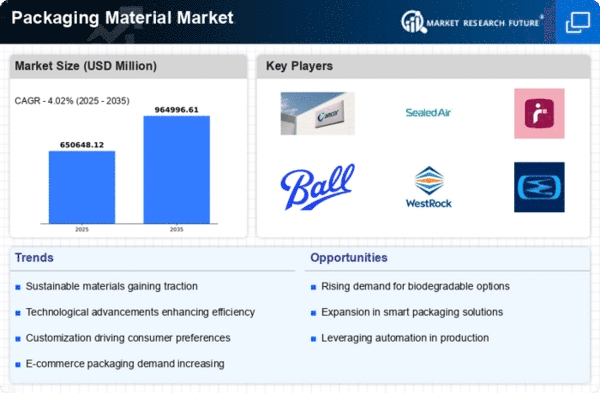
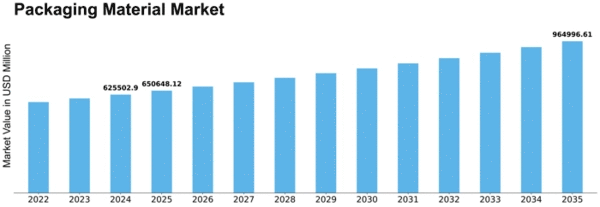
As per MRFR analysis, the Packaging Material Market Size was estimated at 625502.9 USD Million in 2024. The Packaging Material industry is projected to grow from 650649.63 in 2025 to 964996.61 by 2035, exhibiting a compound annual growth rate (CAGR) of 4.02% during the forecast period 2025 - 2035.

Key Market Trends & Highlights

The Packaging Material Market is experiencing a transformative shift towards sustainability and innovation.

  • Sustainable packaging solutions are increasingly becoming a priority for manufacturers in North America, reflecting a broader trend towards environmental responsibility.
  • Technological advancements in packaging are enhancing efficiency and reducing waste, particularly in the fast-growing Asia-Pacific region.
  • E-commerce is driving a surge in demand for specialized packaging solutions, particularly in the food packaging segment, which remains the largest market.
  • Market drivers such as sustainability initiatives and e-commerce growth are significantly influencing the adoption of biodegradable materials in the pharmaceutical packaging sector.

Market Size & Forecast

2024 Market Size 625502.9 (USD Million)
2035 Market Size 964996.61 (USD Million)
CAGR (2025 - 2035) 4.02%
Largest Regional Market Share in 2024 North America

Major Players

Amcor (AU), Sealed Air (US), Mondi (GB), Ball Corporation (US), WestRock (US), Smurfit Kappa (IE), International Paper (US), Tetra Pak (SE), Berry Global (US)

Market Trends

The Packaging Material Market is currently experiencing a dynamic evolution, driven by various factors including sustainability, technological advancements, and changing consumer preferences. As environmental concerns gain prominence, there is a noticeable shift towards eco-friendly materials. This trend is not merely a response to regulatory pressures but reflects a broader societal movement towards responsible consumption. Companies are increasingly adopting biodegradable and recyclable materials, which not only meet consumer demand but also align with corporate social responsibility goals. Furthermore, innovations in packaging technology are enhancing functionality and convenience, thereby attracting a diverse range of industries. In addition to sustainability, the Packaging Material Market is influenced by the rise of e-commerce and the need for protective packaging solutions. As online shopping continues to flourish, businesses are seeking materials that ensure product safety during transit while also appealing to consumers aesthetically. This dual focus on protection and presentation is reshaping packaging design and material selection. Overall, the Packaging Material Market appears poised for continued growth, with trends indicating a strong emphasis on sustainability, innovation, and adaptability to consumer needs.

Sustainable Packaging Solutions

The shift towards eco-friendly materials is becoming increasingly pronounced in the Packaging Material Market. Companies are prioritizing biodegradable and recyclable options to meet consumer expectations and regulatory requirements. This trend reflects a broader commitment to environmental stewardship and responsible consumption.

Technological Advancements in Packaging

Innovations in packaging technology are transforming the Packaging Material Market. Enhanced functionality, such as smart packaging and improved barrier properties, is attracting various industries. These advancements not only improve product safety but also enhance consumer experience.

E-commerce Driven Packaging Needs

The rise of online shopping is significantly impacting the Packaging Material Market. Businesses are focusing on protective packaging solutions that ensure product integrity during transit. This trend emphasizes the importance of both functionality and visual appeal in packaging design.

Packaging Material Market Market Drivers

E-commerce Growth

The rise of e-commerce has a profound impact on the Global Packaging Material Market Industry, necessitating innovative packaging solutions that ensure product safety during transit. With online retail sales expected to continue their upward trajectory, packaging materials must adapt to meet the demands of shipping and handling. This includes the use of protective packaging, such as bubble wrap and molded pulp, which are essential for fragile items. As e-commerce expands, the market is likely to experience a compound annual growth rate of 4.0% from 2025 to 2035, further driving the need for specialized packaging materials.

Consumer Preferences

Shifting consumer preferences significantly influence the Global Packaging Material Market Industry, as buyers increasingly seek convenience and functionality in packaging. The demand for easy-to-open, resealable, and portion-controlled packaging is on the rise, particularly in the food and beverage sector. This trend is driven by busy lifestyles and a growing focus on health and wellness. Brands that respond to these preferences are likely to gain a competitive edge, thereby propelling market growth. As consumer expectations evolve, the market is poised for substantial expansion, aligning with the projected figures for 2024 and beyond.

Regulatory Compliance

Regulatory compliance is a driving force in the Global Packaging Material Market Industry, as governments worldwide implement stricter guidelines on packaging materials. These regulations often focus on reducing plastic waste and promoting recycling initiatives. Companies must adapt their packaging strategies to meet these requirements, which may involve investing in alternative materials or redesigning existing products. Compliance not only mitigates legal risks but also enhances brand reputation among environmentally conscious consumers. As the market adapts to these regulations, it is expected to grow in tandem with the increasing emphasis on sustainable practices.

Market Growth Projections

The Global Packaging Material Market Industry is projected to experience substantial growth, with estimates indicating a rise from 625.5 USD Billion in 2024 to 962.9 USD Billion by 2035. This growth trajectory suggests a compound annual growth rate of 4.0% from 2025 to 2035, reflecting the increasing demand for diverse packaging solutions across various sectors. Factors such as sustainability, e-commerce expansion, and technological innovations are likely to drive this growth, creating opportunities for businesses to innovate and adapt to changing market dynamics.

Sustainability Initiatives

The Global Packaging Material Market Industry is increasingly influenced by sustainability initiatives as consumers and businesses alike prioritize eco-friendly practices. Companies are adopting biodegradable and recyclable materials to reduce their environmental footprint. For instance, many brands are transitioning to plant-based plastics and paper products, which are gaining traction in various sectors. This shift not only aligns with consumer preferences but also complies with stringent regulations aimed at reducing plastic waste. As a result, the market is projected to reach 625.5 USD Billion in 2024, reflecting a growing commitment to sustainable packaging solutions.

Technological Advancements

Technological advancements play a crucial role in shaping the Global Packaging Material Market Industry. Innovations in materials science, such as the development of smart packaging, enhance product tracking and consumer engagement. For example, QR codes and NFC technology are increasingly integrated into packaging, allowing consumers to access product information and promotions. Additionally, advancements in manufacturing processes improve efficiency and reduce costs, making sustainable options more accessible. As these technologies evolve, they are expected to contribute to the market's growth, with projections indicating a rise to 962.9 USD Billion by 2035.

Market Segment Insights

By Application: Food Packaging (Largest) vs. Pharmaceutical Packaging (Fastest-Growing)

The Packaging Material Market is increasingly segmented by application, with Food Packaging dominating the arena due to its essential role in the distribution and selling of food products. This segment captures the highest market share as consumer demand for convenience and safety in food products rises, driving the necessity for advanced packaging solutions. In contrast, Pharmaceutical Packaging, while currently a smaller segment, is witnessing rapid growth fueled by an increase in healthcare investments and the rising demand for high-quality, secure packaging to ensure the integrity of medical products. Growth trends across the application segments indicate that the Food Packaging market is driven by changing consumer lifestyles and preferences, leading to a notable increase in demand for versatile packaging solutions such as eco-friendly and microwaveable materials. Meanwhile, the Pharmaceutical Packaging segment is expanding faster, spurred by innovative advancements in smart packaging technology, the increasing prevalence of chronic diseases, and stringent regulatory requirements. Both segments are set to benefit from advancements in materials technology, emphasizing sustainability and product safety.

Food Packaging (Dominant) vs. Pharmaceutical Packaging (Emerging)

Food Packaging remains the dominant player in the Packaging Material Market due to its vital role in preserving food quality and enhancing consumer convenience. The segment includes various types such as flexible films, rigid containers, and specialty packaging solutions that cater to diverse food items, from perishables to processed goods. The growth leverage here is significant, particularly with rising global trends towards ready-to-eat and on-the-go food solutions. In comparison, Pharmaceutical Packaging, although emerging, showcases rapid growth trends attributed to an increased focus on patient safety and drug efficacy. This sector is leveraging innovative packaging solutions like tamper-evident seals and controlled temperature packaging, which are becoming essential for medicine distribution, reflecting a shift towards advanced functionalities and material specifications.

By Material Type: Plastic (Largest) vs. Biodegradable (Fastest-Growing)

In the Packaging Material Market, the distribution of market share among material types is diverse, with plastic holding the largest segment due to its versatility and low production costs. Plastics are favored for their durability and lightweight nature, making them the predominant choice across various packaging applications. Other material types such as paper, metal, and glass also maintain significant shares but are increasingly being challenged by the rise of biodegradable options.

Plastic (Dominant) vs. Biodegradable (Emerging)

Plastic is the dominant material in the packaging industry, appreciated for its lightweight, moldability, and cost-effectiveness, serving as the backbone of many packaging solutions. However, the biodegradable segment is emerging quickly, appealing to environmentally conscious consumers seeking sustainable alternatives. Biodegradable materials are designed to decompose naturally, significantly reducing environmental impact. As regulations tighten and consumer preferences shift towards sustainability, the demand for <a href="https://www.marketresearchfuture.com/reports/biodegradable-packaging-market-11643" target="_blank" title="biodegradable packaging">biodegradable packaging</a> is growing rapidly, positioning it as a key player in the future landscape of the Packaging Material Market.

By End Use Industry: Food and Beverage (Largest) vs. Healthcare (Fastest-Growing)

The Packaging Material Market is largely driven by the Food and Beverage industry, which commands the largest share among end use sectors. This sector benefits from increasing demand for ready-to-eat meals and convenience foods, leading to innovations in packaging solutions that extend shelf life and enhance product visibility. Conversely, the Healthcare industry is experiencing rapid growth, fueled by increasing demand for pharmaceuticals and medical devices that require specialized packaging to ensure safety and compliance with regulatory standards. As consumer preferences evolve, the Personal Care and Consumer Goods sectors are also adapting to changes, embracing eco-friendly packaging alternatives and innovative designs. The Electronics industry, while smaller in comparison, presents unique challenges and opportunities, particularly with the need for protective and sustainable packaging solutions. Growth trends in these segments are largely driven by advancements in packaging technology and a growing emphasis on sustainability.

Food and Beverage: Dominant vs. Healthcare: Emerging

The Food and Beverage sector remains the dominant force in the Packaging Material Market, characterized by a diverse range of packaging types including flexible pouches, rigid containers, and cartons. This segment is particularly focused on enhancing product longevity and consumer convenience, combining functionality with appealing design to capture market attention. On the other hand, the Healthcare sector is regarded as an emerging player, embracing innovative packaging solutions that cater to its unique requirements such as sterilization, tamper-evidence, and child resistance. This segment is rapidly evolving, adopting smart packaging technologies like QR codes and anti-counterfeiting measures to ensure product integrity. Together, these sectors drive the overall growth and innovation within the packaging market.

By Packaging Type: Flexible Packaging (Largest) vs. Sustainable Packaging (Fastest-Growing)

<p>In the Packaging Material Market, Flexible Packaging holds the largest share, showcasing its strong preference among consumers for its versatility and convenience. This segment's ability to accommodate various shapes and sizes, along with its cost-effectiveness, strengthens its market position. Conversely, Sustainable Packaging, while smaller in current share, is rapidly gaining momentum as businesses and consumers alike prioritize eco-friendly solutions. The sustainability movement is driving significant changes in packaging choices, making this segment one of the most dynamic in the market.</p>

<p>Flexible Packaging (Dominant) vs. Sustainable Packaging (Emerging)</p>

<p>Flexible Packaging is characterized by its adaptability and lightweight design, allowing brands in various industries to enhance shelf life and reduce shipping costs. This segment includes bags, pouches, and films that are easily customizable and often multi-functional. On the other hand, Sustainable Packaging is emerging strongly as brands seek to align themselves with environmentally conscious consumers. This segment includes biodegradable materials, recyclable options, and reduced plastic usage. Sustainable Packaging is not only a market necessity but also a strategic advantage, appealing to an increasingly eco-aware customer base that demands innovative solutions that minimize environmental impact.</p>

By Distribution Channel: Online Retail (Largest) vs. Offline Retail (Fastest-Growing)

<p>In the Packaging Material Market, the distribution channels are segmented into Online Retail, Offline Retail, Direct Sales, and Wholesale. Online Retail holds the largest share, driven by the increasing consumer preference for convenience and accessibility. As e-commerce continues to thrive, it has become a significant avenue for packaging material suppliers to reach end-users. Meanwhile, Offline Retail comprises a substantial portion of the market but is experiencing a gradual shift as consumer behavior evolves toward online shopping.</p>

<p>Online Retail: Dominant vs. Offline Retail: Emerging</p>

<p>Online Retail stands out as the dominant distribution channel in the Packaging Material Market due to its ability to offer a vast selection of products at competitive prices. Consumers enjoy the convenience of browsing and purchasing packaging materials from the comfort of their homes or offices. Additionally, the rising trend of e-commerce is encouraging packaging suppliers to adapt their strategies to capitalize on this growing channel. In contrast, Offline Retail is emerging as a vital segment, particularly in regions where internet penetration is lower, and consumers prefer hands-on purchasing experiences. This channel remains essential for reaching customers who value direct interaction with products and sales personnel, thus maintaining its relevance amid the growth of online platforms.</p>

Get more detailed insights about Packaging Material Market Research Report - Global Forecast by 2035

Regional Insights

North America : Market Leader in Packaging

North America continues to lead The Packaging Material, holding a significant share of 250,000.0. The region's growth is driven by increasing demand for sustainable packaging solutions and innovations in materials technology. Regulatory support for eco-friendly practices further catalyzes market expansion, as companies adapt to consumer preferences for environmentally responsible products. The competitive landscape is robust, with key players such as Amcor, Sealed Air, and Ball Corporation dominating the market. The U.S. stands out as a major contributor, supported by a strong manufacturing base and advanced logistics networks. This environment fosters innovation and collaboration among industry leaders, ensuring that North America remains at the forefront of packaging material advancements.

Europe : Sustainable Packaging Initiatives

Europe's packaging material market is valued at 175,000.0, reflecting a strong commitment to sustainability and regulatory compliance. The region is witnessing a shift towards biodegradable and recyclable materials, driven by stringent EU regulations aimed at reducing plastic waste. This regulatory framework not only encourages innovation but also aligns with consumer demand for greener packaging solutions. Leading countries such as Germany, France, and the UK are at the forefront of this transformation, with companies like Mondi and Smurfit Kappa leading the charge. The competitive landscape is characterized by a mix of established players and emerging startups focused on sustainable practices. This dynamic environment positions Europe as a key player in The Packaging Material.

Asia-Pacific : Emerging Market Potential

The Asia-Pacific region, with a market size of 150,000.0, is experiencing rapid growth in the packaging material sector. This surge is fueled by increasing urbanization, rising disposable incomes, and a growing e-commerce sector. Additionally, government initiatives promoting manufacturing and export activities are further driving demand for innovative packaging solutions across various industries. Countries like China, India, and Japan are leading the charge, with significant investments in packaging technology and infrastructure. Key players such as Tetra Pak and Berry Global are expanding their operations to meet the rising demand. The competitive landscape is evolving, with both local and international companies vying for market share, making Asia-Pacific a vibrant hub for packaging innovation.

Middle East and Africa : Untapped Market Opportunities

The Middle East and Africa region, with a market size of 5,002.9, presents untapped opportunities in the packaging material market. The growth is driven by increasing consumer demand for packaged goods and a burgeoning retail sector. Additionally, government initiatives aimed at diversifying economies are fostering investments in manufacturing and packaging solutions, creating a conducive environment for market expansion. Countries like South Africa and the UAE are emerging as key players in the packaging landscape, with local companies and international firms establishing a presence. The competitive environment is characterized by a mix of traditional and modern packaging solutions, as businesses adapt to changing consumer preferences and market dynamics. This region is poised for significant growth in the coming years.

Key Players and Competitive Insights

The Packaging Material Market is currently characterized by a dynamic competitive landscape, driven by increasing demand for sustainable solutions and innovative packaging technologies. Key players such as Amcor (AU), Sealed Air (US), and Tetra Pak (SE) are strategically positioning themselves through a combination of product innovation, sustainability initiatives, and regional expansion. Amcor (AU), for instance, has been focusing on developing recyclable and biodegradable packaging solutions, which aligns with the growing consumer preference for environmentally friendly products. This collective emphasis on sustainability and innovation among these companies is reshaping the competitive environment, fostering a race towards more advanced and eco-conscious packaging solutions.In terms of business tactics, companies are increasingly localizing manufacturing to enhance supply chain efficiency and reduce lead times. The market structure appears moderately fragmented, with several key players exerting significant influence. This fragmentation allows for a diverse range of offerings, yet the collective strategies of major companies like Sealed Air (US) and Mondi (GB) suggest a trend towards consolidation through strategic partnerships and acquisitions, which may further alter the competitive dynamics.

In November Sealed Air (US) announced a partnership with a leading technology firm to integrate AI-driven analytics into its packaging solutions. This strategic move is likely to enhance operational efficiency and provide customers with data-driven insights, thereby improving product performance and customer satisfaction. Such advancements in technology could position Sealed Air (US) as a frontrunner in the market, emphasizing the importance of digital transformation in packaging.Similarly, in October 2025, Tetra Pak (SE) unveiled a new line of plant-based packaging materials, reinforcing its commitment to sustainability. This initiative not only caters to the rising consumer demand for eco-friendly options but also strengthens Tetra Pak's (SE) market position by differentiating its product offerings. The introduction of these innovative materials may serve to attract environmentally conscious consumers and enhance brand loyalty.Moreover, in September 2025, Amcor (AU) expanded its operations in Asia by establishing a new manufacturing facility aimed at producing sustainable packaging solutions. This expansion is indicative of Amcor's (AU) strategy to tap into emerging markets, where demand for sustainable packaging is on the rise. By localizing production, Amcor (AU) is likely to improve its supply chain resilience and responsiveness to regional market needs.

As of December the competitive trends in the Packaging Material Market are increasingly defined by digitalization, sustainability, and technological integration. Strategic alliances are becoming more prevalent, as companies recognize the need to collaborate in order to innovate and meet evolving consumer demands. The shift from price-based competition to a focus on innovation, technology, and supply chain reliability is evident, suggesting that future competitive differentiation will hinge on the ability to deliver sustainable and technologically advanced packaging solutions.

Key Companies in the Packaging Material Market include

Industry Developments

  • In October 2023, Berry Global has created a lightweight tube closure solution that blends modern style and material adaptability with greenhouse gas emission reduction. The new Slimline collection, which complements Berry's vast range of tube closures, saves greenhouse gas emissions compared to standard caps due to a new lightweight and low-profile design.
  • In September 2023, ProAmpac has announces the launch of its patent-pending ProActive Recyclable® RP-1000 High Barrier (HB) paper-based technology. The ProActive Recyclable RP-1000 HB series is an addition to the company's current lineup that provides superior grease resistance, oxygen and moisture barrier performance. It works well with dry food items like candy, flavored oatmeal, and dehydrated fruit.
  • In April 2023, Sealed Air and Koenig & Bauer AG announced they have signed a non-binding letter of intent to expand their strategic partnership for digital printing machines. The partnership aims to significantly improve packaging design capabilities by developing state-of-the art digital printing technology, equipment, and services. Solutions developed by SEE and Koenig & Bauer will scale and deliver digitally printed materials dramatically faster, enabling brand owners to promote products by connecting with consumers through a digitally enhanced package.

Future Outlook

Packaging Material Market Future Outlook

The Packaging Material Market is projected to grow at a 4.02% CAGR from 2025 to 2035, driven by sustainability trends, technological advancements, and increasing consumer demand for convenience.

New opportunities lie in:

  • Development of biodegradable packaging solutions for eco-conscious brands.
  • Investment in smart packaging technologies to enhance product tracking.
  • Expansion of e-commerce packaging services to meet rising online shopping demands.

By 2035, the Packaging Material Market is expected to be robust, reflecting evolving consumer preferences and innovative solutions.

Market Segmentation

Packaging Material Market Application Outlook

  • Food Packaging
  • Pharmaceutical Packaging
  • Cosmetic Packaging
  • Industrial Packaging
  • Electronics Packaging

Packaging Material Market Material Type Outlook

  • Plastic
  • Paper
  • Metal
  • Glass
  • Biodegradable

Packaging Material Market End Use Industry Outlook

  • Food and Beverage
  • Healthcare
  • Personal Care
  • Consumer Goods
  • Electronics

Report Scope

MARKET SIZE 2024 625502.9(USD Million)
MARKET SIZE 2025 650649.63(USD Million)
MARKET SIZE 2035 964996.61(USD Million)
COMPOUND ANNUAL GROWTH RATE (CAGR) 4.02% (2025 - 2035)
REPORT COVERAGE Revenue Forecast, Competitive Landscape, Growth Factors, and Trends
BASE YEAR 2024
Market Forecast Period 2025 - 2035
Historical Data 2019 - 2024
Market Forecast Units USD Million
Key Companies Profiled Amcor (AU), Sealed Air (US), Mondi (GB), Ball Corporation (US), WestRock (US), Smurfit Kappa (IE), International Paper (US), Tetra Pak (SE), Berry Global (US)
Segments Covered Application, Material Type, End Use Industry
Key Market Opportunities Adoption of sustainable materials driven by consumer demand for eco-friendly packaging solutions.
Key Market Dynamics Rising demand for sustainable packaging materials drives innovation and competition among manufacturers in the packaging material market.
Countries Covered North America, Europe, APAC, South America, MEA

FAQs

What is the current valuation of the Packaging Material Market as of 2024?

<p>The overall market valuation was 625502.9 USD Million in 2024.</p>

What is the projected market valuation for the Packaging Material Market in 2035?

<p>The projected valuation for 2035 is 964996.61 USD Million.</p>

What is the expected CAGR for the Packaging Material Market during the forecast period 2025 - 2035?

<p>The expected CAGR for the Packaging Material Market during the forecast period 2025 - 2035 is 4.02%.</p>

Which companies are considered key players in the Packaging Material Market?

<p>Key players in the market include Amcor, Sealed Air, Mondi Group, Ball Corporation, WestRock, Smurfit Kappa, International Paper, Tetra Pak, and DS Smith.</p>

What are the primary applications of packaging materials in the market?

<p>The primary applications include Food Packaging, Pharmaceutical Packaging, Cosmetic Packaging, Industrial Packaging, and Electronics Packaging.</p>

How does the market segment by material type look in terms of valuation?

<p>The market segments by material type include Plastic at 250000.0 to 380000.0 USD Million, Paper at 150000.0 to 220000.0 USD Million, and Metal at 100000.0 to 150000.0 USD Million.</p>

What is the valuation range for flexible packaging in the market?

Flexible Packaging is valued between 250000.0 and 380000.0 USD Million.

Which end-use industries are driving the Packaging Material Market?

The end-use industries driving the market include Food and Beverage, Healthcare, Personal Care, Consumer Goods, and Electronics.

What distribution channels are prevalent in the Packaging Material Market?

The prevalent distribution channels include Online Retail, Offline Retail, Direct Sales, and Wholesale.

What is the valuation range for biodegradable packaging materials?

Biodegradable packaging materials are valued between 25000.0 and 35000.0 USD Million.

  1. SECTION I: EXECUTIVE SUMMARY AND KEY HIGHLIGHTS
    1. | 1.1 EXECUTIVE SUMMARY
    2. | | 1.1.1 Market Overview
    3. | | 1.1.2 Key Findings
    4. | | 1.1.3 Market Segmentation
    5. | | 1.1.4 Competitive Landscape
    6. | | 1.1.5 Challenges and Opportunities
    7. | | 1.1.6 Future Outlook
  2. SECTION II: SCOPING, METHODOLOGY AND MARKET STRUCTURE
    1. | 2.1 MARKET INTRODUCTION
    2. | | 2.1.1 Definition
    3. | | 2.1.2 Scope of the study
    4. | | | 2.1.2.1 Research Objective
    5. | | | 2.1.2.2 Assumption
    6. | | | 2.1.2.3 Limitations
    7. | 2.2 RESEARCH METHODOLOGY
    8. | | 2.2.1 Overview
    9. | | 2.2.2 Data Mining
    10. | | 2.2.3 Secondary Research
    11. | | 2.2.4 Primary Research
    12. | | | 2.2.4.1 Primary Interviews and Information Gathering Process
    13. | | | 2.2.4.2 Breakdown of Primary Respondents
    14. | | 2.2.5 Forecasting Model
    15. | | 2.2.6 Market Size Estimation
    16. | | | 2.2.6.1 Bottom-Up Approach
    17. | | | 2.2.6.2 Top-Down Approach
    18. | | 2.2.7 Data Triangulation
    19. | | 2.2.8 Validation
  3. SECTION III: QUALITATIVE ANALYSIS
    1. | 3.1 MARKET DYNAMICS
    2. | | 3.1.1 Overview
    3. | | 3.1.2 Drivers
    4. | | 3.1.3 Restraints
    5. | | 3.1.4 Opportunities
    6. | 3.2 MARKET FACTOR ANALYSIS
    7. | | 3.2.1 Value chain Analysis
    8. | | 3.2.2 Porter's Five Forces Analysis
    9. | | | 3.2.2.1 Bargaining Power of Suppliers
    10. | | | 3.2.2.2 Bargaining Power of Buyers
    11. | | | 3.2.2.3 Threat of New Entrants
    12. | | | 3.2.2.4 Threat of Substitutes
    13. | | | 3.2.2.5 Intensity of Rivalry
    14. | | 3.2.3 COVID-19 Impact Analysis
    15. | | | 3.2.3.1 Market Impact Analysis
    16. | | | 3.2.3.2 Regional Impact
    17. | | | 3.2.3.3 Opportunity and Threat Analysis
  4. SECTION IV: QUANTITATIVE ANALYSIS
    1. | 4.1 Packaging & Transport, BY Application (USD Million)
    2. | | 4.1.1 Food Packaging
    3. | | 4.1.2 Pharmaceutical Packaging
    4. | | 4.1.3 Cosmetic Packaging
    5. | | 4.1.4 Industrial Packaging
    6. | | 4.1.5 Electronics Packaging
    7. | 4.2 Packaging & Transport, BY Material Type (USD Million)
    8. | | 4.2.1 Plastic
    9. | | 4.2.2 Paper
    10. | | 4.2.3 Metal
    11. | | 4.2.4 Glass
    12. | | 4.2.5 Biodegradable
    13. | 4.3 Packaging & Transport, BY End Use Industry (USD Million)
    14. | | 4.3.1 Food and Beverage
    15. | | 4.3.2 Healthcare
    16. | | 4.3.3 Personal Care
    17. | | 4.3.4 Consumer Goods
    18. | | 4.3.5 Electronics
    19. | 4.4 Packaging & Transport, BY Packaging Type (USD Million)
    20. | | 4.4.1 Flexible Packaging
    21. | | 4.4.2 Rigid Packaging
    22. | | 4.4.3 Semi-Rigid Packaging
    23. | | 4.4.4 Sustainable Packaging
    24. | 4.5 Packaging & Transport, BY Distribution Channel (USD Million)
    25. | | 4.5.1 Online Retail
    26. | | 4.5.2 Offline Retail
    27. | | 4.5.3 Direct Sales
    28. | | 4.5.4 Wholesale
    29. | 4.6 Packaging & Transport, BY Region (USD Million)
    30. | | 4.6.1 North America
    31. | | | 4.6.1.1 US
    32. | | | 4.6.1.2 Canada
    33. | | 4.6.2 Europe
    34. | | | 4.6.2.1 Germany
    35. | | | 4.6.2.2 UK
    36. | | | 4.6.2.3 France
    37. | | | 4.6.2.4 Russia
    38. | | | 4.6.2.5 Italy
    39. | | | 4.6.2.6 Spain
    40. | | | 4.6.2.7 Rest of Europe
    41. | | 4.6.3 APAC
    42. | | | 4.6.3.1 China
    43. | | | 4.6.3.2 India
    44. | | | 4.6.3.3 Japan
    45. | | | 4.6.3.4 South Korea
    46. | | | 4.6.3.5 Malaysia
    47. | | | 4.6.3.6 Thailand
    48. | | | 4.6.3.7 Indonesia
    49. | | | 4.6.3.8 Rest of APAC
    50. | | 4.6.4 South America
    51. | | | 4.6.4.1 Brazil
    52. | | | 4.6.4.2 Mexico
    53. | | | 4.6.4.3 Argentina
    54. | | | 4.6.4.4 Rest of South America
    55. | | 4.6.5 MEA
    56. | | | 4.6.5.1 GCC Countries
    57. | | | 4.6.5.2 South Africa
    58. | | | 4.6.5.3 Rest of MEA
  5. SECTION V: COMPETITIVE ANALYSIS
    1. | 5.1 Competitive Landscape
    2. | | 5.1.1 Overview
    3. | | 5.1.2 Competitive Analysis
    4. | | 5.1.3 Market share Analysis
    5. | | 5.1.4 Major Growth Strategy in the Packaging & Transport
    6. | | 5.1.5 Competitive Benchmarking
    7. | | 5.1.6 Leading Players in Terms of Number of Developments in the Packaging & Transport
    8. | | 5.1.7 Key developments and growth strategies
    9. | | | 5.1.7.1 New Product Launch/Service Deployment
    10. | | | 5.1.7.2 Merger & Acquisitions
    11. | | | 5.1.7.3 Joint Ventures
    12. | | 5.1.8 Major Players Financial Matrix
    13. | | | 5.1.8.1 Sales and Operating Income
    14. | | | 5.1.8.2 Major Players R&D Expenditure. 2023
    15. | 5.2 Company Profiles
    16. | | 5.2.1 Amcor (AU)
    17. | | | 5.2.1.1 Financial Overview
    18. | | | 5.2.1.2 Products Offered
    19. | | | 5.2.1.3 Key Developments
    20. | | | 5.2.1.4 SWOT Analysis
    21. | | | 5.2.1.5 Key Strategies
    22. | | 5.2.2 Sealed Air (US)
    23. | | | 5.2.2.1 Financial Overview
    24. | | | 5.2.2.2 Products Offered
    25. | | | 5.2.2.3 Key Developments
    26. | | | 5.2.2.4 SWOT Analysis
    27. | | | 5.2.2.5 Key Strategies
    28. | | 5.2.3 Mondi Group (GB)
    29. | | | 5.2.3.1 Financial Overview
    30. | | | 5.2.3.2 Products Offered
    31. | | | 5.2.3.3 Key Developments
    32. | | | 5.2.3.4 SWOT Analysis
    33. | | | 5.2.3.5 Key Strategies
    34. | | 5.2.4 Ball Corporation (US)
    35. | | | 5.2.4.1 Financial Overview
    36. | | | 5.2.4.2 Products Offered
    37. | | | 5.2.4.3 Key Developments
    38. | | | 5.2.4.4 SWOT Analysis
    39. | | | 5.2.4.5 Key Strategies
    40. | | 5.2.5 WestRock (US)
    41. | | | 5.2.5.1 Financial Overview
    42. | | | 5.2.5.2 Products Offered
    43. | | | 5.2.5.3 Key Developments
    44. | | | 5.2.5.4 SWOT Analysis
    45. | | | 5.2.5.5 Key Strategies
    46. | | 5.2.6 Smurfit Kappa (IE)
    47. | | | 5.2.6.1 Financial Overview
    48. | | | 5.2.6.2 Products Offered
    49. | | | 5.2.6.3 Key Developments
    50. | | | 5.2.6.4 SWOT Analysis
    51. | | | 5.2.6.5 Key Strategies
    52. | | 5.2.7 International Paper (US)
    53. | | | 5.2.7.1 Financial Overview
    54. | | | 5.2.7.2 Products Offered
    55. | | | 5.2.7.3 Key Developments
    56. | | | 5.2.7.4 SWOT Analysis
    57. | | | 5.2.7.5 Key Strategies
    58. | | 5.2.8 Tetra Pak (SE)
    59. | | | 5.2.8.1 Financial Overview
    60. | | | 5.2.8.2 Products Offered
    61. | | | 5.2.8.3 Key Developments
    62. | | | 5.2.8.4 SWOT Analysis
    63. | | | 5.2.8.5 Key Strategies
    64. | | 5.2.9 DS Smith (GB)
    65. | | | 5.2.9.1 Financial Overview
    66. | | | 5.2.9.2 Products Offered
    67. | | | 5.2.9.3 Key Developments
    68. | | | 5.2.9.4 SWOT Analysis
    69. | | | 5.2.9.5 Key Strategies
    70. | 5.3 Appendix
    71. | | 5.3.1 References
    72. | | 5.3.2 Related Reports
  6. LIST OF FIGURES
    1. | 6.1 MARKET SYNOPSIS
    2. | 6.2 NORTH AMERICA MARKET ANALYSIS
    3. | 6.3 US MARKET ANALYSIS BY APPLICATION
    4. | 6.4 US MARKET ANALYSIS BY MATERIAL TYPE
    5. | 6.5 US MARKET ANALYSIS BY END USE INDUSTRY
    6. | 6.6 US MARKET ANALYSIS BY PACKAGING TYPE
    7. | 6.7 US MARKET ANALYSIS BY DISTRIBUTION CHANNEL
    8. | 6.8 CANADA MARKET ANALYSIS BY APPLICATION
    9. | 6.9 CANADA MARKET ANALYSIS BY MATERIAL TYPE
    10. | 6.10 CANADA MARKET ANALYSIS BY END USE INDUSTRY
    11. | 6.11 CANADA MARKET ANALYSIS BY PACKAGING TYPE
    12. | 6.12 CANADA MARKET ANALYSIS BY DISTRIBUTION CHANNEL
    13. | 6.13 EUROPE MARKET ANALYSIS
    14. | 6.14 GERMANY MARKET ANALYSIS BY APPLICATION
    15. | 6.15 GERMANY MARKET ANALYSIS BY MATERIAL TYPE
    16. | 6.16 GERMANY MARKET ANALYSIS BY END USE INDUSTRY
    17. | 6.17 GERMANY MARKET ANALYSIS BY PACKAGING TYPE
    18. | 6.18 GERMANY MARKET ANALYSIS BY DISTRIBUTION CHANNEL
    19. | 6.19 UK MARKET ANALYSIS BY APPLICATION
    20. | 6.20 UK MARKET ANALYSIS BY MATERIAL TYPE
    21. | 6.21 UK MARKET ANALYSIS BY END USE INDUSTRY
    22. | 6.22 UK MARKET ANALYSIS BY PACKAGING TYPE
    23. | 6.23 UK MARKET ANALYSIS BY DISTRIBUTION CHANNEL
    24. | 6.24 FRANCE MARKET ANALYSIS BY APPLICATION
    25. | 6.25 FRANCE MARKET ANALYSIS BY MATERIAL TYPE
    26. | 6.26 FRANCE MARKET ANALYSIS BY END USE INDUSTRY
    27. | 6.27 FRANCE MARKET ANALYSIS BY PACKAGING TYPE
    28. | 6.28 FRANCE MARKET ANALYSIS BY DISTRIBUTION CHANNEL
    29. | 6.29 RUSSIA MARKET ANALYSIS BY APPLICATION
    30. | 6.30 RUSSIA MARKET ANALYSIS BY MATERIAL TYPE
    31. | 6.31 RUSSIA MARKET ANALYSIS BY END USE INDUSTRY
    32. | 6.32 RUSSIA MARKET ANALYSIS BY PACKAGING TYPE
    33. | 6.33 RUSSIA MARKET ANALYSIS BY DISTRIBUTION CHANNEL
    34. | 6.34 ITALY MARKET ANALYSIS BY APPLICATION
    35. | 6.35 ITALY MARKET ANALYSIS BY MATERIAL TYPE
    36. | 6.36 ITALY MARKET ANALYSIS BY END USE INDUSTRY
    37. | 6.37 ITALY MARKET ANALYSIS BY PACKAGING TYPE
    38. | 6.38 ITALY MARKET ANALYSIS BY DISTRIBUTION CHANNEL
    39. | 6.39 SPAIN MARKET ANALYSIS BY APPLICATION
    40. | 6.40 SPAIN MARKET ANALYSIS BY MATERIAL TYPE
    41. | 6.41 SPAIN MARKET ANALYSIS BY END USE INDUSTRY
    42. | 6.42 SPAIN MARKET ANALYSIS BY PACKAGING TYPE
    43. | 6.43 SPAIN MARKET ANALYSIS BY DISTRIBUTION CHANNEL
    44. | 6.44 REST OF EUROPE MARKET ANALYSIS BY APPLICATION
    45. | 6.45 REST OF EUROPE MARKET ANALYSIS BY MATERIAL TYPE
    46. | 6.46 REST OF EUROPE MARKET ANALYSIS BY END USE INDUSTRY
    47. | 6.47 REST OF EUROPE MARKET ANALYSIS BY PACKAGING TYPE
    48. | 6.48 REST OF EUROPE MARKET ANALYSIS BY DISTRIBUTION CHANNEL
    49. | 6.49 APAC MARKET ANALYSIS
    50. | 6.50 CHINA MARKET ANALYSIS BY APPLICATION
    51. | 6.51 CHINA MARKET ANALYSIS BY MATERIAL TYPE
    52. | 6.52 CHINA MARKET ANALYSIS BY END USE INDUSTRY
    53. | 6.53 CHINA MARKET ANALYSIS BY PACKAGING TYPE
    54. | 6.54 CHINA MARKET ANALYSIS BY DISTRIBUTION CHANNEL
    55. | 6.55 INDIA MARKET ANALYSIS BY APPLICATION
    56. | 6.56 INDIA MARKET ANALYSIS BY MATERIAL TYPE
    57. | 6.57 INDIA MARKET ANALYSIS BY END USE INDUSTRY
    58. | 6.58 INDIA MARKET ANALYSIS BY PACKAGING TYPE
    59. | 6.59 INDIA MARKET ANALYSIS BY DISTRIBUTION CHANNEL
    60. | 6.60 JAPAN MARKET ANALYSIS BY APPLICATION
    61. | 6.61 JAPAN MARKET ANALYSIS BY MATERIAL TYPE
    62. | 6.62 JAPAN MARKET ANALYSIS BY END USE INDUSTRY
    63. | 6.63 JAPAN MARKET ANALYSIS BY PACKAGING TYPE
    64. | 6.64 JAPAN MARKET ANALYSIS BY DISTRIBUTION CHANNEL
    65. | 6.65 SOUTH KOREA MARKET ANALYSIS BY APPLICATION
    66. | 6.66 SOUTH KOREA MARKET ANALYSIS BY MATERIAL TYPE
    67. | 6.67 SOUTH KOREA MARKET ANALYSIS BY END USE INDUSTRY
    68. | 6.68 SOUTH KOREA MARKET ANALYSIS BY PACKAGING TYPE
    69. | 6.69 SOUTH KOREA MARKET ANALYSIS BY DISTRIBUTION CHANNEL
    70. | 6.70 MALAYSIA MARKET ANALYSIS BY APPLICATION
    71. | 6.71 MALAYSIA MARKET ANALYSIS BY MATERIAL TYPE
    72. | 6.72 MALAYSIA MARKET ANALYSIS BY END USE INDUSTRY
    73. | 6.73 MALAYSIA MARKET ANALYSIS BY PACKAGING TYPE
    74. | 6.74 MALAYSIA MARKET ANALYSIS BY DISTRIBUTION CHANNEL
    75. | 6.75 THAILAND MARKET ANALYSIS BY APPLICATION
    76. | 6.76 THAILAND MARKET ANALYSIS BY MATERIAL TYPE
    77. | 6.77 THAILAND MARKET ANALYSIS BY END USE INDUSTRY
    78. | 6.78 THAILAND MARKET ANALYSIS BY PACKAGING TYPE
    79. | 6.79 THAILAND MARKET ANALYSIS BY DISTRIBUTION CHANNEL
    80. | 6.80 INDONESIA MARKET ANALYSIS BY APPLICATION
    81. | 6.81 INDONESIA MARKET ANALYSIS BY MATERIAL TYPE
    82. | 6.82 INDONESIA MARKET ANALYSIS BY END USE INDUSTRY
    83. | 6.83 INDONESIA MARKET ANALYSIS BY PACKAGING TYPE
    84. | 6.84 INDONESIA MARKET ANALYSIS BY DISTRIBUTION CHANNEL
    85. | 6.85 REST OF APAC MARKET ANALYSIS BY APPLICATION
    86. | 6.86 REST OF APAC MARKET ANALYSIS BY MATERIAL TYPE
    87. | 6.87 REST OF APAC MARKET ANALYSIS BY END USE INDUSTRY
    88. | 6.88 REST OF APAC MARKET ANALYSIS BY PACKAGING TYPE
    89. | 6.89 REST OF APAC MARKET ANALYSIS BY DISTRIBUTION CHANNEL
    90. | 6.90 SOUTH AMERICA MARKET ANALYSIS
    91. | 6.91 BRAZIL MARKET ANALYSIS BY APPLICATION
    92. | 6.92 BRAZIL MARKET ANALYSIS BY MATERIAL TYPE
    93. | 6.93 BRAZIL MARKET ANALYSIS BY END USE INDUSTRY
    94. | 6.94 BRAZIL MARKET ANALYSIS BY PACKAGING TYPE
    95. | 6.95 BRAZIL MARKET ANALYSIS BY DISTRIBUTION CHANNEL
    96. | 6.96 MEXICO MARKET ANALYSIS BY APPLICATION
    97. | 6.97 MEXICO MARKET ANALYSIS BY MATERIAL TYPE
    98. | 6.98 MEXICO MARKET ANALYSIS BY END USE INDUSTRY
    99. | 6.99 MEXICO MARKET ANALYSIS BY PACKAGING TYPE
    100. | 6.100 MEXICO MARKET ANALYSIS BY DISTRIBUTION CHANNEL
    101. | 6.101 ARGENTINA MARKET ANALYSIS BY APPLICATION
    102. | 6.102 ARGENTINA MARKET ANALYSIS BY MATERIAL TYPE
    103. | 6.103 ARGENTINA MARKET ANALYSIS BY END USE INDUSTRY
    104. | 6.104 ARGENTINA MARKET ANALYSIS BY PACKAGING TYPE
    105. | 6.105 ARGENTINA MARKET ANALYSIS BY DISTRIBUTION CHANNEL
    106. | 6.106 REST OF SOUTH AMERICA MARKET ANALYSIS BY APPLICATION
    107. | 6.107 REST OF SOUTH AMERICA MARKET ANALYSIS BY MATERIAL TYPE
    108. | 6.108 REST OF SOUTH AMERICA MARKET ANALYSIS BY END USE INDUSTRY
    109. | 6.109 REST OF SOUTH AMERICA MARKET ANALYSIS BY PACKAGING TYPE
    110. | 6.110 REST OF SOUTH AMERICA MARKET ANALYSIS BY DISTRIBUTION CHANNEL
    111. | 6.111 MEA MARKET ANALYSIS
    112. | 6.112 GCC COUNTRIES MARKET ANALYSIS BY APPLICATION
    113. | 6.113 GCC COUNTRIES MARKET ANALYSIS BY MATERIAL TYPE
    114. | 6.114 GCC COUNTRIES MARKET ANALYSIS BY END USE INDUSTRY
    115. | 6.115 GCC COUNTRIES MARKET ANALYSIS BY PACKAGING TYPE
    116. | 6.116 GCC COUNTRIES MARKET ANALYSIS BY DISTRIBUTION CHANNEL
    117. | 6.117 SOUTH AFRICA MARKET ANALYSIS BY APPLICATION
    118. | 6.118 SOUTH AFRICA MARKET ANALYSIS BY MATERIAL TYPE
    119. | 6.119 SOUTH AFRICA MARKET ANALYSIS BY END USE INDUSTRY
    120. | 6.120 SOUTH AFRICA MARKET ANALYSIS BY PACKAGING TYPE
    121. | 6.121 SOUTH AFRICA MARKET ANALYSIS BY DISTRIBUTION CHANNEL
    122. | 6.122 REST OF MEA MARKET ANALYSIS BY APPLICATION
    123. | 6.123 REST OF MEA MARKET ANALYSIS BY MATERIAL TYPE
    124. | 6.124 REST OF MEA MARKET ANALYSIS BY END USE INDUSTRY
    125. | 6.125 REST OF MEA MARKET ANALYSIS BY PACKAGING TYPE
    126. | 6.126 REST OF MEA MARKET ANALYSIS BY DISTRIBUTION CHANNEL
    127. | 6.127 KEY BUYING CRITERIA OF PACKAGING & TRANSPORT
    128. | 6.128 RESEARCH PROCESS OF MRFR
    129. | 6.129 DRO ANALYSIS OF PACKAGING & TRANSPORT
    130. | 6.130 DRIVERS IMPACT ANALYSIS: PACKAGING & TRANSPORT
    131. | 6.131 RESTRAINTS IMPACT ANALYSIS: PACKAGING & TRANSPORT
    132. | 6.132 SUPPLY / VALUE CHAIN: PACKAGING & TRANSPORT
    133. | 6.133 PACKAGING & TRANSPORT, BY APPLICATION, 2024 (% SHARE)
    134. | 6.134 PACKAGING & TRANSPORT, BY APPLICATION, 2024 TO 2035 (USD Million)
    135. | 6.135 PACKAGING & TRANSPORT, BY MATERIAL TYPE, 2024 (% SHARE)
    136. | 6.136 PACKAGING & TRANSPORT, BY MATERIAL TYPE, 2024 TO 2035 (USD Million)
    137. | 6.137 PACKAGING & TRANSPORT, BY END USE INDUSTRY, 2024 (% SHARE)
    138. | 6.138 PACKAGING & TRANSPORT, BY END USE INDUSTRY, 2024 TO 2035 (USD Million)
    139. | 6.139 PACKAGING & TRANSPORT, BY PACKAGING TYPE, 2024 (% SHARE)
    140. | 6.140 PACKAGING & TRANSPORT, BY PACKAGING TYPE, 2024 TO 2035 (USD Million)
    141. | 6.141 PACKAGING & TRANSPORT, BY DISTRIBUTION CHANNEL, 2024 (% SHARE)
    142. | 6.142 PACKAGING & TRANSPORT, BY DISTRIBUTION CHANNEL, 2024 TO 2035 (USD Million)
    143. | 6.143 BENCHMARKING OF MAJOR COMPETITORS
  7. LIST OF TABLES
    1. | 7.1 LIST OF ASSUMPTIONS
    2. | | 7.1.1
    3. | 7.2 North America MARKET SIZE ESTIMATES; FORECAST
    4. | | 7.2.1 BY APPLICATION, 2025-2035 (USD Million)
    5. | | 7.2.2 BY MATERIAL TYPE, 2025-2035 (USD Million)
    6. | | 7.2.3 BY END USE INDUSTRY, 2025-2035 (USD Million)
    7. | | 7.2.4 BY PACKAGING TYPE, 2025-2035 (USD Million)
    8. | | 7.2.5 BY DISTRIBUTION CHANNEL, 2025-2035 (USD Million)
    9. | 7.3 US MARKET SIZE ESTIMATES; FORECAST
    10. | | 7.3.1 BY APPLICATION, 2025-2035 (USD Million)
    11. | | 7.3.2 BY MATERIAL TYPE, 2025-2035 (USD Million)
    12. | | 7.3.3 BY END USE INDUSTRY, 2025-2035 (USD Million)
    13. | | 7.3.4 BY PACKAGING TYPE, 2025-2035 (USD Million)
    14. | | 7.3.5 BY DISTRIBUTION CHANNEL, 2025-2035 (USD Million)
    15. | 7.4 Canada MARKET SIZE ESTIMATES; FORECAST
    16. | | 7.4.1 BY APPLICATION, 2025-2035 (USD Million)
    17. | | 7.4.2 BY MATERIAL TYPE, 2025-2035 (USD Million)
    18. | | 7.4.3 BY END USE INDUSTRY, 2025-2035 (USD Million)
    19. | | 7.4.4 BY PACKAGING TYPE, 2025-2035 (USD Million)
    20. | | 7.4.5 BY DISTRIBUTION CHANNEL, 2025-2035 (USD Million)
    21. | 7.5 Europe MARKET SIZE ESTIMATES; FORECAST
    22. | | 7.5.1 BY APPLICATION, 2025-2035 (USD Million)
    23. | | 7.5.2 BY MATERIAL TYPE, 2025-2035 (USD Million)
    24. | | 7.5.3 BY END USE INDUSTRY, 2025-2035 (USD Million)
    25. | | 7.5.4 BY PACKAGING TYPE, 2025-2035 (USD Million)
    26. | | 7.5.5 BY DISTRIBUTION CHANNEL, 2025-2035 (USD Million)
    27. | 7.6 Germany MARKET SIZE ESTIMATES; FORECAST
    28. | | 7.6.1 BY APPLICATION, 2025-2035 (USD Million)
    29. | | 7.6.2 BY MATERIAL TYPE, 2025-2035 (USD Million)
    30. | | 7.6.3 BY END USE INDUSTRY, 2025-2035 (USD Million)
    31. | | 7.6.4 BY PACKAGING TYPE, 2025-2035 (USD Million)
    32. | | 7.6.5 BY DISTRIBUTION CHANNEL, 2025-2035 (USD Million)
    33. | 7.7 UK MARKET SIZE ESTIMATES; FORECAST
    34. | | 7.7.1 BY APPLICATION, 2025-2035 (USD Million)
    35. | | 7.7.2 BY MATERIAL TYPE, 2025-2035 (USD Million)
    36. | | 7.7.3 BY END USE INDUSTRY, 2025-2035 (USD Million)
    37. | | 7.7.4 BY PACKAGING TYPE, 2025-2035 (USD Million)
    38. | | 7.7.5 BY DISTRIBUTION CHANNEL, 2025-2035 (USD Million)
    39. | 7.8 France MARKET SIZE ESTIMATES; FORECAST
    40. | | 7.8.1 BY APPLICATION, 2025-2035 (USD Million)
    41. | | 7.8.2 BY MATERIAL TYPE, 2025-2035 (USD Million)
    42. | | 7.8.3 BY END USE INDUSTRY, 2025-2035 (USD Million)
    43. | | 7.8.4 BY PACKAGING TYPE, 2025-2035 (USD Million)
    44. | | 7.8.5 BY DISTRIBUTION CHANNEL, 2025-2035 (USD Million)
    45. | 7.9 Russia MARKET SIZE ESTIMATES; FORECAST
    46. | | 7.9.1 BY APPLICATION, 2025-2035 (USD Million)
    47. | | 7.9.2 BY MATERIAL TYPE, 2025-2035 (USD Million)
    48. | | 7.9.3 BY END USE INDUSTRY, 2025-2035 (USD Million)
    49. | | 7.9.4 BY PACKAGING TYPE, 2025-2035 (USD Million)
    50. | | 7.9.5 BY DISTRIBUTION CHANNEL, 2025-2035 (USD Million)
    51. | 7.10 Italy MARKET SIZE ESTIMATES; FORECAST
    52. | | 7.10.1 BY APPLICATION, 2025-2035 (USD Million)
    53. | | 7.10.2 BY MATERIAL TYPE, 2025-2035 (USD Million)
    54. | | 7.10.3 BY END USE INDUSTRY, 2025-2035 (USD Million)
    55. | | 7.10.4 BY PACKAGING TYPE, 2025-2035 (USD Million)
    56. | | 7.10.5 BY DISTRIBUTION CHANNEL, 2025-2035 (USD Million)
    57. | 7.11 Spain MARKET SIZE ESTIMATES; FORECAST
    58. | | 7.11.1 BY APPLICATION, 2025-2035 (USD Million)
    59. | | 7.11.2 BY MATERIAL TYPE, 2025-2035 (USD Million)
    60. | | 7.11.3 BY END USE INDUSTRY, 2025-2035 (USD Million)
    61. | | 7.11.4 BY PACKAGING TYPE, 2025-2035 (USD Million)
    62. | | 7.11.5 BY DISTRIBUTION CHANNEL, 2025-2035 (USD Million)
    63. | 7.12 Rest of Europe MARKET SIZE ESTIMATES; FORECAST
    64. | | 7.12.1 BY APPLICATION, 2025-2035 (USD Million)
    65. | | 7.12.2 BY MATERIAL TYPE, 2025-2035 (USD Million)
    66. | | 7.12.3 BY END USE INDUSTRY, 2025-2035 (USD Million)
    67. | | 7.12.4 BY PACKAGING TYPE, 2025-2035 (USD Million)
    68. | | 7.12.5 BY DISTRIBUTION CHANNEL, 2025-2035 (USD Million)
    69. | 7.13 APAC MARKET SIZE ESTIMATES; FORECAST
    70. | | 7.13.1 BY APPLICATION, 2025-2035 (USD Million)
    71. | | 7.13.2 BY MATERIAL TYPE, 2025-2035 (USD Million)
    72. | | 7.13.3 BY END USE INDUSTRY, 2025-2035 (USD Million)
    73. | | 7.13.4 BY PACKAGING TYPE, 2025-2035 (USD Million)
    74. | | 7.13.5 BY DISTRIBUTION CHANNEL, 2025-2035 (USD Million)
    75. | 7.14 China MARKET SIZE ESTIMATES; FORECAST
    76. | | 7.14.1 BY APPLICATION, 2025-2035 (USD Million)
    77. | | 7.14.2 BY MATERIAL TYPE, 2025-2035 (USD Million)
    78. | | 7.14.3 BY END USE INDUSTRY, 2025-2035 (USD Million)
    79. | | 7.14.4 BY PACKAGING TYPE, 2025-2035 (USD Million)
    80. | | 7.14.5 BY DISTRIBUTION CHANNEL, 2025-2035 (USD Million)
    81. | 7.15 India MARKET SIZE ESTIMATES; FORECAST
    82. | | 7.15.1 BY APPLICATION, 2025-2035 (USD Million)
    83. | | 7.15.2 BY MATERIAL TYPE, 2025-2035 (USD Million)
    84. | | 7.15.3 BY END USE INDUSTRY, 2025-2035 (USD Million)
    85. | | 7.15.4 BY PACKAGING TYPE, 2025-2035 (USD Million)
    86. | | 7.15.5 BY DISTRIBUTION CHANNEL, 2025-2035 (USD Million)
    87. | 7.16 Japan MARKET SIZE ESTIMATES; FORECAST
    88. | | 7.16.1 BY APPLICATION, 2025-2035 (USD Million)
    89. | | 7.16.2 BY MATERIAL TYPE, 2025-2035 (USD Million)
    90. | | 7.16.3 BY END USE INDUSTRY, 2025-2035 (USD Million)
    91. | | 7.16.4 BY PACKAGING TYPE, 2025-2035 (USD Million)
    92. | | 7.16.5 BY DISTRIBUTION CHANNEL, 2025-2035 (USD Million)
    93. | 7.17 South Korea MARKET SIZE ESTIMATES; FORECAST
    94. | | 7.17.1 BY APPLICATION, 2025-2035 (USD Million)
    95. | | 7.17.2 BY MATERIAL TYPE, 2025-2035 (USD Million)
    96. | | 7.17.3 BY END USE INDUSTRY, 2025-2035 (USD Million)
    97. | | 7.17.4 BY PACKAGING TYPE, 2025-2035 (USD Million)
    98. | | 7.17.5 BY DISTRIBUTION CHANNEL, 2025-2035 (USD Million)
    99. | 7.18 Malaysia MARKET SIZE ESTIMATES; FORECAST
    100. | | 7.18.1 BY APPLICATION, 2025-2035 (USD Million)
    101. | | 7.18.2 BY MATERIAL TYPE, 2025-2035 (USD Million)
    102. | | 7.18.3 BY END USE INDUSTRY, 2025-2035 (USD Million)
    103. | | 7.18.4 BY PACKAGING TYPE, 2025-2035 (USD Million)
    104. | | 7.18.5 BY DISTRIBUTION CHANNEL, 2025-2035 (USD Million)
    105. | 7.19 Thailand MARKET SIZE ESTIMATES; FORECAST
    106. | | 7.19.1 BY APPLICATION, 2025-2035 (USD Million)
    107. | | 7.19.2 BY MATERIAL TYPE, 2025-2035 (USD Million)
    108. | | 7.19.3 BY END USE INDUSTRY, 2025-2035 (USD Million)
    109. | | 7.19.4 BY PACKAGING TYPE, 2025-2035 (USD Million)
    110. | | 7.19.5 BY DISTRIBUTION CHANNEL, 2025-2035 (USD Million)
    111. | 7.20 Indonesia MARKET SIZE ESTIMATES; FORECAST
    112. | | 7.20.1 BY APPLICATION, 2025-2035 (USD Million)
    113. | | 7.20.2 BY MATERIAL TYPE, 2025-2035 (USD Million)
    114. | | 7.20.3 BY END USE INDUSTRY, 2025-2035 (USD Million)
    115. | | 7.20.4 BY PACKAGING TYPE, 2025-2035 (USD Million)
    116. | | 7.20.5 BY DISTRIBUTION CHANNEL, 2025-2035 (USD Million)
    117. | 7.21 Rest of APAC MARKET SIZE ESTIMATES; FORECAST
    118. | | 7.21.1 BY APPLICATION, 2025-2035 (USD Million)
    119. | | 7.21.2 BY MATERIAL TYPE, 2025-2035 (USD Million)
    120. | | 7.21.3 BY END USE INDUSTRY, 2025-2035 (USD Million)
    121. | | 7.21.4 BY PACKAGING TYPE, 2025-2035 (USD Million)
    122. | | 7.21.5 BY DISTRIBUTION CHANNEL, 2025-2035 (USD Million)
    123. | 7.22 South America MARKET SIZE ESTIMATES; FORECAST
    124. | | 7.22.1 BY APPLICATION, 2025-2035 (USD Million)
    125. | | 7.22.2 BY MATERIAL TYPE, 2025-2035 (USD Million)
    126. | | 7.22.3 BY END USE INDUSTRY, 2025-2035 (USD Million)
    127. | | 7.22.4 BY PACKAGING TYPE, 2025-2035 (USD Million)
    128. | | 7.22.5 BY DISTRIBUTION CHANNEL, 2025-2035 (USD Million)
    129. | 7.23 Brazil MARKET SIZE ESTIMATES; FORECAST
    130. | | 7.23.1 BY APPLICATION, 2025-2035 (USD Million)
    131. | | 7.23.2 BY MATERIAL TYPE, 2025-2035 (USD Million)
    132. | | 7.23.3 BY END USE INDUSTRY, 2025-2035 (USD Million)
    133. | | 7.23.4 BY PACKAGING TYPE, 2025-2035 (USD Million)
    134. | | 7.23.5 BY DISTRIBUTION CHANNEL, 2025-2035 (USD Million)
    135. | 7.24 Mexico MARKET SIZE ESTIMATES; FORECAST
    136. | | 7.24.1 BY APPLICATION, 2025-2035 (USD Million)
    137. | | 7.24.2 BY MATERIAL TYPE, 2025-2035 (USD Million)
    138. | | 7.24.3 BY END USE INDUSTRY, 2025-2035 (USD Million)
    139. | | 7.24.4 BY PACKAGING TYPE, 2025-2035 (USD Million)
    140. | | 7.24.5 BY DISTRIBUTION CHANNEL, 2025-2035 (USD Million)
    141. | 7.25 Argentina MARKET SIZE ESTIMATES; FORECAST
    142. | | 7.25.1 BY APPLICATION, 2025-2035 (USD Million)
    143. | | 7.25.2 BY MATERIAL TYPE, 2025-2035 (USD Million)
    144. | | 7.25.3 BY END USE INDUSTRY, 2025-2035 (USD Million)
    145. | | 7.25.4 BY PACKAGING TYPE, 2025-2035 (USD Million)
    146. | | 7.25.5 BY DISTRIBUTION CHANNEL, 2025-2035 (USD Million)
    147. | 7.26 Rest of South America MARKET SIZE ESTIMATES; FORECAST
    148. | | 7.26.1 BY APPLICATION, 2025-2035 (USD Million)
    149. | | 7.26.2 BY MATERIAL TYPE, 2025-2035 (USD Million)
    150. | | 7.26.3 BY END USE INDUSTRY, 2025-2035 (USD Million)
    151. | | 7.26.4 BY PACKAGING TYPE, 2025-2035 (USD Million)
    152. | | 7.26.5 BY DISTRIBUTION CHANNEL, 2025-2035 (USD Million)
    153. | 7.27 MEA MARKET SIZE ESTIMATES; FORECAST
    154. | | 7.27.1 BY APPLICATION, 2025-2035 (USD Million)
    155. | | 7.27.2 BY MATERIAL TYPE, 2025-2035 (USD Million)
    156. | | 7.27.3 BY END USE INDUSTRY, 2025-2035 (USD Million)
    157. | | 7.27.4 BY PACKAGING TYPE, 2025-2035 (USD Million)
    158. | | 7.27.5 BY DISTRIBUTION CHANNEL, 2025-2035 (USD Million)
    159. | 7.28 GCC Countries MARKET SIZE ESTIMATES; FORECAST
    160. | | 7.28.1 BY APPLICATION, 2025-2035 (USD Million)
    161. | | 7.28.2 BY MATERIAL TYPE, 2025-2035 (USD Million)
    162. | | 7.28.3 BY END USE INDUSTRY, 2025-2035 (USD Million)
    163. | | 7.28.4 BY PACKAGING TYPE, 2025-2035 (USD Million)
    164. | | 7.28.5 BY DISTRIBUTION CHANNEL, 2025-2035 (USD Million)
    165. | 7.29 South Africa MARKET SIZE ESTIMATES; FORECAST
    166. | | 7.29.1 BY APPLICATION, 2025-2035 (USD Million)
    167. | | 7.29.2 BY MATERIAL TYPE, 2025-2035 (USD Million)
    168. | | 7.29.3 BY END USE INDUSTRY, 2025-2035 (USD Million)
    169. | | 7.29.4 BY PACKAGING TYPE, 2025-2035 (USD Million)
    170. | | 7.29.5 BY DISTRIBUTION CHANNEL, 2025-2035 (USD Million)
    171. | 7.30 Rest of MEA MARKET SIZE ESTIMATES; FORECAST
    172. | | 7.30.1 BY APPLICATION, 2025-2035 (USD Million)
    173. | | 7.30.2 BY MATERIAL TYPE, 2025-2035 (USD Million)
    174. | | 7.30.3 BY END USE INDUSTRY, 2025-2035 (USD Million)
    175. | | 7.30.4 BY PACKAGING TYPE, 2025-2035 (USD Million)
    176. | | 7.30.5 BY DISTRIBUTION CHANNEL, 2025-2035 (USD Million)
    177. | 7.31 PRODUCT LAUNCH/PRODUCT DEVELOPMENT/APPROVAL
    178. | | 7.31.1
    179. | 7.32 ACQUISITION/PARTNERSHIP
    180. | | 7.32.1

Packaging & Transport Market Segmentation

Packaging & Transport By Application (USD Million, 2025-2035)

  • Food Packaging
  • Pharmaceutical Packaging
  • Cosmetic Packaging
  • Industrial Packaging
  • Electronics Packaging

Packaging & Transport By Material Type (USD Million, 2025-2035)

  • Plastic
  • Paper
  • Metal
  • Glass
  • Biodegradable

Packaging & Transport By End Use Industry (USD Million, 2025-2035)

  • Food and Beverage
  • Healthcare
  • Personal Care
  • Consumer Goods
  • Electronics

Packaging & Transport By Packaging Type (USD Million, 2025-2035)

  • Flexible Packaging
  • Rigid Packaging
  • Semi-Rigid Packaging
  • Sustainable Packaging

Packaging & Transport By Distribution Channel (USD Million, 2025-2035)

  • Online Retail
  • Offline Retail
  • Direct Sales
  • Wholesale
Infographic

Free Sample Request

Kindly complete the form below to receive a free sample of this Report

Get Free Sample

Customer Strories

Compare Licence

×
Features License Type
Single User Multiuser License Enterprise User
Price $4,950 $5,950 $7,250
Maximum User Access Limit 1 User Upto 10 Users Unrestricted Access Throughout the Organization
Free Customization
Direct Access to Analyst
Deliverable Format
Platform Access
Discount on Next Purchase 10% 15% 15%
Printable Versions