×
Request Free Sample ×

Kindly complete the form below to receive a free sample of this Report

* Please use a valid business email

Leading companies partner with us for data-driven Insights

clients tt-cursor
Hero Background
English
Chinese
French
Japanese
Korean
German
Spanish

Packaging Market Analysis

ID: MRFR/PCM/9418-CR
111 Pages
Snehal Singh
August 2022

Packaging Market Size, Share & Industry Analysis Research Report Information by Packaging Material (plastics, paper and paperboard, metal, and glass), By Packaging Type (flexible packaging and rigid packaging), By Printing Technology (offset, flexography, screen, gravure, and digital), By End User (food, beverage, pharmaceutical, beauty and personal care, industrial and others), and by Region (USA, Europe and Africa) –Market Forecast Till 2035

Share:
Download PDF ×

We do not share your information with anyone. However, we may send you emails based on your report interest from time to time. You may contact us at any time to opt-out.

Packaging Market Infographic
×
Packaging Market Infographic Full View
Purchase Options

Market Analysis

Packaging Market (Global, 2024)

Introduction

A PERIOD OF TRANSITION. The market for packages is undergoing a period of change, resulting from changing tastes, the need for greater concern for the environment, and the introduction of new technical devices. As businesses try to increase the visibility of their products and ensure the safety of their products in transit, the importance of an innovation in the field of packages increases. The growth of e-commerce has increased the need for efficient and protective packages, and companies are forced to review their strategies in order to meet the demands of consumers who are more aware of the environment. Regulations and the reduction of the use of plastics lead manufacturers to sustainable materials and methods, in a competitive environment where adaptation and creativity are essential. This report analyzes the evolution of the market for packages, highlighting the major trends and the most important factors influencing its future.

PESTLE Analysis

Political
In 2024, the packaging market is influenced by government regulations aimed at reducing the use of plastics. For example, the European Union has adopted a directive requiring a collection rate of 90% for plastic bottles by 2029, which will affect the 300,000 tons of plastic packaging produced annually in the European Union. Similarly, some countries are introducing taxes on single-use plastics, with the United Kingdom imposing a tax of 200 pounds per ton of plastic packaging that is not at least 30% re-usable from April 2024.
Economic
In 2024 the world economy is characterized by fluctuating prices of raw materials, which directly affect the packaging market. For example, in the first quarter of 2024 the price of polyethylene, a commonly used packaging material, rose by about 15 % compared to the previous year, due to the disruption of supply chains and the growing demand. In the United States alone, the packaging industry employs about 1,5 million people, thereby demonstrating its importance for the economy and the labor market.
Social
Towards a sustainable packaging system, 72% of consumers are willing to pay more for products with a sustainable package. Among young people, this trend is even more pronounced. Among millennials, 85% prefer to buy brands that care about the environment. The companies in the packaging market are responding to these changing demands by investing more in biodegradable and recyclable materials.
Technological
In 2024, the market for packaging is changing, notably through the use of smart packages. By the end of 2024, the market for smart packages (including NFC and QR codes) will reach $ 30 billion. These devices, which engage consumers and provide valuable data to manufacturers, will lead to new innovations in the tracking and tracing of products and the management of inventories. Also, the automation of the packaging process will increase productivity, and over 40 per cent of packaging companies plan to invest in automation technology in 2017.
Legal
In 2024 the packaging market finds itself in the midst of a complex legal framework, particularly in terms of the environment. The American EPA has tightened up its regulations on packaging waste management and requires annual reporting on the data on packaging waste. Fines of up to fifty thousand dollars per infringement are a powerful incentive to companies to adopt more sustainable practices. Furthermore, in some states the extended producer responsibility (EPR) legislation is being implemented, which means that producers are being asked to take responsibility for the entire life cycle of their products.
Environmental
In 2024 the market for packaging is dominated by the environment. It is estimated that each year about 300 million tons of plastic are produced, a significant part of which ends up in dumps and in the sea. In response, many companies have committed to reducing their carbon footprint, with the goal of reaching zero emissions by 2050. For example, major packaging companies have invested over a billion dollars in research and development of sustainable materials and recycling technology, with the aim of reducing plastic waste and promoting the circular economy.

Porter's Five Forces

Threat of New Entrants
The market for packaging in 2024 is subject to a moderate threat of new entrants. There are large, well-established companies in the industry with a strong brand and a significant share of the market. However, the growing demand for sustainable and new packaging solutions opens up opportunities for new companies. The high capital requirements and the high degree of supervision can, however, deter potential new entrants.
Bargaining Power of Suppliers
Suppliers in the packaging market generally have low bargaining power, as a result of the wide availability of raw materials and the availability of alternative sources. The many suppliers of materials such as plastics, paper and metals make it easy for manufacturers to change suppliers, thus reducing the bargaining power of suppliers.
Bargaining Power of Buyers
In the market for containers, buyers are in a strong position, especially large retailers and manufacturers who buy in bulk. They can demand lower prices and better quality, which puts suppliers under pressure to develop new products and improve their offering. The growing focus on the environment and sustainability also makes it easier for buyers to choose suppliers that are in line with their own environmental goals.
Threat of Substitutes
The threat of substitutes in the packaging market is moderate. Although biodegradable and re-usable alternatives to conventional packaging materials are on the rise, the unique properties of certain materials such as glass and metals make them indispensable for certain applications. However, the trend towards greater sustainability is driving innovation in substitutes.
Competitive Rivalry
Competition in the market for paperboard is very strong, with many companies vying for market share. To differentiate their products, companies are constantly launching new products, which has led to intense price competition and marketing. In addition, the rapid evolution in the preferences of consumers, especially for more sustainable packaging, has led to a further increase in competition among companies.

SWOT Analysis

Strengths

  • Diverse range of materials and technologies available for packaging solutions.
  • Growing demand for sustainable and eco-friendly packaging options.
  • Strong innovation in smart packaging technologies enhancing product safety and shelf life.

Weaknesses

  • High costs associated with advanced packaging materials and technologies.
  • Regulatory challenges related to packaging waste and recycling.
  • Dependence on fluctuating raw material prices impacting profit margins.

Opportunities

  • Expansion of e-commerce driving demand for innovative packaging solutions.
  • Increasing consumer preference for sustainable packaging creating new market segments.
  • Technological advancements in automation and digital printing enhancing production efficiency.

Threats

  • Intense competition leading to price wars and reduced profitability.
  • Economic downturns affecting consumer spending and demand for packaged goods.
  • Stringent regulations on packaging waste and environmental impact posing compliance challenges.

Summary

The packaging market in 2024 will be characterized by a strong focus on innovation and sustainable development, which reflects the preferences of consumers. It will, however, be weakened by the high costs and regulatory challenges. Opportunities lie in the growing e-commerce and the shift towards eco-friendly solutions. Competition and the economy will pose a threat to market stability. In this dynamic environment, companies must use their strengths and opportunities and minimize their weaknesses and threats.

Author
Snehal Singh
Assistant Manager - Research

High acumen in analyzing complex macro & micro markets with more than 6 years of work experience in the field of market research. By implementing her analytical skills in forecasting and estimation into market research reports, she has expertise in Packaging, Construction, and Equipment domains. She handles a team size of 20-25 resources and ensures smooth running of the projects, associated marketing activities, and client servicing.

Leave a Comment

FAQs

How much was the Packaging Market in 2024?

The Packaging Market size was valued at USD 5,49,119.9 Million in 2024.

What is the growth rate of the Packaging Market during the forecast period?

Packaging Market is projected to grow at a CAGR of 3.52% during the forecast period, 2025-2035

Which region held the largest market share in the Packaging Market in 2024?

Europe had the largest share of the Packaging Market in 2024.

Who are the key players in the Packaging Market?

The key players in the market are Amcor Plc, Mondi Plc, Sealed Air Corporation, International Paper, Sonoco Products Company, Westrock Company, Berry Global, Constantia Flexibles, Huhtamaki, and Coveris Holdings, among others.

Which Packaging Material dominated the Packaging Market in 2024?

The paper and paperboard segment dominated the Packaging market in 2024.

Which End User segment had the largest market share in the Packaging Market in 2024?

Food End User had the largest revenue share of the Packaging Market in 2024.

Market Summary

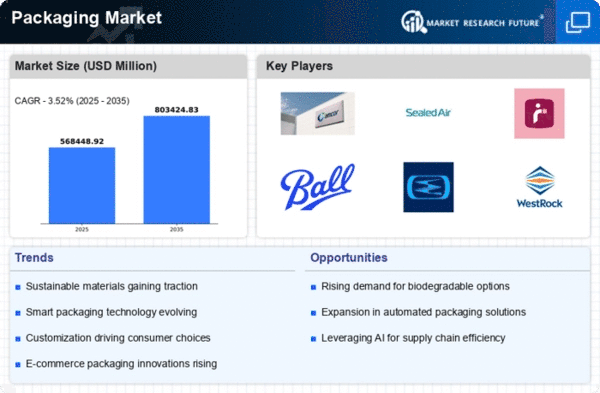
As per MRFR analysis, the Packaging Market Size was estimated at 549119.9 USD Million in 2024. The Packaging industry is projected to grow from 568450.25 USD Million in 2025 to 803424.83 USD Million by 2035, exhibiting a compound annual growth rate (CAGR) of 3.52 during the forecast period 2025 - 2035.

Key Market Trends & Highlights

The Packaging Market is currently experiencing a transformative shift towards sustainability and innovation.

  • The focus on sustainability is reshaping packaging strategies across various industries, particularly in North America. Technological advancements are driving efficiency and customization in packaging solutions, especially in the Asia-Pacific region. Food packaging remains the largest segment, while beverage packaging is witnessing rapid growth due to changing consumer preferences. Sustainability initiatives and e-commerce growth are major drivers influencing the packaging market's evolution.

Market Size & Forecast

2024 Market Size 549119.9 (USD Million)
2035 Market Size 803424.83 (USD Million)
CAGR (2025 - 2035) 3.52%
Largest Regional Market Share in 2024 North America

Major Players

Amcor (AU), Sealed Air (US), Mondi (GB), Ball Corporation (US), Smurfit Kappa (IE), WestRock (US), International Paper (US), Tetra Pak (SE), DS Smith (GB)

Market Trends

The Packaging Market is currently experiencing a dynamic transformation driven by evolving consumer preferences and technological advancements. As sustainability becomes a focal point for both manufacturers and consumers, there is a noticeable shift towards eco-friendly materials and practices. This trend is not merely a response to regulatory pressures but reflects a broader societal commitment to environmental stewardship. Companies are increasingly adopting innovative packaging solutions that minimize waste and enhance recyclability, thereby aligning with the growing demand for sustainable products. Furthermore, advancements in smart packaging technologies are reshaping the landscape, offering enhanced functionality and consumer engagement. These innovations include features such as QR codes and temperature indicators, which provide valuable information and improve the overall user experience. In addition to sustainability and technological integration, the Packaging Market is witnessing a rise in customization and personalization. Brands are recognizing the importance of creating unique packaging that resonates with their target audience. This trend is particularly evident in sectors such as food and beverage, where packaging design plays a crucial role in attracting consumers. As competition intensifies, companies are leveraging creative designs and tailored solutions to differentiate themselves in a crowded marketplace. Overall, the Packaging Market appears poised for continued growth, driven by these multifaceted trends that reflect changing consumer expectations and technological possibilities.

Sustainability Focus

The emphasis on sustainable packaging solutions is becoming increasingly pronounced. Companies are exploring biodegradable materials and reducing plastic usage to meet consumer demand for environmentally friendly options.

Technological Advancements

Innovations in packaging technology are enhancing functionality and consumer interaction. Smart packaging features, such as sensors and digital interfaces, are gaining traction, providing added value to products.

Customization and Personalization

The trend towards personalized packaging is on the rise, as brands seek to create unique experiences for consumers. Tailored designs and limited editions are becoming essential for differentiation in competitive markets.

Packaging Market Market Drivers

E-commerce Growth

The rise of e-commerce has profoundly impacted the Global Packaging Market Industry, necessitating innovative packaging solutions that ensure product safety during transit. With online shopping becoming increasingly prevalent, packaging must adapt to protect goods while also appealing to consumers. The demand for protective packaging materials, such as bubble wrap and corrugated boxes, is on the rise. This trend is expected to contribute to the market's growth, as e-commerce sales continue to surge. By 2035, the market is projected to reach 805.3 USD Billion, indicating the significant role e-commerce plays in shaping packaging requirements.

Consumer Preferences

Consumer preferences play a pivotal role in shaping the Global Packaging as buyers increasingly seek convenience, functionality, and aesthetic appeal in packaging. The demand for user-friendly packaging, such as resealable bags and easy-to-open containers, reflects this trend. Additionally, consumers are becoming more conscious of the environmental impact of packaging, leading to a preference for sustainable options. Companies that effectively respond to these preferences are likely to enhance their market position. As the industry adapts to these changing consumer demands, it is poised for growth, contributing to the projected market value of 549.1 USD Billion in 2024.

Regulatory Compliance

Regulatory compliance is a critical driver in the Global Packaging Market Industry, as governments worldwide implement stricter regulations regarding packaging materials and waste management. Companies must navigate these regulations to avoid penalties and maintain market access. For instance, regulations promoting the use of recyclable materials are prompting manufacturers to innovate and adapt their packaging solutions. This compliance not only ensures legal adherence but also aligns with consumer expectations for sustainable practices. As the industry evolves, adherence to these regulations is likely to shape packaging strategies, influencing market dynamics and growth.

Market Growth Projections

The Global Packaging Industry size is projected to experience substantial growth, with estimates indicating a market value of 549.1 USD Billion in 2024 and an anticipated increase to 805.3 USD Billion by 2035. This growth trajectory suggests a compound annual growth rate of 3.54% from 2025 to 2035. Various factors, including sustainability initiatives, e-commerce expansion, and technological advancements, are likely to drive this growth. As the industry evolves, it is essential to monitor these trends to understand their implications for market dynamics and investment opportunities.

Sustainability Initiatives

The Global Packaging Market Industry is increasingly influenced by sustainability initiatives as consumers and companies alike prioritize eco-friendly practices. This shift is evident in the growing demand for biodegradable and recyclable materials, which are projected to drive market growth. For instance, many companies are adopting sustainable packaging solutions to align with consumer preferences, which could potentially enhance brand loyalty. As a result, the industry is expected to witness a significant transformation, with sustainable packaging solutions becoming a standard rather than an exception. This trend is likely to contribute to the market's projected value of 549.1 USD Billion in 2024.

Technological Advancements

Technological advancements are reshaping the Global Packaging Market Industry by introducing innovative materials and processes that enhance efficiency and reduce costs. Automation in packaging processes, such as robotic packing and smart packaging technologies, is becoming increasingly common. These advancements not only improve production efficiency but also enhance the consumer experience through features like QR codes and interactive packaging. As companies invest in these technologies, they are likely to gain a competitive edge, driving market growth. The anticipated compound annual growth rate of 3.54% from 2025 to 2035 underscores the importance of technology in the evolving packaging landscape.

Market Segment Insights

By Application: Food Packaging (Largest) vs. Beverage Packaging (Fastest-Growing)

The Packaging Market is diverse, with various applications leading in market share. <a href="https://www.marketresearchfuture.com/reports/food-packaging-market-2086">Food Packaging</a> dominates this segment, driven by the increasing demand for convenience and safety in food consumption. Meanwhile, Beverage Packaging is witnessing rapid growth due to the rising consumption of ready-to-drink beverages and innovation in sustainable packaging materials. Both segments showcase distinctive characteristics that address consumer needs while adapting to market trends.

Food Packaging (Dominant) vs. Beverage Packaging (Emerging)

Food Packaging is characterized by its vast array of materials and applications, catering to diverse products like ready meals and fresh produce. It emphasizes sustainability, driving innovations in biodegradable and recyclable materials. On the other hand, Beverage Packaging highlights a dynamic shift towards eco-friendly solutions, with emerging trends in lightweight materials and alternative packaging formats such as glass and recycled plastics. While Food Packaging remains the dominant segment, <a href="https://www.marketresearchfuture.com/reports/beverage-packaging-market-1974">Beverage Packaging</a> is rapidly gaining attention due to changing consumer preferences and health-conscious choices.

By Material Type: Plastic (Largest) vs. Biodegradable Material (Fastest-Growing)

In the Packaging Market, the material type segment showcases a diverse portfolio, with Plastic leading in market share due to its versatility, durability, and low production costs. Glass and Metal follow, each holding significant shares thanks to their premium appeal and recycling potential. Paper stands strong as a preferred eco-friendly option, though still smaller in overall market share compared to <a href="https://www.marketresearchfuture.com/reports/plastics-market-8347">Plastic</a>. Biodegradable materials are emerging, capturing attention as sustainability becomes a greater focus, albeit starting from a smaller base. Looking forward, the growth trends in the material type segment are marked by a shift towards sustainability and environmental responsibility. Driven by consumer preferences for green packaging, Biodegradable materials are rapidly gaining traction, projected as the fastest-growing segment. Meanwhile, the Plastic segment, although dominant, faces challenges from regulatory pressures and changing consumer attitudes, pushing manufacturers to innovate towards more sustainable options, like recycled plastics.

Plastic (Dominant) vs. Biodegradable Material (Emerging)

Plastic serves as the dominant force in the Packaging Market owing to its low-cost production, flexibility in design, and robustness, making it suitable for a multitude of applications. Its widespread use ranges from food packaging to household products. However, this dominance is increasingly challenged as consumer preferences shift towards sustainability, leading to an emerging interest in Biodegradable materials. Biodegradable options are characterized by their ability to decompose naturally, thus minimizing environmental impact. They are gaining traction particularly in sectors aimed at eco-conscious consumers. As regulations tighten around plastic usage and sustainability standards rise, Biodegradable materials are carving a niche, spurred by innovation in material science which enhances their feasibility and cost-effectiveness.

By End Use Industry: Food and Beverage (Largest) vs. Healthcare (Fastest-Growing)

The packaging market is significantly driven by diverse end-use industries, with Food and Beverage segments taking precedence, reflecting a substantial share due to the ongoing demand for convenience and safety in food products. Healthcare remains a key player as well, prominently positioned with substantial shares attributed to the necessity for reliable and sterile packaging solutions, which are integral for pharmaceuticals and medical devices.

Food and Beverage: Dominant vs. Healthcare: Emerging

The Food and Beverage packaging segment is characterized by its established dominance in the market, leveraging innovations in materials that enhance shelf life and convenience. This segment is particularly influenced by consumer preferences for sustainability, leading to increased demand for eco-friendly packaging solutions. Conversely, the Healthcare packaging segment is emerging at a rapid pace, driven by advancements in medical technology and a growing emphasis on safety and compliance. Innovations such as tamper-evident packaging and smart labeling are proving vital, as the need for secure and compliant packaging solutions escalates alongside healthcare advancements.

Get more detailed insights about Packaging Market Research Report—Global Forecast till 2035

Regional Insights

North America : Market Leader in Packaging

North America continues to lead The Packaging, holding a significant share of 220,000.0. The region's growth is driven by increasing demand for sustainable packaging solutions and innovations in materials technology. Regulatory support for eco-friendly practices further enhances market dynamics, as companies adapt to consumer preferences for environmentally responsible products. The rise in e-commerce also fuels demand for efficient packaging solutions, contributing to the region's robust market position. The competitive landscape in North America is characterized by the presence of major players such as Amcor, Sealed Air, and Ball Corporation. These companies are at the forefront of innovation, focusing on advanced packaging technologies and sustainable practices. The U.S. remains the largest market, with Canada and Mexico also contributing to growth. The emphasis on reducing plastic waste and enhancing recyclability is shaping the strategies of key players, ensuring their leadership in the evolving packaging landscape.

Europe : Sustainable Packaging Initiatives

Europe's packaging market is valued at 150,000.0, driven by a strong emphasis on sustainability and regulatory frameworks promoting eco-friendly practices. The European Union's directives on plastic waste reduction and recycling are pivotal in shaping market trends. As consumers increasingly demand sustainable packaging, companies are innovating to meet these expectations, leading to a shift towards biodegradable and recyclable materials. This regulatory environment fosters growth and positions Europe as a leader in sustainable packaging solutions. Leading countries in the European packaging market include Germany, France, and the UK, where major players like Mondi and Smurfit Kappa are actively engaged in developing sustainable products. The competitive landscape is marked by collaboration between manufacturers and regulatory bodies to enhance recycling rates and reduce environmental impact. The focus on circular economy principles is driving innovation, ensuring that Europe remains at the forefront of The Packaging.

Asia-Pacific : Emerging Market Potential

The Asia-Pacific region, with a market size of 160,000.0, is witnessing rapid growth in the packaging sector, driven by urbanization and rising disposable incomes. The demand for packaged goods is increasing, particularly in countries like China and India, where a growing middle class is influencing consumption patterns. Regulatory initiatives aimed at improving packaging waste management are also contributing to market expansion, as governments encourage sustainable practices among manufacturers. China stands out as the largest market in the region, with significant contributions from India and Japan. Key players such as Tetra Pak and DS Smith are focusing on innovative packaging solutions tailored to local preferences. The competitive landscape is evolving, with an increasing number of local manufacturers entering the market, intensifying competition. The emphasis on sustainability and efficiency in packaging is shaping the strategies of both established and emerging players in the region.

Middle East and Africa : Growth Amid Challenges

The Middle East and Africa region, with a market size of 19,000.0, is experiencing growth in the packaging sector, albeit at a slower pace compared to other regions. Factors such as increasing urbanization and a growing population are driving demand for packaged goods. However, challenges such as regulatory inconsistencies and limited infrastructure can hinder market development. Governments are beginning to implement policies aimed at improving waste management and promoting sustainable packaging practices, which could catalyze future growth. Leading countries in this region include South Africa and the UAE, where key players are beginning to establish a stronger presence. Companies are focusing on adapting to local market needs and enhancing their product offerings. The competitive landscape is gradually evolving, with both local and international players vying for market share. As sustainability becomes a priority, the region is likely to see increased investment in innovative packaging solutions.

Key Players and Competitive Insights

The Packaging Market is currently characterized by a dynamic competitive landscape, driven by factors such as sustainability, technological advancements, and evolving consumer preferences. Major players like Amcor (AU), Sealed Air (US), and Tetra Pak (SE) are strategically positioning themselves to leverage these trends. Amcor (AU) focuses on innovation in sustainable packaging solutions, while Sealed Air (US) emphasizes automation and smart packaging technologies. Tetra Pak (SE) is committed to enhancing its product offerings through digital transformation and sustainability initiatives. Collectively, these strategies not only enhance their market presence but also shape a competitive environment that increasingly prioritizes eco-friendly practices and technological integration.
Key business tactics within the Packaging Market include localizing manufacturing and optimizing supply chains to enhance efficiency and responsiveness. The market structure appears moderately fragmented, with a mix of large multinational corporations and smaller regional players. The collective influence of key players fosters a competitive atmosphere where innovation and sustainability are paramount, compelling companies to adapt rapidly to changing market demands.
In November 2025, Amcor (AU) announced a partnership with a leading technology firm to develop biodegradable packaging solutions aimed at reducing plastic waste. This strategic move underscores Amcor's commitment to sustainability and positions the company as a frontrunner in the eco-friendly packaging segment. By investing in biodegradable materials, Amcor not only addresses consumer concerns but also aligns with regulatory trends favoring sustainable practices.
In October 2025, Sealed Air (US) unveiled its latest smart packaging technology, which integrates IoT capabilities to monitor product conditions throughout the supply chain. This innovation is significant as it enhances product safety and reduces waste, thereby appealing to environmentally conscious consumers. Sealed Air's focus on automation and smart solutions reflects a broader industry trend towards digitalization, which is likely to redefine operational efficiencies in the packaging sector.
In September 2025, Tetra Pak (SE) launched a new initiative aimed at increasing the recyclability of its packaging materials. This initiative is crucial as it not only meets growing consumer demand for sustainable products but also positions Tetra Pak as a leader in the circular economy. By enhancing recyclability, Tetra Pak is likely to strengthen its market position and appeal to environmentally aware consumers, further driving its competitive edge.
As of December 2025, current competitive trends in the Packaging Market are heavily influenced by digitalization, sustainability, and the integration of AI technologies. Strategic alliances among key players are shaping the landscape, fostering innovation and collaboration. The shift from price-based competition to a focus on technological advancement and supply chain reliability is evident. Companies that prioritize innovation and sustainability are likely to differentiate themselves in an increasingly competitive market, suggesting a future where adaptability and forward-thinking strategies will be essential for success.

Key Companies in the Packaging Market include

Industry Developments

  • Q4 2024: Amcor Acquires Berry Global Amcor announced its acquisition of Berry Global for $8.4 billion in November 2024, a deal expected to finalize in mid-2025. The combined company will have around 70,000 employees and operations in over 140 countries, making it the largest purchaser of resin globally and a leader in consumer and healthcare packaging.
  • Q4 2024: TOPPAN Holdings announced its acquisition of Sonoco Products Company (Thermoformed and Flexibles Packaging Market Business) for $1.8 billion in December 2024. TOPPAN Holdings, a Japan-based company, announced the acquisition of Sonoco Products Company's Thermoformed and Flexibles Packaging Market Business for $1.8 billion in December 2024, expanding its global packaging footprint.
  • Q4 2024: TricorBraun announced its acquisition of Veritiv Containers at an undisclosed value in December 2024. TricorBraun, a global packaging leader, announced the acquisition of Veritiv Containers in December 2024, further strengthening its position in the packaging sector.
  • Q4 2024: Aterian Investment Partners closed its acquisition of Outlook Group at an undisclosed value in November 2024. Aterian Investment Partners completed the acquisition of Outlook Group, a provider of packaging solutions, in November 2024, expanding its portfolio in the packaging industry.
  • Q4 2024: Hood Packaging Market Corporation closed its acquisition of Transcontinental Packaging Market for $95 million in October 2024. Hood Packaging Market Corporation acquired Transcontinental Packaging Market for $95 million in October 2024, enhancing its capabilities in flexible packaging.
  • Q1 2025: DS Smith, a UK-based manufacturer of packaging products made from recycled paper materials, was acquired by International Paper for $9.9 billion in January 2025. International Paper acquired DS Smith for $9.9 billion in January 2025, positioning itself as an industry leader with an enhanced focus on geographic expansion, particularly across North America and EMEA.
  • Q1 2025: Aluflexpack, a Switzerland-based provider of flexible packaging solutions, was acquired by Constantia Flexibles for $201 million in March 2025. Constantia Flexibles acquired Aluflexpack for $201 million in March 2025, strengthening its position in aluminum-based flexible packaging and expanding its scale in key European markets.
  • Q1 2025: In February 2025, Ball Corporation acquired Florida Can Manufacturing, a provider of custom design, tooling, printing, and packaging services, for $160.0 million. Ball Corporation acquired Florida Can Manufacturing for $160 million in February 2025, aiming to strengthen its North & Central American supply network and meet regional demand.
  • Q1 2025: BEWI, a Norwegian manufacturer of polystyrene beads for the sustainable packaging market, was acquired by Rock Capital and Unipol Holland for $77.6 million in February 2025. Rock Capital and Unipol Holland acquired BEWI for $77.6 million in February 2025, creating a leading producer of expanded polystyrene by merging BEWI’s raw material division with Unipol Holland’s polystyrene portfolio.

Future Outlook

Packaging Market Future Outlook

The Packaging is projected to grow at a 3.52% CAGR from 2024 to 2035, driven by sustainability trends, technological advancements, and increasing consumer demand for convenience.

New opportunities lie in:

  • Development of biodegradable packaging solutions for eco-conscious brands.
  • Integration of smart packaging technologies to enhance product tracking.
  • Expansion into emerging markets with tailored packaging solutions.

By 2035, the Packaging Market is expected to be robust, reflecting adaptability and innovation.

Market Segmentation

Packaging Market Application Outlook

  • Food Packaging
  • Beverage Packaging
  • Pharmaceutical Packaging
  • Cosmetic Packaging
  • Industrial Packaging

Packaging Market Material Type Outlook

  • Plastic
  • Glass
  • Metal
  • Paper
  • Biodegradable Material

Packaging Market End Use Industry Outlook

  • Food and Beverage
  • Healthcare
  • Personal Care
  • Household Products
  • Electronics

Report Scope

MARKET SIZE 2024 549119.9(USD Million)
MARKET SIZE 2025 568450.25(USD Million)
MARKET SIZE 2035 803424.83(USD Million)
COMPOUND ANNUAL GROWTH RATE (CAGR) 3.52% (2025 - 2035)
REPORT COVERAGE Revenue Forecast, Competitive Landscape, Growth Factors, and Trends
BASE YEAR 2024
Market Forecast Period 2025 - 2035
Historical Data 2019 - 2024
Market Forecast Units USD Million
Key Companies Profiled Amcor (AU), Sealed Air (US), Mondi (GB), Ball Corporation (US), Smurfit Kappa (IE), WestRock (US), International Paper (US), Tetra Pak (SE), DS Smith (GB)
Segments Covered Application, Material Type, End Use Industry
Key Market Opportunities Adoption of sustainable materials and smart packaging technologies drives innovation in the Packaging Market.
Key Market Dynamics Rising demand for sustainable packaging solutions drives innovation and competition among manufacturers in the packaging market.
Countries Covered North America, Europe, APAC, South America, MEA

FAQs

How much was the Packaging Market in 2024?

The Packaging Market size was valued at USD 5,49,119.9 Million in 2024.

What is the growth rate of the Packaging Market during the forecast period?

Packaging Market is projected to grow at a CAGR of 3.52% during the forecast period, 2025-2035

Which region held the largest market share in the Packaging Market in 2024?

Europe had the largest share of the Packaging Market in 2024.

Who are the key players in the Packaging Market?

The key players in the market are Amcor Plc, Mondi Plc, Sealed Air Corporation, International Paper, Sonoco Products Company, Westrock Company, Berry Global, Constantia Flexibles, Huhtamaki, and Coveris Holdings, among others.

Which Packaging Material dominated the Packaging Market in 2024?

The paper and paperboard segment dominated the Packaging market in 2024.

Which End User segment had the largest market share in the Packaging Market in 2024?

Food End User had the largest revenue share of the Packaging Market in 2024.

  1. SECTION I: EXECUTIVE SUMMARY AND KEY HIGHLIGHTS
    1. | 1.1 EXECUTIVE SUMMARY
  2. SECTION II: SCOPING, METHODOLOGY AND MARKET STRUCTURE
    1. | 2.1 MARKET INTRODUCTION
    2. | 2.2 RESEARCH METHODOLOGY
  3. SECTION III: QUALITATIVE ANALYSIS
    1. | 3.1 MARKET DYNAMICS
    2. | 3.2 MARKET FACTOR ANALYSIS
  4. SECTION IV: QUANTITATIVE ANALYSIS
    1. | 4.1 Packaging & Transport, BY Application (USD Million)
    2. | 4.2 Packaging & Transport, BY Material Type (USD Million)
    3. | 4.3 Packaging & Transport, BY End Use Industry (USD Million)
    4. | 4.4 Packaging & Transport, BY Region (USD Million)
  5. SECTION V: COMPETITIVE ANALYSIS
    1. | 5.1 Competitive Landscape
    2. | 5.2 Company Profiles
    3. | 5.3 Appendix

Packaging Market Segmentation

Market Segmentation Overview

  • Detailed segmentation data will be available in the full report
  • Comprehensive analysis by multiple parameters
  • Regional and country-level breakdowns
  • Market size forecasts by segment
Infographic

Free Sample Request

Kindly complete the form below to receive a free sample of this Report

Get Free Sample

Customer Strories

Compare Licence

×
Features License Type
Single User Multiuser License Enterprise User
Price $4,950 $5,950 $7,250
Maximum User Access Limit 1 User Upto 10 Users Unrestricted Access Throughout the Organization
Free Customization
Direct Access to Analyst
Deliverable Format
Platform Access
Discount on Next Purchase 10% 15% 15%
Printable Versions