Packaged Substation Market (2026 - 2035)

ID: MRFR/EnP/6219-HCR 111 Pages Priya Nagrale Last Updated: October 16, 2026
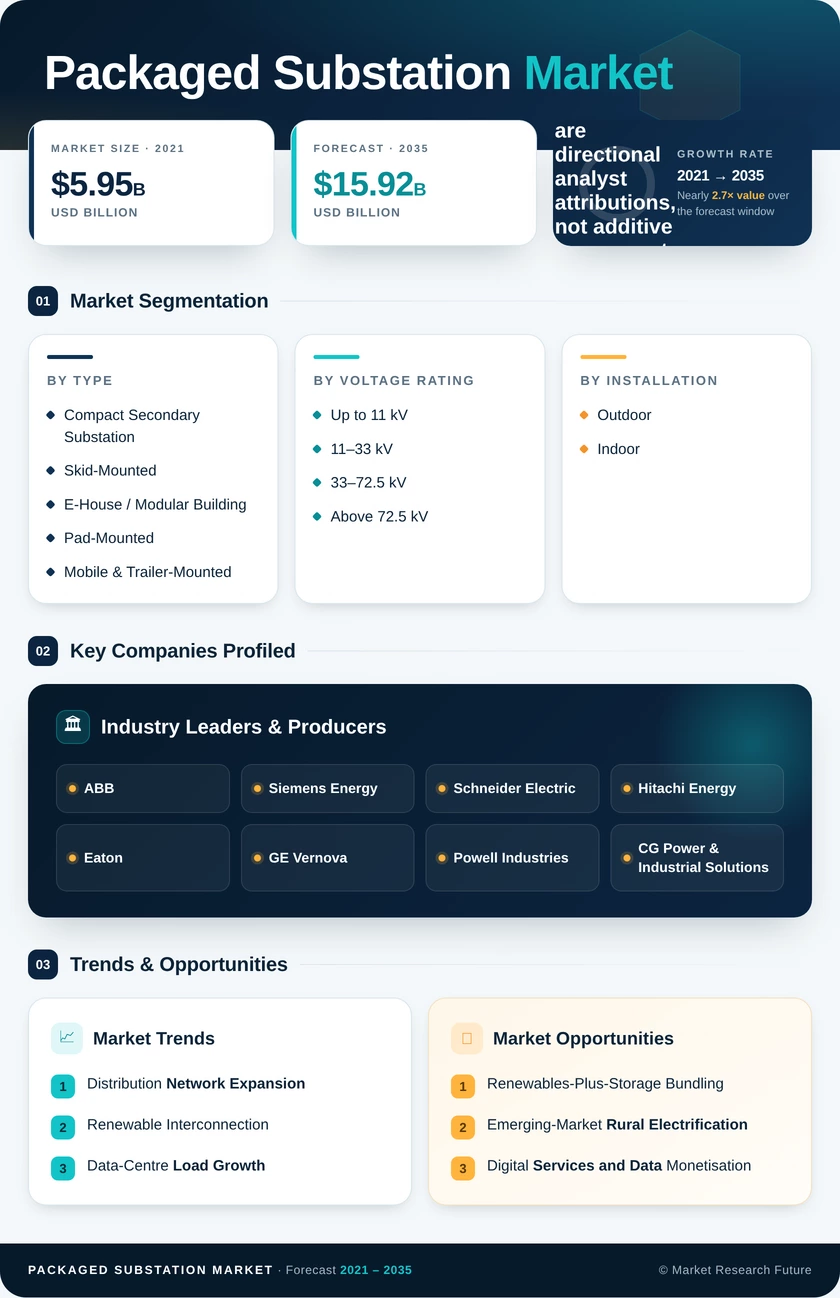
Packaged Substation Market Research Report By Type (Compact Secondary Substation, Skid-Mounted, E-House / Modular Building, Pad-Mounted, Mobile & Trailer-Mounted), By Voltage Rating (Up to 11 kV, 11–33 kV, 33–72.5 kV, Above 72.5 kV), By Installation (Outdoor, Indoor), By End User (Utilities & Power Distribution, Industrial & Manufacturing, Mining & Metals, Oil & Gas, Renewables & Storage, Commercial Infrastructure & Data Centres) - Forecast to 2035
Packaged Substation Market
Market Size
Forecast Period2026-2035
CAGR (2026-2035)7.4%
2025 Market SizeUSD 7.80 Billion
2035 Market SizeUSD 15.92 Billion
Key Players
ABB
Siemens Energy
Schneider Electric
Hitachi Energy
Eaton
GE Vernova
Opportunities
  • Renewables-Plus-Storage Bundling
  • Emerging-Market Rural Electrification
  • Digital Services and Data Monetisation
  1. 1 Market Overview | |
    1. 1.1 Study Assumptions & Market Definition | |
    2. 1.2 Scope of the Study | |
    3. 1.3 Research Methodology | |
  2. 2 Market Summary & Key Report Takeaways | |
  3. 3 Global Market Size & Forecast (2021–2035) | |
    1. 3.1 Historical Market Size (2021–2025) | |
    2. 3.2 Current & Forecast Market Size (2026–2035) | |
    3. 3.3 Market Size by Revenue (USD Billion) | |
    4. 3.4 Year-over-Year Growth Analysis | |
  4. 4 Market Dynamics — Drivers | |
    1. 4.1 Distribution Network Expansion & Reinforcement | |
    2. 4.2 Renewable & Storage Interconnection Demand | |
    3. 4.3 Data-Centre & Hyperscale Load Growth | |
    4. 4.4 Remote Mining & Industrial Electrification | |
    5. 4.5 Urbanisation & Smart-City Distribution Upgrades | |
    6. 4.6 Construction Labour Scarcity & Factory-Build Preference | |
    7. 4.7 Resilience & Disaster-Hardening Mandates | |
  5. 5 Market Dynamics — Restraints | |
    1. 5.1 Transformer & Switchgear Lead Times | |
    2. 5.2 Raw Material Price Volatility | |
    3. 5.3 SF6 Phase-Down & Alternative-Gas Qualification Cost | |
    4. 5.4 Customisation Versus Standardisation | |
    5. 5.5 Commissioning Workforce Shortage | |
  6. 6 Market Opportunity Analysis | |
    1. 6.1 Renewables-Plus-Storage Bundling | |
    2. 6.2 Emerging-Market Rural Electrification | |
    3. 6.3 Digital Services & Recurring Revenue Models | |
    4. 6.4 SF6-Free Retrofit Cycle | |
    5. 6.5 Grid-Edge Flexibility Assets | |
    6. 6.6 Industry Value Chain Analysis | |
    7. 6.7 Porter's Five Forces Analysis | |
  7. 7 Regional Analysis | |
    1. 7.1 North America | | |
      1. 7.1.1 United States | | |
      2. 7.1.2 Canada | | |
      3. 7.1.3 Mexico | |
    2. 7.2 Europe | | |
      1. 7.2.1 Germany | | |
      2. 7.2.2 United Kingdom | | |
      3. 7.2.3 France | | |
      4. 7.2.4 Rest of Europe | |
    3. 7.3 Asia-Pacific | | |
      1. 7.3.1 China | | |
      2. 7.3.2 India | | |
      3. 7.3.3 Japan | | |
      4. 7.3.4 Australia | | |
      5. 7.3.5 Southeast Asia | |
    4. 7.4 South America | | |
      1. 7.4.1 Brazil | | |
      2. 7.4.2 Chile | | |
      3. 7.4.3 Rest of South America | |
    5. 7.5 Middle East & Africa | | |
      1. 7.5.1 Saudi Arabia | | |
      2. 7.5.2 United Arab Emirates | | |
      3. 7.5.3 South Africa | | |
      4. 7.5.4 Rest of Middle East & Africa | |
  8. 8 Future Outlook (2026–2035) | |
    1. 8.1 Digital & Autonomous Operations | |
    2. 8.2 Electrification Supercycle | |
    3. 8.3 Platform Economics & Configurability | |
    4. 8.4 Sustainability & Disclosure Requirements | |
  9. 9 Segmentation Analysis | |
    1. 9.1 By Type | | |
      1. 9.1.1 Compact Secondary Substation | | |
      2. 9.1.2 Skid-Mounted | | |
      3. 9.1.3 E-House / Modular Building | | |
      4. 9.1.4 Pad-Mounted | | |
      5. 9.1.5 Mobile & Trailer-Mounted | |
    2. 9.2 By Voltage Rating | | |
      1. 9.2.1 Up to 11 kV | | |
      2. 9.2.2 11–33 kV | | |
      3. 9.2.3 33–72.5 kV | | |
      4. 9.2.4 Above
    3. 72.5 kV | |
    4. 9.3 By Installation | | |
      1. 9.3.1 Outdoor | | |
      2. 9.3.2 Indoor | |
    5. 9.4 By End User | | |
      1. 9.4.1 Utilities & Power Distribution | | |
      2. 9.4.2 Industrial & Manufacturing | | |
      3. 9.4.3 Mining & Metals | | |
      4. 9.4.4 Oil & Gas | | |
      5. 9.4.5 Renewables & Storage | | |
      6. 9.4.6 Commercial Infrastructure & Data Centres | |
  10. 10 Competitive Landscape | |
    1. 10.1 Market Share Analysis (2026) | |
    2. 10.2 Competitive Benchmarking Matrix | |
    3. 10.3 Company Profiles | | |
      1. 10.3.1 ABB | | |
      2. 10.3.2 Siemens Energy | | |
      3. 10.3.3 Schneider Electric | | |
      4. 10.3.4 Hitachi Energy | | |
      5. 10.3.5 Eaton | | |
      6. 10.3.6 GE Vernova | | |
      7. 10.3.7 Powell Industries | | |
      8. 10.3.8 CG Power & Industrial Solutions | | |
      9. 10.3.9 Efacec | | |
      10. 10.3.10 Ormazabal | |
  11. 11 Recent Developments & News | |
  12. 12 Report Scope & Methodology | |
    1. 12.1 Study Period & Base Year | |
    2. 12.2 Data Sources & Citations | |
    3. 12.3 Abbreviations | |
  13. 13 Detailed Sources & Citations | |
  14. 14 Frequently Asked Questions (FAQs) | | LIST OF TABLES | |
  15. TABLE 1 Global Packaged Substation Market Size & Forecast, by Revenue (USD Billion), 2021–2035 | |
  16. TABLE 2 Global Packaged Substation Market – Year-over-Year Growth Analysis, 2021–2035 | |
  17. TABLE 3 Driver Impact Analysis Matrix, 2026–2035 | |
  18. TABLE 4 Restraint Impact Analysis Matrix, 2026–2035 | |
  19. TABLE 5 Global Market Size, by Type, 2021–2035 (USD Billion) | |
  20. TABLE 6 Global Market Size, by Voltage Rating, 2021–2035 (USD Billion) | |
  21. TABLE 7 Global Market Size, by Installation, 2021–2035 (USD Billion) | |
  22. TABLE 8 Global Market Size, by End User, 2021–2035 (USD Billion) | |
  23. TABLE 9 Global Market Size, by Region, 2021–2035 (USD Billion) | |
  24. TABLE 10 North America Market Size, by Country, 2021–2035 (USD Billion) | |
  25. TABLE 11 Europe Market Size, by Country, 2021–2035 (USD Billion) | |
  26. TABLE 12 Asia-Pacific Market Size, by Country, 2021–2035 (USD Billion) | |
  27. TABLE 13 South America Market Size, by Country, 2021–2035 (USD Billion) | |
  28. TABLE 14 Middle East & Africa Market Size, by Country, 2021–2035 (USD Billion) | |
  29. TABLE 15 North America Market Size, by Type, 2021–2035 (USD Billion) | |
  30. TABLE 16 North America Market Size, by Voltage Rating, 2021–2035 (USD Billion) | |
  31. TABLE 17 North America Market Size, by End User, 2021–2035 (USD Billion) | |
  32. TABLE 18 Europe Market Size, by Type, 2021–2035 (USD Billion) | |
  33. TABLE 19 Europe Market Size, by Voltage Rating, 2021–2035 (USD Billion) | |
  34. TABLE 20 Europe Market Size, by End User, 2021–2035 (USD Billion) | |
  35. TABLE 21 Asia-Pacific Market Size, by Type, 2021–2035 (USD Billion) | |
  36. TABLE 22 Asia-Pacific Market Size, by Voltage Rating, 2021–2035 (USD Billion) | |
  37. TABLE 23 Asia-Pacific Market Size, by End User, 2021–2035 (USD Billion) | |
  38. TABLE 24 South America Market Size, by Type, 2021–2035 (USD Billion) | |
  39. TABLE 25 South America Market Size, by End User, 2021–2035 (USD Billion) | |
  40. TABLE 26 Middle East & Africa Market Size, by Type, 2021–2035 (USD Billion) | |
  41. TABLE 27 Middle East & Africa Market Size, by End User, 2021–2035 (USD Billion) | |
  42. TABLE 28 United States Market Size, by Type & End User, 2021–2035 (USD Billion) | |
  43. TABLE 29 China Market Size, by Type & End User, 2021–2035 (USD Billion) | |
  44. TABLE 30 India Market Size, by Type & End User, 2021–2035 (USD Billion) | |
  45. TABLE 31 Germany Market Size, by Type & End User, 2021–2035 (USD Billion) | |
  46. TABLE 32 Saudi Arabia Market Size, by Type & End User, 2021–2035 (USD Billion) | |
  47. TABLE 33 Brazil Market Size, by Type & End User, 2021–2035 (USD Billion) | |
  48. TABLE 34 Competitive Benchmarking Matrix, 2026 | |
  49. TABLE 35 Company Profiles – Key Players | |
  50. TABLE 36 Recent Developments & Strategic Announcements, 2023–2025 | |
  51. TABLE 37 Report Scope & Methodology Summary | |
  52. TABLE 38 Detailed Sources & Citations Index | | LIST OF FIGURES | |
  53. FIGURE 1 Market Dynamics Snapshot – Drivers, Restraints & Opportunities | |
  54. FIGURE 2 Industry Value Chain Analysis | |
  55. FIGURE 3 Porter's Five Forces Assessment | |
  56. FIGURE 4 Global Market Size Trend, 2021–2035 (USD Billion) | |
  57. FIGURE 5 Year-over-Year Growth Trajectory, 2022–2035 (%) | |
  58. FIGURE 6 Market Share by Type, 2025 vs 2035 (%) | |
  59. FIGURE 7 Market Share by Voltage Rating, 2025 (%) | |
  60. FIGURE 8 Market Share by Installation, 2025 (%) | |
  61. FIGURE 9 Market Share by End User, 2025 vs 2035 (%) | |
  62. FIGURE 10 Regional Revenue Share, 2025 (%) | |
  63. FIGURE 11 Regional CAGR Comparison, 2026–2035 (%) | |
  64. FIGURE 12 North America Country-Level Share, 2025 (%) | |
  65. FIGURE 13 Asia-Pacific Country-Level Share, 2025 (%) | |
  66. FIGURE 14 Competitive Landscape – Revenue Share Ranges, 2026 (%) | |
  67. FIGURE 15 Competitive Positioning Quadrant – Capability vs Delivery Speed

Segmentation Quick Reference

DimensionSub-SegmentsDominant SegmentFastest Growing Segment
By TypeCompact Secondary Substation; Skid-Mounted; E-House / Modular Building; Pad-Mounted; Mobile & Trailer-MountedCompact Secondary SubstationE-House / Modular Building
By Voltage RatingUp to 11 kV; 11–33 kV; 33–72.5 kV; Above 72.5 kVUp to 11 kV33–72.5 kV
By InstallationOutdoor; IndoorOutdoorIndoor
By End UserUtilities & Power Distribution; Industrial & Manufacturing; Mining & Metals; Oil & Gas; Renewables & Storage; Commercial Infrastructure & Data CentresUtilities & Power DistributionRenewables & Storage
By RegionNorth America; Europe; Asia-Pacific; South America; Middle East & AfricaAsia-PacificMiddle East & Africa


Market Segmentation Overview

By Type

Sub-SegmentKey Trend
Compact Secondary SubstationSmaller footprints and arc-classified enclosures for dense urban feeders
Skid-MountedRelocatable designs for phased industrial and extraction projects
E-House / Modular BuildingClimate-controlled rooms integrating switchgear, drives, and controls
Pad-MountedStandardised North American distribution formats with tamper-resistant design
Mobile & Trailer-MountedRapid-deployment units for outage restoration and temporary supply


Product choice increasingly follows site logistics rather than electrical specification alone. Buyers weigh crane access, road load limits, and permitting timelines before settling on an enclosure format.

By Voltage Rating

Sub-SegmentKey Trend
Up to 11 kVHigh unit volumes tied to secondary distribution replacement cycles
11–33 kVStandard band for industrial plants and renewable collector systems
33–72.5 kVFastest expansion as utility-scale solar step-up designs standardise
Above 72.5 kVSpecialist demand from large mining, steel and transmission tie-in projects


Medium-voltage classes carry the bulk of shipments, while higher bands command premium pricing and longer qualification cycles. Vendors with type-tested designs across multiple bands hold an advantage in framework tenders.

By Installation

Sub-SegmentKey Trend
OutdoorWeatherised enclosures with enhanced corrosion and ingress protection
IndoorGrowth tied to data centres, hospitals and mixed-use urban developments


Outdoor configurations remain the default for utility and industrial sites. Indoor variants gain ground wherever real-estate constraints or acoustic limits rule out external placement.

By End User

Sub-SegmentKey Trend
Utilities & Power DistributionMulti-year framework agreements around standardised designs
Industrial & ManufacturingCapacity expansions and process electrification retrofits
Mining & MetalsDiesel-to-electric conversion at remote and high-altitude sites
Oil & GasHazardous-area certified enclosures for upstream and midstream facilities
Renewables & StorageBidirectional protection and hybrid solar-plus-battery configurations
Commercial Infrastructure & Data CentresSchedule-critical procurement with premium paid for delivery certainty


End-user behaviour splits cleanly between repeat institutional buyers and project-driven developers. The former optimise for standardisation and spares commonality; the latter optimise for time-to-energisation.




Download PDF ×

We do not share your information with anyone. However, we may send you emails based on your report interest from time to time. You may contact us at any time to opt-out.