×
  • Cat-intel
  • MedIntelliX
  • Resources
  • About Us
  • Hero Background
    English
    Chinese
    French
    Japanese
    Korean
    German
    Spanish

    Pacemaker Market Trends

    ID: MRFR/HC/1058-HCR
    200 Pages
    Rahul Gotadki
    October 2025

    Pacemaker Market Research Report By Type (Single Chamber Pacemaker, Dual Chamber Pacemaker, Biventricular Pacemaker, Leadless Pacemaker), By Technology (Transvenous Pacemakers, Epicardial Pacemakers, Wireless Pacemakers), By End Use (Hospitals, Cardiac Care Centers, Ambulatory Surgical Centers), By Component (Pulse Generator, Leads, Electrodes, Programming Device) and By Regional (North America...

    Share:
    Download PDF ×

    We do not share your information with anyone. However, we may send you emails based on your report interest from time to time. You may contact us at any time to opt-out.

    Pacemaker Market Infographic
    Purchase Options

    Market Trends

    Key Emerging Trends in the Pacemaker Market

    The rising number of older people around the world has a big effect on the pacemaker business. As the number of older people grows, so does the number of heart diseases that need pacemaker implantation. This increases the demand for pacemaker devices.

    As pacemaker technology keeps getting better, it affects market trends. Some of the most important technology advances that have helped pacemaker devices get better over time are smaller sizes, leadless pacemakers, and longer battery lives.

    There is a clear trend in the market toward pacemakers that don't use leads. Leadless devices, which don't need standard pacing leads, make the insertion process easier and less complicated, which is what drives their popularity.

    Remotely monitorable pacemakers are becoming more popular. Being able to easily access patient data, spot problems early, and act on them quickly improves care for patients and makes healthcare systems more efficient overall.

    MRI compatibility is becoming more and more important in the design of pacemakers. MRI-compatible pacemakers fill a big clinical need by letting people with pacemakers go through MRI treatments without worrying about any possible side effects.

    More and more, pacemakers are working with other cardiovascular internal electronic devices (CIEDs). With this combination, complete heart care is possible, mixing pacemakers with defibrillators or resynchronization devices based on the needs of each patient.

    Personalized medicine with adaptable pacing algorithms is becoming more popular in the market. Pacemakers with adjustable features change the heartbeat settings based on what the patient's body needs. This improves general device performance and makes the heart work better.

    A key goal in developing pacemakers is to make the batteries last longer. Longer battery life means that devices don't have to be replaced as often, which is better for individuals and healthcare systems generally.

    Policies for reimbursement are still a problem in the market for pacemakers. Different payment policies and the need for clear standards affect patients' ability to get pacemaker implants, which changes the way the market works.

    Children's pacemakers get extra attention because they have special needs. Customizing pacemaker options for kids makes sure that kids with heart problems get the right care for their age and improves their quality of life.


    Author
    Rahul Gotadki
    Assistant Manager

    He holds an experience of about 7+ years in Market Research and Business Consulting, working under the spectrum of Life Sciences and Healthcare domains. Rahul conceptualizes and implements a scalable business strategy and provides strategic leadership to the clients. His expertise lies in market estimation, competitive intelligence, pipeline analysis, customer assessment, etc. In addition to the above, his other responsibility includes strategic tracking of high growth markets & advising clients on the potential areas of focus they could direct their business initiatives

    Leave a Comment

    FAQs

    What is the current valuation of the Pacemaker Market as of 2024?

    The Pacemaker Market was valued at 3.76 USD Billion in 2024.

    What is the projected market size for the Pacemaker Market in 2035?

    The market is projected to reach 5.273 USD Billion by 2035.

    What is the expected CAGR for the Pacemaker Market during the forecast period 2025 - 2035?

    The expected CAGR for the Pacemaker Market during 2025 - 2035 is 3.12%.

    Which companies are considered key players in the Pacemaker Market?

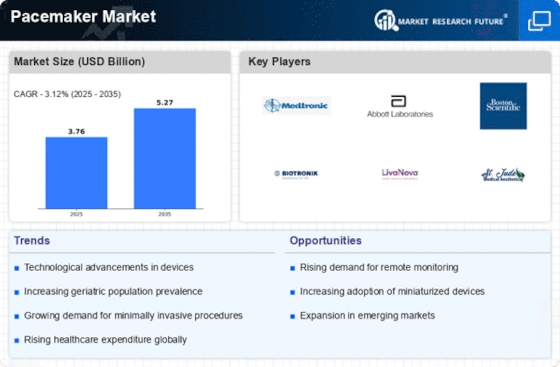
    Key players in the Pacemaker Market include Medtronic, Abbott, Boston Scientific, Biotronik, LivaNova, St. Jude Medical, Sorin Group, and Osypka.

    What are the market segments for Pacemakers based on type?

    The market segments based on type include Single Chamber Pacemaker, Dual Chamber Pacemaker, Biventricular Pacemaker, and Leadless Pacemaker.

    What was the valuation of the Dual Chamber Pacemaker segment in 2024?

    The Dual Chamber Pacemaker segment was valued at 1.5 USD Billion in 2024.

    How is the Pacemaker Market segmented by technology?

    The Pacemaker Market is segmented by technology into Transvenous Pacemakers, Epicardial Pacemakers, and Wireless Pacemakers.

    What is the projected valuation for the Transvenous Pacemaker segment by 2035?

    The Transvenous Pacemaker segment is projected to reach 2.1 USD Billion by 2035.

    What are the end-use segments for Pacemakers?

    End-use segments for Pacemakers include Hospitals, Cardiac Care Centers, and Ambulatory Surgical Centers.

    What is the expected growth for the Pulse Generator component in the Pacemaker Market by 2035?

    The Pulse Generator component is expected to reach a valuation of 2.1 USD Billion by 2035.

    Market Summary

    As per MRFR analysis, the Pacemaker Market Size was estimated at 3.76 USD Billion in 2024. The Pacemaker industry is projected to grow from 3.877 USD Billion in 2025 to 5.273 USD Billion by 2035, exhibiting a compound annual growth rate (CAGR) of 3.12 during the forecast period 2025 - 2035.

    Key Market Trends & Highlights

    The Pacemaker Market is experiencing robust growth driven by technological advancements and increasing healthcare demands.

    • North America remains the largest market for pacemakers, driven by advanced healthcare infrastructure and high patient awareness.
    • The Asia-Pacific region is emerging as the fastest-growing market, fueled by rising healthcare investments and a growing population.
    • Dual chamber pacemakers continue to dominate the market, while leadless pacemakers are gaining traction due to their innovative design and patient benefits.
    • Technological advancements and the rising incidence of cardiovascular diseases are key drivers propelling market growth.

    Market Size & Forecast

    2024 Market Size 3.76 (USD Billion)
    2035 Market Size 5.273 (USD Billion)
    CAGR (2025 - 2035) 3.12%
    Largest Regional Market Share in 2024 North America

    Major Players

    <p>Medtronic (US), Abbott (US), Boston Scientific (US), Biotronik (DE), LivaNova (GB), St. Jude Medical (US), Sorin Group (IT), Osypka (DE)</p>

    Market Trends

    The Pacemaker Market is currently experiencing a transformative phase, driven by advancements in technology and an increasing prevalence of cardiovascular diseases. The integration of innovative features such as remote monitoring and miniaturization of devices appears to enhance patient compliance and overall outcomes. Furthermore, the growing geriatric population, which is more susceptible to heart-related ailments, seems to be a significant factor propelling demand for these devices. As healthcare systems evolve, the emphasis on personalized medicine and patient-centric approaches may further influence market dynamics, suggesting a shift towards more tailored solutions in cardiac care. In addition, the competitive landscape of the Pacemaker Market is becoming increasingly dynamic, with numerous players striving to differentiate their offerings. Collaborations between technology firms and healthcare providers indicate a trend towards developing integrated solutions that not only address the mechanical aspects of pacing but also enhance the overall patient experience. Regulatory bodies are also adapting to these changes, potentially streamlining approval processes for innovative devices. This evolving environment suggests that the Pacemaker Market is poised for sustained growth, with opportunities for new entrants and established companies alike to innovate and expand their reach.

    Technological Advancements

    The Pacemaker Market is witnessing rapid technological innovations, particularly in device miniaturization and connectivity features. These advancements enable remote monitoring, allowing healthcare providers to track patient data in real-time, which may lead to improved patient outcomes and adherence to treatment.

    Rising Cardiovascular Diseases

    An increase in cardiovascular conditions globally is driving the demand for pacemakers. As populations age and lifestyle-related health issues become more prevalent, the need for effective cardiac interventions appears to be escalating, thereby expanding the market.

    Focus on Patient-Centric Solutions

    There is a noticeable shift towards patient-centric approaches in the Pacemaker Market. Companies are increasingly prioritizing user-friendly designs and personalized treatment options, which may enhance patient satisfaction and engagement in their own healthcare.

    Pacemaker Market Market Drivers

    Focus on Patient-Centric Solutions

    The Pacemaker Market is increasingly shifting towards patient-centric solutions, emphasizing personalized care and improved quality of life. This trend is driven by a growing recognition of the importance of patient engagement in treatment outcomes. Manufacturers are developing devices that not only meet clinical needs but also enhance the overall patient experience. Features such as smartphone connectivity and user-friendly interfaces are becoming standard, allowing patients to monitor their health more effectively. Furthermore, the emphasis on shared decision-making between patients and healthcare providers is likely to influence product development in the Pacemaker Market. As patients become more involved in their care, the demand for innovative, patient-focused pacemaker solutions is expected to rise.

    Rising Incidence of Cardiovascular Diseases

    The prevalence of cardiovascular diseases is a critical driver in the Pacemaker Market. As the global population ages, the incidence of heart-related conditions such as arrhythmias and heart block is on the rise. Data indicates that cardiovascular diseases account for nearly 31% of all global deaths, underscoring the urgent need for effective treatment options. This alarming trend is prompting healthcare systems to invest in advanced cardiac devices, including pacemakers, to improve patient outcomes. The increasing awareness of heart health and the importance of early intervention further contribute to the demand for pacemakers. Consequently, the Pacemaker Market is positioned for growth as healthcare providers seek to address the escalating burden of cardiovascular diseases.

    Regulatory Support and Reimbursement Policies

    Regulatory support and favorable reimbursement policies are crucial factors influencing the Pacemaker Market. Governments and regulatory bodies are increasingly recognizing the importance of cardiac devices in improving health outcomes. Streamlined approval processes for new technologies and favorable reimbursement frameworks encourage manufacturers to innovate and bring new products to market. In many regions, pacemakers are covered under health insurance plans, which alleviates the financial burden on patients and promotes device adoption. This supportive regulatory environment is likely to enhance market growth, as it fosters confidence among manufacturers and healthcare providers. As reimbursement policies continue to evolve, the Pacemaker Market may experience accelerated growth, driven by increased accessibility to advanced cardiac care.

    Technological Advancements in Pacemaker Market

    The Pacemaker Market is experiencing rapid technological advancements that enhance device functionality and patient outcomes. Innovations such as leadless pacemakers and MRI-compatible devices are gaining traction, addressing previous limitations. The integration of remote monitoring technologies allows healthcare providers to track patient data in real-time, potentially reducing hospital visits. According to recent data, the market for advanced pacemaker technologies is projected to grow at a compound annual growth rate of approximately 8% over the next five years. This growth is driven by the increasing demand for minimally invasive procedures and improved patient comfort. As technology continues to evolve, the Pacemaker Market is likely to witness further enhancements that could redefine treatment protocols and patient management.

    Aging Population and Increased Healthcare Expenditure

    The aging population is a significant driver of growth in the Pacemaker Market. As individuals age, the likelihood of developing heart conditions increases, leading to a higher demand for pacemakers. In many regions, healthcare expenditure is also on the rise, with governments and private sectors investing more in advanced medical technologies. This trend is reflected in the increasing budgets allocated for cardiac care, which includes pacemaker implantation and follow-up services. According to estimates, healthcare spending is expected to grow by 5% annually, further supporting the expansion of the Pacemaker Market. The combination of an aging demographic and increased healthcare investment creates a favorable environment for the growth of pacemaker technologies.

    Market Segment Insights

    By Type: Dual Chamber Pacemaker (Largest) vs. Leadless Pacemaker (Fastest-Growing)

    <p>The Pacemaker Market is primarily dominated by the dual chamber pacemaker, which accounts for a significant share of the overall market. It is favored for its ability to coordinate the beating of both the atrium and ventricle, thereby providing maximum efficiency for patients with atrioventricular blockages. Following closely are single chamber pacemakers, which are commonly used for their simplicity and effectiveness in treating bradycardia. In contrast, biventricular pacemakers, though less prevalent, cater to a specific subset of patients suffering from heart failure, indicating a diversified market structure across types.</p>

    <p>Pacemaker Types: Dual Chamber (Dominant) vs. Leadless (Emerging)</p>

    <p>The dual chamber pacemaker remains the dominant type due to its extensive application and proven effectiveness in managing heart rhythm disorders. It offers advanced capabilities such as the ability to synchronize heart chambers for improved cardiac function. Meanwhile, the leadless pacemaker, emerging as a popular choice, provides a minimally invasive option that significantly reduces the risks associated with traditional leads used in conventional pacemakers. The rise of leadless technology is driven by an aging population and increasing awareness regarding heart health, making it a crucial player in the market's future growth.</p>

    By Technology: Transvenous Pacemakers (Largest) vs. Wireless Pacemakers (Fastest-Growing)

    <p>In the Pacemaker Market, Transvenous Pacemakers hold the largest market share, primarily due to their established presence and proven effectiveness in managing cardiac rhythm disorders. Epicardial Pacemakers follow, playing a crucial role in specific patient populations, while Wireless Pacemakers, though currently smaller in share, are rapidly gaining traction as advancements in technology render them more appealing to healthcare providers. The distribution of market shares among these segments reflects a combination of clinical usability, healthcare provider preference, and technological advancements. Growth in the Pacemaker Market is being driven by technological innovations, with Wireless Pacemakers leading the charge as the fastest-growing segment. Factors such as the increasing prevalence of cardiovascular diseases and the need for minimally invasive procedures are propelling the demand for newer technologies. Furthermore, ongoing research and development efforts are aimed at enhancing the performance and reliability of existing pacemaker systems, thereby stimulating market growth across all segments. Healthcare providers are increasingly inclined towards solutions that offer enhanced patient outcomes, a trend that favors the emerging technologies in the market.</p>

    <p>Technology: Transvenous Pacemakers (Dominant) vs. Wireless Pacemakers (Emerging)</p>

    <p>Transvenous Pacemakers represent the dominant technology in the Pacemaker Market, characterized by their reliability and broad acceptance among healthcare professionals. These devices are typically implanted through a vein leading to the heart, allowing for better pacing management and effectiveness in treating various cardiac conditions. On the other hand, Wireless Pacemakers signify an emerging technology that is gaining interest due to their innovative design and reduced invasiveness. By eliminating the need for leads, Wireless Pacemakers provide benefits such as fewer complications and shorter recovery times. As the demand for advanced and less intrusive cardiac solutions grows, Wireless Pacemakers are positioned to reshape patient management strategies in the near future.</p>

    By End Use: Hospitals (Largest) vs. Cardiac Care Centers (Fastest-Growing)

    <p>In the Pacemaker Market, hospitals hold the largest share, primarily due to their comprehensive cardiac care services and advanced technological capabilities. Cardiac Care Centers are also significant players, catering specifically to patients with heart conditions and providing specialized care, enhancing their attractiveness and market presence. Ambulatory Surgical Centers, while growing, lag behind in terms of overall market share as they are still establishing themselves in this specialized area of cardiac treatment.</p>

    <p>Hospitals (Dominant) vs. Cardiac Care Centers (Emerging)</p>

    <p>Hospitals represent the dominant force in the Pacemaker Market due to their ability to provide holistic patient care and access to the latest cardiac technologies. They benefit from extensive resources, skilled personnel, and established patient trust, making them the first choice for many undergoing pacemaker implantation. Conversely, Cardiac Care Centers, while emerging, are rapidly gaining traction by offering specialized and focused cardiac care. Their growth is driven by an increasing demand for outpatient procedures and shorter recovery times, positioning them as a formidable competitor in the market.</p>

    By Component: Pulse Generator (Largest) vs. Leads (Fastest-Growing)

    <p>The Pacemaker Market's component segment exhibits distinct distribution patterns. The Pulse Generator remains the most significant component, accounting for a major portion of the market share due to its essential role in providing stimulation to the heart. Following closely are Leads, which are gaining traction as significant contributors owing to advancements in design and functionality that enhance patient outcomes. Electrodes and Programming Devices follow, playing critical roles but holding smaller shares comparatively. Overall, this segment reveals a clear delineation in share distribution, with the Pulse Generator leading the charge.</p>

    <p>Pulse Generator (Dominant) vs. Leads (Emerging)</p>

    <p>The Pulse Generator is pivotal in the Pacemaker Market, acting as the core device that delivers electrical impulses to the heart. Its dominance stems from the widespread adaptation of its technology in modern pacemaking. Meanwhile, Leads are emerging as an increasingly important component, especially considering innovations that improve their durability and effectiveness. These leads connect the Pulse Generator to the heart muscle, and their evolving designs are making them more appealing and reliable for healthcare providers. The contrasting positions of these segments highlight the ongoing evolution in cardiac technology, where traditional elements like the Pulse Generator are complemented by robust advancements in leads. Together, they represent the evolving landscape of cardiac rhythm management.</p>

    Get more detailed insights about Pacemaker Market Research Report-Forecast to 2035

    Regional Insights

    North America : Market Leader in Innovation

    North America is the largest market for pacemakers, accounting for approximately 45% of the global share. The region's growth is driven by advanced healthcare infrastructure, increasing prevalence of cardiovascular diseases, and a strong focus on research and development. Regulatory support from agencies like the FDA has also catalyzed innovation, leading to the introduction of next-generation devices that enhance patient outcomes. The United States is the primary contributor to this market, with key players such as Medtronic, Abbott, and Boston Scientific leading the competitive landscape. These companies are continuously innovating, focusing on miniaturization and remote monitoring technologies. Canada also plays a significant role, contributing to the overall market growth with its robust healthcare system and increasing adoption of advanced medical devices.

    Europe : Emerging Market with Growth Potential

    Europe is the second-largest market for pacemakers, holding around 30% of the global share. The region's growth is propelled by an aging population, rising healthcare expenditure, and favorable regulatory frameworks that encourage innovation. The European Medicines Agency (EMA) has been instrumental in streamlining the approval process for new devices, thus enhancing market accessibility and fostering competition among manufacturers. Germany, France, and the UK are the leading countries in this market, with a strong presence of key players like Biotronik and LivaNova. The competitive landscape is characterized by a mix of established companies and emerging startups focusing on innovative solutions. The increasing prevalence of heart diseases and the demand for minimally invasive procedures are further driving the market in Europe.

    Asia-Pacific : Rapidly Growing Market Segment

    Asia-Pacific is witnessing rapid growth in the pacemaker market, accounting for approximately 20% of the global share. The region's expansion is driven by increasing healthcare investments, rising awareness about cardiovascular health, and a growing elderly population. Countries like China and India are focusing on improving healthcare infrastructure, which is expected to further boost the demand for pacemakers in the coming years. China is the largest market in the region, with significant contributions from local manufacturers and international players. The competitive landscape is evolving, with companies like Abbott and Boston Scientific expanding their presence. The increasing prevalence of heart diseases and the push for advanced medical technologies are key factors driving market growth in Asia-Pacific.

    Middle East and Africa : Untapped Market with Opportunities

    The Middle East and Africa region is an emerging market for pacemakers, holding about 5% of the global share. The growth is primarily driven by increasing healthcare investments, rising awareness of cardiovascular diseases, and government initiatives aimed at improving healthcare access. Countries like South Africa and the UAE are leading the way, with significant investments in healthcare infrastructure and technology. The competitive landscape is still developing, with a mix of local and international players. Key companies like Sorin Group and Osypka are establishing their presence in the region. The demand for advanced medical devices is expected to rise as healthcare systems evolve, presenting significant opportunities for growth in the pacemaker market.

    Key Players and Competitive Insights

    The Pacemaker is currently characterized by a dynamic competitive landscape, driven by technological advancements, increasing prevalence of cardiovascular diseases, and a growing aging population. Major players such as Medtronic (US), Abbott (US), and Boston Scientific (US) are at the forefront, each adopting distinct strategies to enhance their market positioning. Medtronic (US) emphasizes innovation through continuous product development, focusing on advanced features such as remote monitoring capabilities. Abbott (US), on the other hand, appears to be concentrating on strategic partnerships to expand its product offerings and market reach, while Boston Scientific (US) is investing heavily in digital transformation initiatives to improve patient outcomes and operational efficiency. Collectively, these strategies contribute to a competitive environment that is increasingly focused on technological innovation and patient-centric solutions.

    In terms of business tactics, companies are localizing manufacturing to reduce costs and enhance supply chain efficiency. This approach is particularly relevant in a moderately fragmented market where several players vie for market share. The competitive structure is influenced by the collective actions of key players, who are increasingly optimizing their supply chains and manufacturing processes to respond to market demands swiftly. This trend indicates a shift towards a more integrated and responsive market structure, where agility and efficiency are paramount.

    In August 2025, Medtronic (US) announced the launch of its latest generation of pacemakers, which incorporate advanced AI algorithms for predictive analytics. This strategic move is significant as it positions Medtronic as a leader in integrating artificial intelligence into cardiac care, potentially enhancing patient monitoring and outcomes. The introduction of such innovative technology may set a new standard in the industry, compelling competitors to accelerate their own R&D efforts.

    In September 2025, Abbott (US) entered into a collaboration with a leading telehealth provider to enhance remote patient management capabilities for its pacemaker devices. This partnership is indicative of a broader trend towards digital health solutions, suggesting that Abbott is keen on leveraging technology to improve patient engagement and adherence to treatment protocols. Such strategic alliances may not only enhance Abbott's product offerings but also strengthen its market presence in the rapidly evolving digital health landscape.

    In October 2025, Boston Scientific (US) unveiled a new initiative aimed at sustainability in its manufacturing processes, committing to reduce carbon emissions by 50% by 2030. This move reflects a growing trend among medical device manufacturers to prioritize sustainability, which could resonate well with environmentally conscious consumers and healthcare providers. By aligning its operational strategies with sustainability goals, Boston Scientific may enhance its brand reputation and appeal in a market increasingly influenced by corporate responsibility.

    As of October 2025, the Pacemaker Market is witnessing trends that emphasize digitalization, sustainability, and the integration of advanced technologies such as AI. Strategic alliances are becoming increasingly pivotal, shaping the competitive landscape as companies seek to enhance their capabilities and market reach. Looking ahead, it appears that competitive differentiation will likely evolve from traditional price-based competition to a focus on innovation, technological advancements, and supply chain reliability. This shift may redefine how companies position themselves in the market, ultimately benefiting patients through improved care and outcomes.

    Key Companies in the Pacemaker Market market include

    Industry Developments

    There have been important changes and improvements in the Pacemaker Market in the last few months. Medtronic released its next-generation leadless pacemaker in September 2023. This pacemaker has better connectivity and remote monitoring features, which are meant to improve patient outcomes and make follow-up care easier.

    At the same time, Abbott Laboratories has been working to grow its cardiac rhythm management (CRM) portfolio. This includes new developments in implantable cardioverter defibrillators (ICDs), which are very similar to pacemakers in terms of function and market segment.

    The industry has also seen a lot of growth in revenue. For example, in the third quarter of 2023, both Medtronic and Boston Scientific said that their cardiac device divisions made more money, mostly because there was more demand for advanced pacemaker technologies.In March 2023, Boston Scientific bought a startup that makes medical devices and specializes in new pacing solutions. The goal was to make the company stronger in the CRM market.

    LivaNova, which was formed when Sorin Group and Cyberonics merged in 2015, has also kept investing in research and development projects that aim to improve cardiac care technologies, especially in the areas of neuromodulation and heart rhythm devices.

    These changes show that the pacemaker industry is changing quickly because of new technologies, strategic purchases, and more patients wanting cardiac care solutions that are less invasive and more connected.

    Future Outlook

    Pacemaker Market Future Outlook

    <p>The Pacemaker Market is projected to grow at a 3.12% CAGR from 2024 to 2035, driven by technological advancements, increasing cardiovascular diseases, and rising geriatric population.</p>

    New opportunities lie in:

    • <p>Development of remote monitoring solutions for pacemaker patients.</p>
    • <p>Expansion into emerging markets with affordable pacemaker options.</p>
    • <p>Partnerships with telehealth platforms for integrated patient care.</p>

    <p>By 2035, the Pacemaker Market is expected to achieve robust growth, reflecting evolving healthcare needs.</p>

    Market Segmentation

    Pacemaker Market Type Outlook

    • Single Chamber Pacemaker
    • Dual Chamber Pacemaker
    • Biventricular Pacemaker
    • Leadless Pacemaker

    Pacemaker Market End Use Outlook

    • Hospitals
    • Cardiac Care Centers
    • Ambulatory Surgical Centers

    Pacemaker Market Component Outlook

    • Pulse Generator
    • Leads
    • Electrodes
    • Programming Device

    Pacemaker Market Technology Outlook

    • Transvenous Pacemakers
    • Epicardial Pacemakers
    • Wireless Pacemakers

    Report Scope

    MARKET SIZE 20243.76(USD Billion)
    MARKET SIZE 20253.877(USD Billion)
    MARKET SIZE 20355.273(USD Billion)
    COMPOUND ANNUAL GROWTH RATE (CAGR)3.12% (2024 - 2035)
    REPORT COVERAGERevenue Forecast, Competitive Landscape, Growth Factors, and Trends
    BASE YEAR2024
    Market Forecast Period2025 - 2035
    Historical Data2019 - 2024
    Market Forecast UnitsUSD Billion
    Key Companies ProfiledMarket analysis in progress
    Segments CoveredMarket segmentation analysis in progress
    Key Market OpportunitiesIntegration of advanced remote monitoring technologies in the Pacemaker Market enhances patient care and engagement.
    Key Market DynamicsTechnological advancements and regulatory changes drive innovation and competition in the Pacemaker Market.
    Countries CoveredNorth America, Europe, APAC, South America, MEA

    FAQs

    What is the current valuation of the Pacemaker Market as of 2024?

    The Pacemaker Market was valued at 3.76 USD Billion in 2024.

    What is the projected market size for the Pacemaker Market in 2035?

    The market is projected to reach 5.273 USD Billion by 2035.

    What is the expected CAGR for the Pacemaker Market during the forecast period 2025 - 2035?

    The expected CAGR for the Pacemaker Market during 2025 - 2035 is 3.12%.

    Which companies are considered key players in the Pacemaker Market?

    Key players in the Pacemaker Market include Medtronic, Abbott, Boston Scientific, Biotronik, LivaNova, St. Jude Medical, Sorin Group, and Osypka.

    What are the market segments for Pacemakers based on type?

    The market segments based on type include Single Chamber Pacemaker, Dual Chamber Pacemaker, Biventricular Pacemaker, and Leadless Pacemaker.

    What was the valuation of the Dual Chamber Pacemaker segment in 2024?

    The Dual Chamber Pacemaker segment was valued at 1.5 USD Billion in 2024.

    How is the Pacemaker Market segmented by technology?

    The Pacemaker Market is segmented by technology into Transvenous Pacemakers, Epicardial Pacemakers, and Wireless Pacemakers.

    What is the projected valuation for the Transvenous Pacemaker segment by 2035?

    The Transvenous Pacemaker segment is projected to reach 2.1 USD Billion by 2035.

    What are the end-use segments for Pacemakers?

    End-use segments for Pacemakers include Hospitals, Cardiac Care Centers, and Ambulatory Surgical Centers.

    What is the expected growth for the Pulse Generator component in the Pacemaker Market by 2035?

    The Pulse Generator component is expected to reach a valuation of 2.1 USD Billion by 2035.

    1. SECTION I: EXECUTIVE SUMMARY AND KEY HIGHLIGHTS
      1. | 1.1 EXECUTIVE SUMMARY
      2. | | 1.1.1 Market Overview
      3. | | 1.1.2 Key Findings
      4. | | 1.1.3 Market Segmentation
      5. | | 1.1.4 Competitive Landscape
      6. | | 1.1.5 Challenges and Opportunities
      7. | | 1.1.6 Future Outlook
    2. SECTION II: SCOPING, METHODOLOGY AND MARKET STRUCTURE
      1. | 2.1 MARKET INTRODUCTION
      2. | | 2.1.1 Definition
      3. | | 2.1.2 Scope of the study
      4. | | | 2.1.2.1 Research Objective
      5. | | | 2.1.2.2 Assumption
      6. | | | 2.1.2.3 Limitations
      7. | 2.2 RESEARCH METHODOLOGY
      8. | | 2.2.1 Overview
      9. | | 2.2.2 Data Mining
      10. | | 2.2.3 Secondary Research
      11. | | 2.2.4 Primary Research
      12. | | | 2.2.4.1 Primary Interviews and Information Gathering Process
      13. | | | 2.2.4.2 Breakdown of Primary Respondents
      14. | | 2.2.5 Forecasting Model
      15. | | 2.2.6 Market Size Estimation
      16. | | | 2.2.6.1 Bottom-Up Approach
      17. | | | 2.2.6.2 Top-Down Approach
      18. | | 2.2.7 Data Triangulation
      19. | | 2.2.8 Validation
    3. SECTION III: QUALITATIVE ANALYSIS
      1. | 3.1 MARKET DYNAMICS
      2. | | 3.1.1 Overview
      3. | | 3.1.2 Drivers
      4. | | 3.1.3 Restraints
      5. | | 3.1.4 Opportunities
      6. | 3.2 MARKET FACTOR ANALYSIS
      7. | | 3.2.1 Value chain Analysis
      8. | | 3.2.2 Porter's Five Forces Analysis
      9. | | | 3.2.2.1 Bargaining Power of Suppliers
      10. | | | 3.2.2.2 Bargaining Power of Buyers
      11. | | | 3.2.2.3 Threat of New Entrants
      12. | | | 3.2.2.4 Threat of Substitutes
      13. | | | 3.2.2.5 Intensity of Rivalry
      14. | | 3.2.3 COVID-19 Impact Analysis
      15. | | | 3.2.3.1 Market Impact Analysis
      16. | | | 3.2.3.2 Regional Impact
      17. | | | 3.2.3.3 Opportunity and Threat Analysis
    4. SECTION IV: QUANTITATIVE ANALYSIS
      1. | 4.1 Healthcare, BY Type (USD Billion)
      2. | | 4.1.1 Single Chamber Pacemaker
      3. | | 4.1.2 Dual Chamber Pacemaker
      4. | | 4.1.3 Biventricular Pacemaker
      5. | | 4.1.4 Leadless Pacemaker
      6. | 4.2 Healthcare, BY Technology (USD Billion)
      7. | | 4.2.1 Transvenous Pacemakers
      8. | | 4.2.2 Epicardial Pacemakers
      9. | | 4.2.3 Wireless Pacemakers
      10. | 4.3 Healthcare, BY End Use (USD Billion)
      11. | | 4.3.1 Hospitals
      12. | | 4.3.2 Cardiac Care Centers
      13. | | 4.3.3 Ambulatory Surgical Centers
      14. | 4.4 Healthcare, BY Component (USD Billion)
      15. | | 4.4.1 Pulse Generator
      16. | | 4.4.2 Leads
      17. | | 4.4.3 Electrodes
      18. | | 4.4.4 Programming Device
      19. | 4.5 Healthcare, BY Region (USD Billion)
      20. | | 4.5.1 North America
      21. | | | 4.5.1.1 US
      22. | | | 4.5.1.2 Canada
      23. | | 4.5.2 Europe
      24. | | | 4.5.2.1 Germany
      25. | | | 4.5.2.2 UK
      26. | | | 4.5.2.3 France
      27. | | | 4.5.2.4 Russia
      28. | | | 4.5.2.5 Italy
      29. | | | 4.5.2.6 Spain
      30. | | | 4.5.2.7 Rest of Europe
      31. | | 4.5.3 APAC
      32. | | | 4.5.3.1 China
      33. | | | 4.5.3.2 India
      34. | | | 4.5.3.3 Japan
      35. | | | 4.5.3.4 South Korea
      36. | | | 4.5.3.5 Malaysia
      37. | | | 4.5.3.6 Thailand
      38. | | | 4.5.3.7 Indonesia
      39. | | | 4.5.3.8 Rest of APAC
      40. | | 4.5.4 South America
      41. | | | 4.5.4.1 Brazil
      42. | | | 4.5.4.2 Mexico
      43. | | | 4.5.4.3 Argentina
      44. | | | 4.5.4.4 Rest of South America
      45. | | 4.5.5 MEA
      46. | | | 4.5.5.1 GCC Countries
      47. | | | 4.5.5.2 South Africa
      48. | | | 4.5.5.3 Rest of MEA
    5. SECTION V: COMPETITIVE ANALYSIS
      1. | 5.1 Competitive Landscape
      2. | | 5.1.1 Overview
      3. | | 5.1.2 Competitive Analysis
      4. | | 5.1.3 Market share Analysis
      5. | | 5.1.4 Major Growth Strategy in the Healthcare
      6. | | 5.1.5 Competitive Benchmarking
      7. | | 5.1.6 Leading Players in Terms of Number of Developments in the Healthcare
      8. | | 5.1.7 Key developments and growth strategies
      9. | | | 5.1.7.1 New Product Launch/Service Deployment
      10. | | | 5.1.7.2 Merger & Acquisitions
      11. | | | 5.1.7.3 Joint Ventures
      12. | | 5.1.8 Major Players Financial Matrix
      13. | | | 5.1.8.1 Sales and Operating Income
      14. | | | 5.1.8.2 Major Players R&D Expenditure. 2023
      15. | 5.2 Company Profiles
      16. | | 5.2.1 Medtronic (US)
      17. | | | 5.2.1.1 Financial Overview
      18. | | | 5.2.1.2 Products Offered
      19. | | | 5.2.1.3 Key Developments
      20. | | | 5.2.1.4 SWOT Analysis
      21. | | | 5.2.1.5 Key Strategies
      22. | | 5.2.2 Abbott (US)
      23. | | | 5.2.2.1 Financial Overview
      24. | | | 5.2.2.2 Products Offered
      25. | | | 5.2.2.3 Key Developments
      26. | | | 5.2.2.4 SWOT Analysis
      27. | | | 5.2.2.5 Key Strategies
      28. | | 5.2.3 Boston Scientific (US)
      29. | | | 5.2.3.1 Financial Overview
      30. | | | 5.2.3.2 Products Offered
      31. | | | 5.2.3.3 Key Developments
      32. | | | 5.2.3.4 SWOT Analysis
      33. | | | 5.2.3.5 Key Strategies
      34. | | 5.2.4 Biotronik (DE)
      35. | | | 5.2.4.1 Financial Overview
      36. | | | 5.2.4.2 Products Offered
      37. | | | 5.2.4.3 Key Developments
      38. | | | 5.2.4.4 SWOT Analysis
      39. | | | 5.2.4.5 Key Strategies
      40. | | 5.2.5 LivaNova (GB)
      41. | | | 5.2.5.1 Financial Overview
      42. | | | 5.2.5.2 Products Offered
      43. | | | 5.2.5.3 Key Developments
      44. | | | 5.2.5.4 SWOT Analysis
      45. | | | 5.2.5.5 Key Strategies
      46. | | 5.2.6 St. Jude Medical (US)
      47. | | | 5.2.6.1 Financial Overview
      48. | | | 5.2.6.2 Products Offered
      49. | | | 5.2.6.3 Key Developments
      50. | | | 5.2.6.4 SWOT Analysis
      51. | | | 5.2.6.5 Key Strategies
      52. | | 5.2.7 Sorin Group (IT)
      53. | | | 5.2.7.1 Financial Overview
      54. | | | 5.2.7.2 Products Offered
      55. | | | 5.2.7.3 Key Developments
      56. | | | 5.2.7.4 SWOT Analysis
      57. | | | 5.2.7.5 Key Strategies
      58. | | 5.2.8 Osypka (DE)
      59. | | | 5.2.8.1 Financial Overview
      60. | | | 5.2.8.2 Products Offered
      61. | | | 5.2.8.3 Key Developments
      62. | | | 5.2.8.4 SWOT Analysis
      63. | | | 5.2.8.5 Key Strategies
      64. | 5.3 Appendix
      65. | | 5.3.1 References
      66. | | 5.3.2 Related Reports
    6. LIST OF FIGURES
      1. | 6.1 MARKET SYNOPSIS
      2. | 6.2 NORTH AMERICA MARKET ANALYSIS
      3. | 6.3 US MARKET ANALYSIS BY TYPE
      4. | 6.4 US MARKET ANALYSIS BY TECHNOLOGY
      5. | 6.5 US MARKET ANALYSIS BY END USE
      6. | 6.6 US MARKET ANALYSIS BY COMPONENT
      7. | 6.7 CANADA MARKET ANALYSIS BY TYPE
      8. | 6.8 CANADA MARKET ANALYSIS BY TECHNOLOGY
      9. | 6.9 CANADA MARKET ANALYSIS BY END USE
      10. | 6.10 CANADA MARKET ANALYSIS BY COMPONENT
      11. | 6.11 EUROPE MARKET ANALYSIS
      12. | 6.12 GERMANY MARKET ANALYSIS BY TYPE
      13. | 6.13 GERMANY MARKET ANALYSIS BY TECHNOLOGY
      14. | 6.14 GERMANY MARKET ANALYSIS BY END USE
      15. | 6.15 GERMANY MARKET ANALYSIS BY COMPONENT
      16. | 6.16 UK MARKET ANALYSIS BY TYPE
      17. | 6.17 UK MARKET ANALYSIS BY TECHNOLOGY
      18. | 6.18 UK MARKET ANALYSIS BY END USE
      19. | 6.19 UK MARKET ANALYSIS BY COMPONENT
      20. | 6.20 FRANCE MARKET ANALYSIS BY TYPE
      21. | 6.21 FRANCE MARKET ANALYSIS BY TECHNOLOGY
      22. | 6.22 FRANCE MARKET ANALYSIS BY END USE
      23. | 6.23 FRANCE MARKET ANALYSIS BY COMPONENT
      24. | 6.24 RUSSIA MARKET ANALYSIS BY TYPE
      25. | 6.25 RUSSIA MARKET ANALYSIS BY TECHNOLOGY
      26. | 6.26 RUSSIA MARKET ANALYSIS BY END USE
      27. | 6.27 RUSSIA MARKET ANALYSIS BY COMPONENT
      28. | 6.28 ITALY MARKET ANALYSIS BY TYPE
      29. | 6.29 ITALY MARKET ANALYSIS BY TECHNOLOGY
      30. | 6.30 ITALY MARKET ANALYSIS BY END USE
      31. | 6.31 ITALY MARKET ANALYSIS BY COMPONENT
      32. | 6.32 SPAIN MARKET ANALYSIS BY TYPE
      33. | 6.33 SPAIN MARKET ANALYSIS BY TECHNOLOGY
      34. | 6.34 SPAIN MARKET ANALYSIS BY END USE
      35. | 6.35 SPAIN MARKET ANALYSIS BY COMPONENT
      36. | 6.36 REST OF EUROPE MARKET ANALYSIS BY TYPE
      37. | 6.37 REST OF EUROPE MARKET ANALYSIS BY TECHNOLOGY
      38. | 6.38 REST OF EUROPE MARKET ANALYSIS BY END USE
      39. | 6.39 REST OF EUROPE MARKET ANALYSIS BY COMPONENT
      40. | 6.40 APAC MARKET ANALYSIS
      41. | 6.41 CHINA MARKET ANALYSIS BY TYPE
      42. | 6.42 CHINA MARKET ANALYSIS BY TECHNOLOGY
      43. | 6.43 CHINA MARKET ANALYSIS BY END USE
      44. | 6.44 CHINA MARKET ANALYSIS BY COMPONENT
      45. | 6.45 INDIA MARKET ANALYSIS BY TYPE
      46. | 6.46 INDIA MARKET ANALYSIS BY TECHNOLOGY
      47. | 6.47 INDIA MARKET ANALYSIS BY END USE
      48. | 6.48 INDIA MARKET ANALYSIS BY COMPONENT
      49. | 6.49 JAPAN MARKET ANALYSIS BY TYPE
      50. | 6.50 JAPAN MARKET ANALYSIS BY TECHNOLOGY
      51. | 6.51 JAPAN MARKET ANALYSIS BY END USE
      52. | 6.52 JAPAN MARKET ANALYSIS BY COMPONENT
      53. | 6.53 SOUTH KOREA MARKET ANALYSIS BY TYPE
      54. | 6.54 SOUTH KOREA MARKET ANALYSIS BY TECHNOLOGY
      55. | 6.55 SOUTH KOREA MARKET ANALYSIS BY END USE
      56. | 6.56 SOUTH KOREA MARKET ANALYSIS BY COMPONENT
      57. | 6.57 MALAYSIA MARKET ANALYSIS BY TYPE
      58. | 6.58 MALAYSIA MARKET ANALYSIS BY TECHNOLOGY
      59. | 6.59 MALAYSIA MARKET ANALYSIS BY END USE
      60. | 6.60 MALAYSIA MARKET ANALYSIS BY COMPONENT
      61. | 6.61 THAILAND MARKET ANALYSIS BY TYPE
      62. | 6.62 THAILAND MARKET ANALYSIS BY TECHNOLOGY
      63. | 6.63 THAILAND MARKET ANALYSIS BY END USE
      64. | 6.64 THAILAND MARKET ANALYSIS BY COMPONENT
      65. | 6.65 INDONESIA MARKET ANALYSIS BY TYPE
      66. | 6.66 INDONESIA MARKET ANALYSIS BY TECHNOLOGY
      67. | 6.67 INDONESIA MARKET ANALYSIS BY END USE
      68. | 6.68 INDONESIA MARKET ANALYSIS BY COMPONENT
      69. | 6.69 REST OF APAC MARKET ANALYSIS BY TYPE
      70. | 6.70 REST OF APAC MARKET ANALYSIS BY TECHNOLOGY
      71. | 6.71 REST OF APAC MARKET ANALYSIS BY END USE
      72. | 6.72 REST OF APAC MARKET ANALYSIS BY COMPONENT
      73. | 6.73 SOUTH AMERICA MARKET ANALYSIS
      74. | 6.74 BRAZIL MARKET ANALYSIS BY TYPE
      75. | 6.75 BRAZIL MARKET ANALYSIS BY TECHNOLOGY
      76. | 6.76 BRAZIL MARKET ANALYSIS BY END USE
      77. | 6.77 BRAZIL MARKET ANALYSIS BY COMPONENT
      78. | 6.78 MEXICO MARKET ANALYSIS BY TYPE
      79. | 6.79 MEXICO MARKET ANALYSIS BY TECHNOLOGY
      80. | 6.80 MEXICO MARKET ANALYSIS BY END USE
      81. | 6.81 MEXICO MARKET ANALYSIS BY COMPONENT
      82. | 6.82 ARGENTINA MARKET ANALYSIS BY TYPE
      83. | 6.83 ARGENTINA MARKET ANALYSIS BY TECHNOLOGY
      84. | 6.84 ARGENTINA MARKET ANALYSIS BY END USE
      85. | 6.85 ARGENTINA MARKET ANALYSIS BY COMPONENT
      86. | 6.86 REST OF SOUTH AMERICA MARKET ANALYSIS BY TYPE
      87. | 6.87 REST OF SOUTH AMERICA MARKET ANALYSIS BY TECHNOLOGY
      88. | 6.88 REST OF SOUTH AMERICA MARKET ANALYSIS BY END USE
      89. | 6.89 REST OF SOUTH AMERICA MARKET ANALYSIS BY COMPONENT
      90. | 6.90 MEA MARKET ANALYSIS
      91. | 6.91 GCC COUNTRIES MARKET ANALYSIS BY TYPE
      92. | 6.92 GCC COUNTRIES MARKET ANALYSIS BY TECHNOLOGY
      93. | 6.93 GCC COUNTRIES MARKET ANALYSIS BY END USE
      94. | 6.94 GCC COUNTRIES MARKET ANALYSIS BY COMPONENT
      95. | 6.95 SOUTH AFRICA MARKET ANALYSIS BY TYPE
      96. | 6.96 SOUTH AFRICA MARKET ANALYSIS BY TECHNOLOGY
      97. | 6.97 SOUTH AFRICA MARKET ANALYSIS BY END USE
      98. | 6.98 SOUTH AFRICA MARKET ANALYSIS BY COMPONENT
      99. | 6.99 REST OF MEA MARKET ANALYSIS BY TYPE
      100. | 6.100 REST OF MEA MARKET ANALYSIS BY TECHNOLOGY
      101. | 6.101 REST OF MEA MARKET ANALYSIS BY END USE
      102. | 6.102 REST OF MEA MARKET ANALYSIS BY COMPONENT
      103. | 6.103 KEY BUYING CRITERIA OF HEALTHCARE
      104. | 6.104 RESEARCH PROCESS OF MRFR
      105. | 6.105 DRO ANALYSIS OF HEALTHCARE
      106. | 6.106 DRIVERS IMPACT ANALYSIS: HEALTHCARE
      107. | 6.107 RESTRAINTS IMPACT ANALYSIS: HEALTHCARE
      108. | 6.108 SUPPLY / VALUE CHAIN: HEALTHCARE
      109. | 6.109 HEALTHCARE, BY TYPE, 2024 (% SHARE)
      110. | 6.110 HEALTHCARE, BY TYPE, 2024 TO 2035 (USD Billion)
      111. | 6.111 HEALTHCARE, BY TECHNOLOGY, 2024 (% SHARE)
      112. | 6.112 HEALTHCARE, BY TECHNOLOGY, 2024 TO 2035 (USD Billion)
      113. | 6.113 HEALTHCARE, BY END USE, 2024 (% SHARE)
      114. | 6.114 HEALTHCARE, BY END USE, 2024 TO 2035 (USD Billion)
      115. | 6.115 HEALTHCARE, BY COMPONENT, 2024 (% SHARE)
      116. | 6.116 HEALTHCARE, BY COMPONENT, 2024 TO 2035 (USD Billion)
      117. | 6.117 BENCHMARKING OF MAJOR COMPETITORS
    7. LIST OF TABLES
      1. | 7.1 LIST OF ASSUMPTIONS
      2. | | 7.1.1
      3. | 7.2 North America MARKET SIZE ESTIMATES; FORECAST
      4. | | 7.2.1 BY TYPE, 2025-2035 (USD Billion)
      5. | | 7.2.2 BY TECHNOLOGY, 2025-2035 (USD Billion)
      6. | | 7.2.3 BY END USE, 2025-2035 (USD Billion)
      7. | | 7.2.4 BY COMPONENT, 2025-2035 (USD Billion)
      8. | 7.3 US MARKET SIZE ESTIMATES; FORECAST
      9. | | 7.3.1 BY TYPE, 2025-2035 (USD Billion)
      10. | | 7.3.2 BY TECHNOLOGY, 2025-2035 (USD Billion)
      11. | | 7.3.3 BY END USE, 2025-2035 (USD Billion)
      12. | | 7.3.4 BY COMPONENT, 2025-2035 (USD Billion)
      13. | 7.4 Canada MARKET SIZE ESTIMATES; FORECAST
      14. | | 7.4.1 BY TYPE, 2025-2035 (USD Billion)
      15. | | 7.4.2 BY TECHNOLOGY, 2025-2035 (USD Billion)
      16. | | 7.4.3 BY END USE, 2025-2035 (USD Billion)
      17. | | 7.4.4 BY COMPONENT, 2025-2035 (USD Billion)
      18. | 7.5 Europe MARKET SIZE ESTIMATES; FORECAST
      19. | | 7.5.1 BY TYPE, 2025-2035 (USD Billion)
      20. | | 7.5.2 BY TECHNOLOGY, 2025-2035 (USD Billion)
      21. | | 7.5.3 BY END USE, 2025-2035 (USD Billion)
      22. | | 7.5.4 BY COMPONENT, 2025-2035 (USD Billion)
      23. | 7.6 Germany MARKET SIZE ESTIMATES; FORECAST
      24. | | 7.6.1 BY TYPE, 2025-2035 (USD Billion)
      25. | | 7.6.2 BY TECHNOLOGY, 2025-2035 (USD Billion)
      26. | | 7.6.3 BY END USE, 2025-2035 (USD Billion)
      27. | | 7.6.4 BY COMPONENT, 2025-2035 (USD Billion)
      28. | 7.7 UK MARKET SIZE ESTIMATES; FORECAST
      29. | | 7.7.1 BY TYPE, 2025-2035 (USD Billion)
      30. | | 7.7.2 BY TECHNOLOGY, 2025-2035 (USD Billion)
      31. | | 7.7.3 BY END USE, 2025-2035 (USD Billion)
      32. | | 7.7.4 BY COMPONENT, 2025-2035 (USD Billion)
      33. | 7.8 France MARKET SIZE ESTIMATES; FORECAST
      34. | | 7.8.1 BY TYPE, 2025-2035 (USD Billion)
      35. | | 7.8.2 BY TECHNOLOGY, 2025-2035 (USD Billion)
      36. | | 7.8.3 BY END USE, 2025-2035 (USD Billion)
      37. | | 7.8.4 BY COMPONENT, 2025-2035 (USD Billion)
      38. | 7.9 Russia MARKET SIZE ESTIMATES; FORECAST
      39. | | 7.9.1 BY TYPE, 2025-2035 (USD Billion)
      40. | | 7.9.2 BY TECHNOLOGY, 2025-2035 (USD Billion)
      41. | | 7.9.3 BY END USE, 2025-2035 (USD Billion)
      42. | | 7.9.4 BY COMPONENT, 2025-2035 (USD Billion)
      43. | 7.10 Italy MARKET SIZE ESTIMATES; FORECAST
      44. | | 7.10.1 BY TYPE, 2025-2035 (USD Billion)
      45. | | 7.10.2 BY TECHNOLOGY, 2025-2035 (USD Billion)
      46. | | 7.10.3 BY END USE, 2025-2035 (USD Billion)
      47. | | 7.10.4 BY COMPONENT, 2025-2035 (USD Billion)
      48. | 7.11 Spain MARKET SIZE ESTIMATES; FORECAST
      49. | | 7.11.1 BY TYPE, 2025-2035 (USD Billion)
      50. | | 7.11.2 BY TECHNOLOGY, 2025-2035 (USD Billion)
      51. | | 7.11.3 BY END USE, 2025-2035 (USD Billion)
      52. | | 7.11.4 BY COMPONENT, 2025-2035 (USD Billion)
      53. | 7.12 Rest of Europe MARKET SIZE ESTIMATES; FORECAST
      54. | | 7.12.1 BY TYPE, 2025-2035 (USD Billion)
      55. | | 7.12.2 BY TECHNOLOGY, 2025-2035 (USD Billion)
      56. | | 7.12.3 BY END USE, 2025-2035 (USD Billion)
      57. | | 7.12.4 BY COMPONENT, 2025-2035 (USD Billion)
      58. | 7.13 APAC MARKET SIZE ESTIMATES; FORECAST
      59. | | 7.13.1 BY TYPE, 2025-2035 (USD Billion)
      60. | | 7.13.2 BY TECHNOLOGY, 2025-2035 (USD Billion)
      61. | | 7.13.3 BY END USE, 2025-2035 (USD Billion)
      62. | | 7.13.4 BY COMPONENT, 2025-2035 (USD Billion)
      63. | 7.14 China MARKET SIZE ESTIMATES; FORECAST
      64. | | 7.14.1 BY TYPE, 2025-2035 (USD Billion)
      65. | | 7.14.2 BY TECHNOLOGY, 2025-2035 (USD Billion)
      66. | | 7.14.3 BY END USE, 2025-2035 (USD Billion)
      67. | | 7.14.4 BY COMPONENT, 2025-2035 (USD Billion)
      68. | 7.15 India MARKET SIZE ESTIMATES; FORECAST
      69. | | 7.15.1 BY TYPE, 2025-2035 (USD Billion)
      70. | | 7.15.2 BY TECHNOLOGY, 2025-2035 (USD Billion)
      71. | | 7.15.3 BY END USE, 2025-2035 (USD Billion)
      72. | | 7.15.4 BY COMPONENT, 2025-2035 (USD Billion)
      73. | 7.16 Japan MARKET SIZE ESTIMATES; FORECAST
      74. | | 7.16.1 BY TYPE, 2025-2035 (USD Billion)
      75. | | 7.16.2 BY TECHNOLOGY, 2025-2035 (USD Billion)
      76. | | 7.16.3 BY END USE, 2025-2035 (USD Billion)
      77. | | 7.16.4 BY COMPONENT, 2025-2035 (USD Billion)
      78. | 7.17 South Korea MARKET SIZE ESTIMATES; FORECAST
      79. | | 7.17.1 BY TYPE, 2025-2035 (USD Billion)
      80. | | 7.17.2 BY TECHNOLOGY, 2025-2035 (USD Billion)
      81. | | 7.17.3 BY END USE, 2025-2035 (USD Billion)
      82. | | 7.17.4 BY COMPONENT, 2025-2035 (USD Billion)
      83. | 7.18 Malaysia MARKET SIZE ESTIMATES; FORECAST
      84. | | 7.18.1 BY TYPE, 2025-2035 (USD Billion)
      85. | | 7.18.2 BY TECHNOLOGY, 2025-2035 (USD Billion)
      86. | | 7.18.3 BY END USE, 2025-2035 (USD Billion)
      87. | | 7.18.4 BY COMPONENT, 2025-2035 (USD Billion)
      88. | 7.19 Thailand MARKET SIZE ESTIMATES; FORECAST
      89. | | 7.19.1 BY TYPE, 2025-2035 (USD Billion)
      90. | | 7.19.2 BY TECHNOLOGY, 2025-2035 (USD Billion)
      91. | | 7.19.3 BY END USE, 2025-2035 (USD Billion)
      92. | | 7.19.4 BY COMPONENT, 2025-2035 (USD Billion)
      93. | 7.20 Indonesia MARKET SIZE ESTIMATES; FORECAST
      94. | | 7.20.1 BY TYPE, 2025-2035 (USD Billion)
      95. | | 7.20.2 BY TECHNOLOGY, 2025-2035 (USD Billion)
      96. | | 7.20.3 BY END USE, 2025-2035 (USD Billion)
      97. | | 7.20.4 BY COMPONENT, 2025-2035 (USD Billion)
      98. | 7.21 Rest of APAC MARKET SIZE ESTIMATES; FORECAST
      99. | | 7.21.1 BY TYPE, 2025-2035 (USD Billion)
      100. | | 7.21.2 BY TECHNOLOGY, 2025-2035 (USD Billion)
      101. | | 7.21.3 BY END USE, 2025-2035 (USD Billion)
      102. | | 7.21.4 BY COMPONENT, 2025-2035 (USD Billion)
      103. | 7.22 South America MARKET SIZE ESTIMATES; FORECAST
      104. | | 7.22.1 BY TYPE, 2025-2035 (USD Billion)
      105. | | 7.22.2 BY TECHNOLOGY, 2025-2035 (USD Billion)
      106. | | 7.22.3 BY END USE, 2025-2035 (USD Billion)
      107. | | 7.22.4 BY COMPONENT, 2025-2035 (USD Billion)
      108. | 7.23 Brazil MARKET SIZE ESTIMATES; FORECAST
      109. | | 7.23.1 BY TYPE, 2025-2035 (USD Billion)
      110. | | 7.23.2 BY TECHNOLOGY, 2025-2035 (USD Billion)
      111. | | 7.23.3 BY END USE, 2025-2035 (USD Billion)
      112. | | 7.23.4 BY COMPONENT, 2025-2035 (USD Billion)
      113. | 7.24 Mexico MARKET SIZE ESTIMATES; FORECAST
      114. | | 7.24.1 BY TYPE, 2025-2035 (USD Billion)
      115. | | 7.24.2 BY TECHNOLOGY, 2025-2035 (USD Billion)
      116. | | 7.24.3 BY END USE, 2025-2035 (USD Billion)
      117. | | 7.24.4 BY COMPONENT, 2025-2035 (USD Billion)
      118. | 7.25 Argentina MARKET SIZE ESTIMATES; FORECAST
      119. | | 7.25.1 BY TYPE, 2025-2035 (USD Billion)
      120. | | 7.25.2 BY TECHNOLOGY, 2025-2035 (USD Billion)
      121. | | 7.25.3 BY END USE, 2025-2035 (USD Billion)
      122. | | 7.25.4 BY COMPONENT, 2025-2035 (USD Billion)
      123. | 7.26 Rest of South America MARKET SIZE ESTIMATES; FORECAST
      124. | | 7.26.1 BY TYPE, 2025-2035 (USD Billion)
      125. | | 7.26.2 BY TECHNOLOGY, 2025-2035 (USD Billion)
      126. | | 7.26.3 BY END USE, 2025-2035 (USD Billion)
      127. | | 7.26.4 BY COMPONENT, 2025-2035 (USD Billion)
      128. | 7.27 MEA MARKET SIZE ESTIMATES; FORECAST
      129. | | 7.27.1 BY TYPE, 2025-2035 (USD Billion)
      130. | | 7.27.2 BY TECHNOLOGY, 2025-2035 (USD Billion)
      131. | | 7.27.3 BY END USE, 2025-2035 (USD Billion)
      132. | | 7.27.4 BY COMPONENT, 2025-2035 (USD Billion)
      133. | 7.28 GCC Countries MARKET SIZE ESTIMATES; FORECAST
      134. | | 7.28.1 BY TYPE, 2025-2035 (USD Billion)
      135. | | 7.28.2 BY TECHNOLOGY, 2025-2035 (USD Billion)
      136. | | 7.28.3 BY END USE, 2025-2035 (USD Billion)
      137. | | 7.28.4 BY COMPONENT, 2025-2035 (USD Billion)
      138. | 7.29 South Africa MARKET SIZE ESTIMATES; FORECAST
      139. | | 7.29.1 BY TYPE, 2025-2035 (USD Billion)
      140. | | 7.29.2 BY TECHNOLOGY, 2025-2035 (USD Billion)
      141. | | 7.29.3 BY END USE, 2025-2035 (USD Billion)
      142. | | 7.29.4 BY COMPONENT, 2025-2035 (USD Billion)
      143. | 7.30 Rest of MEA MARKET SIZE ESTIMATES; FORECAST
      144. | | 7.30.1 BY TYPE, 2025-2035 (USD Billion)
      145. | | 7.30.2 BY TECHNOLOGY, 2025-2035 (USD Billion)
      146. | | 7.30.3 BY END USE, 2025-2035 (USD Billion)
      147. | | 7.30.4 BY COMPONENT, 2025-2035 (USD Billion)
      148. | 7.31 PRODUCT LAUNCH/PRODUCT DEVELOPMENT/APPROVAL
      149. | | 7.31.1
      150. | 7.32 ACQUISITION/PARTNERSHIP
      151. | | 7.32.1

    Pacemaker Market Segmentation

    Pacemaker Market By Type (USD Billion, 2019-2035)

    Single Chamber Pacemaker

    Dual Chamber Pacemaker

    Biventricular Pacemaker

    Leadless Pacemaker

    Pacemaker Market By Technology (USD Billion, 2019-2035)

    Transvenous Pacemakers

    Epicardial Pacemakers

    Wireless Pacemakers

    Pacemaker Market By End Use (USD Billion, 2019-2035)

    Hospitals

    Cardiac Care Centers

    Ambulatory Surgical Centers

    Pacemaker Market By Component (USD Billion, 2019-2035)

    Pulse Generator

    Leads

    Electrodes

    Programming Device

    Pacemaker Market By Regional (USD Billion, 2019-2035)

    North America

    Europe

    South America

    Asia Pacific

    Middle East and Africa

    Pacemaker Market Regional Outlook (USD Billion, 2019-2035)

    North America Outlook (USD Billion, 2019-2035)

    North America Pacemaker Market by Type

    Single Chamber Pacemaker

    Dual Chamber Pacemaker

    Biventricular Pacemaker

    Leadless Pacemaker

    North America Pacemaker Market by Technology Type

    Transvenous Pacemakers

    Epicardial Pacemakers

    Wireless Pacemakers

    North America Pacemaker Market by End Use Type

    Hospitals

    Cardiac Care Centers

    Ambulatory Surgical Centers

    North America Pacemaker Market by Component Type

    Pulse Generator

    Leads

    Electrodes

    Programming Device

    North America Pacemaker Market by Regional Type

    US

    Canada

    US Outlook (USD Billion, 2019-2035)

    US Pacemaker Market by Type

    Single Chamber Pacemaker

    Dual Chamber Pacemaker

    Biventricular Pacemaker

    Leadless Pacemaker

    US Pacemaker Market by Technology Type

    Transvenous Pacemakers

    Epicardial Pacemakers

    Wireless Pacemakers

    US Pacemaker Market by End Use Type

    Hospitals

    Cardiac Care Centers

    Ambulatory Surgical Centers

    US Pacemaker Market by Component Type

    Pulse Generator

    Leads

    Electrodes

    Programming Device

    CANADA Outlook (USD Billion, 2019-2035)

    CANADA Pacemaker Market by Type

    Single Chamber Pacemaker

    Dual Chamber Pacemaker

    Biventricular Pacemaker

    Leadless Pacemaker

    CANADA Pacemaker Market by Technology Type

    Transvenous Pacemakers

    Epicardial Pacemakers

    Wireless Pacemakers

    CANADA Pacemaker Market by End Use Type

    Hospitals

    Cardiac Care Centers

    Ambulatory Surgical Centers

    CANADA Pacemaker Market by Component Type

    Pulse Generator

    Leads

    Electrodes

    Programming Device

    Europe Outlook (USD Billion, 2019-2035)

    Europe Pacemaker Market by Type

    Single Chamber Pacemaker

    Dual Chamber Pacemaker

    Biventricular Pacemaker

    Leadless Pacemaker

    Europe Pacemaker Market by Technology Type

    Transvenous Pacemakers

    Epicardial Pacemakers

    Wireless Pacemakers

    Europe Pacemaker Market by End Use Type

    Hospitals

    Cardiac Care Centers

    Ambulatory Surgical Centers

    Europe Pacemaker Market by Component Type

    Pulse Generator

    Leads

    Electrodes

    Programming Device

    Europe Pacemaker Market by Regional Type

    Germany

    UK

    France

    Russia

    Italy

    Spain

    Rest of Europe

    GERMANY Outlook (USD Billion, 2019-2035)

    GERMANY Pacemaker Market by Type

    Single Chamber Pacemaker

    Dual Chamber Pacemaker

    Biventricular Pacemaker

    Leadless Pacemaker

    GERMANY Pacemaker Market by Technology Type

    Transvenous Pacemakers

    Epicardial Pacemakers

    Wireless Pacemakers

    GERMANY Pacemaker Market by End Use Type

    Hospitals

    Cardiac Care Centers

    Ambulatory Surgical Centers

    GERMANY Pacemaker Market by Component Type

    Pulse Generator

    Leads

    Electrodes

    Programming Device

    UK Outlook (USD Billion, 2019-2035)

    UK Pacemaker Market by Type

    Single Chamber Pacemaker

    Dual Chamber Pacemaker

    Biventricular Pacemaker

    Leadless Pacemaker

    UK Pacemaker Market by Technology Type

    Transvenous Pacemakers

    Epicardial Pacemakers

    Wireless Pacemakers

    UK Pacemaker Market by End Use Type

    Hospitals

    Cardiac Care Centers

    Ambulatory Surgical Centers

    UK Pacemaker Market by Component Type

    Pulse Generator

    Leads

    Electrodes

    Programming Device

    FRANCE Outlook (USD Billion, 2019-2035)

    FRANCE Pacemaker Market by Type

    Single Chamber Pacemaker

    Dual Chamber Pacemaker

    Biventricular Pacemaker

    Leadless Pacemaker

    FRANCE Pacemaker Market by Technology Type

    Transvenous Pacemakers

    Epicardial Pacemakers

    Wireless Pacemakers

    FRANCE Pacemaker Market by End Use Type

    Hospitals

    Cardiac Care Centers

    Ambulatory Surgical Centers

    FRANCE Pacemaker Market by Component Type

    Pulse Generator

    Leads

    Electrodes

    Programming Device

    RUSSIA Outlook (USD Billion, 2019-2035)

    RUSSIA Pacemaker Market by Type

    Single Chamber Pacemaker

    Dual Chamber Pacemaker

    Biventricular Pacemaker

    Leadless Pacemaker

    RUSSIA Pacemaker Market by Technology Type

    Transvenous Pacemakers

    Epicardial Pacemakers

    Wireless Pacemakers

    RUSSIA Pacemaker Market by End Use Type

    Hospitals

    Cardiac Care Centers

    Ambulatory Surgical Centers

    RUSSIA Pacemaker Market by Component Type

    Pulse Generator

    Leads

    Electrodes

    Programming Device

    ITALY Outlook (USD Billion, 2019-2035)

    ITALY Pacemaker Market by Type

    Single Chamber Pacemaker

    Dual Chamber Pacemaker

    Biventricular Pacemaker

    Leadless Pacemaker

    ITALY Pacemaker Market by Technology Type

    Transvenous Pacemakers

    Epicardial Pacemakers

    Wireless Pacemakers

    ITALY Pacemaker Market by End Use Type

    Hospitals

    Cardiac Care Centers

    Ambulatory Surgical Centers

    ITALY Pacemaker Market by Component Type

    Pulse Generator

    Leads

    Electrodes

    Programming Device

    SPAIN Outlook (USD Billion, 2019-2035)

    SPAIN Pacemaker Market by Type

    Single Chamber Pacemaker

    Dual Chamber Pacemaker

    Biventricular Pacemaker

    Leadless Pacemaker

    SPAIN Pacemaker Market by Technology Type

    Transvenous Pacemakers

    Epicardial Pacemakers

    Wireless Pacemakers

    SPAIN Pacemaker Market by End Use Type

    Hospitals

    Cardiac Care Centers

    Ambulatory Surgical Centers

    SPAIN Pacemaker Market by Component Type

    Pulse Generator

    Leads

    Electrodes

    Programming Device

    REST OF EUROPE Outlook (USD Billion, 2019-2035)

    REST OF EUROPE Pacemaker Market by Type

    Single Chamber Pacemaker

    Dual Chamber Pacemaker

    Biventricular Pacemaker

    Leadless Pacemaker

    REST OF EUROPE Pacemaker Market by Technology Type

    Transvenous Pacemakers

    Epicardial Pacemakers

    Wireless Pacemakers

    REST OF EUROPE Pacemaker Market by End Use Type

    Hospitals

    Cardiac Care Centers

    Ambulatory Surgical Centers

    REST OF EUROPE Pacemaker Market by Component Type

    Pulse Generator

    Leads

    Electrodes

    Programming Device

    APAC Outlook (USD Billion, 2019-2035)

    APAC Pacemaker Market by Type

    Single Chamber Pacemaker

    Dual Chamber Pacemaker

    Biventricular Pacemaker

    Leadless Pacemaker

    APAC Pacemaker Market by Technology Type

    Transvenous Pacemakers

    Epicardial Pacemakers

    Wireless Pacemakers

    APAC Pacemaker Market by End Use Type

    Hospitals

    Cardiac Care Centers

    Ambulatory Surgical Centers

    APAC Pacemaker Market by Component Type

    Pulse Generator

    Leads

    Electrodes

    Programming Device

    APAC Pacemaker Market by Regional Type

    China

    India

    Japan

    South Korea

    Malaysia

    Thailand

    Indonesia

    Rest of APAC

    CHINA Outlook (USD Billion, 2019-2035)

    CHINA Pacemaker Market by Type

    Single Chamber Pacemaker

    Dual Chamber Pacemaker

    Biventricular Pacemaker

    Leadless Pacemaker

    CHINA Pacemaker Market by Technology Type

    Transvenous Pacemakers

    Epicardial Pacemakers

    Wireless Pacemakers

    CHINA Pacemaker Market by End Use Type

    Hospitals

    Cardiac Care Centers

    Ambulatory Surgical Centers

    CHINA Pacemaker Market by Component Type

    Pulse Generator

    Leads

    Electrodes

    Programming Device

    INDIA Outlook (USD Billion, 2019-2035)

    INDIA Pacemaker Market by Type

    Single Chamber Pacemaker

    Dual Chamber Pacemaker

    Biventricular Pacemaker

    Leadless Pacemaker

    INDIA Pacemaker Market by Technology Type

    Transvenous Pacemakers

    Epicardial Pacemakers

    Wireless Pacemakers

    INDIA Pacemaker Market by End Use Type

    Hospitals

    Cardiac Care Centers

    Ambulatory Surgical Centers

    INDIA Pacemaker Market by Component Type

    Pulse Generator

    Leads

    Electrodes

    Programming Device

    JAPAN Outlook (USD Billion, 2019-2035)

    JAPAN Pacemaker Market by Type

    Single Chamber Pacemaker

    Dual Chamber Pacemaker

    Biventricular Pacemaker

    Leadless Pacemaker

    JAPAN Pacemaker Market by Technology Type

    Transvenous Pacemakers

    Epicardial Pacemakers

    Wireless Pacemakers

    JAPAN Pacemaker Market by End Use Type

    Hospitals

    Cardiac Care Centers

    Ambulatory Surgical Centers

    JAPAN Pacemaker Market by Component Type

    Pulse Generator

    Leads

    Electrodes

    Programming Device

    SOUTH KOREA Outlook (USD Billion, 2019-2035)

    SOUTH KOREA Pacemaker Market by Type

    Single Chamber Pacemaker

    Dual Chamber Pacemaker

    Biventricular Pacemaker

    Leadless Pacemaker

    SOUTH KOREA Pacemaker Market by Technology Type

    Transvenous Pacemakers

    Epicardial Pacemakers

    Wireless Pacemakers

    SOUTH KOREA Pacemaker Market by End Use Type

    Hospitals

    Cardiac Care Centers

    Ambulatory Surgical Centers

    SOUTH KOREA Pacemaker Market by Component Type

    Pulse Generator

    Leads

    Electrodes

    Programming Device

    MALAYSIA Outlook (USD Billion, 2019-2035)

    MALAYSIA Pacemaker Market by Type

    Single Chamber Pacemaker

    Dual Chamber Pacemaker

    Biventricular Pacemaker

    Leadless Pacemaker

    MALAYSIA Pacemaker Market by Technology Type

    Transvenous Pacemakers

    Epicardial Pacemakers

    Wireless Pacemakers

    MALAYSIA Pacemaker Market by End Use Type

    Hospitals

    Cardiac Care Centers

    Ambulatory Surgical Centers

    MALAYSIA Pacemaker Market by Component Type

    Pulse Generator

    Leads

    Electrodes

    Programming Device

    THAILAND Outlook (USD Billion, 2019-2035)

    THAILAND Pacemaker Market by Type

    Single Chamber Pacemaker

    Dual Chamber Pacemaker

    Biventricular Pacemaker

    Leadless Pacemaker

    THAILAND Pacemaker Market by Technology Type

    Transvenous Pacemakers

    Epicardial Pacemakers

    Wireless Pacemakers

    THAILAND Pacemaker Market by End Use Type

    Hospitals

    Cardiac Care Centers

    Ambulatory Surgical Centers

    THAILAND Pacemaker Market by Component Type

    Pulse Generator

    Leads

    Electrodes

    Programming Device

    INDONESIA Outlook (USD Billion, 2019-2035)

    INDONESIA Pacemaker Market by Type

    Single Chamber Pacemaker

    Dual Chamber Pacemaker

    Biventricular Pacemaker

    Leadless Pacemaker

    INDONESIA Pacemaker Market by Technology Type

    Transvenous Pacemakers

    Epicardial Pacemakers

    Wireless Pacemakers

    INDONESIA Pacemaker Market by End Use Type

    Hospitals

    Cardiac Care Centers

    Ambulatory Surgical Centers

    INDONESIA Pacemaker Market by Component Type

    Pulse Generator

    Leads

    Electrodes

    Programming Device

    REST OF APAC Outlook (USD Billion, 2019-2035)

    REST OF APAC Pacemaker Market by Type

    Single Chamber Pacemaker

    Dual Chamber Pacemaker

    Biventricular Pacemaker

    Leadless Pacemaker

    REST OF APAC Pacemaker Market by Technology Type

    Transvenous Pacemakers

    Epicardial Pacemakers

    Wireless Pacemakers

    REST OF APAC Pacemaker Market by End Use Type

    Hospitals

    Cardiac Care Centers

    Ambulatory Surgical Centers

    REST OF APAC Pacemaker Market by Component Type

    Pulse Generator

    Leads

    Electrodes

    Programming Device

    South America Outlook (USD Billion, 2019-2035)

    South America Pacemaker Market by Type

    Single Chamber Pacemaker

    Dual Chamber Pacemaker

    Biventricular Pacemaker

    Leadless Pacemaker

    South America Pacemaker Market by Technology Type

    Transvenous Pacemakers

    Epicardial Pacemakers

    Wireless Pacemakers

    South America Pacemaker Market by End Use Type

    Hospitals

    Cardiac Care Centers

    Ambulatory Surgical Centers

    South America Pacemaker Market by Component Type

    Pulse Generator

    Leads

    Electrodes

    Programming Device

    South America Pacemaker Market by Regional Type

    Brazil

    Mexico

    Argentina

    Rest of South America

    BRAZIL Outlook (USD Billion, 2019-2035)

    BRAZIL Pacemaker Market by Type

    Single Chamber Pacemaker

    Dual Chamber Pacemaker

    Biventricular Pacemaker

    Leadless Pacemaker

    BRAZIL Pacemaker Market by Technology Type

    Transvenous Pacemakers

    Epicardial Pacemakers

    Wireless Pacemakers

    BRAZIL Pacemaker Market by End Use Type

    Hospitals

    Cardiac Care Centers

    Ambulatory Surgical Centers

    BRAZIL Pacemaker Market by Component Type

    Pulse Generator

    Leads

    Electrodes

    Programming Device

    MEXICO Outlook (USD Billion, 2019-2035)

    MEXICO Pacemaker Market by Type

    Single Chamber Pacemaker

    Dual Chamber Pacemaker

    Biventricular Pacemaker

    Leadless Pacemaker

    MEXICO Pacemaker Market by Technology Type

    Transvenous Pacemakers

    Epicardial Pacemakers

    Wireless Pacemakers

    MEXICO Pacemaker Market by End Use Type

    Hospitals

    Cardiac Care Centers

    Ambulatory Surgical Centers

    MEXICO Pacemaker Market by Component Type

    Pulse Generator

    Leads

    Electrodes

    Programming Device

    ARGENTINA Outlook (USD Billion, 2019-2035)

    ARGENTINA Pacemaker Market by Type

    Single Chamber Pacemaker

    Dual Chamber Pacemaker

    Biventricular Pacemaker

    Leadless Pacemaker

    ARGENTINA Pacemaker Market by Technology Type

    Transvenous Pacemakers

    Epicardial Pacemakers

    Wireless Pacemakers

    ARGENTINA Pacemaker Market by End Use Type

    Hospitals

    Cardiac Care Centers

    Ambulatory Surgical Centers

    ARGENTINA Pacemaker Market by Component Type

    Pulse Generator

    Leads

    Electrodes

    Programming Device

    REST OF SOUTH AMERICA Outlook (USD Billion, 2019-2035)

    REST OF SOUTH AMERICA Pacemaker Market by Type

    Single Chamber Pacemaker

    Dual Chamber Pacemaker

    Biventricular Pacemaker

    Leadless Pacemaker

    REST OF SOUTH AMERICA Pacemaker Market by Technology Type

    Transvenous Pacemakers

    Epicardial Pacemakers

    Wireless Pacemakers

    REST OF SOUTH AMERICA Pacemaker Market by End Use Type

    Hospitals

    Cardiac Care Centers

    Ambulatory Surgical Centers

    REST OF SOUTH AMERICA Pacemaker Market by Component Type

    Pulse Generator

    Leads

    Electrodes

    Programming Device

    MEA Outlook (USD Billion, 2019-2035)

    MEA Pacemaker Market by Type

    Single Chamber Pacemaker

    Dual Chamber Pacemaker

    Biventricular Pacemaker

    Leadless Pacemaker

    MEA Pacemaker Market by Technology Type

    Transvenous Pacemakers

    Epicardial Pacemakers

    Wireless Pacemakers

    MEA Pacemaker Market by End Use Type

    Hospitals

    Cardiac Care Centers

    Ambulatory Surgical Centers

    MEA Pacemaker Market by Component Type

    Pulse Generator

    Leads

    Electrodes

    Programming Device

    MEA Pacemaker Market by Regional Type

    GCC Countries

    South Africa

    Rest of MEA

    GCC COUNTRIES Outlook (USD Billion, 2019-2035)

    GCC COUNTRIES Pacemaker Market by Type

    Single Chamber Pacemaker

    Dual Chamber Pacemaker

    Biventricular Pacemaker

    Leadless Pacemaker

    GCC COUNTRIES Pacemaker Market by Technology Type

    Transvenous Pacemakers

    Epicardial Pacemakers

    Wireless Pacemakers

    GCC COUNTRIES Pacemaker Market by End Use Type

    Hospitals

    Cardiac Care Centers

    Ambulatory Surgical Centers

    GCC COUNTRIES Pacemaker Market by Component Type

    Pulse Generator

    Leads

    Electrodes

    Programming Device

    SOUTH AFRICA Outlook (USD Billion, 2019-2035)

    SOUTH AFRICA Pacemaker Market by Type

    Single Chamber Pacemaker

    Dual Chamber Pacemaker

    Biventricular Pacemaker

    Leadless Pacemaker

    SOUTH AFRICA Pacemaker Market by Technology Type

    Transvenous Pacemakers

    Epicardial Pacemakers

    Wireless Pacemakers

    SOUTH AFRICA Pacemaker Market by End Use Type

    Hospitals

    Cardiac Care Centers

    Ambulatory Surgical Centers

    SOUTH AFRICA Pacemaker Market by Component Type

    Pulse Generator

    Leads

    Electrodes

    Programming Device

    REST OF MEA Outlook (USD Billion, 2019-2035)

    REST OF MEA Pacemaker Market by Type

    Single Chamber Pacemaker

    Dual Chamber Pacemaker

    Biventricular Pacemaker

    Leadless Pacemaker

    REST OF MEA Pacemaker Market by Technology Type

    Transvenous Pacemakers

    Epicardial Pacemakers

    Wireless Pacemakers

    REST OF MEA Pacemaker Market by End Use Type

    Hospitals

    Cardiac Care Centers

    Ambulatory Surgical Centers

    REST OF MEA Pacemaker Market by Component Type

    Pulse Generator

    Leads

    Electrodes

    Programming Device

    Infographic

    Free Sample Request

    Kindly complete the form below to receive a free sample of this Report

    Get Free Sample

    Customer Strories

    “I am very pleased with how market segments have been defined in a relevant way for my purposes (such as "Portable Freezers & refrigerators" and "last-mile"). In general the report is well structured. Thanks very much for your efforts.”

    Victoria Milne

    Founder
    Case Study
    Chemicals and Materials

    Compare Licence

    ×
    Features License Type
    Single User Multiuser License Enterprise User
    Price $4,950 $5,950 $7,250
    Maximum User Access Limit 1 User Upto 10 Users Unrestricted Access Throughout the Organization
    Free Customization
    Direct Access to Analyst
    Deliverable Format
    Platform Access
    Discount on Next Purchase 10% 15% 15%
    Printable Versions