Request Free Sample ×

Kindly complete the form below to receive a free sample of this Report

* Please use a valid business email

Leading companies partner with us for data-driven Insights

clients tt-cursor
Hero Background
English
Chinese
French
Japanese
Korean
German
Spanish

Outdoor Flooring Market Trends

ID: MRFR/PCM/5164-HCR
100 Pages
Pradeep Nandi
March 2026

Outdoor Flooring Market Research Report Information By Material (Wood, Ceramics, Concrete, and Others), By End User (Residential, Commercial, Public Sector, and Others), And By Region (North America, Europe, Asia-Pacific, And Rest Of The World) –Market Forecast Till 2035

Share:
Download PDF ×

We do not share your information with anyone. However, we may send you emails based on your report interest from time to time. You may contact us at any time to opt-out.

Outdoor Flooring Market Infographic
Purchase Options

Market Trends

Key Emerging Trends in the Outdoor Flooring Market

The outdoor flooring market is experiencing notable trends driven by various factors influencing consumer preferences and industry dynamics. One significant trend is the growing popularity of outdoor living spaces and the increasing focus on outdoor aesthetics and functionality. With a rising emphasis on outdoor leisure and entertainment, homeowners are investing in outdoor flooring solutions that enhance the visual appeal and usability of their outdoor spaces. As a result, there's a surge in the demand for outdoor flooring materials such as wood decking, composite decking, porcelain tiles, natural stone, and concrete pavers, which offer durability, versatility, and aesthetic appeal for patios, decks, terraces, and other outdoor areas.

The main restraining force which hinders the growth of the Outdoor Flooring Market is the rise in the demand because of the increase in construction in developing countries like China, India, the US etc. Due to the demand because of the increase in construction development, the key players are struggling hard to produce the product which is needed in a short time. Also because of the pandemic, production was slow because of the lack of raw materials, shortage of labour and also due to the lack of financial support. All these are because of the pandemic spread, so there was a fluctuation in the cost of the products. So the key players are facing some negative impacts due to some of the restraining factors. Also, the increase in the demand for the usage of the Outdoor Flooring Market products has created an urge to produce the products.

Another prominent trend in the outdoor flooring market is the shift towards sustainable and eco-friendly materials. With growing awareness about environmental sustainability and the need to reduce carbon footprint, consumers are seeking outdoor flooring options that are made from recycled materials, renewable resources, or environmentally friendly manufacturing processes. Sustainable outdoor flooring materials such as recycled composite decking, reclaimed wood, bamboo, and eco-friendly porcelain tiles are gaining traction as eco-conscious consumers prioritize environmentally responsible choices for their outdoor living spaces.

Furthermore, the COVID-19 pandemic has influenced certain trends in the outdoor flooring market, particularly in terms of outdoor living and home improvement projects. With increased time spent at home and a growing focus on outdoor activities, homeowners are investing in outdoor flooring projects to create functional and inviting outdoor spaces for relaxation, recreation, and entertainment. This has led to a surge in demand for outdoor flooring materials and products as consumers seek to enhance their outdoor living experience and maximize the usability of their outdoor areas.

Moreover, technological advancements and innovation are driving product development and differentiation in the outdoor flooring market. Manufacturers are investing in research and development to introduce advanced outdoor flooring solutions with enhanced performance, durability, and aesthetic appeal. This includes the development of outdoor flooring materials with improved weather resistance, UV stability, slip resistance, and low maintenance requirements, catering to the diverse needs and preferences of consumers for outdoor flooring solutions.

Additionally, design trends and preferences are shaping the outdoor flooring market landscape. Consumers are increasingly drawn to outdoor flooring designs that mimic the look and feel of natural materials such as wood, stone, and concrete, while offering the durability and performance benefits of modern materials. This has led to a growing demand for outdoor flooring products with realistic wood grain textures, natural stone finishes, and authentic colors that complement outdoor aesthetics and blend seamlessly with surrounding landscapes.

Furthermore, regulatory standards and building codes influence the outdoor flooring market, particularly in terms of safety and compliance requirements. Governments and regulatory bodies enforce standards and regulations related to slip resistance, fire safety, and structural integrity for outdoor flooring materials and installations to ensure public safety and building code compliance. Manufacturers and suppliers must ensure that outdoor flooring products meet or exceed regulatory requirements and industry standards to maintain market competitiveness and ensure customer satisfaction.


Author
Author Profile
Pradeep Nandi
Senior Research Analyst

I have a bachelor's degree in mechanical engineering and an MBA. I have more than two years of expertise in the retail, food, and beverage, chemical, and material industries, and hence have developed a sound cross-domain expertise. A firm believer in lifelong learning and sharing of knowledge. Having a proclivity for hatching ideas and trying to absorb as much information as possible in a short amount of time. Introducing corporates to the data and insight, which enables them to move from probability to possibility, has been my key areas of interest. 

Leave a Comment

FAQs

What is the current valuation of the Outdoor Flooring Market as of 2024?

<p>The Outdoor Flooring Market was valued at approximately 2019.12 USD Million in 2024.</p>

What is the projected market valuation for the Outdoor Flooring Market in 2035?

<p>The market is projected to reach approximately 3794.1 USD Million by 2035.</p>

What is the expected CAGR for the Outdoor Flooring Market during the forecast period 2025 - 2035?

<p>The expected CAGR for the Outdoor Flooring Market during the forecast period 2025 - 2035 is 5.9%.</p>

Which application segments are included in the Outdoor Flooring Market?

<p>The market includes application segments such as Residential, Commercial, Industrial, and Institutional.</p>

What are the estimated valuations for the Residential and Commercial segments in 2025?

<p>The Residential segment is estimated to be valued between 500.0 and 1000.0 USD Million, while the Commercial segment is projected between 600.0 and 1200.0 USD Million.</p>

What materials are commonly used in outdoor flooring, and what are their market valuations?

<p>Common materials include Wood, Composite, Vinyl, Ceramic, and Stone, with valuations ranging from 250.0 to 1288.1 USD Million.</p>

What installation types are prevalent in the Outdoor Flooring Market?

Prevalent installation types include Interlocking, Glue Down, Nail Down, and Floating.

What are the market valuations for different installation types in 2025?

The Interlocking installation type is valued between 500.0 and 1000.0 USD Million, while Glue Down is between 600.0 and 1200.0 USD Million.

Which key players are leading the Outdoor Flooring Market?

Key players in the market include Trex Company, Mohawk Industries, Armstrong Flooring, and TimberTech, among others.

What are the maintenance level segments in the Outdoor Flooring Market?

The market segments by maintenance level include Low Maintenance, Moderate Maintenance, and High Maintenance.

Market Summary

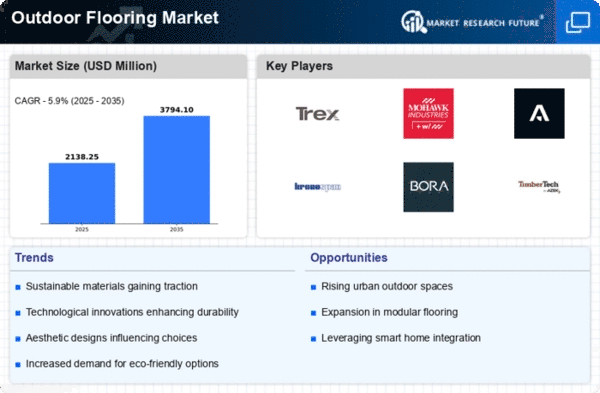
As per MRFR analysis, the Outdoor Flooring Market Size was estimated at 2019.12 USD Million in 2024. The Outdoor Flooring industry is projected to grow from 2138.29 USD Million in 2025 to 3794.1 USD Million by 2035, exhibiting a compound annual growth rate (CAGR) of 5.9% during the forecast period 2025 - 2035.

Key Market Trends & Highlights

The Outdoor Flooring Market is experiencing a dynamic shift towards sustainability and technological advancements.

  • North America remains the largest market for outdoor flooring, driven by a robust demand for residential applications. Asia-Pacific is emerging as the fastest-growing region, fueled by increasing urbanization and outdoor living trends. The residential segment dominates the market, while the commercial segment is witnessing rapid growth due to evolving consumer preferences. Key market drivers include a strong focus on sustainability and technological integration, which are shaping product offerings.

Market Size & Forecast

2024 Market Size 2019.12 (USD Million)
2035 Market Size 3794.1 (USD Million)
CAGR (2025 - 2035) 5.9%
Largest Regional Market Share in 2024 North America

Major Players

Trex Company (US), Mohawk Industries (US), Armstrong Flooring (US), Kronospan (AT), Boral Limited (AU), TimberTech (US), DuraLife (US), Fiberon (US), GAF Materials (US), NexGen Deck (US)

Market Trends

The Outdoor Flooring Market is currently experiencing a dynamic evolution, driven by a confluence of aesthetic preferences, environmental considerations, and technological advancements. As consumers increasingly seek outdoor spaces that reflect their personal style, the demand for diverse flooring options has surged. This market encompasses a wide array of materials, including wood, composite, stone, and concrete, each offering unique benefits and visual appeal. Furthermore, sustainability has emerged as a pivotal factor, with many manufacturers focusing on eco-friendly materials and production processes. This shift not only caters to environmentally conscious consumers but also aligns with broader trends in construction and design that prioritize sustainability, as highlighted in recent outdoor flooring market analysis. 

In addition to aesthetic and environmental factors, technological innovations are reshaping the Outdoor Flooring Market. Enhanced durability and maintenance features are becoming essential selling points, as consumers seek long-lasting solutions that require minimal upkeep. Moreover, the integration of smart technologies into outdoor flooring solutions is gaining traction, potentially transforming how these spaces are utilized. As the market continues to evolve, it appears poised for growth, driven by a blend of consumer preferences, technological advancements, and a heightened awareness of environmental impact. The future of outdoor flooring seems bright, with opportunities for innovation and expansion across various segments of the market. according to ongoing outdoor flooring market analysis.

Sustainability Focus

The Outdoor Flooring Market is increasingly prioritizing sustainable materials and practices. Manufacturers are exploring eco-friendly options, such as recycled composites and responsibly sourced wood, to meet the growing demand for environmentally conscious products. This trend reflects a broader societal shift towards sustainability, influencing consumer choices and brand loyalty.

Technological Integration

Innovations in technology are transforming the Outdoor Flooring Market, with advancements in durability and maintenance. Products that require less upkeep and offer enhanced longevity are gaining popularity. Additionally, smart features, such as integrated lighting and heating systems, are becoming more common, appealing to consumers seeking modern outdoor solutions.

Aesthetic Customization

The desire for personalized outdoor spaces is driving a trend towards aesthetic customization in the Outdoor Flooring Market. Consumers are increasingly looking for unique designs and finishes that reflect their individual tastes. This trend encourages manufacturers to offer a wider variety of styles, colors, and textures, catering to diverse consumer preferences.

Outdoor Flooring Market Market Drivers

Market Growth Projections

The Global Outdoor Flooring Market Industry is poised for substantial growth in the coming years. Projections indicate that the market will reach 2.02 USD Billion in 2024 and is expected to expand to 3.79 USD Billion by 2035. This growth trajectory suggests a robust demand for outdoor flooring solutions driven by various factors, including urbanization, sustainability, and consumer preferences for outdoor living. The anticipated CAGR of 5.89% from 2025 to 2035 further underscores the market's potential, indicating a favorable environment for manufacturers and suppliers in the outdoor flooring sector.

Sustainability and Eco-Friendly Materials

Sustainability plays a pivotal role in shaping the Global Outdoor Flooring Market Industry. There is a marked shift towards eco-friendly materials, such as recycled wood, bamboo, and composite materials, which appeal to environmentally conscious consumers. This trend is not only driven by consumer preferences but also by regulatory frameworks promoting sustainable practices. As governments worldwide implement stricter environmental regulations, manufacturers are compelled to innovate and provide sustainable options. This shift is expected to contribute to the market's growth, as eco-friendly outdoor flooring solutions become increasingly popular among consumers looking to reduce their carbon footprint.

Rising Demand for Aesthetic Outdoor Spaces

The Global Outdoor Flooring Market Industry experiences a notable increase in demand for aesthetically pleasing outdoor spaces. Homeowners and commercial property developers are increasingly investing in outdoor flooring solutions that enhance the visual appeal of patios, decks, and gardens. This trend is driven by a growing emphasis on outdoor living, where spaces are designed for relaxation and entertainment. As a result, the market is projected to reach 2.02 USD Billion in 2024, reflecting a shift towards high-quality materials that offer both beauty and durability. This focus on aesthetics is likely to propel the market forward, as consumers seek to create inviting outdoor environments.

Urbanization and Infrastructure Development

Urbanization and infrastructure development are key drivers of the Global Outdoor Flooring Market Industry. As urban areas expand and new residential and commercial projects emerge, the demand for outdoor flooring solutions increases. This trend is particularly evident in rapidly developing regions where urban planning incorporates outdoor spaces for recreation and social interaction. Governments and private developers are investing in public parks, walkways, and outdoor venues, further fueling the demand for durable and attractive flooring options. This growth trajectory is expected to contribute to the market reaching 3.79 USD Billion by 2035, as urbanization continues to shape the landscape of outdoor living.

Increasing Popularity of Outdoor Living Spaces

The increasing popularity of outdoor living spaces significantly impacts the Global Outdoor Flooring Market Industry. Consumers are increasingly transforming their backyards into functional living areas, complete with dining, lounging, and entertainment spaces. This trend is driven by a desire for more versatile home environments that extend living areas outdoors. As a result, outdoor flooring solutions that are both stylish and functional are in high demand. This shift towards outdoor living is likely to sustain market growth, as homeowners invest in quality flooring materials that enhance their outdoor experiences.

Technological Advancements in Flooring Solutions

Technological advancements significantly influence the Global Outdoor Flooring Market Industry. Innovations in manufacturing processes and materials have led to the development of flooring solutions that are more durable, weather-resistant, and easier to maintain. For instance, advancements in composite materials allow for greater resistance to moisture and UV rays, extending the lifespan of outdoor flooring. These improvements not only enhance product performance but also appeal to consumers seeking low-maintenance options. As a result, the market is anticipated to grow at a CAGR of 5.89% from 2025 to 2035, driven by the continuous evolution of flooring technologies.

Market Segment Insights

By Application: Residential (Largest) vs. Commercial (Fastest-Growing)

The application segment of the outdoor flooring market shows a diverse distribution among residential, commercial, industrial, and institutional uses. The residential sector holds the largest share, driven by an increase in outdoor living spaces and a growing preference for aesthetic outdoor designs. Commercial applications follow, benefiting from trends like urbanization and an enhanced focus on creating inviting public areas. This segment is supported by innovations in material technology, offering durability and aesthetic appeal.

Residential (Dominant) vs. Commercial (Emerging)

The residential outdoor flooring segment dominates the market mainly due to homeowners increasingly investing in outdoor spaces such as patios and gardens. This demand is bolstered by shifts toward outdoor entertaining and relaxation trends. On the other hand, the commercial outdoor flooring segment is rapidly emerging, propelled by the rising need for attractive and functional outdoor areas in businesses, parks, and recreational facilities. Commercial outdoor flooring solutions are often designed to withstand high foot traffic while exhibiting appealing designs, serving the dual purpose of functionality and aesthetics.

By Material Type: Wood (Largest) vs. Composite (Fastest-Growing)

In the Outdoor Flooring Market, the material type segment is characterized by a diverse range of options, each holding a unique market share. Wood remains the largest segment due to its natural aesthetic and traditional appeal, favored by consumers seeking authenticity in their outdoor spaces. Composite materials, on the other hand, have been gaining traction due to their durability and low maintenance requirements, becoming increasingly popular among homeowners looking for longevity and value in their purchases.

Wood: Traditional (Dominant) vs. Composite: Modern (Emerging)

Wood flooring is often considered the epitome of outdoor flooring, known for its timeless appeal, warmth, and natural beauty. It is a popular choice among homeowners who prioritize sustainability and the organic look, making it a dominant force in the market. Conversely, composite materials are emerging as a strong competitor, particularly among younger consumers. They offer the visual appeal of wood while incorporating advanced technology for enhanced durability and resistance to the elements, making them an attractive alternative in environments that demand more resilient flooring solutions.

By Installation Type: Interlocking (Largest) vs. Floating (Fastest-Growing)

<p>In the Outdoor Flooring Market, the installation type segment showcases a diverse distribution among various methods. Interlocking flooring is the largest segment, catering to consumers seeking easy installation and versatility. Glue down and nail down options maintain a significant market presence, favored for their durability and traditional applications. In contrast, floating floors are gaining traction due to their ease of installation and affordability, appealing to a broader audience in the DIY market. The growth trends in the installation type segment are primarily driven by shifting consumer preferences and an increase in outdoor living spaces. The demand for hassle-free and innovative installation methods makes floating floors the fastest-growing option. Additionally, the expansion of DIY home improvement trends supports the growth of interlocking systems and floating installations, aligning with consumer desires for flexibility and aesthetics in outdoor settings.</p>

<p>Interlocking (Dominant) vs. Floating (Emerging)</p>

<p>Interlocking flooring systems are dominating the market, leveraging their user-friendly design and adaptability for various outdoor spaces. Their snap-together feature allows homeowners and contractors to install them quickly without specialized tools, making them an attractive option for residential and commercial use. Meanwhile, floating floors are emerging as a significant contender, appealing to budget-conscious consumers who prefer easy installation without sacrificing style. With innovative designs and materials, floating options are becoming a favorite for outdoor areas that require moisture resistance and durability. The ongoing trend towards enhancing outdoor living spaces continues to drive interest in both interlocking and floating systems, promoting a competitive landscape within the outdoor flooring market.</p>

By End Use: Patios (Largest) vs. Decks (Fastest-Growing)

<p>The Outdoor Flooring Market reveals an intriguing distribution in the end use segment, with patios holding the largest share. This popularity is driven by their crucial role in enhancing outdoor living spaces. Meanwhile, decks, while currently the smallest segment, are rapidly gaining traction due to shifting consumer preferences towards multi-functional outdoor areas. Their appeal is increasingly recognized among homeowners seeking to blend style and functionality in their outdoor environments. Growth trends within the Outdoor Flooring Market are primarily fueled by the escalating demand for outdoor living spaces that accommodate relaxation and socialization. The surge in home renovation activities and investments in landscaping have positioned both patios and decks at the forefront of this growth. Moreover, the increasing realization of the importance of aesthetic outdoor spaces is likely to drive both segments further, creating a competitive landscape.</p>

<p>Patios (Dominant) vs. Walkways (Emerging)</p>

<p>Patios are established as the dominant choice in the Outdoor Flooring Market, distinguished by their durability, aesthetic appeal, and versatile designs that cater to diverse consumer preferences. They serve as an extension of indoor living spaces, preferably made from materials like stone, composite, or concrete. On the other hand, walkways represent an emerging segment gaining attention for their practical application and design flexibility. Increasing homeowners’ focus on curb appeal and outdoor accessibility have fueled their demand. Walkways are typically designed for functionality, guiding foot traffic while enhancing the overall landscape. As consumers prioritize sustainable materials and designs, both patios and walkways are positioned to redefine outdoor aesthetics and functionality, making them key players in the market.</p>

By Maintenance Level: Low Maintenance (Largest) vs. Moderate Maintenance (Fastest-Growing)

<p>In the Outdoor Flooring Market, the maintenance level segment illustrates a diverse distribution of preferences among consumers. Low-maintenance outdoor flooring solutions command the largest share, appealing to homeowners and businesses seeking convenience and durability. This segment's popularity is largely driven by the growing trend towards efficient outdoor spaces that require minimal upkeep. Conversely, the moderate maintenance segment is gaining traction, activated by consumers who appreciate a balance between aesthetics and maintenance effort, highlighting its potential for growth in the upcoming years.</p>

<p>Low Maintenance: Dominant vs. Moderate Maintenance: Emerging</p>

<p>The low maintenance segment stands out as the dominant choice in the Outdoor Flooring Market, characterized by materials that offer weather resistance, durability, and ease of cleaning. This segment is favored by consumers who prioritize minimal upkeep, particularly in areas prone to harsh weather conditions. On the other hand, the moderate maintenance category emerges as a notable choice, appealing to individuals who wish to achieve certain design aesthetics that may require periodic upkeep. While moderate maintenance solutions offer a variety of styles and finishes that enhance outdoor environments, they are recognized as increasingly innovative, incorporating features that reduce the frequency of maintenance tasks.</p>

Get more detailed insights about Outdoor Flooring Market Research Report-Global Forecast 2035

Regional Insights

North America : Market Leader in Outdoor Flooring

North America is poised to maintain its leadership in the outdoor flooring market, holding a significant share of $800.0M in 2025. The growth is driven by increasing consumer demand for sustainable and durable outdoor solutions, alongside favorable regulations promoting eco-friendly materials. The region's robust construction sector and rising investments in residential and commercial outdoor spaces further fuel this growth. The United States stands out as the leading country, with major players like Trex Company, Mohawk Industries, and Armstrong Flooring dominating the landscape. The competitive environment is characterized by innovation in product offerings, including composite and recycled materials. As the market evolves, companies are focusing on enhancing aesthetic appeal and functionality, ensuring a strong foothold in this lucrative sector.

Europe : Emerging Market with Growth Potential

Europe's outdoor flooring market is projected to reach $600.0M by 2025, driven by increasing urbanization and a growing preference for outdoor living spaces. Regulatory initiatives aimed at sustainability and energy efficiency are catalyzing demand for eco-friendly flooring solutions. The region's commitment to reducing carbon footprints is also influencing consumer choices, leading to a shift towards innovative materials. Leading countries such as Germany, France, and the UK are at the forefront of this market, with key players like Kronospan and Boral Limited making significant contributions. The competitive landscape is marked by a blend of established brands and emerging companies focusing on design and sustainability. As the market matures, collaboration between manufacturers and designers is expected to enhance product offerings and consumer appeal.

Asia-Pacific : Rapid Growth in Emerging Markets

The Asia-Pacific outdoor flooring market is anticipated to grow significantly, reaching $500.0M by 2025. This growth is fueled by rapid urbanization, increasing disposable incomes, and a rising trend towards outdoor living. Countries in this region are witnessing a surge in construction activities, supported by government initiatives aimed at infrastructure development and housing projects, which are key drivers for the outdoor flooring market. China and Australia are leading the charge, with a competitive landscape featuring both local and international players. Companies like TimberTech and DuraLife are expanding their presence, focusing on innovative and sustainable products. The market is characterized by a growing demand for versatile flooring solutions that cater to diverse climatic conditions, enhancing the appeal of outdoor spaces across the region.

Middle East and Africa : Untapped Potential in Flooring Market

The Middle East and Africa outdoor flooring market is valued at $119.12M in 2025, showcasing significant growth potential. The region is experiencing a shift towards outdoor living, driven by changing lifestyles and increasing investments in residential and commercial properties. Regulatory frameworks promoting sustainable building practices are also contributing to the demand for innovative flooring solutions that meet environmental standards. Countries like the UAE and South Africa are leading the market, with a competitive landscape that includes both local manufacturers and international brands. The presence of key players such as GAF Materials and Fiberon is enhancing market dynamics, as they introduce advanced products tailored to the region's unique climatic challenges. As the market evolves, opportunities for growth in eco-friendly and durable flooring solutions are expected to expand.

Key Players and Competitive Insights

The Outdoor Flooring Market is currently characterized by a dynamic competitive landscape, driven by increasing consumer demand for sustainable and aesthetically pleasing outdoor spaces. Key players are actively engaging in strategies that emphasize innovation, regional expansion, and digital transformation. For instance, Trex Company (US) has positioned itself as a leader in composite decking solutions, focusing on eco-friendly materials and advanced manufacturing processes. Similarly, Mohawk Industries (US) is leveraging its extensive product portfolio to cater to diverse consumer preferences, while also investing in digital marketing strategies to enhance customer engagement. These strategic initiatives collectively shape a competitive environment that is increasingly focused on sustainability and technological advancement.In terms of business tactics, companies are localizing manufacturing to reduce lead times and optimize supply chains, which is particularly crucial in a market that is moderately fragmented. This approach not only enhances operational efficiency but also allows for greater responsiveness to regional market demands. The competitive structure is influenced by the collective actions of key players, which often leads to collaborative efforts in innovation and sustainability initiatives, thereby fostering a more cohesive market environment.
In November Armstrong Flooring (US) announced a strategic partnership with a leading technology firm to develop smart outdoor flooring solutions that integrate IoT capabilities. This move is significant as it positions Armstrong Flooring at the forefront of the digital transformation trend within the industry, potentially enhancing user experience and operational efficiency through data-driven insights. The integration of technology into outdoor flooring solutions may redefine consumer expectations and set new standards for product functionality.
In October TimberTech (US) launched a new line of eco-friendly decking products made from recycled materials, further solidifying its commitment to sustainability. This initiative not only aligns with growing consumer preferences for environmentally responsible products but also enhances TimberTech's competitive edge in a market increasingly driven by eco-conscious purchasing decisions. The introduction of such innovative products could attract a broader customer base and reinforce brand loyalty.
In September Boral Limited (AU) expanded its manufacturing capabilities by investing in a new facility dedicated to producing high-performance outdoor flooring materials. This strategic investment is likely to enhance Boral's production capacity and efficiency, allowing the company to meet rising demand while maintaining quality standards. Such expansions are indicative of a broader trend where companies are prioritizing operational scalability to capitalize on market growth opportunities.
As of December the Outdoor Flooring Market is witnessing trends that emphasize digitalization, sustainability, and the integration of advanced technologies such as AI. Strategic alliances are increasingly shaping the competitive landscape, enabling companies to pool resources and expertise to drive innovation. The shift from price-based competition to a focus on technological differentiation and supply chain reliability is becoming more pronounced. Moving forward, companies that prioritize innovation and sustainability are likely to emerge as leaders in this evolving market.

Key Companies in the Outdoor Flooring Market include

Industry Developments

July 2022: A recent message to Mohawk workers stated that the acquisition of Foss Floors by Mohawk Industries "will add new product categories and create tremendous opportunities for our business."

February 2021: Armstrong Flooring's two most recent ranges of luxury flooring are Exchange and Theorem. For category-leading scratch, stain, and scuff performance, both collections include a unique Diamond 10 Technology 2.5 mm structure with a 20 mil wear layer. They were both created in the USA with pride.

July 2020: Aurora flooring, which incorporates rubber wear layer fusion, is a new product from Ecore International Limited Company. This is made specifically for the residential and healthcare sectors.

Future Outlook

Outdoor Flooring Market Future Outlook

The Outdoor Flooring Market is projected to grow at a 5.9% CAGR from 2025 to 2035, driven by urbanization, sustainability trends, and technological advancements.

New opportunities lie in:

  • <p>Expansion into eco-friendly composite materials for sustainable projects. Development of smart outdoor flooring solutions integrating IoT technology. Partnerships with landscape architects for customized outdoor flooring designs.</p>

By 2035, the Outdoor Flooring Market is expected to achieve robust growth and innovation.

Market Segmentation

Outdoor Flooring Market End Use Outlook

  • Patios
  • Decks
  • Walkways
  • Pool Areas

Outdoor Flooring Market Application Outlook

  • Residential
  • Commercial
  • Industrial
  • Institutional

Outdoor Flooring Market Material Type Outlook

  • Wood
  • Composite
  • Vinyl
  • Ceramic
  • Stone

Outdoor Flooring Market Installation Method Outlook

  • Interlocking
  • Glue Down
  • Nail Down
  • Floating
  • Self-Adhesive

Report Scope

MARKET SIZE 2024 2019.12(USD Million)
MARKET SIZE 2025 2138.29(USD Million)
MARKET SIZE 2035 3794.1(USD Million)
COMPOUND ANNUAL GROWTH RATE (CAGR) 5.9% (2025 - 2035)
REPORT COVERAGE Revenue Forecast, Competitive Landscape, Growth Factors, and Trends
BASE YEAR 2024
Market Forecast Period 2025 - 2035
Historical Data 2019 - 2024
Market Forecast Units USD Million
Key Companies Profiled Trex Company (US), Mohawk Industries (US), Armstrong Flooring (US), Kronospan (AT), Boral Limited (AU), TimberTech (US), DuraLife (US), Fiberon (US), GAF Materials (US), NexGen Deck (US)
Segments Covered Application, Material Type, Installation Method, End Use
Key Market Opportunities Growing demand for sustainable materials in the Outdoor Flooring Market presents significant innovation opportunities.
Key Market Dynamics Rising consumer preference for sustainable materials drives innovation and competition in the outdoor flooring market.
Countries Covered North America, Europe, APAC, South America, MEA

FAQs

What is the current valuation of the Outdoor Flooring Market as of 2024?

<p>The Outdoor Flooring Market was valued at approximately 2019.12 USD Million in 2024.</p>

What is the projected market valuation for the Outdoor Flooring Market in 2035?

<p>The market is projected to reach approximately 3794.1 USD Million by 2035.</p>

What is the expected CAGR for the Outdoor Flooring Market during the forecast period 2025 - 2035?

<p>The expected CAGR for the Outdoor Flooring Market during the forecast period 2025 - 2035 is 5.9%.</p>

Which application segments are included in the Outdoor Flooring Market?

<p>The market includes application segments such as Residential, Commercial, Industrial, and Institutional.</p>

What are the estimated valuations for the Residential and Commercial segments in 2025?

<p>The Residential segment is estimated to be valued between 500.0 and 1000.0 USD Million, while the Commercial segment is projected between 600.0 and 1200.0 USD Million.</p>

What materials are commonly used in outdoor flooring, and what are their market valuations?

<p>Common materials include Wood, Composite, Vinyl, Ceramic, and Stone, with valuations ranging from 250.0 to 1288.1 USD Million.</p>

What installation types are prevalent in the Outdoor Flooring Market?

Prevalent installation types include Interlocking, Glue Down, Nail Down, and Floating.

What are the market valuations for different installation types in 2025?

The Interlocking installation type is valued between 500.0 and 1000.0 USD Million, while Glue Down is between 600.0 and 1200.0 USD Million.

Which key players are leading the Outdoor Flooring Market?

Key players in the market include Trex Company, Mohawk Industries, Armstrong Flooring, and TimberTech, among others.

What are the maintenance level segments in the Outdoor Flooring Market?

The market segments by maintenance level include Low Maintenance, Moderate Maintenance, and High Maintenance.

  1. SECTION I: EXECUTIVE SUMMARY AND KEY HIGHLIGHTS
    1. | 1.1 EXECUTIVE SUMMARY
    2. | | 1.1.1 Market Overview
    3. | | 1.1.2 Key Findings
    4. | | 1.1.3 Market Segmentation
    5. | | 1.1.4 Competitive Landscape
    6. | | 1.1.5 Challenges and Opportunities
    7. | | 1.1.6 Future Outlook
  2. SECTION II: SCOPING, METHODOLOGY AND MARKET STRUCTURE
    1. | 2.1 MARKET INTRODUCTION
    2. | | 2.1.1 Definition
    3. | | 2.1.2 Scope of the study
    4. | | | 2.1.2.1 Research Objective
    5. | | | 2.1.2.2 Assumption
    6. | | | 2.1.2.3 Limitations
    7. | 2.2 RESEARCH METHODOLOGY
    8. | | 2.2.1 Overview
    9. | | 2.2.2 Data Mining
    10. | | 2.2.3 Secondary Research
    11. | | 2.2.4 Primary Research
    12. | | | 2.2.4.1 Primary Interviews and Information Gathering Process
    13. | | | 2.2.4.2 Breakdown of Primary Respondents
    14. | | 2.2.5 Forecasting Model
    15. | | 2.2.6 Market Size Estimation
    16. | | | 2.2.6.1 Bottom-Up Approach
    17. | | | 2.2.6.2 Top-Down Approach
    18. | | 2.2.7 Data Triangulation
    19. | | 2.2.8 Validation
  3. SECTION III: QUALITATIVE ANALYSIS
    1. | 3.1 MARKET DYNAMICS
    2. | | 3.1.1 Overview
    3. | | 3.1.2 Drivers
    4. | | 3.1.3 Restraints
    5. | | 3.1.4 Opportunities
    6. | 3.2 MARKET FACTOR ANALYSIS
    7. | | 3.2.1 Value chain Analysis
    8. | | 3.2.2 Porter's Five Forces Analysis
    9. | | | 3.2.2.1 Bargaining Power of Suppliers
    10. | | | 3.2.2.2 Bargaining Power of Buyers
    11. | | | 3.2.2.3 Threat of New Entrants
    12. | | | 3.2.2.4 Threat of Substitutes
    13. | | | 3.2.2.5 Intensity of Rivalry
    14. | | 3.2.3 COVID-19 Impact Analysis
    15. | | | 3.2.3.1 Market Impact Analysis
    16. | | | 3.2.3.2 Regional Impact
    17. | | | 3.2.3.3 Opportunity and Threat Analysis
  4. SECTION IV: QUANTITATIVE ANALYSIS
    1. | 4.1 Packaging & Transport, BY Application (USD Million)
    2. | | 4.1.1 Residential
    3. | | 4.1.2 Commercial
    4. | | 4.1.3 Industrial
    5. | | 4.1.4 Institutional
    6. | 4.2 Packaging & Transport, BY Material Type (USD Million)
    7. | | 4.2.1 Wood
    8. | | 4.2.2 Composite
    9. | | 4.2.3 Vinyl
    10. | | 4.2.4 Ceramic
    11. | | 4.2.5 Stone
    12. | 4.3 Packaging & Transport, BY Installation Type (USD Million)
    13. | | 4.3.1 Interlocking
    14. | | 4.3.2 Glue Down
    15. | | 4.3.3 Nail Down
    16. | | 4.3.4 Floating
    17. | 4.4 Packaging & Transport, BY End Use (USD Million)
    18. | | 4.4.1 Patios
    19. | | 4.4.2 Decks
    20. | | 4.4.3 Walkways
    21. | | 4.4.4 Pool Areas
    22. | 4.5 Packaging & Transport, BY Maintenance Level (USD Million)
    23. | | 4.5.1 Low Maintenance
    24. | | 4.5.2 Moderate Maintenance
    25. | | 4.5.3 High Maintenance
    26. | 4.6 Packaging & Transport, BY Region (USD Million)
    27. | | 4.6.1 North America
    28. | | | 4.6.1.1 US
    29. | | | 4.6.1.2 Canada
    30. | | 4.6.2 Europe
    31. | | | 4.6.2.1 Germany
    32. | | | 4.6.2.2 UK
    33. | | | 4.6.2.3 France
    34. | | | 4.6.2.4 Russia
    35. | | | 4.6.2.5 Italy
    36. | | | 4.6.2.6 Spain
    37. | | | 4.6.2.7 Rest of Europe
    38. | | 4.6.3 APAC
    39. | | | 4.6.3.1 China
    40. | | | 4.6.3.2 India
    41. | | | 4.6.3.3 Japan
    42. | | | 4.6.3.4 South Korea
    43. | | | 4.6.3.5 Malaysia
    44. | | | 4.6.3.6 Thailand
    45. | | | 4.6.3.7 Indonesia
    46. | | | 4.6.3.8 Rest of APAC
    47. | | 4.6.4 South America
    48. | | | 4.6.4.1 Brazil
    49. | | | 4.6.4.2 Mexico
    50. | | | 4.6.4.3 Argentina
    51. | | | 4.6.4.4 Rest of South America
    52. | | 4.6.5 MEA
    53. | | | 4.6.5.1 GCC Countries
    54. | | | 4.6.5.2 South Africa
    55. | | | 4.6.5.3 Rest of MEA
  5. SECTION V: COMPETITIVE ANALYSIS
    1. | 5.1 Competitive Landscape
    2. | | 5.1.1 Overview
    3. | | 5.1.2 Competitive Analysis
    4. | | 5.1.3 Market share Analysis
    5. | | 5.1.4 Major Growth Strategy in the Packaging & Transport
    6. | | 5.1.5 Competitive Benchmarking
    7. | | 5.1.6 Leading Players in Terms of Number of Developments in the Packaging & Transport
    8. | | 5.1.7 Key developments and growth strategies
    9. | | | 5.1.7.1 New Product Launch/Service Deployment
    10. | | | 5.1.7.2 Merger & Acquisitions
    11. | | | 5.1.7.3 Joint Ventures
    12. | | 5.1.8 Major Players Financial Matrix
    13. | | | 5.1.8.1 Sales and Operating Income
    14. | | | 5.1.8.2 Major Players R&D Expenditure. 2023
    15. | 5.2 Company Profiles
    16. | | 5.2.1 Trex Company (US)
    17. | | | 5.2.1.1 Financial Overview
    18. | | | 5.2.1.2 Products Offered
    19. | | | 5.2.1.3 Key Developments
    20. | | | 5.2.1.4 SWOT Analysis
    21. | | | 5.2.1.5 Key Strategies
    22. | | 5.2.2 Mohawk Industries (US)
    23. | | | 5.2.2.1 Financial Overview
    24. | | | 5.2.2.2 Products Offered
    25. | | | 5.2.2.3 Key Developments
    26. | | | 5.2.2.4 SWOT Analysis
    27. | | | 5.2.2.5 Key Strategies
    28. | | 5.2.3 Armstrong Flooring (US)
    29. | | | 5.2.3.1 Financial Overview
    30. | | | 5.2.3.2 Products Offered
    31. | | | 5.2.3.3 Key Developments
    32. | | | 5.2.3.4 SWOT Analysis
    33. | | | 5.2.3.5 Key Strategies
    34. | | 5.2.4 Kronospan (AT)
    35. | | | 5.2.4.1 Financial Overview
    36. | | | 5.2.4.2 Products Offered
    37. | | | 5.2.4.3 Key Developments
    38. | | | 5.2.4.4 SWOT Analysis
    39. | | | 5.2.4.5 Key Strategies
    40. | | 5.2.5 Boral Limited (AU)
    41. | | | 5.2.5.1 Financial Overview
    42. | | | 5.2.5.2 Products Offered
    43. | | | 5.2.5.3 Key Developments
    44. | | | 5.2.5.4 SWOT Analysis
    45. | | | 5.2.5.5 Key Strategies
    46. | | 5.2.6 TimberTech (US)
    47. | | | 5.2.6.1 Financial Overview
    48. | | | 5.2.6.2 Products Offered
    49. | | | 5.2.6.3 Key Developments
    50. | | | 5.2.6.4 SWOT Analysis
    51. | | | 5.2.6.5 Key Strategies
    52. | | 5.2.7 DuraLife (US)
    53. | | | 5.2.7.1 Financial Overview
    54. | | | 5.2.7.2 Products Offered
    55. | | | 5.2.7.3 Key Developments
    56. | | | 5.2.7.4 SWOT Analysis
    57. | | | 5.2.7.5 Key Strategies
    58. | | 5.2.8 Fiberon (US)
    59. | | | 5.2.8.1 Financial Overview
    60. | | | 5.2.8.2 Products Offered
    61. | | | 5.2.8.3 Key Developments
    62. | | | 5.2.8.4 SWOT Analysis
    63. | | | 5.2.8.5 Key Strategies
    64. | | 5.2.9 GAF Materials (US)
    65. | | | 5.2.9.1 Financial Overview
    66. | | | 5.2.9.2 Products Offered
    67. | | | 5.2.9.3 Key Developments
    68. | | | 5.2.9.4 SWOT Analysis
    69. | | | 5.2.9.5 Key Strategies
    70. | | 5.2.10 NexGen Deck (US)
    71. | | | 5.2.10.1 Financial Overview
    72. | | | 5.2.10.2 Products Offered
    73. | | | 5.2.10.3 Key Developments
    74. | | | 5.2.10.4 SWOT Analysis
    75. | | | 5.2.10.5 Key Strategies
    76. | 5.3 Appendix
    77. | | 5.3.1 References
    78. | | 5.3.2 Related Reports
  6. LIST OF FIGURES
    1. | 6.1 MARKET SYNOPSIS
    2. | 6.2 NORTH AMERICA MARKET ANALYSIS
    3. | 6.3 US MARKET ANALYSIS BY APPLICATION
    4. | 6.4 US MARKET ANALYSIS BY MATERIAL TYPE
    5. | 6.5 US MARKET ANALYSIS BY INSTALLATION TYPE
    6. | 6.6 US MARKET ANALYSIS BY END USE
    7. | 6.7 US MARKET ANALYSIS BY MAINTENANCE LEVEL
    8. | 6.8 CANADA MARKET ANALYSIS BY APPLICATION
    9. | 6.9 CANADA MARKET ANALYSIS BY MATERIAL TYPE
    10. | 6.10 CANADA MARKET ANALYSIS BY INSTALLATION TYPE
    11. | 6.11 CANADA MARKET ANALYSIS BY END USE
    12. | 6.12 CANADA MARKET ANALYSIS BY MAINTENANCE LEVEL
    13. | 6.13 EUROPE MARKET ANALYSIS
    14. | 6.14 GERMANY MARKET ANALYSIS BY APPLICATION
    15. | 6.15 GERMANY MARKET ANALYSIS BY MATERIAL TYPE
    16. | 6.16 GERMANY MARKET ANALYSIS BY INSTALLATION TYPE
    17. | 6.17 GERMANY MARKET ANALYSIS BY END USE
    18. | 6.18 GERMANY MARKET ANALYSIS BY MAINTENANCE LEVEL
    19. | 6.19 UK MARKET ANALYSIS BY APPLICATION
    20. | 6.20 UK MARKET ANALYSIS BY MATERIAL TYPE
    21. | 6.21 UK MARKET ANALYSIS BY INSTALLATION TYPE
    22. | 6.22 UK MARKET ANALYSIS BY END USE
    23. | 6.23 UK MARKET ANALYSIS BY MAINTENANCE LEVEL
    24. | 6.24 FRANCE MARKET ANALYSIS BY APPLICATION
    25. | 6.25 FRANCE MARKET ANALYSIS BY MATERIAL TYPE
    26. | 6.26 FRANCE MARKET ANALYSIS BY INSTALLATION TYPE
    27. | 6.27 FRANCE MARKET ANALYSIS BY END USE
    28. | 6.28 FRANCE MARKET ANALYSIS BY MAINTENANCE LEVEL
    29. | 6.29 RUSSIA MARKET ANALYSIS BY APPLICATION
    30. | 6.30 RUSSIA MARKET ANALYSIS BY MATERIAL TYPE
    31. | 6.31 RUSSIA MARKET ANALYSIS BY INSTALLATION TYPE
    32. | 6.32 RUSSIA MARKET ANALYSIS BY END USE
    33. | 6.33 RUSSIA MARKET ANALYSIS BY MAINTENANCE LEVEL
    34. | 6.34 ITALY MARKET ANALYSIS BY APPLICATION
    35. | 6.35 ITALY MARKET ANALYSIS BY MATERIAL TYPE
    36. | 6.36 ITALY MARKET ANALYSIS BY INSTALLATION TYPE
    37. | 6.37 ITALY MARKET ANALYSIS BY END USE
    38. | 6.38 ITALY MARKET ANALYSIS BY MAINTENANCE LEVEL
    39. | 6.39 SPAIN MARKET ANALYSIS BY APPLICATION
    40. | 6.40 SPAIN MARKET ANALYSIS BY MATERIAL TYPE
    41. | 6.41 SPAIN MARKET ANALYSIS BY INSTALLATION TYPE
    42. | 6.42 SPAIN MARKET ANALYSIS BY END USE
    43. | 6.43 SPAIN MARKET ANALYSIS BY MAINTENANCE LEVEL
    44. | 6.44 REST OF EUROPE MARKET ANALYSIS BY APPLICATION
    45. | 6.45 REST OF EUROPE MARKET ANALYSIS BY MATERIAL TYPE
    46. | 6.46 REST OF EUROPE MARKET ANALYSIS BY INSTALLATION TYPE
    47. | 6.47 REST OF EUROPE MARKET ANALYSIS BY END USE
    48. | 6.48 REST OF EUROPE MARKET ANALYSIS BY MAINTENANCE LEVEL
    49. | 6.49 APAC MARKET ANALYSIS
    50. | 6.50 CHINA MARKET ANALYSIS BY APPLICATION
    51. | 6.51 CHINA MARKET ANALYSIS BY MATERIAL TYPE
    52. | 6.52 CHINA MARKET ANALYSIS BY INSTALLATION TYPE
    53. | 6.53 CHINA MARKET ANALYSIS BY END USE
    54. | 6.54 CHINA MARKET ANALYSIS BY MAINTENANCE LEVEL
    55. | 6.55 INDIA MARKET ANALYSIS BY APPLICATION
    56. | 6.56 INDIA MARKET ANALYSIS BY MATERIAL TYPE
    57. | 6.57 INDIA MARKET ANALYSIS BY INSTALLATION TYPE
    58. | 6.58 INDIA MARKET ANALYSIS BY END USE
    59. | 6.59 INDIA MARKET ANALYSIS BY MAINTENANCE LEVEL
    60. | 6.60 JAPAN MARKET ANALYSIS BY APPLICATION
    61. | 6.61 JAPAN MARKET ANALYSIS BY MATERIAL TYPE
    62. | 6.62 JAPAN MARKET ANALYSIS BY INSTALLATION TYPE
    63. | 6.63 JAPAN MARKET ANALYSIS BY END USE
    64. | 6.64 JAPAN MARKET ANALYSIS BY MAINTENANCE LEVEL
    65. | 6.65 SOUTH KOREA MARKET ANALYSIS BY APPLICATION
    66. | 6.66 SOUTH KOREA MARKET ANALYSIS BY MATERIAL TYPE
    67. | 6.67 SOUTH KOREA MARKET ANALYSIS BY INSTALLATION TYPE
    68. | 6.68 SOUTH KOREA MARKET ANALYSIS BY END USE
    69. | 6.69 SOUTH KOREA MARKET ANALYSIS BY MAINTENANCE LEVEL
    70. | 6.70 MALAYSIA MARKET ANALYSIS BY APPLICATION
    71. | 6.71 MALAYSIA MARKET ANALYSIS BY MATERIAL TYPE
    72. | 6.72 MALAYSIA MARKET ANALYSIS BY INSTALLATION TYPE
    73. | 6.73 MALAYSIA MARKET ANALYSIS BY END USE
    74. | 6.74 MALAYSIA MARKET ANALYSIS BY MAINTENANCE LEVEL
    75. | 6.75 THAILAND MARKET ANALYSIS BY APPLICATION
    76. | 6.76 THAILAND MARKET ANALYSIS BY MATERIAL TYPE
    77. | 6.77 THAILAND MARKET ANALYSIS BY INSTALLATION TYPE
    78. | 6.78 THAILAND MARKET ANALYSIS BY END USE
    79. | 6.79 THAILAND MARKET ANALYSIS BY MAINTENANCE LEVEL
    80. | 6.80 INDONESIA MARKET ANALYSIS BY APPLICATION
    81. | 6.81 INDONESIA MARKET ANALYSIS BY MATERIAL TYPE
    82. | 6.82 INDONESIA MARKET ANALYSIS BY INSTALLATION TYPE
    83. | 6.83 INDONESIA MARKET ANALYSIS BY END USE
    84. | 6.84 INDONESIA MARKET ANALYSIS BY MAINTENANCE LEVEL
    85. | 6.85 REST OF APAC MARKET ANALYSIS BY APPLICATION
    86. | 6.86 REST OF APAC MARKET ANALYSIS BY MATERIAL TYPE
    87. | 6.87 REST OF APAC MARKET ANALYSIS BY INSTALLATION TYPE
    88. | 6.88 REST OF APAC MARKET ANALYSIS BY END USE
    89. | 6.89 REST OF APAC MARKET ANALYSIS BY MAINTENANCE LEVEL
    90. | 6.90 SOUTH AMERICA MARKET ANALYSIS
    91. | 6.91 BRAZIL MARKET ANALYSIS BY APPLICATION
    92. | 6.92 BRAZIL MARKET ANALYSIS BY MATERIAL TYPE
    93. | 6.93 BRAZIL MARKET ANALYSIS BY INSTALLATION TYPE
    94. | 6.94 BRAZIL MARKET ANALYSIS BY END USE
    95. | 6.95 BRAZIL MARKET ANALYSIS BY MAINTENANCE LEVEL
    96. | 6.96 MEXICO MARKET ANALYSIS BY APPLICATION
    97. | 6.97 MEXICO MARKET ANALYSIS BY MATERIAL TYPE
    98. | 6.98 MEXICO MARKET ANALYSIS BY INSTALLATION TYPE
    99. | 6.99 MEXICO MARKET ANALYSIS BY END USE
    100. | 6.100 MEXICO MARKET ANALYSIS BY MAINTENANCE LEVEL
    101. | 6.101 ARGENTINA MARKET ANALYSIS BY APPLICATION
    102. | 6.102 ARGENTINA MARKET ANALYSIS BY MATERIAL TYPE
    103. | 6.103 ARGENTINA MARKET ANALYSIS BY INSTALLATION TYPE
    104. | 6.104 ARGENTINA MARKET ANALYSIS BY END USE
    105. | 6.105 ARGENTINA MARKET ANALYSIS BY MAINTENANCE LEVEL
    106. | 6.106 REST OF SOUTH AMERICA MARKET ANALYSIS BY APPLICATION
    107. | 6.107 REST OF SOUTH AMERICA MARKET ANALYSIS BY MATERIAL TYPE
    108. | 6.108 REST OF SOUTH AMERICA MARKET ANALYSIS BY INSTALLATION TYPE
    109. | 6.109 REST OF SOUTH AMERICA MARKET ANALYSIS BY END USE
    110. | 6.110 REST OF SOUTH AMERICA MARKET ANALYSIS BY MAINTENANCE LEVEL
    111. | 6.111 MEA MARKET ANALYSIS
    112. | 6.112 GCC COUNTRIES MARKET ANALYSIS BY APPLICATION
    113. | 6.113 GCC COUNTRIES MARKET ANALYSIS BY MATERIAL TYPE
    114. | 6.114 GCC COUNTRIES MARKET ANALYSIS BY INSTALLATION TYPE
    115. | 6.115 GCC COUNTRIES MARKET ANALYSIS BY END USE
    116. | 6.116 GCC COUNTRIES MARKET ANALYSIS BY MAINTENANCE LEVEL
    117. | 6.117 SOUTH AFRICA MARKET ANALYSIS BY APPLICATION
    118. | 6.118 SOUTH AFRICA MARKET ANALYSIS BY MATERIAL TYPE
    119. | 6.119 SOUTH AFRICA MARKET ANALYSIS BY INSTALLATION TYPE
    120. | 6.120 SOUTH AFRICA MARKET ANALYSIS BY END USE
    121. | 6.121 SOUTH AFRICA MARKET ANALYSIS BY MAINTENANCE LEVEL
    122. | 6.122 REST OF MEA MARKET ANALYSIS BY APPLICATION
    123. | 6.123 REST OF MEA MARKET ANALYSIS BY MATERIAL TYPE
    124. | 6.124 REST OF MEA MARKET ANALYSIS BY INSTALLATION TYPE
    125. | 6.125 REST OF MEA MARKET ANALYSIS BY END USE
    126. | 6.126 REST OF MEA MARKET ANALYSIS BY MAINTENANCE LEVEL
    127. | 6.127 KEY BUYING CRITERIA OF PACKAGING & TRANSPORT
    128. | 6.128 RESEARCH PROCESS OF MRFR
    129. | 6.129 DRO ANALYSIS OF PACKAGING & TRANSPORT
    130. | 6.130 DRIVERS IMPACT ANALYSIS: PACKAGING & TRANSPORT
    131. | 6.131 RESTRAINTS IMPACT ANALYSIS: PACKAGING & TRANSPORT
    132. | 6.132 SUPPLY / VALUE CHAIN: PACKAGING & TRANSPORT
    133. | 6.133 PACKAGING & TRANSPORT, BY APPLICATION, 2024 (% SHARE)
    134. | 6.134 PACKAGING & TRANSPORT, BY APPLICATION, 2024 TO 2035 (USD Million)
    135. | 6.135 PACKAGING & TRANSPORT, BY MATERIAL TYPE, 2024 (% SHARE)
    136. | 6.136 PACKAGING & TRANSPORT, BY MATERIAL TYPE, 2024 TO 2035 (USD Million)
    137. | 6.137 PACKAGING & TRANSPORT, BY INSTALLATION TYPE, 2024 (% SHARE)
    138. | 6.138 PACKAGING & TRANSPORT, BY INSTALLATION TYPE, 2024 TO 2035 (USD Million)
    139. | 6.139 PACKAGING & TRANSPORT, BY END USE, 2024 (% SHARE)
    140. | 6.140 PACKAGING & TRANSPORT, BY END USE, 2024 TO 2035 (USD Million)
    141. | 6.141 PACKAGING & TRANSPORT, BY MAINTENANCE LEVEL, 2024 (% SHARE)
    142. | 6.142 PACKAGING & TRANSPORT, BY MAINTENANCE LEVEL, 2024 TO 2035 (USD Million)
    143. | 6.143 BENCHMARKING OF MAJOR COMPETITORS
  7. LIST OF TABLES
    1. | 7.1 LIST OF ASSUMPTIONS
    2. | | 7.1.1
    3. | 7.2 North America MARKET SIZE ESTIMATES; FORECAST
    4. | | 7.2.1 BY APPLICATION, 2025-2035 (USD Million)
    5. | | 7.2.2 BY MATERIAL TYPE, 2025-2035 (USD Million)
    6. | | 7.2.3 BY INSTALLATION TYPE, 2025-2035 (USD Million)
    7. | | 7.2.4 BY END USE, 2025-2035 (USD Million)
    8. | | 7.2.5 BY MAINTENANCE LEVEL, 2025-2035 (USD Million)
    9. | 7.3 US MARKET SIZE ESTIMATES; FORECAST
    10. | | 7.3.1 BY APPLICATION, 2025-2035 (USD Million)
    11. | | 7.3.2 BY MATERIAL TYPE, 2025-2035 (USD Million)
    12. | | 7.3.3 BY INSTALLATION TYPE, 2025-2035 (USD Million)
    13. | | 7.3.4 BY END USE, 2025-2035 (USD Million)
    14. | | 7.3.5 BY MAINTENANCE LEVEL, 2025-2035 (USD Million)
    15. | 7.4 Canada MARKET SIZE ESTIMATES; FORECAST
    16. | | 7.4.1 BY APPLICATION, 2025-2035 (USD Million)
    17. | | 7.4.2 BY MATERIAL TYPE, 2025-2035 (USD Million)
    18. | | 7.4.3 BY INSTALLATION TYPE, 2025-2035 (USD Million)
    19. | | 7.4.4 BY END USE, 2025-2035 (USD Million)
    20. | | 7.4.5 BY MAINTENANCE LEVEL, 2025-2035 (USD Million)
    21. | 7.5 Europe MARKET SIZE ESTIMATES; FORECAST
    22. | | 7.5.1 BY APPLICATION, 2025-2035 (USD Million)
    23. | | 7.5.2 BY MATERIAL TYPE, 2025-2035 (USD Million)
    24. | | 7.5.3 BY INSTALLATION TYPE, 2025-2035 (USD Million)
    25. | | 7.5.4 BY END USE, 2025-2035 (USD Million)
    26. | | 7.5.5 BY MAINTENANCE LEVEL, 2025-2035 (USD Million)
    27. | 7.6 Germany MARKET SIZE ESTIMATES; FORECAST
    28. | | 7.6.1 BY APPLICATION, 2025-2035 (USD Million)
    29. | | 7.6.2 BY MATERIAL TYPE, 2025-2035 (USD Million)
    30. | | 7.6.3 BY INSTALLATION TYPE, 2025-2035 (USD Million)
    31. | | 7.6.4 BY END USE, 2025-2035 (USD Million)
    32. | | 7.6.5 BY MAINTENANCE LEVEL, 2025-2035 (USD Million)
    33. | 7.7 UK MARKET SIZE ESTIMATES; FORECAST
    34. | | 7.7.1 BY APPLICATION, 2025-2035 (USD Million)
    35. | | 7.7.2 BY MATERIAL TYPE, 2025-2035 (USD Million)
    36. | | 7.7.3 BY INSTALLATION TYPE, 2025-2035 (USD Million)
    37. | | 7.7.4 BY END USE, 2025-2035 (USD Million)
    38. | | 7.7.5 BY MAINTENANCE LEVEL, 2025-2035 (USD Million)
    39. | 7.8 France MARKET SIZE ESTIMATES; FORECAST
    40. | | 7.8.1 BY APPLICATION, 2025-2035 (USD Million)
    41. | | 7.8.2 BY MATERIAL TYPE, 2025-2035 (USD Million)
    42. | | 7.8.3 BY INSTALLATION TYPE, 2025-2035 (USD Million)
    43. | | 7.8.4 BY END USE, 2025-2035 (USD Million)
    44. | | 7.8.5 BY MAINTENANCE LEVEL, 2025-2035 (USD Million)
    45. | 7.9 Russia MARKET SIZE ESTIMATES; FORECAST
    46. | | 7.9.1 BY APPLICATION, 2025-2035 (USD Million)
    47. | | 7.9.2 BY MATERIAL TYPE, 2025-2035 (USD Million)
    48. | | 7.9.3 BY INSTALLATION TYPE, 2025-2035 (USD Million)
    49. | | 7.9.4 BY END USE, 2025-2035 (USD Million)
    50. | | 7.9.5 BY MAINTENANCE LEVEL, 2025-2035 (USD Million)
    51. | 7.10 Italy MARKET SIZE ESTIMATES; FORECAST
    52. | | 7.10.1 BY APPLICATION, 2025-2035 (USD Million)
    53. | | 7.10.2 BY MATERIAL TYPE, 2025-2035 (USD Million)
    54. | | 7.10.3 BY INSTALLATION TYPE, 2025-2035 (USD Million)
    55. | | 7.10.4 BY END USE, 2025-2035 (USD Million)
    56. | | 7.10.5 BY MAINTENANCE LEVEL, 2025-2035 (USD Million)
    57. | 7.11 Spain MARKET SIZE ESTIMATES; FORECAST
    58. | | 7.11.1 BY APPLICATION, 2025-2035 (USD Million)
    59. | | 7.11.2 BY MATERIAL TYPE, 2025-2035 (USD Million)
    60. | | 7.11.3 BY INSTALLATION TYPE, 2025-2035 (USD Million)
    61. | | 7.11.4 BY END USE, 2025-2035 (USD Million)
    62. | | 7.11.5 BY MAINTENANCE LEVEL, 2025-2035 (USD Million)
    63. | 7.12 Rest of Europe MARKET SIZE ESTIMATES; FORECAST
    64. | | 7.12.1 BY APPLICATION, 2025-2035 (USD Million)
    65. | | 7.12.2 BY MATERIAL TYPE, 2025-2035 (USD Million)
    66. | | 7.12.3 BY INSTALLATION TYPE, 2025-2035 (USD Million)
    67. | | 7.12.4 BY END USE, 2025-2035 (USD Million)
    68. | | 7.12.5 BY MAINTENANCE LEVEL, 2025-2035 (USD Million)
    69. | 7.13 APAC MARKET SIZE ESTIMATES; FORECAST
    70. | | 7.13.1 BY APPLICATION, 2025-2035 (USD Million)
    71. | | 7.13.2 BY MATERIAL TYPE, 2025-2035 (USD Million)
    72. | | 7.13.3 BY INSTALLATION TYPE, 2025-2035 (USD Million)
    73. | | 7.13.4 BY END USE, 2025-2035 (USD Million)
    74. | | 7.13.5 BY MAINTENANCE LEVEL, 2025-2035 (USD Million)
    75. | 7.14 China MARKET SIZE ESTIMATES; FORECAST
    76. | | 7.14.1 BY APPLICATION, 2025-2035 (USD Million)
    77. | | 7.14.2 BY MATERIAL TYPE, 2025-2035 (USD Million)
    78. | | 7.14.3 BY INSTALLATION TYPE, 2025-2035 (USD Million)
    79. | | 7.14.4 BY END USE, 2025-2035 (USD Million)
    80. | | 7.14.5 BY MAINTENANCE LEVEL, 2025-2035 (USD Million)
    81. | 7.15 India MARKET SIZE ESTIMATES; FORECAST
    82. | | 7.15.1 BY APPLICATION, 2025-2035 (USD Million)
    83. | | 7.15.2 BY MATERIAL TYPE, 2025-2035 (USD Million)
    84. | | 7.15.3 BY INSTALLATION TYPE, 2025-2035 (USD Million)
    85. | | 7.15.4 BY END USE, 2025-2035 (USD Million)
    86. | | 7.15.5 BY MAINTENANCE LEVEL, 2025-2035 (USD Million)
    87. | 7.16 Japan MARKET SIZE ESTIMATES; FORECAST
    88. | | 7.16.1 BY APPLICATION, 2025-2035 (USD Million)
    89. | | 7.16.2 BY MATERIAL TYPE, 2025-2035 (USD Million)
    90. | | 7.16.3 BY INSTALLATION TYPE, 2025-2035 (USD Million)
    91. | | 7.16.4 BY END USE, 2025-2035 (USD Million)
    92. | | 7.16.5 BY MAINTENANCE LEVEL, 2025-2035 (USD Million)
    93. | 7.17 South Korea MARKET SIZE ESTIMATES; FORECAST
    94. | | 7.17.1 BY APPLICATION, 2025-2035 (USD Million)
    95. | | 7.17.2 BY MATERIAL TYPE, 2025-2035 (USD Million)
    96. | | 7.17.3 BY INSTALLATION TYPE, 2025-2035 (USD Million)
    97. | | 7.17.4 BY END USE, 2025-2035 (USD Million)
    98. | | 7.17.5 BY MAINTENANCE LEVEL, 2025-2035 (USD Million)
    99. | 7.18 Malaysia MARKET SIZE ESTIMATES; FORECAST
    100. | | 7.18.1 BY APPLICATION, 2025-2035 (USD Million)
    101. | | 7.18.2 BY MATERIAL TYPE, 2025-2035 (USD Million)
    102. | | 7.18.3 BY INSTALLATION TYPE, 2025-2035 (USD Million)
    103. | | 7.18.4 BY END USE, 2025-2035 (USD Million)
    104. | | 7.18.5 BY MAINTENANCE LEVEL, 2025-2035 (USD Million)
    105. | 7.19 Thailand MARKET SIZE ESTIMATES; FORECAST
    106. | | 7.19.1 BY APPLICATION, 2025-2035 (USD Million)
    107. | | 7.19.2 BY MATERIAL TYPE, 2025-2035 (USD Million)
    108. | | 7.19.3 BY INSTALLATION TYPE, 2025-2035 (USD Million)
    109. | | 7.19.4 BY END USE, 2025-2035 (USD Million)
    110. | | 7.19.5 BY MAINTENANCE LEVEL, 2025-2035 (USD Million)
    111. | 7.20 Indonesia MARKET SIZE ESTIMATES; FORECAST
    112. | | 7.20.1 BY APPLICATION, 2025-2035 (USD Million)
    113. | | 7.20.2 BY MATERIAL TYPE, 2025-2035 (USD Million)
    114. | | 7.20.3 BY INSTALLATION TYPE, 2025-2035 (USD Million)
    115. | | 7.20.4 BY END USE, 2025-2035 (USD Million)
    116. | | 7.20.5 BY MAINTENANCE LEVEL, 2025-2035 (USD Million)
    117. | 7.21 Rest of APAC MARKET SIZE ESTIMATES; FORECAST
    118. | | 7.21.1 BY APPLICATION, 2025-2035 (USD Million)
    119. | | 7.21.2 BY MATERIAL TYPE, 2025-2035 (USD Million)
    120. | | 7.21.3 BY INSTALLATION TYPE, 2025-2035 (USD Million)
    121. | | 7.21.4 BY END USE, 2025-2035 (USD Million)
    122. | | 7.21.5 BY MAINTENANCE LEVEL, 2025-2035 (USD Million)
    123. | 7.22 South America MARKET SIZE ESTIMATES; FORECAST
    124. | | 7.22.1 BY APPLICATION, 2025-2035 (USD Million)
    125. | | 7.22.2 BY MATERIAL TYPE, 2025-2035 (USD Million)
    126. | | 7.22.3 BY INSTALLATION TYPE, 2025-2035 (USD Million)
    127. | | 7.22.4 BY END USE, 2025-2035 (USD Million)
    128. | | 7.22.5 BY MAINTENANCE LEVEL, 2025-2035 (USD Million)
    129. | 7.23 Brazil MARKET SIZE ESTIMATES; FORECAST
    130. | | 7.23.1 BY APPLICATION, 2025-2035 (USD Million)
    131. | | 7.23.2 BY MATERIAL TYPE, 2025-2035 (USD Million)
    132. | | 7.23.3 BY INSTALLATION TYPE, 2025-2035 (USD Million)
    133. | | 7.23.4 BY END USE, 2025-2035 (USD Million)
    134. | | 7.23.5 BY MAINTENANCE LEVEL, 2025-2035 (USD Million)
    135. | 7.24 Mexico MARKET SIZE ESTIMATES; FORECAST
    136. | | 7.24.1 BY APPLICATION, 2025-2035 (USD Million)
    137. | | 7.24.2 BY MATERIAL TYPE, 2025-2035 (USD Million)
    138. | | 7.24.3 BY INSTALLATION TYPE, 2025-2035 (USD Million)
    139. | | 7.24.4 BY END USE, 2025-2035 (USD Million)
    140. | | 7.24.5 BY MAINTENANCE LEVEL, 2025-2035 (USD Million)
    141. | 7.25 Argentina MARKET SIZE ESTIMATES; FORECAST
    142. | | 7.25.1 BY APPLICATION, 2025-2035 (USD Million)
    143. | | 7.25.2 BY MATERIAL TYPE, 2025-2035 (USD Million)
    144. | | 7.25.3 BY INSTALLATION TYPE, 2025-2035 (USD Million)
    145. | | 7.25.4 BY END USE, 2025-2035 (USD Million)
    146. | | 7.25.5 BY MAINTENANCE LEVEL, 2025-2035 (USD Million)
    147. | 7.26 Rest of South America MARKET SIZE ESTIMATES; FORECAST
    148. | | 7.26.1 BY APPLICATION, 2025-2035 (USD Million)
    149. | | 7.26.2 BY MATERIAL TYPE, 2025-2035 (USD Million)
    150. | | 7.26.3 BY INSTALLATION TYPE, 2025-2035 (USD Million)
    151. | | 7.26.4 BY END USE, 2025-2035 (USD Million)
    152. | | 7.26.5 BY MAINTENANCE LEVEL, 2025-2035 (USD Million)
    153. | 7.27 MEA MARKET SIZE ESTIMATES; FORECAST
    154. | | 7.27.1 BY APPLICATION, 2025-2035 (USD Million)
    155. | | 7.27.2 BY MATERIAL TYPE, 2025-2035 (USD Million)
    156. | | 7.27.3 BY INSTALLATION TYPE, 2025-2035 (USD Million)
    157. | | 7.27.4 BY END USE, 2025-2035 (USD Million)
    158. | | 7.27.5 BY MAINTENANCE LEVEL, 2025-2035 (USD Million)
    159. | 7.28 GCC Countries MARKET SIZE ESTIMATES; FORECAST
    160. | | 7.28.1 BY APPLICATION, 2025-2035 (USD Million)
    161. | | 7.28.2 BY MATERIAL TYPE, 2025-2035 (USD Million)
    162. | | 7.28.3 BY INSTALLATION TYPE, 2025-2035 (USD Million)
    163. | | 7.28.4 BY END USE, 2025-2035 (USD Million)
    164. | | 7.28.5 BY MAINTENANCE LEVEL, 2025-2035 (USD Million)
    165. | 7.29 South Africa MARKET SIZE ESTIMATES; FORECAST
    166. | | 7.29.1 BY APPLICATION, 2025-2035 (USD Million)
    167. | | 7.29.2 BY MATERIAL TYPE, 2025-2035 (USD Million)
    168. | | 7.29.3 BY INSTALLATION TYPE, 2025-2035 (USD Million)
    169. | | 7.29.4 BY END USE, 2025-2035 (USD Million)
    170. | | 7.29.5 BY MAINTENANCE LEVEL, 2025-2035 (USD Million)
    171. | 7.30 Rest of MEA MARKET SIZE ESTIMATES; FORECAST
    172. | | 7.30.1 BY APPLICATION, 2025-2035 (USD Million)
    173. | | 7.30.2 BY MATERIAL TYPE, 2025-2035 (USD Million)
    174. | | 7.30.3 BY INSTALLATION TYPE, 2025-2035 (USD Million)
    175. | | 7.30.4 BY END USE, 2025-2035 (USD Million)
    176. | | 7.30.5 BY MAINTENANCE LEVEL, 2025-2035 (USD Million)
    177. | 7.31 PRODUCT LAUNCH/PRODUCT DEVELOPMENT/APPROVAL
    178. | | 7.31.1
    179. | 7.32 ACQUISITION/PARTNERSHIP
    180. | | 7.32.1

Packaging & Transport Market Segmentation

Packaging & Transport By Application (USD Million, 2025-2035)

  • Residential
  • Commercial
  • Industrial
  • Institutional

Packaging & Transport By Material Type (USD Million, 2025-2035)

  • Wood
  • Composite
  • Vinyl
  • Ceramic
  • Stone

Packaging & Transport By Installation Type (USD Million, 2025-2035)

  • Interlocking
  • Glue Down
  • Nail Down
  • Floating

Packaging & Transport By End Use (USD Million, 2025-2035)

  • Patios
  • Decks
  • Walkways
  • Pool Areas

Packaging & Transport By Maintenance Level (USD Million, 2025-2035)

  • Low Maintenance
  • Moderate Maintenance
  • High Maintenance
Infographic

Free Sample Request

Kindly complete the form below to receive a free sample of this Report

Get Free Sample

Customer Strories

Compare Licence

×
Features License Type
Single User Multiuser License Enterprise User
Price $4,950 $5,950 $7,250
Maximum User Access Limit 1 User Upto 10 Users Unrestricted Access Throughout the Organization
Free Customization
Direct Access to Analyst
Deliverable Format
Platform Access
Discount on Next Purchase 10% 15% 15%
Printable Versions