×
Hero Background
English
Chinese
French
Japanese
Korean
German
Spanish

Osteomyelitis Market Trends

ID: MRFR/Pharma/4584-HCR
90 Pages
Rahul Gotadki
October 2025

Osteomyelitis Market Research Report, by Type (Duration, Pathogenesis), by Diagnosis (Blood Tests, Imaging Tests, Bone Biopsy), by Treatment (Antibiotics, Surgery), End-User (Hospital and Clinics, Research Organization) - Forecast Till 2035

Share:
Download PDF ×

We do not share your information with anyone. However, we may send you emails based on your report interest from time to time. You may contact us at any time to opt-out.

Osteomyelitis Market Infographic
Purchase Options

Market Trends

Key Emerging Trends in the Osteomyelitis Market

Over the past years, osteomyelitis (OM) that is a bone infection mostly caused by bacteria has experienced remarkable shifts. There have been several developments in diagnostic methods, treatment options, and raising awareness about the disease concerning the global OM market. The escalating numbers of chronic conditions like diabetes as well as peripheral vascular illnesses which are leading causes of osteomyelitis are some of the key trends impacting this sector. These two afflictions’ rising burden worldwide has necessitated effective management of OM to be sought.

The market’s development was facilitated by notable improvements in diagnostic interventions. Such advanced technologies for imaging purposes like MRI and nuclear medicine scans enable more accuracy as well as timely identification of osteomyelitis cases. This trend aids early identification of infections and subsequent immediate commencement of therapy thereby reducing complications.

There have been shifts from general treatments towards personalized targeted therapies specifically for osteomyelitis. The cornerstone for managing OM is antimicrobial therapy which has led to development novel antibiotics that are more effective against its causative agents. Additionally, there has been an increase in research on multidrug-resistant lineages, resulting in the manufacture of innovative antimicrobial agents so as to address this menace.

Minimally invasive techniques have recently been utilized in surgical treatment of Osteomyelitis with minimal scarring left behind after surgery. Among these techniques include debridement and bone grafting which currently being performed at highly improved standards allowing for better maintenance of uninfected bone tissue thus increased functional abilities among patients at large. Complex surgeries may even consider use bioactive materials and tissue engineering during their procedures to cure Osteomyelitis; an area yet to be fully explored but very promising

Furthermore, there is also an upward trend towards adoption telemedicine and digital health solutions when treating osteomyelitis patients. Such technologies can help monitor patients from a distance; they offer better communication between healthcare providers while ensuring that patients strictly adhere to the prescribed treatment regimens. The ongoing COVD-19 pandemic has also speeded up the acceptance and adoption of telehealth, which is changing how osteomyelitis and other chronic illnesses are managed in healthcare systems.

Moreover, significant investment in research and development has been made into osteomyelitis that encourages collaborations between pharmaceutical companies, academic institutions as well as research organizations. This approach aims at bridging the gaps in OM management such as new therapeutic options, better diagnosis tools or preventive strategies.

Additionally, on the regulatory front, there is a growing focus on speeding up the approval processes for osteomyelitis-related therapies. In order to accelerate development and approval of innovative drugs for OM treatment, regulators are engaging with industry stakeholders who comprehend criticality of this ailment in healthcare system’s burden.

Author
Rahul Gotadki
Assistant Manager

He holds an experience of about 7+ years in Market Research and Business Consulting, working under the spectrum of Life Sciences and Healthcare domains. Rahul conceptualizes and implements a scalable business strategy and provides strategic leadership to the clients. His expertise lies in market estimation, competitive intelligence, pipeline analysis, customer assessment, etc. In addition to the above, his other responsibility includes strategic tracking of high growth markets & advising clients on the potential areas of focus they could direct their business initiatives

Leave a Comment

FAQs

What is the projected market valuation of the Osteomyelitis Market by 2035?

The Osteomyelitis Market is projected to reach approximately 0.2849 USD Billion by 2035.

What was the market valuation of the Osteomyelitis Market in 2024?

In 2024, the Osteomyelitis Market was valued at 0.129 USD Billion.

What is the expected CAGR for the Osteomyelitis Market during the forecast period 2025 - 2035?

The expected CAGR for the Osteomyelitis Market during the forecast period 2025 - 2035 is 7.47%.

Which companies are considered key players in the Osteomyelitis Market?

Key players in the Osteomyelitis Market include Johnson & Johnson, Stryker Corporation, Smith & Nephew, Medtronic, B. Braun Melsungen AG, Zimmer Biomet, Acelity, and MediWound Ltd.

What are the market segments for the Osteomyelitis Market based on type?

The Osteomyelitis Market segments based on type include Acute and Chronic, with valuations of 0.077 to 0.174 USD Billion for Acute and 0.052 to 0.11 USD Billion for Chronic.

Market Summary

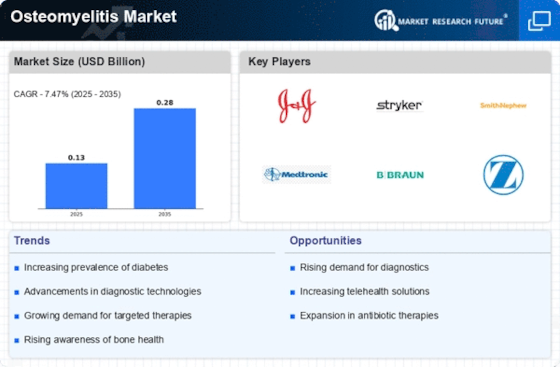
As per MRFR analysis, the Osteomyelitis Market Size was estimated at 0.129 USD Billion in 2024. The Osteomyelitis industry is projected to grow from 0.1386 in 2025 to 0.2849 by 2035, exhibiting a compound annual growth rate (CAGR) of 7.47 during the forecast period 2025 - 2035.

Key Market Trends & Highlights

The Osteomyelitis Market is experiencing a dynamic shift driven by technological advancements and rising healthcare demands.

  • Technological advancements in diagnostics are enhancing the accuracy of osteomyelitis detection, particularly in North America.
  • The rise of personalized medicine is influencing treatment approaches, especially in the Asia-Pacific region, where tailored therapies are gaining traction.
  • A focus on antibiotic stewardship is becoming increasingly critical as healthcare providers aim to combat antibiotic resistance in osteomyelitis cases.
  • The increasing incidence of osteomyelitis, coupled with advancements in treatment modalities, is driving market growth, particularly in the acute segment and imaging tests.

Market Size & Forecast

2024 Market Size 0.129 (USD Billion)
2035 Market Size 0.2849 (USD Billion)
CAGR (2025 - 2035) 7.47%
Largest Regional Market Share in 2024 Americas

Major Players

<p>Johnson & Johnson (US), Stryker Corporation (US), Smith & Nephew (GB), Medtronic (IE), B. Braun Melsungen AG (DE), Zimmer Biomet (US), Acelity (US), MediWound Ltd. (IL)</p>

Market Trends

The Osteomyelitis Market is currently experiencing notable transformations driven by advancements in medical technology and an increasing understanding of the disease. The rise in awareness regarding osteomyelitis, coupled with improved diagnostic techniques, appears to enhance early detection and treatment options. This shift is likely to lead to better patient outcomes and a growing demand for innovative therapies. Furthermore, the integration of telemedicine and digital health solutions is reshaping how healthcare providers manage osteomyelitis, potentially increasing accessibility for patients in remote areas. In addition, the Osteomyelitis Market is influenced by the ongoing research into antibiotic resistance, which poses challenges for treatment protocols. As healthcare professionals seek effective alternatives, there is a growing interest in developing novel therapeutic agents and combination therapies. This trend may drive collaborations between pharmaceutical companies and research institutions, fostering innovation in the field. Overall, the Osteomyelitis Market is poised for growth, with a focus on enhancing patient care and addressing emerging challenges in treatment methodologies.

Technological Advancements in Diagnostics

Recent innovations in imaging techniques and laboratory diagnostics are enhancing the ability to identify osteomyelitis at earlier stages. These advancements facilitate more accurate assessments, leading to timely interventions and improved patient management.

Rise of Personalized Medicine

The shift towards personalized treatment approaches is becoming increasingly prominent in the Osteomyelitis Market. Tailoring therapies based on individual patient profiles may enhance treatment efficacy and minimize adverse effects, thereby improving overall outcomes.

Focus on Antibiotic Stewardship

With the growing concern over antibiotic resistance, there is a heightened emphasis on antibiotic stewardship programs. These initiatives aim to optimize antibiotic use in osteomyelitis treatment, promoting effective management while mitigating resistance development.

Osteomyelitis Market Market Drivers

Emergence of Telemedicine

The emergence of telemedicine is reshaping the landscape of the Osteomyelitis Market. With the increasing adoption of telehealth services, patients can now access specialized care from the comfort of their homes. This trend is particularly beneficial for individuals in remote areas who may have limited access to healthcare facilities. Telemedicine facilitates timely consultations and follow-ups, which are crucial for managing osteomyelitis effectively. Market analysis suggests that the telemedicine sector is expected to grow substantially, potentially reaching a valuation of over 250 billion USD by 2028. This growth is likely to enhance patient engagement and adherence to treatment plans, ultimately benefiting the Osteomyelitis Market.

Rising Healthcare Expenditure

The increase in healthcare expenditure across various regions is a crucial driver for the Osteomyelitis Market. As healthcare systems evolve, there is a growing investment in advanced medical technologies and treatment options. This trend is particularly evident in developed economies, where healthcare spending is projected to rise significantly. For example, healthcare expenditure in certain regions is expected to exceed 10% of GDP by 2025. Such financial commitment facilitates the adoption of innovative therapies and diagnostic tools for osteomyelitis, thereby enhancing patient outcomes and driving market growth. Additionally, increased funding for research and development in this field may lead to breakthroughs that further expand the Osteomyelitis Market.

Growing Awareness and Education

The growing awareness and education surrounding osteomyelitis are vital for the Osteomyelitis Market. Initiatives aimed at educating healthcare professionals and the public about the disease are becoming more prevalent. This heightened awareness is likely to lead to earlier diagnosis and treatment, which can significantly improve patient outcomes. Furthermore, educational campaigns are being supported by various health organizations, emphasizing the importance of recognizing symptoms and seeking timely medical intervention. As awareness increases, the demand for effective treatment options is expected to rise, thereby propelling the Osteomyelitis Market forward. This trend may also encourage more research into the disease, fostering innovation in treatment approaches.

Advancements in Treatment Modalities

Innovations in treatment modalities are significantly influencing the Osteomyelitis Market. The development of novel antibiotics, surgical techniques, and adjunct therapies has transformed the management of osteomyelitis. For instance, the introduction of bioactive materials and advanced wound care products has shown promise in enhancing healing rates. Market data indicates that the global market for osteomyelitis treatment is projected to grow at a compound annual growth rate of around 5.2% over the next few years. This growth is driven by the need for effective treatment options that can address the complexities of osteomyelitis, including chronic cases and antibiotic-resistant infections.

Increasing Incidence of Osteomyelitis

The rising incidence of osteomyelitis is a pivotal driver for the Osteomyelitis Market. Factors such as an aging population, increased prevalence of diabetes, and the growing number of orthopedic surgeries contribute to this trend. According to recent data, osteomyelitis cases are expected to rise, with estimates suggesting that the incidence could reach approximately 2.5 cases per 1,000 individuals annually. This increase necessitates enhanced treatment options and diagnostic tools, thereby propelling the Osteomyelitis Market forward. Furthermore, the growing awareness of the disease among healthcare professionals and patients is likely to lead to earlier diagnosis and treatment, which may further stimulate market growth.

Market Segment Insights

By Type: Acute (Largest) vs. Chronic (Fastest-Growing)

<p>In the Osteomyelitis Market, the Acute segment accounts for the largest market share and is predominantly driven by the increasing incidence of acute infections due to various reasons such as trauma or surgery. This type is characterized by a rapid onset of the disease, requiring immediate medical attention. The Chronic segment, while smaller in market share, is growing rapidly as awareness increases and diagnostic techniques improve, pointing to a rise in diagnosed chronic osteomyelitis cases. Both segments are critical, but their growth dynamics and treatment approaches vary significantly.</p>

<p>Osteomyelitis Type: Acute (Dominant) vs. Chronic (Emerging)</p>

<p>The Acute type of osteomyelitis is recognized for its swift progression and urgent treatment needs, often necessitating hospitalization and aggressive therapeutic approaches such as antibiotics and surgical intervention. This segment dominates the market due to the higher prevalence of sudden infections that require fast action from healthcare providers. Conversely, the Chronic type is emerging as a significant concern, often resulting from unresolved acute infections or conditions like diabetes. Patients with chronic osteomyelitis experience prolonged symptoms and complications, leading to increased healthcare visits and a growing demand for specialized treatments, making it a focal point in the evolving osteomyelitis landscape.</p>

By Diagnosis: Imaging Tests (Largest) vs. Bone Biopsy (Fastest-Growing)

<p>The diagnosis segment of the Osteomyelitis market is currently dominated by Imaging Tests, which hold the largest share due to their non-invasive nature and ability to provide detailed visuals of the bone structure. Blood Tests and Physical Examinations are also significant players, however, they lack the specific insights that Imaging Tests offer, making them less favorable in complex cases. Conversely, as healthcare providers increasingly seek accurate and early diagnosis methods, Bone Biopsies are emerging as the fastest-growing segment within the market. This method, while more invasive, yields definitive diagnosis that can directly influence treatment options.</p>

<p>Imaging Tests (Dominant) vs. Bone Biopsy (Emerging)</p>

<p>Imaging Tests, including X-rays, MRIs, and CT scans, are considered the dominant method for diagnosing osteomyelitis due to their ability to visualize infectious processes in bone. These tests are often the first line in clinical settings because they can quickly reveal changes in bone density and structure associated with infections. On the other hand, Bone Biopsy, although more invasive and typically reserved for complicated cases, is regarded as an emerging diagnostic tool because of its accuracy and ability to provide tissue samples for culture. This has made Bone Biopsy increasingly appealing for confirming osteomyelitis, leading to its rapid growth as healthcare practitioners recognize its importance in driving targeted therapies.</p>

By Treatment: Antibiotics (Largest) vs. Surgery (Fastest-Growing)

<p>In the Osteomyelitis Market, the treatment segment is primarily divided between antibiotics and surgery. Antibiotics hold the largest share, being the preferred first-line treatment due to their effectiveness in managing infections associated with osteomyelitis. The segment distribution showcases antibiotics as a reliable option amongst healthcare professionals, contributing significantly to their continued dominance in the market. Conversely, surgery is emerging as an increasingly important treatment modality, particularly in severe cases where antibiotic treatment is insufficient. Growth trends indicate a rising reliance on surgical interventions as outcomes are optimized with advancements in techniques and technology. Factors such as an increase in antibiotic resistance and a greater understanding of osteomyelitis pathology are driving this shift. As surgical methods advance and become less invasive, the demand for surgical treatment is projected to rise swiftly across the healthcare landscape related to osteomyelitis.</p>

<p>Antibiotics (Dominant) vs. Surgery (Emerging)</p>

<p>Antibiotics remain the dominant treatment option for osteomyelitis, renowned for their targeted approach to combating bacterial infections. They are often the first recourse in treatment protocols, given their substantial success in managing the condition, especially in its acute phase. Their efficacy in the treatment of osteomyelitis is well-established, leading to a robust demand within the healthcare sector. On the other hand, surgery represents an emerging method, with increasing adoption in cases where antibiotic treatment fails or isn’t viable. Surgical interventions, including debridement and bone grafts, are gaining traction due to their ability to directly address infection sites and provide definitive solutions when conservative therapy is insufficient. As awareness of osteomyelitis grows, both treatment modalities are poised to evolve.</p>

By Pathogenesis: Trauma (Largest) vs. Contiguous Spread (Fastest-Growing)

<p>In the Osteomyelitis Market, the pathogenesis segment is characterized by two primary values: Trauma and Contiguous Spread. The Trauma segment accounts for the largest portion of the total market share. This segment is predominant due to the increasing incidence of traumatic injuries that lead to bone infections. On the other hand, the Contiguous Spread segment is emerging swiftly, fueled by the rise in surgical procedures and a growing awareness of post-surgical complications that can lead to osteomyelitis.</p>

<p>Pathogenesis: Trauma (Dominant) vs. Contiguous Spread (Emerging)</p>

<p>The Trauma segment remains the dominant player in the osteomyelitis pathogenesis landscape, primarily driven by factors such as the prevalence of accidents and injuries that expose individuals to the risk of bone infection. This segment includes various underlying conditions that lead to bone trauma, emphasizing the need for effective treatment solutions. Meanwhile, the Contiguous Spread segment is gaining traction as an emerging force, largely attributed to the increasing number of orthopedic surgeries and higher instances of infections spreading from adjacent tissues. This segment highlights the critical importance of addressing post-surgical infections and is witnessing rapid growth as healthcare providers focus on improved infection control practices.</p>

By End-User: Hospitals and Clinics (Largest) vs. Research Organizations (Fastest-Growing)

<p>In the Osteomyelitis Market, Hospitals and Clinics represent the largest segment, as they are often the first point of contact for patients suffering from this condition. Their comprehensive care facilities enable them to provide immediate treatment and long-term management of osteomyelitis. On the other hand, Research Organizations are emerging as a crucial segment, facilitating advanced studies and clinical trials that pave the way for innovative treatment methodologies. This shift indicates a growing focus on research-driven approaches in osteomyelitis care. The growth trends within this segment are significantly driven by an increasing awareness of osteomyelitis and its complications. Hospitals and Clinics are adapting their services to incorporate advanced diagnostic tools and treatment protocols, contributing to their dominance. Meanwhile, Research Organizations are experiencing rapid growth due to increased funding and partnerships aimed at exploring new therapies, especially in antibiotic resistance. This dual focus on clinical practice and research will likely shape the future landscape of osteomyelitis management.</p>

<p>Hospitals and Clinics (Dominant) vs. Research Organizations (Emerging)</p>

<p>Hospitals and Clinics play a dominant role in the Osteomyelitis Market due to their extensive reach and comprehensive patient care capabilities. They provide essential services, including diagnosis, treatment, and rehabilitation for osteomyelitis patients, thereby ensuring a steady inflow of cases. With the integration of advanced imaging and laboratory technologies, these facilities are equipped to handle complex cases effectively. In contrast, Research Organizations represent an emerging segment, catalyzing advancements in osteomyelitis treatment through clinical trials and innovative research projects. Their role is vital in shaping future treatment paradigms, especially with the rise of antibiotic resistance, positioning them as key players in the evolution of osteomyelitis care.</p>

Get more detailed insights about Osteomyelitis Market Research Report – Forecast to 2035

Regional Insights

North America : Leading Market for Osteomyelitis Market

North America is the largest market for osteomyelitis, accounting for approximately 45% of the global share. The region's growth is driven by advanced healthcare infrastructure, increasing prevalence of diabetes and obesity, and a strong focus on research and development. Regulatory support from agencies like the FDA further catalyzes market expansion, ensuring the availability of innovative treatment options. The United States is the primary contributor, with significant investments from key players such as Johnson & Johnson and Stryker Corporation. Canada also plays a vital role, with a growing emphasis on healthcare quality and patient outcomes. The competitive landscape is characterized by a mix of established companies and emerging players, fostering innovation and improving treatment modalities.

Europe : Emerging Market with Growth Potential

Europe is witnessing significant growth in the osteomyelitis market, holding approximately 30% of the global share. The region benefits from a robust healthcare system, increasing awareness of osteomyelitis, and supportive regulatory frameworks. Countries like Germany and the UK are leading the market, driven by rising incidences of chronic diseases and advancements in medical technology. Germany stands out as a key player, with a strong presence of companies like B. Braun Melsungen AG and Smith & Nephew. The competitive landscape is evolving, with a focus on innovative treatment solutions and partnerships among healthcare providers. Regulatory bodies are actively promoting research initiatives to enhance treatment efficacy and patient care, ensuring a favorable environment for market growth.

Asia-Pacific : Rapidly Growing Healthcare Sector

The Asia-Pacific region is emerging as a significant player in the osteomyelitis market, accounting for about 20% of the global share. The growth is fueled by increasing healthcare expenditure, rising awareness of osteomyelitis, and a growing elderly population. Countries like China and India are at the forefront, with expanding healthcare infrastructure and government initiatives aimed at improving healthcare access. China is the largest market in the region, supported by local manufacturers and international players like Medtronic and Zimmer Biomet. The competitive landscape is characterized by a mix of established companies and new entrants, focusing on innovative treatment options. The region's regulatory environment is evolving, with efforts to streamline approval processes and enhance patient safety, further driving market growth.

Middle East and Africa : Untapped Market with Opportunities

The Middle East and Africa region represents an untapped market for osteomyelitis, holding approximately 5% of the global share. The growth is driven by increasing healthcare investments, rising awareness of chronic diseases, and improving healthcare infrastructure. Countries like South Africa and the UAE are leading the way, with government initiatives aimed at enhancing healthcare access and quality. South Africa is a key player, with a growing presence of international companies and local manufacturers. The competitive landscape is gradually evolving, with a focus on innovative treatment solutions and partnerships among healthcare providers. Regulatory bodies are working to improve the approval process for new treatments, creating a favorable environment for market growth.

Key Companies in the Osteomyelitis Market market include

Industry Developments

Future Outlook

Osteomyelitis Market Future Outlook

<p>The Osteomyelitis Market is projected to grow at a 7.47% CAGR from 2024 to 2035, driven by advancements in treatment options, increasing prevalence, and rising healthcare expenditure.</p>

New opportunities lie in:

  • <p>Development of targeted antibiotic therapies for resistant strains</p>
  • <p>Expansion of telemedicine platforms for remote patient monitoring</p>
  • <p>Investment in advanced imaging technologies for early diagnosis</p>

<p>By 2035, the Osteomyelitis Market is expected to achieve substantial growth and innovation.</p>

Market Segmentation

Osteomyelitis Market Type Outlook

  • Acute
  • Chronic

Osteomyelitis Market End-User Outlook

  • Hospitals and Clinics
  • Research Organizations
  • Diagnostic Diseases

Osteomyelitis Market Diagnosis Outlook

  • Physical Examination
  • Blood Tests
  • Imaging Tests
  • Bone Biopsy

Osteomyelitis Market Treatment Outlook

  • Antibiotics
  • Surgery

Osteomyelitis Market Pathogenesis Outlook

  • Trauma
  • Contiguous Spread

Report Scope

MARKET SIZE 20240.129(USD Billion)
MARKET SIZE 20250.1386(USD Billion)
MARKET SIZE 20350.2849(USD Billion)
COMPOUND ANNUAL GROWTH RATE (CAGR)7.47% (2024 - 2035)
REPORT COVERAGERevenue Forecast, Competitive Landscape, Growth Factors, and Trends
BASE YEAR2024
Market Forecast Period2025 - 2035
Historical Data2019 - 2024
Market Forecast UnitsUSD Billion
Key Companies ProfiledMarket analysis in progress
Segments CoveredMarket segmentation analysis in progress
Key Market OpportunitiesAdvancements in targeted therapies and diagnostics enhance treatment options in the Osteomyelitis Market.
Key Market DynamicsRising prevalence of osteomyelitis drives demand for advanced treatment options and innovative therapeutic solutions.
Countries CoveredNorth America, Europe, APAC, South America, MEA

FAQs

What is the projected market valuation of the Osteomyelitis Market by 2035?

The Osteomyelitis Market is projected to reach approximately 0.2849 USD Billion by 2035.

What was the market valuation of the Osteomyelitis Market in 2024?

In 2024, the Osteomyelitis Market was valued at 0.129 USD Billion.

What is the expected CAGR for the Osteomyelitis Market during the forecast period 2025 - 2035?

The expected CAGR for the Osteomyelitis Market during the forecast period 2025 - 2035 is 7.47%.

Which companies are considered key players in the Osteomyelitis Market?

Key players in the Osteomyelitis Market include Johnson & Johnson, Stryker Corporation, Smith & Nephew, Medtronic, B. Braun Melsungen AG, Zimmer Biomet, Acelity, and MediWound Ltd.

What are the market segments for the Osteomyelitis Market based on type?

The Osteomyelitis Market segments based on type include Acute and Chronic, with valuations of 0.077 to 0.174 USD Billion for Acute and 0.052 to 0.11 USD Billion for Chronic.

  1. SECTION I: EXECUTIVE SUMMARY AND KEY HIGHLIGHTS
    1. EXECUTIVE SUMMARY
      1. Market Overview
      2. Key Findings
      3. Market Segmentation
      4. Competitive Landscape
      5. Challenges and Opportunities
      6. Future Outlook
  2. SECTION II: SCOPING, METHODOLOGY AND MARKET STRUCTURE
    1. MARKET INTRODUCTION
      1. Definition
      2. Scope of the study
    2. RESEARCH METHODOLOGY
      1. Overview
      2. Data Mining
      3. Secondary Research
      4. Primary Research
      5. Forecasting Model
      6. Market Size Estimation
      7. Data Triangulation
      8. Validation
  3. SECTION III: QUALITATIVE ANALYSIS
    1. MARKET DYNAMICS
      1. Overview
      2. Drivers
      3. Restraints
      4. Opportunities
    2. MARKET FACTOR ANALYSIS
      1. Value chain Analysis
      2. Porter's Five Forces Analysis
      3. COVID-19 Impact Analysis
  4. SECTION IV: QUANTITATIVE ANALYSIS
    1. Healthcare, BY Type (USD Billion)
      1. Acute
      2. Chronic
    2. Healthcare, BY Diagnosis (USD Billion)
      1. Physical Examination
      2. Blood Tests
      3. Imaging Tests
      4. Bone Biopsy
    3. Healthcare, BY Treatment (USD Billion)
      1. Antibiotics
      2. Surgery
    4. Healthcare, BY Pathogenesis (USD Billion)
      1. Trauma
      2. Contiguous Spread
    5. Healthcare, BY End-User (USD Billion)
      1. Hospitals and Clinics
      2. Research Organizations
      3. Diagnostic Diseases
    6. Healthcare, BY Region (USD Billion)
      1. North America
      2. Europe
      3. APAC
      4. South America
      5. MEA
  5. SECTION V: COMPETITIVE ANALYSIS
    1. Competitive Landscape
      1. Overview
      2. Competitive Analysis
      3. Market share Analysis
      4. Major Growth Strategy in the Healthcare
      5. Competitive Benchmarking
      6. Leading Players in Terms of Number of Developments in the Healthcare
      7. Key developments and growth strategies
      8. Major Players Financial Matrix
    2. Company Profiles
      1. Johnson & Johnson (US)
      2. Stryker Corporation (US)
      3. Smith & Nephew (GB)
      4. Medtronic (IE)
      5. B. Braun Melsungen AG (DE)
      6. Zimmer Biomet (US)
      7. Acelity (US)
      8. MediWound Ltd. (IL)
    3. Appendix
      1. References
      2. Related Reports
  6. LIST OF FIGURES
    1. MARKET SYNOPSIS
    2. NORTH AMERICA MARKET ANALYSIS
    3. US MARKET ANALYSIS BY TYPE
    4. US MARKET ANALYSIS BY DIAGNOSIS
    5. US MARKET ANALYSIS BY TREATMENT
    6. US MARKET ANALYSIS BY PATHOGENESIS
    7. US MARKET ANALYSIS BY END-USER
    8. CANADA MARKET ANALYSIS BY TYPE
    9. CANADA MARKET ANALYSIS BY DIAGNOSIS
    10. CANADA MARKET ANALYSIS BY TREATMENT
    11. CANADA MARKET ANALYSIS BY PATHOGENESIS
    12. CANADA MARKET ANALYSIS BY END-USER
    13. EUROPE MARKET ANALYSIS
    14. GERMANY MARKET ANALYSIS BY TYPE
    15. GERMANY MARKET ANALYSIS BY DIAGNOSIS
    16. GERMANY MARKET ANALYSIS BY TREATMENT
    17. GERMANY MARKET ANALYSIS BY PATHOGENESIS
    18. GERMANY MARKET ANALYSIS BY END-USER
    19. UK MARKET ANALYSIS BY TYPE
    20. UK MARKET ANALYSIS BY DIAGNOSIS
    21. UK MARKET ANALYSIS BY TREATMENT
    22. UK MARKET ANALYSIS BY PATHOGENESIS
    23. UK MARKET ANALYSIS BY END-USER
    24. FRANCE MARKET ANALYSIS BY TYPE
    25. FRANCE MARKET ANALYSIS BY DIAGNOSIS
    26. FRANCE MARKET ANALYSIS BY TREATMENT
    27. FRANCE MARKET ANALYSIS BY PATHOGENESIS
    28. FRANCE MARKET ANALYSIS BY END-USER
    29. RUSSIA MARKET ANALYSIS BY TYPE
    30. RUSSIA MARKET ANALYSIS BY DIAGNOSIS
    31. RUSSIA MARKET ANALYSIS BY TREATMENT
    32. RUSSIA MARKET ANALYSIS BY PATHOGENESIS
    33. RUSSIA MARKET ANALYSIS BY END-USER
    34. ITALY MARKET ANALYSIS BY TYPE
    35. ITALY MARKET ANALYSIS BY DIAGNOSIS
    36. ITALY MARKET ANALYSIS BY TREATMENT
    37. ITALY MARKET ANALYSIS BY PATHOGENESIS
    38. ITALY MARKET ANALYSIS BY END-USER
    39. SPAIN MARKET ANALYSIS BY TYPE
    40. SPAIN MARKET ANALYSIS BY DIAGNOSIS
    41. SPAIN MARKET ANALYSIS BY TREATMENT
    42. SPAIN MARKET ANALYSIS BY PATHOGENESIS
    43. SPAIN MARKET ANALYSIS BY END-USER
    44. REST OF EUROPE MARKET ANALYSIS BY TYPE
    45. REST OF EUROPE MARKET ANALYSIS BY DIAGNOSIS
    46. REST OF EUROPE MARKET ANALYSIS BY TREATMENT
    47. REST OF EUROPE MARKET ANALYSIS BY PATHOGENESIS
    48. REST OF EUROPE MARKET ANALYSIS BY END-USER
    49. APAC MARKET ANALYSIS
    50. CHINA MARKET ANALYSIS BY TYPE
    51. CHINA MARKET ANALYSIS BY DIAGNOSIS
    52. CHINA MARKET ANALYSIS BY TREATMENT
    53. CHINA MARKET ANALYSIS BY PATHOGENESIS
    54. CHINA MARKET ANALYSIS BY END-USER
    55. INDIA MARKET ANALYSIS BY TYPE
    56. INDIA MARKET ANALYSIS BY DIAGNOSIS
    57. INDIA MARKET ANALYSIS BY TREATMENT
    58. INDIA MARKET ANALYSIS BY PATHOGENESIS
    59. INDIA MARKET ANALYSIS BY END-USER
    60. JAPAN MARKET ANALYSIS BY TYPE
    61. JAPAN MARKET ANALYSIS BY DIAGNOSIS
    62. JAPAN MARKET ANALYSIS BY TREATMENT
    63. JAPAN MARKET ANALYSIS BY PATHOGENESIS
    64. JAPAN MARKET ANALYSIS BY END-USER
    65. SOUTH KOREA MARKET ANALYSIS BY TYPE
    66. SOUTH KOREA MARKET ANALYSIS BY DIAGNOSIS
    67. SOUTH KOREA MARKET ANALYSIS BY TREATMENT
    68. SOUTH KOREA MARKET ANALYSIS BY PATHOGENESIS
    69. SOUTH KOREA MARKET ANALYSIS BY END-USER
    70. MALAYSIA MARKET ANALYSIS BY TYPE
    71. MALAYSIA MARKET ANALYSIS BY DIAGNOSIS
    72. MALAYSIA MARKET ANALYSIS BY TREATMENT
    73. MALAYSIA MARKET ANALYSIS BY PATHOGENESIS
    74. MALAYSIA MARKET ANALYSIS BY END-USER
    75. THAILAND MARKET ANALYSIS BY TYPE
    76. THAILAND MARKET ANALYSIS BY DIAGNOSIS
    77. THAILAND MARKET ANALYSIS BY TREATMENT
    78. THAILAND MARKET ANALYSIS BY PATHOGENESIS
    79. THAILAND MARKET ANALYSIS BY END-USER
    80. INDONESIA MARKET ANALYSIS BY TYPE
    81. INDONESIA MARKET ANALYSIS BY DIAGNOSIS
    82. INDONESIA MARKET ANALYSIS BY TREATMENT
    83. INDONESIA MARKET ANALYSIS BY PATHOGENESIS
    84. INDONESIA MARKET ANALYSIS BY END-USER
    85. REST OF APAC MARKET ANALYSIS BY TYPE
    86. REST OF APAC MARKET ANALYSIS BY DIAGNOSIS
    87. REST OF APAC MARKET ANALYSIS BY TREATMENT
    88. REST OF APAC MARKET ANALYSIS BY PATHOGENESIS
    89. REST OF APAC MARKET ANALYSIS BY END-USER
    90. SOUTH AMERICA MARKET ANALYSIS
    91. BRAZIL MARKET ANALYSIS BY TYPE
    92. BRAZIL MARKET ANALYSIS BY DIAGNOSIS
    93. BRAZIL MARKET ANALYSIS BY TREATMENT
    94. BRAZIL MARKET ANALYSIS BY PATHOGENESIS
    95. BRAZIL MARKET ANALYSIS BY END-USER
    96. MEXICO MARKET ANALYSIS BY TYPE
    97. MEXICO MARKET ANALYSIS BY DIAGNOSIS
    98. MEXICO MARKET ANALYSIS BY TREATMENT
    99. MEXICO MARKET ANALYSIS BY PATHOGENESIS
    100. MEXICO MARKET ANALYSIS BY END-USER
    101. ARGENTINA MARKET ANALYSIS BY TYPE
    102. ARGENTINA MARKET ANALYSIS BY DIAGNOSIS
    103. ARGENTINA MARKET ANALYSIS BY TREATMENT
    104. ARGENTINA MARKET ANALYSIS BY PATHOGENESIS
    105. ARGENTINA MARKET ANALYSIS BY END-USER
    106. REST OF SOUTH AMERICA MARKET ANALYSIS BY TYPE
    107. REST OF SOUTH AMERICA MARKET ANALYSIS BY DIAGNOSIS
    108. REST OF SOUTH AMERICA MARKET ANALYSIS BY TREATMENT
    109. REST OF SOUTH AMERICA MARKET ANALYSIS BY PATHOGENESIS
    110. REST OF SOUTH AMERICA MARKET ANALYSIS BY END-USER
    111. MEA MARKET ANALYSIS
    112. GCC COUNTRIES MARKET ANALYSIS BY TYPE
    113. GCC COUNTRIES MARKET ANALYSIS BY DIAGNOSIS
    114. GCC COUNTRIES MARKET ANALYSIS BY TREATMENT
    115. GCC COUNTRIES MARKET ANALYSIS BY PATHOGENESIS
    116. GCC COUNTRIES MARKET ANALYSIS BY END-USER
    117. SOUTH AFRICA MARKET ANALYSIS BY TYPE
    118. SOUTH AFRICA MARKET ANALYSIS BY DIAGNOSIS
    119. SOUTH AFRICA MARKET ANALYSIS BY TREATMENT
    120. SOUTH AFRICA MARKET ANALYSIS BY PATHOGENESIS
    121. SOUTH AFRICA MARKET ANALYSIS BY END-USER
    122. REST OF MEA MARKET ANALYSIS BY TYPE
    123. REST OF MEA MARKET ANALYSIS BY DIAGNOSIS
    124. REST OF MEA MARKET ANALYSIS BY TREATMENT
    125. REST OF MEA MARKET ANALYSIS BY PATHOGENESIS
    126. REST OF MEA MARKET ANALYSIS BY END-USER
    127. KEY BUYING CRITERIA OF HEALTHCARE
    128. RESEARCH PROCESS OF MRFR
    129. DRO ANALYSIS OF HEALTHCARE
    130. DRIVERS IMPACT ANALYSIS: HEALTHCARE
    131. RESTRAINTS IMPACT ANALYSIS: HEALTHCARE
    132. SUPPLY / VALUE CHAIN: HEALTHCARE
    133. HEALTHCARE, BY TYPE, 2024 (% SHARE)
    134. HEALTHCARE, BY TYPE, 2024 TO 2035 (USD Billion)
    135. HEALTHCARE, BY DIAGNOSIS, 2024 (% SHARE)
    136. HEALTHCARE, BY DIAGNOSIS, 2024 TO 2035 (USD Billion)
    137. HEALTHCARE, BY TREATMENT, 2024 (% SHARE)
    138. HEALTHCARE, BY TREATMENT, 2024 TO 2035 (USD Billion)
    139. HEALTHCARE, BY PATHOGENESIS, 2024 (% SHARE)
    140. HEALTHCARE, BY PATHOGENESIS, 2024 TO 2035 (USD Billion)
    141. HEALTHCARE, BY END-USER, 2024 (% SHARE)
    142. HEALTHCARE, BY END-USER, 2024 TO 2035 (USD Billion)
    143. BENCHMARKING OF MAJOR COMPETITORS
  7. LIST OF TABLES
    1. LIST OF ASSUMPTIONS
    2. North America MARKET SIZE ESTIMATES; FORECAST
      1. BY TYPE, 2025-2035 (USD Billion)
      2. BY DIAGNOSIS, 2025-2035 (USD Billion)
      3. BY TREATMENT, 2025-2035 (USD Billion)
      4. BY PATHOGENESIS, 2025-2035 (USD Billion)
      5. BY END-USER, 2025-2035 (USD Billion)
    3. US MARKET SIZE ESTIMATES; FORECAST
      1. BY TYPE, 2025-2035 (USD Billion)
      2. BY DIAGNOSIS, 2025-2035 (USD Billion)
      3. BY TREATMENT, 2025-2035 (USD Billion)
      4. BY PATHOGENESIS, 2025-2035 (USD Billion)
      5. BY END-USER, 2025-2035 (USD Billion)
    4. Canada MARKET SIZE ESTIMATES; FORECAST
      1. BY TYPE, 2025-2035 (USD Billion)
      2. BY DIAGNOSIS, 2025-2035 (USD Billion)
      3. BY TREATMENT, 2025-2035 (USD Billion)
      4. BY PATHOGENESIS, 2025-2035 (USD Billion)
      5. BY END-USER, 2025-2035 (USD Billion)
    5. Europe MARKET SIZE ESTIMATES; FORECAST
      1. BY TYPE, 2025-2035 (USD Billion)
      2. BY DIAGNOSIS, 2025-2035 (USD Billion)
      3. BY TREATMENT, 2025-2035 (USD Billion)
      4. BY PATHOGENESIS, 2025-2035 (USD Billion)
      5. BY END-USER, 2025-2035 (USD Billion)
    6. Germany MARKET SIZE ESTIMATES; FORECAST
      1. BY TYPE, 2025-2035 (USD Billion)
      2. BY DIAGNOSIS, 2025-2035 (USD Billion)
      3. BY TREATMENT, 2025-2035 (USD Billion)
      4. BY PATHOGENESIS, 2025-2035 (USD Billion)
      5. BY END-USER, 2025-2035 (USD Billion)
    7. UK MARKET SIZE ESTIMATES; FORECAST
      1. BY TYPE, 2025-2035 (USD Billion)
      2. BY DIAGNOSIS, 2025-2035 (USD Billion)
      3. BY TREATMENT, 2025-2035 (USD Billion)
      4. BY PATHOGENESIS, 2025-2035 (USD Billion)
      5. BY END-USER, 2025-2035 (USD Billion)
    8. France MARKET SIZE ESTIMATES; FORECAST
      1. BY TYPE, 2025-2035 (USD Billion)
      2. BY DIAGNOSIS, 2025-2035 (USD Billion)
      3. BY TREATMENT, 2025-2035 (USD Billion)
      4. BY PATHOGENESIS, 2025-2035 (USD Billion)
      5. BY END-USER, 2025-2035 (USD Billion)
    9. Russia MARKET SIZE ESTIMATES; FORECAST
      1. BY TYPE, 2025-2035 (USD Billion)
      2. BY DIAGNOSIS, 2025-2035 (USD Billion)
      3. BY TREATMENT, 2025-2035 (USD Billion)
      4. BY PATHOGENESIS, 2025-2035 (USD Billion)
      5. BY END-USER, 2025-2035 (USD Billion)
    10. Italy MARKET SIZE ESTIMATES; FORECAST
      1. BY TYPE, 2025-2035 (USD Billion)
      2. BY DIAGNOSIS, 2025-2035 (USD Billion)
      3. BY TREATMENT, 2025-2035 (USD Billion)
      4. BY PATHOGENESIS, 2025-2035 (USD Billion)
      5. BY END-USER, 2025-2035 (USD Billion)
    11. Spain MARKET SIZE ESTIMATES; FORECAST
      1. BY TYPE, 2025-2035 (USD Billion)
      2. BY DIAGNOSIS, 2025-2035 (USD Billion)
      3. BY TREATMENT, 2025-2035 (USD Billion)
      4. BY PATHOGENESIS, 2025-2035 (USD Billion)
      5. BY END-USER, 2025-2035 (USD Billion)
    12. Rest of Europe MARKET SIZE ESTIMATES; FORECAST
      1. BY TYPE, 2025-2035 (USD Billion)
      2. BY DIAGNOSIS, 2025-2035 (USD Billion)
      3. BY TREATMENT, 2025-2035 (USD Billion)
      4. BY PATHOGENESIS, 2025-2035 (USD Billion)
      5. BY END-USER, 2025-2035 (USD Billion)
    13. APAC MARKET SIZE ESTIMATES; FORECAST
      1. BY TYPE, 2025-2035 (USD Billion)
      2. BY DIAGNOSIS, 2025-2035 (USD Billion)
      3. BY TREATMENT, 2025-2035 (USD Billion)
      4. BY PATHOGENESIS, 2025-2035 (USD Billion)
      5. BY END-USER, 2025-2035 (USD Billion)
    14. China MARKET SIZE ESTIMATES; FORECAST
      1. BY TYPE, 2025-2035 (USD Billion)
      2. BY DIAGNOSIS, 2025-2035 (USD Billion)
      3. BY TREATMENT, 2025-2035 (USD Billion)
      4. BY PATHOGENESIS, 2025-2035 (USD Billion)
      5. BY END-USER, 2025-2035 (USD Billion)
    15. India MARKET SIZE ESTIMATES; FORECAST
      1. BY TYPE, 2025-2035 (USD Billion)
      2. BY DIAGNOSIS, 2025-2035 (USD Billion)
      3. BY TREATMENT, 2025-2035 (USD Billion)
      4. BY PATHOGENESIS, 2025-2035 (USD Billion)
      5. BY END-USER, 2025-2035 (USD Billion)
    16. Japan MARKET SIZE ESTIMATES; FORECAST
      1. BY TYPE, 2025-2035 (USD Billion)
      2. BY DIAGNOSIS, 2025-2035 (USD Billion)
      3. BY TREATMENT, 2025-2035 (USD Billion)
      4. BY PATHOGENESIS, 2025-2035 (USD Billion)
      5. BY END-USER, 2025-2035 (USD Billion)
    17. South Korea MARKET SIZE ESTIMATES; FORECAST
      1. BY TYPE, 2025-2035 (USD Billion)
      2. BY DIAGNOSIS, 2025-2035 (USD Billion)
      3. BY TREATMENT, 2025-2035 (USD Billion)
      4. BY PATHOGENESIS, 2025-2035 (USD Billion)
      5. BY END-USER, 2025-2035 (USD Billion)
    18. Malaysia MARKET SIZE ESTIMATES; FORECAST
      1. BY TYPE, 2025-2035 (USD Billion)
      2. BY DIAGNOSIS, 2025-2035 (USD Billion)
      3. BY TREATMENT, 2025-2035 (USD Billion)
      4. BY PATHOGENESIS, 2025-2035 (USD Billion)
      5. BY END-USER, 2025-2035 (USD Billion)
    19. Thailand MARKET SIZE ESTIMATES; FORECAST
      1. BY TYPE, 2025-2035 (USD Billion)
      2. BY DIAGNOSIS, 2025-2035 (USD Billion)
      3. BY TREATMENT, 2025-2035 (USD Billion)
      4. BY PATHOGENESIS, 2025-2035 (USD Billion)
      5. BY END-USER, 2025-2035 (USD Billion)
    20. Indonesia MARKET SIZE ESTIMATES; FORECAST
      1. BY TYPE, 2025-2035 (USD Billion)
      2. BY DIAGNOSIS, 2025-2035 (USD Billion)
      3. BY TREATMENT, 2025-2035 (USD Billion)
      4. BY PATHOGENESIS, 2025-2035 (USD Billion)
      5. BY END-USER, 2025-2035 (USD Billion)
    21. Rest of APAC MARKET SIZE ESTIMATES; FORECAST
      1. BY TYPE, 2025-2035 (USD Billion)
      2. BY DIAGNOSIS, 2025-2035 (USD Billion)
      3. BY TREATMENT, 2025-2035 (USD Billion)
      4. BY PATHOGENESIS, 2025-2035 (USD Billion)
      5. BY END-USER, 2025-2035 (USD Billion)
    22. South America MARKET SIZE ESTIMATES; FORECAST
      1. BY TYPE, 2025-2035 (USD Billion)
      2. BY DIAGNOSIS, 2025-2035 (USD Billion)
      3. BY TREATMENT, 2025-2035 (USD Billion)
      4. BY PATHOGENESIS, 2025-2035 (USD Billion)
      5. BY END-USER, 2025-2035 (USD Billion)
    23. Brazil MARKET SIZE ESTIMATES; FORECAST
      1. BY TYPE, 2025-2035 (USD Billion)
      2. BY DIAGNOSIS, 2025-2035 (USD Billion)
      3. BY TREATMENT, 2025-2035 (USD Billion)
      4. BY PATHOGENESIS, 2025-2035 (USD Billion)
      5. BY END-USER, 2025-2035 (USD Billion)
    24. Mexico MARKET SIZE ESTIMATES; FORECAST
      1. BY TYPE, 2025-2035 (USD Billion)
      2. BY DIAGNOSIS, 2025-2035 (USD Billion)
      3. BY TREATMENT, 2025-2035 (USD Billion)
      4. BY PATHOGENESIS, 2025-2035 (USD Billion)
      5. BY END-USER, 2025-2035 (USD Billion)
    25. Argentina MARKET SIZE ESTIMATES; FORECAST
      1. BY TYPE, 2025-2035 (USD Billion)
      2. BY DIAGNOSIS, 2025-2035 (USD Billion)
      3. BY TREATMENT, 2025-2035 (USD Billion)
      4. BY PATHOGENESIS, 2025-2035 (USD Billion)
      5. BY END-USER, 2025-2035 (USD Billion)
    26. Rest of South America MARKET SIZE ESTIMATES; FORECAST
      1. BY TYPE, 2025-2035 (USD Billion)
      2. BY DIAGNOSIS, 2025-2035 (USD Billion)
      3. BY TREATMENT, 2025-2035 (USD Billion)
      4. BY PATHOGENESIS, 2025-2035 (USD Billion)
      5. BY END-USER, 2025-2035 (USD Billion)
    27. MEA MARKET SIZE ESTIMATES; FORECAST
      1. BY TYPE, 2025-2035 (USD Billion)
      2. BY DIAGNOSIS, 2025-2035 (USD Billion)
      3. BY TREATMENT, 2025-2035 (USD Billion)
      4. BY PATHOGENESIS, 2025-2035 (USD Billion)
      5. BY END-USER, 2025-2035 (USD Billion)
    28. GCC Countries MARKET SIZE ESTIMATES; FORECAST
      1. BY TYPE, 2025-2035 (USD Billion)
      2. BY DIAGNOSIS, 2025-2035 (USD Billion)
      3. BY TREATMENT, 2025-2035 (USD Billion)
      4. BY PATHOGENESIS, 2025-2035 (USD Billion)
      5. BY END-USER, 2025-2035 (USD Billion)
    29. South Africa MARKET SIZE ESTIMATES; FORECAST
      1. BY TYPE, 2025-2035 (USD Billion)
      2. BY DIAGNOSIS, 2025-2035 (USD Billion)
      3. BY TREATMENT, 2025-2035 (USD Billion)
      4. BY PATHOGENESIS, 2025-2035 (USD Billion)
      5. BY END-USER, 2025-2035 (USD Billion)
    30. Rest of MEA MARKET SIZE ESTIMATES; FORECAST
      1. BY TYPE, 2025-2035 (USD Billion)
      2. BY DIAGNOSIS, 2025-2035 (USD Billion)
      3. BY TREATMENT, 2025-2035 (USD Billion)
      4. BY PATHOGENESIS, 2025-2035 (USD Billion)
      5. BY END-USER, 2025-2035 (USD Billion)
    31. PRODUCT LAUNCH/PRODUCT DEVELOPMENT/APPROVAL
    32. ACQUISITION/PARTNERSHIP

Osteomyelitis Market Segmentation

Market Segmentation Overview

  • Detailed segmentation data will be available in the full report
  • Comprehensive analysis by multiple parameters
  • Regional and country-level breakdowns
  • Market size forecasts by segment
Infographic

Free Sample Request

Kindly complete the form below to receive a free sample of this Report

Get Free Sample

Customer Strories

Compare Licence

×
Features License Type
Single User Multiuser License Enterprise User
Price $4,950 $5,950 $7,250
Maximum User Access Limit 1 User Upto 10 Users Unrestricted Access Throughout the Organization
Free Customization
Direct Access to Analyst
Deliverable Format
Platform Access
Discount on Next Purchase 10% 15% 15%
Printable Versions